Saturday, May 31, 2014

#Fukushima I NPP Reactor 3 MSIV: Leak Is From Expansion Joint That Connects to Main Steam Pipe


Just like the survey above the grating on April 23, 2014, TEPCO's workers inserted the pan-tilt camera from the floor above to identify the location of the leak in the MSIV room in Reactor 3 on May 15, 2014. They used a hook to lift a portion of the grating so that the camera could go below the grating.

They found a leak, and it was from the expansion joint that connects to the Main Steam Pipe D, one of the four Main Steam Pipes.

From TEPCO's photos and videos library, 5/15/2014:

Leak was found from the expansion joint to the Main Steam Pipe D, which is in fact hidden from view. What you see in the foreground is the Main Steam Pipe C and the Expansion Joint C. Leak is marked by red circles in the photo (English labels are by me):


So, the MSIV (Main Steam Isolation Valve) itself may have worked exactly as it is designed for, which is to shut off the steam from the reactor in case of a severe accident that would necessitate the scram (we don't know for sure, unless someone enters the MSIV room and investigate), but the leak is from the joint right before the MSIV.

Here's the video, showing the leak (look very closely after 33 seconds):


Bad news, I think, for reactors around the world, but no one in the media has picked up on the significance of the news so far.

This is the typical reporting that I've seen in the Japanese media:

"A leak was found on the Containment Vessel of Reactor 3 for the first time."


Clearly, reporters don't bother to know what MSIV - Main Steam Isolation Valve - is. They don't seem curious either to ask questions like:

How did the expansion joint get damaged?
Was it by the earthquake?
Was it by pressure that exceeded the spec?
Was it by high heat that exceeded the spec?
If it was high pressure, what caused the high pressure?
If it was high heat, what caused the high heat? What are the implications for other nuclear power plants in Japan (and the world) that use this type of joints for many critical safety components in the plants?

Instead, they'd rather write about "nosebleed" in Fukushima Prefecture and how TEPCO's employees "disobeyed" the order and fled from Fukushima I NPP on March 15, 2011 (that's according to fanciful Asahi Shinbun). (More later, maybe.)

Below are the tweets from "Happy", who was hoping that the leak would be from one of the auxiliary pipes that comes through the Containment Vessel, such as the drain pipe:

https://twitter.com/Happy11311/status/466915608441790464 3号機のMSIV室の漏洩は、やっぱりドレンじゃなくてベロー部からだったでし。PCV漏洩止水にスポットがあたってるけどオイラは、これが地震による配管破断だとしたらとても大きな事で、全国の原発再稼働に待ったをかけるべきなんだけど…。

The leak in the Reactor 3 MSIV Room was from the bellows [expansion joint], not from the drain pipe. A focus is on how to stop the leak from PCV (Primary Containment Vessel), but I think it's a serious stuff if this is a rupture of the pipe because of the earthquake, and the restart of nuclear power plants in Japan should be halted...

https://twitter.com/Happy11311/status/466925690588123137 3号機MSIVのベロー部漏洩が地震による配管破断だとしたら、何故大きな問題になるかと言うと、この伸縮継手は重要な配管やPCVやRPVベッセル等々、至る所で使われているタイプで国内全ての原発が同じタイプを使ってると言っても過言じゃないんだ。

The reason why it is a big problem if the leak from the bellows in the Reactor 3 MSIV Room was from the rupture of the pipe caused by the earthquake is because this type of expansion joints are used everywhere on important pipes, PVCs, and RPVs (Reactor Pressure Vessels), etc. It's no exaggeration to say that every single nuclear power plant in Japan uses the same type of expansion joints.

https://twitter.com/Happy11311/status/466925830493335552 ベロー部(伸縮継手)の基本設計は、どちらかと言うと耐震性より熱による配管の伸縮吸収を考慮した設計だから今回、もし地震の影響だとしたら基本設計を見直さないとダメなはずなんだよね。原発ムラが一番怖れてるのが、この地震による配管破断なんだ。

The basic design of a bellows (expansion joint) takes into account the expansion and contraction of the pipe by the heat, rather than the seismic resistant capacity. If [the damage] is from the effect of the earthquake, the design would need to be revised. What the "nuclear village" is most afraid of is the rupture of pipes due to an earthquake.

https://twitter.com/Happy11311/status/466926728271515650 だから未だに現場検証も線量が高い理由で実施しないんだと思うんだけどね。これはオイラの予想だけど、たぶん国や東電が考えて出すMSIVの漏洩原因は、「地震じゃなくて設計圧力以上の圧力がかかった」とか、「異常に高い温度熱が原因だった」とかの発表を数値を出して説明すると思うでし。

That's why I think the on-site investigation hasn't been done, ostensibly due to high radiation. I expect the reason for the MSIV leak that the national government and TEPCO will come up with will be "due to the pressure that exceeded the design pressure, not the earthquake" or "due to extremely high temperature," citing some numbers.


Well, even if they say the damage was due to high pressure or high temperature, I would assume the critical component like this that connects to the super-critical component (MSIV) should not fail in a severe accident that would probably generate high pressure and high temperature that would exceed the design specs.

(OT) Obamanomics = "Godzilla of Incompetence"


Cartoon by Michael Ramirez at International Business Daily:


I suspect that it will be the same for "Abenomics", except the reason (aka excuse) is not going to be the weather but the "pacifist Constitution" that restricts the prime minister from freely selling arms and sending the Self Defense Force to places where the US troops are (i.e. practically everywhere on the planet Earth).

Saturday, May 24, 2014

Tritium in Seawater Over 30 Years in Japan


TEPCO has started the groundwater bypass operation, releasing the groundwater drawn before it reaches the highly contaminated reactor buildings in Fukushima I Nuclear Power Plant. Fukushima Minpo (5/24/2014) has the information on nuclide analysis of the seawater after the release:

東京電力福島第一原発の「地下水バイパス」計画で東電は23日、放水前後の海水の放射性物質濃度の測定結果を発表した。放水前後で目立った変動は見られなかった。

TEPCO released the nuclide analysis of seawater before and after the release of groundwater from "the groundwater bypass" scheme on May 23, 2014. No significant change was observed.

東電によると、初めて放水した21日に地下水バイパスの排水口から南へ約220メートル離れた付近で海水を採取し分析したところ、セシウム134、137は放水前後がいずれも検出下限値未満、全ベータは放水前が1リットル当たり12ベクレル、放水後が同11ベクレルだった。

According to TEPCO, the seawater sample was taken about 220 meter south of the groundwater bypass drainage outlet and analyzed. Cesium-134 and cesium-137 were below detection levels before and after the release of the groundwater. All-beta was 12 Bq/L before the release, and 11 Bq/L after the release.

トリチウムは放水前が同3・9ベクレル、放水後が同2・2ベクレルだった。

Tritium was 3.9 Bq/L before the release, and 2.2 Bq/L after the release.


Tritium in single-digit becquerels per liter of seawater. How does this compare to what existed before the Fukushima nuclear accident?

From the database maintained by Japan Chemical Analysis Center (radiation monitoring around nuclear facilities in Japan), the historical range for Fukushima Prefecture from 1979 to 2010 (two nuclear power plants - Fukushima I and Fukushima II) is approximately 0.4 Bq/L to 4 Bq/L.


How does Fukushima compare to other prefectures with nuclear power plant?

Here's a chart plotting tritium levels in Fukushima (two plants with 8 boiling water reactors), Ibaraki (2 plants, one decomissioned, one boiling water reactor from 1978 on), and Hokkaido (one plant with 3 pressurized water reactors, from 1989 on).

Now Fukushima is in red triangles (which I have no control over in the chart creation app at the website), Hokkaido in blue squares, and Ibaraki in black crosses. The range is approximately 0.4 Bq/L to 200 Bq/L (Ibaraki).


Hokkaido's spike above 10 Bq/L in 2011 may be the effect from the Fukushima nuclear accident, but the sample was collected in August 2011, nearly five months after the start of the accident and four months after the leak of extremely contaminated water from Reactor 2.

Now let's add "Nuclear Ginza" - Fukui Prefecture, with 13 reactors (most of which are pressurized water reactors). The range is approximately 0.4 Bq/L to 1100 Bq/L (Fukui).


1100 Bq/L of tritium was measured from the sample taken off Tateishi on April 24, 2009, according to the Japan Chemical Analysis Center database. Tsuruga Nuclear Power Plant is located nearby. I couldn't find any incident on or around that date for the plant.

Finally, a chart that includes all prefectures with tritium measurement:


I am trying to find the data on tritium levels in seawater off Fukushima AFTER the accident, but it's not in the Japan Chemical Analysis Center database. The prospect of shifting through the government data on ever-changing links is not very appealing...

Tuesday, May 20, 2014

#Fukushima I NPP Groundwater Bypass: 560-Tonne Water from April Is Being Released into the Ocean Today (May 21, 2014)


(UPDATE) TEPCO Nuclear's tweet from 30 minutes ago says they finished the release at 12:42PM. 561 tonnes in total.

Again, the groundwater is NOT highly radioactive, as it is drawn before it enters the reactor buildings.

Cesium-134: 0.022 Bq/L
Cesium-137: 0.039 Bq/L
All alpha (including plutonium): ND
All beta (including strontium): ND
Strontium-90: 0.011 Bq/L
Tritium: 230 Bq/L

--------------------------

Having secured the consent from the Fukushima fishermen with the help from the national government (Ministry of Economy, Trade and Industry, which is still in charge of oversight), TEPCO has started releasing the groundwater drawn from the wells before the water reaches the reactor buildings and gets contaminated heavily.

According to TEPCO's alert for the press (5/21/2014),

Release of the groundwater started at 10:25AM on May 21, 2014. The groundwater had been drawn from the groundwater bypass wells and stored in the temporary storage tank.

About 560 tonnes of water will be released today.

The area patrol was done at 10:30AM, and we confirmed there was no leak or other abnormalities [along the pipes].

本日(5月21日)午前10時25分、福島第一原子力発電所において地下水バイパス揚水井から一時貯留タンクに汲み上げていた地下水について、海洋へ排水を開始いたしました。

本日は約560トンの排水を予定しております。

排水状況については、午前10時30分にパトロールを実施し、漏えい等の異常がないことを確認しております。


NHK says the release is from the South Drainage Outlet, which is located south of the plant harbor. That means the water is directly going into the ocean.

As to the contamination levels of the water (which was drawn in April), TEPCO released the nuclide analysis done by both TEPCO and a third-party laboratory (Japan Chemical Analysis Center), as per agreement with the fishermen in Fukushima.

The result of nuclide analysis of the groundwater, from TEPCO (5/14/2014; English labels are by me):

(click to enlarge)


Tritium, measured by Japan Chemical Analysis Center, is 230 Bq/L. The rest of radionuclides, including alpha nuclides, are in negligible amounts or ND.

From my post on 8/21/2013, locations of the wells to draw groundwater (map from TEPCO, annotation by Kontan_Bigcat):

The wells in dark blue circles, pipes to transport the water to the ocean in yellow.


The red circle above marks the H4 tank area where highly contaminated (beta nuclides) wastewater (after reverse osmosis treatment) was found leaked in August 2013.

You can also see the South Drainage Outlet in the upper right corner.

Did Kitty Litter Cause Chemical Reaction That Led to Radiation Leak at WIPP in New Mexico?


The story was on May 13, 2014 on Reuters, before the latest update from the US Department of Energy on May 16, 2014.

It fondly reminded me of TEPCO's use of bath salt (as tracer) and shredded newspaper and baby diaper polymer to plug the leak at the water intake for Reactor 2 back in April 2011.

From Reuters (5/13/2014; emphasis is mine):

Kitty litter eyed as possible culprit in New Mexico radiation leak

Kitty litter used to absorb liquid in radioactive debris may have triggered a chemical reaction that caused a radiation leak at a below-ground U.S. nuclear waste storage site in New Mexico, a state environmental official said on Tuesday.

The waste disposal site, where drums of plutonium-tainted refuse from nuclear weapons factories and laboratories are buried in salt caverns 2,100 feet (640 meters) underground, has been shut down since unsafe radiation levels were first detected there on Feb. 14.

The leak of radiation, a small amount of which escaped to the surface and exposed 21 workers at the Waste Isolation Pilot Plant, ranks as the worst accident at the facility and one of the few blemishes on its safety record since it opened in 1999.

Investigations of the chamber where the leak occurred suggest a chemical reaction may have generated sufficient heat to melt seals on drums and boxes of contaminated sludge from the Los Alamos Nuclear Laboratory, releasing radioisotopes such as plutonium, Energy Department officials have said.

Jim Blankenhorn, deputy manager with the contractor running WIPP, told a public meeting last week that a change in the materials used at Los Alamos to package waste may have triggered a reaction between nitrate salts and organic matter.

Kitty litter is in the field of theories,” Jill Turner, spokeswoman for the New Mexico Environment Department, said about a possible cause for the accident.

Kitty litter is used as an absorbent for liquid contained in radiological debris destined for WIPP, which does not accept fluid waste, Turner said.

Los Alamos, a leading U.S. nuclear weapons lab, and the WIPP contractor, Nuclear Waste Partnership, did not immediately respond to requests for comment on Tuesday.

Dozens of drums of waste from Los Alamos that have been linked to the radiation accident are deposited in two separate waste disposal chambers at WIPP, managers have said.

The plant last week suspended shipments of that waste to a Texas-based commercial storage facility, which had received 25 drums between April 1 and May 1, said WIPP spokesman Brad Bugger.

The plant in the Chihuahuan Desert in southeastern New Mexico provides for permanent disposal of contaminated items like clothing and equipment from U.S. nuclear laboratories and weapons sites.

It is not expected to resume operations for at least 18 months and may take as long as three years to be fully operational, managers have said.

Monday, May 19, 2014

Just In: All Three Lines of ALPS Have Stopped at #Fukushima I Nuclear Power Plant


The entire ALPS multi-nuclide removal system is down again, as Line C has just been stopped as the water sample from Line C is found with high calcium content.

Line A was stopped three days ago, and Line B has been idle since March this year, when the water treated in Line B was found with high beta (in the order of 10 million Bq/L) and brand-new storage tanks got contaminated.

Stopping ALPS won't affect the cooling of reactors, as the treatment for the cooling water is done by SARRY (removal of radioactive cesium) and by the reverse osmosis apparatus (desalination).

From TEPCO's email alert for the press, 5/20/2014:

多核種除去設備(ALPS)C系については処理運転中でしたが、本日(5月20日)の定例のサンプリングにおいて、系統水に若干の白濁があること、カルシウム濃度が高いことを確認しました。

Line C of the multi-nuclide removal system ALPS has been in operation. However, we noted in today (May 20, 2014)'s scheduled sampling that the water [coming out of] Line C was clouded, and that it had high calcium content.

 このため、多核種除去設備(ALPS)C系について、同日午前9時00分、処理運転を停止し、循環待機運転に切り替えました。

Therefore, we stopped Line C at 9:00AM today, and switched it to the circulation stand-by operation. [I don't know exactly what TEPCO means; I'm guessing they are circulating the water within Line C instead of sending treated water into a storage tank.]

 この結果、多核種除去設備(ALPS)は3系統ありますが、全て処理運転を停止している状況となります。

As the result, all three lines of ALPS have stopped treatment operation.

 原因等については、今後調査いたします。

We will investigate the cause.


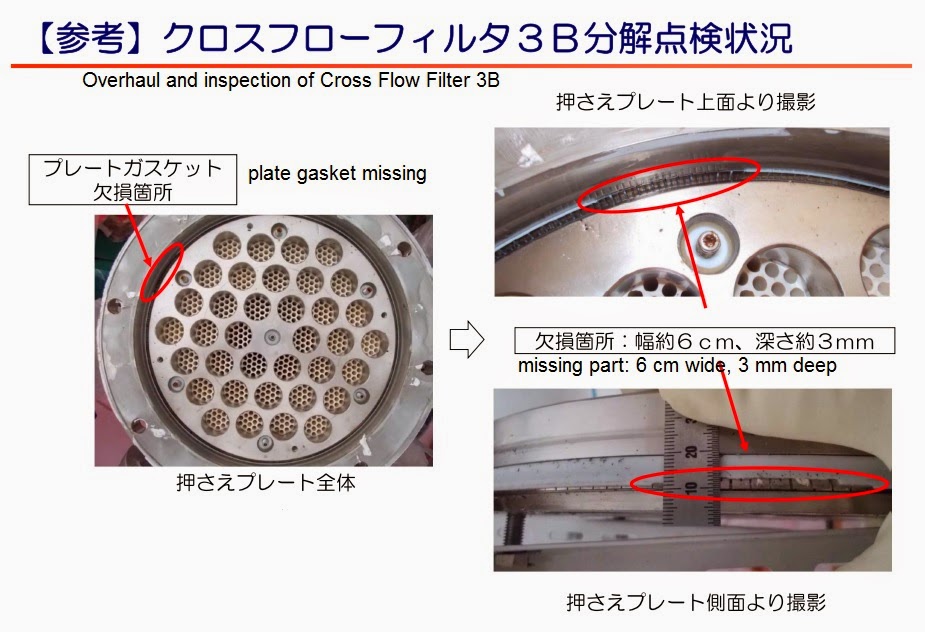
The cause, if it is the same as Line A which stopped three days ago after the water sample was found with high calcium content, is likely to be the defective cross flow filter, like this one on Line B (from TEPCO's Roadmap update page 24, 4/24/2014) (English labels are by me):


Whether the defective gasket is due to material defect, design defect or irradiation is unknown at this point.

Sunday, May 18, 2014

(OT) "Janjira Nuclear Power Plant" in Japan in "Godzilla" the Movie


Uh... Janjira? In Japan? Not India? The word doesn't mean a thing in Japanese. (Not to mention most Japanese cannot even pronounce "r"...)

That aside, my attention was drawn to minor details, as usual, in the trailers for the summer-blockbuster-in-the-making "Godzilla", which opened this weekend in the US grossing over $93 million, according to The Hollywood Reporter.

From Godzilla Official Movie Site, screen shots from "Extended Look" trailer:

"Janjira Nuclear Power Plant" in a town at the foot of Mt. Fuji. The town is supposed to be near Tokyo, even if it is this close to Mt. Fuji. A stereotypical nuclear power plant you see often in the US (but none in Japan) with vigorous steam rising from the cooling towers, like the one you see in "The Simpsons" or Three Mile Island NPP.


The plant seems to sit right in the middle of town. Why a nuclear power plant needs so many smoke stacks of different heights is a mystery to me. But take a look at the house in the foreground. Very interesting roof line, with fin-like structures like in a Buddhist temple in Thailand. The sky is blue, with "The Simpsons"-like puffy clouds, but there are two people walking by with umbrellas. The concrete walkway looks wet.


The plant crumbling like the World Trade Center building after an earthquake (which was in fact caused by a monster):


A closer shot:


But it was only a 6.3 earthquake (from Asia Trailer):


Godzilla's foe this time is a huge ancient creature who feeds on radiation, a "MUTO (or Massive Unidentified Terrestrial Organism)", according to the wiki entry of the movie.

Nice, sarcastic touch, intended or not. Muto is the surname of the vice president of TEPCO when the Fukushima I Nuclear Power Plant accident started on March 11, 2011. Mr. Muto gave daily and nightly press briefings in a small room at TEPCO's headquarters in Tokyo in the first week of the accident.

The impression I got from these trailers is that the movie is way too serious for the loose details. But who cares about details (except me)?

My favorite Godzilla movie remains "Mothra vs Godzilla" (Godzilla was a bad guy). Wonderful loose details galore.

Public Referendum in Bern, Switzerland Rejects Immediate Shut-Down of Mühleberg Nuclear Power Plant by Wide Margin


According to Jiji Tsushin (5/19/2014),

スイスの首都ベルン近郊にあるミューレベルク原発の即時運転停止を問う住民投票が18日、中部ベルン州で行われ、賛成36.7%、反対63.3%で否決された。同原発は2019年の廃止が決まっているが、東京電力福島第1原発事故の恐ろしさを実感した住民が発議した。投票率は51.6%。

A public referendum was carried out in the canton of Bern on May 18 to decide whether to shut down Mühleberg Nuclear Power Plant near the Swiss capital Bern. The measure was defeated, with 36.7% in favor and 63.7% against. Muehleberg Nuclear Power Plant is slated to be shut down in 2019, but residents proposed the measure after the Fukushima I Nuclear Power Plant accident. The turnout was 51.6%.


Muehleberg NPP has been found to have multiple cracks in the core shroud. See my post in March 2012.

40% of Switzerland's electricity comes from nuclear power, and 60% comes from hydroelectricity.

Saturday, May 17, 2014

US Department of Energy Releases Update on Radiation Leak at Waste Isolation Pilot Plant (WIPP) in New Mexico, Container with Broken Lid Identified


(UPDATE 5/20/2014) Possible culprit: kitty litter. See my new post.

-------------------------------

And it was a container from Los Alamos National Laboratory (LANL).

The first report of radiation leak (plutonium) from the Waste Isolation Pilot Plant (WIPP) that necessitated the evacuation of workers and plant shutdown was in February this year.

From Department of Energy WIPP Update (5/16/2014):

New Information Provided About Possible Contributor to the WIPP Radiological Event

The Department of Energy issued the following statement today regarding new information generated during the May 15 entry into WIPP:

Since the February 14 radiological release, the Department and its Waste Isolation Pilot Plant have been working deliberately to safely determine the cause of the release. The team that entered the underground facility yesterday was able to get additional visual evidence that shows a damaged waste container, identified as one from Los Alamos National Laboratory.

In the new pictures, the LANL container has a cracked lid and shows evidence of heat damage. Workers will continue investigating to determine what caused the container breach and if any other containers were involved or damaged,” said a DOE spokesperson.

Community Meetings Scheduled

May 20 – A WIPP Recovery update will be provided at the Economic Development Corporation of Lea County Annual Meeting. The update, which will be provided by a member of the NWP Communications team, is scheduled for 11:30 a.m. Location: Hobbs Country Club, 5001 W. Carlsbad Highway.

May 22– The City of Carlsbad and DOE will co-host its weekly meeting featuring updates on WIPP recovery activities. The meeting is scheduled today at 5:30 p.m. Location: Carlsbad City Council Chambers, 101 N. Halagueno Street. Live streaming of the weekly meetings can be seen at http://new.livestream.com/rrv/.

"Evidence of Damaged Drum in Panel 7, Room 7" from DOE WIPP "Photo and Video" section (more photos at the link):


"The May 15 entry into Panel 7, Room 7 produced this photo of a waste container (left) with its lid unsealed and apparent heat discoloration."


There is a video of re-entry to WIPP on May 15, 2014.

According to Japan's NHK reporting on the DOE update, it may take at least three years before the facility resumes operation.

Thursday, May 15, 2014

(OT) Head and Shoulders Topping Pattern in Japan's Nikkei Weekly Chart?


Uh oh... Is about the only "success" story of so-called "Abenomics", Nikkei Stock Index, in danger of collapsing?

If this "head and shoulders" topping pattern (10 months in the making) plays out, the target seems somewhere below 11,500. There is not much of a support until 10,200 or so.

I'm sure Bank of Japan's Governor Haruhiko "wages are rising even as they are falling for 22 months" Kuroda will do whatever it takes to prop up the market.

Or in this new normal world, the topping pattern is actually bullish, signaling the central bank's intervention and sending the stock market even higher.


US Ambassador to Japan Visits #Fukushima I NPP with Her Son, Praises Workers for Dedication and Determination


From TEPCO's Photos and Videos Library (English), 5/14/2014:

On the operating floor of Reactor 4, overlooking the Spent Fuel Pool. From the left, Chief Decommissioning Officer Masuda, Ambassador Caroline Kennedy, TEPCO's CEO and President Hirose:


Ambassador Kennedy speaking with a female TEPCO employee in the Anti-Seismic Building:

So it is true that TEPCO now has female workers working at the plant...

UK's Daily Mail (5/14/2014) has a short video clip of Kennedy speaking to the press, with her son Jack:

"...very grateful for the chance to see. It is hard to visualize and understand the complexity of the challenge when you just read about it. So this was a very informative visit, and I'm very grateful to all those who are working here every day and those who showed us around."

"We stand ready to help in any way we can, going forward."


Ambassador Kennedy's statement, from the press release by the US Embassy in Tokyo:

PRESS RELEASE

米国大使館 報道室 PRESS OFFICE, U.S. EMBASSY, TOKYO
japan.usembassy.gov

14-13R May 14, 2014

Ambassador Caroline Kennedy Statement
on Visit to the Fukushima Daiichi Nuclear Power Plant

Earlier today, I visited the Fukushima Dai-ichi Nuclear Power Station. I am grateful to the Tokyo Electric
Power Company and relevant Japanese government authorities for making this visit possible.

I was struck that more than three years after the tragic events of March 11, 2011, the destructive force of the
Great East Japan Earthquake and the resulting tsunami are still visible. TEPCO and Japan face a daunting task
in the cleanup and decommissioning of Fukushima Dai-ichi. Decommissioning will take years of careful
planning and arduous work, under difficult conditions. Today, I was able to see firsthand these challenges, and
I gained new appreciation for the dedication and determination of the workers at the Fukushima site.

Immediately following the Fukushima Dai-ichi accident, the United States—through the Department of Energy,
the Nuclear Regulatory Commission, and other agencies—began supporting the Government of Japan and
TEPCO in response efforts, decommissioning, and cleanup activities. We are committed to providing support
as long as it is necessary. At Fukushima Dai-ichi, I saw examples of the assistance we provided, as well as the
continuing partnerships between TEPCO, U.S. Government agencies, U.S. national laboratories, and U.S.
companies. The United States Government will offer our experience and capabilities, in particular, toward the
near term resolution of ongoing water contamination issues. We welcome Japan’s steps toward ratification of
the Convention on Supplementary Compensation for Nuclear Damage which will make it easier for American
and other international firms to add their expertise to Fukushima cleanup and decommissioning efforts.

Tomorrow, I will have an opportunity to visit a wind turbine and a power substation in the Fukushima Floating
Wind Farm Demonstration Project. This project is one of the symbols of the Tohoku region’s recovery from
the Great East Japan Earthquake. It is one of many examples of how the Japanese people have realized new
opportunities, even in the midst of great tragedy. Such projects are creating new employment and industries,
as well as potential trade opportunities. The United States looks forward to continuing a strong cooperative
relationship with Japan in the energy security and clean energy arenas, in addition to our ongoing assistance in
the Fukushima region.

Saturday, May 10, 2014

#Fukushima I NPP Reactor 3 Spent Fuel Pool Debris Removal Update: Fuel Handling Machine Set for Removal

Just as the start of fuel assembly removal from Reactor 4's Spent Fuel Pool was anticlimactic, so is the removal of debris from Reactor 3's Spent Fuel Pool. No one reports it (not even the independent journalists these days), and TEPCO does not publicize.

According to the progress report inside the updated Roadmap (4/24/2014; from page 222 to page 233), since December 17, 2013, TEPCO has so far removed from the Reactor 3 Spent Fuel Pool:


(from Page 224)

  • 322 reinforcing bars (out of 330 total)

  • 55 deck plates (out of 65)

  • 6 roof trusses (out of 9)

  • 1 Fuel Handling Machine mast (out of 1)


Having removed debris that was in the way of removing Fuel Handling Machine, TEPCO (and the main contractor Kajima) is now removing the Fuel Handling Machine itself, which weighs about 35 tonnes.

(from Page 225)

Photo (clearly composite) of Reactor 3 SFP as of March 11, 2014, top arrow showing one of the roof trusses, bottom arrow showing the Fuel Handling Machine mast (1.6 tonne) (click to enlarge):


Removal of the roof truss on March 28, 2014:


Removal of the FHM mast on March 27, 2014:


According to TEPCO's progress report, they are removing the debris that is in the way of removing the FHM, such as the main hoist pulley (which was removed on April 16, 2014), hoist frame, trolley frame, walkway, bridge, etc.

(From Pages 228, 229):


After several hiccups (such as dropping the debris into the pool in February 2013 when they braved the heavy snow - low visibility - to do the catch-up work of debris removal, or dropping the camera into the pool in November 2013), so far so good, without major incident, since the debris removal from the Spent Fuel Pool itself started in December 2013.

There has to be the videos of the debris removal from Reactor 3's SFP, but they are not posted at TEPCO's website for public view. From the description of the work, though, the videos would be extremely boring, with the slow (probably excruciatingly so) and deliberate remote-controlled heavy equipment taking eternity to grab one piece of debris.

All my posts about Reactor 3 are here.

Video of #Fukushima I NPP Seen from Ocean, 1.5 Kilometer Away


People at Umi-Labo ("sea laboratory") in Iwaki City, a non-profit citizens' group, went near TEPCO's Hirono Thermal Power Plant, Fukushima II (Daini) Nuclear Power Plant, and Fukushima I (Daiichi) Nuclear Power Plant for the second time on April 27, 2014 on a fishing boat that had survived the March 11, 2011 tsunami. They came as close as 1.5 kilometer from Fukushima I Nuclear Power Plant.

Apparently, there is no restriction that prohibits anyone from going near Fukushima I Nuclear Power Plant by boat. So far, I only know of this group that has done that. No research institute nor nuclear expert (other than IAEA) has bothered.

According to Mainichi Shinbun (5/7/2014) reporting the trip:

  • The air radiation level on the boat at 1.5 kilometer from Fukushima I NPP was 0.05 microsievert/hour, surprisingly low, due to the shielding effect of water (ocean).

  • The ocean soil sample taken at Fukushima I NPP contained 417 Bq/Kg of radioactive cesium, whereas the ocean soil sample taken off Iwaki City had 287 Bq/Kg.


In the Mainichi article, the captain of the fishing boat says, "Isn't it amazing, how small Fukushima I NPP looks from the ocean? And this small plant is troubling the world." He had saved his boat by riding the tsunami waves on March 11, 2011.

Wednesday, May 7, 2014

#Fukushima I NPP: 53% of Fuel Assemblies in Reactor 4 Spent Fuel Pool Have Been Removed So Far


As of May 7, 2014, 814 fuel assemblies (22 new (unused) assemblies, 792 used fuel assemblies) out of the total 1533 in the Reactor 4 Spent Fuel Pool have been successfully removed.

Removal of the fuel assemblies in Reactor 4's SFP started on November 18, 2013. At this pace, it will be completed sometime in November this year, as scheduled.

From TEPCO's English page on Reactor 4's SFP fuel assembly removal (which has been updated finally, to my surprise):


This job seems to be about the only one job at Fukushima I Nuclear Power Plant these days that is carried out without a major glitch or accident, though with a significant radiation exposure to the workers who manipulate the Fuel Handling Machine on the platform above the pool to remove the fuel assemblies. The bulk of radiation comes not from radioactive cesium but cobalt-60 in the water, according to Nuclear Regulation Authority.

Sunday, May 4, 2014

International Nuclear Cooperation: Japan's Monju Reactor to Help France's Astrid, UK's Sellafield to Help Japan's TEPCO


As Japan's Prime Minister Abe tours Europe, he is securing the cooperation from Europe's largest nuclear nations that he hopes (I think) will enhance the status of Japan as a major nuclear nation and secure the nuclear future for Japan.

With France, Mr. Abe is offering Japan's Monju fast breeder reactor to conduct tests for the Astrid.

What's the Astrid? From the wiki entry for Generation IV reactors:

The European Sustainable Nuclear Industrial Initiative is funding three Generation IV reactor systems, one of which is a sodium-cooled fast reactor, called ASTRID, Advanced Sodium Technical Reactor for Industrial Demonstration, Areva, CEA and EDF are leading the design with British collaboration.[13][14] Astrid will be rated about 600 MWe and is expected to be built in France, with construction slated to begin in 2017 near to the Phénix reactor.[9]


Mr. Abe is eager to justify Japan's fuel cycle policy, and he wants to make nuclear technology and military weaponry as two of the major exports from Japan for which his government wants to become the top salesman.

From Nikkei Asia (4/30/2014; emphasis is mine):

Japan, France to work together on next-generation reactors

TOKYO -- The Japanese and French governments are working toward an agreement to cooperate in the development of fast reactors, a technology designed to reduce nuclear waste.

Prime Minister Shinzo Abe and President Francois Hollande will likely affirm the partnership in Paris on May 5. The agreement would build on an earlier comprehensive partnership formed last June in the field of nuclear energy.

Fast neutron reactors convert spent fuel, which remains radioactive for tens of thousands of years, into materials that emit radiation for just a few hundred years, thus helping to reduce overall nuclear waste.

When put into practical operation, such a reactor would generate electricity and cut down on nuclear waste at the same time.

France is developing the Astrid (Advanced Sodium Technological Reactor for Industrial Demonstration), which it plans to start operating around 2025, but it lacks sufficient reactors to conduct tests. Japan will offer up its Monju prototype fast breeder reactor, which has been idle due to safety concerns, for the tests.


Good luck France. Workers, engineers, and scientists at Monju say they are not comfortable working there, unsure about safety.

Then, TEPCO has announced that they will closely collaborate with the UK's Sellafield Ltd. whose expertise in decommissioning a troubled reactor could benefit TEPCO in decommissioning Fukushima I Nuclear Power Plant.

The Windscale accident was an INES Level 5 accident.

From TEPCO's presentation in English (5/2/2014):

Overview

Tokyo Electric Power Company (TEPCO) considers it would be beneficial to share expertise with overseas operators which have similar decommissioning experience, to decommission Fukushima Daiichi Nuclear Power Station.

TEPCO has agreed with Sellafield Ltd. on exchanging information relating to the management and technology of decommissioning, towards a safer and stable decontamination and decommissioning at Fukushima Daiichi Nuclear Power Station. Sellafield Ltd. is a company in UK which has engaged in the decommissioning of a reactor and radioactive waste facilities. On ahead of the formal information exchanging agreement, the two companies signed a cooperation statement, which clarifies the objectives and significance of the agreement.

Content of the Statement (Objectives and significance of the information exchanging agreement)

Overview of the objectives

  • Sharing expertise, experience and technology in radioactive waste management, clean up and decommissioning:

  • Visits in both directions (Fukushima Daiichi NPS, Sellafield) by representatives from both organisations, sharing of information / reports and similar exercises

  • Contributing to achieving the goals for both sites by learning from the similar challenges

  • Continuously assessing the effectiveness of cooperation


Overview of the significance

  • Proper visibility of the suppliers’ contribution

  • Strengthening of the links between our businesses and wider, civil society

  • Positive support of the UK Nuclear Decommissioning Authority (NDA) etc.


About technologies/knowledge of Sellafield Ltd.

  • Sellafield is working with the decommissioning of the Windscale nuclear reactor, which suffered radiation leak (INES-5).

  • It deals with the decommissioning and risk-reducing measurements fo the other facilities with high risk of radiation leakage

  • It has an experience of dealing contaminated water leak to the ground


It is clear from the comment by Mr. Naohiro Masuda, Chief Decommissioning Officer of a new TEPCO company called Fukushima Daiichi D&D Engineering Company, that this deal was brokered by the Japanese government and the UK government, regardless of whether TEPCO wanted it or not.

Mr. Masuda was the plant manager of Fukushima II (Daini) Nuclear Power Plant, which came very close to core melt after the loss of power after the earthquake on March 11, 2011. What the workers did under his leadership and why the core melt did not happen at Fukushima II would be worth recalling.

(OT) Bank of Japan's Governor Says Wages in Japan Are Rising


Uh... rising?

In this post-Lehman "New Normal" world, particularly in the so-called developed nations of the US, Japan and EU, 22 straight months of wage decline must mean wages are rising.

Governor Haruhiko Kuroda of Bank of Japan had an exclusive interview with the US's financial news channel CNBC while attending the Asian Development Bank meeting in Kazakhstan.

From the video in the CNBC article (5/4/2014):

Kuroda starts out by declaring that economists have been consistently wrong about Japan in the past twelve months because they have failed to predict the inflation that is actually happening.

Then, at about 1:23,

Susan Li, CNBC: Wages have been down for 22 straight months, and it's not keeping up with the inflation ...

Kuroda: (cutting the interviewer off) But that, that is not true. Actually, wages have started to rise. We expect uh nominal wages uh continue to rise, coupled with improving employment situation, means that employer's (sic) income would increase by about 3%.

I am sure Mr. Kuroda meant "employee". For sure, Japan's employers, particularly large multinationals, are raking in huge revenues, partly thanks to cheapened yen.

Then Kuroda prattles on about employment situation, and Ms. Li drops the topic of wages completely.

So are wages in Japan rising, or falling, in the reality-based world?

22 straight months of decline, from Zero Hedge (4/29/2014):

"monthly wages excluding overtime and bonus payments fell 0.4 percent in March from a year earlier (the biggest drop in 2014), a series of declines which has now stretched to 22 consecutive months."

Reading Japan's Nikkei Shinbun (4/30/2014), you wouldn't know that unless you pay attention to detail. Governor Kuroda wants you to focus on the positive message of "wage increase". Clearly, the "wages" Mr. Kuroda is talking about are wages including overtime pay and bonus:

3月の給与総額、3カ月ぶり増加 残業代増える

Total wages in March increased for the first time in three months, overtime pay increased

厚生労働省が30日まとめた3月の毎月勤労統計調査(速報)によると、残業代を含む給与総額の平均は27万6740円と前年同月に比べて0.7%増えた。増加は3カ月ぶりで、伸び率は2年ぶりの大きさ。消費増税前の駆け込み需要で残業代が増えたため。一方、基本給にあたる所定内給与は0.4%減の24万656円と22カ月連続で前年を下回った。

According to the monthly labor statistics (preliminary) announced by Ministry of Health, Welfare and Labor on April 30, the average total wages including overtime increased by 0.7% in March compared to a year ago to 276,740 yen [US$2760] . It was the first increase in three months, and the rate of increase was the biggest in two years. The increase was due to the increase in overtime pay, to meet the last-minute demand [for goods and services] before the sales tax increase [on April 1, 2014]. On the other hand, fixed wages, or base wages dropped by 0.4% to 240,656 yen [US$2400], decline of 22 consecutive months.

As far as I know, when comparing wages over time or across different regions/countries, you don't include overtime pay, benefits, or one-time pay like bonuses. But that's not Kuroda BOJ, apparently.

Pick the data that justifies your position, conviction or belief, even if you can't objectively compare that data with anything else. That seems totally normal in post-Obokata Japan. (Maybe Ms. Obokata should have been an economist or a banker, like Mr. Kuroda. Or politician, like Mr. Shinzo "contaminated water at Fukushima I NPP totally controlled" Abe.)

Thursday, May 1, 2014

(OT) "Ultra" Mokugyo


Saw the picture on a tweet just now...

Mokugyo (木魚) is a wooden percussion instrument used in Buddhist rituals.


"Nice sound," the tweet says.

US 1Q GDP Growth Would Have Been Negative (-1%) Without Obamacare Spending and Heating


If you listen to NPR, you wouldn't know that.

And never mind that Obamacare simply "takes money out of one person’s pocket and transfers it to another person’s, potentially crimping the spending of the person or company bearing the higher cost burden".

And never mind that it's very hard to find doctors who do take Obamacare insurance...

From Wall Street Journal (4/30/2014; emphasis is mine):

Health Care, Heating Prevent First-Quarter Contraction in U.S. GDP

The U.S. economy might have shrunk in the first quarter if not for the Affordable Care Act and spending to keep out the cold.

U.S. gross domestic product expanded a paltry 0.1% in the first three months of the year, dragged down by falling inventories and weaker exports. Spending on housing and utilities, meanwhile, contributed 0.73 percentage point to the change in GDP while spending on health care added a hefty 1.1 percentage points, the highest figure on record.

If health-care spending had been unchanged, the headline GDP growth number would have been -1.0%,” said Ian Shepherdson, chief economist at Pantheon Macroeconomics.

Outlays on utilities are clearly a double-edged sword. First, the severe winter weather chilled activity in other areas of the economy. Second, households have limited budgets and might well have spent money buying other goods or services had they not been forced to boost their thermostats.

“Looking ahead, we expect consumption growth to remain stronger than in 2013, but we expect the contribution from goods consumption to rise and the temporary support from utilities and health care to gradually wane,” said Michael Gapen, an economist at Barclays Capital.

The strong increase in health-care spending reflects that Americans — some of whom are newly insured — are visiting doctors and purchasing more medical products, said Jason Furman, chairman of the White House’s Council of Economic Advisers.

Prices for health-care services rose more slowly than overall inflation in the first quarter, compared to a year earlier. That indicates utilization — not price gains — is driving the increased spending, he said.

“People who didn’t have insurance before can now go to the hospital and the doctor,” Mr. Furman said in an interview. “That’s good for the economy.”

The spending figure includes amounts spent on purchasing insurance as well as drugs, exams and other care.

The Affordable Care Act required most Americans to carry health coverage, expanded eligibility for Medicaid and created new health-insurance exchanges offering subsidized policies for many. Enrollment for private health insurance through federal and state exchanges has swelled to about 8 million, the White House said.

So far this year, that has increased incomes and encouraged more spending on health-care services. (The Commerce Department cautions that its figures may be heavily revised. Its latest estimate is based on Medicaid benefits and ACA insurance exchange enrollments; more complete information is expected before the final first-quarter GDP release on June 25.)

Clearly, though, the vast pool of Americans with new access to health care have been visiting doctors and hospitals in rising numbers. “That pent-up/hidden demand for healthcare was huge,” Mr. Shepherdson said. “Next question: How long will it last?”

The White House’s Mr. Furman said the Affordable Care Act should provide a “tailwind” to the economy for “the next year or two,” as more Americans gain health coverage.

The deadline to enroll in exchanges was March 31. Though it’s been extended for individuals who had trouble completing applications, some economists say the economic impact of the health-care law may well fade—at least until the next enrollment period.

The law could have negative consequences as well. The Congressional Budget Office said in February the law would reduce the total number of hours Americans work by the equivalent of 2.3 million full-time jobs in 2021.

Another factor to consider: The Affordable Care Act, like all government spending, is funded either via taxes or borrowing. So it takes money out of one person’s pocket and transfers it to another person’s, potentially crimping the spending of the person or company bearing the higher cost burden.

Finally, one main goal of the law is to help contain health-care costs over the long term, allowing more resources to flow to other sectors of the economy. Much more data — and time — is needed to see if it’s successful on that front.

Oregon State University Researchers on Albacore Tuna off Oregon: "you would have to consume more than 700,000 pounds of the fish" to match annual natural background radiation


Probably not what many people want to hear, who have been busy petitioning their local governments on the US west coast about the danger of "high levels" of Fukushima radiation.

According to the press release by Oregon State University, the researchers at Oregon State University and National Oceanic and Atmospheric Administration (NOAA) tested Pacific albacore tuna caught off the coast of Oregon between 2008 and 2012 and compared radioactive cesium levels, the first study to compare "before and after". The study is also the first to compare different parts of the fish.

The study seems to be the continuation of the study they published on October 2012.

The result was that the amount of radioactive cesium in post-Fukushima fish was triple that of pre-Fukushima fish, "at the most extreme level".

From the paper's abstract, here are the numbers, in MILLIBECQUEREL/Kg (millibecquerel=1/1000 of 1 becquerel) in WET WEIGHT:

  • Cesium-134: 18.2–356 mBq/kg of wet weight

  • Cesium-137: 234–824 mBq/kg of wet weight

Expressed in more familiar Bq/kg,
  • Cesium-134: 0.0182 - 0.356 Bq/kg

  • Cesium-137: 0.234 - 0.824 Bq/kg


An unexpected side benefit of studying these fish was, according to the researchers, to better understand the albacore tuna migration, using radioactive cesium from Fukushima as a trace.

The press release by Oregon State University (4/28/2014; emphasis is mine):

Study finds only trace levels of radiation from Fukushima in albacore
04/28/2014

CORVALLIS, Ore. – Albacore tuna caught off the Oregon shore after the Fukushima Daiichi power station in Japan was destroyed in a 2011 earthquake had slightly elevated levels of radioactivity but the increase has been minute, according to a newly published study.

In fact, you would have to consume more than 700,000 pounds of the fish with the highest radioactive level – just to match the amount of radiation the average person is annually exposed to in everyday life through cosmic rays, the air, the ground, X-rays and other sources, the authors say.

Results of the study are being published in the journal Environmental Science and Technology.

You can’t say there is absolutely zero risk because any radiation is assumed to carry at least some small risk,” said Delvan Neville, a graduate research assistant in the Department of Nuclear Engineering and Radiation Health Physics at Oregon State University and lead author on the study. “But these trace levels are too small to be a realistic concern.

“A year of eating albacore with these cesium traces is about the same dose of radiation as you get from spending 23 seconds in a stuffy basement from radon gas, or sleeping next to your spouse for 40 nights from the natural potassium-40 in their body,” he added. “It’s just not much at all.”

In their study, the researchers examined a total of 26 Pacific albacore caught off the coast between 2008 and 2012 to give them a comparison between pre-Fuskushima and post-Fukushima radiation levels. They discovered that levels of specific radioactive isotopes did increase, but at the most extreme level, they only tripled – a measurement that is only 0.1 percent of the radiocesium level set by the U.S. Food and Drug Administration for concern and intervention.

The researchers tested samples of the albacore from their loins, carcass and guts and found varying levels – all barely detectable. The findings are still important, however, since this is one of the first studies to look at different parts of the fish.

The loins, or muscle, is what people eat and the bioaccumulation was about the same there as in the carcass,” said Jason Phillips, a research associate in OSU’s College of Earth, Ocean, and Atmospheric Sciences and co-author on the study.

The researchers next began looking at the radionuclide levels in different aged fish and found they were somewhat higher in 4-year-old albacore than in the younger fish. This suggests that the 3-year-old albacore may have only made one trans-Pacific migration, whereas the 4-year-old fish may have migrated through the Fukushima plume twice.

The majority of the 3-year-old fish had no traces of Fukushima at all.

Although it is possible that additional exposures to the plume could further increase radiation levels in the albacore, it would still be at a low level, the researchers pointed out. Additionally, as albacore mature at around age 5, they stop migrating long distances and move south to subtropical waters in the Central and West Pacific – and do not return to the West Coast of the United States.

The presence of these radioactive isotopes is actually helping us in an odd way – giving us information that will allow us to estimate how albacore tuna migrate between our West Coast and Japan,” Neville said.

Little is known about the migration patterns of young albacore before they enter the U.S. fishery at about three years of age, Phillips said.

“That’s kind of surprising, considering what a valuable food source they are,” Phillips said. “Fukushima provides the only known source for a specific isotope that shows up in the albacore, so it gives us an unexpected fingerprint that allows us to learn more about the migration.”

Other authors were Richard Brodeur of NOAA’s Northwest Fisheries Science Center, and Kathryn Higley, of the OSU Department of Nuclear Engineering and Radiation Health Physics. The study was supported by Oregon State University and the National Oceanic and Atmospheric Administration, with continued support from Oregon Sea Grant.


The abstract of the paper "Trace Levels of Fukushima Disaster Radionuclides in East Pacific Albacore" (emphasis is mine):

The Fukushima Daiichi power station released several radionuclides into the Pacific following the March 2011 earthquake and tsunami. A total of 26 Pacific albacore (Thunnus alalunga) caught off the Pacific Northwest U.S. coast between 2008 and 2012 were analyzed for 137Cs and Fukushima-attributed 134Cs. Both 2011 (2 of 2) and several 2012 (10 of 17) edible tissue samples exhibited increased activity concentrations of 137Cs (234–824 mBq/kg of wet weight) and 134Cs (18.2–356 mBq/kg of wet weight). The remaining 2012 samples and all pre-Fukushima (2008–2009) samples possessed lower 137Cs activity concentrations (103–272 mBq/kg of wet weight) with no detectable 134Cs activity. Age, as indicated by fork length, was a strong predictor for both the presence and concentration of 134Cs (p < 0.001). Notably, many migration-aged fish did not exhibit any 134Cs, suggesting that they had not recently migrated near Japan. None of the tested samples would represent a significant change in annual radiation dose if consumed by humans.


Researchers at Stanford University and Stony Brook University published the study on Pacific bluefin tuna in June 2013, which revealed radiation exposure from natural radioactive potassium and polonium (alpha nuclide) is significantly greater than exposure from Fukushima-derived radioactive cesium.

Tuesday, April 29, 2014

'Cui Bono' Over Ukraine: Monsanto Setting Up GMO Seed Corn Business in Ukraine


US President Obama sure works hard for biggest multinationals, as can be inferred from his recent sushi dinner with Japan's prime minister.

And Monsanto? His food safety 'czar', of all people, is a former Monsanto Vice President. Monsanto was also the winner of 27th Annual World Food Prize by the US State Department in 2013.

Several articles on GMO corn in Ukraine below, from the time the US was showing renewed interest in the domestic affairs in Ukraine, with Republican Senator John McCain greeting the head of one of the neo-Nazi groups and US Assistant Secretary of State Nuland handing out cookies to Kiev protesters in December 2013:

From Interfax Ukraine (11/5/2013; emphasis is mine):

Large Ukrainian agricultural associations have prepared draft amendments to the law on the state biosecurity system in creating, testing, transportation and use of genetically modified organisms (GMO) regarding the legalization of genetically modified seeds.

President of the Ukrainian Grain Association (UGA) Volodymyr Klymenko said at a press conference at Interfax-Ukraine that the relevant appeal to the president, the head of the Verkhovna Rada and the heads of parliamentary factions was signed by six agricultural associations.

"We could mull over this issue for a long time, but we, jointly with the associations, have signed two letters to change the law on biosecurity, in which we propose the legalization of the use of GM seeds, which had been tested in the United Stated for a long time, for our producers," he said.

According to the UGA president, currently the GM seeds of corn and soybeans are used in the country in spite of the legislative ban. Talking about the use of foreign experience in this field, Klymenko said that "we will never take someone's seeds and will never be able to study them, because this requires decades. Ukraine's way forward in this issue is either to agree or not to."

According to the expert, the United States produces about 75% of corn and 95% soybeans from GM seeds. The European Union banned the cultivation of GM crops, but GM products are imported and used, in particular, in animal breeding, added Klymenko.


From Bloomberg News (1/6/2014; emphasis is mine):

China Rejecting U.S. Corn as First Shipment From Ukraine Arrives

China continued to reject corn cargoes from the U.S. that contained an unapproved genetically modified variety while accepting a first bulk-carrier shipment of the grain from Ukraine.

Genetically modified corn and corn-derived products totaling 601,000 metric tons were rejected in 2013, the official Xinhua News Agency reported today, citing the General Administration of Quality Supervision, Inspection and Quarantine. A Panamax-sized shipment of non-genetically modified corn from Ukraine entered the country on Dec. 6, according to a statement dated Dec. 25 on the website of state-owned China National Complete Engineering Corp.

The quarantine agency’s newest figure cited by Xinhua was 56,000 tons more than it announced on Dec. 19, showing the government’s continued screening of U.S. corn and and dried distillers’ grains, or DDGS, for the unapproved insect resistanr MIR 162 gene. Net corn sales to China from the U.S. in the seven days through Dec. 26 dropped by 116,000 tons from the previous week, according to a report on the website of U.S. Department of Agriculture.

China National Complete Engineering carries out overseas engineering projects, often funded by Chinese government, according to its website. It began to market grain from Ukraine last year under a contract that became effective December 2012, according to the Dec. 25 statement.

China’s Ministry of Agriculture said in May 2012 the country agreed to finance $3 billion worth agriculture projects in Ukraine in exchange for terms including rights to sell Ukrainian farm products.

Ukraine may export 18 million tons of corn in 2013-2014, tying it with Argentina as the third-biggest supplier behind the U.S. and Brazil, the U.S. Department of Agriculture forecast in December.


From CNBC (3/18/2014; part, emphasis is mine):

...Now everything from an unstable currency to tight credit threatens the spring planting season, and the uncertain outlook for the Ukrainian economy is a longer-term threat to the prediction by some of the biggest agricultural companies that a future Ukrainian corn belt will rival the U.S. market.

Ukraine and, to a wider extent, Eastern Europe, are among the most promising growth markets for farm-equipment giant Deere, as well as seed producers Monsanto and DuPont, said Michael Cox, senior analyst and research director at Piper Jaffray. Ukraine's growth is becoming even more important, as it will serve to counterbalance the South American farm markets, where overseas growth has been increasing in places like Argentina and Brazil for these companies.

..."It's the Western corporate farm operators that are pushing these new techniques,'' Cox said. "The U.S. has made this same transition. It took several decades, but that's as the technology was being developed. Since the technology and tools are readily available now, the improvement in yields could progress much faster in Eastern Europe.''

DuPont already has a corn seed production plant in Ukraine. Monsanto is building a $140 million seed plant that isn't open yet. Last week DuPont said in a regulatory filing that first-quarter earnings forecasts would be "challenged'' by the Ukraine crisis, which has caused delays in shipments of corn seed from its plant in Ukraine.


Here's Monsanto's current job openings in Kiev, Ukraine.