Showing posts with label J-PARC. Show all posts

Saturday, May 25, 2013

#Radioactive Leak at J-PARC: Staff Let 100 Billion Becquerels Escape Through Ventilation Fans


(For all posts about J-PARC radiation leak, click here.)

To add further disgrace to what's already there aplenty, the researchers at J-PARC, Japan Proton Accelerator Research Complex, were fully aware that turning on the ventilation fans without any filter would release radioactive materials outside the facility, but did it anyway.

I wondered aloud in the previous post on this accident: Why didn't these particle physicists (supposedly some of the brightest people in Japan) connect the dots and figure out "Radiation level was high, turned on the fans, radiation level dropped, radioactive materials went from inside the facility to outside"?

Well now I know they did know.

From Chunichi Shiinbun Medical Site (5/26/2013; part, link won't last long):

職員たちは、放射線量が通常時の10倍の毎時4マイクロシーベルトまで上がっているのが分かると、施設内の線量を下げるために排気ファンを2度にわたって運転。KEKは「線量がそれほど高くなかった。大気に出ても迷惑はかからないだろうと思った」と説明した。

The staff, on learning the radiation level had risen to 4 microsievert/hour, 10 times the normal, operated the fans twice in order to lower the radiation level inside the facility. KEK [High Energy Accelerator Research Organization] explained, "The radiation level wasn't that high. We figured even if [radioactive materials] leaked into the atmosphere it wouldn't be of much inconvenience to anyone."

ファンは換気用で、放射性物質を吸着するフィルターは取り付けられていない。設備の誤作動も想定しておらず、事故時のマニュアルも用意していなかった。モニタリングポストで線量が上がっているのを確かめたのは、ファンを回して26時間もたった24日午後6時だった。

The fans are for ventilation, and there is no filter installed that would absorb radioactive materials. They didn't expect the malfunction of the equipment, and there was no accident manual. It was 26 hours after they operated the fans, at 6PM on May 24, that they finally confirmed the rise in radiation levels at the monitoring post.

KEKによると、現場では国などに速やかに報告すべきだという声も一部であったが、原子力機構出身の池田裕二郎J-PARCセンター長ら幹部が「通報に該当する事象ではない」と判断。報告遅れにつながった。

According to KEK, some people who were at the facility suggested the incident be reported to authorities including the national government, but the senior management including Yujiro Ikeda, J-PARC president who came from JAEA, decided it was not the event that requires reporting, leading to the delay in reporting.


But wait, there's always more in Japan when it comes to anything radioactive...

To ignore the warning buzzer and restart the experiment without confirming safety, and to expel radioactive materials from inside the facility using unfiltered ventilation fan is exactly what the operation manual at the facility calls for, according to KEK.

Again, from Chunichi Shinbun Medical Site (5/26/2013; part):

実験を実施していた高エネルギー加速器研究機構によると、23日午前11時55分、J-PARC内の原子核素粒子実験設備で金に陽子ビームを当てて素粒子を発生させる実験中、異常を検知して安全装置が作動、警報音が鳴ったため、いったん実験装置を停止した。

According to High Energy Accelerator Research Organization [KEK] who was conducting the experiment at the nuclear and particle physics experiment facility to hit gold with proton beams to generate elementary particles, the safety mechanism detected the abnormality and sounded an alarm at 11:55AM on May 23. The equipment was stopped.

担当者は安全装置作動の原因が分からないまま午後零時8分に警報をリセットし、実験を再開した。その後、施設内で放射線量が上昇し再び運転を停止。午後3時15分ごろ、排気ファンを作動させて施設内の線量が下がったため、また運転を再開していた。

The researcher in charge, without knowing why the safety mechanism tripped, reset the alarm at 12:08PM and resumed the experiment. Later, when the radiation level rose inside the facility, the experiment was stopped again. At about 3:15PM, the experiment resumed as the radiation level dropped after operating the ventilation fans.

高エネ研の担当者は「マニュアルに従った手順だった」と話している。

The person in charge at High Energy Accelerator Research Organization says, "It was the procedure following the manual."


This by-the-book release of radioactive material was 100 billion becquerels in the south-westerly direction, one-hundredths of the annual legal limit of radioactive material release, according to Mainichi Shinbun (5/26/2013) quoting JAEA.

Here's the image of the ventilation fans in question (from Chunichi Shinbun):


There are several Japanese nuclear and particle physicists that are widely followed on Twitter, and some of them were apparently scheduled to conduct their experiments using the facility at J-PARC. To a sheer puzzlement of people with some rational mind left, some of these researchers are being ridiculed and bad-mouthed by Twitter mob just because they are nuclear and particle physicists using J-PARC.

It Was #Radioactive Gold, Mercury, Potassium, and Sodium Leak at J-PARC


(For previous posts on the accident, go here and here.)

Particle physics scientists at J-PARC are trying to show they are not like nuclear scientists (or nuclear plant operators) and released the result of analysis for gamma nuclides using the germanium semiconductor detector on the night of May 23, 2013, the day of the accident.

No mention of tritium, which is beta nuclide.

From the scanned images of the report on paper, published on May 25, 2013:


Hg (mercury) 197: half life 2.706 days
K (potassium) 43: half life 0.9294 day
Au (gold) 198: half life 2.695174 days
Hg (mercury) 195: half life 10.5306 hours
Na (sodium) 24: half life 14.9589 hours

There are numerous spikes indicating other radionuclides. But since it is a scanned image, I can't read the tiny print clearly.

The report also says the external radiation exposure was 0.1 millisievert (max). Almost all radiation exposure for the researchers, therefore, was from internal exposure as they inhaled the air inside the facility without realizing the gold used as target had been partially vaporized and radioactive materials, instead of staying inside the metal, were released in the air.

(English labels are by me)


The accident timeline in the report shows they continued the experiment after the equipment malfunction at 11:55AM, until 4:15PM when they used the survey meter to measure the radiation levels inside the hall. It was between 4 and 6 microsievert/hour, 10 times the normal level.

The ostensible reason for the delay in reporting the accident to authorities was that on May 23 they thought the contamination was only inside the radiation control area. That doesn't quite fly, as they say (in the accident timeline) that the radiation level (gamma) inside the hall dropped when the ventilation fan was used, and rose when they stopped using the fan.

So these particle physics scientists claim they didn't connect the dots at that time, and that they finally decided there had been radioactive materials leak outside the facility when they checked the monitoring post placed outside the facility in the evening of May 24. Another facility inside the J-PARC compound notified the Hadron Facility that their monitoring post showed elevated radiation level on May 23, precisely when the ventilation fan was being used, according to the report.

It looks like a much larger leak than first reported.

J-PARC's Hadron Experimental Facility, from their homepage:

(Here We Go Again...) "Soh-Teh-Gai" (想定外, Beyond Expectation) Events at J-PARC That Possibly Leaked Tritium and Radioactive Gold


What are the "beyond expectation" events at J-PARC in which radioactive materials leaked after they managed to vaporize gold by hitting it with proton beam that was a bit too strong?

They say (according to Jiji Tsushin, 5/25/2013):

  • They didn't even imagine that the equipment could malfunction; and

  • They didn't even imagine that proton beam could be so strong that it vaporized the metal; and therefore,

  • They didn't even imagine that radioactive materials, which in normal situation remain inside the metal, would leak outside the equipment; therefore,

  • The ventilating fan did not have a filter to block the leak of radioactive materials.


NHK's latest news adds more "beyond expectation" events:

  • They did check the surface contamination on May 23, the day of the accident, and it showed the contamination 10 times the normal level. But they didn't even suspect internal radiation exposure, and let the researchers go home;

  • They didn't check the researchers for internal radiation exposure until 4 researchers asked to be tested;

  • They are yet to test 55 others who at the facility.


The highest radiation exposure, of both internal and external radiation, was 2 millisieverts, according to NHK.

NHK also says they noticed there was a leak of radioactive materials when the radiation level in the facility dropped after using the ventilation fan.

(Duh.)

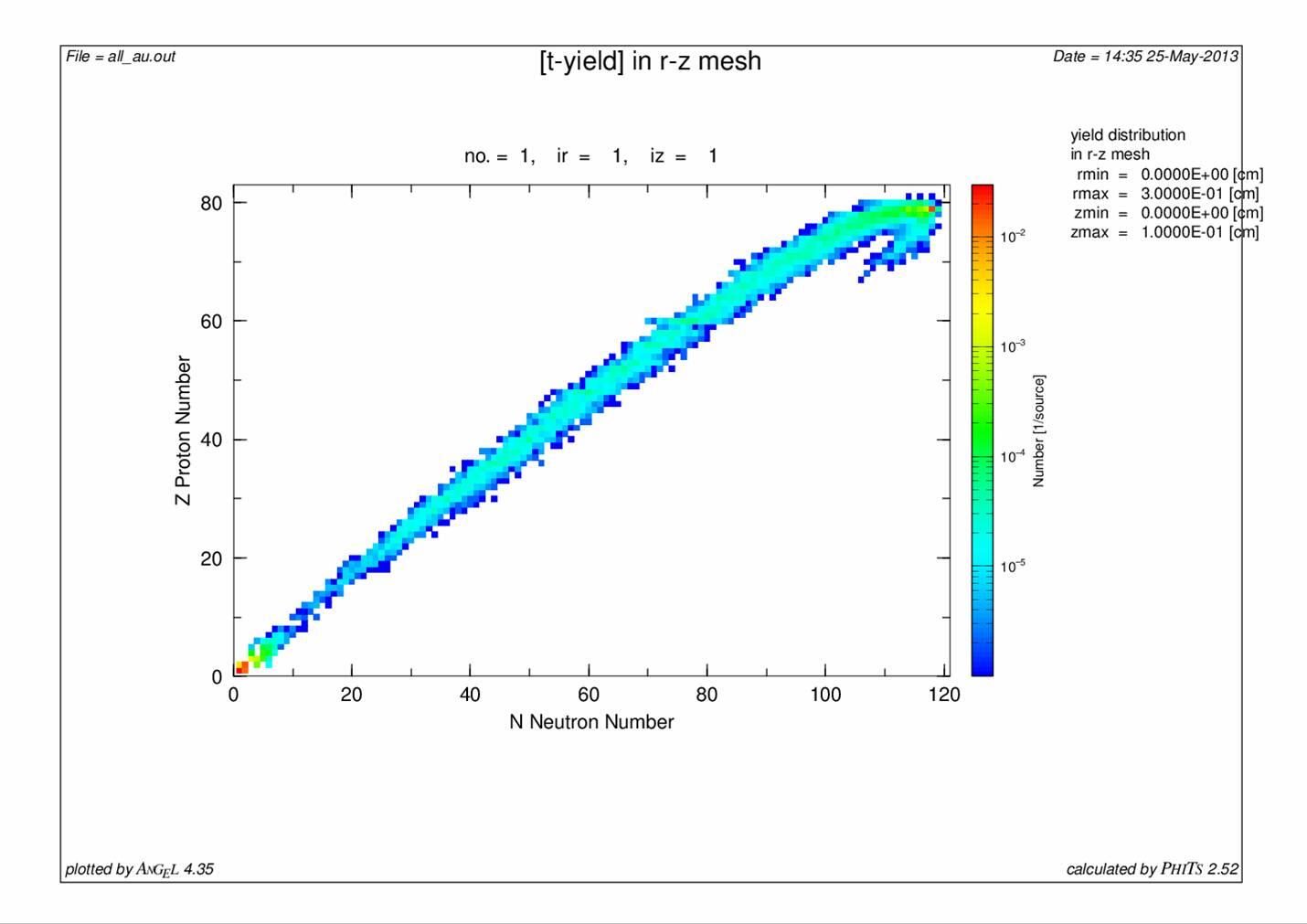
From the tweet of one of the nuclear researchers that I follow (Tomohiro Endo, of Nagoya University), "Calculation of distribution of all nuclides (including stable isotopes and radionuclides) created when 30GeV proton beams hit 1mm-thick gold (30GeVの陽子を1mm厚さの金に当てたときに生成される全核種の分布を計算)":

(Click to enlarge)


He says in another tweet that they are the sum of (1) nuclides created when protons hit gold, and (2) nuclides created when neutrons hit gold.

Most likely radionuclides from the accident are in red and yellow, which he thinks include tritium (proton number 1, neutron number 2) - the orange dot in the lower left corner, and radioactive gold (Au-196), on the left of the orange dot which is stable AU-187 in the upper right corner.

Au-196 has half life of about 6 days. Half life of tritium is about 12 years.

Friday, May 24, 2013

#Radioactive Materials Leak at Japan Proton Accelerator Research Complex (J-PARC) in Ibaraki, Researchers Accidentally Inhaled Radioactive Gold


(UPDATE 2) For the latest, see my posts here and here.

(UPDATE) From Jiji Tsushin (5/25/2013):

施設内の放射線量が上がった際に担当者が換気扇を回し、外部に放射性物質を放出していたことが25日、分かった。許可を出した三浦太一・高エネ研教授は会見で、「通常運転時も半減期の短い放射性物質で線量が上がることがあり、すぐ減衰するとの認識だった。結果として浅はかだった」と謝罪した。

When the radiation level inside the facility rose, the person in charge turned on the ventilating fan and released radioactive materials outside the facility. Professor Taichi Miura at High Energy Accelerator Research Organization, who authorized the ventilation, apologized in the press conference, saying "Radiation level rises even in the normal operation because of radioactive materials with short half life, so we thought they would decay quickly. But it turned out to be imprudent."


================================

Japan Atomic Energy Agency (JAEA), who operates J-PARC, didn't bother to notify the Nuclear Regulatory Agency (secretariat of the Nuclear Regulatory Authority, mostly made of people from NISA) for 2 days, because they did not think there was any leak of radioactive materials.

According to Asahi, the researchers suffer internal radiation of exposure of 1.7 millisievert, and the contamination of the facility is 40 becquerels per square centimeter.

Apparently, the Ibaraki prefectural government was not too happy about the incident and the fact that JAEA didn't bother to notify the authority and the prefectural government, and held an angry press conference at 2AM on May 25.

The official story of the accident, from Asahi Shinbun (5/25/2013, 1:37AM):

原子力機構で放射性物質漏れ 研究者ら4人が内部被曝

Radioactive materials leak at JAEA facility, 4 researchers suffer internal radiation exposure

日本原子力研究開発機構は25日、茨城県東海村のJ―PARCの原子核素粒子実験施設で、放射性物質が施設の外に漏れたと明らかにした。中にいた研究者ら少なくとも4人が内部被曝(ひばく)した。漏洩(ろうえい)は止まっており、拡大の恐れはないという。被曝した4人のうち、最大の被曝量は1・7ミリシーベルトという。原子力機構は外部に漏洩した放射性物質の量を調べている。

Japan Atomic Energy Agency disclosed on May 25 that there was a leak of radioactive materials outside the nuclear and particle research facility at J-PARC in Tokai-mura in Ibaraki Prefecture. At least 4 researchers inside the facility suffered internal radiation exposure. The leak has stopped, and there is no danger of the leak spreading further. The maximum radiation exposure was 1.7 millisievert, according to JAEA. JAEA is currently investigating how much radioactive materials have leaked outside the facility.

原子力機構や原子力規制委員会によると、放射能漏れがあったのは23日午前11時55分ごろ。陽子ビームを金にあて素粒子を発生させる実験をしていた。装置が誤作動を起こして陽子ビームは通常の400倍の出力になり、金が蒸発。放射性物質が漏れて研究者が吸い込んだ。現場には当時、研究者ら約30人がいたという。

According to JAEA and the Nuclear Regulatory Authority, the leak took place at 11:55AM on May 23. They were conducting an experiment of generating elementary particles by hitting gold with proton beam. The equipment malfunctioned, and the output of the proton beam increased to 400 times the normal strength, and gold was vaporized. Radioactive materials [radioactive gold vapor] leaked [from the equipment], and were inhaled by the researchers. There were about 30 researchers when the accident happened.

施設の汚染は最大で1平方センチあたり約40ベクレル。現在、施設内を立ち入り禁止にしている。原子力機構は発生当時、外部への放射能漏れはないと考え、国に報告しなかった。J―PARCは大型の加速器を備えた素粒子などを調べる実験施設。

Contamination of the facility is about 40 becquerels per square centimeter maximum. Currently the facility is off-limit. At the time of the accident, JAEA didn't think there was a leak of radioactive materials, and did not report to the government. J-PARC is a facility to study elementary particles with large accelerators.


Equipment malfunctioned. That's the official story.

Let us now turn to "baseless rumors" among knowledgeable researchers (like this one, from Professor Hayano of Tokyo University) for what may really have happened. According to the unverified rumors, it was not the equipment that malfunctioned. Researchers made a mistake, and instead of hitting the target (gold) with low, continuous proton beam over a long period of time they accidentally hit it with high-intensity proton pulses.

According to NHK quoting the Ibaraki prefectural government, the monitoring post outside the facility showed a slight increase in radiation level between 3PM and 6PM on May 23. The radiation level is normally between 70 to 130 nanogray/hour, but it rose by 10 nanogray/hour on May 23.

Never trust the Japanese with a gigantic facility like a proton accelerator. Or a nuclear reactor. They are not only incapable of operating them properly, but when an accident happens they don't tell you.

(How do you get rid of radioactive gold in the body? Does anyone know?)