Showing posts with label December 2012 election. Show all posts

Monday, December 17, 2012

Japanese Election: LDP Managed to Win 2/3 of Seats Even Though It Only Got 42% of Votes Cast


Or only 25% of all eligible voters (103,959,866 voters)

Before it disappears, from Tokyo Shinbun (12/18/2012; English labels are mine):


Tokyo Shinbun comments in the article:

現在の衆院選挙制度は、小選挙区制と比例代表の並立制を採用している。民意を集約して二大政党制に導く小選挙区制で自民党は、有権者全体に占める得票率の三倍以上の議席を獲得。信じられないような世論との乖離(かいり)が生じた。

The current election system for the Lower House is Small Electoral District Election and Proportional Representation Election. The Small Electoral District Election is aimed at creating a two-party systems by concentrating the votes, and LDP won three times as many seats as the percentage of the votes in the total eligible voters indicates. It is an incredible dissociation from the public opinion.


The Small Electoral District Election elects 300 representatives and the Proportional Representation Election elects 180 representatives. There is only one winner in each Small District.

The Small District system is conductive to giving major, established parties more seats.

It is highly ironic that it was Ichiro Ozawa who successfully pushed for the adoption of the Small District Election format. Thanks to his system, all his followers lost in the Small District Election, who had to fight under the unfamiliar, fluffy party name of Japan Future. Mr. Ozawa, under the tutelage of Kakuei Tanaka, pushed for the electoral reform in order to create the "two-party system" for political stability. It has resulted in a huge swing, instead.

The US has the Small District Election system, but not foolhardy enough to elect all representatives all at once.

Australia Is Celebrating Japan's LDP Win, Sending Share Prices of Uranium Miners Soaring


Australian uranium miners are positive that the reactors in Japan will be back on shortly under the LDP administration, as they are certain that US$100 million a day spent on extra coal, oil and gas is simply unsustainable for Japan. Australia is here to help, they say.

Sydney Morning Herald reports the shares of Paladin soared more than 8% on Monday following the Japanese election results:


(The announcer looks pretty, but her Australian English is scary.)

Also from the paper's article (12/18/2012; emphasis is mine):

Producers bullish on Japanese demand

by Paddy Manning

GLOBAL uranium demand is set to rebound as Japan's nuclear reactors are gradually switched back on by the new Liberal Democratic Party government, elected over the weekend.

Greg Hall, managing director of junior Toro Energy, said Japan had been spending an additional $US100 million a day on extra coal, oil and gas, which represented a ''very, very high cost''.

After the weekend's election, he said the country now had the political will to restart its reactors. A new independent safety authority would be in place by April and Japan's nuclear power capacity would be restored through 2013-15.

Shares in uranium producers Paladin Energy and Rio Tinto's Energy Resources Australia surged on Monday - by 8 per cent and 5 per cent respectively - and the spot price of uranium oxide neared $US44 a pound.

Paladin Energy chief John Borshoff predicted Germany, too, would eventually return to the nuclear power fold. ''Germany can't survive on a no-nuclear basis with all the countries around it pouring electricity into the country. How could Japan survive as an island country?''

Mr Borshoff said it was impossible for Japan to do without 27 per cent of its electricity-generating capacity. ''We've been working on the basis the nuclear programs will resume in some modified form. Germany have set an irreversible path but I believe in eight-10 years they'll be back on the drawing board.''

UBS resources analyst Glyn Lawcock welcomed the Japanese news saying it had been a ''torrid'' 18 months for uranium markets since the closure of the Fukushima Daiichi reactor after last year's Japanese earthquake and tsunami.

Japan shut its fleet of 54 reactors in the wake of the partial meltdown, causing power shortages and a rise in energy prices as coal, oil and gas made up the shortfall.

Spot uranium prices fell from their pre-Fukushima level of about $US65/lb to a low of $US40.80 in November and have recovered somewhat since.

Mr Lawcock said until recently investors had been concerned that Japan, which had deferred some deliveries of uranium as stockpiles rose, would turn around and become a net seller into the world market. Paladin was better placed than ERA to benefit, he said, because three-quarters of its output would be sold at prices linked to a rising spot market.

UBS commodities analyst Tom Price said the Fukushima Daiichi reactor was one of Japan's oldest and slated for closure within two years. ''Fukushima was a genuine tragedy but nuclear is a genuine alternative for baseload power stations to coal, and relatively cheap, once built,'' he said.

The indefinite deferral of BHP Billiton's Olympic Dam expansion, and the re-election of the LDP in Japan, were ''two bull points'' for the uranium price and UBS was forecasting a recovery to $US50/lb in 2013, and $US55/lb in 2014 and a long-term price of $US65/lb, he said.

Toro Energy is expecting a decision this week from federal Environment Minister Tony Burke on its 100 per cent-owned Wiluna uranium mine in Western Australia. Toro shares were unchanged on Monday at 11.5¢.


"Mr Borshoff said it was impossible for Japan to do without 27 per cent of its electricity-generating capacity" ??

Mr. Borshoff clearly isn't aware (or chooses not to be aware) that Japan has been doing without the so-called 27% of electricity-generating capacity ever since March 11, 2011, and all it has suffered was a manufactured threat of rolling blackouts thanks to then-Chief Cabinet Secretary Yukio Edano and NISA's Nishimura.

"UBS commodities analyst Tom Price...'Fukushima was a genuine tragedy but nuclear is a genuine alternative for baseload power stations to coal, and relatively cheap, once built'"??

Nuclear power plants needs electricity from other power plants to operate, not at all suitable for baseload power stations. And for him to say nuclear is cheap once the plant is built, I suppose he is assuming an accident will never happen.

Mr. Greg Hall, managing director of junior Toro Energy talks about the "political will to restart the reactors".

LDP won two-thirds of the seats by getting votes of only 25% of eligible voters (or 42% of votes actually cast). It's hardly a mandate, but yes political will will be there, which has hardly anything to do with what the majority of the citizens want.

Mr. Hall says one thing that greatly distresses me: new independent safety authority will be in place by April. Hmmm. Either he doesn't know about the Nuclear Regulatory Authority that exists already, or the current Nuclear Regulatory Authority will be ditched, as I've been fearing all along.

Sunday, December 16, 2012

Japanese Election: Voter Turnout at 59.32%, Lowest Since World War II, and Pro-Nuke LDP Is Back


(Chart from Yomiuri Shinbun)
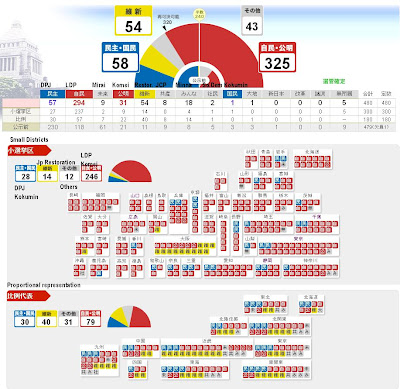

Fantastic (literally) results for flag-waving Liberal (joke) Democratic (joke) Party under the leader whose leadership ability was supposedly proven by fast-eating the pork cutlet on curry & rice and grabbing a train seat from a senior citizen: 294 seats (pre-election 118)

Boy-wonder and Ishihara's Japan Restoration Party which is already talking about working very, very close with LDP: 54 (pre-election 11)

Punishing results for Democratic Party of Japan under the leader who had declared "cold shutdown state" exactly a year prior: 57 seats (pre-election 230)

"Why bothered at all?" results for Japan Future Party under the leader who hid Ichiro Ozawa until very last and who was busy selling her books than campaigning for the candidate who was fighting PM Noda: 9 seats (pre-election 61, mostly Ichiro Ozawa's and Shizuka Kamei's parties)

Noda's gambit to call an election in December did not pay off. He probably underestimated the extent of people's disappointment and probably hatred for his party over the last 3 years, particularly the last 21 months.

While DPJ has been crushed, the guilty party of the Fukushima nuclear disaster all won. Naoto Kan and Banri Kaieda lost in the district election but survived because of the proportional representation part of the election. Yukio Edano, Goshi Hosono, Noda Yoshihiko all won decisively. So did Seiji Maehara.

Noda's Chief Cabinet Secretary Fujimura lost, first time in the election history since 1947. DPJ's "kingmaker" Sengoku also lost. Good riddance. So did Makiko Tanaka, the daughter of Kakuei Tanaka. She apparently lost the support of the backers she inherited from her father, who was a very powerful prime minister of Japan. DPJ couldn't get enough proportional representation votes to have them elected.

Ichiro Ozawa handily won in his district, but his bet on Ms. Kada went very badly for his followers. Ms. Yukiko Miyake, who switched from her own district in Gunma Prefecture to Chiba 4th District to fight PM Noda ended 3rd, out of 4 candidates. Not even close.

Only Ichiro Ozawa and Shizuka Kamei won in the Small District Election, on their own strength, for Ms. Kada's Japan Future Party. Everyone else lost. 7 people won the proportional representation part of the election; none of them was a new candidate under Ms. Kada. Mr. Tetsunari Iida lost both small district and proportional representation, despite his rearranging the proportional representation ranking on the day to submit the document to the election board so that he would be ranked No.1.

Now, Twitter is full of extremely disappointed net citizens busy blaming the generation who get their news from TV and newspaper only and many of whom probably voted for LDP candidates. But from the viewpoints from these people,

  • After suffering 3 years under DPJ, there is no way they want to allow the party to rule;

  • But looking around for alternatives, there's only LDP and Komei that they sort of know and are familiar with;

  • There are people that they've never seen or heard before, from the parties that they never seen or heard before, suddenly coming to their districts and trying to push some fancy-sounding ideas like "graduating from nuke" without details that they can understand.


For them, particularly older people, "Why should we trust these people? They don't even know us, don't know what we need, never worked for us. Now they want our votes?"

But now, the pork-cutlet president of LDP has already declared his first priority is (drum rolls please...):

Change the Constitution.

Why? Because it is his pet project. What does he want to change? Article 9, about Japan renouncing wars. And any reference to "fundamental human rights" Why does he want to do it? Because now he can, he has "the mandate"! But that's a whole another very disturbing and depressing topic later.

I'm seriously worried that the Nuclear Regulatory Authority will be disbanded under the LDP rule, and their scientific, truthful work of examining and recognizing active faults in the nuclear power plants in Japan (in Tsuruga and Higashidori so far) will be nullified.

The only bright spot was Tokyo 8th District, where Taro Yamamoto, though lost to Shintaro Ishihara's ultra-hawkish son who wanted to ban personal radiation survey meters, won more than 72,000 votes despite he had decided to run only one day prior to the start of official election campaign period. He didn't talk about fluffy ideals and future goals, but about children in high-radiation Fukushima, food contamination from radiation, about truly ending the nuclear accident. After the defeat, they are still the specifics he talks about.

Strangely, Japanese Twitter is full of people who accuse Mr. Yamamoto for having run. A lot of Japanese people on the net are screaming the election was rigged. Why? Because the internet polls that they saw all the way up to the election day showed their favorite party Japan Future Party with over 30% (here's one from Reuters, archived).

If Internet polls are correct and true, Ron Paul would be the president of the United States now.

(UPDATED) Japanese Election: 99% of Polling Stations in Gunma Prefecture Will Close As Early As 5PM Instead of 8PM, to Save Money


(UPDATE) See my latest post for election results.

(UPDATE) It turns out that Tottori Prefecture in Chugoku Region closed the polling stations as early as 4PM (Yomiuri Shinbun). The reasons? To alleviate the undue burden on the witnesses at the polling stations (i.e. save money) and start counting sooner (i.e. save money).

ALL polling stations in Fukushima Prefecture close at 6PM, according to Sankei Shinbun. 85% of polling stations in Akita, 64% in Iwate, 57% in Miyagi will also close early. The reasons? To save energy (yes, we have to fight global warming) and to be safe, as winter is cold and dark.

======================================

Huh?

According to Yomiuri Shinbun's December 10, 2012 article, more than 99% of 953 polling stations in Gunma Prefecture will close early, instead of being open until 8PM like everywhere else in Japan.

Yomiuri says the municipalities in Gunma have always been like that, closing the stations earlier so that they could start counting the votes right at 8PM and announce the result first in the nation.

From the article, it is only one municipality (Minakami) that will keep the polling stations open until 8PM. 17 municipalities will close at 5PM, 11 will close at 6PM, 23 will close at 7PM.

There seem to be two reasons:

  • Why waste money keeping the stations open? We can close early and start counting early, so everyone can go home early.

  • The sun sets early and it gets dark early in the winter, so it's dangerous on the streets.


Uh... it is as if they were still in pre-Meiji era with no electricity...

Saturday, December 15, 2012

(Updated) Japanese Election: Low Turnout So Far, Likely to Benefit Large, Established Parties


The voter turnout as of 2PM was 27.4%, says Yomiuri Shinbun, 7.79% lower than in the 2009 election.

People on Twitter are reporting a huge turnout, despite the media report. I asked my parents how crowded the polling station was. They both said it was very crowded.

We'll see soon enough.

====================================

Kyodo News is reporting that the number of voters who have cast their votes as of 11AM on December 16 is running lower than the previous Lower House election in 2009, when the Democratic Party of Japan won in landslide.

From Kyodo News (12/16/2012; part):

第46回衆院選は16日午前7時から、全国各地の投票所で投票が始まった。総務省発表の午前11時現在の投票率は全国平均で14・03%。前回の21・37%を7・34ポイント下回った。

Voting for the 46th election of the Lower House started at the stations all over the country at 7AM on December 16. The voter turnout as of 11AM is 14.03% (national average), 7.34 points lower than the last election's 21.37%.


The so-called "third pole" parties have failed to make their cases to the voters, including Boy-wonder's party (Japan Restoration Party) and Ms. Yukiko Kada's Japan Future Party. They were all caught flat-footed when on November 14 Prime Minister Noda announced the dissolution of the Lower House and called the election in December 16, (at least) several months earlier than they had anticipated.

Ms. Kada's party which many net citizens continue to have high hopes for its stance on nuclear power disappointed me for the lack of specificity on its "graduating from nuclear" platform and extremely weak policies on just about everything else (see my posts, here and here).

I recently learned that Ms. Kada as the governor of Shiga Prefecture, which sits right next to Fukui Prefecture with "Nuclear Ginza Boulevard", ditched the fixed monitoring stations for radioactive materials and replaced them with one mobile monitoring vehicle, 6 months before the Fukushima accident. Her reason? "Why waste money?" The single monitoring car has been monitoring locations in Shiga Prefecture ever since the nuclear accident.

Well she can keep the money. I hope she won't come to the national politics.

Japanese Election OT: Just Wondering How Taro Yamamoto Is Faring in Tokyo's 8th District...


About 8 more hours of voting time left (until 8PM) in Japan.

Taro Yamamoto, the actor turned anti-nuclear activist who has been not just against nuclear power plants in general (like Japan Future Party and others) but against disaster debris burning, against contaminated food, against keeping children in Fukushima Prefecture and who is in favor of spending everything to clean up the mess even if it means national bankruptcy is running for office from the 8th District in Sugimani-ku, Tokyo.

Kenji Sawada, known as "Julie" for generations of fans since 1960s, showed up in one of Yamamoto's campaign events on December 14, and urged the excited audience to vote for this "fine young man" who has stepped up to the plate to stop the nukes.

I remember Yamamoto saying in one of the TV variety shows last year, "We should do everything, spend all the money necessary, to clean up this mess, help people and children in the affected area. Even if the country goes bankrupt as the result, as long as we have people, we can start again." He was roundly ridiculed by other guests at that time, as "unrealistic", as someone who didn't know anything about economics.

It made sense to me.

One of my favorite songs by Julie, from 1971, when he was a teenage girls' "idol". How time has passed. He still sings today, just like this, in the same key.


Toward the wind
Wearing leather shoes
We walk side by side
On a long road

My map is torn
No one here to give me a new one
So we walk, holding each other around the shoulder
On a long road

When you feel down
I will sing you a song
Carrying you across the sea at night
I will be the boat

Japanese Election: This Is Not Your Father's LDP


Probably not your grandfather's LDP either.

Liberal Democratic Party, which is neither "liberal" nor "democratic", has always been a party of convenience and compromise: pro-business as long as the party can control the business and receive donations, wearing "nationalism" on its sleeve when convenient, and pro-nuclear as long as citizens pay for it.

But now, it has a decidedly different look this time around. Many second-generation, third-generation LDP politicians have clearly started to believe in their own rhetoric.

An aerial photo by Mainichi Shinbun of the last night of the LDP campaign, in Akihabara, Tokyo, indeed shows Abe's LDP is very popular:


People on the ground reported they had never seen so many flags (link):


LDP's PR agency, whoever it is, did a clever job of selecting the main stage right in front of the Gandum Cafe (link):


I'm not too worried about the flags. After nearly 70 years of having been told, by your public elementary school teachers onward, that the Japanese flag is something that you should be ashamed of and shun, there is going to be a reaction to the other extreme.

And for the majority of Japanese to whom the nuclear accident doesn't mean a thing as they eat food from the contaminated areas in Tohoku and Kanto, all they care is about economy, economy, economy, even though they remain extremely ignorant about how the economy and finance actually work. To them, Mr. Abe's harebrained idea of forcing the central bank to print money to create just the right amount of inflation sounds very sophisticated and wise.

My tweets about what has happened in the US since the central bank started to massively intervene in the financial market fall on deaf ears, even among anti-nuclear followers. It's practically a religion in Japan that "deflation" is bad and "inflation" is good. They do not want to hear that under the monetary inflation caused by excess amount of mis-priced money in the system the intangible assets (like stocks) may rise but the wages may fall while the price of essential items like food and gas may rise.

The Japanese often talk about learning from the past and learning from the others.

They are good at talking.

The voting will start at 7AM on December 16 in Japan.

Friday, December 14, 2012

LDP Leader Shinzo "Curry Rice with Pork Cutlet on Top" Abe Scolds Old Man Who Scolded Him for Grabbing JR Train Seat, Barks at the Man, Then Pretends to Be Asleep


A rich, spoiled third-generation brat of a politician and former prime minister with a chronic stomach problem was in Shizuoka Prefecture, giving campaign speech, when he was confronted by an angry elderly citizen...

As Asahi Shinbun reported (cache, 12/14/2012):

15・30 自民党の安倍総裁が遊説のため、静岡県内をJR東海道線の普通列車で移動中、初老の男性に注意される。JR職員がおさえていた席に、後から乗ってきた安倍氏が座ったため。男性は安倍氏の隣に立って苦言を続ける。安倍氏はしばらく聞いていたが、「だから、すみませんって言ってるじゃないか」と怒り、その後は座ったまま目を閉じる。男性は隣に立ち続けた。

3:30PM LDP President Abe was scolded by a elderly citizen when he was on the regular train on JR Tokaido Line as he was moving around in Shizuoka Prefecture for campaign speeches. It was because the seat was held by a JR personnel, and Mr. Abe took the seat even though Abe boarded the train after the elderly citizen. Standing right next to Mr. Abe, the citizen kept complaining. Mr. Abe listened for a while, but got angry and burst out, "I said I'm sorry, didn't I?" Then he continued to sit, with his eyes closed. The citizen kept standing next to Mr. Abe.


The LDP President who's been preaching national virtue and morals and further promoting nuclear power had a JR personnel hold a train seat for him, took the seat, robbing the elderly citizen of his seat, and got angry when the citizen complained. Some virtue.

I wonder if he paid for the train fare.

Nonetheless, his party is, according to Asahi and all the other major media outlets in Japan, set to win at least 280 seats, a huge jump from the current 119.

Fool me once, shame on you. Fool me twice, shame on me.

In case of Japan, fool me once, shame on you. Fool me twice, shame on you. Fool me three times, shame on you. Fool me four times, shame on you. Fool me five times, shame on you. Fool me six times, shame on you. Et ad infinitum.

Sunday, December 9, 2012

Election in Japan: 94-Year-Old Candidate in Saitama 12th District Says, "A Man Gotta Do What a Man Gotta Do"


Mr. Ryokichi Kawashima was drafted and fought in the World War II for 7 years. He is plain angry at the chicken hawks in LDP and Japan Restoration Party and worried about the direction of the country. So, this 94-year-old grandpa decided to run for office from Saitama 12th District, using the money he has saved from his pension as the deposit (which will not be returned if he, or any candidate, does not get a certain number of votes in the election).

He says, "A man gotta do what a man gotta do."


94歳無所属新人、蓄えた葬式代つぎ込み出馬…埼玉12区

From Sports Hochi (12/8/2012):

94歳無所属新人、蓄えた葬式代つぎ込み出馬…埼玉12区

94-year-old running as an independent in Saitama 12th District, using the funeral money he has saved

埼玉12区に無所属新人で立候補した川島良吉氏は、御年94歳。今選挙の最高齢候補者となるおじいちゃんは「葬式代としてためていた年金を選挙資金に充てた」と覚悟を口にする。一方の最年少候補者は群馬4区の民主・青木和也氏。投票3日前の13日に25歳となる。

Mr. Ryokichi Kawashima, who is a new, independent candidate in Saitama 12th District, is 94 years old. Grandpa, the oldest candidate in this election, speaks grimly about his resolution. "I used my pension savings for my funeral as election campaign fund." The youngest candidate by the way is Mr. Kazuya Aoki of DPJ in Gunma 4th District, who will turn 25 on December 13.

94歳ながら、視力1・2を誇る両目は鋭い眼光を放つ。国の行く末を憂う川島氏は、立候補の理由を明快に語る。「オレの出番だと思ってしまったんですよ」。供託金300万円は葬式代にと、ためていた年金から捻出した。まさに不退転。覚悟の初出馬だ。

Even though he is 94 years old, Mr. Kawashima still has the keen vision of 1.2 [20/16 in the US]. He is worried about the direction that this country is taking, and tells us why he decided to run for office. "I felt it was my turn." He came up with the deposit money of 3 million yen from the pension that he saved up for his funeral. It is indeed an indomitable resolve. This is his first candidacy

政治家を志したことはなかったが、各党の主張を聞くうちに闘志がたぎった。「右傾化する安倍(晋三・自民党総裁)や石原(慎太郎・日本維新の会代表)から『軍』なんていう言葉が普通に出る。橋下(徹・同党代表代行)もムチャクチャ。無条件降伏したのに。日本はどうなっちゃったんだ、という不安がありました」。耳は少し聞こえにくいが、話し出したら止まらないマシンガントークが武器だ。

He never wanted to become a politician, but as he listened to the politicians his fighting spirits were stirred. "Right-leaning (LDP President Shinzo) Abe and (Japan Restoration Party Leader Shintaro) Ishihara are moving to the right, they say "military" with ease. (Japan Restoration Party Deputy Leader Toru) Hashimoto is just absurd. We surrendered unconditionally [he is speaking of World War II]. What has happened to Japan? I got worried." He is a little bit hard of hearing, but his weapon is his rapid, machine-gun talk which doesn't stop once it starts.

第1次世界大戦が終結した1918年に生を受け、第2次大戦勃発の39年に徴兵。中国での7年間の戦闘では多くの仲間を失った。「オレは戦争で死なず、散々いい思いをした。このままじゃ死んでいった仲間に申し訳ないと」。そんな思いが出馬へと背中を押した。先月30日に自宅に親族を集めて「出馬表明」。最初は反対した親族も熱意に負けた。「友だちに手伝ってもらおうと思ったけど、もうみんな死んでいなくなってた」

He was born in 1918, the year the World War I ended. He was drafted in 1939, to fight in the World War II. He fought in China for seven years, many of his fellow soldiers died. "I survived the war, I have had a good time. If I don't do anything now, I don't know how I can justify myself to the soldiers who died." On November 30, he gathered his family members to his house and declared that he would run for office. His family was initially against it, but he prevailed. "I thought I would ask my friends to help me, but they were all dead."

カマド販売業、金融証券業などさまざまな仕事に従事した。今は埼玉県羽生市の自宅で一人暮らし。腰は真っすぐ。足取りは軽快だ。炊事、洗濯、掃除から車の運転まで自分でこなす。総務省選挙部管理課によると、94歳は今選挙の立候補者1504人の最高齢となる。

Mr. Kawashima had worked in many industries. Now he lives by himself in his own home in Hanyu City in Saitama Prefecture. His back is straight, he walks with a spring in his steps. He cooks, does laundry, cleans, and drives, all by himself. According to the Election Department Management Section of Ministry of Internal Affairs and Communications, he is the oldest candidate at 95 years of age, among 1504 candidates for this election.

埼玉12区は民主・本多氏と自民・野中氏の対決に、自民を離党した元県議・森田氏が加わる激戦の構図だ。「正直勝てるとは思っていない。でも訴えたいんですわ」。公約は憲法9条順守、原発反対、天皇を「象徴」ではなく「元首」とすること。公示直前の出馬決定で活動は出遅れたが、ようやく7日、チラシとポスターの作製に着手した。今後は街頭演説も行う予定だ。「男ってのはね、やるときゃやんないといかんのよ」―。

It is a tough competition in Saitama 12th District, with the DPJ candidate, the LDP candidate, and former LDP candidate battling it out. "To be honest, I don't think I will win. But I want to make myself heard." His campaign pledge is the adherence to the Article 9 of the Constitution, opposition to nuclear power plants, and having the emperor as "head of the state" instead of "symbol". His campaign started late as he had decided to run right before the official announcement of the election. On December 7, he finally started to make pamphlets and posters. He plans to make campaign speeches on the street.

"A man gotta do what a man gotta do."


But you could almost hear the steps of the military boots in Japan these days, not just in bellicose campaign speeches by the likes of Shinzo Abe or Boy Wonder and his new sidekick Shintaro Ishihara. Just yesterday (December 9), the Osaka Prefectural Police arrested the associate professor at Hannan University for supposedly holding a demonstration without a permit to protest against the disaster debris burning in Osaka City. His alleged crime was to have walked about 250 meters inside the JR Osaka Station, handing out pamphlets in October.

What scares me is not that he was arrested but the reaction of many prominent people I see on Twitter to this arrest, approving the police action as "legitimate", "their right to arrest as they see fit".

All over the so-called developed world, left or right, the governments are exerting ever-increasing, arbitrary power over the citizens, and the citizens are hard pressed to find the reasons to justify what's happening around them.

94-year-old Kawashima must know that very well.

Friday, December 7, 2012

Election in Japan: Nippon Future Party Leader Disappoints


Ms. Yukiko Kada's party is not doing well. Some blame the media coverage, but actually the media has given more than the usual coverage of her party than even that of the existing parties like Komei Party. I'm afraid it has more to do with her and her rather tone-deaf campaign style so far.

Mr. Tetsunari Iida as the deputy party leader is not helping either. He was squarely, solely responsible for the debacle on the day of submission of the list of party candidates when the party almost missed (technically it did miss, by 10 seconds) the deadline to submit the list of candidates because of the last-minute change that Mr. Iida demanded. It was a very bad PR for the party, and one of the party members seen crying on camera didn't help. The whole incident confirmed the suspicion held by many that they were rank amateurs.

Articles I found yesterday indicate to me that Mr. Kada, despite her being the governor of Shiga Prefecture, is one of the amateurs of the party, out of sync, out of step even with her party's candidate.

Sponichi (12/7/2012) says Ms. Kada was at the side of Ms. Yukiko Miyake, who is putting up a good fight to defeat Prime Minister Noda in his Chiba 4th District (Funabashi City, Chiba). But what did she do to help Ms. Miyake? Nothing. After ms. Miyake spoke, with sharp attacks on PM Noda, It was Ms. Kada's turn. But Ms. Kada mentioned Mr. Noda only once in her speech in connection with the restart of Ooi Nuclear Power Plant (she approved of the restart anyway) , and toward the end she started to peddle her book. "All I talked about today is in this book", she said, whipping out her book titled "What a governor can do". She recommended the audience to go ahead and buy the book and read it. Then she handed the book to Ms. Miyake, and left in a car. Huh?

In the same event in Funabashi City, Ms. Kada also said the following, according to Sankei Shinbun (12/6/2012): "I'm heartbroken." Why? Because the poll numbers for her party reported by the media are low. So her party does not have a system to gauge the effectiveness of the campaign and is relying on the mass media's numbers. And to say she was heartbroken (depressed, dejected, disheartened, etc.) in a speech that was supposed to support and encourage Ms. Miyake on to fight the prime minister of Japan, what was she thinking?

Finally, not all people in Shiga Prefecture are happy about their governor spending time campaigning on their dime (or yen). According to Yomiuri Shinbun (12/6/2012), Mayor of Hikone City has filed a "resident audit request to local government authority", demanding the prefecture halt salary payment to Ms. Kada while she's campaigning. According to the Hikone City Mayor, Ms. Kada didn't come to work from December 4 to 6 as she campaigned elsewhere. "To pay from the taxpayers' money in Shiga to the governor who is campaigning for a particular political party while the Shiga residents' political views vary is clearly illegal", says the mayor.

To this, Ms. Kada responded: "The resident audit request is invalid, because the governorship is a special position in the government service, and there is no set number of work hours like the regular government employees."

Her argument is strange. It is true that the governors are not bound by obligation to work certain number of hours, but that does not mean they are free to do anything they like. In fact, the law only says they are not punished for working less hours, or not rewarded for working more hours. Governors are paid by taxpayers' money to be governors 24/7, always ready to work as the governors of the prefectures.

Apparently not to her, and not to the governor of Osaka, who, as the sidekick to the boy wonder, has been working the struggling campaign for his party (Japan Restoration Party).

Here's Ms. Kada's party's campaign CM. Very weak. Silly music. Portraying nuclear and tax issues as if they were just the matter of clicking buttons on the net.


So far, it seems like the decision by Mr. Ichiro Ozawa and Mr. Shizuka Kamei to join her party may end up destroying their own bases in the election.

Monday, December 3, 2012

OT: My Personal Election Campaign Poster


I'm not running for any office, but since everyone is having fun creating election posters, I thought I'd make one myself.

I have to admit it's not very inspiring or pretty.


(The photo courtesy of TEPCO.)

Japanese Politics: December 16 Election Posters


[My brief impression in square bracket.]

Democratic Party of Japan, Yoshihiko Noda: "What matters is decision [in the very large font]. Responsibility for today and for the future." [or "What matters is the ability to decide." Noda's left eye and right eye look as if they belong to two different persons. Scary.]


Liberal Democratic Party, Shinzo Abe: "Take back Japan" [Take back from whom? Gazing into distance, not looking at you, with eyebrows that reminded me of Gromit. To my amusement, LDP now call themselves "Lib Dems", like the Lib Dems in the UK. As we all know by now, LDP is not liberal, it's not democratic either.]


Boy-wonder's Japan Restoration Party: "Rebirth of Japan, responsibility for the future." [If anyone get inspired by looking at this poster, he/she will fully deserve whatever comes after this party is elected.]


Japan's Future Party: "Future where everyone can have hope." [Mr. Tetsunari Iida and Ms. Yukiko Kada, both of whom changed part of their names from kanji to hiragana for the election so that voters can easily write, without mistake. Sorry to say but I find very little personal charm in these two. Mr. Iida had better get a decent haircut.]


Japan Communist Party: Kazuo Shii, "We propose, we act." [Mr. Shii, you are not an enka singer. Sorry. The look is the 70's look...]


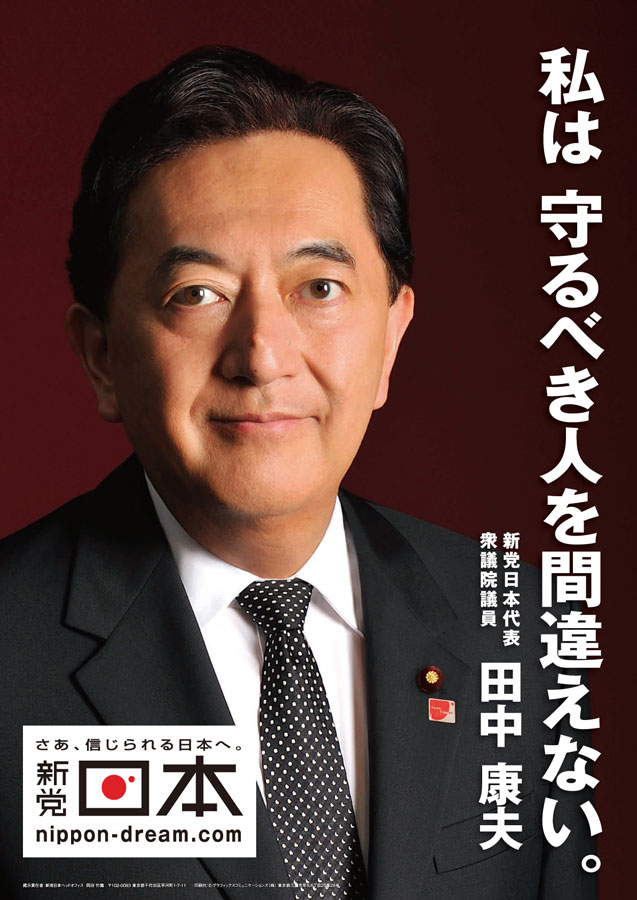
New Party Nippon, Yasuo Tanaka: "I know who to protect" [his word. "I don't make mistakes in choosing who to protect" - criticizing DPJ and LDP for putting big businesses first.]


My personal favorite is Mr. Tanaka's poster. He looks calm and not prone to over-promising. Despite the silly gesture, I also do like Mr. Shii, smiling at us, looking like a good sport.

As far as the color scheme goes, DPJ's Noda and New Party Nippon's Tanaka are the winners to me. The colors (red or dark red background, very dark suits) portray substance, whether the substance is actually there or not. Mr. Tanaka could have chosen a better tie.

Someone couldn't help faking a poster for Goshi Hosono: