Showing posts with label pond leak 4/13. Show all posts

Tuesday, August 13, 2013

#Fukushima I Nuke Plant: In-the-Ground Water Storage Ponds Are "Floating" Because of Groundwater Pressure


It's one thing after another at Fukushima I Nuclear Power Plant. Today, it's the floating ponds.

Remember those in-the-ground water storage ponds that leaked back in April? They were originally constructed for storage of treated water. But as TEPCO was running out of above-the-ground steel tanks, TEPCO consulted with the then-regulator Nuclear and Industrial Safety Agency bureaucrats and experts in August 2012. NISA officially allowed the use of these in-the-ground water storage ponds for highly contaminated, post-RO (reverse osmosis) waste water with high beta.

The ponds were lined with thin liners, as if they were garden ponds, and the water leaked. That was not what the elites at TEPCO and NISA were expected. TEPCO was forced to move the waste water into above-the-ground steel tanks.

These ponds have stood empty since May/June. Well of course they float.

Now, TEPCO announced that they found two of these ponds "floating", or bulging in the center. TEPCO doesn't say why, but Asahi Shinbun (8/13/2013) speculates it may be from the groundwater pressure:

貯水槽40センチ浮く 福島第一原発、地下水の浮力か

In-the-ground water storage ponds float 40 centimeters [max] at Fukushima I Nuke Plant, probably due to buoyancy from groundwater

東京電力は13日、福島第一原発で4月に汚染水が漏れた地下貯水槽が最大40センチ浮き上がったと発表した。周囲を流れる地下水によって浮力が生じたことが原因とみられる。汚染水は地上タンクに移送され、貯水槽は空だった。東電は、新たな汚染水の漏れはないと説明している。

TEPCO announced on August 13 that the in-the-ground water storage ponds at Fukushima I Nuclear Power Plant which leaked contaminated water in April were found floating maximum 40 centimeters. It is probably due to buoyancy created by groundwater flowing around the ponds. The contaminated water has been transferred to the above-the-ground tanks, and the ponds are empty. TEPCO says there is no fresh leak of contaminated water.

 東電によると、高濃度の汚染水が入っていた3号貯水槽(縦56メートル、横45メートル、深さ6メートル)が最大約40センチ浮き上がり、5、6号機の建屋地下の低濃度汚染水を入れていた4号貯水槽(縦40メートル、横25メートル、深さ6メートル)も最大約15センチ浮き上がった。

According to TEPCO, the Pond No.3 (56 x 45 x 6 meters) that contained highly contaminated water is floating maximum 40 centimeters, and the Pond No.4 (40 x 25 x 6 meters) that contained low-contamination water from the basements of Reactors 5 and 6 buildings is floating maximum 15 centimeters.

 3、4号貯水槽は、いずれも1~4号機の建屋の山側にある。1日千トンの地下水が流れているという。貯水槽周辺の地下水位は4月から1メートル程度上昇したという。

The Pond No.3 and the Pond No.4 are located west (mountain-side) of the reactor buildings. According to TEPCO, 1,000 tonnes of groundwater is flowing there per day, and the groundwater levels in the area where the in-the-ground ponds are located have risen by 1 meter or so since April.

 対策として東電は、地下貯水槽の上に50センチほどの砂利を敷き、重しにする。ゲリラ豪雨などで急に地下水位が上がった場合は、地下貯水槽の周囲の井戸から地下水をくみ出し、別の地下貯水槽に移すという。

As a countermeasure, TEPCO will put a 50-centimeter layer of gravel at the bottom of the ponds as weights. If the groundwater levels suddenly rise due to heavy rain, TEPCO will draw groundwater from the wells around the ponds and move the water to different ponds.


Uh... musical ponds?

Why don't they simply pump up the groundwater there and put it in these ponds?

It was just too bad and extremely short-sighted for TEPCO and NISA to use these ponds for highly contaminated waste water. They could have used these ponds to store clean groundwater before it goes anywhere near the reactor buildings and from there released into the ocean.

From TEPCO's handout for the press, 8/13/2013, Pond No.3:

Wednesday, May 1, 2013

#Fukushima I Nuke Plant: Was TEPCO Using Used Bottle to Collect Water Samples from the Pond Leak?


As I posted on Monday, TEPCO announced a 10-fold spike in radioactive materials (all-beta) in the water sample collected from soil just outside the thin (6.4 millimeter-thick) bentonite layer of the in-the-ground water storage pond No.1.

In the successive email alert for the press (which they know post on their homepage press release section), TEPCO sort of tell us what they think was the cause for the spike:

A used bottle that previously collected samples.


TEPCO doesn't say it outright, but instead, from their email alert for the press regarding the pond leak (No. 110) on April 28, 2013:

本日午前および午後に地下貯水槽No.1ドレン孔(南西側)の水を採取する際、採取した水が汚染しないように新品のサンプリングボトルを使用して採取したところ、一昨日(4月26日)と同レベルの低い値が得られました。そのため、昨日(4月27日)、地下貯水槽No.1ドレン孔(南西側)の水を採取した際、採取した水が何らか汚染した可能性があるものと推定しております。

When we collected the water samples from the drain hole (southwest) of the in-the-ground water storage pond No.1 in the morning and in the afternoon today [April 28, 2013], we used brand-new sampling bottles to avoid contamination of the water collected. Then the amount of [radioactive materials in the water] dropped to the same low level as the one on April 26. Therefore, we now assume the possibility that the water collected on April 27 from the southwest drain hole of the pond No.1 got somehow contaminated.


which I take it to mean they were using used bottles to collect highly radioactive water samples until April 28.

It is little wonder why there is no "end-state" vision for the plant.

Monday, April 29, 2013

#Fukushima I Nuke Plant: Amount of Radioactive Materials in Water Sample from Outside the In-The-Ground Water Storage Pond No.1 Rose by 10


Cause unknown, according to TEPCO.

No surprise there.

From Jiji Tsushin (4/28/2013):

土壌の放射能濃度10倍に=1号貯水槽、2日前と比べ-福島第1

Fukushima I Nuke Plant: amount of radioactive materials in the soil [outside] the in-the-ground water storage pond No.1 10 times larger, compared to two days ago

東京電力福島第1原発の地下貯水槽から放射能汚染水が漏えいした問題で、東電は28日、1号貯水槽の外側土壌で27日に採取した水の放射能濃度が、2日前と比べ10倍超に上昇したと発表した。貯水槽外側土壌での水採取場所は2カ所あり、今回上昇が判明した場所はこれまで濃度が低い状態が続いていた。東電は「原因は分かっていない。監視を続ける」としている。

Regarding the leak of radioactive waste water from the in-the-ground water storage ponds at Fukushima I Nuclear Power Plant, TEPCO announced on April 28 that the amount of radioactive materials in the water sample taken from the soil outside the Pond No.1 on April 27 was more than 10 times the amount from two days prior. There are two sampling locations outside the pond, and the location that saw the increase this time had had low amount of radioactive materials. TEPCO says "We don't know the cause. We will continue to watch carefully."

東電によると、放射能濃度が上昇したのは1号貯水槽の南西側土壌。27日に採取した水でストロンチウムなどベータ線を出す放射性物質が1ミリリットル当たり1.1ベクレル検出された。26日は検出限界値未満で、25日は同0.099ベクレルだった。

According to TEPCO, it was [the water from] the soil on the southwest side of the Pond No.1 that saw the increase in radioactive materials. 1.1 Bq/milliliter (cubic centimeter) of beta nuclides including radioactive strontium was detected from the water taken from there on April 27. From the same location, it was below detection level on April 26, and 0.099 Bq/milliliter on April 25.


TEPCO's handout for the press on 4/27/2013, showing 1.1 Bq/cm3 of beta nuclides (red rectangle):


Measurement on 4/28/2013 of the same location shows the amount dropped down to 0.074 Bq/cm3 and 0.048 Bq/cm3 (they measured twice, the second time only beta nuclides):


In the meantime, Fukushima Prefecture sent in a group of officials and experts to the plant on April 24 to observe the in-the-ground storage ponds firsthand. They said they were appalled at what they saw. One of the experts, Professor Susumu Nakamura of Nippon University (seismic engineering) said, according to Mainichi Shinbun, "Amateurs. If it were at least 50 to 100 centimeter-thick, the leak of highly radioactive waste water may have been prevented."

Oh but that would cost too much, in a nation whose central bank prints 7 trillion yen (about US$70 billion, at least the conversion calculation is getting easier by the day) each month out of thin air to buy up JGBs from financial institutions to create inflation.

And this thin blue hose is what is transporting extremely contaminated waste water from the Pond No.1 to the metal storage tank(s) (TEPCO will use two, one tank meant for filtered water, and another in the H2 area):

(Photo from Mainichi)


Thursday, April 18, 2013

The Case of Disappearing 600 Tonnes of Extremely Radioactive Waste Water at #Fukushima I Nuke Plant


From the beginning of the news of this leak, scientifically-minded people that I follow on Twitter have been talking about the difference in the amount of waste water that is supposed to be in each pond and the amount the same water in each pond as measured by TEPCO every day since the first news of the leak, with spreadsheets and charts. Now the MSM is finally getting wiser.

TEPCO's reassurance is that it is within the tolerance of the measuring equipment.

From Kyodo News (4/18/2013):

福島原発、汚染水6百トン消える 東電は大量漏えいを否定

600 tonnes of contaminated water disappeared from Fukushima I Nuke Plant, but TEPCO denies massive leak

東京電力福島第1原発の地下貯水槽から放射性物質に汚染された水が相次いで漏れた問題で、東電は地下貯水槽にあった汚染水の総量を現在約2万3千トンとしているが、漏えいを最初に確認した直後に示した総量は約2万3600トンだった。約600トンがどこかに消えたことになるが、東電は「計測機器の誤差の範囲」と説明している。

Waste water highly contaminated with radioactive materials has leaked from the in-the-ground water storage ponds at Fukushima I Nuclear Power Plant. TEPCO currently puts the total amount of waste water that was stored in the ponds at 23,000 tonnes. However, the amount was 23,600 tonnes when TEPCO announced the first leak. 600 tonnes of water seems to be missing, but TEPCO says "It is within the tolerance of the measuring equipment."

どこかの貯水槽から大量に水が流出した可能性はないのか。東電は「外部に流出した明確な兆候はない」と、大量漏えいを否定している。

Isn't there a possibility that a large amount of water leaked from one of the ponds? TEPCO says "There is no clear sign of water having leaked outside", and denies there has been a massive leak.


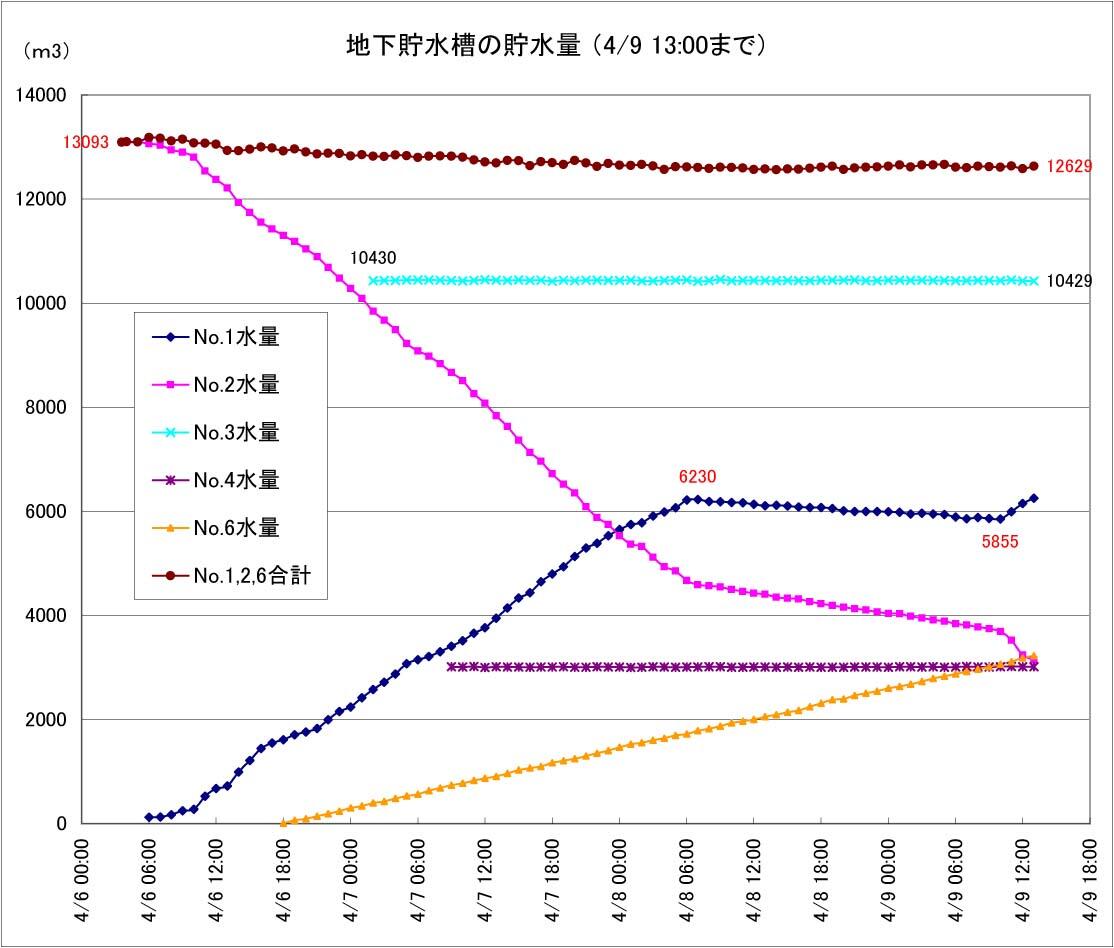
One of the people I follow (Kontan_Bigcat) on Twitter has been saying the leak may be as much as 460 tonnes as of April 9, with 130 terabequerels of all beta. From his tweet on April 9, 2013:


The top brown line is the total of the Ponds 1, 2 and 6, which was 13,093 tonnes on April 6 but 12,629 on April 9.

Wednesday, April 17, 2013

#Fukushima I Nuke Plant Pond Leak of April 2013: TEPCO Started Transfering 900 Tonnes of Post-RO Waste Water from Pond No.2 to a Steel Tank, Will Take 6 Days


OK, so it will be 150 tonnes per day, using temporary pipes and a temporary tank between the Pond No.2 and the final destination which is about 550 meters away.

The Reverse Osmosis apparatus is currently operated intermittently, according to TEPCO (handout for the press in Japanese, 4/16/2013).

From the 58-page handout for the press conference given by the TEPCO president Hirose (4/17/2013):

In-the-ground water storage ponds and where the RO waste water is going. Green line in the map is where the waste water from the Pond 2 is traveling:


The physical setup to transfer the waste water in the Pond No.2 to a steel tank in H2 area. (I seems to be hallucinating the leak already...):


In the handout, I don't find any reference to any effort to make any of the temporary contraptions since March 11, 2011 into a permanent, stable one.

Here's page 26, showing photographs of electrical panel for the Reactor 2 Spent Fuel Pool cooling system, which was rigged up after the accident. "Look what we found! A small animal (rat) can get inside!" So what did TEPCO do? Cover the lines with plastic sheets:


From my experience in living in a countryside, rats and mice can easily chew through plastic sheets.

I hear that Mr. Naomi Hirose, TEPCO's president, is a very smart guy, with MBA from Yale University. He's from sales and marketing, and not an engineer. He was in charge of TEPCO's highly successful push for "all-electric" homes, which significantly boosted the electricity consumption in large cities, which in turn was used to justify building more nuclear power plants. Yale MBA Program apparently wrote it up as a case study. I'd love to see it.

I can see that he is indeed an MBA, as he sets up a new "communication" department to better communicate with the press, the government, and citizens as if communication is what's wrong with TEPCO and Fukushima I Nuclear Power Plant.

Friday, April 12, 2013

#Fukushima I Nuke Plant Pond Leak of April 2013: All 7 In-the-Ground Water Storage Ponds Are Leaking Radioactive (Beta) Water


Jiji Tsushin (4/13/2013) says TEPCO has reported to the Nuclear Regulatory Authority that the in-the-ground water storage pond No.1 is indeed leaking into the surrounding soil.

TEPCO's handout for the press on April 13, 2013 shows that beta nuclides are being detected in the water taken from either the drains or the leak detection pipes or both in not only the ponds Nos 1, 2, 3 but all seven of these in-the-ground storage ponds:

(Click to enlarge)


The top table is for the sampled water from the drain holes, which are placed outside the bottom bentonite layer.

From the presentation material by TEPCO's President (4/10/2013), Page 7:


Confusing information about which pond had the highly contaminated waste water after the Reverse Osmosis (RO) treatment. Ponds Nos 1, 2, 3 have them for certain, and Pond No.6, I think. According to the TEPCO president presentation, Pond No.5 (capacity 2,000 tonnes) and Pond No.7 (capacity 4,000 tonnes) were empty.

Thursday, April 11, 2013

(UPDATED) Latest on #Fukushima I Nuke Plant Waste Water Pond Leaks: Pump Is Also Leaking, 22 Liters With 6.38 Billion Bq of All Beta


And the latest from TEPCO on April 11, 2013 in the email notice to the press No.35:

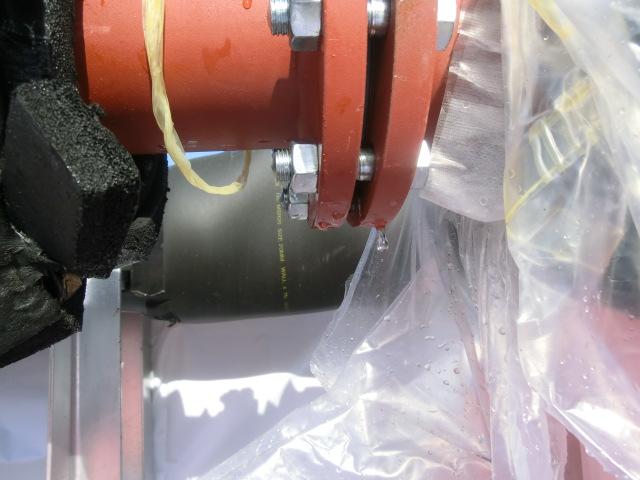
地下貯水槽No.3からNo.6への移送について、4月11日午後2時から移送を開始いたしましたが、同日午後2時3分に移送ポンプ出口配管の接続部(フランジ部)より漏えいが確認されたことから、同時刻に移送ポンプを停止いたしました。

Transfer of waste water from the in-the-ground water storage pond No.3 to the pond No.6 started at 2PM on April 11, but a leak was found at the flange of the pipe of the transfer pump at 2:03PM, so we stopped the pump.

漏えいについては、移送ポンプを停止したことにより停止しております。また、漏えいした水は、土中に染み込んでおります。

The leak stopped when the pump was stopped. The leaked water was soaked into the soil.


And No.37:

地下貯水槽No.3からNo.6への移送中に発生した水漏れについて、移送ポンプ出口配管の接続部(フランジ部)からの漏えいの原因調査のため、配管フランジの分解をおこないます。

We will disassemble the flange to investigate the leak that occurred during the transfer of waste water from the pond No.3 to the pond No.6.

また、漏えい水が滴下して染みこんだと思われる地下貯水槽上部覆土(盛土)の除去作業を開始いたします。

We will also start removing the soil that covers the top part of the water storage pond where the leaked water may have dripped.


The water contains 290,000 Bq/cm3 of all beta (mostly strontium), and 22 liters of this water leaked, as TEPCO's email notice No.36 confirms. That would be 6.38 billion becquerels of all beta (290,000 x 1000 x 22). Who is going to disassemble the flange and remove the dirt? TEPCO's president? One of Mr. Abe's ministers who frequent the plant for photo-ops?

They are having another press conference starting at any moment now (scheduled to start at 6PM local time).

Flange that leaked, from TEPCO's photos and videos library 4/11/2013:


TEPCO's Ono says the pump was never tested with running water. (UPDATE 4/14/2013) Ono in fact said during the press conference that the company sort of tested, by making sure the bolts were tightened to the specification, and that, by definition, was safety testing.

4/11/2011 Update on In-the-Ground Storage Pond Leaks at #Fukushima I Nuke Plant: How The Ponds Were Constructed the Same Way as Solid Waste Disposal Sites


In the TEPCO's handout detailing the in-the-ground water storage ponds at Fukushima I Nuclear Power Plant that the company started to use to store extremely radioactive (beta, potentially 2 sieverts/hour) and saline waste water after the Reverse Osmosis (desalination) treatment, there was this diagram (click to enlarge):


Independent journalist Ryuichi Kino often asks questions that visibly irk the TEPCO spokesman, and he asked one such question in the press conference on April 10, 2013 as I watched live:

"So these ponds are constructed in the same way as a controlled final landfill site. Why? A controlled final landfill site is not meant to be waterproof. Why didn't you choose a covered final landfill site with concrete foundation, at least?"


There was no answer from the TEPCO spokesman other than to mumble they had their own reasons. I didn't hear any other reporter ask questions about the construction of the ponds.

Kino also reports that the company who supplied the polyethylene sheets says they are not responsible for the degradation due to radiation.

Here's Asahi Shinbun Fukushima local version (4/11/2013; part), inspired perhaps by Kino's questions:

第一原発地下貯水槽 ごみ処分場と構造同じ
●専門家「漏出は防げない」

In-the-ground water storage ponds at Fukushima I Nuclear Power Plant are constructed like a garbage disposal site. Experts say "They cannot prevent leaks."

福島第一原発で相次いで汚染水漏れを起こした地下貯水槽の基本構造は、遮水シートを使った「管理型」と呼ばれるごみ処分場と同じだったことが、東京電力の説明で分かった。その構造について、専門家からは「ごみ処分場の水準から見てもお粗末だ」などと厳しい批判が上がっている。

It has been revealed by the explanation given by TEPCO that the basic structure of the in-the-ground water storage ponds which leaked one after another at Fukushima I Nuclear Power Plant is the same as a type of waste disposal site called "controlled landfill site" using waterproof sheets. Experts heavily criticize the structure, as "badly made even from the standard of a waste disposal site".

東電によると、貯水槽は地面に穴を掘り、一番下に粘土を布で包んだベントナイトシートを張り、その上に2重の遮水シートを敷いた構造。「厳重な品質管理をしていた」と強調する。

According to TEPCO, these ponds were made by first digging holes in the ground, laying the bentonite sheet first and then two layers of waterproof sheets. TEPCO emphasizes they were doing the strict quality control.

この構造について、日本環境学会前会長の畑明郎・元大阪市大教授は「ため池にシートを敷いて汚染水をためているようなもの。近年の処分場ではあり得ないお粗末さだ。考え方自体が間違っている」とあきれる。その上で「一定の漏出は防ぐことができない。漏れることを前提に造るのが常識で、漏れてもすぐ分かる地上型ステンレスタンクにすべきだ」と提案する。

Commenting on this structure, Akio Hata, former chairman of the Japan Association on the Environmental Studies and former professor at Osaka City University, says, "It is as if you lay sheets in a pond to store contaminated water. It is impossibly pathetic considering the recent standard of disposal sites. It's wrong to even think about [using such a structure]." He suggests, "You cannot prevent all leaks. So you build a structure on the assumption that it will leak. It should be the above-ground, stainless-steel tank so that a leak can be detected easily."

放射性ストロンチウムなどを含む高濃度汚染水を地下貯水槽にためることは、原子力規制委員会の前身の旧原子力安全・保安院が昨年8月、了承している。しかし、どういう構造の施設ならば安全を担保できるかについては、法に基づく明確な審査基準もない。

The Nuclear and Industrial Safety Agency, the regulatory agency overseeing TEPCO before the Nuclear Regulatory Authority was set up, approved the plan in August 2012 to store the highly contaminated water that contained radioactive strontium and other nuclides in the in-the-ground water storage ponds. However, there is no clear legal standard for examining what type of structure would secure the safety.


Needless to say, there was no expert at NISA who knew anything about waste management. NISA took TEPCO at their word and approved the plan.

The ponds were designed and speced by TEPCO and built by Maeda Construction, who has already said such a structure is used for solid waste storage not liquid.

During the April 9, 2013 press conference, TEPCO's spokesman Mr. Ono uttered a convoluted sentence regarding the delay in announcing the leaks:

漏洩していないとは思わないが、漏洩をしているという疑いは否定できない

"We don't think it is not leaking, but we cannot deny the doubt that it may be leaking."


Got that? In other words, TEPCO tried very hard to find other reasons first that may be contributing to higher chloride concentration or radioactive materials in the sampled water.

Tuesday, April 9, 2013

4/10/2013 Update on Never-Ending Pond Leak Story out of #Fukushima I Nuke Plant: Radioactive Materials Found Outside the Liners


(The post will be updated as the day/night progresses...)

Let's start from the latest... 

(UPDATE) TEPCO says they will hold a press conference in J-Village from 3:30PM today (April 10) with TEPCO's president, who will explain the situation of the leak. The regular TEPCO press conference will start one hour earlier, at 4:30PM.

(UPDATE) NHK just reported that radioactive materials detected outside the liners for the pond No.1 was 0.11 Bq/cc (cm3) (or 110 Bq/liter) of radioactive strontium (and others, of course).

Just a headline from Kyodo News (11:27AM 4/10/2013):

福島第1原発の地下貯水槽の防止シート外側で微量の放射性物質が検出されたと、東京電力が発表。

TEPCO announced that a very small amount of radioactive materials has been detected outside the liners for the in-the-ground water storage.


No info on which pond, how much.

TEPCO so far has hoped that the leaks in the pond No.3 and the pond No.1 are at the locations where the leak detection pipes stick out, piercing through the HDPE layers. Unfortunately, that is not the case for the pond No.1.

Asahi Shinbun reports (4/10/2013; part):

新たに漏れが見つかったのは、1号貯水槽。これまで漏れが見つかった2、3号貯水槽のうち、2号貯水槽の汚染水の9200トンを6日から移し替えている途中だった。

A new leak was found in the storage No.1. Leaks had been found in the storage No.2 and No.3, and 9,200 tonnes of waste water in the storage No.2 was being transported to the storage No.1 starting April 6.

東電によると、9日午前、3重構造の遮水シートの間にたまった水を調べたところ、1立方センチあたり高濃度の1万ベクレルが検出され、汚染水の漏れを確認した。

According to TEPCO, the water between the 3-layer waterproof sheets was tested in the morning of April 9, and found 10,000 becquerels/cm3 of radioactive materials which confirmed the leak of the waste water.

東電はこれまで、貯水槽の上部から漏れていると推定。満水状態にしなければ汚染水をためられるとしていた。しかし、今回漏れた1号貯水槽は5割しかたまっておらず、底に近い方のシートの継ぎ目などから漏れたことが確実となった。

So far, TEPCO had assumed that the leak was from the upper part of the storage, and insisted that they could use the storage as long as the storage was not filled to the top. However, the storage No.1 where the new leak was found was only 50% full. It is now certain that the location of the leak is near the bottom, probably from one of the joints of the liners.


Meanwhile, the Nuclear Regulatory Authority met in the morning of April 10 to discuss the leak problem, but the meeting lasted for only 30 minutes, as there is no effective way to deal with the leak.

Jiji Tsushin reports (4/10/2013; part):

会合では規制委として、汚染水を保管するタンクの増設前倒しを東電に要求することや、放射性物質を取り除く多核種除去装置の本格稼働を急ぐことなどが挙げられたが、新たに有効な対策は示されず、議論は30分足らずで終了した。

At the meeting, they raised the issues such as demanding TEPCO to build additional storage tanks for the waste water ahead of schedule and pushing for the start of the multi-nuclide removal system [ALPS]. However, there was no effective measure [for the leak], and the meeting was over in less than 30 minutes.

規制委で事故対応を担当する更田豊志委員は「過酷な現場で作業を進めている」と述べ、現場に配慮して警告が十分できなかったと反省した。

Commissioner Toyoshi Fuketa, who is in charge of the accident response, said "The work is being carried out in an extremely harsh environment", and regretted that he could not give enough warning in consideration for the workers there.


Monday, April 8, 2013

Latest on Ever-Changing #Fukushima I Nuke Plant In-The-Ground Water Storage Leak: Now the Pond No.1 Is Also Leaking


(For the latest on April 10, 2013, see my latest post with continuous update.)

(For more information, see the previous post on the leak, including photos of the "pond" construction.)

While the Nuclear Regulatory Authority has said there is no other choice but to continue using the in-the-ground water storage (as they themselves are partly responsible for the current mess because of their insistence on ALPS vessel safety, which has significantly delayed the deployment of the system), a blame game is starting between TEPCO and the construction company who built these storage facilities in the ground.

TEPCO, after having speced out the in-the-ground water storage for Fukushima I Nuclear Power Plant, contracted Maeda Construction, a second-tier general construction firm. TEPCO is blaming Maeda Construction for the faulty construction, and Maeda Construction is blaming TEPCO for sloppy specs.

Or both, is my guess. And some more.

Latest information from Mainichi Shinbun (4/9/2013):

Liners used for the in-the-ground storage construction:

  • 1st and 2nd layers: Polyethylene (HDPE) sheet, 1.5 millimeter thick

  • 3rd and the bottom layer: Bentonite sheet, 6.4 millimeter thick


Leak detection pipes were installed through the 1st and 2nd layers

TEPCO's claim:

"Similar specifications have been used for constructing agricultural ponds. There is no problem if the leak detection pipes pierce through the layers, as long as the location is above the water."


Maeda Construction's claim:

"In water storage ponds, if such pipes are used that pierce through the liner sheets, the sheets may get pulled by the weight of the water, creating the gap through which the water could leak. Therefore, you don't spec these pipes to pierce through the sheets. As to the sheets themselves, we have used them for the storage facilities for solid objects, but never water."


TEPCO's spokesman Mr. Ono claimed in the press conference that the bentonite sheet must have absorbed a large chunk of radioactive strontium, and that justified TEPCO's announcing 710 billion becquerels of all beta in the leaked 120 tonnes of waste water.

But wait... This is no ordinary waste water. It is extremely saline.

Another Mainichi article (4/7/2013) quotes Professor Hideo Komine of Ibaraki University (civil engineering and geotechnology), who says:

汚染水に含まれる高濃度塩分によってベントナイトが膨らまず、防水機能が発揮されなかった

[There is a possibility that] because of the high salt content in the waste water, bentonite did not expand, and didn't function as waterproof material.

ベントナイトは厚いほど防水性が増すため、シートの厚さ不足も背景にある

The thicker the bentonite sheet, the more waterproof. The sheet used at Fukushima I Nuke Plant may not be thick enough.


Oops. But wait, there's yet some more. It's not just salt in the water. There are also cation (or positive ion). There are people who thinks the effect of radioactive materials, salt, and cation in the waste water on the bentonite sheet must be studied.

On a comical note, TEPCO has sent out the email notice No.20 to the press (which these days they post on their websites, a slight improvement) saying the company has resumed transportation of waste water from the pond No.2 (the one found with 120-tonne leak) to the pond No.1.

Resumed? Yes, resumed. It was stopped. Why was it stopped? Well, it was stopped when they noticed that some of the water they had transported to the pond No.1 was coming back into the pond No.2.

Why? you ask? TEPCO says it must have been a siphon effect.

OH WAIT... TEPCO just published the email notice No.21, and it says:

本日午前にサンプリングした地下貯水槽No.1ドレン孔水(2箇所)および地下貯水槽No.1漏えい検知孔水(2箇所)の分析を実施いたしました。

We conducted the analysis of water taken this morning from the in-the-ground water storage No.1 drains (2 locations) and from the leak detection pipes (2 locations).

分析結果では、漏えい検知孔水(北東側)の塩素濃度が前日分析結果4ppmから910ppmに上昇しました。

According to the result, chloride concentration of the water taken from the leak detection pipe (northeast) rose to 910ppm from 4ppm yesterday.

なお、仮設ポンプによる地下貯水槽No.2から地下貯水槽No.1への移送については、本日12時47分に停止しました。

Transfer of water from the in-the-ground water storage No.2 to No.1 using the temporary pumps was halted at 12:47PM.


So the pond No.1 is leaking. First it was just No.2, then No.3. If they cannot use No.1 and No.3 (they continue to use No.3 despite the leak, which they claim very minor), 27,000-tonne capacity is removed from the total 58,000 tonnes from 7 ponds.

When I saw him yesterday via the vid, Mr. Ono, TEPCO's spokesman, was rather confident that the water leak may not be that bad, because the layers may have effectively absorbed the water.

And the biggest problem: radiation levels. Even though most of gamma nuclides have been removed, the water contains 290,000 becquerels/cubic centimeter of all betas (mostly strontium). The radiation level on the surface of the waste water may be as high as 2 sievert/hour (beta radiation only), says independent journalist Kino, citing the leak from a tank storing the same waste water that happened on February 3, 2012. (Here's TEPCO's document, in Japanese; see pages 2 and 3.)

Let's check in to their latest presser (2:30PM local time) and hear what he has to say.

(Independent journalist Ryuichi Kino just tweeted that he is hurrying to the press conference, but says he got the email notice at 1:35PM, and sighs, "This is so like two years ago...")

============================

(UPDATE) TEPCO press conference is still going on, nearly two hours after the start. My take is that TEPCO are in big trouble, trying to find any empty storage that can take 400 tonnes/day of the waste water after RO... Mr. Ono is very subdued today. A lot of reporters, and the room is almost full.

Saturday, April 6, 2013

#Fukushima I Nuke Plant: At Least 120 Tonnes of Contaminated Water with 710 Billion Bq of Beta Nuclides Leaked from One of In-The-Ground Water Storage Locations


(4/9/2013 The latest on the leak in the new post)

===============================

That's according to TEPCO as of April 6, 2013.

The latest is that there may be additional 47 tonnes of the water leaked (Kyodo News 4/6/2013), and that may be from the in-the-ground storage No.3 (TEPCO, latest email to the press (No.12) on 4/7/2013).

And there is a possibility that instead of 710 billion becquerels of all beta in the water there may be 35 trillion becquerels of all beta.

But first thing first, here's my best effort of summarizing the leak incident.

Yesterday, I watched part of the press conference, I read articles, I read tweets, togetters, and I still didn't clearly get what exactly happened and how - why the water was leaking, how much was leaking, when they found out about it, what was their plan, why the water was stored there in the first place.

At least I sort of figured out the last question. The in-the-ground storage, where the leakage occurred, was not supposed to be used for storing the waste water after the Reverse Osmosis (desalination) treatment with high salt content and high beta nuclides. But the multi-nuclide removal system ALPS couldn't start as planned (September last year; TEPCO is now doing the hot trial run), the water treated by SARRY or Kurion's system (cesium removal) had to be stored somewhere to wait for the treatment by ALPS. So, this water is stored in the tanks made for the post-RO waste water. So, for the post-RO waste water, they started to use in-the-ground storage (there are 7 of them) in early February this year, which was originally meant for post-ALPS treatment water.

For the leak of contaminated water, this is what I have gathered from Jiji, Asahi, NHK, and TEPCO:

  • TEPCO dug up 7 locations in the Fukushima I Nuke Plant compound to create in-the-ground water storage, and has started to use them on February 1, 2013. Total capacity of these 7 storage locations is 58,000 cubic meters (tonnes).

  • Construction was carried out by Maeda Construction. They dug up the ground, installed layers of liners, poured concrete to protect and secure the liners, and put in the plastic water storage devices (see the photos below).

  • The storage location 2 holds 13,000 tonnes of the waste water, with max capacity of 14,000 tonnes. This is where they noticed the leak.

  • They measured beta nuclides (35 Bq/cm3) during the routine sampling test of water on April 3 in the drain hole on the northeast corner, and on April 5, 5,838 Bq/cm3 of all beta from the leak detection hole on the northeast corner between the bentonite sheet and unwoven fabric sheet/HDPE sheet. That's when TEPCO determined that the water was leaking into the ground.

  • The storage location 2 is 60 x 52 x 6 meters. TEPCO had confirmed the strength of the protective sheets, but the company did not do a leak test prior to actual use.

  • TEPCO estimated the amount of leak using the data from the water gauge in the storage, and came up with the number of about 120 tonnes, or slightly under 1 percent of the waste water stored. Calculating from the all beta from the detection hole (5,838 Bq/cm3), TEPCO says 710 billion becquerels of radioactive materials may have leaked.


There is also confusing information as to how full these in-the-ground storage locations already are.

BUT WAIT, THAT MAY BE MUCH, MUCH MORE BECQUERELS.

Why? Because the number TEPCO used to calculate the amount of radioactive materials in the leaked water was from the water taken from the leak detection hole in the bottom protection layer, and NOT the waste water in the storage.

So, how many becquerels of all beta does the waste water in the storage have?

  • Asahi Shinbun article which I consulted did say "290,000 Bq/cm3 strontium" in the water in the storage, and that's the number reported by TEPCO on March 6, 2013 as the amount of all beta in the waste water after the Reverse Osmosis treatment. Again, that is the waste water being stored in the holes in the ground with several layers of sheets...

  • Using that number, 290,000 Bq/cm3, instead of 5,838 Bq/cm3, there could be nearly 35 trillion becquerels of all beta in 120 tonnes of the leaked waste water.

  • In the press conference on April 6, TEPCO didn't disclose the radioactivity of the stored waste water, and none of the reporters at the press conference seems to have asked about it.


Here's the link to a togetter in Japanese discussing the above points.

From TEPCO's handout for the press, here's what a in-the-ground water storage facility looks like:


The quality of information coming out of TEPCO's press conference has markedly gone downhill in the past few months.

In the first few weeks of the nuclear accident in 2011 when one of TEPCO's managers who gave press conference was Vice President Muto, very few reporters understood what Mr. Muto was saying. Not because Mr. Muto, who is a nuclear engineer, was obfuscating but because reporters didn't know much about nuclear reactors/plants at all. They didn't know what to ask, they didn't comprehend the answers they got. Mr. Muto himself didn't seem to understand that the (mostly) young reporters didn't have a clue of what he was talking about.

Then came Mr. Matsumoto, TEPCO's PR spokesman, sometime in late March-early April time frame. The reporters were getting up to speed, and Mr. Matsumoto, after initial bureaucratic awkwardness, turned out to be OK, giving out technical information in more or less straight-forward manner. I was impressed when he explained with a straight face, no pretense, in the press conference how his company was trying to stop the leak of highly contaminated water (probably from Reactor 2 turbine building) in early April of 2011 with baby diaper polymers and shredded newspaper, using onsen bath salts as tracer.

Then came Mr. Ono, new spokesman, starting this year. Suddenly, TEPCO's press conference has become muddled again. Mr. Ono, whose manner of speech is not clear to begin with, has a convoluted and confusing way of explaining things to the reporters who are by now quite knowledgeable about things nuclear and particularly about Fukushima I Nuke Plant. I've seen them often lose patience with Mr. Ono, who often becomes defensive. He does not seem to know well enough of the subject matter (nuclear, and this plant in particular) to be able to speak clearly. The reporters, in turn, reacting to this muddled-through way of communication, have reverted back to the initial state of not knowing what to ask.

People say "It's the company, TEPCO". I'm inclined to say it's this particular spokesman who is wiping out what credibility TEPCO had accumulated in the past 2 years by trying to be straight-forward in disclosing information.