Showing posts with label Japanese Communist Party. Show all posts

Sunday, July 21, 2013

Japanese Upper House Election: Taro Yamamoto Won Seat in Tokyo With 4th Highest Votes, Communist Party Increased Seats Significantly


LDP and Komei won 76 seats together, bringing the overall number of seats in the Upper House (including the seats not contested this time) to 135, well past the simple majority of 121. DPJ collapsed from pre-election 44 to only 17, even though it is still the 2nd largest party overall.

It was almost funny to see the media, both newspapers and TV, keep telling the voters throughout the day and evening on July 21 (the election day) that the voter turnout was going to be so low that it would be the record-low. Here's Mainichi, saying the voter turnout as of 6PM was only 32.64%, and it was low across the nation. However, Yomiuri reports that the final turnout two hours later at 8PM was 52%. It is still low, but above 50% and not the record-low like the media has been telling the voters. It seems 20% of voters showed up in the last two hours of voting, except for places where the voting was finished earlier (35% of all voting stations nationwide).

Anyhow... Here's the election results, per Asahi Shinbun (English labels are by me):


And the results of Tokyo, per Yomiuri Shinbun, showing Taro Yamamoto close 4th after a Japanese Communist Party candidate (a 30-year-old woman), beating an experienced LDP politician (who still won the seat) and beating a DPJ candidate who was supported by many "famous" and "well-known" people but couldn't win the seat:


What's not so good is this, also from Asahi - overall numbers of Upper House Councilors of each party. To LDP and Komei, add Boy-wonder's Japan Restoration Party and Your Party whose policies are hardly different from those of LDP; you get the two-thirds majority, enough to change the Constitution. Abe has already declared that what he is going to do, now that he has the "mandate", having won both Houses of the Diet.


For sure, Komei Party says it is against the radical change of the Constitution as proposed by LDP, but it still wants to modify certain clauses. There are DPJ politicians who are for changing the Constitution.

After the win of Yamamoto was confirmed, I was surprised to see some of the influential experts on Twitter resorted to propagating totally false information about Yamamoto. They are people who think the fear of radioactive contamination in Japan and particularly in Fukushima Prefecture is way overblown. As far as I have followed, they have so far not resorted to manufacturing a lie about people they do not agree with, and they are usually the ones who appreciate accuracy in data.

But not this time. One such expert tweeted that Taro Yamamoto is "racist" (against people in Fukushima, he means; at least he doesn't use the transliterated katakana word) because Yamamoto just said in an NHK interview that the agricultural produce in Fukushima was nuclear waste. Yamamoto said no such thing, as it turned out. He said 100 Bq/kg contamination had been considered nuclear waste until the Fukushima accident, and after the Fukushima accident it is the safety limit for food.

I have problems myself with some of Yamamoto's opinions and understanding of things, but I didn't expect these experts to manufacture a lie like this to attack someone they don't agree with.

The other phenom in the election, Yohei Miyake, didn't win in the proportional representation part of the election for the Green Party, but he got over 150,000 votes (the highest in the Green Party). He has declared he will run again in three years in the Upper House election, and says he's glad his movement contributed to the win by Yamamoto.

Saturday, July 20, 2013

Japanese Upper House Election: Japanese Communist Party, Miyake and Yamamoto Attracting Huge Crowd on the Last Day of Campaign, Voting Has Started


(UPDATE 7/21/2013) Sure enough, both Taro Yamamoto and Japanese Communist Party won big in the election. See my new post.

==========================

The media has been hammering the idea for the past two weeks that the voter turnout will be a record low this time.

As many as 16,958 out of the total 48,777 voting stations in the country, or 35% of the voting stations, will close earlier than mandated by the law.


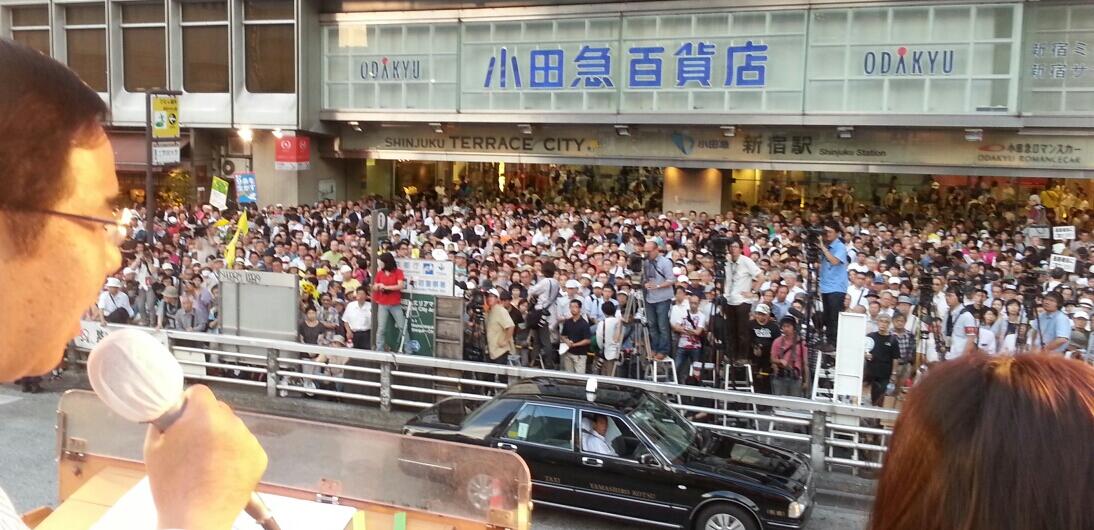
The crowd for the existing, mainstream parties (LDP, DPJ, Komei) did seem low during the election campaign. So much so that to sum up the election coverage, Kyodo News used the aerial photo of a large crowd outside the Shinjuku Station in Tokyo without naming the campaigner. The Kyodo article was mostly about LDP and Abe's promise. You would think the crowd was Abe's crowd.

Well, the photo turned out to be not LDP, DPJ, Komei, or Boy-wonder's dwindling party, but Japanese Communist Party.

From the tweet of JCP Chairman Kazuo Shii, who says 3,500 people stopped to listen to his party's last appeal:


There were many on Kyodo's site and on Twitter claiming it was the crowd for Taro Yamamoto. I retweeted one of such tweets, then my eyes got fixated with the three characters (小田急) in the upper left corner of the Kyodo photo. That's Odakyu Department Store, and that means the exit is Shinjuku West. After quick search I noticed that could only be JPC, and it was.

Asahi had this aerial photo of an even bigger crowd in Shibuya. Whose campaign was this? Taro Yamamoto and Yohei Miyake. But following Kyodo, Asahi didn't bother telling the readers whose campaign it was that attracted what Professor Yukio Hayakawa described as 10,000-strong crowd (Professor Hayakawa was right there in the crowd, according to his own tweet, and he says there were more people across the street):

(Image of Asahi Shinbun paper, from Professor Hayakawa's tweet)

Owly Images

Thursday, February 23, 2012

23,300 Bq/Kg of Radioactive Cesium from a Mix of Wet Soil and Dead Leaves in Mizumoto Park in Tokyo

(Sorry, you can't just multiply the number by 65 and compare it to the Chernobyl evacuation level. Read on to find out why.)

The Mizumoto Metropolitan Park is located in the eastern Tokyo with elevated radiation levels. The Communist Party delegation of Tokyo Metropolitan Assembly, who has done the survey of radiation levels in Tokyo from very early on in the nuclear crisis, released the result of the latest survey in one of the Metropolitan parks in Tokyo.

The survey found 23,300 becquerels/kg of radioactive cesium from a wet mix of dirt and dead leaves in one location in the Mizumoto Park in Katsushika-ku, Tokyo (No. 4 location in the table posted below).

The delegation did three tests at this location with 2 samples taken on February 15. The third test was done on February 18 by combining the two samples taken on February 15 and tested on February 16 and 17.

It may be important to note that the Communist Party delegation tested the top 1 centimeter of the soil, and the top 1 to 2 centimeters of the soil and dead leaves mixture. The measured numbers may therefore be higher than the samples taken from the top 5 centimeters, which is a normal procedure in the government tests.

To derive "becquerel/square meter" from "becquerel/kg", you multiply "becquerel/kg" number by 65, but that only applies if the soil is taken from the top 5 centimeters. (Ibaraki Prefecture's measurement page as reference, here.)

From the Communist Party delegation of Tokyo Metropolitan Assembly website (English translation is mine; the last two rows are the reference):


According to Yomiuri Shinbun article (2/22/2012), "the Ministry of Education and Science sets the standard of radiation that requires decontamination as locations that test "1 microsievert/hour higher than the surrounding areas", and the Tokyo Metropolitan Bureau of Environment says "There is no need for decontamination at this point.""

Never mind that the Ministry of Environment's decon standard is 0.23 microsievert/hour.

The surface radiation levels and the air radiation levels at 1 meter off the ground all exceed 0.23 microsievert/hour. The highest surface radiation level was 1.54 microsievert/hour, and the highest radiation level at 1 meter was 0.74 microsievert/hour.

Before the nuclear accident, the average background radiation level in Tokyo was slightly above 0.03 microsievert/hour. That was the level right before something very radioactive arrived from Fukushima on March 15, 2011 sometime between 4AM and 4:59AM. (See the Tokyo Metropolitan government's own measurement, here, as the radiation in Shinjuku went from 0.0347 microsievert/hour average between 3AM and 3:59AM to 0.1 microsievert/hour average in the next hour. )

What the Tokyo Metropolitan government needs to do is to scrape 1 centimeter of the soil under the trees and shrubs and remove dead leaves to lower the radiation. But they openly say they are not going to do anything.

================

(UPDATE from Kontan Bigcat on Twitter: the 65 multiplier applies only to soil taken from 5 centimeters AND with the soil density (dry) of 1.3 gram/cubic centimeter.

Thursday, October 20, 2011

7 Microsieverts/Hr Radiation Measured in Matsudo City, Chiba

According to Mainichi Shinbun (linked and translated below), the group of Japanese Communist Party assemblymen in Matsudo City in Chiba Prefecture released the result of their radiation survey of 144 locations in the city, and found 37 locations with over 1 microsievert/hour radiation. The highest was 7 microsieverts/hour. If you stand on the spot 24 hours a day for one year, you would get 61 millisieverts of external radiation.

Matsudo City, located on the western edge of Chiba Prefecture, are one of the cities and towns that have relatively high overall radiation in Kanto. (The map (version 4) is by Professor Yukio Hayakawa of Gunma University. Matsudo City is circled in red.)

The Communist Party assemblymen in the Tokyo Metropolitan Assembly did the similar survey of Tokyo back in May, which helped force the Tokyo government to start monitoring radiation in more details.

From Mainichi Shinbun (10/20/2011):

千葉県松戸市の共産党市議団は20日、同市内の公園、民家、保育園など144カ所での空間放射線量の測定結果を発表した。1カ所あたり最大25地点で測定し、農業用ビニールハウスそばで記録した毎時約7.0マイクロシーベルトが最高。37カ所で同1マイクロシーベルト以上の地点があった。

The group of Japanese Communist Party assemblymen in Matsudo City in Chiba Prefecture announced on October 20 the result of the air radiation survey of 144 locations in the city. The locations included parks, private residences, and nursery schools. They measured up to 25 points in one location, and the highest radiation was recorded at the side of an agricultural greenhouse, at 7 microsieverts/hour. More than 1 microsievert/hour radiation was measured at 37 locations.

 調査には市民ら約1830人が参加し、先月7日から今月17日、各地点の地上5センチで計測。同市議団は同約7.0マイクロシーベルトを記録した場所については「風評被害の恐れがあり、場所やその後の対応も答えられない」と話している。公園での最高値は西ノ下公園(同市西馬橋幸町)砂場の同約3.42マイクロシーベルトで、連絡を受けた市が除染し、同0.3マイクロシーベルトに低下した。

1,830 Matsudo City residents also participated in the survey that was carried out from September 7 to October 17. The radiation was measured at 5 centimeters off the ground at each location. The group says it will not reveal the details of the location that measured 7.0 microsieverts/hour radiation for the fear of "baseless rumors". The highest measurement in parks was recorded at the sand box of Nishinoshita Park, at 3.42 microsieverts/hour. The group notified the city, who decontaminated the sand pit. The radiation was reduced to 0.3 microsievert/hour after decontamination.

 同市はこれまでも、市民が独自に測定した地点で再測定するなどし、既に約10カ所で緊急除染を実施。今後も、公園などでより詳細な調査を進める。

The city has already carried out emergency decontamination at 10 locations after confirming the radiation measurements done by the city residents. It will conduct a more detailed survey in parks.

 砂場など特定の場所で局所的に高い汚染が確認される傾向が強く、同市議団は「比較的安全と考えられていた場所で突出した数値が出て驚いている。より細やかな調査が急務だ」と話している。

Localized, high radiation contamination has been consistently found in places like sand boxes. The group says, "We are surprised at the very high numbers in locations that have been considered relatively safe. We should make it an urgent task to conduct a more detailed survey."

Thursday, June 2, 2011

#Radiation in Tokyo as Measured by Japan's Communist Party

For the readers of this blog who live in the Tokyo metropolitan area.

Ironically, the Japanese Communist Party (JCP) is about the only credible "opposition" party left in Japan in the middle of the kindergarten-level squabble within the DPJ (many of whom are ex-LDP politicians anyway) and the LDP. Its representatives in the Tokyo Metropolitan Assembly, with the help from experts, did the survey of the air radiation levels in various parts of Tokyo. I believe it is by far the most detailed survey done by any entity.

(The following information from the JCP's press release, in Japanese, in May 25, 2011)

They divided Tokyo into 10 kilometers-by-10 kilometers grids and measured the air radiation level at total 128 locations. In the eastern Tokyo where the high radiation levels have been detected, they used 5 km by 5 km grids to measure 55 locations. 8 locations in Shinjuku-ku were measured, and 23 locations around Toyosu (landfill where the Tokyo metropolitan government is moving the wholesale fish market, by the way), as both Shinjuku and Toyosu have been reported to have higher radiation.

Findings:

  1. According to the official number from the Tokyo Metropolitan government measured at 18 meters off the ground at the Tokyo Metropolitan Institute of Public Health [in Hyakunin-cho, Shinjuku], the average radiation level for the month of May was 0.068 to 0.062 microsievert/hour. The ground level (1 meter from the ground) showed the similar number, according to the government. However, when we measured the radiation at 1 meter from the ground, the radiation level similar to the official level was only observed in very narrow, limited areas in Ota-ku, Suginami-ku, and Machida City. The areas with relatively high level of radiation were Ome City, Akiruno City, Nerima-ku, at 0.09 microsievert/hr, the Tokyo Bay area of Edogawa-ku and Koto-ku at 0.1 microsievert/hr, and the highest level of radiation was observed in Adachi-ku and Katsushika-ku, at 0.2 to 0.3 microsievert/hr. (Map 1)

  2. The eastern Tokyo - Adachi-ku, Katsushika-ku, and Edogawa-ku - has areas of high air radiation between 0.18 to 0.39 microsievert/hr. The high level of radiation in Toyosu landfill is thought to be the continuation of the high level in the eastern Tokyo. The ground-level measurement (0 meter) done in one location in this area registered 0.618 microsievert/hr. (Map 2)

  3. There is a possibility that the radiation level in areas east of the line that connects Koto-ku and Nerima-ku is at the level that will result in 1 millisievert/year. (Map 3)

  4. There are huge variations in radiation within a very narrow (3.5 kilometer radius) area within Shinjuku-ku, from 0.066 to 0.116 microsievert/hr. (Map 4)

  5. The radiation on the surface of the grass and around trees was higher than other surroundings.

The survey was done between May 6 and 25, using ALOKA PDR-101 pocket survey meter. The air radiation at 1 meter from the ground was measured, and in some locations the radiation on the ground surface was also measured. The measurement was repeated 10 times at 10-second intervals, and the numbers were averaged.

These are the maps that summarize the JCP's findings:
Map 1:

Map 2:

Map3:

Map 4:

Sunday, August 2, 2009

Japanese Communist Identifies With Obama

Welcome to a brave, new world. A Japanese blog finds a lot of common ground shared by President Obama and the Japanese Communist Party.

I was searching the articles on how Obama and his policies were perceived in Japan, and up popped this blog. The blog author is a member of the Communist Party in Kochi Prefecture and he is in charge of policy formulation.

"オバマ大統領と日本共産党 経済政策の共通性" [President Obama and Japanese Communist party - Commonality in Economic Policies] (7/29/09, 土佐のまつりごと [Politics in Tosa (old name for Kochi Prefecture)])

The blog post starts with the news headlines of recently announced Manifesto by Japanese Communist Party:

"Communist Party Announces Manifesto, Identifies How To Fund Projects" - Asahi
"Japanese Communist Party Announces Manifesto 'To Eliminate Working-Poor'" - Mainichi Newspaper, 7/28

And here's the opening paragraph of the post:

"Tax cuts for the working class, increased taxation for the rich and big corporations, cut in defense expenditure - public policies to get out of the recession look the same between the capitalist United States and Japanese Communist Party. And we [JCP] are simply talking common sense."

Oh boy. So what's in their Manifesto? Among others,

  1. Eliminate the working poor by raising the national minimum wage above 1,000 yen ($10.55)
  2. Free medical care for children under 6 and elderly over 75
  3. Raise the highest rate for personal income tax
  4. Raise tax rates for big corporations
  5. Cut defense spending
  6. Cut big public works
OK, they sound familiar up to No.4. He seems to think the U.S. is cutting the defense spending under Obama. He is probably looking only at "on budget" spending. The U.S. president is staying the course in Iraq, vastly expanding the Af-Pak front, and may be considering opening a third front (Iran, anyone?). How's that possible with shrinking defense? Also, Obama and Congress are not keen at all on No.6. They want to EXPAND the government projects as the only way out of the recession.

The blog author seems to be cherry-picking somewhat. But what's interesting and instructive is that a Communist Party member gladly identifies himself/his Party with Obama and his policies.

He clearly feels that time is on his and his Party's side. Japan will hold the general election on August 30, and the ruling coalition (Liberal Democratic Party and New Komeito Party) is expected to lose big to the opposition (Democratic Party of Japan). Japanese Communist Party is expected to significantly increase the number of seats, potentially overtaking New Komeito Party to become the third largest party in Japan.

Names of political parties in Japan are misleading. Liberal Democratic Party (LDP) is a centrist to conservative party. Democratic Party of Japan (DPJ) is liberal in the U.S. sense. DPJ was a coalition of small liberal and socialist parties.

Unlike Europe where the national and continental-wide elections saw the resurgence of nationalists and conservatives, Japan is set to go the U.S. way.