NGO "FoE Japan (Friends of Earth Japan) did its own survey of radiation contamination in Watari District in Fukushima City with the help from Professor Tomoya Yamauchi of Kobe University. Watari District has high radiation levels throughout the district, but the national government has so far refused to designate anywhere in the district as "evacuation recommended" area.
If the government designate an area as such, the government has to pay for the relocation cost. As the result, the designation in other cities like Date City has been very arbitrary and spotty, rendering the whole exercise worthless. Often, the residents are simply moved to the other parts of the same city with slightly lower radiation.
Professor Yamauchi already released the result of the air radiation survey of Watari District, but today (October 5, 2011) FoE Japan held a press conference and announced the result of the soil contamination survey.
The links at the NGO's site are broken unfortunately, but the newspapers reporting the press conference, the highest contamination was 300,000 becquerels/kg of radioactive cesium. Here's one from Asahi Shinbun (10/5/2011), which is one of the better Japanese newspapers that tend to keep the links alive longer.
Judging from Professor Yamauchi's air radiation survey (in Japanese), this particular location looks like the one that had 23 microsieverts/hour radiation at 1 centimeter off the surface of the dirt in the roadside drain. Professor Yamauchi hypothesized that radioactive cesium from surrounding mountains and forests washes down the drain after the rain, and naturally gets concentrated in the dirt.
In my communication with Professor Yamauchi, I asked if the decontamination as currently practiced in Fukushima works at all, given the non-result in Watari District which he surveyed. He said the spot decontamination like removing the dirt and sludge is useless as radioactive materials simply come from somewhere else, so the district-wide decontamination including the surrounding mountains would be necessary to "decontaminate" in the true sense of the word - to remove radioactive materials, not reduce.
He also said that spraying water with high-pressure washers hardly work at all on concrete and asphalt surfaces, as radioactive cesium is now deeply embedded in the concretes and asphalt. The only way to decontaminate concrete and asphalt, the professor said, was to physically remove all concrete structures - houses, fences, pavement, etc., which he said would destroy the neighborhood. He is of the opinion that all the residents in the district should be evacuated first, with the government paying for the cost, and the experts should get to work to truly "decontaminate".
Professor Yamauchi also wryly observed the the word for "decontamination" in Japanese, 除染 (jo-sen), is misleading. Looking at the characters for the word, it does mean "removing the contamination". So by doing the "jo-sen" work people think they are removing the contamination, when all they may achieve is to reduce the level of contamination somewhat (not much, if Watari District is any indication). He even said it was as if the government was encouraging "decontamination" so as not to evacuate people.
Or in the case of Minami Soma City, it is as if the residents in contaminated areas could feel comfortable enough to remain there by doing the "decontamination" work, as one volunteer related in the US ABC News interview in August. "If this radiation is going to stick around here for five to 10 years, we have to learn to live with it,"she said, instead of moving away from the high radiation area. For her, shoveling dirt from the kindergarten playground was a way to live with "it".
17,000 people live in Watari District, with beautiful mountains and water. It is dubbed "hidden paradise" in Fukushima City for the scenery like this:
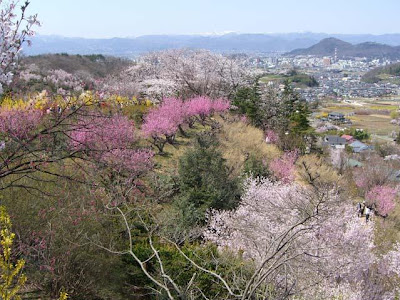
(Photo credit: SHEjapan.com, with permission)


 30-Day free trial by following the link.
 Tokyo Time
![[Most Recent Quotes from www.kitco.com]](https://lh3.googleusercontent.com/blogger_img_proxy/AEn0k_v1EiUCeUbXO1XSEmlAKOxMI692wiuhDkP_N5rO2R2X6Cy9s_GMaQ2zOTffWuppx4iE2MhFeVzu1c0LWwkwMNApJa1gxqa12q2uCIlDsIurKEwRbAqA0QVON0WYhxE9GPQX5Q=s0-d)


