Showing posts with label iodine-131. Show all posts

Friday, November 8, 2013

Dr. Shunichi Yamashita: I thought, "Oops..." After Seeing the SPEEDI Simulation Map on March 23, 2011


Right after the start of the nuclear accident on March 11, 2011, the Japanese national government, then under the Democratic Party of Japan headed by Naoto Kan, initially said they didn't know about SPEEDI. What was SPEEDI? Then they said SPEEDI failed to work. Then on March 23, 2011, Nuclear Safety Commission reluctantly made several SPEEDI simulation maps available to the public. Full disclosure didn't come until early May, 2011. (WSPEEDI disclosure was even later, in mid May 2011.)

By that time, it was too late for the residents in Fukushima Prefecture and areas in Miyagi Prefecture and northern Kanto, and it was apparently too late for Dr. Shunichi Yamashita, thyroid expert and special advisor to Fukushima Prefecture at that time.

According to Asahi Shinbun's still on-going "Trap of Prometheus", Dr. Yamashita was caught off guard when the SPEEDI simulation maps were finally made public. He had confidently persuaded the officials of Fukushima Medical University in the preceding days that there was absolutely no need to distribute potassium iodide pills because the spread of radioactive materials from the accident, compared to the Chernobyl accident, would be so miniscule.

But the SPEEDI simulation maps showed the areas with 100 millisieverts or more equivalent dose at thyroid (effective dose for the whole body is 100x0.04=4 millisieverts) extended far beyond the 30-kilometer radius evacuation zone.

I guess Dr. Yamashita was basing his assertion on his hope. Or he truly believed there was no SPEEDI simulation. Or he was a medical doctor not nuclear scientist. Or all of the above.

Oops.

From "Trap of Prometheus" on November 7, 2013, on Dr. Yamashita prevailing on potassium iodide pills and speaking about the "fate" of Japan as an earthquake-prone country with many nuclear power plants:

大阪空港経由で山下が福島に入ったのは18日午後。午後6時からの県立医大の職員向け講演会に登壇した。同僚教授の松田尚樹(56)、高村昇(たかむらのぼる)(45)も一緒だった。

Yamashita arrived in Fukushima in the afternoon of [March] 18, via Osaka Airport. He appeared in the lecture for the staff at Fukushima Medical University on the same day at 6PM. He was accompanied by the fellow professors [at Nagasaki University], Naoki Matsuda (age 56) and Noboru Takamura (age 45).

大会議室で行われたこの講演会には300人の職員が集まった。多くの職員が放射能対策のマスクをつけたまま、話に耳を傾けた。

There were 300 people who attended the lecture held in the large conference room. Many were wearing masks to block radioactive materials.

山下は最後にマイクを握った。

Yamashita spoke last.

話の要点は安定ヨウ素剤が必要か否か。山下はチェルノブイリ事故も例に出し、不要論を展開した。

The talk was about whether potassium iodide pills were necessary. Citing the Chernobyl accident, Yamashita said there was no need:

(1)安定ヨウ素剤で甲状腺がんが防げるという誤解が広がっているが、「ヨウ素剤信仰」にすぎない。日本人が放射性ヨウ素を取り込む率は15~25%。4、5割を取り込むベラルーシとはわけがちがう。

(1) Many believe that potassium iodide pills will prevent thyroid cancer, but it is nothing but "iodine religion". For the Japanese, the intake of radioactive iodine would be 15 to 25%, unlike 40 to 50% for people in Belarus.

(2)20キロ圏、30キロ圏以西の被曝(ひばく)量はおそらく1ミリシーベルト以下。チェルノブイリと比べて被曝量が微量なので、日本政府も安定ヨウ素剤服用の指示を出さない。

(2) The amount of radiation exposure west of the twenty, thirty kilometer radius [from the plant] will probably be less than 1 millisievert. [Not clear whether he meant effective dose for the whole body or thyroid equivalent dose.] Compared to Chernobyl, the amount of radiation exposure will be so small that the Japanese government will not issue instruction to take potassium iodide pills.

(3)服用マニュアルは数々の欠点がある。使われないことを祈る。

(3) The dosing manual has many defects. I hope it won't be used.

最後、こう職員を鼓舞した。

In conclusion, Yamashita tried to raise the morale of the staff:

「ぜひ逃げ出すことのないように。事故による被曝は地震国で原発立国を進めてきた日本の宿命です」

"I beg that you do not escape [desert your post]. Radiation exposure due to a nuclear accident is a fate of the quake-prone Japan that has nonetheless been promoting nuclear power plants."


Well, his last remark is, sadly, spot on. People in Japan had failed to see it, or refused to see it, until the Fukushima I Nuclear Power Plant accident.

From "Trap of Prometheus" on November 8, 2013, on "Oops...":

討議の結果、骨格を固めていた最寄り薬局利用案を踏襲することにした。(1)最寄りの薬局で安定ヨウ素剤を渡す(2)大人には錠剤、乳幼児には粉末を分包にして渡す(3)苦いので、乳幼児にはジュースに溶かして飲んでもらう。

After discussion, they [Fukushima Medical University staff] decided to adopt the plan they had been fleshing out, which was to use the neighborhood pharmacies. (1) People receive potassium iodide at the neighborhood pharmacies; (2) pills for adults, power for small children; (3) for small children, powder was to be dissolved in juice, since the powder was bitter.

山下の了解が出れば、この案を県に提案する予定だった。県は十分な在庫を持っており、県には服用を指示する権限もある。このときがヨウ素剤が行き渡るチャンスだった。

If Yamashita OKed, this plan was to be suggested to the prefectural government. The Fukushima prefectural government had ample stock [of potassium iodide] and had the authority to instruct people to take it. This was an opportunity to distribute potassium iodide pills to the residents.

しかし同日、山下はこの案を却下した。理由は以下の通り。

However, Yamashita rejected the plan, for the following reasons:

(1)原子力安全委員会のマニュアルから逸脱する(2)服用量を誤る危険もあるし、副作用が出た際に対応が困難(3)飲み物と混ぜた場合に効き目があるかどうかわからない――。

(1) The procedure was not in the manual by the Nuclear Safety Commission; (2) There was a danger that people would take a wrong dosage, and it would be hard to respond to the side effect; (3) there was no knowing if it was effective if mixed with drink.

日本甲状腺学会理事長をつとめる山下の意見は絶対だった。3月12日以降、医大で話し合われてきた配布案はこれで尻すぼみとなった。

As the president of Japan Thyroid Association, Yamashita's opinion carried weight. The plan to distribute potassium iodide that had been discussed at Fukushima Medical University since March 12 tapered off.

ところが……。

However,

数日後、山下は想像を超えた事実に驚いたと明かす。以下、ことし6月に山下から取材した内容だ。

Yamashita reveals he was surprised by the fact that was beyond his imagination. The following is from our interview with Yamashita in June this year.

山下を驚かせたのは、11年3月23日に国が公開したSPEEDI(放射能拡散予測システム)の計算図だった。当時のヨウ素剤服用基準は、甲状腺の被曝(ひばく)線量が100ミリシーベルトになると予測されたとき。計算図では100ミリを超える地域が原発30キロ圏外にも大きく広がっていた。

What surprised Yamashita was the SPEEDI simulation maps that the national government disclosed on March 23, 2011. At that time, the standard for taking potassium iodide pills was when the equivalent dose at thyroid was expected to reach 100 millisieverts. In the simulation maps, the areas where the equivalent dose would exceed 100 millisieverts extended far outside the 30-kilometer radius from the plant.

「ありゃー、と思いました」

"I thought, 'Oops...'"

放射能汚染は山下の予想を大きく上回っていた。

Radiation contamination far exceeded Yamashita's expectation.

「日本の原発にはヨウ素とかを取り除くフィルターとかがきちんと付いているものだと思っていた。まさかこんなに広範囲に汚染されているとは思わなかった」

"I had thought a nuclear power plant in Japan was properly equipped with filter or something to remove iodine and other nuclides. I never imagined such wide areas were contaminated."


This particular segment of "Trap of Prometheus" reads like a hit piece to put all blame on Dr. Yamashita regarding the debacle over potassium iodide pills that were never distributed.

Distributing potassium iodide pills on March 19, 2011 may have helped somewhat to protect the residents in Fukushima (at least) from the fresh release of radioactive materials from Fukushima I Nuclear Power Plant from March 20 to 23, 2011. But what would have mattered much, much more is if the residents were able to take potassium iodide before the reactors exploded and dry vents were carried out, with the latter apparently releasing much more radioactive materials than the explosions.

And that was all before March 15, 2011, and Dr. Yamashita didn't even arrive in Fukushima until March 18.

Who was responsible for ordering the distribution of the pills? The national government, and the Fukushima prefectural government. Instead of distributing the pills, what did they do? They accused the town of Miharu that distributed the pills and ordered the residents to take them of acting on its own without the government order. They also used the media to educate the viewers on the "danger" of potassium iodide pills, instead of danger of radioactive iodine uptake. (They continue to do this even today, and enough people are so convinced of the danger of potassium iodide pills that they furiously try to refute anyone who touts the benefit of taking them in a nuclear accident.)

Unlike Dr. Yamashita who didn't see the SPEEDI maps until March 23, 2011 like the rest of us, the ministers of the Kan administration, bureaucrats at METI and Ministry of Education, the governor of Fukushima Prefecture and officials at the Fukushima prefectural government, and even the municipal government heads in Futaba, Okuma, and Tomioka in Fukushima had either SPEEDI simulation maps or TEPCO's simulation maps or both from the beginning of the accident. They all sat on the data. Or worse. In case of the Fukushima prefectural government, they deliberately deleted the emails that contained SPEEDI simulation maps.

There is one good thing I would say about Dr. Yamashita. He is honest. As Asahi reports, he readily admitted he had made a potentially grave mistake when he saw the SPEEDI simulation maps. No self-conscious and politically savvy scientist would say things like "Oops..." in an interview for a national paper. When he gave lectures to the residents in Fukushima Prefecture in the populous middle-third Nakadori region starting March 21, 2011, telling them the effect of radiation won't come to people who are smiling, his face and mannerism as he delivered the speech revealed he was at least uncomfortable, probably very worried.

That lecture series started right when there was something happening in Reactor 3 causing the release of a significant amount of radioactive materials, and spikes in radiation were observed in wide areas in Tohoku and Kanto (March 20 - 23, 2013). Dr. Yamashita continued telling the Fukushima residents there was nothing to worry about, after he saw the SPEEDI maps and realized his assumption was very wrong.

Dr. Yamashita has since returned to Nagasaki University, though he still is the special advisor on radiation risk management for Fukushima Prefecture.

Wednesday, June 26, 2013

(UPDATED with Maps) JAEA and US Dept of Energy Maps of Iodine-131 Deposition in April 2011 Finally to Be Revealed After Two Years


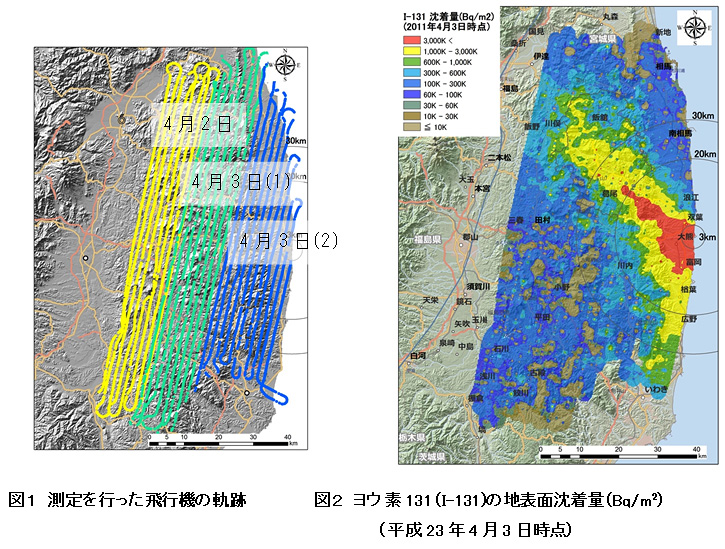
(UPDATE) From JAEA website,

The maps covers about the ocean-third of Fukushima Prefecture.


The left map shows the flight paths. The right map is I-131 deposition.


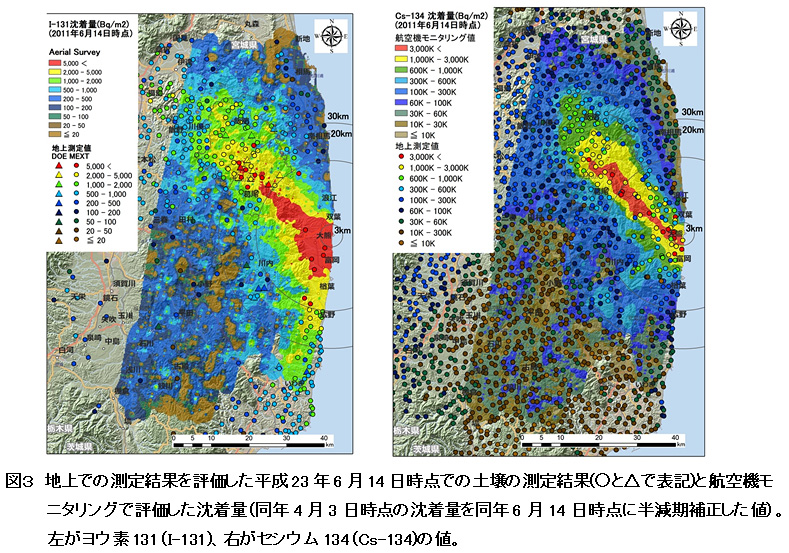
The left map is I-131 deposition, and the left map is cesium-134 deposition to show similarities and differences.

==============================

Japan Atomic Energy Agency and the US Department of Energy and National Nuclear Security Administration collaborated to create a map of iodine-131 deposition, and the paper featuring the map is to be published on June 26, 2013 in the electronic version of the official journal of Health Physics Society.

I searched JAEA site looking for the maps, and as usual their latest information is several days old, even though they just held a press conference announcing the publication.

Here's from a nuclear researcher I follow, an abstract of the paper for the 58th Annual Meeting of the Health Physics Society (7-11 July 2013, Madison, WI):

WAM-B.5   10:30  Enhanced Analysis of Early Aerial Surveys Maps I-131 Deposition from the Fukushima Daiichi Accident T Torii, Fukushima Environmental Safety Center, Japan Atomic Energy Agency ; T Sugita, Fukushima Environmental Safety Center, Japan Atomic Energy Agency; CE Okada*, U.S. Department of Energy, Remote Sensing Laboratory; MR Reed, U.S. Department of Energy, Remote Sensing Laboratory; DJ Blumenthal, U.S. Department of Energy, National Nuclear Security Administration

Abstract: During March through May 2011, the U.S. Department of Energy, National Nuclear Security Administration conducted aerial radiological surveys to characterize the severity and extent of the Fukushima Daiichi accident. The data from these surveys have previously been reported in terms of ground-level exposure rate (mSv/h) and concentrations of Cs-134/Cs-137 (Bq/m²). A small subset of the data has been re-examined with analysis techniques that were developed to exploit the gamma-ray spectral data and determine the ground-level I-131 concentration. I-131 is a short-lived (t½ = 8.04 d) radionuclide that is a potential major contributor to dose in a nuclear power plant accident. The methods developed for this analysis are described, and results of this effort are reported. *This work was done in part by National Security Technologies, LLC, under Contract No. DE-AC52-06NA25946 with the U.S. Department of Energy.


National Security Technologies, LLC is a joint venture formed in 2006 between Northrop Grumman Corporation and three other corporate partners including Babcock & Wilcox. Looks like an outsourcing outfit of Dept of Energy.

According to Mainichi Shinbun (6/27/2013):

  • The maps show contamination by radioactive iodine in the 400 square kilometer areas around Fukushima I Nuclear Power Plant.

  • The maps are based on the analysis of the data from aerial surveys done by the US Department of Energy on April 2 and 3 in 2011.

  • High deposition of radioactive iodine in the north-western direction from the plant, same as radioactive cesium deposition.

  • High deposition of radioactive iodine also in the southern direction from the plant, with areas with more than 1 million Bq/m2 extending to the north of Iwaki City.

  • Delay in disclosing the data is ascribed to "careful examination" by JAEA, as it was difficult to extract data for radioactive iodine as the contamination of the airplanes used in the survey was quite high.


I think this is part of the data that was freely given by the US government to the Japanese government, with the express consent by the US government to the Japanese government to distribute the data freely, but which the Japanese government decided to sit on. The data included contamination maps from data collected by Global Hawk drones in March 2011, and near-real-time video footage of Fukushima I Nuclear Power Plant also by Global Hawk in March 2011. (See my post from 2012.)

If so, JAEA may have finally figured out that the data was in GIS file format.

Radioactive iodine spreading to the south of the plant was the animation of the simulation I was watching in horror at France's IRSN site within a week (earliest simulation was on March 17, 2011) of the accident on March 11, 2011.

Friday, June 14, 2013

#Fukushima Medical University Distributed Potassium Iodide to Medical Staff on March 15, 2011, Says It Was Their "Vested Interest" As Medical Professionals


as radioactive materials were falling on people waiting outside to get drinking water and food.

A short blog post by Minamisoma City Assemblyman Koichi Ooyama contains a link to a religious newspaper article that recounts the early days of the nuclear accident in March 2011 and how people are trying to recover from the disaster by decontaminating their place.

In the June 6, 2013 article, the author Koyu Abe, a Zen Buddhist monk in Fukushima City, says the following:

当時の放射性ヨウ素の貴重なデータがある。福島市の南東に位置する県立医大近辺で3月15日(爆発から3日後)に採取された葉菜の検査記録だ。県が測定し手書きで残したその資料には、ヨウ素だけで1キロあたり119万ベクレルが検出されたことが示されている。

There exists a valuable piece of data about radioactive iodine in the early days of the accident. It is the record of measuring leafy vegetables taken near Fukushima Medical University [located just south of Fukushima City center] on March 15 (three days after the explosion [of Reactor 1]). The handwritten data by the prefectural government shows 1.19 million becquerels/kg of radioactive iodine.

当時医大で医師・看護師などに「安定ヨウ素剤」を配ったのも頷けるデータだ。しかし、私たちにはそうしたデータが公表されることはなかった。

Looking at this number, it is understandable that Fukushima Medical University distributed potassium iodide pills to doctors and nurses. However, this data was never disclosed to us.

今年の1月、法務省主催の人権フォーラム「震災と人権」でパネリストを務め、こうした事実を伝えた。ところが、後日主催者から報告文書中のこの発言内容について削除したい旨の電話が入った。

In January this year, I served as a panelist in a human rights forum sponsored by the Ministry of Justice called "March 11, 2011 disaster and human rights", and I talked about this fact. However, the sponsor called me later and said they would like to delete my comments from the report.

医大関係者から「それは医療従事者の既得権益で、なんら問題がない」という意見が寄せられたためだ。私は「百歩譲ってそれを認めたとしても、地震により当時ライフラインの復旧のために何週間もの間、文字通り寝食を忘れ、大量の放射性物質が降り注ぐ中、復旧工事に従事していた人にはなぜ配られなかったのか。彼らには既得権益はないのか」と一蹴すると、1時間足らずで「削除せず、そのまま記録する」との返答があった。明らかな職業差別であったからだ。

Officials at Fukushima Medical University had raised issues with the sponsor by saying "It [distributing potassium iodide pills] was our vested interest as medical professionals, and there should be no problem with that."

I protested and said, "For argument's sake let's assume it is true. But there were people at that time working hard day and night for weeks on end, literally without sleep and food, in order to restore life lines after the earthquake while a large amount of radioactive materials were falling on them. Why didn't they get the pills? Why didn't they have vested interest?" One hour later, they called me back and said my comments wouldn't be deleted, and would be recorded as they were. It was clear that [the University's argument] was discrimination based on occupation.


Mr. Abe is the one who decided to use his temple to store contaminated soil removed from people's homes, three months after the start of the accident.

On March 15, 2011, I remember reading about people in Fukushima, particularly in Fukushima City, standing outside in long lines in the snow for a long time to get some drinking water, with mothers and fathers taking their kids with them.

Reactor 3 building blew up at 11AM on the previous day, March 14. They were trying to vent Reactor 2 all night and early morning of March 15. Reactor 4 building managed to blow up (no one knows how) in the early morning of March 15, and at about the same time some event did happen in Reactor 2's Suppression Chamber.

On March 15, 2011, I was writing about:

#Fukushima I Nuke Plant: Maybe a Level 7 Disaster

#Fukushima I Nuke Plant: Reactor No.4 Radiation Abnormally High, Government Asking US Military to Spray Water From Air

On March 16, 2011, I was screaming about the first evacuee death due to lack of water, heat, and food, while the official depots were swimming with foods, water and blankets and clothes from people from all over the world.

Hardly anyone was reading my blog then, but I had to write to keep some sanity. It still feels like only yesterday.

Sunday, January 13, 2013

#Radioactive Iodine (I-131) Dispersion Simulation, 22 Months After #Fukushima Nuclear Accident


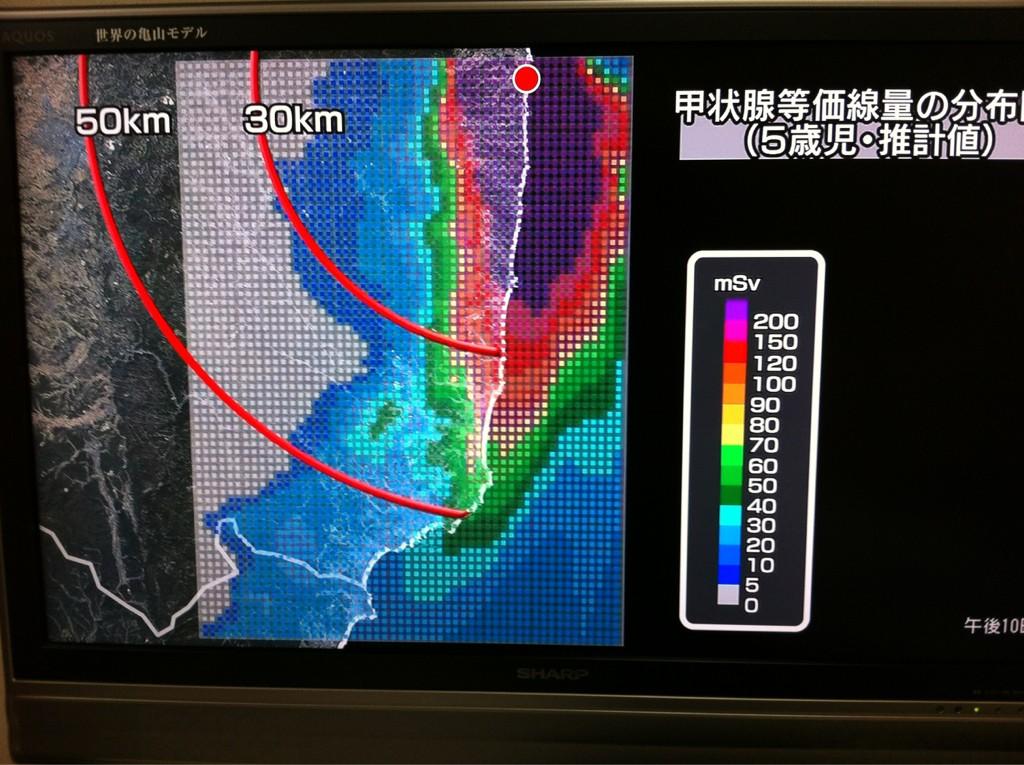
For some unknown reason, NHK decided to air a documentary on iodine-131 dispersion in the days right after the start of the Fukushima I Nuclear Power Plant accident in March 2011. In it, there was a simulation map created by researchers who carefully pieced together information without the government funding. It was a map of estimated thyroid dose equivalent exposure of I-131 for 5-year-olds.

The highest exposure is shown at above 200 millisieverts (thyroid dose equivalent for 5-year-olds).

(TV screenshot by @study2007, from Twitter)


This is the first map I've ever seen that has been made by the Japanese, plotting the thyroid dose.

What's interesting is why the dispersion of iodine-131 is still an estimate and simulation. As NHK tells it, the government ministry in charge of measuring radiation, Ministry of Education, actively intervened and prohibited the officials or researchers from doing the actual measurement of radioactive iodine in the air from March 14 to March 17, 2011.

WHY? Because the explosion of the Reactor 3 building at Fukushima I Nuclear Power Plant would endanger the officials doing the measurement outdoors. The officials dutifully followed the order. They chose not to collect probably the most critical data of the accident, and they didn't bother to tell the residents either, who were out and about with no information.

That's if you can believe NHK.

I wonder why they created the above map as dose equivalent for 5-year-olds, instead of 1-year-olds, like France's IRSN did. My guess is that the numbers would then be too high for viewers' comfort.

NHK's documentary (in Japanese) can be still seen here (part 1) and here (part 2), until NHK notices and takes them down.

Friday, January 11, 2013

US National Cancer Institute I-131 Thyroid Dose Calculator for Nevada Test Site Fallout


For readers in the US who were born before 1971, there is an online calculator available from the National Cancer Institute to assess your radioactive iodine (I-131) exposure (thyroid dose equivalent) from nuclear tests in Nevada:

I-131 Thyroid Dose/Risk Calculator for Nevada Test Site (NTS) Fallout

You input gender, date of birth (month, year), state, county, and primary type of milk you drank. The number may surprise.

NCI has reports on I-131, here.

State and county level exposures in an interactive map (which wasn't working when I checked), here. The maximum exposure was 16 rad (thyroid dose equivalent), which is 160 milligray which is 160 millisieverts. That is rather high.


I got the links to the site from a tweet by a young nuclear researcher in Japan I follow on Twitter. He said in a later tweet, "It would have been very nice if Fukushima Prefecture's system to estimate the radiation exposure had been available for the residents to run the calculation like this." I can't agree with him more.

Instead in Japan, the National Institute of Radiological Sciences (NIRS), a government agency, built a proprietary system based on the questionnaires from the Fukushima residents (low response rate), and came up with model cases. (For details, see this PDF, in Japanese.) I don't think the residents who submitted the questionnaires have received any individualized estimate, but I could be wrong.

In nuclear testing in Nevada by the US government, soldiers were made to watch without any shielding.


The US Department of Defense has a website to assist ex-soldiers file a claim if they think they were exposed to ionizing radiation.

The recent study "Childhood Thyroid Radioiodine Exposure and Subsequent Infertility in the Intermountain Fallout Cohort" by University of Utah Department of Family and Preventive Medicine considers up to 1,245.5 milligray exposure. (PDF file of the paper is here.)

Monday, April 2, 2012

WSPEEDI Simulation Showed 10 Terabecquerels/Hour Iodine-131 in Chiba on March 15 Last Year, Data Still Not Disclosed

10 terabequerels = 10,000,000,000,000 becquerels.

The system also calculated the amount of radioactive cesium to be 1 terabecquerels/hour each for cesium-134 and cesium 137. And the Japanese government is still sitting on the data.

WSPEEDI simulation system can predict the dispersion of radioactive materials in the hemisphere, in 3D.

From what Jiji Tsushin reports, the WSPEEDI simulation was done on March 15 upon request from the Ministry of Education and Science. For whatever reason, the Ministry decided to not announce it (for that matter, not let anyone know about it, till April 3, 2012).

On the very next day, on March 16, the Ministry announced that SPEEDI and WSPEEDI would now be the responsibilities of the Nuclear Safety Commission, and instructed the Japan Atomic Energy Agency to send the data to the Commission, who either sat on it or didn't even know they were now in charge of SPEEDI/WSPEEDI.

There is another interesting bit of information in the Jiji article below. The simulation was ordered by the Ministry of Education, and one of the parameters was that radioactive materials were released at about 9PM on March 14, 2011. That's about the time (9:18PM to be exact) when 2 safety relief valves were opened in Reactor 2, probably releasing a large amount of radioactive materials through a breach in the Suppression Chamber, according to the research paper by Fumiya Tanabe of Sociotechnical Systems Safety Research Institute.

If that's the case, the government must have known that the Reactor 2 Suppression Chamber had already failed, and opening the safety relief valves would release a large amount of radioactive materials from the breach. So they ordered the WSPEEDI simulation specifying the time of the release at 9PM on March 14.

Jiji Tsushin (4/3/2012):

千葉で「ヨウ素10兆ベクレル」未公表=昨年3月、世界版SPEEDI試算

WSPEEDI Simulation last March: 10 terabecquerels[/hour] of radioactive iodine in Chiba, data not disclosed yet

 東京電力福島第1原発事故で、昨年3月15日、放射性物質の拡散予測データ「世界版SPEEDI」の試算結果で、千葉市内でヨウ素の濃度が毎時10兆ベクレルという高い値が出ていたにもかかわらず、文部科学省と原子力安全委員会の間で十分な連携が取られず、現在も公表されていないことが3日、分かった。

On March 15 last year after the Fukushima I Nuclear Power Plant accident started, the WSPEEDI simulation of the dispersion of radioactive materials predicted the very high density for radioactive iodine in Chiba City in Chiba, at 10 terabequerels per hour. However, there was no effective communication between the Ministry of Education and Science and the Nuclear Safety Commission, and the data has still not been disclosed.

 文科省や安全委によると、世界版SPEEDIは放出される放射性物質の拡散状況を半地球規模で予測するシステム。日本原子力研究開発機構が同システムを運用しており、昨年3月も文科省の依頼を受け、試算を行っていた。

According to the Ministry of Education and the Nuclear Safety Commission, the WSPEEDI system is capable of simulating the dispersion of radioactive materials emitted on a hemispheric scale. The Japan Atomic Energy Agency (JAEA) operates the system, and it was conducting the calculations upon request from the Ministry of Education in March last year.

 それによると、福島第1原発から昨年3月14日午後9時ごろに放出された放射性物質が拡散した結果、千葉市内で同15日午前6~7時、ヨウ素の濃度は毎時10兆ベクレル、セシウム134、137もそれぞれ同1兆ベクレルと推計された。

According to the calculations, as the result of radioactive materials released from Fukushima I Nuclear Power Plant at about 9PM on March 14, 2011 and dispersed, Chiba City would have 10 terabequerels/hour radioactive iodine (I-131) between 6AM and 7AM, and 1 terabequerel/hour of cesium-134 and 1 terabequerel/hour of cesium-137.

 この試算データの評価について、文科省は安全委の担当と判断し、同16日に安全委へデータを送るよう同機構に指示した。同機構はメールに添付して送信したが、安全委は重要情報と認識せず、放置したという。同様にデータを受け取っていた文科省も、安全委に公表するよう連絡しなかった。

The Ministry of Education then decided that the Nuclear Safety Commission should be in charge of evaluating this data, and instructed JAEA to send the data to the Nuclear Safety Commission on the next day, March 16. JAEA sent the data as email attachments to the Nuclear Safety Commission, but the Commission didn't see the data as important, and didn't do anything. The Ministry of Education, who had received the data, did not contact the Commission and tell them the data should be made public.

I think the Ministry of Education got scared, seeing the data.

They didn't want to be the one to handle such "hot" data. So they passed it on to the Nuclear Safety Commission under Dr. Haruki Madarame, who was apparently so overwhelmed by the nuclear disaster and missing sleep that he doesn't even remember what he was doing or saying in the first 1 week of the accident.

What a luck that Japan had, having these people in the government.

Sunday, January 15, 2012

Canadian Government Hid Data of Radioactive Iodine in Rainwater in March 2011

From Montreal Gazette (1/14/2012):

After the Fukushima nuclear accident, Canadian health officials assured a nervous public that virtually no radioactive fallout had drifted to Canada.

But last March, a Health Canada monitoring station in Calgary detected an average of 8.18 becquerels per litre of radioactive iodine (an isotope released by the nuclear accident) in rainwater, the data shows.

The level easily exceeded the Canadian guideline of six becquerels of iodine per litre for drinking water, acknowledged Eric Pellerin, chief of Health Canada's radiation-surveillance division.

"It's above the recommended level (for drinking water)," he said in an interview. "At any time you sample it, it should not exceed the guideline."

Canadian authorities didn't disclose the high radiation reading at the time.

In contrast, the state of Virginia issued a don't-drink-rainwater advisory in late March after iodine levels in rain in a nearby city spiked to 3.4 becquerels per litre on a single day. That was less than half of the level seen in Calgary during the entire month of March.

Radioactive iodine also appeared in smaller amounts in March in Vancouver (which saw an average of 0.69 becquerels per litre in rainwater, up from zero before Fukushima), Winnipeg (which got 0.64 becquerels per litre) and Ottawa (which had 1.67 becquerels per litre), the data shows.

These other levels didn't exceed the Canadian limit for drinking water. But the level in Ottawa did surpass the more stringent ceiling for drinking water used by the U.S. Environmental Protection Agency.

The data still isn't posted on Health Canada's web page devoted to the impacts of Fukushima.

Pellerin said he doesn't know why Health Canada didn't make the data public. "I can't answer that. The communication aspect could be improved."

The rainwater data also raises questions about how Ottawa monitors radiation after a nuclear crisis:

Some of Health Canada's numbers are much lower than those reported by other radiation researchers. Simon Fraser University nuclear chemist Krzysztof Starosta found iodine levels in rainwater in Burnaby, B.C., spiked to 13 becquerels per litre in March - many times higher than the levels Health Canada detected in nearby Vancouver.

Rain was tested only at the end of each month, after a network of monitoring stations sent samples to Ottawa. This meant the radiation spikes last March were only discovered in early April, after rainwater samples were sent to Ottawa for testing - too late to alert the public, including those who collect rain for drinking and gardening.

In contrast, the EPA tested the rain for radiation every day and immediately reported the data on its website.

The paper's praise of the US EPA is ill-placed. The EPA's RADNET, at least in California, depends on volunteers collecting air filters twice a week and mail them to Montgomery, Alabama to have them tested because it fits their lifestyle. Some of monitors in southern California were broken at the time of the Fukushima accident.

From my post on March 27, 2011 quoting the AP article:

"It sounds sort of loosey goosey, but we already operate our network on a very rigid schedule so we just sort of fit it into our lifestyle," said Eric Stevenson, a director of technical services who oversees operation of the monitor from his office at the Bay Area Air Quality Management District near San Francisco's domed city hall. "We've been operating this thing for years and no one has really said boo about it. Something like this comes along and all of us realize `Hey, gee, that's a relatively smart program.'"

Wednesday, January 4, 2012

Japan to Stop Using SPEEDI to Decide Whether to Instruct Residents to Take Potassium Iodide Pills

Instead, the decision will be made using the air radiation levels and the water levels inside the nuclear reactors.

In other words, when (if) they do distribute the pills to citizens who may be affected by a nuclear accident, it may be too late. If the last year is any indication, such data will be released several weeks to several months after a nuclear accident happens.

As to the water levels inside the reactors, it's a joke. TEPCO and NISA insisted there was water inside the Reactor Pressure Vessels until mid May.

But no matter, that's what the Nuclear Safety Commission under Dr. Haruki "Detarame" Madarame has decided and is duly reported by NHK.

NHK conveniently omits the now-known fact that the SPEEDI simulation data was there from the beginning. The politicians and the bureaucrats, in their petty turf war, couldn't make any use of it. They even had three sets of simulation from three different entities - the Ministry of Education, the Nuclear and Industrial Safety Agency, and TEPCO, from the beginning of the accident. Everyone decided to drop the ball all at once.

How did they manage to do that? Asahi Shinbun's "Trap of Prometeus" has an excellent coverage on that (part 1 here, part 2 here).

From NHK News (1/4/2012):

東京電力福島第一原子力発電所の事故で、放射性物質の広がりを予測するシステムが機能せず、甲状腺の被ばくを避けるヨウ素剤の取り扱いに混乱が生じたことから、国の原子力安全委員会は、ヨウ素剤の服用を指示するかどうかの判断に予測システムは使わないことを決め、空気中の放射線量など別の指標を導入することになりました。

In the Fukushima I Nuclear Power Plant accident, the system to forecast the dispersion of radioactive materials didn't function, causing the confusion as to what to do with the potassium iodide pills to avoid radiation exposure in the thyroid. So the Nuclear Safety Commission has decided not to use the system any more to instruct residents to take the pills; instead, the air radiation levels and other indicators will be used.

原子力事故の際、甲状腺の被ばくを避けるヨウ素剤を服用するかどうかは、放射性物質の広がりを予測する「SPEEDI」というコンピューターシステムのデータを基に国などが判断し、住民に指示することになっています。

In a nuclear accident, in order to decide whether to take potassium iodide pills to prevent thyroid irradiation, the national government is to use the data from the simulation system to forecast the dispersion of radioactive materials, called SPEEDI, and to instruct the residents.

しかし、福島第一原発の事故ではシステムが機能せず、国や福島県が判断を示さなかったことから、市町村によってはヨウ素剤の取り扱いに混乱が生じました。このため原子力安全委員会の作業部会は、今後も迅速な対応につながるか疑わしいとして、ヨウ素剤の服用を指示するかどうかの判断に予測システムは使わないことを決めました。

However, in the Fukushima I Nuclear Power Plant accident, this system did not function and the national government and the Fukushima prefectural government did not make a decision [on whether to instruct residents to take the pills], causing confusion in the municipalities affected on what to do with the potassium iodide pills. The working group at the Nuclear Safety Commission has determined that it is doubtful that SPEEDI data will be used for a quick response in the future and therefore the SPEEDI system won't be used in determining the need for the administration of the pills.

代わりに、空気中の放射線量や原子炉の水位などのデータの利用を検討しています。さらに、服用の基準についても国際的な動きに合わせて見直し、1歳児の甲状腺の被ばく線量で今の半分の50ミリシーベルトに引き下げるということです。作業部会では今後、指標についての具体的な数値を検討し、ことし3月までに提言にまとめることにしています。

Instead, the Commission is considering using the data such as the air radiation levels and the water level in the reactor. Further, the levels to instruct the residents to take the pill will be revised based on the prevailing international standards. For 1 year-old, it will be an equivalent dose of 50 millisieverts at the thyroid, which is half of the current level. The working group will further consider the numbers and will make a suggestion to the government by March.

WHO's standard for 1-year old is 10 millisieverts.

(I sent a tweet to NHK Kabun (culture and science), telling them the article is false about SPEEDI. I was surprised when NHK Kabun marked my tweet as "favorite".)

Speaking of potassium iodide, there are tweets from the residents in Iwaki City, Fukushima Prefecture that they just received an envelope from the city that contained potassium iodide pills. They are wondering why, and wondering if Reactor 4 is as safe as TEPCO has said after the water level decrease in the Skimmer Surge Tank.

Friday, November 18, 2011

IAEA: Source of Iodine-131 in Europe Is the Institute of Isotopes Ltd in Budapest, Hungary

(UPDATE) The said Hungarian Institute says "It's not us." "If the source of heightened radioactivity had been Budapest, the levels measured here should have been much higher."

-----------------------------------------------

The press release on 11/17/2011 from IAEA (emphasis is mine):

17 November 2011 | The IAEA has received information from the Hungarian Atomic Energy Authority (HAEA) that the source of the iodine-131 (I-131) detected in Europe was most probably a release to the atmosphere from the Institute of Isotopes Ltd., Budapest. The Institute of Isotopes Ltd. produces radioisotopes for healthcare, research and industrial applications. According to the HAEA, the release occurred from September 8 to November 16, 2011. The cause of the release is under investigation.

As previously mentioned, the levels of I-131 that have been detected in Europe are extremely low. There is no health concern to the population. If any member of the public were to breathe iodine for a whole year at the levels measured in European countries, then they would receive a dose in the range of 0.01 microsieverts for the year. To put this into perspective, the average annual background is 2400 microsieverts per year.

The IAEA was first notified of the presence of trace levels of I-131 by authorities from the Czech Republic on 11 November. Since this notification, the IAEA contacted several member states throughout the region to determine the cause and origin. The IAEA also worked with the World Meteorological Organization (WMO) to conduct air dispersion modelling, as part of efforts to determine the source.

At least IAEA didn't mention X-ray or transcontinental flight. Never mind that the average annual background includes external radiation, and that iodine-131 goes almost exclusively to thyroid; talking about the whole body radiation is irrelevant.

Sunday, November 13, 2011

Iodine-131 in Europe: from Nuke Plant in Pakistan?

Breitbart says so, quoting the Polish source:

From Breitbart (11/12/2011):

...In Poland, a spokesman for the atomic energy agency told AFP that the cause may lie in Pakistan, where officials were forced to repair a leak at the nearly 40-year-old Karachi Nuclear Power Plant (KANUPP) on October 19.

After the incident, an official from KANUPP had told AFP that no radioactivity had been recorded and none of their staff had been affected. ...

According to the IAEA and the officials in the countries that have been detecting iodine-131, as long as the dose is minute and doesn't affect health, it's nothing to worry about.

In the meantime, 17 people are dead from an accident at a weapons facility in Iran, including the commander in charge of Iran's nuclear missile development.

Friday, November 11, 2011

Radioactive Iodine Detected in Wide Areas of Europe Since Mid October

IAEA's press release mentions only Czech Republic and other areas in Europe.

According to NHK News (11/12/2011), CTBTO says Russia, Sweden, and Austria.

NHK adds Hungary and Germany.

IAEA says it is probably not from a nuclear power plant accident, and it is not from Fukushima, and it doesn't affect health because the amount is minute.

If CTBTO stations have been catching it, iodine-131 is airborne; you can't say someone treated for thyroid illness is peeing.

NHK News speculates the origin of this artificial iodine as follows:

放射性物質の「ヨウ素131」は、自然界に本来は存在せず、ウランなどの核分裂によって生成されます。原子力施設で重大な事故が起きた場合、ヨウ素131が外部に漏れ出すことがあります。旧ソビエトで起きたチェルノブイリ原発事故の際には、ヨウ素131が大量に放出され、被ばくした住民に深刻な健康被害をもたらしました。また、福島第一原発の事故でも大量に放出されました。ヨウ素131は、病気の検査や治療など主に医療用にも使われています。ヨウ素131をはじめ、医療や研究目的などで製造される放射性物質については、病院や研究所、企業などに安全に管理する責任がありますが、不適切な管理が報告されるケースも少なくありません。

Radioactive iodine-131 does not exist in nature. It is caused by nuclear fission of materials like uranium. When a serious accident happens in a nuclear facility, iodine-131 may be released into the environment. In the Chernobyl nuclear plant accident that took place in the former Soviet Union, a large amount of iodine-131 was released, causing grave health damage to the residents who were exposed to the nuclide. Iodine-131 was released in the Fukushima I Nuclear Power Plant accident. Iodine-131 is also used in the medical purposes like diagnosis and treatment. Hospitals, laboratories and corporations are responsible for the safe management of the radioactive materials including iodine-131 for medical and research purposes, there are cases reported of inappropriate management.

... meaning some hospital, lab, or manufacturer has been releasing iodine-131 by accident or by neglect, according to the insinuation of IAEA and NHK.

OK, so where is it coming from? IAEA says there is no health effect. (Paging Mr. Edano...)

Well, there was an earthquake that hit Turkey on October 23. There was a report/rumor on the Iranian state radio in Japanese that the "most dangerous in the world" Metsamor Nuclear Power Plant in Armenia was damaged in the earthquake. But if the CTBTO station in Austria started detecting iodine-131 on October 17 (1 nanosievert/hour max, 1/100 of the level seen after the Fukushima accident), the Armenian plant cannot be it.

IAEA's press release (11/11/2011):

The IAEA has received information from the State Office for Nuclear Safety of the Czech Republic that very low levels of iodine-131 have been measured in the atmosphere over the Czech Republic in recent days.

The IAEA has learned about similar measurements in other locations across Europe.

The IAEA believes the current trace levels of iodine-131 that have been measured do not pose a public health risk and are not caused by the Fukushima Daiichi nuclear accident in Japan.

Iodine-131 is a short-lived radioisotope that has a radioactive decay half-life of about eight days.

The IAEA is working with its counterparts to determine the cause and origin of the iodine-131.

The IAEA will provide further information via its Website as it becomes available.


Wednesday, September 28, 2011

#Radioactive IODINE from Milk from Miyagi Prefecture

(UPDATE: Now, Niigata Prefecture's site says it is radioactive CESIUM, not iodine.)

----------------------------------------

Niigata Prefecture announced the result of the test for radioactive materials in milk and milk products on September 29.

Iodine-131 was detected from the milk from Miyagi Prefecture.

According to the Niigata prefectural government site:

Date tested: September 28
Item: Milk
Place produced: Miyagi Prefecture
Radioactive cesium: ND
Radioactive iodine: 19.1 becquerels/kg

Remember those detections in wide areas of Japan in mid August to early September of iodine-131 in sewer sludge, and mostly dismissed as a patient or two in each city being treated for thyroid-related illnesses?

I wish Niigata Prefecture say where in Miyagi, but these milk cows did eat or drink something that was freshly contaminated with radioactive iodine, and I don't think that something was the radioactive sewer sludge.

Wednesday, September 7, 2011

Radioactive Iodine in Sewer Sludge in Oshu City, Iwate

Oshu City is located 187 kilometers north of Fukushima I Nuclear Power Plant.

The city announced the latest survey of radioactive materials in sewer sludge in a sewage treatment center in the city, and it shows iodine-131 being detected in the sludge cake since August 25.

From the city's announcement on September 7 (original in Japanese, I translated the dates, etc.; emphasis is mine):

Collection date


Testing date


I-131

Cs-134

Cs-137

Cs-Total

7/7/2011

7/14/2011

ND

81

100

181

7/21/2011

7/23/2011

ND

71

64

135

7/28/2011

7/30/2011

ND

58

79

137

8/4/2011

8/7/2011

ND

38

76

114

8/11/2011

8/12/2011

ND

33

52

85

8/25/2011

8/27/2011

2,300

47

52

99

8/31/2011

9/2/2011

590

20

57

77

9/6/2011

9/6/2011

480

82

96

178


The city says it has stopped the shipment of sludge cakes from this plant because of the high radioactive iodine concentration detected from the August 25 sample, but that the sludge cakes have been used as fertilizer material because the amount of radioactive cesium has been below the provisional safety limit for composts and manures (400 becquerels/kg).

Thursday, August 25, 2011

13% of Radioactive Iodine, 22% of Radioactive Cesium from Fukushima I Nuke Plant Landed in Central/Northern Japan

The rest was either blown off to the ocean or landed somewhere else in Japan.

Researchers at the National Institute of Environmental Studies (NIES) had their paper published in the electronic version of "Geophysical Research Letters" published by the American Geophysical Union on August 11, and they announced the result of their research in Japan on August 25.

The paper was submitted on June 27, and they kept quiet until the research was published. The researchers at this government institute therefore knew all along how bad the contamination was all over southern Tohoku and all of Kanto and part of Chubu.

Abstract of the paper titled "Atmospheric behavior, deposition, and budget of radioactive materials from the Fukushima Daiichi nuclear power plant in March 2011" by Yu Morino, Toshimasa Ohara,* and Masato Nishizawa, Regional Environment Research Center, National Institute for Environmental Studies, 16-2, Onogawa, Tsukuba, Ibaraki, 305-8506, Japan:

To understand the atmospheric behavior of radioactive materials emitted from theFukushima Daiichi nuclear power plant after the nuclear accident that accompanied the great Tohoku earthquake and tsunami on 11 March 2011, we simulated the transport and deposition of iodine-131 and cesium-137 using a chemical transport model. The model roughly reproduced the observed temporal and spatial variations of deposition rates over 15 Japanese prefectures (60–400 km from the plant), including Tokyo, although there were some discrepancies between the simulated and observed rates. These discrepancies were likely due to uncertainties in the simulation of emission, transport, and deposition processes in the model. A budget analysis indicated that approximately 13% of iodine-131 and 22% of cesium-137 were deposited over land in Japan, and the rest was deposited over the ocean or transported out of the model domain (700 × 700 km2). Radioactivity budgets are sensitive to temporal emission patterns. Accurate estimation of emissions to the air is important for estimation of the atmospheric behavior of radionuclides and their subsequent behavior in land water, soil, vegetation, and the ocean.

No other nuclides are discussed in the paper. But just for these two, if you look at the deposition and concentration simulation maps below, you see that at least half Fukushima Prefecture is "red", not just along the coast, which means the highest deposition of both iodine-131 and cesium-137 in high concentration. Southern Miyagi is just as bad as Fukushima , so is part of Ibaraki and Tochigi.

From their paper (page 19) - top row is the cumulative surface deposition amount of iodine-131 and cesium-137 from March 11 to 29; the bottom row is the average concentration of iodine-131 and cesium-137, again from March 11 to 29:

Now that their paper has been safely published, I wonder if these researchers will speak up (or the government will allow them to speak up) on the subject of radioactive contamination in much of Tohoku and Kanto. I doubt it, but I hope so. I wish they had spoken up much earlier, but I understand that having their paper published by a prestigious foreign academic society is very important for a scientific researcher.

(While I do understand the restriction on the researchers like not allowing them to publish the data before the paper is peer-reviewed and published, but I do wonder if the academic society or the magazine would have given them some sort of waiver. The paper was not about Chernobyl cesium deposition 25 years after people were evacuated from the area; it is about an on-going disaster where many people's lives may be at stake. Oh well.)

Monday, June 6, 2011

Arnie Gundersen: "On-and-Off Recriticality Possible in Reactor 3"

I was listening the podcast of the interview Arnie Gundersen gave to Chris Martenson the other day (in order to translate into Japanese) and noticed something I had missed when I skimmed through the transcript for my post.

Gundersen is saying that 10% of the fuel core of the Reactor 3 may be repeating a re-criticality, on and off:

"Unit 3 may not have melted through and that means that some of the fuel certainly is lying on the bottom, but it may not have melted through and some of the fuel may still look like fuel, although it is certainly brittle. And it's possible that when the fuel is in that configuration that you can get a re-criticality. It's also possible in any of the fuel pools, one, two, three, and four pools, that you could get a criticality, as well. So there’s been frequent enough high iodine indications to lead me to believe that either one of the four fuel pools or the Unit 3 reactor is in fact, every once in a while starting itself up and then it gets to a point where it gets so hot that it shuts itself down and it kind of cycles. It kind of breathes, if you will.

"I think it's a relatively significant amount – maybe a tenth of the nuclear reactor core starts back up and shuts back down and starts back up and shuts back down. And that’s an extra heat load; you are not prepared to get rid of one tenth of a nuclear reactor’s heat by pumping water in the top."

Hiroaki Koide of Kyoto University suspected an on-and-off recriticality in the Reactor 1 back in early April when TEPCO announced, supposedly erroneously, chlorine-38 was detected. Dr. Tetsuo Matsui of Tokyo University suspected recriticality in the Reactor 2 and/or the Reactor 4 Spent Fuel Pool. Gundersen suspects an on-and-off recriticality in the Reactor 3 (or any of the Spent Fuel Pools).

Below is the chart of iodine-131 detection at the Federal Office of Radiation Protection in Germany, plotting the CTBTO station data from around the world. Station 38 is Takasaki, Gunma Prefecture in Japan, 218 kilometers (135 miles) from Fukushima I Nuclear Power Plant. I always thought it was rather peculiar that there seemed to be periodic spikes in the amount of iodine-131 (also of cesium-137 but to a lesser degree) followed by a relatively calm, steady decline.

Could these spikes indicate what Gundersen is talking about? On-and-off recriticality?


Friday, June 3, 2011

#Fukushima I Nuke Accident: NISA Now Says 1.31 Million Becquerel Iodine-131 Was Detected on March 15, 38 Kilometers from the Plant

It was not just the tellurium-132 data that the Japanese government hid.

The national government and the Fukushima prefectural government had the data that showed 1,230,000 becquerels/kilogram iodine-131 was detected from the grass on March 15 in Kawamata-machi, 38 kilometers from Fukushima I Nuclear Power Plant.

They sat on it. It didn't occur to them to disclose, said NISA's Nishiyama. His subordinate at NISA further commented, as seen in the news clip on NHK Japanese, "It is not clear that the data would have helped at all, even if it had been disclosed."

Tell that to parents in Fukushima and elsewhere.

By the way, Kawamata-machi is where the residents in the areas closer to the plant intially evacuated, including the residents in Iitate-mura and Namie-machi.

From NHK Japanese (4:32AM JST 6/4/2011):

... 公表されていなかったのは、避難や飲食物の摂取制限など、住民の防護対策を決める際の参考にするため、発電所周辺で国や福島県によって行われた「緊急時モ ニタリング」のデータの一部です。

Part of the "emergency monitoring data" collected by the national government and the Fukushima prefectural government around the nuclear plant wasn't disclosed [until June 3]. The data was to be used for protection of the residents, such as evacuation and restriction on food and water consumption.

このうち、大気中のちりなどに含まれる放射性物質の調査では、事故の翌日の3月12日午前8時半すぎに発電所からおよそ 7キロの浪江町の地点で、核燃料が溶けた際に出るテルルと呼ばれる放射性物質が1立方メートル当たり73ベクレル検出されていました。

In the survey of radioactive materials in the dust particles in the air, 73 becquerels/kilogram of tellurium was detected at 8:30AM on March 12 at a location 7 kilometers from the power plant in Namie-machi. Tellurium is one of the radioactive materials released when the nuclear fuel melts.

このデータが検出さ れる3時間ほど前、政府は避難区域を発電所の3キロから10キロ以内に拡大し、住民に避難を呼びかけていましたが、燃料の損傷の説明はなく、その後、昼す ぎに行われた原子力安全・保安院の会見でも、核燃料は壊れていないと説明していました。深刻な事態が進みつつあることを示すデータが早い段階で公表されて いれば、住民の避難のしかたや避難への心構えなどに役立てられた可能性がありますが、原子力安全・保安院は「データがどれだけ住民のために役立てられたか は現時点では分からない」としています。

3 hours before tellurium was detected, the national government expanded the evacuation zone from 3-kilometer radius from the plant to 10-kilometer radius, and was asking the residents to leave. But there was no mention of the damage to the fuel. In the press conference that afternoon, the Nuclear and Industrial Safety Agency said the nuclear fuel was not damaged. If the data had been disclosed at an early stage when a serious situation was developing, the data might have been useful in evacuating the residents or better informing the residents. However, NISA claims "It is not known at this point how useful the information would have been to help the residents."

一方、事故発生の4日後に周辺の市町村で行った放射性物質の調査のうち、原発から30キロから50キロの4か所で 採取した雑草などのデータも公表されていませんでした。このうち、原発の北西およそ38キロの川俣町で採取した雑草からはヨウ素131が1キログラム当た り123万ベクレルという高い濃度で検出されていました。

Meanwhile, of the survey done in cities, towns, and villages around the nuclear plant 4 days after the start of the accident, the data on the grass taken at 4 locations 30 to 50 kilometers from the plant wasn't disclosed. The withheld data shows a high concentration (1,230,000 becquerels/kilogram) of iodine-131 was detected from the grass in Kawamata-machi, 37 kilometers northwest of the plant.

原発周辺の雑草については、この調査から9日後になって初めて飯舘村で1キログラム当たり252 万ベクレルの放射性ヨウ素が検出されたと発表されていました。

About the grass in the area around the plant, it was announced [on March 24] that 2,520,000 becquerels/kilogram of radioactive iodine was detected in Iitate-mura, 9 days after [the data in Kawamata-machi was taken].

これについて、環境中の放射性物質に詳しい学習院大学の村松康行教授は「放射性ヨウ素は子ど もへの影響が大きく最も注意が必要な物質だ。早い段階で遠くまで放射性ヨウ素の汚染が広がっていることが公表されていればより早く何らかの対応ができた可 能性がある。当時の対応を検証する必要がある」と指摘しています。

Professor Yasuyuki Muramatsu of Gakushuin University, an expert in environmental radiation, points out, "Radioactive iodine affects children the most and we should monitor it very carefully. If the extent of contamination of radioactive iodine in places far away from the plant was disclosed early on, we could have done something about it. We need to examine the government response at that time."

データの公表が遅れたことについて、原子力安全・保安院は「対策本部を現地から福島県庁 に移す際に混乱したため、データがあることは把握していたが、公表しようという考えに至らなかった。深く反省している」と話しています。

About the delay in disclosing the data, NISA says, "There was a confusion when we moved the headquarters [to deal with the accident] from the plant to the Fukushima prefectural government hall. We knew there was such data, but it never occurred to us to disclose it. We deeply regret."

"Delay" is an understatement. And it is clear that it was a selective amnesia; they picked the worst data and hid it.

The government also "forgot" to disclose the simulation data that were created in case of an accident at Fukushima II Nuclear Power Plant, according to NHK.

Sunday, May 22, 2011

Ministry of Education Quietly Released WSPEEDI Simulation, It Shows Very High Organ Dose of Iodine-131 for Infants in Wide Area

I mentioned the system called the WSPEEDI simulation system in passing when I wrote about SPEEDI data for the early period of the Fukushima I Nuke Plant accident (March 11 onward).

When Professor Kosako resigned from his post as PM special advisor in protest of the 20 millisievert/year radiation limit for school children, he called for the release of WSPEEDI, which can cover much wider area ("several thousand kilometers", according to Professor Kosako).

Well well. The Ministry of Education very quietly put the WSPEEDI simulation data on their webpage for SPEEDI data list on May 10, without any fanfare, without any media (I mean MSM) coverage.

The Ministry released 2 simulation maps, one for March 24 and another for March 25. They are only about iodine-131.

One of the maps, "Organ dose of I-131 for infant [less than a year old]", shows that the extremely high dose along the coast of Fukushima, with the dose in the area around Fukushima I Nuke Plant over 500 millisieverts (deep pink color). I added the prefecture names:


Another map, "Surface deposition of I-131", shows a very wide area in Kanto and Tohoku in green, which indicates iodine-131 deposition of between 100,000 to 1,000,000 becquerels per square meter. In Tokyo, one green band goes over the densely populated eastern Tokyo (23 "ku" or districts) and another one goes over the middle. That pretty much corresponds with the higher air radiation level that continues in the 23 districts, particularly the eastern most districts, and the elevated level in cities like Fuchu, which sits in the middle. Again, I added the prefecture names:


So this is what TPTB wanted to hide at all cost, and released in a sneaky fashion after 2 months, and it's only about iodine-131 whose half life is 8 days. Where there's iodine-131, there's got to be cesium, but they are still mum on cesium or any other radionuclides. No WSPEEDI data from the earlier days, nor after March 25.

Wednesday, April 6, 2011

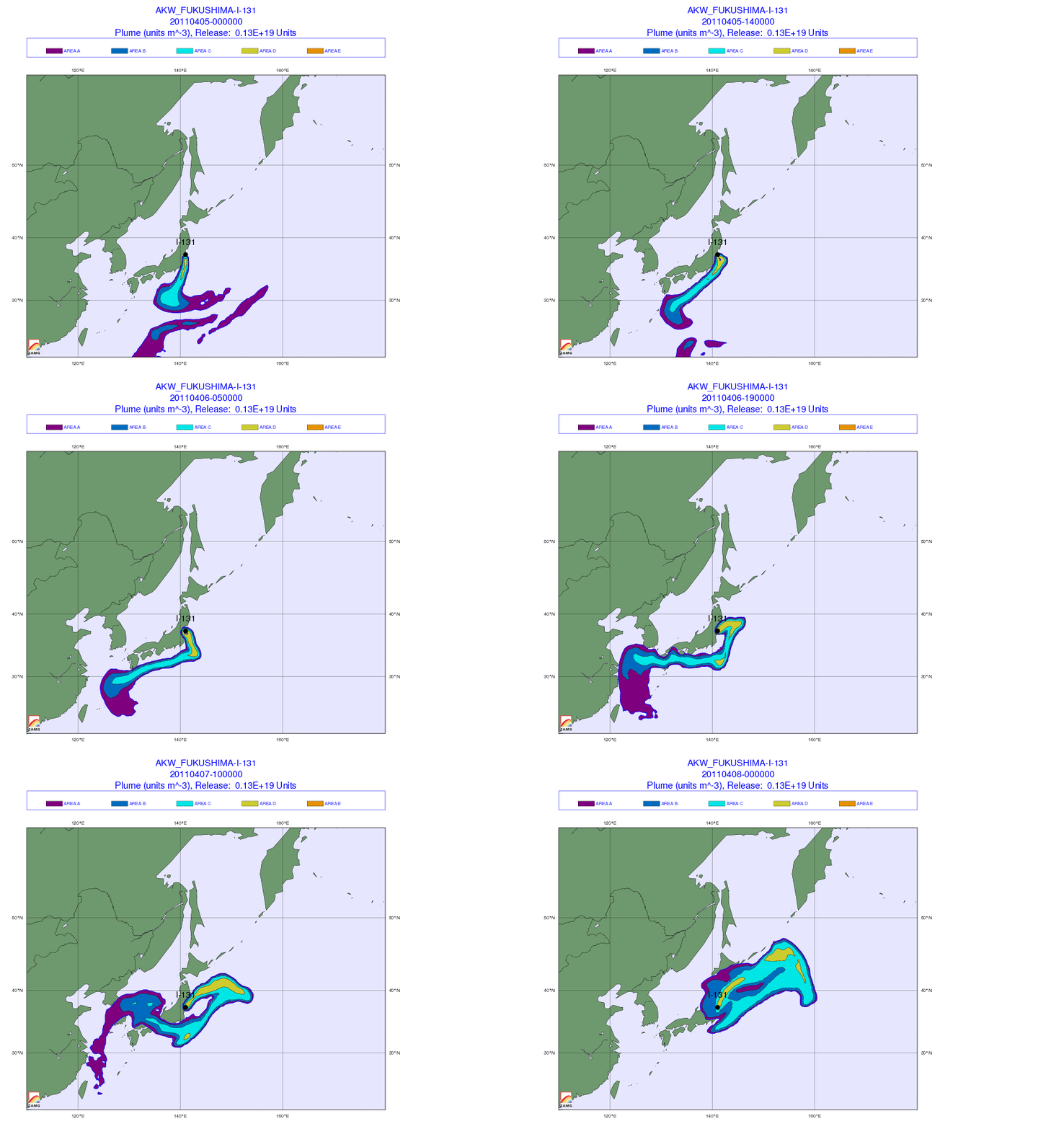
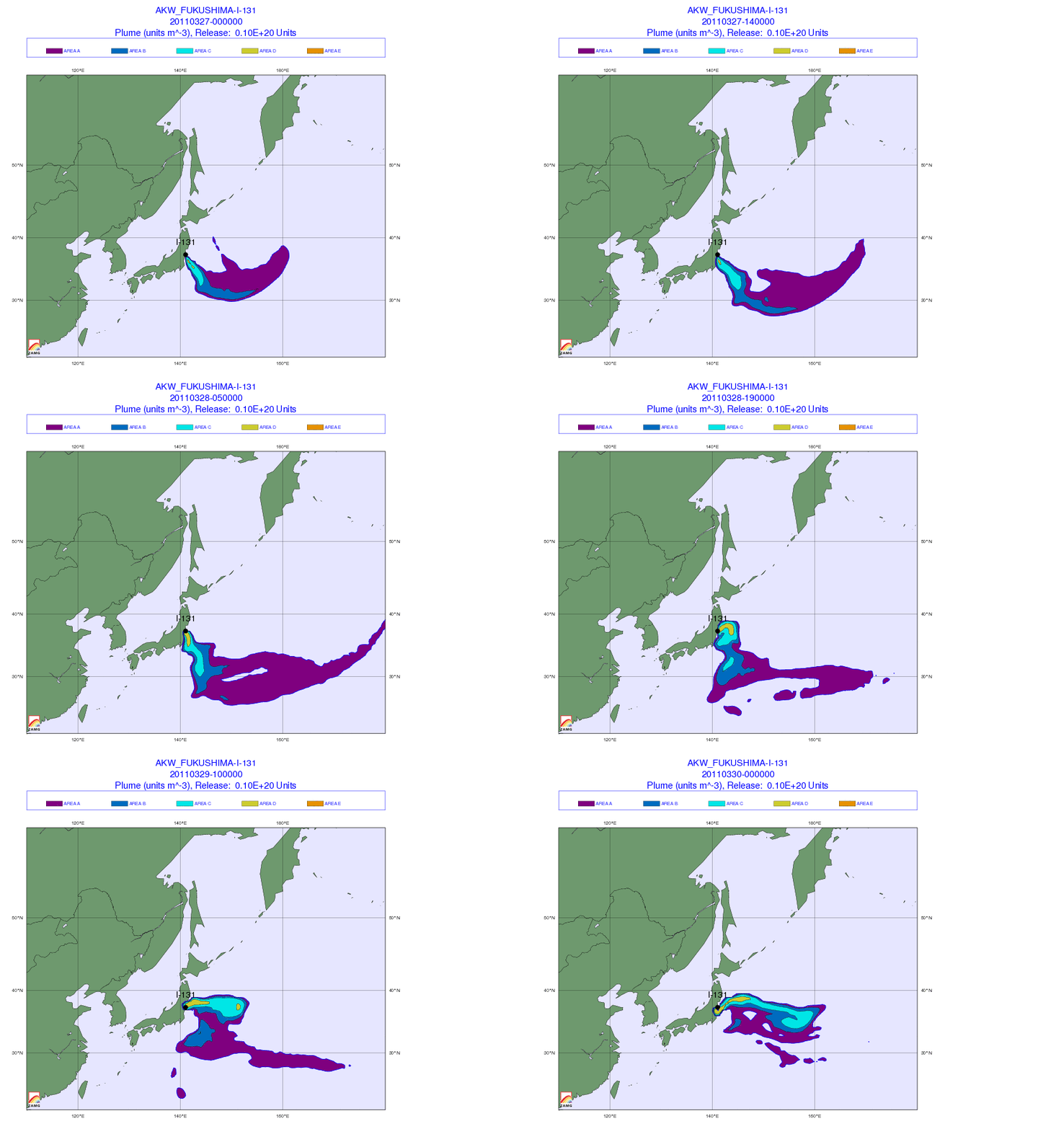
Austria's ZAMG: Iodine-131 Forecast in Japan and Far East, April 5-7

It doesn't look pretty on April 7. The only place that's safe from the plume seems to be the northern half of Hokkaido. Everywhere else, even Okinawa may be covered, though very low level. South Korea and part of North Korea may be covered.

Their forecast is here (in German).

Wednesday, March 30, 2011

#Fukushima I Nuke Plant: Iodine-131 Is 4,385 Times the Limit in Seawater Near the Water Drain

Jiji Tsushin via Yahoo Japan (in Japanese, emphasis added; 11:19AM JST 3/31/2011):

Ministry of Economy, Trade and Industry (METI)'s Nuclear and Industrial Safety Agency (NISA) announced on March 31 that from the water sample taken at 330 meters from the water drain from the Reactors 1 to 4 at TEPCO Fukushima I Nuclear Reactor iodine-131 was detected at 180 becquerel/1 cubic centimeter, or 4,385 times the limit. The Agency is going to increase the sampling points further out in the ocean, and will analyze underground water in the plant compound.

According to TEPCO, fission products from the damaged fuel rods in the Reactors or the Spent Fuel Pools may have entered the sea water. However, TEPCO cannot confirm whether the fission products have come from the water drain, and doesn't yet know how they reached the ocean.

Besides iodine-131, cesium-134 (half-life 2 years) was detected at 783.7 times the limit, and cesium-137 (half-life 30 years) was detected at 527.4 times the limit.

(Original Japanese)
 経済産業省原子力安全・保安院は31日、東京電力福島第1原発1~4号機の放水口から330メートルの地点で30日午後に採取した海水から、国の定める 濃度限度の4385倍(1立方センチ当たり180ベクレル)の放射性ヨウ素131が検出されたと発表した。保安院は、新たに沖合の検査ポイントを増やし、 敷地内の地下水についても分析する。
 東電によると、原子炉か使用済み核燃料プール内の損傷した核燃料棒からの核分裂生成物が、新たに海水に流入したとみられる。放水口からの流出は確認できず、流出ルートをまだ突き止められないという。
 またヨウ素以外にも、セシウム134が783.7倍、セシウム137が527.4倍を検出。半減期はそれぞれ2年と30年で、ヨウ素より長い。 

Sunday, March 27, 2011

#Fukushima I Nuke Plant: Austria's ZAMG Says Radioactive Iodine from Fukushima I Plant in 3 Days Equals 20% of Total Chernobyl Emissions

Zentralanstalt für Meteorologie und Geodynamik (ZAMG) is talking about the three days of March 12, 13, 14.

From ZAMG update on Fukushima I Power Plant on March 24, 2011 (in English):

During the reactor accident in Chernobyl in 1986, the total releases of Iodine-131 and Cesium-137 (whole accident scenario) were 1.76 1018 Bq and 8.5 1016 Bq, respectively. The three day emissions from Fukushima of Iodine-131 would be about 20% of the total Chernobyl emissions, while those of Cesium-137 would be between 20 and 60% of the total Chernobyl emissions, depending whether one believes in the different Iodine to Caesium ratio measured in Japan.

So, iodine-131 was 20% of the total Chernobyl emissions in three days, cesium-137 20 to 60% of the total Chernobyl depending on who you believe.

Remember, in Chernobyl, the Reactor Pressure Vessel exploded. That hasn't happened, yet, in Fukushima, and already cesium-137 could be as high as 60% of Chernobyl in 3 days.

This is their latest GIF file (3/27/2011) showing how iodine-131 is blowing.

(h/t goes to Yomiuri Shinbun writer who mentioned it in 3/28/2011 article)