Showing posts with label nuke emergency robot. Show all posts

Wednesday, November 21, 2012

Toshiba's Robot for #Fukushima I Nuke Plant Is a Dud, Japanese Media Is Mum on Shortcomings as Toshiba Tries to Sell to TEPCO


While all Japanese media seem to have simply copied and pasted Toshiba's PR material and called it a "news article", AP actually reported what the reporter saw at a demonstration held in Yokohama on November 21, 2012.

If you just read the Japanese media, Toshiba's four-legged robot has wonderful features. According to one of the media, Sankei Biz (11/22/2012):

  • It can withstand 100 millisieverts/hour radiation for almost a year, working 10 hours a day;

  • It can move at 1 kilometer/hour, work for 2 hours straight (...wait a minute, you just said it can work 10 hours..);

  • It can climb stairs, carry 20 kilograms of load.


But according to AP's Japanese reporter,

  • During the demonstration, it took a misstep, with one leg frozen up in the air, and the robot had to be carried off the stairs and rebooted;

  • It took one minute to climb one stair;

  • If it falls, it cannot get up by itself.


Duh. AP's Ms. Kageyama correctly asks, "What exactly is the robot capable of doing?"

From Bradenton Herald, quoting AP (11/21/2012; emphasis is mine):

Toshiba shows off robot meant to help at nuke site

By YURI KAGEYAMA — AP Business Writer

YOKOHAMA, Japan — Toshiba Corp. has developed a robot it says can withstand high radiation to work in nuclear disasters, but it's not clear what exactly the robot is capable of doing if and when it gets the go-ahead to enter Japan's crippled Fukushima Dai-ichi nuclear plant.

The four-legged robot can climb over debris and venture into radiated areas off-limits to humans. One significant innovation, Toshiba said, is that its wireless network can be controlled in high radiation, automatically seeking better transmission when reception becomes weak.

But the machine, which looks like an ice cooler on wobbly metal legs, also appears prone to glitches. The robot took a jerky misstep during a demonstration to reporters, freezing with one leg up in the air. It had to be lifted by several people and rebooted.

The robot was also notably slow in climbing a flight of eight steps, cautiously lifting its legs one by one, and taking about a minute to go up each step.

With obstacles that aren't as even and predictable as steps, such as the debris at the Fukushima plant, it may need as much as 10 minutes to figure out how to clear the object, Toshiba acknowledged.

And if it ever falls, it will not be able to get up on its own.

Still, Tokyo Electric Power Co. said it might use the robot to inspect the suppression chamber of the nuclear plant where a devastating meltdown occurred after a mammoth tsunami slammed into northeastern Japan on March 11, 2011.

Toshiba began developing the robot with hopes it would prove useful in helping to decommission the plant. No human has been able to enter the highly radiated chamber since the tsunami disaster.

"We need this to go in and first check what is there," Toshiba Senior Manager Goro Yanase said Wednesday.

It was unclear when a decision on the robot's use would be made, according to TEPCO, which operates the nuclear plant.

Although what Toshiba showed was top-notch robotics, what the machine might be able to do appeared limited in the face of the disaster's magnitude and complexity.

Japan boasts among the world's most sophisticated robotics technology, exemplified in the walking, talking human-shaped Asimo robot from Honda Motor Co. The inability of such gadgetry to help out with the Fukushima disaster was widely criticized.

Part of the reason is that robots, although suited for tasks such as greeting visitors at dealerships, are too delicate. Their wireless remote-controlled networks are not designed to endure high radiation. Honda has acknowledged Asimo would not have been able to withstand the environment at Fukushima, as some had suggested.

Toshiba's Yanase said the new robot, which has a dosimeter to measure radiation and six cameras, can stay in a 100 millisievert environment for about a year and can tolerate even higher radiated areas for shorter periods. At 100 millisieverts, the rise in cancer cases caused by radiation becomes statistically detectable, although even lower dose radiation is not advisable for people.

The suppression chamber was 360 millisieverts the last time it was measured, TEPCO said.

Decommissioning Fukushima Dai-ichi is expected to take decades.


Reading the Sankei article, Toshiba seems to be pressuring TEPCO to take its robot and use it (somehow) at Fukushima I Nuclear Power Plant, as Toshiba expands its portfolio of post-nuclear-disaster technologies that includes gamma-ray camera, SARRY, and the new multi-nuclide decontamination facility (ALPS).

Why does a robot have to be a hunky gadget loaded with stuff and why does it need to climb stairs to begin with? A host of tiny, self-organizing and collaborating drones still gets my vote.

If the robot has to have legs, MIT spin-off's BigDog is not bad either, able to run 5 miles per hour, carrying loads:


Compare this with the Toshiba's robot...


(H/T Twitter follower @metro172)

Tuesday, March 13, 2012

Univ. of Pennsylvania Researcher Has Flying Robots That Know How to Cooperate

Vijay Kumar at Department of Mechanical Engineering and Applied Mechanics at University of Pennsylvania has small autonomous flying robots that can sense each other and form a team to carry out tasks - surveying, searching, construction, and more - all while avoiding obstacles.

Going into reactor buildings and surveying the radiation levels is one of the things Dr. Kumar actually mentions in the video.

Fukushima I Nuke Plant could use a swarm of these tiny helicopter robots.

Friday, June 24, 2011

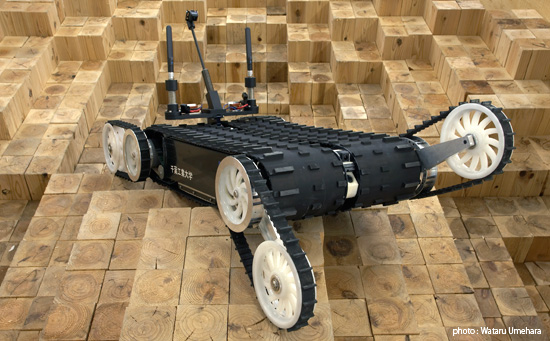
Made-In-Japan Robot "Quince" Joined the Also-Failed at #Fukushima I Nuke Plant

Kurion's water treatment system underperformed by a vast margin, T-Hawk crashed on the roof of the Reactor 2 building, and now the Japanese robot "Quince" got caught in a bad juju at Fukushima I Nuclear Power Plant.

"Quince" was designed and developed by Chiba Institute of Technology, and was going to install the water gauge for the highly contaminated water (radiation near the surface of water was 430 millisieverts/hour the other day) in the basement of the Reactor 2's reactor building.

(Photo is from CIT's site. You can see how it is supposed to work here on Youtube.)

Quince tried to go there in the morning of June 24, but it got stuck in the stairway leading to the basement, and had to be retrieved by the carbon-based workers.

From AP Tokyo (6/24/2011):

The Quince robot, developed by Chiba Institute of Technology for nuclear and biological disaster relief activity, had ventured out into the Unit 2 reactor building to set up a gauge to measure the contaminated water pooling in the basement. Radioactivity inside the reactor buildings is too high for workers to take measurements there.

The machine got stuck at a staircase landing and failed to go downstairs, TEPCO spokesman Junichi Matsumoto said. A cable that was supposed to drop a gauge into the basement also malfunctioned.

The workers retrieved the robot and were going to make adjustments before sending it back in for another try, Matsumoto said. He did not elaborate.

TEPCO's handout for the press doesn't make any mention of it, although it does mention the crashed T-Hawk.

By the way, the above AP article, just like any other reports by the Japan-based media, continues to say:

TEPCO and the government have said they hope to achieve a cold shutdown of the reactors by January by bringing the core temperatures to below 100 Celsius (212 Fahrenheit.)

A "cold shutdown" cannot even be defined for a broken reactor where the fuel core had melted away along with control rods and other in-vessel equipment and got out of the Reactor Pressure Vessel and probably out of the Containment Vessel. The RPV is broken, and so is the Containment Vessel. Sure, TEPCO measures temperature of the RPVs, but what does that mean, when the corium is already out of the RPVs? How could a temperature of a broken RPV be an indication for a "cold shutdown"? Do they know how hot the escaped corium is, or where exactly the corium is right now?

Do reporters ask such questions?

Saturday, May 7, 2011

Robot Expo at #Fukushima I Nuke Plant: Now Sweden's Brokk Is Coming

The CEO of the company says his machine is the best and the toughest, having been tested in decommissioning and cleanup at the Chernobyl nuke plant.

From Robotland blog (5/5/2011):

"Swedish Brokk, the world´s leading manufacturer of remote controlled demolition machines, is delivering two Brokk 330 Diesel robots and a brand new larger robot to Fukushima nuclear plant in Japan.

"The first task for the machines is to provide access to highly contaminated areas and clean up contamination. “One key difference between Brokk’s demolition robots and other robots currently on site is that our machines are capable of carrying out multiple different and tougher tasks, such as tearing down concrete structures and take care of heavier contaminated materials” says Martin Krupicka CEO of Brokk.

"The first contact with Brokk and its Japanese partner BGE Company Ltd was taken soon after the accident at Fukushima, as Brokk demolition robots are known globally for decommissioning and material handling in radioactive environments.

"Brokk has successfully delivered robots for demolition, decommissioning and disposal of radioactive material to the nuclear industry for over twenty years, including to the USA, France, Great Britain, Russia and Japan. Brokk machines have for example been used for decommissioning and cleanup at Chernobyl in Urkraine. Brokk was chosen for this extremely challenging work by Taisei Corp, which works for TEPCO at Fukushima, because of our extensive experience in the nuclear industry. Brokk has over two hundred machines at various nuclear sites worldwide. "

Wednesday, March 16, 2011

#Fukushima I Nuke Plant: French Company Offers Robots to TEPCO

Please just send them to TEPCO, don't bother with the Japanese government. TEPCO, just accept them and start using them, don't bother with the Japanese government.

The article by Rudolphe Gelin at Atlantico.fr has to take some obligatory snide comments about why Japan, which boasts of robotic technology, hasn't sent the robot that can deal with the nuclear emergency at Fukushima I Nuke Plant.

We all know why, because they haven't got any. They don't even have many functioning emergency power generators! They've been using regular fire engines to try to pump water. French being French, I understand, but please, can't you do without taking a pot shot, for this once?

But then Monsieur Gelin says the French company has offered their nuclear emergency robots to TEPCO.

Gelin says French robots can do the following:

  • Remotely controlled
  • Enter the building
  • Take pictures
  • Make accurate diagnosis
  • Larger models can close valves, cut pipes, and possibly hold a fire hose to get water to the core.

I don't quite care how snooty this writer is, please just send those robots and put them to real test.

From Atlantico.fr (3/16/2011) in French (emphasis is all original):

Robots français pour centrale japonaise en panne

Le Japon est sans conteste la patrie de la robotique, et pourtant ! Seuls la France et l'Allemagne disposent de robots spécialement préparés pour intervenir dans des centrales nucléaires, capables de résister à des taux de radioactivité extrêmes. Henri Proglio, le PDG d'EDF a proposé à l'opérateur japonais Tepco de lui envoyer les robots français.

(Here comes snide remarks..)

Depuis des décennies, les Japonais font beaucoup d’efforts sur la robotique personnelle, de confort ou ludique, car c’est là qu’il y a un marché de masse, intéressant économiquement. En revanche, ils ont très peu travaillé, voire pas du tout sur la robotique d’intervention, qui restera toujours un marché de niche. Les Japonais se sont dits qu’en cas de besoin, ils iraient acheter des robots spécialisés en Allemagne, aux Etats-Unis ou en France pour s’équiper.

Résultat, les robots humanoïdes que l’on connaît au Japon, Asimo de Honda, HRP2 de Kawada Industries, quand on les regarde, on a l’impression qu’ils savent tout faire. En fait, non. Ils ne savent intervenir que dans un environnement très connu et normé avec un logiciel comportemental préinstallé. Les objets doivent être à la place prévue, ce qui est incompatible avec une situation de chaos comme on la connaît dans la centrale de Fukushima, et en plus ils ne sont pas du tout durcis aux radiations. Asimo tiendrait ¼ d’heure à Fukushima, tous ses processeurs seraient en panne aussitôt !
De fait, les Japonais n’ont pas l’équivalent d’un groupe d’intervention prêt à intervenir dans une centrale.

(But in contrast, French and Germans were serious..)

Au contraire, après Tchernobyl, s’est posée la question en France et en Allemagne de la pertinence d’avoir des robots prêts à intervenir si un incident nucléaire devait se produire dans ces deux pays proches et équipés en centrales nucléaires.

EDF, le CEA et Areva ont donc investi dans un projet qui s’appelle Intra, destiné à bâtir une équipe d’hommes prêts à intervenir, avec des camions et du matériel, sur une centrale en difficulté. Parmi les moyens dont dispose Intra, il y a des robots qui ne sont pas des robots que l’on trouve dans le commerce, mais prêts à intervenir dans des conditions extrêmes. Ils sont spécialement préparés, durcis, pour opérer les missions dont on a besoin dans une centrale en panne.

(But the author admits that even machines do not like radiation, and this French robot hasn't been tested in a real situation like this..)

Le mot clef, c’est durci. Les hommes n’aiment pas les radiations, mais la mécanique et l’électronique non plus. Les processeurs, les transistors, toute l’électronique est perturbée par les radiations nucléaires, et cela peut aussi abimer les joints en caoutchouc ou les durites. Il faut donc prendre certaines dispositions pour que ces belles mécaniques ne s’abiment pas trop vite. Il faut aussi les concevoir afin de pouvoir les décontaminer, pour qu’ils ne deviennent pas eux mêmes des déchets après intervention.

Henri Proglio, le PDG d’EDF, a proposé d’envoyer des robots et du matériel de détection au Japon...

Ce serait un test en grandeur nature pour ces équipes. Nous, en France n’avons jamais eu d’incident de cette ampleur. Cela permettrait de valider en conditions réelles l’utilisation de ces robots qui contrairement à Asimo ou HRP2 sont téléopérés. On les pilote à distance avec une télécommande et ils font ce qu’on leur dit de faire. Ils pourraient ainsi entrer dans les bâtiments, prendre des images, faire un diagnostic précis de la situation. Les plus gros de ces robots peuvent fermer des robinets, couper des tuyaux, éventuellement tenir une lance à incendie pour aller arroser le cœur.

(Then the last shot at Americans, who has robotic trucks that may be of some help...)

Maintenant, les militaires américains aussi ont des moyens : ils disposent de camions robotisés, qui pourraient aussi rendre une partie du service attendu, et aller arroser le cœur.

If you want to see some amusing translation, here's Google Translate.