Showing posts with label NISA. Show all posts

Tuesday, March 26, 2013

JNES Calculation of the Amount of Radioactive Materials Released from #Fukushima I Nuke Plant


Japan Nuclear Energy Safety Organization (JNES), an independent administrative corporation under the Ministry of Economy, Trade and Industry, issued the result of its calculation of radioactive amounts released from Fukushima I Nuclear Power Plant in the first week of the nuclear accident.

From JNES presentation (3/27/2013), unit is petabecquerel (1x10^15) and 1 petabecquerel is 1,000 terabecquerels:

From March 11 to March 17, 2011,

I-131: 250 to 340 petabecquerels (or 250,000 to 340,000 terabecquerels)
Cs-134: 8.3 to 15 petabecquerels (or 8,300 to 15,000 terabecquerels)
Cs-137: 7.3 to 13 petabecquerels (or 7,300 to 13,000 terabecquerels)

For I-131, JNES's calculation, which is based on the accident progress analysis, is closest to TEPCO's number which is the highest (500 petabecquerels, or 500,000 terabecquerels).

In the image below (English labels added by me), from the top row, the entities that did the analysis are:

  • Japan Nuclear Energy Safety Organization (JNES)

  • TEPCO

  • Japan Atomic Energy Agency (JAEA)

  • Japan Agency for Marine-Earth Science and Technology (JAMSTEC)

  • Central Research Institute of Electric Power Industry (CRIEPI)


All except JNES based their calculation on the actual measurement of radioactive materials.


I find it interesting that JNES's calculation shows potentially more Cs-134 than Cs-137. From the actual measurements on the ground, I believe the ratio has been 1:1 to 1:1.2.

On the night of March 11, 2011, the now-defunct Nuclear and Industrial Safety Agency (NISA) had JNES do the simulation using the Emergency Response Support System (ERSS) to predict the progression of the accident. JNES faxed the result of the simulation for Reactor 2 to NISA as early as 9PM on March 11, the simulation for Reactor 1 by noon on March 12 (more than three hours before the explosion), and the simulation for Reactor 3 at 6:30AM on March 13. The faxed results for Reactor 2 was delivered to the Prime Minister's Official Residence just past midnight on March 11 (early hours of March 12). (Jiji Tsushin, 9/3/2011)

No one acted on them.

NISA was trying to figure out the areas to have people evacuate. In addition to ERSS, the agency also ordered SPEEDI simulations done, using the information that the agency collected on its own. The agency dropped that effort when Prime Minister Kan and his ministers thought they knew best and drew concentric circles around the plant and decided the evacuation zones, ignoring the emergency protocol that specifically said they should use SPEEDI simulations for that purpose. (Asahi Shinbun's "Trap of Prometeus" Part 2)

Thursday, December 13, 2012

Radioactive Materials Dispersion Simulation for Nuclear Regulatory Authority Was Done by One Worker, Using a Pocket Calculator


(Update 12/14/2012) I asked Ryuichi Kino (who's now allowed back in TEPCO press conferences) about these maps. As far as he knows, these maps still ignores geographical information, and treat the land as flat. He says he will ask about it in the next press conference of the Nuclear Regulatory Authority/Agency.

==========================

The dispersion simulation maps first announced by the Nuclear Regulatory Authority right were full of errors and had to be redone. NRA announced the corrected maps on December 13, but according to the article by Tokyo Shinbun, the real story is not the maps but how the maps were created.

According to the Tokyo Shinbun article as quoted at "Zamamiyagarei" blog, the history is as follows:

  1. Nuclear and Industrial Safety Agency under the Ministry of Economy, Trade and Industry, before it was shut down, decided to have the simulation maps created for each nuclear power plant in Japan. It contracted Japan Nuclear Energy Safety Organization (JNES) to do the job. [I've read elsewhere that the job was for mere 10 million yen, or US$119,000).]

  2. JNES had one person in charge of the job, and he gave it to a long-term subcontractor called CSA Japan in Tokyo, as usual.

  3. CSA Japan had one person doing the job of creating the simulation maps for the entire nuclear power plants in Japan, who used his pocket calculator to calculate the dispersion models. He apparently made numerous errors, resulting in the inaccurate simulation maps that NRA announced, to their embarrassment.

  4. No one at JNES or NRA checked the work.


It's not that using a pocket calculator is bad. An Indian "computor" (a person who computes) calculated the height of Peak XV in Himalaya by hand calculation. It is all in the brain, after all.

CSA Japan was incorporated in 1999 with the capital of 10 million yen. Its main customers are government agencies and large corporations in nuclear industry. JNES comes near the top of the customer list. TEPCO also seems to be their regular customer:

Japan Atomic Energy Agency
Japan Nuclear Energy Safety Organization
Tokyo Electric Power Company
The Japan Atomic Power Company
TEPCO Systems Corporation
Institute of Nuclear Safety System ,Incorporated
Genden Information System Co.
Mitsubishi Heavy Industries, Ltd.
Nuclear Fuel Industries ,Ltd.
Mitsui Engineering & Shipbuilding Co., Ltd.
MHI Nuclear Engineering Company, Limited
Itochu Techno-Solutions Corporation
TOiNX (Tohoku Information Systems Company, Incorporated)


Why did NISA need to create simulation maps by contracting them out cheaply, which ended up on the lap of one unhappy employee at a subcontractor who used a pocket calculator? They have SPEEDI.

My guess is that NISA figured it was cheaper to contract out anew than to run SPEEDI.

"Cheap, cheap", sang a NISA bird. So sings just about every government agencies in Japan, large and small. Money before safety. That's what two "lost decades" have done to the country.

By the way, the first set of maps not only got the wind directions wrong, but they didn't consider the topography at all, treating the land in Japan as flat. I don't know if that has been corrected in the new version. With a pocket calculator, it may have been a bit too complicated.

Sunday, December 2, 2012

TEPCO's Teleconference Video on March 16, 2011: "Lunch Menu is Biscuits and Canned Saury"


About 50 minutes into the March 16, 2011 video linked in the previous post, there is an announcement from the Workers Welfare Section of Fukushima I Nuclear Power Plant:

This is Workers Welfare Section. Lunch is distributed at ... Today's menu is biscuits and canned saury. Please bring your own spoon. If you don't have one...


I'll never forget the NISA official who said in March last year that it was none of the government's responsibility to provide the workers at the plant with decent food. He said, "Yes we're aware of the situation, but it's basically TEPCO's problem. No, we're not going to do anything about it."

The workers didn't have enough blankets in the beginning, either.

As hardly anyone in Japan has paid attention to details on what happened and why, this will be repeated in the next accident.

Tuesday, August 28, 2012

NISA's New Safety Standard May Allow Nuclear Reactors on Top of Active Faults to Continue Operation


(No, this is not an April Fool's Day's joke.)

Totally, absolutely in line with Prime Minister Noda's intention of seeking the "fourth way" for the future energy policy on reliance on nuclear power, the Nuclear and Industrial Safety Agency (which is still the one and only regulatory agency over the nuclear industry in Japan) is now considering installing a new safety standard:

You can continue to operate a nuclear reactor even if the reactor happens to sit on top of an active fault, as long as the expected size of dislocation is small enough.


This Kyodo News has the largest number of retweets I've seen on the websites of the Japanese mainstream media, currently with 9,015 retweets.

From Kyodo News (8/28/2012):

原発直下に地盤をずらす「断層」があっても原発の運転を一律に禁止せず、継続の可能性を残す新たな安全評価基準の導入を、経済産業省原子力安全・保安院が検討していることが28日、分かった。

It was revealed on August 28 that the Nuclear and Industrial Safety Agency under the Ministry of Economy, Trade and Industry was considering the introduction of a new safety evaluation standard that would leave a possibility of continued operation of a nuclear reactor even when the reactor sits on top of a fault that could shift the ground, instead of uniformly banning the operation of such reactors.

 保安院は従来「活断層の真上に原子炉を建ててはならない」との見解を示していた。新基準では、これまでは活断層と判断される可能性があった一部の断層について原発の直下にあっても、ずれの量が小さく原子炉建屋などに影響が生じないと評価されれば原発の運転継続も可能になるとみられる。

So far, the NISA's opinion has been that "a nuclear reactor cannot be built on top of an active fault". Under the [proposed] new standard, it is expected that the continued operation will become possible for reactors that sit on top of certain faults which may be active faults, as long as the shifting of the ground is small enough and there is no effect on the reactor buildings.

 だが「ずれの量の正確な評価手法はまだ完全ではない」(保安院)など課題も多い。

There are many issues still to be resolved, as NISA admits that the method to precisely evaluate the size of the shifting is not yet perfect.


In the meantime, the prime minister who seeks the "fourth way" further elaborated on his stance. According to Jiji Tsushin (8/28/2012), Mr. Noda had a casual dinner in Tokyo with the DPJ's newbies (and apparently open to the press), where he told them and the press that he couldn't commit easily to "zero nuclear" because of national security concerns.

Monday, August 13, 2012

Jiji Tsushin: NISA Ordered TEPCO Not To Talk About Rising Pressure in Reactor 3 on March 14, 2011 Because NISA Official Couldn't Reach His Supervisor


That, according to Jiji Tsushin, is captured in the video TEPCO released and has been allowing the media to view at TEPCO's Headquarters in Tokyo. The company has made 1.5-hour video for the public consumption, but the media has been reporting new findings in the video only they are allowed to view, and this is one of the latest.

TEPCO was ready to hold a press conference immediately after it learned of the rising pressure in Reactor 3 in the early morning on March 14, 2011. But an elite bureaucrat at the Nuclear and Industrial Safety Agency at an elite ministry (Ministry of Economy, Trade and Industry) needed to find his boss to decide whether TEPCO could hold a press conference to tell the general public of such a terrible news. This bureaucrat told TEPCO, "Absolutely not", because he couldn't find his supervisor and he didn't want to be the one in charge at NISA when this bad news was disclosed.

Fit for an agency whose Director General, being a liberal arts major as he claimed as an excuse, went home from the Disaster Response Headquarters at Prime Minister's Official Residence in the evening of March 11, 2011 and never returned.

I suppose this official knew, as a matter of fact, what had happened to the NISA official who had talked about a possible core melt in Reactor 1 at the noon press conference on March 12, 2011. He was dismissed immediately after, by the Kan administration.

From Jiji Tsushin (8/13/2012; emphasis is mine):

保安院指示で公表遅れ=水素爆発直前、3号機の圧力上昇-「上司と連絡取れなかった」

Delay in disclosure because of NISA's order - rising pressure in Reactor 3 right before the hydrogen explosion because [NISA official] "couldn't locate my supervisor".

東京電力福島第1原発3号機が水素爆発を起こす直前の昨年3月14日朝、同機格納容器の圧力を示す数値が急上昇したことを受け、東電が記者発表しようとしたところ、経済産業省原子力安全・保安院から公表を待つよう指示されていたことが、同社のテレビ会議映像などで13日、分かった。

On the morning of March 14 last year right before the hydrogen explosion at Reactor 3 at Fukushima I Nuclear Power Plant, TEPCO was about to give a press conference on the news that the parameters that monitored the pressure inside the Reactor 3 Containment Vessel indicated a sudden spike in pressure but the company was ordered to wait by the Nuclear and Industrial Safety Agency, [we learned] on August 13 [after viewing] TEPCO's teleconference video.

同映像によると、3号機では14日午前6時ごろ、格納容器の圧力の値が異常に上昇したことを把握。吉田昌郎所長(当時)は水素爆発が起きるかもしれないとして、現場にいる作業員を一時的に退避させたが、この情報を保安院が公表したのは同日午前9時すぎ、同機原子炉建屋が水素爆発を起こす約2時間前だった。

According to the video, [TEPCO] learned of the abnormal rise in pressure inside the Containment Vessel of Reactor 3 at about 6AM on March 14, 2011. Plant Manager Masao Yoshida feared for a hydrogen explosion and instructed the workers at the scene [near Reactor 3?] to take shelter. However, it was not until after 9AM that day when NISA finally made the announcement of this information, about 2 hours before the hydrogen explosion at the Reactor 2 building.

福島第1原発の東電広報班はこれに先立ち、報道向け広報文を準備したが、本社とのやりとりの中で担当者は「国から止められ、プレス発表を行わずに待っている状況」と発言。本社の社員とみられる人物も「この事象に関しては、保安院の方もプレスへの情報を全て止めていると。事業者からの公表もやめろということです」と話した。

TEPCO's press relation team at Fukushima I Nuke Plant had prepared the press release, but the person in charge at the plant said during the exchange with TEPCO Headquarters, "The national government has ordered us not to, and we are waiting, without giving any press conference." A person at TEPCO Headquarters was heard saying, "About this event, NISA has stopped all communication to the press, and we as the plant operator are told not to disclose anything."

さらに、本社では「先ほどのプレスに関する情報です。保安院に確認しましたら、絶対に駄目だというのが向こうの見解で、このプレスは行うなという強い要請、指示だそうです」との声も録音されていた。

Further, at TEPCO's Headquarters, someone was recorded saying "[Additional] information about the press release. I've confirmed it with NISA, and their opinion is "absolutely not", this press release must not be made, it's a strong demand and order."

保安院は公表が遅れたことについて、「上司と連絡が取れず、東電にも発表を待ってもらっていた」などと説明している。

On this delay in disclosure, NISA [official] explains, "[I] couldn't get hold of my supervisor, so I asked TEPCO to delay the release of information."

国会の事故調査委員会も7月に公表した最終報告で、この問題について「(保安院の発表まで)危機的状況が(少なくとも)2時間以上も国民に知らされなかった」などと指摘していた。

In the final report by the National Diet Fukushima Accident Independent Investigation Commission released in July, the Commission pointed out "(Until the announcement by NISA) citizens were not informed of this critical situation for (at least) more than 2 hours."


Reactor 3 building would still have blown up regardless of whether TEPCO or NISA held a press conference, but it might have made a tremendous difference in alerting the residents in the surrounding areas and evacuate them sooner. After all, from last year's articles and my own posts, Reactor 3's explosion was so downplayed by the government that residents were given conflicting information about whether there was an explosion at all, several hours after the explosion took place.

There were many people still remaining in Namie-machi, Minami Soma City, and people even in Futaba-machi and Okuma-machi (whose residents should have been evacuated by then), looking for survivors of the earthquake and tsunami on March 11, 2011.

We would never know, but I always wonder. What would have happened if TEPCO had said "NO" to NISA's order and held a press conference? What could NISA do? Fire TEPCO? Fine the company for not following orders? Sue the company for fanning "baseless rumors" and create panic?

Sunday, July 8, 2012

Ooi Nuke Plant Restart: Senior Vice Minister Tells KEPCO "Lowly Jellyfish Should Never Stop a Modern Nuclear Power Plant!"


Little does he know about nuclear power plants.

As the readers of this blog have tirelessly pointed out, jellyfish and nuclear power plants go together very well. (For more info, here, and here, for a start.)

But never mind that. To Seishu Makino, Senior Vice Minister of Economy, Trade and Industry, it's all about your fighting spirit. Against jellyfish.

From Jiji Tsushin (7/9/2012):

関西電力大飯原発3号機(福井県おおい町)がフル稼働に達したのを受け、安全監視の現地責任者の牧野聖修経済産業副大臣は9日未明、同町で記者団に「行き詰まっていたエネルギー政策が一歩前進した喜びはあるが、4号機の再稼働までミッション(任務)は続く。今まで以上に気を引き締め、安全のための職務を遂行したい」と語った。大飯4号機は18日に原子炉を起動し、21日にも発電と送電を再開する予定。

On the resumption of full operation of Reactor 3 at KEPCO Ooi Nuclear Power Plant (Ooi-cho, Fukui Prefecture), Senior Vice Minister of Economy, Trade and Industry Seishu Makino, who is in charge of special surveillance on site to secure safety, spoke to the press in Ooi-cho in the early hours on July 9. "I am happy that it is a one step forward for the energy policy that has been deadlocked. But the mission [he actually said this word in English, instead of using the perfectly good Japanese word for it] continues until Reactor 4 restarts. We will gird ourselves more, and perform our duty to insure safety", he said. Reactor 4 at Ooi is scheduled to restart on July 18, with power generation and transmission to restart on July 21.

また、3号機の海水取水口周辺でクラゲが大量発生し、出力低下が懸念されたことには、「科学技術の粋を集めた原発で、クラゲごときに惑わされてはいけない」と関電に対策を指示したと述べた。

Commenting on the concern for the power decline because of jellyfish swarmed near the water intake for Reactor 3, he said he instructed KEPCO to come up with countermeasure, because "We must not be disturbed by [lowly creasures like] jellyfish, at a nuclear power plant built with the best of science and technology."


That this person can only talk in cliches is amazing, and in this case extremely funny (for Japanese speakers).

One of my Japanese Twitter followers just tweeted me that the jellyfish at Ooi Nuke Plant are recognized as "enemy" of some sorts by the Nuclear and Industrial Safety Agency under the Ministry of Economy, Trade and Science. Enemy, like a alien monster in a Godzilla movie.

NISA's email to journalists on the Ooi jellyfish that swarmed the water intake apparently describes the incident as "jellyfish attack/invasion" (クラゲ来襲). Any Japanese who sees this word 来襲 would associate it with those alien monsters from outer space to be repelled by Godzilla or Ultraman.

The follower who tweeted the NISA's characterization of the incident astutely observes that this senior vice minister sounds (and looks, too) like the fictional minister in charge of science and technology who appears in those Godzilla/Ultraman movies and makes a futile attempt after futile attempt to direct the Self Defense Force to repel the alien monster invasion, telling them "We can't be defeated by such a creature! We will commandeer the best of the best of our science and technology to repel and destroy it!"

Someone already created an image of jellyfish swarming and protesting "再稼動反対 Saikado Hantai" (against restart).

Friday, June 29, 2012

#Fukushima's "Lesson" Learned Well by the Japanese Government: Don't Plan for Core Melt, Don't Train, Don't Alarm Residents


The first Nuclear Emergency Preparedness Training since the Fukushima I Nuclear Power Plant accident was being planned last year. What did the national government assume in an nuclear accident, now that they had supposedly learned the "lessons" from the Fukushima accident?

Why, eliminate the situations like "core melt" (meltdown), of course! We cannot alarm the public, can we?

From Kyodo News (6/30/2012; emphasis is mine):

国の訓練想定「炉心溶融なし」 原発事故後、「不安増長」と

Assumption by the national government on [Nuclear Emergency Preparedness] training: "No core melt", as it would "increase uneasiness" after the nuclear accident.

東京電力福島第1原発事故後、初となる国の原子力総合防災訓練について、計画作りを指示された原子力安全基盤機構が「最悪ケースの想定は避ける」として、福島事故で起きた炉心溶融(メルトダウン)を除外するなどの方針をまとめていたことが30日、分かった。共同通信が情報公開請求で計画案を入手した。

It was discovered on June 30 that the Japan Nuclear Energy Safety Organization (JNES) had drafted the plan for the National Nuclear Emergency Preparedness Training [last year] that would exclude the possibility of core meltdown as had happened in the Fukushima nuclear accident and avoid assumption of the worst-case scenario. JNES had been instructed to draft the plan [by the national government]. Kyodo News obtained the draft plan with the freedom of information request.

「地域住民の不安を増長する」という理由。一方で、福島事故で役立たなかった対応拠点施設(オフサイトセンター)が一定段階から本格的に機能すると想定していた。

[The reason for excluding "core melt"] was because it would increase uneasiness among the local residents. In the meantime, the plan assumed the Off-Site Centers, which didn't work in the Fukushima nuclear accident, would be functioning fully after a certain period of time.

同機構は、経済産業省原子力安全・保安院の安全規制を実務面で支援。保安院の指示で2011年度訓練の計画案を作成した。

JNES supports the practical aspect of safety regulations by the Nuclear and Industrial Safety Agency under the Ministry of Economy, Trade and Industry. It drafted the plan for the Training for the fiscal 2011 under the instruction from NISA.


More than not assuming the core melt, the fully-functioning Off-Site Centers triggered a belly laugh from me.

Here's the list of all the Off-Site Centers, at NISA's site. By design, they are located within the 20-kilometer radius from the respective nuclear power plants or nuclear facilities.

The Off-Site Center for Fukushima I Nuclear Power Plant was only 5 kilometers away from the plant, and didn't even have the maps of the areas outside the 10-kilometer radius from the plant. It didn't have air filters to block radioactive materials either.

The Off-Site Center for Ooi Nuclear Power Plant (which has been having a series of seemingly minor problems indicative of deferred or sloppy maintenance) is 7 kilometers away from the plant, and the only way to access the plant is by one road.

Japan is very ill-suited to operate a nuclear power plant, and it is not the matter of technology.

(Neither is India, if workers got sick drinking tritium-laced water from a water cooler... I wonder how much removed the water was from the source of tritium...)

Tuesday, June 26, 2012

KEPCO Can't Find Photos of Fault at Ooi Nuclear Power Plant, But NISA Says No Problem


We are supposed to take their word for it that it's not active and that the plant is is safe.

Fukui Shinbun reports that KEPCO, Ooi Plant operator, cannot find photographs of the crushed zone that runs through the plant compound, between Reactor 2 and Reactor 3 buildings.

Two university researchers have said publicly that the crushed zone could be active faults or that it could be activated by the active faults nearby.

From Fukui Shinbun (6/26/2012):

大飯原発の敷地内断層写真未提出 保安院要請に関西電力

KEPCO hasn't submitted the photos of faults at Ooi Nuke Plant despite the request from NISA

再稼働準備中の関西電力大飯原発(福井県おおい町)の敷地内を走る軟弱な断層(破砕帯)が、活断層と連動して地表をずらす危険性が指摘されている問題で、経済産業省原子力安全・保安院は25日、関電に求めた破砕帯の写真が提出されていないことを明らかにした。

It has been pointed out by researchers that the crushed zone at the Ooi Nuclear Power Plant may cause the slippage of the ground surface when the active faults move. The plant is currently being prepared for the restart in Ooi-cho in Fukui Prefecture. The Nuclear and Industrial Safety Agency disclosed on June 25 that the photographs of the crushed zone that the agency had asked KEPCO to submit weren't submitted.

 保安院によると、要請には法的強制力はなく、関電は「写真を探しているが見つからない」としている。保安院は「データの要請は情報収集の一環」としており、大飯原発の破砕帯の活動性はないとの見解は変えていない。

According to NISA, the request was not legally binding. KEPCO says "We're looking for the photographs but we can't find them." NISA says the request for the photographs is part of the information gathering, and the agency hasn't changed its opinion that the crushed zone at Ooi Nuke Plant is not active.

 同日、参院議員会館で開催された市民団体などとの会合で保安院が明らかにした。

NISA disclosed this information during the meeting with citizens' groups held at the Office Building for the members of the House of Councilors (Upper House).

 保安院は、渡辺満久東洋大教授(変動地形学)らが今月初め、破砕帯がずれる危険性を指摘したのを受け、情報収集を始めた。1985年に関電が国に提出した大飯3、4号機の増設申請書に掲載された調査図面の原図と、破砕帯の写真を求めたが、原図しか提供されていないという。

NISA started collecting information after Professor Mitsuhisa Watanabe of Toyo University (tectonic geomorphology) had pointed out the danger of the crushed zone shifting, earlier this month. The agency requested the original survey map that was attached to the application submitted by KEPCO to the national government in 1985 to build Reactors 3 and 4 at Ooi Nuclear Power Plant, and the photographs of the crushed zone. NISA said KEPCO only submitted the original survey map.

 また、保安院専門家会議の委員のうち活断層に詳しい6人に非公式に見解を尋ねたところ、一部の委員からは「現地を調査するべきだ」との意見があったという。

NISA also said it had unofficially asked the agency's 6 expert commissioners who were knowledgeable about active faults, and some of them were of the opinion that a field survey should be carried out.


I have a feeling that KEPCO is looking all over the place for the photographs, in all locations where they know for sure they don't keep.

The Ooi plant is set to restart on July 1.

Monday, June 25, 2012

Alarms Sounded 26 Times at Power Transmission Line Monitoring Systems for Ooi Nuke Plant


The Nuclear and Industrial Safety Agency, still the one and only regulatory agency for the nuclear power plants in Japan, disclosed it during the press conference in Ooi-cho on June 24. Plant operator KEPCO says that happens all the time, nothing to worry about.

And the famous last word, "It won't have any effect", on the restart.

Sankei Shinbun (6/24/2012) reported:

警報作動は計26回 大飯原発の送電線 

Alarm sounded 26 times at the power transmission line to Ooi Nuke Plant

関西電力大飯原発(福井県おおい町)と京都市の送電施設を結ぶ送電線の監視設備であった警報作動は、23日深夜から24日午前にかけ、2カ所で計26回に上ったことが分かった。関電と経済産業省原子力安全・保安院が24日、おおい町での記者会見で明らかにした。

Alarms sounded 26 times total, at two monitoring facility locations for the power transmission lines between KEPCO's Ooi Nuclear Power Plant (Ooi-cho, Fukui Prefecture) and the power transmission facilities in Kyoto City from midnight on June 23 till June 24 morning. KEPCO and the Nuclear and Industrial Safety Agency (NISA) announced the incident in the press conference held in Ooi-cho on June 24

 関電によると、福井県南部から京都府北部の、関電高浜原発(同県高浜町)や送電施設間を結ぶ送電線の設備計5カ所でも、同様に大気の不安定な状態によるとみられる警報作動が23~24日に計32回あったという。

According to KEPCO, alarms also went off 32 times at 5 power transmission facilities located in southern Fukui and northern Kyoto Prefectures between KEPCO Takahama Nuclear Power Plant and the power transmission facilities, due to the unstable atmosphere.

 警報が作動したのは、23日午後6時41分から24日午前8時12分まで、計58回。実際に送電設備の異常はなく、大気のゆらぎにより監視用の無線信号が途切れたことが原因だったとしている。

In all, 58 alarms sounded between 6:41PM on June 23 and 8:12AM on June 24. There was no actual problem at the power transmission facilities themselves, and [KEPCO and NISA says] the alarms were due to the wireless signals for monitoring were cut off by the atmospheric disturbances.

 関電は「気象条件でしばしば起こる現象」と説明、再稼働準備作業への影響はないとしている。

KEPCO explained it was "a phenomenon that happens often, due to the weather conditions", and said there would be no effect on the work to prepare for the restart of the plant.


It may be that such an incident is very common and very minor, and is usually not reported at all. But now that NISA and the electric power companies in Japan have lost credibility, whenever they do report an incident it is immediately upgraded to something that could be a major problem in the minds of the general public. When KEPCO says there will be no effect, people simply hear the echo of then-Chief Cabinet Secretary Yukio Edano in March 2011.

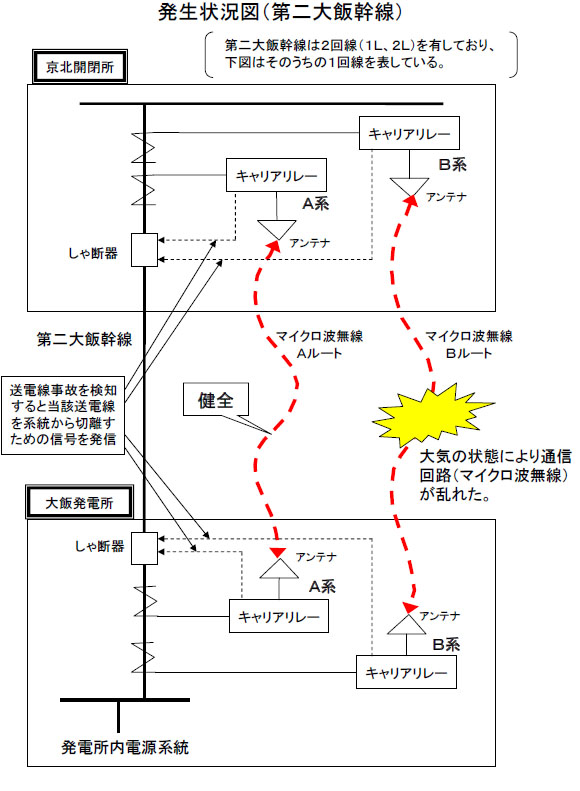
These alarms are connected to the carrier relays, and use microwave for communication. Because of the bad weather in June 23 and 24, the atmospheric disturbances caused the phenomenon called "fading", according to Kaden Watch News.

KEPCO's press release has this diagram:

Wednesday, June 20, 2012

Ooi Nuke Plant: KEPCO Waited 10 Hours Before Announcing the Alarm and Leak, with NISA's Approval


Certain things will never change, nuclear accident or not.

From Jiji Tsushin (6/21/2012):

警報出ればすぐ公表=大飯原発、遅れ批判で-保安院
Responding to the criticism in delay in announcement regarding Ooi Nuke Plant, NISA says if an alarm sounds it will be promptly announced

 再稼働の準備が進む関西電力大飯原発3号機(福井県おおい町)で、発電機冷却系の警報の公表が遅れた問題で、経済産業省原子力安全・保安院は21日、「予期されていない警報などが出た場合は、安全への影響にかかわらず速やかに公表する」とのルールを決めた。

About the delay in announcing the alarm at the generator cooling system of Reactor 3 at Kepco's Ooi Nuclear Power Plant which is being prepared for the restart, the Nuclear and Industrial Safety Agency under METI decided on a new rule on June 21 that "if an unexpected alarm sounds, it will be promptly announced regardless of the effect on safety".

 大飯原発では19日午後9時50分ごろ、発電機冷却系のタンク水位低下を示す警報が鳴ったが、関電は安全上の影響はないとして、保安院の了解を得た上で10時間以上たった翌20日朝に公表した。

At Ooi Nuclear Power Plant, an alarm sounded at about 9:50PM on June 19 indicating the water level decreased in the tank of the generator cooling system. KEPCO decided that there was no effect on safety, and obtaining the consent from the NISA to do so announced the event in the morning of June 20, more than 10 hours after the event.


There was also a leak at the pump in the cooling system at Reactor 3 on June 19, and KEPCO also waited until June 20 to announce. According to Sankei Shinbun (6/21/2012):

関西電力は20日、大飯原子力発電所3号機(おおい町)で、発電機を冷やす水をタンクから送り出すポンプの一部から、わずかに水漏れしていたと発表した。前日19日夜のタンクの水位低下には影響なく、環境への影響はなかった。

KEPCO announced on June 20 that there was a slight leak of water from the part of the pump that transfers water from the generator cooling system tank. [According to KEPCO,] the leak had no effect on the water level decrease in the tank on the night of June 19, and there was no effect on the environment.

 関電によると、19日午後10時ごろ、水位低下が見つかった同3号機の発電機の冷却水タンク周辺を調べている際、現場作業員が微量の水漏れを発見したとしている。

According to KEPCO, a worker was inspecting the area around the generator cooling system tank of Reactor 3 at about 10PM on June 19, when he noticed a minute amount of leak.

 水漏れは、ポンプの部品を通った水に含まれる不純物を除去するチューブ部分。

The water leak was from the tube that removes foreign matters in the water running through the pump.

 関電は、チューブ接続部のボルトを締め、交換も検討している。

KEPCO has tighten the bolt at the connection of the tube, and is considering replacing it.


According to KEPCO's press release, the leak was 0.02cc/second. The press release has a PDF file with a diagram of the system, but it is hard for me to figure out what is what. The location of the leak is not immediately clear, and there is no photograph of the actual leak. It looks KEPCO needs to learn a little bit from TEPCO when it comes to communicating with the outside world. TEPCO's communication skills have improved over the past year under the unfortunate circumstance.


(I don't want to be too familiar with a pressurized water reactor. I don't want to do a self-inflicted crash course on one, like I did on the boiling water reactors in Fukushima as they blew up. Don't start Ooi Nuke Plant. I don't have time to learn a new reactor type. I don't want to even learn about a turbine generator. Don't do it. Learning a little about Mitsubishi's steam generators is already too much...)

Sunday, June 10, 2012

Off-Site Center for Ooi Nuclear Power Plant, Government's Key to Nuclear Safety


The Off-Site Center for Ooi Nuclear Power Plantis located at about 7 kilometers from the plant, at the foot of the peninsula and on what looks like a landfill. The access to the plant from the Center, as you can see, is either through the long bridge to the east, or around the coast to the west, and getting on to the only road (Route 241) to the plant. (Zoom out on the map below to see the plant.)

It's a spiffy-looking facility full of light and huge video conferencing screens and computers. Just like in the case of the Off-Site Center for Fukushima I Nuclear Power Plant, I suppose they are assuming they will have access to abundant electricity even when a large earthquake hits. Not to mention roads remaining open and in good shape after such a quake...


View Larger Map


Here's the document detailing the "Special Surveillance Measures" that Prime Minister Noda has promised to assure safety of Ooi Nuclear Power Plant restart (yes, the one about stationing the Senior Vice Minister), from the nuclear safety specialist committee of the Fukui prefectural government. The document was apparently prepared by the Ministry of the Environment, on the occasion of Minister Hosono's visit to the prefecture earlier. According to the document, the senior vice minister won't be at the plant itself but at this Off-Site Center:


Under the "Members" and "Functions" (middle of the document), it says:

Members

  1. Senior Vice Minister of Economy, Trade and Industry

  2. Nuclear and Industrial Safety Agency (including Deputy Director-General level personnel, total of about 10 people)

  3. Kansai Electric Power Company (Vice President level)

  4. Nuclear plant manufacturer [Toshiba, Hitachi]

  5. Persons of learning and experience

* We [the national government] wants Fukui Prefecture to cooperate, with its over 40 years of experience and ability to face nuclear safety.

Functions

  • Connected through the teleconference system at all time, constantly monitor the restart, and provide information to the citizens.

  • In case of an emergency, immediately grasp and analyze the situation, and decide on the necessary countermeasures.

  • In case of a nuclear emergency, the Senior Vice Minister will act as the local head of the emergency headquarters, and implement measures to respond to the plant accident.


So they will solely rely on the plant manufacturers (the only ones who know anything).

In the paragraph second from the bottom, it says:

The teleconference system will be on all the time, connecting the plant, the Off-Site Center, KEPCO, and NISA. In case of an emergency, the Prime Minister's Official Residence and the plant will be connected.


No joke...

Now, you can laugh and be merry. It's good for you, remember?

Thursday, June 7, 2012

A #Fukushima Woman Asks NISA Experts, "Are You Man Enough to Protect Women and Children?"


Tokyo Brown Tabby managed to set up another Youtube channel (here), and here's part of the description of the video Tabby sent me:

On January 18, 2012, Japan's Nuclear and Industrial Safety Agency (NISA) held a hearing to discuss with a committee of experts the results of the "stress test" for judging whether to restart Kansai Electric's Ooi Nuclear Power Plant. The hearing was supposed to be open to public, but at the last minute NISA decided to hold the meeting in a separate room without the audience. The angry audience, who were locked out in a room with a TV monitor, eventually rushed into the meeting room and made a protest.

In the middle of the confusion, an unidentified woman from Fukushima came out of the audience. This video clip shows part of the protest from the audience and the woman's poignant words.


The original video was taken by independent net-based OurPlanet-TV, so I hope there will be no worries about "copyright infringement" this time.

Tabby says "poignant". I'd say "strong". Because this slight, demure-looking woman from Fukushima is challenging the experts in front of her, asking, essentially, "Are you man enough to protect women and children?" No one answered her of course, they tried their best as if nothing was happening. Obviously, they were not man enough.


Almost identical words uttered by a young Egyptian woman may well have triggered the revolution in Egypt in January 2011, when she said "I am going to Tahrir Square on January 25. If you think yourself a man, come with me. Have some honor and manhood and come with me on January 25." We knew right afterwards that there were a lot of Egyptian men who were man enough to do that and much more.

Tuesday, April 24, 2012

In March Last Year, NISA Officials Had Withdrawn from #Fukushima I Nuke Plant Before TEPCO Did

Sankei Shinbun never liked Naoto Kan. For that matter, none of the Japanese mainstream media outlets liked him. While he was in charge of the Fukushima I Nuclear Power Plant accident as the prime minister of Japan, they were highly critical of his handling of the accident. That seems to have stopped after Noda was elected as the party leader and prime minister; they hardly snickered at Noda's declaration of "cold shutdown state".

Sankei still goes after him with this article on April 24, 2012, albeit obliquely. The article is about the Nuclear and Industrial Safety Agency which is supposed to be abolished and replaced by the new agency under the Ministry of the Environment (Goshi Hosono's influence-peddling outfit), and what a disgrace it was that the agency regulating the nuclear industry had failed so miserably in the first days of the accident.

In the 2-part article titled "Nuclear and Industrial Safety Agency withdrew from the plant on its own, 3 days after the disaster struck", Sankei reports (part):

 保安院には順守することを定めた4つの行動規範がある。筆頭は「強い使命感」であり、こう続く。《常に国民の安全を第一に考えた任務遂行》《緊急時における安全確保のための積極果敢な行動》。残り3つは「科学的・合理的な判断」「業務執行の透明性」「中立性・公正性」だ。しかし、11年前の保安院設置時に掲げられた崇高な理念は浸透していなかった。

The Nuclear and Industrial Safety Agency has the code of conduct that everyone should adhere to. The first is "Strong sense of duty: carry out tasks with the safety of the citizens first; act aggressively to secure safety in an emergency". The other three are: "Scientific and rational decision-making", "Transparency in carrying out tasks", "Neutrality and fairness". However, these noble ideals codified when the agency was created 11 years ago hadn't become part of the agency.

 1号機が水素爆発した昨年3月12日。原子力災害対策本部が置かれた首相官邸は異常な雰囲気に包まれた。飛び交う断片情報に駆け回る関係閣僚や官僚。しかし、そこにいるべき重要な人物がいなかった。

March 12, 2011, when Reactor 1 had a hydrogen explosion. The atmosphere was unusually tense at the Prime Minister's Official Residence where the nuclear disaster response headquarters was set up. The ministers and bureaucrats were scurrying to piece together the fragmented information. But there was one person missing from the scene.

 当時の保安院院長、寺坂信昭(59)だ。原子力規制を担う組織のトップで、原災本部事務局長でもある。彼はその前日、つまり東日本大震災発生の当日午後7時すぎ、原災本部初会合終了時には官邸を去り、保安院に戻っていた。

Nobuaki Terasawa (age 59), Director General of the NISA was missing. He was the head of the organization that regulates the nuclear industry, and he was also the head of the secretariat of the nuclear disaster response headquarters. He had left the Prime Minister's Official Residence at 7PM on the previous day on March 11, 2011, after the first meeting of the nuclear disaster response headquarters, and had returned to the NISA.

 「事務系の人間なので、私が残るよりも技術的により分かった人間が残った方がいいと判断した」。今年2月15日の国会事故調査委員会で、証人として呼ばれた寺坂は、そう弁明した。質問した委員の中央大法科大学院教授、野村修也(50)は「規制行政庁のトップに原子力についての知見を持たない方がなっておられるということか」と言葉を失った。

"Because I am not the technical person [don't have a technical degree], I decided it was better to have someone there who understood [the nuclear technology] better, rather than me staying there." Terasaka tried to explain in the February 15 hearing of the investigation committee of the Fukushima accident set up by the Diet. Professor Shuya Nomura (age 50) of Chuo University Law School was left speechless. "So the head of the regulating agency was someone who didn't know much about nuclear technology."

 保安院に戻ってからも、寺坂が官邸に電話したのは「数回程度」(寺坂)。規制機関のトップとして、首相の右腕となり事故対応の中心的役割を担うべき人物は全く機能しなかった。

After he returned to the NISA, Terasawa called the PM's Official Residence "a few times" (according to Terasawa). He was supposed to be the right-hand man for the prime minister as the head of the regulating agency and be in charge of responding to the accident. It didn't work that way at all.

“敵前逃亡”は寺坂だけではない。福島第1原発で勤務していた保安検査官らも同様だった。当時、原発敷地内には保安検査官ら職員8人がいた。平時は施設の巡視点検などを行うのが役割だが、緊急時には現場確認や本院への情報提供を行うことになっている。

It was not Terasawa alone who "fled in the face of the enemy". The Nuclear Safety Inspector and other NISA officials who worked at Fukushima I Nuclear Power Plant did the same. At the time of the accident, there were 8 NISA officials including Nuclear Safety Inspector. In normal times, they would make a tour of inspection on the plant. In an emergency, they were to inspect the scene of the accident and provide information to the NISA.

 彼らは、3号機が水素爆発し、2号機でも原子炉内部の放射性物質を含む蒸気を外部に逃す「ベント」ができないなど、状況が悪化する中、事故から3日後の昨年3月14日午後5時には、独断で現地を離れていた。国は現場の情報を得るチャンネルを失い、情報収集は東電に頼らざるを得ない状況が生まれた。

As the situation deteriorated after Reactor 3 had a hydrogen explosion and the vent couldn't be carried out at Reactor 2 to release the radioactive steam from inside the reactor, they withdrew from the plant on their own decision by 5PM on March 14, 2011, 3 days after the start of the accident. So the national government lost the channel through which to obtain information at the scene of the accident, and now had to rely on TEPCO for information.

 保安検査官らが撤退した日は、東電が政府に「全面撤退」を申し入れたとされる時期と重なる。当時の首相、菅直人(65)は同15日早朝に東電本店に乗り込み「撤退はありえない」と拒否したが、この時すでに政府側が現場から撤退していたのだ。

Around the same time the Nuclear Safety Inspectors and others left the plant, TEPCO was said to be asking the government for "complete withdrawal" from the plant. Then-Prime Minister Naoto Kan (age 65) made his way to the TEPCO headquarters in the early morning of March 15, and refused TEPCO's said request to withdraw. But at that time, the government side had already withdrawn from the scene of the accident.


I have no problem with having the NISA's head without a technical or science degree. What you would need in the situation like this is not the technical or scientific knowledge but common sense, leadership, good grasp of overall picture, and will and authority to commandeer people who do know technical details. Instead, he simply went home because he didn't have a technical degree.

With that kind of director general, it's not surprising at all that the NISA people at the plant withdrew on their own. I wonder if Kan had known about it when he went to TEPCO. Probably not. The NISA head would probably not have told the prime minister, because he probably didn't know about it himself.

Wednesday, March 21, 2012

Now They Tell Us: #Fukushima's Off-Site Center Didn't Even Have a Map That Showed Areas Outside 10-Kilometer Radius From the Plant

Tokyo Shinbun has another incredible, unbelievable report on how the Japanese government worked (or rather, didn't work) during the first 5 days of the Fukushima I Nuclear Power Plant accident that started on March 11, 2011.

You've read about Fukushima Prefecture deleting the emails that had SPEEDI simulation graphics earlier. Now you're about to learn about the Off-Site Centers.

The Off-Site Centers are located near the nuclear power plants, usually within 10 kilometers from a nuclear power plant. There are 16 of them in Japan, and in case of a nuclear emergency these Off-Site Centers act as the local headquarters for nuclear disaster response.

Fukushima I Nuclear Power Plant had one, 5 kilometers west of the plant in Okuma-machi. The officials and the staff who manned the Off-Site Center in Okuma-machi fled the Center on March 15 as the radiation levels shot up to 1 millisievert/hour, leaving the mayors of towns and cities in the affected areas to fend for themselves without any actionable information from the Off-Site Center.

Not only that. The Tokyo Shinbun article says the Okuma-machi Off-Site Center didn't even have a map that covered the areas outside the 10-kilometer radius from the plant. The Nuclear and Industrial Safety Agency doesn't have a plan to fit the Centers with maps that show outside the 10-kilometer radius, because no formal decision has been made to revise the nuclear emergency zoning.

Bureaucrats remain bureaucrats, no matter what. Particularly the Japanese variety. Not even the worst nuclear accident is likely to change them.

From Tokyo Shinbun (3/22/2012; the link won't last long, emphasis is mine)

原発オフサイトセンター 10キロ圏外、今も地図なし

Nuclear Power Plant Off-Site Center doesn't have maps outside the 10-kilometer radius, even today

原発事故の際、現地の対策拠点として全国に十六カ所あるオフサイトセンター(OFC)に、いまだに十キロ圏外の詳しい地図が用意されていない。東京電力福島第一原発の事故では、発生翌日、避難地区が一気に二十キロ圏にまで拡大し、地図がなかったため、避難すべき住民を確定させるのに手間取った。OFCをめぐっては、原発にあまりにも近い立地など抜本的に見直す必要があるが、事故から一年たっても、地図の備えすら改善されていない。

There are still no detailed maps that show the areas outside the 10-kilometers from the nuclear power plants at the nation's 16 Off-Site Center (OFC) which will act as the local headquarters in case of a nuclear accident. In the Fukushima I Nuclear Power Plant accident, the evacuation zone was expanded to the 20-kilometer radius on the 2nd day of the accident. But since there was no map, [the officials at the center] took too long to determine which residents to evacuate. Drastic changes are necessary for the Off-Site Centers including the locations of the Centers that are too close to the nuclear power plants. But one year since the accident, they still don't even have decent maps.

 「『地図がない』と騒然となった。そのうち誰かがどこからか探してきて、地図に線を引き始めた」。1号機原子炉建屋が水素爆発し、避難区域が十キロ圏から二十キロ圏に広がった昨年三月十二日に福島のOFCにいた経済産業省原子力安全・保安院の黒木慎一審議官は、当時の状況をこう語る。

Shinichi Kuroki of the Nuclear and Industrial Safety Agency under the Ministry of Economy, Trade and Industry looks back on the early days of the accident. ""There is no map!" we panicked. Someone finally found a map somewhere, and started to draw lines on the map." Kuroki was at the Off-Site Center in Fukushima on March 12 last year when a hydrogen explosion blew up the reactor building of Reactor 1 and the evacuation zone was expanded from the 10-kilometer radius to the 20-kilometer radius.

 現行制度では、原発から半径八~十キロを防災対策重点区域(EPZ)に指定し、事前に避難計画などを定めておくことになっている。

The current system designates the area inside the 8 to 10 kilometer radius from a nuclear power plant as Emergency Planning Zone (EPZ), and the evacuation plan for the area should be in place.

 しかし、現実の原発事故の影響は想定よりずっと大きかった。二十キロ圏への避難拡大を市町村に指示しようとしても、避難計画があるのも詳しい地図があるのも十キロ圏内のみ。地図がないため、正確に地区割りができずに手間取った。

However, the real nuclear accident affected much wider areas. Even when they wanted to instruct the municipalities about the expansion of the evacuation zone to the areas inside the 20-kilometer radius, the evacuation plan and the detailed map were only for the areas inside 10-kilometer radius. Since they didn't have the map [outside the 10-kilometer radius], it took too long to accurately assign the districts for evacuation.

 政府の事故調査・検証委員会の中間報告でも「住民避難の担当者は避難区域が特定できず、市町村の問い合わせにはっきり答えられなかった」と厳しく指摘している。

In its interim report, the accident investigation commission set up by the government (the cabinet office) harshly criticizes the officials at the Off-Site Center. "People in charge of evacuating the residents could not identify the areas to evacuate, and they couldn't answer the inquiries from the affected municipalities."

 教訓を踏まえ、原子力安全委員会の専門部会は、半径五キロ圏を重大事故時に住民が直ちに避難する予防防護措置区域(PAZ)に、三十キロ圏を放射線量の高まりに応じ避難する緊急防護措置区域(UPZ)に指定する案を決めた。

Based on this lesson, one expert committee in the Nuclear Safety Commission has decided to designate the areas inside the 5-kilometer radius as Precautionary Action Zone (PAZ), and the areas inside the 30-kilometer radius as Urgent Protective Action Planning Zone (UPZ) where the residents would evacuate depending on the levels of radiation.

 区域の拡大をめぐっては、六年前、保安院が安全委に圧力をかけて拡大を見送った経緯がある。

Six years ago, NISA pressured the Nuclear Safety Commission to forgo the expansion of these zones.

 ただ、地図の不備を解消しようとする動きは鈍い。本紙の取材に対し、保安院の担当者は「個別には調べていないが、EPZ外の地図はない」と話す。

But the plan to equip the Off-Site Centers with the maps [that covers wider areas] is going very slow. To our inquiry, the person in charge at NISA said, "We haven't checked individual Centers, but there are no maps outside the EPZs."

 新たな防災指針が正式決定されていないことを理由に挙げ、「議論を見極め、どの範囲の地図を用意するか決めたい」と話した。

He said it was because a new guideline for disaster prevention hadn't been formally approved yet, and that they would wait and see how the discussion would go before deciding which areas the maps should cover.

 国内で現在、稼働している原発は二基だけだが、停止中でも冷却が止まるなどすれば、福島第一の4号機のように重大事故が起きる可能性はある。

Currently, there are only two reactors operating in Japan. But even when the reactors are stopped, there is a possibility of a severe accident like Reactor 4 at Fukushima I Nuke Plant if the cooling systems fail.

If a nuclear reactor fails again in Japan, the bureaucrats in the national government will continue to split hairs, playing Sir Humphrey. No doubt about it.

Friday, March 9, 2012

NISA Approves TEPCO's Request to Have Female Workers Back at #Fukushima I Nuke Plant

TEPCO informed the Nuclear and Industrial Safety Agency that it would bring female workers back at Fukushima I Nuclear Power Plant on March 9, and NISA approved before the day was over.

According to Tokyo Shinbun quoting Kyodo News (3/9/2012), TEPCO is envisioning 8 hours a day, 20 days per month indoor work that would result in less than 5 millisieverts in 3 months.

As per my calculation, it will be 3.456 millisieverts in 3 months.

I just asked a former TEPCO employee who used to work at one of the TEPCO's nuclear power plants, who said "0.1 to 0.3 millisievert per year" radiation exposure for indoor, office work with occasional visits to controlled areas.

What is the point of TEPCO bringing back female workers at the plant where 7.2 microsieverts/hour radiation is considered "low"? Just to send a hopeful message that everything is going well in Fukushima?

Sunday, February 12, 2012

NISA on Reactor 2 RPV Temperature: Not a Problem

(UPDATE: Latest temperature is 89.6 degrees Celsius as of 5AM, 2/13/2012.)

since it is most likely to be the instrument failure.

Yomiuri Shinbun (2/11/2012):

東京電力福島第一原子力発電所2号機の原子炉圧力容器の底部温度が保安規定で上限と定めた80度を上回ったことを受け、経済産業省原子力安全・保安院の森山善範原子力災害対策監は12日夜、臨時の記者会見を開き、「原子炉全体としては冷却されている。放射性物質の放出量にも変化は無く、安全性に問題はない」と述べ、昨年末に政府と東電が宣言した「冷温停止状態」について、変更する必要はないとの認識を示した。

As the temperature at the bottom of Reactor 2 Pressure Vessel at Fukushima I Nuclear Power Plant exceeded 80 degrees Celsius, which is the upper limit in the safety regulations, Yoshinori Moriyama of the Nuclear and Industrial Safety Agency held an ad hoc press conference in the evening of February 12, and said "The reactor as a whole is well cooled. There is no change in the amount of radioactive materials released, and there is no problem with the safety", sharing the agency's view that there was no need to change the status of "cold shutdown state" that the national government and TEPCO had declared at the end of last year.

 保安院によると、複数ある温度計のうち上昇傾向を示しているのは1か所だけで、温度も激しく変化していることから、故障の可能性もあるという。保安院は同日、東電に対し、圧力容器の温度の把握方法や、故障した温度計の保安規定上の取り扱いについて検討し、報告するよう口頭で指示した。

According to NISA, there is only one thermometer among several that shows uptrend and the temperature fluctuates widely, which has led to the speculation that it may be the instrument failure. NISA issued an oral instruction to TEPCO on February 12 to come up with a report to the agency regarding the ways to measure the temperatures of the RPV, and how to handle thermometers that are broken in light of the safety regulations.

Just remember that NISA is staffed with the nuclear and electric power industry people on leave.

In TEPCO's defense, though, the declaration of "cold shutdown state" to the derision of the world (even in Japan, surprise) was made by the prime minister of Japan whose interest seems to be more aligned with the "global" community than with the subjects in the increasingly Orwellian Japan. TEPCO went along with it, for sure.

Tuesday, January 31, 2012

NISA's Young Career Bureaucrat Admits Fukushima I Nuke Accident Is NOT Over

Oops.

Independent journalist Ryusaku Tanaka reports on the meeting between a citizens' group and the Nuclear and Industrial Safety Agency. The citizens' group made a formal appointment with the agency for the meeting, but on the day of the meeting they were shoved into a dark corridor to wait for someone to show up, and the "meeting" was done in the lobby, standing, between the group and a lone 30-year-old NISA bureaucrat.

From Tanaka's blog (1/31/2012):

保安院・若手官僚うっかり 「現場は収束に向けて動いている」

A young bureaucrat at NISA inadvertently says, "Workers at the [Fukushima I Nuke] plant are working toward winding down the accident"

市民団体が「全ての原発の停止と廃炉」などを求めて経産省原子力安全・保安院に請願に行ったところ、若手官僚から仰天発言が飛び出した。原発事故は収束していない、と口を滑らせたのである。

When a citizens' group went to petition the Nuclear and Industrial Safety Agency at the Ministry of Economy, Trade and Industry demanding "halting and decommissioning all nuclear power plants", a young bureaucrat had an amazing slip of the tongue. He said the nuclear accident was not over.

「すべての原発いますぐなくそう!全国会議」を中心とする一行12人は31日、経産省別館の原子力安全・保安院を訪れた。同会議事務局長の織田陽介さんが保安院広報課に苦労してアポを取っての訪問である。

On January 31, a group of 12 people from "Let's stop all nuclear power plant! national conference" visited the Nuclear and Industrial Safety Agency in the annex building of the Ministry of Economy, Trade and Industry. Yosuke Oda, secretary of the conference, had managed to make an appointment with the PR department of the NISA.

約束通り同日午後2時、保安院の受付で面会の手続きを取ろうとしたところ、広報課に内線電話を入れた受付嬢は「担当者が変わったそうです」。オイオイ、5日前にアポ取ってんだぞ。傍らでやりとりを聞いていた筆者は保安院の非常識さに吹き出しそうになった。

They arrived at 2PM, as per the appointment, and went to the reception at NISA for necessary procedure before the meeting. After calling the PR department, the receptionist told them, "There has been a change of person in charge". Oh boy, they had set up the meeting 5 days prior... I almost burst into laughter at the lack of common sense at NISA as I was observing the exchange.

『このまま門前払いされてなるか』。一行は受付嬢を通して広報課に猛然と抗議した。10分ほど押し問答が続いたところで警備担当の職員がおもむろにやってきた。

"We're not going to be turned away like this." The group protested vehemently to the PR department through the receptionist. After 10 minutes of exchange, a security guard came.

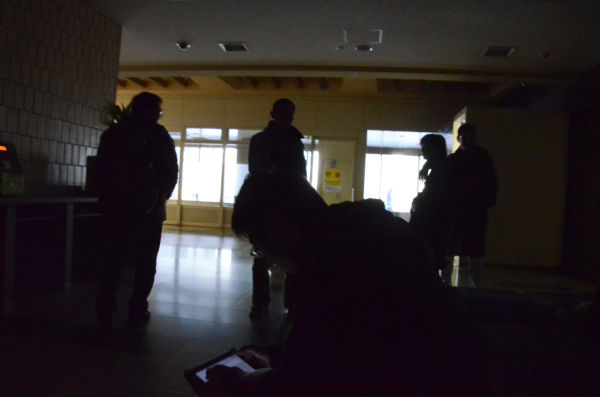
「あちらでお待ち頂けますか」。警備担当者は受付裏のソファーが並ぶスペースに一行を押し込んだ。電燈が一器も点いておらず真っ暗だ(写真)。別の警備担当職員に聞くと節電の一環らしい。

"Could you wait over there?" The security guard put them in the space at the back of the reception area. There was no light, and it was dark (see photo). When we asked another security guard, it was part of energy saving effort.

 暗がりの中で20分間ほど待つと、先ほどの警備担当職員と共に広報課の役人が現れた。「原子力安全広報課・下鶴俊輔係長」だ。30歳になるかならないかのうら若き青年である。十中八九キャリアだ。

We waited in the dark for about 20 minutes. A bureaucrat from the PR department showed up with the security guard. It was Shunsuke Shimozuru (or Shimotsuru), section manager at NISA PR department. He was a youthful-looking young man, hardly 30 years of age. A career bureaucrat, in all likelihood.

下鶴青年、もとい、下鶴係長は一行を同じフロアーのロビーに案内した。立ったまま請願を受け付けようというのである。

Young Shimozuru, correction, Manager Shimozuru took us to a lobby on the same floor. He was going to receive the petition standing.

「どうして会議室じゃないの?」
「請願はロビーで受けるようにしている」

"Why not in a conference room?"
"It is our policy to receive a petition in the lobby."

「(昨年)10月27日に『福島の女たち』が申し入れた時には会議室を取ってくれたわよ」、「請願権の制限になるよ」……一行は畳み掛けた。

"When "Group of Fukushima women" went to petition on October 27 last year, they were shown to a conference room." "Are you limiting our right to petition?" People pressed him for an answer.

下鶴係長は追い詰められた格好になった。「庁舎の警備上の都合もあり…」

Manager Shimozuru was cornered. "Well, it is also a matter of security..."

「我々は別に危ないことしないよ。会議室に入れたからといって警備上何が問題なの?」

"We are not doing anything dangerous. What's the security problem of letting us in a conference room?"

いよいよ困った下鶴係長は、つい本音をもらしてしまった。「(原発事故の)収束宣言は出しましたが、現場は収束に向かって動いてますんで…」。

Not knowing what else to say, Manager Shimozuru blurted out the truth despite himself. "The declaration was made that the nuclear plant accident was over, but the workers at the plant are working toward ending the accident..."

「(事故を起こした)原発から白い煙が出てて、どうして収束と言えるんですか?」。福島の人々がよく口にする言葉だ。

"How can you say that the accident is over when you see a white smoke coming out of the broken plant?" That's what people in Fukushima often say.

原子力安全・保安院の若手官僚が、うっかりとはいえ原発事故が事実上収束していないことを認めたのである。「やはり、そうだったのか」と思わざるを得ない。野田首相に「当の保安院が収束していないって言ってますよ~」と言ってやりたい。

A young bureaucrat of NISA inadvertently admitted that the nuclear plant accident, for all intent and purposes, was not over. "Just as I expected", as I thought to myself. I wish I could tell Prime Minster Noda, "NISA itself is saying the accident is not over. Do you know that?"

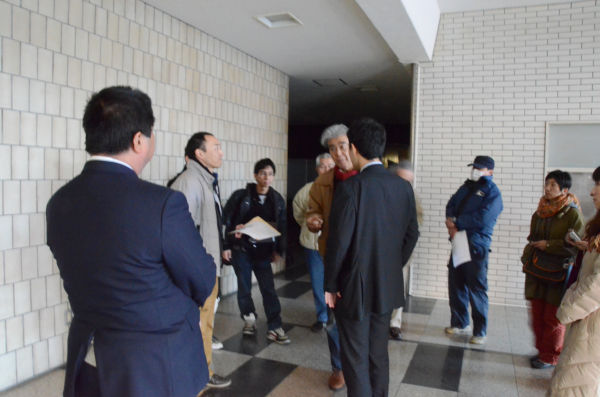
Mr. Shimozuru is a man in the center, with his back on the camera.

It must be a rude learning experience for ordinary citizens of Japan. All their lives, they thought the bureaucrats and politicians who graduated from top schools in the nation were working for them. When they made an appointment to see them, they were shoved into a dark corner, and met with a young man no more than 30 years of age, in the lobby, standing.

Just for your information in case you are not familiar, not all bureaucrats are "career" bureaucrats in Japan. Career bureaucrats are those elites in the national government who have passed the rigorous examination and in exchange are guaranteed fast-track promotions within the ministries. They dominate the top hierarchy of the ministries. They are usually the graduates from elite universities in Japan. As part of on-the-job training of some sort, many are dispatched to municipalities throughout Japan during their career to become vice mayors of the cities before they come back to the ministries. Some go to international agencies and come back.

Some of them decide to run for office after vice mayoral experience, and become politicians but with ties to the ministries. The pro-nuke governor of Hokkaido is one example; she was a career bureaucrat at the Ministry of Economy before she became the governor. There are many others. Then, on retirement, they "descend from heaven" to the NGOs, NPOs, research institutes, big corporations, with fat checks with little work.

Monday, January 30, 2012

NHK Mistranslates IAEA Remarks and Says "NISA's Stress Test Evaluation Conforms to International Standard"

NHK reports on the findings of the IAEA during the visit this time to evaluate whether the "stress test" carried out by electric power companies and overseen by Japan's Nuclear and Industrial Safety Agency was appropriate, particularly in the case of Ooi Nuclear Power Plant.

This is what the IAEA mission chief said, as you can see and hear in the accompanying video to the news:

We found that the NISA's approach is generally consistent with the IAEA's safety standards, and the international practice.
NHK translated the remark as:
ストレステストの評価方法はIAEAおよび国際基準に適合している
which would translate back into English as:
The way [NISA] evaluate the result of the stress test conforms to the IAEA and international standards.

As if there are international standards for stress test evaluation. (Or are there?)

Japanese Twitterers who understand English immediately tweeted the incorrect translation by NHK. NHK has quickly added a paragraph to supposedly "clarify" but it is still wrong. It now translates the remark by the IAEA mission chief Lyons as:

原子力安全・保安院の審査の過程は、IAEAのルールに適合していて、ヨーロッパなどでの国際的な活動にも即している
which is:
NISA's evaluation process conforms to the IAEA rules, and in line with the international activities in Europe and other places.

Ummm. Nowhere the IAEA chief said anything about Europe. What activities? And he said "standards" not rules.

(Now I'm suddenly flooded with the memory of just atrocious translation that NHK did in the early days of the nuclear crisis in March last year. All these simultaneous translators that NHK World paid a fortune who didn't have a clue what they were translating. Ugghhh.)

I copied and pasted the NHK News for the record. Nothing much in it other than NHK's mistranslation. It basically says the IAEA rubber-stamped what the Japanese government did, again, with a friendly advice to make it as if the IAEA actually did something. What's the advice you ask? "You'd better learn how to explain to the local residents better."

Now the illusion must be totally expelled from the minds of Japanese people who cling to the idea that an "international" organization is somehow "neutral" and therefore will scold their government into the right direction.

NHK News (1/31/2012 12:07PM):

IAEA 評価方法は国際基準適合

原子力発電所の運転再開の判断の前提となる「ストレステスト」について検証してきたIAEA=国際原子力機関の調査団は、国の原子力安全・保安院に報告書を提出し、「評価の方法は国際的な基準に適合している」とした一方で、原発の地元自治体などにさらに説明をすべきだといった改善点を指摘しました。

IAEAの調査団のジェームズ・ライオンズ団長は、東京の原子力安全・保安院を訪れ、深野弘行院長に報告書を手渡しました。調査団の10人は、今月22日に来日し、電力会社が行った「ストレステスト」に対し、保安院が国の規制機関として適切に評価をしているかを検証するため、保安院の聞き取りや、福井県にある関西電力の大飯原発で視察をしてきました。報告書では、保安院が原発の現地調査をしたり、評価の過程を公開したりしている点を挙げて、「評価の方法は、国際的な基準に適合している」と結論づけました。その一方で、原発の地元自治体などにさらに説明をすべきだといった11の改善点を指摘しました。保安院は、大飯原発の3号機と4号機について、「テストの方法は妥当だ」と評価していて、IAEAの報告書を踏まえ、来月、最終評価を取りまとめることにしていますが、原発の運転再開は地元に慎重な意見が少なくなく、具体的な見通しは立っていません。

(The audiovisual news that accompanies the article ends there.)

記者会見をしたIAEAの調査団のジェームズ・ライオンズ団長は、「原子力安全・保安院の審査の過程は、IAEAのルールに適合していて、ヨーロッパなどでの国際的な活動にも即している」と述べたうえで、「保安院の電力会社などへの指示は、もっと具体的にするべきだ」と指摘しました。

And then, strangely, NHK has another paragraph of the pugnacious mayor of Osaka who looks like a kindergarten bully and acts like one commenting on the NISA's stress test and the IAEA mission.

What does he have to do with anything? The only thing I can think of is that somehow this Osaka mayor, who was the governor of Osaka, full of ambition for the national politics, managed to butt himself in on the news to give an impression that he was some politician for everyone in Japan to pay attention and listen to.

大阪市の橋下市長は、原発の施設の安全性については専門家しか判断できないとする一方で、「今、何が問題かと言えば、施設だけではなく、政府や電力会社の『組織』が問題となっている。ストレステストをやるのなら、施設だけではなく、組織が本当に機能しているのかどうかをテストすべきだ。SPEEDIのデータをすぐに出すという決断をできないのが今の政府だ。施設が安全でも、それを扱う側の政府や電力会社の組織が、非常時に機能するのかどうかについて、ストレステストをやらないと全然納得できない」と述べ、政府や電力会社の組織としての在り方を検証すべきだという考えを示しました。

Friday, January 20, 2012

NISA Hid Fast Breeder "Monju" Trouble for Over a Month

The Nuclear and Industrial Safety Agency's excuse is that the operator, Japan Atomic Energy Agency, did make an announcement of the trouble "locally" - probably meaning the municipality where the fast breeder is located.

From Yomiuri Shinbun (1/20/2012):

もんじゅで原因不明トラブル、存廃論議に拍車も

Trouble at Monju, cause unknown. May further spur the debate whether to continue the project

経済産業省原子力安全・保安院は20日、日本原子力研究開発機構の高速増殖原型炉「もんじゅ」(福井県敦賀市)で、制御棒の駆動機構に不具合が生じたとして、同機構に原因究明と再発防止を指示した。

The Nuclear and Industrial Safety Agency under the Ministry of Economy, Trade and Industry instructed the Japan Atomic Energy Agency (JAEA) to investigate the cause of malfunction at the driving mechanisms for the control rods at the JAEA's fastbreeder "Monju" (in Tsuruga City, Fukui Prefecture), and to come up with measures to prevent it from happening again.

 保安院によると、不具合が生じたのは昨年12月12日。駆動機構19基のうち、1基が動作確認試験で稼働せず、2日後の再試験で動いた。さらに別の1基も動かず、機構は、原因を究明できないとして工場で分解点検する方針。

According to NISA, the malfunction happened on December 12. Of the 19 driving mechanisms for the control rods, one mechanism didn't work at all when they conducted the test to verify the mechanisms were working. When tested again 2 days later, the mechanism worked. However, there is another mechanism that didn't work [and didn't work in the 2nd test]. JAEA says they will disassemble the mechanism in order to identify the cause.

 公表が遅れた点について保安院は「制御棒がすべて挿入されていた上、機構側が地元で公表していた」と釈明した。もんじゅは現在、原子炉に制御棒が挿入された状態で、安全性に問題はない。しかし、東京電力福島第一原発事故を受けて政府がもんじゅの存廃を含めた原子力政策全般の見直しを進めており、不具合は議論に拍車をかけそうだ。

As to why the disclosure was so late, NISA explained that the control rods were all in, and JAEA did announce locally. The control rods are all inserted, and the Monju reactor is safe at this time. However, the government has been reviewing its nuclear policies in the aftermath of the Fukushima I Nuclear Power Plant accident, including whether to continue the Monju project. The trouble this time may spur the debate.

Not just the malfunction trouble, but the fact that the regulatory agency NISA felt it was OK to wait for more than one month to announce the problem should raise alarm.

NISA's press release on January 20 states that JAEA must report back to the Agency by February 29.

Thursday, January 19, 2012

Reactor 2 Containment Vessel Endoscopy Update: They Coudn't See the Water

(UPDATE: Photos inside the CV just released. See my new post.)

=============================

The Nuclear and Industrial Safety Agency's press conference is ongoing. TEPCO will have its evening press conference in less than an hour (at 6:00PM JST).

From NISA's press conference, on Reactor 2 Containment Vessel endoscopy carried out on January 19:

TEPCO couldn't see the surface of the water which was supposed to remain in the Containment Vessel.

The water level was probably much lower than expected (5.3 meters from the bottom of the CV).

It was highly humid inside the CV, and water was dripping.

No comment to one reporter's question of whether there is a damage on the CV as the water level was lower than expected.

Blurry image with water drops and high radiation inside.

Inside the CV, temperature was 40 degrees Celsius.