Showing posts with label Department of Energy. Show all posts

Saturday, May 17, 2014

US Department of Energy Releases Update on Radiation Leak at Waste Isolation Pilot Plant (WIPP) in New Mexico, Container with Broken Lid Identified


(UPDATE 5/20/2014) Possible culprit: kitty litter. See my new post.

-------------------------------

And it was a container from Los Alamos National Laboratory (LANL).

The first report of radiation leak (plutonium) from the Waste Isolation Pilot Plant (WIPP) that necessitated the evacuation of workers and plant shutdown was in February this year.

From Department of Energy WIPP Update (5/16/2014):

New Information Provided About Possible Contributor to the WIPP Radiological Event

The Department of Energy issued the following statement today regarding new information generated during the May 15 entry into WIPP:

Since the February 14 radiological release, the Department and its Waste Isolation Pilot Plant have been working deliberately to safely determine the cause of the release. The team that entered the underground facility yesterday was able to get additional visual evidence that shows a damaged waste container, identified as one from Los Alamos National Laboratory.

In the new pictures, the LANL container has a cracked lid and shows evidence of heat damage. Workers will continue investigating to determine what caused the container breach and if any other containers were involved or damaged,” said a DOE spokesperson.

Community Meetings Scheduled

May 20 – A WIPP Recovery update will be provided at the Economic Development Corporation of Lea County Annual Meeting. The update, which will be provided by a member of the NWP Communications team, is scheduled for 11:30 a.m. Location: Hobbs Country Club, 5001 W. Carlsbad Highway.

May 22– The City of Carlsbad and DOE will co-host its weekly meeting featuring updates on WIPP recovery activities. The meeting is scheduled today at 5:30 p.m. Location: Carlsbad City Council Chambers, 101 N. Halagueno Street. Live streaming of the weekly meetings can be seen at http://new.livestream.com/rrv/.

"Evidence of Damaged Drum in Panel 7, Room 7" from DOE WIPP "Photo and Video" section (more photos at the link):


"The May 15 entry into Panel 7, Room 7 produced this photo of a waste container (left) with its lid unsealed and apparent heat discoloration."


There is a video of re-entry to WIPP on May 15, 2014.

According to Japan's NHK reporting on the DOE update, it may take at least three years before the facility resumes operation.

Sunday, February 16, 2014

Possible Leak of Alpha and Beta Radiation Emitters at Transuranic Radioactive Waste Underground Storage Facility in New Mexico, DOE Official Doesn't Quantify the Leak


The facility, Waste Isolation Pilot Plant (WIPP), takes plutonium-contaminated waste from Los Alamos National Laboratory and other federal nuclear projects.

According to wiki,

The Waste Isolation Pilot Plant, or WIPP, is the world's third deep geological repository (after closure of Germany's Repository for radioactive waste Morsleben and the Schacht Asse II Salt Mine) licensed to permanently dispose of transuranic radioactive waste for 10,000 years that is left from the research and production of nuclear weapons.


(FYI, transuranic elements: the chemical elements with atomic numbers greater than 92 (the atomic number of uranium))

From Salon, quoting AP (2/16/2014; emphasis is mine):

Crews monitor NM nuclear repository for radiation

CARLSBAD, N.M. (AP) — Officials checking the presence of airborne radiation at an underground site in southeastern New Mexico where the U.S. government seals away low-grade nuclear waste say surface tests have detected no contamination.

Samples were taken at several sites around the Waste Isolation Pilot Plant after an air monitor found radiation on the underground levels of the facility around 11:30 p.m. Friday, the U.S. Department of Energy said in a news release.

No workers were underground at the time and no injuries or damages have been reported. A fire at the site earlier this month prompted an evacuation.

“Monitors at the WIPP boundary have confirmed there is no danger to human health or the environment,” the department said late Saturday night. “No contamination has been found on any equipment, personnel, or facilities.”

Energy Department spokesman Roger Nelson said that the 139 workers aboveground at the site near Carlsbad were told Saturday to stay where they were as a precaution. None of them tested positive for contamination, and all non-essential personnel were released, Nelson said.

The surface samples show no contamination has been detected, implying the leak was “not significant,” he said.

Nelson says the cause of the leak is not known yet. The devices that continuously monitor the air underground reached a threshold level that automatically switches the ventilation system into a filtered mode. He couldn’t quantify the level it takes to trigger the monitors, but says they’re sensitive. He says the monitors have been triggered in the past by radon fluctuations.

WIPP stores waste that emits alpha and beta radiation, which is in particulate form, so the risk is of inhalation not penetration, he said.

No one has been underground, and Nelson said he didn’t know when that would happen.

“We are going to take measurements and make sure we understand it” before sending in a team, he said.

U.S. Rep. Steve Pearce issued a statement saying, “WIPP has acted quickly and cautiously to ensure the safety of personnel and the local community.”

============================

The incident comes 10 days after an underground truck fire at the plant prompted an evacuation. Six people were treated for smoke inhalation on Feb. 5.

Nelson said the fire was in a different part of the site, about 1,000 feet away, from where the radiation was found.

Asked if the incidents were related, he said, “I just can’t think of a scenario where there would be a relationship.”

WIPP is the nation’s first and only deep geological nuclear waste repository. It takes plutonium-contaminated waste from Los Alamos National Laboratory and other federal nuclear projects.

Sunday, November 3, 2013

U.S. Energy Secretary Ernest Moniz to Japanese Government: "Ratify the Convention on Supplementary Compensation for Nuclear Damage, and We Will Send Kurion to Help TEPCO"


Kurion?

So what's the trick?

Reading the Bloomberg article linked below, the trick seems to be that Kurion wouldn't be liable under the ratified treaty even if Kurion's patented system to remove TRITIUM (really?) doesn't work or fails to deliver or causes damage. Only the plant operator, in this case TEPCO, would be held liable.

Kurion's cesium absorption system was sold by then-US Energy Secretary and Nobel Prize winner Steven Chu in 2011, right after the start of the Fukushima nuclear accident. As with any system installed at the plant after the accident, Kurion's cesium absorption system was plagued with problems from the beginning (too many to list here, but browse through these posts) and sub-par performance. TEPCO stopped using it when Toshiba's SARRY came online in October 2011.

A quick check on Kurion's website shows the current CEO of the company from France's AREVA with close ties with the US Department of Energy, and two people whose career was with the Department of Energy, and one former researcher at Oak Ridge National Laboratory. The company was founded by a venture capital in 2008.

Now the new Secretary of Energy is trying to peddle a new system from the same company - tritium removal system. Just like the cesium absorption system, Kurion and the US Department of Energy probably want to use Fukushima I Nuclear Power Plant as a test site for unproven or prototype technology, with liability safely on TEPCO, a clueless, technologically-blind plant operator.

From Bloomberg News (11/3/2013; emphasis is mine):

U.S. Says Japan Signing Liability Pact Would Aid Nuclear Cleanup

Japan will receive international help with the cleanup at the Fukushima atomic station once it joins an existing treaty that defines liability for accidents at nuclear plants, U.S. Energy Secretary Ernest Moniz said.

The treaty, known as the Convention on Supplementary Compensation for Nuclear Damage, assigns accident liability to plant operators rather than equipment and technology vendors, Moniz said in a Nov. 2 interview in Tokyo. The treaty includes setting up a fund for victims of nuclear accidents and a standard for compensation claims.

Japanese Prime Minister Shinzo Abe, Trade Minister Toshimitsu Motegi and other officials showed an “eagerness” during meetings last week for expertise from abroad to decommission the Fukushima plant, Moniz said. Such help will be easier to secure once Japan ratifies the treaty, he said.

“As one gets into the real work, then these liability conventions become quite important,” Moniz said. “Certainly Prime Minster Abe and Minster Motegi both emphasize that the importance of moving on this in 2014 is to a large extent driven by their openness and their desire to get as much international help as they can.”

...

The Compensation for Nuclear Damage treaty was adopted in 1997 under the International Atomic Energy Agency and had 16 signatories as of June 24 this year, including the U.S., India and Italy.

At least five signatories must ratify the treaty to enact it. So far, the U.S., Romania, Morocco and Argentina have ratified. So Japan joining would bring it into force, Moniz said.

Legislation ratifying the convention could be introduced to parliament early next year, Foreign Minister Fumio Kishida told reporters on Nov. 1, Kyodo news reported.

Under the pact, a company such a Irvine, California-based Kurion Inc., which possesses technology for removing the radioactive isotope tritium from contaminated water, could deploy its technology at the Fukushima plant, Moniz said.

Liability would rest with Tepco, as the plant’s operator is known, he said.

(Full article at the link)


If the Abe administration is indeed "eager" for the international (read United States here) expertise that will come by ratifying the treaty, it will probably be not particularly for the expertise, as far as I see it.

It will be for the fund to be set up for the victims and a set standard for compensation, I think, which must be more advantageous to the government than what (sort of) exists currently (i.e. saving tons of money for the government).

It would be amazing, to me, if the countries who have already ratified the treaty actually allows Japan to join them, after the fact (=nuclear accident).

Kurion's press release on their tritium-removing technology is copied below. (Please let me know if there is more to it than meets the eye, as I cannot picture a system from the press release that will treat over 100,000 tonnes of water that are in the storage tanks and turbine building basements at Fukushima I Nuke Plant...)

Press Releases
Kurion Introduces Tritium Removal Technology to Limit Release of Radionuclides into Environment

Originally Published on 09/30/2013

Patent-pending Modular Detritiation System™ Strengthens Clean, Safe Value of Nuclear Power

Kurion, Inc., an innovator in nuclear and hazardous waste management, announced a breakthrough in the treatment of the historically difficult to capture isotope with the introduction of its patent-pending Modular Detritiation System™ (MDS™) to decontaminate tritiated water. The ability to perform light water detritiation (i.e., the removal of tritium from water) enables the safe release of purified water into the environment or recycling of reactor cooling water. The technology has applications for light water reactors, which are the dominant nuclear plant designs worldwide.

The decontamination of tritium (T) is particularly problematic: it is a special form of hydrogen that forms tritiated water (HTO vs. H2O), which does not lend itself to removal by conventional technologies. This is because instead of the contaminant being carried along in water in suspended or dissolved form, the water molecule itself is modified. As a result, tritiated water is particularly difficult to treat and can spread easily if it escapes into the environment.

“Preventing the release of tritium into the environment represents one of the last remaining environmental challenges for nuclear energy,” said Bill Gallo, chief executive officer of Kurion. “The key value of Kurion’s patent-pending detritiation technology is that it offers an economical alternative to releasing tritium into the environment and bolsters the appeal of nuclear power as a clean, safe energy source.”

John Raymont, Kurion founder and president of international operations, added, “Historically, nuclear power plants were forced to release tritium into the environment because there was no method to remove it economically. Kurion’s new detritiation system now offers a technology-based alternative with the benefit of addressing the public's concern over environmental release.”

The industrial process of removing tritium from water has historically focused on cleaning highly contaminated “heavy water” for recycling back into nuclear reactors, such as for the CANDU design. However, this technology is prohibitively expensive for use with light water reactors. The Kurion MDS™ builds upon proven heavy water solutions and makes advances in throughput and efficiency where the tritium removal occurs. Kurion has developed an economical solution that – for the first time – would allow for recycling or clean release of reactor cooling water for light pressurized water reactors.

Wednesday, June 26, 2013

(UPDATED with Maps) JAEA and US Dept of Energy Maps of Iodine-131 Deposition in April 2011 Finally to Be Revealed After Two Years


(UPDATE) From JAEA website,

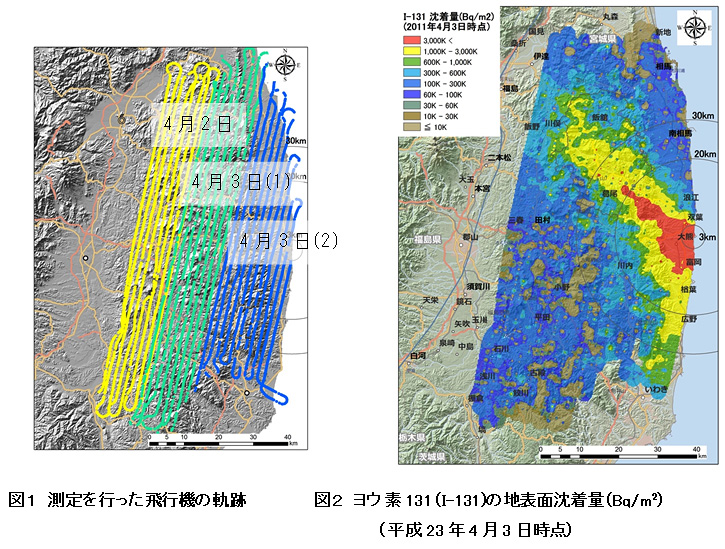
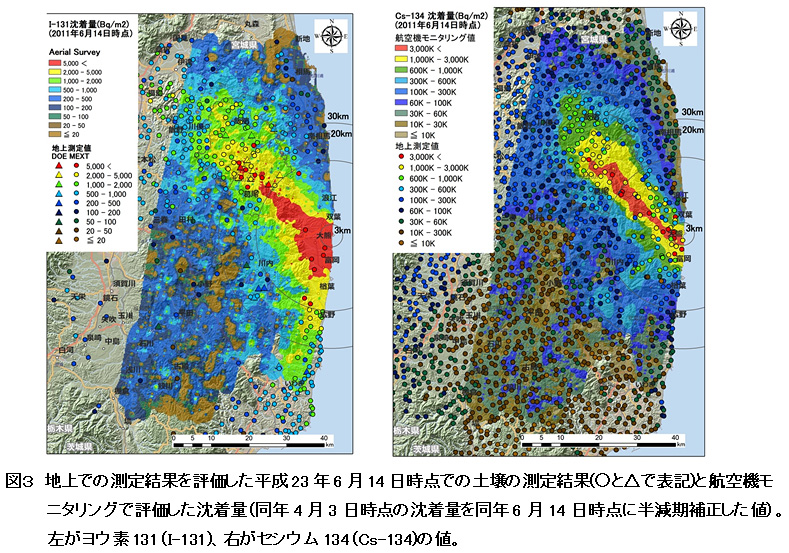
The maps covers about the ocean-third of Fukushima Prefecture.


The left map shows the flight paths. The right map is I-131 deposition.


The left map is I-131 deposition, and the left map is cesium-134 deposition to show similarities and differences.

==============================

Japan Atomic Energy Agency and the US Department of Energy and National Nuclear Security Administration collaborated to create a map of iodine-131 deposition, and the paper featuring the map is to be published on June 26, 2013 in the electronic version of the official journal of Health Physics Society.

I searched JAEA site looking for the maps, and as usual their latest information is several days old, even though they just held a press conference announcing the publication.

Here's from a nuclear researcher I follow, an abstract of the paper for the 58th Annual Meeting of the Health Physics Society (7-11 July 2013, Madison, WI):

WAM-B.5   10:30  Enhanced Analysis of Early Aerial Surveys Maps I-131 Deposition from the Fukushima Daiichi Accident T Torii, Fukushima Environmental Safety Center, Japan Atomic Energy Agency ; T Sugita, Fukushima Environmental Safety Center, Japan Atomic Energy Agency; CE Okada*, U.S. Department of Energy, Remote Sensing Laboratory; MR Reed, U.S. Department of Energy, Remote Sensing Laboratory; DJ Blumenthal, U.S. Department of Energy, National Nuclear Security Administration

Abstract: During March through May 2011, the U.S. Department of Energy, National Nuclear Security Administration conducted aerial radiological surveys to characterize the severity and extent of the Fukushima Daiichi accident. The data from these surveys have previously been reported in terms of ground-level exposure rate (mSv/h) and concentrations of Cs-134/Cs-137 (Bq/m²). A small subset of the data has been re-examined with analysis techniques that were developed to exploit the gamma-ray spectral data and determine the ground-level I-131 concentration. I-131 is a short-lived (t½ = 8.04 d) radionuclide that is a potential major contributor to dose in a nuclear power plant accident. The methods developed for this analysis are described, and results of this effort are reported. *This work was done in part by National Security Technologies, LLC, under Contract No. DE-AC52-06NA25946 with the U.S. Department of Energy.


National Security Technologies, LLC is a joint venture formed in 2006 between Northrop Grumman Corporation and three other corporate partners including Babcock & Wilcox. Looks like an outsourcing outfit of Dept of Energy.

According to Mainichi Shinbun (6/27/2013):

  • The maps show contamination by radioactive iodine in the 400 square kilometer areas around Fukushima I Nuclear Power Plant.

  • The maps are based on the analysis of the data from aerial surveys done by the US Department of Energy on April 2 and 3 in 2011.

  • High deposition of radioactive iodine in the north-western direction from the plant, same as radioactive cesium deposition.

  • High deposition of radioactive iodine also in the southern direction from the plant, with areas with more than 1 million Bq/m2 extending to the north of Iwaki City.

  • Delay in disclosing the data is ascribed to "careful examination" by JAEA, as it was difficult to extract data for radioactive iodine as the contamination of the airplanes used in the survey was quite high.


I think this is part of the data that was freely given by the US government to the Japanese government, with the express consent by the US government to the Japanese government to distribute the data freely, but which the Japanese government decided to sit on. The data included contamination maps from data collected by Global Hawk drones in March 2011, and near-real-time video footage of Fukushima I Nuclear Power Plant also by Global Hawk in March 2011. (See my post from 2012.)

If so, JAEA may have finally figured out that the data was in GIS file format.

Radioactive iodine spreading to the south of the plant was the animation of the simulation I was watching in horror at France's IRSN site within a week (earliest simulation was on March 17, 2011) of the accident on March 11, 2011.

Tuesday, March 5, 2013

Obama's Nominee for Secretary of Energy Is an MIT Professor Who Said It Would Be a Mistake to Abandon Nuclear Power Because of #Fukushima Accident


It sort of rhymes with the Jiji's interview with Dr. Antonino Zichichi, the 83-year-old Italian particle nuclear physicist who extolled the virtue of safe and cheap nuclear power, dismissing the Fukushima I Nuclear Power Plant accident as caused "human errors" committed by lowly non-specialist workers.

President Obama's pick for the next Secretary of Energy is an MIT theoretical nuclear physicist who wrote in 2011 that it was a grave mistake for governments in the world to abandon nuclear power just because the Fukushima accident happened.

Why? Because nuclear energy is carbon-free energy! (Uggghhh...)

And because Chinese, Indians, Russians, and South Koreans haven't stopped pursuing nuclear energy even after the Fukushima accident. So why should you?

To address safety of nuclear power plants, he advocates the Small Modular Reactors (SMR), for which Babcock & Wilcox backed by Microsoft's Bill Gates won the federal government funding for half the cost of its 5-year project to design and commercialize small, modular reactors.

And nuke waste? From what I've skimmed through he doesn't propose anything new. He simply says it has to be addressed.

From his featured essay in Foreign Affairs magazine in 2011 (November/December 2011 issue):

Why We Still Need Nuclear Power
Making Clean Energy Safe and Affordable

By Ernest Moniz

In the years following the major accidents at Three Mile Island in 1979 and Chernobyl in 1986, nuclear power fell out of favor, and some countries applied the brakes to their nuclear programs. In the last decade, however, it began experiencing something of a renaissance. Concerns about climate change and air pollution, as well as growing demand for electricity, led many governments to reconsider their aversion to nuclear power, which emits little carbon dioxide and had built up an impressive safety and reliability record. Some countries reversed their phaseouts of nuclear power, some extended the lifetimes of existing reactors, and many developed plans for new ones. Today, roughly 60 nuclear plants are under construction worldwide, which will add about 60,000 megawatts of generating capacity -- equivalent to a sixth of the world's current nuclear power capacity.

But the movement lost momentum in March, when a 9.0-magnitude earthquake and the massive tsunami it triggered devastated Japan's Fukushima nuclear power plant. Three reactors were severely damaged, suffering at least partial fuel meltdowns and releasing radiation at a level only a few times less than Chernobyl. The event caused widespread public doubts about the safety of nuclear power to resurface. Germany announced an accelerated shutdown of its nuclear reactors, with broad public support, and Japan made a similar declaration, perhaps with less conviction. Their decisions were made easier thanks to the fact that electricity demand has flagged during the worldwide economic slowdown and the fact that global regulation to limit climate change seems less imminent now than it did a decade ago. In the United States, an already slow approach to new nuclear plants slowed even further in the face of an unanticipated abundance of natural gas.

It would be a mistake, however, to let Fukushima cause governments to abandon nuclear power and its benefits. Electricity generation emits more carbon dioxide in the United States than does transportation or industry, and nuclear power is the largest source of carbon-free electricity in the country. Nuclear power generation is also relatively cheap, costing less than two cents per kilowatt-hour for operations, maintenance, and fuel. Even after the Fukushima disaster, China, which accounts for about 40 percent of current nuclear power plant construction, and India, Russia, and South Korea, which together account for another 40 percent, show no signs of backing away from their pushes for nuclear power.

....

(Full article at the link)


At least partial meltdowns? I think at the time of the publication it had been already fully admitted by TEPCO and the Japanese government that they were total meltdowns and partial melt-throughs (out of Reactor Pressure Vessels).

Ihe concluding part of the essay, Dr. Moniz says "the public needs to be convinced that nuclear power is safe". Have we seen this before? Yes, in the past 50 years or so in Japan, and particularly in the past 2. This is a political essay urging politicians to do "now or never" to save the planet from global warming, and telling them he is there to help:

The concluding part of the same essay above (emphasis is mine):

NOW OR NEVER

As greenhouse gases accumulate in the atmosphere, finding ways to generate power cleanly, affordably, and reliably is becoming an even more pressing imperative. Nuclear power is not a silver bullet, but it is a partial solution that has proved workable on a large scale. Countries will need to pursue a combination of strategies to cut emissions, including reining in energy demand, replacing coal power plants with cleaner natural gas plants, and investing in new technologies such as renewable energy and carbon capture and sequestration. The government's role should be to help provide the private sector with a well-understood set of options, including nuclear power -- not to prescribe a desired market share for any specific technology.

The United States must take a number of decisions to maintain and advance the option of nuclear energy. The NRC's initial reaction to the safety lessons of Fukushima must be translated into action; the public needs to be convinced that nuclear power is safe. Washington should stick to its plan of offering limited assistance for building several new nuclear reactors in this decade, sharing the lessons learned across the industry. It should step up its support for new technology, such as SMRs and advanced computer-modeling tools. And when it comes to waste management, the government needs to overhaul the current system and get serious about long-term storage. Local concerns about nuclear waste facilities are not going to magically disappear; they need to be addressed with a more adaptive, collaborative, and transparent waste program.

These are not easy steps, and none of them will happen overnight. But each is needed to reduce uncertainty for the public, the energy companies, and investors. A more productive approach to developing nuclear power -- and confronting the mounting risks of climate change -- is long overdue. Further delay will only raise the stakes.

Wednesday, January 9, 2013

Nissan Motor to Start Production of Batteries for Unpopular EV "Leaf" in the US, Thanks to $1.4 Billion Loan from Obama's DOE


From Detroit News (1/9/2013):

Nissan launching production of Leaf in U.S.

Washington — Nissan Motor Co. said it will begin U.S. production of its all-electric Leaf on Thursday in Tennessee as part of a $1.4 billion government loan.

The Japanese automaker won an Energy Department loan in 2010 to build a battery plant in Smyrna, Tenn., and to retool to build the Leaf at its assembly plant next door.

The Leaf will be built alongside the company's gasoline-powered products.

Nissan says it is the only automaker that manufactures its own electric vehicle batteries, at the biggest lithium-ion automotive battery plant in the United States.

The Leaf's sales have struggled and the automaker failed to double sales in 2012 as it had predicted and instead sold about the same number as in 2011.

Last year, Nissan sold 9,819 Leaf EVs in the United States — up 1.5 percent over 2011.

The Leaf is not the only struggling electric vehicle. Ford Motor Co. sold just 685 Focus EVs in 2012 — its first full year of sales — even though it has built 1,627, according to a report from Ford last week.

(Full article at the link)


How generous of the US government to help out a foreign company. TARP money extracted from the Congress under the threat of martial law was also generously spent on foreign financial institutions. No wonder tax should be raised across the board.

Sunday, January 6, 2013

#Fukushima Nuclear Accident: Japan's Top Bureaucrats Didn't Know GIS, Couldn't Figure Out Data Given by the US, a Japanese Magazine Alleges


I have read incredible news over the past 20 months, but this one, if true, may take the cake.

I saw the article below back in July last year, and was going to post it but I couldn't manage to do so. On December 31, 2012, the news by Kyodo surfaced that the team the US government sent to Japan right after the start of the Fukushima I Nuclear Power Plant accident was a special nuclear counter-terrorism group. That resurrected the news in June last year that the Japanese government did not disclose the US data in a timely manner and the government ministers of the Noda administration apologized.

Yukio Edano, then Minister of the Economy, Trade and Industry, was heard again apologizing, as Kahoku Shinpo (original is probably from Kyodo News; 1/1/2013):

当時、官房長官として危機管理に当たった枝野幸男氏は「(米データを活用していれば)屋内退避エリアの避難が早くなった可能性はある。なぜ政務まで上がってこなかったのか。本当に遺憾だ」と話した。

Mr. Yukio Edano, then in charge of crisis management as Chief Cabinet Secretary, said, "(If the US data was utilized) it is possible that we could evacuate people in the 'indoor evacuation area' sooner. Why wasn't the data brought up to the parliamentary official level? It is really lamentable."


Well, if the Shukan Playboy magazine is right, it was because no one in the national government could make head or tail out of the US data because it was in GIS format, it didn't even occur to them that the data was in GIS format.

From Shukan Playboy (7/23/2012; part):

最大の問題は、保安院や文科省にGISデータを読み解ける者がいなかったことである。法律まで制定して活用を目指したのにも関わらず、日本政府のエリートたちはこのデータの使い方を知らなかったのだ。

The biggest problem was that there was no one at Nuclear and Industrial Safety Agency or Ministry of Education who could [recognize the data as] the GIS data. The national government had enacted the law to utilize GIS, but the elite bureaucrats in the Japanese government did not know how to use this data [from the US government].

霞が関の役人の中には、GISのソフトウェアで読み込まなければなんの意味も持たない膨大なデータを、なぜか紙にプリントアウトしてにらめっこしている者もいたという。そしてマスコミの敏腕記者たちもまた、同様にこの貴重なデータをまったく使いこなせていない。挙句の果てには、軍事機密でもないのに“暗号”呼ばわりされているありさまだ。

[We learned that] there were bureaucrats in Kasumigaseki [in Tokyo where the national government ministries are located] who printed out the vast amount data on paper and stared at it, even though the numbers wouldn't mean a thing unless they were opened in GIS software. [Otherwise] competent reporters of the media are equally incapable of making full use of this valuable data. They even call the data "cipher", even if it is not a military secret.

米国政府が、昨年10月から測定場所と放射性核種の測定値、測定日時を盛り込んだ「生の測定データ」をインターネット上で一般公開し続けている理由もそこにある。日本の政府機関やマスコミが信用できないため、データを直接配っているわけだ。

That's the reason why the US government has made the "raw data" available on the Internet since October 2011 that includes locations measured, types and amounts of radionuclides measured, and dates measured. They are making the data directly available because they can't trust the Japanese government or the media [to do anything with the data].

GISでの利用を前提としていることが、日本において米軍の測定した放射能汚染データを理解し、活用する上での“壁”となった。その結果、日本国民がこの貴重な情報を知る機会は、福島原発事故発生から1年以上が過ぎた今日まで、ついになかった。「GISを高度に活用していく」というNSDI法が、聞いて呆れる。

The Japanese government could not understand nor utilize the radiation contamination data taken by the US military because the data was meant to be used in GIS. As the result, the Japanese people did not have a chance to learn about this valuable data. Not even today, more than 1 year after the start of the Fukushima nuclear accident. What good is the NSDI Law [National Spatial Data Infrastructure Law, which became the law in 2007] that is supposed to "fully utilize GIS"?


It's not that this reporter knows much about GIS himself, as he writes,

GISとは、大規模な環境汚染をともなう事故や災害が発生した際に、「主な汚染物質」「高濃度の汚染範囲」「時間ごとの推移」といった情報と、緯度・経度や地形などの地理情報を組み合わせてひとつの地図上に表示し、高度な分析や迅速な判断・対応を可能にする技術だ。

GIS is a technology that combines geographic information and data such as "main contaminant", "areas of high contamination", "timeline" etc. as a single map to allow sophisticated analysis and quick decision-making when an accident or disaster happens with large-scale contamination of the environment.

GISのソフトウェアは無料でダウンロードすることができ、ハードウェアの高性能化&低価格化が進んだこともあって、今や世界中で普及している。

GIS software can be downloaded free of charge. With high-performance hardware available at cheaper cost, GIS is widely used throughout the world.


I don't know for certain but it is not likely that the GIS system used by the US government is free software. It is likely to be from Esri, definitely not free, nor cheap. The reporter seems to think it's like a GPS car navigation system from Garmin, or Google Earth.

GIS is decidedly not a technology only for a big accident or natural disaster. It is about how to organize and visualize information geographically.

But isn't this sad, if the article is true? Bureaucrats at the powerful ministries didn't have any idea what the data was about, and they were staring at the printouts and trying to make sense of the numbers, as if by intuition that might come in a divine flash.

Many Japanese readers dismissed the article as "not credible" because it came from a soft-core men's magazine. I found it very credible, particularly the part it describes elite bureaucrats staring at the printouts trying to make sense out of the numbers. That image fits very nicely with the then-head of NISA, who left the disaster response headquarters inside the Prime Minister's Official Residence and went home on March 11, 2012 because he was a "liberal arts major". He never returned to the headquarters afterward.

Wednesday, June 20, 2012

LDP "Shadow Foreign Minister: "Prime Minister's Office Refused to Accept Radiation Data from the US"


On June 18, 2012, Asahi Shinbun reported that:

The Ministry of Foreign Affairs received the fax from the US showing the contamination map created from the actual data collected by Global Hawk drones via the US Embassy in Tokyo on March 18 and 20 last year. The Ministry of Foreign Affairs told Asahi that it immediately forwarded the fax to the Nuclear and Industrial Safety Agency and the Ministry of Education. NISA and the Ministry of Education both sat on the data.


A Lower House Representative and "Shadow Minister of Foreign Affairs" of LDP (Liberal Democratic Party) describes the event a bit differently.

Itsunori Onodera, a Representative from Miyagi District 6, tweeted on June 18, 2012 as follows:

福島原発事故直接の米国データ公表しなかった件、事故直接、官邸が受け付けないので、何とかして欲しいと私の事務所にも米国大使館から要請があり、官邸につなぎました。ですが結局無視されてしまいました。あまりに無責任。

About the data from the US right after the Fukushima nuclear accident started, the US Embassy asked my office to do something because the Prime Minister's Official Residence wouldn't accept the data from them directly. So I liaised with the PM's Official Residence. However, in the end it was ignored. It is just too irresponsible.


Some of the people responding to his tweet are rather critical of him. They say, "So what did you do then? Did you speak out?"

Mr. Onodera, as with many people at that time - journalists, experts, politicians, bloggers - may have self-censored so as not to cause panic among the population. Or simply, the earthquake and tsunami damage seemed overwhelmingly bigger than the nuclear accident, even after 3 (visible) explosions. (What happened in Reactor 2 is still not known or disclosed.) It was when some people were saying "Let's go out, have fun and spend money so that the economy doesn't contract and deflation further sets in", as I read at that time on an online message board in Japan.

But the government officials at the Prime Minister's Official Residence knew full well what the Fukushima I Nuclear Power Plant accident meant, as Mr. Edano was on record suggesting the evacuation plan for wider areas in Kanto be considered. If what Mr. Onodera says is true, there's some explaining to do for Mr. Edano, Mr. Kaieda, and Mr. Kan.

Monday, June 18, 2012

(Now They Tell Us) "Miscommunication" Prevented Radiation Monitoring on March 12 Last Year


The article that appeared in Asahi Shinbun on February 24 this year says the Self Defense Force made one of their helicopter available for the government to conduct an aerial survey of radiation in the early afternoon of March 12, 2011, before the Reactor 1 building blew out at Fukushima I Nuclear Power Plant.

From what I gather from the article, the timeline was something like this:

  1. Sometime in the morning on March 12, 2011, Ministry of Education and Science asked for a SDF helicopter to be used for radiation monitoring.

  2. Ministry of Defense agreed, and sent one medium-size helicopter at 11:10AM from its base in Sendai, Miyagi that had been used for disaster relief to Rokkasho-mura, where the Nuclear Safety Technology Center staff were supposed to be waiting.

  3. The helicopter landed in the meeting place (a park in Rokkasho-mura) at 1PM, but there was no one waiting for the helicopter. So it took off at 1:10PM.

  4. The Nuclear Safety Technology Center in Rokkasho-mura received the instruction from the Ministry of Education at 1:30PM. Two people went to the meeting place, and waited for the SDF helicopter to show up for one hour from 2:40PM.

  5. The center assumed the SDF heli was busy doing the disaster relief, and decided to drive to Fukushima the next day (March 13) at 9AM.

  6. The aerial radiation survey was then scheduled on March 15, but that was canceled because of the information that "Reactor 4 blew up".

  7. The aerial survey wasn't carried out until March 25.


The Nuclear Safety Technology Center's Rokkasho-mura branch had the staff and the equipment to conduct aerial radiation surveys.

What is wrong with this picture?

First, it confirms that the Ministry of Education and Science knew the radiation from Fukushima I Nuclear Power Plant was leaking in the morning of March 12, 2011.

Second, neither the SDF nor the Nuclear Safety Technology Center bothered to try to contact each other when there was no one at the meeting place (Rokkasho-mura park), or when there was no helicopter. I doubt that they had a direct means of communication, but the SDF helicopter pilot could have contacted the base who could have contacted the SDF headquarters/Ministry of Defense who could have contacted the Ministry of Education.

The Asahi article specifically says that the head of the Radiation group at the Emergency Response Center (ERC) under the Ministry of Economy, Trade and Industry was a bureaucrat on assignment from the Ministry of Education. The Ministry of Education blames the ERC of course, saying "It was the ERC under the Ministry of Economy, Trade and Industry who proposed an aerial [radiation] monitoring. It was the ERC who coordinated with the Ministry of Defense. We immediately conveyed the ERC messages to the Nuclear Safety Technology Center."

Third, Asahi didn't report it until February this year.

Fourth, I managed to miss the news when it appeared in February this year.

The US Department of Energy and the US military were conducting the aerial survey using Global Hawk drones from March 17 to 19 last year, and they SHARED the results with the Japanese government. The Japanese government sat on it. Asahi Shinbun first reported it in March 24 last year, and it just reported the news again on June 18 this year.

According to the June 18 article, the Ministry of Foreign Affairs received the fax from the US showing the contamination map created from the actual data collected by Global Hawk drones via the US Embassy in Tokyo on March 18 and 20 last year. The Ministry of Foreign Affairs told Asahi that it immediately forwarded the fax to the Nuclear and Industrial Safety Agency and the Ministry of Education. NISA and the Ministry of Education both sat on it. Probably because it came from the Ministry of Foreign Affairs. What does the Ministry of Foreign Affairs know anything about radiation? Right?

(It is also possible that "immediate" in the minds of the officials at the Ministry of Foreign Affairs was "several hours later" in a reality-based world.)

Moreover, Mainichi Daily (English paper) reported on March 19 last year that the Japanese government was in possession of near-real time video footage of Fukushima I Nuclear Power Plant taken from Global Hawk, with the permission from the US to release to the general public. The Japanese government sat on it. I think it is still sitting on it.

Japan was the worst possible place for a major nuclear accident to occur - bureaucracy that plays bureaucracy in an extreme emergency, politicians who cannot lead in an extreme emergency, and the populace who cannot even properly "panic" in an extreme emergency.

Friday, December 16, 2011

State of Cold Shutdown in #Fukushima: US Deputy Secretary of Energy Was Also At Hand

As I posted yesterday, NHK quoted the US Deputy Secretary of State expressing a strong interest from the US companies to participate in Japan's decontamination (bubble), after he congratulated the administration on this important milestone.

Well, he was not alone. It looks like a whole delegation of the US government has been quietly in Japan, negotiating with the extremely pro-US Noda administration for a big piece of "post"-accident bubble in decommission and decontamination, to be paid for by the hapless Japanese taxpayers.

Businessweek/Bloomberg news on the "state" of cold shutdown at Fukushima (12/16/2011) quotes the US Deputy Secretary of Energy Daniel Poneman:

Cold War weapons production in the U.S. left the country with “a significant nuclear cleanup legacy, including high- level waste, contaminated soil and groundwater,” Daniel Poneman, the U.S. Deputy Secretary at the Department of Energy, said in Tokyo yesterday.

The Hanford Site in Washington State and the Savannah River Site in South Carolina have more than 90 million gallons of liquid waste in tanks the government is working to convert into more stable forms that do not threaten the environment, he said.

Japan's government has requested support from the U.S. to decommission the Fukushima Dai-Ichi plant as well as managing the site from an environmental perspective, he said.

Sovereign capture is so complete. Or it always has been.