Showing posts with label JAEA. Show all posts

Thursday, January 9, 2014

JAEA to Recreate a Core Melt to Better Understand #Fukushima I NPP Accident


Japan Atomic Energy Agency (JAEA) of Monju fame (most recently with free video playback software download that infected the PC in the central control room at Monju) will conduct an experiment that creates a small-scale core melt (commonly referred to as "meltdown").

Let's see. JAEA had a fire at Monju, which they hid. They dropped the fuel handling machine in the reactor. There were so many irregularities that Nuclear Regulation Authority was recommending shutting down the organization, when the pro-nuclear Abe administration came in and pledged to continue fuel recycle using Monju operated by JAEA.

(I would be much more comfortable if it weren't JAEA who will be doing the experiment.)

From Yomiuri Shinbun (1/8/2014):

炉心溶融を実験で再現…原子力機構、事故対策へ

JAEA to recreate core melt in an experiment, [result] to be utilized in dealing with Fukushima I NPP accident

日本原子力研究開発機構は、東日本大震災の際に東京電力福島第一原子力発電所で起きた炉心溶融(メルトダウン)を再現する小規模実験を、新年度に行う。

Japan Atomic Energy Agency will conduct a small-scale experiment in the new fiscal year (that starts April 1, 2014) that will recreate a core melt that happened at Fukushima I Nuclear Power Plant after the March 11, 2011 earthquake/tsunami.

事故の際、核燃料の過熱や溶融がいつごろ、どのように進んだのかは、これまで限られたデータを基にコンピューター計算で推定されただけで、不明な点が多い。実際の核燃料を冷却水のない「空だき」で過熱させる実験により、機構は「事故で起きた現象を明らかにして、今後の原発の事故対策に役立てたい」と話している。

So far, the progression of core melt has only been simulated by computer models based on limited data, and there is much that are still unknown. By using an actual fuel rod and overheat it without coolant [water], JAEA hopes to "better understand what actually happened in the accident and utilize the knowledge gained from the experiment in dealing with the accident."

実験は、茨城県東海村にある原子炉安全性研究炉で行う。研究炉の中心部にステンレス製のカプセル(長さ1・2メートル)を入れ、ミニ燃料棒(同30センチ)1本を水に触れないようにして収める。カプセルの周囲の核燃料から飛んでくる中性子によって、ミニ燃料棒の中のウランも核分裂し、2000度以上の高温になって溶ける。

The experiment will be carried out in JAEA's Nuclear Safety Research Reactor (NSRR) in Tokai-mura in Ibaraki Prefecture. A stainless steel capsule (1.2 meter long) will be inserted in the center of the reactor, and a miniature fuel rod (30 centimeters long) will be placed in the capsule without touching water. Uranium in the miniature fuel rod will undergo nuclear fission as it is being hit by neutrons emitted from the nuclear fuels surround the capsule, causing the temperature to rise above 2,000 degrees Celsius and causing the fuel rod to melt. [See the diagram by Yomiuri. English labels are by me.]

機構によると、実際の原発で使う長さ約4・5メートルの燃料棒の束に比べて少量で、核分裂はすぐに止まり、溶けて数分後には冷えて固まるという。固まった燃料は分析した後、他の核燃料と同様に、敷地内のプールで冷やして保管する。

According to JAEA, since [the fuel rod to be used] is much smaller than 4.5 meter-long fuel rods used in a real nuclear power plant, nuclear fission will stop shortly, and the melted fuel will cool and solidify in a few minutes. The solidified fuel will be analyzed, and then stored in the pool on the premises with other nuclear fuels.

Monday, September 16, 2013

Monju Fast Breeder Reactor's Emergency Response Support System Was Down for One Hour, Cause Unknown, Plant Site Not Accessible Due to Landslides


According to an emergency email from Nuclear Regulatory Authority that independent journalist Ryuichi Kino shares, the cause of the system stoppage is not likely to be known anytime soon as the maintenance staff cannot reach Monju because of landslides caused by Typhoon 18's heavy rain.

From Kino's tweets:

本日(16日)、原子力規制庁は、独立行政法人原子力安全基盤機構(JNES)より、日本原子力研究開発機構もんじゅの緊急時対策支援システム(ERSS)のプラント情報表示システムからのデータ伝送が停止している旨の連絡を受けました。

Today (September 16), we at Nuclear Regulatory Authority received correspondence from Japan Nuclear Energy Safety Organization (JNES) that data transfer from the plant parameter display system of the Emergency Response Support System (ERSS) for Japan Atomic Energy Agency (JAEA)'s Monju Fast-Breeder stopped.

(16日2時56分から伝送停止。同日3時46分から順次受信)。JNES及び日本原子力研究開発機構においてデータ伝送停止の原因を調査中ですが、台風18号の大雨による土砂崩れのため、保修担当者がもんじゅ構内に通行不能であり、伝送停止の原因判明には時間を要する模様です。

(The data transfer stopped at 2:56AM on September 16, and partially resumed after 3:46AM.) JNES and JAEA are currently investigating the cause of the data transfer stoppage. However, because of landslides from heavy rain from Typhoon No.18, maintenance and repair staff cannot get to the Monju Plant compound. Therefore, it may take a while to determine the cause of the stoppage.

なお、ERSS伝送装置復旧までの間に原子力施設でトラブルが発生した場合には、電話、FAX、電子メール等の代替手段によりデータを入手でき、データ提供を確実なものとするよう、日本原子力研究開発機構に指示済みです。

We have already instructed JAEA to secure the collection and transfer of data via alternative means such as telephone, FAX, email if a problem arises at the nuclear facility before the ERSS data transfer system is fully restored.


According to Asahi Shinbun (9/16/2013), there were two landslides near Monju, with one of them at the entrance of a tunnel 1 kilometer from the plant.

There are several nuclear power plants in Japan which are only accessible by one road and/or a tunnel - Monju, Tsuruga Nuclear Power Plant, and Ooi Nuclear Power Plant.

Here's how Monju is situated: accessible via a tunnel, or a narrow road hugging the coastline:


Accessibility to the site in case of a problem is not included in the conditions for restarting the nuclear power plants in Japan.

By the way, in terms of accessibility, TEPCO's nuclear plants including Fukushima I Nuclear Power Plants are one of the best nuclear plants in Japan, and still the earthquake and tsunami led to the disaster we continue to face at Fukushima I Nuclear Power Plant.

Wednesday, July 31, 2013

High-Level Radioactive Liquid Waste, Plutonium Nitrate Stored in Tokai Reprocessing Plant, JAEA Volunteers Information to NRA


I've never heard of a nuclear operator volunteering bad information to a regulatory agency without being asked. Neither has NRA Chairman Tanaka, apparently.

It is almost unprecedented, says Chairman Tanaka, that a nuclear operator (in this case JAEA) has volunteered the information and alerted the regulatory authority (in this case NRA) of existence of hazard and risk at a nuclear facility (in this case Tokai Reprocessing Plant).

On July 31, Nuclear Regulatory Authority held its regular weekly meeting, which was netcast live (now archived at NRA's Youtube channel). Toward the end of the long meeting, Chairman Shunichi Tanaka asked the commissioners if they had any last thoughts and suggestions. Commissioner Fuketa raised his hand, and proceeded to tell the other commissioners and officials from the Nuclear Regulatory Agency (secretariat of NRA) about a piece of information voluntarily submitted by Japan Atomic Energy Agency (JAEA).

JAEA told NRA that there are large quantities of high-level liquid waste and plutonium in liquid form at its Tokai Reprocessing Plant in Ibaraki Prefecture and that they wanted to solidify them to make the facility safer. JAEA wanted to know how to proceed under the new standards, if applied.

A nuclear operator proactively (to save its skin maybe, but) addressing the safety issue and asking for direction - a small, first step toward the right direction?

This is what Commissioner Fuketa told the group (my summary, from the video of the meeting, after 1 hour and 45 minutes):

JAEA operates Tokai Reprocessing Plant in Ibaraki Prefecture, about 1/4 of the size of Rokkasho Reprocessing Plant in Aomori Prefecture. It became operational in 1981, and stopped operation to enter into a prolonged inspection/maintenance in 2007.

NRA is currently soliciting public comments on the new regulatory standards for nuclear fuel reprocessing facilities, and as part of the process NRA conducted hearings from the nuclear operators for their opinions on the new regulatory standards. Instead, JAEA submitted the information that in addition to spent fuel assemblies there are large quantities of high-level radioactive liquid waste and liquid plutonium (plutonium nitrate) stored at Tokai Reprocessing Plant, and that they pose a hazard and JAEA wants to do something about it.

JAEA seems to have decided to volunteer the information before the new standards are enforced [later this year, I think]. JAEA says it wants to vitrify high-level radioactive liquid waste and solidify plutonium nitrate to make them safer, and the new regulatory standards should address this problem.

It is extremely rare that a nuclear operator readily disclose a hazard or risk at its facility. Nuclear Regulatory Authority/Agency should assess the situation and figure out what to do.

Existence of liquid waste and plutonium itself does not constitute a regulatory problem per se. But since the operator has volunteered the information of this risk, we should investigate, understand the situation and quantify the risk.

Then, to vitrify the liquid waste and solidify plutonium nitrate, we have to somehow bring Tokai Reprocessing Plant operational. Do we do that under the new regulatory standards? In order to figure out how we could do so and come up with the plan, Nuclear Regulatory Agency should investigate and find out the details of the situation.

There are 400m3 (cubic meter) of highly contaminated liquid waste, and 670 kilograms of plutonium nitrate (in liquid form) at the site. (699 kilogram to be exact, according to JAEA's website).


Chairman Tanaka expressed his concern that he had had about the liquid waste and liquid plutonium at Tokai, and said it was unprecedented that an operator volunteered such information. He reminded the group about the leak of high-level liquid waste in the US, and asked Nuclear Regulatory Agency to investigate. But he asked the Agency to do the operator hearing in public, as it concerned safety of the facility. The Agency chief agreed.

Then, Commissioner Kenzo Oshima, the only commissioner who is not scientist but a career bureaucrat at Ministry of Foreign Affairs, asked to comment. He went on to try to vilify JAEA for disclosing the information now that the new regulatory standards on nuclear reprocessing facilities are coming their way, and repeatedly raised the issue (it was the issue to him, apparently) of "abandoning high-level liquid waste at the site" and who should be held responsible (Ministry of Education, he mentioned).

The scientists of NRA looked puzzled. Finally, Commissioner Fuketa told Commissioner Oshima rather forcefully that it was not the matter of "abandoning" the waste, but since the processing was halted, the waste and plutonium were "work in progress", so to speak, and it was not the matter of who was responsible or who was to be punished. What would be needed was to understand the situation, and come up with the solution to the problem. Commissioner Fuketa was effectively saying it was not about punishing JAEA for volunteering the information.

Commissioner Oshima is the one who declared in early July that they would restart some reactors in one year's time.

As a non-scientist, Commissioner Oshima cannot participate in the examination of the applications from nuclear power plant operators, and in the meeting he sounded frustrated, being among no-nonsense scientists who so far do not play much politics.

It made me wonder what kind of dialog TEPCO (or any nuclear power plant operators) and NISA, previous regulatory body now abolished, used to have. I have a feeling that TEPCO never volunteered a bad piece of information about their nuke plants, and NISA didn't want to hear either.

Wednesday, July 17, 2013

Japan's Nuclear Regulatory Authority Investigates Faults Beneath Fast-Breeder Monju, Operator JAEA Insists They Are Not Active Faults


Nuclear Regulatory Authority's Deputy Chairman and seismologist Kunihiko Shimazaki is leading a team of experts to determine whether the 8 faults that run directly beneath the trouble-prone fast-breeder Monju in Fukui Prefecture are active faults.

Japan Atomic Energy Agency (JAEA) "operates" the fast-breeder reactor which is supposed to be the centerpiece of Japan's fuel cycle policy. In its 22-year history since the test run in 1991, Monju has managed to generate one hour worth of electricity.

The Abe administration insists the fuel cycle policy will continue.

JAEA is a government corporation under the Ministry of Education and Science and the Ministry of Economy, Trade and Industry - i.e. a landing pad for the top bureaucrats with golden parachutes.

NRA's Dr. Shimazaki has not been political so far, and has practically said about another nuclear power plant in Fukui (Tsuruga Nuclear Power Plant) that the operator doesn't want to see active faults, therefore does not see the active faults which are apparent to him and his team of experts in two-day investigation.

I suspect it's the same thing at Monju.

From Asahi Shinbun (7/17/2013):

もんじゅ断層、現地調査を開始 原子力規制委

NRA starts field survey of faults at Monju

日本原子力研究開発機構の高速増殖原型炉もんじゅ(福井県)の敷地内に活断層がある疑いが指摘されている問題で、原子力規制委員会は17日、現地調査を始めた。活断層と判定されれば廃炉になる公算が大きく、国は核燃料サイクル政策の見直しを迫られる。

To determine whether there are active faults at Fast-breeder Monju (Fukui Prefecture) operated by Japan Atomic Energy Agency, Nuclear Regulatory Authority started the field investigation on July 17. If the faults are determined to be active, it is likely that Monju will be decommissioned, and the national government will be pressed to revise its fuel cycle policy.

 規制委の島崎邦彦委員長代理ら有識者会合のメンバー4人がこの日午前、現地に入った。まず、もんじゅの西約500メートルを走る活断層「白木(しらき)―丹生(にゅう)断層」が露出している福井県美浜町の現場を調査。2日間かけて、敷地内の断層が活断層かどうかを確かめる。

4 members of the expert group including NRA's Deputy Chairman Kunihiko Shimazaki arrived in Fukui in the morning of July 17. They first investigated the location in Minaha-cho in Fukui where the known active fault, "Shiraki-Nyu Fault", which runs 500 meters west of Monju, is exposed. The group will determine whether the faults inside the Monju compound are active, after the two-day survey.

 敷地内には9本の断層があり、うち8本が原子炉施設の真下にあることが知られている。白木―丹生断層が活動したときに、これらの断層が引きずられて動くおそれが指摘されてきた。今回は最も長い「a断層」を中心に見る。機構側は「新しい年代に繰り返し動いたことを示す痕跡は認められない」として活断層ではないと主張している。

There are nine faults inside the compound, with 8 of them known to be directly beneath the reactor facilities. Experts have pointed out the danger of these faults moving if the Shiraki-Nyu Fault becomes active. In the survey, the longest fault "a-fault" will be the focus. JAEA insists that it is not an active fault, saying there is no evidence that it repeatedly moved in recent years.


By "recent years", JAEA means in the last 100,000 years or so. NRA has made it clear in its new "regulatory standards" that it will consider the last 400,000 years.

Location of the Shiraki-Nyu Fault and Monju, from Asahi Shinbun:


The Shiraki-Nyu Fault in Mihama-cho:


Even without any active fault, Monju should not be operating, for the simple reason that should the road (Route 141) become inaccessible, Monju would be utterly inaccessible except from the sea. Even the ocean access would be problematic after a big earthquake and tsunami:


View Larger Map

Wednesday, June 26, 2013

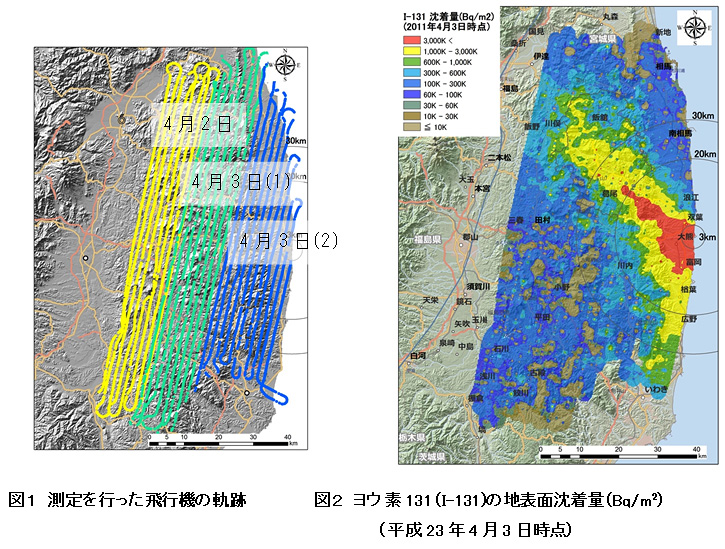
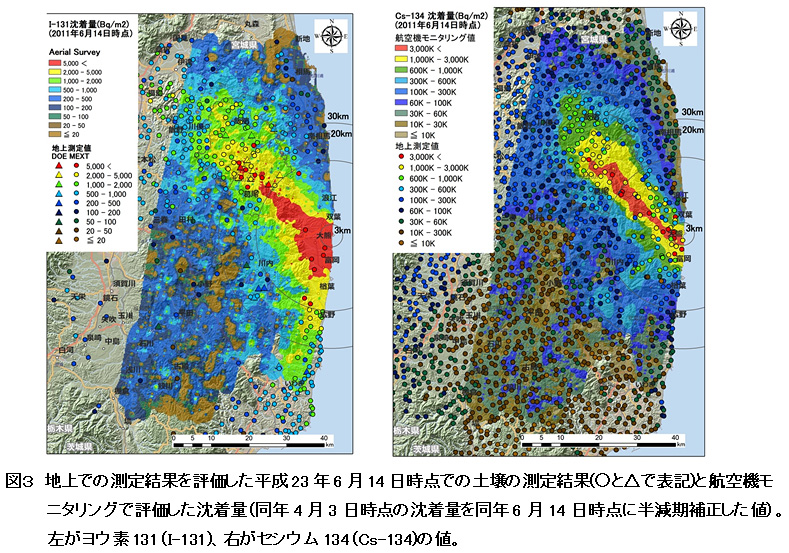
(UPDATED with Maps) JAEA and US Dept of Energy Maps of Iodine-131 Deposition in April 2011 Finally to Be Revealed After Two Years


(UPDATE) From JAEA website,

The maps covers about the ocean-third of Fukushima Prefecture.


The left map shows the flight paths. The right map is I-131 deposition.


The left map is I-131 deposition, and the left map is cesium-134 deposition to show similarities and differences.

==============================

Japan Atomic Energy Agency and the US Department of Energy and National Nuclear Security Administration collaborated to create a map of iodine-131 deposition, and the paper featuring the map is to be published on June 26, 2013 in the electronic version of the official journal of Health Physics Society.

I searched JAEA site looking for the maps, and as usual their latest information is several days old, even though they just held a press conference announcing the publication.

Here's from a nuclear researcher I follow, an abstract of the paper for the 58th Annual Meeting of the Health Physics Society (7-11 July 2013, Madison, WI):

WAM-B.5   10:30  Enhanced Analysis of Early Aerial Surveys Maps I-131 Deposition from the Fukushima Daiichi Accident T Torii, Fukushima Environmental Safety Center, Japan Atomic Energy Agency ; T Sugita, Fukushima Environmental Safety Center, Japan Atomic Energy Agency; CE Okada*, U.S. Department of Energy, Remote Sensing Laboratory; MR Reed, U.S. Department of Energy, Remote Sensing Laboratory; DJ Blumenthal, U.S. Department of Energy, National Nuclear Security Administration

Abstract: During March through May 2011, the U.S. Department of Energy, National Nuclear Security Administration conducted aerial radiological surveys to characterize the severity and extent of the Fukushima Daiichi accident. The data from these surveys have previously been reported in terms of ground-level exposure rate (mSv/h) and concentrations of Cs-134/Cs-137 (Bq/m²). A small subset of the data has been re-examined with analysis techniques that were developed to exploit the gamma-ray spectral data and determine the ground-level I-131 concentration. I-131 is a short-lived (t½ = 8.04 d) radionuclide that is a potential major contributor to dose in a nuclear power plant accident. The methods developed for this analysis are described, and results of this effort are reported. *This work was done in part by National Security Technologies, LLC, under Contract No. DE-AC52-06NA25946 with the U.S. Department of Energy.


National Security Technologies, LLC is a joint venture formed in 2006 between Northrop Grumman Corporation and three other corporate partners including Babcock & Wilcox. Looks like an outsourcing outfit of Dept of Energy.

According to Mainichi Shinbun (6/27/2013):

  • The maps show contamination by radioactive iodine in the 400 square kilometer areas around Fukushima I Nuclear Power Plant.

  • The maps are based on the analysis of the data from aerial surveys done by the US Department of Energy on April 2 and 3 in 2011.

  • High deposition of radioactive iodine in the north-western direction from the plant, same as radioactive cesium deposition.

  • High deposition of radioactive iodine also in the southern direction from the plant, with areas with more than 1 million Bq/m2 extending to the north of Iwaki City.

  • Delay in disclosing the data is ascribed to "careful examination" by JAEA, as it was difficult to extract data for radioactive iodine as the contamination of the airplanes used in the survey was quite high.


I think this is part of the data that was freely given by the US government to the Japanese government, with the express consent by the US government to the Japanese government to distribute the data freely, but which the Japanese government decided to sit on. The data included contamination maps from data collected by Global Hawk drones in March 2011, and near-real-time video footage of Fukushima I Nuclear Power Plant also by Global Hawk in March 2011. (See my post from 2012.)

If so, JAEA may have finally figured out that the data was in GIS file format.

Radioactive iodine spreading to the south of the plant was the animation of the simulation I was watching in horror at France's IRSN site within a week (earliest simulation was on March 17, 2011) of the accident on March 11, 2011.

Saturday, June 8, 2013

Fast Breeder Reactor Monju's Coolant Heating System Accidentally Switched Off for 30 Minutes, No Effect on the Environment, Says JAEA


JAEA again, this time on the fast breeder reactor Monju that this agency "operates" (if it can be called "operating").

Coolant for Monju, sodium, is supposed to be kept at 200 degrees Celsius.

So what's the excuse this time?

Their manual was not well written!

Do you trust these people to run a nuclear reactor, not to mention fast breeder reactor that uses liquid metal that explodes on contact with water and ignites on contact with air?

Do you trust these people to export nuclear reactors all over the world, claiming the superior technology and know-hows, including know-hows from "lessons learned from the Fukushima I Nuke Plant accident"?

Good luck, Czech Republic. Good luck, India, Vietnam, and Turkey.

From Kyodo News (6/8/2013):

もんじゅ、ヒーター停止 ナトリウム一時保温できず

Monju's heater stopped, sodium wasn't kept warm enough temporarily

 日本原子力研究開発機構は7日、高速増殖炉原型炉もんじゅ(福井県敦賀市)で2日、電源設備の点検作業中に、2次系冷却材ナトリウムの温度を保つヒーターを誤って約30分間停止させたと発表した。手順書の不備による作業ミスなどが原因とみられる。

Japan Atomic Energy Agency (JAEA) announced on June 7 that at Fast Breeder Reactor Monju (Tsuruga City, Fukui Prefecture) the heater to keep the secondary coolant, sodium, warm was switched off accidentally for about 30 minutes during the inspection of electric systems on June 2. The cause is attributed to human error due to poor instructions in the manual.

 一部の配管で、ナトリウムは本来の200度から約40度下がったが、環境や原子炉への影響はなかったとしている。ナトリウムの融点は98度程度。

In certain part of the pipe, the temperature dropped 40 degrees Celsius from the normal 200 degrees Celsius, but there was no effect on the environment or the reactor, according to JAEA. Melting point of sodium is about 98 degrees Celsius.

 原子力規制庁や福井県、敦賀市には3日に通報した。公表が遅れた理由について原子力機構は「内規で通報が不要な軽微以下の事案だったため」としている。

JAEA reported to the Nuclear Regulatory Agency, Fukui Prefecture and Tsuruga City on June 3. The reason for the delay in reporting was, according to JAEA, because "it was the very minor incident that didn't require reporting, according to our internal [i.e. unofficial] rules".


So they blame the manual for the incident, but abide by the other, unofficial manual and decide they don't need to report it.

If they didn't notice the heater was off for another hour, they would have been in a big trouble (assuming the temperature drop is linear).

The footage of 1995 sodium leak accident is still there on the net, despite TV Asahi's copyright claim.

The Nuclear Regulatory Authority has already ordered JAEA to stop all the work for preparation for the restart, as 10,000 parts and equipments weren't maintained according to the schedule.

Again, good luck Czech Republic, India, Vietnam, Turkey. And many others, no doubt, now that Japan's Prime Minister Abe and President Francois Hollande of France have formed a formidable team to sell nuclear plants all over the world...

Saturday, May 25, 2013

(Here We Go Again...) "Soh-Teh-Gai" (想定外, Beyond Expectation) Events at J-PARC That Possibly Leaked Tritium and Radioactive Gold


What are the "beyond expectation" events at J-PARC in which radioactive materials leaked after they managed to vaporize gold by hitting it with proton beam that was a bit too strong?

They say (according to Jiji Tsushin, 5/25/2013):

  • They didn't even imagine that the equipment could malfunction; and

  • They didn't even imagine that proton beam could be so strong that it vaporized the metal; and therefore,

  • They didn't even imagine that radioactive materials, which in normal situation remain inside the metal, would leak outside the equipment; therefore,

  • The ventilating fan did not have a filter to block the leak of radioactive materials.


NHK's latest news adds more "beyond expectation" events:

  • They did check the surface contamination on May 23, the day of the accident, and it showed the contamination 10 times the normal level. But they didn't even suspect internal radiation exposure, and let the researchers go home;

  • They didn't check the researchers for internal radiation exposure until 4 researchers asked to be tested;

  • They are yet to test 55 others who at the facility.


The highest radiation exposure, of both internal and external radiation, was 2 millisieverts, according to NHK.

NHK also says they noticed there was a leak of radioactive materials when the radiation level in the facility dropped after using the ventilation fan.

(Duh.)

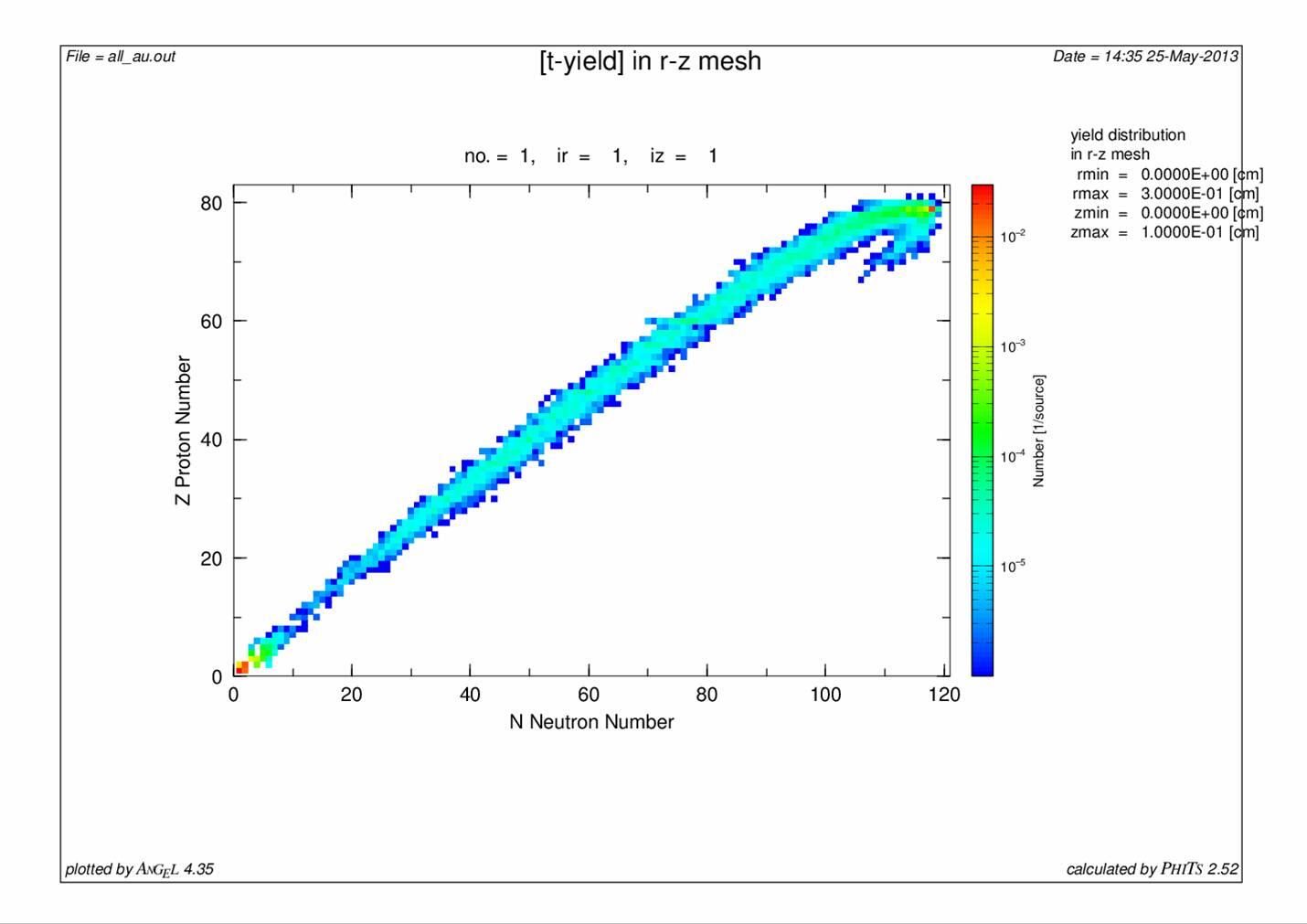
From the tweet of one of the nuclear researchers that I follow (Tomohiro Endo, of Nagoya University), "Calculation of distribution of all nuclides (including stable isotopes and radionuclides) created when 30GeV proton beams hit 1mm-thick gold (30GeVの陽子を1mm厚さの金に当てたときに生成される全核種の分布を計算)":

(Click to enlarge)


He says in another tweet that they are the sum of (1) nuclides created when protons hit gold, and (2) nuclides created when neutrons hit gold.

Most likely radionuclides from the accident are in red and yellow, which he thinks include tritium (proton number 1, neutron number 2) - the orange dot in the lower left corner, and radioactive gold (Au-196), on the left of the orange dot which is stable AU-187 in the upper right corner.

Au-196 has half life of about 6 days. Half life of tritium is about 12 years.

Friday, May 24, 2013

#Radioactive Materials Leak at Japan Proton Accelerator Research Complex (J-PARC) in Ibaraki, Researchers Accidentally Inhaled Radioactive Gold


(UPDATE 2) For the latest, see my posts here and here.

(UPDATE) From Jiji Tsushin (5/25/2013):

施設内の放射線量が上がった際に担当者が換気扇を回し、外部に放射性物質を放出していたことが25日、分かった。許可を出した三浦太一・高エネ研教授は会見で、「通常運転時も半減期の短い放射性物質で線量が上がることがあり、すぐ減衰するとの認識だった。結果として浅はかだった」と謝罪した。

When the radiation level inside the facility rose, the person in charge turned on the ventilating fan and released radioactive materials outside the facility. Professor Taichi Miura at High Energy Accelerator Research Organization, who authorized the ventilation, apologized in the press conference, saying "Radiation level rises even in the normal operation because of radioactive materials with short half life, so we thought they would decay quickly. But it turned out to be imprudent."


================================

Japan Atomic Energy Agency (JAEA), who operates J-PARC, didn't bother to notify the Nuclear Regulatory Agency (secretariat of the Nuclear Regulatory Authority, mostly made of people from NISA) for 2 days, because they did not think there was any leak of radioactive materials.

According to Asahi, the researchers suffer internal radiation of exposure of 1.7 millisievert, and the contamination of the facility is 40 becquerels per square centimeter.

Apparently, the Ibaraki prefectural government was not too happy about the incident and the fact that JAEA didn't bother to notify the authority and the prefectural government, and held an angry press conference at 2AM on May 25.

The official story of the accident, from Asahi Shinbun (5/25/2013, 1:37AM):

原子力機構で放射性物質漏れ 研究者ら4人が内部被曝

Radioactive materials leak at JAEA facility, 4 researchers suffer internal radiation exposure

日本原子力研究開発機構は25日、茨城県東海村のJ―PARCの原子核素粒子実験施設で、放射性物質が施設の外に漏れたと明らかにした。中にいた研究者ら少なくとも4人が内部被曝(ひばく)した。漏洩(ろうえい)は止まっており、拡大の恐れはないという。被曝した4人のうち、最大の被曝量は1・7ミリシーベルトという。原子力機構は外部に漏洩した放射性物質の量を調べている。

Japan Atomic Energy Agency disclosed on May 25 that there was a leak of radioactive materials outside the nuclear and particle research facility at J-PARC in Tokai-mura in Ibaraki Prefecture. At least 4 researchers inside the facility suffered internal radiation exposure. The leak has stopped, and there is no danger of the leak spreading further. The maximum radiation exposure was 1.7 millisievert, according to JAEA. JAEA is currently investigating how much radioactive materials have leaked outside the facility.

原子力機構や原子力規制委員会によると、放射能漏れがあったのは23日午前11時55分ごろ。陽子ビームを金にあて素粒子を発生させる実験をしていた。装置が誤作動を起こして陽子ビームは通常の400倍の出力になり、金が蒸発。放射性物質が漏れて研究者が吸い込んだ。現場には当時、研究者ら約30人がいたという。

According to JAEA and the Nuclear Regulatory Authority, the leak took place at 11:55AM on May 23. They were conducting an experiment of generating elementary particles by hitting gold with proton beam. The equipment malfunctioned, and the output of the proton beam increased to 400 times the normal strength, and gold was vaporized. Radioactive materials [radioactive gold vapor] leaked [from the equipment], and were inhaled by the researchers. There were about 30 researchers when the accident happened.

施設の汚染は最大で1平方センチあたり約40ベクレル。現在、施設内を立ち入り禁止にしている。原子力機構は発生当時、外部への放射能漏れはないと考え、国に報告しなかった。J―PARCは大型の加速器を備えた素粒子などを調べる実験施設。

Contamination of the facility is about 40 becquerels per square centimeter maximum. Currently the facility is off-limit. At the time of the accident, JAEA didn't think there was a leak of radioactive materials, and did not report to the government. J-PARC is a facility to study elementary particles with large accelerators.


Equipment malfunctioned. That's the official story.

Let us now turn to "baseless rumors" among knowledgeable researchers (like this one, from Professor Hayano of Tokyo University) for what may really have happened. According to the unverified rumors, it was not the equipment that malfunctioned. Researchers made a mistake, and instead of hitting the target (gold) with low, continuous proton beam over a long period of time they accidentally hit it with high-intensity proton pulses.

According to NHK quoting the Ibaraki prefectural government, the monitoring post outside the facility showed a slight increase in radiation level between 3PM and 6PM on May 23. The radiation level is normally between 70 to 130 nanogray/hour, but it rose by 10 nanogray/hour on May 23.

Never trust the Japanese with a gigantic facility like a proton accelerator. Or a nuclear reactor. They are not only incapable of operating them properly, but when an accident happens they don't tell you.

(How do you get rid of radioactive gold in the body? Does anyone know?)

Sunday, July 29, 2012

Liquid Sodium Leak Alarm at Monju Fast Breeder Reactor But No Leak Found, Says Operator JAEA


Secondary coolant leak alarm was sounded on July 30, but the workers didn't find any actual leak. Or so the Japan Atomic Energy Agency, the operator of Monju Fast Breeder in Fukui Prefecture, says.

From Kyodo News (7/30/2012):

もんじゅでナトリウム漏れ誤警報 福井・敦賀、作動原因調査

False alarm of sodium leak at Monju, in Tsuruga, Fukui Prefecture; JAEA to investigate the cause of malfunction

 日本原子力研究開発機構は30日、高速増殖炉原型炉もんじゅ(福井県敦賀市)で同日午前3時40分ごろ、2次冷却系の冷却材ナトリウムの漏えいを知らせる警報が作動したと発表した。実際のナトリウム漏れや環境への影響はなかった。

Japan Atomic Energy Agency (JAEA) announced on July 30 that an alarm was sounded off at about 3:40AM on July 30 that signaled a leak of coolant (liquid sodium) from the secondary cooling system at Monju Fast Breeder Reactor (Tsuruga City, Fukui Prefecture).

 警報が作動した原因は不明で、同機構が詳しく調べ、結果を経済産業省原子力安全・保安院に報告する。

It is not known why an alarm was triggered. JAEA will investigate, and will report the findings to the Nuclear and Industrial Safety Agency under the Ministry of Economy, Trade and Industry.

 もんじゅは原子炉停止中だが、炉内には核燃料が装荷されており、冷却のために1次系、2次系でナトリウムが循環している。

Monju Reactor is stopped, but the nuclear fuel is loaded in the reactor. To cool the fuel, liquid sodium is being used in the primary and secondary cooling systems.

 警報が作動したのは、原子炉補助建屋にある、2次系配管周辺に設置された検出器の一つ。作業員が現場を目視で点検したりしたが、ナトリウム漏れは確認できなかったという。

The alarm was set off by one of the detectors placed around the secondary cooling system pipes in the reactor auxiliary building. The workers went to the site to do the visual inspection, but no sodium leak was observed, says JAEA.

Sunday, June 3, 2012

#Radioactive Japan: JAEA Compares Angry Wife to Radioactive Material


(UPDATE) The page at JAEA is now "Under Construction".


========================================

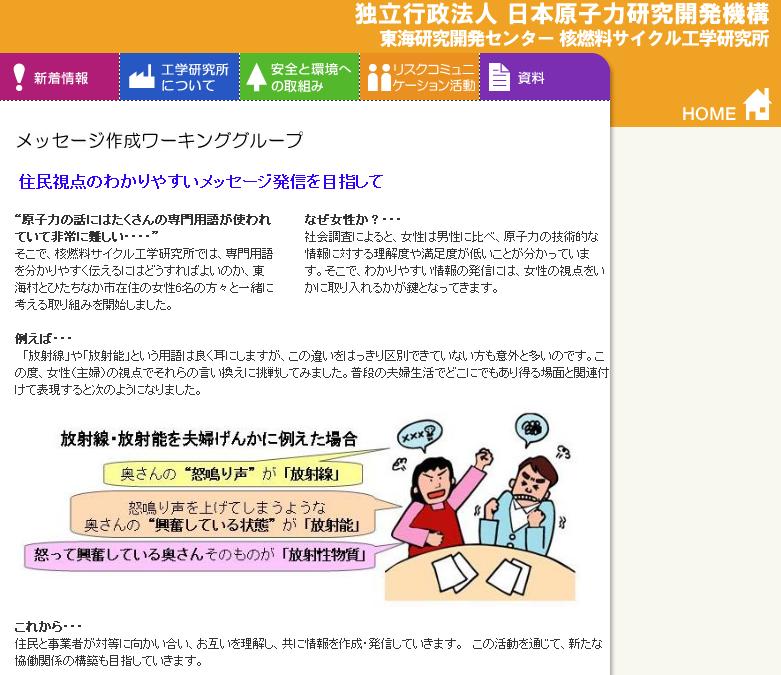
For record before it disappears... JAEA (Japan Atomic Energy Agency) tries to do the "risk communication" to ordinary citizens and blows itself up on Twitter.

JAEA's Tokai Research and Development Center Nuclear Fuel Cycle Engineering department has created the page below, to communicate things nuclear more effectively to general public who are not familiar with special terminology and numbers. The target is women, who they say have less understanding of technical aspect of nuclear energy than men. Therefore, the key to better communication is to how to adopt women's point of view, they say.

So what have they come up with? Using a quarrel between husband and wife to illustrate what radiation, radioactivity, radioactive material mean.


If we compare radiation and radioactivity to a quarrel between husband and wife...

Angry voice of the wife is "radiation",

The excited state in which the wife is in and which causes her to shout angrily is "radioactivity",

The angry wife shouting to the husband is "radioactive material" itself.


It would be the same if the shouting party is the husband instead of the wife. But they target women, because, as they say, women are considered to have less understanding of matters related to nuclear technology.

In general, it is what has been expected in Japan for long time - that women are not good at math and science.

Even the so-called "pro-nuke" people are appalled at this clumsy "risk communication" by JAEA. "What is this? JAEA, what's the matter with you?" was the tweet from a female theoretical physicist.

The JAEA page does say it has come up with the idea by talking with 6 women who live in Hitachinaka City where the JAEA Tokai Research and Development Center is located.

Tuesday, March 13, 2012

Radioactive Materials in Soil May Already Have Reached 30 Centimeters Below Surface, JAEA Says

Japan Atomic Energy Agency's researchers say radioactive materials that remained on the top 5 centimeters of the soil for the first 3 months of the nuclear accident may have already migrated down to as deep as 30 centimeters.

It may be difficult to decontaminate, says the agency who happens to be in charge of the government pilot project to decontaminate within the no-entry zone and planned evacuation zone in Fukushima, using joint ventures by the largest construction companies in Japan. (For more on the confused state of this pilot program, see my post on NY Times article.)

But on the other hand, it's been too late anyway in Fukushima, Miyagi, and areas in Kanto with significant amounts of radioactive fallout (except for Miyagi, whose data is still not disclosed, if it exist), where farmers tilled the land in spring last year to grow vegetables and rice upon encouragement from the government.

From Kyodo News (3/14/2012):

地中30センチにまで浸透か 放射性物質、除染に影響も

Radioactive materials may have migrated to 30 centimeter deep in the soil, may affect decontamination efforts

 東京電力福島第1原発事故で放出され地面に降り積もった放射性物質について、事故から3カ月後の昨年6月にはほとんどが地表から5センチまでの浅い場所にとどまっていたが、1年後の現在では10~30センチの深さまで浸透している可能性があるとの推定を、日本原子力研究開発機構のチームが14日までにまとめた。

Radioactive materials deposited on the ground after the Fukushima I Nuclear Power Plant accident stayed within 5 centimeters from the soil surface in June last year, 3 months after the accident started, says a research team at Japan Atomic Energy Agency. However, the group says there is a possibility that radioactive materials have now migrated to between 10 and 30 centimeters from the surface, one year after the accident.

 雨水がしみ込む際に一緒に運ばれるとみられる。同機構幌延深地層研究ユニット(北海道幌延町)の佐藤治夫研究員は「除染活動が遅れるほど放射性物質は深く移動し、作業の負担を大きくする恐れがある」と警告している。

The team thinks rainwater carries radioactive materials down the soil. Haruo Sato, a researcher in the Horonobe Underground Research Center of JAEA (in Horonobe-cho in Hokkaido) warns, "The longer decontamination takes, the deeper radioactive materials migrate, making the decontamination effort more difficult."

Oops... The government and many researchers have said that radioactive materials remain on the shallow surface of the soil, citing the case of Chernobyl. I guess they didn't realize the warm, rainy climate of Japan was different from Chernobyl. The annual average rainfall in Fukushima is 1,300 to 1,600 millimeters, whereas in Chernobyl it is 300 millimeters.

Looking at blog posts and tweets from last summer, many in Japan were hoping the large amount of rain that Japan gets would wash away the radioactive materials to the rivers and to the sea quickly. Instead, it drove them down the soil, according to JAEA.

Thursday, March 8, 2012

Photos of TMI Corium from Japan Atomic Energy Agency

JAEA published the photographs of the corium from the Reactor No.2 from the Three Mile Island nuclear accident in 1979.

Asahi Shinbun (3/7/2012) reports that the 60 samples of the TMI corium have been kept at JAEA since 1991. The samples, weighing 3 kilograms, were given to JAEA by Idaho National Laboratory as part of the international research collaboration.

According to Asahi, JAEA is planning to re-evaluate the samples as part of the basic research for decommissioning the reactors at Fukushima I Nuclear Power Plant.

Cross section of a corium sample, with the surface oxidized to show colors. Green is uranium dioxide. Brownish part is metals like zirconium, iron, nickel melted together (according to Asahi):


Cross section of a small 1-mm corium grain. Whitish color is where uranium and cladding melted and mixed (according to Asahi):

Thursday, February 9, 2012

#Radiation in Japan: Decontamination Work in 70 - 130 Microsieverts/Hr Location in Fukushima

What is the point here?

Contract workers pile up plastic bags containing highly contaminated soil on the ground in one of the most contaminated area in the entire Fukushima Prefecture. (Photo from Yomiuri)

This particular location, Ottozawa District of Okuma-machi (where Fukushima I Nuclear Power Plant is located), regularly measures well over 100 microsieverts/hour in air radiation 1 meter off the ground.

Just 6 days ago (2/3/2012 in Japan), the air radiation was 130 microsieverts/hour in Ottozawa District, according to Fukushima Minyu. The newspaper says the levels of radiation haven't changed much.

At 130 microsieverts/hour, if one stands there 24/7 for a year, it will be 1138.8 millisieverts, or 1.138 sievert, per year. (Only Professor Wade Allison may say it is safe.)

To say Ottozawa District is "inside the 20 kilometer radius no entry zone", as Yomiuri in the article below does, is a severe understatement. Ottozawa is within 3 kilometers from Fukushima I Nuclear Power Plant. Some of the public facilities of Ottozawa District are right up against the plant compound.

From Yomiuri Shinbun (2/10/2012):

政府は9日、東京電力福島第一原発から半径20キロ・メートル圏の警戒区域にある福島県大熊町夫沢(おっとざわ)地区で、除染モデル事業で出た廃棄物を仮置き場に搬入する様子を報道関係者に初めて公開した。

On February 9, the national government invited the press for the first time to the temporary storage site of the waste from the government's decontamination model project. The storage site is located in Ottozawa District in Okuma-machi in Fukushima Prefecture, inside the 20-kilometer radius "no entry zone".

 公開されたのは第一原発から約3キロ・メートルにある町営野球場グラウンドの2か所。この日の夫沢地区の放射線量は高い所で毎時70マイクロ・シーベルトを超えていた。国の調査地点の中では最高値だ。

Two locations on the town's baseball ground, 3 kilometers from the plant, were shown to the press. The radiation levels in Ottozawa District on February 9 exceeded 70 microsieverts/hour in some locations. The radiation levels [in Ottozawa District] are the highest among the locations regularly monitored by the government.

 作業員は防護服にマスク姿の重厚ないでたちで、汚染された土や草などが入った約1トンの袋を次々と積み上げていた。作業員の1人は「防護マスクは息苦しいし、ゴム手袋だから手がかじかんで重労働」と話した。

The workers in protective clothing and face masks were piling up 1-tonne bags of contaminated soil and vegetation. One of the workers said, "The protective mask is suffocating, and my hands are freezing because of the rubber gloves. It's a hard work."

 袋を置く地面には遮水シートなどが4層にも敷いてあった。袋を積み上げた後はさらに3層のシートなどで覆い、最後には土をかぶせる予定だ。事業を受託する日本原子力研究開発機構の担当者は、「放射線は98%遮蔽できる」と説明した。

Four protective layers, including water-shielding sheet, were laid on the ground where the bags were being put. After the bags are piled up, they will be covered with 3 layers of sheet, which they will be covered with dirt. The Japan Atomic Energy Agency who contracted the decontamination work explains, "98% of radiation [coming from the bags] can be shielded."

Well, there is no information in the article what's the radiation coming from the bags that contain extremely contaminated soil right near the nuke plant. The workers, as far as Yomiuri reports, are not concerned about radiation but inconvenience of having to work in the protective gear which does not shield radiation.

There is no information on whether the workers are JAEA employees or the contract workers, but judging from the remark by one of the workers in the article, it is likely to be the latter. I hope they were fully informed of the risks and paid accordingly, but hope is a dirty word.

My uneducated guess is that the radiation coming off the bags can be measured in millisieverts, not in microsieverts.

Friday, January 20, 2012

NISA Hid Fast Breeder "Monju" Trouble for Over a Month

The Nuclear and Industrial Safety Agency's excuse is that the operator, Japan Atomic Energy Agency, did make an announcement of the trouble "locally" - probably meaning the municipality where the fast breeder is located.

From Yomiuri Shinbun (1/20/2012):

もんじゅで原因不明トラブル、存廃論議に拍車も

Trouble at Monju, cause unknown. May further spur the debate whether to continue the project

経済産業省原子力安全・保安院は20日、日本原子力研究開発機構の高速増殖原型炉「もんじゅ」(福井県敦賀市)で、制御棒の駆動機構に不具合が生じたとして、同機構に原因究明と再発防止を指示した。

The Nuclear and Industrial Safety Agency under the Ministry of Economy, Trade and Industry instructed the Japan Atomic Energy Agency (JAEA) to investigate the cause of malfunction at the driving mechanisms for the control rods at the JAEA's fastbreeder "Monju" (in Tsuruga City, Fukui Prefecture), and to come up with measures to prevent it from happening again.

 保安院によると、不具合が生じたのは昨年12月12日。駆動機構19基のうち、1基が動作確認試験で稼働せず、2日後の再試験で動いた。さらに別の1基も動かず、機構は、原因を究明できないとして工場で分解点検する方針。

According to NISA, the malfunction happened on December 12. Of the 19 driving mechanisms for the control rods, one mechanism didn't work at all when they conducted the test to verify the mechanisms were working. When tested again 2 days later, the mechanism worked. However, there is another mechanism that didn't work [and didn't work in the 2nd test]. JAEA says they will disassemble the mechanism in order to identify the cause.

 公表が遅れた点について保安院は「制御棒がすべて挿入されていた上、機構側が地元で公表していた」と釈明した。もんじゅは現在、原子炉に制御棒が挿入された状態で、安全性に問題はない。しかし、東京電力福島第一原発事故を受けて政府がもんじゅの存廃を含めた原子力政策全般の見直しを進めており、不具合は議論に拍車をかけそうだ。

As to why the disclosure was so late, NISA explained that the control rods were all in, and JAEA did announce locally. The control rods are all inserted, and the Monju reactor is safe at this time. However, the government has been reviewing its nuclear policies in the aftermath of the Fukushima I Nuclear Power Plant accident, including whether to continue the Monju project. The trouble this time may spur the debate.

Not just the malfunction trouble, but the fact that the regulatory agency NISA felt it was OK to wait for more than one month to announce the problem should raise alarm.

NISA's press release on January 20 states that JAEA must report back to the Agency by February 29.

Tuesday, January 17, 2012

Another Decon Worker Dies in Hirono-Machi, Fukushima in a Government Decon Project

No effect of radiation at all, says the government agency in charge of "decontaminating" the former "planned evacuation zone" in which Hirono-machi is located, between 20 and 30 kilometer radius from Fukushima I Nuclear Power Plant.

The 59-year-old worker from Iwaki City, Fukushima Prefecture started to work in the decon project in December, and his cumulative radiation exposure until January 16, 2012 was 102 microsieverts.

Decontamination work in Hirono-machi officially started in mid December. The annual radiation exposure limit for decontamination workers is 50 millisieverts under the new law on decontamination effective as of January 1, 2012.

Ms. Emiko Numauchi of Minami Soma City, Fukushima, aka "Numayu", has commented in her blog that she sees and hears about people living in the temporary housing after the earthquake/tsunami/nuke accident in cities and towns in Fukushima being recruited for the decontamination work, as there aren't many jobs available for the displaced people. I suspect this 59-year-old worker from Iwaki City may be one of those people.

From Sankei Shinbun (1/17/2012):

 日本原子力研究開発機構などは17日、東京電力福島第1原発事故を受け福島県広野町で実施している国の除染モデル実証事業で、同県いわき市の男性作業員(59)が除染作業中に倒れ、搬送先の病院で死亡したと発表した。死因は調査中。

The Japan Atomic Energy Agency announced on January 17 that a 59-year-old worker from Iwaki City, Fukushima collapsed during the decontamination model work being carried out in Hirono-machi and died at the hospital. The cause of death is under examination.

 原子力機構によると、男性は同日午前9時から広野町下北迫地区で6人の作業員と土の表面を削り取る作業をしていた。同11時50分過ぎ、男性がいびきをかいて倒れているのを別の作業員が発見した。

According to the JAEA, the worker was scraping the surface soil with 6 other workers in Shimokitaba District of Hirono-machi since 9AM on January 17. He was found collapsed, snoring heavily, by the co-worker at 11:50AM.

 男性は昨年12月から同町での除染活動に参加。今月16日までの積算線量は102マイクロシーベルトで、本人から持病の申告はなかったという。

The worker had been doing the decontamination work in Hirono-machi since December last year. His cumulative radiation exposure till January 16, 2012 was 102 microsieverts, and there was no declaration from the worker of any existing illness, says JAEA.

From Jiji Tsushin (1/17/2011):

日本原子力研究開発機構福島技術本部などは17日、福島県広野町周辺で実施している除染モデル事業で働いていた男性(59)が同日の作業中に死亡したと発表した。放射線被ばくが影響した可能性は極めて低いという。同機構の除染事業での死亡は2人目。

The Japan Atomic Energy Agency Fukushima Headquarters announced on January 17 that a worker, age 59, died during work that day. According to the Agency, the possibility is extremely low that the radiation exposure played a role in any way. It is the 2nd death in the decontamination work operated by the Agency.

A worker died in the decon work in Date City in December last year. The death had "nothing to do with radiation", because he died in a car during the lunch break. This second worker may have collapsed during the decon work, but he died at the hospital. Therefore, the death has "nothing to do with radiation".

That's the "Newspeak" a la the Japanese government and TEPCO. You would have to die on the spot. But then, as TEPCO did for the worker at Fukushima I Nuke Plant who clearly died at the plant on January 12, you would still get transported to the hospital, only to be pronounced dead on arrival; technically you still die at the hospital, not at Fuku I, so radiation has nothing to do with it...

Wednesday, October 26, 2011

New "Decon" Experiment in Iitate-Mura: Burn Radioactive Soil

The Japanese government has just started a new experiment in the very highly contaminated Iitate-mura in Fukushima Prefecture where the soil contamination exceeds 50,000 becquerels/kg of radioactive cesium, with a host of other nuclides including strontium and neptunium which has since decayed into plutonium.

What's the experiment? To burn the radioactive soil to reduce the bulk for disposal.

What's this Japanese obsession with "decontamination" and with "incineration"? Do they think they can somehow "purify" the radioactive fallout by burning? (Hint: this is a rhetorical question. Answer is yes of course.)

The nuclear researchers at the government's JAEA seem to think burning the soil will revive the soil.

It will kill the soil.

From Kyodo News Japanese (10/26/2011):

東京電力福島第1原発事故で汚染された田畑の再生に向け、日本原子力研究開発機構(茨城県東海村)は26日、福島県飯舘村で、農地の土壌を焼却し、放射性セシウムの除去効果を確認する新たな実証試験を公開した。

On October 26, Japan Atomic Energy Agency (located in Tokai-mura, Ibaraki Prefecture) showed off its new experiment to see if radioactive cesium could be effectively removed by burning the farm soil in Iitate-mura in Fukushima Prefecture. The experiment is aimed at reviving the farm fields contaminated by the Fukushima I Nuclear Power Plant accident.

 農林水産省から委託された土壌改良技術開発の一環で、農業・食品産業技術総合研究機構(茨城県つくば市)との共同研究。測定結果は2~3週間後に判明する予定。

It is part of the soil remediation technology development as assigned by the Ministry of Agriculture, Forestry and Fisheries. JAEA and National Agriculture and Food Research Organization (in Tsukuba City, Fukushima Prefecture) are jointly conducting the research. The result of the experiment will be known in 2 to 3 weeks.

 農水省によると、福島県で土壌1キログラム当たり5千ベクレル以上の農地全ての表土を削り取ると、東京ドーム2、3杯分の約300万トンになると推定され、残土の処理が難題となっている。

According to the Ministry of Agriculture, if all the farm soil with 5000 becquerels/kg and higher [of radioactive cesium] is removed in Fukushima Prefecture, it would fill 2 to 3 Tokyo Domes, or about 3 million tonnes. How to dispose the removed soil is a big issue.

Let's assume the lowest number, 5,000 becquerels/kg of radioactive cesium in the Fukushima farm soil. 1 tonne is 1000 kilograms. So,

  • 1 tonnes contains: 5 million becquerels of radioactive cesium

  • 3 million tonnes contains: 1.5 x 10^13, or 15 terabecquerels, or 15,000,000,000,000 becquerels.

If the national government's much-publicized past experiments (like planting sunflowers to absorb radioactive materials in soil) in Iitate-mura are any indication, this one may also fail.

Besides, by strongly encouraging farmers outside the no-entry evacuation zone and the planned evacuation zone (like Iitate-mura) in Fukushima to grow crops as usual, the soil was probably turned deep, mixing radioactive materials with deeper, clean soil. So, removing the top 5 centimeters are likely to do hardly anything other than making people feel good that they have done the "decontamination".

There are areas and spots with high radiation outside Fukushima Prefecture, but those are none of the concern for the national government, although it has said it may consider the national-level decontamination for the areas with expected annual radiation exposure (external only) of more than 1 millisievert.

Thursday, September 8, 2011

Ocean Contamination 3 Times As Much As TEPCO Announced

says the government corporation Japan Atomic Energy Agency, 5 months after the leak of highly contaminated water was first discovered (in April) at the water intake for Reactor 2 at Fukushima I Nuclear Power Plant.

So, instead of 4,700 terabecquerels of radioactive iodine and cesium as TEPCO announced back in May, JAEA says it was 15,000 terabecquerels that leaked into the Pacific Ocean, and that it could have been leaking since March 21, not from April 1.

From Yomiuri Shinbun (9/9/2011):

東京電力福島第一原子力発電所の事故で、汚染水や大気中からの降下分も含めて、海に流出した放射性物質の総量を1万5000テラ・ベクレル(テラは1兆倍)とする試算を、日本原子力研究開発機構の小林卓也研究副主幹らがまとめた。

Researchers at Japan Atomic Energy Agency (JAEA) led by Takuya Kobayashi has come up with the estimate that puts the total amount of radioactive materials leaked into the ocean from Fukushima I Nuclear Power Plant at 15,000 terabecquerels. Their estimate includes the radioactive materials in the contaminated water and in the air that fell in the ocean.

 東電が推定した値の3倍以上になっている。19日から北九州市で始まる日本原子力学会で発表する。

The JAEA estimate is three times as much as the estimate by TEPCO. It will be announced during the Atomic Energy Society of Japan conference set to begin in Kitakyushu City from September 19.

 東電は高濃度汚染水の流出を4月1~6日に限定しており、その間の放射性物質(ヨウ素131、セシウム134、137)の量を4700テラ・ベクレルと推定していた。

TEPCO limited the time period of the contaminated water leak from April 1 to 6, and estimated the amount of iodine-131, cesium-134 and cesium-137 to be 4,700 terabequerels.

 小林副主幹らは、原発の取水口付近での放射性物質の濃度をもとに、海で放射性物質が初めて検出された3月21日から4月30日までの流出量を逆算した。推計値をもとに海洋への拡散を模擬計算したところ、原発の周辺海域での観測値に合っていることも確かめた。試算ではセシウム134を含めていないため、総量はより多くなる。

Kobayashi et al calculated the amount of the leaked water from March 21 to April 30, based on the density of radioactive materials at the water intake of the plant. March 21 was when radioactive materials were detected in seawater for the first time. They also did the simulation of how the radioactive materials spread in the ocean based on their estimate, and confirmed that it matched the observed data in the ocean near the plant. The estimate does not include cesium-134, so the total amount of radioactive materials would be higher.

So the researchers concluded the leak may have been ongoing since March 21, based on the density of radioactive materials at the water intake that TEPCO was announcing. Duh. And TEPCO insisted that the leak started on April 1 or not so long before a worker noticed for the first time, and no one in the media questioned at that time. No one is saying anything now either about this extremely contaminated water that may have been leaking for 10 days before TEPCO even noticed.

(Note to self: Think.)

Asahi Shinbun has different details:

  • The main factor that pushed the number up was the radioactive materials in the air that fell into the ocean;

  • Iodine-131 alone accounts for 11,400 terabecquerels, and cesium-137 for 3,600 terabecquerels.

Well I sure hope this number for cesium-137 is "iodine-131 equivalent". Otherwise the total amount of radioactive materials leaked would be approaching INES Level 7 on its own.

These government researchers are announcing their precious studies left and right, now that their papers have been peer-reviewed and set to be published.