Showing posts with label radioactive compost. Show all posts

Sunday, August 21, 2011

#Radioactive Sludge in Kindergartens in Tokamachi City, Niigata

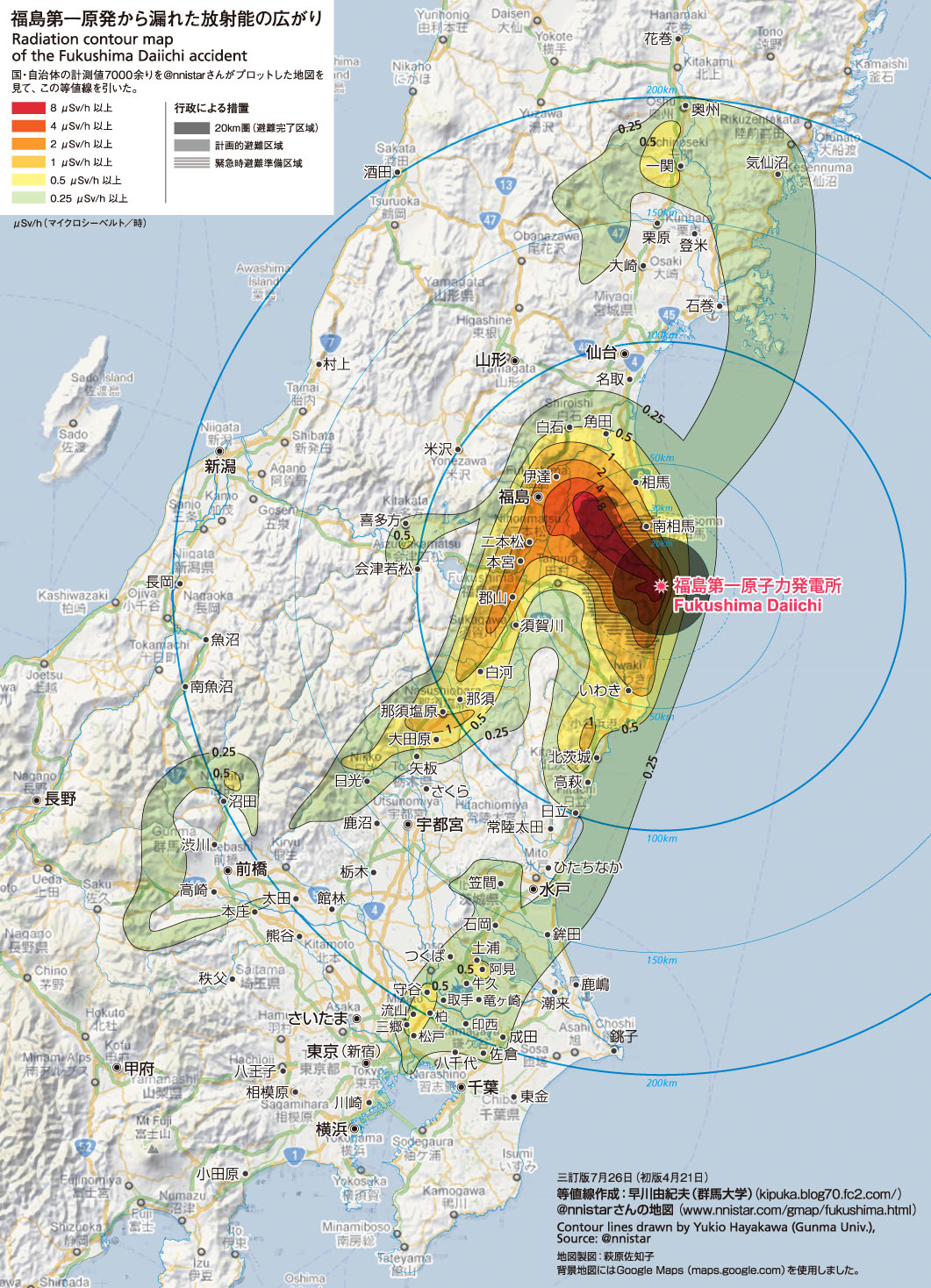
Tokamachi City in Niigata Prefecture is located 205 kilometers west of Fukushima I Nuclear Power Plant. It's not even under the plume according to Professor Hayakawa's map.

Tokamachi is the green arrow. Fukushima I Nuke Plant is the red tag "D". (Map created at Jukurabe.)

From Yomiuri Shinbun (1:37PM JST 8/22/2011):

新潟県十日町市は22日、市が保育施設の土壌などの放射性物質調査を行った結果、市立白梅保育園で雨水を集める槽にたまった泥から1キロ・グラム当たり1万8900ベクレル、私立愛宕幼稚園で草葉の堆積物から同2万7000ベクレルの放射性セシウムが検出されたと発表した。

Tokamachi City in Niigata Prefecture announced on August 22 the result of the survey of radioactive materials in the soil in nursery schools and kindergartens in the city. 18,900 becquerels/kg of radioactive cesium was found in the sludge at the bottom of the container that collects rainwater at a public nursery school, and 27,000 becquerels/kg of radioactive cesium was found in the yard compost pile at a private kindergarten.

 8000ベクレル超~10万ベクレルは管理型処分場での仮置き対象となり、市は県と処分方法について相談する。

If the level of radioactive cesium exceeds 8,000 becquerels/kg up to 100,000 becquerels/kg, it has to be temporarily stored at a controlled processing plant. The city will consult the prefectural government as to how to dispose the sludge and the yard compost.

 今月12日に採取し、県内の検査機関に調査を委託していた。両園とも、検査地点の地上1メートルの空間放射線量はそれぞれ0・10マイクロ・シーベルトと0・14マイクロ・シーベルトで、通常の範囲内だったという。

The samples were taken on August 12, and tested at a testing laboratory in Niigata. At both locations, the air radiation levels at 1 meter above the ground was 0.10 microsievert/hour and 0.14 microsieverts/hour, both of which were within the normal range.

Tuesday, August 2, 2011

#Radiation in Japan: Now It's Radioactive Manure

Now that the Ministry of Agriculture has set the provisional safety standard for compost at 400 becquerels/kg, this is the first manure to exceed that limit. It was made in Ibaraki Prefecture, and was being sold in Kyoto.

Low-level contamination spreads to the western half of Japan. Already, radioactive leaf compost have been found in Tottori Prefecture (Chugoku region) and Kagawa Prefecture (Shikoku region).

From Mainichi Shinbun Japanese (12:35AM JST 8/3/2011):

京都府は2日、同府向日市の「ロイヤルホームセンター物集女(もずめ)店」で「茨城県産」の表示で販売されていた堆肥(たいひ)から国の暫定許容値(1キロ当たり400ベクレル)の10倍以上の同4990ベクレルの放射性セシウムを検出したと発表した。流通ルートは未判明だが、茨城県産と見られる堆肥から放射性セシウムが検出されたのは初めて。府によると、東京の業者が販売する「馬ふんたい肥」(5リットル)で、馬ふんやわらなどを熟成発酵させたもの。府は店頭からの撤去と自主回収を指導した。これまでの販売数量は不明という。

The Kyoto prefectural government announced on August 2 that 4,990 becquerels/kg of radioactive cesium was detected from the manure labeled "made in Ibaraki Prefecture"; the level of radiation is more than 10 times the provisional safety limit of 400 becquerels/kg. The manure was sold at "Royal Home Center Mozume Branch" in Muko City in Kyoto. It is the first time radioactive cesium has been detected from the manure made in Ibaraki. According to the Kyoto prefectural government, the manure is sold by a dealer in Tokyo and labeled "Horse Manure" (5 liters), made from horse manure and rice hay. The prefectural government instructed the store to remove the manure from the store premise and to recall the product voluntarily. There's no information as to how many bags of this manure have already been sold.

 また、府は同日、同府木津川市の「カインズホーム木津川店」で販売の栃木県産腐葉土から2万6600ベクレルの放射性セシウムを検出したと発表した。秋田・鳥取両県のホームセンターでも栃木県産腐葉土から放射性セシウムが検出されているが、放射線量は今回が最大。

Also, the prefectural government announced that 26,600 becquerels/kg of radioactive cesium was detected from the leaf compost made in Tochigi Prefecture and sold at "Cainz Home Kizugawa Branch" in Kizugawa City, Kyoto. Radioactive cesium has been detected in the Tochigi-made leaf compost in home/garden centers in Akita and Tottori Prefectures, but Kyoto's number is the largest so far.

The dealer who manufactured and sold the radioactive horse manure is Sowa Recycle Corporation, headquartered in Tokyo. (The name of the dealer was in the press release by the Kyoto government.) On the company's website there is no mention of the manure found radioactive in Kyoto.

One bright spot in this case of radioactive compost and manure that came to light in late July: It all started with a citizen in Saitama Prefecture who went in to the garden center nearby in June to measure the radiation on the surface of a bag of leaf compost. Power of an individual.

She (I think it is she) had heard rumors that the radiation was high near the pile of leaf compost bags in the center, so she went there with a personal survey meter and a camera, and uploaded the video on Youtube. That was in late June. Then, more citizens went to garden centers in other prefectures to measure the radiation, and alerted the municipal governments. And the governments had to act.


Monday, August 1, 2011

#Radioactive Leaf Compost Spreads to Schools

possibly irradiating children as they planted flowers as part of school curriculum.

Ever since the March 11 start of the Fukushima I Nuke Plant accident, unthinking, order-following school teachers and administrators throughout Japan from kindergarten/nursery school on (with a few exceptions) have made small children:

Now the latest: they made them plant flowers using the leaf compost which turned out to be highly radioactive.

As journalist Takashi Hirose said, they are "killing the children".

First, from Shinano Mainichi Shinbun (local paper in Nagano Prefecture, 8/2/2011):

県内で高濃度の放射性物質を含む可能性がある腐葉土の製品が流通していた問題で、北信地方の小中学校計2校が同じ製品40袋余(1袋14リットル入り)を使っていたことが31日分かった。県農政部によると、プランターで花を栽培するのに使ったという。同部は両校に対し児童生徒が近づかない場所に置くよう指導したとしている。

The leaf compost that may contain high concentration of radioactive materials have been sold in the Prefecture. On July 31, it was discovered that one elementary school and one junior high school used the total of 40 bags (14 liters per bag) of the compost. According to the Prefecture's agricultural division, the schools used it in planters to grow flowers. The division says it has instructed the schools to move the planters away from school children.

 両校から県に29日に相談が寄せられ、判明した。県は校名は公表していない。

The schools contacted the Prefecture for advice on July 29. The names of the schools haven't been disclosed.

 製品は、カインズ(群馬県高崎市)がホームセンター「カインズホーム」の長野県内の14店で販売した「バーク入り腐葉土14L」。同部によると、小学校は6月下旬に約10袋を県内店舗で購入し、キクを栽培するプランターに土と混ぜて入れた。中学校は花の栽培に30~40袋を使った。

The compost was sold at at Cainz Home's 14 stores in Nagano Prefecture. According to the agricultural division of the Prefecture, the elementary school purchased 10 bags in late June and mixed it with potting soil to grow chrysanthemums in planters. The junior high school used 30 to 40 bags to grow flowers.

 この製品は鳥取県の調査で、鳥取市内の店舗が販売した製品から1キロ当たり1万4800ベクレルの放射性セシウムが検出された。カインズによると、長野県内では東日本大震災後、販売を自粛した7月27日までに約1万300袋を販売したという。

14,800 becquerels/kg of radioactive cesium have been detected from this compost, as tested by Tottori Prefecture. According to Cainz, 13,000 bags of the same compost had been sold in Nagano since the March 11 earthquake until July 27, when the company voluntarily stopped selling.

And from Shikoku Shinbun (local paper in Kagawa Prefecture in Shikoku, 8/1/2011):

 香川県内3小学校で放射性セシウムに汚染された栃木県産の腐葉土が栽培学習に使われていた問題で、児童がプランターで菊を栽培していた綾川町の昭和小学校(中塚正則校長)は31日夜、同校で保護者説明会を開いた。学校側は保護者の意見を踏まえ、腐葉土の廃棄処分を決定。説明会後、教職員が全保護者に対してメールや電話で連絡に当たった。

Concerning the radioactive leaf compost made in Tochigi Prefecture that was used in the schools' cultivation classes at 3 elementary schools in Kagawa Prefecture, one of the schools, Showa Elementary School in Ayagawa-cho (Principal Masanori Nakatsuka) held a meeting with the parents on July 31 night. The school listened to the parents and decided to discard the leaf compost. After the meeting, teachers and school administrators contacted all parents by email and phone calls.

 会には、保護者約35人が出席。中塚校長と杉村和則町教育長らが説明に立った。

35 parents attended the meeting, in which Principal Nakatsuka and Kazunori Sugimura, head of the town's Board of Education explained the situation.

 冒頭、学校と町教委側が「ご心配をおかけしたことを心からおわびしたい」と述べ、「一人でも廃棄処分を求める声があれば、そうしたい」との考えを示した。

They said, "We want to apologize for having caused you much anxiety. If there is one parent who wants to have [the compost] discarded, we will."

 その後、中塚校長が栽培学習の内容や事態把握までの経緯を説明。同日午前中に腐葉土を使ったプランター約400鉢を、立ち入り禁止のロープを張った場所に移したことも報告した。

Then, the principal explained what the school's cultivation class was, and how the school became aware of the problem [of the radioactive compost]. He also reported that 400 planters that used the leaf compost had been moved to a location that morning and the school cordoned off the place.

 質疑応答では、保護者から「健康に問題ないというが、やはり不安」「きちんと処分し、家庭や学校で子どもに説明するのが教育」などの声が上がったため、中塚校長が廃棄処分することをその場で伝えた。

In Q&A session, parents said "We still worry even if you say there is no effect on health", and "It will be educational if we dispose it properly, and explain to our children at home and at school". The principal promised to dispose the leaf compost.

 校長は「一生懸命菊を育ててきた子どもの心のケアに努めるとともに、処分方法については県に相談しながら対応したい」としている。同校では6月上旬、3~6年の児童179人が菊の鉢植え作業を行っていた。

The principle also said, "We will try our best to care for the psychological effect on children who have been growing chrysanthemum with great care. We will consult the prefectural government on the disposal." 179 pupils in 3rd to 6th grades planted chrysanthemums in the planters, using the compost.

Shikoku Shinbun reports that the prefectural government received only 4 inquiries from the residents on July 31.

Well, Mr. Nakatsuka, before you care for the psychological ill-effect, why don't you apologize to the pupils for having exposed them to physical ill-effect - radiation?

Friday, July 29, 2011

#Radioactive Compost Has Been Sold in 23 Prefectures

It's attracting far less attention, but the radioactive leaf compost is getting to be like the radioactive beef.

First, it was 20,000 bags sold in Akita. Then, an unknown number of bags sold in Tottori (link in Japanese). Now it turns out 200,000 bags of the radioactive leaf compost from a retailer based in Gunma Prefecture have been sold at least in 23 prefectures, Tottori included, at the retailer's 166 outlets throughout Japan.

Home gardeners in 23 prefectures ended up irradiating their garden soil.

From Mainichi Shinbun Japanese (7/28/2011):

鳥取県は27日、鳥取市のホームセンター「カインズホームFC鳥取店」で販売されていた腐葉土から1キロ当たり1万4800ベクレルの放射性セシウムが検出されたと発表した。

Tottori Prefecture announced on July 27 that 14,800 becquerels/kg of radioactive cesium was detected from the leaf compost sold at a home/garden center "Cainz Home FC" in Tottori City.

 県と運営会社カインズ(本社・群馬県高崎市)によると、この腐葉土は同社のプライベートブランド商品「バーク入り腐葉土14L」。栃木県と岩手県 のほか、タイやベトナムから輸入した植物を基に、栃木県鹿沼市内の業者が生産。東日本大震災以降、23都道府県の166店で14リットル入り約13万袋、 3リットル入り約7万袋を販売したという。

According to the Prefecture and Cainz Ltd (headquartered in Takasaki City, Gunma Prefecture), the leaf compost is sold under the company's private brand. The compost is made of plants from Tochigi and Iwate Prefectures, and from Thailand and Vietnam. It is made by a manufacturer in Kanuma City in Tochigi Prefecture. Since the March 13 earthquake/tsunami, 130,000 14-liter bags and 70,000 3-liter bags have been sold at the company's 166 stores in 23 prefectures.

 県が14リットル入りの商品を1センチ離れた位置で計測したところ、1時間当たりの放射線量は0.7マイクロシーベルトだった。3リットル入りでは放射性物質は検出されなかった。

The radiation level at 1 centimeter from a 14-liter bag was 0.7 microsievert/hour. No radiation was detected in a 3-liter bag.

Thursday, July 28, 2011

#Radioactive Leaf Compost: Kamakura City in Kanagawa Finally Stops Giving Out Compost to Residents

after more than 4 months of radioactive fallout, because the Ministry of Agriculture, Forestry and Fisheries has finally issued a notice that it would be better not to use leaf compost.

It has been in the news from early on that the level of radiation is higher under the rain gutters, in the shrubs and trees, on the dead leaves and twigs on the ground. (Ding ding ding ding......hello?)

Another lesson in importance of thinking on your own and not depending on the authorities in Japan and elsewhere.

From Tokyo Shinbun Kanagawa version (7/28/2011):

腐葉土から放射性セシウムが検出された問題で、農林水産省が堆肥などの利用、流通の自粛を通知したことを受け、鎌倉市は二十七日、無料で行っていた市民への堆肥の配布を中止した。

After radioactive cesium was detected from the leaf compost, the Ministry of Agriculture, Forestry and Fisheries issued a notice to withhold use and shipment of compost on a voluntary basis. Accordingly on July 27, City of Kamakura stopped the distribution of free compost to the residents.

 市はごみの減量化と資源化のため、市民や植木業者などが出す樹木の剪定(せんてい)枝などを回収し、処理業者に委託して山梨県内で堆肥化している。

The city collects yard waste - pruned twigs and branches from the residents and commercial gardeners - in order to reduce and recycle waste. The yard waste is shipped to Yamanashi Prefecture and is composted there.

 剪定枝は年間で約一万千トン。できた堆肥の一部を市役所や行政センター、ごみ処理施設など市内八カ所で、市民に無料配布している。配布は昨年度で 約二千百トンに上っている。市は、国が堆肥の扱い基準を出すまでの間、配布の中止を決めた。中止は市のホームページで知らせている。

Such pruned twigs and branches amount to 11,000 tonnes per year. The compost is distributed free of charge to the residents at 8 locations in the city. Last year, 2,100 tonnes of compost were distributed. The city decided to stop the distribution until the national government comes up with a standard for compost, and notified the residents on the city's homepage.

 市は、市民が出す剪定枝は当面、回収を行うが、堆肥化は対応を検討中。また、堆肥に含まれる放射性セシウムについて独自に分析、調査を進めている。

For the time being, the city still collects the yard waste from the residents, but will decide what to do with the composting. The city is also doing its own analysis of the compost to see if radioactive cesium is detected.

Wednesday, July 27, 2011

#Radioactive Compost Has Already Spread Wide

From the press release by Akita prefectural government on July 25:

A resident in Akita Prefecture alerted the authorities when the bag of leaf compost that he purchased from a local garden/home center measured high in radiation with his portable survey meter. The authorities tested the content of the bag, and it had 11,000 becquerels/kg of cesium.

At the garden/home center (2 locations) the air radiation 1 meter from the pile of the leaf compost bags measured as high as 0.48 microsievert/hr.

The press release is somewhat misleading, as it says the air radiation 1 meter from one bag of the leaf compost is 0.06 microsievert/hr. If you measure in front of the pile of the same bags, the radiation is as high as 0.48 microsievert/hr. Akita's air radiation level (which the prefectural government measures only at 2 locations) is between 0.04 and 0.06 microsievert/hr.

According to Yomiuri Shinbun (7/27/2011), these bags were packed in Tochigi Prefecture, and 20,000 bags have already been sold in Akita Prefecture alone.

Shimotsuke Shinbun (local Tochigi paper; 7/27/2011) reports that Tochigi Prefecture tested the leaves that went into the leaf compost bags, and they found 72,000 becquerels/kg of radioactive cesium. The leaves were collected in the northern Tochigi in April, and was sold outside the prefecture from mid June to early July. The Tochigi prefectural government ordered the two sellers of leaf compost in Tochigi to recall what's been sold and refrain from shipping "voluntarily" (i.e. at the sellers' own cost, with no support from the government).

Leaf composts are mainly used by the home gardeners. There may be many who hoped to grow their own, radiation-free vegetables and bought these bags to amend the soil for better growth of the seedlings. Well, that hope is dashed. The home gardeners may have ended up contaminating their own soil which may not have been contaminated before they put in the compost.

The Ministry of Agriculture, Forestry and Fisheries couldn't even figure out that cattle farmers feed their cows with rice hay. What the individual home gardeners use for their small gardens was probably none of their concern, as the Ministry is there for the producers.