Showing posts with label Okuma-machi. Show all posts

Sunday, September 23, 2012

(Now They Tell Us) 1,590 Microsieverts/Hr in Futaba-machi, #Fukushima on March 12, 2011, Before Reactor 1 Explosion, and Vent, Not Explosion, May Have Caused High Radiation


So says the Fukushima prefectural government, after more than one and a half year since the start of the Fukushima I Nuclear Power Plant accident. Supposedly, it took them all these days to analyze the data that was retrieved from the 19 monitoring posts around the two nuclear power plants (Fukushima I and II), and only now the prefectural government is sheepishly admitting the radiation levels were much, much higher than it has been telling the residents.

What's more, though the prefectural government doesn't say it explicitly, the spikes in radiation levels correlate not to the explosive events but the vents, if you look at the charts published by the Fukushima prefectural government.

First, from Asahi Shinbun Fukushima Edition (9/22/2012):

県は21日、東京電力福島第一原発の周辺で昨年3月に測定した空間放射線量の結果を発表した。同原発から北西5・6キロの双葉町上羽鳥で毎時1590マイクロシーベルトと、発電所の敷地外では、県がこれまでに把握している中では最も高い値が出た。

On September 21, Fukushima Prefecture announced the result of air radiation survey conducted in March last year around Fukushima I Nuclear Power Plant. The reading in Kamihatori in Futaba-machi, 5.6 kilometers northwest of the nuclear plant, was 1,590 microsieverts/hour, highest so far outside the plant as the prefectural government knows.

原発周辺に設置されていた19局のモニタリングポストに残っていた昨年3月11日~31日のデータを取りまとめた。双葉町山田では16日午前0時に同1020マイクロシーベルト、同町新山で12日午後5時に毎時904マイクロシーベルトだった。

The result was compiled from the data from March 11 to 31 last year that remained in the 19 monitoring posts installed near the nuclear power plant. In Yamada in Futaba-machi, it was 1,020 microsieverts/hour at 12AM on March 16, 2011, and it was 904 microsieverts/hour at 5PM on March 12 in Shinzan, also in Futaba-machi.

県によると、原発の北側のモニタリングポストでは12日から、楢葉町や広野町など南側は15日から放射線量が上がる傾向があった。

According to Fukushima Prefecture, the monitoring posts in the north of Fukushima I Nuclear Power Plant started to register higher radiation levels in March 12, and the monitoring posts in the south of the plant in Naraha-machi and Hirono-machi in March 15.

また、上羽鳥の場合、同原発1号機の水素爆発よりも前の12日午後3時に最大値を観測しており、県は「爆発前から放射性物質が漏れていた」と見ている。今後、風向きや風速など、詳細な分析をするという。

In the case of Kamihatori, the maximum level was recorded at 3PM on March 12, before the hydrogen explosion at Reactor 1 at Fukushima I Nuclear Power Plant. According to the prefectural government, it was probably because "radioactive materials had been leaking even before the explosion". The prefectural government says it will conduct more detailed analysis including wind directions and wind speed.


Now, for Fukushima Prefecture to pretend this was new information (that the radiation had been leaking even before the Reactor 1 explosion), that's highly misleading. Fukushima Prefecture started measuring radiation levels in the areas surrounding the two nuclear power plants (Fukushima I and II) as early as 8AM on March 12, 2011. The first measurement that would have shown them that the radiation level was already several times higher than normal (0.04 - 0.06 microsievert/hour) was that of Tomioka-machi (Fukushima II) at 0.18 microsievert/hour at 8:25AM on March 12, 2012. At 8:52AM on the same day, they measured 14 microsieverts/hour in Namie-machi. Reactor 1 had a hydrogen explosion at 3:36PM.

(All of these were disclosed long time ago - June 3, 2011 - by NISA of all people, and no one in the media said a thing. If you read Japanese, see my Japanese blog.)

But what's more interesting about the latest disclosure by the Fukushima prefectural government is that the spikes in air radiation levels coincide not with the explosive events but with the vents that TEPCO did or attempted.

From the data released by the Fukushima prefectural government (I put the English labels):

Kamihatori, Futaba-machi: The first spike of radiation occurred even before the first vent of Reactor 1 on March 12, 2011. The huge spike to 1590 microsieverts/hour occurred at 3PM, after the vent at 10:17AM and after the pressure of the Reactor 1 Containment Vessel dropped at 2:30PM.
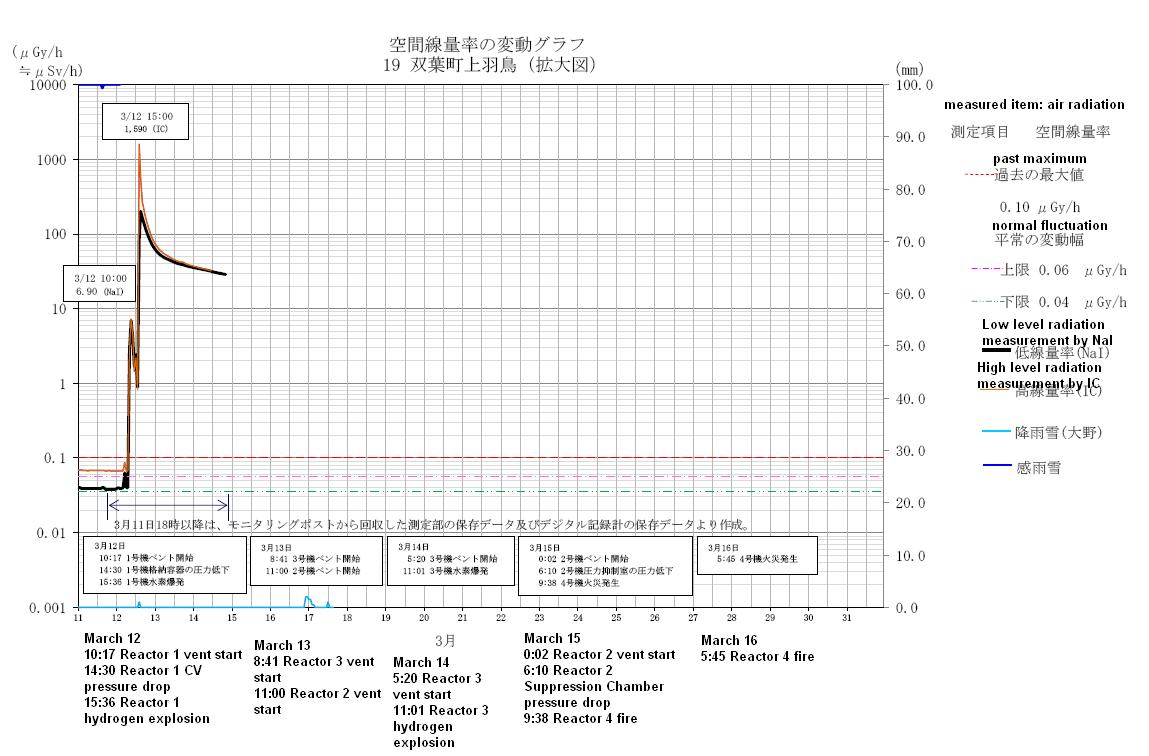

Kamiyatori is located northwest of Fukushima I Nuclear Power Plant. On March 12, 2011, the areas that registered high levels of radiation were all located north and northwest of the plant.

Then, after the vent of Reactor 2 on 12AM on March 15, 2011 (which was a dry vent), huge spikes in radiation were recorded in the areas in Okuma-machi, Tomioka-machi, and Naraha-machi, which were located south of the plant.

Mukaihata, Okuma-machi, immediate south of the plant. Spike at 11PM on March 14, 2011:


Yonomori, Tomioka-machi. Spike at 2AM on March 15, 2011:


Yamadaoka, Naraha-machi. Spike at 3AM on March 15, 2011:


The plume that went past Okuma, Tomioka, Naraha reached Kitaibaraki City in Ibaraki at 5:50AM on the same day, registering 5.5 microsieverts/hour. The Japanese media reported it, as possibly caused by the explosion of Reactor 2 (here's Sankei Shinbun on March 15, 2011), and no one understood the significance of the news at that time. Hardly anyone knew what "microsievert" was.

Well, it may not have been the explosion that caused the spikes. It is likely to have been the vent - intentional release of radioactive materials to lower pressure to avoid explosions. Well the explosions or some explosive event (in the case of Reactor 2) took place at Fukushima I Nuclear Power Plant after they did the vent. So what was the vent for?

That the vent, not the explosions, caused the radiation levels to rise has already been stated by none other than TEPCO in its report. Again, when the report was released, the media paid no attention, and people didn't care (other than the familiar refrain of "TEPCO lies").

A Tokyo University researcher stated in his paper accepted by a peer-reviewed magazine that a huge spike of radiation was registered at Fukushima I Nuclear Power Plant after the Reactor 2 dry vent. Again, no one paid attention.

Thursday, February 9, 2012

#Radiation in Japan: Decontamination Work in 70 - 130 Microsieverts/Hr Location in Fukushima

What is the point here?

Contract workers pile up plastic bags containing highly contaminated soil on the ground in one of the most contaminated area in the entire Fukushima Prefecture. (Photo from Yomiuri)

This particular location, Ottozawa District of Okuma-machi (where Fukushima I Nuclear Power Plant is located), regularly measures well over 100 microsieverts/hour in air radiation 1 meter off the ground.

Just 6 days ago (2/3/2012 in Japan), the air radiation was 130 microsieverts/hour in Ottozawa District, according to Fukushima Minyu. The newspaper says the levels of radiation haven't changed much.

At 130 microsieverts/hour, if one stands there 24/7 for a year, it will be 1138.8 millisieverts, or 1.138 sievert, per year. (Only Professor Wade Allison may say it is safe.)

To say Ottozawa District is "inside the 20 kilometer radius no entry zone", as Yomiuri in the article below does, is a severe understatement. Ottozawa is within 3 kilometers from Fukushima I Nuclear Power Plant. Some of the public facilities of Ottozawa District are right up against the plant compound.

From Yomiuri Shinbun (2/10/2012):

政府は9日、東京電力福島第一原発から半径20キロ・メートル圏の警戒区域にある福島県大熊町夫沢(おっとざわ)地区で、除染モデル事業で出た廃棄物を仮置き場に搬入する様子を報道関係者に初めて公開した。

On February 9, the national government invited the press for the first time to the temporary storage site of the waste from the government's decontamination model project. The storage site is located in Ottozawa District in Okuma-machi in Fukushima Prefecture, inside the 20-kilometer radius "no entry zone".

 公開されたのは第一原発から約3キロ・メートルにある町営野球場グラウンドの2か所。この日の夫沢地区の放射線量は高い所で毎時70マイクロ・シーベルトを超えていた。国の調査地点の中では最高値だ。

Two locations on the town's baseball ground, 3 kilometers from the plant, were shown to the press. The radiation levels in Ottozawa District on February 9 exceeded 70 microsieverts/hour in some locations. The radiation levels [in Ottozawa District] are the highest among the locations regularly monitored by the government.

 作業員は防護服にマスク姿の重厚ないでたちで、汚染された土や草などが入った約1トンの袋を次々と積み上げていた。作業員の1人は「防護マスクは息苦しいし、ゴム手袋だから手がかじかんで重労働」と話した。

The workers in protective clothing and face masks were piling up 1-tonne bags of contaminated soil and vegetation. One of the workers said, "The protective mask is suffocating, and my hands are freezing because of the rubber gloves. It's a hard work."

 袋を置く地面には遮水シートなどが4層にも敷いてあった。袋を積み上げた後はさらに3層のシートなどで覆い、最後には土をかぶせる予定だ。事業を受託する日本原子力研究開発機構の担当者は、「放射線は98%遮蔽できる」と説明した。

Four protective layers, including water-shielding sheet, were laid on the ground where the bags were being put. After the bags are piled up, they will be covered with 3 layers of sheet, which they will be covered with dirt. The Japan Atomic Energy Agency who contracted the decontamination work explains, "98% of radiation [coming from the bags] can be shielded."

Well, there is no information in the article what's the radiation coming from the bags that contain extremely contaminated soil right near the nuke plant. The workers, as far as Yomiuri reports, are not concerned about radiation but inconvenience of having to work in the protective gear which does not shield radiation.

There is no information on whether the workers are JAEA employees or the contract workers, but judging from the remark by one of the workers in the article, it is likely to be the latter. I hope they were fully informed of the risks and paid accordingly, but hope is a dirty word.

My uneducated guess is that the radiation coming off the bags can be measured in millisieverts, not in microsieverts.

Thursday, December 15, 2011

Japanese Government to Abolish Evacuation Zone for Fukushima II (not I) by Year-End

The area within the 8-kilometer radius from Fukushima II (Daini) Nuclear Power Plant has been designated as "evacuation" zone following March 11 earthquake/tsunami and the residents have been evacuated. The Japanese government has decided to abolish that zone by the year-end, paving the way for the residents of Okuma-machi, Naraha-machi, Tomioka-machi, and Hirono-machi to return.

Never mind that Okuma, Naraha, Tomioka also happen to fall within the 20 kilometer-radius "no entry" zone for Fukushima I (Daiichi) Nuclear Power Plant.

From Fukushima Minyu, a local newspaper in Fukushima (12/14/2011):

経済産業省原子力安全・保安院は13日、東京電力福島第2原発から8キロ圏内の広野、楢葉、富岡、大熊4町に措置している避難指示を解除する方針を関係市町村に伝えた。

The Nuclear and Industrial Safety Agency under the Ministry of Economy, Trade and Industry told the municipalities within the 8-kilometer radius "evacuation" zone around Fukushima II (Daini) Nuclear Power Plant on December 13 that the evacuation order would be lifted shortly.

 関係者によると、政府は年内に福島第1原発から20キロ圏内の警戒区域と計画的避難区域見直しの考え方を示すとみられる。ただ、警戒区域は、福島第2原発の避難指示区域と重なっていることから、警戒区域の見直しに先行して第2原発の避難指示を解除することで、見直しに向けた環境を整える考えとみられる。

According to the people involved, the national government is to indicate its thinking about how to redesign the "no-entry" zone within the 20-kilometer radius from Fukushima I Nuke Plant and the "planned evacuation" zone [between 20 and 30-kilometer radius] before the year-end. The "no-entry" zone for Fukushima I includes the evacuation zone for Fukushima II. By lifting the evacuation order for Fukushima II first, the government may be trying to create a favorable environment in which to revise the "no entry" zone for Fukushima I.

 警戒区域などの見直しについて政府は、福島第1原発事故収束の工程表ステップ2の完了を受けて実施する方針。年間の積算放射線量に応じて50ミリシーベルト以上を「長期帰還困難」、20~50ミリシーベルト未満を「居住制限」、20ミリシーベルト未満を「解除準備」の3区域に再編する方向で関係自治体と調整しているもようで、見直しの考え方について年内に明らかにする見通し。

Revision of the evacuation zones is to be carried out by the national government on the completion of the "step 2" of the roadmap to recovery of the Fukushima I Nuclear Power Plant. The plan seems to be that the no-entry zone will be reorganized into three different zones depending on the cumulative [external] radiation exposure levels per year. If the annual cumulative radiation exposure is to be 50 millisieverts and above, the areas will be designated as "difficult to return for a long time"; the areas between 20 and 50 millisieverts as "restricted residence", and the areas below 20 millisieverts as "preparing for return". The national government is said to have been discussing with the municipalities affected, and to disclose its thinking before the year-end.

To be more precise, in practical terms, on the "declaration" of the completion of the step 2, whether the so-called "step 2" has been achieved or not. As long as you declare.

According to Yomiuri Shinbun (12/15/2011) on the subject, a NISA official told the mayor of Tomioka-machi the reason for lifting the evacuation order as Fukushima II fully prepared for disaster with "external power source secured and emergency generators equipped".

The mayor of Naraha-machi has been itching to restart Fukushima II Nuclear Power Plant and get "genpatsu (nuke plant)" money flowing again. He may get his wish soon.

When the national government talks about "radiation" in these areas, it is talking about external radiation only, and at 1 meter off the ground. The latest survey result (12/13/2011) by the Ministry of Education and Science is here.

Sunday, November 20, 2011

#Fukushima I Nuke Plant Reactor 3: Packbot Finds 1.6 Sievert/Hr Spot

(UPDATE: There seems to be transcription error in the soil contamination numbers at the Okuma-machi official website, so I corrected them: 4.5 million --> 450K, 295 million --> 29.5 million. I've alerted the Okuma-machi HP.)

---------------------------------------------

It was in the vicinity of the 1.3 sievert/hr spot it found on November 14. Mainichi Shinbun reports that the cleanup operation by the Packbot is not going well.

Mainichi Shinbun (11/20/2011):

東京電力は20日、福島第1原発3号機の原子炉建屋1階で毎時約1600ミリシーベルトの放射線量を計測したと発表した。3号機では最も高い。14日にも付近で毎時1300ミリシーベルトが検出されていた。原子炉格納容器内から漏れたとみられる少量の水のふき取り作業とともに再計測した。ロボットによるふき取り作業は難航しているという。

TEPCO announced on November 20 that 1600 millisieverts/hour radiation was measured on the 1st floor of Reactor 3 reactor building at Fukushima I Nuclear Power Plant. It is the highest measurement [so far] in Reactor 3 building. On November 14, 1300 millisieverts/hour radiation was detected nearby. The measurement was conducted as [the robot] tried to wipe off the small amount of water which may have leaked from the Containment Vessel. According to TEPCO, the cleaning operation by the robot is not going well.

On a separate note, Quince, who got lost in October somewhere in the high radiation upper floors of Reactor 2, remains lost. As if as an obituary, NHK had a special program detailing the development of Quince.

On yet another note, Okuma-machi, where part of Fukushima I Nuke Plant is located, just re-elected the mayor who ran on the platform of "Let's all return to our home town", demanding thorough decontamination and rehabilitation of the infrastructure so that people can return as soon as possible.

Okuma-machi's highest air radiation level at 1 meter off the ground exceeds 100 microsieverts/hour. Soil contamination? About 454K becquerels/kg, or 29.5 million becquerels/square meter (numbers corrected; wrong number given at the official HP of the town). Nothing compared to the Fuku-I compound, I'm sure.