Showing posts with label Toshiba. Show all posts

Thursday, December 25, 2014

District Court Dismisses Lawsuit from Family of Worker Who Died At #Fukushima NPP, "No Evidence TEPCO Was Supervising the Work"


and therefore is not responsible for the worker's death.

Then who was supposed to be supervising the work?

The deceased worker himself?

Is the judge saying the worker was working at Fukushima I Nuclear Power Plant in May of 2011 just because he felt like it?

The judge also exonerates four layers of subcontractors likewise, and adds that the plant operator (TEPCO) and main contractors do not have obligation to ensure worker safety.

Who was supposed to ensure safety, then?

The deceased worker himself?


Japan's judiciary is notorious for overwhelmingly siding with the authority and large corporations, but this seems to be going overboard.

The worker, Mr. Nobukatsu Osumi, died of a heart attack on May 14, 2011, the very first contract worker to die while working at Fukushima I Nuclear Power Plant. He was hired by the fourth-tier subcontractor.

From Jiji Tsushin on Christmas Day (12/25/2014):

東電への賠償請求棄却=福島第1労災死訴訟-静岡地裁

Liability claim against TEPCO rejected by Shizuoka District Court in the Fukushima I NPP worker's accident lawsuit

東京電力福島第1原発事故の収束作業中、下請け会社から派遣された元作業員大角信勝さん=当時(60)=が心筋梗塞で死亡したのは、東電などが安全配慮義務を怠ったからだとして、妻が東電や東芝など4社に計3080万円の賠償を求めた訴訟の判決で、静岡地裁(村野裕二裁判長)は25日、請求を棄却した。

Shizuoka District Court (presiding judge Yuji Murano) rejected the liability claim against four companies including TEPCO and Toshiba totaling 30.8 million yen [US$257,000] in the death of Mr. Nobukatsu Osumi (age 60 at the time of death) who had been sent to Fukushima I Nuclear Power Plant by a subcontractor and died of a heart attack on the job. The suit alleged that TEPCO and the subcontractors were negligent in ensuring safety.

村野裁判長は、東電など4社は「元作業員に対し事実上の指揮監督をしていた証拠はない」と認定。「工事の発注者や元請け会社としての安全配慮義務はない」と判断した。

Judge Murano acknowledged that "There is no evidence that the four companies including TEPCO were actually directing and supervising the worker." He concluded that "For the orderer of the contract [TEPCO] and prime contractors [Toshiba and others], there is no obligation to ensure safety."

判決によると、大角さんは2011年5月13日から、東電が東芝やIHIなどに協力を求めた原発復旧のための配管工事に、4次下請け企業の作業員として従事。翌14日早朝に体調が急変し死亡した。

According to the judgment, Mr. Osumi worked as a worker for the 4th-tier subcontractor from May 13, 2011, laying pipes for the plant restoration work for which TEPCO had contracted Toshiba and IHI among others. He became ill all of a sudden in the early morning of May 14, 2011 and died.

判決後、記者会見した妻でタイ国籍のカニカさん(56)は「東電は線香1本くれない。あまりに冷たい判決」と語り、26日にも控訴するという。(2014/12/25-16:51)

In the press conference after the judgment, Mr. Osumi's wife who is a Thai national said "TEPCO doesn't even offer one incense stick [i.e. offer a single prayer for the deceased]. Such a dry judgement." She plans to appeal on December 26.


If I remember right, Mr. Osumi's work was for AREVA's decontamination/co-precipitation system. TEPCO has long stopped using the system, due to extreme contamination of the system as well as sub-par performance.

All for nothing.

-------------------

As to be so expected and anticipated by this blog's readers, no doubt, TEPCO's Plan D for plugging the trenches leading from Reactor 2's turbine building is not succeeding, if not an outright failure. TEPCO says water flow is still detected, but the flow is very minute (as in "400 liter/hour" minute). I'll post later.

Thursday, June 26, 2014

US Westinghouse Is Asking NRC for Approval for 'Specialized Seismic Option' for Its AP1000 Nuclear Reactors, Eyeing Earthquake-Prone Markets


The news is from Reuters (6/26/2014; emphasis is mine):

Westinghouse eyes nuclear reactor technology for higher seismic locations

Westinghouse Electric Co on Thursday announced it has begun the process of attaining regulatory approval for developing technology that would enable its AP1000 nuclear reactors to be used in locations with higher seismic activity.

The company said it started the process of obtaining approval from the U.S. Nuclear Regulatory Commission (NRC) for its 'Specialized Seismic Option' at a meeting on Wednesday.

The 'Specialized Seismic Option' being worked on by the company and its majority owner, Toshiba Corp will allow new units to be built in areas with a higher seismic spectrum seen in some portions of the western United States and other countries.

Eight units of its AP1000 reactors are being constructed worldwide, including in China and the U.S., the company said.


I guess Toshiba wants to be the one-stop total nuclear solution company - from building reactors (AP1000) to soaking up radioactive materials (SARRY, ALPS) after reactors get damaged.

Westinghouse's press release (6/26/2014) doesn't discuss the detail of this "Option", other than saying:

"...In addition, customers in more active seismic environments have expressed a strong interest in incorporating this Westinghouse technology into their energy portfolios,” said Jeff Benjamin, Westinghouse senior vice president, Nuclear Power Plants.


The US Nuclear Regulatory Commission has the non-proprietary information package submitted by Westinghouse/Toshiba on May 29, 2014, but the critical part of it (what the "Specialized Seismic Option" is) is blank (whiteout). The slide presentation says:

Target sites are select hard-rock sites west of the Mississippi River. Range also envelopes certain sites in other countries

Monday, April 28, 2014

'Cui Bono' Over Ukraine: Toshiba/Westinghouse for One, Selling More Nuclear Fuel to Ukraine, But Russia Says It May Lead to "15 Chernobyl Disasters at a Time"


The US's Westinghouse, 100% owned by Japan's Toshiba, will be selling more nuclear fuel to nuclear power plants in Ukraine to make up for the potential supply disruption from Russia.

Never mind that Russian Vice Prime Minister Dmitry Rogozin warns on his Facebook (link from Huffington Post Japan article) about a danger of using the US-made nuclear fuel in the Russian-made nuclear reactors in Ukraine.

As the FT article below quotes the vice president of Westinghouse, Ukraine is now the third largest nuclear power operator in Europe after France and the UK, with 50% of electricity from nuclear power.

From Financial Times (4/11/2014; emphasis is mine):

Westinghouse extends nuclear fuel deal with Ukraine

Westinghouse Electric Company has extended a contract with Energoatom, Ukraine’s nuclear power operator, to supply fuel to plants until 2020.

The deal struck on Friday, valued at between $100m and $200m, will see the Toshiba-owned company supply 15 annual fuel supplies for initially two reactors, easing Ukraine’s dependence on Russia for fuel supplies as disputes between the two countries rumble on.

Russia has raised natural gas prices to Ukraine by 80 per cent and threatened to cut supplies altogether. This has left the government in Kiev to seek alternatives in order to diversify fuel supplies in its energy inefficient economy, as talks on importing gas from European markets via Slovakia drag on.

Mike Kirst, Westinghouse vice-president, said the group aims to be providing “roughly 20-25 per cent of Ukrainian nuclear fuel supply through 2020”.

The first supplies will be shipped to the South Ukraine nuclear power plant. Supplies to other Ukrainian nuclear reactors currently burning fuel from Russia’s TVEL will follow.

Mr Kirst described the deal as a “milestone” for Ukraine and Westinghouse.

“This contract would represent roughly between 5-10 per cent of our European fuel business. When you talk about a fleet of reactors that are 15, it could [reach] 20-25 per cent” of our business in Europe, he said.

Citing Ukrainian officials, Mr Kirst said Westinghouse fuel had proven less expensive for Ukraine “if you factor in” price and efficiency.

For Westinghouse, Ukraine is a big market. Mr Kirst added: “Ukraine is the third largest nuclear power civilian operator in Europe. France is number one. The UK number two. Now that the Germans have shut off much of their reactors, Ukraine moves into third. It is literally one of the largest markets in Europe, and very reliant on nuclear fuel getting about 50 per cent of its electricity from nuclear power.”


Here's The Voice of Russia, warning against Westinghouse's nuclear fuel (4/11/2014; emphasis is mine):

The use of US-made fuel in Ukrainian reactors may lead to 15 Chernobyl disasters at a time

Kiev is reducing cooperation with Russia in the field of nuclear power production and is going to sign a contract with the Westinghouse Electric Corporation of the United States for nuclear fuel supplies. Flaws have been repeatedly detected in Westinghouse-made fuel assemblies. Experts believe that the use of such assemblies will make Ukrainian nuclear reactors less reliable and may pose a threat to Ukraine’s nuclear safety.

Ukraine’s new authorities have clearly decided to ratchet down Kiev’s dependence on Russian nuclear fuel supplies and sign a contract to that end with the Westinghouse Corporation. But the move may result in a manmade disaster in Ukraine, since the nuclear power plants in Ukraine have been built from Soviet design an can safely operate only on the fuel made in the Russian city Elektrostal, says Deputy Chairman of the State Duma Committee for Natural Resources, Maxim Shingarkin, and elaborates.

"Every single reactor is normally built on the assumption that it will consume the nuclear fuel with specific characteristics, such as the amount of highly enriched uranium and certain thermal response. Any deviation may result in a nuclear accident. We can get as many as 15 Chernobyl disasters at a time, with a danger of such a scale to Ukraine, Russia and Europe that the entire world’s civilization will fail to cope with them".

Ukraine already signed a contract with Westinghouse, five years ago to be exact. US-made fuel assemblies caused problems in two generating units in less than a year. The assemblies began to bend themselves due to design flaws. But Ukraine managed to avoid a nuclear disaster then. Ukraine banned the Westinghouse-made nuclear rods from loading into its reactors. But the people currently at the helm in Kiev seem to be prepared to ignore the negative experience of using US-made fuel assemblies and to have them loaded into as many as three reactors at a time. This runs counter to the international nuclear safety and security standards, says the Chairman of the International Union of Atomic Energy and Industry Veterans, Evgeniy Akimov, and elaborates.

"This kind of experiment was made several years ago when Ukraine and the Czech Republic attempted to use US-made nuclear fuel rods. The results proved negative in both cases. The rods were removed, and the plants resumed the use of Russian-made fuel".

The use of Westinghouse-made fuel in Ukraine may put out Ukrainian reactors out of operation, prompt a discharge of radioactive substances into the atmosphere, cause the whole of Ukraine’s electric power production system to collapse and trigger and environmental catastrophe in Ukraine and beyond.


The Voice of Russia may be exaggerating, for the fear (if there is fear on their part) of losing the nuclear fuel business in Ukraine. But Mr. Maxim Shingarkin's comment above rings true.

Sunday, June 16, 2013

#Fukushima I Nuke Plant: Highly Radioactive Water Leak (6,700 Bq/cm3 All Beta) from ALPS, Hot Run Halted


The leak is apparently from the weld. Either they can't weld, or they can't test the weld. Or both.

The water that leaked is after the treatment by SARRY, also a Toshiba system, to remove radioactive cesium.

If you recall, SARRY, Toshiba's cesium absorption system, had a leak in February 2012 from what was clearly a defective weld of a pipe connected to the cesium absorption tank.

From Asahi Shinbun (6/17/2013):

高濃度汚染水漏れか 福島原発、放射性物質除去装置停止

Highly contaminated water leak at Fukushima I Nuke Plant, multi-nuclide removal system (ALPS) stopped

 東京電力は16日、福島第一原発で3月末に試験運転を始めた放射性物質除去装置「ALPS(アルプス)」のタンクから、処理前の高濃度汚染水が漏れた疑いがあると発表した。タンク表面の溶接部の放射線量は毎時0・2ミリシーベルトと高い。東電は原因を調べるために試験運転を止めた。

TEPCO announced on June 16 that a leak was suspected from one of the tanks at "ALPS", multi-nuclide removal system in Fukushima I Nuclear Power Plant that TEPCO had started to test at the end of March. Highly contaminated water before the treatment by ALPS may have leaked. The surface radiation at the weld of the tank is high, at 0.2 millisievert/hour. TEPCO has stopped the test run to investigate the cause of the leak.

 4月に誤操作で停止したことはあるが、トラブル調査で止めるのは初という。

It is the first time to stop ALPS due to trouble, TEPCO says, although the system stopped in April because of human error.

 東電によると、タンクは高さ約6メートル、直径約3メートルの円柱形で、汚染水約25トンが入っていた。15日午後11時ごろ、タンクの結露を調べていた社員が、タンクの受け皿部分で茶色の水滴の跡を見つけた。タンク表面にある溶接部の線量が周辺より高いため、溶接部から汚染水が漏れたとみている。

According to TEPCO, the cylindrical tank of 6 meters high and 3 meters in diameter contained about 25 tonnes of contaminated water. At 11PM on June 15, a TEPCO employee who was inspecting the condensation on the tank found dried water spots in brown color on the saucer (receptacle) of the tank. The weld on the surface of the tank was found with higher radiation, and it is assumed that the contaminated water leaked from the weld.

 ALPSは、高濃度の汚染水からストロンチウムなど62種類の放射性物質を取り除くことを目指して導入する装置。汚染水の漏れが確認されれば、タンクの交換などで7月末を目指していた試験運転の完了がその分遅れる。

ALPS is being introduced to remove 62 types of radionuclides including strontium from the highly contaminated water. If the leak is confirmed, the tank will have to be replaced, which will delay the completion of the test run scheduled to run till the end of July.

 A、B、Cの三つの系統があり、止めるのは3月30日から試験運転中のA系統。B系統は今月13日に試験運転に入ったばかりで、C系統はまだ試験運転を始めていない。

There are three lines, A, B and C, in ALPS. The A line, which has been on a test run since March 30, will be stopped because of this leak. The line B has been on a test run since June 13, and the line C hasn't been tested yet.


TEPCO says in their latest email notice to the media (6/17/2013) that they tested the water they collected in a bucket. Beta is high:

 当該タンク下に滴下水を受けるためのバケツを設置しておりましたが、昨日(6月16日)から約16時間バケツで受けた滴下した結露水(370ml)の核種分析を行った結果、以下の通りでした。

We placed a bucket under the tank to collect the drips. We tested the water (370 milliliters) collected over 16 hours since yesterday (June 16), and the results are as follows:

【バケツに受けた水の核種分析結果】
 ・セシウム134 :1.9×10^0[Bq/cm3]
 ・セシウム137 :3.9×10^0[Bq/cm3]
 ・全ベータ核種:6.7×10^3[Bq/cm3]

Cesium-134: 1.9×10^0[Bq/cm3] (or 1.9 Bq/cm3)
Cesium-137: 3.9×10^0[Bq/cm3] (or 3.9 Bq/cm3)
All beta: 6.7×10^3[Bq/cm3] (or 6,700 Bq/cm3)

Friday, June 7, 2013

#Nuclear Japan: Toshiba/Westinghouse to Sell AP1000 Nuclear Reactors to Czech Republic


Thanks to the top sell by Shinzo Abe, who must be visiting his loo every 10 minutes during the market hours in Tokyo.

From Nikkei Shinbun (6/8/2013; part, emphasis is mine):

東芝傘下WHがチェコ原発受注へ 福島事故後で初

Toshiba subsidiary Westinghouse to supply nuclear reactors to Czech Republic, first after the Fukushima accident

チェコの原子力発電所建設計画で、東芝傘下の原子力大手、米ウエスチングハウス(WH)が受注する見通しとなった。安倍晋三首相とゼマン・チェコ大統領が16日の首脳会談で、原子力技術の相互協力を柱とする覚書(MOU)を交わすことで大筋合意した。建設する原発は2基、総事業費は100億ドル(約1兆円)。東日本大震災後に中断していた日本の原発輸出が一段と加速しそうだ。

Westinghouse in the US, one of the largest companies in nuclear business and subsidiary of Toshiba, is set to receive orders for the nuclear power plant project in Czech Republic. Prime Minister Shinzo Abe and Czech President Miloš Zeman will exchange a memorandum of understanding of mutual assistance in nuclear technology during the summit meeting on June 16. The total project cost is projected to be 10 billion dollars (about 1 trillion yen). Japan's nuclear export, which was interrupted by the March 11, 2011 disaster, is set to accelerate.


Toshiba/Westinghouse is to supply two additional reactors to the existing two at Temelin Nuclear Power Station in South Bohemia in Czech Republic. Their AP1000, received the highest ranking among competing bidders in March this year.

Thursday, December 27, 2012

Bloomberg News: Toshiba in Talks to Sell as Much as 16% of Westinghouse


From Bloomberg News (12/26/2012; emphasis is mine):

Toshiba Corp. is in talks to sell a stake of as much as 16 percent in its Westinghouse Electric Co. nuclear-power unit, the Japanese company said.

The company is in talks with three parties over the possible sale, Toru Ohara, a spokesman for Tokyo-based Toshiba, said by phone today, confirming comments by President Norio Sasaki, reported earlier by MarketWatch.

The Japanese company said in October it had “received interest” from potential partners about acquiring a stake and was open to talks on the condition that Toshiba retains majority control. Toshiba is set to acquire 20 percent of Westinghouse from Baton Rouge, Louisiana-based Shaw Group Inc. (SHAW) next month for 125 billion yen ($1.5 billion), bringing its total stake to 87 percent.

Toshiba paid $4.16 billion for 77 percent of Westinghouse in 2006. It nows owns 67 percent after Kazatomprom, Kazakhstan’s state nuclear company, purchased 10 percent in 2007.

Toshiba rose 3.2 percent to 321 yen at the close of trading in Tokyo, while Japan’s benchmark Nikkei 225 Stock Average gained 0.9 percent. The stock has advanced 1.9 percent this year.

Wednesday, December 12, 2012

Update from TEPCO's Press Conference on Toshiba's 4-Legged Robot That Crashed in #Fukushima I Nuke Plant Reactor 2 Torus Room


It's so pathetic it is almost funny. Or at least the dialog between the reporters and TEPCO during the December 12, 2012 press conference was, probably unintentionally.

It was funnier reading about it via the tweets by @ystricera, who has tweeted almost all press conferences by TEPCO and the government regulatory agencies since March 2011.

Reporter: What time did the robot stop?
TEPCO: In the morning.
Reporter: It's evening now, and you don't know the exact time?
TEPCO: We will investigate all day tomorrow.


Two human colleagues from Toshiba had to get exposed to 1.36 millisievert radiation to retrieve the robot, but just to the outside the torus room.

For more of the mission of this clumsy Toshiba robot, see my previous post.

From his tweets on December 12, 2012, the remarks in parenthesis are either his explanation or the reporters' questions:

(2号機4本足ロボット調査、もともと1階北東側三角コーナーから親機入れて階段を降りてから)東電「階段をまず降りて地下のところまでいってトーラス室に行くのに登り階段がある、そこから登る操作していた所足をかけて上に上がろうとしていた所前足が浮いて後ろに倒れる形に 」

(Investigation of Reactor 2 by the 4-legged robot, it was to enter from the northeast corner on the first floor and climb down the stairs, then..?) TEPCO "The robot first climbed down the stairs to go to the basement, then there are stairs to climb up to the torus room. The robot started to climb. Then the forelegs went up in the air and the robot fell backward."

東電「遠隔段階、動作不能になったので2人いって回収。結果的には倒れているので想定していない不具合があったのかと思うが、状況としては前足を前にかけていて後ろ足をあげる段階で後ろ倒しになったと、バランス崩す制御になったと」

TEPCO "The robot was on a remote control. Two people went to retrieve the unresponsive robot. Since it fell down, we assume there were some unexpected problems. But the situation was that the forelegs were on the step already, and the robot was lifting the hind leg, then lost control and fell backwards."

東電「動作開始の直後。登り始めるところからスタートで登りはじめたらすぐ。」

TEPCO "It was right after the robot started to climb."

東電「2号機ベント管調査の件、キャットウォークに登る階段を登りはじめた所で厳密に言うとトーラス室に入ったところ」(人がいって回収したのは間違いないか)「2人いって回収、入り口なのでそんなに大きいわけではなく実際の被曝量は多い方の方で1.36mSv」

TEPCO "The robot was just starting to climb the stairs leading to the catwalk. So to be precise, it was right inside the torus room." (So human workers went to retrieve it, is that correct?) "Two people went to retrieve the robot. Because the location was right at the entrance, the radiation level was not that high. The max exposure was 1.36 millisievert."

(共同池上 調査前にひっくり返った)東電「開始直後ですので調査はできていない」(明日は調査しない、終わり時期がよくわからないがいつくらいまでやる予定)「1日1本、2本、状況に応じてだが全部で8本あるのでそういうオーダーでできると作業継続」

(Ikegami of Kyodo News: So the robot flipped over before the investigation.) TEPCO "It happened right at the beginning of the work, so no, there was no investigation done." (So you're not going to do the investigation tomorrow? When will the investigation be over?) "One or two vent pipes a day, so depending on the situation, there are 8 vent pipes, we hope to carry out the investigation at that pace."

(回収は東電社員)「協力企業」(東芝の人)「そうだと思います」

(Did TEPCO employees retrieve the robot?) "Affiliate company." (Were they from Toshiba?) "I think so." [TEPCO doesn't even know that??]

(壊れた部分は)東電「倒れかかったということで、そんなに大きく壊れてないと。後ろの壁にもたれかかった。回収は手で運び出した」(建屋の外まで)「トーラス室の外の三角コーナーまで」(ロボット自体は今どこに)「三角コーナーに」

(What broke?) TEPCO "The robot didn't completely fall down, so we don't think it's damaged much. It was leaning against the wall behind it. Workers hand-carried it." (To outside the reactor building?) "To the landing just outside the torus room." (Where is the robot now?) "On the landing."

(仮置きしたのはおもいっちゅうのもあると思うが)東電「そこでバッテリーチャージもできますし」

(I suppose it is because the robot was so heavy that the workers had to leave it there for now.) TEPCO "Well, we can charge batteries there."

(ロボット三角コーナーに仮置きというお話されたが故障原因わからずにその場に仮置きだと修理しようがないが外に持ちだして確認したりは)東電「どういう調査するか含めて確認中」

(So the robot is temporarily placed on the landing, you say. But if you have it there temporarily without knowing the cause of the problem, there is no way to repair it. Are you going to take it outside [the reactor building] and inspect?) TEPCO "We're trying to figure out what to do."

(止まったのは何時)東電「朝」(夕方になってもわからないと)東電「明日1日調査する」

(What time did it stop?) TEPCO "In the morning." (It's evening now, and you don't know the exact time?) TEPCO: "We will investigate tomorrow all day."


AAAAGGGGHHHH....

(UPDATED) #Fukushima I Nuke Plant: Toshiba's 4-Legged Robot Checked Vent Pipe in Reactor 2, No Leak, Damage Observed


(UPDATE) I just had a laugh for the night. In TEPCO's press conference on December 12, TEPCO has just said this robot has crashed. TEPCO was going to check one or two more vent pipes on December 12, but the robot lost its balance and collapsed on the staircase to the torus room and cannot move. TEPCO will investigate the cause of this malfunction tomorrow.

In the demonstration in Yokohama in November, humans had to carry the robot off the stairs when it froze. I suppose Toshiba workers will have to retrieve the robot from the torus room, braving the high radiation.

It was very stupid to send the clumsy robot like this on a task similar to the one that had caused it to freeze in the demonstration. TEPCO that cannot say no (or doesn't say no).

===============================

In the video released by TEPCO on December 11, the Toshiba robot who froze with one leg up in the air during the demonstration in November in Yokohama takes time to put one leg forward and then another. It takes about 25 seconds for it to lift the left hind leg and put it on the next step.

I feel sorry for TEPCO for having to accept a dud like this.

The video title is "Investigation on the lower part of Unit 2 vent pipe at Fukushima Daiichi Nuclear Power Station (Mockup test)", indicating TEPCO is going to use this thing in Reactor 2.

(Video is being uploaded right now.)


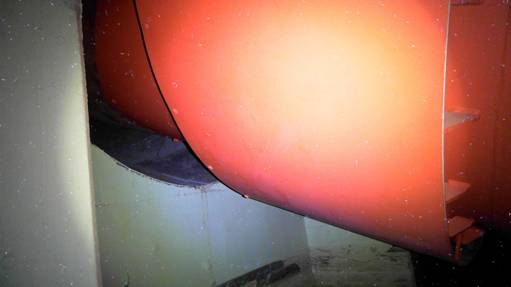
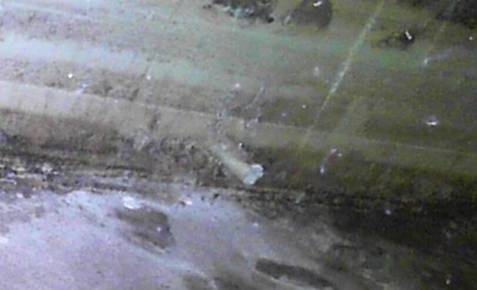
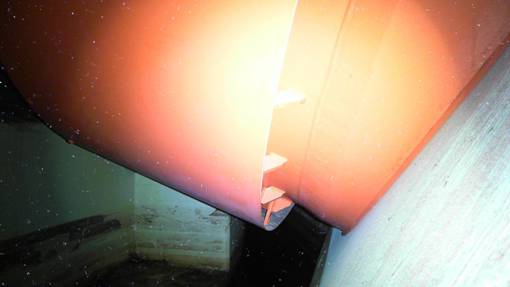
And it did. TEPCO just released the photos of the vent pipe that was examined by the robot on December 11. There is no discernible leak or damage to this particular pipe.

From TEPCO's handout for the press, "Results of Investigation on the Lower Part of Unit 2 Vent Pipe at Fukushima Daiichi Nuclear Power Station" (12/11/2012), page 2 (click to enlarge):


No information on how long it took this robot to do the work. Page 3 says actual radiation dose was 1.75 millisievert, but no information whether that was for the robot or the robot operator(s).

Edge of vent pipe sleeve:


Edge of sand cushion drain pipe:


Lower part of vent pipe bellows cover:


On March 15, 2011, a loud sound was heard from the Reactor 2 torus room, and Reactor 2 is supposed to have released radioactive material an order of magnitude larger than the other reactors.

Wednesday, November 21, 2012

Toshiba's Robot for #Fukushima I Nuke Plant Is a Dud, Japanese Media Is Mum on Shortcomings as Toshiba Tries to Sell to TEPCO


While all Japanese media seem to have simply copied and pasted Toshiba's PR material and called it a "news article", AP actually reported what the reporter saw at a demonstration held in Yokohama on November 21, 2012.

If you just read the Japanese media, Toshiba's four-legged robot has wonderful features. According to one of the media, Sankei Biz (11/22/2012):

  • It can withstand 100 millisieverts/hour radiation for almost a year, working 10 hours a day;

  • It can move at 1 kilometer/hour, work for 2 hours straight (...wait a minute, you just said it can work 10 hours..);

  • It can climb stairs, carry 20 kilograms of load.


But according to AP's Japanese reporter,

  • During the demonstration, it took a misstep, with one leg frozen up in the air, and the robot had to be carried off the stairs and rebooted;

  • It took one minute to climb one stair;

  • If it falls, it cannot get up by itself.


Duh. AP's Ms. Kageyama correctly asks, "What exactly is the robot capable of doing?"

From Bradenton Herald, quoting AP (11/21/2012; emphasis is mine):

Toshiba shows off robot meant to help at nuke site

By YURI KAGEYAMA — AP Business Writer

YOKOHAMA, Japan — Toshiba Corp. has developed a robot it says can withstand high radiation to work in nuclear disasters, but it's not clear what exactly the robot is capable of doing if and when it gets the go-ahead to enter Japan's crippled Fukushima Dai-ichi nuclear plant.

The four-legged robot can climb over debris and venture into radiated areas off-limits to humans. One significant innovation, Toshiba said, is that its wireless network can be controlled in high radiation, automatically seeking better transmission when reception becomes weak.

But the machine, which looks like an ice cooler on wobbly metal legs, also appears prone to glitches. The robot took a jerky misstep during a demonstration to reporters, freezing with one leg up in the air. It had to be lifted by several people and rebooted.

The robot was also notably slow in climbing a flight of eight steps, cautiously lifting its legs one by one, and taking about a minute to go up each step.

With obstacles that aren't as even and predictable as steps, such as the debris at the Fukushima plant, it may need as much as 10 minutes to figure out how to clear the object, Toshiba acknowledged.

And if it ever falls, it will not be able to get up on its own.

Still, Tokyo Electric Power Co. said it might use the robot to inspect the suppression chamber of the nuclear plant where a devastating meltdown occurred after a mammoth tsunami slammed into northeastern Japan on March 11, 2011.

Toshiba began developing the robot with hopes it would prove useful in helping to decommission the plant. No human has been able to enter the highly radiated chamber since the tsunami disaster.

"We need this to go in and first check what is there," Toshiba Senior Manager Goro Yanase said Wednesday.

It was unclear when a decision on the robot's use would be made, according to TEPCO, which operates the nuclear plant.

Although what Toshiba showed was top-notch robotics, what the machine might be able to do appeared limited in the face of the disaster's magnitude and complexity.

Japan boasts among the world's most sophisticated robotics technology, exemplified in the walking, talking human-shaped Asimo robot from Honda Motor Co. The inability of such gadgetry to help out with the Fukushima disaster was widely criticized.

Part of the reason is that robots, although suited for tasks such as greeting visitors at dealerships, are too delicate. Their wireless remote-controlled networks are not designed to endure high radiation. Honda has acknowledged Asimo would not have been able to withstand the environment at Fukushima, as some had suggested.

Toshiba's Yanase said the new robot, which has a dosimeter to measure radiation and six cameras, can stay in a 100 millisievert environment for about a year and can tolerate even higher radiated areas for shorter periods. At 100 millisieverts, the rise in cancer cases caused by radiation becomes statistically detectable, although even lower dose radiation is not advisable for people.

The suppression chamber was 360 millisieverts the last time it was measured, TEPCO said.

Decommissioning Fukushima Dai-ichi is expected to take decades.


Reading the Sankei article, Toshiba seems to be pressuring TEPCO to take its robot and use it (somehow) at Fukushima I Nuclear Power Plant, as Toshiba expands its portfolio of post-nuclear-disaster technologies that includes gamma-ray camera, SARRY, and the new multi-nuclide decontamination facility (ALPS).

Why does a robot have to be a hunky gadget loaded with stuff and why does it need to climb stairs to begin with? A host of tiny, self-organizing and collaborating drones still gets my vote.

If the robot has to have legs, MIT spin-off's BigDog is not bad either, able to run 5 miles per hour, carrying loads:


Compare this with the Toshiba's robot...


(H/T Twitter follower @metro172)

Saturday, August 18, 2012

Photos of Minor Leak at Reverse Osmosis (Desalination) Facility in #Fukushima I Nuke Plant: Defective Pipe Joint?


The Reverse Osmosis (RO) system at Fukushima I Nuclear Power Plant treats water already treated by Toshiba's SARRY (cesium absorption towers) in order to remove salt before the water is fed back to the Reactor Pressure Vessels in Reactors 1, 2 and 3.

I believe the RO system was also built by Toshiba, and it started operation in August in 2011.

Looking at the photographs of the leak that TEPCO released on August 17, now we know it doesn't matter whether the pipes are Kanaflex or metal. They fail no matter what, at Fukushima I Nuke Plant. In this case, one of the metal pipe joints cracked and fell off, and the water leaked from there.

Gamma radiation was low in the leaked water but since SARRY (or for that matter, Kurion or AREVA, both of which have not been used) does not remove any beta nuclides (including strontium), beta radiation was rather high at 3 millisieverts/hour on the water.

From TEPCO's Photos and Videos Library (8/17/2012):


The system still uses Kanaflex:


How bad is the leak? About 0.2 tonnes, or 200 liters.

(Defective cast, poor workmanship (installation) either from lack of training/apprenticeship or from lack of stake in the project, or all, was the comment from a person with experience in chemical plants, when I showed these photos.)

Tuesday, December 13, 2011

#Radiation in Japan: Toshiba to Sell Camera That Visualizes Hot Spot

Now that France's AREVA is in dire financial trouble, Toshiba may have one less competition in selling nuke plants all over the world. And when a nuke plant goes bust, like Fukushima I Nuclear Power Plant did in a spectacular fashion, why it makes more money by first selling cesium towers (SARRY) which have so far delivered OK performance but not that great, then selling a desalination system (evaporative condensation apparatus) that keeps leaking water.

Now, Toshiba is set to make money in the "decon bubble" in wider communities outside the nuke plant by introducing a camera that can visualize radiation levels in different colors. According to the Asahi article below, it has been tested in the harshest environment - Fuku-I compound.

From Asahi Shinbun (12/14/2011):

東芝は13日、放射線量を色の違いで映し出すカメラを開発したと発表した。局地的に放射線量が高い「ホットスポット」を見つけるのに役立ち、除染作業の効率がよくなるという。このカメラを使った計測サービスを来年から環境省や自治体などに売り込む予定だ。

Toshiba announced on December 13 that it has developed a camera that can show different radiation levels in different colors. The company says the camera will help identify so-called "hot spots" with localized high radiation and improve the effectiveness of decontamination work. The company plans to market the survey service using the camera to the Ministry of the Environment and local municipalities, starting next year.

 カメラ内部に放射線を測定するセンサーと、映像を取り込むセンサーを取りつけた。センサーからの2種類の信号をあわせ、パソコンなどの画面に映し出すことで放射線が見えるようにした。放射線量が高い場所は赤く表示されるので、従来の放射線量を数値で示す測定器よりもホットスポットが発見しやすいという。

The camera contains a sensor that measures radiation and a sensor that captures graphic images. By combining two signals from the two sensors and sending the signals to the computer screen, the system allows users to visualize radiation. The locations with high radiation levels will be displayed in red, making it easier to identify "hot spots" than the traditional display of radiation in digits.

 東京電力福島第一原発の建屋内でも、ほぼ同じ機能を持つ東芝製のカメラが使われた。感度を高めたうえで、大きさと重さをほぼ半分にして自治体などでも使いやすくした。年内に福島市と共同で実証実験をして実用化する。自治体などから希望があれば、カメラそのものの販売も検討する。

The Toshiba-made camera with almost identical capabilities has been used inside the buildings at Fukushima I Nuclear Power Plant. The company has improved that camera by raising the sensitivity and reducing the size and weight by half, making it easier for local municipalities to use. Toshiba will conduct a joint experiment with Fukushima City before the year end, and commercialize the camera. If there's a demand from municipalities, the company will consider the sales of the camera itself.

Thursday, September 15, 2011

#Contaminated Water Treatment System at #Fuku I: TEPCO to Use SARRY Only from October

Just as I thought. TEPCO will ditch the Kurion-AREVA combo that has had numerous problems from the beginning and will rely solely on Toshiba (and IHI and US's Shaw)'s SARRY for highly contaminated water treatment. Toshiba's SARRY has had its share of problems but not as many as the Kurion-AREVA duo.

The latest trouble at the water treatment system: the density of radioactive materials, reduced after Kurion's treament, shot up again after AREVA's treatment.

From Mainichi Shinbun (9/15/2011):

 東京電力は15日、福島第1原発事故で生じた高濃度の放射性物質を含む汚染水を浄化して原子炉の冷却に使う「循環注水冷却システム」で、米キュリオン社の装置によって下がった放射性物質の濃度が、続いて仏アレバ社の装置を通すと上がるトラブルが起きたと発表した。アレバ社の装置が処理する高濃度の汚泥が流出した可能性もあり、原因を調べている。現在は、アレバ社の装置は止め、キュリオン社の装置だけで処理している。

TEPCO announced on September 15 that there was a trouble in the reactor cooling system that circulates water treated in the contaminated water treatment system. The density of radioactive materials that decreased after the treatment with Kurion's system increased after the treatment with AREVA's system. It is possible that highly radioactive sludge in AREVA's system leaked. TEPCO is investigating the cause. Currently, AREVA's system is stopped, and the treatment is done by Kurion's system alone.

 東電が同日、両社の装置の処理能力を確認したところ、キュリオン社単独では汚染水の放射性物質の濃度が1立方センチ当たり数百万ベクレルから数百ベクレルまで下がったが、その汚染水を続けてアレバ社の装置で処理すると、逆に数十万ベクレルに上がった。

TEPCO looked at the treatment performance of both systems and found that Kurion's system had reduced the density of radioactive materials from several million becquerels/cubic centimeter to several hundred becquerels/cubic centimeter. However, when that treated water was further processed in AREVA's system, the density shot up to several hundred thousand becquerels/cubic centimeter.

 東電は10月以降、キュリオン社とアレバ社の装置を組み合わせた浄化システムを止め、比較的故障が少ない東芝製の別の浄化装置「サリー」で汚染水を浄化する方針だ。

TEPCO plans to stop using Kurion-AREVA system starting October, and use Toshiba's SARRY exclusively for contaminated water treatment. SARRY has had a relatively small number of failures compared to Kurion's or AREVA's system.

TEPCO was working on both Kurion's and AREVA's system from September 13, replacing a pump at Kurion's and a stirrer in the coagulation settling unit at AREVA's. Maybe that had something to do with the problem. Maybe not. TEPCO is not very forthcoming, as you may have noticed over the past 6 months.

Saturday, August 20, 2011

#Fukushima I Nuke Plant: Toshiba's SARRY Joins the Underperformers at the Plant

TEPCO released the result of the decontamination by Toshiba's SARRY (cesium absorption) after the start of the full run, and it was OK (according to TEPCO) but not as spectacular as the manufacturers (Toshiba, IHI, and the US's Shaw) had claimed.

SARRY achieved the decontamination factor (DF) of about 50,000, instead of 1 million the manufacturers had confidently hoped. The DF of 50,000 means that the system was able to reduce the amount of radioactive materials (in this case, cesium) to one-50,000th after the treatment.

It is still much better than Kurion, whose most recent DF is slightly less than 350 (reducing the redioactive materials to one-350th.

There goes, for now at least, the idea of just using SARRY and bypassing Kurion and AREVA in decontaminating the water. The desalination unit needs the treated water to have radioactive materials at one-100,000th of the initial contaminated water, at least. TEPCO still needs at least two of the three decontamination units.

From TEPCO's handout for the press on August 20:


Thursday, July 14, 2011

#Fukushima Water Treatment System: Toshiba's Long Tall "SARRY" to the Rescue!

10 workers spent 2 minutes each to fix the PVC joint that broke off in AREVA's unit at Fukushima I Nuclear Power Plant on July 13, according to Asahi (link is in Japanese). The air radiation level at the location is 100 to 150 millisieverts/hour. For 2 minutes work, a worker could have received 5 millisieverts radiation.

The on-again-off-again water treatment system is finally on again, but at this point all TEPCO cares about is probably that these Kurion-AREVA units keep hobbling along, at least processing the amount of water that's being injected into the RPVs (Reactors 1, 2 and 3) so that the highly contaminated water in the reactor and turbine buildings does not increase.

Why? Because Toshiba's "SARRY" will soon come to the rescue. (Photo is from Asahi.)

SARRY stands for "Simplified Active Water Retrieve and Recovery System". Well, it doesn't quite stand for these words, but that's how Toshiba's been calling it.

It is already being installed at Fukushima I Nuke Plant, and is expected to come online sometime in early August. As it is planned right now, this Toshiba's system comes after Kurion and before AREVA.

SARRY is being jointly built by Toshiba, IHI, and the US company Shaw. A metal cylinder of 1.4 meter in diameter and 3.6 meters in height is filled with synthetic zeolite and titanium silicate. The system will connect these cylinders serially to decontaminate the water. The first half of the cylinders use absorbers with low percentage removal of cesium, and the second half of the cylinders use absorbers with higher percentage removal.

Toshiba thinks SARRY can reduce the amount of radioactive materials in the water to one-millionth, and process 1,200 tonnes of water per day.

The water will first go through the resin filters that remove oil, then through the cylinders filled with zeolite and titamium silicate for cesium removal. The system will be surrounded by lead panels to reduce radiation. Compared to Kurion's system which basically uses the same principle, Toshiba's system uses less pumps and thus less chance of breakdowns, according to TEPCO/Toshiba.

The drawings are probably written in a language that TEPCO and workers understand without dictionary, and it is probably being installed by Toshiba and its affiliates who are building the system.

If Toshiba's system delivers what it promises, there will be no need at all for Kurion or AREVA, and TEPCO can simply bypass both and just use SARRY. Kurion+AREVA can remain as a backup.

We'll see if Murphy will get Toshiba. After all, processing 1,200 tonnes of water per day and reducing the radioactive materials in the water to one-millionth is what was promised with Kurion and AREVA's systems.

Yomiuri has a video that Toshiba has released, showing the manufacturing and assembly of SARRY.

TEPCO's handout for press on July 14 has the diagrams and photos:


(I have a suspicion that Toshiba engineers wanted to call it "Sally", as in "Long Tall Sally". The system does use long tall cylinders, doesn't it? But as I said, "Sally" and "Sarry" don't make a bit of difference to most Japanese who are incapable of differentiating between "l" and "r". In Japanese they are pronounced the same, more like "l".)

Friday, July 1, 2011

Toshiba Pushes for Spent Fuel Processing Plant in Mongolia, in Discussion with US Government

Toshiba owns and operates Westingshouse Electric (77% ownership), and has continued to sell nuclear power plants all over the world after the Fukushima accident. So does Hitachi with GE, and so does Mitsubishi Heavy Industries with AREVA. Business as usual, no matter what.

From Kyodo News Japanese (10:08PM JST 7/1/2011):

米原子力大手ウェスチングハウス・エレクトリック(WH)を子 会社に持つ東芝の佐々木則夫社長が5月中旬、米政府高官に書簡を送り、使用済み核燃料などの国際的な貯蔵・処分場をモンゴルに建設する計画を盛り込んだ新 構想を推進するよう要請、水面下で対米工作を進めていることが1日、分かった。

It became known on July 1 that Norio Sasaki, the president of Toshiba which owns Westingshouse Electric, a major nuclear energy company in the US, sent a letter to a high ranking official in the US government in mid May urging the US government to promote the new scheme that includes a plan to build an international storage and final processing plant for the nuclear spent fuel in Mongolia.

 モンゴルでの核処分場計画は、新興国への原発輸出をにらみ、モンゴルで加工したウラン燃料の供給と使用後の処理 を担う「包括的燃料サービス(CFS)」構想の一環。米国とモンゴルが主導し、日本にも参加を呼び掛けた。経済産業省が後押ししてきたが、外務省が慎重姿 勢を示すなど政府内に異論もある。

The plan to build a processing plant in Mongolia is part of the "CFS [Comprehensive Fuel Service?]" scheme to process uranium and to process the spent fuel in Mongolia, eying the lucrative nuclear plant markets in developing countries. The US and Mongolia have been leading the effort, and have asked Japan to join. But there is a difference of opinion within the Japanese government; the Ministry of Economy, Trade and Industry has been pushing for the idea, while the Ministry of Foreign Affairs is not too keen.

As I wrote here before, Mongolia does have faults that are capable of producing Magnitude 8 earthquakes. How to transport the spent fuel rods to Mongolia should be a problem, though. Either China or Russia has to agree to have them transported overland. Russia is unlikely to allow that, as it is in direct competition with the US and the West to win nuke plant contracts in developing nations with a packaged deal like the CFS. And China? Maybe, if the US/Mongolia/Japan let China in on the scheme, in exchange of allowing the use of the facility and some "technology transfer" from the US and/or Japan.

It looks like the Cold War has never ended in the minds of politicians and nuclear industry people.

Wednesday, March 30, 2011

More on TEPCO's South Texas Nuke Plant Investment

that TEPCO Chairman Katsumata mentioned in the yesterday's press conference.

From Skadden law office announcement in May 2010 [emphasis added]:

Skadden is representing the Tokyo Electric Power Company, Inc. (TEPCO), which entered into an agreement with Nuclear Innovation North America LLC, a nuclear development company jointly owned by NRG Energy, Inc. and Toshiba Corporation, to acquire a 10 percent interest in the planned expansion of the South Texas Project nuclear plant. TEPCO's investment, announced May 10, marks the first time a Japanese utility has invested in an overseas nuclear power project. This will be the first project in the United States to utilize Advanced Boiling Water Reactor technology.

"Advanced"? After the GE-designed, Toshiba-made boiling water reactor in the Reactor 3 at Fukushima I blew up? I suppose TEPCO and Toshiba have since refined the technology after they installed the Reactor 3 at Fukushima I Nuke Plant in 1974.

Advanced boiling water reactor, according to wiki, is currently offered by GE Hitachi Nuclear Energy. Fukushima I Nuke Plant's Reactor No.6 and 7, whose construction was scheduled to start in April 2012, were planned to be ABWR.

And the Texans seem to remain bullish on nuclear energy and believe TEPCO will not pull out.

From Platt's Energy Week (emphasis added; 3/15/2011):

Japan's still-unfolding nuclear crisis has shaken investor confidence in prospects for a US nuclear renaissance, but it remains unclear if the March 12 accident at a Japanese nuclear plant in the aftermath of a 9.0 earthquake and subsequent tsunami will slow or even stop US nuclear projects now in advanced stages of development.

... The plan by Nuclear Innovation North America, an 88/12 joint venture of NRG Energy and Tokyo-based Toshiba, to add two 1,350-MW advanced boiling water reactors at the South Texas nuclear project in Matagorda County, Texas, faces perhaps the most immediate uncertainty.

Toshiba supplied the GE-designed boiling water reactor at Fukushima Daiichi Unit 3, whose reactor roof exploded on Monday. And both that unit and Fukushima Daiicchi Unit 1, which suffered a similar fate on Saturday, are owned and operated by Tokyo Electric Power Co., which last May committed to buy up to a 499-MW stake in the South Texas nuclear expansion.

NRG spokesman David Knox said Monday that it is too soon to comment on whether the Japanese nuclear crisis might lead Tepco to shift its attention to rebuilding its crippled nuclear generation fleet at home and withdraw its plan to invest in US nuclear capacity.

"Our focus is on our friends and partners" in Japan, Knox said. "There will be time to assess the impact [of Japan's nuclear crisis] on nuclear development in the US in the days and weeks to come."

Tepco said last May that it will pay NINA $125 million for a 10% share of the joint venture, which owns a 92.375% stake in the South Texas expansion project, once the Department of Energy has issued a conditional commitment to the project's developers for a federal loan guarantee.

Tepco also agreed to pay NINA $30 million for an option to buy an additional 10% stake in NINA about a year later for another $125 million. Tepco's initial 10% stake in NINA will give it a 9.2375% interest in the expansion project, and its second 10% stake will increase that interest to 18.47%, or 499 MW. CPS Energy, the San Antonio municipal utility, owns the other 7.625% stake in the expansion project.

NRG's Knox said that "nothing happens" regarding Tepco's commitment to join the South Texas expansion project until DOE has offered the project a conditional loan guarantee. The proposed loan guarantee is currently being reviewed by the Treasury Department and the White House Office of Management & Budget, he said. It would then go back to the DOE Credit Review Board for approval before being issued.

"Considering everything that's going on I wouldn't want to hazard a guess" on when that conditional loan guarantee might be forthcoming, Knox said.

Leading proponents of "new nuclear" said that they do not believe the Japanese nuclear crisis will delay or kill US projects now under development.

Please read the full article at the link.

After today's Obama's speech, Mr. Knox can rest assured that the federal loan guarantee will be forthcoming shortly.

So the Japanese are not the only delusional people. Good to know.

Monday, March 14, 2011

#Fukushima I Nuke Plant: Danger of MOX Fuel

from BBC Live report of the Japan earthquake, citing Mr. Masashi Goto, former Toshiba engineer who designed the containment vessel of the Reactor No.3 at Fukushima I Nuclear Power Plant:

...
1431: More from Japanese nuclear engineer Masashi Goto: He say that as the reactor uses mox (mixed oxide) fuel, the melting point is lower than that of conventional fuel. Should a meltdown and an explosion occur, he says, plutonium could be spread over an area up to twice as far as estimated for a conventional nuclear fuel explosion. The next 24 hours are critical, he says.

426: Mr Goto says his greatest fear is that blasts at number 3 and number 1 reactors may have damaged the steel casing of the containment vessel designed to stop radioactive material escaping into the atmosphere. More to follow.

1422: Japanese engineer Masashi Goto, who helped design the containment vessel for Fukushima's reactor core, says the design was not enough to withstand earthquakes or tsunamis and the plant's builders, Toshiba, knew this. More on Mr Goto's remarks to follow.

1415: Prof Richard Wakeford adds: "The other thing authorities [in Japan] will be considering is the issuing of stable iodine tablets to block the intake of radioactive iodine which accumulates in the thyroid, and which is particularly problematic if it happens in young children."