Showing posts with label ALPS. Show all posts

Monday, May 19, 2014

Just In: All Three Lines of ALPS Have Stopped at #Fukushima I Nuclear Power Plant


The entire ALPS multi-nuclide removal system is down again, as Line C has just been stopped as the water sample from Line C is found with high calcium content.

Line A was stopped three days ago, and Line B has been idle since March this year, when the water treated in Line B was found with high beta (in the order of 10 million Bq/L) and brand-new storage tanks got contaminated.

Stopping ALPS won't affect the cooling of reactors, as the treatment for the cooling water is done by SARRY (removal of radioactive cesium) and by the reverse osmosis apparatus (desalination).

From TEPCO's email alert for the press, 5/20/2014:

多核種除去設備(ALPS)C系については処理運転中でしたが、本日(5月20日)の定例のサンプリングにおいて、系統水に若干の白濁があること、カルシウム濃度が高いことを確認しました。

Line C of the multi-nuclide removal system ALPS has been in operation. However, we noted in today (May 20, 2014)'s scheduled sampling that the water [coming out of] Line C was clouded, and that it had high calcium content.

 このため、多核種除去設備(ALPS)C系について、同日午前9時00分、処理運転を停止し、循環待機運転に切り替えました。

Therefore, we stopped Line C at 9:00AM today, and switched it to the circulation stand-by operation. [I don't know exactly what TEPCO means; I'm guessing they are circulating the water within Line C instead of sending treated water into a storage tank.]

 この結果、多核種除去設備(ALPS)は3系統ありますが、全て処理運転を停止している状況となります。

As the result, all three lines of ALPS have stopped treatment operation.

 原因等については、今後調査いたします。

We will investigate the cause.


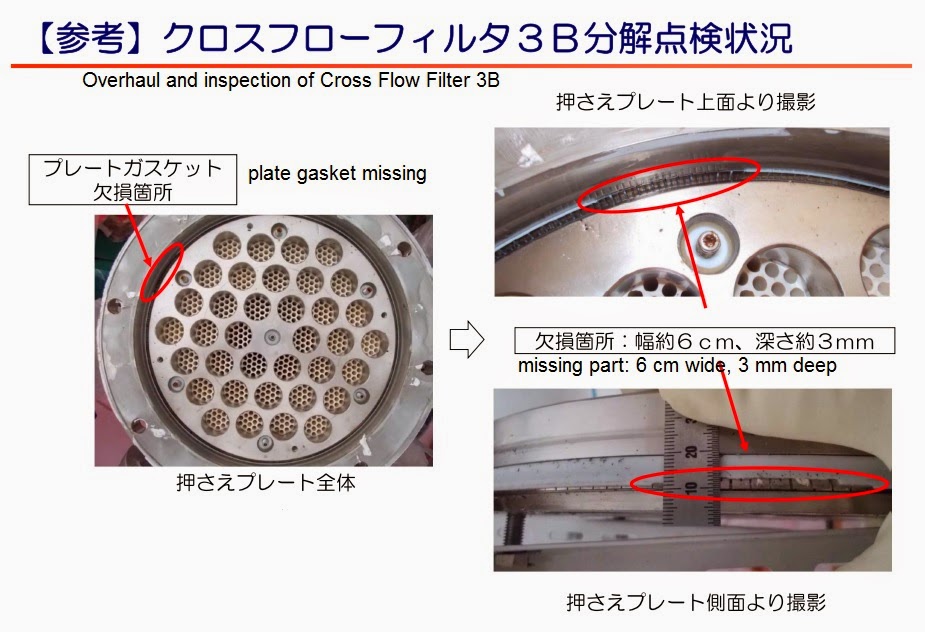
The cause, if it is the same as Line A which stopped three days ago after the water sample was found with high calcium content, is likely to be the defective cross flow filter, like this one on Line B (from TEPCO's Roadmap update page 24, 4/24/2014) (English labels are by me):


Whether the defective gasket is due to material defect, design defect or irradiation is unknown at this point.

Tuesday, April 1, 2014

Happy April Fools' Day! Residents Back in 20km Evacuation Zone in #Fukushima, TEPCO Manages to Contaminate Brand-New Tanks, 30-Year-Old STAP Cell Researcher Says She Meant Well When She Copied and Pasted for Nature Magazine Thesis


April 1st is the start of Japan's new fiscal year. Fitting, you might say.

Residents who were forced to leave their homes in Miyakoji District of Tamura City soon after the start of the nuclear accident on March 11, 2011 are allowed back, as of April 1st, 2014. They are the first in the former no-entry evacuation zone within 20-kilometer radius from Fukushima I Nuclear Power Plant.

NBC News in the US has a Reuters article whose only sensationalism is in the title (Miyakoji was never "hot"); otherwise the article simply reports facts, and surprisingly, with numbers for radiation levels, which rarely happens in the articles in the US mainstream media on the Fukushima accident, or any nuclear accident.

It is still a joke. Not because the Japanese government is sending the residents back in the "hot zone" (as Reuters' article says, which is misleading) in 3 "short" years, but because the residents in Miyakoji should never have been forced to leave to begin with.

The radiation levels in Miyakoji, even though the town is inside the 20-kilometer radius, have generally been much lower than larger cities in the more populous middle-third of Fukushima Prefecture ("Nakadori"), where residents have never been forced to evacuate. It's all because of the unscientific, uninformed decision by the ministers of the Kan administration (PM Naoto Kan, Cabinet Secretary Yukio Edano, Minister of Economy Banri Kaieda) to draw concentric circles around the plant to decide the evacuation zone - as if the nuclear plant accident were an atomic bomb detonation, and as if that had happened on a flat land on a day with no wind.

From NBC News quoting Reuters (4/1/2014; emphasis is mine):

Fukushima Families Return to Homes in 'Hot Zone'

The completion of decontamination work allowed residents of a small part of the Fukushima exclusion zone to return home Tuesday, just over three years after they were forced into exile.

The reopening of the Miyakoji area of Tamura, a city inland from the wrecked nuclear station, marks a tiny step for Japan as it attempts to recover from the 2011 disasters.

But the event is a major milestone for the 357 registered residents of the district. The trickle of returnees highlights both people's desire to return to the forested hamlet and the difficulty of returning to normal.

"Many of our friends and neighbors won't come back," said Kimiko Koyama, 69, speaking on her return to the large farmhouse she had occupied for 50 years, while her husband Toshio, 72, tried to fix a television antenna on the roof.

"There are no jobs. It's inconvenient and young people are scared of radiation," she said. "My daughter won't bring our grandsons here because of the radiation."

A few cars streamed into the town on Tuesday, where several TV news vans were set up. Some elderly women sat by the roadside, but there were no children or families in sight outside.

Schools open later this week, but seven children came to the local pre-school and four older children were also dropped off, as volunteers from nuclear plant operator Tokyo Electric Power (Tepco) removed ice and snow and leveled the playground.

Radiation levels in Miyakoji ranged from 0.11 microsieverts to 0.48 microsieverts per hour, February readings show.

That was higher than the average 0.034 microsieverts per hour measured in central Tokyo on Monday, but comparable to background radiation of about 0.2 microsieverts per hour in Denver. A commercial flight between Tokyo and New York exposes passengers to about 10 microsieverts per hour.

People exposed to radiation typically have a higher chance of getting cancer if doses exceed 100 millisieverts (100,000 microsieverts), the World Health Organisation says.

Tuesday's homecoming is particularly difficult, as many residents worked at the Fukushima plant before the disaster and depended on Tepco for stable jobs.

"It was the only job out here and we were grateful," said Kimiko Koyama. "We worked hard to feed our three daughters. We worked and we built our life here."

The Koyamas, who helped to build the very nuclear reactors that have displaced them from their homes, are letting the city keep radioactive debris in an empty lot on their land in a bid to hasten the cleanup.


The Koyamas at their home, photo by Reuters:


In Japan, you don't actually hear much about fear of radiation as reason for not returning for these residents. Rather, the concern is not radiation (whose levels are lower than in cities like Fukushima and Koriyama in the middle third), but local economy.

As Reuters' article above briefly mentions, the employment in the district depended heavily on TEPCO. But it is not just employment. Residents used to go to neighboring Okuma-machi and Futaba-machi, both of which are inside the 20-kilometer radius evacuation zone and actually heavily contaminated, for shopping, seeing doctors, entertainment, etc. Both Okuma-machi and Futaba-machi are off-limits for years to come.

According to the latest measurement by Tamura City, Miyakoji District's radiation level as of March 30, 2014 was 0.14 microgray/hour (more or less the same as 0.14 microsievert/hour).

According to the real-time monitoring information compiled at Nuclear Regulation Authority, radiation levels in Koriyama City in the middle-third of Fukushima Prefecture range from 0.09 microsievert/hour to 0.595 microsievert/hour (which happens to be in a nursery school...). The levels in Miyakoji District in Tamura City look to be between 0.1 and 0.2 microsievert/hour.

One clarification about the radiation dose of 100 millisieverts mentioned in the article: it is about life-time cumulative dose.

Now, moving on to TEPCO, you will encounter a joke in the true sense of the word...

The stoppage of all three lines of ALPS was my last post in March, but since then the multi-nuclide removal system has been plagued with new leaks and other problems that cause constant stoppage.

The saddest and stupidest of all must be this (or at least it is for me): TEPCO unknowingly contaminated the brand-new 1,000-tonne welded tanks as they kept sending the water treated by ALPS, except ALPS wasn't treating the waste water properly (for reasons not yet clear) and left a significant amount of beta nuclides in the water.

TEPCO (or rather, Toshiba) didn't have a way to test the water treated by the three ALPS lines individually. Treated water from the three lines all goes to the same holding tank, from which the water is sent to the storage tanks.

There are 21 such brand-new, welded tanks, and TEPCO has admitted that 9 of them have been contaminated (10 million Bq/Liter of all beta). I have a suspicion that all 21 tanks have been contaminated. Why? Because these tanks are all connected by pipes and valves near the bottom of the tanks, and they keep the valves open to fill all tanks by pumping the treated water into one tank

Now, someone has to crawl inside the tanks from the inspection holes near the bottom, and scrub the inside clean.

From Tokyo Shinbun (3/26/2014; part):

東京電力福島第一原発の新型除染装置「ALPS(アルプス)」で不具合が起きているのに東電が運転を続けた結果、多数のタンクを高濃度の放射性物質で汚した。東電は「タンクの除染を始めた」というが、後始末をさせられるのは作業員。除染に当たった作業員らが語る現場は、過酷だった

TEPCO continued to operate ALPS, the multi-nuclide removal system at Fukushima I Nuclear Power Plant, without noticing the problem. As the result, many tanks were contaminated by highly radioactive materials. TEPCO says it has started to "decontaminate the tanks", but the ones who do the actual decontamination are the workers. As told by the workers who did the decontamination, it was a hard labor.

除染されたのは、ALPSで処理した水を一時的にためるため、装置脇にあるタンク一基。作業員らはタンク下部の側面に直径八十センチほどの点検孔を開け、高さ、直径ともに約十メートルあるタンクの中に入った。天板に二カ所ある点検孔を開け、そこから差し込むわずかな光と持ち込んだ発光ダイオード(LED)ライトの光だけが頼りだ。

Workers decontaminated one tank near ALPS which temporarily stores water treated by ALPS. They opened an inspection hole, 80 centimeters in diameter, at the side of the tank near the bottom to enter the tank with 10 meters in diameter and in height. They opened the two inspection hole on the ceiling to let the light. They also carried in the LED lights for the work.

すでに上部から高圧の水を吹きつけて洗浄してあるとはいえ、つい数日前まで一リットル当たり一〇〇〇万ベクレルと、放出基準の数十万倍もある放射性ストロンチウムなどを含む水が入っていた。ベータ線を発する物質で、被ばくの心配は少ないが、直接触れたり体内に取り込むと内部被ばくにつながる。

Even though the tank had been washed from above with high-pressure washer, until a few days ago it had stored water that contained 10 million becquerels per liter of radioactive materials including radioactive strontium, hundreds of thousands times the limit for discharge. They were beta nuclides so there was less worry for radiation exposure unless they came into direct contact or they were ingested.

防護服の上にかっぱを二枚重ねし、かっぱのフードを全面マスクの上からテープで密封。手はゴム手袋など四枚重ね。足元は長靴と完全防備だ。

Workers wore two [water-proof] jackets on top of the protective clothing [Tyvek, probably]. The hoods of the jackets were taped shut onto the full-face masks. They wore four layers of gloves including rubber gloves, and wore long boots.


Meanwhile, I hear that TEPCO's president, Mr. Hirose, was welling up as he welcomed new employees (new graduates) for the first time in three years. TEPCO on the road to recovery...

Now, moving on to surreal...

The 30-year old (so-called) researcher at RIKEN, one of the premier research institutions in Japan, who seems to have copied and pasted all the way to her current cushy position, claims her STAP cells are real, and copying and pasting she did to falsify the data was done with good intension - or at least with lack of bad intension.

So in her privileged mind, as long as she doesn't mean ill, she should be forgiven.

For those who are not familiar, she and her professor during her Harvard days, Professor Charles Vacanti, claim they have created a cell that can become any cell from an adult cell just by stressing it a little bit with acid bath or mechanical stress. One of the photographs critical to their claim and prominently featured and published in the prominent peer-reviewed magazine Nature turns out to be the same photograph from her doctoral dissertation from a totally different process.


RIKEN's top management (who happen to be top scientists, too, including a Nobel prize winner in chemistry) held a press conference on April 1st to announce their final findings: The researcher, Ms. Haruko Obokata, knowingly falsified.

Ms. Obokata, now being advised by not just one but THREE lawyers, has this to say (From none other than Nature Magazine, 4/1/2014):

In her letter, Obokata says the spliced gel lane did nothing to change the study’s results. “There was no merit in falsifying data, and I had no intention of doing so when I made the image. I only wanted to have a better image,” she writes. Use of the duplicated image was also “a simple mistake” made because the images were similar. Obokata says that she had already identified the mistakes and sent Nature a correction.


Except she didn't identify the mistakes. Net citizens did. Her "simple mistake" involved photoshopping the original image and editing the text beneath the photos. Such an innocent mistake, she actually claims. As long as the intention is good, she should be forgiven, she says.

RIKEN says it was presented with only two lab notes in the three years Ms. Obokata was with RIKEN, and the commissioners at the press conference said they were effectively just one note, and so poorly written, without dates, that they couldn't verify the data or the origin of the photos.

Ms. Obokata is doubling down, and says she will file a formal complaint with RIKEN, and probably sue them.

For what? No one knows. She probably liked the attention she got in her 15 minutes of fame. RIKEN is under heavy criticism for hiring this person who seems like a pathological liar if you read tabloid magazines and for allowing this to happen. She reportedly won the essay contest when she was in middle school by copying and pasting quotes from a very popular animation (Galaxy Express Three-Nine) and passing them as her own words.

So far, no one has accused Nature Magazine for its sloppy peer review.

Hope you had a fun April Fools' Day...

Tuesday, March 18, 2014

#Fukushima I NPP: All Three Lines of ALPS (Multi-Nuclide Removal System) Are Stopped


TEPCO says "as a precaution". It looks ALPS Line B wasn't removing enough all-beta.

The multi-nuclide removal system ALPS is still on the extended "hot" test run using the waste water, treating less than 200 tonnes of water per day.

ALPS comes after the desalination (reverse osmosis) that comes after the cesium absorption by either SARRY or Kurion. These systems before ALPS haven't stopped. The water processed through SARRY/Kurion and reverse osmosis goes back into the reactors to cool the corium, and ALPS is to treat the waste water that is high in all-beta.

Even if ALPS is stopped, the water treatment and cooling the reactors continue.

TEPCO's email alert to the press (3/18/2014) says:

多核種除去設備(ALPS)では、汚染水処理設備にて処理した廃液を用いた試験(ホット試験)を行っていますが、本日(3月18日)、3系統(A系,B系,C系)あるうちの1系統(B系)について、午後0時4分にフィルタの酸洗浄のため停止しています。

We've been conducting the "hot" test of the multi-nuclide removal system ALPS using the waste water after it is processed in the contaminated water treatment systems. Today (3/18/2014), one of the three lines, Line B, has been stopped at 12:04PM to acid-clean the filters.

同日、B系の処理後の出口水の全ベータの分析結果(3月17日採取分)が10の7乗Bq/L程度であることを確認しました。

Also today, we noted that the nuclide analysis of the water treated by Line B (collected on March 17) showed all-beta to be [in the order of] 10^7 Bq/L [10,000,000 Bq/L].

多核種除去設備(ALPS)の入口水については、全ベータで10の8乗Bq/L程度であり、処理が不充分となっている可能性があることから、念のため、A系について同日午後1時38分、C系について午後1時39分に処理を中断しました。

The water before entering ALPS has about 10^8 Bq/L [100,000,000 Bq/L] of all-beta, so there is a possibility that the treatment by ALPS is not adequate. As a precaution, we stopped Line A at 1:38PM and Line C at 1:39PM.


Strontium-90, a beta nuclide, is mostly removed in the pre-treatment process of ALPS that uses iron coprecipitation and carbonate coprecipitation. TEPCO hasn't found what part of ALPS may be malfunctioning this time.

For my post on why ALPS may already be obsolete, click here.

Monday, December 30, 2013

#Fukushima I NPP: Multi-Nuclide Removal System (ALPS) May Be Obsolete Even Before It Starts Full Operation


TEPCO was counting on the multi-nuclide removal system ALPS (Advanced Liquid Processing System) to be operational in the summer of 2012, so that the only remaining radionuclide in the water going through the treatment cycle would be tritium.

The system, advertised as Toshiba's system but in fact developed by EnergySolutions based in Utah in the United States, was supposed to remove strontium and a host of other alpha, beta and gamma nuclides that still exist after cesium absorption (by SARRY and Kurion) and desalination (reverse osmosis, mostly).

The first hiccup came when Nuclear and Industrial Safety Agency (NISA) was abolished and replaced by Nuclear Regulation Authority (NRA) in September 2012. NRA demanded additional safety tests of the vessels that would store highly radioactive waste after the treatment by ALPS, and hot tests were delayed. Then throughout this year, the system with three lines were on again off again in hot tests that started in March this year because of the leaks from tanks and vessels from what look like poor welds. (For ALPS problems, see my posts here.)

Then around October this year, I started to hear that there would be another set of ALPS to accelerate the treatment. But then in November, I read a magazine article in which a researcher said the current ALPS was not capable of effectively removing strontium, and an entirely new system needed to be developed.

Then finally I found this document (PDF) in the website of Ministry of Economy, Trade and Industry (who continues to be in charge of promoting the nuclear energy and for reasons unknown to me in charge of dealing with contaminated water at Fukushima I Nuclear Power Plant):


The first meeting of a task force for a high performance multi-nuclide removal system

November 29, 2013

prepared by Tokyo Electric Power Company, Hitachi-GE Nuclear Energy, and Toshiba


This document (available only in Japanese) is from the first meeting of the task force on November 29, 2013 at METI. I believe it was a closed meeting, and there was no news coverage as far as I know.

The presentation is, as often the case with TEPCO's, a fine example of how not to make a presentation as each page is jammed with information some of which does not belong on the page. So I'm doing my best to piece together a cohesive story here.

First, this is the current ALPS system, in trial hot runs at Fukushima I Nuclear Power Plant:

(From TEPCO's 3/29/2013 presentation in English)


Take note of the "Pretreatment Facilities", made up of iron coprecipitation and carbonate coprecipitation systems, and producing highly contaminated slurry as waste product to be stored in the "high integrity containers (HIC)" (I believe it was these containers that NRA wanted tested for integrity by dropping from height).

Now, it turns out that this pretreatment system produces too much waste product, according to the document at METI (English translation is mine):

"Estimated total waste product from the existing system is 2,300m3 annually (800 High Integrity Containers), 95% of which is the slurry from pretreatment (iron coprecipitation and carbonate coprecipitation)."


and

"In order to reduce waste product, we need to develop a radionuclide removal process that does not use iron coprecipitation and carbonate coprecipitation but is able to remove radionuclides as well as, or better than, the existing system."


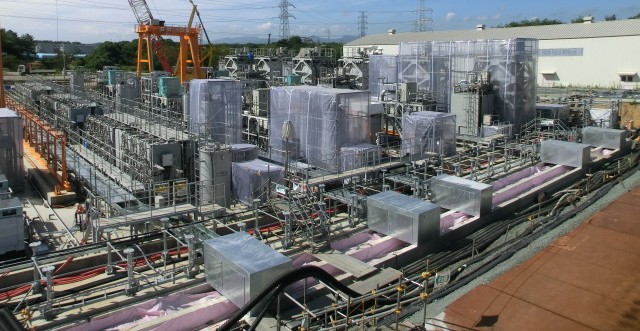
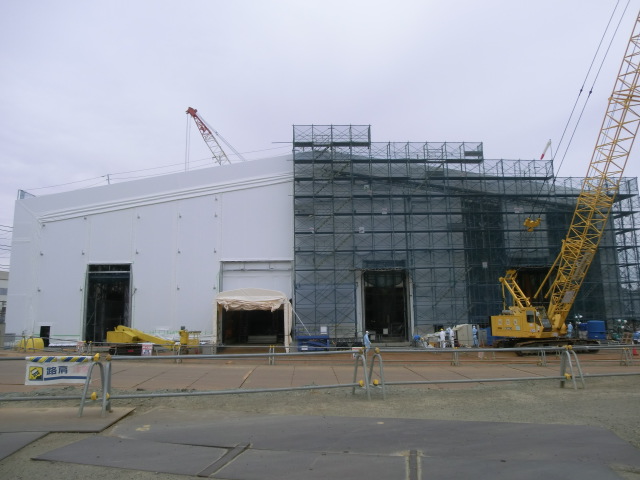
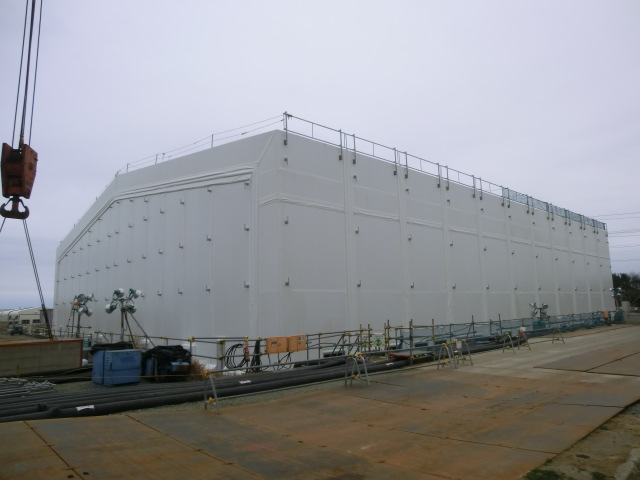
Uh oh. After paying Toshiba and Kajima (construction) a ton of money to build a huge system (see the photos below) that is not even in full operation yet, they need a new one because the current one produces too much waste.

What I don't understand is that they, particularly Toshiba who picked EnergySolution's technology, should have known from the very beginning that the current ALPS system would create a large amount of slurry from coprecipitation process, much like the decontamination system by AREVA that use coprecipitation process (AREVA's system was stopped and practically abandoned when too much, highly radioactive slurry was created as the waste, on top of numerous technical problems).

But wait, it is not just about the amount of toxic waste that the existing ALPS is not performing to expectations. It's also about how it removes radionuclides.

From the document at METI, TEPCO/Toshiba(/Hitachi-GE) thought radionuclides, particularly cesium and strontium, existed in the contaminated water as "ions" at the time when the current ALPS system was being designed. However, it turns out that the nuclides exist in the contaminated water mostly as "colloids" and "particulates", not "ions". The existing ALPS system is fitted with ion-exchange media from the Finnish company Fortum. Uh Oh.


More than 93% of cesium-137 in the post-RO (reverse osmosis for desalination) waste water exists as "colloids", less than 2% as "ions" and 5% as "particulates".

59% of all beta (strontium-89, -90, Y-90) exists as "colloids", 37% as "particulates", and 4% as "ions".

The existing absorption materials (in vessels) can only remove these nuclides in "ion" form. The nuclides in "colloids" and "particulates" are removed by the pretreatment process, thus the large amount of slurry waste.

So now, after two full years of building and testing the ALPS, it is obsolete even before it reaches full operation.

At least this was on TEPCO's own money, not the taxpayers' money, though I feel sorry for the workers made to work in a high-radiation environment.

ALPS (photo taken on September 16, 2012):


housed in :

Friday, August 23, 2013

RO Waste Water Leak: TEPCO's Modus Operandi Is "Bad But Cheap", Says Fukushima I Nuke Plant Worker


There is another worker who's been tweeting from Fukushima I Nuclear Power Plant besides "Happy". He is known as "Sunny", and despite the cheerful twitter handle, he is often more sarcastic and more critical of TEPCO than "Happy". Still, just like "Happy", "Sunny" is doing what he's been doing with the sense of responsibility and mission. (Both of which are sorely lacking in TEPCO's management, I have to say.)

In short, he says the leak of RO waste water from the storage tank(s) happened because TEPCO counted on ALPS, multi-nuclide removal system, too much.

Oops. The hot run of the system has been stopped when TEPCO found the leak and corrosion in the stainless steel tanks used in the system.

The following is "Sunny"'s take on the RO waste water leak:

「東電安かろう悪かろう戦術」

"TEPCO's Bad but Cheap Strategy" [i.e. "You Get What You Pay For"]

タンクをボルト締めとライニングで組み立て。対してMIGやMAGの自動溶接機。造船なんかいろいろ見たらみんな自動溶接なのな。なぜそうしないか。スピード云々よりも、コストだな。大量にやればタンクは余裕を持ちコストも安くなる。ではなぜそうしないか。アルプス稼働が前提だからである。

Tanks are assembled with bolts and linings, as opposed to being welded using automatic welding machines like MIG and MAG. Shipbuilding uses automatic welding machines. Why didn't TEPCO use them? It's not the matter of speed [that's TEPCO's excuse] but cost. But if you build a large enough number of tanks you have extra capacities and the cost becomes lower. Why didn't TEPCO do that? It's because all their plans depended on ALPS.

アルプスが動けばタンクは余る。なのでタンクは余分には作らなかった。その分無駄になる。溶接なんかすれば余計金がかかる。ところが今回の事象でタンクの除染と調査、対策の水平展開でそれ以上に金がかかってしまう。最初から溶接にしとけば、水抜して除染してから溶接なんてことにもならんかろうて。

If ALPS becomes operational, there will be excess tanks. So TEPCO didn't build tanks more than enough, because it would be waste of money. Welding the tanks would cost more money. However, the incident this time will cost yet more money for decontamination of the tank(s), investigation, and countermeasures. If the tanks were welded from the beginning, TEPCO wouldn't have needed to empty the water, decontaminate the tank(s) and weld.

これがコストカットと東電の「俺たちの計画は完璧さ主義」とリスク管理と別分野での知識不足が起こした起きるべくして起きた事象。福島第一の事故そのものと同じである。しかも今回は容易に予想できるのを防げなかった。シートベルトを「めんどいから」としないで車に乗るのと同じだぞ

The incident was bound to happen, because of TEPCO's cost cutting measures, their "our plan is always perfect" mentality, their risk management and their lack of knowledge in the field it is unfamiliar with. In other words, it is exactly the same as the Fukushima I Nuclear Power Plant accident. Besides, the incident this time was easily preventable. It is like riding a car without any seat belt, because it is "annoying".

Wednesday, August 7, 2013

#Fukushima I Nuke Plant: ALPS Multi-Nuclide Absorption Vessel Itself Had Rust and Corrosion


TEPCO kindly updated us with the bad weld and rust on the batch processing tanks in ALPS multi-nuclide removal system (see my posts from June this year here, here, here and here) on August 7, 2013. But I thought the title of the page was funny (emphasis is by me):

「多核種除去設備バッチ処理タンクからの漏えいを踏まえたB系統の停止計画と追加調査結果」

"Plan to halt Line B because of the leak from the batch processing tanks in Multi-Nuclide Removal System and the result of additional investigation"


Additional investigation?

It turns out that this additional investigation has found corrosion and rust in one of the multi-nuclide absorption tower vessels. The absorption material inside the vessel was due for exchange, so TEPCO decided to take a look inside the vessel. This is what they found:

From TEPCO's Photos and Videos Library 8/7/2013:

Flange of the inspection hole:


Rust around the weld, inside the vessel:


These were not supposed to happen.

From PDF document, page 2 (English labels are by me):


Here's the system diagram of ALPS. There are three lines, A, B and C.


In my June 20, 2013 post, I wondered:

how about the same tanks in other two lines? What about other tanks and vessels that are all welded?


The tanks and towers for ALPS were made by Toshiba (most likely Toshiba's subcontractor), and the weld was inspected by Toshiba before they were deployed at Fukushima I Nuclear Power Plant, according to independent journalist Ryuichi Kino when I asked him back in June when the batch processing tanks were found with bad weld and leak.

What has happened to the technological and manufacturing might of Japan? (Or was it a myth after all?)

Thursday, June 20, 2013

#Fukushima I Nuke Plant: TEPCO Says Another ALPS Tank Has a Pinhole in the Weld


Just as I was wondering in my previous post, TEPCO confirmed they found a pinhole in the other Batch Treatment Tank of the same line (Line A) of ALPS, multi-nuclide removal system contracted by Toshiba.

There are three lines (A, B and C) in ALPS, and each line has two Batch Treatment Tanks which receive contaminated water which has been treated by SARRY (cesium absorption).

From Jiji Tsushin (6/20/2013):

別タンクにも微細な穴=放射能低減装置-福島第1

Minute hole in a different tank in ALPS system, at Fukushima I Nuke Plant

 東京電力福島第1原発で汚染水の放射性物質を除去する「多核種除去装置(アルプス)」のタンクから微量の汚染水が漏れた問題で、東電は20日、同じ系統の別のタンクでも溶接部に微細な穴(ピンホール)が1カ所見つかったと発表した。水漏れは確認されていないという。

Concerning the small leak of contaminated water from a tank in ALPS multi-nuclide removal system at Fukushima I Nuclear Power Plant, TEPCO announced on June 20 that the other tank in the same line had a pinhole in the weld. According to TEPCO, there is no leak from the hole.

 東電によると、アルプスは3系統に汚染水を入れるタンクが二つずつ設置されている。水漏れ発覚で同系統のタンクを調べたところ、最初に穴が見つかったタンクと同様、溶接したつなぎ目部分にピンホールがあった。

According to TEPCO, there are two tanks each in the three lines of ALPS to store contaminated water. After the discovery of the leak in one tank, TEPCO inspected the other tank and found a pinhole in the weld, just like the first tank.

 この系統は試験運転中だったが、水漏れで運転を停止しており、新たなピンホールが見つかったタンクに汚染水は入っていないという。

This line [A] was conducting the test run, but since stopped after the discovery of the leak. There is no contaminated water in the tank where a pinhole was discovered this time, according to TEPCO.


TEPCO at least has some wits about them to inspect the other tank. What a surprise. Now, how about the same tanks in other two lines? What about other tanks and vessels that are all welded?


I'm sure the Nuclear Regulatory Authority, very proud of their "world toughest safety standard" they managed to come up with in less than 10 months, will make sure every weld is done properly.

Wednesday, June 19, 2013

#Fukushima I Nuke Plant: Two Pinholes in the Bad Weld on ALPS Batch Treatment Tank Found, Says TEPCO


Additional information (or stating the obvious) on the leak from one of the ALPS (multi-nuclide removal system) tanks Fukushima I Nuke Plant.

From Jiji Tsushin (6/18/2013):

タンク溶接部に微細な穴=放射能低減装置水漏れで-福島第1

Pinholes found in the weld on the tank for ALPS at Fukushima I Nuke Plant

東京電力は18日、福島第1原発敷地内で汚染水の放射性物質を除去する「多核種除去装置(アルプス)」のタンクから、微量の汚染水が漏れた問題で、タンク下部の溶接部分に2カ所の微細な穴(ピンホール)が見つかったと発表した。同社はここから水が漏れたとみており、内部にカメラを入れ、原因調査を進める。

TEPCO announced on June 18 that two pinholes were found in the weld at the bottom of the tank used in the multi-nuclide removal system ALPS at Fukushima I Nuke Plant, where a small leak of contaminated water was found. The company thinks the water leaked from these holes, and plans to insert a camera inside the tank to further investigate the cause [of the pinholes].

東電によると、ピンホールはタンク下部の溶接したつなぎ目部分に約30センチの間隔で開いていた。直径1ミリに満たず、通常の目視では確認できないため、色の付いた溶剤を塗る検査で判明した。

According to TEPCO, two pinholes were found at the weld, about 30 centimeters apart. They are less than 1 millimeter in diameter and couldn't be found by visual inspection. TEPCO applied colored solvent [on the weld] to find the holes.


Cause of the pinholes? Bad weld, bad inspection, I can't think of anything else.

Looking at the diagram that TEPCO provided the other day, there are total 6 Batch Treatment Tanks in ALPS, two each in the three lines. There are numerous other tanks and vessels to absorb radioactive materials, and they are all welded. I wonder if they are properly inspected - i.e. each and every one of the tanks and vessels inspected by professionals and regulatory officials, instead of copying the data of a good weld.

Monday, June 17, 2013

#Fukushima I Nuke Plant: Photographs of Bad Weld in ALPS Batch Treatment Tank That Leaked


(UPDATE 6/19/2013) TEPCO found two pinholes in the weld, says it will investigate why these pinholes are there.

===================================

TEPCO released the photographs of the weld that leaked highly radioactive water that was going to the Line A of ALPS multi-radionuclide removal system at Fukushima I Nuclear Power Plant.

The photographs are not big enough to see the details of the weld clearly, but it looks like a poor weld. Another rush job, I suppose.

From TEPCO's Photos and Videos page, 6/17/2013:


Overview of ALPS by TEPCO, here.

ALPS stands for "Advanced Liquid Processing System", developed by Energy Solutions in Salt Lake City, Utah.

I wonder which subcontractors of Toshiba did the welding of these tanks being used in the ALPS system. The weld in the photos above sure doesn't look like a "nuclear power plant" grade.

Sunday, June 16, 2013

#Fukushima I Nuke Plant: Highly Radioactive Water Leak (6,700 Bq/cm3 All Beta) from ALPS, Hot Run Halted


The leak is apparently from the weld. Either they can't weld, or they can't test the weld. Or both.

The water that leaked is after the treatment by SARRY, also a Toshiba system, to remove radioactive cesium.

If you recall, SARRY, Toshiba's cesium absorption system, had a leak in February 2012 from what was clearly a defective weld of a pipe connected to the cesium absorption tank.

From Asahi Shinbun (6/17/2013):

高濃度汚染水漏れか 福島原発、放射性物質除去装置停止

Highly contaminated water leak at Fukushima I Nuke Plant, multi-nuclide removal system (ALPS) stopped

 東京電力は16日、福島第一原発で3月末に試験運転を始めた放射性物質除去装置「ALPS(アルプス)」のタンクから、処理前の高濃度汚染水が漏れた疑いがあると発表した。タンク表面の溶接部の放射線量は毎時0・2ミリシーベルトと高い。東電は原因を調べるために試験運転を止めた。

TEPCO announced on June 16 that a leak was suspected from one of the tanks at "ALPS", multi-nuclide removal system in Fukushima I Nuclear Power Plant that TEPCO had started to test at the end of March. Highly contaminated water before the treatment by ALPS may have leaked. The surface radiation at the weld of the tank is high, at 0.2 millisievert/hour. TEPCO has stopped the test run to investigate the cause of the leak.

 4月に誤操作で停止したことはあるが、トラブル調査で止めるのは初という。

It is the first time to stop ALPS due to trouble, TEPCO says, although the system stopped in April because of human error.

 東電によると、タンクは高さ約6メートル、直径約3メートルの円柱形で、汚染水約25トンが入っていた。15日午後11時ごろ、タンクの結露を調べていた社員が、タンクの受け皿部分で茶色の水滴の跡を見つけた。タンク表面にある溶接部の線量が周辺より高いため、溶接部から汚染水が漏れたとみている。

According to TEPCO, the cylindrical tank of 6 meters high and 3 meters in diameter contained about 25 tonnes of contaminated water. At 11PM on June 15, a TEPCO employee who was inspecting the condensation on the tank found dried water spots in brown color on the saucer (receptacle) of the tank. The weld on the surface of the tank was found with higher radiation, and it is assumed that the contaminated water leaked from the weld.

 ALPSは、高濃度の汚染水からストロンチウムなど62種類の放射性物質を取り除くことを目指して導入する装置。汚染水の漏れが確認されれば、タンクの交換などで7月末を目指していた試験運転の完了がその分遅れる。

ALPS is being introduced to remove 62 types of radionuclides including strontium from the highly contaminated water. If the leak is confirmed, the tank will have to be replaced, which will delay the completion of the test run scheduled to run till the end of July.

 A、B、Cの三つの系統があり、止めるのは3月30日から試験運転中のA系統。B系統は今月13日に試験運転に入ったばかりで、C系統はまだ試験運転を始めていない。

There are three lines, A, B and C, in ALPS. The A line, which has been on a test run since March 30, will be stopped because of this leak. The line B has been on a test run since June 13, and the line C hasn't been tested yet.


TEPCO says in their latest email notice to the media (6/17/2013) that they tested the water they collected in a bucket. Beta is high:

 当該タンク下に滴下水を受けるためのバケツを設置しておりましたが、昨日(6月16日)から約16時間バケツで受けた滴下した結露水(370ml)の核種分析を行った結果、以下の通りでした。

We placed a bucket under the tank to collect the drips. We tested the water (370 milliliters) collected over 16 hours since yesterday (June 16), and the results are as follows:

【バケツに受けた水の核種分析結果】
 ・セシウム134 :1.9×10^0[Bq/cm3]
 ・セシウム137 :3.9×10^0[Bq/cm3]
 ・全ベータ核種:6.7×10^3[Bq/cm3]

Cesium-134: 1.9×10^0[Bq/cm3] (or 1.9 Bq/cm3)
Cesium-137: 3.9×10^0[Bq/cm3] (or 3.9 Bq/cm3)
All beta: 6.7×10^3[Bq/cm3] (or 6,700 Bq/cm3)

Saturday, March 30, 2013

#Fukushima I Nuke Plant: TEPCO Has Started "Hot" Test on ALPS (Multinuclide Removal Equipment)


A short announcement on March 30, 2013 from TEPCO:

本日(平成25年3月30日)午前9時56分、多核種除去設備(ALPS)において、水処理設備で処理した廃液を用いたホット試験を開始いたしました。

At 9:56AM today (March 30, 2013), we started the hot test of the multinuclide removal equipment (ALPS) using the water treated by the contaminated water treatment system.

多核種除去設備(ALPS)は3系統(A~C)ありますが、まずは1系統(A)でホット試験を行い、処理状況を確認してまいります。

The multinuclide removal equipment (ALPS) has three lines (A through C), but we are starting the hot test using the line A to observe the effectiveness of the treatment.


The vessels ("high-integrity containers") for the system managed to pass the test of being dropped onto concrete surface.

TEPCO's information on ALPS, released on March 29, 2013, "Overview of the Multi-nuclide Removal Equipment (ALPS) at Fukushima Daiichi Nuclear Power Station":

On hot testing:

- At hot testing, the capabilities of the multi-nuclide removal equipment to “remove radioactive materials” and to “maintain its capability to remove radioactive materials while in operation” are evaluated.
- In accordance with a direction given by NISA (at the time) “perform testing in a minimum amount of time/scope to evaluate the specified capabilities”, the hot testing will be performed on system A first.

[Evaluation of capability to remove radioactive materials]
- Confirm that the radioactivity densities of target 62 nuclides are below the density limit specified by the Reactor Regulation.
- Perform evaluation during the period in which approx. 1000-2000m3 of water is treated per system.

[Evaluation of capability to maintain its capability to remove radioactive materials while in operation]
- Confirm that the capability to remove radioactive materials is maintained until the timing of adsorbent replacement.
- Considering that the longest adsorbent replacement cycle (adsorbent 7) is 121 days (Flow rate of treated water: approx. 30,000m3), perform evaluation during the period in which approx. 30,000m3 of water is treated per system.


In the big scheme of things, ALPS is at the end of the treatment cycle:


Detailed schematics of ALPS:


This structure...


Is housing this (photo taken on September 16, 2012):


The hot testing of the line A is to continue till the end of July. The first analysis of treated water is scheduled in mid April, according to TEPCO's timeline (on page 8 of the handout above).

ALPS can remove 62 different nuclides, including strontium and americium. Pages 13 to 17 shows the nuclides and removal performance of ALPS (on a small-scale test, I suppose).

What's missing is tritium, which cannot be removed.

As space to build more temporary storage tanks becomes scarcer at Fukushima I Nuclear Power Plant, and some materials used to build these tanks (which are bolted together not welded) reach the end of useful life in 3 years, the company (and its effective owner, the national government) will try harder to win consensus on releasing the water treated by ALPS into the ocean.

Not before another politician, this time from LDP, does another performance of drinking the treated water to prove safety, I'm hoping.