Showing posts with label Japanese election. Show all posts

Sunday, July 21, 2013

Japanese Upper House Election: Taro Yamamoto Won Seat in Tokyo With 4th Highest Votes, Communist Party Increased Seats Significantly


LDP and Komei won 76 seats together, bringing the overall number of seats in the Upper House (including the seats not contested this time) to 135, well past the simple majority of 121. DPJ collapsed from pre-election 44 to only 17, even though it is still the 2nd largest party overall.

It was almost funny to see the media, both newspapers and TV, keep telling the voters throughout the day and evening on July 21 (the election day) that the voter turnout was going to be so low that it would be the record-low. Here's Mainichi, saying the voter turnout as of 6PM was only 32.64%, and it was low across the nation. However, Yomiuri reports that the final turnout two hours later at 8PM was 52%. It is still low, but above 50% and not the record-low like the media has been telling the voters. It seems 20% of voters showed up in the last two hours of voting, except for places where the voting was finished earlier (35% of all voting stations nationwide).

Anyhow... Here's the election results, per Asahi Shinbun (English labels are by me):


And the results of Tokyo, per Yomiuri Shinbun, showing Taro Yamamoto close 4th after a Japanese Communist Party candidate (a 30-year-old woman), beating an experienced LDP politician (who still won the seat) and beating a DPJ candidate who was supported by many "famous" and "well-known" people but couldn't win the seat:


What's not so good is this, also from Asahi - overall numbers of Upper House Councilors of each party. To LDP and Komei, add Boy-wonder's Japan Restoration Party and Your Party whose policies are hardly different from those of LDP; you get the two-thirds majority, enough to change the Constitution. Abe has already declared that what he is going to do, now that he has the "mandate", having won both Houses of the Diet.


For sure, Komei Party says it is against the radical change of the Constitution as proposed by LDP, but it still wants to modify certain clauses. There are DPJ politicians who are for changing the Constitution.

After the win of Yamamoto was confirmed, I was surprised to see some of the influential experts on Twitter resorted to propagating totally false information about Yamamoto. They are people who think the fear of radioactive contamination in Japan and particularly in Fukushima Prefecture is way overblown. As far as I have followed, they have so far not resorted to manufacturing a lie about people they do not agree with, and they are usually the ones who appreciate accuracy in data.

But not this time. One such expert tweeted that Taro Yamamoto is "racist" (against people in Fukushima, he means; at least he doesn't use the transliterated katakana word) because Yamamoto just said in an NHK interview that the agricultural produce in Fukushima was nuclear waste. Yamamoto said no such thing, as it turned out. He said 100 Bq/kg contamination had been considered nuclear waste until the Fukushima accident, and after the Fukushima accident it is the safety limit for food.

I have problems myself with some of Yamamoto's opinions and understanding of things, but I didn't expect these experts to manufacture a lie like this to attack someone they don't agree with.

The other phenom in the election, Yohei Miyake, didn't win in the proportional representation part of the election for the Green Party, but he got over 150,000 votes (the highest in the Green Party). He has declared he will run again in three years in the Upper House election, and says he's glad his movement contributed to the win by Yamamoto.

Saturday, July 20, 2013

Japanese Upper House Election: Japanese Communist Party, Miyake and Yamamoto Attracting Huge Crowd on the Last Day of Campaign, Voting Has Started


(UPDATE 7/21/2013) Sure enough, both Taro Yamamoto and Japanese Communist Party won big in the election. See my new post.

==========================

The media has been hammering the idea for the past two weeks that the voter turnout will be a record low this time.

As many as 16,958 out of the total 48,777 voting stations in the country, or 35% of the voting stations, will close earlier than mandated by the law.


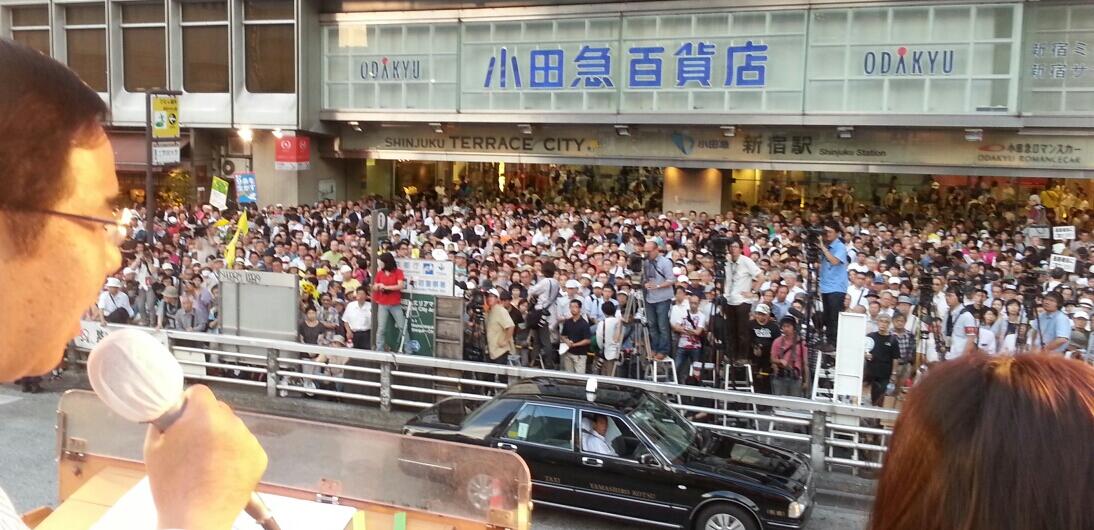
The crowd for the existing, mainstream parties (LDP, DPJ, Komei) did seem low during the election campaign. So much so that to sum up the election coverage, Kyodo News used the aerial photo of a large crowd outside the Shinjuku Station in Tokyo without naming the campaigner. The Kyodo article was mostly about LDP and Abe's promise. You would think the crowd was Abe's crowd.

Well, the photo turned out to be not LDP, DPJ, Komei, or Boy-wonder's dwindling party, but Japanese Communist Party.

From the tweet of JCP Chairman Kazuo Shii, who says 3,500 people stopped to listen to his party's last appeal:


There were many on Kyodo's site and on Twitter claiming it was the crowd for Taro Yamamoto. I retweeted one of such tweets, then my eyes got fixated with the three characters (小田急) in the upper left corner of the Kyodo photo. That's Odakyu Department Store, and that means the exit is Shinjuku West. After quick search I noticed that could only be JPC, and it was.

Asahi had this aerial photo of an even bigger crowd in Shibuya. Whose campaign was this? Taro Yamamoto and Yohei Miyake. But following Kyodo, Asahi didn't bother telling the readers whose campaign it was that attracted what Professor Yukio Hayakawa described as 10,000-strong crowd (Professor Hayakawa was right there in the crowd, according to his own tweet, and he says there were more people across the street):

(Image of Asahi Shinbun paper, from Professor Hayakawa's tweet)

Owly Images

Thursday, July 18, 2013

Yohei Miyake Energizes Young (and Young at Heart) Voters for a Seat in Japan's Upper House


34-year-old Yohei Miyake is an highly popular and acclaimed reggae-rock musician in Japan. He's running for a seat in the Upper House of the National Diet for the Green party in the proportional representation part of the election.

Along with Taro Yamamoto, who is running from Tokyo, Miyake seems to be winning young voters and not-so-young voters who have never bothered with elections with the message he delivers with his guitar.

He speaks as he plays guitar, and occasionally breaks into singing - in the centuries-old Japanese tradition of emotive story-telling with a string instrument.

I've heard about him, but I never bothered to view his election appearances until one of my Twitter followers sent me a video with English subtitle. (Like, just now.)

I was shocked to see a nice-looking man who looks to have actually grown into adulthood, instead of simply getting old with the wrinkled face of an elementary school boy (like so many of politicians and so many of so-called elite bureaucrats and corporate executives in Japan).

I was shocked again when I saw a huge audience at the end of the video. You don't see that kind of crowd at campaign speeches by established parties.

From Miyake's appearance in Kichijoji, Tokyo on the first day of the election campaign on July 4, 2013, with English subtitle:


The large crowd doesn't necessarily translate into votes, but I sense the audience is feeling empowered by him, which is rare in Japan.

His official slogan at his official site says, "Turn all weapons into musical instruments." Being a musician myself, I'm all for that. I do not agree with many of his policies, but that doesn't really matter.

(In fact, I quite disagree with some of his policies, particularly one about consumption tax. He proposes tax on financial assets instead of consumption tax. That's Cyprus, and that's unfair double-taxation on people who saved their earnings post-tax, just because these people have bank accounts and investment accounts that are big enough for the government to plunder. I don't know what rate he is thinking of.)

Official blog (Japanese only): http://ameblo.jp/miyake-yohei/

Twitter: https://twitter.com/MIYAKE_YOHEI

Like Yamamoto's, Miyake's campaign organization is made up of all volunteers.

Wednesday, July 10, 2013

Japanese Upper House Election: PM Abe "I'm Healthy Because I Eat Fukushima Rice, and LDP/Komei Stable Majority Will Result in Proud Japan"


After re-reading what Mr. Masao Yoshida said last year and thinking about what he and his men had to go through at Fukushima I Nuclear Power Plant after March 11, 2011, it is almost revolting to relate to you what the current prime minister of Japan is saying to win the election for the LDP candidates.

Prime Minister Abe, whose party is set to win a landslide in the coming Upper House election (on July 21), has been going all over Japan to give campaign speeches for LDP candidates, probably inhaling oxygen regularly.

Unlike a handful of candidates that I've listened to (Taro Yamamoto, for one), Abe's speeches are totally devoid of meaning but sprinkled with sound bytes like "recovery" "strong" "proud" that he utters with his high-pitched voice, no doubt aimed at making people look longingly over the horizon for the better, brighter, and fuzzy future for the nation of the rising sun. (Never mind the dog shit at their feet, and it is the nation of the setting sun seen from the US...)

Here are two gems from the recent Abe's utterance.

First, from his July 4 appearance in Iwaki City in Fukushima Prefecture in support of LDP's Masako Mori, the minister in charge of consumer affairs and increasing the number of children in Japan who has declared all-out war to eradicate "baseless rumors" to help farmers in Fukushima Prefecture by forcing retailers to carry Fukushima produce. She is from Fukushima Prefecture, naturally.

Video from Merx.me:


At about 7 minutes into the boring speech:

課題があります。それは風評被害です。
残念ながらまだ風評被害があって、オイシイ、オイシイ、福島の農産品、値段が低い、あるいはなかなか売れない、世界でもまだ日本からの福島県産の輸入を認めてもらえない。これを変えていく。

We have something we should deal with. And that's baseless rumors. There are baseless rumors, unfortunately, and delicious Fukushima produce can only get low prices or it is hard to sell them. Countries still do not allow import of Fukushima produce from Japan. We will change that.


At about 11 minutes:

今日、私は、こうやって元気いっぱいお話をさせていただいています。何故、私が、こんなに元気かといえば、実は毎日、お昼、官邸で福島産のお米を食べているからであります。

首脳会談をやるたびに、私は、相手の首脳にいってるんです。私は福島産のお米を食べているんですよ。そういっています。
しっかりと風評被害を払しょくして、インフラを加速化して、福島の復興、全力でとりくんでいきます。

そして、何よりも、福島の子供たちの健康を森さんとともに断じて守っていく、このこともお約束申し上げるしだいであります。

Today, I am speaking to you full of vigor and health. Why am I so full of vigor and health? To tell you the truth, it's because I eat rice from Fukushima at my official residence everyday for lunch.

When I meet foreign leaders at summit meetings, I tell them, "I am eating rice from Fukushima". I am saying that.

I will eradicate baseless rumors completely, accelerate [the buildup of] infrastructure, and do my best for the recovery of Fukushima. And above all, I will protect the health of children in Fukushima at all cost, together with Ms. Mori. And that is my promise.


(Well, is it any wonder that foreign leaders seem to avoid Mr. Abe at all cost?)

Then on July 8 in Narashino City in Chiba Prefecture, Mr. Abe equates the LDP majority in the Upper House (and the coalition majority already in the Lower Hosue) to "proud Japan", one of his buzz words he thinks will inspire the Japanese.

From Yomiuri Shinbun (7/9/2013):

安定多数によって、誇りある日本をつくっていく

I will win the "stable majority" and create a proud Japan


So, winning the stable majority by LDP and Komei will make Japan proud. Such nonsense, such light-weight.

"Stable majority" means LDP and Komei Party win enough seats in the coming election (half of Upper House is up for election, 122 seats) so that their overall seats are 129. A simple majority is 123. Winning the stable majority in the Upper House means the ruling coalition will rule more than half of the 17 standing committees. LDP/Komei is expected to easily pass 123 seats. Currently the two parties hold 102 seats (LDP 83, Komei 19).

An Asahi Shinbun's China correspondent sadly observed in a recent ASEAN meeting in Brunei that Japan was becoming irrelevant to the world politicians, as he related the Chinese foreign minister having a casual and friendly chat with the US NSC Asia Division director, with both speaking in fluent Japanese. Japanese foreign minister didn't talk to anyone other than at official meetings, and no one sought him out for a chat or any kind of informal talk. Japanese foreign minister couldn't even talk to the US counterpart, Secretary John Kerry.

I guess they don't want to hear about baseless rumors and Fukushima rice.

For those Japanese citizens who are highly critical of secular Egyptians wanting none of the Islamic president (who seem to be the majority in Japan), citing "rule of law" and "democracy", when the LDP/Komei landslide happens in about 10 days, it will be their chance to follow their own advice and fully support LDP and Mr. Abe and their policies, to show the world how rule of law and democracy should work.

Japanese are in their own bubble, politicians and citizens alike, as not even the triple meltdown of nuclear reactors woke them up.

Saturday, July 6, 2013

Japanese Upper House Election: Taro Yamamoto Doesn't Need Teleprompter to Appeal to Voters


He knows his stuff forwards and backwards, it seems.


Taro Yamamoto, a 38-year-old actor turned activist turned aspiring politician, is in the race from Tokyo. He lost in the December 2012 Lower House Election against Shintaro Ishihara's son, but he managed to get more than 70,000 votes which was very significant in that particular district in Tokyo.

He relies only on volunteers for his election campaign, and from Day 1 they have been out on the streets. Yamamoto is running as independent. It's a tough race in Tokyo, with 20 candidates vying for 5 slots and LDP expected to win 2.

I think he originally planned to run as a nation-wide candidate in the proportional representation part of the election, but somehow that fell apart. I think it had to do with him not part of an established party.

It will be a blast if Yamamoto wins...

From his website, here are his three simple core policies and election promises:

1. No one will be exposed to radiation.
2. No Transpacific Partnership (TPP)
3. No one will go hungry.


He is about the only one candidate I know who has been speaking about the danger of radiation exposure from contaminated food and contaminated environment, and demanding government action to stop distribution and sales of contaminated food and goods (such as cement mixed with ashes that contain radioactive cesium).

For that alone, he has my support.

His website: http://imahahitori.com/
His Twitter: @yamamototaro0
His campaign live cast: http://twitcasting.tv/yamamototaro0

Friday, July 5, 2013

Japan Upper House Election Promises from Political Parties on Nuclear Power


The campaign is already in full swing. Half of Japan's Upper House - House of Councilors - will face election, where Liberal Democratic Party is already rumored to take as many as 73 seats of 122 that are being contested. Combined with 50 seats it already has, LDP could hold the majority in the Upper House, even without the coalition partner Komei Party.

With that wonderful prospect, let us turn to what the parties are promising in terms of nuclear power, 2 years and 4 months after the Fukushima I Nuclear Power Plant accident.

In these 2 years and 4 months, food contaminated with varying amounts of radioactive materials (now mostly cesium) continue to be grown and sold, people continue to live in the contaminated middle-third of Fukushima Prefecture and people there continue to grow food for the rest of the country, reduction of radiation contamination has been achieved not by decontamination work by the government and municipalities but by natural reduction through weathering.

In other words, not much has changed since the early days of the nuclear accident. The only difference is that reactors are no longer blowing up one after another at Fukushima I Nuke Plant.

Liberal Democratic Party (自民党)(Uggghhh the top page is a huge photo of Abe's face, with too much photoshopping....):

(page 5 of PDF)東京電力福島第一原発事故に関し、新しくかつ友好な除染・減容化技術の導入や中間貯蔵施設の整備等、除染の加速化に努めます。また、除染から廃炉までの道筋を明らかにし、国がより前面に立って具体的な事業展開を加速化します。また、風評被害対策にも万全を期します。

About the Fukushima I Nuclear Power Plant accident, we will try to accelerate decontamination by introducing new and effective decontamination and volume reduction technologies and by preparing the intermediate storage facilities [for contaminated soil, etc]. We will make clear the pathway from decontamination to decommissioning, and have the national government closer to the forefront in accelerating the business [of decontamination and decommissioning, I suppose]. We will do our best in countering baseless rumors.

(Note that it does not say "the national government will be at the forefront". It will be closer to the forefront than where it is now. Note also that they won't decontaminate. They will accelerate the work. Whatever that means.)

(page 9 of PDF) 原子力発電所の安全性については、原子力規制委員会の専門的判断に委ねます。その上で、国が責任を持って、安全と判断された原発の再稼動については、地方自治体の理解が得られるよう最大限の努力をいたします。

We will leave the safety of nuclear power plants to the expert judgment of the Nuclear Regulatory Authority. we will make our maximum effort to obtain the understanding (consent) of the restart from the local municipalities once the nuclear power plants are deemed safe, on the national government's responsibility.

(Hmmm. It looks as if the national government's responsibility is not about the safety of the nuke plants but about its max effort to obtain the local consent.)

Democratic Party of Japan:

(Well, beyond the first page with nice calligraphy, the PDF refuses to load on Firefox.)


Komei Party (公明党) (section headlines):

①福島を再生
②廃炉に向けたロードマップを策定
③安全管理を厳格に
④除染を加速

1. Revive Fukushima
2. Create a roadmap toward decommissioning
3. Stricter safety control
4. Accelerate decontamination

(In other words, nothing new. Komei Party doesn't seem to be aware that we already have a roadmap for decommissioning for nearly 2 years now.)


Japan Restoration Party (日本維新の会) (aka Boy-wonder's party on this blog):

エネルギー供給体制を賢く強くする

風力、バイオマス等の再生可能エネルギーの開発推進により、地方に雇用を創出する。
先進国を主導する脱原発依存体制を構築する。
原発政策のメカニズム・ルールを根本から見直し、より厳格なものとする。
~世界最高水準の安全基準を設定し、原子力の運営をより安全にさせる。
~廃炉への道筋を明確化する。
~原子力賠償関連法案を改正し、国と電力会社それぞれの責任関係を明確化する。
~使用済み核燃料サイクル、最終処分場の選定問題に早期に結論を出す。

"Smarter and stronger" energy supply system

Promote wind, biomass and other renewable energy to create jobs in local economies.
Go beyond the system that rely on nuclear power plants and lead advanced nations.
Fundamentally revise nuclear policy mechanisms and rules and make them stricter.
Set the world number one safety standards, and make operation of nuclear power safer.
Make the path to decommissioning clear.
Make the responsibility of the government and electric power companies clear by revising the laws regarding nuclear accident compensation.
Make decisions soon on spent fuel recycling and final disposal sites.


Japanese Communist Party (日本共産党) (headlines from the long page on nuclear policy):

原発のない日本に――無謀な原発の再稼働と輸出をやめ、即時「原発ゼロ」の政治決断を

Japan without nuclear power plant - stop the reckless restart of nuke plants and nuclear exports, make a political decision on "zero nuke plant" immediately

原発事故は「収束」どころか、危機的事態の真っただ中です 政府が再稼働のテコにしようとする「新基準」も、「破たん」しています

[Fukushima] nuclear accident hasn't "ended"; it is still in the middle of crisis. "New standards" that the government wants to use to restart nuke plants are already "broken". [JCP says an interesting thing - that Nuclear Regulatory Authority has stopped using the word "safety standards" and started using the word "regulatory standards", because it cannot guarantee safety.]

「原発のない日本へ――日本共産党の三つの提案」
日本共産党は、危険な再稼働をきっぱりとやめ、「即時原発ゼロ」への政治決断を行うことこそが、もっとも現実的で責任ある道と考え、次のように提案します。

"Three proposals from Japanese Communist Party toward nuclear-free Japan"
Japanese Communist Party thinks the most realistic and responsible way is to stop dangerous restart of nuclear power plants and to make a political decision on "zero nuke immediately", and proposes the following:

①「収束宣言」を撤回し、収束と廃炉、除染と賠償を、日本の英知を結集した国の一大事業として位置づけやりぬく
②原発再稼働の方針を撤回し、輸出政策を中止する
③「即時原発ゼロ」の政治決断をおこない、再生可能エネルギーの大幅導入へ抜本的に転換する

1. Withdraw "declaration of end of the accident", position ending the accident, decommissioning, decontamination, and compensation as a big national project that combines expertise and knowledge in Japan, and carry them through.
2. Withdraw policy of restarting nuclear power plants, halt nuclear exports.
3. Make a political decision to stop nuke plants immediately, and make a fundamental shift toward rapidly introducing renewable energy. [This includes shutting down Monju fast breeder and Rokkasho fuel recycling plant.]


People's Life Party (生活の党):

◆いのち:脱原発こそ成長戦略
○最新型火力発電と太陽光、風力、バイオマス、メタンハイドレートなどの新エネルギーを急ピッチで促進します。
○原発立地地域では廃炉ビジネスと新エネルギーを推進し、脱原発によって地域経済の発展と雇用を拡大します。

Life: Beyond nuclear is the growth strategy
We will rapidly promote latest thermal power generation and new energy such as solar, wind, biomass, methane hydrate.
In the areas that have nuclear power plant, we will promote the growth of local economy and local employment by going beyond nuclear, promoting decommissioning businesses and new energy.


LDP, DPJ, Japan Restoration Party have their campaign promises in PDF files. That's silly.

The sneakiest wording award goes to LDP, and the devoid of meaning award goes to Komei, with Boy-wonder's party close second.

Boy-wonder's party's election promises read like a textbook for elementary school kids. Everything is about making something "smarter and stronger" (their slogan). It sounds just plain silly. And their drivels about nuclear power and energy are, drivels.

I think I like Japanese Communist Party the best, though I personally disagree with decontamination (I don't think decontamination is feasible) and renewable energy.

I don't think much of Ichiro Ozawa's party (People's Life Party)'s policy. Using decommissioning work as economic growth strategy? How can you grow economy and feel good about it by exposing the workers to added radiation from decommissioning nuclear power plants? Decommissioning is what one needs to do, whether that makes money or not.

By the way, One of the reasons why Nuclear Regulatory Authority decided to start implementing the new regulatory safety standards on July 8, instead of later this month as originally planned, is rather obvious. By doing it on July 8, in the middle of the heated campaign, no one will pay attention.

I suppose the Japanese will practice what they preach to others (like secular Egyptians who demonstrated against "democratically elected" President Morsi) and support the overwhelmingly and "democratically elected" government of Liberal Democratic Party and its policies.

Monday, August 31, 2009

Japan's Democratic Party Already Feels Like the U.S. Democratic Party

under President Obama.

The Democratic Party of Japan, or DPJ, won 308 seats out of 480 in the powerful Lower House in the August 30 election. A landslide bigger than anticipated, it is indeed a historic event. The Liberal Democratic Party, or LDP, who held the grip on the Japanese politics since the end of World War II, has only itself to blame for the crushing defeat. DPJ, whose leadership is mostly made up of ex-LDP members, is understandably ecstatic.

However, what is rapidly emerging in post-election political scene in Japan should be disturbing to the proponents of free market economy and of smaller government.

DPJ won in a landslide, and in their euphoria they may think they have the mandate. However, I suspect many of the DPJ votes were the votes against LDP, similar to the 2008 U.S. election where many voters voted against George Bush.

About the very first thing that the DPJ leadership announced after the election was the creation of the National Strategy Bureau (Kokka Senryaku Kyoku 国家戦略局), which will be placed in the Cabinet and under the direct control of the Prime Minister. The head of the Bureau will have the same power as a Cabinet Minister. The Bureau will be in charge of deciding on "important national strategies and policies" including budget, which has long been the domain of the bureaucrats in the government ministries. 30 people will be appointed to this Bureau, and they will include politicians, experts from private sector and bureaucrats (a token gesture). The Bureau will be created initially by a Cabinet Order, which only requires the approval by the Cabinet, two signatures (of the Minister in charge and of the Prime Minister) to become a law.

Can you feel, see, smell the Obama administration here? DPJ seems intent on creating the equivalent of Obama's "czar" system, except the Japanese version will be created with the equivalent of the U.S.'s executive order.

The very name of the "National Strategy Bureau" sounds oddly dictatorial, coming from a party that is supposed to be left of center.

With the creation of the National Stretegy Bureau, DPJ makes it clear that the important policies, even down to the details, will be led by politicians, not bureaucrats. As if these career politicians, often 2nd or 3rd generation, more often than not from well-connected, wealthy families, actually know what to do. For good or bad, Japan has functioned because of the career bureaucrats who know how the system really works, without the meddling from the bumbling politicians. Now DPJ proposes to create an organization that sits on top of the sprawling bureaucracy to impose the DPJ leaders' vision.

Yukio Hatoyama, ex-LDP leader of DPJ who is himself a 4th-generation politician from a prominent family that has produced a Speaker of the Lower House, a Prime Minister, and a Foreign Minister in the past 120 years, is positioning himself as a champion (for the mass, I suppose) to battle the entrenched bureaucracy. Good luck with that.

Another DPJ leader, Naoto Kan, declared that DPJ may nullify the budget proposals that were coming up from the ministries (deadline for submission was 8/31) and that the new administration under DPJ may create the budget from scratch through this Bureau of National Strategy.

Their party's stated policies read like those of the Obama administration. A few examples:

Global warming:

  • Create "cap and trade" carbon exchange market
  • Create new tax to combat global warming

Finance:

  • Comprehensive, structural reform to protect investors

Crisis management:

  • Create a new agency to manage crisis, natural and man-made (terrorism, cyber-attack), under the control of the Cabinet

Community renewal:

  • Modify tax law to benefit non-profit organizations

So it even has policies for "community". (I have a feeling that they don't know what "community" means these days in the U.S.)

Stanford-educated Yukio Hatoyama, who is slated to become the Prime Minister in the new administration, is also a proponent of giving a voting right to foreigners who live in Japan; he also wants to make Japan more "liveable" for foreigners.

These all suggest to me that the fear in the U.S. that Japan will distance herself from the U.S. in policies is overblown. After all, the leadership of DPJ is made up of ex-LDP members. Even on the defence and foreign policy front, I don't see much difference from the previous administration. On the contrary, the Obama administration should be comforted that at least one U.S. ally is very closely following his footsteps. He may regret, though, having appointed a virtual nobody to the position of ambassadorship to Japan.

(Links, except the last one, are in Japanese.)