Thursday, December 26, 2013

15-Nation Study on Low Dose Radiation Cancer Risks for Nuclear Workers May Have Been Skewed by Canadian Data


Particularly after the Fukushima nuclear accident, one of the often cited pieces of evidence that even the low dose radiation exposure (less than 100 millisieverts) can increase the risk of (solid) cancer is the study published in 2005 of more than 400,000 nuclear workers in 15 countries.

In looking for the study, I found instead an editorial in British Journal of Cancer (11/14/2013) that suggests the seminal 2005 study of nuclear workers may have been flawed due to the Canadian data that significantly skewed the result because of 3,088 Atomic Energy of Canada Limited workers who were employed between 1956 and 1964 and whose dose information may be incomplete.

For what it's worth. (Emphasis is mine.)

Nuclear worker studies: promise and pitfalls


R Wakeford1
 

1Centre for Occupational and Environmental Health, Institute of Population Health, The University of Manchester, Ellen Wilkinson Building, Oxford Road, Manchester M13 9PL, UK

Correspondence: Professor R Wakeford, E-mail: Richard.Wakeford@manchester.ac.uk

The publication in this issue of BJC of the findings of an updated study of Canadian nuclear industry workers by Zablotska et al (2013) invites enquiry into the background of this and similar studies. Nearly 40 years ago, the Royal Commission on Environmental Pollution (1976) opined that it would be desirable to conduct epidemiological studies of nuclear workers to directly assess risks to health from protracted occupational exposure to ionising radiation, to test the appropriateness of the assumptions made in setting radiation protection standards based largely on the experience of the acutely exposed Japanese survivors of the atomic bombings of Hiroshima and Nagasaki. The next year, the study by Mancuso et al (1977) on nuclear workers at Hanford, WA, appeared to show that cancer risks among these workers were greater than expected; the methodology of this study was heavily criticised (Hutchison et al, 1979), but it received much publicity.
 

In the United Kingdom, the National Registry for Radiation Workers (NRRW) was established in 1976 (Kendall et al, 1992), and nuclear worker studies were initiated in other countries, notably the United States of America (Gilbert et al, 1989) and Canada (Gribbin et al, 1993). However, it was recognised that international collaboration was highly desirable to increase the statistical power of the worker studies, and in 1988 the International Agency for Research on Cancer (IARC) agreed to coordinate such a collaboration, the first fruits of which appeared in 1995 and involved three countries and seven groups of workers, three from the United States of America (including Hanford), three from the United Kingdom (including Sellafield) and one from Canada (the workers of Atomic Energy of Canada Limited, AECL) (Cardis et al, 1995). The combined data showed a positive association between the risk of mortality from leukaemia (excluding chronic lymphocytic leukaemia, CLL) and the cumulative recorded dose of radiation from external sources, which was of marginal statistical significance, and a (non-significantly) negative association for the risk of all other cancers combined, results that were compatible with conventional risk estimates (Cardis et al, 1995). For AECL workers, the estimates of the excess relative risk (ERR) per sievert were as follows: leukaemia excluding CLL (5 deaths), 48.40 (95% confidence interval (CI): 2.8, >100); all other cancers (324 deaths), 0.13 (95% CI: <0, 2.1) (Cardis et al, 1995).
 

The IARC-coordinated collaborative study was later extended to 15 countries, and the first report from this study was published in 2005 (Cardis et al, 2005). Although the trend of risk with cumulative external dose was positive for mortality from leukaemia excluding CLL, somewhat surprisingly given the findings of the three-country study it was not statistically significant; but the association with dose for all other cancers was both positive and significant – the ERR/Sv was 0.97 (95% CI: 0.14, 1.97). Moreover, the risk estimate for the group of all other cancers was only just compatible with the prediction of standard risk models, leading to controversial suggestions that the risk of cancer resulting from protracted exposure to radiation in the workplace has been underestimated.
 

The interpretation of the 15-country study was not, however, straightforward, and one aspect of the findings that troubled both me (Wakeford, 2005, 2009a) and others (United Nations Scientific Committee on the Effects of Atomic Radiation, 2008; Boice, 2010) was the surprisingly large influence of the Canadian workers on the risk estimate for all other cancers – although the Canadian workers contributed around 4% of the deaths, the exclusion of these workers caused a ~40% reduction in the risk estimate (Wakeford, 2005). In fact, the ERR/Sv for the Canadian workers, 6.65 (90% CI: 2.56, 13.0), was notably and significantly larger than the ERR/Sv estimate for the combined workers from the other 14 countries, 0.58 (90% CI: −0.10, 1.39) (Cardis et al, 2007). Of course, this does not mean that the Canadian data are necessarily wrong, but scrutiny of previous findings of studies of Canadian workers, including the three-country study (Cardis et al, 1995), reveals an apparent upward step-change in risk estimates for the group of all other cancers that coincides with the start of the use of Canadian National Dose Registry (NDR) data in the analyses (Wakeford, 2009a).
 

Ashmore et al (2010) examined the NDR data for the AECL workers, the group of workers who seemed to be the primary reason for the upward change in the Canadian risk estimates. They identified a number of possible deficiencies in the AECL worker data used in the 15-country study, in particular those relating to the data before 1971. They called for a thorough examination of the Canadian worker data, and if appropriate, a new analysis of Canadian worker risks based on revised NDR data.


The Canadian worker data contributing to the 15-country study were those used in the study of Zablotska et al (2004) of workers from AECL and three Canadian electricity-generating companies. Now, Zablotska et al (2013) report the findings of an updated study of 45656 Canadian nuclear industry workers, following a detailed check of dosimetry and employment records, which resulted in a number of changes in the AECL data in the NDR. These revisions led to a reduction in the ERR/Sv for mortality from all solid cancers from 2.80 (95% CI: −0.04, 7.13) to 1.77 (95% CI: −0.42, 5.30), the latter risk estimate being driven by the AECL workers, 3.25 (95% CI: 0.11, 8.85). However, also revealed was a notable difference in the solid cancers ERR/Sv for 3088 (19%) of the AECL workers first employed during 1956–1964, 7.87 (95% CI: 1.88, 19.5), and those first employed after 1964, −1.03 (95% CI: <−1.66, 5.76). Zablotska et al (2013) conclude that the finding for the early AECL workers is likely to be due to remaining data inaccuracies, probably missing dose information, rather than a real effect of radiation exposure, and they believe that use of the pre-1965 AECL worker data cannot be justified until further investigation is undertaken.
 

So, it would appear that the most reliable results from the 15-country study are for the combined 14 countries excluding Canada, which are not exceptional (see above). For Canada, Zablotska et al (2013) propose that until the findings of further investigations of the AECL data are available, the ERR/Sv estimates should be taken to be those using the post-1964 AECL worker data combined with the data for the workers of the three generating companies: leukaemia excluding CLL (12 deaths), 14.4 (95% CI: <−1.49, 146), and all other cancers (347 deaths), −1.36 (95% CI: <−1.47, 1.98).
 

Zablotska et al (2013) have indicated that it is intended to further investigate the data for pre-1965 AECL workers with the intention of eventually including them in future studies. Hopefully, this investigation will prove fruitful as the earlier studies of all AECL workers based on an AECL dosimetry database rather than the NDR suggested that these early workers could contribute valuable data – for example, it was pointed out above that a statistically significant positive trend with dose for mortality from leukaemia excluding CLL, was previously reported for all AECL workers (Cardis et al, 1995). It is generally the case that early nuclear workers will have accumulated larger radiation doses than later workers, not only because they have worked longer, but also and importantly because doses received in the early years of the industry were greater (sometimes much greater) than those received in recent years. Consequently, the inclusion of such early workers will considerably improve statistical power, and this is especially the case for workforces in countries with nuclear programmes starting in the 1940s and 1950s, such as Canada. By way of illustration, the recently published third analysis of the NRRW included greater than 10000 workers with cumulative external radiation doses exceeding 100mSv (i.e., moderate doses), but at the time of the analysis only about one-quarter of these workers had died (Muirhead et al, 2009), suggesting that substantial information is still to come.
 

Studies on radiation workers have the potential to provide valuable evidence on the risks from protracted exposure to low-level radiation. International collaboration remains the obvious way of extracting as much information out of the available data as possible, and these collaborations should certainly continue (Wakeford, 2009b), but the difficulties in conducting such studies and interpreting the results should not be underestimated. The latest Canadian worker study by Zablotska et al (2013) illustrates the care that must be exercised in collating worker data, and the problems that can arise, especially when using data that may have been collected for purposes other than epidemiology.

Top

References
  1. Ashmore JP, Gentner NE, Osborne RV (2010) Incomplete data on the Canadian cohort may have affected the results of the study by the International Agency for Research on Cancer on the radiogenic cancer risk among nuclear industry workers in 15 countries. J Radiol Prot 30: 121–129. | Article | PubMed |
  2. Boice JD (2010) Uncertainties in studies of low statistical power. J Radiol Prot 30: 115–120. | Article | PubMed |
  3. Cardis E, Gilbert ES, Carpenter L, Howe G, Kato I, Armstrong BK, Beral V, Cowper G, Douglas A, Fix J, Fry SA, Kaldor J, Lavé C, Salmon L, Smith PG, Voelz GL, Wiggs LD (1995) Effects of low doses and low dose rates of external ionizing radiation: cancer mortality among nuclear industry workers in three countries. Radiat Res 142: 117–132. | Article | PubMed | ISI | CAS |
  4. Cardis E, Vrijheid M, Blettner M, Gilbert E, Hakama M, Hill C, Howe G, Kaldor J, Muirhead CR, Schubauer-Berigan M, Yoshimura T, Bermann F, Cowper G, Fix J, Hacker C, Heinmiller B, Marshall M, Thierry-Chef I, Utterback D, YO Ahn, Amoros E, Ashmore P, Auvinen A, Bae JM, Solano JB, Biau A, Combalot E, Deboodt P, Diez Sacristan A, Eklof M, Engels H, Engholm G, Gulis G, Habib R, Holan K, Hyvonen H, Kerekes A, Kurtinaitis J, Malker H, Martuzzi M, Mastauskas A, Monnet A, Moser M, Pearce MS, Richardson DB, Rodriguez-Artalejo F, Rogel A, Tardy H, Telle-Lamberton M, Turai I, Usel M, Veress K (2005) Risk of cancer after low doses of ionising radiation: retrospective cohort study in 15 countries. Br Med J 331: 77. | Article |
  5. Cardis E, Vrijheid M, Blettner M, Gilbert E, Hakama M, Hill C, Howe G, Kaldor J, Muirhead CR, Schubauer-Berigan M, Yoshimura T, Bermann F, Cowper G, Fix J, Hacker C, Heinmiller B, Marshall M, Thierry-Chef I, Utterback D, Ahn YO, Amoros E, Ashmore P, Auvinen A, Bae JM, Bernar J, Biau A, Combalot E, Deboodt P, Diez Sacristan A, Eklöf M, Engels H, Engholm G, Gulis G, Habib RR, Holan K, Hyvonen H, Kerekes A, Kurtinaitis J, Malker H, Martuzzi M, Mastauskas A, Monnet A, Moser M, Pearce MS, Richardson DB, Rodriguez-Artalejo F, Rogel A, Tardy H, Telle-Lamberton M, Turai I, Usel M, Veress K (2007) The 15-Country Collaborative Study of Cancer Risk among Radiation Workers in the nuclear industry: estimates of radiation-related cancer risks. Radiat Res 167: 396–416. | Article | PubMed | ISI | CAS |
  6. Gilbert ES, Fry SA, Wiggs LD, Voelz GL, Cragle DL, Petersen GR (1989) Analyses of combined mortality data on workers at the Hanford Site, Oak Ridge National Laboratory, and Rocky Flats Nuclear Weapons Plant. Radiat Res 120: 19–35. | Article | PubMed |
  7. Gribbin MA, Weeks JL, Howe GR (1993) Cancer mortality (1956-1985) among male employees of Atomic Energy of Canada Limited with respect to occupational exposure to external low-linear-energy-transfer ionizing radiation. Radiat Res 133: 375–380. | Article | PubMed |
  8. Hutchison GB, MacMahon B, Jablon S, Land CE (1979) Review of report by Mancuso, Stewart and Kneale of radiation exposure of Hanford workers. Health Phys 37: 207–220. | Article | PubMed |
  9. Kendall GM, Muirhead CR, MacGibbon BH, O'Hagan JA, Conquest AJ, Goodill AA, Butland BK, Fell TP, Jackson DA, Webb MA, Haylock RGE, Thomas JM, Silk TJ (1992) Mortality and occupational exposure to radiation: first analysis of the National Registry for Radiation Workers. Br Med J 304: 220–225. | Article | CAS |
  10. Mancuso TF, Stewart A, Kneale G (1977) Radiation exposures of Hanford workers dying from cancer and other causes. Health Phys 33: 369–385. | Article | PubMed |
  11. Muirhead CR, O'Hagan JA, Haylock RG, Phillipson MA, Willcock T, Berridge GL, Zhang W (2009) Mortality and cancer incidence following occupational radiation exposure: third analysis of the National Registry for Radiation Workers. Br J Cancer 100: 206–212. | Article | PubMed |
  12. Royal Commission on Environmental Pollution (Chairman: Sir Brian Flowers) (1976) Sixth Report. Nuclear Power and the Environment. Her Majesty’s Stationery Office: London.
  13. United Nations Scientific Committee on the Effects of Atomic Radiation (2008) Effects of Ionizing Radiation. Volume I: UNSCEAR 2006 Report to the General Assembly, with Scientific Annexes. Annex A: Epidemiological Studies of Radiation and Cancer pp 13–322. United Nations: New York.
  14. Wakeford R (2005) Cancer risk among nuclear workers. J Radiol Prot 25: 225–228. | Article | PubMed |
  15. Wakeford R (2009a) Radiation in the workplace-a review of studies of the risks of occupational exposure to ionising radiation. J Radiol Prot 29: A61–A79. | Article | PubMed |
  16. Wakeford R (2009b) More on the risk of cancer among nuclear workers. J Radiol Prot 29: 1–4. | Article |
  17. Zablotska LB, Ashmore JP, Howe GR (2004) Analysis of mortality among Canadian nuclear power industry workers after chronic low-dose exposure to ionizing radiation. Radiat Res 161: 633–641. | Article | PubMed |
  18. Zablotska LB, Lane RSD, Thompson PA (2013) A reanalysis of cancer mortality in Canadian nuclear workers (1957–1994) based on revised exposure and cohort data Br J Cancer e-pub ahead of print 14 November 2013; doi:10.1038/bjc.2013.592. | Article |

The 2005 study is part of the BEIR VII report (2006) as Appendix E.

From the 2005 report (Risk of cancer after low doses of ionising radiation: retrospective cohort study in 15 countries):

Fig 1 Distribution of cumulative radiation doses among workers included in the analyses


Fig 2 Excess relative risks per Sv for all cancer excluding leukaemia in cohorts with more than 100 deaths (NPP=nuclear power plants, ORNL=Oak Ridge National Laboratory)


The Canadian Nuclear Safety Commission (CNSC) issued a report in June 2011 after they scrutinized the Canadian data.

From the executive summary of the CNSC report (emphasis is mine):

Reanalysis Main Findings

The main findings and recommendations from this reanalysis are:
• Approximately 42,200 NEWs [nuclear energy workers] from Hydro-Québec, New Brunswick Power Corporation, Ontario
Hydro, and Atomic Energy of Canada limited (AECl), first employed since 1965, had no increase in
risk of solid cancer mortality in relation to radiation exposure.
A group of 3,088 AECl NEWs first employed before 1965 (1956-1964) was the only group of workers
with a consistent radiation-associated increase in risk of solid cancer mortality.
The risk estimate was
statistically significant and was nine times higher than the risk estimates for workers with zero dose.
This group of AECl NEWs had a profound impact on the Canadian and 15-country study findings.
It is very likely that these early AECl NEWs have incomplete dose information (i.e., their doses are
under-reported).
Despite this apparent increase in cancer risk among early AECl NEWs, a comparison using the
Canadian Mortality Database showed statistically significant lower rates of all causes of death and
cancer mortality for this group than for the general Canadian population
. This fact reinforces CNSC
concerns that there remains a data problem as opposed to a true increase in their risk of solid cancer
mortality
.
• Further investigation of this group of early AECl NEWs is necessary to ensure the accuracy and
completeness of radiation dose records in the National Dose Registry (NDR).

Conclusions and Path Forward

• The CNSC’s reanalysis confirms that there is no increased cancer risk among any Canadian nuclear
power plant workers for any time period or for AECl NEWs first employed since 1965.
• While the data suggests an increased solid cancer mortality risk for AECl NEWs first employed
before 1965 (1956-1964), a comparison using the Canadian Mortality Database shows lower rates of
all causes of death and cancer mortality for this group than for the general Canadian population.
The CNSC does not have confidence in the historical AECl dose data (1956-1964). The apparent
increase in the risk of solid cancer mortality for these early AECl NEWs deserves further
investigation
.
• The CNSC, Health Canada and AECl are further assessing the dose data of early AECl NEWs to
resolve the existing outstanding issues. Health Canada has agreed not to share the Canadian cohort
for any further epidemiological research until the quality of the data file has been confirmed.


Effort, often systematic, to underestimate radiation exposure of the Fukushima I NPP workers would mean the dose data of the workers cannot be used in epidemiological studies in the future.

Wednesday, December 25, 2013

(UPDATED with US Embassy Statement) Japan's Prime Minister Goes to Yasukuni Shrine, Defying the Stern Warning from the US Administration, Says a Japanese TV Station


In the morning of December 26, Prime Minister Shinzo Abe went to Yasukuni Shrine where the war-dead, including those found guilty by the Tokyo tribunal and executed after the World War II, are enshrined.

Nikkei Shinbun says Abe's decision was in part based on the urging from the politicians from LDP's conservative wing (Mr. Abe's base) who concluded that it was impossible to placate China no matter what, as China unilaterally declared the air defense identification zone (ADIZ) over Senkaku Islands.

Then, FNN (Fuji News Network), one of Japanese TV network, reports (12/26/2013) that Abe's visit was in defiance of the strong US objection:

安倍首相靖国参拝 アメリカ側は事前に「日米関係害する」と反対

Prime Minister Abe to visit Yasukuni Shrine, the US objected as "harming the US-Japan relationship"

安倍首相は、政権発足から1年を迎えた26日、東京・九段北の靖国神社を参拝する。11月、衛藤首相補佐官が、協議のためにアメリカを訪問した際に、参拝すれば「日米関係を害するだろう」などと、強く反対されていたことが、FNNの取材で明らかになった。

Prime Minister Abe visits Yasukuni Shrine in Kudan Kita in Tokyo on December 26, one year anniversary of his administration. FNN has found that the US strongly objected to the visit, telling prime minister's advisor Eto that the visit would "harm the US-Japan relationship" when Eto visited the US for consultation in November.

衛藤首相補佐官は、靖国参拝をめぐる意見交換のため、11月中旬に訪米し、ラッセル国務次官補など、アメリカの要人らと面会した。

Mr. Eto went to the US in mid November to meet with key officials including Assistant Secretary of State for East Asian and Pacific Affairs [Daniel] Russel over the prime minister's visit to Yasukuni.

この際、アメリカ側から、「オバマ大統領が理解を示すことはない」、「日本の評判を落とし、日本のアジアにおける影響力低下を招く」などと、厳しく反対されたという。

At that time, [FNN learned that] the US strongly opposed the visit, saying "President Obama will not be positive about it", "It will harm Japan's reputation, resulting in lessening the influence of Japan in Asia."

また、日韓関係のさらなる悪化への懸念のほか、中国に対しては、日本側が緊張をあおっていると主張するための口実を与えることになるため、結果的に、中国の立場を有利にするといった声も上がった。

There were worries that the visit would worsen the relationship with Korea. It would also give China an excuse to insist that Japan is causing the tension to rise, putting China in a better position.

TPP(環太平洋経済連携協定)や日米ガイドラインの見直しなど、重要課題を抱える日本が、アメリカの反対を押し切った形で参拝したことで、日米関係への影響が懸念される。

Since [PM Abe] visited the shrine despite the objection from the US, there are worries that this may negatively affect the US-Japan relationship even as Japan has important issues including TPP (Transpacific Partnership) and revising the guidelines [for defense cooperation] between Japan and the US.


When they visited Japan in October, US Defense Secretary Chuck Hagel and State Secretary John Kerry went to Chidorigafuchi instead, a strong hint that the US would expect the Abe administration to start de-emphasizing the controversial Yasukuni.

AFP has Abe's comment:

Tokyo (AFP) - Prime Minister Shinzo Abe said Thursday his visit to the controversial Yasukuni war shrine was a pledge that Japan would not go to war again and was not intended to hurt Chinese or South Koreans.

"I chose this day to report (to enshrined spirits) what we have done in the year since the administration launched and to pledge and determine that never again will people suffer in war," he told reporters at the shrine.

"I am aware that, because of misunderstandings, some people criticise a visit to Yasukuni shrine as an act of worshipping war criminals, but I made my visit to pledge to create an era where people will never suffer from catastrophe in war," Abe said.

"I have no intention at all to hurt the feelings of Chinese or South Korean people."

A Chinese foreign ministry official condemned his visit as "absolutely unacceptable to the Chinese people".


By the way, how many "war criminals" are enshrined in Yasukuni?

14, out of 2,466,532 war dead since the Boshin War (1868-69) that toppled the Tokugawa Shogunate and ushered in the Meiji era of imperial Japan supported by the winners of the war (Choshu, Satsuma).

Kyodo News reports that the US Embassy in Japan issued a statement saying the US is disappointed. There's nothing on the US Embassy website, but the tweet by the Embassy Press Office has a link to the statement:

December 26, 2013

Japan is a valued ally and friend. Nevertheless, the United States is disappointed that Japan's leadership has taken an action that will exacerbate tensions with Japan's neighbors.

The United States hopes that both Japan and its neighbors will find constructive ways to deal with sensitive issues from the past, to improve their relations, and to promote cooperation in advancing our shared goals of regional peace and stability.

We take note of the Prime Minister’s expression of remorse for the past and his reaffirmation of Japan's commitment to peace.


The US Embassy has the provisional Japanese translation of the statement, which seems, to me, overly harsh by selecting the particular ending pattern for the sentences.

(OT) Japan's Obsession with Humanoid Robot Goes Creepy


Some call it degrading to women, others call it a male fantasy. Either way, it is creepy. Mechanically, it makes absolutely zero sense.

Who is this entity that came up with this?

It is the Japanese Society for Artificial Intelligence, putting a new front cover for its academic journal:


The best-selling cleaning robot in Japan is a round disk from a US company that is not tethered and which doesn't carry a bloom (or a book):


Rumba's colleagues, albeit in a very different form, are still working hard at Fukushima I Nuclear Power Plant, sometimes alone, sometimes assisting other robots.

Most recently, a Packbot is assisting the decontamination robot "Raccoon" in decontaminating the floor surface of Reactor 2.

Tuesday, December 24, 2013

(OT) Merry Christmas


From Edward Snowden, via UK's Channel 4:


and from me, on the third Christmas since the March 11, 2011 accident,

Hallelujah Chorus, from "Messiah" by George Frederick Handel:

#Fukushima Reactor 4 Spent Fuel Pool: 132/1533 As of December 24, 2013


TEPCO has a new page that summarizes the operation of removing fuel assemblies from the Spent Fuel Pool of Reactor 4.

According to TEPCO, 132 fuel assemblies have been removed from the Reactor 4 Spent Fuel Pool into the Common Pool, out of total 1,533 assemblies.

(Nice color scheme... my favorite color combination.)


The tally is updated weekly (on Monday).

Since the removal started on November 18, people's interest in the work, which had been hyped as basically a "disaster that would end the world" if gone wrong by experts, particularly in North America, has dropped off significantly to an almost non-existent level. I don't see any reporting by the Japanese media, I don't even see tweets by people in Japan who were screaming the end of the world if TEPCO proceeded to remove the fuel assemblies from the "toppling" Reactor 4.

I guess they've moved on.

#Fukushima I NPP: Another Day, Another Leak (of 225 Tonnes, Maybe)


The huge storage tanks riveted together in haste at Fukushima I Nuclear Power Plant in mid 2011 to hold highly contaminated waste water after cesium absorption and reverse osmosis treatment continue to be a headache for TEPCO, though not a big one as in August this year when supposedly 300 tonnes of this waste water were suspected to have leaked from one such tank into the surrounding soil (for more, see posts on "RO waste water leak of August 2013").

Leaks found on December 21 and 22 was not the waste water but rainwater accumulated inside the concrete/steel plate barrier that surrounds the concrete pad on which these tanks stand.

How did 225 tonnes of rainwater contaminated with up to 440 Bq/L of strontium leak? From cracks in the concrete barrier and the concrete pad. Looking at the photos from TEPCO, I think I can almost tell which brand of sealants at neighborhood DIY stores that absolutely do not work as promised.

Well, let's just say TEPCO's ingenuity in emergency in April 2011 of using bath salts and saw dusts and shredded newspaper and baby diaper polymer to trace and stop the extremely radioactive water (with more than 1 Sievert/hour radiation) continues to this day.

The legal density limit for strontium in discharge water is 50 Bq/L, and TEPCO's internal standard is 10 Bq/L.

From TEPCO's photos and videos library, 12/22/2013:

Leak:


and solution (note the two-level metal barriers installed this year to prevent the overflow):

More solutions using waterproof sealant, from TEPCO's 12/24/2013 photos:

Sealant along the crack:


and sandbags:

and waterproof paint:

The Asahi article (12/24/2013) says strontium is most likely from the concrete surface. TEPCO says cesium was below detection level.

Still, I'm more optimistic about the plant these days compared to, say the first week of the accident in March 2011 when the reactor buildings were blowing up one after another with no power supply to the plant (which wasn't restored until April 4, 2011) and to the central control rooms to figure out what was going on.

Almost by sheer luck, the Spent Fuel Pool of Reactor 4 was "refilled" when the gate that separated the Spent Fuel Pool and the Reactor Well/DSP partially broke after the explosive event on March 15, 2011 that wrecked the operating floor; the water that was in the Reactor Well/DSP flooded the SFP, restoring the water level in the pool.

Despite numerous declarations and predictions by mostly overseas experts for the past two years, the Reactor 4 building is still standing, and from all measurements done so far, not even tilting or bulging or cracking beyond the design standard. (You are always free to exercise the freedom of speech and declare TEPCO is lying.)

Instead, the disaster that continues to unfold at Fukushima I Nuclear Power Plant has been of slow, whack-a-mole type since the initial explosions in March 2011. No scary enough headlines that would allow experts and bloggers to scream "disaster" and declare the world's end, but it is disheartening (partly because they seem so trivial and made worse by TEPCO's incompetence and lack of hands-on knowledge - or I should say lack of workers with hands-on knowledge and experience) nonetheless and demoralizing.

So much so that it almost makes one want an actual, huge disaster to happen at the plant.

Monday, December 23, 2013

Decontamination in #Fukushima Prefecture Is About Mowing and Delimbing


So says a flyer advertising the position, as tweeted by an independent journalist. Little more than general cleaning.

There is no mention of radiation or radioactive materials.

Looking for Decontamination Workers!!
Easy job of mostly mowing, delimbing, and removing the top soil.

Age: 18 to 60

Job locations:
1) Koriyama City, Nishigo-mura, and other locations in Fukushima Prefecture
2) Hamadori [ocean third of the prefecture];
3) Minamisoma City

Work hours: 8AM to 5PM, with breaks

Pay:
12,000 yen and up for locations in 1)
15,500 yen and up for 2), with dormitory
11,500 yen and up for 3)

Benefits: 5,000 to 25,500 yen

Possible to earn more than 300,000 yen per month. Call us now. Please bring your resume.


Minamisoma City is in Hamadori - ocean-third - too, but the pay is lower than in Nakadori - middle-third - where Koriyama City and Nishigo-mura are located. Hmmm.

Hamadori locations with dormitory must be inside the former evacuation zones, where the national government wants the evacuees to return, with a cash incentive of 900,000 yen (US$9,000) per person.

Note that, unlike workers hired by subcontractors 6 or 7th degree removed from the main contractors at Fukushima I Nuclear Power Plant, they will get benefits.

(OT) Japanese Government Gives 10,000 Cartridges for Rifles to South Korean Army Deployed in South Sudan, Citizens Cry Foul


(UPDATE 12/24/2013) Japan's opposition parties are accusing the Abe government of having given 10,000 cartridges to the Korean Army, in violation of Japan's arm export principle (that it does not export arms), according to Kyodo News (12/24/2013).

10,000 cartridges to fight the rebels? Good luck.

==========================

Japan's Self Defense Force is part of the UN peacekeeping operation (it's a Newspeak, now I think about it) in South Sudan, where the US government is sending the Marines.

The South Korean troops ran out of ammunition in the volatile country, and Japan's SDF is the only one who uses the same 5.56-millimeter rifles.

The Abe administration used the newly created National Security Council to rapidly approve the UN request, and from what comes to my Twitter, net citizens are very upset that Japan has broken the self-imposed ban of arms exports, though this is not strictly an "export".

From Jiji Press English (12/24/2013):

(Update 3) Japan Provides Ammunition to S. Korean PKO Force in S. Sudan

Tokyo, Dec. 23 (Jiji Press)--The Japanese government, in an unprecedented move Monday, provided rifle ammunition to South Korean troops participating in U.N. peacekeeping operations in South Sudan through the Unites Nations.

The decision to give for free the Japanese Ground Self-Defense Force's 10,000 cartridges for 5.56-millimeter rifles was made at emergency four- and nine-minister meetings of the Japanese National Security Council and given the round-robin cabinet go-ahead earlier in the day, in response to a joint request on Sunday from the South Korean peacekeeping force and the U.N. Mission in South Sudan, or UNMISS.

Among peacekeeping troops in South Sudan, only Japanese and South Korean peacekeepers use 5.56-millimeter rifles, government officials said, adding the ammunition assistance is an exception to Japan's rules effectively banning arms exports because it is a matter of "high urgency and humane concern."

On late Monday night, Chief Cabinet Secretary Yoshihide Suga issued a comment saying the ammunition supplies are not subject to the rules because the rounds will be used only to protect the South Korean peacekeepers and evacuees and their transfer to parties other than the UNMISS is strictly limited.

This is the first time for Japan to supply ammunition to a foreign force via the United Nations under the country's PKO cooperation law.


Tom Lehrer: Send the Marines


When someone makes a move
Of which we don't approve,
Who is it that always intervenes?
UN and OAS, they have their place I guess
But first, send the Marines!

We'll send them all we've got,
John Wayne and Randolph Scott.
Remember those exciting fighting scenes?
To the shores of Tripoli,
But not to Mississipoli,
What do we do?
We send the Marines!

For might makes right,
And till they've seen the light,
They've got to be protected,
All their rights respected,
Till somebody we like
Can be elected

Members of the corps,
All they hate the thought of war
They'd rather kill them all by peaceful means
Stop calling it aggression,
Ooo we hate that expression

We only want the world to know
That we support status quo
They love us everywhere we go,
So when in doubt,

Send the Marines!

(OT) 100th Birthday of the US Federal Reserve (or "Worst Legislative Crime of the Ages", according to Lindbergh)


So many unhappy returns...

The inflation calculator at a federal government's site (real "federal", not Federal Reserve "federal" which is the same as Federal Express; and real "government" as evidenced by the domain extension ".gov" instead of Federal Reserve banks' websites that end in ".org") shows the value of US dollar has dropped by 96% in 100 years since the Federal Reserve was created.

Quotes from Charles August Lindbergh Sr., the father of the famous aviator and who voted no to the Federal Reserve Act and later voted no to the US entry to the World War I:

"This [Federal Reserve Act] establishes the most gigantic trust on earth. When the President Woodrow Wilson signs this bill, the invisible government of the monetary power will be legalized....the worst legislative crime of the ages is perpetrated by this banking and currency bill."

"The Aldrich Plan is the Wall Street Plan. It means another panic, if necessary, to intimidate the people. Aldrich, paid by the government to represent the people, proposes a plan for the trusts instead."

"To cause high prices, all the Federal Reserve Board will do will be to lower the rediscount rate..., producing an expansion of credit and a rising stock market; then when ... business men are adjusted to these conditions, it can check ... prosperity in mid career by arbitrarily raising the rate of interest. It can cause the pendulum of a rising and falling market to swing gently back and forth by slight changes in the discount rate, or cause violent fluctuations by a greater rate variation and in either case it will possess inside information as to financial conditions and advance knowledge of the coming change, either up or down. This is the strangest, most dangerous advantage ever placed in the hands of a special privilege class by any Government that ever existed. The system is private, conducted for the sole purpose of obtaining the greatest possible profits from the use of other people's money. They know in advance when to create panics to their advantage, They also know when to stop panic. Inflation and deflation work equally well for them when they control finance."


Well, we'll see about their ability to "stop panic" going forward, after their balance sheet exceeds $4 trillion dollars.

Saturday, December 21, 2013

#Fukushima I NPP: Radioactive Cesium, All-Beta Detected from Groundwater Sample 25 Meters from the Ground Surface


The groundwater sample from the observation hole dug 25 meters from the ground surface in between the turbine buildings for Reactor 3 and Reactor 4 (No. H25J7) was found with:

  • Cesium-134: 1.6 Bq/Liter

  • Cesium-137: 2.8 Bq/L

  • All-beta: 67 Bq/L


after dirt particles were filtered out.

So far, radioactive materials (cesium, all-beta, tritium) have been detected from groundwater samples from the shallower, upper permeable layer. This is the first detection of radioactive materials from the groundwater below the level of the in-the-ground impermeable wall made of waterglass that is still being built closer to the plant harbor.

TEPCO says (handout for the press, 12/20/2013) they don't know whether that means:

  1. The lower permeable layer (25 meters from the ground surface) is contaminated; or

  2. Radioactive materials entered the groundwater when the observation hole was dug; or

  3. The water from the upper permeable layer somehow entered the lower permeable layer; or

  4. The water got contaminated when it was being sampled.


The handout shows the particular location (observation hole No. H25J7) to be close to the turbine buildings of Reactor 3 and Reactor 4:


As far as I'm aware, it is only TV Asahi who covered this news on December 20:


Japanese net citizens on Twitter and message boards who heard about the news (it doesn't look to be many) are all doom and gloom, having already come to the conclusion that the lower permeable layer is contaminated (TEPCO's hypothesis No.1).

Friday, December 20, 2013

Japan's PM Abe: "I Want Next Governor of Tokyo to Be A Young Woman"


Well, as if it would be his to decide. The gubernatorial election to be called early next year in Tokyo is a local election, albeit an important one if only because Tokyo is the most populous prefecture in Japan.

In case you haven't heard about it, Tokyo Governor Naoki Inose, who won the election in December last year with a landslide (he amassed the largest ever number of votes in the Tokyo gubernatorial election) and won the 2020 Olympic for Tokyo, suddenly found himself a target of the suddenly righteous press in Japan (who have all but stopped coverage of the State Secrecy Protection Law as soon as it passed the Upper House), and has been forced out of office.

Mr. Inose's sin? Having received a "huge", no-interest campaign loan (50 million yen, or 500,000 US dollars) from a hospital chain that provided campaign funds to a host of other national politicians, many of them in Liberal Democratic Party in the December 2012 Lower House election/local elections.

Mr. Inose did an extremely poor job of explaining away (he miserably failed), and for that small amount, as far as the politics go in Japan and which he claims he has returned, he resigned on December 19, 2013.

Is the righteous mainstream (national) media in Japan going after the national politicians in the ruling party?

Nope.

It's not that I think highly of Mr. Inose (I don't), but the way the mainstream media (particularly Asahi, who had a "scoop" - sure, sure) and LDP blew it out of proportion from a potential bribery case into a circus is highly suspicious. Now that Mr. Inose has resigned, all is well, the case closed, not just for Inose but most likely for any politician who received money from the hospital chain.

Mr. Inose's word says it all: "I was a politically naive amateur."

Prime Minister Shinzo Abe, on December 18 even before Governor Inose announced he would resign, was quoted as saying this on TV Tokyo:

自民党関係者によりますと、安倍総理は都知事候補について若い女性がいい」と周辺に話していたということです。

According to the source connected to LDP, Prime Minister Abe was telling his staff that the candidate for the Governor of Tokyo should be a young woman.


Young woman. Meaning someone (or a whole lot of them) like these, Abe's favorite, dressed in a school-uniform-like outfit (you are supposed to see them as high school girls)?


(My sincere condolence to the ASEAN ministers and their spouses who were subjected to this "entertainment" by PM Abe. If you were thinking about teaming up with Abe's Japan to counter the pressure from China, good luck.)

Oh by the way, the "candidates" (unofficial, undeclared for now) picked by a TV program (Asahi, I think) are beyond the pale for most Japanese net citizens:


Candidates with yellow background color are from the opposition, blue from LDP. They don't even look human, but four out of seven are girls. Not sure about "young".

Thursday, December 19, 2013

TEPCO to Set Up "Decommission Company" as a Separate Division Within TEPCO, National Government to Support TEPCO with 10 Trillion Yen


Details are to be announced By TEPCO's president Naomi Hirose at a press conference starting at 5PM, December 20, 2013, according to TEPCO's tweet.

"Decommission Company" is not going to be a separate company with separate capital but a company within TEPCO, more like a division. The idea was first floated in October this year at an LDP work group on recovery and reconstruction.

Now, why would they do that, instead of setting up a separate company? I have some ideas but they are not firm yet. I'll wait till I hear Mr. Hirose.

This "Decommission Company" will be in charge of decommissioning Fukushima I Nuclear Power Plant and dealing with contaminated water at the plant. Two disparate objectives it seems to me, but clearly not to LDP or TEPCO.

Reuters Japan reports (12/20/2013) that the national government will increase the amount of loan to TEPCO for decontamination and compensation from 5 trillion yen to 9 trillion yen. In addition, the government will pay 1.1 trillion yen to cover the cost to build the intermediate storage facilities for the contaminated soil removed as the result of decontamination. The cost of building the intermediate storage facilities was to be paid by TEPCO.

Total support of over 10 trillion yen, with the national government paying, not just TEPCO. Now it's getting halfway to the amount that some people say will cost to decommission and decontaminate.

If Japan had been to print money in great quantity and spend it, it would have been after March 2011. It didn't. The government of Democratic Party of Japan, whether under Naoto Kan or Yoshihiko Noda, was too busy putting the blame of the accident on TEPCO and looking for cheap solutions. They sure found the cheapest solution: talk.

Current Air Dose Levels in Different Areas Within #Fukushima I NPP Show Radiation Hazard for Workers


The PDF document that TEPCO released on December 11, 2013 (in Japanese only, so far) also contained information on air dose rates in different areas inside the plant compound, and how TEPCO hopes to reduce the rates for workers who have to work in the cluttered, high-radiation environment.

Areas:


Air dose levels in the above areas (in microsievert/hour), and the radiation mitigation plan:


Area I is the ocean-side (east) of the reactor buildings and turbine buildings (1 - 4). Between the turbine buildings and the open channel of the plant harbor, workers are still injecting waterglass to create in-the-ground impermeable wall to stop the groundwater from leaking into the harbor. Debris in this area is highly contaminated with fallout, and the effect of direct radiation is also significant. It is a high-radiation area (over 100 microsieverts/hour), and unless the debris are removed, the air dose levels there are not going to come down.

Area II-1 is the mountain-side (west) of the reactor buildings (1 - 4), and radiation levels are high. In the far right column "Further mitigation plan", TEPCO writes, "block direct radiation that comes from reactor buildings".

Area III may not be that high in gamma radiation but it is the area where the waste water after reverse osmosis (desalination) leaked, and it has high beta radiation contamination.

Area IV-1 and Area IV-2 are the only two areas with relatively low air dose rates. The anti-seismic building is located in Area IV-2. Area V is where the removed debris is stored.

Clear the debris first, bury them somewhere so that we can work, Mr. Michio Ishikawa of Japan Nuclear Technology Institute said in April 2011. Two years and eight months later, TEPCO's radiation mitigation plan in December 2013 is to clear the debris and sweep the roads.

(OT) Comment Section Is Open Again


At least spam attacks stopped. I'll have to keep an eye on the comment section for a while, as certain references and links seem to have triggered the event that forced me to shut down the comment section.

Wednesday, December 18, 2013

Photos of #Fukushima I NPP in Late 2013: Still Very Much Cluttered and Contaminated


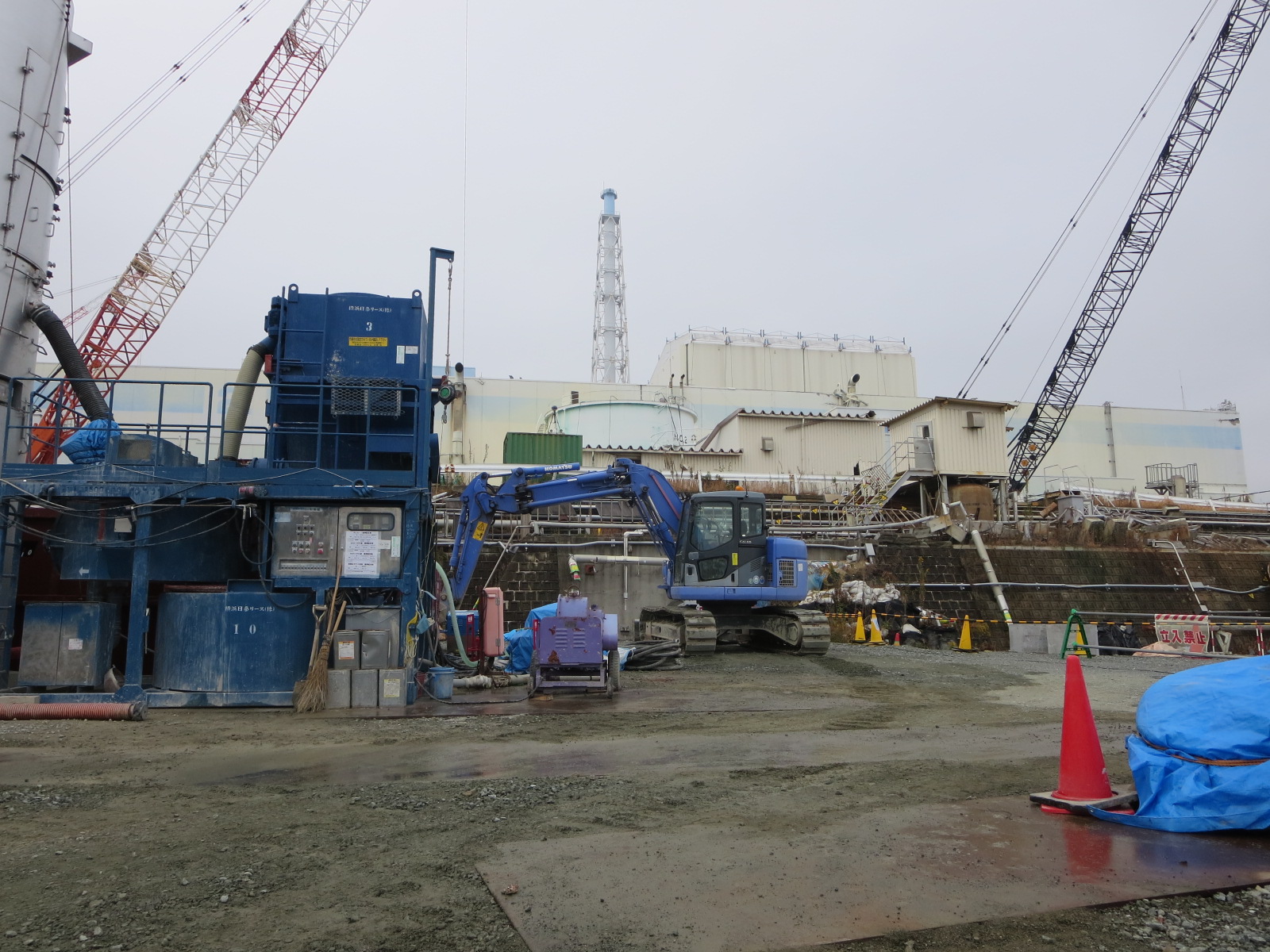
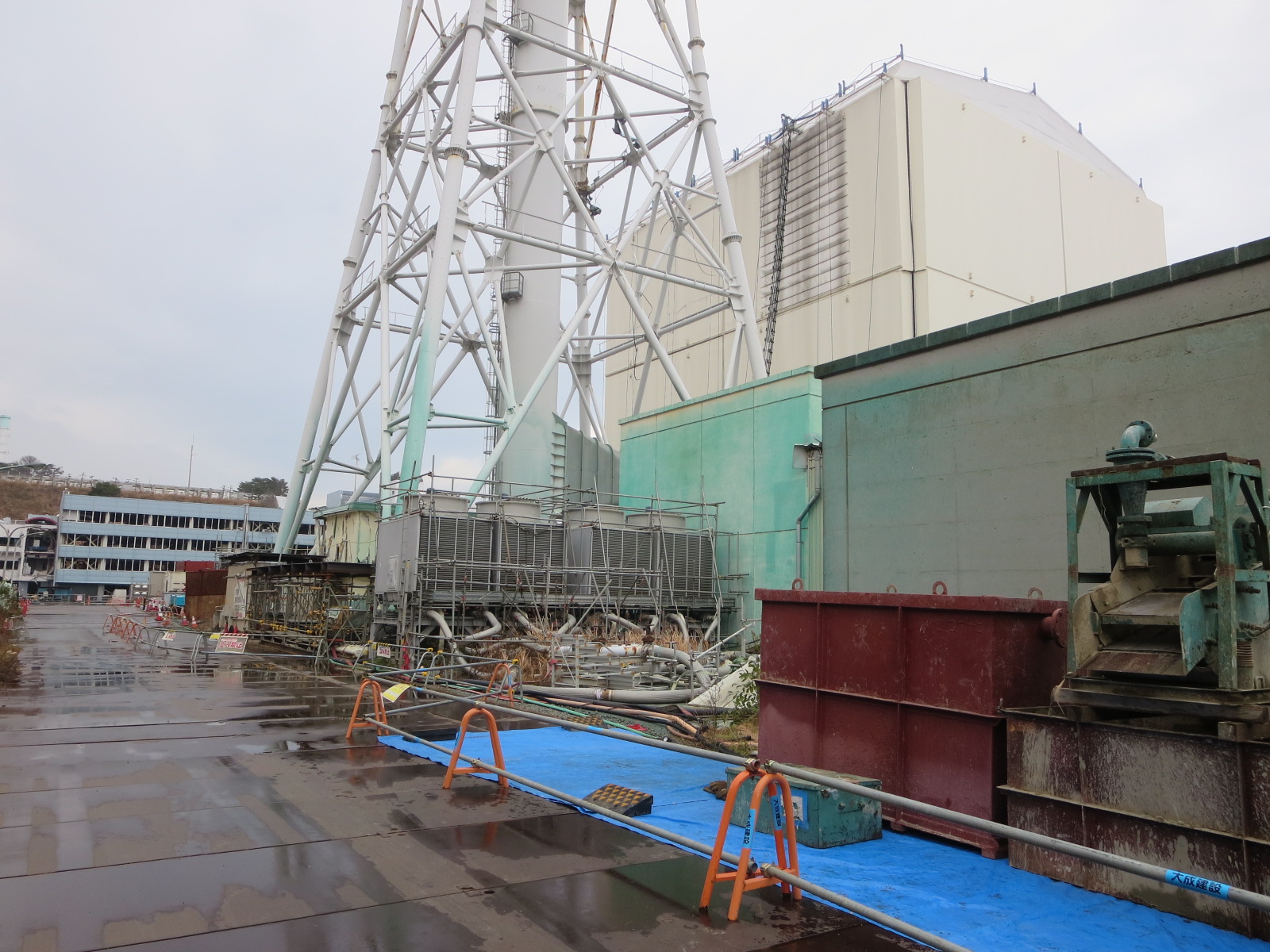
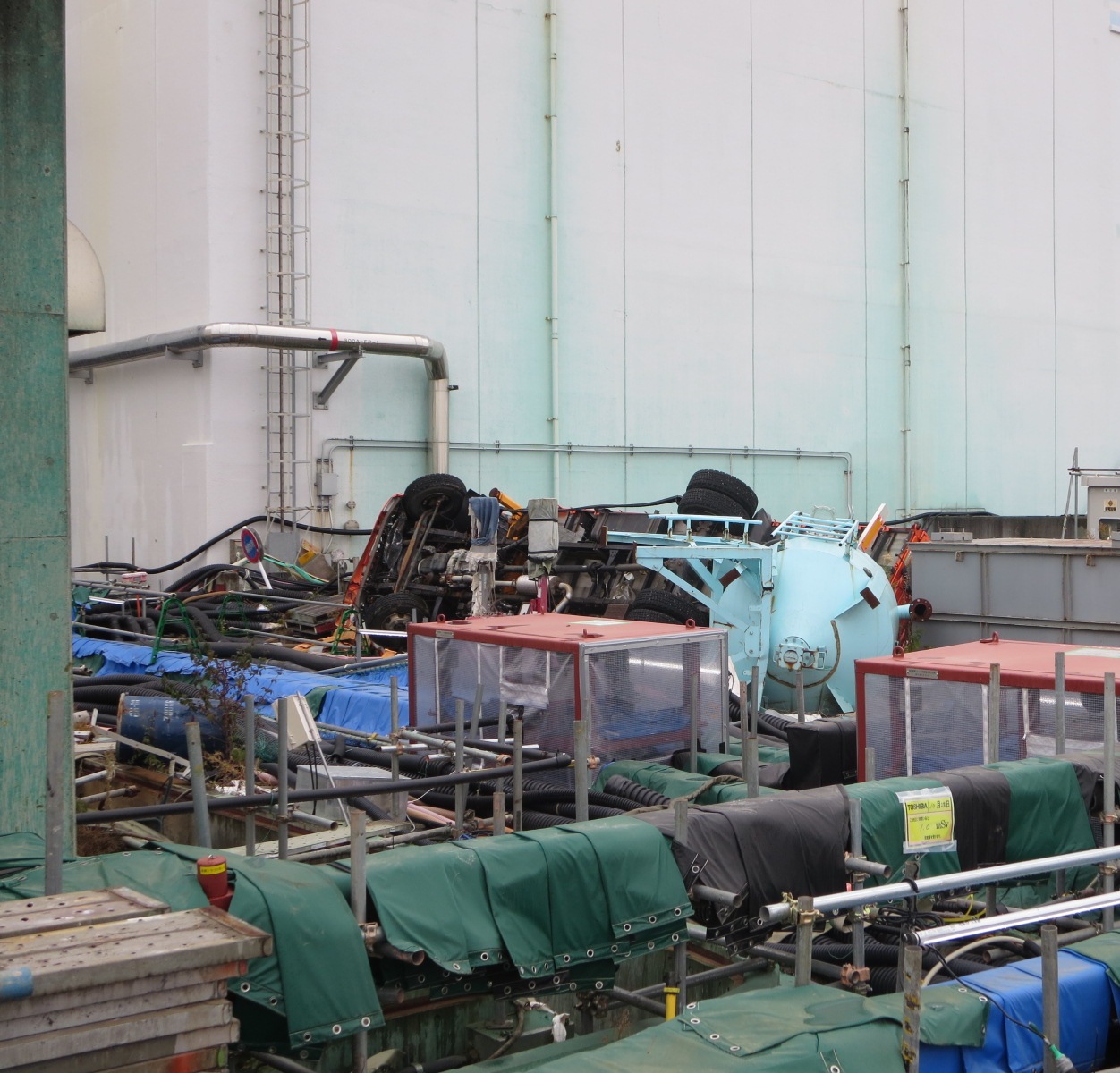
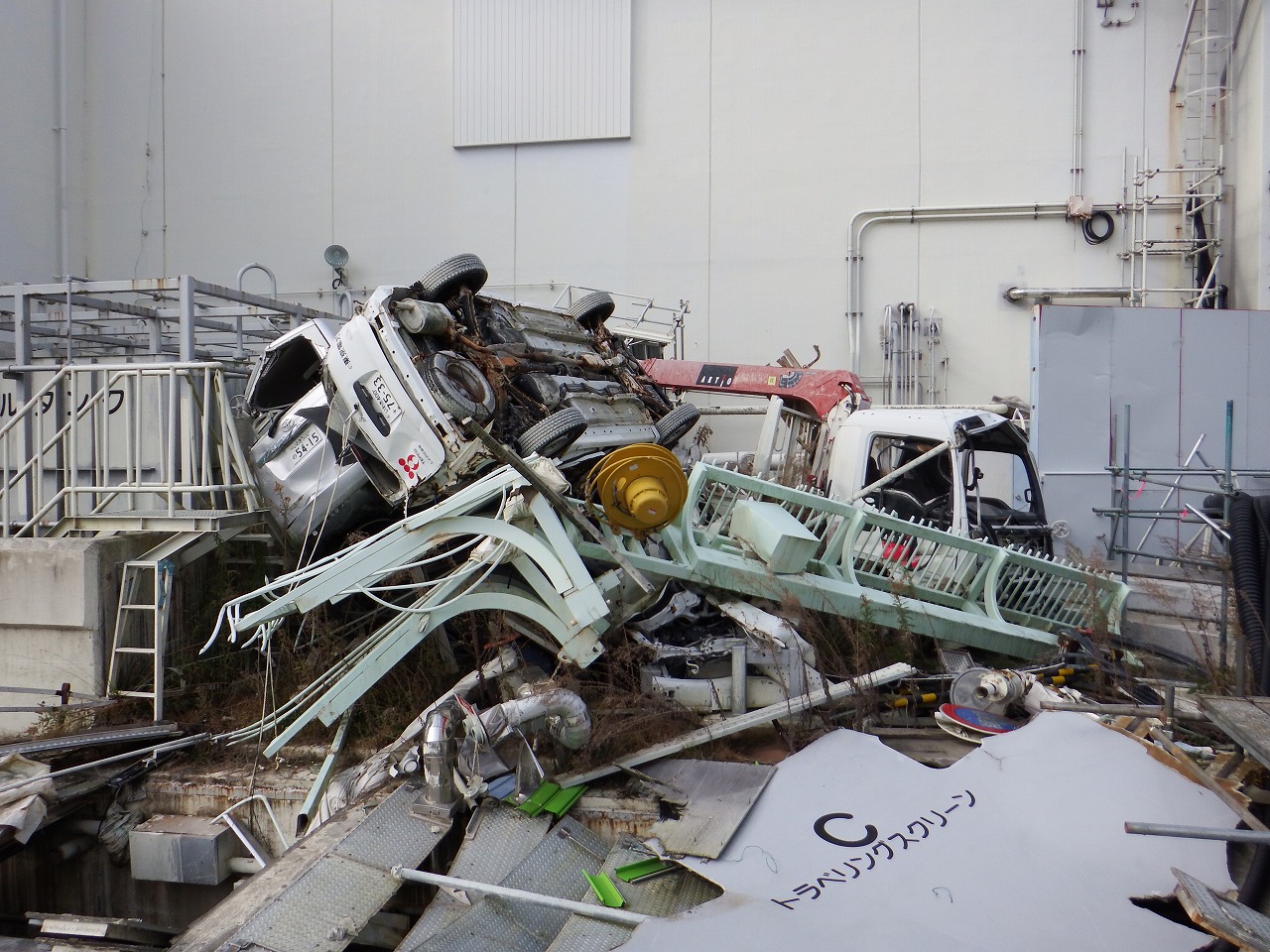
While I'm at it, I might as well show the most recent photos that TEPCO released which, I think, show what lack of money and planning (and lack of decision-making itself) has done (or hasn't done, in this case) at Fukushima I Nuclear Power Plant in the past two years and nine months.

Some areas inside the plant compound today look exactly the same as in March 2011.

From TEPCO's photos and videos library, 12/11/2013 (text is my translation of the explanation in the accompanying PDF document):

4 meters above the sea level (Onahama Peil - average sea level used for the plant), ocean-side (east) of Reactors 1 - 4:

While a temporary storage area for equipment and materials has been secured,

other areas are still littered with debris; it is difficult to decontaminate:


10 meters above the sea level, around Reactor buildings:

While a temporary storage area for equipment and materials, pathway for vehicles and heavy equipment have been secured,


other areas have pipes for transferring (contaminated) water and electric cables running and are still littered with debris; it is difficult to decontaminate:


Some vehicles turned upside down by the tsunami,


have been removed.


Debris removal will continue systematically, says TEPCO [meaning "extremely slowly, piece by piece").

I still vividly remember Mr. Michio Ishikawa of Japan Nuclear Technology Institute on April 29, 2011 on an all-night TV program. To the astonished fellow guests (or guests who were feigning astonishment), Mr. Ishikawa, a strong proponent of nuclear energy, said as a matter of fact that all nuclear fuel inside the reactors had been melted down, the government was lying about it, and some of it would be already outside the Pressure Vessels.

He also said, "This is a war."

"Take the debris clean-up job for example. They are picking up the debris and putting them in containers, as if this is the peacetime normal operation. This is a war. They should dig a hole somewhere and bury the radioactive debris and clean up later. What's important is to clear the site, using the emergency measures. Build a bridgehead to the reactor.

"The line of command is not clear, whether it is the government, TEPCO, or Nuclear and Industrial Safety Agency.

"Look squarely at the reactors and find out the true situation. [Trying to do something with] the turbine buildings is nothing but a caricature [a joke, a manga, a diversion]."


No one took his word seriously, and we are where we are today as the result. Mr. Ishikawa's remark on core melt was not even in the news the next day. Hardly anyone talked about it even on Twitter. "Why should we listen to a pro-nuke shill?" was part of the attitude of net citizens in Japan who turned against nuclear energy after the Fukushima accident.

So today, radioactive debris continues to litter the site, hindering workers' efforts. We have been doing something with the turbine buildings (all the contaminated water from the reactor buildings goes to the turbine building basements, from which the water goes either to another building for storage or to the cesium absorption system (SARRY, or on rare occasions, Kurion).

(OT) US Fed to "Taper" QE by $10 Billion, Stock Market Soars


The quantitative easing (QE) that was started in September 2012 will continue at $75 billion a month, instead of $85 billion.

Much like the federal budget forged by GOP's Paul Ryan and Dem Senator Patty Murray, which does nothing of actually reducing deficit but only reducing the rate of deficit increase.

After the initial plunge on the FOMC announcement, the US stock market swung the other direction and ended the day at all-time high (Dow, S&P500):


As yet another sign of great "recovery", the mortgage application plunged to the 13-year low (from Zero Hedge):


Bullish for the stock market!

The Bernanke Fed said:

Reflecting cumulative progress and an improved outlook for the job market...


Cumulative progress of 0.1% taking from 99.9%, and an improved outlook for the job market expressed by the lower unemployment rate, because they stop counting people whose unemployment benefit has run out even though they are still looking for jobs.

The unemployment rate is set to dramatically fall next year, as the Ryan-Murray budget deal is making sure of it by cutting the extended unemployment benefit beyond 26 weeks.

Bullish for the stock market! Just keep buying the risk assets, as almost all bearish investors have thrown in the towel. Even people like Hugh Hendry, who is effectively saying, "Nothing matters but trends."

Japanese yen has turned even lower against US dollar, at 104 yen per dollar. Hello more carry trade.


Nikkei futures (in yen) to 15,895, more than 300 points higher than Wednesday's (Japan time) cash close (15,587):


Economically ignorant Prime Minister Abe (just like his US counterpart) will exclaim, "See, my Abenomics is working!"

Tuesday, December 17, 2013

#Fukushima I NPP: 63,000 Bq/L of All-Beta One Day, ND the Next Day, All Thanks to TEPCO's Mix-Up (Literally)


The news yesterday (12/16/2013) was that 63,000 Bq/Liter of all-beta that includes strontium-90 was detected in the groundwater sample from an observation hole right on the embankment near the open channel in the plant harbor. The fear was that the groundwater high in all-beta, well exceeding the TEPCO's in-house limit of 10 Bq/L for strontium, was leaking unchecked into the harbor, because the in-the-ground impermeable waterglass wall is not in place at this particular observation hole.

This sudden spike made no sense, as this observation hole, No. 0-3-2, had never had such a high number for all-beta - for that matter, not even for gamma nuclides (cesium).

Then the next day it all made sense. At some point between the collection of the samples and the measurement, TEPCO managed to mix up the sample from the hole No. 0-3-2 with the sample from the hole No. 1-16, which was found with 1,700,000 Bq/L of all-beta on the same December 16, 2013.

Another example of the deteriorating quality of the workers at the plant, AND of the managers who are supposed to train and oversee the workers.

From TEPCO's handout for the press, 12/17/2013 (English labels are by me):


Now, an interesting question is: Where is the groundwater that is sampled at the hole No. 1-16 coming from?

Note that the amount of radioactive cesium is below detection levels (2.8 Bq/L for cesium-134, 1.5 Bq/L for cesium-137), but all-beta (at least half of it is strontium-90) is 1.7 million Bq/L.

At first, I thought this water may be coming either from the leaky tanks that store waste water after cesium absorption and desalination (reverse osmosis), or the tanks that store treated waters, as that would explain the lack of cesium and abundance of all-beta.

Then, on close examination of the numbers for all-beta (see the table; click to enlarge),

  • Water sample from the hole No. 1-16: 1,700,000 Bq/L

  • Treated water (after cesium absorption and desalination): 19,000 Bq/L (8/9/2013)

  • Waste water (after cesium absorption and desalination): 75,000,000 Bq/L (8/9/2013)


The water from the hole No.1-16 contains too much all-beta if it comes from treated water tanks, and contains too little all-beta if it comes from waste water tanks that are leaky. Besides, both treated water and waste water do contain radioactive cesium above the detection limit.

So my brilliant idea is not so brilliant after all, but there is one another, more likely possibility (h/t Kontan_Bigcat).

The water that is finding its way to the hole No. 1-16 may have come from the trenches, either from Reactor 2 or Reactor 3, and filled with the highly contaminated water from April/May of 2011 when the water leaked from the reactor buildings into the turbine buildings after it cooled the broken reactors then into the ocean via the trenches that connect the turbine buildings and water intakes at the embankment.

The reason for the non-detectable levels of radioactive cesium may be that radioactive cesium has been absorbed by the dirt/soil after two years and 9 months.

Whether or not this trench water has been leaking has been discussed at the meetings of Nuclear Regulation Authority, which usually end with one or more commissioners and/or experts scratching their heads at TEPCO's non-explanation. But as this blog wrote in July this year, detection of significant amounts of radioactive materials along the embankment started right after TEPCO started driving the sheet piles into the embankment and into the sea floor of the open culvert in the plant harbor in April in its effort to "stop" the groundwater from flowing into the harbor.

Looking at the cesium content of the trench water (7/31/2013 post) as of 7/31/2013, it is not likely that this water is currently leaking from the trench into the surrounding soil (cesium content is too low in the sample water from the observation holes).

Sunday, December 15, 2013

Evans-Pritchard: China-Japan Rearmament is Keynesian Stimulus, If It Doesn't Go Horribly Wrong


An "IF" in capital letters, but even if it does go wrong and things come to a head between China and Japan, it will still be a great Keynesian stimulus for the US and Europe, whose economies have been suffering "long malaise".

Ambrose Evans-Pritchard, on-again-off-again Keynesian (I think it's "on" now, since the Great Recession induced by the Lehman collapse), says Japan is ready for a fight if necessary; at the same time he seems to think that mishap is not necessarily by China or Japan but by the United States, and fear the cascading effect outside the parties directly involved, as he cites the Agadir crisis in 1911.

With the flip-flopping president who are surrounded by advisors whose expertise (if that) is only in the US domestic politics, the probability of the mishap is rather significant, I'm afraid, no matter how much Japan's PM Shinzo Abe tries to flatter the US president.

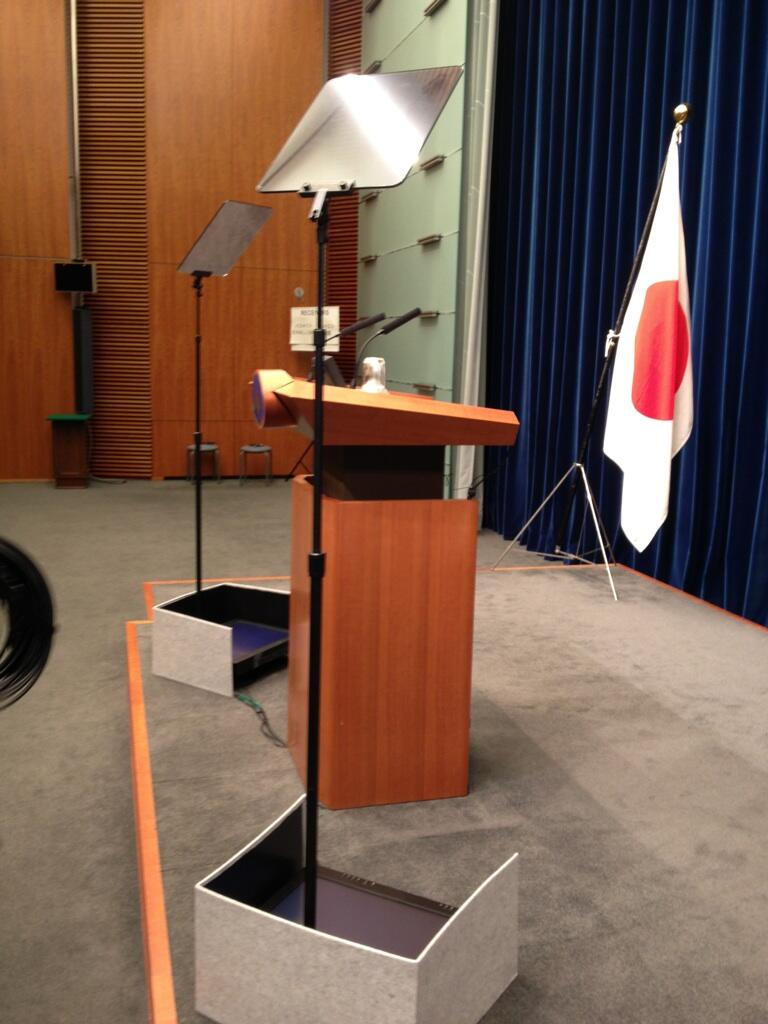
(The latest example of flattery is Abe's mimicking President Obama in using teleprompters for the first time to deliver his speech at a hastily scheduled press conference on December 14, 2013, probably just to show off his brand-new toy...image from Yasumi Iwakami)

From The Telegraph (11/26/2013; emphasis is mine), by Ambrose Evans-Pritchard:

China-Japan rearmament is Keynesian stimulus, if it doesn't go horribly wrong

Asia is on the cusp of a full-blown arms race. The escalating clash between China and almost all its neighbours in the Pacific has reached a threshold. All other economic issues at this point are becoming secondary.

Beijing's implicit threat to shoot down any aircraft that fails to adhere to its new air control zone in the East China Sea is a watershed moment for the world. The issue cannot easily be finessed. Other countries either comply, or they don't comply. Somebody has to back down.

The gravity of the latest dispute should by now be obvious even to those who don't pay attention the Pacific Rim, the most dangerous geostrategic fault line in the world.

Japan’s foreign minister, Fumio Kishida, accused China of “profoundly dangerous acts that unilaterally change the status quo”.

The US defence secretary Chuck Hagel called it “a destabilising attempt to alter the status quo in the region” and warned that the US would defy the order. The Pentagon has since stated that US pilots will not switch on their transponders to comply, and will defend themselves if attacked. Think about this for a moment.

Mr Hagel asserted categorically that Washington will stand behind its alliance with Japan, the anchor of American security in Asia. “The United States reaffirms its long-standing policy that Article V of the US Japan Mutual Defense Treaty applies to the Senkaku Islands,” he said.

Whether China fully believes this another matter, of course. The Senkaku islands offer a perfect opportunity for Beijing to test the resolve of the Obama Administration since it is far from clear to the war-weary American people why they should risk conflict in Asia over these uninhabited rocks near Taiwan, and since it also far from clear whether President Obama's Asian Pivot is much more than a rhetorical flourish.

Besides, Beijing has just watched the US throw its long-time ally Saudi Arabia under a bus over Iran. It has watched Moscow score an alleged victory over Washington in Syria. You and I may think it is an error to infer too much US weakness from these incidents, but that is irrelevant. Beijing seems to be drawing its own conclusions.

Even if the immediate crisis can be defused, we are clearly sliding into a new Cold War. While it is dangerous, it could have paradoxical and powerful side effects. Rearmament lifted the world economy out of slump in the late 1930s, working as a form of concerted Keynesian fiscal stimulus. It could do so again.

The parallels are not exact. They never are. But an Asian arms race would almost certainly tackle some of the underlying causes of the long malaise in the Western economies. It would soak up much of the Asian "savings glut" and the excess industrial capacity in China, and would help to narrow the perennial East-West trade gap.

This would be an answer of sorts to the West's "secular stagnation" – to use the term of former US treasury secretary Larry Summers – or the liquidity trap as others call it. But be careful what you wish for.

I don't wish to become entangled in debate over whether other states impose such ADIZ identification zones beyond their territorial waters, as asserted by Beijing. It is political infantilism to see and judge such disputes through a moral prism, as if our Hobbesian world conforms to codes of right and wrong. What we are dealing with is a great power collision of epochal proportions.

The Asian arms race is young, but clearly under way already. China has launched its first stealth drone, known as Sharp Sword. It developing indigenous aircraft carriers. Its “Two-Ocean-Strategy” implies a fleet of five or six carrier battle groups.

Japan is already rearming. It is building a de facto marine force. It has launched its largest warship since WW2, an 800-foot long DDH-class helicopter carrier, an aircraft carrier in all but name. Tokyo is developing its own version of the Pentagon's Advanced Research Projects Agency. Spending on warships and aircraft will jump by 23pc this year.

When I visited the spanking new buildings of the Japanese defence ministry in Tokyo in March, it already seemed like another world from the run-down digs of the old Self-Defence Force that I had visited six years earlier.

You could feel the emergence of a new military power, pacifist still in name only. The message that came through loud and clear from talking to officials is that Japan is ready for a fight if necessary, and is convinced that it can sink or shoot down any force sent by China into Japan's waters and airspace – whether to close in on the Senkaku/Diaoyu islands, or to ratchet up pressure against Okinawa.

I was shown detailed maps tracing movements of Chinese DDG warships and Yuan-class submarines that left me deeply alarmed over where this is going. Japanese officials said Chinese naval officers on patrol were not responding to normal signals.

"What we don't know is whether Chinese officers follow any international code of conduct? Do they understand what is banned and not banned? Does the Communist Party control their own military?" said one defence planner.

"Two thousand years ago under the Han Dynasty, the emperor put his right hand on the wheel of his chariot and told his general that everything inside the borders was the domain of the emperor, and everything outside was left to the commander. That has plagued China throughout its history, and it is the delicate issue we now face," he said.

There is no red telephone between Tokyo and Beijing to defuse a crisis if it erupts, nothing comparable to the Washington-Moscow "hotline" during the Cold War.

While the US and China were able to calm the waters after an American military jet collided with a Chinese fighter in 2002 – killing the Chinese pilot – it is unlikely that any such mishap between China and Japan could be contained at this stage.

Today's escalating spat has echoes of the Agadir crisis in 1911, the stand-off between Wilhelmine Germany and the Franco-British Entente in the final years before the First World War.

In case you have forgotten, Kaiser Wilhelm sent the warship Panther to Morocco in 1911 to prevent French annexation. The Kaiser picked his moment well. The French were violating earlier accords.

Yet his real purpose was to probe and weaken Britain's entente with France (not a formal alliance) by picking on an issue where London had little natural sympathy for French actions.

The Agadir Crisis backfired against the Kaiser. The Entente did not break. But that is hardly a reassuring episode. The chain of events that followed were catastrophic.

France felt emboldened by British backing, with ripple effects through the Franco-Russian alliance. Russia then felt more able to push its luck when the Serbian crisis hit in 1914. Agadir fed an overwhelming sense of fury in Germany, a feeling that Britain had become an enemy.

America is now having to walk the same sort of tightrope that Britain had to walk – and walked badly – from Agadir to Sarajevo. One misjudgement by either side in the East China Sea could change our world entirely. If you are not concerned, perhaps you should be.


"Mr Hagel asserted categorically that Washington will stand behind its alliance with Japan, the anchor of American security in Asia."


Well, ever since Evans-Pritchard wrote this article (11/26/2013), the US has been busy pleasing Beijing while throwing Japan under the bus (here and here). The US State Department's deputy spokesperson even said the US was happy to see changes in South Korea, which announced it would now allow airlines to file flight plans with Chinese authorities over the disputed territories.

Meanwhile Prime Minister Abe is busy meeting and speaking with the heads of the ASEAN nations in an effort to form a united front against China, whom they perceive as encroaching on the neutral or international (and disputed) space.