Friday, February 8, 2013

#Fukushima I Nuke Plant: TEPCO DID Drop Debris into Reactor 3 Spent Fuel Pool


(UPDATE 2/10/2013) See my latest post on this topic. The crane is remote-controlled, but there are human workers right on on the platform who have to be there to observe the work to make sure the work is done properly and safely.

==========================

It's snowing heavily at the plant. The equipment to remove the debris from what used to be the operating floor of Reactor 3 is remote-controlled.

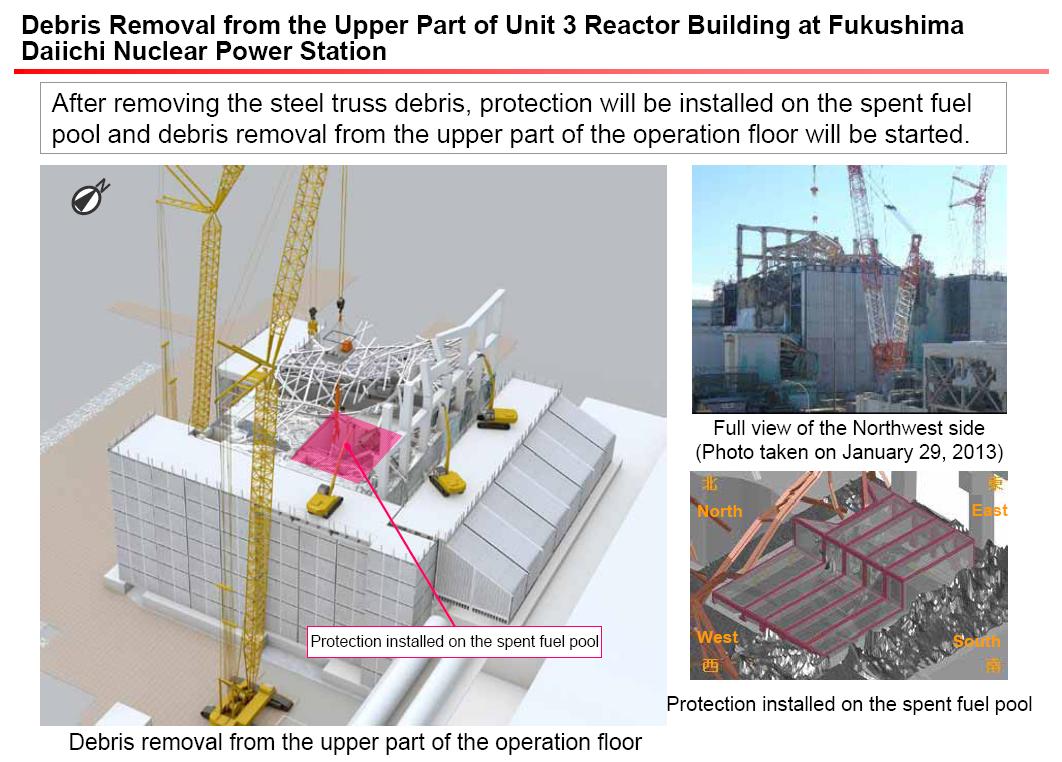
From TEPCO's Photos and Videos page, 2/8/2013:


According to TEPCO, the debris is "assumed to be the fuel handling machine mast", and it is a "possible" drop. Since no one can be there to witness the event firsthand, it is always a possibility, I suppose.

The radiation levels in and around the Reactor 3 building remain very high, although I don't remember any reporting of how high they actually are for a very long time. I think it was in 2011 when the human workers dared enter the reactor building. I remember seeing them making very quick swipes of the floor. I wonder if they did the analysis.

Thursday, February 7, 2013

Boeing 787 Battery Fire: Thermal Runaway from a Short-Circuited Cell, Says NTSB


So that's for JAL's battery. No word yet on ANA's. There is no mention of multiple occasions of JAL and ANA exchanging batteries throughout last year.

From ABC News (2/7/2013):

The battery fire that grounded Boeing's Dreamliner back in January was started in one of eight battery cells that make up the lithium-ion battery used to power the plane when all other power sources fail, NTSB investigators said at a news conference today.

The single cell showed signs of short circuiting that led to thermal runaway -- a chemical reaction during which a rising temperature leads to increasingly higher temperatures, and spread to the rest of the battery, the board reported.

The NTSB has ruled out external short circuiting as a cause for the problems.

"Boeing has indicated that these tests that were conducted prior to certification showed no evidence of cell-to-cell propagation or fire in the battery," Deborah Hersman, chairwoman of the NTSB, said today in Washington. "However, our investigative findings with respect to the event battery show that when a short circuit did occur, it resulted in cell-to-cell propagation in a cascading manner and a fire."

...The certification tests by Boeing found that the likelihood of "smoke emission" from one cell and then a spread to other areas would occur in less than one out of every 10-million flight hours. The 787 currently has only 100 thousand flight hours, and already there have been two smoke events -- one resulting in a fire.

...But the NTSB said Boeing failed to mitigate the hazards and must review not only the battery problem but its testing that provided false conclusions.

(Full article at the link)


It looks like both Boeing and GS Yuasa have some explaining to do, but to say the "testing ... provided false conclusions" is a bit harsh. As Boeing says, in the article:

"We provided testing and analysis in support of the requirements of the FAA special conditions associated with the use of lithium ion batteries..."


In other words, Boeing provided exactly what the regulator wanted.

(Sound familiar?)

#Fukushima I Nuke Plant: Has TEPCO Just Dropped 1.5-Tonne Steel Debris in Reactor 3 Spent Fuel Pool?


NHK News says it may have.

From NHK News (2/8/2013; part):

東京電力福島第一原子力発電所3号機の使用済み核燃料の貯蔵プールで、ほぼ水の中につかった状態で見えていた、重さ1.5トンの鋼鉄製の棒がなくなっていることが分かり、東京電力は、プールに落下したとみて、今後、水中カメラを入れて燃料に異常がないか確認するとしています。

A 1.5-tonne steel debris, which had been submerged in the water but visible in the Reactor 3 Spent Fuel Pool at Fukushima I Nuclear Power Plant, went missing. TEPCO thinks it may have dropped into the Spent Fuel Pool, and will use the underwater camera to make sure the spent fuel rods are unaffected.

福島第一原発3号機では、使用済み核燃料の将来的な取り出しに向けて、貯蔵プール周辺のがれきの撤去作業を続けています。

The work to remove the debris near the Reactor 3 Spent Fuel Pool has been on-going, in order to remove the spent fuel in the future.

東京電力によりますと、6日の作業のあと、遠隔操作のカメラでプールの状況を確認したところ、作業前まで水にほぼつかった状態でプールの中央付近にあった、重さ1.5トンの鋼鉄製の棒が完全に見えなくなっていることが分かりました。

According to TEPCO, when they monitored the condition of the pool using the remote-controlled camera after the work on February 6 they noticed the 1.5-tonne steel debris which had been mostly submerged in the center of the pool but visible was completely invisible.

このため東京電力は、プールの中に落下した可能性があるとみて、準備が整いしだい水中カメラを入れて、水没した棒の状態や、使用済み核燃料に異常がないか確認することになりました。

TEPCO concluded that the debris may have fallen into the pool. The company will use the underwater camera as soon as it is ready to check on the debris and the spent fuel.


From TEPCO's handout for the press in English, 2/8/2013:

Possibility of Debris (Assumed to be the Fuel Handling Machine Mast) Sinking in the
Spent Fuel Pool at Debris Removal from the Upper Part of the Unit 3 Reactor
Building at Fukushima Daiichi Nuclear Power Station

At the steel truss debris removal from the upper part of the spent fuel pool performed on February 6, 2013, the
debris assumed to be the fuel handling machine mast* which was present before the steel truss removal was
found to be missing in the image taken after the removal work. On February 7, we judged that there is a possibility
that the missing debris has sunk into the pool.

*Fuel handling machine mast: Extendable pole used to lift the grip up and down when moving the fuel assemblies (Length: Approx. 5-23m, Weight: Approx. 1.5 tons)

Once the preparation is complete, we will investigate the condition of the sunken debris when we perform
investigation of the inside of the spent fuel pool utilizing an underwater camera.


Goshi Hosono Didn't Run for DPJ Leadership in December, Because His Infant Daughter Just Died


First, from the news, as reported by News Post Seven (2/7/2013; my summary, not the literal translation):

Overwhelming number of DPJ politicians wanted Goshi Hosono to run in the DPJ leadership election in December, after Yoshihiko Noda resigned, taking responsibility for the disastrous election result, but Hosono resisted the call. He didn't explain why to the disappointed supporters.

In a gathering in January, Hosono finally told them the reason, that his infant daughter had died right before the December leadership election. According to the source who attended the gathering, Hosono said, "I knew it was the time to put the party first, but I thought it was the time to devote myself to my family, as the father."

According to the source, Hosono's child was due this June but was born 6 months prematurely. Hosono was at his wife at the hospital every day. They named the baby with the name that the family had prepared, and called the baby by the name to encourage her. But the baby died a few days later.

Hosono eventually accepted the position of the secretary-general of the party, a very powerful position, after his wife told him to do so. "You are a politician. Do what you are good at, for the party."


And here are some examples of the reaction (on a togetter) from anti-nuclear net citizens to Mr. Hosono and his wife's personal tragedy. While couching with words like "poor child", they say:

It's probably from eating contaminated rice and contaminated food from Fukushima. He's got what he deserves.

It's nothing but God's punishment.

It's because Hosono is guilty of spreading radioactive materials [in reference to the wide-area disposal of disaster debris].

[Against people who said he should be considerate to a parent who just lost his baby daughter,] So it's OK for such a person to hurt others as long as he lost his daughter? You're crazy.


God's punishment. So it's OK for them to talk like Shintaro Ishihara (who said the March 11, 2011 tsunami was God's punishment), as long as they are against nuclear power.

There are similar kind of tweets over the plant engineering company whose workers were killed in the hostage-taking crisis in Algeria recently. They say the workers deserve the fate, because they work for a company that designs nuclear power plants. They also say the Japanese government sent a government jet to bring the surviving workers home because the company is part of the nuclear industry. (And yes, all these are somehow a sinister plot by the United States.)

Then, these tweets are apparently effectively used by the "other side" to discredit the anti-nuclear people. Then, there are people who attack the person who complied the togetter, calling him "scum" for trying to make people look bad.

"Whatever" is all I can say at this point.

OT: Hedge Fund Shakes Down Apple, Apple Says It Welcomes Shake-Down


David Einhorn of Greenlight Capital has a large stake in Apple. The last I checked, his average price was somewhere in low $400s. After seeing his paper gain from the high of over $700 evaporated in the last 4 months or so (I'm 100% sure he's superbly hedged anyway), he resorts to a more direct approach to extract more money from Apple.

Fantastic.

From Market Watch via Yahoo Finance (2/7/2013):

SAN FRANCISCO (MarketWatch) -- Apple Inc. said late Thursday afternoon that it will "thoroughly evaluate" a proposal by Greenlight Capital to issue preferred stock, but that it was sticking by its plan to eliminate its ability to grant such measures without shareholder approval. Greenlight's David Einhorn earlier in the day filed a lawsuit against the company and papers with the Securities and Exchange Commission in an effort to oppose a measure on the company's proxy statement that would end Apple's ability to issue so-called "blank check" preferred stock. "If Proposal #2 is adopted, our shareholders would have the right to approve the issuance of preferred stock. As such, Proposal #2 has the support of many of our shareholders," the statement read. Apple shares were up 2.4% to $465.85 in late trading Thursday.


"Without shareholder approval"?? Apple (symbol: AAPL) is not called "hedge fund hotel" for nothing. Look what happened to Apple's share price when the above comment was released; "shareholders" are already approving the deal.


Wednesday, February 6, 2013

Zero Hedge on Japan: Why "This Time Won't Be Different"


From Zero Hedge post titled "Why "This Time Won't Be Different" For Japan In Two Charts" (2/6/2013; emphasis is mine):

...The problem is what happens once said rotation [from JBG to shares and equities] and begins?

Well, the clock begins ticking. Because with a debt load of some 230% of GDP, and with debt that is 2000% of government revenue, about five times more than the second highest (Greece), a simple doubling of average interest rates means half of all government revenues goes to pay interest. Double rates again, and it's game over for the funding side of the Japanese P&L statement, as all inbound cash will have to pay down interest, pushing Japan into the long-delayed hyperinflationary spiral.

And, by the way, none of the above is new! In fact, everything said previously has been well-known to every Japanese PM, and central banker for the past 30 years. It is also the reason why nobody has attempted the kind of ultimately suicidal move that Abe is now trying.

The good news is that it will ultimately be the bond market which puts an end to this latest bout of insanity before it is too late. Unless of course, we get bad news, which in Japan will means 2% inflation... then 12%... then 22%.... then 222% and so on.

By that point every central bank will be openly monetizing not only its own but everyone else's debt too, as the full 1930s rerun, which most certainly included full-blown currency war just before full-blown trade war erupted, unfolds.

And as everyone knows from history, both of the above metaphoric wars in the 1930s culminated with a different war. A real one.


Yup. Kyle Bass has also said as much and more.

Japan's Prime Minister pork-cutlet-curry Abe said in the National Diet session on February 7 that his pride and confidence were shattered to pieces when he had to resign in one year the last time around. I guess the now-confident Abe wants something that he can claim as his lasting legacy. Good or bad is not the point.

One of my Japanese twitter followers said Mr. Abe may be thinking that 2% annual inflation will be linear. Well, he's a poli-sci major. I'm guessing the rules of mathematics apply differently in politics.

The last time Japan's finance minister (Korekiyo Takahashi) inflated the hell out was right before the start of the second Sino-Japan war which was the effective start of World War II in the Far East.

UK's Centrica Will Pull Out of New Nuclear Investment in the UK


That leaves the field wide open for foreign companies including Japan's Hitachi and China's state-owned Guangdong Nuclear Power Company.

From Wired UK (2/4/2013; emphasis is mine):

Centrica pulls out of deal for new UK nuclear power stations

Centrica, the company that owns British Gas, has decided not to invest in building new nuclear power stations in the UK. It was the last British company with an interest in investing in the planned next generation of nuclear plants, with the government now hoping that foreign companies will step into the breach.

The government's energy policy has focused on the construction of new nuclear power plants to replace the old nuclear and fossil fuel plants that will be going offline within the next decade, but that has always been reliant upon private investment. Centrica's decision to pull out -- citing "uncertainty about overall project costs and the construction schedule" -- will be a blow to the prospective construction of the four nuclear power plants that the company had a 20 percent stake. Centrica has launched a £500m share repurchasing programme to recoup some of its initial £2.2bn investment for its shareholders.

The four new stations -- located in Hinkley Point in Somerset and Sizewell in Suffolk -- are planned by French energy company EDF, with Centrica taking a 20 percent share in their cost and future operations in 2008. However, costs have been driven up since then for various reason (including new safety measures imposed in the wake of the Fukushima disaster), leading Centrica to feel its investment is no longer cogent. Centrica will retain, however, the 20 percent stake it owns in eight existing nuclear power stations it also purchased in 2008.

EDF has reportedly been in talks with the Chinese state-owned Guangdong Nuclear Power Company over investment into its new nuclear projects in Europe, and may look to it to take up Centrica's now-free share.

Centrica's withdrawal is not the latest blow to the future of British nuclear power, either, with Cumbrians voting last week against the construction of a vast underground nuclear waste storage facility in the county. As the only location in the UK to express interest in hosting large quantities of nuclear waste, the rejection puts the government in a difficult position with regards to disposing of any waste to come from new nuclear power plants yet to open.

However, Hitachi's purchase of the rights in October 2012 for the rights to a new generation of nuclear plants that may generate up to six gigawatts of power is being pointed to by the government as evidence that the UK remains an attractive place for foreign energy companies to invest.

NTSB Chief Deborah Hersman on Boeing 787 Battery Fire: Plane Batteries Not Necessarily Unsafe


She says NTSB still doesn't have answers why the lithium-ion batteries by Japan's GS Yuasa caught fire in ANA and JAL, but as long as there are safeguards in place we shouldn't worry too much.

(and nuclear reactors that melt down are not necessarily unsafe as long as there are safeguards in place...)

From AP (2/6/2013; emphasis is mine):

NTSB: Plane batteries not necessarily unsafe
NTSB chairman: Lithium batteries not necessarily unsafe in aviation but safeguards needed

WASHINGTON (AP) -- Despite a battery fire in one Boeing 787 Dreamliner and smoke in another, the type of batteries used to power the plane's electrical systems aren't necessarily unsafe — manufacturers just need to build in reliable safeguards, the nation's top aviation safety investigator said Wednesday.

National Transportation Safety Board Chairman Deborah Hersman said she doesn't want to "categorically" rule out the use of lithium ion batteries to power aircraft systems, even though it's clear that safeguards failed in the case of a Japan Airlines 787 that had a battery fire while parked at Boston's Logan International Airport last month.

"Obviously what we saw in the 787 battery fire in Boston shows us there were some risks that were not mitigated, that were not addressed," Hersman told reporters in an interview. The fire was "not what we would have expected to see in a brand new battery in a brand new airplane," she said.

The board is still weeks away from determining the cause of the Jan. 7 battery fire, Hersman said.

The 787 is the first airliner to make extensive use of lithium batteries. Aircraft makers view lithium batteries, which are lighter and can store more energy than other types of batteries of an equivalent size, as an important way to save on fuel costs. The Airbus A350, expected to be ready next year, will also make extensive use of lithium ion batteries. Manufacturers are also looking to retrofit existing planes, replacing other types of batteries with lithium ion.

But lithium batteries are more likely to short circuit and start a fire than other batteries if they are damaged, if there is a manufacturing flaw or if they are exposed to excessive heat.

..."What happens is that when an aircraft is certified it basically gets locked into the standards that were in existence at the time," Hersman said. Oftentimes, tougher standards will come along later, but aren't applied to already-approved aircraft designs. "Those are issues we do look at regularly in our investigations and it is something I'm sure we will be focusing on with the battery," she said.

Investigators have been working very closely with the FAA on a review the agency has under way of its sanctioning of the 787's certification for flight, Hersman said. The FAA awarded the certification in August 2011.

"We are evaluating assessments that were made, whether or not those assessments were accurate, whether they were complied with and whether more needs to be done," she said. "I think that is important before this airplane is back in the air, to really understand what the risks are and that they're mitigated effectively."

(Full article at the link)


From the article, the issue of safety seems to be just the matter of whether the certification is properly issued by the government bureaucrats. As long as that is properly done, the plane should be safe.

The parallel to things nuclear is obvious.

Tuesday, February 5, 2013

In Japan, Fear of Hyperinflation Now Joins Radioactive Cesium as "Baseless Rumor"


Stuck in Keynesianism and no way out anyway, Prime Minister Abe calls hyperinflation worries "unfounded".

(So, hyperinflation joins radioactive materials as "baseless rumor".)

From Dow Jones Business News, quoted at NASDAQ (2/5/2013; kind of fitting):

Japan PM Says Hyperinflation Worries 'Unfounded'

TOKYO--Japanese Prime Minister Shinzo Abe said Tuesday in parliament that worries of the central bank's inflation target triggering hyperinflation are unfortunate and unfounded.

"It's unfortunate that there are people who tout the mostly unfounded fears of hyperinflation," Mr. Abe said in a lower house plenary session.

"By building a sustainable fiscal framework we will dispel such worries," he said.

Mr. Abe also denied allegations by an opposition lawmaker that last month's accord between the government and Bank of Japan on the 2% inflation target threatened the central bank's independence, adding that the government will leave the methods of achieving the target up to the central bank.

The prime minister also fended off criticism about his government spending its way out of stagnation, saying that his economic policies will eventually pave the way for sustainable private sector growth in the mid- to long-term.

Write to Toko Sekiguchi at toko.sekiguchi@dowjones.com

Subscribe to WSJ: http://online.wsj.com?mod=djnwires


Abe's time horizon must be really, really long and far out into the future. 20-plus years of mostly LDP administrations after another trying to spend its way out of stagnation haven't resulted in sustainable private sector growth.

Growth or no growth, Abe can do what the US government has been doing so that there is no inflation that is not 2%. All he has to do is to cheery-pick the data - eliminate prices of goods that are rising too fast, and prices of goods that are sinking. And use Ben Bernanke's and Obama administration's line that the rising stock market makes people feel happy and prosperous so that they spend money that they don't have.

(Anything Goes Series - 5) When Nikkei Is Under Pressure (Finally), Remove BOJ Governor


Why? You can see why. Yen tanks, and the Nikkei Stock index soars by over 4% in one day.

Bank of Japan Governor Shirakawa's tenure was to end in April. Instead, he said today that he would resign soon.

The results:

Yen


Nikkei

Two BOJ commissioners who opposed the 2% inflation target in the last policy meeting, Takehiro Sato (from Morgan Stanley where he was a managing director and chief economist) and Takahide Kiuchi (from Nomura Securities where he was the chief economist) now say they will do their utmost best to achieve that target.

If you think "WTF?" like I did, that's quite a historical, traditional mentality in Japan. During the warring days in 15th and 16th centuries, it was quite common for the soldiers and lords who were defeated to join the victorious and fight alongside the victor, to atone for the sins of the past of having dared oppose the victor. The game of "shogi", Japanese version of chess, allows the opponent's pawns that are captured to be used again, against the opponent.

Now defeated, the two commissioners will be vigorously push for the 2% inflation target that they opposed.

Senkaku Islands Row: Chinese Frigate Locked Weapon-Targeting Radar on Japanese SDF Navy Ship


Ishihara Senior and Junior must be thrilled.

From The Telegraph quoting AFP (2/6/2013; emphasis is mine):

China frigate locked radar on Japan navy

A Chinese military frigate locked its weapon-targeting radar on a Japanese navy vessel on at least one occasion, Japan's defence minister has claimed, as the bitter territorial row threatened to escalate.

Itsunori Onodera claimed that on January 30, "something like fire-control radar" was directed at a Japanese Self-Defence Maritime escort ship in the East China Sea.

Mr Onodera said a Japanese military helicopter was also locked with a similar radar a few days earlier.

"Directing such radar is very abnormal," he said. "We recognise it would create a very dangerous situation if a single misstep occurred.

"We will seek the Chinese side's self-restraint from taking such dangerous action."

The move is an apparent ramping up of an already tense situation in the East China Sea, where Asia's two largest economies are at loggerheads over the sovereignty of an uninhabited island chain.

(Full article at the link)


It is as if someone is pulling a gun right at your face. So what is the reaction in Japan?

Mainichi Shinbun (2/5/2013) says that the Chinese government may be "frustrated" with Japan's Abe administration, but tries to lay the blame later only on the military who did it without the approval from the Chinese political leadership.

Asahi Shinbun (puts out a more realistic assessment, quoting military experts. A Defense Ministry official is quoted as saying "It's as if someone is aiming a gun right at you". Another expert says it is a provocation by the Chinese, who fully know that Japan's SDF could not do anything. The Self Defense Force is not allowed to retaliate unless it is attacked first. For now.

And as usual, many on Twitter firmly believe it has something to do with the imperial interest of the United States somehow. They don't know (or say) exactly what the interest is, but as usual concludes anything bad that happens to Japan is because of the US.

How about blaming the Ishiharas, for a change? Or the Abe administration? No, the ascent of Ishihara, Abe is considered by many on the net as having something to do with the imperial interest of the United States.

Monday, February 4, 2013

#Fukushima I Nuke Plant: TEPCO Ready to Remove Huge Truss from Reactor 3 Spent Fuel Pool


These days, it almost feels as if the last sane place remaining in Japan is actually Fukushima I Nuclear Power Plant, where they have actual jobs to do and they are at it every single day mostly because they have no other choice. (If you are wondering what I'm talking about, read the Anything Goes series.)

TEPCO (or rather, workers at 2nd-tier subcontractors just below the primary subcontractors such as Hitachi and Kajima) has been carefully removing the debris on what was used to be the operating floor of the Reactor 3 building. It says it is ready to remove one of the big trusses sometime in early February, and has released the photographs and diagrams.

From TEPCO's handout for the press, 2/4/2013:


Platforms have been built surrounding the reactor building so that the remote-controlled heavy equipment can operate from the platforms:


In the meantime, according to Mainichi Shinbun, the Japanese prosecutors have seized the testimony that the former Fuku-I plant manager Masao Yoshida gave in closed-door sessions by the Fukushima nuclear accident independent investigation commission set up by the Cabinet Office under the DPJ administration, for the purpose of potentially using the testimony to indict Yoshida and TEPCO. The testimony in the closed sessions was freely given, under the government guarantee that the information obtained would not be used against the person giving the testimony.

Now that it is no longer DPJ government but a new and improved LDP government, that guarantee means squat, and the court that routinely sides with the prosecutors readily grants a warrant of seizure.

Mr. Yoshida, stricken with esophagus cancer and after suffering a stroke last year, hasn't been seen or heard. TEPCO hasn't shared any information about his condition. The Mainichi article says he is in no condition to speak to the prosecutors.

Bloomberg English News "Japan's Government Pension Fund to Diversify to Avoid Erosion of Asset Value"; Bloomberg Japan "Government Pension Fund Will Have Positive Return This Year"


It's about the same news, written by the same reporters.

It was quite common for both the Japanese news outlets that also have English language service and the US news outlets that also have presence in Japan to report different stories for their Japanese audience in Japan and for their foreign audience in English language when reporting on the Fukushima I Nuclear Power Plant accident.

When it comes to bad news for the economically clueless Japanese citizens, Bloomberg News seems to be doing the same as it reports on the decision by the Government Pension Investment Fund (GPIF) to start planning for diversification of their JGB-heavy portfolio.

I first saw the article in English at Zero Hedge, and looked for the same article in Japanese Bloomberg News to tweet to my Japanese followers. I found the Japanese article, written by the same reporters based in Tokyo, but I was completely confused. Instead of quoting the manager of GPIF warning the potential erosion of asset values because of the new LDP administration's policies as in the English article, the Japanese article starts out by saying:

The return will be positive two years in a row due to cheaper yen, says the manager of GPIF.


Huh?

So, here are the opening paragraphs of Bloomberg English (2/3/2013) titled "Japan Pension Fund’s Bonds Too Many on Abe Plan, Mitani Says", by Anna Kitanaka, Toshiro Hasegawa & Yumi Ikeda:

Japan’s public pension fund, the world’s biggest manager of retirement savings, is considering the first change to its asset balance as a new government’s policies could erode the value of $747 billion in local bonds.

Managers of the Government Pension Investment Fund, which oversees about 108 trillion yen ($1.16 trillion) in assets, will begin talks in April about reducing its 67 percent target allocation to domestic bonds, President Takahiro Mitani said in a Feb. 1 interview in Tokyo. The fund may increase holdings in emerging market stocks and start buying alternative assets.

The GPIF, created in 2006, didn’t alter the structure of its holdings during the worst global financial crisis in 80 years or in response to the 2011 earthquake and nuclear disaster. Prime Minister Shinzo Abe and the Bank of Japan (8301) have pledged to restore economic growth and spur inflation, which will mean higher interest rates, Mitani said.

“If we think about the future and if interest rates go up, then 67 percent in bonds does look harsh,” said Mitani, who was appointed in 2010 after serving as an executive director at the Bank of Japan. “We will review this soon. We will begin discussions for this in April-to-May. Any changes to our portfolio could begin at the end of the next fiscal year.”

GPIF, one of the biggest buyers of Japanese government bonds, held 69.3 trillion yen, or 64 percent of total assets, in domestic debt at the end of September, according to its latest quarterly financial statement. That compares with 12 trillion yen, or 11 percent, in Japanese stocks; 9.6 trillion yen, or 9 percent, in foreign bonds; and 12.6 trillion yen, or 12 percent, in overseas stocks.

The fund, which took over management of government employee retirement savings when it was set up, returned to profit in the three months ended Dec. 31 from a 1.4 percent loss in the first six months of the fiscal year, Mitani said. He declined to be more specific. It needs to raise about 6.4 trillion yen this fiscal year through March 31 to meet payments.


And here's my translation of the opening paragraphs of the Japanese Bloomberg article (2/4/2013) by the same reporters:

世界最大の資産規模を持つ日本の年金積立金管理運用独立行政法人(GPIF)は、昨年12月以降の円安進行や株高基調を背景に、今年度の運用収益率が2年連続でプラスとなる見通しを明らかにした。

Japan's Government Pension Investment Fund (GPIF) that holds the world's beggest assets revealed that this fiscal year's return will be positive, two years in a row, thanks to cheaper yen and higher stock market since December last year.

三谷隆博理事長は1日、ブルームバーグとのインタビューで、2012年度の運用状況について、「昨年12月以降、株価が上昇し、円安方向に振れたのでかなりプラスが出ているのではないか。7-9月期までの年度収益率はマイナスだったが、これを取り戻してプラスになっていることは間違いない」と語った上で、11年度の2.32%に続いてプラスになるとの見通しを示した。

President Takahiro Mitani said in a February 1 interview with Bloomberg about the fund performance in the fiscal 2012 [which ends in March 31, 2013], "Stock prices have gone up and Japanese yen has gone down since December last year, so I assume the return has turned positive in a significant way. The annualized return up to the July-September quarter was negative, but I have no doubt that the return has turned positive." In the fiscal 2011, the return was 2.32%.

GPIFの今年度の収益率は、4-6月期にマイナス1.85%だったが、7-9月期は外国株式の上昇が寄与してプラス0.49%。4-9月累計ではマイナス1.39%だった。

The rate of return at GPIF this fiscal year was minus 1.85% in the April-June quarter [1st quarter of the fiscal year], but in the July-September quarter the rate turned positive to 0.49% thanks to the rise in foreign stocks. The cumulative rate of return from April to September was minus 1.39%.


Rejoice, the government pension fund will make money this year!

Later, the Japanese article talks about Mr. Mitani's concern about the Japanese Government Bonds which makes up more than 60% of their portfolio, but in a much more subdued way; there is no talk of change in portfolio possibly starting at the end of the next fiscal year.

Let's see, GPIF has 108 trillion yen, and Mr. Mitani says the fund will make money. How much money will be the question, as Bloomberg English article says the fund has to raise 6.4 trillion yen to meet the payment obligations. That would be the equivalent of almost 6% return on the total asset.

Instead of focusing on writing the grammatically correct English devoid of meaning or on native-like pronunciation of English words and sentences (native in where is a good question, but), the Japanese people should really study English, so that they can read and understand the Bloomberg English article.

But even before their English lessons, they probably need economic lessons (and need to stop adoring Krugman, for a start).

Sunday, February 3, 2013

#Fukushima I Nuke Accident: Enigma of "Concrete Pumper Truck from Australia"


The US airlifted a concrete pumper truck from Australia to Japan but the Japanese government wouldn't allow it to travel to Fukushima because the vehicle was not licensed to travel on Japanese roads, says a US nuclear expert at the Union of Concerned Scientists, according to New Jersey Newsroom.

It is a plausible enough story, given the similar incident where TEPCO/Toshiba could not (or would not dare) drive on the highway in a truck full of special batteries that might have tremendously helped Fukushima I Nuclear Power Plant during the earliest days of the accident, because they couldn't obtain a permit from the government.

From New Jersey Newsroom (1/31/2013; part):

Fukushima Rescue Mission Lasting Legacy: Radioactive Contamination of Americans
Thursday, 31 January 2013
BY ROGER WITHERSPOON

...Information was hard to come by, exacerbated by the rigidity of the Japanese bureaucracy. Two nuclear experts at the Union of Concerned Scientists, David Lochbaum, who has worked as a consultant for the NRC and industry, and Ed Lyman, a nuclear physicist, have examined thousands of government emails and cable traffic during a confusing period where the data base shifted by the hour and concrete information was hard to come by.

“After the explosion in Fukushima Daiichi Unit #4 the Japanese were not able to get enough water into the building to keep the spent fuel pool cool,” Lochbaum said. “So the US airlifted a concrete pumper truck all the way from Australia to an American naval base in the northern part of the island. And the Japanese would not let it leave the base because it wasn’t licensed to travel on Japanese roads. Given the magnitude of their problems, that seemed to be the wrong priority...”


Here's what I've found (and wrote) about the Putzmeister concrete pumps sent to Fukushima, from publicly available news sources:

Fukushima I Nuke Plant got Putzmeister cranes, two from the US with 70-meter boom (the world largest), two with 62-meter boom from somewhere else.

One of the 70-meter boom cranes was being used at the construction site of the U.S. government’s $4.86 billion mixed oxide fuel plant at Savannah River Site. Ashmore Concrete Contractors, Inc., based on Augusta, Georgia, owned the crane.

The other one was from Associated Conrete Pumping in Sacramento, California. According to McClatchy News (4/8/2011),

Mike Parigini, the 60-year-old founder and owner of Associated Concrete Pumping in Sacramento, has sold his nearly 190,000-pound pump back to its maker — Putzmeister America Inc. of Sturtevant, Wis.

Putzmeister America officials said Thursday that Parigini and a Georgia concrete contractor "made the pumps available upon learning of the need in Japan."


They were transported on the Russian-made cargo plane and arrived in Tokyo on April 11, 2011. They were promptly moved to Putzmeister's office in Chiba, using the Japanese roads, where TEPCO workers were being trained on using them.

A slightly smaller, 62-meter boom Putzmeister crane was sent from SANY Heavy Industry in China. According to SANY's press release from March 20, 2011, the company received the mail from TEPCO's then-president Masataka Shimizu that TEPCO wanted to buy the crane from SANY to use at Fukushima I Nuke Plant. SANY offered the crane free of charge, and shipped it to Osaka. The crane should have arrived in Osaka on March 24, 2011, according to the SANY press release.

According to Putzmeister's May 23, 2011 press release, two cranes with 62-meter boom were sent from Germany. The press release says the very first putzmeister crane arrived in Fukushima on March 22, 2011. The head of Putzmeister Japan was able to convince the Japanese government of the pump's potential capabilities on March 15, 2011. A 58-meter boom crane was then diverted from the delivery to a customer in Vietnam, and went to Fukushima.

None of the above offers were made by the US government or the military; rather, the offers to ship the Putzmeister cranes to Fukushima were made by private companies.

If anyone knows anything about the concrete pumper from Australia transported by the US government, please let me know. Maybe it's in the documents disclosed by the US NRC last year.

Moving on for now to another puzzling comment in the New Jersey Newsroom article: "an American naval base in the northern part of the island".

The northern most American naval base in Japan is in Yokosuka, in Kanagawa Prefecture. So what naval base in the northern part of Japan is the article talking about? There is the Misawa Air Base in Aomori Prefecture.

By the way, China's SANY has since bought Putzmeister in January 2012. Good thing the Senkaku Islands row started with China well after the March 11, 2011 nuclear accident, many Japanese may say.

Saturday, February 2, 2013

(Anything Goes Series 4) #Fukushima City's Tap Water "Safe and Delicious", To Be Served at Events in Fukushima to Eradicate Baseless Rumors


A 500-milliliter bottle sells for 100 yen.

This is the latest in the non-stop effort by people in Fukushima since March 11, 2011 to insist it's nothing but baseless rumors, not radioactive materials, and people in Fukushima are hurt by such rumors. To prove it is baseless rumors, they bottle the tap water in Fukushima City and sell it to you.

Nearly 2 years after the accident, that their land has been radioactively contaminated by the Fukushima I Nuclear Power Plant accident clearly hasn't sunk in to most of the residents who continue to live in the prefecture. And at this point, it doesn't look like it will ever sink in, even a millimeter.

From Fukushima Minyu, local Fukushima paper (2/1/2013):

「安全でおいしい」 福島市の水道水ペットボトルをPR

"Safe and delicious", bottled tap water in Fukushima City being promoted

福島市水道局は同市の水道水ペットボトル「ふくしまの水」を使い、安全性PRに乗り出している。市内で開く会議やイベントでの利用を各種団体などに呼び掛け、安全な福島の水を多くの人に飲んでもらい、東京電力福島第1原発事故の風評被害払拭(ふっしょく)につなげる。

The municipal water department of Fukushima City has embarked on a PR campaign to appeal safety using "Fukushima no Mizu [Fukushima water]", the city's tap water in plastic bottles. They are asking the organizers planning conferences and events in the city to use the bottled water so that many people can drink safe water in Fukushima. They hope to eradicate the baseless rumors from the Fukushima I Nuclear Power Plant accident.

「ふくしまの水」は同市の水道水を詰めたペットボトル。観光PRなどを目的に2008(平成20)年に販売を開始、市内の名所花見山をデザインしたラベルも昨年度リニューアルした。放射性物質の検査も行っており、ボトルには放射性物質が検出されていないことを示す「ND」と書かれたシールを貼り、安全性をアピールしている。

"Fukushima no Mizu" is bottled water filled with the city's tap water. It went on sale in 2008 for tourism promotion. The bottle label was updated last year with the design featuring Hanami-yama, city's popular tourist destination. Radioactive materials are tested, and the bottles have stickers that says "ND", indicating there was no radioactive material detected, to emphasize safety.

震災後、市内では県外からの人が多く集まる会議なども増えた。「多くの人に実際に水を飲んでもらえれば、風評被害が払拭できる」。市水道局はこうした会議やイベントを主催する企業、団体にペットボトル利用の呼び掛けを始めた。評判も上々という。

After the March 11, 2011 disaster, there have been conferences [held in Fukushima City] with many people from outside the prefecture. "If we could have these people drink our water, we would be able to eradicate baseless rumors." The city's water department started to ask corporations and groups that held these conferences and events if they wanted to use the bottles with the city's water. [The water department] says they are getting excellent reviews.


同水道局の阿部利秀技査と菅野孝文副主査は「福島市の水道水は摺上川を原水としたおいしい水。安全性も十分に確保しており、ぜひ利用してほしい」と話している。水道水ペットボトルは1本500ミリリットル入りを100円(税込み)で販売している。事前注文が必要。

Officials at the city's water department say, "Tap water in Fukushima City is from Surikamigawa River and it is delicious. Safety is amply secured, so please use it." A 500-milliliter bottle of Fukushima City tap water sells for 100 yen (including sales tax). Pre-order is required.


The detection limit is 1 becquerel/kg in Fukushima City's testing. Before the Fukushima nuclear accident, the Japanese government routinely monitored the radioactive materials in the environment. For tap water, the detection limit ranged from 0.074 to 0.185 millibecquerel/liter in case of Fukushima Prefecture (according to Japan Chemical Analysis Center's database). Note the unit: millibecquerel, one-thousands of a becquerel.

I fondly recall Goshi Hosono's sidekick who drank treated water at Fukushima I Nuclear Power Plant to demonstrate how safe the water is after the elaborate treatment. Iodine and cesium were ND, but the water was full of tritium.

(OT) Wise Tweet from "GS Elevator Gossip"


(Ain't it the truth? Learn from the best.)

(On second thought, that's how Goldman's competitors see Goldman, probably.)

(Anything Goes Series -3) "Danger of Active Faults Is Baseless Rumor", Says Tokyo University Geologist


The others chime in, and say, basically, "Let's coexist with nuclear power plants that sit on top of active faults."

Very interestingly, the pro-nuclear Sankei Shinbun's article echoes the open letter by the US Energy and Commerce Commission to the Nuclear Regulatory Commission, with its curious emphasis on "performance-based" policy.

The article by Sankei Shinbun quotes a physicist, a nuclear engineer, and an marine geologist among others who say the Nuclear Regulatory Authority's new safety regulation proposal is not based on science but is pure fiction.

I'm afraid the entire country of Japan is pure fiction at this point.

Sankei's article starts with a very tricky headline as if it were the NRA who says it is possible (for nuclear power plants) to coexist with active faults. It is not, but unless you actually read the article, Sankei readers wouldn't know that.

From Sankei Shinbun via Yahoo Japan (1/30/2013; part; my comments in square brackets in blue italic):

地震・津波原発の新安全基準骨子案 「活断層との共生可能」

Proposed new safety standard outline for nuclear power plants in the event of earthquake/tsunami "It is possible to coexist with active faults"

科学的根拠失った規制を危惧

Fearful of regulation without scientific basis

原子力規制委員会が29日に骨子案をまとめた地震・津波に関する原発の新安全基準。活断層の真上に重要施設の設置を禁止したが、全国に約2千本あるといわれる活断層大国の日本では「耐震設計で活断層との共生は可能」との見方も出ている。科学者らは失われた科学技術への信頼回復を目指す一方で、安全を強調するあまり科学的根拠を失った規制がまかり通ることを危惧している。

On January 29, the Nuclear Regulatory Authority announced its outline proposal for new safety standard for nuclear power plants in the event of earthquake and/or tsunami. The new standard would prohibit the installation of important facilities on top of active faults, but there are people who think it is possible to coexist with active fault with anti-seismic design in the country where there are about 2,000 active faults. Scientists are trying to restore the trust in science and technology which was lost [in the wake of the Fukushima I Nuclear Power Plant accident], but at the same time they are worried that with too much emphasis on safety the regulations without scientific basis will go unchallenged.

[Go unchallenged? OK, who are those scientists?]

元文相で物理学者の有馬朗人氏は25日に都内で開かれたシンポジウムで、東日本大震災でも無事だった東北電力女川(おながわ)原発(宮城県)や東京電力福島第2原発(福島県)を取り上げ、「活断層があってもどうすれば安全が保たれるか研究開発を進めればよい」

In a symposium held in Tokyo on January 25, former Minister of Education and [nuclear] physicist Akito Arima cited Tohoku Electric Power's Onagawa Nuclear Power Plant (in Miyagi Prefecture) and TEPCO's Fukushima II (Daini) Nuclear Power Plant (in Fukushima Prefecture) as having survived the March 11, 2011 earthquake and tsunami, and said, "Even if there is an active fault, all we need to do is do R&D to maintain safety."

[Well said, Dr. Arima, but nuclear physics doesn't address how to construct buildings on top of an active fault, does it?]

東京大の岡本孝司教授(原子炉工学)は「本当に重要なのは活断層かどうかということではなく、放射性物質が漏れるリスクがあるかどうかだ。だが、その議論がない」と指摘。その上で「規制委での議論は科学とはいえず、小説の世界だ」と断じた。

Professor Koji Okamoto of Tokyo University (nuclear reactor engineering) says, "What's more important is not whether it is an active fault, but whether there is a risk of radioactive leak. But there is no discussion [of the latter]." He concluded, "The discussion at the NRA is not science. It is a world of fiction."

[So, a nuclear reactor engineer calling the discussion by the top seismologists and geologists a fiction. That makes sense. Not.]

首都大学東京の山崎晴雄教授(地震地質学)は「活断層が危ないというのは風評で、原発反対運動の口実として使われている」と指摘。

Professor Haruo Yamazaki of Tokyo Metropolitan University (seismogeology) points out, "Danger of active fault is a baseless rumor, and it is used as a pretext in opposing nuclear power plants."

[Baseless rumor.]


This newspaper is incredible for its choice of words like "go unchallenged", as if the NRA trying to be on the conservative side of science were the bullies punishing the industry for no good scientific reason.

The article continues, saying that the definition of active faults has changed over time - from 50,000 year-old faults to 120,000 to 130,000, and now to 400,000-year-old faults - and the new benchmark of "400,000 years" is "meaningless", quoting a marine geologist. (A marine geologist should know very well about land geology, shouldn't he?)

Right on cue, a faction of the ruling Liberal Democratic Parties has started to make noise about the commissioners of Nuclear Regulatory Authority, who have been installed without the consent from the National Diet by then-Prime Minister Yoshihiko Noda. They say they have doubts about these commissioners because of their extremely strict conditions for the restart of a nuclear power plant, and particularly because of their opinion that Tsuruga Nuclear Power Plant (that sits on active faults) has to be decommissioned.

LDP has already bullied Bank of Japan into submission (whatever Governor Shirakawa says now to defend himself as "independent" is ludicrous). Nuclear Regulatory Authority next?

Thursday, January 31, 2013

Parts Suppliers in Japan: "Half the Expected Production of iPhone 5"


As Japanese companies report their 2012 4th quarter earnings in a short span of few days, parts suppliers of Apple's iPhone 5 are indicating less than expected shipment of iPhone 5 is hurting their bottom lines, without naming Apple.

How polite of them.

Not so long ago when iPhone 5 was launched, pundits said the phone was going to push the US 4th quarter GDP up by 0.5% on an annualized basis. Instead, the 4th quarter GDP came in at minus 0.1%, which was celebrated by the financial media as "best-looking contraction of US GDP ever" in this bizarro world.

From Asahi Shinbun (2/1/2013):

iPhone5、予想より減産? 部品提供の日本側指摘

iPhone 5 being produced less than expected? Japanese part suppliers point out

アップルに部品を提供する日本のメーカーから、同社の成長の陰りを指摘する声が出始めている。

Japanese manufacturers who supply parts to Apple have start to voice concern over Apple's growth.

TDKの上釜健宏社長は31日の会見で「北米メーカーのスマートフォンの台数が予想に比べ半減している」と明かした。「社名は言えないが世界2強の一つ」とし、iPhone5を指したとみられる。13年3月期の営業利益が前回予想より220億円目減りする見込みという。

Takehiro Kamigama, President of TDK said in the press conference on January 31, "The number of smart phones by a US maker is half of what was expected." He said he "cannot reveal the name, but one of the two largest in the world", indicating iPhone 5.

村田製作所の藤田能孝副社長も、31日の決算会見で「iPhone5減産の影響は」と質問され、「個別のお客様については言ってはいけないが、世の中で言われている通り」と述べ、計画より減産していることを認めた。アルプス電気の米谷信彦専務も「スマホ向けの製品が期待どおりに伸びなかった」と述べ、13年3月期の業績を押し下げる一因に挙げた。

Yoshitaka Fujita, Vice President of Murata Manufacturing, was asked about the effect of reduced production of iPhone 5 during the earnings conference on January 31. He admitted that the production was less than planned, and said, "I shouldn't comment on individual customers [of our company], but it is just as what's being said in the world." Nobuhiko Yonetani, executive director of Alps Electric, said "Parts for smart phones haven't sold as well as we hoped", citing it as one of the causes that will push the 2013 1st quarter results lower.


Japanese electronics companies may be suffering from not-so-brisk sales of iPhone 5, but if Canon is any indication they may still have a fat profit thanks to much cheaper yen since Shinzo "pork cutlet on curry rice" Abe became the prime minister again.

(OT) Stratfor: The Consequences of Intervening in Syria


"Unintended" consequences of indirect intervention in Syria, as per Stratfor, with a short summary of the situation in Africa as introduction.

From Stratfor, by Scott Stewart (1/31/2013; part, emphasis is mine):

The Consequences of Intervening in Syria

The French military's current campaign to dislodge jihadist militants from northern Mali and the recent high-profile attack against a natural gas facility in Algeria are both directly linked to the foreign intervention in Libya that overthrew the Gadhafi regime. There is also a strong connection between these events and foreign powers' decision not to intervene in Mali when the military conducted a coup in March 2012. The coup occurred as thousands of heavily armed Tuareg tribesmen were returning home to northern Mali after serving in Moammar Gadhafi's military, and the confluence of these events resulted in an implosion of the Malian military and a power vacuum in the north. Al Qaeda in the Islamic Maghreb and other jihadists were able to take advantage of this situation to seize power in the northern part of the African nation.

As all these events transpire in northern Africa, another type of foreign intervention is occurring in Syria. Instead of direct foreign military intervention, like that taken against the Gadhafi regime in Libya in 2011, or the lack of intervention seen in Mali in March 2012, the West -- and its Middle Eastern partners -- have pursued a middle-ground approach in Syria. That is, these powers are providing logistical aid to the various Syrian rebel factions but are not intervening directly.

Just as there were repercussions for the decisions to conduct a direct intervention in Libya and not to intervene in Mali, there will be repercussions for the partial intervention approach in Syria. Those consequences are becoming more apparent as the crisis drags on.

Intervention in Syria

For more than a year now, countries such as the United States, Turkey, Saudi Arabia, Qatar and European states have been providing aid to the Syrian rebels. Much of this aid has been in the form of humanitarian assistance, providing things such as shelter, food and medical care for refugees. Other aid has helped provide the rebels with non-lethal military supplies such as radios and ballistic vests. But a review of the weapons spotted on the battlefield reveals that the rebels are also receiving an increasing number of lethal supplies.

For example, there have been numerous videos released showing Syrian rebels using weapons such as the M79 Osa rocket launcher, the RPG-22, the M-60 recoilless rifle and the RBG-6 multiple grenade launcher. The Syrian government has also released videos of these weapons after seizing them in arms caches. What is so interesting about these weapons is that they were not in the Syrian military's inventory prior to the crisis, and they all likely were purchased from Croatia. We have also seen many reports and photos of Syrian rebels carrying Austrian Steyr Aug rifles, and the Swiss government has complained that Swiss-made hand grenades sold to the United Arab Emirates are making their way to the Syrian rebels.

With the Syrian rebel groups using predominantly second-hand weapons from the region, weapons captured from the regime, or an assortment of odd ordnance they have manufactured themselves, the appearance and spread of these exogenous weapons in rebel arsenals over the past several months is at first glance evidence of external arms supply. The appearance of a single Steyr Aug or RBG-6 on the battlefield could be an interesting anomaly, but the variety and concentration of these weapons seen in Syria are well beyond the point where they could be considered coincidental.

This means that the current level of external intervention in Syria is similar to the level exercised against the Soviet Union and its communist proxies following the Soviet intervention in Afghanistan. The external supporters are providing not only training, intelligence and assistance, but also weapons -- exogenous weapons that make the external provision of weapons obvious to the world. It is also interesting that in Syria, like Afghanistan, two of the major external supporters are Washington and Riyadh -- though in Syria they are joined by regional powers such as Turkey, Jordan, Qatar and the United Arab Emirates, rather than Pakistan.

In Afghanistan, the Saudis and the Americans allowed their partners in Pakistan's Inter-Services Intelligence agency to determine which of the myriad militant groups in Afghanistan received the bulk of the funds and weapons they were providing. This resulted in two things. First, the Pakistanis funded and armed groups that they thought they could best use as surrogates in Afghanistan after the Soviet withdrawal. Second, they pragmatically tended to funnel cash and weapons to the groups that were the most successful on the battlefield -- groups such as those led by Gulbuddin Hekmatyar and Jalaluddin Haqqani, whose effectiveness on the battlefield was tied directly to their zealous theology that made waging jihad against the infidels a religious duty and death during such a struggle the ultimate accomplishment.

A similar process has been taking place for nearly two years in Syria. The opposition groups that have been the most effective on the battlefield have tended to be the jihadist-oriented groups such as Jabhat al-Nusra. Not surprisingly, one reason for their effectiveness was the skills and tactics they learned fighting the coalition forces in Iraq. Yet despite this, the Saudis -- along with the Qataris and the Emiratis -- have been arming and funding the jihadist groups in large part because of their success on the battlefield. As my colleague Kamran Bokhari noted in February 2012, the situation in Syria was providing an opportunity for jihadists, even without external support. In the fractured landscape of the Syrian opposition, the unity of purpose and battlefield effectiveness of the jihadists was in itself enough to ensure that these groups attracted a large number of new recruits.

But that is not the only factor conducive to the radicalization of Syrian rebels. First, war -- and particularly a brutal, drawn-out war -- tends to make extremists out of the fighters involved in it. Think Stalingrad, the Cold War struggles in Central America or the ethnic cleansing in the Balkans following the dissolution of Yugoslavia; this degree of struggle and suffering tends to make even non-ideological people ideological. In Syria, we have seen many secular Muslims become stringent jihadists. Second, the lack of hope for an intervention by the West removed any impetus for maintaining a secular narrative. Many fighters who had pinned their hopes on NATO were greatly disappointed and angered that their suffering was ignored. It is not unusual for Syrian fighters to say something akin to, "What has the West done for us? We now have only God."

When these ideological factors were combined with the infusion of money and arms that has been channeled to jihadist groups in Syria over the past year, the growth of Syrian jihadist groups accelerated dramatically. Not only are they a factor on the battlefield today, but they also will be a force to be reckoned with in the future.


(The Consequences of Intervening in Syria is republished with permission of Stratfor.)

I have heard other stories (here, here, and here for example) about Syrian jihadist "rebels", but not from Stratfor.

Now comes Israel.

Wednesday, January 30, 2013

(Anything Goes Series-2) Highly Contaminated Fukushima Hills to Be Fully Open for Cherry Blossom Viewers, Harbinger of Explosive Recovery in Fukushima


Or so it is hoped in Fukushima City.

The country was incomprehensible to the outside world for a long time. It has become incomprehensible even to some of its citizens after the Fukushima I Nuclear Power Plant accident.

The hills in question, Hanami-yama, are famous for cherry blossom trees, but they are also located in Watari District, the most contaminated district in Fukushima City. Professor Mori of Tokyo University picked up an earthworm in that district whose castings had 1.37 million becquerels/kg of radioactive cesium. That's also where the rice was harvested whose radioactive cesium exceeded 1,500 becquerels/kg.


According to Ministry of Education, as of now, the radiation level in the parking lot at the trail head is 0.528 microsievert/hour at 1 meter from the ground, a drop from about 0.7 microsievert/hour after decontamination done on what looks like January 13 and 14, 2013. However, the level has been creeping up again since.

Anyway, this is what the Fukushima local newspaper Fukushima Minpo (1/30/2013) reports:

花見山、全面開放再開へ 復興の起爆剤に

Hanami-yama to be fully open, hope is that it will trigger explosive recovery

「桃源郷」として名高い福島市の花見山は2月から、全面開放を再開する。29日、同市内で開いた花見山観光振興協議会総会で決定した。昨年は花木の養生のため「花見山公園」内の立ち入りを制限していたが、ファンの熱い要望に対し、園主の阿部一郎さん(93)はじめ、地元住民が応えた。東京電力福島第一原発事故の風評被害に苦しむ観光関係者は地域観光復興の起爆剤になると期待する。

Hanami-yama in Fukushima City is dubbed as "hidden paradise". Starting February, it will be fully open to visitors, as per the decision by the Hanami-yama tourism promotion association at its general meeting held in Fukushima City on January 29. The entry was restricted last year so that the trees could recuperate, but this year the local residents including the owner of the land Mr. Ichiro Abe (age 93) responded to a strong demand from the [cherry blossom tree viewing] enthusiasts. People in the tourism industry which has suffered from the baseless rumors after the Fukushima I Nuclear Power Plant accident hope that [opening the hills to the visitors] will trigger an explosive recovery of the local tourism.

花見山は、春の観光名所として人気で、入り込み数は平成22年に32万人を記録。しかし、東日本大震災、原発事故後の23年は9万4千人と減少した。24年は10万1千人。観光客数が増え、花木が弱ってきたため昨年は、立ち入りを制限し周囲のみの散策となった。

Hanami-yama is a popular destination in springtime. In 2010, there were 320,000 visitors. However, after the March 11, 2011 disaster and nuclear accident, only 94,000 visited. In 2012, 101,000 people came. As the number of visitors increased, the trees grew weakened. Last year, the entry was restricted, and walking only around the periphery was allowed.

本来であれば3年ほどの養生が必要だが、市などに再開放を望む声が多く寄せられたことや、震災と原発事故からの復興を成し遂げるため、阿部さんら地元農家が再開を決断したという。

The trees would need about three years to properly recuperate, but the local farmers including Mr. Abe decided to reopen as many people wrote to the city asking for the reopening, and to achieve recovery from the disaster and the nuclear accident.

2月1日から園内を開放。4月6日から29日(予定)までは周辺の道路で交通規制やシャトルバス運行を行う。また、同協議会のホームページで放射線量などの情報を提供する。4月のシーズン本格化までに駐車場の除染などを行い不安解消にもつなげる。

The park will be open on February 1. From April 5 to 29, the traffic control will be in place and shuttle buses will be operated. The tourism promotion association will provide radiation information on its homepage. The parking lot will be decontaminated by the busiest season in April to dispel fear.

同協議会の土田充会長(80)は「全国から励ましの声も受けた。より多くの人をお迎えしたい」と期待。瀬戸孝則市長は「にぎやかな春が戻り、市民の心に力を付けてくれる。地元の皆さんにも感謝したい」とコメントした。市観光コンベンション協会の渡辺和裕会長(62)は「震災後、観光のダメージも大きかった。三春の滝桜、八重の桜ブームの会津など各地と連携も見込める」と期待した。

Mr. Mitsuru [?] Tsuchida (age 80) is hopeful. He said, "We have received encouragement from people all over the country. We would like to welcome as many people as we can." Fukushima City Mayor Takanori Seto said, "Lively spring will be back, cheering the city residents. I would also like to thank the local residents [in Watari District]." Mr. Kazuhiro Watanabe (age 62), chairman of the city's tourism convention association, said expectantly, "Damage to tourism has been severe since the disaster. We are looking forward to collaborate with other areas [with famous cherry blossom trees] such as Minaru's cheery trees and Aizu, now popularized by [NHK's year-long drama titled] "Yae no Sakura (double cherry blossoms)."


So, according to the paper (I'm sure that's the popular and only acceptable meme in Fukushima) the reason why the hills were closed off to visitors last year was to give cherry trees a rest, as the trees suffered stress from too many visitors that went from 320,000 in 2010 to 94,000 in 2011. That makes sense, doesn't it?

I wonder if Mr. Abe, 93, and Mr. Tsuchida, 80 really know how contaminated their hills are.

Again, the meme of "visitors from afar will give cheers to the local residents" is there. Just like elementary school kids in Osaka Prefecture were to cheer the residents in another highly contaminated city in Fukushima (Date City), and just like the Tokyo Municipal government wanting to host the 2020 Olympics so that Tokyo residents and people in Japan can receive cheer and vigor from people around the world visiting Tokyo for the occasion.

Explode away, I say.

Hanami-yama before the nuclear accident (2010), from this blog: