Showing posts with label IRSN. Show all posts

Wednesday, June 26, 2013

(UPDATED with Maps) JAEA and US Dept of Energy Maps of Iodine-131 Deposition in April 2011 Finally to Be Revealed After Two Years


(UPDATE) From JAEA website,

The maps covers about the ocean-third of Fukushima Prefecture.
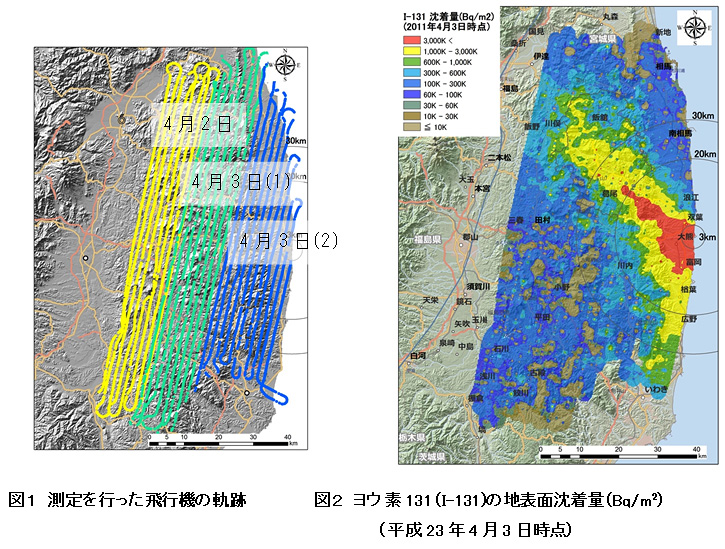

The left map shows the flight paths. The right map is I-131 deposition.
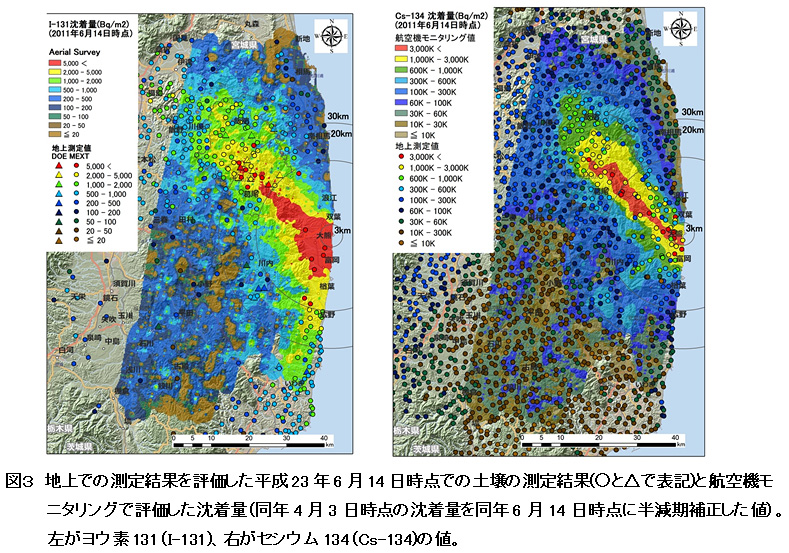

The left map is I-131 deposition, and the left map is cesium-134 deposition to show similarities and differences.

==============================

Japan Atomic Energy Agency and the US Department of Energy and National Nuclear Security Administration collaborated to create a map of iodine-131 deposition, and the paper featuring the map is to be published on June 26, 2013 in the electronic version of the official journal of Health Physics Society.

I searched JAEA site looking for the maps, and as usual their latest information is several days old, even though they just held a press conference announcing the publication.

Here's from a nuclear researcher I follow, an abstract of the paper for the 58th Annual Meeting of the Health Physics Society (7-11 July 2013, Madison, WI):

WAM-B.5   10:30  Enhanced Analysis of Early Aerial Surveys Maps I-131 Deposition from the Fukushima Daiichi Accident T Torii, Fukushima Environmental Safety Center, Japan Atomic Energy Agency ; T Sugita, Fukushima Environmental Safety Center, Japan Atomic Energy Agency; CE Okada*, U.S. Department of Energy, Remote Sensing Laboratory; MR Reed, U.S. Department of Energy, Remote Sensing Laboratory; DJ Blumenthal, U.S. Department of Energy, National Nuclear Security Administration

Abstract: During March through May 2011, the U.S. Department of Energy, National Nuclear Security Administration conducted aerial radiological surveys to characterize the severity and extent of the Fukushima Daiichi accident. The data from these surveys have previously been reported in terms of ground-level exposure rate (mSv/h) and concentrations of Cs-134/Cs-137 (Bq/m²). A small subset of the data has been re-examined with analysis techniques that were developed to exploit the gamma-ray spectral data and determine the ground-level I-131 concentration. I-131 is a short-lived (t½ = 8.04 d) radionuclide that is a potential major contributor to dose in a nuclear power plant accident. The methods developed for this analysis are described, and results of this effort are reported. *This work was done in part by National Security Technologies, LLC, under Contract No. DE-AC52-06NA25946 with the U.S. Department of Energy.


National Security Technologies, LLC is a joint venture formed in 2006 between Northrop Grumman Corporation and three other corporate partners including Babcock & Wilcox. Looks like an outsourcing outfit of Dept of Energy.

According to Mainichi Shinbun (6/27/2013):

  • The maps show contamination by radioactive iodine in the 400 square kilometer areas around Fukushima I Nuclear Power Plant.

  • The maps are based on the analysis of the data from aerial surveys done by the US Department of Energy on April 2 and 3 in 2011.

  • High deposition of radioactive iodine in the north-western direction from the plant, same as radioactive cesium deposition.

  • High deposition of radioactive iodine also in the southern direction from the plant, with areas with more than 1 million Bq/m2 extending to the north of Iwaki City.

  • Delay in disclosing the data is ascribed to "careful examination" by JAEA, as it was difficult to extract data for radioactive iodine as the contamination of the airplanes used in the survey was quite high.


I think this is part of the data that was freely given by the US government to the Japanese government, with the express consent by the US government to the Japanese government to distribute the data freely, but which the Japanese government decided to sit on. The data included contamination maps from data collected by Global Hawk drones in March 2011, and near-real-time video footage of Fukushima I Nuclear Power Plant also by Global Hawk in March 2011. (See my post from 2012.)

If so, JAEA may have finally figured out that the data was in GIS file format.

Radioactive iodine spreading to the south of the plant was the animation of the simulation I was watching in horror at France's IRSN site within a week (earliest simulation was on March 17, 2011) of the accident on March 11, 2011.

Tuesday, November 22, 2011

TEPCO to Recalculate the Amount of Radioactive Materials Leaked into the Ocean

Not only foreign researchers but also Japanese researchers have raised issues with TEPCO's estimate on the amount of radioactive materials that leaked (on its own, or intentionally) into the Pacific Ocean, TEPCO has said it will recalculate the number. The company hopes to announce the result of the recalculation by the end of this month.

So far, TEPCO's number is 4,700 terabequerels (iodine, cesium).

From Chunichi Shinbun (11/23/2011; don't expect the link to last long on this paper):

福島第1原発の事故で、4月に判明した高濃度汚染水の海洋流出をめぐり、東京電力が公表した放射性物質の流出量は少なすぎるとして、国内外の研究者から異論が続出している。東電の値には3月の流出分が含まれていないためだが、この値を加えると、過去最悪の海洋汚染になる可能性がある。突き上げを受けた形で、東電は月内の公表を目指し、再計算に乗り出した。

Researchers in Japan and abroad have been disputing the number that TEPCO had announced regarding the amount of radioactive materials in the highly contaminated water at Fukushima I Nuclear Power Plant that leaked into the ocean. The leak was discovered in April. TEPCO's number does not include the amount that leaked in March. If the March number were to be added, it could be the worst marine contamination ever. In response to the criticism, TEPCO has started the recalculation, and hopes to announce the result by the end of this month.

 東電は5月、2号機の取水口近くなどから流出した放射性物質の量は、ヨウ素やセシウムなど3種類で計4700兆ベクレルだったと公表した。1975年に英国セラフィールド核燃料再処理施設から流出したセシウム137の総量5200兆ベクレルより少ないとされた。

In May, TEPCO announced that the amount of radioactive materials that leaked from the water intake of Reactor 2 was 4,700 terabecquerels, total of 3 nuclides including iodine and cesium. It was claimed at that time that the amount was less than 5,200 terabequerels of cesium-137 that leaked from UK's Sellafield nuclear fuel reprocessing plant in 1975.

 だが、9月に日本原子力研究開発機構と、東電の“身内”でもある電力中央研究所の研究者が、実際の流出量は東電発表の約3倍だったとの試算値を相次いで学会発表し、波紋を広げた。

However, in September, researchers at the Japan Atomic Energy Agency and the Central Research Institute of Electric Power Industry (a TEPCO insider, in a way) published the results of their calculations in academic society meetings, showing the actual amount of the leak could be 3 times as much as what TEPCO had announced, creating a stir.

 さらに10月、フランスの放射線防護原子力安全研究所(IRSN)が、セシウム137だけで2・7京ベクレル(京は兆の1万倍)と見込まれるとする試算値を発表。東電発表の実に28倍に当たる。

Then in October, IRSN of France announced their result of calculation which was 27,000 terabecquerels for cesium-137 alone, 28 times as much as what TEPCO had announced.

 日本の研究者の間では、IRSNの試算値は海中でセシウムなどが拡散する状況を適切に見ていない、といった疑問の声も多い。

There are researchers in Japan who cast doubt over the IRSN number as not taking into consideration the dispersion of radioactive cesium in the ocean water.

TEPCO's calculation only counts radioactive materials from April 1 to April 6. The French IRSN thinks the leak started around March 21, when an elevated level of radioactive materials was first observed near the water drain, and lasted till the end of July, though they say the bulk of the leak happened before April 8 (see my post on October 27, 2011).

From my post on April 21, 2011, here are TEPCO's numbers for 6 days of leak:

  • Iodine-131: 2.8 x 10^15 becquerels (2,800 terabecquerels)

  • Cesium-134: 9.4 x 10^14 becquerels (940 terabecquerels)

  • Cesium-137: 9.4 x 10^14 becquerels (940 terabecquerels)

  • Total: 4.7 x 10^15 becquerels (4,700 terabecquerels)

JAEA said the amount of cesium-137 was 4 times as much as what TEPCO had announced. (See JAEA's paper, here.)

Whatever criticism that the Japanese researchers may have, the IRSN was the first in the world (as far as I know) to quickly publish the marine contamination simulation. They published the paper that included this simulation in early April, even before the leak of highly contaminated water was taken into account:


I guess the French researchers weren't thinking much about peer-reviewed science magazines, unlike the Japanese counterparts.

Thursday, October 27, 2011

France's IRSN New Estimate on Amount of Cesium-137 into the Pacific Ocean: 27,100 Terabequerels, or 20 Times TEPCO's Estimate

From Jiji Tsushin (10/28/2011):

フランス政府系の放射線防護原子力安全研究所(IRSN)は27日、東京電力福島第1原発事故後の3月21日から7月半ばまでに海に流出した放射性セシウ ム137の総量は2.71京ベクレル(1京は1兆の1万倍)で、東京電力が6月に発表した推計値の20倍に達すると推定した調査報告書を公表した。

On October 27, the Institute for Radiological Protection and Nuclear Safety (IRSN, Institut de Radioprotection et de Surete Nucleaire) of France announced its research report in which the researchers estimated the total amount of radioactive cesium-137 leaked from Fukushima I Nuclear Power Plant into the ocean was 27,100 terrabecquerels from March 21 to mid July. The IRSN estimate is 20 times as much as the estimate announced in June by TEPCO.

 単独の事故によるものとしては過去最大規模という。このうち82%は、事故が起きた原子炉を冷やすための放水によって4月8日までに流れ出たとされる。

According to IRSN, it is the largest amount of radiation leak in a single accident. 82% of the leak took place by April 8, because of the spraying of water to cool the reactors.

The research paper (in French) is here.

(I don't have energy to look for TEPCO's estimate. But here's the paper (English) by Japan Atomic Energy Agency that put its estimate as 4 times as much as TEPCO's for cesium-137.)

Early April was when someone finally noticed the highly contaminated water from Reactor 2 had been leaking through the "crack" near the water intake canal. Remember the "tracer" (bath salt) to identify the location of the leak? Ah the good old days...

Monday, April 4, 2011

#Fukushima I Nuke Plant: France's IRSN Assessment on Impact on Marine Environment

Now that Japan is openly dumping contaminated water and their government telling everyone who still listens that everything is safe, let's hear what the French experts have to say about the impact on marine life.

France's Institut de Radioprotection et de Surete Nucleaire (IRSN) issued a paper on April 1 on impact of Fukushima I Nuclear Power Plant accident on the marine environment.

It doesn't seem that safe to me. The summary below (google-translated as my French is very rusty) says that while some of radioactive materials will be dispersed wide and over long distance, others will set on the particles suspended in water and will sink to the ocean floor, causing sediment contamination.

Oh great. The ocean floor will be contaminated with the likes of cesium-137 or worse. But not to worry. The Japanese government recommends you eat all the fish and seaweed you want, every single day for 365 days, and you still get only a quarter of the safe radiation dosage per year. What a bargain.

The paper is not yet translated into English/Japanese yet, but the Institute has started to do that for their March papers.

Here's Google translation (looks decent enough):

Measurements made over several days in sea water near the nuclear power plant in Fukushima-Daiichi in Japan show a high contamination of the marine environment by various radionuclides released during the accident at the plant.

In general, radioactive pollution at sea comes from:

  • partly from the direct discharge of contaminated water from the plant;
  • partly transferred by the rivers of radioactive pollutants deposited in soil following air emissions, then leached by rain;
  • benefits for part finally in the ocean part of the plume of radionuclides atmospheric air currents that led to the sea for much of the accident sequence.

Some of these radionuclides are soluble, they will be transported by ocean currents and disperse in oceanic water masses over significant distances.

Others tend to set more or less easily on the solid particles suspended in water, causing sediment contamination after deposition on the ocean floor. Radioactive elements of short half-life, such as iodine 131 (131I), will be detectable for a few months (the radioactivity of iodine-131 is divided by 1000 all ten half-lives, or every 80 days). Others, such as ruthenium 106 (106Ru) and Cesium 134 (134Cs) persist in the marine environment for many years. Cesium 137 (137Cs) has a half long (30 years) it may be justified to ensure close monitoring of long duration, in the coastal areas of Japan where he is likely to be present in sediment. It might be true of plutonium if it was in discards, which is not established yet.

Depending on the persistence of these radionuclides and their concentrations more or less important, some plant and animal species could be contaminated to significant levels, justifying the establishment of a radiological monitoring program of seafood from areas Coastal Japan's most impacted.

Download the information note of the IRSN: " Impact on the marine environment of radioactive releases resulting from the nuclear accident in Fukushima-Daiichi "(pdf)

Half life of:
  • Ruthenium-106: 373 days
  • Cesium-134: 2 years
  • Plutonium: 24,200 years (Pu-239)