Showing posts with label Nuclear Regulatory Authority. Show all posts

Friday, February 28, 2014

201 Accidents at #Fukushima I NPP? "No Way," Says Worker at the Plant, "It's More Like 1,000"


"Happy", who's been tweeting from Fukushima I Nuclear Power Plant since March 2011, tweeted on the news that Nuclear Regulation Authority told the Lower House Budget Committee that there have been 201 accidents at the plant since March 2011 earthquake.

He says "1,000" is more like it. OK that makes more sense. Almost one a day.

"Happy"'s tweet:

この数は発表されたものだけで、全企業のヒヤリハット含めると1000件は越えてるはずでし。

首相は「なぜ?」って理解してないみたいだけど、それは首相が1F収束に対し真剣に目と耳を傾けてないからでし。

This number [201] is only the ones that have been publicly disclosed. If you include "hiyari hatto" [a Japanese word that means "an incident that almost became a more serious accident") by all companies at the plant, the number would be over 1,000.

Prime Minister asks "Why?" He doesn't seem to understand. But that's because Prime Minister is not paying serious attention to the restoration [ongoing work] of Fukushima I NPP.


From what I've read since 2011, "Happy" seldom voices a direct criticism of politicians. This tweet is one of the rare cases.

=============

"Hiyari" - making one's blood turn cold
"Hatto" - startled

Thursday, February 27, 2014

There Have Been 201 Accidents at #Fukushima I NPP Since March 11, 2011, Says Nuclear Regulation Authority; PM Abe Says "Regrettable"


If the number is correct, it has been 5 to 6 accidents ("toraburu" - trouble, as Japanese call them) per month since March 11, 2011. Reading tweets by workers at Fukushima I Nuclear Power Plant, I would have thought the number was much, much higher (like one per day).

From Jiji Tsushin (2/27/2014):

福島原発トラブル201件=規制委

201 accidents at Fukushima I Nuclear Power Plant, says Nuclear Regulation Authority

 原子力規制委員会の田中俊一委員長は27日の衆院予算委員会で、2011年3月の東日本大震災発生以降の東京電力福島第1原発でのトラブル発生件数について、「構内車両の油漏れなども含め、(原子力)規制庁が整理したものまで入れると、全体で201件になる」と語った。共産党の笠井亮氏への答弁。

In the Budget Committee in the Lower House on February 27, Chairman Shunichi Tanaka of Nuclear Regulation Authority said the number of accidents that have taken place in Fukushima I Nuclear Power Plant since the March 2011 Great East Japan Earthquake is "201, including oil leaks from the vehicles inside the plant compound and including those documented by the Nuclear Regulation Agency." His remark was in response to the question by Mr. Ryo Kasai of Japanese Communist Party.

 田中氏は当初、規制委として把握しているトラブルの件数を107件と説明した。笠井氏は「トラブル隠しとしか言いようがない」と批判。安倍晋三首相は「なぜ(トラブルが)出るのかはなかなか理解できないが、そういうことがあれば誠に遺憾だし、起こらないように万全を尽くすべきだ」と述べた。

Initially, Mr. Tanaka said the number of incidents that NRA was aware of was 107. Mr. Kasai criticized [Mr Tanaka] as "hiding accidents". Prime Minister Shinzo Abe said, "It is hard to understand why (accidents) happen, but when they do it is very regrettable, and [TEPCO] should do its atmost best to prevent accidents from happening."


It's not that Mr. Abe does not quite understand; he doesn't quite care. That's the feeling I get, seeing him and reading the comment like this which is devoid of any meaning, even though he was the one who declared "the national government at the forefront" in dealing with the Fukushima I NPP accident.

The concept of "Japan, the beautiful country" is all he cares. Not the real thing.

Representative Kasai of Communist Party criticizes, but I don't think his party cares either, judging from what Communist Party's stance turned out to be during the Tokyo gubernatorial election. If the plant keeps having one accident after another, they can use the accidents to criticize the Abe administration and look good in the eyes of current supporters and potential voters in the future election. No incentive for them to push for comprehensible measures.

Tuesday, February 11, 2014

#Nuclear Japan: Nuclear Regulation Authority Agrees That Ooi Nuclear Power Plant Does Not Have Active Faults


It's Nuclear Regulation Authority's turn to be bullish on nuclear power plants in Japan awaiting NRA's approval to restart, now that the Tokyo gubernatorial election ended with the result interpreted as great endorsement of Prime Minister Abe's policies across the board.

NRA accepted the conclusion of the experts that the fractured zones inside the Ooi Nuclear Power Plant compound are not active faults.

All set to restart, then.

From Jiji Tsushin (2/12/2014):

「活動せず」報告書を了承=大飯原発の敷地内断層-規制委

NRA accepted the report that fractured zones at Ooi Nuclear Power Plant are not "active faults"

 関西電力大飯原発(福井県おおい町)敷地内の破砕帯(断層)が活断層である疑いを指摘されていた問題で、原子力規制委員会は12日、「将来活動する可能性のある断層などには該当しない」とする専門家調査団の報告書を了承した。

Fractured zones inside KEPCO's Ooi Nuclear Power Plant (Ooi-cho, Fukui Prefecture) compound have been suspected to be active faults. However, on February 12, 2014, Nuclear Regulation Authority accepted the report by a group of experts whose conclusion is that "they are not faults that may become active in the future".


Ooi Nuclear Power Plant in Fukui Prefecture is accessible through a tunnel. In a severe accident after a big earthquake and tsunami, the only way to access the plant is by boat, if the tunnel collapses. Even then, if the plant harbor is destroyed by tsunami, oh well. It is not supposed to happen, and therefore it won't happen.

The experts investigating on behalf of NRA did two surveys of the site to determine whether the fractured zones were active faults. The first survey was inconclusive, with most experts saying they were active faults. Clearly that changed in the second survey.

In case of a severe accident, the emergency response headquarters at Ooi Nuclear Power Plant will be a small spare room next to the central control room. There was no objection at all from NRA to this arrangement.

Again, the Tokyo gubernatorial election was supposed to be a mere provincial election (which was not, as revealed after the election by the compliant media), and the nuclear issues were supposed to be of little significance (which were total opposite, as revealed after the election by the compliant media).

There's no stopping the Abe administration now.

(... unless another swarm of jellyfish clogs water intakes...)

Ooi Nuclear Power Plant and the access tunnel:

Tuesday, December 10, 2013

#Fukushima I Nuke Plant: Saving Money Comes First Before the Need to Monitor Groundwater Leak Inside the Harbor in a Hilarious NRA Meeting


What's more pressing at Fukushima I Nuclear Power Plant is not measuring radiation levels around the SGTS pipe where 25 sieverts/hour radiation source may be inside (to be sure, again, this 25 sieverts/hour was NOT measured but derived by calculation), nor removing the fuel assemblies from the Spent Fuel Pool on the top floor of Reactor 4 (again, not individual "fuel rods" that are inside a fuel assembly), which has the lowest radiation levels of all reactors (except for Reactors 5 and 6, which are in cold shutdown in the true sense of the word).

It is, as late-Masao Yoshida, Fukushima I NPP Plant Manager at the time of the accident, said, what to do with the contaminated water that keeps increasing. Of particular concern (supposedly) of the national government and TEPCO is whether the contaminated groundwater (albeit low contamination of gamma nuclides) is leaking into the plant harbor.

In the embankment between the plant harbor and the turbine buildings for Reactors 1 through 4, workers have been injecting waterglass into the artificial soil there to create impermeable walls in the soil to stop the flow of groundwater into the harbor. Never mind that their very work causes the groundwater to rise and go over the top of the underground impermeable wall, or go somewhere else and find its way to the ocean anyway.

From TEPCO, 12/8/2013 (red lines: silt fences, green lines: soil amendment by waterglass, yellow dots: groundwater monitoring locations):


TEPCO has been frequently monitoring radioactive materials (gamma nuclides such as cesium, all-beta including strontium, and tritium) in the water samples taken from these numerous observation holes in the embankment. However, samples from the seawater in the harbor are taken far less frequently. Nuclear Regulation Authority has been calling for continuous monitoring of seawater for some time, and the topic came up in the third meeting of NRA's ocean monitoring group on December 9, 2013.

But the word that came out of NRA Commissioner Kayoko Nakamura was, "Continuous monitoring system is an expensive purchase..."

From independent journalist Ryuichi Kino, and a togetter on the December 9 NRA meeting on ocean monitoring:

(Kino summarizes the relevant part of the meeting in a dignified way...)

汚染水の漏洩を検知する連続モニタリング装置の設置について、東電は南側放出口と北の放出口に3か所を検討していて、海が荒れているので設置方法に時間かかっているなどと説明。委員から、なぜ開渠内(防潮堤内側の護岸付近)につけないのか理解できないと疑問の声

TEPCO is considering three locations near the south discharge and the north discharge to install continuous monitoring system to detect the leak of contaminated water, and explains it is taking time to install because of the rough ocean. People questioning, why not install inside the open channel (inside the harbor near the embankment)?

この疑問は今に始まったことではない。今年1月に東電が護岸に観測用井戸を掘って地下水を分析したという時に会見で聞くと、港湾内で何点か測っている、海でも測っているので変化はわかる、問題ないという主旨の回答があった。同じ回答を今でもしてる

The question is nothing new. When I asked TEPCO in January this year when they started digging the observation holes along the embankment and analyzed the groundwater samples, TEPCO answered that they were measuring in several locations inside the harbor, and they were measuring in the ocean, too. They could detect the change that way, no problem. That was the answer then, and that is the answer now.

今問題になっているのは護岸からトレンチ由来、あるいは建屋由来の高濃度のものが出ているかどうか。連続監視は高濃度のものが出たらすぐにわかるようにするのが目的なので、近いほうが変化はわかる。けれども東電は港湾の外で測ることに固執。理由がわからない。

What's at issue now is whether the highly radioactive water from the trench [where extremely radioactive water from March/April 2011 from the reactors sits] or from the reactor buildings is leaking from the embankment or not. The purpose of continuous monitoring is to know immediately if highly radioactive water is leaking. To monitor the change, it's better to monitor closer [to the embankment where the leak may be occurring]. But TEPCO insists on monitoring outside the harbor. I don't understand the reason.

規制委の中村佳代子座長「連続モニタリングは高い買い物」。だから選定に時間かかると。はて、どういう意味なのか。高い安いの問題ではなく、委員から出ていた意見は「早く」やること。のんびり半年、1年かけてやるようなものではない

NRA's Kayoko Nakamura says, "Continuous monitoring is an expensive purchase." So it takes time to select [the equipment], she says. Well, what does that mean? It's not the matter of how expensive or how cheap; the opinion of the members is to do it "soon". It is not the thing to be done leisurely over six months or a year.

中村座長は精度が重要ともいう。すでにこれまでの精度にも疑義が出ているのでこれは重要だけど、東電がいったいどこのメーカーや専門家となにを検討しているのか、中身の公表がないので、やっぱり設置が遅れている理由はわからない

Ms. Nakamura also says accuracy [of measurement] is important. It is important, as the accuracy has been questioned before. But no information has been disclosed as to which manufacturer and/or experts TEPCO is consulting with and on what. We still don't know the reason why the installation hasn't been done.

(The same discussion, from the togetter; it reads almost like a farce, a comedy routine, where research experts are at a loss what to do with TEPCO...)

TEPCO says it wants to install continuous monitoring instruments OUTSIDE the plant harbor. From NRA's reference document for the meeting (English labels and comment are mine):


森田:前回も同じこと言ったが。港湾の外につける意味が分からない。5・6放水口は、港湾の中の水を吸い上げているので、外につける意味が(ないんじゃ?)
Morita [from the Fisheries Agency]: As I said before, I don't understand why you want to install [the continuous monitoring system] outside the harbor. The discharge for Reactors 5/6 pumps out the water from inside the harbor, so there is no point in installing it outside.

森田:漏れているのが海渠だと言われているので、そちらにつけるほうが。港湾の外、日々のデータが取れるのか?
Morita: The water is leaking into the open channel, or so it is said. Doesn't it make more sense to install the instrument there? Can you collect daily data outside the harbor?

[To this, TEPCO answers in non-answer by talking about detection limit...]

東電:検出限界値、0.1Bq/L。全βを排除するかというのが問題だが、20Bq/Lを目安に。
TEPCO: Detection limit is 0.1Bq/L. The problem is whether to exclude all-beta, but we are aiming at 20Bq/L.

青山委員:全βの連続モニタリングなんて、技術的・機械的に可能なの?(頭を抱える青山委員)
Aoyama [chief researcher from Meteorological Research Institute]: Is it even technically and mechanically possible to continuously monitor all beta? (and Mr. Aoyama buries his head in his hands.)

青山:γ線は、セシウム137?
Aoyama: gamma rays, you mean cesium-137?

東電:監視は、セシウム134・137
TEPCO: Cesium-134 and -137 will be monitored.

青山:いまの東電さんの説明は理解できません、誰が理解できたひとがいたら説明してください
Aoyama: I don't understand TEPCO's explanation. If anyone understands, please explain.

堀口委員:森田委員からもありましたが、私も港湾内に設置しないというのは理解できません。港湾内にないのは奇異に感じる。おそれがあるところをモニターしないと。本末転倒。一番重要なところが抜けている
Horiguchi [National Science Laboratories Environmental Risk Research Center]: Like Mr. Morita, I don't understand either why the monitoring instruments are not going to be installed inside the harbor. Monitoring should be done at the locations where the leak is suspected. We're getting our priorities wrong. The most important thing is not being done.


中村座長:装置を導入購入するには、必ず放射線の専門家の意見を参考にして、高い買い物ですし、と
Commissioner Nakamura: When you purchase the instrument, make sure you consult radiation specialists. It's an expensive purchase, you know...

Well the priority seems to be the cost.

After the Fukushima I Nuke Plant accident, they still think of cost as outlay of money to purchase goods and services. They don't consider the social cost of not starting monitoring the water inside the harbor as soon as possible, particularly inside the open channel right outside the embankment.

As it stands, TEPCO plans to start continuous monitoring OUTSIDE the harbor hopefully next spring, maybe fall.

For TEPCO and the national government, time is indeed money - i.e. money saving.

Reference documents (in Japanese) for the meeting: http://www.nsr.go.jp/committee/yuushikisya/kaiyou_monitoring/20131209.html

Cheerful Commissioner Kayoko Makamura:

Wednesday, October 9, 2013

Pictorial-2: Another Elementary Mistake in Water Leak at #Fukushima I NPP - Good Old Overflow


This is now a toddler-would-start-to-be-embarassed level of a mistake.

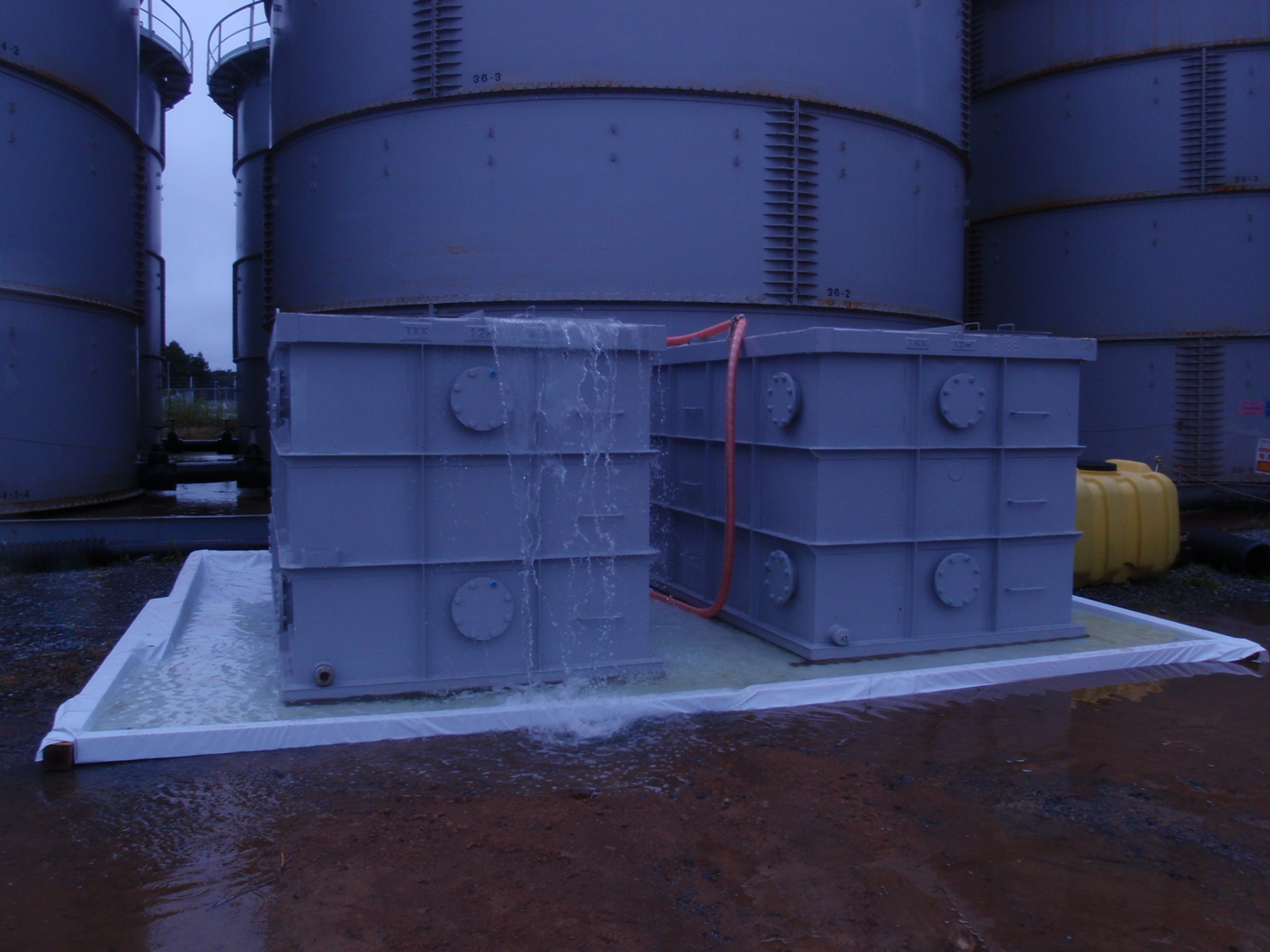
In preparation for the typhoon rain, workers connected the hose to transport rainwater into a square tank (TEPCO calls it "notch tank") and turned on the pump. The problem was that they connected to a wrong tank in a wrong area (H6 Area, instead of intended H2), and the rainwater overflowed.

Photo from TEPCO (10/1/2013):

(Photo taken by Nuclear Regulation Authority)


NRA chairman Shunichi Tanaka is worried about the recent spate of minor water leaks at Fukushima I Nuclear Power Plant due to apparent worker errors, and commented, according to Mainichi Shinbun (10/9/2013):

「現場の士気がかなり落ちており、不注意によるトラブルを起こす原因になっている。今後東電の経営陣に(士気向上を)求める必要がある」

"The [workers'] morale at the plant has dropped considerably, causing problems due to carelessness. We need to request TEPCO's top management to (boost the morale)."


Commissioner Fuketa, in the same Mainichi article, also said:

「汚染水の移送先の間違いなど単純な人的ミスが発生しており、看過できない」

"Simple, human errors are occurring, including the one where workers transported the contaminated water to a wrong tank. We cannot overlook such errors."


So, what are you going to do, Dr. Tanaka and Dr. Fuketa?

TEPCO's top management, as with any top management at any large corporation, does not necessarily know how the front-line workers at the plant work. Recall how then-Plant Manager Masao Yoshida had to fight the top management to get the job done at the plant.

Besides, many workers at the plant are made to work for peanuts ($100 a day, if that) with no benefit or job security, as a contract worker at a subcontractor.

The best morale-boosting thing TEPCO could do, I think, would be to split out the plant as a separate company, directly hire the workers with benefits, raise own capital and attract companies/people with expertise in decommissioning. Too bad the idea, which was first raised and advocated by then-TEPCO Chairman Katsumata in 2011, was shot down by the Democratic Party of Japan administration under Naoto Kan.

Wednesday, August 21, 2013

#Fukushima I Nuke Plant: Leak of "300 Tonnes" of RO Waste Water May Not Be "300 Tonnes"


As I wrote in my previous post, TEPCO said at least 300 tonnes of highly contaminated (mostly beta nuclides) waste water after the RO (reverse osmosis) treatment may have leaked, because the water level of the tank that leaked was found to have dropped by 3.4 meters.

Well, not so fast.

Thanks to mostly TEPCO's extremely sloppy management of these steel tanks that hold highly contaminated RO waste water, it turns out we really don't know how many tonnes of this waste water has leaked from the tank No.5 in the area H4. It could be more, it could be less, but no one really knows.

How so?

Here are some of the topics discussed in the yesterday (August 21, 2013)'s long meeting of Nuclear Regulatory Authority's Working Group to deal with contaminated water at Fukushima I Nuclear Power Plant and which didn't get reported in the media. (Information from NRA's youtube video, presentations at the meeting, blogpost by @tsokdba, togetter by @mtx8mg)

1. Is it really "300 tonnes" leak?

"300 tonnes" of RO waste water leak assumes the tank No.5 had been actually close to full (about 96% of the capacity) before the leak started. But this turned out to be just an "assumption" (sound familiar?) on the part of TEPCO.

Why?

Because there is only one water gauge installed for the group of tanks. As TEPCO's diagram shows, the tank No.5 belongs to the tank group I which consists of the tanks No.5, 7, 8, 9, 10. The water gauge for the group is installed on the tank No.7. Note the tiny yellow star on the side of the tank No.7:


When the waste water is transported from the Reverse Osmosis Apparatus, it is fed to the tanks No. 5, 7, 8, 9, 10 evenly, because the tanks are connected to each other via the feed line. So when the tank No.7 becomes full, all the other tanks are assumed to be also full.

TEPCO had never measured the water level of the tank No.5 until this leak was found, and the company had to send workers on top the tank to stick in the tape measure.

Mr. Kinjo from the Nuclear Regulatory Agency (secretariat of NRA) asked if TEPCO had confirmed that the tank No.5 had been full. The answer was no.

2. Where has this "300 tonnes" (if it was actually 300 tonnes) of waste water been leaking from?

"300 tonnes" of RO waste water was supposed have leaked over a month, according to the media report. However, that's 10 tonnes, or 10,000 liters a day. Even for TEPCO, the amount is too large not to have spotted it much sooner. Workers who are sent out daily to patrol the site have been spotting leaks with few hundred liters. TEPCO says the workers didn't find anything until August 19.

TEPCO hasn't found any leak from the visible part of the tank itself, but the level of waste water in the tank continues to decrease, albeit at rates that are not consistent with the constant leak.

TEPCO measured the water level of the tank No.5 on August 20, and

  • From 9:30AM to 3:30PM, the water level dropped by 5 centimeters.

  • In the next 6 hours, it dropped by 1 centimeter.

  • So in 12 hours it dropped by 6 centimeters, which translates into 10 tonnes in 24 hours.


(Hmmm. Why are there two different, drastically different rates? How could they extrapolate this into 24-hour rate?)

Could the leak be from the bottom of the tank, which is made of five 16-millimeter thick SS400 steel sheets fastened together? (They did use epoxy sealer inside to prevent corrosion.)

(From TEPCO's presentation to NRA Working Group, 8/21/2013)


Could the concrete platform have cracks through which the waste water has been leaking?

TEPCO couldn't answer, as there is no way to check the leak at the bottom of the tank unless the water is first emptied.

3. Has the water leaked into the open water?

TEPCO says they have found locations along the drain that have high radiation levels, and says the possibility cannot be denied.

However, the analysis of seawater on August 20 near the location where the C drain drains to the ocean shows cesium-137 at 0.0018 Bq/cm3, cesium-134 and all-beta were ND. If the waste water has been leaking into the ocean, the measurement at this location should show the high level of all-beta. It hasn't, so far, this time.

So, in conclusion, neither TEPCO nor NRA know exactly what's happening, and but at this point it is more likely than not that this waste water with high beta hasn't leaked much into the ocean, at least not through the drains located nearby.

There is a possibility that the tank No.5 wasn't full, and that it wasn't 300 tonnes that leaked. And there is a possibility that the leak is from the bottom of the tank, and it has been leaking through a crack in the concrete (if there's a crack). In case of the latter, radioactive materials, especially all-beta, will show up in the groundwater sooner or later if TEPCO monitors the wells for the groundwater bypass plan.

TEPCO has finished emptying the tank No.5, but the radiation level inside the tank is just too high right now for closer inspection, according to NHK.

But the facts (or I should say the lack thereof) don't matter much any more to most people, and the Japanese media (like NHK) is almost gleeful that the attention of foreign media like BBC, Reuters, Wall Street Journal, etc. is again on the plant. The most recent entity to weigh in is IAEA, saying it "views this matter seriously and remains ready to provide assistance on request."

Tuesday, August 6, 2013

Ministry of Economy's Money Grab Using #Fukushima I Nuke Plant Groundwater Contamination


(UPDATE) And just to show it knows something about contaminated water, the Agency of Natural Resources and Energy under METI just declared that 300 tonnes of contaminated water is flowing out to the ocean every day from Fukushima I Nuke Plant, according to Kyodo News.

============================

There may no line of command and they may be "blind", but that doesn't stop Ministry of Economy, Trade and Industry and its Minister Toshimitsu Motegi from using the "crisis" over the contaminated groundwater at Fukushima I Nuclear Power Plant for money grab.

As Japanese and foreign media's coverage of "highly contaminated" groundwater that may have gone over the top of the underground impermeable wall into the "ocean" (open culvert outside the water intakes inside the plant harbor) without much raising the radioactivity in the seawater there reaches a crescendo, Motegi and his Ministry of Economy, Trade and Industry which (surprisingly) still retains the main role in Fukushima I Nuke Plant decommissioning ride to the rescue.

According to the Japanese papers (Asahi, Nikkei, Jiji and others) are reporting on August 7 that:

  • Ministry of Economy, Trade and Industry will ask for at least 40 billion yen from the fiscal 2014 national budget for the construction of the frozen impermeable wall to surround the reactor buildings and turbine buildings at Fukushima I Nuke Plant to stop the groundwater from entering the buildings;

  • Prime Minister Shinzo Abe will formally instruct Minister of Economy Toshimitsu Motegi to hurry up with countermeasures to deal with the contaminated water at Fukushima I Nuke Plant during the meeting of Nuclear Emergency Response Headquarters [yes, it still exists] in the afternoon of August 7;

  • "There is no precedent in the world to build such an extensive frozen wall like this", says Chief Cabinet Secretary Yoshihide Suga, "So the national government should step forward to carry out the project".


Fiscal 2014 starts in April 2014. Some urgency. And the national government wants to take credit because it will be the first ever in the world (their favorite - "No.1! Number One!"). Or at least so in their mind.

That indicates to me that METI and Motegi are using the problem of contaminated groundwater that may be slowly saturating the space between the turbine buildings and the seawall and potentially destabilizing the underground trenches as a tool to grab money for themselves, to show the Ministry is still powerful and influential in distributing goodies to their buddies (in this case minimum 40 billion yen to Kajima to build the frozen wall).

Nikkei Shinbun makes a curious put-down on Nuclear Regulatory Authority:

昨年9月に経産省から独立して発足した原子力規制委員会は当初、廃炉作業から距離を置き、官庁の監督体制も弱まった

Nuclear Regulatory Authority, which was created separate from Ministry of Economy, Trade in Industry in September last year, distanced itself initially from the decommission work, and the regulatory oversight by ministries weakened.


As if NRA had any choice, and as if it was because of NRA that the oversight weakened.

The tenor and timbre of the Japanese papers are:

Finally! National government is doing something! and it will be Ministry of Economy in charge. Isn't it wonderful?


Nuclear Regulatory Authority's Kinjo said in the Reuters' article that TEPCO's "sense of crisis is weak". The same can be said about METI and Abe's government. For that matter, it can be said about the entire populace.

Normalcy bias has been pervasive and strong in Japan from the day one of the nuclear accident.

#Fukushima I Nuke Plant Accident: The Blind (METI) Still Leading the Blind (TEPCO)


So Nuclear Regulatory Authority finally butted in, formed its own committee and started ordering TEPCO to do something (probably wrong "something", again, but...) over the groundwater saturating the embankment at Fukushima I Nuclear Power Plant because of TEPCO's ill-conceived underground impermeable wall.

I was wondering why it took NRA until very recently to actively participate in dealing with the accident, until I read independent journalist Ryuichi Kino's tweet just now. It is because Ministry of Economy, Trade and Industry (METI) is in charge of decommissioning the plant:

福島第一の現場で何かが行われているのか、何を基準に工法や、工事の優先順位を決めているのか、この判断理由が外からはまったく見えない。事故収束作業の管理監督をしているのは資源エネルギー庁を事務局とする廃炉対策推進会議だけども、エネ庁はコストの確認をしていない。

What is going on at Fukushima I Nuke Plant? Who decides what method of construction to use on what criteria, and who decides which construction to be given the priority? From outside, the decision-making is completely opaque. The entity in charge of managing and supervising the works to control the plant is the Council on Decommissioning Measures with the Agency of Natural Resource and Energy [under Ministry of Economy, Trade and Industry] acting as the secretariat, but the Agency does not know the cost of works at the plant.


The Council was set up by the Ministry of Economy, Trade and Industry as of February 8, 2013, and so far has had 5 meetings. The members are (information from TEPCO):

  • Chairman: Minister of Economy, Trade and Industry

  • Deputy Chairman: Vice Minister of Economy, Trade and Industry

  • Council members: President of TEPCO, Director General of JAEA, President of Toshiba, President of Hitachi

  • Secretary: Advisor to Minister of Economy, Trade and Industry in charge of energy and technology

  • Observer: Nuclear Regulatory Authority/Nuclear Regulatory Agency


Nuclear Regulatory Authority/Nuclear Regulatory Agency is just an observer, which in case of Japan has a privilege to sit in the meeting and literally "observe" the meeting but not say much (or at all).

Ministry of Economy, Trade and Industry (METI) had to relinquish NISA (Nuclear and Industrial Safety Agency) in September last year when the new nuclear regulatory body (NRA) was created. Or so I thought.

Reuters' article from yesterday quoting Mr. Kinjo, who is the observer to this Council, fails to mention that it is still good old METI in charge of decommissioning work.

Kino says the Secretary to the Council is a career bureaucrat, and the current one was rotated into this position in June this year. Just a part of career stepping stone for bureaucrats at the Agency of Natural Resources and Energy.

Minister of Economy, Trade and Industry is ex-McKinsey consultant Toshimitsu Motegi, who just dispensed consulting advice to "the parties concerned" regarding Kashiwazaki-Kariwa Nuclear Power Plant.

For politicians and bureaucrats, it's "Après moi, le déluge". Literally.

Reuters: Japan nuclear body says radioactive water at Fukushima an "emergency", water could breach surface


OK, it may be an emergency after all.

From Reuters Japan, who regularly sends reporters to press conferences by TEPCO and Nuclear Regulatory Authority, on the groundwater contamination along the embankment of Fukushima I Nuclear Power Plant (8/5/2013):

EXCLUSIVE-Japan nuclear body says radioactive water at Fukushima an "emergency"

* Fukushima radioactive groundwater could breach surface, regulator says

* Watchdog panel head says Tepco's 'sense of crisis is weak'

* Official says leaks into ocean exceed legal limits

* Tepco apologises, says taking steps to block further leaks into ocean (Adds comments from outside experts, background)

By Antoni Slodkowski and Mari Saito

TOKYO, Aug 5 (Reuters) - Highly radioactive water seeping into the ocean from Japan's crippled Fukushima nuclear plant is creating an "emergency" that the operator is struggling to contain, an official from the country's nuclear watchdog said on Monday.

This contaminated groundwater has breached an underground barrier, is rising toward the surface and is exceeding legal limits of radioactive discharge, Shinji Kinjo, head of a Nuclear Regulatory Authority (NRA) task force, told Reuters.

Countermeasures planned by Tokyo Electric Power Co are only a temporary solution, he said.

Tepco's "sense of crisis is weak," Kinjo said. "This is why you can't just leave it up to Tepco alone" to grapple with the ongoing disaster.

"Right now, we have an emergency," he said.

Tepco has been widely castigated for its failure to prepare for the massive 2011 tsunami and earthquake that devastated its Fukushima plant and lambasted for its inept response to the reactor meltdowns. It has also been accused of covering up shortcomings.

It was not immediately clear how much of a threat the contaminated groundwater could pose. In the early weeks of the disaster, the Japanese government allowed Tepco to dump tens of thousands of tonnes of contaminated water into the Pacific in an emergency move.

The toxic water release was however heavily criticised by neighbouring countries as well as local fishermen and the utility has since promised it would not dump irradiated water without the consent of local townships.

"Until we know the exact density and volume of the water that's flowing out, I honestly can't speculate on the impact on the sea," said Mitsuo Uematsu from the Center for International Collaboration, Atmosphere and Ocean Research Institute at the University of Tokyo.

"We also should check what the levels are like in the sea water. If it's only inside the port and it's not flowing out into the sea, it may not spread as widely as some fear."

NO OTHER OUTLET FOR WATER

Tepco said it is taking various measures to prevent contaminated water from leaking into the bay near the plant. In an e-mailed statement to Reuters, a company spokesman said Tepco deeply apologised to residents in Fukushima prefecture, the surrounding region and the larger public for causing inconveniences, worries and trouble.

The utility pumps out some 400 tonnes a day of groundwater flowing from the hills above the Fukushima Daiichi nuclear plant into the basements of the destroyed buildings, which mixes with highly irradiated water that is used to cool the reactors in a stable state below 100 degrees Celsius.

Tepco is trying to prevent groundwater from reaching the plant by building a "bypass" but recent spikes of radioactive elements in sea water has prompted the utility to reverse months of denials and finally admit that tainted water is reaching the sea.

In a bid to prevent more leaks into the bay of the Pacific Ocean, plant workers created the underground barrier by injecting chemicals to harden the ground along the shoreline of the No. 1 reactor building. But that barrier is only effective in solidifying the ground at least 1.8 meters below the surface.

By breaching the barrier, the water can seep through the shallow areas of earth into the nearby sea. More seriously, it is rising toward the surface - a break of which would accelerate the outflow.

"If you build a wall, of course the water is going to accumulate there. And there is no other way for the water to go but up or sideways and eventually lead to the ocean," said Masashi Goto, a retired Toshiba Corp nuclear engineer who worked on several Tepco plants. "So now, the question is how long do we have?"

Contaminated water could rise to the ground's surface within three weeks, the Asahi Shimbun said on Saturday. Kinjo said the three-week timeline was not based on NRA's calculations but acknowledged that if the water reaches the surface, "it would flow extremely fast."

A Tepco official said on Monday the company plans to start pumping out a further 100 tonnes of groundwater a day around the end of the week.

The regulatory task force overseeing accident measures of the Fukushima Daiichi nuclear power station, which met Friday, "concluded that new measures are needed to stop the water from flowing into the sea that way," Kinjo said.

Tepco said on Friday that a cumulative 20 trillion to 40 trillion becquerels of radioactive tritium had probably leaked into the sea since the disaster. The company said this was within legal limits.

Tritium is far less harmful than cesium and strontium, which have also been released from the plant. Tepco is scheduled to test strontium levels next.

The admission on the long-term tritium leaks, as well as renewed criticism from the regulator, show the precarious state of the $11 billion cleanup and Tepco's challenge to fix a fundamental problem: How to prevent water, tainted with radioactive elements like cesium, from flowing into the ocean. (Additional reporting by Kentaro Hamada; Editing by Edmund Klamann and Raju Gopalakrishnan)


Asahi's article: http://digital.asahi.com/articles/TKY201308030013.html?ref=comkiji_txt_end_kjid_TKY201308030013

It looks like "three weeks" is Asahi's own calculation.

I hope TEPCO has at least stopped the injection of waterglass into the artificial soil, but hope is a dirty four-letter word.

#Fukushima I Nuke Plant Groundwater Contamination: TEPCO's Ad-Hoc Underground Impermeable Wall in Embankment Made It Worse


This is just too ... (I can't even come up with the right word to describe).

Amateurish, maybe. Pathetic, maybe. And sad.

Because radioactive materials started to get detected in June this year in observation holes along the embankment in orders they didn't expect, TEPCO hastily decided in early July to inject waterglass in the soil of the embankment to create an impermeable wall in the ground. Since it is hot during the day at the plant, they made the workers work at night in full protection gear, from 7PM to 7AM, in the area with high radiation.

According to the articles below, we now know what many of us may have been suspecting all along. The idiom "Haste makes waste" exists for TEPCO.

It turned out that injection of chemicals to create the impermeable wall was too successful. It not only stopped the flow of groundwater, but raised the groundwater level significantly. So now, the groundwater is probably going up and over the hastily built underground impermeable wall, and through the porous, top part of the embankment into the open culvert.

The embankment is artificial, built on top of a natural sandy beach which had existed before the plant was built. There is no way to inject chemicals to solidify the top 1.8 meters. Even if it is possible, the water will simply go around the sides.

(The opening sentence of Nikkei's article below is wrong, though. There is no highly contaminated water leaking from the plant, yet. The highly contaminated water is mostly in the underground trenches, where it has been since 2011. Some may be leaking into the groundwater flowing from the west and that groundwater may be leaking into the open culvert.)

From Nikkei Shinbun (8/3/2013):

福島第1の汚染水、地下の遮水壁越え海に流出か

Contaminated water from Fukushima I Nuke Plant may be leaking into the ocean over the underground impermeable wall

東京電力福島第1原子力発電所から高濃度に汚染された水が流出している問題で、地下の「遮水壁」を乗り越えて海に漏れ出ている可能性が高いことが2日、明らかになった。原子力規制委員会の作業部会で、更田豊志委員らが指摘し、東電も認めた。魚など海洋生物などへの影響が懸念されるため、規制委は東電に緊急対策を指示した。

Regarding the problem of highly contaminated water leaking from Fukushima I Nuclear Power Plant, it was revealed on August 2 that it was highly likely that the contaminated water is going over the underground "impermeable wall" and leaking into the ocean. Nuclear Regulatory Authority's working group met on August 2, and commissioners including Toyoshi Fuketa pointed out the possibility and TEPCO admitted to the possibility. As there are worries over the effect on marine creatures including fish, Nuclear Regulatory Authority ordered TEPCO to come up with emergency countermeasures.

 東電は地下の汚染水が海に流出するのを防ぐため、7月上旬から護岸沿いに水ガラスと呼ぶ特殊な薬液を注入して土を固め、遮水壁をつくる工事を進めていた。遮水壁は地下1.8メートルよりも深い部分に設置されている。

In order to prevent the underground contaminated water from leaking into the ocean, TEPCO has been injecting special liquid called waterglass [sodium silicate solution] along the embankment to solidify the soil and build an impermeable wall since early July. The wall is set deeper than 1.8 meters from the surface.

 作業部会は地下水の水位が最近になって上昇し、遮水壁の上端部を越えた可能性が高いとの結論に達した。壁で地下水をせき止めたのが原因とみられる。地下水は壁を乗り越えるほか、横からも漏れる恐れがある。

The working group came to the conclusion that because the underground impermeable wall stopped the flow of groundwater, the level of groundwater rose recently, and went over the top of the wall. Not only the groundwater could go over the impermeable wall but go around the wall and leak from the sides of the wall.

 東電は遮水壁の近くに井戸を掘り、地下水をくみ上げて水位を下げる工事に着手。今月末までの完成を目指す。地下水は山側から1日に100トンほど流れ込んでおり、これを超す量をくみ上げる必要がある。水の保管方法などは今後検討する。

TEPCO will start digging wells near the impermeable wall to draw groundwater and lower the water level. The company hopes to finish by the end of this month. Groundwater is flowing in from the mountain side (west) at the rate of 100 tonnes per day, and TEPCO needs to draw more than that amount. Storage of the water thus drawn will be discussed later.

(Diagram from Nikkei Shinbun, English labels are by me.)


Now, what is the point of drawing the contaminated groundwater along the embankment? In haste? Particularly when the levels of cesium, all-beta, and tritium in the open culvert have not risen in a significant manner? Do they even stop and think?

They have to somehow stop the groundwater upstream, before it reaches the space between the turbine buildings and the embankment and gets contaminated.

According to an article by Mainichi Shinbun that only appeared in Fukushima local edition (7/24/2013), the embankment was a landfill:

この一帯は原発建設時の1960年代に埋め立てられたもので、東電は「なぎさに泥岩、砂岩を積み上げてできた土地」と説明する。

This area was reclaimed in the 1960s when the plant was being constructed. TEPCO explains that the land was made by piling up mudstones and sandstones on the beach.


And just like anything else - from removing fuel rods from the spent fuel pools to removing the corium from the broken reactors - TEPCO has been made to promise the wells will be dug "ahead of schedule", starting this weekend, according to Yomiuri Shinbun (8/6/2013).

The Yomiuri article makes no mention of what will happen to the water drawn from the wells.

What's the point of drawing the water "ahead of schedule" when you don't even know what to do with it?

I am more convinced that construction of the impermeable wall in the ocean by driving sheet piles in the open culvert with vibratory hammer has caused the leak by disturbing the underground trenches and joints that were already damaged by the March 11, 2011 earthquake and tsunami. The trenches and shafts were filled with highly contaminated water from April/May 2011 leak from the turbine buildings for Reactors 2 and 3.

TEPCO did not want to deal with the highly contaminated water, and instead decided to inject waterglass, thinking that would stop any water from flowing into the ocean.

My guess is that by hastily injecting waterglass TEPCO wanted at least few weeks of non detection or low detection of radioactive materials from the observation holes, so that they could somehow proceed on releasing the uncontaminated groundwater drawn from upstream into the ocean.

For now, TEPCO cannot release any water, and groundwater keeps flowing from west to east without any hindrance.

The photo below is from July 16, as workers injected waterglass in an effort to stop the groundwater (from TEPCO's Photos and Videos Library 7/17/2013):

Wednesday, July 31, 2013

High-Level Radioactive Liquid Waste, Plutonium Nitrate Stored in Tokai Reprocessing Plant, JAEA Volunteers Information to NRA


I've never heard of a nuclear operator volunteering bad information to a regulatory agency without being asked. Neither has NRA Chairman Tanaka, apparently.

It is almost unprecedented, says Chairman Tanaka, that a nuclear operator (in this case JAEA) has volunteered the information and alerted the regulatory authority (in this case NRA) of existence of hazard and risk at a nuclear facility (in this case Tokai Reprocessing Plant).

On July 31, Nuclear Regulatory Authority held its regular weekly meeting, which was netcast live (now archived at NRA's Youtube channel). Toward the end of the long meeting, Chairman Shunichi Tanaka asked the commissioners if they had any last thoughts and suggestions. Commissioner Fuketa raised his hand, and proceeded to tell the other commissioners and officials from the Nuclear Regulatory Agency (secretariat of NRA) about a piece of information voluntarily submitted by Japan Atomic Energy Agency (JAEA).

JAEA told NRA that there are large quantities of high-level liquid waste and plutonium in liquid form at its Tokai Reprocessing Plant in Ibaraki Prefecture and that they wanted to solidify them to make the facility safer. JAEA wanted to know how to proceed under the new standards, if applied.

A nuclear operator proactively (to save its skin maybe, but) addressing the safety issue and asking for direction - a small, first step toward the right direction?

This is what Commissioner Fuketa told the group (my summary, from the video of the meeting, after 1 hour and 45 minutes):

JAEA operates Tokai Reprocessing Plant in Ibaraki Prefecture, about 1/4 of the size of Rokkasho Reprocessing Plant in Aomori Prefecture. It became operational in 1981, and stopped operation to enter into a prolonged inspection/maintenance in 2007.

NRA is currently soliciting public comments on the new regulatory standards for nuclear fuel reprocessing facilities, and as part of the process NRA conducted hearings from the nuclear operators for their opinions on the new regulatory standards. Instead, JAEA submitted the information that in addition to spent fuel assemblies there are large quantities of high-level radioactive liquid waste and liquid plutonium (plutonium nitrate) stored at Tokai Reprocessing Plant, and that they pose a hazard and JAEA wants to do something about it.

JAEA seems to have decided to volunteer the information before the new standards are enforced [later this year, I think]. JAEA says it wants to vitrify high-level radioactive liquid waste and solidify plutonium nitrate to make them safer, and the new regulatory standards should address this problem.

It is extremely rare that a nuclear operator readily disclose a hazard or risk at its facility. Nuclear Regulatory Authority/Agency should assess the situation and figure out what to do.

Existence of liquid waste and plutonium itself does not constitute a regulatory problem per se. But since the operator has volunteered the information of this risk, we should investigate, understand the situation and quantify the risk.

Then, to vitrify the liquid waste and solidify plutonium nitrate, we have to somehow bring Tokai Reprocessing Plant operational. Do we do that under the new regulatory standards? In order to figure out how we could do so and come up with the plan, Nuclear Regulatory Agency should investigate and find out the details of the situation.

There are 400m3 (cubic meter) of highly contaminated liquid waste, and 670 kilograms of plutonium nitrate (in liquid form) at the site. (699 kilogram to be exact, according to JAEA's website).


Chairman Tanaka expressed his concern that he had had about the liquid waste and liquid plutonium at Tokai, and said it was unprecedented that an operator volunteered such information. He reminded the group about the leak of high-level liquid waste in the US, and asked Nuclear Regulatory Agency to investigate. But he asked the Agency to do the operator hearing in public, as it concerned safety of the facility. The Agency chief agreed.

Then, Commissioner Kenzo Oshima, the only commissioner who is not scientist but a career bureaucrat at Ministry of Foreign Affairs, asked to comment. He went on to try to vilify JAEA for disclosing the information now that the new regulatory standards on nuclear reprocessing facilities are coming their way, and repeatedly raised the issue (it was the issue to him, apparently) of "abandoning high-level liquid waste at the site" and who should be held responsible (Ministry of Education, he mentioned).

The scientists of NRA looked puzzled. Finally, Commissioner Fuketa told Commissioner Oshima rather forcefully that it was not the matter of "abandoning" the waste, but since the processing was halted, the waste and plutonium were "work in progress", so to speak, and it was not the matter of who was responsible or who was to be punished. What would be needed was to understand the situation, and come up with the solution to the problem. Commissioner Fuketa was effectively saying it was not about punishing JAEA for volunteering the information.

Commissioner Oshima is the one who declared in early July that they would restart some reactors in one year's time.

As a non-scientist, Commissioner Oshima cannot participate in the examination of the applications from nuclear power plant operators, and in the meeting he sounded frustrated, being among no-nonsense scientists who so far do not play much politics.

It made me wonder what kind of dialog TEPCO (or any nuclear power plant operators) and NISA, previous regulatory body now abolished, used to have. I have a feeling that TEPCO never volunteered a bad piece of information about their nuke plants, and NISA didn't want to hear either.

Tuesday, July 30, 2013

Governor of Niigata Meets Minister of State for Economic and Fiscal Policy, as Kashiwazaki-Kariwa Nuke Plant in Niigata Suffers a Small Fire (Fluorescent Light Burned)


Hirohiko Izumida, Governor of Niigata Prefecture, is a thorn in the side of TEPCO and the LDP government who want to restart Kashiwazaki-Kariwa Nuclear Power Plant in Niigata as soon as possible.

TEPCO's president Naomi Hirose went to meet with him on July 5 in an effort to convince the governor of the need to submit the application for inspection under the new regulatory standard (which used to be called "safety standard") set by Nuclear Regulatory Authority, and was rebuffed by the governor who wanted ...

Actually I did not understand what he wanted. Mr. Izumida kept asking Mr. Hirose, "What is more important to you, money or safety?" It is an impossible question for a president of (nominally) for-profit organization. Mr. Hirose tried to tell Mr. Izumida that submitting the application and having NRA inspect Kashiwazaki-Kariwa would be the best way to ensure safety. As far as I watched the video of the meeting and read about it (here and here) there was no dialog between the two. They simply talked past each other.

So now, it's the national government's turn to weigh in, and Mr. Akira Amari, former Minister of Economy, Trade and Industry (which is where Mr. Izumida came from) and current Minister of State for Economic and Fiscal Policy, had words with Mr. Izumida on July 30.

From Kyodo News (7/30/2013):

甘利明経済再生担当相は30日、東京電力柏崎刈羽原発6、7号機(新潟県)の安全審査をめぐり新潟県の泉田裕彦知事と東京都内で会談し、原子力規制委員会による審査への東電の申請を了承するよう理解を求めた。

Akira Amari, Minister of State for Economic and Fiscal Policy, met with Hirohiko Izumida, Governor of Niigata, in Tokyo on July 30 over the safety evaluation for Reactors 6 and 7 at TEPCO's Kashiwazaki-Kariwa Nuclear Power Plant (in Niigata Prefecture). Amari urged for Izumida to agree to TEPCO submitting the application for the inspection by Nuclear Regulatory Authority.

甘利氏は会談終了後、記者団に「審査するのは悪いことではない」と泉田知事に説明したが、知事の理解は得られず会談は「すれ違いだった」と述べた。会談は非公開だった。

After the meeting, Mr. Amari said to the press, "I explained to Governor Izumida that 'It's not a bad thing to have the plant examined', but I failed to obtain the understanding from the governor. We talked past each other." The meeting was closed to the press.

東電は6、7号機の再稼働に向け早期の審査申請を目指しているが、新潟県側との調整の遅れから申請できない状態が続いている。

TEPCO is aiming at submitting the application for inspection as soon as possible, so that they can restart Reactors 6 and 7 at Kashiwazaki-Kariwa. However, the company has been unable to do so because of delay in coordinating with officials in Niigata.


Kyodo News has a video of Governor Izumida speaking to the press after the meeting. I still don't quite understand what the governor is trying to achieve, but he seems to be saying:

  • Responsibility of Fukushima's recovery and compensation should be shared by the national government so that TEPCO doesn't feel the need to restart Kashiwazaki-Kariwa in haste (to generate revenue).

  • Talk with TEPCO's president has already started. All TEPCO needs to do is answer my questions.

  • TEPCO needs to talk to him with sincerity.

  • Problem is that there is no central government command (in nuclear policies) - Ministry of Education is involved, Ministry of Economy is involved, Ministry of the Environment is also involved.


So what does the governor want? What does he want to achieve? I still can't tell. If TEPCO's management speaks to him in a nice, sincere way, then he will be satisfied and let the plant restart?

As I wrote before, governors of prefectures where nuclear power plants are located DO NOT have legal say or power in allowing or stopping the operators' applications for NRA inspection. They do not have legal power to interfere with the decision of municipalities when it comes to allowing the operators to restart the nuclear power plants in their cities and towns.

Meanwhile at Kashiwazaki-Kariwa Nuclear Power Plant, TEPCO says a fluorescent light caught on fire in Reactor 6 turbine building. The fire died on its own. Just so you know.

From TEPCO's Photos and Videos page, 7/30/2013:


There is some negative campaign going on to discredit or smear Governor Izumida. Weekly magazines have been writing up articles telling the readers how Izumida was universally disliked while he was at Ministry of Economy, Trade and Industry, and many thought he was strange.

========================

(UPDATE 7/30/2013) From the reader "Beppe", Izumida's appearance in Hodo Station program:

"Izumida just showed up at Hodo Station and I had no problem understanding what he wants.

"Basically he does not want another Fukushima to happen; the new "regulatory" standard, which replaced the safety standard, does not offer enough guarantees and is based on the premise that accidents happen.

"He also wants to be able to evacuate the people in the 5km radius from KK: they tried evacuating 400 people and obtained a traffic jam; in case of an accident they would have to evacuate 20,000 people; he does not know how to do that.

"Moreover, in case of another accident, he wants it to be decided in advance who is expected to go and operate the power plant even at the cost of his life. Apparently in the US this is the army job; in Japan this is not decided.

"He also wants the KK npp to be reinforced taking into account *at least* the lessons from the 2007 earthquake: at that time the ground sunk up to 1.5m and, as a result, some electrical connections were severed and a relatively large fire broke out. Izumida is asking what if the same happens with the pipes that will connect the reactor to the filtered vent? if pipes are severed the reactor will discharge directly in the atmosphere, possibly at a few meters height. This is not being addressed by Tepco.

"Obviously he sees a lot of issues with nuclear power and he is getting no satisfactory answer. He met Amari but Amari has no decisive power; he would like to meet NRA's Tanaka but the latter refused to meet him.

"During the interview he came across as being very passionate about the issue and I do not see what personal benefit he could get from asking nuclear power to be safe. I wish we had many more Izumida."

Wednesday, July 17, 2013

Japan's Nuclear Regulatory Authority Investigates Faults Beneath Fast-Breeder Monju, Operator JAEA Insists They Are Not Active Faults


Nuclear Regulatory Authority's Deputy Chairman and seismologist Kunihiko Shimazaki is leading a team of experts to determine whether the 8 faults that run directly beneath the trouble-prone fast-breeder Monju in Fukui Prefecture are active faults.

Japan Atomic Energy Agency (JAEA) "operates" the fast-breeder reactor which is supposed to be the centerpiece of Japan's fuel cycle policy. In its 22-year history since the test run in 1991, Monju has managed to generate one hour worth of electricity.

The Abe administration insists the fuel cycle policy will continue.

JAEA is a government corporation under the Ministry of Education and Science and the Ministry of Economy, Trade and Industry - i.e. a landing pad for the top bureaucrats with golden parachutes.

NRA's Dr. Shimazaki has not been political so far, and has practically said about another nuclear power plant in Fukui (Tsuruga Nuclear Power Plant) that the operator doesn't want to see active faults, therefore does not see the active faults which are apparent to him and his team of experts in two-day investigation.

I suspect it's the same thing at Monju.

From Asahi Shinbun (7/17/2013):

もんじゅ断層、現地調査を開始 原子力規制委

NRA starts field survey of faults at Monju

日本原子力研究開発機構の高速増殖原型炉もんじゅ(福井県)の敷地内に活断層がある疑いが指摘されている問題で、原子力規制委員会は17日、現地調査を始めた。活断層と判定されれば廃炉になる公算が大きく、国は核燃料サイクル政策の見直しを迫られる。

To determine whether there are active faults at Fast-breeder Monju (Fukui Prefecture) operated by Japan Atomic Energy Agency, Nuclear Regulatory Authority started the field investigation on July 17. If the faults are determined to be active, it is likely that Monju will be decommissioned, and the national government will be pressed to revise its fuel cycle policy.

 規制委の島崎邦彦委員長代理ら有識者会合のメンバー4人がこの日午前、現地に入った。まず、もんじゅの西約500メートルを走る活断層「白木(しらき)―丹生(にゅう)断層」が露出している福井県美浜町の現場を調査。2日間かけて、敷地内の断層が活断層かどうかを確かめる。

4 members of the expert group including NRA's Deputy Chairman Kunihiko Shimazaki arrived in Fukui in the morning of July 17. They first investigated the location in Minaha-cho in Fukui where the known active fault, "Shiraki-Nyu Fault", which runs 500 meters west of Monju, is exposed. The group will determine whether the faults inside the Monju compound are active, after the two-day survey.

 敷地内には9本の断層があり、うち8本が原子炉施設の真下にあることが知られている。白木―丹生断層が活動したときに、これらの断層が引きずられて動くおそれが指摘されてきた。今回は最も長い「a断層」を中心に見る。機構側は「新しい年代に繰り返し動いたことを示す痕跡は認められない」として活断層ではないと主張している。

There are nine faults inside the compound, with 8 of them known to be directly beneath the reactor facilities. Experts have pointed out the danger of these faults moving if the Shiraki-Nyu Fault becomes active. In the survey, the longest fault "a-fault" will be the focus. JAEA insists that it is not an active fault, saying there is no evidence that it repeatedly moved in recent years.


By "recent years", JAEA means in the last 100,000 years or so. NRA has made it clear in its new "regulatory standards" that it will consider the last 400,000 years.

Location of the Shiraki-Nyu Fault and Monju, from Asahi Shinbun:


The Shiraki-Nyu Fault in Mihama-cho:


Even without any active fault, Monju should not be operating, for the simple reason that should the road (Route 141) become inaccessible, Monju would be utterly inaccessible except from the sea. Even the ocean access would be problematic after a big earthquake and tsunami:


View Larger Map

Tuesday, July 16, 2013

Tuesday Humors: Naoto Kan Sues Shinzo Abe for Defamation, Self Defense Force Dispels Baseless Rumors on Ibaraki Beach, NRA Starts Nuke Plant Inspection, TEPCO's Shares Jump 12% in One Day


You really can't take any of them seriously, can you?

Former Prime Minister Naoto Kan sues current Prime Minister Shinzo Abe for defamation, over Abe's email magazine's mention of Kan "stopping the injection of seawater into the reactor and later taking credit for seawater injection". According to Kan, that's patently false. Why is he suing Abe now, for the mail magazine article that appeared in May 2011? I suppose in Kan's mind the lawsuit should boost the chance of his party, Democratic Party of Japan, in the coming Upper House election (July 21 for most of Japan).

From Sankei Shinbun (7/16/2013; part):

安倍首相のメールマガジンは平成23年5月20日付配信。首相は「東電はマニュアル通り淡水が切れた後、海水を注入しようと考えており、実行した。しかし、やっと始まった海水注入を止めたのは、何と菅総理その人だった」と記載。その上で「海水注入を菅総理の英断とのウソを側近は新聞・テレビにばらまいた」としている。

Prime Minister Abe's mail magazine was distributed as of May 20, 2011. According to Prime Minister [Abe] wrote, "Following the manual, TEPCO was planning to inject seawater after the supply of fresh water depleted. However, it was Prime Minister Kan himself who stopped the seawater injection which had just started." Further, he wrote "[Mr. Kan's] advisors then spread the lie in newspapers and TV that injection of seawater was Prime Minister Kan's heroic decision."

菅氏は「内容は全くの虚偽の情報に基づく。私の名誉を著しく傷つける中傷記事だ」と述べた。

Mr. Kan said [in the press conference he held in the Diet building], "The content is based on totally false information. The article has severely damaged my honor."


(Go ahead and laugh now.)

Next, Self Defense Force tanks and ship on the Ooarai beach in Ibaraki Prefecture. Saturday July 13 was the beach opening day for Ooarai in Ibaraki, the town become famous because of a popular "anime" based on the town.

To an outsider (including myself), the anime, "GIRLS und PANZER", is totally hilarious, totally detached from the reality-based world where everyone else lives but the Japanese in Japan. It is about a world where cute high school girls are well-trained and versed in "the way of tanks" (like "the way of tea" or "the way of flower arrangement").

Ooarai requested tanks and a training ship from Self Defense Force to attract more people to town on the beach opening day, as the town's beach is suffering from "baseless rumors". Self Defense Force obliged, as it wants to increase recruitment. So the event was a triple-win: Ooarai dispelling baseless rumors, anime fans getting to do their cosplay on the real tanks and real ship, and SDF promoting itself to the population.

See how they all enjoy the day on the beach... (Screenshots of a TV report of the event from this blog at 2ch; click to enlarge):


Next, Asahi Shinbun reports (7/26/2013) that Nuclear Regulatory Authority has started the examination and inspection of 10 reactors at 5 nuclear plants. They are:

Hokkaido Electric: Tomari Reactors 1, 2, 3
Kansai Electric: Takahama Reactors 3, 4, Ooi Reactors 3, 4
Shikoku Electric: Ikata Reactor 3
Kyushu Electric: Sendai Reactors 1, 2

(For the locations of these plants, see my post from July 5, 2013.)

According to Asahi, assessment of Ooi reactors won't be done while the faults inside the compound are being investigated, and assessment of Tomari Reactors 1 and 2 will be delayed as Hokkaido Electric wants Reactor 3 to be assessed first. (That's the reactor where use of MOX fuel is planned.)

So, there are 6 reactors to be assessed. Asahi says three teams will each assess two, three reactors concurrently, and one team is specialized in earthquake/tsunami assessment. There will be 80 people at Nuclear Regulatory Agency (secretariat of Nuclear Regulatory Authority) doing the assessment. And all this to be finished in about 6 months.

NRA spent less than 6 months coming up with the safety regulatory standards, and now will spend 6 months (or less, my guess) in applying the standards.

(You can laugh now.)

And last but not least, for no good reason that I could find, TEPCO's shares jumped 12.6% in one day on Tuesday in Japan. Contaminated groundwater found along the seawall must be bullish for the stock. After all, for a long time now, particularly in the US but also elsewhere, bad news is good news, and bullish for the stock market.

From Nikkei Shinbun, TEPCO's intraday chart (7/16/2013):


The 5-year chart shows a shallow cup and handle pattern, and if that plays out TEPCO's shares could be going over 1,300 yen:


"OT" humor: Russia's RIA Novosti reports (7/15/2013) that "US Urges Russia to Protect Reporters, Human Rights Activists", and "Putin Blasts US for Intimidation in Snowden Asylum Saga".

Tuesday, July 9, 2013

Japan's Nuclear Regulatory Authority: "We will need a long time to change safety culture" but "We will restart some reactors in one year"


NRA Chairman Shunichi Tanaka has no problem, actually he is extremely proud and confident, in executing the new, world-toughest regulatory standards for the nuclear power plants in Japan which he and his group of scientists and industry advisors and bureaucrats came up with in less than 6 months.

For their defense, they had no choice, as the law that created the Nuclear Regulatory Authority in September 2012 specified that the NRA come up with the new standards within 10 months.

The 80-strong inspection members in 4 groups (3 groups for inspecting the facilities, one group specializing in earthquakes and tsunami assessment) are confident they can finish inspection of the physical plants, after they pour over thousands of pages of each application for restart (there have been 10 so far, and four more to come) in 6-month time.

From Reuters (7/4/2013; emphasis is mine):

Japan says building nuclear safety culture will take a long time

By Aaron Sheldrick and Kentaro Hamada

(Reuters) - Japan's nuclear regulator said on Thursday that elevating safety culture to international standards will "take a long time", days before new rules come into effect to avoid a repeat of the Fukushima nuclear disaster in March 2011.

An earthquake and tsunami killed nearly 20,000 people and triggered the world's worst nuclear crisis in 25 years when the Fukushima-Daiichi nuclear plant was destroyed, leaking radiation into the sea and air.

The Nuclear Regulation Authority admitted that the awareness of the dangers related to working with nuclear technology had been weak prior to the disaster and that it hoped new standards would force the companies to change their approach.

"The new regulations include extremely stringent requirements that the operators would not be able to endure if they don't change their culture," authority chairman Shunichi Tanaka told reporters.

"We will need a long time to change this culture, but day-to-day efforts to meet those tough standards will in the end lead to the improvement in the safety culture."

Tokyo Electric Power Co, operator of the Fukushima plant that had three meltdowns, Kansai Electric Power Co and three other listed nuclear operators have said they will apply for restarts after the rules go into effect.

Tanaka declined to comment on whether he considered Tokyo Electric - still struggling to contain leaks and power cuts at its ravaged plant - fit to operate nuclear facilities. He added that whether the company will be given a green light would depend on the contents of its application.

Only two of Japan's 50 reactors are running and the decision by the previous government to start them up last year was met with the biggest protests in decades and contributed to its defeat in polls in December.

According to an Asahi newspaper poll in June, 59 percent of respondents were opposed to the new government's plans to use nuclear power to help turn the economy around.

Without reactors running, the utilities have been forced to turn to fossil fuels instead, especially costly liquefied natural gas (LNG).

The fall in the value of the yen means they face a fuel import bill of 3.8 trillion yen this business year, double the year before the Fukushima disaster, according to a recent government study.

Upgrades the Nuclear Regulation Authority requires in its quest to impose the world's toughest earthquake and tsunami standards will cost the industry an estimated $12 billion, according to Tom O'Sullivan, an independent energy analyst based in Tokyo.

Tanaka stressed that the new regulator had what it took to impose the new regulations.

"We have large authority and powers. If the operator does not comply with our regulations, they won't be able to operate, let alone restart their reactors," he said.


Well, judging from the very fact that the operators of 10 reactors were able to submit applications that run thousands of pages on the very first day under the new regulatory standards, the "extremely stringent requirements that the operators would not be able to endure if they don't change their culture" may not be that stringent after all.

So, the Japanese way to develop "safety culture" is to hastily come up with new regulatory standards, hastily enforce it, hastily accept applications, hastily inspect the plants, hastily restart the plants that passed the hasty inspection based on the hastily crafted regulatory standard, and see what happens and hope no accident happens in the lifetime of the stakeholders.

Sounds like a game.

Reuters' latest article (7/9/2013) on the NRA's new regulation quotes an NRA commissioner Kenzo Oshima saying:

"Some units are projected (to restart) one year from now, though I don't know how many," Kenzo Oshima, a commissioner of Japan's Nuclear Regulation Authority, told Reuters. "It is hard to imagine that all the applications would be rejected, though we don't know what the outcome will be at the moment."


Kenzo Oshima is the only commissioner in the Nuclear Regulatory Authority who is not a scientist. He was a career bureaucrat at the Ministry of Foreign Affairs.

I occasionally listen to the live netcast of NRA's press conference, and when I do I am often impressed with questions from the Japanese reporters working for foreign news agencies like Reuters, AP, New York Times, etc. They ask tough questions, and they do not easily give up, because they have articles to write for tougher audience.

Friday, July 5, 2013

#Nuclear Japan: As Many As 14 Reactors at 7 Nuke Plants for Consideration for Restart


There are 60 inspectors in 3 teams that Nuclear Regulatory Authority will send out to these plants, and they will assess whether the reactors and the plants meet the new and improved safety standards set out by NRA within 6 months, or so NRA says it will try.

The new safety standards, which no one outside NRA and the industry seem to know exactly, are scheduled to become effective on Monday July 8, 2013, but NRA doesn't want confusion and media circus on the day. So, it has instructed the plant operators to submit a document today, Friday July 5, indicating their intention to submit the formal application for restart on July 8.

Protocols and formalities first. Always first. Probably the last also.

According to Jiji Tsushin's pictorial (6/19/2013), these 14 reactors at 7 nuclear power plants are:


Tomari Nuclear Power Plant (Hokkaido Electric Power Company)
Reactors 1, 2, 3 (MOX-fuel planned)

Kashiwazaki-Kariwa Nuclear Power Plant (Tokyo Electric Power Company)
Reactors 6, 7

Takahama Nuclear Power Plant (Kansai Electric Power Company)
Reactors 3 (uses MOX-fuel), 4 (MOX-fuel planned)

Ooi Nuclear Power Plant (Kansai Electric Power Company)
Reactors 3, 4

Ikata Nuclear Power Plant (Shikoku Electric Power Company)
Reactor 3 (uses MOX-fuel)

Genkai Nuclear Power Plant (Kyushu Electric Power Company)
Reactors 3 (uses MOX-fuel), 4

Sendai Nuclear Power Plant (Kyushu Electric Power Company)
Reactors 1, 2

In the press conference on July 3, 2013 (the same press conference in which he let everybody know his displeasure toward Governor of Niigata), NRA Chairman Shunichi Tanaka said (according to Jiji Tsushin):

「リスクがゼロとは言わないが、重大な事故を防ぐ手だては整った。東京電力福島第1原発事故を起こさないための要求をしているので大丈夫だ」

"I do not say the risk is zero, but we now have means to prevent a serious accident. We are requesting [measures] so as not to cause an accident like the Fukushima I Nuclear Power Plant accident, so we will be OK."

What he doesn't say here is:
  • What about measures if an accident does happen?

  • What if the mode of accident is totally different from what happened in Fukushima?


But those will be "soh teh gai - beyond expectation", again, and we are supposed to say "shikata ga nai - It can't be helped, whatever happens happens", again.

On the first day of the Upper House election campaign, only three heads of the political parties mentioned in length about nuclear power plants: Japanese Communist Party, Social Democratic Party, and Green Wind Party.

Friday, June 28, 2013

Japan's Nuclear Regulatory Authority Blasts #Fukushima I Nuke Plant Revised Plan for Decommissioning As "Pie In The Sky"


The original Japanese is "drawing a picture of mochi (sticky rice cake)" - it may look nice but can't be eaten.

Sadly, their severe criticism won't make a bit of difference.

Japan's Nuclear Regulatory Authority had a meeting with TEPCO on June 28, 2013 to hear what TEPCO/government had to say about their new and improved decommissioning plan for Fukushima I Nuclear Power Plant, which proudly proclaims the corium (fuel debris) will be taken out of the reactors "ahead of schedule".

NRA's commissioners' response was: So what? What's the point of doing it "ahead of schedule" when you don't even know how to seal containment vessels that are leaking?

To that, TEPCO/government answer was: It is really very meaningful to do it "ahead of schedule".

In other words, they were from different planets.

Summary of the meeting from Jiji Tsushin (6/28/2013):

前倒し「絵に描いた餅」=規制委、工程表を批判-福島原発

NRA criticizes the Roadmap for decommissioning Fukushima I Nuke Plant as "pie in the sky"

東京電力福島第1原発事故の廃炉作業の安全性を監視する原子力規制委員会の検討会が28日、開かれた。政府と東電などの廃炉対策推進会議が核燃料の取り出し時期を前倒しする工程表をまとめたことに対し、専門家から「段取りが見えず、実感が持てない」「絵に描いた餅」など批判が相次いだ。

A meeting was held on June 28 at the Nuclear Regulatory Authority in charge of monitoring the decommissioning of Fukushima I Nuclear Power Plant and assuring the safety of decommissioning work. Experts at NRA criticized the revised roadmap from the government and TEPCO that would remove [melted] nuclear fuel [from the reactors] ahead of schedule, as "no concrete steps to do it ahead of schedule, unreal" and "pie in the sky".

新たな廃炉工程表は1、2号機の原子炉内で溶けた燃料の取り出し開始を、これまでより1年半早い2020年6月にするなど、計画の一部を前倒しした。

The revised schedule for decommissioning specifies the start of fuel debris removal from Reactors 1 and 2 as June 2020, one and a half year ahead of the original plan.

検討会で、メンバーの渡辺明福島大教授は「溶融燃料の取り出しが大きな意味を持つのは分かるが、現状では最終目標。1年半の前倒しに何の意味があるか分からない。着実な計画を見せてもらい、地元に説明するのが大事だ」と指摘。規制委の更田豊志委員も「絵に描いた餅に見える。いかなる根拠があって前倒しできるのか釈然としない」と批判し
た。

Professor Akira Watanabe of Fukushima University said in the meeting, "I understand the removal of fuel debris means a lot, but it is the ultimate goal at this point. What's the point of doing it one and a half year ahead of schedule? What's more important is to show a solid (credible) plan and explain it to the people in the affected areas." NRA's Commissioner Toyoshi Fuketa criticized by saying "It looks like pie in the sky. I don't see the basis on which [the removal of corium] can be done ahead of schedule."

更田委員は、第1原発の観測用井戸の検査結果などから、海に流出した疑いが強まっている汚染水への対応の記載が少ないことにも不満を見せ、「最終的な取り出しより、今あるリスクを下げることが目の前の目標だ。工程表が何を示そうとしているか、分からなくなってきた」と苦言を呈した。

Commissioner Fuketa was not happy either that the roadmap had only few mentions of countermeasures against contaminated water. Judging from the result of analysis of the water taken from the observation wells at Fukushima I Nuclear Power Plant, contaminated water may have leaked into the ocean. Commissioner Fuketa criticized [TEPCO/government], and said "The immediate goal should be to lower the current risks, not the ultimate removal [of fuel debris]. I don't understand anymore what this roadmap is trying to show."


IAEA really spoke the truth when it advised TEPCO/government to picture the end state - what is it that you want to achieve? How do you get there?

The government entity that was severely criticized by the NRA commissioners and experts is the Agency for Natural Resources and Energy within the Ministry of Economy, Trade and Industry. The Ministry is headed by Mr. Toshimitsu Motegi, the original "ahead of schedule because he says so" guy.

To the critical commissioners and experts at NRA, the Agency for Natural Resources and Energy, which oversees the nuclear industry, said during the 3-plus-hour meeting (from the tweet from someone who actually watched the entire meeting live):

  • The medium/long-term roadmap was already decided and confirmed yesterday, and it is hard to change anything right now.

  • There is a certain hazard to fuel and fuel debris. It means a great lot to remove them sooner.

  • We've written "safety first" in the roadmap.

That's comforting, isn't it? They wrote in "safety first".

By the way, there is apparently no "Plan B" if the fuel debris cannot be removed. The Agency for Natural Resources and Energy said in the meeting that the reason why the concrete steps toward removing the fuel debris ahead of schedule was not mentioned in the roadmap was because they couldn't figure out those steps yet.

Looking at TEPCO's plan for fuel debris removal, as posted at NRA's site, it is painfully clear that TEPCO was told by the Agency what to write (garbage).

So, this meeting between TEPCO/government and NRA, as with many (if not most) meetings in a "democratic" society, is just to keep up the appearance, so to speak. NRA has been consulted, never mind that the commissioners and experts blasted their plan. For TEPCO and the government, particularly the government, a mere gesture of consulting with NRA is more than enough for procedural purposes.

Now they can proudly announce "We have a great plan, and we have even spoken with NRA about it, and the fact that they met with us means the plan has been approved. It's ready to go."

They now get to squander more taxpayers' money for "pie in the sky".

Sunday, June 23, 2013

Japan's Nuclear Regulatory Authority's "World Toughest" Safety Standards, Assumed to Work Perfectly


Although no one outside the NRA seems to know clearly what is in the new safety standards that will be effective as of July 8, 2013, it has been praised by the media as the "world number one" and "world toughest".

So I looked for any write-up by the media about these standards, which should be of interest to many in Japan after the Fukushima nuclear accident. I couldn't find any beyond a mention of "filtered vents". So I went to the NRA website.

All they have is the drafts from February this year. As almost always happens in Japan and other "democratic" countries, the drafts were very likely to have been adopted as the official standards after public comments were solicited so that the government could claim the public had been consulted and then the comments were ignored.

From NRA's English page, "NRA Library":

Safety Standards


Is there anyone who would care to read and highlight the points, problems for us? (I'm being too lazy, I know.)

If you prefer Japanese, here they are (in PDF):

I am skimming through the second one, "Severe Accident Measures". So far, many details on what facilities, equipment, manuals, measures to prepare in advance in case of a severe accident as defined by the NRA (core damage including core melt, containment vessel damage, spent fuel damage, and fuel damage while reactor is not in operation), but NRA seems to assume such facilities, equipment, manuals and measures will all work.

What if they don't work? Then what?

Or what if the next major accident is not BWR or PWR but fast breeder with liquid sodium as coolant?

Or what if the next accident happens at a plant not easily accessible like Fukushima I Nuclear Power Plant? KEPCO's Ooi Nuclear Power Plant is only accessible through a tunnel, and Mihama Nuclear Power Plant in Fukui Prefectureis is located on a peninsula connected to the mainland by a single bridge:


View Larger Map