Showing posts with label NSA. Show all posts

Monday, February 24, 2014

(OT) The Conspiracy Theory Is True: Agents Infiltrate Websites Intending To "Manipulate, Deceive, And Destroy Reputations"


From Zero Hedge, summarizing the latest revelation from Edward Snowden by way of Glenn Greenwald(2/24/2014; emphasis is mine):

In the annals of internet conspiracy theories, none is more pervasive than the one speculating paid government plants infiltrate websites, social network sites, and comment sections with an intent to sow discord, troll, and generally manipulate, deceive and destroy reputations. Guess what: it was all true.

And this time we have a pretty slideshow of formerly confidential data prepared by the UK NSA equivalent, the GCHQ, to confirm it, and Edward Snowden to thank for disclosing it. The messenger in this case is Glenn Greenwald, who has released the data in an article in his new website, firstlook.org, which he summarizes as follows: "by publishing these stories one by one, our NBC reporting highlighted some of the key, discrete revelations: the monitoring of YouTube and Blogger, the targeting of Anonymous with the very same DDoS attacks they accuse “hacktivists” of using, the use of “honey traps” (luring people into compromising situations using sex) and destructive viruses. But, here, I want to focus and elaborate on the overarching point revealed by all of these documents: namely, that these agencies are attempting to control, infiltrate, manipulate, and warp online discourse, and in doing so, are compromising the integrity of the internet itself." Call it Stasi for "Generation Internet."

Greenwald's latest revelation focuses on GCHQ’s previously secret unit, the JTRIG (Joint Threat Research Intelligence Group).

Among the core self-identified purposes of JTRIG are two tactics: (1) to inject all sorts of false material onto the internet in order to destroy the reputation of its targets; and (2) to use social sciences and other techniques to manipulate online discourse and activism to generate outcomes it considers desirable. To see how extremist these programs are, just consider the tactics they boast of using to achieve those ends: “false flag operations” (posting material to the internet and falsely attributing it to someone else), fake victim blog posts (pretending to be a victim of the individual whose reputation they want to destroy), and posting “negative information” on various forums.


For more and for pretty Powerpoint presentation, go to Zero Hedge.

Friday, December 13, 2013

(OT) Friday Humor: Sing Along! "The NSA Is Coming to Town..."


You better watch out, you better not Skype, you better Log Out, you better not type, The NSA is coming to town.

courtesy of ACLU...

Tuesday, November 26, 2013

(OT) New Japanese Secrecy Law Is Welcomed by the US, Japanese Citizens Worry About Return of Pre-War Regime That Suppressed Freedom


AP has a nice summary of the situation surrounding Japan's state secrecy protection law which easily passed the Lower House (House of Representatives) yesterday (11/26/2013) with votes from Liberal Democratic Party, Komei Party, and Your Party. There are 294 Representatives from LDP alone in the Lower House with total 480 Representatives.

One of the ostensible reasons for the ruling coalition (LDP, Komei)'s push for the passage of the law has been that, without such a law, no foreign country will share sensitive information with Japan.

From AP, via Fox News (11/26/2013; emphasis is mine):

New Japanese secrecy law welcomed by US but stirs fears at home

TOKYO – A proposed state secrecy law in Japan that imposes stiffer penalties on bureaucrats who leak information — and journalists who seek it — is spurring a public outcry, with opponents blasting it as a heavy-handed effort to hide what the government is doing and restrict press freedom.

The public's top concern is that the government won't say exactly what it wants to make secret. Critics say the law could allow the government to withhold information about whatever it wants and ultimately undermine Japan's democracy.

The ruling party says the "secrecy protection" law, which the lower house of parliament could vote on as soon as Tuesday, is needed to allow the United States and other allies to share national security information with Japan. Along with the creation of a U.S.-style National Security Council in his office, it's part of an effort by Prime Minister Shinzo Abe to beef up Japan's role in global security, and make a more authoritarian government at home.

The moves are welcomed by the United States, which wants a stronger Japan to counter China's military rise, but they raise fears in Japan that the country could be edging back toward its militaristic past, when authorities severely restrained free speech.

"My biggest concern is that it would be more difficult for the people to see the government's decision-making process," said Kyouji Yanagisawa, a former top defense official who was in charge of national security at the Prime Minister's Office from 2004-2009. "That means we can't check how or where the government made mistakes, or help the government make a wise decision."

The bill allows heads of government ministries and agencies to classify information related to defense, diplomacy, counterintelligence and counterterrorism, almost indefinitely.

Critics say that it might sway authorities to withhold more information about nuclear power plants, arguing they could become terrorist targets. Or they warn that officials may refuse to disclose key elements of free trade talks to protect concessions that would make Tokyo or a partner look bad.

At a public hearing in Fukushima on Monday, the only one held by the government just before the planned vote, lawyer Hiroyasu Maki said the bill's definition of secrets is so vague and broad that it could easily be expanded to include radiation data crucial to the evacuation and health of the residents in the case of another nuclear crisis.

Ruling Liberal Democratic Party lawmakers say Washington has repeatedly said that they feel insecure about sharing top security information with Japan due to its lack of legal protection for secrets. The U.S. is worried about leaks to China, they say.

"(The bill) is by all means necessary to step up Japan's intelligence levels. Many other countries already have legal framework like this but Japan does not," said Nobutaka Machimura, a senior ruling lawmaker and head of the party's secrecy bill team.

Under the bill, leakers in the government face a prison term of up to 10 years, up from one year now, if convicted. Journalists who get information "inappropriately" or "wrongfully" can get up to five years in prison, prompting criticism that it would only make officials to be more secretive and intimidate the Japanese media.

"This is a severe threat on freedom to report in Japan," said Lawrence Repeta, a law professor at Meiji University in Tokyo. "It appears the Abe administration has decided that they can get a lot of what they want, which is to escape oversight, to decrease transparency in the government by passing a law that grants the government and officials broad authority to designate information as secret."

Experts including Repeta say the new law paves the way for Abe's drive to revise Japan's U.S.-drafted pacifist constitution to give more power to the government and stress civil duties over basic human rights.

Currently, Japan lacks a comprehensive legal framework to protect state secrets except for "defense secrets" that the Defense Ministry is allowed to decide. The proposed bill would complement a separate law, also due to be passed this week, to establish a National Security Council that would centralize the chain of command in the office of the prime minister and give him more power.

Washington sees the proposal as a positive step that would make Japan "more effective alliance partner," U.S. Charge d'Affairs Kurt Tong said in his recent speech in Tokyo. He urged Japan, however, to make the process transparent and to explain the policies to its Asian neighbors.

The former bureaucrat, Yanagisawa says he does not recall any instance Japan failed to obtain necessary information from Washington or other countries due to lack of secrets law. When the U.S. or other countries decide not to share information with Japan, it was because of their own national interest not because of Japan secrecy protection, he added.

Even without the new secrecy law, journalist Takichi Nishiyama, 82, was convicted for exposing confidential cables related to Tokyo's secret deal with Washington over the reversion of U.S.-administered Okinawa to Japanese control in 1972.

He said what he revealed was only a tiny part of the mountain of secrets that never surface. He said that most classified Japanese military or diplomatic documents often come out of U.S. archives, not Japanese.

"In this country, it's already difficult enough to get information to verify our own history," Nishiyama said. "The new law would only make it worse."

Japanese and foreign journalists, writers, academics and activists have opposed the bill. On Thursday, about 10,000 people gathered at a Tokyo park to protest the bill.

According to the result of government-sponsored "public comment" process in September, a policymaking procedure similar to public hearing, 77 percent of about 90,000 comments opposed the bill, most of them expressing concerns about a possibility of their civil activities being curtailed.

Some people worry that the law might point Japan back toward severe restrictions on freedom of speech and press imposed before and during World War II. Under the Maintenance of the Public Order Act in 1925, some 100,000 people were arrested.

Activist Kazuyuki Tokune says his attempts to access information about nuclear power plants may be considered illegal under a broad interpretation of the law.

"I may be arrested some day for my anti-nuclear activity," Tokune said during a recent protest against the secrecy bill outside the prime minister's office. "But that doesn't stop me."


The battle cry from the Japanese media - mainstream and alternative - over this law is that it will restrict press freedom. That is a bit preposterous, particularly coming from the mainstream media. Most have been little more than the government PR division, reporting what they are told to report without raising many questions or objections. What freedom will they lose? Freedom to report what they are told to report?

What's more preposterous is the comment by the US Charge d'Affairs Kurt Tong. For the current US administration to lecture Japan on transparency is a joke.

Now, more importantly, why is the Abe administration in such a great hurry to please the US by passing the law, particularly when not having such a law in place hasn't prevented Japan from obtaining information from the US or other countries? What would be the benefit that the administration would get in return, particularly from the US?

Many in Japan do not even think about the problem from that angle, and their answer to the passage of the law in the Lower House is to express fear that Japan is heading back to pre-World War II era of secret police and to vent frustration that Japan is nothing but a territory of the US with no sovereignty.

Quid pro quo for Japan, in my humble opinion, is the secret information collected by the US National Security Agency (NSA) on Chinese political and military intelligence. The article above hints as much, with "The moves are welcomed by the United States, which wants a stronger Japan to counter China's military rise".

And that for the US? Another information laundering hub for the NSA, I presume, where the NSA ships information it is not supposed to be collecting, and re-import as "foreign intelligence" back into the US.

Japan could do the similar thing: Have the NSA collect information on Japanese citizens, and receive that information from the NSA as "foreign intelligence". There is no penalty in the law for foreign entities to collect sensitive information in Japan.

Transparency indeed.

As to the Japanese citizens who are worried about freedom of speech suppressed, well they have let pass so many pieces of information of the government's misdeeds, willful neglect, suppression of critical information, even without the secrecy law. One of the most glaring examples in recent years is, in my mind, the very unusual NHK's documentary in the summer of 2011 that the Japanese government had known about the details of Hiroshima/Nagasaki atomic bombing and done nothing. (See my special posts for August 15, here and here.) Was there an outcry from citizens? Hardly. Were other news outlets covering the story? None.

It's better late than never, but it is rather late.

Sunday, October 27, 2013

(OT) US House Intelligence Committee Chair to France: Celebrate! Pop Champagne Over NSA Spying on French!


Republican Representative Mike Rogers represents Michigan's 8th congressional district, and the current chairman of the Permanent Select Committee on Intelligence.

According to an Agence France-Presse article that appeared on Raw Story, he is urging French citizens to celebrate NSA spying on them because it keeps them safe.

What do you say, French readers? Agreed?

Mr. Rogers further asserts that the rise of fascism and communism in the early 20th century took place because the US wasn't spying enough on Europeans.

And of course, the media is blowing things out of proportion.

From AFP, via Raw Story (10/27/2013):

Rep. Mike Rogers: France should be ‘popping champagne’ over NSA spying

US intelligence is better than in Europe, and snooping at the heart of a widening scandal helps keeps the world safe, a top US lawmaker declared Sunday amid a widening spying row.

House Intelligence Committee Chairman Mike Rogers also suggested there was nothing surprising in revelations that the United States was monitoring communications of several dozen world leaders and ordinary citizens, and blamed the news media for getting the story wrong.

“I think the bigger news story here would be… if the United States intelligence services weren’t trying to collect information that would protect US interests both (at) home and abroad,” the Republican told CNN’s “State of the Union” program.

“We need to make sure that we’re not collecting information we don’t need. But we should collect information that is helpful to the United States’ interests.”

...

But Rogers said that French citizens would celebrate US phone intercepts in their country if they realized how the practice keeps them safe.

“If the French citizens knew exactly what that was about, they would be applauding and popping champagne corks. It’s a good thing. it keeps the French safe. It keeps the US safe. It keeps our European allies safe,” he added.

“This whole notion that we’re going to go after each other on what is really legitimate protection of nation-state interest, I think is disingenuous.”

Rogers called for improved intelligence oversight in European capitals, contrasting allies’ approaches to the United States, where he stressed the government must first obtain approval from a special court to monitor communications.

European countries “don’t have necessarily the same type of oversight of their intelligence services that we do,” Rogers said.

“They need to have a better oversight structure in Europe. I think they would be enlightened to find out what their intelligence services may or may not be doing.”

The Republican lawmaker said the news media was “100 percent wrong” in suggesting that the NSA monitored up to 70 million French telephone records in a single month.

“They’re seeing three or four pieces of a 1,000-piece puzzle and wanted to come to a conclusion,” he added, insisting the records collection was a counterterrorism program that did not target French citizens.

Rogers also suggested that US leaders failed to foresee the rise of fascism and communism in early 20th century Europe because American spies were not spying extensively on European allies’ communications.

“In the 1930s, we had this debate before. We decided we were going to turn off our ability to even listen to friends,” he said.

“Look what happened in the 30s, the rise of fascism and communism. We didn’t see any of it. It resulted in the death of really tens of millions of people.”

But the lawmaker stressed that any intelligence activities between allies should remain “respectful” and “accurate,” as well as be subjected to proper oversight.

(Full article at the link)


France had the superb spy-master in the person of Joseph Fouché. To be lectured by the likes of Mike Rogers must be an insult.

Friday, August 9, 2013

(OT) Obama on NSA Spying on Americans: No Intention of Stopping


AP article (8/9/2013) from Friday's press conference that Mr. Obama kindly gave, before he goes on his summer vacation (emphasis is mine):

Obama: New oversight but no change to spying power

WASHINGTON (AP) — President Barack Obama made clear Friday that he has no intention of stopping the daily collection of phone records from millions of Americans, but he promised "appropriate reforms" to how such surveillance is carried out.

In an afternoon news conference, the president acknowledged the domestic spying has troubled Americans and hurt the country's image abroad. But Obama blamed the damage on misinformation stemming from leaks to the news media.

"Understandably, people would be concerned," the president said. "I would be, too, if I weren't inside the government."

But he assured Americans that the surveillance is not being abused, and he described the phone program as "an important tool" that keeps America safe.

"It's not enough for me to have confidence in these programs," Obama said. "The American people have to have confidence in them as well."

(Full article at the link)


Have to have confidence in spy programs. That's rich, coming from a supposed constitutional scholar.

According to President Obama, NSA spying is bad because it was leaked.

By the way here are some choice words from former NSA and CIA director Michael Hayden (who looks like a space alien in The Guardian's article from 8/6/2013), dissing the hackers (whom institutions like NSA and CIA depend on):

The former director of the National Security Agency and the CIA speculated on Tuesday that hackers and transparency groups were likely to respond with cyber-terror attacks if the United States government apprehends whistleblower Edward Snowden.

"If and when our government grabs Edward Snowden, and brings him back here to the United States for trial, what does this group do?" said retired air force general Michael Hayden, who from 1999 to 2009 ran the NSA and then the CIA, referring to "nihilists, anarchists, activists, Lulzsec, Anonymous, twentysomethings who haven't talked to the opposite sex in five or six years".

Wednesday, July 24, 2013

US House Narrowly Rejects Proposal To End NSA Surveillance (HR 2397) In 205-217 Vote


From Zero Hedge (7/24/2013; emphasis is mine):

Moments ago, an unlikely grouping between a 33-year old Republican, Rep-Justin Amash, and an 84-year old Democrat, Rep-John Conyers, resulted in a House vote, that if passed, would have suspended the NSA's "indiscriminate collection of phone records" and effectively ended the program's statutory authority. Yet despite significant lobbying by the White House, security experts and representative on both sides of the aisle, the vote came within a startlingly close 12 votes of passage. A majority of Democrats, 111, voted for Amash's amendment despite the full court press while 83 Democrats voted no. The GOP vote was 94-134. That the vote did not pass is not surprising. However, that it came to just 12 votes of passage is the stunning development and shows a sea change of how Congress approaches both personal privacy and the broader implications of the Patriot Act. All of it thanks to the action of one man who at last check was still stuck in the transit terminal in Moscow.

(Full article at the link)


I couldn't say it better.

The final vote results for HR 2397 (Amash-Conyers amendment):

205 for, 217 against

  • Democrats: 111 for, 83 against, 6 no vote

  • Republicans: 94 for, 134 against, 6 no vote


Representative Justin Amash is an 33-year-old libertarian Republican of Palestinian and Syrian descent. Hayek and Bastiat are his favorite economists, according to his wiki entry. Representative John Conyers is the second-longest serving incumbent in the US Congress. He is a liberal in the traditional sense, and the Founding Member and Dean of the Congressional Black Caucus.

Mr. Conyers on why he is working with Mr. Amash on the issue, from Washington Post (7/24/2013):

I think the whole Congress reacted much the way I did. First of all, we didn’t know it was going on, and we didn’t think it was fair. We thought it ought to be changed, and that’s what we hope to do ...

And who are the people who were dead set against the bill?

  • Dem, GOP leadership and their minions (like Michelle Bachmann)

  • Obama White House


Despite their threats and pressure, 57% of Democrats voted for the bill, and 41% of Republicans voted for the bill.

Friday, July 5, 2013

Venezuelan President Offers Asylum to Edward Snowden on Venezuela's Independence Day


"I have decided to offer humanitarian asylum to the young American, Edward Snowden, so that in the fatherland of (Simon) Bolivar and (Hugo) Chavez, he can come and live away from the imperial North American persecution"


Earlier, there was a report that Nicaragua was considering granting asylum, too.

From Reuters (7/5/2013; emphasis is mine):

Venezuela's Maduro offers asylum to Snowden

(Reuters) - Venezuelan President Nicolas Maduro said on Friday he had decided to offer asylum to former U.S. intelligence contractor Edward Snowden, who has petitioned several countries to avoid capture by Washington.

"In the name of America's dignity ... I have decided to offer humanitarian asylum to Edward Snowden," Maduro told a televised military parade marking Venezuela's independence day.

The 30-year-old former National Security Agency contractor is believed to be holed up in the transit area of Moscow's Sheremetyevo international airport.

WikiLeaks said on Friday that Snowden had applied to six more nations for asylum, bringing to about 20 the number of countries he has asked for protection from U.S. espionage charges.

Maduro said Venezuela was ready to offer him sanctuary, and that the details Snowden had revealed of a U.S. spy program had exposed the nefarious schemes of the U.S. "empire."

"He has told the truth, in the spirit of rebellion, about the U.S. spying on the whole world," Maduro said.

"Who is the guilty one? A young man ... who denounces war plans, or the U.S. government which launches bombs and arms the terrorist Syrian opposition against the people and legitimate President Bashar al-Assad?"

"Who is the terrorist? Who is the global delinquent?"

Russia has shown signs of growing impatience over Snowden's stay in Moscow. Its deputy foreign minister said on Thursday that Snowden had not sought asylum in that country and needed to choose a place to go.

Moscow has made clear that the longer he stays, the greater the risk of the diplomatic standoff over his fate causing lasting damage to relations with Washington.


Zero Hedge seems to have captured the earlier version of the same Reuters article, which had a different wording of what the president of Venezuela said:

"I have decided to offer humanitarian asylum to the young American, Edward Snowden, so that in the fatherland of (Simon) Bolivar and (Hugo) Chavez, he can come and live away from the imperial North American persecution,"


Here's Nicaragua's remarks, via RT USA:

Nicaragua's President Daniel Ortega said on Friday that he had received an asylum request from US NSA-leaker Edward Snowden and could accept the bid "if circumstances permit."

"We are open, respectful of the right to asylum, and it is clear that if circumstances permit it, we would receive Snowden with pleasure and give him asylum here in Nicaragua," Ortega said at a public event.

(UPDATED: Iceland, Germany Reject) Snowden Drops Russia Asylum Bid, As Some European Nations Insist He Apply on Their Soil


(UPDATE-3, 7/6/2013) Bolivia's president Evo Morales says he will offer asylum to Snowden if asked.

(UPDATE-2, 7/5/2013) Nicaragua, then Venezuela offer asylum to Snowden. See my latest post.

(UPDATE 7/5/2013)  Iceland is the latest to say no to Snowden, by the Parliament overwhelmingly voting to not bring the issue to the Parliament.

Earlier, there was a report by Der Spiegel, that Germany "agonized" over the asylum request, but in the end had to reject the request because Mr. Snowden is not on Germany's soil. Sure.

At least Germany's Green Party said this:

But many political leaders, particularly from Germany's Green Party, had demanded that Snowden be allowed to come to Germany on humanitarian grounds. Some Green Party leaders also pointed out that Snowden is an important witness in a significant case of espionage involving German interests and should be brought to Germany as a witness.

"Ame-pochi" nations.

===================

(original post on 7/2/2013)

Russian President Vladimir Putin has said Snowden must stop leaking the information harmful to the US before his government can consider asylum. (Huh?)

Germany, Norway, Austria, Poland, Finland and Switzerland say he must make his request on their soil, according to the latest from AP.

It looks like the Obama administration's bullying is working.

So, the list of 21 countries...becomes the list of 14 countries one maybe and a handful that haven't made any response, as of Tuesday July 2, 2013 according to The Guardian.

  1. the Republic of Austria,
  2. the Plurinational State of Bolivia,
  3. the Federative Republic of Brazil,
  4. the People’s Republic of China,
  5. the Republic of Cuba,
  6. the Republic of Finland,
  7. the French Republic,
  8. the Federal Republic of Germany,
  9. the Republic of India,
  10. the Italian Republic,
  11. the Republic of Ireland,
  12. the Kingdom of the Netherlands,
  13. the Republic of Nicaragua,
  14. the Kingdom of Norway,
  15. the Republic of Poland,
  16. the Russian Federation,
  17. the Kingdom of Spain,
  18. the Swiss Confederation,
  19. the Bolivarian Republic of Venezuela,
  20. the Republic of Ecuador and
  21. the Republic of Iceland

Monday, July 1, 2013

Statement from Edward Snowden in Moscow, July 1, 2013


From Wikileaks (emphasis is mine, but emphasis should actually be on every single sentence):

One week ago I left Hong Kong after it became clear that my freedom and safety were under threat for revealing the truth. My continued liberty has been owed to the efforts of friends new and old, family, and others who I have never met and probably never will. I trusted them with my life and they returned that trust with a faith in me for which I will always be thankful.

On Thursday, President Obama declared before the world that he would not permit any diplomatic "wheeling and dealing" over my case. Yet now it is being reported that after promising not to do so, the President ordered his Vice President to pressure the leaders of nations from which I have requested protection to deny my asylum petitions.

This kind of deception from a world leader is not justice, and neither is the extralegal penalty of exile. These are the old, bad tools of political aggression. Their purpose is to frighten, not me, but those who would come after me.

For decades the United States of America has been one of the strongest defenders of the human right to seek asylum. Sadly, this right, laid out and voted for by the U.S. in Article 14 of the Universal Declaration of Human Rights, is now being rejected by the current government of my country. The Obama administration has now adopted the strategy of using citizenship as a weapon. Although I am convicted of nothing, it has unilaterally revoked my passport, leaving me a stateless person. Without any judicial order, the administration now seeks to stop me exercising a basic right. A right that belongs to everybody. The right to seek asylum.

In the end the Obama administration is not afraid of whistleblowers like me, Bradley Manning or Thomas Drake. We are stateless, imprisoned, or powerless. No, the Obama administration is afraid of you. It is afraid of an informed, angry public demanding the constitutional government it was promised — and it should be.

I am unbowed in my convictions and impressed at the efforts taken by so many.

Edward Joseph Snowden

Monday 1st July 2013

Saturday, June 29, 2013

Germany's Spiegel Online: Attacks from America - NSA Spied on European Union Offices


At this point, who hasn't been spied on by NSA?

The newspaper says it has seen part of secret documents obtained by Edward Snowden.

From Spiegel Online International (6/29/2013; emphasis is mine):

Attacks from America: NSA Spied on European Union Offices

By Laura Poitras, Marcel Rosenbach, Fidelius Schmid and Holger Stark

America's NSA intelligence service allegedly targeted the European Union with its spying activities. According to SPIEGEL information, the US placed bugs in the EU representation in Washington and infiltrated its computer network. Cyber attacks were also perpetrated against Brussels in New York and Washington.

Information obtained by SPIEGEL shows that America's National Security Agency (NSA) not only conducted online surveillance of European citizens, but also appears to have specifically targeted buildings housing European Union institutions. The information appears in secret documents obtained by whistleblower Edward Snowden that SPIEGEL has in part seen. A "top secret" 2010 document describes how the secret service attacked the EU's diplomatic representation in Washington.

The document suggests that in addition to installing bugs in the building in downtown Washington, DC, the EU representation's computer network was also infiltrated. In this way, the Americans were able to access discussions in EU rooms as well as emails and internal documents on computers.

The attacks on EU institutions show yet another level in the broad scope of the NSA's spying activities. For weeks now, new details about Prism and other surveillance programs have been emerging that had been compiled by whistleblower Snowden. Details have also emerged that the British intelligence service GCHQ operates a similar program under the name Tempora with which global telephone and Internet connections are monitored.

The documents SPIEGEL has seen indicate that the EU representation to the United Nations was attacked in a manner similar to the way surveillance was conducted against its offices in Washington. An NSU document dated September 2010 explicitly names the Europeans as a "location target"

The documents also indicate the US intelligence service was responsible for an electronic eavesdropping operation in Brussels. A little over five years ago, EU security experts noticed several telephone calls that were apparently targeting the remote maintenance system in the Justus Lipsius Building where the EU Council of Ministers and the European Council is located. The calls were made to numbers that were very close to the one used for the remote administration of the building's telephone system.

Security officials managed to track the calls to NATO headquarters in the Brussels suburb of Evere. A precise analysis showed that the attacks on the telecommunications system had originated from a building complex separated from the rest of the NATO headquarters that is used by NSA experts.

A review of the remote maintenance system showed that it had been called and reached several times from precisely that NATO complex. Every EU member state has rooms in the Justus Lipsius Building that can be used by EU ministers. They also have telephone and Internet connections at their disposal.


Naturally, European officials are not too happy. From Allvoices.com:

US officials have yet to comment but the European Parliament chief Martin Schulz said that more information was needed , but if the charges of spying were confirmed, it would be a huge scandal. Schultz said in statement: "On behalf of the European Parliament, I demand full clarification and require further information speedily from the US authorities with regard to these allegations" The Foreign Minister of Luxembourg said that it the reports are true it is disgusting. "The United States would be better off monitoring its secret services rather than its allies. We must get a guarantee from the very highest level now that this stops immediately."


I agree with the Luxembourg minister.

As to Mr. Snowden, he is apparently still stranded inside the airport in Moscow, as Ecuador President Corea revoked his transit papers to Ecuador where he seeks asylum. Apparently, President Corea's ego is bruised as Wikileaks' Assange is seen to be running the show.

President Obama's newly appointed National Security Advisor Susan Rice (the same one who was sent out to lie about Benghazi on Sunday talk shows right after the attack) says NSA leaks are not significant, and they haven't weakened her boss one bit.

President Obama and his family and friends are on a 100-million-dollar tour of Africa right now. No sign of weakness as far as the dollar amount shows.

Wednesday, June 26, 2013

Russian President Vladimir Putin: Snowden "Is a Free Man", US Accusations of Russia Are "Drivel and Nonsense"


From Bloomberg News (6/25/2013):

Putin Defends Snowden’s Stopover, Rejects U.S. ‘Drivel’

Russian President Vladimir Putin refused to extradite fugitive Edward Snowden as the Obama administration maintained that officials in Moscow have a legal basis to return him to the U.S.

Russia was “completely surprised” by the arrival of Snowden, who remained in a Moscow airport transit zone after traveling from Hong Kong on June 23, Putin told reporters in Finland yesterday. Snowden, who faces U.S. espionage charges, can’t be handed over because the two nations don’t have an extradition treaty, Putin said.

Tensions between the U.S. and Russia increased after U.S. Secretary of State John Kerry said on June 24 that it would be “deeply troubling” if Russia had received advance notice of Snowden’s arrival. Yesterday, Putin said that Russian security agencies “didn’t work and aren’t working” with Snowden and any accusations of wrongdoing by his country are “drivel and nonsense.”

Snowden has requested asylum in Ecuador, and he also may be exploring other possible places of refuge, according to Julian Assange, founder of the anti-secrecy group WikiLeaks. Snowden, a former worker for government contractor Booz Allen Hamilton Holding Corp. (BAH), disclosed top-secret U.S. National Security Agency programs that collect phone and Internet data.

Snowden “is a free man, and the sooner he selects his final destination, the better it will be both for us and for him,” Putin said. “As a transit passenger, he has the right to buy a ticket and fly wherever he wants.”

(Full article at the link)


Let's see. John Kerry, a swift boat captain, vs Vladimir Putin, KGB spymaster. Who will win?

The comment section of the article is more entertaining than the article, which is increasingly the case with any media websites these days. People continue to write stuff, even though they now know NSA is snooping.

Sunday, June 23, 2013

Hong Kong Government Denies US Government Request, Ed Snowden in Moscow


Instead of deferring to the Obama administration's request for a provisional warrant of arrest against the NSA whistleblower, Hong Kong government said they abide by the law, and the US didn't provide enough information the requirement by that law. Request denied, Snowden free to go.

Snowden is in transit in Moscow and may be on the way to Ecuador, eventually, as the Foreign Minister of Ecuador tweets that his government received the asylum request.

From Hong Kong's Information Services Department (6/23/2013) (emphasis is mine):

Snowden leaves HK

June 23, 2013

Edward Snowden has left Hong Kong on his own accord for a third country through a lawful and normal channel, and Hong Kong has informed the US Government of his departure.

The Hong Kong Government today said the US Government had earlier requested a provisional warrant of arrest against Mr Snowden.

Since the documents provided by the US Government did not fully comply with legal requirements under Hong Kong law, the Hong Kong Government requested additional information so that the Department of Justice could consider whether the US Government's request met relevant legal conditions.

As the Hong Kong Government did not yet have sufficient information to process the request, there was no legal basis to restrict Mr Snowden from leaving Hong Kong.

At the same time, it has formally written to the US Government requesting clarification on reports about the hacking of computer systems in Hong Kong by US government agencies. It will follow up on the matter, to protect the legal rights of people of Hong Kong.


So, Hong Kong pulled off a "Sir Humphrey Appleby", in a good way, by sticking to the rule of law.

In what could be a small sign of perhaps a slowly changing time that even the progressives may be upset with the federal government surveillance, Nancy Pelosi, US House Minority Leader, was booed onstage by her home crowd, as The Hill reports (6/22/2013; emphasis is mine):

Pelosi booed for saying NSA leaker Snowden violated the law

House Minority Leader Nancy Pelosi (D-Calif.) was booed onstage Saturday when she said former government contractor Edward Snowden broke the law by leaking classified documents on National Security Agency (NSA) surveillance programs.

Speaking at the NetRoots Nation conference in San Jose, Calif., Pelosi told the audience to reject comparisons between President Barack Obama and his predecessor, President George W. Bush, on their oversight of surveillance programs. The top House Democrat said Obama is poised to reveal "in another few days, a few more proceedings" of the secret Foreign Intelligence Surveillance Court.

Pelosi received the loudest boos and heckles from the crowd when she said Snowden had run afoul of the law by leaking documents to the media on a pair of secret NSA surveillance programs.

"He did violate the law in terms of releasing those documents," Pelosi said, drawing a thunder of boos from the crowd at the progressive conference. "I understand, I understand, but he did violate the law. And the fact is that, again, we have to have the balance between security and privacy, and we don't know what sources and methods may have been revealed, which is a tough thing."

(Full article at the link)

Saturday, June 15, 2013

Hundreds in Hong Kong Protest NSA Surveillance, Support Snowden


Both pro-China legislators and anti-Hong Kong government protesters are upset with the US government snooping.

One sign carried by a Hong Kong resident reads, "Protect Snowden. Protect Freedom."


From USA Today (6/15/2013):

Hundreds in Hong Kong protest NSA surveillance

Zach Coleman

HONG KONG — In a show of protest against U.S. surveillance programs and in support of whistle-blower Edward Snowden, several hundred people marched Saturday to the U.S. Consulate General and the offices of the Hong Kong government despite drizzly weather.

"I think it's not acceptable for the (National Security Agency) to spy" on everyone, said Patrick Cheung, who has been upset by claims former NSA contractor Snowden made about the agency's data gathering from U.S.-based Internet firms. "It's our right to have our privacy protected."

"Shame on NSA! Defend freedom of speech!" chanted marchers, who carried signs written in Chinese and English and wrapped in plastic to keep out the rain. "Protect Snowden!"

The march, backed by five opposition parties and 22 other organizations, included the presentation of protest letters addressed to U.S. Consul General Steve Young and the head of Hong Kong's government.

"We request you to stop running these surveillance programs against innocent Internet users in Hong Kong and around the world," read the letter to Young.

Before the rally, several representatives of a pro-China political party marched to the consulate to call for an end to the alleged U.S. hacking of Hong Kong computer systems, an allegation Snowden made to a local newspaper earlier in the week after he fled to the city.

Meanwhile, half of respondents in a survey of 509 residents conducted by university researchers on behalf of the South China Morning Post said they opposed the Hong Kong government turning Snowden over to U.S. authorities, while a third of respondents said they considered the NSA whistle-blower a hero.

"We are glad Snowden is brave enough to expose all the U.S. government's evil deeds," said James Hon, who marched Saturday as a leader of the League in Defence of Hong Kong's Freedom, a group that commonly participates in anti-Hong Kong government protests. "We should let Snowden live in Hong Kong and express his views freely."

Several Hong Kong legislators addressed the rally, and others are planning to raise Snowden's allegations of U.S. hacking into Hong Kong computers with government ministers at a session Wednesday. Two legislators sent their own letter addressed to President Obama saying the NSA surveillance programs had "set a dangerous precedent and will likely be used to justify similar actions by authoritarian governments".

Back at the rally, marcher Venus Hui expressed a simple hope for the man at the center of the controversy.

"I hope Snowden can go back to the U.S. one day," he said.

Wednesday, June 12, 2013

Edward Snowden: US Government Has Been Hacking Hong Kong and China Since 2009


And what is it that President Obama has been saying? That China is attacking the US in cyberspace?

From South China Morning Post (6/13/2013; emphasis is mine):

Edward Snowden: US government has been hacking Hong Kong and China for years

Former CIA operative makes more explosive claims and says Washington is ‘bullying’ Hong Kong to extradite him

Thursday, 13 June, 2013 [Updated: 2:00AM]

Lana Lam

...In an exclusive interview carried out from a secret location in the city, the former Central Intelligence Agency analyst also made explosive claims that the US government had been hacking into computers in Hong Kong and on the mainland for years.

...Snowden said that according to unverified documents seen by the Post, the NSA had been hacking computers in Hong Kong and on the mainland since 2009. None of the documents revealed any information about Chinese military systems, he said.

One of the targets in the SAR [Special Administrative Region, i.e. Hong Kong], according to Snowden, was Chinese University and public officials, businesses and students in the city. The documents also point to hacking activity by the NSA against mainland targets.

Snowden believed there had been more than 61,000 NSA hacking operations globally, with hundreds of targets in Hong Kong and on the mainland.

We hack network backbones – like huge internet routers, basically – that give us access to the communications of hundreds of thousands of computers without having to hack every single one,” he said.

“Last week the American government happily operated in the shadows with no respect for the consent of the governed, but no longer. Every level of society is demanding accountability and oversight.”

(Full article at the link)

NSA Whistleblower Edward Snowden to HK's South China Morning Post: "I am not here to hide from justice; I am here to reveal criminality"


He also says he has "faith in Hong Kong’s rule of law". So he is still in Hong Kong.

There are many commentators in the US and outside who say Hong Kong is an odd choice for anyone seeking liberty and freedom, and of all things, rule of law. There are some conservative talk show hosts in the US who tell their not-so-knowledgeable listeners that Hong Kong is the most repressive regime in the world.

Hong Kong was under the British rule until 1997.

From South China Morning Post (6/12/2013; emphasis is mine):

Whistle-blower Edward Snowden tells SCMP: 'Let Hong Kong people decide my fate'

Ex-CIA operative wants to remain in Hong Kong

Lana Lam

Edward Snowden says he wants to ask the people of Hong Kong to decide his fate after choosing the city because of his faith in its rule of law.

The 29-year-old former CIA employee behind what might be the biggest intelligence leak in US history revealed his identity to the world in Hong Kong on Sunday. His decision to use a city under Chinese sovereignty as his haven has been widely questioned – including by some rights activists in Hong Kong.

Snowden said last night that he had no doubts about his choice of Hong Kong.

“People who think I made a mistake in picking Hong Kong as a location misunderstand my intentions. I am not here to hide from justice; I am here to reveal criminality,” Snowden said in an exclusive interview with the South China Morning Post.

“I have had many opportunities to flee HK, but I would rather stay and fight the United States government in the courts, because I have faith in Hong Kong’s rule of law,” he added.

Snowden says he has committed no crimes in Hong Kong and has “been given no reason to doubt [Hong Kong’s legal] system”.

“My intention is to ask the courts and people of Hong Kong to decide my fate,” he said.

Snowden, a former employee of US government contractor Booz Allen Hamilton who worked with the National Security Agency, boarded a flight to Hong Kong on May 20 and has remained in the city ever since.

His astonishing confession on Sunday sparked a media frenzy in Hong Kong, with journalists from around the world trying to track him down. It has also caused a flurry of debate in the city over whether he should stay and whether Beijing will seek to interfere in a likely extradition case.

The Hong Kong government has so far refused to comment on Snowden’s case. While many Hong Kong lawmakers, legal experts, activisits and members of the public have called on the city’s courts to protect Snowden’s rights, others such as Beijing loyalist lawmaker and former security chief Regina Ip Lau Suk-yee said he should leave.

Hong Kong Human Rights Monitor director Law Yuk-kai said he was surprised by Snowden’s choice, adding: “Snowden’s positive view of Hong Kong no longer matches the reality.”

...

Local activists plan to take to the streets on Saturday in support of Snowden. Groups including the Civil Human Rights Front and international human rights groups will march from Chater Gardens in Central to the US consulate on Garden Road, starting at 3pm.

The march is being organised by In-media, a website supporting freelance journalists.

“We call on Hong Kong to respect international legal standards and procedures relating to the protection of Snowden; we condemn the US government for violating our rights and privacy; and we call on the US not to prosecute Snowden,” the group said in a statement.

(Full article at the link)


As far as my personal experience goes, economic freedom exists in Hong Kong. People in Hong Kong have stood up for what they see as injustice and violation of human rights on numerous occasions. People I've encountered (mostly business people) are urbane, confident, and open.

Icelandic legislators have offered help to obtain asylum status for Snowden, and the spokesman for Russia's President Vladimir Putin has said Russia would consider asylum.

Monday, June 10, 2013

Guardian Interview of Edward Snowden, NSA Whistleblower


who has now disappeared.


Now increasingly we see that it's happening domestically. To do that NSA specifically targets the communications of everyone, it ingests them by default, it collects them in its system and it filters them and analyzes them and it measures them and stores them for periods of time simply because that's the easiest, most efficient, and most valuable way to achieve these ends. So while they may be intending to target someone associated with a foreign government or someone that they suspect at terrorism, they are collecting your communications to do so.

Any analyst at any time can target anyone, any selector, anywhere. Where those communications will be picked up depends on the range of the sensor networks and the authorities that the analyst is empowered with. Not all analysts have the ability to target everything. But I, sitting at my desk, certainly had authorities to wire-tap anyone - from you, your accountant, to a federal judge, even to the president if I had the personal email.

... ...

I'm no different from anybody else. I don't have special skills, I'm just another guy who sits there day to day in the office who watches what's happening, and goes "This is something that's not our place to decide, the public needs to decide, whether these programs and policies are right or wrong." I'm willing to go on record to defend the authenticity of them, and say "I didn't change these, I didn't modify the story, this is the truth, this is what's happening, you should decide whether we need to be doing this."


And "the public"? According to Pew Research, 56% of Americans are quite happy that NSA is tracking their phone conversations. The good government is doing all they can to protect us from "terrorists"!

It is hard to believe they are the citizens of a country born of a revolution, but if I remember right, the majority of residents of the American colony were happy to remain the English subjects under King George III.

Sunday, June 9, 2013

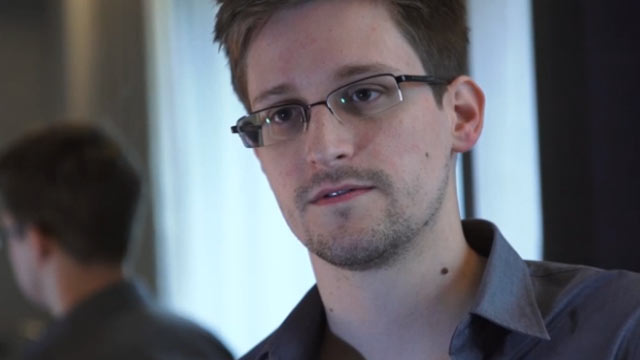
Quiet-Spoken 29-Year-Old Former CIA Technician Is the NSA Whistleblower


(UPDATE 6/10/2013) And he disappears. I hope it is his intention to disappear, not someone having him "disappear".

==========================

"My name is Ed Snowden, I am 29 years old. I work for Booz Allen Hamilton as an infrastructure analyst for NSA in Hawaii."

Before that, he says he worked for the Central Intelligence Agency.

The Guardian has a video of the interview by Glenn Greenwald and Ewen MacAskill in Hong Kong, and part of the interview is written up as an article.

It is at Mr. Snowden's request that the paper is revealing his identity.

From The Guardian (6/9/2013; part):

NSA whistleblower Edward Snowden: 'I do not expect to see home again'

Source for the Guardian's NSA files on why he carried out the biggest intelligence leak in a generation – and what comes next

Ewen MacAskill

Q: Why did you decide to become a whistleblower?

A: "The NSA has built an infrastructure that allows it to intercept almost everything. With this capability, the vast majority of human communications are automatically ingested without targeting. If I wanted to see your emails or your wife's phone, all I have to do is use intercepts. I can get your emails, passwords, phone records, credit cards.

"I don't want to live in a society that does these sort of things … I do not want to live in a world where everything I do and say is recorded. That is not something I am willing to support or live under."

Q: Do you think what you have done is a crime?

A: "We have seen enough criminality on the part of government. It is hypocritical to make this allegation against me. They have narrowed the public sphere of influence."

Q: What do you think is going to happen to you?

A: "Nothing good."

Q: What do the leaked documents reveal?

A: "That the NSA routinely lies in response to congressional inquiries about the scope of surveillance in America. I believe that when [senator Ron] Wyden and [senator Mark] Udall asked about the scale of this, they [the NSA] said it did not have the tools to provide an answer. We do have the tools and I have maps showing where people have been scrutinised most. We collect more digital communications from America than we do from the Russians."

Q: Is it possible to put security in place to protect against state surveillance?

A: "You are not even aware of what is possible. The extent of their capabilities is horrifying. We can plant bugs in machines. Once you go on the network, I can identify your machine. You will never be safe whatever protections you put in place."

(Interview video and full article at the link)


In another article about the interview, Mr. Snowden says:

"All my options are bad," he said. The US could begin extradition proceedings against him, a potentially problematic, lengthy and unpredictable course for Washington. Or the Chinese government might whisk him away for questioning, viewing him as a useful source of information. Or he might end up being grabbed and bundled into a plane bound for US territory.

"Yes, I could be rendered by the CIA. I could have people come after me. Or any of the third-party partners. They work closely with a number of other nations. Or they could pay off the Triads. Any of their agents or assets," he said.

"We have got a CIA station just up the road – the consulate here in Hong Kong – and I am sure they are going to be busy for the next week. And that is a concern I will live with for the rest of my life, however long that happens to be."

Having watched the Obama administration prosecute whistleblowers at a historically unprecedented rate, he fully expects the US government to attempt to use all its weight to punish him. "I am not afraid," he said calmly, "because this is the choice I've made."

He predicts the government will launch an investigation and "say I have broken the Espionage Act and helped our enemies, but that can be used against anyone who points out how massive and invasive the system has become".


And this from Zero Hedge:

We would like to thank Snowden for putting a nail into the coffin of all those who use the term "conspiracy theorist" pejoratively. Because whatever his motives, whatever the outcome of this dramatic escalation between the people's right to know and a government intent on hijacking all civil liberties one by one, Snowden has showed that the distance from Conspiracy Theory to Conspiracy Fact is just one ethical judgment away.

UK Guardian (Glenn Greenwald): NSA's "Boundless Informant" Tracks Global Surveillance Data, 97 Billion Pieces of Intelligence in One Month


Greenwald's scoop keeps going on and on...

From The Guardian (6/8/2013; part, emphasis is mine):

Boundless Informant: the NSA's secret tool to track global surveillance data

Revealed: The NSA's powerful tool for cataloguing data – including figures on US collection

Glenn Greenwald and Ewen MacAskill

The National Security Agency has developed a powerful tool for recording and analysing where its intelligence comes from, raising questions about its repeated assurances to Congress that it cannot keep track of all the surveillance it performs on American communications.

The Guardian has acquired top-secret documents about the NSA datamining tool, called Boundless Informant, that details and even maps by country the voluminous amount of information it collects from computer and telephone networks.

The focus of the internal NSA tool is on counting and categorizing the records of communications, known as metadata, rather than the content of an email or instant message.

The Boundless Informant documents show the agency collecting almost 3 billion pieces of intelligence from US computer networks over a 30-day period ending in March 2013. One document says it is designed to give NSA officials answers to questions like, "What type of coverage do we have on country X" in "near real-time by asking the SIGINT [signals intelligence] infrastructure."

An NSA factsheet about the program, acquired by the Guardian, says: "The tool allows users to select a country on a map and view the metadata volume and select details about the collections against that country."

Under the heading "Sample use cases", the factsheet also states the tool shows information including: "How many records (and what type) are collected against a particular country."

A snapshot of the Boundless Informant data, contained in a top secret NSA "global heat map" seen by the Guardian, shows that in March 2013 the agency collected 97bn pieces of intelligence from computer networks worldwide.

(Full article at the link)

The "heat map" shows NSA's keen interest in March 2013 in Iran, Pakistan, Jordan, Egypt, and India.


Also from The Guardian/Greenwald, President Obama has ordered his senior national security and intelligence officials to draw up a list of potential overseas targets for US cyber-attacks. I wonder if Chairman Xi had read that Friday June 7, 2013 article before he met with Obama.

Friday, June 7, 2013

Glenn Greenwald: US Is Committed to Destroying Privacy Worldwide


(UPDATE) "Investigate" they will. "Shoot The PRISM-Gate Messenger: Obama To Launch Criminal Probe Into NSA Leaks", says Zero Hedge headline, with eyes on details like (emphasis is original):

Reuters reports that "President Barack Obama's administration is likely to open a criminal investigation into the leaking of highly classified documents that revealed the secret surveillance of Americans' telephone and email traffic, U.S. officials said on Friday."

And how did Reuters learn this: from "law enforcement and security officials who were not authorized to speak publicly."

============================

I forgot to mention who wrote that Guardian article on the top-secret NSA program called PRISM. It is Glenn Greenwald and Ewen MacAskill.

Greenwald, who used to write for Salon.com, a progressive constitutional lawyer and strong advocate for civil liberty, appeared on the US news media and blasted the US government. He is also one of the few who continue to write about Bradley Manning and his treatment by the US government under the Obama administration.

From Politico (6/7/2013; part, emphasis is mine):

Glenn Greenwald: U.S. wants to destroy privacy worldwide

...“There is a massive apparatus within the United States government that with complete secrecy has been building this enormous structure that has only one goal, and that is to destroy privacy and anonymity, not just in the United States but around the world,” charged Glenn Greenwald, a reporter for the British newspaper “The Guardian,” speaking on CNN. “That is not hyperbole. That is their objective.”

“So whatever the Justice Department wants to do, they can beat their chests all they want,” he said. “People like Dianne Feinstein and Saxby Chambliss can have press conferences threatening people for bringing … light to what it is they’re doing, but the only people who are going to be investigated are them. It’s well past time that these threats start to be treated with the contempt that they deserve. That’s certainly how I intend to treat them moving forward, with more investigation and disclosures.”

“The Obama administration has been very aggressive about bullying and threatening anybody who thinks about exposing it or writing it or even doing journalism about it, and it’s well past time that come to an end,” he said.

“What the Obama administration is doing in interpreting the PATRIOT Act is so warped and distorted and it vests themselves with such extremist surveillance powers over the United States and American citizens that Americans, in their words, would be stunned to learn what the Obama administration is doing,” he said on CNN’s “The Lead.”

Speaking with MSNBC host Lawrence O’Donnell, Greenwald dared lawmakers to investigate how information about the Verizon phone records leaked, as Feinstein has said should happen.

“Let them go and investigate,” Greenwald said.


He added, “There is this massive surveillance state that the United States government has built up that has extraordinary implications for how we live as human beings on the earth and as Americans in our country, and we have the right to know what it is that that government and that agency is doing. I intend to continue to shine light on that, and Dianne Feinstein can beat her chest all she wants and call for investigations, and none of that is going to stop and none of it is going to change.”

(Full article at the link)


It looks Glenn Greenwald has declared his war.

Unlike other liberal/progressive commentators who almost completely stopped criticizing the federal government once their idol became the occupant of the White House, Greenwald has continued to criticize the government for what it does, regardless of who is at the (nominal) top.

Unlike Greenwald, New York Times folded in mere two and a half hours or so after they dare published an editorial condemning the Obama administration and President Obama. They "modified" it, they say.

The "communication companies" that have been aiding the NSA turn out to be (no surprise here) Verizon, AT&T, and Sprint. In addition, NSA has been obtaining the records from credit card companies. No surprise there either, particularly the issuing companies are big Wall Street banks who were bailed out by the federal government at the expense of small people who were made to foot the bill.

Thursday, June 6, 2013

US NSA's Top Secret PRISM Program Has Been Spying on Everything You Do on the Net Since 2007, Says UK's Guardian


Adding to the earlier news of National Security Agency under the Obama administration collecting telephone records of millions of Americans from Verizon, UK's Guardian says the NSA has also been collecting user data directly from the Internet companies including Microsoft, Google, Apple, Yahoo, Youtube, Skype, and Facebook.


Unlike Verizon, these Internet companies (so far) deny they had any knowledge of the government snooping.

(Sure.)

NSA has been receiving assistance from "communications providers in the US", according to The Guardian. AT&T, Verizon, Comcast,

From The Guardian (6/6/2013; emphasis is mine):

NSA taps in to internet giants' systems to mine user data, secret files reveal

By Glenn Greenwald and Ewen MacAskill

• Top secret PRISM program claims direct access to servers of firms including Google, Facebook and Apple
• Companies deny any knowledge of program in operation since 2007

The National Security Agency has obtained direct access to the systems of Google, Facebook, Apple and other US internet giants, according to a top secret document obtained by the Guardian.

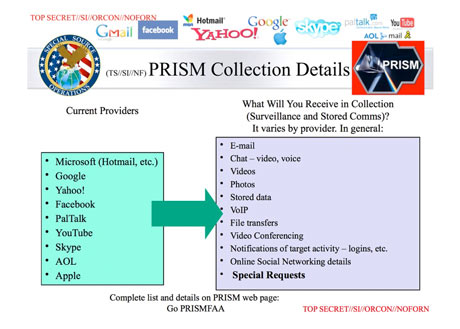
The NSA access is part of a previously undisclosed program called PRISM, which allows officials to collect material including search history, the content of emails, file transfers and live chats, the document says.

The Guardian has verified the authenticity of the document, a 41-slide PowerPoint presentation – classified as top secret with no distribution to foreign allies – which was apparently used to train intelligence operatives on the capabilities of the program. The document claims "collection directly from the servers" of major US service providers.

Although the presentation claims the program is run with the assistance of the companies, all those who responded to a Guardian request for comment on Thursday denied knowledge of any such program.

In a statement, Google said: "Google cares deeply about the security of our users' data. We disclose user data to government in accordance with the law, and we review all such requests carefully. From time to time, people allege that we have created a government 'back door' into our systems, but Google does not have a back door for the government to access private user data."

Several senior tech executives insisted that they had no knowledge of PRISM or of any similar scheme. They said they would never have been involved in such a program. "If they are doing this, they are doing it without our knowledge," one said.

An Apple spokesman said it had "never heard" of PRISM.

The NSA access was enabled by changes to US surveillance law introduced under President Bush and renewed under Obama in December 2012.

The program facilitates extensive, in-depth surveillance on live communications and stored information. The law allows for the targeting of any customers of participating firms who live outside the US, or those Americans whose communications include people outside the US.

It also opens the possibility of communications made entirely within the US being collected without warrants.

Disclosure of the PRISM program follows a leak to the Guardian on Wednesday of a top-secret court order compelling telecoms provider Verizon to turn over the telephone records of millions of US customers.

The participation of the internet companies in PRISM will add to the debate, ignited by the Verizon revelation, about the scale of surveillance by the intelligence services. Unlike the collection of those call records, this surveillance can include the content of communications and not just the metadata.

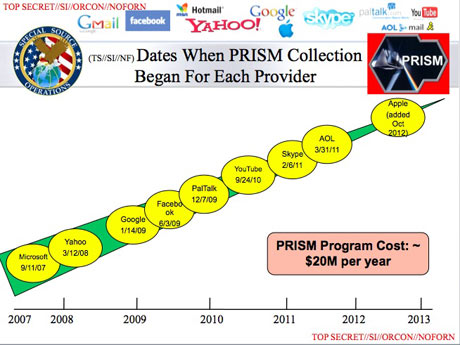
Some of the world's largest internet brands are claimed to be part of the information-sharing program since its introduction in 2007. Microsoft – which is currently running an advertising campaign with the slogan "Your privacy is our priority" – was the first, with collection beginning in December 2007.

It was followed by Yahoo in 2008; Google, Facebook and PalTalk in 2009; YouTube in 2010; Skype and AOL in 2011; and finally Apple, which joined the program in 2012. The program is continuing to expand, with other providers due to come online.


The extent and nature of the data collected from each company varies.

Companies are legally obliged to comply with requests for users' communications under US law, but the PRISM program allows the intelligence services direct access to the companies' servers. The NSA document notes the operations have "assistance of communications providers in the US".

(Full article at the link)


US's Washington Post has the article on the same subject. A joint operation by the two papers?

It was in 2006 when an AT&T whistleblower, Mark Klein, leaked internal AT&T documents that revealed the company had set up a secret room in its San Francisco office to give the National Security Agency access to its fiber optic internet cables.

No one cared then, and the Foreign Intelligence Surveillance Act was amended in July 2008 to authorize the NSA program of warrantless wiretapping. Will anyone care now?

(So far Twitter seems to be safe. I wonder how long.)