Showing posts with label Tomioka-machi. Show all posts

Monday, March 25, 2013

#Radioactive Japan: 50 Millisieverts Radiation Exposure Per Year Is "Low" Enough to Bring Residents and Businesses Back to Tomioka-Machi in Fukushima


That's where Fukushima II (Daini) Nuclear Power Plant is located, but the town was heavily contaminated when the radioactive plume released from Fukushima I (Daiichi) Nuclear Power Plant (mostly from vent, from explosions to a lesser degree) hit south. The entire town has been designated as "no-entry (exclusion) zone".

But now, one year after similar measures were taken in other outlying cities and towns like Minami Soma City, Tomioka-machi and Namie-machi, another very contaminated town north of Fukushima I Nuke Plant, are being reorganized into new zones that signifies "hope" (at least for the government if not for the residents). No more forbidding "no-entry zone".

The areas which are expected to have cumulative radiation exposure of 20 millisieverts or less per year will be called the "zone in preparation for having the evacuation order lifted" (避難指示解除準備区域) where people are free to go back and live (or I should say strongly encouraged to go back and live) after the national government thoroughly decontaminate the areas.

The areas with the expected cumulative radiation exposure of 20 to 50 millisieverts per year will be called the "zone with restricted entry" (居住制限区域) which only means cannot cannot stay there overnight but no problem if they want to commute to work there.

Only if the cumulative radiation exposure per year in the areas exceed 50 millisieverts, the areas are designated as "zone where it is difficult for people to return" (帰還困難区域), and people cannot go back at all until 5 years after the accident, meaning only three more years. After three more years, the cumulative radiation levels per year are magically expected to drop below 50 millisieverts. (Good luck with that, with cesium-137 whose half-life is 30 years.)

Who measures the radiation levels? The national government under the pork-cutlet-over-rice prime minister (baseless rumors say he won't last long, as his stomach ailment has returned) of course. They will continue token "decontamination" - practically smearing the area with water and bagging the top soil (if that, these days), cutting branches of trees (and dumping in the rivers nearby) - mostly to profit general contractors, greatly save on compensation money, and claim "See, we're not Chernobyl! We're returning people in two years!".

Here's from Mainichi English, talking hopefully about cherry blossom viewing event in the most contaminated area inside Tomioka-machi (3/25/2013; emphasis is mine):

Nuke disaster exclusion zone change has Fukushima town ready for cherry blossom season

TOMIOKA, Fukushima -- The cherry blossoms in this town are on the edge of blooming, and as of March 25 local residents can see the buds in person for the first time since the Fukushima nuclear disaster began more than two years ago.

Tomioka had been locked inside the nuclear disaster exclusion zone since the town was evacuated in March 2011. However, the national government has determined that radiation doses in about 70 percent of the town have fallen to 50 millisieverts per year or less -- still high, but low enough to re-designate these areas as open to temporary visits.

The rezoning happens to cover a good portion of Yonomori Park, known for its some 1,500 cherry trees lining an L-shaped road and forming a pink tunnel when in full bloom.

"The buds look ready to pop open," said Kiyoshi Horikawa, the 72-year-old chairman of a local cherry blossom viewing group as he looked on the trees on March 25.

The day also marked the beginning of decontamination work on the trees. Unfortunately, the east-west part of the route generally remains in the exclusion zone and generally out-of-bounds even for quick visits. Many of the trees in that section are more than a century old.

Nevertheless, the town government is planning a cherry blossom-viewing bus trip for residents in late April, and includes the section still inside the exclusion zone.


So the national government has simply decided the radiation levels have dropped below 50 millisieverts per year in 70% of the town. Why didn't Russians think of this wonderful gimmick?

Sunday, September 23, 2012

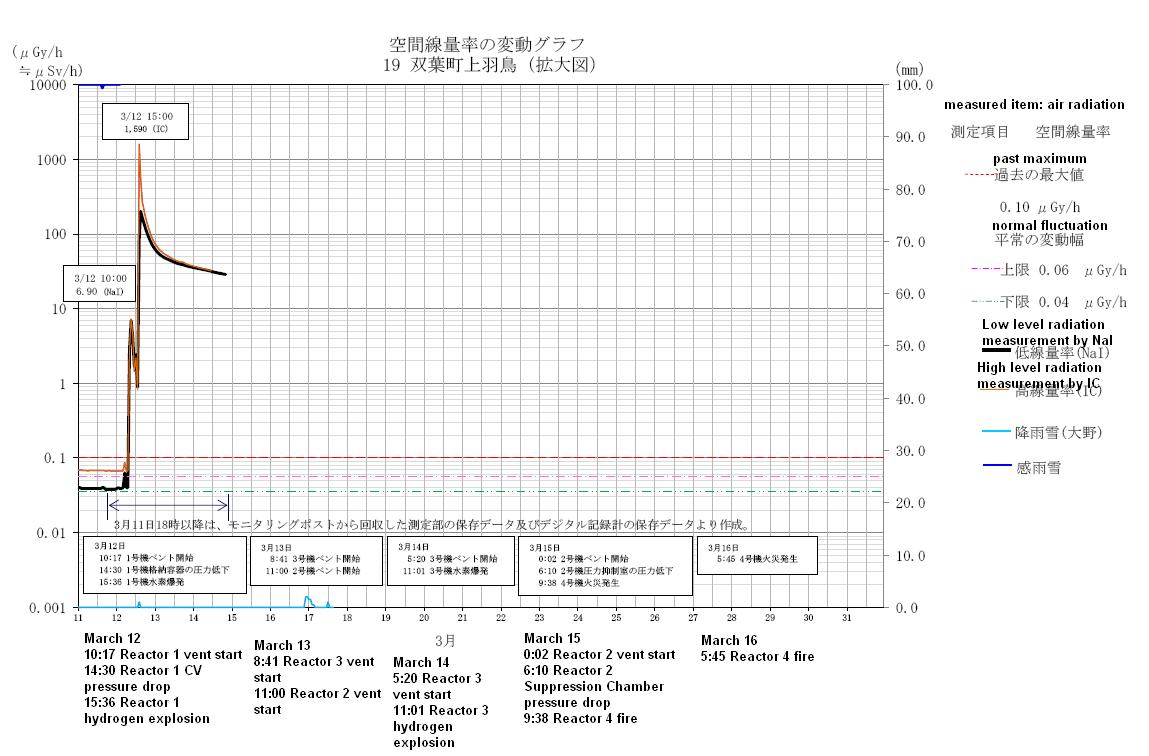
(Now They Tell Us) 1,590 Microsieverts/Hr in Futaba-machi, #Fukushima on March 12, 2011, Before Reactor 1 Explosion, and Vent, Not Explosion, May Have Caused High Radiation


So says the Fukushima prefectural government, after more than one and a half year since the start of the Fukushima I Nuclear Power Plant accident. Supposedly, it took them all these days to analyze the data that was retrieved from the 19 monitoring posts around the two nuclear power plants (Fukushima I and II), and only now the prefectural government is sheepishly admitting the radiation levels were much, much higher than it has been telling the residents.

What's more, though the prefectural government doesn't say it explicitly, the spikes in radiation levels correlate not to the explosive events but the vents, if you look at the charts published by the Fukushima prefectural government.

First, from Asahi Shinbun Fukushima Edition (9/22/2012):

県は21日、東京電力福島第一原発の周辺で昨年3月に測定した空間放射線量の結果を発表した。同原発から北西5・6キロの双葉町上羽鳥で毎時1590マイクロシーベルトと、発電所の敷地外では、県がこれまでに把握している中では最も高い値が出た。

On September 21, Fukushima Prefecture announced the result of air radiation survey conducted in March last year around Fukushima I Nuclear Power Plant. The reading in Kamihatori in Futaba-machi, 5.6 kilometers northwest of the nuclear plant, was 1,590 microsieverts/hour, highest so far outside the plant as the prefectural government knows.

原発周辺に設置されていた19局のモニタリングポストに残っていた昨年3月11日~31日のデータを取りまとめた。双葉町山田では16日午前0時に同1020マイクロシーベルト、同町新山で12日午後5時に毎時904マイクロシーベルトだった。

The result was compiled from the data from March 11 to 31 last year that remained in the 19 monitoring posts installed near the nuclear power plant. In Yamada in Futaba-machi, it was 1,020 microsieverts/hour at 12AM on March 16, 2011, and it was 904 microsieverts/hour at 5PM on March 12 in Shinzan, also in Futaba-machi.

県によると、原発の北側のモニタリングポストでは12日から、楢葉町や広野町など南側は15日から放射線量が上がる傾向があった。

According to Fukushima Prefecture, the monitoring posts in the north of Fukushima I Nuclear Power Plant started to register higher radiation levels in March 12, and the monitoring posts in the south of the plant in Naraha-machi and Hirono-machi in March 15.

また、上羽鳥の場合、同原発1号機の水素爆発よりも前の12日午後3時に最大値を観測しており、県は「爆発前から放射性物質が漏れていた」と見ている。今後、風向きや風速など、詳細な分析をするという。

In the case of Kamihatori, the maximum level was recorded at 3PM on March 12, before the hydrogen explosion at Reactor 1 at Fukushima I Nuclear Power Plant. According to the prefectural government, it was probably because "radioactive materials had been leaking even before the explosion". The prefectural government says it will conduct more detailed analysis including wind directions and wind speed.


Now, for Fukushima Prefecture to pretend this was new information (that the radiation had been leaking even before the Reactor 1 explosion), that's highly misleading. Fukushima Prefecture started measuring radiation levels in the areas surrounding the two nuclear power plants (Fukushima I and II) as early as 8AM on March 12, 2011. The first measurement that would have shown them that the radiation level was already several times higher than normal (0.04 - 0.06 microsievert/hour) was that of Tomioka-machi (Fukushima II) at 0.18 microsievert/hour at 8:25AM on March 12, 2012. At 8:52AM on the same day, they measured 14 microsieverts/hour in Namie-machi. Reactor 1 had a hydrogen explosion at 3:36PM.

(All of these were disclosed long time ago - June 3, 2011 - by NISA of all people, and no one in the media said a thing. If you read Japanese, see my Japanese blog.)

But what's more interesting about the latest disclosure by the Fukushima prefectural government is that the spikes in air radiation levels coincide not with the explosive events but with the vents that TEPCO did or attempted.

From the data released by the Fukushima prefectural government (I put the English labels):

Kamihatori, Futaba-machi: The first spike of radiation occurred even before the first vent of Reactor 1 on March 12, 2011. The huge spike to 1590 microsieverts/hour occurred at 3PM, after the vent at 10:17AM and after the pressure of the Reactor 1 Containment Vessel dropped at 2:30PM.


Kamiyatori is located northwest of Fukushima I Nuclear Power Plant. On March 12, 2011, the areas that registered high levels of radiation were all located north and northwest of the plant.

Then, after the vent of Reactor 2 on 12AM on March 15, 2011 (which was a dry vent), huge spikes in radiation were recorded in the areas in Okuma-machi, Tomioka-machi, and Naraha-machi, which were located south of the plant.

Mukaihata, Okuma-machi, immediate south of the plant. Spike at 11PM on March 14, 2011:


Yonomori, Tomioka-machi. Spike at 2AM on March 15, 2011:


Yamadaoka, Naraha-machi. Spike at 3AM on March 15, 2011:


The plume that went past Okuma, Tomioka, Naraha reached Kitaibaraki City in Ibaraki at 5:50AM on the same day, registering 5.5 microsieverts/hour. The Japanese media reported it, as possibly caused by the explosion of Reactor 2 (here's Sankei Shinbun on March 15, 2011), and no one understood the significance of the news at that time. Hardly anyone knew what "microsievert" was.

Well, it may not have been the explosion that caused the spikes. It is likely to have been the vent - intentional release of radioactive materials to lower pressure to avoid explosions. Well the explosions or some explosive event (in the case of Reactor 2) took place at Fukushima I Nuclear Power Plant after they did the vent. So what was the vent for?

That the vent, not the explosions, caused the radiation levels to rise has already been stated by none other than TEPCO in its report. Again, when the report was released, the media paid no attention, and people didn't care (other than the familiar refrain of "TEPCO lies").

A Tokyo University researcher stated in his paper accepted by a peer-reviewed magazine that a huge spike of radiation was registered at Fukushima I Nuclear Power Plant after the Reactor 2 dry vent. Again, no one paid attention.

Thursday, December 15, 2011

Japanese Government to Abolish Evacuation Zone for Fukushima II (not I) by Year-End

The area within the 8-kilometer radius from Fukushima II (Daini) Nuclear Power Plant has been designated as "evacuation" zone following March 11 earthquake/tsunami and the residents have been evacuated. The Japanese government has decided to abolish that zone by the year-end, paving the way for the residents of Okuma-machi, Naraha-machi, Tomioka-machi, and Hirono-machi to return.

Never mind that Okuma, Naraha, Tomioka also happen to fall within the 20 kilometer-radius "no entry" zone for Fukushima I (Daiichi) Nuclear Power Plant.

From Fukushima Minyu, a local newspaper in Fukushima (12/14/2011):

経済産業省原子力安全・保安院は13日、東京電力福島第2原発から8キロ圏内の広野、楢葉、富岡、大熊4町に措置している避難指示を解除する方針を関係市町村に伝えた。

The Nuclear and Industrial Safety Agency under the Ministry of Economy, Trade and Industry told the municipalities within the 8-kilometer radius "evacuation" zone around Fukushima II (Daini) Nuclear Power Plant on December 13 that the evacuation order would be lifted shortly.

 関係者によると、政府は年内に福島第1原発から20キロ圏内の警戒区域と計画的避難区域見直しの考え方を示すとみられる。ただ、警戒区域は、福島第2原発の避難指示区域と重なっていることから、警戒区域の見直しに先行して第2原発の避難指示を解除することで、見直しに向けた環境を整える考えとみられる。

According to the people involved, the national government is to indicate its thinking about how to redesign the "no-entry" zone within the 20-kilometer radius from Fukushima I Nuke Plant and the "planned evacuation" zone [between 20 and 30-kilometer radius] before the year-end. The "no-entry" zone for Fukushima I includes the evacuation zone for Fukushima II. By lifting the evacuation order for Fukushima II first, the government may be trying to create a favorable environment in which to revise the "no entry" zone for Fukushima I.

 警戒区域などの見直しについて政府は、福島第1原発事故収束の工程表ステップ2の完了を受けて実施する方針。年間の積算放射線量に応じて50ミリシーベルト以上を「長期帰還困難」、20~50ミリシーベルト未満を「居住制限」、20ミリシーベルト未満を「解除準備」の3区域に再編する方向で関係自治体と調整しているもようで、見直しの考え方について年内に明らかにする見通し。

Revision of the evacuation zones is to be carried out by the national government on the completion of the "step 2" of the roadmap to recovery of the Fukushima I Nuclear Power Plant. The plan seems to be that the no-entry zone will be reorganized into three different zones depending on the cumulative [external] radiation exposure levels per year. If the annual cumulative radiation exposure is to be 50 millisieverts and above, the areas will be designated as "difficult to return for a long time"; the areas between 20 and 50 millisieverts as "restricted residence", and the areas below 20 millisieverts as "preparing for return". The national government is said to have been discussing with the municipalities affected, and to disclose its thinking before the year-end.

To be more precise, in practical terms, on the "declaration" of the completion of the step 2, whether the so-called "step 2" has been achieved or not. As long as you declare.

According to Yomiuri Shinbun (12/15/2011) on the subject, a NISA official told the mayor of Tomioka-machi the reason for lifting the evacuation order as Fukushima II fully prepared for disaster with "external power source secured and emergency generators equipped".

The mayor of Naraha-machi has been itching to restart Fukushima II Nuclear Power Plant and get "genpatsu (nuke plant)" money flowing again. He may get his wish soon.

When the national government talks about "radiation" in these areas, it is talking about external radiation only, and at 1 meter off the ground. The latest survey result (12/13/2011) by the Ministry of Education and Science is here.

Friday, September 2, 2011

A Solitary Farmer in Tomioka-Machi: "I'll Never Leave, I'll Never Be Beaten"

AP News reported on August 31 about Mr. Naoto Matsumura, who refuses to leave his home and his farm in Tomioka-machi, which lies in the no-entry evacuation zone within the 20 kilometer radius from Fukushima I Nuclear Power Plant. His family has farmed in that location for 5 generations.

"I'll never be beaten", he says. If he wants to stay, it's his right to do so, he also says.


(h/t Irene)