Showing posts with label "300 tonnes". Show all posts

Tuesday, August 20, 2013

Head of #Fukushima Fisheries Associations Agrees to the Release of Uncontaminated Groundwater from Fukushima I Nuke Plant


After the career bureaucrat at the Agency of Natural Resources and Energy within the Ministry of Economy, Trade and Industry spoke of his assumption at the August 7, 2013 press conference that "300 tonnes of contaminated (ground)water" is leaking into the sea every day, I wrote in my August 9 post:

Oh well. The horse is out of the barn. The powerful Ministry of Economy, Trade and Industry has spread baseless rumors around the world.

I'm starting to believe it is deliberate. The Agency of Natural Resources and Energy wants TEPCO to be able to dump uncontaminated groundwater drawn upstream into the ocean, but the talk with the fisheries associations in Fukushima has stalled after the detection of radioactive materials from the observation holes in the embankment in June.

Here's the bargain the Agency could use with the fishermen: Do you want the leak of "300 tonnes of contaminated groundwater" to continue? Or would you rather have us release uncontaminated groundwater drawn upstream, and keep the contaminated groundwater in tanks?


I may be right after all. The head of the federation of the fisheries associations in Fukushima Prefecture wants to have uncontaminated groundwater released, aka "groundwater bypass plan", rather than having contaminated groundwater leaking unchecked. And he wants all the associations to come up with "yes" answer.

Here's the latest from Nikkei Shinbun (8/21/2013):

地下水の海洋放出、福島県漁連会長は容認

Head of the Fukushima Prefecture Fisheries Associations approves release of groundwater into the ocean

福島県漁業協同組合連合会の野崎哲会長は20日、「汚染水の流出を止めるという漁業者の要求実現の一助になる」とし、放射性物質に汚染される前の地下水を海に流すことを容認する意向を明らかにした。28日の組合長会に向け各漁協に意見集約を急ぐよう求めた。県漁連が開いた組合員向けの説明会で語った。

Mr. Tetsu Nozaki, head of the Federation of Fisheries Associations in Fukushima Prefecture, signaled his intention to agree to the release of groundwater drawn before it becomes contaminated with radioactive materials into the ocean, as "it will be helpful in realizing the fishermen's goal of stopping the leak of contaminated water". He requested each fisheries association to come up with the opinion as an association [i.e. agree to the release, in Japanese parlance], in preparation for the meeting of the association heads on August 28.

同席した政府と東電の担当者は汚染前の地下水をくみ上げ、海に流す「地下水バイパス計画」に改めて理解を求めた。漁協関係者から「早く結論を出さないと汚染水の放流に発展しかねない」として計画に理解を示す声も上がった。

The officials from the government and TEPCO who attended the meeting asked again for understanding of their "groundwater bypass plan", in which uncontaminated groundwater will be drawn and released into the ocean. There were some at the meeting who were sympathetic to the plan, as "it may well lead to the release of contaminated water if we don't come to a conclusion soon."

ただ県内では漁獲物の風評被害への懸念も根強く、各漁協が同意でまとまるかはなお流動的だ。福島県の佐藤雄平知事は20日の関係部長会議で「国家としての非常事態」と厳しい認識を表明。「国が前面に立って対処してもらいたい」と述べ、政府の対応を促した。

However, there is a persistent fear of baseless rumors in Fukushima Prefecture on catch of fish, and the situation remain fluid whether the fishermen agree [to the bypass plan] as a whole. Governor of Fukushima Yuhei Sato spoke harshly in a meeting on August 20 that this was "a national emergency". He demanded the response from the national government, saying "The national government should lead the effort."


Mr. Nozaki speaks as if he was unaware of the 300-tonne highly contaminated water leak from a RO waste water tank. Unlike the slightly contaminated groundwater leaking through the embankment soil into the open culvert and the plant port, the drain near the RO waste water tank area (H4) goes directly to the ocean OUTSIDE the port.

Governor Sato, who was so glad that he became famous because of the Fukushima nuclear accident, wants the national government (= Ministry of Economy, Trade and Industry and Agency of Natural Resources and Energy) to lead the work at the plant. Good luck.

Monday, August 19, 2013

(UPDATED with Diagrams) Real Leak of at Least 300 Tonnes of Really Highly Contaminated Water at #Fukushima I Nuke Plant, and Leak Continues


(8/21/2013 New post with two potentially big problems, uploaded.)

==================

As the world's mainstream media and alternative media suddenly rediscover Fukushima I Nuke Plant over the "assumption" by a career bureaucrat at Ministry of Economy, Trade and Industry (whose Agency of Natural Resources and Energy oversees the decommissioning of the plant) that "300 tonnes of highly contaminated [sic] water" may be leaking every day, a real leak of actual waste water with extremely high beta nuclides has been found.

According to TEPCO, who held an ad hoc press conference at noon on August 20, 2013, at least 300 tonnes of waste water after the cesium absorption (by SARRY) and desalination (by Reverse Osmosis Apparatus) has leaked from a huge 1,000-tonne steel tank (or two, they don't know yet), and it is likely that the waste water is STILL LEAKING as TEPCO hasn't been able to identify the location of the leak(s).

Information about the leak, from Jiji Tsushin (8/20/2013), TEPCO's press conference on 8/20/2013 and TEPCO's handout to the press (8/20/2013):

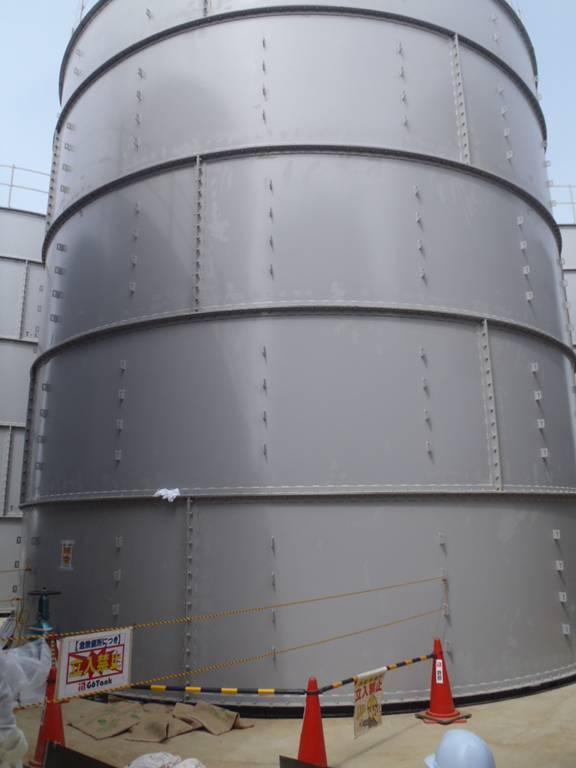
Leak from a group of 1,000-tonne steel tanks (tank is 12 meters in diameter, 11-meter high) in the area H4 which has total 26 tanks. The location is about 500 meters from the embankment.

One of the tanks in this particular group (No.5 in the group I in H4 area, or H4-I-5) was found with the water level that was 3.4-meter lower than before.

Nature of contaminated water: waste water after cesium absorption and desalination (called by TEPCO RO water)

Estimated amount of contaminated water: 300 tonnes (300,000 liters)

Density of radioactive materials (TEPCO's announcement is in Bq/cm3, as it is highly contaminated water; Jiji Tsushin reports the number in Bq/liter):

  • All-beta including strontium: 80 million Bq/L (80,000 Bq/cm3)

  • Radioactive cesium: 146,000 Bq/L (146 Bq/cm3)


Most of the leaked waste water went outside the low enclosure built around the tanks. The valve is installed to drain rainwater from the enclosure, and this valve was found "open", as it shouldn't have been.

The water leaked inside the enclosure has been collected (about 4 tonnes as of 12AM on August 20, 2013). The area is being inspected every three hours, but the leak CONTINUES (or TEPCO cannot confirm that the leak has stopped, though the company seems to think it has stopped).

TEPCO hopes to empty the tank No.5 and move the RO waste water into the tanks in the nearby group B, as the tanks in group B is only about 60% full. The rest of the tank in this H4 areas are 97.8% full.

The scale of the leak is one of the largest since the start of the accident (excluding the April 2011 leak of highly contaminated water from the Reactor 2 turbine building basement).

The manufacturer's warranty of the tank is 5 years.

There is a drain nearby that goes to the ocean, but hardly any radioactive materials have been detected from the water (most likely rainwater) in the drain.


Here's how one of the tanks looks like, from the leak in June 2013 from a tank in a different area:


From TEPCO's handout for the press, 8/20/2013 (English labels are by me):


Monday, August 12, 2013

#Fukushima I Nuke Plant Groundwater Contamination: 1st Well in Operation, 13 Tonnes of Groundwater Drawn in 6 Hours


Assuming the same pace throughout the 24-hour period, it would be only 52 tonnes of water - about half of much publicized 100 tonnes per well per day, totaling "300 tonnes of contaminated water" assumption by METI.

From TEPCO's English press release, from the Japanese email alert for the press, 8/9/2013:

Status of Pumping up Groundwater from the Water Collection Pit at the East Side of the Unit 1, 2 Turbine Building in Fukushima Daiichi Nuclear Power Station

At 2:10 PM today (on August 9), groundwater was pumped up from the water collection pit (south) installed at the east side of the Unit 1, 2 Turbine Building and transferred to Unit 2 vertical shaft C.

Amount of groundwater pumping up from the water collection pit as of 8:00 PM today (on August 9) is approx. 13m3. Of those, approx. 3m3 are transferring to the vertical shaft C.


So, TEPCO is pumping up the groundwater in the embankment area to dump it back in Shaft C, where the highly contaminated water from April 2011 has been sitting. TEPCO's representative at yesterday's meeting of Nuclear Regulatory Authority's working group on dealing with contaminated water at the plant was saying the operation would be useful in diluting the density of radioactive materials in the highly contaminated water.

Uh...

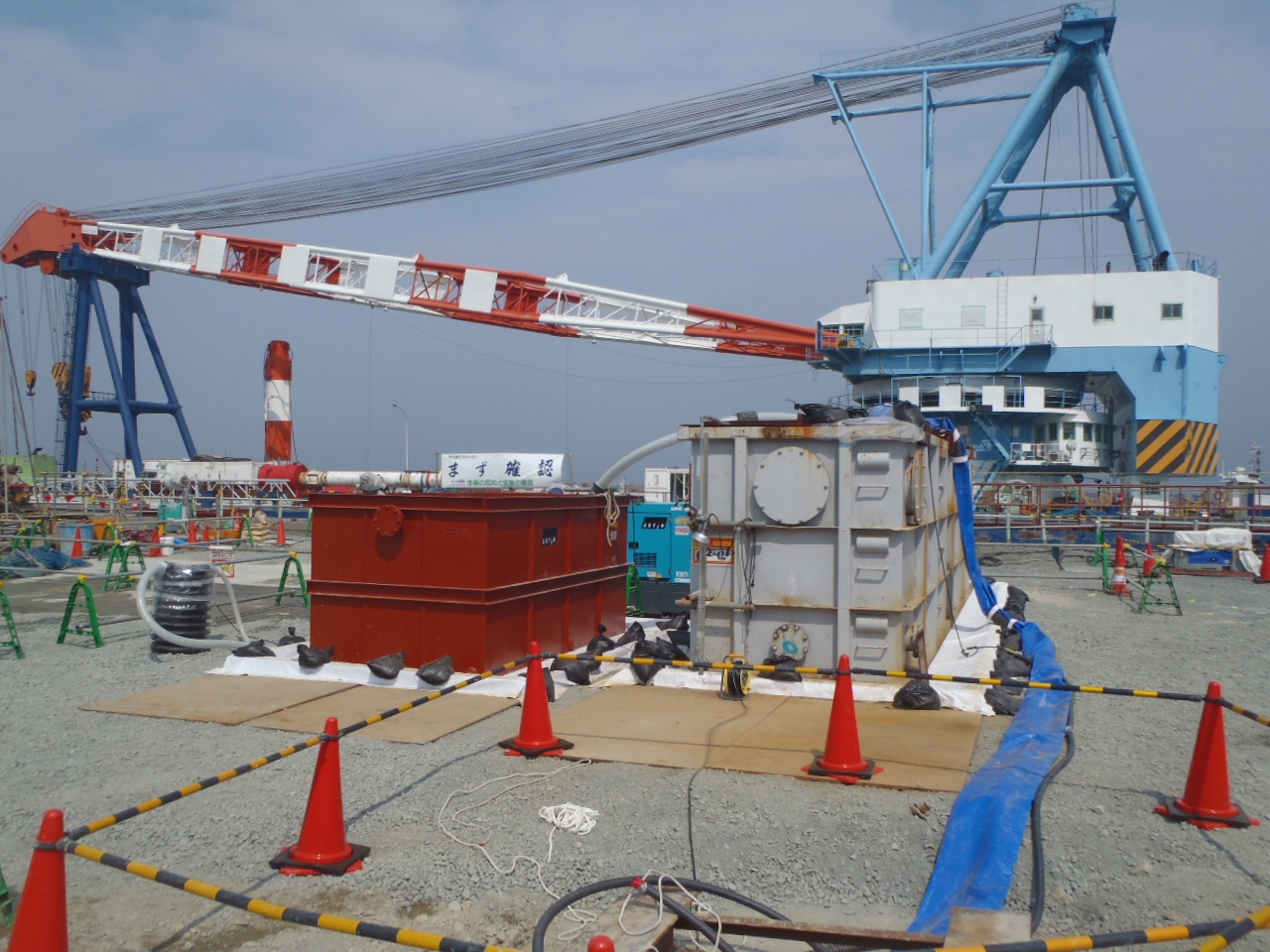
Here's the pit that became operational (from TEPCO's Photos and Videos Library, 8/9/2013):


Groundwater is pumped up by the suction pump (small black thing on the left), then transferred to the filtration tank (red tank in the middle), then to the gray water tank. Then it will be transported to Shaft C in the flexible blue tube you see coming out of the gray tank.

Sunday, August 11, 2013

#Fukushima I Nuke Plant: Historical Radioactive Cesium Levels in Seawater Near Water Intakes Inside Plant Harbor - From 71 Million Bq/L to 200 Bq/L in 2 Years


(Warning: the post is very long. It's for my record.)

The post was being written for my Japanese blog in early August, but I may write it up for here as well for my record, in light of the off-handed remark of "300 tonnes of contaminated water leaking every day" by a career bureaucrat from the most powerful government ministry in Japan.

The remark was actually a mere assumption by the official and his office but was reported as "fact" by the reporters from Japanese and foreign media who were present at the press conference and who heard the official repeat the word "assumption" a number of times throughout the press conference.

It was not just established mass media but also some independent journalists who decided to go with the "300 tonnes of contaminated water" assumption, because it fits their narrative of hopeless situation at Fukushima (plant) and in Fukushima (prefecture).

The latest article (8/11/2013) by one of the independent journalists covering the nuclear accident presents an amazing story - a hearsay supposedly directly from workers at the plant that this "300-tonne-a-day contaminated water" is flowing like a river, no, it's worse, it's pouring out like a waterfall. Needless to say, this article in Japanese is being retweeted at a furious pace. No doubt it will be translated into English and spread throughout the world very soon, if not already.

After the remark by the METI bureaucrat was widely reported as "fact", the mental image held by people outside Japan (and many inside) seems to be that the "highly" contaminated water directly from the basements of the turbine building at Fukushima I Nuke Plant is flooding into the Pacific Ocean unchecked and polluting marine life, some experts claim as far away as in southern hemisphere.

The actual "highly" contaminated water, whose contamination is so high that it is expressed in Bq/cm3 instead of Bq/Liter (as in "millions of becquerels of radioactive cesium per cubic centimeter"), sits in the underground trenches coming from the turbine buildings. It's been mostly sitting there since April and May 2011.

These trenches may have been damaged by March 11, 2011 earthquake and tsunami, or by subsequent strong aftershocks, and part of this water may have been seeping into the layers of crushed stones beneath the trenches and into the surrounding soil, which then gets mixed with the groundwater that's been flowing from the mountain-side (west side) of the plant. Radioactive cesium, all-beta including strontium, tritium, and several other gamma nuclides have been detected in the sample water (probably this mixture of groundwater and the trench water) from the observation holes dug along the embankment.

The density of radioactive cesium in the sample water from the observation holes is expressed in liter instead of in cubic centimeter, as the contamination is far less than the water in the trenches, and as the contamination of seawater is measured in liter. Instead of millions of becquerels of cesium per cubic centimeter (or in liter, billions of becquerels) as in the water in the trenches, the sample water from the observation holes has between 10s and 1000s becquerels of cesium per liter.

And what about the seawater itself? The seawater samples have been taken almost every day since April 2011 from right outside the water intakes for the reactors, which is located along the embankment. TEPCO calls it "open culvert". Each water intake location is somewhat sealed off by silt screen, and the open culvert is also somewhat sealed off by silt screen from the rest of the plant harbor.

Diagram from TEPCO's "Enhancement of Monitoring Plan at the East Side of Unit 1-4 Turbine Buildings and in the Port at Fukushima Daiichi Nuclear Power Station", 6/26/2013, showing the plant harbor and the open culvert area (in gray) where the water intakes are located. Silt screens are indicated in curved lines in red:


As of August 1, 2013, the highest measurement of radioactive cesium in seawater was 66 becquerels/liter of cesium-134, and 140 becquerels/liter of cesium-137, inside the silt screen of Reactor 3 water intake in the open culvert. Outside the silt screen, the numbers drop to 13 Bq/L for cesium-134, and 23 Bq/L for cesium-137.

Maximum amount of cesium in discharge water allowed for Fukushima I Nuclear Power Plant BEFORE the accident, per liter:

  • Cesium-134: 60 becquerels/liter

  • Cesium-137: 90 becquerels/liter


From TEPCO's Nuclide Analysis Result Page (in Japanese only):

Fukushima I Nuclear Power Plant nuclide analysis of seawater inside the plant harbor, released on August 1, 2013

  • Unit: Bq/L (liter)

  • Maximum density: Seawater at Reactor 3 water intake screen (inside the silt fence) Cesium-134 66 Bq/L, Cesium-137 140 Bq/L 


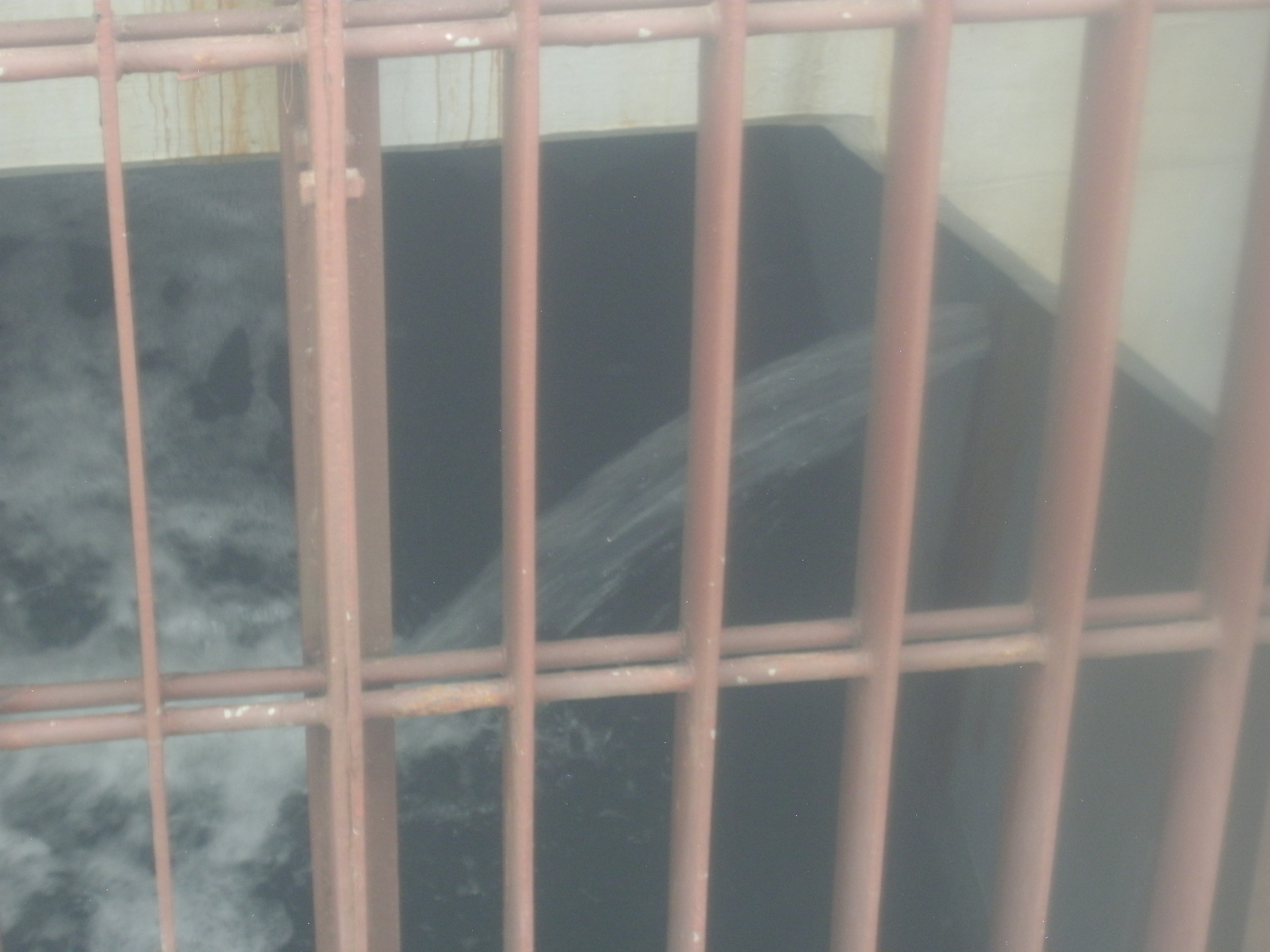
Now, going back in time, what was the density of radioactive cesium in the extremely contaminated water that was pouring out from the crack in the concrete wall near the Reactor 2 water intake screen in April 2011?

  • Cesium134 1.8 million Bq/cm3 (or 1.8 billion Bq/Liter)

  • Cesium-137 1.8 million Bq/cm3 (or 1.8 billion Bq/Liter) 

(Photo from TEPCO's Photos and Videos 4/2/2011)

What about the density of radioactive cesium in seawater when the above "highly" contaminated water was pouring out of the crack?

Nuclide analysis of seawater inside the plant harbor, released on April 5, 2011:

  • Unit: Bq/cm3 (cubic centimeter, or 1/1000 of liter)

  • Maximum density: seawater at the Reactor 2 water intake screen Cesium-134 35,000 Bq/cm3 (or 35 million Bq/Liter), Cesium-137 36,000 Bq/cm3 (or 36 million Bq/Liter


The density of radioactive cesium in seawater then rapidly fell down. Nearly three months later, the density was low enough to be expressed in becquerels per liter, instead of becquerels per cubic centimeter.

Nuclide analysis of seawater inside the plant harbor, released on July 31, 2011

  • Unit: Bq/L (Liter)

  • Maximum: Seawater in front of Reactor 3 water intake screen (inside the silt fence) Cesium-134 1,300 Bq/L, Cesium-137 1,500 Bq/L


Expressed in liter, the density of radioactive cesium in seawater went from 71 million Bq/L in April to 2,800 Bq/L in July, 2011.

By the end of 2011, the density of radioactive cesium in seawater right in front of water intake screens dropped to three digits, from 4 digits in July.

Nuclide analysis of seawater inside the plant harbor, released on December 22, 2011

  • Unit: Bq/L 

  • Maximum: Seawater in front of Reactor 3 water intake screen (inside the silt fence) Cesium-134 310 Bq/L, Cesium-137 340 Bq/L


One year later in December 2012, the density further dropped to two digits, but still above the legal limit for discharge water from the normal nuclear power plant (Cs-134: 60 Bq/L, Cs-137: 90 Bq/L).

Nuclide analysis of seawater inside the plant harbor, released on December 31, 2012

  • Unit: Bq/L 

  • Maximum: Seawater in front of Reactor 3 water intake screen (inside the silt fence) Cesium-134 40 Bq/L, Cesium-137 76 Bq/L


In early 2013, the density dropped below the legal limit of radioactive cesium in the discharge water from the normal nuclear power plant (again, Cs-134: 60 Bq/L, Cs-137: 90 Bq/L).

Here's from April 1, 2013, one day before TEPCO started the construction of the impermeable wall by driving down sheet piles with vibratory hammer along the embankment.

Nuclide analysis of seawater inside the plant harbor, released on April 1, 2013

  • Unit: Bq/L 

  • Maximum: Seawater in front of Reactor 4 water intake screen (inside the silt fence) Cesium-134 17 Bq/L, Cesium-137 49 Bq/L


The data released on April 2 and April 3 do not show much difference. However, from the seawater sample taken on April 3, one day after the construction using sheet piles and vibratory hammer started, radioactive cesium was found again exceeding the legal limit for Cs-137.

Nuclide analysis of seawater inside the plant harbor, released on April 4, 2013

  • Unit: Bq/L 

  • Maximum: Seawater in front of Reactor 3 water intake screen (inside the silt fence) Cesium-134 59 Bq/L, Cesium-137 110 Bq/L


Depending on the locations, some samples show the density of radioactive cesium one order of magnitude larger than the samples taken before the start of the construction work, from two digits to three digits. Since then, the density of cesium in the seawater in front of water intake screens has been fluctuating between two-digit numbers and three-digit numbers.

Here's a chart plotting the density of radioactive cesium in seawater at the Reactor 3 water intake screen, inside the silt fence. It's a composite of the chart released on April 20 and the chart released on August 1. The thin red line indicates 10 to the power of 2 (1.0E+2). (Y-axis is in log scale.)


Toward the end of April, as the construction of the impermeable wall with sheet piles progressed, the density of radioactive cesium in seawater started to fluctuate wider.

Still, as far as radioactive cesium is concerned, the seawater in front of the water intake screens has not at all reached the level of contamination that obtained when the truly highly contaminated water from the Reactor 2 turbine building was pouring out into the ocean in April 2011.

It is safe, I believe, to assume that the highly contaminated water that still exists in the trenches and which has radioactive cesium in billions of becquerels per liter is not leaking in great quantity into the seawater yet.

If the density of radioactive cesium in the seawater in front of the water intake increases to 4 digit numbers per liter, I might start to worry. So far, it hasn't happened, despite TEPCO's (and METI/Agency of Natural Resources and Energy's) ill-conceived attempt to stop the groundwater flow with waterglass.

Saturday, August 10, 2013

Reporting of the "300 Tonnes of Contaminated Water Leaking Every Day from #Fukushima I Nuke Plant" Assumption by METI Official


(UPDATE) Here comes IAEA, pledging support to Japanese government in dealing with contaminated water leak at Fukushima I Nuke Plant. Jiji Tsushin in English reports "IAEA Ready to Help TEPCO over Tainted Water Leak". ("Tainted"??)

=====================

The press decided to simply quote the government official, despite their misgivings.

There's a word for that in Japanese: げたを預ける (to leave a matter completely in someone else's hand)

It is rather apparent if you watch the video of the press conference on August 7, 2013 that reporters from Japanese press and foreign press either did not understand what Mr. Tatsuya Shinkawa, official in charge of dealing with the Fukushima I Nuke Plant accident at the Agency of Natural Resources and Energy at METI, said about the "300 tonnes leak", or had varying degrees of doubt as to the veracity of the numbers.

Particularly when Mr. Shinkawa, to answer the persistent questions from the reporters throughout the press conference from Asahi, Yomiuri, Mainichi, NHK, Wall Street Journal, AP and others, had to repeatedly cite TEPCO's numbers which had nothing to do with the actual or potential leak:

TEPCO told us they will start drawing 100 tonnes of water each day from three wells.

On hearing that from TEPCO, the conclusion at his place of work, the most elite ministry of the Japanese government with Japan's best and brightest, was that this water must be leaking right now, because the wells were yet to be operational.

Judging by the questions and how the reporters asked them, it is clear that they didn't buy Shinkawa's "assumption" or hypothesis (仮定), the word Shinkawa repeatedly used.

But what happened when the reporters wrote up their articles for their respective papers?

With the exception of Tokyo Shinbun reporter, they made no reference to how Mr. Tatsukawa came up with the number ("assumption" from TEPCO's numbers which were not about the amount of leak), and treated Tatsukawa's remark at face value, as a given fact that officially came from the national government.

If it is wrong, it's Tatsukawa's and the government's problem, not the reporters. What can go wrong by citing the government official? And in the process of quoting the government official, so what the groundwater morphed into either "highly contaminated water" or "nuclear waste water"? What minor difference!

The amount of groundwater flowing into the ocean is unknown. It could be 300 tonnes, it could be more. It could be less. The degree of contamination is known, to the extent of the actual monitoring of the seawater right outside the water intakes at the embankment; the data shows radioactive cesium in slightly over 100 Bq per liter at the maximum, no radioactive iodine.

The highest measurement of radioactive cesium is in front of the Reactor 3 water intake. At other locations, the density of cesium is between 10 and 50 percent of the legally allowable density in discharge water from a nuclear power plant. Tritium and all-beta are not regularly monitored. (Here's the latest seawater monitoring data, released by TEPCO on August 10, 2013.)

The video archive of the August 7, 2013 press conference at IWJ: http://iwj.co.jp/wj/open/archives/95298

Friday, August 9, 2013

"300 Tonnes of Contaminated Water" Leaking from #Fukushima I Nuke Plant: "It's Just an Assumption", Says Energy Agency Official


"300 tonnes of highly contaminated water is leaking everyday from Fukushima I Nuke Plant! The government official in charge of the nuclear accident in the Ministry of Economy admitted!"

This bad news is all over the world, for a change. Even a financial analyst is talking about it (the groundwater has morphed into highly contaminated nuclear waste water in his article).

Is it? Did he?

Reporter: So, uh... you say 300 tonnes of contaminated water per day is leaking into the ocean. What is the basis for your estimate? How did you calculate? Any monitoring data or anything?

Tatsuya Shinkawa, in charge of dealing with the Fukushima nuclear accident at the Agency of Natural Resources and Energy, under the Ministry of Economy, Trade and Industry: Uh... The amount of water that will be drawn is going to be 100 tonnes for each well, as we learned from TEPCO at our hearing.

Reporter: Amount of water to be drawn? So, what you're saying is a mere assumption?

Shinkawa: Yes it is, in that sense.

Reporter: I don't quite understand your logic that the entire 100 tonnes of water [per well] is contaminated.

Shinkawa: Naturally, the groundwater flows from the mountainside. If the amount of water to be drawn is 100 tonnes, we supposed those 100 tonnes must have been leaking.

Reporter: How do you know all the water is contaminated?

Shinkawa: At least the water that comes to this particular area may be contaminated, we think.


Watching the video of the August 7, 2013 press conference by the Nuclear Disaster Response Headquarters of the Japanese national government where it all started (at Yasumi Iwakami's IWJ archive), I just have to laugh so hard that my sides start to hurt. The above dialog is from about 55 minutes into the 2-hour video.

Probably more than 80% of the press conference was about "300 tonnes of contaminated water". Toward the end, both Mr. Shinkawa and the reporters were too tired to realize they were just repeating themselves over and over again.

Probably due to fatigue, Reuters' reporters wrote in their article (8/7/2013):

"Shinkawa described the water as "highly" contaminated."


I watched the entire press conference, and didn't hear him say that.

Probably due to fatigue also, almost all Japanese newspapers and news agencies simply wrote what Shinkawa said as truism, except for Tokyo Shinbun whose reporter doubted the wisdom of basing the countermeasures on such a flimsy assumption.

Here's one-page document that Mr. Shinkawa distributed to the press:


Oh well. The horse is out of the barn. The powerful Ministry of Economy, Trade and Industry has spread baseless rumors around the world.

I'm starting to believe it is deliberate. The Agency of Natural Resources and Energy wants TEPCO to be able to dump uncontaminated groundwater drawn upstream into the ocean, but the talk with the fisheries associations in Fukushima has stalled after the detection of radioactive materials from the observation holes in the embankment in June.

Here's the bargain the Agency could use with the fishermen: Do you want the leak of "300 tonnes of contaminated groundwater" to continue? Or would you rather have us release uncontaminated groundwater drawn upstream, and keep the contaminated groundwater in tanks?