Showing posts with label NHK. Show all posts

Wednesday, June 18, 2014

Fukushima I NPP Telephone Game (Nth Time): "Ice Plug for Trench Water Not Working" Morphed into "Frozen Soil Wall Around Reactor Buildings Not Working"


It involves both the Japanese media and the foreign media, both in Japanese and in English, following the usual pattern of:

  1. Original Japanese article appears in the Japanese media;

  2. Original Japanese article is then translated into English incorrectly;

  3. English article freaks out the foreign readers;

  4. English article is then translated back into Japanese;

  5. Japanese readers freak out reading the translated Japanese article.


In this telephone game still being played out as of June 18, 2014, the original article was by NHK Japan (6/17/2014), which was correctly translated (except for the paragraph order) by NHK World into English.

The news is about the frozen water barrier, or ice plug, that TEPCO is trying to form in the trench from the Reactor 2 turbine building to the plant harbor near the water intake for the reactors. The trench contains extremely contaminated water that has been sitting there since April 2011 when a worker found it pouring from the crack into the open culvert in the plant harbor. The dosimeter went overscale at 1,000 millisievert/hour over the water.

It is NOT about the frozen soil impermeable wall that TEPCO/Kajima have started constructing around the reactor/turbine buildings.

From NHK World (6/16/2014 UTC; emphasis is mine):

TEPCO finds water in tunnels not yet frozen

Workers at the crippled Fukushima nuclear plant say their effort to freeze radioactive water in underground tunnels hasn't gone as planned.

In April, they began pouring chemical solutions into tunnels at the No.2 reactor. They hoped to freeze the water to stop it flowing out to the sea.

But tests show the water remains above freezing temperature.

Operator Tokyo Electric Power Company believes objects in the tunnels are preventing the coolant from spreading evenly. They also said running wastewater is slowing the process.

They say they are planning to find ways to control the water currents and add pipes to pour in more coolant.

They say they may not be able to complete the frozen barrier by the end of the month, and dry up the tunnel next month, as scheduled.

They are trying the same process in a tunnel around the No.3 reactor. About 11,000 tons of wastewater is believed to be in tunnels at the two reactors.

TEPCO hopes to remove wastewater from tunnels around all reactors in fiscal 2014.

The utility also has to deal with groundwater flowing into the plant from nearby hillsides and mixing with contaminated materials. Workers have been creating a 1.5-kilometer underground wall of frozen soil surrounding all four damaged reactors.


The problem lies, I think, in the paragraph order in the original Japanese news article by NHK. The bit about the frozen soil wall, which is placed at the end of the news piece in the English NHK article above, is in the middle of the news in the Japanese NHK news.

So, the focus of the writers who wrote up the articles on the topic based on the NHK Japan's Japanese report may have been diverted away from the ice plug by freezing the trench water to the different topic of the frozen soil wall to stop groundwater. Or the writers simply did not follow enough on the on-going work on the plant.

(Of all people) Japan's English-language paper Japan Times wrote an article (6/18/2014) supposedly quoting AFP, Jiji and Reuters and confusing the ice plug for trench water with the frozen soil wall for groundwater. The writer clearly does not understand what "trench" TEPCO was talking about:

[My comments in square brackets in italic]

Tepco’s ice wall runs into glitch at Fukushima No. 1

Tokyo Electric Power Co. says the refrigerated ice wall being built to slow the movement of water beneath damaged reactors at the Fukushima No. 1 nuclear plant isn’t working as expected. [No, TEPCO didn't say that.]

Tepco said the project, which remains in its early stages, is experiencing a problem with an inner ice wall designed to contain highly radioactive water that is draining from the basements of the wrecked reactors.

“We have yet to form an ice plug because we can’t get the temperature low enough to freeze the water,” a Tepco spokesman said Tuesday.

Trenches are being dug for a huge network of pipes under the plant that will have refrigerant pumped through them. If successful, it would freeze the soil and form a physical barrier, significantly slowing the rate at which uncontaminated groundwater flows into the reactor basements and becomes contaminated. [Japan Times is talking about frozen soil wall, not the ice plug that TEPCO's spokesman was talking about.]

“We are behind schedule, but have already taken additional measures, including putting in more pipes, so that we can remove contaminated water from the trench starting next month,” a spokesman said.

The coolant used in the operation is an aqueous solution of calcium chloride, which is cooled to minus 30 degrees. The ice wall employs the same technology as the trench project and involves the same contractor, Kajima Corp.

The idea of freezing a section of the ground was proposed last year. Engineers have used the technique to build tunnels near watercourses. But scientists point out it has never been used on such a large scale, or for the length of time Tepco is proposing.

Coping with the huge amount of water at the plant is proving to be a major challenge for Tepco, as it tries to clean up the mess after the worst nuclear disaster in a generation.

As well as having to collect vast quantities of water used to cool the melted down reactors, Tepco has been pumping up and storing water that drains down from inland mountains to the sea.

Full decommissioning of the plant is expected to take several decades. An exclusion zone remains in place, and experts warn that some former residential areas may have to be abandoned as settlements because of persistently high levels of radiation.


Foreign media outlets that also have the Japanese web presence then wrote articles in Japanese, saying "NHK said frozen soil wall is not working." Voice of Russia's Japanese article (6/17/2014) and Huffington Post Japan's article are two such examples. There are English sites and blogs that quoted the erroneous Japan Times article.

After three-plus years of confused information and confused information dissemination regarding the Fukushima nuclear accident, an increasing number of people seem to be resorting to the "devil's proof" - can you prove that the news (as per Japan Times and others) is 100% wrong?

In this case in fact it is 100% wrong, as the news is not about the frozen soil wall but about the extremely contaminated trench water which is apparently running, or flowing, and which remains above freezing temperature.

That's much scarier to me than the groundwater (target of the frozen soil wall), as it means this extremely contaminated trench water may not be standing water but may be constantly flowing and constantly leaking, possibly into the surrounding soil and into the plant harbor. I haven't read anyone paying attention to that possibility. (Certainly not NHK.)

But no matter. An increasing number of people have also started to speak like Hillary Clinton (over Benghazi): What difference does it make?

Apparently, confusion in reporting in English is such that TEPCO issued an English press release (6/18/2014) to try to set the record straight. I think it will likely fall on deaf ears, but here it is (emphasis is mine):

Fukushima - June 18, 2014, TEPCO has started freezing the water at intersections of turbine buildings inside the trenches (tunnel) from April 28, 2014, which contain contaminated water at Fukushima Daiichi NPS. This operation is one of the first steps to remove contaminated water from the trenches which is a major mile stone for TEPCO's decommissioning at Fukushima Daiichi NPS.

On June 16, TEPCO has announced some difficulties that were encountered with an effort to freeze standing water inside the tunnel which TEPCO has been implemented countermeasures since early June. However, this has nothing to do with the "ice wall (Land-side impermeable wall with frozen soil)" which is constructed by freezing the soil surrounding pipes that carry circulating refrigerant. Unfortunately, there are some miss understandings as relating to the ice wall that is being built around the perimeter of the four reactor units for the purpose of blocking groundwater.

This freezing the standing water inside the trenches are entirely different from the ice wall, which the technology is used to freeze soil, creating a frozen wall - not really an "ice wall" but in fact a wall of frozen soil - was tested and demonstrated to be effective before construction on the wall began in May. Instead of freezing the soil, TEPCO has to freeze standing water inside the trenches.

The difficulties encountered in freezing the contaminated water does not in any way represent a "setback" in development of the "ice wall," for which construction is proceeding as planned.

TEPCO will continue the decommissioning operation and contaminated water management safely and diligently with a support and the knowledge gain from our domestic and other international partners.

Friday, February 7, 2014

(OT) NHK Commissioner Says Emperor is "Living God" for the Japanese to Worship and Die For, and Abe Administration OK with Her Personal Opinions


NHK, a (forced) "public-supported" television/radio in Japan, has mostly toed the line of whoever at the top of the political hierarchy in Japan. Still, I thought it was over the top when the new chairman of the NHK Commission expressed his personal conviction and belief in a very public way (press conference and testimony in the National Diet) that Japan didn't commit war crimes, that any military anywhere in the world has had so-called "comfort women" (not again...).

Then I was flabbergasted when I heard about another recently appointed Commissioner who adores the Emperor of Japan as "living god" to whom the Japanese should sacrifice their very lives to preserve "the state of things where the Emperor is the ethical, spiritual, political center uniting people" (that is what 国体 kokutai is, as used in Japan before and during the World War II), and who praises a ultra-right wing yakuza who shot himself in the Asahi Shinbun building in 1993 after praying to the Emperor.

(Time Magazine has an article summarizing the way it is now at NHK under the Abe administration.)

Who's this Commissioner? Ms. Michiko Hasegawa, 67-year-old professor emeritus at Saitama University. She is a Tokyo University graduate (elite), an outspoken proponent of the way we were, so to speak, when women stayed home while their men earned the living, when the government started the war in the name of the Emperor and people went to war to kill and get killed. Ms. Hasegawa was born in March 1946, about 7 months after the imperial Japan surrendered unconditionally.

But what appalled me was not NHK Chairman nor Commissioner Hasegawa. Instead of at least cautioning the Commissioners for their views that are not widely shared by the population, Chief Cabinet Secretary of the Abe Administration said he had no comments on the private views of the Commissioners of the public broadcaster under effective control of the government.

From J-Cast News (2/5/2014), comments from Chief Cabinet Secretary Yoshihide Suga during the Diet session on NHK Commissioner Hasegawa:

「その(長谷川氏について報道されている)部分については承知していなかったが、我が国を代表する哲学者、評論家として活躍している。文化にも精通している。そういう中で政府として国会に提出して一部野党の同意もいただいて決定した。それ以上でもそれ以下でもない」

"I wasn't aware of the particular remarks (of Ms. Hasegawa that are being reported), but she is one of the most prominent philosophers and critics who represent Japan. She is thoroughly versed in cultures. That's why our government submitted her name [as a candidate for NHK Commissioner] to the National Diet, and it was approved with the votes from some opposition parties. Nothing more, nothing less."

「いちいち、経営委員の言動について政府がコメントすることは差し控えたい」

"I'll withhold my comment as the government official on every single word and deed of the Commissioners."


I guess Mr. Suga and his boss Prime Minister Abe have no right to comment anyway. Both of them gave three "banzai" to the bewildered and clearly annoyed emperor and empress on April 28 "Restoration of Sovereignty Day" last year. I wonder how the government celebrates that day.

And all this while NHK pressures commentators who appear on their programs not to talk about nuclear power, particularly about anti-nuclear movement after the Fukushima nuclear accident, during the Tokyo gubernatorial election campaign, which is ending on February 8.

Private broadcasters are no better, with Asahi TV blurring the faces of former prime ministers (Hosokawa and Koizumi) as they spoke to an enormous crowd in Tokyo in their campaigning for the governorship (for Hosokawa) and switching right back to the LDP/Komei candidate, showing full face.

Both the national government and national media have also been busy repeating again and again that the Tokyo governor race is not so much about anti-nuclear (or beyond-nuclear) but much more about jobs, Olympics, welfare, your (small) lives. In fact, nuclear issues shouldn't be in the gubernatorial race anyway, they say, because Tokyo does not have nuclear power plants. Supporters of Mr. Kenji Utsunomiya, left-leaning attorney who is anti-nuclear and backed by Social Democrats and Communist Party, take advantage of this government/media characterization to attack the anti-nuclear former PM duo instead of attacking the other two right-leaning candidates (Masuzoe, Tamogami).

It is snowing heavily in Tokyo on Saturday February 8. If this snow deters many voters on February 9, Mr. Yoichi Masuzoe, backed by LDP/Komei and particularly by Prime Minister Abe, will probably win handily, thanks to organized votes from Komei Party and labor unions who support Masuzoe this time instead of their usual support for left/liberal candidates.

And thanks to NHK and the rest of the media, and fragmented anti-nuclear people.

Sunday, August 18, 2013

(Special Post for August 15 - Part 2) Japan's General Staff Office Knew About Hiroshima and Nagasaki Atomic Bombing in Advance and Did Nothing, According to 2011 NHK Documentary


(Continued from Part 1)

Some ask, "Why didn't Japan surrender after Hiroshima, or sooner?" Japan had been suing for peace at least since May 1945, sending secret delegations to contact the Allied Forces. The sticking point did seem to be about the status of the Emperor, but by July the surrender completely in the Allied Forces' terms - unconditional surrender - was being considered as the only alternative. Japan had nothing to fight with, and was defenseless. There were only a handful of major cities (Kyoto, Niigata, Hiroshima, Kokura, Nagasaki) that hadn't been bombed and incinerated. But the negotiations dragged on, going nowhere.

Atomic bombing of Nagasaki has an added irony, as the bomb made by a Christian country destroyed a Catholic church with worshipers in it in a city where the Christians endured harsh state persecution for centuries and kept their faith.

Here's Part 2 of the 2011 NHK documentary "Atomic bombing - top secret information that was never utilized (原爆投下 活かされなかった極秘情報)".

I am aware that this part is even longer than Part 1, but I hope you have time to read it.

Summary of Part 2:

August 6, 1945. The Imperial Army's special intelligence unit picked up the call sign in V600s at 3AM - one of the "special task planes". It was accompanied by a short-wave message to Washington, then followed by a wireless voice communication to the base in Saipan: "Approaching the target".

Major Eizo Hori (see Part 1), head of the Division 2 of the General Staff Office that oversees the special intelligence unit, reported to his superiors that the weather reconnaissance plane was followed by the "special task plane" coming to Hiroshima. The General Staff Office sat on the information and did not share it with the regional headquarter in Hiroshima. The bomb was detonated 5 hours later at 8:15AM over unsuspecting residents of Hiroshima. There was no air raid siren. "Enola Gay" and the accompanying B29s were uncontested all the way to the target.

Three days later on August 9, again 5 hours before the atomic bomb explosion over Nagasaki, the intelligence unit picked up the same call sign in V600 again, and this time the B29 was heading for Kyushu. In light of what had happened in Hiroshima, the information was again immediately delivered all the way to the head of the General Staff Office. The cabinet ministers [more than half of whom were either current or former high-ranking military officers] were in a meeting in the Imperial Palace to discuss what to do in light of the atomic bombing in Hiroshima that practically wiped out the city in an instant. They couldn't come to any conclusion, but the Chief of Staff Umezu assured them there would be no second atomic bombing.

Meanwhile, a pilot of Shidenkai - Japanese fighter plane that could take out B29s - was waiting on the runway of a base in Kyushu. The sortie order never came. The group of B29s, including "Bockscar", on seeing the visibility of the first target of Kokura City in Fukuoka Prefecture was low, went on to the second target. The atomic bomb was dropped over a Catholic church in Nagasaki.

Survivors, who were intimately involved in the atomic bombing of the two cities and were interviewed by NHK, are still left with the question, "Why didn't the government do anything?"


原爆投下 活(い)かされなかった極秘情報 by gataro-clone

================
(26:50 - August 6, 1945)

August 6, 1945, 3AM. The Imperial Army special intelligence unit caught a call sign in V600s. The "special task plane" was heading toward Japan [for the first time]. Major Eizo Hori, of the General Staff Office, received the information.

"On August 6, this plane with a call sign in V600s issued a short-wave message. We didn't know what the message was, but it went to Washington. Then, it made the wireless voice communication to the US base in Iojima, saying

"We are approaching the target."


That "special task plane" was B29 "Enola Gay", carrying the atomic bomb to be used in the real battlefield for the first time in human history.


Lieutenant Russel Guggenbach was on board a B29 accompanying "Enola Gay" to film the bombing:

"They told us this was a big day, that we will be using, dropping our special bomb. Our target would be, in order, Hiroshima, Kokura, and Nagasaki. This is what we were trained for. Others were still training missions, but this was the real thing."


"Enola Gay" departed Tinian Island, flew over Iojima, and headed toward Hiroshima.

=================

(28:35 - Hiroshima, on August 6, 1945)

August 6. The regional headquarter of the Imperial Army at Hiroshima Castle had been on the heightened alert against air raids. Ms. Yoshie Oka, then 14-year-old student, was working at the headquarter running messages, as part of the student mobilization during the war.

In the early hours of that day, neighboring cities had been attacked by large formations of B29 bombers - Nishinomiya [in Hyogo Prefecture], Imabari [Ehime Prefecture in Shikoku] and Ube [in Yamaguchi Prefecture]. The General Staff Office in Tokyo had had the information of the impending attacks in advance, so it had contacted the regional headquarters which then issued air raid alerts for the residents of those cities.


The regional headquarter in Hiroshima was in the underground vault to escape air raids. The next target might be Hiroshima. Ms. Oka and others were there the whole night, so that they could issue air raid alerts as soon as possible.

"Yes, we were tense, and unsettled. We were wondering what was going on that night. We stayed up all night, till the morning of August 6."


Slightly past 7AM, a solitary B29 entered Hiroshima, about one hour before the atomic bomb was to be dropped.

Major Eizo Hori's voice:

"About 7:20AM, there was a plane coming from Bungo Channel into Hiroshima. It was a B29. Judging by the radio wave it emitted, it was a weather reconnaissance plane."


Major Hori's analysis was correct. According to the mission order issued by the US government, it was a weather reconnaissance plane. The instruction was that the weather aircraft fly first, and using the call sign of "V675" instruct the "Enola Gay", which was following the weather aircraft.

Major Hori:

"Then, as it flew over Hiroshima, this B29 emitted short-wave signal, again it was in V600s. This was so out of the ordinary, we thought. We knew the "special task plane" was approaching."


However, the General Staff Office in Tokyo did not share this information with the regional headquarter in Hiroshima.

Not knowing the "special task plane" was following the weather reconnaissance plane, the regional headquarter called off the alert.

Ms. Yoshie Oka [who was at the regional headquarter running errands]:

"That plane flew over us without doing anything, and we were all relieved. The commander and his staff stayed up all night, so they thought it should be OK if they went back home, eat something and take a short 30-minute nap and come back."


Voice of Lieutenant Guggenbach, who was on board a B29 following "Enola Gay" to document the bombing:

"...none of our planes were ever shot at. Never saw a flight.. Prior to getting to Hiroshima, I did get out of my seat and I did stand behind the bombardier and the pilot. So I did have a look straight at the front of the plane."

8:15AM:


Destroyed Hiroshima, without even an air raid siren:


Unprotected, many residents perished.

====================

(34:10 - Why the information wasn't used)

Why didn't the top military officials give the information of the "special task plane" to the Hiroshima regional headquarter? We still don't know the answer.

Mr. Ryoji Hasegawa, who worked in the special intelligence unit, saw in this very room his superior mortified because the information they conveyed to the top officials hadn't been used.

"His face said everything - 'My opinion was not accepted. I am so frustrated.'"


(Hasegawa continues with some heat:)

"'Japan was being attacked, to death probably, and yet people are too slow to respond.' My superior's recognition was not shared with the other members of the General Staff Office."


====================

(35:16 - Hiroshima)

Ms. Yoshie Oka again. She was working as a student at the regional headquarter. Although she was only 700 meters away from the hypocenter, she was unharmed because she was in the underground vault. But her 60 classmates who were out in the nearby field all perished.


If only there had been an air raid alert. Ms. Oka is chagrined even today.

"We were working in this underground vault, and we were saved, with no injuries. If there had been an early air raid alert and people had taken shelters in the underground vaults, many people wouldn't have had to die, many more people would have survived."


Ms. Oka tended her injured classmates after the bomb dropped. But all she could do was to watch them die, one after another.

"A mother was holding her badly injured daughter and cried. But the daughter said, 'Don't cry, mother. I am dying, serving the country.' And she made a smile on her badly burned face and died peacefully. Every day was like that. It was hard. All we could do was to watch."

====================

(37:45 - August 7, August 8)

August 7, the day after the bombing of Hiroshima. Even after the news of destruction of Hiroshima reached them, the Imperial Army wouldn't admit it was an atomic bomb.

Shigenori Togo, Foreign Minister, demanded the affirmation of the fact. To that, the Imperial Army staff answered,

"The US is saying it was an atomic bomb, but it is also possible that it was just a conventional bomb with large explosive power."


Minister Togo said the Army, who denied the existence of an atomic bomb, was trying to minimize the effect of the bomb as little as possible.

However, the General Staff Office admitted, among themselves, that it was an atomic bomb that was dropped on Hiroshima.

On August 8, two days after the bomb was dropped, an award ceremony was performed by the General Staff Office in the courtyard of the headquarter of the special intelligence unit. The feat of identifying the call sign of the B29 that dropped the atomic bomb was hailed as great achievement.

We found someone who was present at the ceremony. Mr. Kunio Tanaka, 90, was a captain of the special intelligence unit. Mr. Tanaka listened to the officer from the General Staff Office explaining that the B29 with the call sign in V600s was carrying an atomic bomb.

"'The plane was carrying the most terrible weapon, atomic bomb. If the same kind of planes come again, we will stop them. We will pursue and destroy them. You all did a great job.' We received the praise from him."

However, the very next day, the same tragedy was repeated in Nagasaki.

=====================

(41:08 - August 9)

Before dawn on August 9. The same call sign came in - V675, exactly the same as in Hiroshima. It was coming from Tinian Island, just like before.

We found someone who was monitoring this very call sign. Mr. Arao Ota, 90, was a lieutenant in the intelligence unit. He spoke about the day for the first time on camera.

"It was the same special radio wave used by the B29 that dropped the atomic bomb on Hiroshima. It was coming from the airfield on Tinian Island. We didn't know what it said, all we knew was the radio wave was emitted. But it was me who caught the call sign. I knew it was out of the ordinary, I felt fear. I thought there was a high probability that within a few hours an atomic bomb would be dropped somewhere in Japan."


This information did reach the top officers in the military. We found the document that backs it up, at the Military History Department of the Ministry of Defense.

It was Lieutenant Colonel Tadao Inoue of the General Staff Office who left the document. He was a close advisor to Chief of General Staff Yoshijiro Umezu.

This is a memorandum kept by Lieutenant Colonel Inoue. There was a running note on August 9, 1945:

"Special bomb V675. We knew in advance, via communication [radio wave], 5 hours before Nagasaki was bombed."


So, the information of the bomber with atomic bomb approaching had indeed reached the top of the General Staff Office 5 hours before the bombing.

======================

(44:15 - Omura airbase)

Omura Airbase, 15 kilometers north of Nagasaki. In order to protect the entire Kyushu, a detachment of fighter planes was stationed in the airbase.

Mr. Minoru Honda, 88, was a pilot there. Mr. Honda and his fellow pilots flew "Shidenkai" (Purple Thunder). Shidenkai was one of the few fighter planes that could go as high as B29, to 10,000 meters. Mr. Honda says he was determined to take out B29 with the atomic bomb if it came again, even if that meant a suicide attack.

Mr. Honda happened to witness the atomic bomb explosion in Hiroshima from the sky two days earlier. He was on his way from Hyogo to his base in Omura.

"Just as I was flying over the Hiroshima Castle, I was blown off the course. The heavy Shidenkay was blown off. The plane became uncontrollable, and I must have dropped at least 500 meters. I finally regained control of the plane, and looked up ahead. Then I saw a cloud of red and black rapidly rising. The city of Hiroshima, which I had just looked on moments ago, disappeared. I couldn't see the city. I thought I had gone crazy. I couldn't tell if that was real."

======================

(46:45 - Nagasaki bombing)

August 9, 9AM. After taking off Tinian, the B29 with the second atomic bomb was approaching Kyushu - "Bockscar". It went first to Kokura City in Fukuoka Prefecture, but since the visibility was bad it moved on to the second target, Nagasaki.

However, no order came to Mr. Honda's unit to make a sortie. That B29 was approaching Nagasaki was confirmed, but they weren't told the B29 was carrying an atomic bomb.

Shidenkai pilot Minoru Honda looks puzzled:

"B29 is not impregnable. I actually shot it down. It is extremely difficult, but it's not impossible to shoot it down. Even today, I am vexed. Why didn't they issue us a sortie order? They lacked information that much?"


======================

(48:35 - What the top echelon of the military was doing when the bomb dropped in Nagasaki)

August 9, 10:30AM. The Conference of Supreme Leaders of War was on-going at the Imperial Palace all morning. They had received information of further deterioration of the war.

On August 9, 1945, Soviet Union, which had remained neutral, declared war against Japan, and the troops were crossing the Manchurian border.

The topic of the meeting that day was whether to accept the Potsdam Declaration and make an unconditional surrender. But if they surrendered, what would happen to the status of the Emperor? Would they be harshly prosecuted as war criminals? They couldn't decide what to do.


The top military officers present in the meeting, including Chief of Staff Umezu, insisted that it was possible to continue the war even after the atomic bombing of Hiroshima, and said the following:

Umezu: "It is true that the damage from the atomic bomb is extremely heavy, but I doubt that the US can keep using the bombs one after another."


There will be no atomic bombing the second time. As the B29 with the atomic bomb was approaching Nagasaki, the military was repeating the baseless assertion. [NHK's word, literally.]

At 11:02AM, while the meeting was still on-going, an atomic bomb was dropped on Nagasaki.


Again, there wasn't even an air raid siren.


==================

(51:10 - Aftermath - "Day after the fair")

Mr. Arao Ota, who caught the call sign from Tinian Island and reported on the danger of the second atomic bombing, still can't understand.

"I am so mortified. We knew it! If they used the information and did all they could, then we might have been able to accept it. But there was no indication that they used the information. All the more I'm mortified."


Major Eizo Hori, who reported the information collected by the special intelligence unit to the top officers in the General Staff Office, had hardly anything to say about the Nagasaki bombing. In his post-war document, he simply wrote:

"The same call sign was caught again on August 9, but nothing was done. A day after the fair."


Mr. Minoru Honda, who was waiting for a sortie order at Omura Airbase, was ordered to carry injured people to the hospitals after the bombing.

"I can't forget, till I die. People without any hair, naked with no clothes on, melted. How could a horrendous thing like this be allowed in this world? I cried and cried. I didn't even know why I was crying. I still remember. I feel helpless. As a soldier, I feel helpless, I feel sorry."


We shared our new information with Mr. Honda, that the top military officers had information of the bomber with the atomic bomb approaching Nagasaki 5 hours in advance. The truth, the first time in 66 years.

(Mr. Honda says in a shaky voice, in sheer disbelief, disgust, and anger:)

「分かってたん。それじゃなんで命令ださんですかそしたら?5時間もあったら十分待機できたはずですよねえ。」

"So they knew. Then why didn't they issue orders? 5 hours were more than enough to thoroughly prepare."

「これが日本の姿ですかね。こんなこと、またおきるんじゃないですかね、こんなこと許しておったら。」

"So this is Japan. Such a thing, I think it will happen again, if we let them get away with it."


=====================

(55:20 - burning the record)

On August 11, with Japan's surrender all but certain, an order was issued to the special intelligence unit - destroy all information, including intelligence information, kept at the headquarter in Tokyo.

Mr. Ryoji Hasegawa was ordered to burn the documents. He says with some heat:

"I was told to burn them, and then turn them into dust. Destroy evidence. Destroy evidence of the existence of the unit."


Mr. Hasegawa says he kept burning the documents there, until the day of surrender.

Everything, including the fact that the Imperial Army knew about the activities surrounding the atomic bombing, was made to cease to exist.

Hiroshima and Nagasaki. Atomic bombs dropped on defenseless people. Many lives and living were destroyed in an instant.

Knowing the grave danger approaching, the military leaders did not share the information. Two tragedies keep asking us about the responsibility of those who lead the nation.

(THE END)

=====================

This is beyond incompetence. They purposefully withheld the key information and lied.

NHK does not speculate why the top military (essentially the government) decided to sit on the information, but the documentary seems almost begging us to "read between the lines" when the scene was described with highest ranking officers and government officials meeting to decide what to do on the day of Nagasaki bombing.

Excuse can be made for the Imperial Army that by that time, having tens of thousands of people killed on one bombing raid must have seemed like nothing. In March that year, more than 100,000 people perished in Tokyo in one night in a massive incendiary bombing. Hundreds of B29 had been dropping bombs indiscriminately over cities. A few B29s flying toward Hiroshima may have hardly seemed worthy of any attention, even though they were with the peculiar call signs and did unusual things (like short-wave communication to Washington).

But all they needed to do might have been to sound an air raid siren so that people would stay in bomb shelters, and to send fighter planes to at least harass the B29s so that the B29s would abandon the missions (and drop the charge in the ocean, instead of over the targets).

Instead, they withheld, lied. The B29s were uncontested. It is almost as if the military wanted the bombs to go off.

The documentary was aired two years ago. Since then, arm-chair general (or I should say cosplay tank commander) Shinzo Abe has become the prime minister for the second time. Despite the revelation from, of all people, NHK, most Japanese don't seem to care that ordinary Japanese in Hiroshima and Nagasaki were essentially abandoned by the central government in August 1945. From what I can tell, this documentary doesn't seem to have caused much impact in Japan at all.

The Japanese continue to let them get away with it.

It is an inconvenient truth, which doesn't suit anyone's narrative. The Japanese government wouldn't want to admit to any of this, after 68 years of having gotten away with it. Japanese people who condemn senseless killing of civilians by the US using atomic bombs would want to keep their narrative that the attacks were "surprise attacks" by the US. They have to remain the victims of the atomic bombs dropped by the US. They probably wouldn't want to admit that they were victims of their own government.

Mr. Honda the Shidenkai pilot said it will be repeated if people let them get away with it. Many would say it has been repeated, most recently on March 11, 2011 and its aftermath. It will be repeated.

-----

P.S. Chief of Staff Yoshijiro Umezu received a sentence of life in prison in the International Military Tribunal for the Far East, but died while in prison in 1949 because of colon cancer. If he lived, I have no doubt that he was pardoned, like most others who also received the life sentence. He is enshrined in Yasukuni Shrine.

Saturday, August 17, 2013

(Special Post for August 15 - Part 1) Japan's General Staff Office Knew About Hiroshima and Nagasaki Atomic Bombing in Advance and Did Nothing, According to 2011 NHK Documentary


(8/18/2013: Part 2 has been uploaded. They knew the B29 headed for Hiroshima was carrying the atomic bomb, they knew the B29 headed for Nagasaki was carrying the atomic bomb. They knew hours in advance.)

===================

There is an NHK documentary that was aired two years ago on August 6, 2011, on the anniversary day of Hiroshima atomic bombing. I was unaware of this documentary until I saw a tweet a few days ago that had the link to a blogpost by Councilman Koichi Ohyama of Minamisoma City, Fukushima on September 25, 2012.

Mr. Ohyama's post from one year ago quotes the NHK documentary's announcement from two years ago, which says that the top officers of Japanese imperial army knew in advance the impending US attacks on Hiroshima and Nagasaki, and did not do anything.

Atomic bomb attacks on Hiroshima and Nagasaki have been described (at least in Japan) as "beyond expectation" (just like the Fukushima nuclear accident) and "surprise attacks" with no pre-warning by the US, who used to dump leaflets in Japanese from the planes to warn civilians of impending attacks.

But NHK says the top military officers in imperial Japan knew, and did nothing. The military essentially was the government during the war.

I had never heard of such a thing.

So I looked for the video of this documentary and watched it.


原爆投下 活(い)かされなかった極秘情報 by gataro-clone

To share what I learned with readers who do not speak Japanese, the following is my first-pass translation (not all strictly literal, subject to revision; links added for reference) from the NHK documentary titled "Atomic bombing - top secret information that was never utilized (原爆投下 活かされなかった極秘情報)", aired on August 6, 2011. Since the documentary is one-hour long, I have broken up into two parts with my summary for each, for easier reading.

Summary of Part 1:

Atomic bombing of Hiroshima and Nagasaki has been considered "beyond expectation", "surprise attack". However, the General Staff Office of the Japanese Imperial Army knew about the secretive US activities on Tinian Island in the Northern Mariana Islands since June 1945. The special intelligence unit directly controlled by the General Staff Office had been monitoring the code signs of B29s on the Northern Mariana Islands, and it noticed the peculiar code signs of about a dozen B29s that suddenly appeared on the island of Tinian in June 1945, two months before the atomic bombing of Hiroshima and Nagasaki. The intelligence unit sensed these planes were on some unknown, special mission. The information was quickly shared with the top military officials.

Japan had been aware of the US efforts to develop atomic bombs, and it had started its own efforts to develop atomic bombs in 1943. But when the government had to abandon the effort in June 1945, it convinced itself that uranium extraction was impossible for anyone, including the United States. The Japanese government had information on successful detonation of the first atomic bomb on July 16, 1945 in New Mexico, but it again convinced itself that it couldn't be an atomic bomb.

The intelligence unit continued to monitor B29s with V600 call signs and kept informing the top officials. They did not connect the dots, and the mysterious B29s on Tinian Island remained mysteries as the fateful August 6, 1945 approached.


============

(Preamble)

Tinian Island in the Northern Mariana Islands. August 6, 1945. North Field. Secret B-29 planes was about to depart, to drop the "special bombs" - atomic bombs on Japan.

An atomic bomb was dropped on Hiroshima. Three days later, the same happened in Nagasaki.

So far, the atomic bombing in Hiroshima and Nagasaki is considered to have been utterly "beyond expectation" for the Japanese, "surprise attacks". However, in fact, the Japanese military intelligence unit had known in advance the US activities surrounding the atomic bombing. They were monitoring the US military communications.

NHK has uncovered what little information left on the matter, and found eyewitnesses, diaries, audio tapes of the deceased officers in charge of intelligence. What NHK has found out is the fact that the military knew the danger was imminent but nothing was done.

The military intelligence unit had started tracking what they called "special task planes" which became active in June 1945 on Tinian Island, two months before the atomic bombing. On August 6, 1945, they knew the movement of the bomber approaching Hiroshima.

In case of Nagasaki, the top officers of the military knew the bomber was approaching Nagasaki, 5 hours before the bomb was dropped.

Was there anything that could have been done?

People who had been involved and who had said nothing since the end of the World War II have started to talk.

There was no air-raid siren. People were exposed to radiation and heat from the atomic bombs, without any protection. More than 200,000 people died in 1945 alone in Hiroshima and Nagasaki. Why was nothing done, when they had intelligence surrounding the atomic bombing?

For the first time in 66 years, here's the truth.

============

(5:02 - Intelligence)

The former headquarters of the special army intelligence unit in Suginami-Ward in Tokyo. Ryoji Hasegawa, 88, was a second lieutenant of the Japanese Imperial Army. He was told never to disclose even the existence of the unit, which became active in the spring of 1945. The unit was directly under the General Staff Office, charged with collecting the enemy intelligence. One of the tasks for Hasegawa was to collect information on B-29 bombers, as the US air raids using B-29 on Japan intensified in March 1945.

There were more than 100 members in the special intelligence unit. They were listening in on the Morse code used between the bombers and the bases. The messages were mostly encrypted, and deciphering was difficult. However, there was a short signal at the top that was not encrypted.

That was a call sign. It started with "V", followed by three digits, and that would let the receiver know who was sending the message.

The monitoring records of the Japanese military. Most of the records were destroyed after the war, but NHK found some that survived. Most call signs were from the Mariana Islands.

The special intelligence unit noticed that bombers from each island had different call signs. Saipan: V400s, Guam: V500s, and Tinian: V700s. By monitoring the call signs, they could tell how many bombers were coming from which island. The unit was able to predict where they were headed, by continuously monitoring the call signs.

Hasegawa: "We would collect the information, and tell the General Staff Office how many B29 bombers were likely to go which direction. 200 here, 300 there..."

=============

(9:40 - V600 call signs from Tinian Island in June 1945)

June 1945. The special intelligence unit noticed something abnormal. They caught mysterious call signs that they had never heard before. Hasegawa says, "They were call signs in V600s. We'd seen 400s, 500s and 700s, and they come from Saipan, Guam, Tinian. But now, V600s. Something was wrong, we thought."

They were coming from Tinian Island. On the island that had been using call signs in 700s, there was now a new group of B29 bombers using call signs in 600s. What was their purpose? The unit strengthened its monitoring capability to watch closely.

Tinian Island was taken by the US in August 1944. North Field of Tinian Island, which was the base for Japan bombing raids. A special unit arrived there in June 1945 and started using call signs in V600s. It was the 509th Composite Group, which later dropped atomic bombs in Hiroshima and Nagasaki.


One of the Group was Mr. Russel Guggenbach (spelling is my guess), 88. He participated in the bombing of Hiroshima and Nagasaki as a crew member of B29. Mr. Guggenbach says the contact with other units was strictly forbidden on the island.

"The new commander informed us that there was going to be new officer, a new bomb was being developed, and if successful the bomb would shorten the war. We were told we were on the tight security, and we should obey orders and what we learned, what we saw, we learned to keep it ourselves. We were not supposed to tell even to our best friends."


The US was spending 2 billion dollars to develop atomic bombs.

There were about 10 B29s of this special unit on Tinian Island that used the call signs in V600s. Compared to other B29s that went on the air raids on Japan, 200 or 300 planes at a time, it was incredibly small. Guggenbach says they did the pin-point bombing practice in the nearby small islands, though they didn't know the final destination. All their training, says Guggenbach, "was for this special bomb, on a special mission."

===============

(15:03 - How much did the top Japanese military officers know about this information?)

Major Eizo Hori was in charge of providing intelligence collected by the special intelligence unit to the top officers in the General Staff Office. He died 16 years ago, but according to his family he had always blamed himself for not being able to stop the atomic bombing. His family kept an audio tape that Hori made several years before his death, about the special unit on Tinian Island.

"Unit with the call signs in 600s, it was a mysterious unit. When we followed the numbers carefully, we found that there were only 12 or 13 of them. So far, B29s were in hundreds. Something was wrong. We started to call them "special task plane". Something was very wrong, and we did our best to keep track of them..."


Major Hori's information of the "special task planes" was conveyed all the way to the top of the General Staff Office. However, Hori said he didn't know at that time that the "special task" was atomic bombing.

===============

(17:57 - What the military/Hideki Tojo knew about the US atomic bomb development)

Japanese Imperial Army had known from early on that the US had been developing nuclear bombs. In the spring of 1943, General Hideki Tojo, who was then the Minister of War, spoke to people in charge of weapon development. He said,

"We also have information that the development of atomic bombs is in an advanced stage in the US. This development may decide the fate of the war."


General Tojo then ordered the aviation headquarters to start the development of atomic bombs.

The best and the brightest in the nation were gathered. One of them was Mr. Kunihiko Kigoshi, 92. He was in charge of developing the uranium compound to be used in the bombs. Dr. Yoshio Nishina of Institute of Physical and Chemical Research led the group of researchers including Mr. Kigoshi.

Mr. Kigoshi says Dr. Nishina was frequently called to the aviation headquarters of the Japanese Imperial Army to be asked about the progress on atomic bomb development.

"After Dr. Nishina returned from the aviation headquarters, we were called to his office and told to do our best. I believe he was under significant pressure from the Army."


In the mountainous region of Fukushima Prefecture, uranium ore was being mined by school students. Mr. Kiwamu Ariga, 80, was one of the students mobilized for the war efforts to mine uranium. He and his fellow students mined, and then transported uranium ore on their backs.

One day, to inspire the students doing the harsh labor, an army officer came and spoke to the students. Mr. Ariga says,

"The officer told us that a bomb will be made from the stones we were carrying. He said a small matchbox-size [bomb] would destroy a large city like New York in an instant. So keep up your effort, said the officer."


However, the Imperial Army gave up on developing the atomic bomb at the end of June, 1945. It was due to lack of materials and resources, as the US air raids became too frequent.

But that was not the reason cited in an Army report. The report said, "It turned out that it was impossible to extract radioactive uranium. In the US, they came to the conclusion that it was impossible."

As an excuse for discontinuing the development, the Army made a baseless assertion that even the US couldn't do it [extract uranium]. [This is by NHK's narrator - i.e. NHK's opinion.]

Mr. Kigoshi says,

"They had to have a reason for discontinuing. If they thought the US might succeed, that would mean Japan would totally lose. The environment was such that it prohibited that kind of thought from entering into people's minds."


===============

(23:27 - The US succeeds in the first atomic bomb detonation in New Mexico)

But right after Japan halted the development of atomic bombs, the US carried out the first successful atomic bomb experiment in New Mexico on July 16, 1945. Fragments of this information were delivered to the General Staff Office. But no one dared admit it was an atomic bomb.

After the war, the Ministry of Foreign Affairs compiled the history of the war. A person who served as secretary to the Minister of War wrote a memo on the incident:

"We had the report of a new weapon tested in New Mexico that had large explosive power. But no one thought it was an atomic bomb."


Mr. Kigoshi, who was involved in Japan's effort to develop atomic bombs, says it was impossible for the top Army officers not to know it was an atomic bomb.

"Of course, even at that time, they must have thought the bomb was utilizing nuclear fission, I believe. Japan's development effort was just too small-scale. I thought it would be the US who would succeed."


The Imperial Army refused to recognize that the US had succeeded in developing an atomic bomb. Mysterious B29s on Tinian Island, dubbed "special task planes" by the Japanese intelligence, remained mysterious. The fateful day approached.

(To be continued in Part 2 of the post)

Monday, March 11, 2013

NHK: 55% of Water Injected into Reactor 3 Pressure Vessel at #Fukushima I Nuke Plant May Have Gone to Condenser Instead


NHK did a documentary special of Fukushima I Nuclear Power Plant for the second anniversary of the nuclear accident. It sent reporters to the plant, and also did its own analysis and simulation experiments with the help of experts.

NHK says it obtained the blueprints of Reactor 3, and carefully studied them with the experts. Now why wouldn't anyone have done it sooner?

The news below must be a segment from the documentary. NHK raises the possibility that Reactor 3's meltdown occurred because not enough water was reaching the Reactor Pressure Vessel, and more than half the water being injected by the fire engines went to the condenser instead.

The pump that circulates the water from the condenser had a line coming in from the main water line to the Reactor Pressure Vessel. In normal condition, the powerful pump (2,500 tonnes/hour) prevents any water coming in from the line as its blades spin at a very high speed. However, the pump stopped on March 11, 2011 when the power was totally lost. So the water injected into the main water line to the RPV reached the condenser pump and went to fill the condenser, instead of going to the RPV.

NHK also says if the loss was only 25% of water instead of 55%, the meltdown may not have happened.

TEPCO did mention in a press conference in the very early days of the nuclear accident that for some reason the condensers in Reactor 2 and Reactor 3 seemed to be full of water. In those days, reporters probably didn't even know what a condenser in a nuclear power plant was, and TEPCO's managers (they were engineers in the beginning of the accident) couldn't explain things well to the general public.

Screen captures from NHK News (3/10/2013):

Experts examine the blueprints for Reactor 3, and they notice the water line from the fire engine to the reactor is connected to a line that could divert the water to the condenser:


Fire engine pumping water into the water line that reaches the Reactor:


But this line has a small feeder line to the Condenser Unit:


The pump is installed there to regulate the flow of water:


The water from this feeder line does not flow to the Condenser Unit in the normal condition (i.e. the pump is powered by electricity):


But when the power was lost, the pump stopped, and the blades stopped spinning, and there was nothing to stop the water being injected by the fire engine from going into the Condenser Unit.


TEPCO did mention the Condenser Units of Reactor 2 and Reactor 3 to be full of water, in a press conference in 2011 right after the start of the accident:


So NHK and the experts NHK consulted do a simulation, using a small-scale model, and conclude that about 55% of water injected may have leaked into the Condenser Unit.


They further conclude that if the leak was up to 25% of the water injected, the meltdown may have been prevented:


Then, NHK turns to fire engines installed at nuclear power plants after the Fukushima accident, and says "Nobody knows whether a sufficient amount of water from a fire engine can reach the reactor in an emergency."


One of the experts comments, "It is a mistake to feel safe, or secure, just because you have fire engines on site."


I remember experts commenting that the pressure from heating fuel inside the Pressure Vessel prevented enough water from reaching the Pressure Vessel. I wonder if they knew about the line to the condenser pump, or if it occurred to them that the water intended for the Pressure Vessel got diverted to the condenser because of the loss of power to the pump.

=========================================
Original Japanese NHK News, which has additional information that does not appear in the news video:

3号機に注水の半分以上漏出か

東京電力福島第一原子力発電所の事故で、1号機に続いてメルトダウンした3号機について、当時、消防車から緊急に原子炉に向けて注入した水の半分以上が、別の装置に漏れ出し、冷却に必要な量の水が原子炉に入っていなかった可能性の高いことが、NHKが専門家と共に行った解析や実験で分かりました。

消防車は、事故のあと、安全対策の要として全国の原発に配備されていますが、原子炉に確実に水が入るのか、事故から2年になる今も十分な検証が進んでいない実態が浮かび上がりました。

おととし3月の福島第一原発の事故では、1号機から3号機まで次々にメルトダウンし、建屋が水素爆発するなどして、大量の放射性物質が外部に放出されました。

事故から2年、なぜメルトダウンを防げなかったのか、十分な解明が進まないなか、NHKは、当時緊急に行われた消防車からの原子炉への注水に注目し、なすすべなく最初に水素爆発した1号機のあとに危機を迎えた3号機で検証しました。

消防車による注水を巡っては、一部が原子炉以外のどこかに漏れているのではないかという指摘が専門家からあり、NHKは、独自に入手した3号機の配管の図面などを基に、専門家と共に詳しく分析しました。

その結果、消防車から原子炉までの配管ラインの途中に水の抜け道があり、ここを通って、原子炉とは別の装置に水が漏れ出る可能性のあることを見つけました。

この抜け道の先には、発電に使われた蒸気を再び水に戻す「復水器」と呼ばれる装置があり、通常はその途中にあるポンプが動いていて水がせき止められるため、復水器に水が流れ込むことはありません。

ところが、専門家の協力を得て実験すると、ポンプが止まった場合、素通りして水が先に流れることが分かり、すべての電源を失った福島の事故の際には復水器側に水が漏れ出る可能性が高いことが分かりました。

当時、3号機の復水器は通常ではあり得ない満水状態だったことが、事故直後に東京電力が行った記者会見で明らかにされていて、今回の実験結果を裏付けています。

さらに、消防注水した際の当時の3号機の水の流れを実験で再現し、その結果を基に専門家が解析すると、原子炉に入らずに漏れた量はおよそ55%に上り、この量ではメルトダウンを防げなかったという結果になりました。

一方、漏れた量が25%までなら、メルトダウンは防げるという結果になっています。

消防車は、事故のあと、安全対策の要として全国の原発に配備されましたが、原子炉に確実に水が入るのか、事故から2年になる今も十分な検証が進んでいない実態が浮かび上がりました。

法政大学の宮野廣客員教授は、「消防車を配備すれば終わりではなく、本当に核燃料を冷やすのに十分な量の水が入るのかを確かめなければ、意味がない。事故の検証は不十分だ」と指摘しています。

「放射性物質漏らさない」構造が落とし穴に

原子炉に向けて注水した水がポンプから復水器に漏れ出した背景には、放射性物質を外に漏らしてはいけないという、原発特有の“落とし穴”がありました。

水が漏れる原因となった、「復水器」につながるポンプは、1時間に2500トン近くの水を送り出す能力があり、猛スピードで回転するため、通常、軸の部分に少量の水を送り込んで熱の発生を抑える工夫が凝らされています。

一般のポンプであれば、水は送り込んだあと、そのまま外に排出しますが、原発で使うポンプの場合、放射性物質を含む水を外に漏らしてはいけないため、水でふたをする「封水」と呼ばれる特殊な構造をしています。

「封水」は、ポンプの羽根が回転する際に発生する水の圧力によって、ポンプに流れ込む水をせき止めます。

ところが、福島の事故では、すべての電源が失われてポンプが止まってしまったため、ポンプを素通りして、復水器に水が流れました。

緊急時に原子炉に注水する際、本来、水の漏れがあってはいけません。

ポンプの構造に詳しい東京海洋大学の刑部真弘教授は、「原発のように汚染水を絶対に漏らしてはならない状況では非常によくできた仕組みだが、電源が失われた今回は、大きな盲点になった。似たようなケースはほかにもある可能性があり、どこに弱点が存在するのか、徹底的に検証すべきだ」と指摘しています。

原子力規制委はまだ検証できず

消防車を使った原子炉への注水の検証が十分進んでいないことについて、国の原子力規制委員会で、原発の新安全基準作りを担当している更田委員に聞きました。

更田委員は「当然、漏れることは考えられるし、消防車やポンプ車で期待した量がすべて原子炉にいくわけではないと考えてもらっていい。安全基準や注水の手順で足りないところを見つけることは、事業者と個別の原子炉を対象に図面を基に議論しようとしているが、今の時点ではほとんどやっていない」と述べ、現状では規制委員会としても検証ができていないことを認めました。

そのうえで、今後の対応について更田委員は、「弱点探しや、実際に事故が起きたときにどうしようかという議論は、基準とは別の話だ。消防車による代替注水で十分な能力なのか、十分な手順なのか、万一事故が起きたときに実際に対応する人たちと私たちが向かい合って議論することになると思う」と述べ、消防車による注水のように、事故が起きたときの対応については、安全基準とは別に、事業者と直接議論をして対応策を検討する考えを示しました。

Sunday, January 13, 2013

#Radioactive Iodine (I-131) Dispersion Simulation, 22 Months After #Fukushima Nuclear Accident


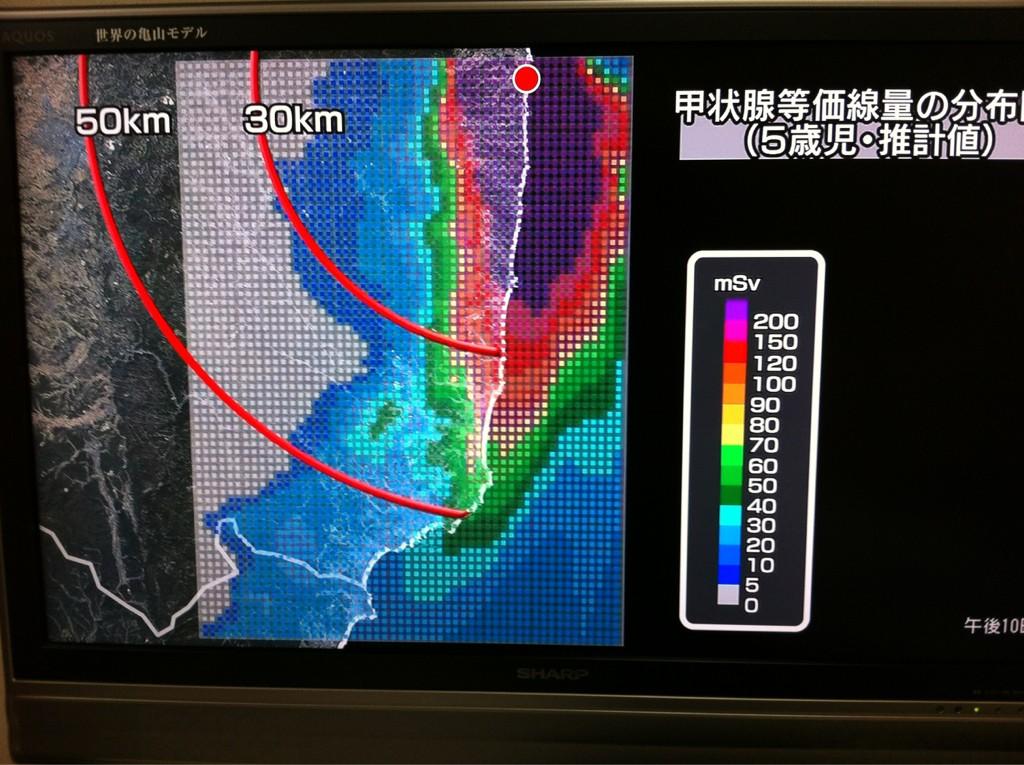
For some unknown reason, NHK decided to air a documentary on iodine-131 dispersion in the days right after the start of the Fukushima I Nuclear Power Plant accident in March 2011. In it, there was a simulation map created by researchers who carefully pieced together information without the government funding. It was a map of estimated thyroid dose equivalent exposure of I-131 for 5-year-olds.

The highest exposure is shown at above 200 millisieverts (thyroid dose equivalent for 5-year-olds).

(TV screenshot by @study2007, from Twitter)


This is the first map I've ever seen that has been made by the Japanese, plotting the thyroid dose.

What's interesting is why the dispersion of iodine-131 is still an estimate and simulation. As NHK tells it, the government ministry in charge of measuring radiation, Ministry of Education, actively intervened and prohibited the officials or researchers from doing the actual measurement of radioactive iodine in the air from March 14 to March 17, 2011.

WHY? Because the explosion of the Reactor 3 building at Fukushima I Nuclear Power Plant would endanger the officials doing the measurement outdoors. The officials dutifully followed the order. They chose not to collect probably the most critical data of the accident, and they didn't bother to tell the residents either, who were out and about with no information.

That's if you can believe NHK.

I wonder why they created the above map as dose equivalent for 5-year-olds, instead of 1-year-olds, like France's IRSN did. My guess is that the numbers would then be too high for viewers' comfort.

NHK's documentary (in Japanese) can be still seen here (part 1) and here (part 2), until NHK notices and takes them down.

Sunday, December 30, 2012

#Radioactive Japan: Former NRC Chairman Gregory Jaczko Visits Fukushima, Meets Evacuees


I haven't watched the entire program myself, but will do so tomorrow, before NHK finds the video and takes it down.

NHK BS-1 documentary "原発の“安全”を問い直す 米NRC前委員長 福島への旅 (NRC former chairman's trip to Fukushima - to re-examine the safety of nuclear power plants)", first aired on December 22, 2012. The program is in Japanese, but you can hear Jaczko's comments in English, and you can catch the interpreter.

Jaczko visited Japan in August this year, soon after he resigned from the NRC.


原発の“安全”を問い直す ~米NRC前委員長 福島... by tvpickup

While walking in Namie-machi with a former resident in Tyvek suits and mask, Jaczko says,

I see many different people with views about nuclear power. Some people try and say that really because no one was killed from radiation or appears to have received lethal doses of radiation that there's... such hype. But I think it is certainly very difficult to walk around here and see the livelihood that's just no longer there.


The town is frozen at March 11, 2011.

At the end of the program, Jaczko says,

"In the end, everyone has to keep in mind that the safety of the public is the number one responsibility, whether you are a power plant owner, whether you're a worker at the power plant, or a local or state or national government official, everyone has to recognize that safety of the people is the most important issue."


Well, it wasn't, in case of Japan. What came first and foremost was to tell people it was safe, and kept repeating it like a mantra.

Jaczko certainly does not come across as arrogant, bullying chairman that he was accused of being, by his colleagues.

Monday, July 16, 2012

July 16 Protest in Yoyogi Park "Largest Anti Nuclear Protest Ever in Tokyo", Reports NHK


What a surprise. I'm just shocked, SHOCKED! that NHK reported!

(Sarcasm off)

NHK reported on the July 16 protest in Yoyogi Park in Tokyo, for a change. It must be near impossible to ignore, because NHK is located right around the corner from the park.

The Tokyo Metropolitan Police apparently told NHK that 75,000 people participated.

From NHK (7/16/2012; part):

東京で過去最大の反原発集会

Largest-Ever Anti-Nuclear Event in Tokyo

関西電力大飯原子力発電所3号機がフル稼働に達するなど、国内で原発の運転再開に向けた動きが進むなか、東京で、過去最大規模の原発に反対する集会が開かれ、参加者が運転再開の撤回や原発の廃炉を訴えました。

As Reactor 3 at KEPCO's Ooi Nuclear Power Plant is in full operation and other nuclear plants in the country may be getting ready to resume operation, an anti-nuclear event was held in Tokyo which attracted the largest crowd ever. The participants demanded the reactor at Ooi Nuclear Power Plant be stopped and that nuclear reactors be decommissioned.

16日の集会は、ノーベル賞作家の大江健三郎さんやルポライターの鎌田慧さんなどが呼びかけ人となって、政府に抗議の声を届けようと開きました。

The July 16 gathering was organized by people including Nobel Prize winning author Kenzaburo Ooe and Satoshi Kamata, journalist and author, to let the government hear their voice of protest.

会場となった東京の代々木公園には、市民団体や労働組合のほか、ツイッターなどで呼びかけられた人たちが集まりました。
参加したのは、主催者側の発表でおよそ17万人、警視庁によりますとおよそ7万5000人で、東京で行われた反原発の集会やデモとしては、過去最大の規模になったということです。

Citizens' groups, labor unions, and people who had learned of the event via Twitter [and other net media] gathered in Yoyogi Park in Tokyo. The number of participants was 170,000 according to the organizers, and 75,000 according to the Police. It was the largest crowd ever gathered in Tokyo for anti nuclear protest.

Monday, June 18, 2012

Goshi Hosono on NHK, Trying to Spin Radiation Exposure in #Fukushima Last Year, Ooi Restart This Year


Goshi Hosono, Minister of the Environment and Minister in charge of nuclear accident, and former personal assistant to former PM Naoto Kan when the Fukushima nuclear accident started, appeared on NHK's program "Close-Up Gendai" on June 18, 2012. Here's the segment where he blurts out a story he must have carefully memorized (in an occasionally mangled speech) to impress the NHK viewers on the sincerity of the government when it says Ooi Nuclear Power Plant is safe.

In it, Hosono speaks of radiation exposure "kindly experienced by the residents" of Namie-machi, Fukushima Prefecture.


I transcribed what Hosono said in the video and translated below.

First he briefly talks about the restart of Ooi Nuclear Power Plant:

すべてが出来ているとは申しません。課題があるのは事実です。しかし、今の段階でやれることは国もやっているし、そして地元の福井県もやっていただいてるというように、思っています。

I am not saying we've done everything. It is true that there are problems. However, all that can be done at this stage is being done by the national government, and the local prefecture, Fukui Prefecture, is also kindly doing it, I believe.


The first two sentences seem true enough. But the third? From the governor of Fukui Prefecture, we know that all Fukui Prefecture did was to rubber stamp what the "experts" said, and to rely on the word of the KEPCO president that he would try his best. Hosono says everything that can be done is being done, and that is what he believes. What if he's wrong? "Out of expectation" - 想定外 (soh-tei-gai) of course.

Then he refers to the residents of Namie-machi in Fukushima in particular, and says he cannot forget about them:

あのー、特に浪江町の方々のことがですね、私頭から離れないんですよ。あの時10キロ、そして20キロという避難のですね、判断をしたわけですけれども、政府は。その時にあの、きちっと方角を示すべきだったのが示されなかったと。あのそこでたくさん被曝をしていただいたという状況ではない、と言うことはですね、後ほど確認は出来ましたが、それを経験をした皆さんの思いというのはですね、我々はほんとに忘れてはならないと思ってます。

Uh, about people in Namie-machi, I cannot help thinking about them. Back then [first few days of the nuclear crisis], first 10-kilometer, then 20-kilometer evacuation areas were determined and set, by the national government. At that time, uh, the direction [in which Namie-residents should evacuate] should have been given but it wasn't. Uh, it's not that much radiation exposure was kindly experienced by the residents, that we were able to confirm later. But the thoughts and feelings of people who experienced it, I think we should never forget.


Again, the first two sentences seem true enough. It was the government under PM Kan whom he served as a personal advisor who confidently (at that time, I remember) declared 10 kilometer-radius evacuation zone was more than sufficient, and the further away people went from the crippled plant the far less risk they would have from radiation exposure. Hosono now says the government should have told the residents which direction to go. Well it did. It told the residents to move as far away from the plant as they reasonably could, i.e. all directions.

As to whether Namie-machi residents were exposed to much radiation, I don't believe it has been "confirmed". There is no meaningful data on early radiation exposure suffered by the residents in Fukushima Prefecture, because government officials, from the national government on down, didn't allow researchers to conduct a meaningful survey of enough people in the early days and weeks of the accident. Namie-machi is where the radiation level of 330 microsieverts/hour were measured on March 15, 2011 by an official from the Ministry of the Education and Science. Not only many Namie residents remained for weeks after the start of the accident, but they were eating the food and drinking water that were contaminated, without knowing.

Then, Hosono tries to reassure the audience by mentioning the special surveillance system for Ooi Nuclear Power Plant:

だからこそですね、政府としては特別な監視体制というのをひいてまして、えーしっかりと原発の状況をですね、政府として、えー監視をするということをやってます。そして、あの、事故がないという状況を作らなければなりませんが、万万が一、なんらかのトラブルがあった場合は、それをそれぞれの自治体にですね、的確に情報が伝わるような仕組みも作っているんですね。

For that very reason, the national government is implementing the special surveillance system [for Ooi Nuke Plant], uh, to closely monitor the situation at the nuclear plant. And, uh, we have to create a situation of no accident, but if by any remote chance there is a trouble, we are building a system so that the accurate information will reach the affected municipalities.


We also know what this "special surveillance system" that Hosono is talking about. It is the Ooi Nuke Plant Off-Site Center, 7 kilometers away from the plant, at the foot of the peninsula where the nuclear power plant is located, manned by the senior vice minister from the Ministry of Economy, Trade and Industry assisted by a KEPCO vice president and NISA bureaucrats, all of whom will be babysat by managers from the plant manufacturers. Just like the Off-Site Center for Fukushima I Nuke Plant, everything relies on the electricity not cut off even in the case of a severe accident.

Hosono looks as if he doesn't understand anything he is saying. The female interviewer, a veteran announcer at NHK I think, is not there to ask questions but to help Hosono along so that he can regurgitate what he's been fed as quickly as possible.

(H/T anon reader for the video)