Showing posts with label Ishinomaki City. Show all posts

Monday, January 14, 2013

#Fukushima I Nuke Plant Accident: Contamination in Ojika Peninsula in NE Miyagi May Be Specifically from Reactor 1, Tokyo University Researcher Says


Ojika Peninsula is located in the northeast part of Miyagi Prefecture, where towns like Ishinomaki City and Onagawa-machi are located (see the map at the bottom of the post). Tokyo Municipal government has been importing the disaster debris from Onagawa and burning it in the regular garbage incinerators (many of which are located in the middle of residential areas) all over the central Tokyo since March 2012.

The Tokyo University researcher who was the first to measure Neptunium-239 in Iitate-mura in early April 2011 says he thinks he has been able to identify the radiation contamination in Ojika Peninsula to have happened on March 12, 2011, from Reactor 1.

Radioactive materials such as iodine-131, cesium-137 and tellurium-132 started to leak hours before the Reactor 1 venting operation in the early afternoon and the hydrogen explosion in late afternoon on March 12, 2011.

From Dr. Shouzugawa's tweets to other researchers who were discussing the Fukushima nuclear accident and the resultant contamination in various locations in Kanto and Tohoku:

牡鹿半島は12日の1号機汚染であることを実証する結果が得られましたので論文化して査読中です。その他、福島県内の2,3号機の寄与を分けていますが、まだ完全なものではありません。

I have obtained the result that proves the contamination in Ojika Peninsula is from Reactor 1 on [March] 12. The paper is currently in review process. I have also been trying to attribute contamination in various parts in Fukushima to Reactor 2 and Reactor 3, but this is not yet complete.

1号機建屋内の汚染水と牡鹿半島で採取した土壌に含まれる核種の放射能比が一致し、かつ、この値が他の炉のデータとは明らかに異なったことが根拠です。

The activity ratio of nuclides in the contaminated water taken from the Reactor 1 building matched that in the soil sample taken in Ojika Peninsula, and this activity ratio is distinctively different from the activity ratios for the other reactors.


22 months after the start of the accident, painstakingly slowly, the picture may emerge of the radiation contamination mechanism. About time, but it is exciting nonetheless.

I'm searching for the available data at TEPCO's site, but if you want to beat me to it, feel free and post the links in the comment section. (It is possible though that the Reactor 1 data is only available in detail to researchers.)

(Let's see, who was that university professor who claimed there was no radiation contamination in the disaster debris from Ojika Peninsula...?)

From Professor Yukio Hayakawa's Radiation Contour Map Version 7, location of Ojika Peninsula:


Professor Hayakawa puts contamination of Ojika Peninsula just past the midnight, at 1:50AM on March 13, 2011 (according to the backside of the Version 7 map).

That's when the radiation measured at Onagawa Nuclear Power Plant jumped to 21 microsieverts/hour.

Sunday, September 16, 2012

#Radioactive Disaster Debris from Miyagi to Kitakyushu City, 2 Billion Yen Just To Transport


(UPDATE) Kitakyushu City is burning it now, on Monday September 17, which is a holiday in Japan (Respect the Elderly Day, no joke). Looking at TV Tokyo News, it certainly does not look anything like "wood chips".


=================================

Does that make sense? Yes it does. Kajima, one of the largest general contractors in Japan, got the job of transporting the debris by sea for a handsome 2 billion yen (US$25.5 million), and the mayor of Kitakyushu City can tell the residents that the cash-strapped city of his will get 620 million yen from Miyagi Prefecture (who will bill the national government, who will bill the Japanese citizens/residents), according to Mr. Yushi Yokota, Communist Party assemblyman in the Miyagi prefectural assembly.

After all, Kitakyushu City has been prepping the city's children, telling them how wonderfully safe and clean it is to burn the debris. This kind of effort should not be wasted.

Here's Asahi Shinbun's video footage. The container ship that carried 800 tonnes of disaster debris from Miyagi arrived at the port in Kitakyushu City in the morning of September 13, 2012:


The containers carried flammable debris, mostly wood chips carefully sorted and washed, from Ishinomaki City in Miyagi, or that's how it was sold to the Kitakyushu City residents.

Well, not quite. A blog called "Kyushu Sunflower Project" by people against accepting and burning debris in kitakyushu City has this photo in one of their posts. When one of the containers was opened, this is what they found. Does it look like "wood chips" to you? Does it look like they were carefully sorted and washed to you?


The blogpost adds one more piece of information that should alarm the residents of Kitakyushu. Debris from Onagawa-cho, Miyagi was mixed in with that of Ishinomaki. Onagawa's debris is much more contaminated than that of Ishinomaki. (For the degree of contamination of disaster debris in Miyagi and Iwate, see my post from March 24, 2012.)

There is also an allegation of "double-counting" of disaster debris from Ishinomaki. As it turns out that there is far less debris than originally estimated, there is not enough to go around. So what does the enterprising governor of Miyagi do? Double-count. Kajima's joint venture had won the contract to process all the disaster debris in Ishinomaki last year. That should have been the end of it. No debris to give to anyone else. But miraculously, for Kitakyushu City, the debris somehow materialized, and Goshi Hosono's Ministry of the Environment will make sure it will get burned and money be paid to Kajima and Kitakyushu City.

The blog "Kyushu Sunflower Project" has a cartoon titled "There was no debris left", explaining this double-counting. The cartoon also has an incredible piece of information - the temporary housing for people in the city who lost their homes in the tsunami of March 11, 2011 was built right next to the debris piles. What's more, Ishinomaki City does have a landfill in the mountain on the east side of the city, and it is empty.

What were they thinking? (Maybe they WERE thinking well, to use this as a tool to pressure the municipalities outside Miyagi to accept contaminated debris for the sake of these poor residents...)


(Cartoon continues at the link.)

Sunday, March 18, 2012

Goshi Hosono Short on Facts on Debris-Peddling Commercial

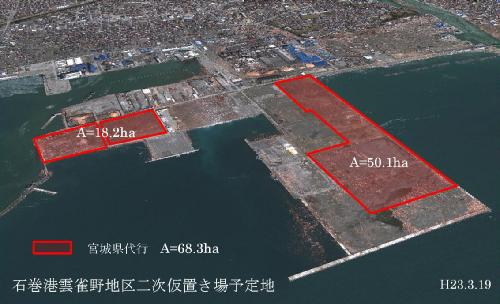
The Ministry of the Environment has a 2-minute-long commercial featuring Minister Goshi Hosono, aka disaster debris pusher, in front of the mountains of disaster debris in Ishinomaki City in Miyagi Prefecture.

Just about every single sentence he utters is short on facts and accuracy and full of misrepresentation.

From the Ministry of the Environment commercial below, translated and captioned by Tokyo Brown Tabby:

Hosono: As you can see, this is a huge mountain of debris.

Fact: Debris is actually neatly piled up, because it has been removed from the immediate coastal areas hit by the tsunami and is being stored there, as you can see at 0:26 into the video. But the disaster debris wide-area processing is being sold on the perception that the tsunami debris is still littering the streets and people's backyards after one year.

Hosono: Ishinomaki City cannot complete the disposal alone.

Fact: In fact, the city can. The debris are being stored on the landfill on the bay, not bothering anyone nearby. The city has budgeted nearly 200 billion yen (US$2.4 billion) to do the debris disposal, building 5 new incineration plants on the landfill and in the process creating 1,250 jobs. None of the sister cities of Ishinomaki City has been asked to take the debris.

Hosono: The debris is the remnants of people's lives.

Fact: Yes it is. So? Is that the reason to spread it all over Japan? Wouldn't the pieces of lives of people in Ishinomaki want to remain in Ishinomaki?

Hosono: There are people in the city who are discouraged to see the debris in front of them...

Fact: The debris is on the landfill, removed from the areas where people live and work. It is not in front of them.

Hosono: Please assist the nation-wide disposal...

Fact: Ishinomaki has 6 million tonnes of debris. Of that, 10 to 20% of the debris is what the Ministry of the Environment wants to spread to the rest of Japan because "Ishinomaki cannot do it alone". It doesn't add up. It may lengthen the time it takes to dispose of the debris by 20% at most. It may take 6 years instead of 5. Or 12 years instead of 10. It doesn't seem like such a vast difference.

Hosono: See, we measure radiation ... (using a survey meter that measures only gamma ray radiation)

Fact: You cannot measure the contamination on the debris by a survey meter unless the contamination is in the order of tens of thousands of becquerels per kilogram.

Hosono: I ask your cooperation of nation-wide disposal of safe debris...

Fact: No one trusts the "safety" standards of the national government, particularly those set by the Ministry of the Environment.

And the ultimate fact is that this wide-area disposal of the disaster debris was decided in May when the radiation contamination was thought (by the government) to be occurring in Fukushima Prefecture alone. Everything was set to go, with the heavy support from the big businesses, when radioactive materials started to be detected outside Fukushima. So what do you do when the situation changes? As far as the Japanese government goes (as with most governments in the world), keep pushing no matter what. Big money is at stake.