Showing posts with label Obama administration. Show all posts

Monday, March 17, 2014

(OT) New "Cold War" Between the US and Russia: US Will "Calibrate", Russia Will "Incinerate"


Too funny to pass these up...

President Obama says this, after slapping "sanctions" on Russia (and Ukraine's government officials, 11 of them in total) over what seems like a very democratic vote in Crimea to leave Ukraine and re-join Russia, according to Bloomberg News (3/17/2014):

Obama said at the White House. The U.S. can “calibrate our response” based on whether Russia chooses “to escalate or to de-escalate the situation.”


While President Obama, who didn't attend the National Security Council meeting at the White House over the weekend (again), "calibrates", Mr. Dmitry Kiselyov, a presenter of the Russian state-owned TV, says, according to The Independent (3/17/2014):

"Russia is the only country in the world realistically capable of turning the United States into radioactive ash," Kiselyov said standing in front of a large screen depicting a mushroom cloud produced by a nuclear explosion.

"Americans themselves consider Putin to be a stronger leader than Obama," he said. "Why is Obama phoning Putin all the time and talking to him for hours on end?"

Kiselyov suggested President Obama's hair is turning grey because he is fretting about Russia's nuclear capacity, which could turn the US into dust.


The Independent has a screen shot of Mr. Kiselyov with the image of a huge mushroom cloud in the back:


A less-colorful and plainer word is from Crimea's Prime Minister Sergey Aksyonov, according to CNN:

"We are going home. Crimea is in Russia"


Soviet Russia did have one awe-inspiring atomic bomb (Tsar Bomba):

Monday, March 3, 2014

(OT) Anatole Kaletsky: "Realpolitik in Ukraine"


A post at Zero Hedge has made most sense to me so far regarding the turmoil in Ukraine after the West has successfully incited the opposition to President Yanukovich and after Russia has entered Crimea.

Putin’s decision to back himself into this corner has been derided by the Western media as a strategic blunder but it is actually a textbook example of realpolitik. Putin has created a situation where the West’s only alternative to acquiescing in the Russian takeover of Crimea is all-out war.


Accept Putin's terms, or an all-out war.

In another word, checkmate for the West?

From Zero Hedge (3/3/2014; emphasis is mine):

Realpolitik In Ukraine

Submitted by Anatole Kaletsky via Evergreen-Gavekal


Oscar Wilde described marriage as the triumph of imagination over intelligence and second marriage as the triumph of hope over experience. In finance and geopolitics, by contrast, experience must always prevail over hope and realism over wishful thinking. A grim case in point is the Russian incursion into Ukraine. What makes this confrontation so dangerous is that US and EU policy seems to be motivated entirely by hope and wishful thinking. Hope that Vladimir Putin will “see sense,” or at least be deterred by the threat of US and EU sanctions to Russia’s economic interests and the personal wealth of his oligarch friends. Wishful thinking about “democracy and freedom” overcoming dictatorship and military bullying.

Financial markets cannot afford to be so sentimental. While we should always recall at a time like this the famous advice from Nathan Rothschild to “buy at the sound of gunfire,” the drastically risk-off response to weekend events in Ukraine makes perfect sense because Russia’s annexation of Crimea is the most dangerous geopolitical event of the post-Cold War era, and perhaps since the Cuban Missile crisis. It can result in only two possible outcomes, either of which will be damaging to European stability in the long-term. Either Russia will quickly prevail and thereby win the right to redraw borders and exercise veto powers over the governments of its neighbouring countries. Or the Western-backed Ukrainian government will fight back and Europe’s second-largest country by area will descend into a Yugoslav-style civil war that will ultimately draw in Poland, NATO and therefore the US.

No other outcome is possible because it is literally inconceivable that Putin will ever withdraw from Crimea. To give up Crimea now would mean the end of Putin’s presidency, since the Russian public, not to mention the military and security apparatus, believe almost unanimously that Crimea still belongs to Russia, since it was only administratively transferred to Ukraine, almost by accident, in 1954. In fact, many Russians believe, rightly or wrongly, that most of Ukraine “belongs” to them. (The very name of the country in Russian means “at the border” and certainly not “beyond the border”). Under these circumstances, the idea that Putin would respond to Western diplomatic or economic sanctions, no matter how stringent, by giving up his newly gained territory is pure wishful thinking.

Putin’s decision to back himself into this corner has been derided by the Western media as a strategic blunder but it is actually a textbook example of realpolitik. Putin has created a situation where the West’s only alternative to acquiescing in the Russian takeover of Crimea is all-out war. And since a NATO military attack on Russian forces is even more inconceivable than Putin’s withdrawal, it seems that Russia has won this round of the confrontation. The only question now is whether the new Ukrainian government will accept the loss of Crimea quietly or try to retaliate against Russian speakers in Ukraine—offering Putin a pretext for invasion, and thereby precipitating an all-out civil war.

(Full article at the link)


The United Kingdom has already backed out of trade sanctions against Russia over Crimea, as it fears the impact on global economic recovery.

(What recovery? 99.9% would ask...)

Tuesday, February 25, 2014

Obama Signed Off on Nuclear Deal with Vietnam, Allowing Nuclear Fuel Sale and Uranium Enrichment


As he openly demands Japan to return 300 kilograms of weapons-grade plutonium that the US gave as part of "Atoms for Peace" for his concern for nuclear proliferation (to the delight of China for another chance to bash Japan), President Obama allows the US to sell nuclear fuel and technology to Vietnam, and allows Vietnam to enrich uranium if they want to.

Why? According to The Hill, to counter China.

It's a curious timing, as Vietnam has just postponed the construction of its first nuclear power plant (to be built by Russian companies) for six years. Vietnam's second nuclear power plant is to be built by the Japanese consortium, but there is no news of delay for that one.

The Hill (2/24/2014; emphasis is mine):

Obama OKs nuke deal with Vietnam

President Obama signed off Monday on a controversial civilian nuclear deal with Vietnam.

The cooperation agreement with the communist nation allows the U.S. to sell nuclear fuel and technology to its former foe. It aims to help guarantee Vietnams' energy independence as China asserts a more prominent role in the region.

“I have determined that the performance of the Agreement will promote, and will not constitute an unreasonable risk to, the common defense and security,” Obama wrote in a memo for the secretaries of State and Energy.
The deal aims to get Vietnam to import the fuel it needs for its reactors instead of producing it domestically. But it doesn't bar the country from conducting its own uranium enrichment, raising concerns about nuclear proliferation.

The agreement is also seen as a potential complicating factor in the ongoing nuclear talks with Iran. Iran has repeatedly accused nuclear powers, and the United States in particular, of a double standard in terms of which nations are allowed to run nuclear programs that are allegedly for civilian purposes only.

Sunday, December 15, 2013

Evans-Pritchard: China-Japan Rearmament is Keynesian Stimulus, If It Doesn't Go Horribly Wrong


An "IF" in capital letters, but even if it does go wrong and things come to a head between China and Japan, it will still be a great Keynesian stimulus for the US and Europe, whose economies have been suffering "long malaise".

Ambrose Evans-Pritchard, on-again-off-again Keynesian (I think it's "on" now, since the Great Recession induced by the Lehman collapse), says Japan is ready for a fight if necessary; at the same time he seems to think that mishap is not necessarily by China or Japan but by the United States, and fear the cascading effect outside the parties directly involved, as he cites the Agadir crisis in 1911.

With the flip-flopping president who are surrounded by advisors whose expertise (if that) is only in the US domestic politics, the probability of the mishap is rather significant, I'm afraid, no matter how much Japan's PM Shinzo Abe tries to flatter the US president.
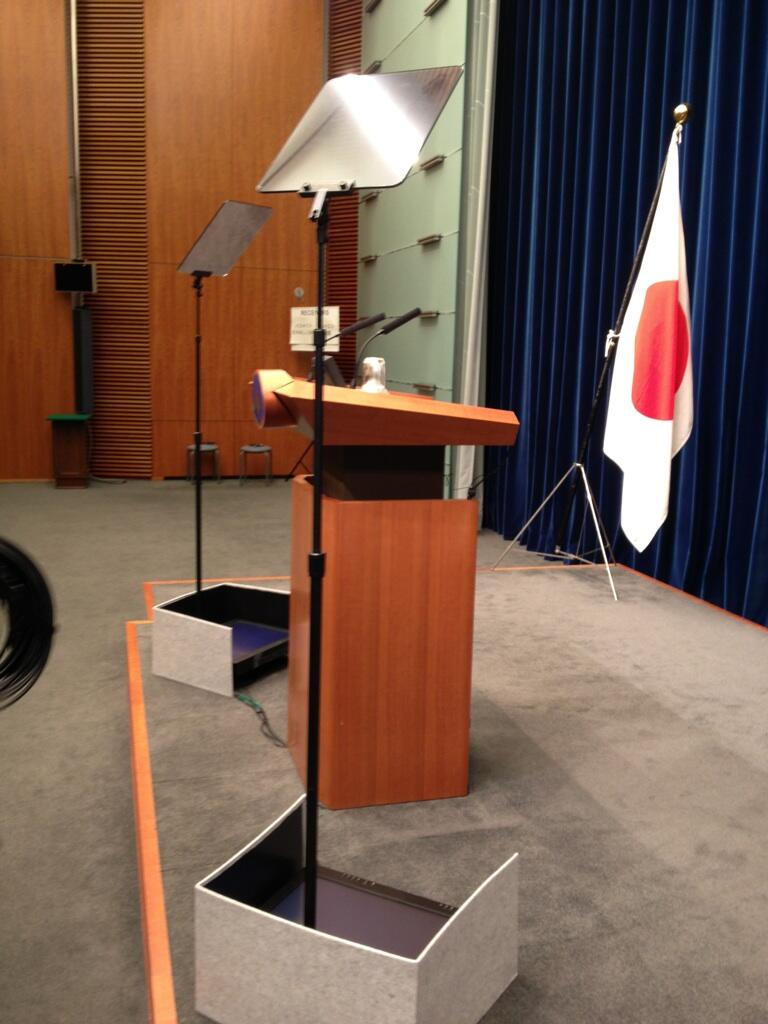
(The latest example of flattery is Abe's mimicking President Obama in using teleprompters for the first time to deliver his speech at a hastily scheduled press conference on December 14, 2013, probably just to show off his brand-new toy...image from Yasumi Iwakami)

From The Telegraph (11/26/2013; emphasis is mine), by Ambrose Evans-Pritchard:

China-Japan rearmament is Keynesian stimulus, if it doesn't go horribly wrong

Asia is on the cusp of a full-blown arms race. The escalating clash between China and almost all its neighbours in the Pacific has reached a threshold. All other economic issues at this point are becoming secondary.

Beijing's implicit threat to shoot down any aircraft that fails to adhere to its new air control zone in the East China Sea is a watershed moment for the world. The issue cannot easily be finessed. Other countries either comply, or they don't comply. Somebody has to back down.

The gravity of the latest dispute should by now be obvious even to those who don't pay attention the Pacific Rim, the most dangerous geostrategic fault line in the world.

Japan’s foreign minister, Fumio Kishida, accused China of “profoundly dangerous acts that unilaterally change the status quo”.

The US defence secretary Chuck Hagel called it “a destabilising attempt to alter the status quo in the region” and warned that the US would defy the order. The Pentagon has since stated that US pilots will not switch on their transponders to comply, and will defend themselves if attacked. Think about this for a moment.

Mr Hagel asserted categorically that Washington will stand behind its alliance with Japan, the anchor of American security in Asia. “The United States reaffirms its long-standing policy that Article V of the US Japan Mutual Defense Treaty applies to the Senkaku Islands,” he said.

Whether China fully believes this another matter, of course. The Senkaku islands offer a perfect opportunity for Beijing to test the resolve of the Obama Administration since it is far from clear to the war-weary American people why they should risk conflict in Asia over these uninhabited rocks near Taiwan, and since it also far from clear whether President Obama's Asian Pivot is much more than a rhetorical flourish.

Besides, Beijing has just watched the US throw its long-time ally Saudi Arabia under a bus over Iran. It has watched Moscow score an alleged victory over Washington in Syria. You and I may think it is an error to infer too much US weakness from these incidents, but that is irrelevant. Beijing seems to be drawing its own conclusions.

Even if the immediate crisis can be defused, we are clearly sliding into a new Cold War. While it is dangerous, it could have paradoxical and powerful side effects. Rearmament lifted the world economy out of slump in the late 1930s, working as a form of concerted Keynesian fiscal stimulus. It could do so again.

The parallels are not exact. They never are. But an Asian arms race would almost certainly tackle some of the underlying causes of the long malaise in the Western economies. It would soak up much of the Asian "savings glut" and the excess industrial capacity in China, and would help to narrow the perennial East-West trade gap.

This would be an answer of sorts to the West's "secular stagnation" – to use the term of former US treasury secretary Larry Summers – or the liquidity trap as others call it. But be careful what you wish for.

I don't wish to become entangled in debate over whether other states impose such ADIZ identification zones beyond their territorial waters, as asserted by Beijing. It is political infantilism to see and judge such disputes through a moral prism, as if our Hobbesian world conforms to codes of right and wrong. What we are dealing with is a great power collision of epochal proportions.

The Asian arms race is young, but clearly under way already. China has launched its first stealth drone, known as Sharp Sword. It developing indigenous aircraft carriers. Its “Two-Ocean-Strategy” implies a fleet of five or six carrier battle groups.

Japan is already rearming. It is building a de facto marine force. It has launched its largest warship since WW2, an 800-foot long DDH-class helicopter carrier, an aircraft carrier in all but name. Tokyo is developing its own version of the Pentagon's Advanced Research Projects Agency. Spending on warships and aircraft will jump by 23pc this year.

When I visited the spanking new buildings of the Japanese defence ministry in Tokyo in March, it already seemed like another world from the run-down digs of the old Self-Defence Force that I had visited six years earlier.

You could feel the emergence of a new military power, pacifist still in name only. The message that came through loud and clear from talking to officials is that Japan is ready for a fight if necessary, and is convinced that it can sink or shoot down any force sent by China into Japan's waters and airspace – whether to close in on the Senkaku/Diaoyu islands, or to ratchet up pressure against Okinawa.

I was shown detailed maps tracing movements of Chinese DDG warships and Yuan-class submarines that left me deeply alarmed over where this is going. Japanese officials said Chinese naval officers on patrol were not responding to normal signals.

"What we don't know is whether Chinese officers follow any international code of conduct? Do they understand what is banned and not banned? Does the Communist Party control their own military?" said one defence planner.

"Two thousand years ago under the Han Dynasty, the emperor put his right hand on the wheel of his chariot and told his general that everything inside the borders was the domain of the emperor, and everything outside was left to the commander. That has plagued China throughout its history, and it is the delicate issue we now face," he said.

There is no red telephone between Tokyo and Beijing to defuse a crisis if it erupts, nothing comparable to the Washington-Moscow "hotline" during the Cold War.

While the US and China were able to calm the waters after an American military jet collided with a Chinese fighter in 2002 – killing the Chinese pilot – it is unlikely that any such mishap between China and Japan could be contained at this stage.

Today's escalating spat has echoes of the Agadir crisis in 1911, the stand-off between Wilhelmine Germany and the Franco-British Entente in the final years before the First World War.

In case you have forgotten, Kaiser Wilhelm sent the warship Panther to Morocco in 1911 to prevent French annexation. The Kaiser picked his moment well. The French were violating earlier accords.

Yet his real purpose was to probe and weaken Britain's entente with France (not a formal alliance) by picking on an issue where London had little natural sympathy for French actions.

The Agadir Crisis backfired against the Kaiser. The Entente did not break. But that is hardly a reassuring episode. The chain of events that followed were catastrophic.

France felt emboldened by British backing, with ripple effects through the Franco-Russian alliance. Russia then felt more able to push its luck when the Serbian crisis hit in 1914. Agadir fed an overwhelming sense of fury in Germany, a feeling that Britain had become an enemy.

America is now having to walk the same sort of tightrope that Britain had to walk – and walked badly – from Agadir to Sarajevo. One misjudgement by either side in the East China Sea could change our world entirely. If you are not concerned, perhaps you should be.


"Mr Hagel asserted categorically that Washington will stand behind its alliance with Japan, the anchor of American security in Asia."


Well, ever since Evans-Pritchard wrote this article (11/26/2013), the US has been busy pleasing Beijing while throwing Japan under the bus (here and here). The US State Department's deputy spokesperson even said the US was happy to see changes in South Korea, which announced it would now allow airlines to file flight plans with Chinese authorities over the disputed territories.

Meanwhile Prime Minister Abe is busy meeting and speaking with the heads of the ASEAN nations in an effort to form a united front against China, whom they perceive as encroaching on the neutral or international (and disputed) space.

Saturday, November 2, 2013

(OT) ABC News Exclusive: Secretary General of Interpol Wonders Aloud If Armed Citizenry Is More Necessary Now, Instead of Gun Control


I don't believe this article got much coverage, given how it is under the Obama administration when it comes to armed citizenry.

For my record, from ABC News (10/21/2013; emphasis is mine):

Exclusive: After Westgate, Interpol Chief Ponders 'Armed Citizenry'

Interpol Secretary General Ronald Noble said today the U.S. and the rest of the democratic world is at a security crossroads in the wake of last month's deadly al-Shabab attack at a shopping mall in Nairobi, Kenya – and suggested an answer could be in arming civilians.

In an exclusive interview with ABC News, Noble said there are really only two choices for protecting open societies from attacks like the one on Westgate mall where so-called "soft targets" are hit: either create secure perimeters around the locations or allow civilians to carry their own guns to protect themselves.

"Societies have to think about how they're going to approach the problem," Noble said. "One is to say we want an armed citizenry; you can see the reason for that. Another is to say the enclaves are so secure that in order to get into the soft target you're going to have to pass through extraordinary security."

Noble's comments came only moments after the official opening of the 82nd annual gathering of the Interpol's governing body, the General Assembly. The session is being held in Cartagena, Colombia, and is being used to highlight strides over the last decade in Colombia's battle against the notorious drug cartels that used to be the real power in the country.

The secretary general, an American who previously headed up all law enforcement for the U.S. Treasury Department, told reporters during a brief news conference that the Westgate mall attack marks what has long been seen as "an evolution in terrorism." Instead of targets like the Pentagon and World Trade Center that now have far more security since 9/11, attackers are focusing on sites with little security that attract large numbers of people.

At least 67 were killed over a period of days at the Westgate mall, more than 60 of the dead were civilians. The Somalia-based al Qaeda-allied terror group al-Shabab claimed responsibility for the attack as it was ongoing but investigators are still trying to determine exactly who planned the strike, where they are and what is next for them. U.S. authorities in Uganda, fearing another similar incident in Africa, issued a warning late last week.

Citing a recent call for al Qaeda "brothers to strike soft targets, to do it in small groups," Noble said law enforcement is now facing a daunting task.

"How do you protect soft targets? That's really the challenge. You can't have armed police forces everywhere," he told reporters. "It's Interpol's view that one way you protect soft targets is you make it more difficult for terrorist to move internationally. So what we're trying to do is to establish a way for countries … to screen passports, which are a terrorist's best friend, try to limit terrorists moving from country to country. And also, that we're able to share more info about suspected terrorists."

In the interview with ABC News, Noble was more blunt and directed his comments to his home country.

"Ask yourself: If that was Denver, Col., if that was Texas, would those guys have been able to spend hours, days, shooting people randomly?" Noble said, referring to states with pro-gun traditions. "What I'm saying is it makes police around the world question their views on gun control. It makes citizens question their views on gun control. You have to ask yourself, 'Is an armed citizenry more necessary now than it was in the past with an evolving threat of terrorism?' This is something that has to be discussed."

"For me it's a profound question," he continued. "People are quick to say 'gun control, people shouldn't be armed,' etc., etc. I think they have to ask themselves: 'Where would you have wanted to be? In a city where there was gun control and no citizens armed if you're in a Westgate mall, or in a place like Denver or Texas?'"

Prior to the Westgate attack, the gun control debate has been ignited time and time again in the U.S. in the aftermath of a series of mass shootings, including one in a movie theater in Aurora, Col., a suburb of Denver.


(I think I can tell the answer by the majority of Japanese: they'd rather be in a city with the strictest gun control and absolutely no citizens armed when shooting starts in a big shopping mall...)

Sunday, October 27, 2013

(OT) US House Intelligence Committee Chair to France: Celebrate! Pop Champagne Over NSA Spying on French!


Republican Representative Mike Rogers represents Michigan's 8th congressional district, and the current chairman of the Permanent Select Committee on Intelligence.

According to an Agence France-Presse article that appeared on Raw Story, he is urging French citizens to celebrate NSA spying on them because it keeps them safe.

What do you say, French readers? Agreed?

Mr. Rogers further asserts that the rise of fascism and communism in the early 20th century took place because the US wasn't spying enough on Europeans.

And of course, the media is blowing things out of proportion.

From AFP, via Raw Story (10/27/2013):

Rep. Mike Rogers: France should be ‘popping champagne’ over NSA spying

US intelligence is better than in Europe, and snooping at the heart of a widening scandal helps keeps the world safe, a top US lawmaker declared Sunday amid a widening spying row.

House Intelligence Committee Chairman Mike Rogers also suggested there was nothing surprising in revelations that the United States was monitoring communications of several dozen world leaders and ordinary citizens, and blamed the news media for getting the story wrong.

“I think the bigger news story here would be… if the United States intelligence services weren’t trying to collect information that would protect US interests both (at) home and abroad,” the Republican told CNN’s “State of the Union” program.

“We need to make sure that we’re not collecting information we don’t need. But we should collect information that is helpful to the United States’ interests.”

...

But Rogers said that French citizens would celebrate US phone intercepts in their country if they realized how the practice keeps them safe.

“If the French citizens knew exactly what that was about, they would be applauding and popping champagne corks. It’s a good thing. it keeps the French safe. It keeps the US safe. It keeps our European allies safe,” he added.

“This whole notion that we’re going to go after each other on what is really legitimate protection of nation-state interest, I think is disingenuous.”

Rogers called for improved intelligence oversight in European capitals, contrasting allies’ approaches to the United States, where he stressed the government must first obtain approval from a special court to monitor communications.

European countries “don’t have necessarily the same type of oversight of their intelligence services that we do,” Rogers said.

“They need to have a better oversight structure in Europe. I think they would be enlightened to find out what their intelligence services may or may not be doing.”

The Republican lawmaker said the news media was “100 percent wrong” in suggesting that the NSA monitored up to 70 million French telephone records in a single month.

“They’re seeing three or four pieces of a 1,000-piece puzzle and wanted to come to a conclusion,” he added, insisting the records collection was a counterterrorism program that did not target French citizens.

Rogers also suggested that US leaders failed to foresee the rise of fascism and communism in early 20th century Europe because American spies were not spying extensively on European allies’ communications.

“In the 1930s, we had this debate before. We decided we were going to turn off our ability to even listen to friends,” he said.

“Look what happened in the 30s, the rise of fascism and communism. We didn’t see any of it. It resulted in the death of really tens of millions of people.”

But the lawmaker stressed that any intelligence activities between allies should remain “respectful” and “accurate,” as well as be subjected to proper oversight.

(Full article at the link)


France had the superb spy-master in the person of Joseph Fouché. To be lectured by the likes of Mike Rogers must be an insult.

Tuesday, September 10, 2013

(OT) Today's John Kerry on Syria: "It Was Me Who Suggested Syria's Chemical Weapon Control Last Week"


After the scramble to spin Secretary Kerry's blunder during a press briefing in London on Monday which gave an opening to Vladimir Putin was unsuccessful, the Obama administration's Tuesday's spin is that it is not Russia but the US who suggested it, and it was last week.

From Buzz Feed (9/10/2013):

Administration Changes Russian Proposal’s Origin Story

WASHINGTON — The Obama Administration’s explanation of how a Russian proposal to get rid of Syrian chemical weapons came to be has morphed rapidly in the past 24 hours from being portrayed as an unexpected slip-up to — in its new incarnation — a plan that U.S. officials were involved in as early as last week.

“I had some conversations about this with my counterpart from Russia last week,” Secretary of State John Kerry said during a House Armed Services Committee hearing on Tuesday, referring to Russian Foreign Minister Sergei Lavrov. “President Putin raised the issue with President Obama at St. Petersburg. President Obama directed us to try to continue to talk and see if it is possible. So it is not something that — you know, suddenly emerged, though it did publicly. But it cannot be allowed to be a delay.”

Later, under questioning by Rep. Hank Johnson, Kerry said he had not made a mistake when he suggested the proposal in a press conference in London on Monday.

I didn’t misspeak,” Kerry said. “I was asked about it. I responded because I was asked.”

(Full article at the link)


How he takes us for fools who cannot (do not, would not) remember what his own department put out yesterday that his remark was nothing but "hypothetical and rhetorical".

But now the Obama administration's "strategy" today is to make it near-impossible for the UN Security Council to come to any agreement on Russia's proposal for an international supervision of Syria's chemical weapons. Russia has just withdrawn the request for the emergency session of the Council.

Meanwhile "Syrian rebels" that the US supports are dead set against political solutions, as they have been planning their offensive around the coming US military attack on Syria.

Mccain-Graham duo now says the Assad administration's willingness to submit its chemical weapons under international supervision is an excellent reason for the US Congress to vote "yes" on launching a military attack on Syria.

President Assad, during his interview with Charlie Rose that was aired on Monday, said:

"... for us in Syria, we have principles. We'll do anything to prevent another crazy war in the region. ... It's not about me, it's about the region."

Monday, September 9, 2013

(OT) US Secretary of State John Kerry's Own Goal on Syria, and Obama Takes Credit for Possible "Political Solution"


Now the Obama administration is busy taking credit for possible political solutions on Syria, after Russia made good use of Secretary Kerry's blunder, aka "hypothetical" remark, during a press briefing in London on Monday, and Syria, the UN, and a host of political leaders around the world (including UK's Cameron) warm up to the Russian proposal of putting Syria's chemical weapons under international supervision.

Even the GOP duo McCain and Graham, who have been staunch supporters of President Obama's policies and initiatives, say "the proposal should be given a chance".

Harry Reid has delayed the procedural vote in the US Senate due to this new development (aka he doesn't have enough vote to pass the resolution).

From Washington Post (9/9/2013; emphasis is mine):

(Original title of the article as seen on the browser bar: Syria says it 'welcomes' Russia proposal on chemical weapons)

(Current article title is all about Obama) Obama sees potential ‘breakthrough’ in Russia’s Syria proposal

Russia and Syria embraced Secretary of State John F. Kerry’s suggestion Monday that the Syrian government could avert a U.S. attack by placing its chemical weapons under international control, upending the Obama administration’s efforts to sharpen its case for military action.

...

The timing of the new proposal was awkward and its apparent genesis perhaps more so.

It began when Kerry was asked early Monday whether Assad could avoid a U.S. attack.

“Sure. He could turn over every bit of his weapons to the international community within the next week, without delay,” Kerry responded with a shrug. “But he isn’t about to.”

As Kerry flew back to Washington to help lobby lawmakers, he received a midair call from Russian Foreign Minister Sergei Lavrov, who said he had heard the secretary’s remarks and was about to make a public announcement.

The statement in Moscow came before Kerry landed.

“We are calling on the Syrian authorities [to] not only agree on putting chemical weapons storages under international control but also for its further destruction and then joining the Organization for the Prohibition of Chemical Weapons,” Lavrov said, adding, “We have passed our offer to [Syrian Foreign Minister] Walid al-Moualem and hope to receive a fast and positive answer.”

Moualem, who was in Moscow meeting with Lavrov, followed with a statement that his government “welcomes Russia’s initiative, based on the Syrian government’s care about the lives of our people and security of our country.”

Although Syrian President Bashar al-Assad denies having a stockpile of the widely banned weapons, the idea of international control also quickly gained traction among diplomats and at least some senior Democrats whose support Obama seeks for a show of force.

Sen. Dianne Feinstein (D-Calif.) was the first senior lawmaker to voice support for the Russian proposal.

“I think if the U.N. would accept the responsibility of maintaining these facilities, seeing that they’re secure, and that Syria would announce that it is giving up any chemical weapons programs or delivery system vehicles that may have been armed, then I think we’ve got something,” Feinstein said.

The Russian announcement was met with approval by international backers and critics of a U.S. strike. U.N. Secretary General Ban Ki-moon, who has said a U.S. attack on Syria would be illegal without U.N. approval, signaled support, as did British Prime Minister David Cameron.

French Foreign Minister Laurant Fabius, whose government had said it would join an American attack and who two days ago stood at Kerry’s side in Paris to pledge an all-out effort to build public support, said it was worth testing. German Chancellor Angela Merkel, who has been wary of a strike, welcomed the idea.

Republican Sens. John McCain (Ariz.) and Lindsey O. Graham (S.C.) said the proposal came only because Assad feels the threat of military force and that Congress should continue considering Obama’s request for legislative backing. But the two said the proposal should be given a chance — and a test of its sincerity — by being committed to writing in a U.N. Security Council resolution.

“We should not trust, and we must verify,” the pair said in a joint statement.

A senior State Department official said Kerry warned Lavrov that the United States was “not going to play games.”

Current and former Obama administration officials scrambled Monday to say the proposal should not derail plans for a punitive strike. They suggested it was a delaying tactic after more than two years of diplomatic efforts with Syria and its ally Russia, albeit one spurred by the prospect that a U.S. military attack is imminent.

“It’s very important to note that it’s clear that this proposal comes in the context of the threat of U.S. action and the pressure that the president is exerting,” deputy national security adviser Tony Blinken said at the White House. “So it’s even more important that we don’t take the pressure off and that Congress give the president the authority he’s requested.”

(Full article at the link)


Senator John McCain's initial reaction to Secretary Kerry's own goal was, "unbelievably unhelpful".

(OT) "Coalition of the Willing" to Attack Syria for Whatever Reason that Obama Administration Comes Up With Has Expanded to 25


(UPDATE) The latest and hilarious development over Syria in the new post.

===================

Nations who signed the joint agreement with the US at G20:

Australia
Canada
France
the U.K. (even though the Parliament voted No)
Italy
Japan
Saudi Arabia
South Korea
Spain
Turkey

As of 9/9/2013, according to Washington Times):

Albania
Croatia
Denmark
Estonia
Germany
Honduras
Hungary
Kosovo
Latvia
Lithuania
Morocco
Qatar
Romania
United Arab Emirates

Total 25 mighty nations of the world.

As the Obama administration sends out top officials (including this one of Benghazi fame) to TV networks to prep the general public for the big speech by Mr. Obama himself on Tuesday, Russia has proposed the initiative for chemical weapon disarmament for Syria, and Syria has welcomed the proposal. The UN Secretary General Ban Ki-moon is now calling for the destruction of Syria's chemical weapons in internationally supervised safe zones.

Sunday, September 8, 2013

(OT) Obama's Chief of Staff Says Military Attack on Syria Is to Teach Iran a Lesson (UPDATED)


(UPDATE 9/9/2013) "Coalition of the willing" has added new members. See the list at the bottom.

============================

Rumor has it (other than the amount of money each candidate cities spent on winning the hearts and minds of IOC members) that Istanbul lost because of its proximity to Syria and Middle East. (See Xinhua news, for one.)

True that this Olympic is for 2020 not this year or the next, but it seems the recency bias worked on the IOC members.

The reason for the Obama administration to attack Syria continues to shift, and the latest reason was offered by Obama's Chief of Staff Denis McDonough on NBC "Meet the Press" by David Gregory on Sunday, September 8, 2013.

It's about teaching IRAN, not Syria, a lesson.

But instead of attacking Iran to teach the lesson, the Obama administration wants to attack Syria.

Now that's clear, I wonder how many Senators and Congressmen/women will rush to the support of the President.

From NBC News (9/8/2013):

McDonough says attack on Assad regime would send message to Iran

By Tom Curry, National Affairs Writer, NBC News

White House Chief of Staff Denis McDonough said Sunday that an impending U.S. attack on Syria would send a message to Iranian leaders that they should not feel free to develop nuclear weapons.

“This is an opportunity to be bold with the Iranians,” McDonough said on NBC’s Meet the Press.

He said, “nobody is rebutting the intelligence; nobody doubts the intelligence” that is the basis for President Barack Obama pinning the blame for an August 21 chemical weapons attack in Syria on President Bashar Assad's regime which is fighting to suppress a rebellion that began in 2011.

McDonough noted that “our troops have not been subject to chemical weapons attacks since World War I” and argued that “we have to make sure that for the sake of our guys – our men and women on the front lines – that we reinforce this prohibition against using chemical weapons.”

If Assad is not deterred, he will put chemical weapons on the front lines in his battle against the Syrian rebels and that would mean “a greater risk of them being proliferated” and perhaps falling into terrorists’ hands, McDonough argued.

He added that “the momentum on the battle field will be changed by a targeted, limited effort” but he said ultimately “there’s not a military resolution” to the civil war in Syria, only a “political, diplomatic resolution.”

(Full article at the link)


In the video segment at the link, Mr. Gregory shows the Youtube video (he doesn't say it's from Youtube) which was then edited by the State Department for public consumption and breathlessly explains that was the work of the Assad regime.

"Nobody is rebutting the intelligence, nobody doubts the intelligence"? I've seen several already, including the one from Russians on March 2013 attack, and the one from the retired US military and intelligence officers. I suppose Mr. McDonough's "nobody" means "nobody" in the administration and in the US Congress who are in support of attacking Syria.

So far, the "coalition of the willing" for Obama on attacking Syria includes:

10 countries at G20 who signed the joint statement with the US):
Australia
Canada
France
the U.K. (even though the Parliament voted No)
Italy
Japan
Saudi Arabia
South Korea
Spain
Turkey

(and)
few unnamed Arab countries, as per Secretary Kerry

(as of 9/9/2013, according to Washington Times)
Albania
Croatia
Denmark
Estonia
Germany
Honduras
Hungary
Kosovo
Latvia
Lithuania
Morocco
Qatar
Romania
United Arab Emirates


The Japanese government pretends as if the statement they signed at G20 was not about military intervention.

Friday, September 6, 2013

(OT) Obama Manages to Get 10 Nations at G20 to Support US Attack on Syria


They are: Australia, Canada, France, the U.K., Italy, Japan, Saudi Arabia, South Korea, Spain, Turkey.

These nations signed a joint statement that says they "support efforts undertaken by the United States and other countries to reinforce the prohibition on the use of chemical weapons."

Spain is not actually a G20 member but "permanent guest".

(What a coincidence, all three 2020 Olympics candidate nations are with Obama.)

Those nations who didn't sign: Russia, China, Brazil, Argentina and Mexico, India, Germany, South Africa, Indonesia

The European Union is against the military strike.

The joint statement on Syria, full text, via International Business Times (9/6/2013):

The Leaders and Representatives of Australia, Canada, France, Italy, Japan, Republic of Korea, Saudi Arabia, Spain, Turkey, the United Kingdom and the United States of America made the following statement on the margins of the Group of 20 Nations Leaders' Meeting in Saint Petersburg, Russia:

The international norm against the use of chemical weapons is longstanding and universal. The use of chemical weapons anywhere diminishes the security of people everywhere. Left unchallenged, it increases the risk of further use and proliferation of these weapons.

We condemn in the strongest terms the horrific chemical weapons attack in the suburbs of Damascus on August 21st that claimed the lives of so many men, women and children. The evidence clearly points to the Syrian government being responsible for the attack, which is part of a pattern of chemical weapons use by the regime.

We call for a strong international response to this grave violation of the world’s rules and conscience that will send a clear message that this kind of atrocity can never be repeated. Those who perpetrated these crimes must be held accountable.

Signatories have consistently supported a strong U.N. Security Council Resolution, given the Security Council's responsibilities to lead the international response, but recognize that the Council remains paralyzed as it has been for two and a half years. The world cannot wait for endless failed processes that can only lead to increased suffering in Syria and regional instability. We support efforts undertaken by the United States and other countries to reinforce the prohibition on the use of chemical weapons.

We commit to supporting longer term international efforts, including through the United Nations, to address the enduring security challenge posed by Syria’s chemical weapons stockpiles. Signatories have also called for the UN fact finding mission to present its results as soon as possible, and for the Security Council to act accordingly.

We condemn in the strongest terms all human rights violations in Syria on all sides. More than 100,000 people have been killed in the conflict, more than 2 million people have become refugees, and approximately 5 million are internally displaced. Recognizing that Syria’s conflict has no military solution, we reaffirm our commitment to seek a peaceful political settlement through full implementation of the 2012 Geneva Communique. We are committed to a political solution which will result in a united, inclusive and democratic Syria.

We have contributed generously to the latest United Nations (UN) and ICRC appeals for humanitarian assistance and will continue to provide support to address the growing humanitarian needs in Syria and their impact on regional countries. We welcome the contributions announced at the meeting of donor countries on the margins of the G-20. We call upon all parties to allow humanitarian actors safe and unhindered access to those in need.

European signatories will continue to engage in promoting a common European position.


So, according to the US and the supporters, there is no military solution for Syria but they will attack Syria militarily anyway:

  • "The evidence clearly points to the Syrian government being responsible for the attack, which is part of a pattern of chemical weapons use by the regime."

  • They will attack Syria militarily to "send a clear message that this kind of atrocity can never be repeated", even though they are fully aware that "Syria’s conflict has no military solution".


One of the keywords here seems to be "clearly". So they are not sure. The word is rather weak to justify bombing a country with 200 Tomahawk cruise missiles and B-2 and B52 bombers.

We haven't been shown any credible evidence beyond rebel-supplied youtube videos and a whisper of secret "intelligence" which may or may not have been doctored. A pattern of chemical weapons use by the regime? The UN has said the March 2013 attack was by the so-called rebels with make-shift devices.

Minor details, obviously, to Mr. Obama and his global supporters.

Thursday, September 5, 2013

(OT) The US Attack on Syria Much Bigger Than Anticipated, Will Include 200 Tomahawk Missiles and Intense Aerial Bombing by B2, B52


The US military attack on Syria has been being sold by the Obama administration as surgical strikes by cruise missiles to teach Assad a lesson.

Well, President Obama lied, it seems.

Here's ABC News quoting military officials who say the US government is preparing for a much larger-scale campaign involving firing almost all of 200 Tomahawk missiles fired from 4 navy destroyers off the coast of Syria and aerial bombing by B2 and B52 flying from the United States.

According to ABC News, one official said, "This military strike could do more damage to Assad's forces in 48 hours than the Syrian rebels have done in two years."

From ABC News (9/5/2013):


As I wrote in my previous post, there is a research reactor near Damascus that uses 90% enriched uranium as the core.

Meanwhile, in an ironic turn of event, President Obama eagerly sought out Japan's Prime Minister Shinzo Abe for an hour-long meeting, according to Nikkei Shinbun. The US previously declined to meet with Abe at G20, and when Mr. Abe visited the US earlier this year all President Obama offered was a short, working lunch meeting. Despite whatever personal misgivings that Mr. Obama may have had about Mr. Abe, that was not really a way to treat a prime minister of the world 3rd largest economy and the 2nd largest buyer of US Treasuries (3rd largest, if you include the US Federal Reserve).

But the increasingly lonely US president wanted another staunch ally (France's Hollande is still gung-ho on Syria), and there was Mr. Abe.

Monday, August 26, 2013

(OT) Russia's Foreign Minister: Syria Is Headed for Western Strike, "US and Allies on a Slippery Slope"


(UPDATE) UK's Guardian says warplanes are gathering in the UK base in Cyprus, and the UN inspection team was attacked in Syria.

===================

From Bloomberg News (8/26/2013):

The U.S. and its allies are on a “slippery slope” to military intervention in Syria that will have “extremely dangerous” consequences for the region, Russian Foreign Minister Sergei Lavrov said.

Any military intervention without UN Security Council approval would be “a gross violation of international law,” Lavrov told reporters in Moscow today. He ruled out a Russian military response.

World leaders from Washington to Istanbul called for action to punish Syrian President Bashar Al-Assad for what they said was his use of chemical weapons as United Nations inspectors attempted to probe the allegations. Some Syrian opposition groups say 1,300 people were killed in the Aug. 21 attack in the Damascus suburb of Ghouta.

“Western leaders are making statements that indicate that they won’t wait for the results of this commission, they have already decided everything,” Lavrov said. “It’s a very dangerous slippery slope that our Western partners have gone on before. I hope common sense prevails.”

U.K. Foreign Secretary William Hague said Britain is convinced Assad was behind the Aug. 21 attack and that there was agreement with the U.S. and France on the need to respond. Turkish Foreign Minister Ahmet Davutoglu said his country will join a “coalition” against Syria if the UN fails to act.

The accusations are “nonsense,” Assad said in an interview with Russian newspaper Izvestia published today.

“First they make an accusation and only then search for evidence,” he said.

‘Past Mistakes’

Russia, a veto-wielding permanent member of the Security Council which has blocked all resolutions condemning its Soviet-era ally Syria, yesterday urged the U.S. not to “repeat past mistakes” like the 2003 American-led invasion of Iraq. The U.S. and its allies attacked Iraq without UN approval after Russia, France and Germany refused to endorse the military operation to remove Iraqi leader Saddam Hussein.

Russian President Vladimir Putin discussed the situation in Syria with U.K. Prime Minister David Cameron by telephone today, according to a statement on the Kremlin’s website.

U.S. statements expressing readiness for involvement in Syria’s more than two-year conflict have set off “deep alarm” in Russia, Lavrov told U.S. Secretary of State John Kerry in a phone conversation yesterday, the Foreign Ministry in Moscow said on its website.

There are “multiple indications” that the Syrian opposition staged the attack to incriminate Assad’s government, Lavrov said.

(Full article at the link)


Back in the days right before the US-led attack on Iraq after a group of mostly Saudi nationals slammed highjacked jets into the World Trade Center buildings, the Bush administration sent Colin Powell to the UN ("weapons of mass destruction" in Iraq) and Condoleezza Rice to the media (you don't want to see "mushroom cloud") to flat-out lie. Those were the good old days when enough people bought their lies.

Meanwhile, the US stock market ended near the day's low, rapidly (in about 8 minutes) reversing a modest gain after Secretary of State John Kerry stopped speaking:


What jumped was gold, without waiting for the drop in the stock market:

Friday, July 5, 2013

(UPDATED: Iceland, Germany Reject) Snowden Drops Russia Asylum Bid, As Some European Nations Insist He Apply on Their Soil


(UPDATE-3, 7/6/2013) Bolivia's president Evo Morales says he will offer asylum to Snowden if asked.

(UPDATE-2, 7/5/2013) Nicaragua, then Venezuela offer asylum to Snowden. See my latest post.

(UPDATE 7/5/2013)  Iceland is the latest to say no to Snowden, by the Parliament overwhelmingly voting to not bring the issue to the Parliament.

Earlier, there was a report by Der Spiegel, that Germany "agonized" over the asylum request, but in the end had to reject the request because Mr. Snowden is not on Germany's soil. Sure.

At least Germany's Green Party said this:

But many political leaders, particularly from Germany's Green Party, had demanded that Snowden be allowed to come to Germany on humanitarian grounds. Some Green Party leaders also pointed out that Snowden is an important witness in a significant case of espionage involving German interests and should be brought to Germany as a witness.

"Ame-pochi" nations.

===================

(original post on 7/2/2013)

Russian President Vladimir Putin has said Snowden must stop leaking the information harmful to the US before his government can consider asylum. (Huh?)

Germany, Norway, Austria, Poland, Finland and Switzerland say he must make his request on their soil, according to the latest from AP.

It looks like the Obama administration's bullying is working.

So, the list of 21 countries...becomes the list of 14 countries one maybe and a handful that haven't made any response, as of Tuesday July 2, 2013 according to The Guardian.

  1. the Republic of Austria,
  2. the Plurinational State of Bolivia,
  3. the Federative Republic of Brazil,
  4. the People’s Republic of China,
  5. the Republic of Cuba,
  6. the Republic of Finland,
  7. the French Republic,
  8. the Federal Republic of Germany,
  9. the Republic of India,
  10. the Italian Republic,
  11. the Republic of Ireland,
  12. the Kingdom of the Netherlands,
  13. the Republic of Nicaragua,
  14. the Kingdom of Norway,
  15. the Republic of Poland,
  16. the Russian Federation,
  17. the Kingdom of Spain,
  18. the Swiss Confederation,
  19. the Bolivarian Republic of Venezuela,
  20. the Republic of Ecuador and
  21. the Republic of Iceland

Wednesday, July 3, 2013

Egyptian President Under House Arrest As the US Backs Away from Morsi, Coup Over


Well that was quick.

Politico's piece is titled "Military Ousts Morsi in Egypt", but the original (or former) title can still be seen at the browser bar.

It was "US eases away from Egyptian President Morsi". Exactly.

From Politico (7/3/2013):

Military ousts Morsi in Egypt

Egyptian President Mohamed Morsi was forced out of office Wednesday by the Egyptian military and opposition leaders, just a couple of hours after the Obama Administration voiced its first public doubts about Morsi's handling of the massive street protests that spread across the country in recent days.

...Earlier Wednesday, the U.S. Government also panned Morsi's speech, saying the address fell short of detailing the reforms the Egyptian leader needed to promise to quell widespread dissatisfaction with his rule.

State Department Spokeswoman Jen Psaki said the U.S. "felt there was an absence of significant, specific steps" in Morsi's Tuesday night speech. "Unfortunately, that was not a part of what he talked about in his speech.....There's more that he needs to do," she added during a daily briefing for reporters.

The comments expressed a greater degree of U.S. dissatisfaction with Morsi than previously acknowledged by U.S. officials. However, Psaki insisted that the criticism did not reflect a U.S. decision to back the opposition or the military.

"We haven’t taken sides and don’t plan to take sides," Psaki said. She acknowledged that she had no criticism to offer of the Egyptian military, despite a warning from military leaders that they would step in if Morsi's government and protesters did not come to an accomodation.

Psaki declined to outline specific steps the U.S. would like Morsi to take, beyond avoiding violence. However, she disputed claims by many protesters that U.S. Ambassador to Egypt Anne Patterson had sided with the government over the opposition.

In a speech two weeks ago, Patterson said she and the U.S. were "deeply skeptical" that protests would bring about positive change in Egypt. But Psaki said the full text of the ambassador's remarks showed she was not expressing a preference for the government. "We continue to support the right of all people to peaceably assemble and express themselves," Psaki said.


Sure. Tell that to the protesters. "Why don't you read the full text of what she said? You're taking things out of context and that's not right!"

Either she or Politico conveniently omits that the protesters' anger was more toward President Obama himself.

If the US now endorses any candidate, that person will likely become the next target of the public anger.

===================

(UPDATE) It is just hilarious to read many tweets and snippets of TV programs in Japan about this "coup" in Egypt. They seem to think it is all done by the US government, to make democratically elected president look bad. It's only handful of citizens protested against the president, and that was at the prompting of the US.

The biggest demonstration in history, as per BBC, is a "handful" according to some Japanese. One of my followers reprimanded me for not feeling sorry for this dictatorial president of Egypt, by sending me a clip of a TV show, in which a gaunt-looking woman said it's all because of the US, only a handful of demonstrators, the president did nothing wrong, etc., etc. I was told that person was an expert on Egypt, because she was born in Egypt. Right.

Monday, July 1, 2013

US State Department Awards "2013 World Food Prize" to Executive Vice President of Monsanto


With Monsanto's former vice president serving as Obama's Food Safety Czar, what else could you expect?

From the US State Department Press Release on 6/19/2013 (emphasis is mine):

Three Scientists Win 27th Annual World Food Prize

Office of the Spokesperson
Washington, DC
June 19, 2013

Secretary of State John Kerry delivered the keynote address at a ceremony at the U.S. Department of State on June 19, where three distinguished scientists were named winners of the 2013 World Food Prize: Marc Van Montagu, Professor Emeritus at the Institute of Plant Biotechnology for Developing Countries, Department of Molecular Genetics at Ghent University, Belgium; Mary-Dell Chilton, Distinguished Science Fellow at Syngenta Biotechnology, Inc. in Triangle Park, North Carolina; and Robert T. Fraley, Executive Vice President and Chief Technology Officer at Monsanto Company in St. Louis, Missouri.

They were honored for their independent breakthrough achievements in founding, developing and applying modern plant biotechnology. Their research has made it possible for farmers to grow crops with improved yields, resistance to insects and disease, and the ability to tolerate extreme variations in climate such as excessive heat and drought.

(Full press release at the link)


Mark Bittman at New York Times says Dr. Robert T. Fraley is a pioneer in genetic engineering in agriculture, and that Monsanto is actually a sponsor of this Prize.

What a joke.

Some of Mr. Bittman's fuming (emphasis is mine):

If Secretary of State John Kerry’s G.M.O.-boosting speech announcing the World Food Prize at the State Department last week is any indication of his ability to parse complicated issues, he might be better off windsurfing. Because Kerry appears to have bought into the big ag-driven myth that only by relying on genetic engineering will we be able to feed the nine billion citizens of our planet by 2050. And he enthusiastically endorsed granting this mockery of a prize to three biotech engineers, including Robert Fraley, executive vice president and chief technology officer at Monsanto and a pioneer of genetic engineering in agriculture.

Never mind that Monsanto is a sponsor of the prize (and that the list of other backers reads like a who’s who of big ag and big food), or that we never get to know the names of either the nominees or the nominators. [1] Never mind that we’re not feeding the seven billion now, or that we’re sickening a billion of those with a never-before-seen form of malnourishment. Never mind that we already grow enough food to feed not only everyone on the planet but everyone who’s going to be born in the next 30 or 40 years. And never mind that, despite the hype, there’s scant evidence that the involvement of genetic engineering in agriculture has done much to boost yields, reduce the use of chemicals or improve the food supply.

Thursday, June 13, 2013

(Wag the Dog) US Decides Syrian Government Used Chemical Weapons Against Rebels (and Not the Other Way Around)


(UPDATE 2) Washington Post reports (6/14/2013) CIA is preparing to deliver arms to rebels in Syria via clandestine bases in Turkey and Jordan. The government officials, including Obama's speechwriter-turned-advisor Ben Rhodes, are quoted in the article expressing confidence that they know who are the "good" rebels and who are the "bad" rebels. Trust us, they are saying...

================================

(UPDATE) By the way, a war game is underway in Jordan, called "Eager Lion 2013". How coincidental. 18 nations join the US. 5,000 Americans from all services, including Marines, participate.

================================

Benghazi scandal

Phone records scandal

DOJ Spying on journalists scandal

IRS scandal

State Department sex and drug ring scandal

NSA leak and snooping scandal

Blitzkrieg on the Obama administration and President Obama has finally succeeded. So, now,

"U.S. Concludes Assad Used Chemical Weapons Against Rebels"

Time for direct military support including training rebels in Jordan, and no-fly zone out of Jordan. (I see. That's why NSA was very busy collecting intelligence out of Jordan in March this year.)

Didn't UN say it was the so-called "rebels" who may have used sarin gas? Don't bother with details, I guess.

From Bloomberg (6/13/2013):

The U.S. has confirmed that Bashar al-Assad’s regime in Syria used chemical weapons against rebels and will escalate deliveries of military aid to opposition forces, an administration official said.

Assad’s forces used the nerve gas sarin on a “small scale” several times against the opposition, causing 100 to 150 deaths, Ben Rhodes, Obama’s deputy national security adviser, told reporters on a conference call.

The U.S. is stepping up assistance to the Syrian opposition, including aid that would have “direct military purposes on the ground,” Rhodes said, without elaborating. He refused to say whether that would include weapons.

“We’re just not going to be able to lay out an inventory of what exactly falls under the scope of that assistance,” Rhodes said. He said the administration has “not made any decision to pursue” establishing a no-fly zone over Syria.

“We’ve prepared for many contingencies,” he said.

(Full article at the link)


And Wall Street Journal (6/13/2013) on Jordan:

WASHINGTON—A U.S. military proposal for arming Syrian rebels also calls for a limited no-fly zone inside Syria that would be enforced from Jordanian territory to protect Syrian refugees and rebels who would train there, according to U.S. officials.

Asked by the White House to develop options for Syria, military planners have said that creating an area to train and equip rebel forces would require keeping Syrian aircraft well away from the Jordanian border.

To do that, the military envisages creating a no-fly zone stretching up to 25 miles into Syria which would be enforced using aircraft flown from Jordanian bases and flying inside the kingdom, according to U.S. officials.

The White House is currently considering proposals to arm the rebels in Jordan, according to U.S. officials. White House National Security Council spokeswoman Caitlin Hayden declined to comment on the details of those deliberations.

The limited no-fly zone wouldn't require the destruction of Syrian antiaircraft batteries, U.S. officials said.

Officials said the White House could decide to authorize the U.S. to arm and train rebels in Jordan without authorizing the no-fly zone recommended by military planners. A White House announcement could come soon, officials said.

(Full article at the link)


Wall Street Journal says "officials" but it looks the "officials" are Mr. Ben Rhodes.

His entry on Wikipedia says he has been Obama's foreign policy speech writer since 2007. His brother is the president of CBS. For more about Mr. Rhodes, here's one link that is informative.

Right on cue, the usual suspects issue their joint statement praising the administration's decision.

The Obama administration, with the strong support from politicians like Graham and McCain, will support the "rebels" who executed a 14-year-old boy in front of his parents because the boy "insulted Islam".

Totally irrelevant but not knowing it, Japan's Prime Minister Abe is likely to announce at G-8 that Japan will join the EU and the US in directly supporting the Syrian "rebels", without ever wondering who these "rebels" are. He is just desperate for Japan to join the winning side.

Sunday, June 9, 2013

UK Guardian (Glenn Greenwald): NSA's "Boundless Informant" Tracks Global Surveillance Data, 97 Billion Pieces of Intelligence in One Month


Greenwald's scoop keeps going on and on...

From The Guardian (6/8/2013; part, emphasis is mine):

Boundless Informant: the NSA's secret tool to track global surveillance data

Revealed: The NSA's powerful tool for cataloguing data – including figures on US collection

Glenn Greenwald and Ewen MacAskill

The National Security Agency has developed a powerful tool for recording and analysing where its intelligence comes from, raising questions about its repeated assurances to Congress that it cannot keep track of all the surveillance it performs on American communications.

The Guardian has acquired top-secret documents about the NSA datamining tool, called Boundless Informant, that details and even maps by country the voluminous amount of information it collects from computer and telephone networks.

The focus of the internal NSA tool is on counting and categorizing the records of communications, known as metadata, rather than the content of an email or instant message.

The Boundless Informant documents show the agency collecting almost 3 billion pieces of intelligence from US computer networks over a 30-day period ending in March 2013. One document says it is designed to give NSA officials answers to questions like, "What type of coverage do we have on country X" in "near real-time by asking the SIGINT [signals intelligence] infrastructure."

An NSA factsheet about the program, acquired by the Guardian, says: "The tool allows users to select a country on a map and view the metadata volume and select details about the collections against that country."

Under the heading "Sample use cases", the factsheet also states the tool shows information including: "How many records (and what type) are collected against a particular country."

A snapshot of the Boundless Informant data, contained in a top secret NSA "global heat map" seen by the Guardian, shows that in March 2013 the agency collected 97bn pieces of intelligence from computer networks worldwide.

(Full article at the link)

The "heat map" shows NSA's keen interest in March 2013 in Iran, Pakistan, Jordan, Egypt, and India.


Also from The Guardian/Greenwald, President Obama has ordered his senior national security and intelligence officials to draw up a list of potential overseas targets for US cyber-attacks. I wonder if Chairman Xi had read that Friday June 7, 2013 article before he met with Obama.

Wednesday, April 24, 2013

Obama Administration Notifies the Congress on Including Japan in the Trans-Pacific Partnership (TPP) Negotiation


I wonder if anyone in the Congress has been even aware that the Obama administration has been negotiating for the US to join this free-trade trade block with the Pacific Rim countries.

As far as Japan goes, the media and the Abe administration have been breathlessly touting the numerous benefits of joining the trade block, while the prime minister himself has admitted he doesn't clearly know what's involved. But not to worry, TPP will help pull Japan from 2 decades in the economic and societal doldrums! No one clearly explains how.

From the so-called economics experts in Japan comes this "argument" that unless Japan joins TPP now, the nation will be left out in the world.

In the case of the US, TPP is to be sold by the Obama Administration as "job creator". Sounds all too familiar.

The Office of the US Trade Representative's press release (4/24/2013; emphasis is original):

Obama Administration Notifies Congress of Intent to Include Japan in Trans-Pacific Partnership Negotiations

04/24/2013
Washington, D.C. – The Obama Administration today notified Congress of its intent to include Japan in the Trans-Pacific Partnership (TPP) Agreement negotiations. This notification follows an announcement on April 12, 2013 that the United States and Japan had completed bilateral TPP consultations, as well as an announcement by TPP countries on April 21, 2013 that they welcome Japan as a new participant in the TPP negotiations, pending the successful completion of domestic procedures by each TPP country. Today’s notification triggers a 90-day consultation period with Congress and the public on U.S. negotiating objectives with respect to Japan. Acting United States Trade Representative Demetrios Marantis noted in a letter to lawmakers that Japan’s entry into this important negotiation will help to deliver significant economic benefits for the United States, Japan and the Asia-Pacific region.

“The participation of Japan, a major U.S. trading partner as well as close ally, further increases the economic significance of a TPP Agreement. With Japan’s entry, TPP countries would account for nearly 40 percent of global GDP and about one-third of all world trade," wrote Ambassador Marantis. “As we have done thus far, we will work with Congress as we use the TPP Agreement to promote new technologies and emerging economic sectors, create new opportunities for U.S. exporters, including small- and medium-sized businesses, in the region, and help U.S. firms participate in production and supply chains in order to encourage investment and production in the United States. We value the partnership we have established with Congress on the TPP negotiations and look forward to maintaining it as we discuss U.S. objectives and carry out negotiations to conclude this important new agreement.”

Furthermore, the United States will conduct bilateral, parallel negotiations with Japan to address concerns in the automotive sector and non-tariff measures in other sectors. The Obama Administration will consult closely with Congress and stakeholders on the elements of these negotiations during the 90-day consultation period.

The TPP is a key element of the Obama Administration’s efforts to support the creation and retention of high-quality jobs for Americans by increasing exports to the vibrant economies of the Asia-Pacific region. The United States and its TPP partners are determined to expeditiously complete a comprehensive, next-generation agreement. In addition to the United States, the current TPP countries include Australia, Brunei Darussalam, Canada, Chile, Malaysia, Mexico, New Zealand, Peru, Singapore, and Vietnam.
To view a copy of the notification letter to Congress, click here. For more information on the Trans-Pacific Partnership and the upcoming negotiating round in Lima, Peru, please visit www.ustr.gov/tpp.


"The TPP is a key element of the Obama Administration’s efforts to support the creation and retention of high-quality jobs for Americans by increasing exports to the vibrant economies of the Asia-Pacific region" ???

What vibrant economies?

TPP current members (original members of the 2005 Trans-Pacific Strategic Economic Partnership Agreement):
Brunei
Chile
New Zealand
Singapore

TPP prospective members:
Australia
Canada
Malaysia
Mexico
Peru
the United States
Vietnam

and now Japan.

My personal take of this trade block is to give Brunei, Chile, New Zealand, Singapore, Australia, Canada, Malaysia, Mexico, Peru the two of the three largest economies in the world, the US and Japan, as their markets to sell to.

For some reason, Mr. Abe is very eager to join TPP so that he can protect the beautiful, lush and fertile farmland in Japan. The Cabinet Office has released the official paper that says agricultural production in Japan will decrease by 3.4 trillion yen per year if Japan joins TPP. Japan's agricultural production is about 8.2 trillion yen in fiscal 2011, according to the Ministry of Agriculture.

I guess Mr. Abe just wants to look back on what it used to be in Japan in dreamy-eyed nostalgia (as he inhales radon gas to calm his stomach, as the baseless rumor goes...).

Tuesday, April 16, 2013

Update on Boston Marathon Bombing: Experts Speculate It Was a "Domestic Terrorists" Job


The Saudi national who was reported as "suspect" in the initial reporting is in fact a "witness", says Washington Post.

In the place of a foreign terrorist, therefore, we now have a possibility of the bombing carried out by "domestic terrorists", as in Boston Globe. The reasons? One, the explosive devices were too crude to be the work of Al Qaeda; two, Boston Marathon was accessible to everyone.

Definition of domestic extremists under the current administration is not what you may think.

And this from Local15TV.com (4/16/2013; part, emphasis is mine):

UM Coach: Bomb Sniffing Dogs, Spotters on Roofs Before Explosions

University of Mobile’s Cross Country Coach, who was near the finish line of the Boston Marathon when a series of explosions went off, said he thought it was odd there were bomb sniffing dogs at the start and finish lines.
 
"They kept making announcements to the participants do not worry, it's just a training exercise," Coach Ali Stevenson told Local 15.

Stevenson said he saw law enforcement spotters on the roofs at the start of the race. He's been in plenty of marathons in Chicago, D.C., Chicago, London and other major metropolitan areas but has never seen that level of security before.
 
"Evidently, I don't believe they were just having a training exercise," Stevenson said. "I think they must have had some sort of threat or suspicion called in."

CNN reports a state government official said there were no credible threats before the race.