Showing posts with label Iwaki City. Show all posts

Thursday, October 18, 2012

#Radioactive Japan: Government Changes Rules, and 102.8Bq/kg of Cesium in Rice Becomes 100Bq/kg, Rice Safe and Good to Sell


Rice harvested this year in a district in Iwaki City in southern Fukushima was found with 102.8 becquerels/kg of radioactive cesium.

Not a problem.

Because under the little-noted guideline from the Ministry of Health and Welfare on March 15 this year before the provisional safety standard of 500 becquerels/kg of cesium expired, you are supposed to round down or up the 3rd digit and use only the first 2 digits. (Jiji article below says the notice was issued on July 5, but the original notice was on March 15.)

So, 102.8 becomes 100. Exactly the safety limit, and that's fine with the Fukushima prefectural government. They say it is "sufficiently safe", meaning the rice will be sold.

From Jiji Tsushin (10/18/2012):

コメ検査で基準値上限=「十分に安全」と県-福島

Rice tested at the upper safety limit, "Sufficiently safe", says Fukushima government

 福島県は18日、2012年産米のモニタリング検査で、同県いわき市で生産されたコメから放射性セシウムの基準値の限度いっぱいの1キロ当たり100ベクレルが検出されたと発表した。基準値は超えておらず、県は「十分に安全」(水田畑作課)としている。

Fukushima prefectural government announced the result of monitoring tests of rice harvested in 2012, which showed 100 becquerels/kg of radioactive cesium had been detected from rice grown in Iwaki City in Fukushima. Since it didn't exceed the safety limit, the prefectural government says it is "sufficiently safe".

 県によると、いわき市の旧川部村で16日に採取した玄米で、セシウム134が39.6ベクレル、セシウム137が63.2ベクレル検出された。合計すれば102.8ベクレルで基準値を上回るが、厚生労働省は「(合計値の)3桁目を四捨五入し、有効数字2桁とする」と7月5日付で通知しており、これに従うと100ベクレルちょうどになる。

According to the prefectural government, unmilled rice from former Kawabe-mura in Iwaki City harvested on October 16 was found with 39.6 becquerels/kg of cesium-134, and 63.2 becquerels/kg of cesium-137. Total would be 102.8 becquerels/kg, exceeding the safety limit. However, the Ministry of Health and Welfare had sent a notice dated July 5, 2012 which stated, "Round off the third digit to the nearest whole number and use the first two digits as significant figure." According to the notice, [Iwaki's number] is exactly 100 becquerels.

 県は安全性確保のため、一定数のサンプルを採取して行うモニタリング検査に加え、全ての県産米(約1200万袋)を対象に全袋検査を実施中。これまでに、いずれの検査でも基準値を超えるセシウムは見つかっていない。

The prefectural government has been conducting the test to detect radioactive materials (cesium) on all rice (about 12 million bags [of 30 kilograms of rice]) grown in Fukushima, in addition to the monitoring test with a certain number of samples [per location]. So far, no rice has been found with radioactive cesium exceeding the safety standard in either test.


Uh... it has just been found, hasn't it? 102.8 becquerels/kg?

Japanese wiki on rounding numbers says you should be conservative in rounding the numbers when it comes to safety. In this case, if the safety standard is 100 becquerels/kg and the rice exceeded that standard by whatever small margin, it should have been treated as "exceeding the standard", instead of rounding down and declaring it is "sufficiently safe". If anything, it should be rounded up to 110 and ban the sales to be very conservative and safe.

As one of my Japanese Twitter followers suggested, that wiki entry needs a revision: "You should disregard safety when it involves the government policy, and round down the numbers to fit the safety standard to avoid baseless rumors."

By the way, Fukushima Prefecture tested one more sample from the same village in the monitoring test. That sample was found with 71.8 becquerels/kg, which the Fukushima prefectural government dutifully rounded up and printed "72 becquerels/kg".

Last year, there were 3 samples tested from this particular village in Iwaki City. They were all ND.

Monday, June 18, 2012

#Radioactive Japan: Iwaki City's Water Department Campaign "Let's Drink City's Tap Water!"


You can't make this up.

I'm pretty sure the city's water department does this every year.

Iwaki City in Fukushima Prefecture says it has selected a drawing by a 4th grader for its "Tap Water Week" campaign. It has been made into postcards to be distributed at the city's public facilities (municipal government branches, public libraries, community halls) and tourist and cultural facilities. They will be given to all elementary school children in Iwaki City.


At the top of the card, it says:

From Water Department of Iwaki City: "Let's Drink Tap Water!"

In recent years, mineral water in PET bottles have been popular. But tap water is gentle on the environment, safe and secure, and delicious water. Water in Iwaki, blessed with nature. Water that you can enjoy right from the tap. Let's drink in big gulps!


All the kanji (Chinese characters) on the postcard have "furigana" (kana, or phonetic Japanese characters over kanji to indicate pronunciation) so that even the 1st graders can read.

(Elementary school children reading the card to their parents at home. I could almost see it now.)

Iwaki City still does the testing of drinking water for radioactive cesium, and it has been ND (not detected). The detection limit is 1 bq/kg.

(I am so sick of the phrase now - "safe and secure" or 安心・安全.)

Tuesday, May 22, 2012

Report from Australia: "Japan farmer harvests hope in our soil"

The Australian has the following report of Mr. Takemi Shirado, Iwaki-City rice farmer who went to Australia after the Fukushima I Nuclear Plant Accident to start again from scratch.

Farmer Shirado just harvested 10 kilograms of rice from 100 grams of seed rice. Now he will plant 10 kilograms of seed rice to harvest 1 tonne of rice by summer.


From The Australian (5/23/2012):

JAPANESE farmer Takemi Shirado still sounds grief-stricken and shell-shocked when talking about last year's Fukushima nuclear disaster that so devastated his rural community.

Catastrophic radiation contamination of the soil means his family won't be able to sow rice on their Iwaki rice paddies, about 60km from the crippled defunct power plant, for at least 300 years.

Other local farmers are starting to grow leafy vegetables on less-contaminated fields, but are finding consumers too scared to buy their risky produce.

But Mr Shirado is clearly not a man to moan and mope.

Instead he has come to Australia as head of a consortium of Fukushima farmers to see if north Queensland's fertile Burdekin valley might hold the solution to his prefecture's long-term fallout-affected food problems.

Mr Shirado's dream now is to turn the sugarcane fields around Ayr into fertile flooded rice paddies growing Japanese rice varieties in traditional organic ways, to supply the people of his ruined home prefecture once again with their staple food.

Yesterday Mr Shirado, official representative of the Fukushima farmers co-operative, was celebrating.

More than 15 months after the tsunami and nuclear explosion destroyed his community's quiet way of life, the proud Japanese rice grower could be found standing knee deep in green rice stalks, small Japanese sickle in hand, harvesting his first Kochi rice trial in tropical north Queensland.

"It is looking good; even though it is still early days," said a satisfied Mr Shirado.

"So far this looks like being a very good area for growing rice; I think we can grow four crops a year here and the water is very pure too."

With strict quarantine restrictions on importing Japanese varieties of rice into Australia, Mr Shirado's Burdekin rice scheme has had to start from scratch.

Three months ago he had just a handful of the required kochi rice seeds -- only 100g -- to plant in three small test plots at the Ayr agricultural research station.

After yesterday's hand harvest, he now has 10kg of rice grain to grow his next Ayr crop on more irrigated land. By August, Mr Shirado hopes to have turned that 10kg of rice into one tonne of seed, before expanding exponentially.

Local Queensland agricultural regional development manager Gareth Jones admits the plans of the Fukushima Farmers co-operative are ambitious; particularly their certainty of harvesting a rapid four crops of rice a year, each taking just three months to grow.

But he says the Burdekin needs diversity, and that new varieties of sushi or short-grain rice grown using flood irrigation, might fit well into fallow rotations of local canegrowers.

"It's no exaggeration to say that when this project started, the Japanese delegation felt they were planting seeds of hope for the future," Mr Jones says.


Mr. Shirado has the same smile of a farmer who loves farming, growing what he wants without worries of radiation contamination, like Mr. Tanno, who gave up farming in Fukushima and moved to Nagano to grow his organic carrots.

(H/T John Noah)

Thursday, March 22, 2012

Iwaki City, #Fukushima Will Start Burning the Contaminated Disaster Debris in the City in April

Not a problem, says the city. The debris from the natural disaster (earthquake, tsunami) was doused with radioactive fallout from Fukushima I Nuclear Power Plant.

As I wrote earlier today, plutonium isotopes were found in Iwaki City on a metal plate that had been outside since March 11, 2011, and they were of Fukushima I Nuke Plant origin.

But the city will start burning in earnest in April so that the city is debris-free by the end of 2013.

The residents of the city don't seem totally on board, but just like Tokyo's governor and Shimada City's mayor, the Iwaki City's unnamed officials (in the article below) say the city will do it anyway.

Fukushima Minpo (3/22/2012):

震災がれきを本格焼却へ いわき市「線量、問題なし」と判断 

Iwaki City will burn the disaster debris in earnest, "Radiation level is not a problem"

いわき市は平成24年度、東日本大震災のがれきの本格焼却を開始する方針を固めた。2月に実施した試験焼却の結果、放射線の値に問題がないと判断した。地区住民の代表らへの説明などをした上で、早ければ4月中に市の北部、南部両清掃センターで焼却を始める。

Iwaki City has decided to start the burning of the disaster debris from the March 11, 2011 earthquake/tsunami in the fiscal 2012 [that starts on April 1]. The city conducted the test burn in February, and decided there was no problem with the radiation level. After explaining to the local residents, the city will start burning the debris in the city's two waste disposal plants in April.

 市によると、焼却処理が必要な災害がれきは約4万トンで、本格焼却が始まれば25年度内にも処理が完了するという。
 試験焼却は2月16~22日まで南部清掃センターで実施。通常の生活ごみに8・8%の割合で災害がれきを混ぜ、計約860トンを焼いた。排ガス、飛灰、主灰の放射線量、敷地内や周辺の空間線量を計測した結果、生活ごみだけを燃やした場合と比較して高い値は出なかったという。測定結果は市のホームページで公表している。

Iwaki City has about 40,000 tonnes of disaster debris that needs incineration. If the incineration starts in earnest, the debris will be disposed of completely in the fiscal 2013, according to the city. The test burn was conducted from February 16 to 22 at the Nanbu waste disposal center. Disaster debris was mixed with the regular household garbage at 8.8%, and 860 tonnes of this mixed waste was burned. Radiation levels of exhaust gas, fly ashes, and main ashes were measured, and the air radiation levels inside the compound and in the surrounding levels were measured. The levels were not significantly higher than when only the household garbage was burned. The results of the measurements are published on the city's website.

 これまでは、反対する住民の声があったことなどから、本格焼却には至っていなかった。市の担当者は「焼却しなければ市民生活に支障が出る。(住民から)100%の同意を得ることは難しいかもしれないが、最終的には行政責任で実施したい」としている。

So far, because of the opposition from the residents, the disaster debris in the city hasn't been burned in earnest. The person in charge at the city government says, "Unless we burn, daily lives of the citizens will be negatively impacted. It may be difficult to obtain the unanimous consent from the residents, but ultimately we will carry out [the burn], and the city will take responsibility."

Well if that's the case, what is your name, Mr. Anonymous at the Iwaki municipal government in charge of contaminated debris burning?

As of February 2012, 8,500 becquerels/kg of radioactive cesium was still found in the fly ashes at the incineration plants in the city, and that was just household garbage.

Low-Level Plutonium of #Fukushima Origin Detected in Iwaki City, 40 Kilometers South of Fukushima I Nuke Plant

It was originally reported on a blog called "Alpha rays and metal plate (α線と鉄板)" on March 18, 2012.

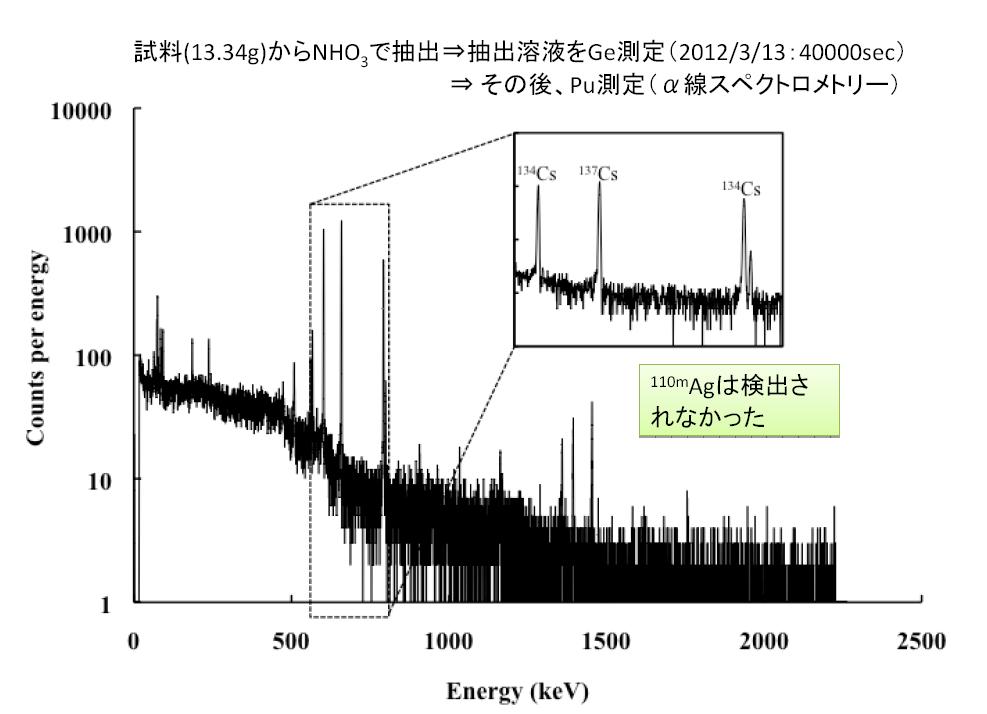
Email from Professor Masayoshi Yamamoto, Institute of Nature and Environmental Technology at Kanazawa University about the analysis of dust off the metal plate that had been left outside since the March 11, 2011 accident, as reported by the blog:

測定結果をお送りします。
Puが検出され、正直なところびっくりしました。

Here's the result of the analysis. Frankly, I am surprised that plutonium was detected.

Puは核実験ですでに広く,低レベルで分布しています。
このPuついて、Pu238/Pu239,240放射能比は0.03程度です。
今回のこの比は0.8で明らかに高く、原発由来のPuを含んでいます。

Plutonium has been spread and deposited at low densities in wide areas because of the atmospheric testing of nuclear weapons . The ratio of plutonium isotopes, Pu238/Pu239+240, of the atmospheric testing origin is about 0.03. But this time [dusts off the metal plate in Iwaki City], this ratio is higher at 0.8, indicating the dusts contain plutonium of the Fukushima I Nuke Plant origin.

政府の放出量見積もりでは3です。
野ざらしの鉄板には核実験のPuが付着していないと考えると、
何故比が低いのかと考えさせられます。
全て3ではなくて0.8の低い比を持つPuが放出された可能性もありますね。

The government estimate of the ratio of these plutonium isotopes is 3. Considering the plutonium of the atmospheric testing origin is not attached to the metal plate, I wonder why the ratio is lower than the government estimate. It is possible that not all plutonium isotopes released had the ratio of 3, and there were plutonium isotopes with the lower ratio (0.8) that were released from the plant.

さらにPu239,240/Cs-137放射能比が9.0E-5で、政府の推定値4.3E-7の200倍になり、Puが多く検出されています.たぶんフラクショネーション(挙動の違い)が存在するためだと思われます。

Further, the ratio of Pu239+240/Cs-137 is 9.0E-5, which is 200 times the government estimate of 4.3E-7, showing more plutonium being detected than the government estimate indicates. It is probably because of fractionation.

(中略)
現在ウラン、出来れば Am-241なども分析できればと考えています。

Right now, I am hoping to test for uranium, and Am-241 if possible.

The report by Professor Yamamoto, from the same blog:

Cesium detection:


Plutonium. Pu-242 is a tracer for chemical yield correction. [-- Don't ask me what it means. I translated as best I can.]


I am asking Professor Yamamoto to confirm that this is his analysis report.

Saturday, September 17, 2011

#Radiation in Japan: Tonga Man Starts Teaching English in Fukushima

to show the world that "Fukushima is OK".

Some people have ridiculed the Bayerische Staatsoper members who refuse to come to Japan for a few weeks for the radiation contamination fear. They should be all praise for this man from Tonga, who persuaded friends and family members and came to Japan to teach English in Iwaki City in Fukushima.

Personally, I cannot join in the praise but feel free.

From Jiji Tsushin (9/17/2011):

福島第1原発事故で世界的に有名になった「フクシマ」の学校で、10カ国から来た52人の新米外国語指導助手(ALT)が新学期から教壇に立っている。母国では家族や友人が心配するが、「ここで働くことで、福島は大丈夫ということを世界に示したい」と意気込んでいる。

"Fukushima" has become world-famous thanks to the Fukushima I Nuclear Plant Accident. In schools in Fukushima, 52 new teachers from 10 different countries have started teaching English as ALT (assistant language teacher). Their families and friends back in their home countries are worried, but the teachers are determined "to show to the world that Fukushima is alright, by working in Fukushima".

 「私の国では、刺し身をココナツミルクにつけて食べます」。原発30キロ圏内に一部が含まれ、津波で300人以上が犠牲になったいわき市の市立平第一中学校。5日午前、南太平洋のトンガ王国出身、ペセティ・ベアさん(35)が英語で紹介すると、静かだった教室が沸き返った。初授業で緊張感が漂っていたが、遠い国の話を聞くうちに生徒の表情は和らぎ、最後は「伝言ゲーム」で笑いに包まれた。女子生徒(13)は「英語は嫌いだけど、ペセティ先生となら楽しくやれそう」。

"In my country, we dip sashimi in coconut milk", said a 35-year-old teacher ペセティ・ベア [I haven't a slightest idea how this name is spelled] from Tonga in the south Pacific, as a way to introduce himself to the class on the morning of September 5 at Iwaki City Taira Daiichi Junior High School. Part of Iwaki City is within the 30-kilometer radius from the power plant, and more than 300 people perished in the March 11 tsunami. The students laughed. It was the first class, and at first the students were nervous. But as they listened to the stories from a distant country they relaxed, and enjoyed a "telephone game". A 13-year-old girl said, "I don't like English but it looks like fun with this teacher".

 地元高校の英語教師をしていたベアさんがALTに応募したのは、日本の「相手を敬う」文化を身に付けたかったから。赴任先が福島県と分かり、周囲は放射線被ばくを懸念したが、「福島には人が住んでいて、過度に恐れる必要はない」と粘り強く説得した。

Mr. ペセティ・ベア was teaching English at a local high school in Tonga before he applied for the ALT. He says he wanted to learn the Japanese culture of "respecting others". Once his teaching assignment turned out to be in Fukushima, his friends and family worried about radiation exposure, but he steadfastly persuaded them by saying "People live in Fukushima. There is no need to fear excessively."

That's akin to saying "If the food is sold in the market, it is safe", a la the mayor of Yokohama City who fed kindergarteners with radioactive beef. And for Fukushima, it seems impossible to fear excessively when the radiation level is already excessive.

As to the Japanese culture of "respecting others", I have my doubts that "others" only refers to people with money or power or both.

But it's just me.

In the above Jiji's article, I put Fukushima in parenthesis, as the original Japanese. The original Japanese for Fukushima is written in Katakana, instead of Kanji, indicating "Fukushima" as understood outside Japan.

Wednesday, August 17, 2011

1 Millisievert/hour Radiation from a Truck in Iwaki City in Fukushima??

Well, you can't watch the video below any more, as it has become "private" for some reason on Youtube. It was public. I have seen it at a members-only site.

The video was posted on this Japanese site on July 15, and it is supposed to be the radiation level measured on July 13 on a small truck parked in Iwaki City in Fukushima Prefecture, near Onahama.

Someone is holding the personal survey meter, standing, facing the street. The survey meter shows between 0.17 to 0.45 or so microsievert/hour. The person approaches a small white truck parked on a small parking lot at the side of the road. The survey meter quickly rises above 1 microsievert/hour, then 10, and 20 microsieverts/hour.

The highest level of radiation is measured on the truck bed. As the person slowly lowers the survey meter to the floor of the bed, it goes from several tens of microsieverts/hour to 100 microsieverts/hour, then rapidly rises to 150, 380, and before it reaches the bottom the meter goes overscale and shows just "8888".

The person also measures the front right tire, which measures 17 microsieverts/hour. Inside the truck, the radiation is also very high. The survey meter goes quickly above 80 microsieverts/hour close to the seat.

As the person walks away from the truck, the radiation level quickly drops down to below 1 microsievert/hour, back to between 0.1 to 0.50 microsievert/hour.

The video you cannot see any more on Youtube. The title says "July 13, 2011 Radiation level in Onahama, Iwaki City":


I can give you a few screen shots though...

As the person approaches the truck:


The highest number on the truck bed before the meter goes overscale:


Interior of the truck:

(H/T Dr. Ono)