Showing posts with label Shinzo Abe. Show all posts

Saturday, December 13, 2014

(OT) Abe's Just-In-Case Election - "This Is The Only Way"


Japan's Prime Minister Abe called a snap election without a cause, other than to make sure, just in case, his party LDP and coalition partner Komei Party still has popular support to carry out so-called Abenomics.

Today (December 14, 2014) is the voting date in Japan, and Japan's media outlets have been overdrive ever since the Lower House (House of Representatives) was dissolved in telling people that:

1. The voting rate will be very low, as there is no "cause" for the election;
2. Low turnout means parties with organized votes (i.e. LDP and Komei) will win big;
3. LDP alone will surpass 300 seats.

Angry voters in the small world of social media (like Twitter) doesn't seem to translate into real-world angry voters who will vote against LDP/Komei over abysmal real-world Abenomics accomplishments (higher stock market, lower yen, lower wages, more contract workers, negative GDP growth, etc. etc.) or over Abe's peculiar idea of "Beautiful Nation Japan" by changing the Constitution and removing "fundamental human rights" references.

Here's a photo in the post by independent journalist Ryusaku Tanaka on the last evening of the campaign (December 13), showing people waving small Japanese flags to greet Prime Minister Abe, as if he were the emperor of Japan:


Mr. Abe's Party has this as the official poster for the election. It says,

"For Economic Recovery, This Is the Only Way"


So the madman Haruhiko Kuroda at Bank of Japan will keep printing increasingly worthless yen to boost the stock market even further, as Abe's ministers having handsomely benefitted from the rising Nikkei. His ministers, particularly Finance Minister Aso, would point out the Nikkei index and say, as if it should be so self-evident to anyone, "See, Abenomics is working. The stock market is rising."

For his part, Abe will restart nuclear power plants, export arms, invite Las Vegas casinos, curtail citizens' rights for the greater good for his "Beautiful Nation". If the ruling coalition wins two-third majority, he may try to amend the Constitution by national referendum. LDP already has the draft, and it makes a very scary reading unless you are Abe believer.

The only thing I have noticed different this time around, compared to the last election (Upper House), is that more net citizens look more determined to vote for the opposition, EVEN IF THEY DON'T LIKE THE OPPOSITION. Because they detest LDP/Komei more, many are willing to hold their noses and vote for the opposition candidates, whatever the party.

Saturday, August 9, 2014

(OT) Japanese Prime Minister Copies and Pastes Speech for Hiroshima AND Nagasaki Memorial Ceremonies for Atomic Bomb Victims


Somehow quite fitting for Mr. Shinzo Abe, who, along with his Minister of Education and Science, remains staunch supporter of Ms. Haruko Obokata, who copied and pasted and photoshopped her way to a very brief scientific fame (turned infamy) as a "Nature" author on STAP cells.

Unlike Ms. Obokata, who copied and pasted other people's work (among many other misconducts) without citation, Prime Minister Abe claims his is no misconduct, because the speeches he lifted for this year's ceremonies were his own speeches for the same occasions last year.

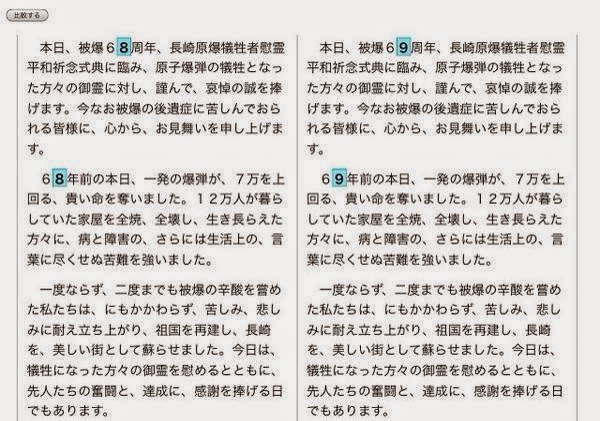
Tokyo Shinbun (8/8/2014) says the opening few paragraphs of Mr. Abe's speech in Hiroshima on August 6, 2014 were almost identical to his speech in 2013.

2013 speech on the left, 2014 speech on the right. Only the parts highlighted in blue are different:


It apparently got better (I know I should say "worse") in Nagasaki. Mr. Abe's speech on August 9, 2014 was identical except for the number of years since the atomic bomb was dropped in Nagasaki:


The Prime Minister's Office has the temerity to say this after the Hiroshima ceremony, according to Kyodo News (via Nikkan Sports):

首相のあいさつは、犠牲者を悼み、平和に力を尽くす決意を述べたものだ。その姿勢は昨年も本年も全く変わりはない

Prime Minister's speech is to mourn for the victims and to express his determination to do his utmost for peace. This attitude is the same as the last year.

平和への祈りや追悼の気持ちは、政府も被爆者やその遺族、地元の人たちと変わりはない。そういう部分はどうしても同じようになってしまう

Praying for peace and mourning [for the victims] are shared by the government, atomic bomb victims and their families, and local residents. The part [that expresses such feeling] ends up being similar, no matter what.


Similar? How about "identical"?

I was amused by the reaction in Japan on Twitter, where people were rightfully angry and upset that the prime minister didn't bother to change this year's speech from the last year's, and that it was such an insult to the victims, Japanese citizens, and foreign dignitaries who attended the ceremonies. Many of them seem to think a prime minister, or any politician, is supposed to write his/her own speech, and that the more world-class he/she is the better speech he/she writes and gives.

'Tatemae' hurts.

To me, the ultimate insult is that the Japanese government hasn't owned up to its own culpability for the two atomic bombs dropped in Japan in August 1945, as 2011 NHK Special revealed, and that most Japanese refuse to face the possibility that their government was fully aware that those planes were carrying atomic bombs but let the bombing happen anyway, if the NHK documentary is correct. (For those who wants to know more about the NHK documentary, see my posts from last year, here and here.)

Meanwhile, Mr. Abe's comrade in copying and pasting, Ms. Obokata, is still with Riken drawing nice salary no doubt while she gets ready for delicate lab work and preparing tea, thanks to the strong pressure Mr. Abe and his Education Minister exerted on Riken, a research institution funded by public money, not to fire her.

Saturday, June 28, 2014

(OT: Graphic Images) A Man Sets Himself on Fire in Protest Against Abe Administration's Collective Self-Defense Stance in Central Tokyo


It happened within the last hour on June 29, 2014 (Japan time). So far it is only on Twitter and Instagram.

A man set himself on fire after making a speech to the passers-by as he sat atop a pedestrian bridge over a busy street in Shinjuku, Tokyo. According to the eyewitness accounts on Twitter, he looked like a regular office worker in suits, and he was expressing his disapproval of the Abe administration and the administration's plan to allow collective self-defense without formally modifying the Constitution by national referendum.


I was very surprised that self-immolation like this happened in Japan (of all places) now (of all times) as a political protest (of all things).

But I was more surprised to see some tweets (like this, and this, and this) accusing this man of carrying out an act of "terrorism" - setting himself on fire and thus endangering others on a busy street, when freedom of speech and universal suffrage are guaranteed [by the Constitution].

Never mind that the Abe administration's ultimate goal is to gut that Constitution with such niceties. My tweet wondering about those people and their perception of "terrorism" is getting retweeted by people who then spit out "Of course this man is such a nuisance!"

People on the street apparently wasted no time in capturing the images with their smartphones.

Friday, February 28, 2014

(OT) Unintended Humor on a Street Corner Somewhere in Tokyo: "Abe LDP Heading for Dead End"


The left poster with Prime Minister Abe says: "Japan Has Started to Move. Retake Japan. That's the responsibility of Tokyo. Liberal Democratic Party."

The poster to the right of the LDP poster is by a landowner who probably owns a lot where the poster is displayed: "Dead End that way (with a blue arrow pointing in the direction of the LDP poster)."

(H/T @aoshizu on Twitter)

Tuesday, February 25, 2014

Japan Under Prime Minister Abe: Back to the Future (to Pre-World War II)?


Someone is ripping the pages off over 300 copies of Anne Frank's "Diary of a Young Girl" in libraries in parts of Tokyo and Yokohama. The police thinks the same person may be doing it.

Minami Kyushu City in Kagoshima Prefecture in Kyushu has applied to the UNESCO to have over 300 pieces of farewell letters by "kamikaze" pilots during the World War II designated as "world heritage", so that people will remember how awful a war is. (Anne Frank's "Diary" is designated as "world heritage".)

Kasai City in Hyogo Prefecture wants to memorialize the runway used by kamikaze pilots during the World War II as a historic site.

William Pesek, Bloomberg's columnist in Tokyo wonders aloud: Where is Prime Minister Abe?

From Bloomberg News (2/23/2014):

Is Abe Encouraging Japan's Nut Jobs?

There's a reason the nuns in Queens had me and my classmates read Anne Frank's "The Diary of a Young Girl" several times -- the same reason that's made the book required reading around the globe. The 15-year-old's account of hiding from the Nazis is impervious to nut jobs who argue the Holocaust is fiction.

Shockingly, in recent days at least 282 copies of Frank's memoirs have been vandalized at 36 libraries across Tokyo -- their pages torn or defaced. No one knows who did it, or why. But it requires an acrobatic feat of compartmentalization not to see the connection to Japan's own recent efforts to deface history.

Earlier this month, the southern Japanese city of Minami Kyushu asked the U.N. World Heritage organization to enshrine farewell letters written by World War II kamikaze suicide pilots alongside documents like Frank's diaries and the Magna Carta. The request drew an immediate rebuke from China and stirred up Japan's right wing. What many see as evidence of Japan's wartime fanaticism, nationalists view as testaments to manly duty and devotion to the Emperor.

I have no evidence that Japan's right-wingers are behind this clearly coordinated campaign to desecrate Frank's work. Anti-Semitism isn't particularly pervasive among Japanese (although one extremist group is organizing a 125th birthday party for the Fuhrer so fans can "converse, listening to Wagner's music and enjoying wine together"). But it would be a coincidence of astounding proportions if this shameful vandalism weren't related to the kamikaze letters controversy.

One has to ask to what extent the return of nationalistic leader Shinzo Abe has encouraged such behavior. Though most attention has focused on Abe's efforts to revive the economy, right-wingers have delighted in the prime minister's other initiatives -- to whitewash textbooks, beautify Japan's wartime aggression, load the governing board of national broadcaster NHK with like-minded conservatives, and embolden the nation's military.

No, I'm not suggesting Abe bears responsibility for the Frank diary attacks. But his 14 months in office have created an atmosphere that's encouraging fringe activists, who may believe Abe secretly supports them. Intentionally or not, the Prime Minister has fed this impression by visiting Yasukuni Shrine, which honors 14 World War II Class A war criminals, and hinting that he wants to revisit a past apology for the military's sex-slave program. Among Abe's picks for the NHK board is a man who claims the Nanjing Massacre of the 1930s never happened.

When Abe and his ilk explain why Japan should be able to honor its dead soldiers and rewrite its pacifist constitution, they highlight how their nation has been a model global citizen. The argument is not without merit. For 68 years now, Japan has been a peaceful, generous, and reasonably cooperative power.

Yet Abe's rightward turn could squander much of the "soft power" Japan amassed since then
. Japanese don't tend to track events in Richmond, Virginia and Glendale, California very closely. But it’s in these two American cities that officials in Tokyo can get a glimpse of their nation's future. It's not pretty.

On Feb. 6, the Virginia legislature passed a bill to change textbooks to say the Sea of Japan is also known as the East Sea. It may not seem like a big deal, but the move outraged Japan. The change came at the behest of fast-rising contingent of Korean-American voters who are wielding that power to right what they view as historical wrongs by Japan 7,000 miles away. Tokyo has also taken great umbrage at a "comfort women" statue in the Los Angeles area erected by Asian Americans, and protests from Japanese diplomats and an online petition to President Barack Obama have gone unheeded. More and more, Chinese-Americans are showing up at Japanese consulates with protest placards, including in December when Abe visited Yasukuni.

As Abe preaches the glory of patriotism more than capitalism, expect Korea and China to intensify efforts around the world to shame Tokyo. Take Xi Jinping's trip to Germany next month. According to Reuters, the Chinese president plans to highlight Germany's atonement for the sins of World War II, in order to embarrass Japan. It's a reminder that statements from Japanese politicians have repeatedly undercut the country's many apologies for its wartime behavior.

Abe's mandate from voters is the economy, not prettifying some ugly moments in the nation's history. He should get back to that job. But first he must unequivocally condemn the Frank attacks in clear and strong terms. Few issues are more cut-and-dry than the need to denounce anti-Semitism in all forms. This isn't an issue to be left to Abe's cabinet chief, Yoshihide Suga, whose name isn't widely known outside Japan. Suga has promised a full investigation. But this is a task for the nation's leader, and Abe's silence is, like much of his other signaling thus far, damaging the nation's interests.


Mr. Pesek seems to think the culprit behind the defaced copies of Anne Frank's "Diary" is an Abe supporter. It is indeed possible that his supporters are that dumb.

JTA (2/21/2014; emphasis is mine) notes that Anne Frank's "Diary" is extremely popular in Japan, with the number of copies sold only next to the United States:

Vandals destroy copies of Anne Frank’s diary in Japan

(JTA) — More than 100 copies of Anne Frank’s “Diary of a Young Girl” have been vandalized in public libraries in Japan’s capital Tokyo.

Pages have been ripped from at least 265 copies of the diary and other related books, Japanese officials told the BBC on Thursday. It is not clear who is behind the vandalism, they said.

Anne Frank’s diary was written during World War II, while the teenager hid from the Nazis in occupied Amsterdam. The book made her a symbol of the suffering of Jews during the war.

The head of Japan’s library council, Satomi Murata, told the French AFP news agency that five of Tokyo’s wards had reported the vandalism so far. “We don’t know why this happened or who did it,” he added.

Toshihiro Obayashi, a library official in West Tokyo’s Suginsami area, said, “Each and every book which comes up under the index of Anne Frank has been damaged at our library.”

The Simon Wiesenthal Center said in a statement that it was shocked and concerned by the incidents, and called for the authorities to investigate.

“The geographic scope of these incidents strongly suggest an organized effort to denigrate the memory of the most famous of the 1.5 million Jewish children murdered by the Nazis in the World War II Holocaust,” Associate Dean Abraham Cooper said.

Rotem Kowner, a professor of Japanese history and culture at Israel’s University of Haifa, told the BBC that the book has been exceptionally popular and successful in Japan.

He said that in terms of absolute numbers of copies of the book sold, Japan is second only to the United States.

About 30,000 Japanese tourists visit the Anne Frank House in Amsterdam every year, about 5,000 visitors more than the number of visitors from Israel.

Japan is also the only East Asian country with statues and a museum in memory of Anne Frank.

Thursday, February 20, 2014

Financial Times: Washington Regrets the Shinzo Abe It Wished For


Since 1950s, the US has been demanding the kind of Japan that Prime Minister Abe is now advocating, says Financial Times.

Why is the US complaining, then? Buyer's remorse?

The subtitle "The US fears that Japan’s departure from postwar pacifism will provoke Beijing" almost reads like what Special Advisor to Prime Minister Seiichi Eto said in his Youtube video which was then taken down by the request from Chief Cabinet Secretary Suga the other day.


From Financial Times (2/19/2014; emphasis is mine):

Washington regrets the Shinzo Abe it wished for

The US fears that Japan’s departure from postwar pacifism will provoke Beijing

By David Pilling


It is fairly easy to assess the relationship between Shinzo Abe’s Japan and Xi Jinping’s China. Neither likes the other very much. Both are using nationalism as a prop to further policy aims. Both conceivably find it useful to have a “tough man” on the other side, the better to push against.

Less easy to calibrate is the state of relations between Japan and the US. This ought to be far easier to decipher. Japan is, after all, the US’s most important ally in Asia, the “unsinkable aircraft carrier” that has hosted US fighter aircraft and troops since the end of the second world war. Now, in Mr Abe, it has a leader who, after decades of American prodding, is finally willing to adopt a more robust defence posture and revisit the “freeloader” defence doctrine that pacifist Japan has long embraced. Yet having attained what it has long been after, Washington is showing signs it is getting cold feet.

One sign of that was its expression of “disappointment” after the December visit of Mr Abe to Yasukuni shrine, which is regarded as a symbol of Japan’s unrepentant militarism by China and South Korea. In the past, Washington has privately voiced its displeasure at Yasukuni visits, but has not publicly reprimanded Japan. Tokyo was taken aback by the use of the word “disappointed” – translated as shitsubo – which sounds harsh in Japanese.

There have been other signs of strain. US politicians have voiced concern at Mr Abe’s view of history. Virginia lawmakers ruled that school textbooks should also use the Korean name – East Sea – for the Sea of Japan. Washington is concerned that, under Mr Abe, Tokyo’s relations have also soured with Seoul, another important US ally.

From Japan’s perspective, Washington did not back it up with sufficient vigour when Tokyo’s control of disputed islands was cleverly challenged by Beijing’s announcement of an air defence identification zone. Washington did show its displeasure by flying B52 bombers over the zone, but Joe Biden, US vice-president, did not make a big deal of the issue when he visited Beijing.

Many officials in Tokyo regard Washington as having virtually capitulated to China’s unilateral move. They also regularly bemoan the absence of “Japan hands” around President Barack Obama, who has tended to surround himself with people far more steeped in China. More than one official in Tokyo speaks of a growing sense that Washington can no longer be relied upon to support Japan.

There is an irony to all of this that will not be lost on Mr Abe. Ever since 1950, Washington has been urging Japan to rearm and to adopt the sort of defence posture Japan’s prime minister is now advocating. No sooner was the ink dry on the 1947 pacifist constitution, written under the orders of General Douglas MacArthur, than the Americans regretted forcing Japan to forever renounce “the right of belligerency”. John Foster Dulles, appointed to negotiate the end of the US occupation, urged Japan to build an army of 300,000 to 350,000 men. China had gone communist and the US was fighting a war in Korea. It no longer suited the US to have a neutered “client state” in east Asia.

For years Japan resisted that pressure. Tokyo relied on the US nuclear umbrella and got on with the business of business. Its only concession was to form a Self Defence Force that was forbidden from fighting. Now, six decades later, Japan has a leader willing to take the US at its word. Mr Abe has the personal conviction, as well as the geopolitical pretext, to revamp Japan’s interpretation of its constitution or even to overturn pacifist article nine itself.

Now the moment has come, though, some in Washington are having second thoughts. John Kerry, secretary of state, according to one former White House official, regards Japan as “unpredictable and dangerous”. There is nervousness that Japanese nationalism will provoke a counter-reaction in Beijing. Hugh White, an Australian academic and former defence official, says the meaning is clear: “America would rather see Japan’s interests sacrificed than risk a confrontation with China.”

When Mr Abe went to Yasukuni, he may have partly been sending a message to Washington. It is a curiosity of the Japanese right that it has been the most ardent supporter of the US-Japan alliance while simultaneously being resentful of the postwar settlement imposed by Washington on a defeated Japan. Going to Yasukuni in defiance of US wishes is one way of signalling that Japan cannot always be relied upon to do Washington’s bidding.

Distaste in Washington for Mr Abe is by no means universal. In some ways, the Japanese prime minister is exactly what the US doctor ordered. He has a plan to reflate Japan’s economy. He is the first leader in years with any hope of solving the festering issue of US marine bases in Okinawa. He is willing to spend more on defence after years of a self-imposed limit of 1 per cent of output. Those policies, however, come with a price tag: a revisionist nationalism that many in Washington find distasteful.

“As China grows, Japan has more and more reason to be anxious about China’s power, and less and less confidence in America’s willingness to protect it,” Mr White says. The US, he argues, must either commit itself unambiguously to defend Japan’s core interests or help Japan regain the “strategic independence it surrendered after 1945”. Japan’s answer to that dilemma is to hold on ever tighter to America – and to pull away.

Wednesday, February 19, 2014

Special Advisor to PM Abe Told to Delete Youtube Video in Which He Says "We Are the Ones Who Are Disappointed with the US"


From Bloomberg News (2/19/2014; part):

Abe Aide Told to Delete Video Criticizing U.S. Over Shrine Issue

An aide to Prime Minister Shinzo Abe was instructed to delete a video in which he expressed disappointment over the U.S. reaction to the Japanese premier’s December visit to a Tokyo war shrine.

Chief Cabinet Secretary Yoshihide Suga told reporters in Tokyo he had directed Seiichi Eto, a member of the upper house of parliament and a special adviser to the prime minister, to delete the video from YouTube because it expressed a personal view rather than the government position.

The U.S. embassy last year issued a statement saying the government was “disappointed” by Abe paying his respects at the Yasukuni Shrine on Dec. 26, adding his action would “exacerbate tensions with Japan’s neighbors.” Animosity with China and South Korea over separate territorial disputes was worsened by Abe’s visit to the shrine, which is seen by many in both countries as a symbol of Japan’s past militarism.

“America said it was disappointed, but we are the ones who are disappointed they said that,” Eto said in a video posted to YouTube on Feb. 16. “Why doesn’t America value its ally Japan?”

Eto went on to say that the U.S. was trying to appease China with its statement.

“You may think the ’disappointed’ statement was directed at Japan, but that’s not the case. They are telling China that they are disappointed. My understanding is that it’s just an excuse they are making to China,” he said.

(Full article at the link)


His youtube video (it is one of his regular video new to his constituents) has already been made "private".

Mr. Seiichi Eto, pictured right, is the one who was sent to the US in October last year as special advisor to Prime Minister Abe to lay the groundwork for Abe's Yasukuni Shrine visit and obtain the understanding from the Obama administration.

In the video which I watched before it became "private", Mr. Eto expressed his puzzlement over the US response. As far as he was concerned, the US understood that Abe wanted to visit the shrine. Mr. Eto said he told the Obama administration officials not to make a big issue out of it even if they wouldn't approve of the visit, and they agreed.

It's interesting that the above Bloomberg article mentions only the US embassy (in Tokyo) that issued the "disappointed" statement, not the State Department (whose spokeswoman told a Chinese reporter to go get a dictionary).


Sunday, February 16, 2014

(OT) Heavy Snowfall in Kanto That Has Killed 15 So Far Is Clearly Not Disastrous Enough for Prime Minister Abe...


The tweet (2/17/2014) by Asahi Shinbun's reporters attached to the Prime Minister's Official Residence says it all:

Reporters: What is your thoughts on the government's measures for the heavy snow?

PM Abe: Good Morning!


The twitter account of the PM Official Residence on Emergency Response Information did not have anything on the extreme snow fall in parts of Kanto, particularly Yamanashi, until the afternoon of Sunday February 16, 2014. Even then, it only retweeted the tweets by Ministry of Land and Infrastructure with the links to PDF files (as if people accessing the emergency tweets on their cellphones can easily open the PDF files).

There was a tweet by someone who called the PM Official Residence on Sunday to urge someone there to get busy on helping Yamanashi and other prefectures which are not prepared for this kind of snowfall. (In normal years, Yamanashi's snowfall is about 14 centimeters. This year, it is over 156 centimeters.) The call was received by a guard, who told this person to call back on Monday (weekday).

PM Abe himself had a tempura dinner (15,000 yen (US$150) per person, I hear) on Sunday with his supporters at an upscale restaurant in uptown Tokyo, as people stuck on the highways and roads in Yamanashi and northern Kanto survived on free bread provided by Yamazaki Bread.

Another heavy snow storm is expected this week, as early as February 17 or 18.

As to the new governor of Tokyo who said "Snow? What's the big deal?", his twitter account has nothing so far on the snow emergency, which is severely affecting the western (mountainous) Tokyo. The last tweet was on February 13 or 14, telling his followers he has been working very hard every day as the governor.

Monday, February 10, 2014

PM Abe Takes Tokyo Governor Race Win by Masuzoe as Endorsement of His Administration, Moves Ahead with Nuke Restart, Constitutional Change


Sure enough, on the heel of a big win by the candidate that his party supported in the Tokyo gubernatorial election, Prime Minister Shinzo Abe moves full on again on restarting the nuclear power plants in Japan and crafting the new national energy policy that puts nuclear power back in the center.

Abe takes Masuzoe's win as strong endorsement of his administration's policies, particularly nuclear policies, just as The Economist and other influential foreign papers predicted (here's Wall Street Journal's take, with a not-so-kind photograph of Masuzoe).

It will be not just the restart of the nuclear power plants in Japan. To those of you who briefly had a glimmer of hope that Japan would finally ditch the fast breeder Monju, my condolences. Abe also wants to quickly pass the budget, modify the Constitution and carry out an educational reform.

All because the LDP/Komei backed Masuzoe won in the Tokyo gubernatorial election.

And who were all those people who insisted that the governorship of Tokyo was just another local, provincial matter with little bearing on the national politics? Whoever you are, my condolences, too.

From Mainichi Shinbun, published after the poll closed on February 9, 2014 (part):

都知事選:首相、主要政策に追い風 エネ計画月内決定

Tokyo gubernatorial election result will act as tailwind for Prime Minister's core policies, energy policies to be decided within this month

東京都知事選で自民、公明両党の支援する舛添要一元厚生労働相(65)が当選し、安倍晋三首相は今年最初のハードルを越えた。原発再稼働に前向きな安倍政権の姿勢は一定の評価を得たととらえ、国の中長期的なエネルギー政策の指針となる新たな「エネルギー基本計画」を月内にも閣議決定する。さらに2014年度予算案を早期に成立させて「経済重視」をアピールしつつ、集団的自衛権の行使を可能にする憲法解釈の変更や教育委員会改革などを進める構えだ。

Prime Minister Shinzo Abe cleared the first hurdle of this year by the win in the Tokyo gubernatorial election by Yoichi Masuzoe, former Minister of Health and Labor who was supported by both LDP and Komen Party. Masuzoe's win is considered as a certain degree of approval of the Abe administration which is in favor of the restart of nuclear power plants, and the new Basic Energy Plan will be approved by a cabinet decision within this month. The Basic Energy Plan serves as guidelines for mid- to long-term national energy policies. Further, Abe will pass the fiscal 2014 budget at the earliest opportunity to appeal his "focus on the economy" as well as modifying the interpretation of the Constitution that will enable Japan to exercise the right to collective defense and carrying out the reform of Board of Education.

首相に近い参院議員の一人は「首相は自民党を捨てた舛添氏をよく思っていないが、『勝てる候補』と割り切った」と首相の心情を代弁する。今年は大型の国政選挙が予定されていないものの、首都・東京で敗れた場合、高い内閣支持率を保ってきた政権の潮目が変わりかねなかったためだ。

One of the Councilors close to the prime minister speaks for Mr. Abe and says "Prime Minister doesn't think highly of Mr. Masuzoe who abandoned Liberal Democratic Party, but decided to see him as "someone who could win the election"." There is no large national election to be held this year, but if [the LDP-backed candidate] had lost in Tokyo, capital of Japan, the tide may have turned against the Abe administration whose approval rating has remained high.

細川護熙元首相と小泉純一郎元首相による「脱原発」の争点化が奏功しなかったことで、政府は、都知事選後に閣議決定を先送りしていたエネルギー基本計画について、原発を「ベース電源」と位置付けた政府素案から大きく修正しない方向だ。ただ、今後の核燃料サイクル政策を巡っては、高速増殖原型炉もんじゅを計画通り進めることに自公両党の批判が強い。自民党の高市早苗政調会長は9日夜、毎日新聞の取材に「相当丁寧に議論していかなければならない」と述べ、政府に慎重な対応を求めた。

Seeing that the efforts by former prime ministers Morihiro Hosokawa and Junichiro Koizumi to turn the "beyond nuclear" movement as an election issue was not successful, the Abe government is not going to vastly modify the government draft plan of the Basic Energy Plan, which defines nuclear power as "basic power supply". The government had deferred the cabinet decision on the Basic Energy Plan until after the Tokyo gubernatorial election. However, there are significant objections from within both LDP and Komen Party to operating the fast breeder Monju as planned, as part of the fuel cycle policy. Sanae Takaichi, Chairman of LDP's Policy Research Council, said in the Mainichi Shinbun interview in the evening of February 9 that [Monju and the fuel cycle policy] would have to be thoroughly discussed, and would require a cautious approach by the government.


Thorough discussion and cautious approach. Just like when they passed the State Secrecy Protection Law. So ditch that thought that Japan finally ditches Monju.

Remember that Abe wanted to run a young female candidate to win the election. When he and his administration saw the attorney who had been defeated very badly by Mr. Inose in the December 2012 election entering the race again, they decided on Mr. Masuzoe, who they were confident could easily beat him (which he did, even if he was a man).

In the National Diet Budget Committee on the next day (February 10), Prime Minister Abe moved quickly with his coalition partner Komei Party (that also supported Mr. Masuzoe) and effectively resurrected nuclear power as "basic power supply". There is no way that "basic power supply" for the nation will be terminated in the near or even the distant future.

And what are those "beyond nuclear" supporters of the "socialist lawyer" (as The Economist puts him) doing?

Gloating on the "win" over the former prime ministers who wanted to immediately ditch nuclear power.

They are promising their followers the "long" struggle toward a nuclear-free future someday. Masuzoe's win seems to have guaranteed them a life work, paid or otherwise. Congratulations for that.

Friday, February 7, 2014

(OT) NHK Commissioner Says Emperor is "Living God" for the Japanese to Worship and Die For, and Abe Administration OK with Her Personal Opinions


NHK, a (forced) "public-supported" television/radio in Japan, has mostly toed the line of whoever at the top of the political hierarchy in Japan. Still, I thought it was over the top when the new chairman of the NHK Commission expressed his personal conviction and belief in a very public way (press conference and testimony in the National Diet) that Japan didn't commit war crimes, that any military anywhere in the world has had so-called "comfort women" (not again...).

Then I was flabbergasted when I heard about another recently appointed Commissioner who adores the Emperor of Japan as "living god" to whom the Japanese should sacrifice their very lives to preserve "the state of things where the Emperor is the ethical, spiritual, political center uniting people" (that is what 国体 kokutai is, as used in Japan before and during the World War II), and who praises a ultra-right wing yakuza who shot himself in the Asahi Shinbun building in 1993 after praying to the Emperor.

(Time Magazine has an article summarizing the way it is now at NHK under the Abe administration.)

Who's this Commissioner? Ms. Michiko Hasegawa, 67-year-old professor emeritus at Saitama University. She is a Tokyo University graduate (elite), an outspoken proponent of the way we were, so to speak, when women stayed home while their men earned the living, when the government started the war in the name of the Emperor and people went to war to kill and get killed. Ms. Hasegawa was born in March 1946, about 7 months after the imperial Japan surrendered unconditionally.

But what appalled me was not NHK Chairman nor Commissioner Hasegawa. Instead of at least cautioning the Commissioners for their views that are not widely shared by the population, Chief Cabinet Secretary of the Abe Administration said he had no comments on the private views of the Commissioners of the public broadcaster under effective control of the government.

From J-Cast News (2/5/2014), comments from Chief Cabinet Secretary Yoshihide Suga during the Diet session on NHK Commissioner Hasegawa:

「その(長谷川氏について報道されている)部分については承知していなかったが、我が国を代表する哲学者、評論家として活躍している。文化にも精通している。そういう中で政府として国会に提出して一部野党の同意もいただいて決定した。それ以上でもそれ以下でもない」

"I wasn't aware of the particular remarks (of Ms. Hasegawa that are being reported), but she is one of the most prominent philosophers and critics who represent Japan. She is thoroughly versed in cultures. That's why our government submitted her name [as a candidate for NHK Commissioner] to the National Diet, and it was approved with the votes from some opposition parties. Nothing more, nothing less."

「いちいち、経営委員の言動について政府がコメントすることは差し控えたい」

"I'll withhold my comment as the government official on every single word and deed of the Commissioners."


I guess Mr. Suga and his boss Prime Minister Abe have no right to comment anyway. Both of them gave three "banzai" to the bewildered and clearly annoyed emperor and empress on April 28 "Restoration of Sovereignty Day" last year. I wonder how the government celebrates that day.

And all this while NHK pressures commentators who appear on their programs not to talk about nuclear power, particularly about anti-nuclear movement after the Fukushima nuclear accident, during the Tokyo gubernatorial election campaign, which is ending on February 8.

Private broadcasters are no better, with Asahi TV blurring the faces of former prime ministers (Hosokawa and Koizumi) as they spoke to an enormous crowd in Tokyo in their campaigning for the governorship (for Hosokawa) and switching right back to the LDP/Komei candidate, showing full face.

Both the national government and national media have also been busy repeating again and again that the Tokyo governor race is not so much about anti-nuclear (or beyond-nuclear) but much more about jobs, Olympics, welfare, your (small) lives. In fact, nuclear issues shouldn't be in the gubernatorial race anyway, they say, because Tokyo does not have nuclear power plants. Supporters of Mr. Kenji Utsunomiya, left-leaning attorney who is anti-nuclear and backed by Social Democrats and Communist Party, take advantage of this government/media characterization to attack the anti-nuclear former PM duo instead of attacking the other two right-leaning candidates (Masuzoe, Tamogami).

It is snowing heavily in Tokyo on Saturday February 8. If this snow deters many voters on February 9, Mr. Yoichi Masuzoe, backed by LDP/Komei and particularly by Prime Minister Abe, will probably win handily, thanks to organized votes from Komei Party and labor unions who support Masuzoe this time instead of their usual support for left/liberal candidates.

And thanks to NHK and the rest of the media, and fragmented anti-nuclear people.

Wednesday, January 1, 2014

(OT) Shinzo Abe Sweet Buns You Can Purchase at Yasukuni Shrine


They are made by an enterprising confectionary in Tokyo, I hear.

I also hear on Twitter that someone's friend whose grandfather is enshrined at Yasukuni was saddened and angered by the frivolous wrappings.

From one of many tweets with this photo:


Upper left: Nihon wo tori modosu (Take back Japan) sweet buns, from Japan the land of the rising sun. "Tori" in Japanese is phonetically the same as the word for "bird". The sweet bun is made into a shape of a bird, the wrapping says. Cartoon Abe says, "To a new Japan."

Upper right: Nejire kaisho (No more split Diet) mochi, strong Japan one more time. Cartoon Abe says, "We will never allow split again."

Lower right: Atarashii Shin-chan (New Shinzo Abe) sweet buns, or Abenomics sweet buns, 2% volume up. Cartoon Abe says, "I will be at the helm."

Traditional goods to commemorate the visit to the shrine are in the lower left.

I wonder how brisk the sales are.

Tuesday, December 31, 2013

(OT) Abe's Yasukuni Shrine Visit and the "Disappointed" US: State Dept Spokesperson Tells Chinese Reporter to Go Get a Dictionary


and learn the difference between "disappointment", "regret" and "concern".

The Chinese reporter's question is quite legitimate, as the words used in diplomatic statements are (or should be) strictly defined and used to convey specific meanings. The US State Department, following the example of the US Embassy in Tokyo, chose the word "disappointed" in their statement regarding Japan's PM Abe's visit to Yasukuni Shrine on December 26, 2013.

But Ms. Harf, deputy spokesperson of the US State Department, told the reporter to get a dictionary and look up.

In passing, Ms. Harf also debunked the story floating in Japan and clearly in Asia that the State Department consulted the White House in choosing the word "disappointed". So much for that story.

From the Daily Press Briefing at the US State Department, 12/30/2013:

QUESTION: Some media reports that U.S. officials from State Department discussed with officials from White House and finally chose the word “disappointed” rather than “regret” or “concern” to express a stronger or tougher tone. I mean, what kind of message does U.S. trying to send to the Japanese Government?

MS. HARF: Well, I think our message is very clear from the words we chose. I don’t know those reports about interagency communications. Obviously, we talk to our colleagues at the White House all the time. I think we’ve made very clear that we were disappointed, that we think this will exacerbate tensions. I think those words are very clear in their meaning, and I wouldn’t probably wordsmith them any further to try and get deeper meaning out of them.

QUESTION: So you have no differences between “regret” --

MS. HARF: Us and the White House?

QUESTION: No, I mean the differences between “disappointed, “regret,” or “concern.”

MS. HARF: I’m happy for you to get a dictionary and look up what the difference is. I think it’s pretty clear what I mean when I say “disappointed.”


If you are in Japan or following the Japanese media and social media, you would know that this "disappointed" statement by Caroline Kennedy's US Embassy in Tokyo and the State Department has been causing a tremendous stress among Japanese citizens on and off the net.

It is almost comical to see people who normally accuse the Japanese government (particularly the LDP one under PM Abe and more specifically Mr. Abe himself) of always taking orders from and following orders of the United States quite upset that Mr. Abe defied the US (who had reportedly expressed opposition to the visit) and so upset the US that the US issued "such a strong statement" using the word "disappointed".

Most Japanese only understand the Japanese word for "disappointed" - which can be translated into Japanese as 失望 (shitsu-bo), or literally "loss of hope", and that's the Japanese word that the US Embassy chose (I presume, and not Googled) in the provisional (reference) Japanese translation.

In the Press Briefing video, Ms. Harf looks annoyed that she has to work at the end of December.

Saturday, December 28, 2013

(OT) Abe's Visit to Yasukuni Shrine Was Timed With Progress on Okinawa Base


Japan's Prime Minister Abe visited Yasukuni Shrine on December 26 to the resulting loud condemnation of the world's governments and entities.

It was exactly when the prospect of a breakthrough in the construction (or prep thereof) a new US military base in Okinawa was greater than ever (and sure enough on the next day the governor of Okinawa gave his approval of the project, to the loud condemnation from Okinawans who felt betrayed by the governor).

I thought these two events were related, and were presented as a "package", so to speak, to the US government. It is as if to say:

"I visited the shrine. So? I also won the approval from the Okinawa governor of a long-standing issue of a new base in Okinawa. Add two together. Is it net positive or negative for the US interest?"


Abe was confident, clearly, that the it was net positive for the US, and went to the shrine.

The Wall Street Journal's article (12/28/2013) seems to agree with me, though all I can read, as a non-subscriber, is the headline and the first paragraph (emphasis is mine):

Abe's Style Presents U.S. With Dilemma

Japanese Prime Minister Timed Shrine Visit Around Progress on Okinawa Base, Aides Say

TOKYO—In just a matter of days, Japanese Prime Minister Shinzo Abe has drawn both praise and censure from the U.S., underlining how his assertive style presents a dilemma for Washington policy makers needing his help to counter China's influence in the region.

Wednesday, December 25, 2013

(UPDATED with US Embassy Statement) Japan's Prime Minister Goes to Yasukuni Shrine, Defying the Stern Warning from the US Administration, Says a Japanese TV Station


In the morning of December 26, Prime Minister Shinzo Abe went to Yasukuni Shrine where the war-dead, including those found guilty by the Tokyo tribunal and executed after the World War II, are enshrined.

Nikkei Shinbun says Abe's decision was in part based on the urging from the politicians from LDP's conservative wing (Mr. Abe's base) who concluded that it was impossible to placate China no matter what, as China unilaterally declared the air defense identification zone (ADIZ) over Senkaku Islands.

Then, FNN (Fuji News Network), one of Japanese TV network, reports (12/26/2013) that Abe's visit was in defiance of the strong US objection:

安倍首相靖国参拝 アメリカ側は事前に「日米関係害する」と反対

Prime Minister Abe to visit Yasukuni Shrine, the US objected as "harming the US-Japan relationship"

安倍首相は、政権発足から1年を迎えた26日、東京・九段北の靖国神社を参拝する。11月、衛藤首相補佐官が、協議のためにアメリカを訪問した際に、参拝すれば「日米関係を害するだろう」などと、強く反対されていたことが、FNNの取材で明らかになった。

Prime Minister Abe visits Yasukuni Shrine in Kudan Kita in Tokyo on December 26, one year anniversary of his administration. FNN has found that the US strongly objected to the visit, telling prime minister's advisor Eto that the visit would "harm the US-Japan relationship" when Eto visited the US for consultation in November.

衛藤首相補佐官は、靖国参拝をめぐる意見交換のため、11月中旬に訪米し、ラッセル国務次官補など、アメリカの要人らと面会した。

Mr. Eto went to the US in mid November to meet with key officials including Assistant Secretary of State for East Asian and Pacific Affairs [Daniel] Russel over the prime minister's visit to Yasukuni.

この際、アメリカ側から、「オバマ大統領が理解を示すことはない」、「日本の評判を落とし、日本のアジアにおける影響力低下を招く」などと、厳しく反対されたという。

At that time, [FNN learned that] the US strongly opposed the visit, saying "President Obama will not be positive about it", "It will harm Japan's reputation, resulting in lessening the influence of Japan in Asia."

また、日韓関係のさらなる悪化への懸念のほか、中国に対しては、日本側が緊張をあおっていると主張するための口実を与えることになるため、結果的に、中国の立場を有利にするといった声も上がった。

There were worries that the visit would worsen the relationship with Korea. It would also give China an excuse to insist that Japan is causing the tension to rise, putting China in a better position.

TPP(環太平洋経済連携協定)や日米ガイドラインの見直しなど、重要課題を抱える日本が、アメリカの反対を押し切った形で参拝したことで、日米関係への影響が懸念される。

Since [PM Abe] visited the shrine despite the objection from the US, there are worries that this may negatively affect the US-Japan relationship even as Japan has important issues including TPP (Transpacific Partnership) and revising the guidelines [for defense cooperation] between Japan and the US.


When they visited Japan in October, US Defense Secretary Chuck Hagel and State Secretary John Kerry went to Chidorigafuchi instead, a strong hint that the US would expect the Abe administration to start de-emphasizing the controversial Yasukuni.

AFP has Abe's comment:

Tokyo (AFP) - Prime Minister Shinzo Abe said Thursday his visit to the controversial Yasukuni war shrine was a pledge that Japan would not go to war again and was not intended to hurt Chinese or South Koreans.

"I chose this day to report (to enshrined spirits) what we have done in the year since the administration launched and to pledge and determine that never again will people suffer in war," he told reporters at the shrine.

"I am aware that, because of misunderstandings, some people criticise a visit to Yasukuni shrine as an act of worshipping war criminals, but I made my visit to pledge to create an era where people will never suffer from catastrophe in war," Abe said.

"I have no intention at all to hurt the feelings of Chinese or South Korean people."

A Chinese foreign ministry official condemned his visit as "absolutely unacceptable to the Chinese people".


By the way, how many "war criminals" are enshrined in Yasukuni?

14, out of 2,466,532 war dead since the Boshin War (1868-69) that toppled the Tokugawa Shogunate and ushered in the Meiji era of imperial Japan supported by the winners of the war (Choshu, Satsuma).

Kyodo News reports that the US Embassy in Japan issued a statement saying the US is disappointed. There's nothing on the US Embassy website, but the tweet by the Embassy Press Office has a link to the statement:

December 26, 2013

Japan is a valued ally and friend. Nevertheless, the United States is disappointed that Japan's leadership has taken an action that will exacerbate tensions with Japan's neighbors.

The United States hopes that both Japan and its neighbors will find constructive ways to deal with sensitive issues from the past, to improve their relations, and to promote cooperation in advancing our shared goals of regional peace and stability.

We take note of the Prime Minister’s expression of remorse for the past and his reaffirmation of Japan's commitment to peace.


The US Embassy has the provisional Japanese translation of the statement, which seems, to me, overly harsh by selecting the particular ending pattern for the sentences.

Friday, December 20, 2013

Japan's PM Abe: "I Want Next Governor of Tokyo to Be A Young Woman"


Well, as if it would be his to decide. The gubernatorial election to be called early next year in Tokyo is a local election, albeit an important one if only because Tokyo is the most populous prefecture in Japan.

In case you haven't heard about it, Tokyo Governor Naoki Inose, who won the election in December last year with a landslide (he amassed the largest ever number of votes in the Tokyo gubernatorial election) and won the 2020 Olympic for Tokyo, suddenly found himself a target of the suddenly righteous press in Japan (who have all but stopped coverage of the State Secrecy Protection Law as soon as it passed the Upper House), and has been forced out of office.

Mr. Inose's sin? Having received a "huge", no-interest campaign loan (50 million yen, or 500,000 US dollars) from a hospital chain that provided campaign funds to a host of other national politicians, many of them in Liberal Democratic Party in the December 2012 Lower House election/local elections.

Mr. Inose did an extremely poor job of explaining away (he miserably failed), and for that small amount, as far as the politics go in Japan and which he claims he has returned, he resigned on December 19, 2013.

Is the righteous mainstream (national) media in Japan going after the national politicians in the ruling party?

Nope.

It's not that I think highly of Mr. Inose (I don't), but the way the mainstream media (particularly Asahi, who had a "scoop" - sure, sure) and LDP blew it out of proportion from a potential bribery case into a circus is highly suspicious. Now that Mr. Inose has resigned, all is well, the case closed, not just for Inose but most likely for any politician who received money from the hospital chain.

Mr. Inose's word says it all: "I was a politically naive amateur."

Prime Minister Shinzo Abe, on December 18 even before Governor Inose announced he would resign, was quoted as saying this on TV Tokyo:

自民党関係者によりますと、安倍総理は都知事候補について若い女性がいい」と周辺に話していたということです。

According to the source connected to LDP, Prime Minister Abe was telling his staff that the candidate for the Governor of Tokyo should be a young woman.


Young woman. Meaning someone (or a whole lot of them) like these, Abe's favorite, dressed in a school-uniform-like outfit (you are supposed to see them as high school girls)?


(My sincere condolence to the ASEAN ministers and their spouses who were subjected to this "entertainment" by PM Abe. If you were thinking about teaming up with Abe's Japan to counter the pressure from China, good luck.)

Oh by the way, the "candidates" (unofficial, undeclared for now) picked by a TV program (Asahi, I think) are beyond the pale for most Japanese net citizens:


Candidates with yellow background color are from the opposition, blue from LDP. They don't even look human, but four out of seven are girls. Not sure about "young".

Sunday, December 15, 2013

Evans-Pritchard: China-Japan Rearmament is Keynesian Stimulus, If It Doesn't Go Horribly Wrong


An "IF" in capital letters, but even if it does go wrong and things come to a head between China and Japan, it will still be a great Keynesian stimulus for the US and Europe, whose economies have been suffering "long malaise".

Ambrose Evans-Pritchard, on-again-off-again Keynesian (I think it's "on" now, since the Great Recession induced by the Lehman collapse), says Japan is ready for a fight if necessary; at the same time he seems to think that mishap is not necessarily by China or Japan but by the United States, and fear the cascading effect outside the parties directly involved, as he cites the Agadir crisis in 1911.

With the flip-flopping president who are surrounded by advisors whose expertise (if that) is only in the US domestic politics, the probability of the mishap is rather significant, I'm afraid, no matter how much Japan's PM Shinzo Abe tries to flatter the US president.

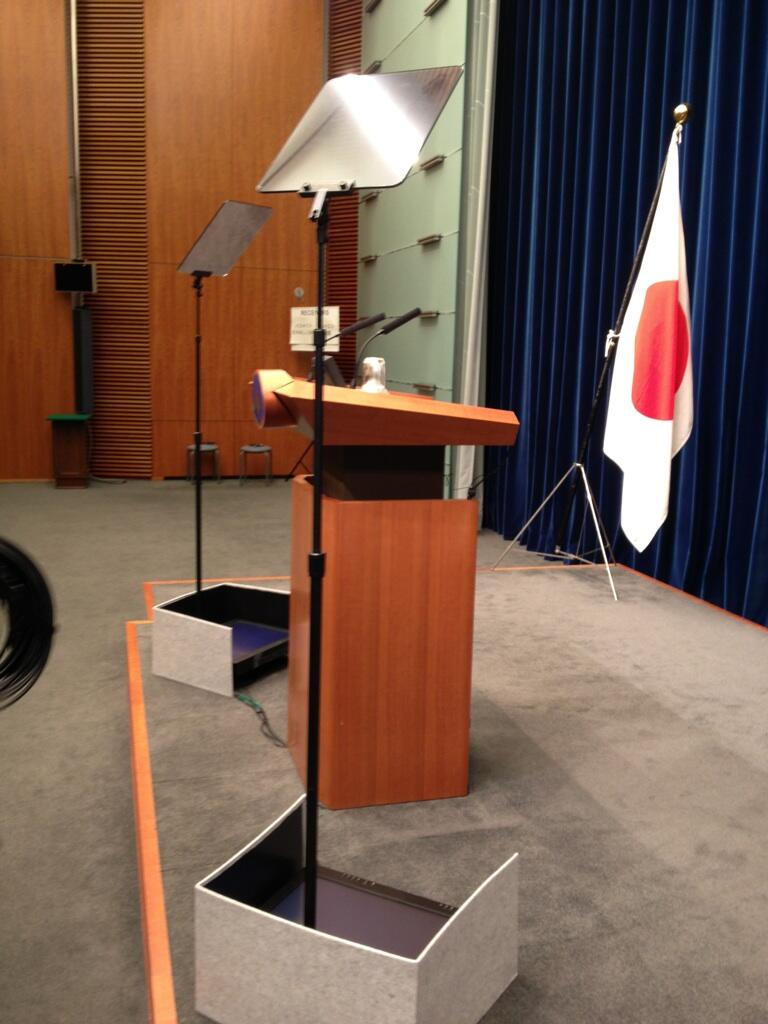
(The latest example of flattery is Abe's mimicking President Obama in using teleprompters for the first time to deliver his speech at a hastily scheduled press conference on December 14, 2013, probably just to show off his brand-new toy...image from Yasumi Iwakami)

From The Telegraph (11/26/2013; emphasis is mine), by Ambrose Evans-Pritchard:

China-Japan rearmament is Keynesian stimulus, if it doesn't go horribly wrong

Asia is on the cusp of a full-blown arms race. The escalating clash between China and almost all its neighbours in the Pacific has reached a threshold. All other economic issues at this point are becoming secondary.

Beijing's implicit threat to shoot down any aircraft that fails to adhere to its new air control zone in the East China Sea is a watershed moment for the world. The issue cannot easily be finessed. Other countries either comply, or they don't comply. Somebody has to back down.

The gravity of the latest dispute should by now be obvious even to those who don't pay attention the Pacific Rim, the most dangerous geostrategic fault line in the world.

Japan’s foreign minister, Fumio Kishida, accused China of “profoundly dangerous acts that unilaterally change the status quo”.

The US defence secretary Chuck Hagel called it “a destabilising attempt to alter the status quo in the region” and warned that the US would defy the order. The Pentagon has since stated that US pilots will not switch on their transponders to comply, and will defend themselves if attacked. Think about this for a moment.

Mr Hagel asserted categorically that Washington will stand behind its alliance with Japan, the anchor of American security in Asia. “The United States reaffirms its long-standing policy that Article V of the US Japan Mutual Defense Treaty applies to the Senkaku Islands,” he said.

Whether China fully believes this another matter, of course. The Senkaku islands offer a perfect opportunity for Beijing to test the resolve of the Obama Administration since it is far from clear to the war-weary American people why they should risk conflict in Asia over these uninhabited rocks near Taiwan, and since it also far from clear whether President Obama's Asian Pivot is much more than a rhetorical flourish.

Besides, Beijing has just watched the US throw its long-time ally Saudi Arabia under a bus over Iran. It has watched Moscow score an alleged victory over Washington in Syria. You and I may think it is an error to infer too much US weakness from these incidents, but that is irrelevant. Beijing seems to be drawing its own conclusions.

Even if the immediate crisis can be defused, we are clearly sliding into a new Cold War. While it is dangerous, it could have paradoxical and powerful side effects. Rearmament lifted the world economy out of slump in the late 1930s, working as a form of concerted Keynesian fiscal stimulus. It could do so again.

The parallels are not exact. They never are. But an Asian arms race would almost certainly tackle some of the underlying causes of the long malaise in the Western economies. It would soak up much of the Asian "savings glut" and the excess industrial capacity in China, and would help to narrow the perennial East-West trade gap.

This would be an answer of sorts to the West's "secular stagnation" – to use the term of former US treasury secretary Larry Summers – or the liquidity trap as others call it. But be careful what you wish for.

I don't wish to become entangled in debate over whether other states impose such ADIZ identification zones beyond their territorial waters, as asserted by Beijing. It is political infantilism to see and judge such disputes through a moral prism, as if our Hobbesian world conforms to codes of right and wrong. What we are dealing with is a great power collision of epochal proportions.

The Asian arms race is young, but clearly under way already. China has launched its first stealth drone, known as Sharp Sword. It developing indigenous aircraft carriers. Its “Two-Ocean-Strategy” implies a fleet of five or six carrier battle groups.

Japan is already rearming. It is building a de facto marine force. It has launched its largest warship since WW2, an 800-foot long DDH-class helicopter carrier, an aircraft carrier in all but name. Tokyo is developing its own version of the Pentagon's Advanced Research Projects Agency. Spending on warships and aircraft will jump by 23pc this year.

When I visited the spanking new buildings of the Japanese defence ministry in Tokyo in March, it already seemed like another world from the run-down digs of the old Self-Defence Force that I had visited six years earlier.

You could feel the emergence of a new military power, pacifist still in name only. The message that came through loud and clear from talking to officials is that Japan is ready for a fight if necessary, and is convinced that it can sink or shoot down any force sent by China into Japan's waters and airspace – whether to close in on the Senkaku/Diaoyu islands, or to ratchet up pressure against Okinawa.

I was shown detailed maps tracing movements of Chinese DDG warships and Yuan-class submarines that left me deeply alarmed over where this is going. Japanese officials said Chinese naval officers on patrol were not responding to normal signals.

"What we don't know is whether Chinese officers follow any international code of conduct? Do they understand what is banned and not banned? Does the Communist Party control their own military?" said one defence planner.

"Two thousand years ago under the Han Dynasty, the emperor put his right hand on the wheel of his chariot and told his general that everything inside the borders was the domain of the emperor, and everything outside was left to the commander. That has plagued China throughout its history, and it is the delicate issue we now face," he said.

There is no red telephone between Tokyo and Beijing to defuse a crisis if it erupts, nothing comparable to the Washington-Moscow "hotline" during the Cold War.

While the US and China were able to calm the waters after an American military jet collided with a Chinese fighter in 2002 – killing the Chinese pilot – it is unlikely that any such mishap between China and Japan could be contained at this stage.

Today's escalating spat has echoes of the Agadir crisis in 1911, the stand-off between Wilhelmine Germany and the Franco-British Entente in the final years before the First World War.

In case you have forgotten, Kaiser Wilhelm sent the warship Panther to Morocco in 1911 to prevent French annexation. The Kaiser picked his moment well. The French were violating earlier accords.

Yet his real purpose was to probe and weaken Britain's entente with France (not a formal alliance) by picking on an issue where London had little natural sympathy for French actions.

The Agadir Crisis backfired against the Kaiser. The Entente did not break. But that is hardly a reassuring episode. The chain of events that followed were catastrophic.

France felt emboldened by British backing, with ripple effects through the Franco-Russian alliance. Russia then felt more able to push its luck when the Serbian crisis hit in 1914. Agadir fed an overwhelming sense of fury in Germany, a feeling that Britain had become an enemy.

America is now having to walk the same sort of tightrope that Britain had to walk – and walked badly – from Agadir to Sarajevo. One misjudgement by either side in the East China Sea could change our world entirely. If you are not concerned, perhaps you should be.


"Mr Hagel asserted categorically that Washington will stand behind its alliance with Japan, the anchor of American security in Asia."


Well, ever since Evans-Pritchard wrote this article (11/26/2013), the US has been busy pleasing Beijing while throwing Japan under the bus (here and here). The US State Department's deputy spokesperson even said the US was happy to see changes in South Korea, which announced it would now allow airlines to file flight plans with Chinese authorities over the disputed territories.

Meanwhile Prime Minister Abe is busy meeting and speaking with the heads of the ASEAN nations in an effort to form a united front against China, whom they perceive as encroaching on the neutral or international (and disputed) space.

Tuesday, November 26, 2013

(OT) New Japanese Secrecy Law Is Welcomed by the US, Japanese Citizens Worry About Return of Pre-War Regime That Suppressed Freedom


AP has a nice summary of the situation surrounding Japan's state secrecy protection law which easily passed the Lower House (House of Representatives) yesterday (11/26/2013) with votes from Liberal Democratic Party, Komei Party, and Your Party. There are 294 Representatives from LDP alone in the Lower House with total 480 Representatives.

One of the ostensible reasons for the ruling coalition (LDP, Komei)'s push for the passage of the law has been that, without such a law, no foreign country will share sensitive information with Japan.

From AP, via Fox News (11/26/2013; emphasis is mine):

New Japanese secrecy law welcomed by US but stirs fears at home

TOKYO – A proposed state secrecy law in Japan that imposes stiffer penalties on bureaucrats who leak information — and journalists who seek it — is spurring a public outcry, with opponents blasting it as a heavy-handed effort to hide what the government is doing and restrict press freedom.

The public's top concern is that the government won't say exactly what it wants to make secret. Critics say the law could allow the government to withhold information about whatever it wants and ultimately undermine Japan's democracy.

The ruling party says the "secrecy protection" law, which the lower house of parliament could vote on as soon as Tuesday, is needed to allow the United States and other allies to share national security information with Japan. Along with the creation of a U.S.-style National Security Council in his office, it's part of an effort by Prime Minister Shinzo Abe to beef up Japan's role in global security, and make a more authoritarian government at home.

The moves are welcomed by the United States, which wants a stronger Japan to counter China's military rise, but they raise fears in Japan that the country could be edging back toward its militaristic past, when authorities severely restrained free speech.

"My biggest concern is that it would be more difficult for the people to see the government's decision-making process," said Kyouji Yanagisawa, a former top defense official who was in charge of national security at the Prime Minister's Office from 2004-2009. "That means we can't check how or where the government made mistakes, or help the government make a wise decision."

The bill allows heads of government ministries and agencies to classify information related to defense, diplomacy, counterintelligence and counterterrorism, almost indefinitely.

Critics say that it might sway authorities to withhold more information about nuclear power plants, arguing they could become terrorist targets. Or they warn that officials may refuse to disclose key elements of free trade talks to protect concessions that would make Tokyo or a partner look bad.

At a public hearing in Fukushima on Monday, the only one held by the government just before the planned vote, lawyer Hiroyasu Maki said the bill's definition of secrets is so vague and broad that it could easily be expanded to include radiation data crucial to the evacuation and health of the residents in the case of another nuclear crisis.

Ruling Liberal Democratic Party lawmakers say Washington has repeatedly said that they feel insecure about sharing top security information with Japan due to its lack of legal protection for secrets. The U.S. is worried about leaks to China, they say.

"(The bill) is by all means necessary to step up Japan's intelligence levels. Many other countries already have legal framework like this but Japan does not," said Nobutaka Machimura, a senior ruling lawmaker and head of the party's secrecy bill team.

Under the bill, leakers in the government face a prison term of up to 10 years, up from one year now, if convicted. Journalists who get information "inappropriately" or "wrongfully" can get up to five years in prison, prompting criticism that it would only make officials to be more secretive and intimidate the Japanese media.

"This is a severe threat on freedom to report in Japan," said Lawrence Repeta, a law professor at Meiji University in Tokyo. "It appears the Abe administration has decided that they can get a lot of what they want, which is to escape oversight, to decrease transparency in the government by passing a law that grants the government and officials broad authority to designate information as secret."

Experts including Repeta say the new law paves the way for Abe's drive to revise Japan's U.S.-drafted pacifist constitution to give more power to the government and stress civil duties over basic human rights.

Currently, Japan lacks a comprehensive legal framework to protect state secrets except for "defense secrets" that the Defense Ministry is allowed to decide. The proposed bill would complement a separate law, also due to be passed this week, to establish a National Security Council that would centralize the chain of command in the office of the prime minister and give him more power.

Washington sees the proposal as a positive step that would make Japan "more effective alliance partner," U.S. Charge d'Affairs Kurt Tong said in his recent speech in Tokyo. He urged Japan, however, to make the process transparent and to explain the policies to its Asian neighbors.

The former bureaucrat, Yanagisawa says he does not recall any instance Japan failed to obtain necessary information from Washington or other countries due to lack of secrets law. When the U.S. or other countries decide not to share information with Japan, it was because of their own national interest not because of Japan secrecy protection, he added.

Even without the new secrecy law, journalist Takichi Nishiyama, 82, was convicted for exposing confidential cables related to Tokyo's secret deal with Washington over the reversion of U.S.-administered Okinawa to Japanese control in 1972.

He said what he revealed was only a tiny part of the mountain of secrets that never surface. He said that most classified Japanese military or diplomatic documents often come out of U.S. archives, not Japanese.

"In this country, it's already difficult enough to get information to verify our own history," Nishiyama said. "The new law would only make it worse."

Japanese and foreign journalists, writers, academics and activists have opposed the bill. On Thursday, about 10,000 people gathered at a Tokyo park to protest the bill.

According to the result of government-sponsored "public comment" process in September, a policymaking procedure similar to public hearing, 77 percent of about 90,000 comments opposed the bill, most of them expressing concerns about a possibility of their civil activities being curtailed.

Some people worry that the law might point Japan back toward severe restrictions on freedom of speech and press imposed before and during World War II. Under the Maintenance of the Public Order Act in 1925, some 100,000 people were arrested.

Activist Kazuyuki Tokune says his attempts to access information about nuclear power plants may be considered illegal under a broad interpretation of the law.

"I may be arrested some day for my anti-nuclear activity," Tokune said during a recent protest against the secrecy bill outside the prime minister's office. "But that doesn't stop me."


The battle cry from the Japanese media - mainstream and alternative - over this law is that it will restrict press freedom. That is a bit preposterous, particularly coming from the mainstream media. Most have been little more than the government PR division, reporting what they are told to report without raising many questions or objections. What freedom will they lose? Freedom to report what they are told to report?

What's more preposterous is the comment by the US Charge d'Affairs Kurt Tong. For the current US administration to lecture Japan on transparency is a joke.

Now, more importantly, why is the Abe administration in such a great hurry to please the US by passing the law, particularly when not having such a law in place hasn't prevented Japan from obtaining information from the US or other countries? What would be the benefit that the administration would get in return, particularly from the US?

Many in Japan do not even think about the problem from that angle, and their answer to the passage of the law in the Lower House is to express fear that Japan is heading back to pre-World War II era of secret police and to vent frustration that Japan is nothing but a territory of the US with no sovereignty.

Quid pro quo for Japan, in my humble opinion, is the secret information collected by the US National Security Agency (NSA) on Chinese political and military intelligence. The article above hints as much, with "The moves are welcomed by the United States, which wants a stronger Japan to counter China's military rise".

And that for the US? Another information laundering hub for the NSA, I presume, where the NSA ships information it is not supposed to be collecting, and re-import as "foreign intelligence" back into the US.

Japan could do the similar thing: Have the NSA collect information on Japanese citizens, and receive that information from the NSA as "foreign intelligence". There is no penalty in the law for foreign entities to collect sensitive information in Japan.

Transparency indeed.

As to the Japanese citizens who are worried about freedom of speech suppressed, well they have let pass so many pieces of information of the government's misdeeds, willful neglect, suppression of critical information, even without the secrecy law. One of the most glaring examples in recent years is, in my mind, the very unusual NHK's documentary in the summer of 2011 that the Japanese government had known about the details of Hiroshima/Nagasaki atomic bombing and done nothing. (See my special posts for August 15, here and here.) Was there an outcry from citizens? Hardly. Were other news outlets covering the story? None.

It's better late than never, but it is rather late.

Monday, October 14, 2013

Mainichi: "40% of Japan nuclear tech exported over past decade failed to go through safety check"


Well, not really. The manufacturers weren't required to go through safety checks because they didn't use government loans.

Besides, even though the Mainichi English's article below inadvertently (I hope) omits, safety checks for nuclear exports amount to quick checks of the paper documents.

As the Abe administration continues to make nuclear tech exports as the new national policy, all I can say is caveat emptor.

From Mainichi Shinbun English version (10/14/2013; emphasis is mine):

40% of Japan nuclear tech exported over past decade failed to go through safety check

About 40 percent of Japanese nuclear plant equipment exported over the past decade -- worth some 51.1 billion yen -- failed to go through national government safety inspections, the Mainichi Shimbun has learned.

The government conducts safety inspections on nuclear plant equipment that is to be exported only if manufacturers receive loans from the government-affiliated Japan Bank for International Cooperation (JBIC), or take out insurance policies from Nippon Export and Investment Insurance, an independent administrative agency. This is in sharp contrast to the requirement that all devices for domestic nuclear power stations be subject to strict government safety inspections.

An expert involved in the Japan Atomic Energy Commission's compilation of a new nuclear power policy outline said the finding highlights insufficiencies in the government's system to examine nuclear plant equipment for export.

"It came as a surprise to me that many exported nuclear plant-related devices failed to undergo safety inspections," said Keio University professor Masaru Kaneko. "Prime Minister Shinzo Abe claimed in a speech overseas that Japan can provide the world's safest atomic power technology, but how can Japan guarantee the safety of nuclear plant equipment Japanese firms export without a proper system to examine it?"

Japanese manufacturers exported some 124.8 billion yen worth of nuclear plant equipment to 23 countries and territories from 2003 to 2012, according to the Finance Ministry's trade statistics.

Of that, some 73.7 billion yen worth sold to five countries -- China, the United States, France, Belgium and Finland -- received prior government safety inspections, according to documents that the Mainichi has obtained from the Agency for Natural Resources and Energy under the freedom of information system. The remainder, worth approximately 51.1 billion yen, failed to go through such checks.

Devices exported without going through safety inspections include those for the installation at Taiwan's fourth atomic power station, and repair works in Sweden and Brazil, according to manufacturer officials and the Japan Electrical Manufacturers' Association's internal documents.

Three major manufacturers of nuclear plants -- Hitachi, Ltd., Toshiba Corp. and Mitsubishi Heavy Industries, Ltd. are among the manufacturers that exported relevant equipment without safety inspections. Among the items exported without inspection are key components such as nuclear reactor pressure vessels, their lids and control rod driving systems.

Since many sections of the documents released by the Agency for Natural Resources and Energy had been redacted, it remains unclear whether all the 73.7 billion yen worth of devices underwent full government safety checks.

Japanese manufacturers must pay heavy compensation if nuclear plant devices they have exported fail.


And as often the case with Mainichi Shinbun, the English version omits one important piece of information: that the safety inspection by the Japanese government for the nuclear exports is nothing but on paper only.

From Mainichi Japanese:

書類上の簡単な審査で「元々不十分」

[Government safety inspection for nuclear exports] is only a quick inspection of documents, "insufficient to begin with"


Either the translator and the editor for Mainichi English didn't read the Japanese article carefully, or they decided to cover for the Japanese government when wrote: "it remains unclear whether all the 73.7 billion yen worth of devices underwent full government safety checks".

Well they didn't, as there is no "full" government safety checks for nuclear exports to begin with.

(H/T Enformable)

Tuesday, October 8, 2013

(OT) US State Secretary, Defense Secretary Gung-Ho with Japanese Counterparts, As Abe Smiles Broadly


US State Secretary John Kerry was the one who wanted to mete out "shock and awe"-like military attacks on a small country in Middle East back in August based on Youtube videos, and Defense Secretary Chuck Hagel was going along with Kerry until Kerry put his foot in his mouth.

The two look very eager to please Japan's Abe administration, as shown in the photos below, taken during their recent visit to Japan.

Back in February this year, President Obama treated Mr. Abe rather shabbily when the latter visited the US, with only a brief working lunch and no press conference. I guess the US administration needs some allies now.

Chuck Hagel, John Kerry, Shinzo Abe, Fumio Kishida (Minister of Foreign Affairs), Itsunori Onodera (Minister of Defense), from freebeacom.com (10/4/2013):


From freebeacom.com:

The United States and Japan announced on Thursday that defense relations are being strengthened for the first time in 16 years, including new force deployments and greater cooperation against missile and cyber attacks.

The closer military and defense relations come amid growing tensions in Asia over China’s maritime encroachment in the region, which military officials fear could trigger a future conflict.

New missile defenses, the addition of two squadrons of MV-22 tilt rotor transport aircraft, and deployment of three Global Hawk long-range drone aircraft are key elements of the new ties. New P-8 anti-submarine warfare aircraft and advanced F-35 jets also will be deployed in Japan.


"MV-22 tilt rotor transport aircraft" is trouble-prone Osprey.

Kerry and Hagel laid a wreath at the Chidorigafuchi Cemetery where the war-dead (including unnamed soldiers and civilians who died, but not those judged as "war criminals" in the Tokyo Tribunal) are buried, in Tokyo, from AFP (10/3/2013). The only other foreign high-ranking official who did the same was the Argentinean president in 1979; there had been no US official who had done so, until Kerry and Hagel on October 3, 2013:

Friday, September 20, 2013

Friday Humor: "So Where Is This 0.3 Square Kilometer?" PM Abe Asks TEPCO on #Fukushima I Nuke Plant Visit


Prime Minister of Japan was talking about his own "0.3 square kilometer" of the harbor where the "effect" of contaminated water is supposedly completely contained, according to none other than himself. (Even TEPCO was baffled at his comment.)

That's what the national government "at the forefront" is, in reality.

From Kyodo News (9/20/2013):

汚染水の影響範囲知らず発言か 首相「0・3平方キロはどこ?」

So he didn't know the extent of the effect of contaminated water? "Where is the 0.3 square meter?" asks PM

東京電力福島第1原発の汚染水問題をめぐり、安倍晋三首相が19日に現地を視察した際、放射性物質による海洋への影響が抑えられていると説明する東電幹部に、「0・3(平方キロ)は(どこか)」と尋ねていたことが20日、分かった。

It was revealed on September 20 that Prime Minister Shinzo Abe had asked "(Where) is the 0.3 (square kilometer)?" to the TEPCO management at Fukushima I Nuclear Power Plant on September 19, as they explained to the prime minister how the effect of radioactive materials on the marine environment is contained.

首相は東京五輪招致を決めた国際オリンピック委員会(IOC)総会で「汚染水の影響は港湾内0・3平方キロの範囲内で完全にブロックされている」と説明していたが、実際の範囲がどの程度か理解しないまま発言していた可能性がある。

At the General Meeting of the International Olympic Committee (IOC) which voted for Tokyo, Prime Minister Abe explained "The effect of contaminated water is completely blocked within the 0.3 square meters of the plant harbor." He may have been saying it without knowing the actual extent [of the effect of contaminated water].

安倍首相は東電の小野明所長から放射性物質の海への流出や海中での拡散を防ぐ対策の説明を受けた際に「0・3は?」と質問した。

Prime Minister Abe was briefed by TEPCO's Plant Manager Akira Ono on the countermeasures to prevent radioactive materials from leaking into the ocean and spreading in the ocean, when he asked "Where is 0.3?"


Speaking of a farce, PM Abe wore a protective suit with his name printed wrong ("安部" instead of "安倍", both of which reads "Abe"), and Abe's supporters are indignant (like the political commentator quoted in ultra pro-LDP Sankei Shinbun's magazine), accusing TEPCO of this egregious, disrespectful mistake.

According to the Sankei's magazine that carries the photo below, it was not just disrespectful but "it cast doubts over TEPCO's crisis management skills".


Big deal. Clearly Mr. Abe didn't make a fuss over the wrong character and wore the suit.

What's funnier to me is that Abe wore the name tag that declares he's the Prime Minister. As if that matters in dealing with the problems that have been constantly cropping up at Fukushima I Nuclear Power Plant since the day 1 of the accident.

At least, the name tag on the back of Abe's protective suit had the character correct (photo is from TEPCO):