Showing posts with label Asiana. Show all posts

Tuesday, July 16, 2013

(OT) Asiana Airlines to Sue California TV Station for "Racist Fake Pilot Names"


According to CBS News (7/15/2013):

Asiana has decided to sue KTVU-TV to "strongly respond to its racially discriminatory report" that disparaged Asians, Asiana spokeswoman Lee Hyomin said. She said the airline will likely file suit in U.S. courts.

She said the report seriously damaged Asiana's reputation.


Here are the names that "disparaged Asians":

Captain sum ting wong (something wrong)
wi tu lo (way too low)
ho lee fuk (holy f..k)


From the comment section:

Asiana: Don't insult yourselves. Concentrate on flying airplanes safely. I can absolutely guaranty you that suing the media will not improve your reputation.

I find this also almost as hilarious as the names of the flight crew. I am an aircraft mechanic for a major airline and I have to say most of us laughed so hard when we saw this we all wanted to buy this NTSB intern a steak dinner. This is just good old fashion humor and was done wonderfully. I am worried that we as a people have become so judgemental that everything is offensive and everything is a law suit. it is my proffesional opinion that these names being in some way able to make Asiana look bad is a complete joke.

Every Asian I've talked to thought the KTVU report was very funny. Admittedly it's not a huge sample, one spouse (Cantonese), one dentist (1/2 Cantonese, 1/2 Japanese), and one dental assistant (Filipino). I need to talk to my niece when she returns from Korea, she flew out out on Asiana from SFO this past Saturday.

Asiana is free to sue KTVU, but it's ill-advised. They will draw more attention to themselves and further damage their reputation which was damaged not by a bogus report of pilot names, but by the actual pilots.

I think Asiana Airlines damaged their own reputation by crashing.

Yes, these names damaged Asiana's sterling reputation as a world leader in "almost landing planes"


What's not very funny is that a government agency like NTSB handling the on-going investigation of the crash lets an intern handle PR without supervision.

("Racism" the word by the way is very much loved in Japan; they love it so much that they use it in transliteration, as "reishizumu" (except, alas, the "r" sound that doesn't exist in Japanese except in some dialects with rolled "r" sound). I wonder how many know the word starts with "r" instead of "l".)

Thursday, July 11, 2013

Asiana Crash Survivors Plead for Ambulance; They Weren't Evacuated for 90 Seconds


For the crash victims and witnesses of the crash who called 911, help was very, very slow to come. 20, 30 minutes, they say.

San Francisco Fire Department says its airport unit responded immediately. However, the spokeswoman also says the airport unit does not have ambulances, and "the fire department ambulances were held in a staging area near the runway as a precaution against potential risks, including an explosion or a terrorist device", but the private ambulances responded immediately.

The first victims arrived at San Francisco General Hospital, 11 miles from the airport, about one hour after the crash. And that's after the victims were "prioritized", according to the spokeswoman.

From Bloomberg News (7/11/2013):

Asiana Crash Survivors Plead for Ambulances for Hurt Passengers

By Alison Vekshin & Kathleen Chaykowski

The first ambulance reached San Francisco International Airport at 11:34 a.m., six minutes after Asiana Airlines Flight 214 slammed its tail into the seawall short of the runway and spun across the tarmac.

It was an eternity for those who fled the burning Boeing 777. They used their mobile phones to call emergency 911 operators, pleading for medical help for victims they described as near death or critically injured.

“There are no ambulances here,” one woman tells a dispatcher in recordings released by the California Highway Patrol. “We’ve been on the ground, I don’t know, 20 minutes, a half hour. There are people laying on the tarmac with critical injuries -- head injuries. We’re almost losing one here. We’re trying to keep her alive.”

Only two of the 307 people on board the wide-body jet didn’t survive the crash landing on the edge of San Francisco Bay about 11:28 a.m. local time, July 6. More than 200 were taken to hospitals. The 911 records offer a window into the scene as investigators seek to understand why so many survived.

“We just got in a plane crash and there a bunch of people who still need help and there’s not enough medics here,” says another female passenger. She tells the operator she’s standing near debris at the end of the runway where the plane hit.

“There is a woman out here on the street -- on the runway -- who is pretty much burned very severely on the head and we don’t know what to do,” she says. “She is severely burned. She will probably die soon if we don’t get help.”

Firefighters, Paramedics

Mindy Talmadge, a San Francisco Fire Department spokeswoman, said its airport units rolled at 11:28 a.m. Twenty-three firefighters, including four trained as paramedics, began prioritizing victims based on the severity of their conditions, she said in an interview. The unit doesn’t have ambulances, she said.

The firefighters’ initial focus was to remove passengers from the plane and suppress the flames, she said. In plane crashes, the department’s ambulances are used to transport, not treat, patients, she said.

The fire department ambulances were held in a staging area near the runway as a precaution against potential risks, including an explosion or a terrorist device, she said.

“There may have been some people that waited a long time to be transported to the hospital, but those were the patients that were prioritized as being delayed transports and in need of less medical attention than the ones who were transported before,” Talmadge said.

A small number of private ambulances were close to the scene at the time of the crash and responded immediately, she said. At least 13 hospitals received passengers from the crash.

First Patients

At the city’s only trauma center, San Francisco General Hospital, 11 miles (18 kilometers) from the airport, the first wave of victims arrived at 12:30 p.m., or about an hour after the crash, according to Rachael Kagan, a spokeswoman.

In California, all mobile phone calls to 911 are routed to highway patrol communications centers. Dispatchers heard not only from victims, but people who saw the crash and smoke.

“We just heard a giant explosion and I’m with a couple of other hikers and they saw that an airplane had crashed right there at SFO,” says a man who gives his location as near Pacifica, a coastal town about 6 miles west of the airport.

His call is transferred to police, whose dispatcher tells him they’re aware of the crash.

“We just don’t see any sirens or anything,” he says.

“We are responding,” the operator replies. “Trust me.”


USA Today reports (7/11/2013) that the Asiana crew didn't evacuate the passengers for 90 seconds after the plane crash-landed. No one knows why at this point:

Evacuation of the plane didn't begin immediately. Airlines must certify that they can evacuate fully loaded planes within 90 seconds. But in this case, a pilot told flight attendants not to begin the evacuation immediately when the plane came to rest.

But after about 90 seconds, a flight attendant near the second door reported seeing fire outside a window in the middle of the plane. He relayed that information to the cockpit and the evacuation began.

Hersman said evacuations don't always begin immediately. But she said once the crew was aware of the fire, evacuations began.

"We need to understand what they were thinking," Hersman said.

Sunday, July 7, 2013

(UPDATED with additional information) Video of Asiana Airlines Flight 214 Crash-Landing at SFO


(UPDATE) According to Reuters, one of the two Chinese girls who died may have been run over by an emergency vehicle. According to another Reuters article, this was the very first landing on San Francisco Airport on Boeing 777 for the Asiana pilot, who was training on 777 with 43 hours so far. The co-pilot who had significantly more hours (3,220) on 777 and overall was assisting the pilot.

In an CNN interview, an American on board Asiana Flight 214 said ambulances didn't come for more than 20 minutes, and when they did, the crew ignored his word that there were people behind the plane who fell out of the back of the plane.

That's where the girls were.

=============================

from CNN:

Just heard on the radio news: the plane was coming in at a speed significantly lower than the speed for landing. So the plane stalled.

Saturday, July 6, 2013

(UPDATED) Asiana's Boeing 777 Crash-Lands in SFO, 2 Dead 61 Injured


(7/7/2013: Additional information and video in the latest post.)

(UPDATE-7) People seen leaving the plane with their luggage, taken by Samsung executive David Eun. I thought the emergency escape instruction was to leave all the luggage. I wonder if Asiana has a different policy. I hope this didn't result in more people suffering injuries which would have been unnecessary.

2 people dead, 181 injured, 5 in critical condition.


(UPDATE-6) From KTVU screen, image of the seawall, with pieces of plane debris floating in the water:


(UPDATE-5) From KTVU live: 75 people injured. Broken bones and burns suffered by 10 critical passengers (6 females, 4 males). KTVU is praising the flight crew for the quick, successful evacuation of the passengers.

Now 15 patients at SF General Hospital. 6 passengers at a SF hospital specializing in burns. The hospital is waiting for another 20, 30 people, according to the KTVU report.

Triage tent at SF General Hospital:


(UPDATE-4) From local radio station KGO, 2 children and 8 adults taken to San Francisco General Hospital in critical condition, the hospital setting up triage tents.

(UPDATE-3) From Japan's NHK, the passengers on Asiana 214 include 77 Koreans, 141 Chinese, 61 Americans, 1 Japanese. Total number of passengers is 291.

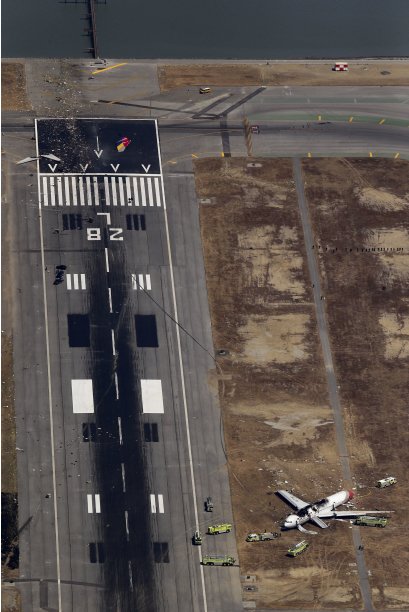
(UPDATE-2) The photos from KTVU shows pieces of the tail in the part of the runway where you're not supposed to land. It looks like the pilot landed short, hitting the seawall. According to radio reports, there was no distress call prior to landing.


(UPDATE) Bay Area TV KTVU says at least 2 dead, 61 injured. There is a raw footage of the crashed plane from a helicopter. The tail is completely gone.


According to radio reports, 10 who were brought to a San Francisco hospital were in critical condition.

==================================

Asiana Airlines' Flight 214 crashed while landing on runway 28 left at 11:26 PDT.

From USA Today (7/6/2013):


The tail broke off on landing, according to LA Times.

According to radio news reports, the tail of the Boeing 777 operated by Asiana Airlines (Flight 214 from Seoul) hit the piers before the runway.

It is a clear day with hardly any fog at San Francisco Airport, and all the planes before the Asiana flight landed with no problem at all.