Showing posts with label china. Show all posts

Monday, April 28, 2014

Reuters Columnist on Obama's Promise to Defend Japan in Territorial Disputes: "Creating False Expectations"


Another bogus "red line", I suppose.

Reuters' columnist Anatole Kaletsky's take on Obama's promise to defend Japan militarily against China over Senkaku Islands (that's how it is understood in Japan) is that the US president created false expectation he has no intention of actually fulfilling.

I see. So indeed China is Russia, and Ukraine is Japan, as Reuters Japan's article compared the other day (see my post on April 24, 2014 for the quote from the article).

From Reuters (4/24/2014; emphasis is mine):

Abe’s disturbing lack of focus

President Barack Obama’s trip to Asia this week has focused mostly on Japan’s territorial disputes with China. On this issue, Obama seems to be repeating the same mistakes he made in Ukraine.

By creating false expectations of U.S. support for the Japanese position, the president is encouraging Japan to escalate its belligerent rhetoric. That, in turn, makes Chinese military action to seize the disputed islands more likely. Everyone knows that there is no chance of the United States going to war with China to defend Japan’s claim to four uninhabited lumps of rock.

Luckily, a military confrontation in the East China Sea remains highly unlikely because the Beijing government’s top priority is economic and financial reform. Unfortunately, this seems less true of Japan.

Prime Minister Shinzo Abe’s attention seems to have shifted from economics to diplomacy and military matters — and financial markets have started to notice this disturbing change of focus. The clearest evidence can be seen in the relative performance of the Japanese stock market.

...The second reason for the Abe government’s new-found tolerance for an economic slowdown is directly connected to the rise of China. When Abe was elected in late 2012, his determination to revive the Japanese economy was significantly motivated by fears about China.

The worry was not that China had overtaken Japan as the world’s second-biggest economy and would eventually overtake the United States’ — even the most ardent Japanese nationalists see both these trends as inevitable. More troubling was growing evidence that China’s economic might was shifting the balance of interest in Washington from the traditional postwar friendship with Japan to cultivating better relations with China.

Given Japan’s dependence on U.S. military power, the shift of U.S. attention to China was alarming. Particularly to a fervent nationalist such as Abe, who has always cared passionately about winning Japan’s territorial disputes and rehabilitating its wartime reputation.

But with Obama’s words, the United States has now shown its willingness to antagonize China by promising to defend Japan unconditionally in any territorial disputes. These promises will almost certainly prove false in the event of a genuine military confrontation. But for the moment, they seem to have reassured Japanese politicians that Washington will continue to pay attention to Japan — even if it slides back into economic irrelevance.

(Full article at the link)


Japan's Nikkei Shinbun's article on April 29, 2014 by Nikkei's Washington Bureau is right on, which surprises me that they actually get it.

From Nikkei Shinbun (4/29/2014; part):

尖閣に日米安保適用 オバマ大統領の本心

Senkaku under US-Japan Security Treaty - President Obama's true intension

...環太平洋経済連携協定(TPP)で果実を得るために、言葉だけで日本に「貸し」をつくることができるなら、お安いご用――。シリア問題の対処に象徴されるオバマ氏の軽い言葉と行動からはこんな疑問もつきまとう。

It would be an easy task, if he could do a favor to Japan with words only and receive a substantive gain in Trans-Pacific Partnership (TPP) in return. It makes one wonder, given Mr. Obama's words and deeds without gravity as symbolized (represented) by his handling of Syria.


Mr. Obama was all ready to go to war with Syria (backed by nuclear Russia) with youtube videos as evidence. Who needs gravity in this day and age?

Tuesday, February 18, 2014

Chinese Government Demands Japan to Return Weapon-Grade Plutonium to the US as President Obama Has Requested


"G2" in complete agreement in this case. See my post in January this year for the demand from the other G2 nation.

From Xinhua (2/19/2014; emphasis is mine):

China calls on Japan to return plutonium to U.S.

BEIJING, Feb. 19 (Xinhuanet) -- China has voiced serious concern over Japan’s possession of weapons-grade nuclear material. The US has been calling for the return of over 300 kilos of weapons-grade plutonium, which it loaned to Japan for research during the Cold War.

The Chinese Foreign Ministry is pressing Tokyo to return the plutonium to the US as soon as possible. At a routine news conference on Monday, Foreign Ministry Spokesperson, Hua Chunying, said Japan’s large stockpile of plutonium poses serious nuclear security and non-proliferation risks.

China is calling on Japan to settle the imbalance between its supply and demand of nuclear materials, in accordance with International Atomic Energy Agency rules.

"China has been paying great attention to nuclear proliferation, the safety of nuclear material, and its potential threat to regional security. According to the rules of the International Atomic Energy Agency, each country should ensure a balance of supply and demand when it comes to nuclear material. Japan storing large amounts of weapons-grade material violates such rules. It is obvious that only the peaceful use of nuclear energy can guarantee no security issues will arise. China urges Japan to give a concrete explanation, and take responsibility for the safety of international society, comply with its obligations, and return the materials to the US as soon as possible.” Hua said.


"A complete explanation" is simple enough - the US gave Japan 300 kg of weapons-grade plutonium. (The understanding in Japan is that this plutonium is not "loaned" but gifted. )

Thursday, January 30, 2014

(OT) Echo of Past World Wars from Davos, as Chinese Professional Channels "Iojima" and Japan's Prime Minister Channels Evans-Pritchard


in comparing the current Sino-Japan relationship to the British-German relationship right before the World War I.

Disconcerting remarks that seem to have freaked out many who attended the events (two separate events at Davos - confab of the rich and the powerful in the world), but there is hardly a peep about them in Japan. I don't think either remarks were reported by the Japanese media.

First, about the incredible Chinese professional, from Business Insider's Henry Blodget, who was at a dinner at Davos where he heard the following (1/22/2014; emphasis is mine):

I went to one of those fancy private dinners last night in Davos, Switzerland.

Like most of the events here at the 2014 World Economic Forum, the dinner was conducted under what are known as "Chatham House Rules," which means that I can't tell you who was there.

I can tell you what was said, though. And one thing that was said rattled a lot of people at the table.

During the dinner, the hosts passed a microphone around the table and asked guests to speak briefly about something that they thought would interest the group.

One of the guests, an influential Chinese professional, talked about the simmering conflict between China and Japan over a group of tiny islands in the Pacific.

China and Japan, you may recall, each claim ownership of these islands, which are little more than a handful of uninhabited rocks between Japan and Taiwan. Recently, the Japan-China tension around the islands has increased, and has led many analysts, including Ian Bremmer of the Eurasia Group, to worry aloud about the potential for a military conflict.

The Chinese professional at dinner last night did not seem so much worried about a military conflict as convinced that one was inevitable. And not because of any strategic value of the islands themselves (they're basically worthless), but because China and Japan increasingly hate each other.

The Chinese professional mentioned the islands in the context of the recent visit by Japan's Prime Minister Shinzo Abe to the Yasukuni Shrine in Tokyo. The Yasukuni Shrine is a Shinto shrine where Japanese killed in Japan's many military conflicts over the centuries are memorialized — including the Japanese leaders responsible for the attacks and atrocities Japan perpetrated in World War 2. A modern-day Japanese leader visiting the Yasukuni Shrine is highly controversial, because it is viewed by Japan's former (and current) enemies as an act of honoring war criminals.

That's certainly the way the Chinese professional at the dinner viewed it.

He used the words "honoring war criminals," to describe Abe's visit to the shrine. And, with contained but obvious anger, he declared this decision "crazy."

He then explained that the general sense in China is that China and Japan have never really settled their World War 2 conflict. Japan and America settled their conflict, he explained, and as a result, the fighting stopped. But China and Japan have never really put the war behind them.

The Chinese professional acknowledged that if China asserted control over the disputed islands by attacking Japan, America would have to stand with Japan. And he acknowledged that China did not want to provoke America.

But then he said that many in China believe that China can accomplish its goals — smacking down Japan, demonstrating its military superiority in the region, and establishing full control over the symbolic islands — with a surgical invasion.

In other words, by sending troops onto the islands and planting the flag.


The Chinese professional suggested that this limited strike could be effected without provoking a broader conflict. The strike would have great symbolic value, demonstrating to China, Japan, and the rest of the world who was boss. But it would not be so egregious a move that it would force America and Japan to respond militarily and thus lead to a major war.

Well, when the Chinese professional finished speaking, there was stunned silence around the table.

The assembled CEOs, investors, executives, and journalists stared quietly at the Chinese professional. Then one of them, a businessman, reached for the microphone.

"Do you realize that this is absolutely crazy?" the businessman asked.

"Do you realize that this is how wars start?"

"Do you realize that those islands are worthless pieces of rock... and you're seriously suggesting that they're worth provoking a global military conflict over?"

The Chinese professional said that, yes, he realized that. But then, with conviction that further startled everyone, he said that the islands' value was symbolic and that their symbolism was extremely important.

Challenged again, the Chinese professional distanced himself from his earlier remarks, saying that he might be "sensationalizing" the issue and that he, personally, was not in favor of a war with Japan. But he still seemed certain that one was deserved.

I'm far from an expert on the Japan-China conflict, and I'll leave the analyses of this situation to those who are. All I can tell you is that a respected, smart, and influential Chinese professional suggested at dinner last night that a surgical invasion by China of the disputed islands is justified and would finally settle the Japan-China conflict without triggering a broader war. And that suggestion freaked out everyone in the room.


Japan's prime minister is equally incredible when he suggested to Financial Times' Gideon Rachman that he, too, sees a Sino-Japan conflict as "conceivable" and is quite nonchalant about it.

From Gideon Rachman's blog at FT (1/22/2014; part, emphasis is mine):

Here at Davos, I’ve just had the opportunity to moderate a discussion between the Japanese prime minister, Shinzo Abe, and a group of international journalists. I asked Mr Abe whether a war between China and Japan was “conceivable”.

Interestingly, he did not take the chance to say that any such conflict was out of the question. In fact, Mr Abe explicitly compared the tensions between China and Japan now to the rivalry between Britain and Germany in the years before the first world war, remarking that it was a “similar situation”.

The comparison, he explained, lies in the fact that Britain and Germany – like China and Japan – had a strong trading relationship. But in 1914, this had not prevented strategic tensions leading to the outbreak of conflict.


Ambrose Evans-Pritchard at UK's Telegraph said this in November last year:

...Today's escalating spat has echoes of the Agadir crisis in 1911, the stand-off between Wilhelmine Germany and the Franco-British Entente in the final years before the First World War.

In case you have forgotten, Kaiser Wilhelm sent the warship Panther to Morocco in 1911 to prevent French annexation. The Kaiser picked his moment well. The French were violating earlier accords.

Yet his real purpose was to probe and weaken Britain's entente with France (not a formal alliance) by picking on an issue where London had little natural sympathy for French actions.

The Agadir Crisis backfired against the Kaiser. The Entente did not break. But that is hardly a reassuring episode. The chain of events that followed were catastrophic.

France felt emboldened by British backing, with ripple effects through the Franco-Russian alliance. Russia then felt more able to push its luck when the Serbian crisis hit in 1914. Agadir fed an overwhelming sense of fury in Germany, a feeling that Britain had become an enemy.

America is now having to walk the same sort of tightrope that Britain had to walk – and walked badly – from Agadir to Sarajevo. One misjudgement by either side in the East China Sea could change our world entirely. If you are not concerned, perhaps you should be.


As I said above, very, very few in Japan are concerned. They either do not take Mr. Abe seriously, or they put much faith in the sanity of the Chinese leadership.

Monday, December 30, 2013

(OT) Performance of East Asian Stock Markets in 2013


Maybe this is one of the reasons Japan's Abe decided to go visit the war shrine, thinking his "Abenomics" has won...

From January 4 to December 30, 2013:

  • Japan's Nikkei: up over 50%

  • Hong Kong's Hang Seng Index: flat

  • Shanghai's Composit Index: down 8%

  • South Korea's Kospi: flat


(Chart created at stockcharts.com)


Of course the depreciating currency of Japan has helped a great deal.

Japanese yen, from November 2012 to December 2013:


The Japanese government and the South Korean government have reduced the size of the currency swaps since October 2012 to an insignificant level ($10 billion). Though the South Korean government has since expanded the currency swaps with China, it now has less ammo to cheapen its own currency.

Sunday, December 15, 2013

Evans-Pritchard: China-Japan Rearmament is Keynesian Stimulus, If It Doesn't Go Horribly Wrong


An "IF" in capital letters, but even if it does go wrong and things come to a head between China and Japan, it will still be a great Keynesian stimulus for the US and Europe, whose economies have been suffering "long malaise".

Ambrose Evans-Pritchard, on-again-off-again Keynesian (I think it's "on" now, since the Great Recession induced by the Lehman collapse), says Japan is ready for a fight if necessary; at the same time he seems to think that mishap is not necessarily by China or Japan but by the United States, and fear the cascading effect outside the parties directly involved, as he cites the Agadir crisis in 1911.

With the flip-flopping president who are surrounded by advisors whose expertise (if that) is only in the US domestic politics, the probability of the mishap is rather significant, I'm afraid, no matter how much Japan's PM Shinzo Abe tries to flatter the US president.

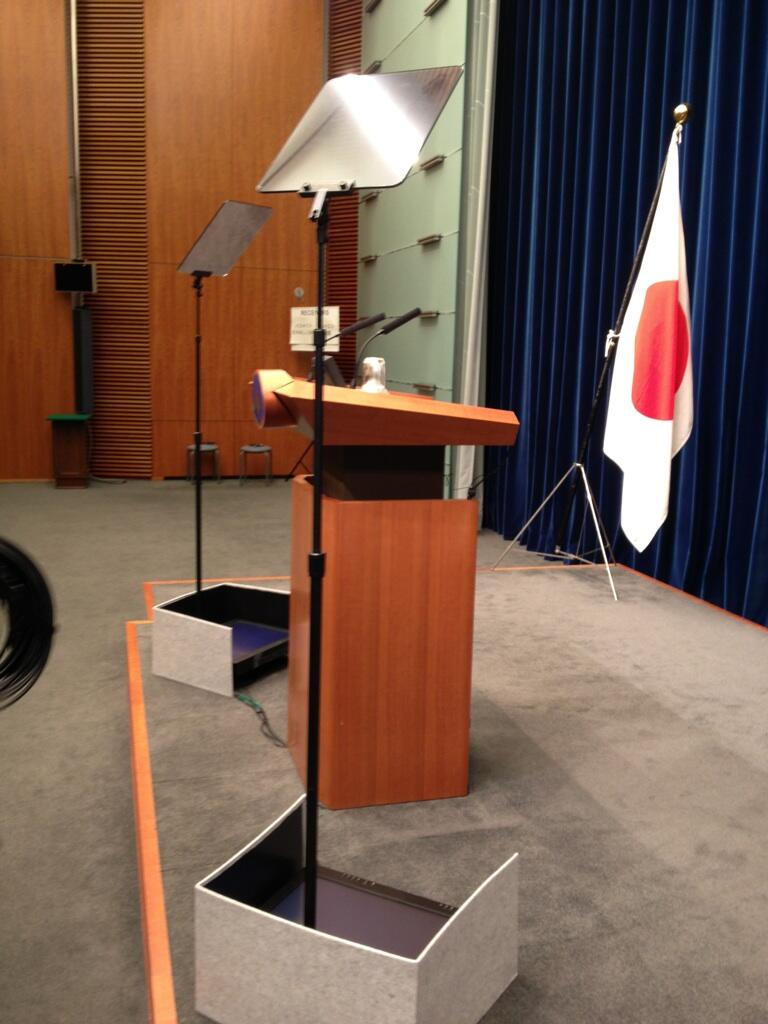
(The latest example of flattery is Abe's mimicking President Obama in using teleprompters for the first time to deliver his speech at a hastily scheduled press conference on December 14, 2013, probably just to show off his brand-new toy...image from Yasumi Iwakami)

From The Telegraph (11/26/2013; emphasis is mine), by Ambrose Evans-Pritchard:

China-Japan rearmament is Keynesian stimulus, if it doesn't go horribly wrong

Asia is on the cusp of a full-blown arms race. The escalating clash between China and almost all its neighbours in the Pacific has reached a threshold. All other economic issues at this point are becoming secondary.

Beijing's implicit threat to shoot down any aircraft that fails to adhere to its new air control zone in the East China Sea is a watershed moment for the world. The issue cannot easily be finessed. Other countries either comply, or they don't comply. Somebody has to back down.

The gravity of the latest dispute should by now be obvious even to those who don't pay attention the Pacific Rim, the most dangerous geostrategic fault line in the world.

Japan’s foreign minister, Fumio Kishida, accused China of “profoundly dangerous acts that unilaterally change the status quo”.

The US defence secretary Chuck Hagel called it “a destabilising attempt to alter the status quo in the region” and warned that the US would defy the order. The Pentagon has since stated that US pilots will not switch on their transponders to comply, and will defend themselves if attacked. Think about this for a moment.

Mr Hagel asserted categorically that Washington will stand behind its alliance with Japan, the anchor of American security in Asia. “The United States reaffirms its long-standing policy that Article V of the US Japan Mutual Defense Treaty applies to the Senkaku Islands,” he said.

Whether China fully believes this another matter, of course. The Senkaku islands offer a perfect opportunity for Beijing to test the resolve of the Obama Administration since it is far from clear to the war-weary American people why they should risk conflict in Asia over these uninhabited rocks near Taiwan, and since it also far from clear whether President Obama's Asian Pivot is much more than a rhetorical flourish.

Besides, Beijing has just watched the US throw its long-time ally Saudi Arabia under a bus over Iran. It has watched Moscow score an alleged victory over Washington in Syria. You and I may think it is an error to infer too much US weakness from these incidents, but that is irrelevant. Beijing seems to be drawing its own conclusions.

Even if the immediate crisis can be defused, we are clearly sliding into a new Cold War. While it is dangerous, it could have paradoxical and powerful side effects. Rearmament lifted the world economy out of slump in the late 1930s, working as a form of concerted Keynesian fiscal stimulus. It could do so again.

The parallels are not exact. They never are. But an Asian arms race would almost certainly tackle some of the underlying causes of the long malaise in the Western economies. It would soak up much of the Asian "savings glut" and the excess industrial capacity in China, and would help to narrow the perennial East-West trade gap.

This would be an answer of sorts to the West's "secular stagnation" – to use the term of former US treasury secretary Larry Summers – or the liquidity trap as others call it. But be careful what you wish for.

I don't wish to become entangled in debate over whether other states impose such ADIZ identification zones beyond their territorial waters, as asserted by Beijing. It is political infantilism to see and judge such disputes through a moral prism, as if our Hobbesian world conforms to codes of right and wrong. What we are dealing with is a great power collision of epochal proportions.

The Asian arms race is young, but clearly under way already. China has launched its first stealth drone, known as Sharp Sword. It developing indigenous aircraft carriers. Its “Two-Ocean-Strategy” implies a fleet of five or six carrier battle groups.

Japan is already rearming. It is building a de facto marine force. It has launched its largest warship since WW2, an 800-foot long DDH-class helicopter carrier, an aircraft carrier in all but name. Tokyo is developing its own version of the Pentagon's Advanced Research Projects Agency. Spending on warships and aircraft will jump by 23pc this year.

When I visited the spanking new buildings of the Japanese defence ministry in Tokyo in March, it already seemed like another world from the run-down digs of the old Self-Defence Force that I had visited six years earlier.

You could feel the emergence of a new military power, pacifist still in name only. The message that came through loud and clear from talking to officials is that Japan is ready for a fight if necessary, and is convinced that it can sink or shoot down any force sent by China into Japan's waters and airspace – whether to close in on the Senkaku/Diaoyu islands, or to ratchet up pressure against Okinawa.

I was shown detailed maps tracing movements of Chinese DDG warships and Yuan-class submarines that left me deeply alarmed over where this is going. Japanese officials said Chinese naval officers on patrol were not responding to normal signals.

"What we don't know is whether Chinese officers follow any international code of conduct? Do they understand what is banned and not banned? Does the Communist Party control their own military?" said one defence planner.

"Two thousand years ago under the Han Dynasty, the emperor put his right hand on the wheel of his chariot and told his general that everything inside the borders was the domain of the emperor, and everything outside was left to the commander. That has plagued China throughout its history, and it is the delicate issue we now face," he said.

There is no red telephone between Tokyo and Beijing to defuse a crisis if it erupts, nothing comparable to the Washington-Moscow "hotline" during the Cold War.

While the US and China were able to calm the waters after an American military jet collided with a Chinese fighter in 2002 – killing the Chinese pilot – it is unlikely that any such mishap between China and Japan could be contained at this stage.

Today's escalating spat has echoes of the Agadir crisis in 1911, the stand-off between Wilhelmine Germany and the Franco-British Entente in the final years before the First World War.

In case you have forgotten, Kaiser Wilhelm sent the warship Panther to Morocco in 1911 to prevent French annexation. The Kaiser picked his moment well. The French were violating earlier accords.

Yet his real purpose was to probe and weaken Britain's entente with France (not a formal alliance) by picking on an issue where London had little natural sympathy for French actions.

The Agadir Crisis backfired against the Kaiser. The Entente did not break. But that is hardly a reassuring episode. The chain of events that followed were catastrophic.

France felt emboldened by British backing, with ripple effects through the Franco-Russian alliance. Russia then felt more able to push its luck when the Serbian crisis hit in 1914. Agadir fed an overwhelming sense of fury in Germany, a feeling that Britain had become an enemy.

America is now having to walk the same sort of tightrope that Britain had to walk – and walked badly – from Agadir to Sarajevo. One misjudgement by either side in the East China Sea could change our world entirely. If you are not concerned, perhaps you should be.


"Mr Hagel asserted categorically that Washington will stand behind its alliance with Japan, the anchor of American security in Asia."


Well, ever since Evans-Pritchard wrote this article (11/26/2013), the US has been busy pleasing Beijing while throwing Japan under the bus (here and here). The US State Department's deputy spokesperson even said the US was happy to see changes in South Korea, which announced it would now allow airlines to file flight plans with Chinese authorities over the disputed territories.

Meanwhile Prime Minister Abe is busy meeting and speaking with the heads of the ASEAN nations in an effort to form a united front against China, whom they perceive as encroaching on the neutral or international (and disputed) space.

Wednesday, December 4, 2013

(OT) Team Obama Changes Course, Appears to Accept China Air Defense Zone, Says Foreign Policy Magazine


Japan looks so solidly under the bus now, even as the ruling coalition of Liberal Democratic Party and Komei Party (plus Your Party and probably Japan Restoration Party) pushes the passage of the State Secrecy Protection Law in the Upper House of the Japanese national Diet, trying to do the bidding - supposedly - of the US Obama administration.

From Foreign Policy (12/4/2013; part, emphasis is mine):

Team Obama Changes Course, Appears to Accept China Air Defense Zone

Top Obama administration and Pentagon officials signaled a willingness to temporarily accept China's new, controversial air defense identification zone on Wednesday. Those officials expressed disapproval for the way in which the Asian power has flexed its muscles, and cautioned China not to implement the zone. But they also carved out wiggle room in which the United States and China ultimately could find common ground on the issue, indicating that they may be willing to live with the zone for now -- as long as China backs off its demand that all aircraft traveling through it check in first.

"It wasn't the declaration of the ADIZ that actually was destabilizing," said Army Gen. Martin Dempsey, America's highest-ranking military officer. "It was their assertion that they would cause all aircraft entering the ADIZ to report regardless of whether they were intending to enter into the sovereign airspace of China. And that is destabilizing."

That's a change from just a few days ago, when U.S. Vice President Joe Biden demanded that China take back its declaration of the zone. And it's another demonstration that China's recent decisions have forced the United States to tread carefully. On Wednesday, Biden met with Chinese President Xi Jinping in Beijing for more than five hours, according to a senior administration official. In brief public remarks midway through the marathon session, Biden didn't mention the air defense zone at all.

...In meetings in Beijing on Wednesday, Biden laid out the U.S. position in detail, reiterating that the United States does not recognize the new zone and has deep concerns about it, a senior administration official said. Biden told Xi that the United States wants China to take steps to lower tensions in the region, avoid enforcement actions that could lead to crisis, and to establish communication with Japan and other countries in the region to avoid altercations, the administration official added. Privately, Biden did not call for the air defense identification zone it to be rolled back -- something administration officials had done Monday while Biden was visiting Japan. Instead, the vice president asked the Chinese leader to be careful about how his country operated the zone going forward.

"He indicated to Xi that we are looking to China to take steps as we move forward to lower tensions, to avoid enforcement actions that could lead to crisis, and to establish channels of communication with Japan, but also with their other neighbors to avoid the risk of mistake, miscalculation, accident or escalation," the official told reporters in Beijing.

(Full article at the link)


"As long as you don't actually implement and enforce it, your ADIZ is OK with us in the US (wink wink)" is essentially what VP Biden and General Dempsey are saying.

Much like President Obama issuing executive orders to let businesses break the law (Obamacare) for one year without penalty.

Meanwhile, after the all-night session in the Upper House that covered pending legislations including the State Security Protection Law, the Special Committee for National Security of the Upper House is in session right now. There is no TV station covering the proceeding, and the livecast of the Upper House is sketchy at best due to a large number of access requests from net citizens. So here's Yahoo Japan, if you're interested and understand Japanese, who has started the netcast:


Live streaming video by Ustream

The choreography is that the Committee vote is expected in the afternoon, and then the bill goes to the full Upper House floor either in the evening for vote or tomorrow, by extending the Diet session by one day. Watching the questions and answers in the Committee, neither side - the Abe administration and the ruling coalition, or the opposition - doesn't seem to quite know what they are talking about.

Remember Boy Wonder, aka Mayor of Osaka City of comfort women fame? He's trying his best to get his name printed in the newspaper by making fuss about the law that he and his party are quite in favor of. Right now, Boy Wonder is saying he thinks the law is necessary, but he doesn't agree with the vote today.

Just like in the Lower House, his party will be happy as long as the bill is not voted on today.

It is all happening as the US has thrown Japan under the bus and Japan doesn't even know it.

Saturday, November 30, 2013

(OT) Obama Administration Instructs US Commercial Airlines to File Flight Plans with China in Newly Declared Air Defense Identification Zone (ADIZ)


...leaving Japan's Prime Minister Shinzo Abe hung to dry. Nice job, Mr. Obama.

After kindly informing China the other day that its two B52 bombers that flew inside the Air Defense Identification Zone over Senkaku Islands were unarmed, the United States government now says it is requesting the US commercial airlines to adhere to China's new rules and submit flight plans to China, to be safe.

The State Department Office of the Spokesperson (from 11/27/2013 daily press briefing, released on 11/29/2013; emphasis is mine):

China's Declared ADIZ - Guidance for U.S. Air Carriers

Question: Is there any specific guidance or information we are giving to U.S. carriers operating in China's recently declared Air Defense Identification Zone (ADIZ)?

Answer: Freedom of overflight and other internationally lawful uses of sea and airspace are essential to prosperity, stability, and security in the Pacific. We remain deeply concerned by China's November 23 declaration of an "East China Sea Air Identification Zone."

The U.S. government generally expects that U.S. carriers operating internationally will operate consistent with NOTAMs (Notices to Airmen) issued by foreign countries. Our expectation of operations by U.S. carriers consistent with NOTAMs does not indicate U.S. government acceptance of China's requirements for operating in the newly declared ADIZ.


Well, even NHK News is taking this as "acceptance".

From NHK News (11/30/2013):

これについてアメリカ国務省は、29日、報道官の談話を発表し「アメリカ政府は、国際的に運航するアメリカの航空会社は外国政府が発表する航空情報に従うべきだと考えている」として、アメリカの航空各社に対し、中国当局へのフライトプラン=飛行計画書の提出を、事実上求めていく考えを明らかにしました。

[NHK quoting the State Department answer (second paragraph of the answer above), then says that] the US State Department has made it clear that it is the intention of the US government to effectively request the US airlines to file flight plans with the Chinese authority.


NHK also quotes part of the New York Times article on the matter, with the officials in the Obama administration putting safety first.

According to The New York Times article (11/29/2013):

While the United States continued to defy China by sending military planes into the zone unannounced, administration officials said they had made the decision to urge civilian planes to adhere to Beijing’s new rules in part because they worried about an unintended confrontation.

... It was not immediately clear if the Obama administration had notified Japan, a close ally, of its decision.


Well they hadn't. At all.

The clearly irate Ministry of Foreign Affairs official says they haven't heard anything like that from the US counterpart, as reported by Mainichi Shinbun (11/30/2013):

防空識別圏:米国の新方針に外務省「聞いていない」

ADIZ: Ministry of Foreign Affairs on the new US policy "We haven't been informed"

米政府の方針について、外務省幹部は30日午前、毎日新聞の取材に「全く聞いていない。これまでの米国の行動とは全く異なる対応だ」と語った。

A top official at the Ministry of Foreign Affairs spoke with Mainichi Shinbun in the morning of November 30 on the US government policy, and said "We haven't been informed at all. It is a completely different response from what the US has been doing."

日本政府は中国の防空識別圏設定について「何ら効力を有するものではなく、これまでのルール通りの運用を行っていく」としており、中国への飛行計画提出は不要との立場。国土交通省を通じ航空各社に、こうした方針を伝えている。政府は今後、米国に詳細を確認する方針だ。

The Japanese government's stance on the Chinese ADIZ is that it does not have any enforceability, the Japanese government will continue to follow the existing rules and that there is no need to submit flight plans to China. The Japanese airlines have been informed of the government stance by the Ministry of Land, Infrastructure, Transport and Tourism. The Japanese government will ask the US for the details of the new policy.


It was only several days ago the Secretary of State John Kerry and the Secretary of Defense Chuck Hagel issued a strong statement condemning China.

But it was also only several days ago that National Security Advisor Susan Rise made a strange speech at Georgetown University which was interpreted in Japan as a sign that the US will form a partnership with China as the two biggest powers in the world, leaving Japan hanging in the air.

Ms. Rice, of lying-through-her-teeth-on-Benghazi fame, indeed said, "When it comes to China, we seek to operationalize a new model of major power relations."

She mentioned China 20 times, Korea 11 times, Japan 7 times. No mention of Senkaku Islands.

(Operationalize? What kind of ugly verb is that? DCSpeak?)

Friday, November 29, 2013

(OT) China Says Japan Is the Prime Target of Air Defense Identification Zone (ADIZ)


The US (who declared to the world that its B52 bombers were unarmed), Australia, South Korea do not matter, according to the editorial in the English language paper Global Times by China's People's Daily.

Global Times (11/29/2013; emphasis is mine):

Japan prime target of ADIZ tussle

Japan has been giving fierce reaction to China's demarcation of the East China Sea Air Defense Identification Zone (ADIZ).

Japanese Minister of Defense Itsunori Onodera has made malicious remarks almost daily since last Saturday when the zone was set up. Perhaps that just proves a folk saying: The more guilty one feels, the more unscrupulous he will be.

Apart from Japan, the US and Australia have also rebuked Beijing for its new air defense rules with provocative remarks or actions, and even South Korea's foreign ministry expressed formal regrets over the ADIZ.

Nonetheless, all the criticism and provocation will not pose a real challenge for the newly created ADIZ. It is a fact that China has already established its ADIZ over the East China Sea.

Maybe an imminent conflict will be waged between China and Japan. As a staunch supporter of Tokyo, Washington is expected to refrain from confronting Beijing directly in the East China Sea, at least for now. Canberra and Seoul just chimed in.

The Chinese government is supposed to remain resolute in its strategies while taking flexible and resilient measures to cope with unexpected accidents.

If the US does not go too far, we will not target it in safeguarding our air defense zone. What we should do at present is to firmly counter provocative actions from Japan. Australia, having no real conflict with China now, can be ignored at the moment.

Seoul understands it is not the target of China's ADIZ, plus it has tensions with Japan right now, therefore, China has no need to change its actions toward South Korea.

We should carry out timely countermeasures without hesitation against Japan when it challenges China's newly-declared ADIZ. If Tokyo flies its aircraft over the zone, we will be bound to send our plane to its ADIZ.

If the trend continues, there will likely be frictions and confrontations and even tension in the air like in the Cold War era between the US and the Soviet Union. It is therefore an urgent task for China to further train its air force to make full preparation for potential conflicts.

We are willing to engage in a protracted confrontation with Japan. Our ultimate goal is to beat its willpower and ambition to instigate strategic confrontation against China.

Though Beijing has encountered difficulties in the nascent stage of the ADIZ, Chinese authorities appear calm in the wake of all the provocations.

The Chinese nation is heading towards peace and prosperity with peace-loving people.

Turbulence over the Diaoyu Islands and the East China Sea Air Defense Identification Zone will in no way alter China's overall architecture.


Fierce reaction? The US, staunch supporter of Tokyo, is to refrain from confronting Beijing?

What they are saying doesn't make much sense, but I suppose it is a good match for the equally incomprehensible Abe administration.

BBC reports (11/29/2013) that China scrambled fighter jets to monitor Japanese fighter jets and the US surveillance planes entering, as far as Japan and the US know, their ADIZ over Senkaku Islands.

Friday, July 12, 2013

China Cancels Construction of $6 Billion Nuclear Fuel Plant in Guandong Amid Strong Citizen Protest


When it comes to actually stopping a nuclear project, Chinese people seem far more effective than the Japanese.

From Zeenews.com (7/13/2013; emphasis is mine):

China cancels construction of $6 bn nuclear plant

Beijing: China has cancelled the construction of a USD six billion nuclear procession plant in Guangdong province apparently due to public concerns over its safety.

The planned nuclear fuel processing project in south China's Guangdong Province has been cancelled, state-run Xinhua news agency reported today.

The planned Longwan Industrial Park project under China National Nuclear Corporation, located in Zhishan Township in Heshan City, was cancelled, the report said, quoting officials of municipal government of Jiangmen, which administers Heshan and company sources.

The planned industrial park, with a designed capacity of 1,000 tonnes of uranium in 2020, was to feature facilities for uranium conversion, enrichment and manufacturing of nuclear fuel equipment, involving a total investment of 37 billion yuan (USD 6 billion), the report said.

The brief report did not mention why the project was cancelled. This is the first nuclear project cancelled by China, which is embarking on a massive expansion of nuclear power projects.

Earlier reports said local people had expressed concerns over the safety of the processing plant handling such large quantities of uranium.

Public protests which are rare in China are now becoming common specially when it comes to preservation of the environment.

Chinese officials also halted the construction of a copper alloy plant in Sichuan province following violent protests by local residents.

The cancellation of Guangdong plant also comes in the backdrop of slowing down of the economy which was expected to contract to 7.5 per cent this year from last year's 7.8 per cent, amid reports of a liquidity crunch.

(Full article at the link)


Locals voicing opposition in a demonstration were reported by Xinhua (7/13/2013; emphasis is mine), though I couldn't find the article about the cancellation:

Hundreds of people gathered in a city in south China's Guangdong Province on Friday to protest a planned industrial park processing nuclear fuel.

Protesters "took a walk" through Jiangmen, holding banners and wearing T-shirts with slogans calling against the planned construction of a nuclear facility in Zhishan Township in Heshan City, which is administered by Jiangmen.

According to information published by the government of Jiangmen, the 229-hectare industrial park will feature facilities for uranium conversion, enrichment and manufacturing of nuclear fuel equipment, involving a total investment of 37 billion yuan (6 bln U.S. dollars).

Industry insiders told Xinhua that the project is the first industrial park planned in southeast China for nuclear fuel production. It will supply to nuclear power plants in Guangdong and neighboring Fujian Province, with a designed capacity of 1,000 tonnes of uranium in 2020.

"We don't need such projects to boost the economy," said a resident surnamed Liu in the crowd of protestors. Liu said he knew little about the nuclear industry but was upset that the planned site was only 30 km away from the city.

Wu Yuxiong, mayor of Heshan, said on Friday that the public consultation period for the project, details of which were published on July 4, would be extended. Another official said the construction of the park was "a long way off being started."

The city will invite members of the public to tour other nuclear facilities to better understand their production, beef up publicity of relevant scientific knowledge and invite experts from home and abroad into the evaluation of the project, Wu said.


Photo from South China Morning Post (7/13/2013). The placard says "I need life, don't need nuke":


According to South China Morning Post, the residents remain highly skeptical, and think it's just the city's tactics to placate the residents for a while (emphasis is mine):

The municipal government in Jiangmen, Guangdong announced on Saturday that it would drop a controversial plan to build a uranium processing project in the city. But local residents worried it was just city official's delay tactic to stop them from staging more protests.

About 500 people lingered at the city's landmark Donghu Square on Saturday morning after vice mayor Wu Guojie made the announcement at 9 am. Protesters were scheduled to walk from Donghu Sqaure to the municipal government building.

"We don't believe the project will be dropped premenently, because our goverent has no credibility at all," one participater said.

"The government officials are so corrupt. The accept lots of bribes that could support them to migrant to overseas. That's why they never seriously take care of our living safty," said another resident.


Some parents brought their children to Saturday's rally.

"I want to use the protest to teach my son and our next generation that nuclear projects wil negatively affact their life and the future development of the Pearl River Delta," a man who brought his 7-year-son to the rally said.

The protest was finally cancelled as local government mobolised more than100 police officers and plainclothes policemen who urged protesters to leave.

Tuesday, April 23, 2013

Sign at a Restaurant in Wuhan, China "No Entry for Japanese", No Tee Time for Japanese at a Golf Course


Toyota, Honda, Nissan's slump in China will continue.

From Bloomberg News (4/23/2013):


No Tee Time for Japanese Shows Depth of Toyota China Slump: Cars

Honda Motor Co. employees in the Chinese city of Wuhan need only visit the popular Feng Bo Zhuang restaurant to see the resentment their company faces. A sign at the door says Japanese are barred from entering.

Discrimination against Japanese is common in China, according to Yasuhide Mizuno, the head of Honda’s venture in Wuhan, some 500 miles (800 kilometers) up the Yangtze River from Shanghai. Mizuno -- who has also been assigned to Thailand, Taiwan, Malaysia and Australia -- says he’s never worked in a more hostile place.

“Wherever I go, like department stores or in taxis, people ask me whether I am Japanese,” Mizuno, 49, president of Dongfeng Honda (GHAJCZ), said in an interview at the Shanghai auto show. When he says yes, he said, the reception can be frosty.

Mizuno’s experiences in the city, site of one of the bloodiest battles of the Sino-Japanese war in the 1930s, illustrate why sales for Honda and Toyota Motor Corp (7203). have yet to recover since violent protests across China seven months ago. Though the riots -- triggered by a territorial dispute over uninhabited islands -- have subsided, Japanese carmakers are continuing to lose share in the world’s biggest auto market.

...First-quarter China deliveries for Honda, Nissan Motor Co. and Toyota (7203) fell even as overall Chinese car sales rose 17 percent. The share of Japanese brands dropped to 15 percent, versus a peak of 23 percent in 2011, according to the China Association of Automobile Manufacturers. LMC predicts the Japanese will see no growth in China this year, while the country’s auto market will expand 10 percent. Toyota doesn’t expect deliveries in the country to reach pre-protest levels before this autumn, China chief Hiroji Onishi said at the Shanghai show.

...For Honda’s Mizuno, the numbers are personal, though he says things are slowly improving. Japanese expatriates are still turned away from grocery stores, but not as often as before, he said. The Wuhan Tianwaitian Golf Country Club is always booked when he tries to reserve a tee time, he says, though it’s better than simply being told Japanese aren’t welcome on the course, as was the case a few months ago.

“I’ve never had that kind of experience in Beijing, Shanghai or Guangzhou,” Mizuno said. “They don’t understand that what they do affects foreign impressions of the city.”

Wang Qian, a representative at Tianwaitian’s reservations hotline, said the club doesn’t discriminate, though she acknowledged it refused Japanese golfers in September and October. Currently, the club prioritizes bookings for members and Japanese executives don’t belong to the club, she said.

At Feng Bo Zhuang near Wuhan’s bustling shopping district, workers in the 150-seat restaurant make no secret of their prejudices.

“My boss thinks the Japanese are way wrong on the Diaoyu islands issues, so he decided to put up the sign,” said a manager dressed in a Kung Fu master’s outfit who identified himself only by his family name, Zhong. “It’s also our way of marketing, because Chinese people were all angry.”

Japanese automakers can’t pin all the blame on political disputes as their cars have a lackluster reputation, according to Zhu Bin, an analyst at LMC Automotive. Sales at Toyota had been falling in the two months preceding the protests, while Nissan was underperforming the broader market.

(Full article at the link)


"Lackluster reputation". Coming from Chinese is priceless.

Meanwhile 1,000 officers of Japan's Self Defense Force will have a joint drill in June in California with the US military to recapture an isolated island, according to Kyodo News.

When I tweeted the military drill news, one follower responded by saying "There is no way that the US will side with Japan. Only a token gesture, because they don't want to anger China." The same kind of people also accused the US for not helping Japan enough in March 2011.

Monday, April 22, 2013

Earthquake in Sichuan, China: Threat of Secondary Disasters Including Nuclear, Says South China Morning Post


From South China Morning Post (4/22/2013):

Aftershocks from Sichuan earthquake pose threat of secondary disasters

Authorities issue warnings amid potential for mudslides, damage to dams and nuclear plants

Secondary disasters such as mudslides and dam-related crises may occur in the days or even months after Saturday's earthquake, threatening the safety of residents and rescuers, geologists warn.

Fan Xiao, chief engineer at the Sichuan Geology and Mineral Bureau in Chengdu, said yesterday the banks along the Qingyi River, in one of the most geologically unstable regions of the province, had taken a big hit.

Known for its high mountains and deep valleys, the area was already unstable before the earthquake, with villages and roads sitting almost in the path of potential landslides, Fan said. And shockwaves from the earthquake could profoundly increase structural instability in the region.

"Residents and rescuers must be highly alert to the dangers of mudslides, especially after rain," he said. "There will be lots of rain in the coming months."

...

Sichuan is also known for its nuclear facilities, many of which are for military purposes. The China National Nuclear Power Corporation announced on its website that its nine nuclear facilities in Sichuan experienced various levels of shockwaves at the weekend, prompting safety checks. There had been no reports of leaking pipes or collapsed buildings at the facilities.

As of 6pm yesterday, the quake zone had experienced 1,642 aftershocks - the strongest with a magnitude of 5.4.

(Full article at the link)


Looking at the photo in the article (above), I do see the challenge for the rescue workers.

China's Ministry of Environmental Protection (MEP) announced on April 21 that "Sichuan-based nuclear power facilities are safe and no abnormalities have been detected in environmental radiation monitoring following a 7.0-magnitude quake" (Xinhua, quoted by China.org.cn website).

(Hmmm. This too sounds very familiar.)

Tuesday, March 12, 2013

Dead Pigs in a Shanghai River: 5,916 and Counting (and Drinking Water Is Safe)


So says the Chinese officials. Pig farmers in the neighboring province have been dumping the dead pigs, supposedly died of cold weather.

The AP article below also mentions the "illicit trade of pork products harvested from diseased pigs", which the authorities are cracking down on.

From AP (3/12/2013):

China Pulls out 5,916 Pigs From Shanghai River

The number of dead pigs found floating in a river flowing into Shanghai has reached nearly 6,000.

The Shanghai municipal government said in an online announcement that 5,916 swine carcasses had been retrieved from Huangpu River by 3 p.m. Tuesday, but added that municipal water remains safe.

The surge in the dumping of dead pigs — believed to be from pig farms in the upstream Jiaxing area in the neighboring Zhejiang province — has followed police campaigns to curb the illicit trade of pork products harvested from diseased pigs.

Shanghai authorities said the city has taken proper measures to safely dispose of the pig carcasses and that the city's water plants are stepping up efforts to disinfect public water and testing for six common swine viruses.

The Shanghai government reported no major swine epidemic, widespread pig deaths or dumping of pigs within the city boundaries of Shanghai.

The state-run China News news agency said Monday that Zhejiang province had reported no swine epidemic but that a provincial agriculture official blamed cold weather for the deaths of the pigs.

The official, who was identified only by his family name Gu, told China News that the practice of dumping dead pigs into rivers lingers among some pig farmers in the city of Jiaxing. "We are still introducing the practice of collecting dead pigs," Gu was quoted as saying.

Shanghai authorities have been pulling out the swollen and rotting pigs, some with their internal organs visible, since Friday — and revolting images of the carcasses in news reports and online blogs have raised public ire against local officials.

Beijing-based writer Li Mingsheng expressed shock when he learned of the latest number of dead pigs in Shanghai.

"This is not only an environmental issue but also a public moral problem," Li wrote. "What's been polluted is not only Shanghai's river water but also the spirit of our country people."


Dumping something undesirable down the river seems to be a universal behavior, both physically and figuratively. So is selling something tainted with undesirable substances (disease virus, chemicals, radioactive cesium).

Saturday, October 27, 2012

China Will Take Forceful Measures Over "Diaoyu" (Senkaku) Islands, Says China's Vice Foreign Minister


While hardly anyone mentions Senkaku Islands in Japanese Twitter any more, Chinese do not easily forget. With the leadership election coming fast, they need to wag the dog as well, I suppose.

Chinese Vice Foreign Minister Zhang Zhijun didn't fail to mention "history", of course, and said China had to uphold their principles and bottom line.

(Bottom line? There must be some translation error here...)

From China Daily US Edition, citing Xinhua (10/27/2012):

China says no concession on territorial sovereignty

BEIJING - China on Friday said it will take forceful measures in response to any moves that challenge the country's bottom line on sovereignty.

"We want to live in friendship with all countries including Japan, but we have to uphold our principles and bottom line," Chinese Vice Foreign Minister Zhang Zhijun told reporters Friday night.

Zhang said China pursues a policy of friendship and partnership with its neighboring countries and stays committed to the path of peaceful development.

"However, should anyone want to challenge China's bottom line on the issue of sovereignty, China will have no alternative but to respond forcefully so as to remove disturbance and obstacles and move steadily on the path of peaceful development," he said.

Zhang said Japanese government's "purchase" of the Diaoyu Islands, which was announced on September 10, constituted a grave violation of China's territorial sovereignty.

He said the move has caused "the most severe repercussions" on China-Japan relations since the two countries normalized diplomatic relations in 1972.

The Diaoyu Islands are part of China's territory in accordance with historical fact and law, Zhang said.

Japan has no right to buy or sell Chinese territory in any way and no transaction is allowed over even one inch of the Diaoyu Islands or anything on it, he said.

Zhang said the "purchase" farce had been orchestrated by Japan's right-wing forces. The Japanese government, instead of doing anything to stop the right-wing forces from violating China's sovereignty and sabotaging China-Japan relations, has stepped in and "purchased" the islands itself.

"What the right-wing forces had wanted to do and achieve was finally accomplished by the Japanese government," he said.

The dangerous political tendency of the Japanese right-wing forces had once plunged Asia into a major disaster. Such forces, if not stopped but used, if encouraged and indulged out of domestic political needs, will become further emboldened and lead Japan further down a dangerous path, Zhang said.

Some Japanese political figures have swaggered into the Yasukuni Shrine which honored WWII war criminals and paid tribute there without feeling guilty or ashamed, dismissing the feelings of the people in other Asian countries, which were victims of Japan's past aggression, he said.

If Japan cannot face up to history, cannot examine its conscience and sincerely correct its mistakes, no matter how developed its economy is, it will never stand up morally or psychologically, he said.

(Full article at the link)


Swaggered into the Yasukuni Shrine which honored WWII war criminals? There are also soldiers who were drafted and died in the horrible battles, to whom the politicians in the entire National Diet should be apologizing forever.

So the vice foreign minister says his country will respond with force to remove "disturbance and obstacles" (Japan and the Japanese) to achieve peace with neighbors. That makes sense. Akin to some country invading sovereign countries in order to spread peace and democracy.

Speaking of "right-wing forces", the boy-wonder mayor of Osaka and ex-Tokyo Governor Ishihara will join forces. Just as expected. As his popularity plummets, Hashimoto needs a daddy figure in order to win big in the national politics.

To call them "right-wing" is really an insult to the real right-wing (conservatives). They are statists, who genuinely believe in the power of the bigger, stronger government to do (them) good.

Tuesday, October 2, 2012

Chinese Banks to Pull Out of IMF Annual Meeting in Tokyo


To spite the host country because of the row over Senkaku Islands, it seems.

Both Japan and China have much serious problems to attend to, be that their economies, finance, and in case of Japan radiation contamination from the ongoing nuclear accident which no one pays attention to these days. Instead, they focus on these pieces of real estate that promise untold rich natural resources.

From Fox Business News citing Dow Jones Newswire (10/2/2012):

Japan's territorial dispute with China could finally be spilling onto the global stage.

Several big Chinese banks say they've canceled participation in the high-profile annual meeting of the World Bank and International Monetary Fund--to be held in Tokyo next week--as well as in the constellation of events taking place alongside. Some of the banks say they've also pulled out of another big financial-industry conference scheduled to take place in the western Japanese city of Osaka at the end of the month.

Most of the banks haven't given a reason for their last-minute no-shows. But the withdrawals come amid an escalating tit-for-tat between China and Japan, which recently nationalized a set of islands in the East China Sea that are also claimed by Beijing. China has shown its displeasure by canceling some diplomatic events and sending patrol boats into what Japan considers its territorial waters--with one group going through Tuesday. Some Japanese companies have reported falling demand for their goods in China and unusually strict inspections as well as processing delays at Chinese ports.

"Quite frankly, it's Japan-China relations," said an official at the Tokyo branch of the Agricultural Bank of China, explaining why the bank was pulling out of both IMF-related events and the Osaka conference, which is sponsored by Belgium-based SWIFT, a group set up by financial institutions to handle transactions. The bank is still sponsoring and participating in a meeting of the Institute of International Finance--a global association of financial institutions--that is taking place in Tokyo at the same time as the IMF meeting, another official said.

The moves by the Chinese banks are the latest sign that souring relations between Asia's two biggest economies are starting to affect the broader, economic realm, and go beyond regional squabbling. The annual meeting of the IMF and World Bank is the largest single gathering of finance and economic officials, non-governmental organizations and bankers. Organizers estimate some 20,000 delegates will be in Tokyo for a range of meetings and seminars, taking place Oct. 9-Oct. 14.

(Full article at the link)


I guess China's thinking goes like this: "China is so important for global economy, and everyone wants China to be there in the important meetings like IMF/World Bank events. By not attending the event, the member nations will put pressure on Japan to be more accommodative to China's request, for the global economy depends on China's well-being." Something like that.

The Dow Jones article has this comment from a Singapore-based author:

"The point is really about China being a global player," said Fraser Howie, a Singapore-based co-author of "Red Capitalism," a book on China's financial system. "China may rightly demand a seat at the head table, but what signal does it send when they go off in a huff over these types of issues. Such boycotts are pointless. They only harm China and make China out to be a unstable and unreliable partner."


Well, many Asians including Japanese and Chinese are myopic, physically. Maybe that also affects the way they perceive and think broadly, while enabling them to focus intensely on issues close at hand.

Friday, September 28, 2012

Japan Stole Diaoyu Islands, Chinese Foreign Minister Said in the UN


Foreign Minister Yang Jiechi repeated China's claim that "Japan tricked China into signing a treaty" and stole the islands.

China's UN envoy Li Baodong said the Japanese government’s purchase of the islands was based purely on "the logic of robbers".

From South China Morning Post, citing AFP (9/28/2012):

Japan 'stole' Diaoyu Islands, China tells UN

Foreign Minister Yang Jiechi sparked angry exchanges with Japanese diplomats at the United Nations on Thursday by accusing Japan of stealing disputed islands.

Chinese and Japanese envoys staged a series of attacks after Yang heightened tensions over the East China Sea islands and reopened old diplomatic wounds over the second world war

The Japanese government’s purchase of the uninhabited islands from a private owner this month has infuriated Beijing and set off violent protests in several Chinese cities.

“China strongly urges Japan to immediately stop all activities that violate China’s territorial sovereignty, take concrete actions to correct its mistakes and return to the track of resolving the dispute through negotiation,” Yang told the UN assembly.

China has demanded the return of the uninhabited islands, known as the Diaoyu in Chinese and the Senkaku in Japanese, for decades. Taiwan also claims the islands.

Yang reaffirmed his country’s historical claim that Japan tricked China into signing a treaty ceding the islands in 1895. Japan states that the islands were legally incorporated into its territory.

“The moves taken by Japan are totally illegal and invalid. They can in no way change the historical fact that Japan stole Diaoyu and its affiliated islands from China and the fact that China has territorial sovereignty over them,” said the Chinese minister.

Japan’s move was in “outright denial” of its defeat in the second world war, he added, reaffirming China’s repeated references to the 1939-45 war.

Yang and Japan’s Foreign Minister Koichiro Gemba held stern talks on the dispute in New York on Tuesday, and Yang’s speech sparked sharp exchanges between Japanese and Chinese diplomats as each sought a right of reply.

Insisting that Japan legally incorporated the islands into its territory in 1895, Japan’s deputy UN ambassador Kazuo Kodama said that “an assertion that Japan took the islands from China cannot logically stand.”

Kodama added that the references to the second world war were “unconvincing and unproductive.”

China’s UN envoy Li Baodong responded that “the Japanese delegate once again brazenly distorted history, resorting to spurious fallacious arguments that defy all reason and logic to justify their aggression of Chinese territory.”

“The Japanese government still clings to its obsolete colonial mindset,” Li added. “China is capable of safeguarding the integrity of its territory,” the ambassador warned.

When Kodama responded that the islands “are clearly an inherent territory of Japan,” Li returned to the attack. He said his Japanese counterpart “feels no guilt for Japan’s history of aggression and colonialism.”

The Japanese government’s purchase of the islands is based purely on “the logic of robbers,” he stormed.


In the meantime, Zero Hedge has an article from the same paper about potential bankruptcy of a boom town in Guangdong Province.

Wag the dog.

Sunday, September 23, 2012

Chinese Top Security Official's Surprise Visit to Afghanistan


It seems China has decided to expand the sphere of influence further as conflicts start to erupt all over Asia.

The last official Chinese visit to Afghanistan was 46 years ago.

From Xinhua English version (9/23/2012):

Top Chinese security official makes surprise visit to Afghanistan

KABUL, Sept. 23 (Xinhua) -- China's top security official on Saturday made a surprise visit to Afghanistan, the first time in 46 years that a Chinese leader set his foot on the soil of this landlocked Asian country.

Zhou Yongkang, a member of the Standing Committee of the Political Bureau of the Communist Party of China (CPC) Central Committee, arrived at the Kabul airport late in the afternoon.

The four-hour visit had not been announced by Beijing due to security concerns. It followed a two-day trip of Zhou to Singapore, where he met Singaporean leaders on bilateral ties.

Zhou, who is also secretary of the Committee of Political and Legislative Affairs of the CPC Central Committee, will also go to Turkmenistan.

The last visit by a Chinese leader to neighboring Afghanistan was made by Liu Shaoqi in 1966 when he was the President of China.

During the past half century, Afghanistan was afflicted with series of military coups and two major wars commenced by the former Soviet Union and the United States respectively.

The country is still the front line in the U.S.-led war against terrorism and is undergoing daily bombing and bleeding.

In Kabul, Zhou was warmly received by Afghan President Hamid Karzai. The two leaders held a bilateral meeting.

"It is a priority of China's foreign policy to strengthen good- neighbored relations with surrounding countries. It is the consistent policy of the Chinese government and the CPC to consolidate and develop China-Afghanistan relations," Zhou said, according to a press release from the Chinese delegation.

Zhou said China is willing to make due contributions to peace and stability in Afghanistan, which is at a critical transition period.

"We will continue to provide assistance to Afghanistan with no attached conditions and sincerely hope the Afghan people can regain peace as soon as possible and build a better home in a peaceful environment," he added.

The United States has said that Washington and its allies will completely withdraw their troops from Afghanistan by 2014, leaving the country to stand on its own.

Karzai said Afghanistan would like China to be involved in its reconstruction efforts and is expecting China to play a bigger role in the peaceful development of Afghanistan and the region.

Official figures showed that by the end of 2011, China's direct investment into Afghanistan stood at about 200 million U.S. dollars and the aggregate contract value of projects undertaken by Chinese constructors in Afghanistan reached nearly 600 million U.S. dollars. In addition, about 20 China-aided projects in Afghanistan were completed between 2002 and 2011.

Karzai said China is among the first batch of countries that invested in Afghanistan, which brought concrete benefits to the Afghan people, and Afghanistan welcomes China to expand investment.

(Full article at the link)


Well let's see.


Maybe the entire Asia is entering another period of incessant warfare that could last a hundred years or more.

Tuesday, September 18, 2012

Senkaku Island Row May Turn into a Bond War as China Threatens to Dump Japanese Government Bond It Holds


Uh oh...now we're talking serious matters. Are Messrs Ishihara, Noda (not to mention Bank of Japan Governor Shirakawa) ready for this?

(Talk about fiscal cliff... See the chart near the bottom of the post.)

First, from Ambrose Evans-Pritchard at The Telegraph (9/18/2012):

Beijing hints at bond attack on Japan

A senior advisor to the Chinese government has called for an attack on the Japanese bond market to precipitate a funding crisis and bring the country to its knees, unless Tokyo reverses its decision to nationalise the disputed Senkaku/Diaoyu islands in the East China Sea.

Jin Baisong from the Chinese Academy of International Trade – a branch of the commerce ministry – said China should use its power as Japan’s biggest creditor with $230bn (£141bn) of bonds to “impose sanctions on Japan in the most effective manner” and bring Tokyo’s festering fiscal crisis to a head.

Writing in the Communist Party newspaper China Daily, Mr Jin called on China to invoke the “security exception” rule under the World Trade Organisation to punish Japan, rejecting arguments that a trade war between the two Pacific giants would be mutually destructive.

Separately, the Hong Kong Economic Journal reported that China is drawing up plans to cut off Japan’s supplies of rare earth metals needed for hi-tech industry.

The warnings came as anti-Japanese protests spread to 85 cities across China, forcing Japanese companies to shutter factories and suspend operations.

Mr Jin said China can afford to sacrifice its “low-value-added” exports to Japan at a small cost. By contrast, Japan relies on Chinese demand to keep its economy afloat and stave off “irreversible” decline.

It’s clear that China can deal a heavy blow to the Japanese economy without hurting itself too much,” he said. It is unclear whether he was speaking with the full backing of the Politburo or whether sales of Japanese debt would do much damage. The Bank of Japan could counter the move with bond purchases. Any weakening of the yen would be welcome.

(Full article at the link)


Mr. Evans-Pritchard, on-again-off-again Keynesian (currently "on"), seems to think Bank of Japan would be happy and willing to absorb the dumped JGB should it occur. But reality-based Tyler Durden at Zero Hedge has a different take:

Should this stunning recommendation be enacted, not only would it be the first time in world history that insurmountable credit is used as a weapon of retaliation, it would mark a clear phase transition in the evolution of modern warfare: from outright military incursions, to FX wars, to trade wars, culminating with "bond wars" which could in the span of minutes cripple the entire Japanese fiscal house of cards still standing solely due to the myth that unserviceable debt can be pushed off into perpetuity (as previously discussed here).

Not needing further explanation is the reality that should China commence a wholesale Japanese bond dump, it may well lead to that long anticipated Japanese bond market collapse, as creditor after creditor proceeds to sell into a market in which the BOJ is the buyer of only resort in the best case, and into a bidless market in the worst.

The immediate outcome would be soaring inflation as the BOJ is forced to monetize debt for dear life, buying up first hundreds of billions, then trillions in the secondary market to avoid a complete rout, matched by trillions of reserves created out of thin air which may or may not be halted by the Japanese deflationary gate, and which most certainly could waterfall into the economy especially if Japanese citizens take this as an all clear signal that the Japanese economy is about to be crippled in all out economic warfare with the most dangerous such opponent, and one which just defected from the "global insolvent creditor" game of Mutual Assured Destruction.

Further complicating things is that Japan has no clear means of retaliation: it owns no Chinese bonds of its own it can dump as a containment measure. Instead, Japan is at best left with the threat of damages incurred on the Chinese economy should Japan be lost as a trading parting.


Tyler's conclusion, to which I agree:

One thing here is certain: Japan picked on the wrong country when two weeks ago it "purchased" the disputed Senkaku Islands. If it thought that China would just forgive and forget with a wink, it was dead wrong.

It now has several two options: undo all that has happened in the past fortnight, in the process suffering tremendous diplomatic humiliation, leaving Senkaku in the "no man's land" where they belong, or push on, and suffer the consequences. And the consequences for the country represented by the question market in the chart below, would be tragically severe, as would they for the entire "developed", insolvent and daisy-chained world.


The world could literally collapse over some inconsequential pieces of rock in the South China Sea.

Monday, September 17, 2012

Senkaku Island Row: 1,000 Fishing boats to Senkaku, and Fake Brand Market in Beijing Refuses Japanese Goods, Noda Dispatches SDF Ships


(UPDATE) According to Nikkei Shinbun (9/17/2012), the Noda administration is dispatching the Self Defense Force ships to Senkaku Island.

(What Chinese clearly doesn't think much of: Article 5 of the Security Treaty between Japan and the US. US Defense Secretary Leon Panetta just affirmed it would apply to Senkaku Islands during his visit to Japan:

Each Party recognizes that an armed attack against either Party in the territories under the administration of Japan would be dangerous to its own peace and safety and declares that it would act to meet the common danger in accordance with its constitutional provisions and processes. Any such armed attack and all measures taken as a result thereof shall be immediately reported to the Security Council of the United Nations in accordance with the provisions of Article 51 of the Charter. Such measures shall be terminated when the Security Council has taken the measures necessary to restore and maintain international peace and security.

====================================

Not to be late for the party of global unrest from Portugal to Syria to Afganistan to Indonesia, about 12,000 fishing boats have departed from mainland China, and 1,000 of them due at Senkaku Islands on September 18.

As Shanghai Stock Exchange Composite Index plunged more than 2% on Monday September 17 to the level last seen in early 2009, people in China look very happy smashing windows of evil Japanese establishments in China. Sankei Shinbun has several interesting photos from Reuters, and this one caught my attention:


Young males in 20s, at most early 30s, smashing windows of Seibu Department Store in Shenzhen. China's draconian one-child policy has produced a severe, unnatural imbalance of males and females, 1.2 to 1. As the economy slows significantly in China, how to engage these excess males in gainful activities becomes a big issue. What better way than to egg them on to some destructive activities to relieve some pressure?

I thought this photo below was cute. A middle-aged man posing in front of a huge banner at a fake-brand goods market in Beijing, saying "We refuse to sell Japanese goods, the islands are ours!" Uh... fake Japanese goods made in China? Take a close look at the depiction of Senkaku Islands, with figures (soldiers, probably) propping up a Chinese flag. The US Marines in Iojima imagery. Very cute.


By making the banner in Chinese and English (not Japanese), it's rather obvious who they are appealing to.

Techworld: "Microsoft discovers Chinese malware pre-installed on new PCs"


What a surprise.

From Techworld.com, by John E. Dunn (9/14/2012):

Microsoft discovers Chinese malware pre-installed on new PCs: Shock as Chinese supply chain compromised

Microsoft has published evidence of an extraordinary conspiracy in which potent botnet malware was apparently installed and hidden on PCs during their manufacture in China.

In ‘Operation B70’ started in August 2011, Microsoft documents how its Digital Crimes Unit (DCU) bought 20 brand new laptops and desktop PCs from various cities in China, finding that four were infected with pre-installed backdoor malware, including one with a known rootkit called ‘Nitol’.

Tracing Nitol’s activity back to an extensive network of global command and control (C&C) servers, the team discovered that the malware that has infected PCs to build a larger bot, most probably used to launch DDoS attacks.

Once in situ, Nitol would spread beyond the PCs on which it had been pre-installed by copying itself to USB and other removable drives.

Disturbingly, other malware hosted on the main domain used as C&C by Nitol was capable of performing just about every nasty in the malware criminal’s armoury, including keylogging, controlling webcams, and changing search settings.

This hints at the disturbing possibility that the pre-installed malware tactic is almost certainly much more significant than previously realised.

That PCs are being pre-installed with malware during or soon after manufacture confirmed a long-held suspicion that had prompted Microsoft to investigate supply chain security, the firm said.

“What’s especially disturbing is that the counterfeit software embedded with malware could have entered the chain at any point as a computer travels among companies that transport and resell the computer,” Microsoft said in a blog introducing its investigations.

Anyone installing malware during manufacture – that is before any form of security is added – would have an important head start over security systems that might be installed on the PC at a later point. The only way around this would be for the customer to reinstall the operating system after purchase using a known secure image.

As PC malware scandals go this is about as bad as it gets; Operation B70 offers an unpleasant glimpse of the state of PC security and asks questions of the security of the supply chain.

(Full article at the link.)

Thursday, June 21, 2012

IHT: "From Milk to Peas, a Chinese Food-Safety Mess"


While Japan continues to struggle with radioactive materials (cesium is what's tested) found in food, China doesn't need radioactive materials to contaminate its food supply. All it needs is "creative" "food" producers and distributors/retailers who have no problem selling the "food" items (note the quotation marks around the word "food") like:

Baby formula with mercury;
Cabbages sprayed with formaldehyde;
Recycled cooking oil scooped out of gutters
Soy sauce made from hair clippings;
Pork buns so loaded with bacteria that they glow in the dark
Artificial green peas with food coloring and bleach-like additives


and on and on...

No wonder Hong Kong was the largest importer of Japanese agricultural products and food items before the Fukushima I Nuke Plant accident.

From International Herald Tribune / New York Times (6/21/2012):

HONG KONG — There’s mercury in the baby formula. Cabbages are sprayed with formaldehyde. Gelatin capsules for pills, tens of millions of them, are laced with chromium. Used cooking oil is scooped out of gutters for recycling, right along with the sewage.

Accounts of dubious or unsafe food in China are as mesmerizing as they are disturbing — “artificial green peas,” grilled kebabs made from cat meat, contaminated chives, chlorine showing up in soft drinks.
There have been stories of imitation soy sauce made from hair clippings, ink and paraffin being used to dress up cheap noodles, and pork buns so loaded with bacteria that they glow in the dark.

A new investigation by the Chinese magazine Caixin has found that “these publicized food safety scandals represent only a fraction of unsafe food production practices. Hundreds of chemical food additives are pumped into products that Chinese people consume every day.”
The official Chinese news agency Xinhua reported Wednesday that Chinese authorities have discovered 15,000 cases of substandard food so far this year while shutting down 5,700 unlicensed food businesses.

Things are so bad that a new iPhone app was recently launched to track food scandals nationwide. The app, which sends out daily updates on the latest outrages, was reportedly downloaded more than 200,000 times in the first week.

In 2008, infant formula and other milk products were found to be contaminated with melamine, an industrial chemical used to make fertilizer and plastic pipe. Six children died and some 300,000 fell sick.
The melamine scandal caused a nationwide panic among parents of young children, and there was a worldwide recall of Chinese products ranging from biscuits to baby formula. Two Chinese milk producers were executed for selling more than 3 million pounds of contaminated milk powder.

There were unsettling echoes of that scandal last week when China’s largest dairy, Inner Mongolia Yili Industrial Group, found elevated levels of mercury in its infant formula and was forced to recall six months’ worth of production. Yili was one of the dairies involved in the 2008 scandal.

Milk and dairy safety has become such a sensitive topic in China that some Internet searches about the scandal were reportedly blocked by government censors.

Another major milk producer, China Mengniu Dairy, had to destroy large batches of milk in December when government spot checks turned up evidence of aflatoxin, a cancer-causing fungus. Within a day of the news, my colleague Edward Wong reported, people on the Internet “had posted or copied posts on the bad milk nearly four million times.”

The string of food-safety scandals, especially in the dairy sector, has led to falling share prices — and significant buying opportunities for foreign investors, according to a Reuters report published in the International Herald Tribune. The Danish-Swedish dairy group Arla, for example, said last week that it plans to buy a 6 percent stake in Mengniu.

China is already the world’s largest formula market, Reuters reported, noting that the country is “expected to overtake the United States as the largest dairy market by 2020.” That timeline could be hastened by a possible relaxation of China’s so-called one-child policy in 2015.

From the Reuters report:

“To be a minority shareholder in a food company in China, regardless of the quality of your partner, you’re still exposed to the supply chain,” said David Mahon, a dairy consultant and head of Mahon China Investment Management, referring to the Arla-Mengniu deal. “The lesson from melamine would not have been learned, and that would be a pity.”

The private equity firms Hopu, Kohlberg Kravis Roberts and Carlyle Group all took stakes in Chinese dairy companies in 2008 and 2009.

Hopu is winding down its fund and got out as soon as it could, but K.K.R. and Carlyle have invested in technology and production systems to bring Western-style milk production to Chinese dairies, including imported cows.“China woke up to its food safety problems with the entrance of multinational companies,” the Caixin report says. “Fast-food giants McDonald’s and KFC were among the first violators caught by media in 2005, when ‘tony red,’ a toxic chemical was found in fried chicken.”

Wal-Mart is another company that has recently had its share of food-quality problems in China.
“A scandal over mislabeled pork led to the closure of stores and the resignation of the country head,” the BBC reported, and the Food Safety Administration in Beijing said in March that a Wal-Mart store in the capital had “sold sesame oil and squid with dangerous amounts of cancer-causing chemicals.”

In April, the police in China arrested nine people, shut down 80 production lines and seized more than 77 million pill capsules contaminated with chromium.

In March, “artificial green peas” were discovered in Hunan Province. Shriveled peas were being reconstituted by soaking them in food coloring and bleach-like chemical additives.

“The peas were an unnatural color and had a penetrating odor,” said a local newspaper report cited by China Daily. “After 20 minutes of cooking, the peas did not turn soft but the water turned green.”
In 2010, the government issued health alerts about recycled cooking oil. It seems used oil was being scooped from gutters outside hot-pot restaurants and then reprocessed — right along with bits of sewage. My colleague David Barboza reported from Shanghai that investigators began hunting down illegal oil-recycling factories and naming found to be using the iffy oil.

China recently issued a new five-year food-safety plan that intends to simplify a welter of overlapping and contradictory regulations. The plan acknowledges that China is “still suffering from the absence of several major food safety regulations.”

Meanwhile, as the Caixin report concludes, “Regulatory standards have not been able to keep up with the ingenuity of food manufacturers.”


(H/T John Noah)