Showing posts with label Masao Yoshida. Show all posts

Thursday, August 22, 2013

TEPCO and Citizens Thanked and Bid Farewell to Masao Yoshida, Plant Manager of #Fukushima I Nuke Plant at the Time of the Accident


Today (August 23, 2013) was the day TEPCO held a formal, corporate funeral in Tokyo for Mr. Masao Yoshida, who died of esophagus cancer on July 9, 2013 at the age of 58. (Photo from @pochipress.)

The event was open to public, and there were many politicians (including Prime Minister Shinzo Abe, who left in less than 3 minutes, former Prime Minister Naoto Kan, Goshi Hosono, Banri Kaieda) and people who wanted to thank Yoshida for what he had done at the plant after March 11, 2011.
According to Toshihiro Okuyama of Asahi Shinbun, former TEPCO chairman Katsumata and former TEPCO president Shimizu came before the official start of the event, dedicated flowers and spoke with the family.


Again according to Asahi's Okuyama, over 1,000 people in total attended the event. The photo of Mr. Yoshida for the funeral showed him in blue uniform, smiling. In front of the photo, there were a megaphone and a towel with Hanshin Tigers (baseball team) logo.

There was a concerted negative campaign right after Yoshida's death that he had been very reluctant to devise countermeasures against tsunami and therefore he was directly responsible for the nuclear accident. According to Mr. Rhusho Kadota, independent journalist who interviewed Mr. Yoshida right before he was incapacitated by brain hemorrhage in July 2012, Yoshida was the one who had been pushing strongly for tsunami countermeasures at Fukushima I Nuclear Power Plant and trying to obtain hard evidence of a large tsunami to persuade the local municipalities to build a large seawall for the plant.

One of the plant workers who attended was one of the workers who have been tweeting from Fukushima I Nuclear Power Plant since the beginning of the nuclear accident. He is known as "Sunny" on Twitter. He said he found himself to be quite calm, no big deal, until:

式場の前をアジア系の外国人の親子がとおりかかった。娘「誰のお葬式だろう?」父「あれは、吉田所長だよ。あの一生懸命頑張った所長だよ。」そう言うと二人は立ち止まり、静かに手を合わせた。そして彼らは静かにまた仲良く歩いていった。

I saw a foreign-looking, Asian father and his daughter walking in front of the ceremonial hall. Daughter: I wonder whose funeral it is. Father: That's Mr. Yoshida. That plant manager who did all he could. They stopped, and quietly put their hands together in prayer. Then they walked away quietly together.


If Mr. Yoshida is looking down at the plant right now, he would say "I told you so..." over the water problems the plant has had one after another since April this year.

TEPCO President Hirose, offering his tribute to the memory of the deceased:


Tuesday, July 9, 2013

Just In: Masao Yoshida, #Fukushima I Nuke Plant Manager at the Time of Accident, Died


Mainichi Shinbun (7/9/2013):

東京電力福島第1原発の吉田昌郎(よしだ・まさお)元所長(58)が9日午前、死去したことが分かった。東電関係者が取材に明らかにした。在任中の2011年3月に東日本大震災と原発事故が起こり、現場対応に当たった。同年12月に退任。12年7月に脳出血で緊急手術を行った。

Masao Yoshida (age 58), who was the plant manager at Fukushima I Nuclear Power Plant, died in the morning of July 9. Sources at TEPCO revealed the news to Mainichi. While he was the plant manager in March 2011, the Great East Japan Earthquake and the nuclear accident happened. He led the accident response at the plant. He left the post in December 2011. He underwent an emergency surgery in July 2012 for cerebral hemorrhage.


Jiji Tsushin says the cause of death was the cancer of the esophagus.

In the first and the only interview he gave was right before the emergency brain surgery. He said he saw divine beings in the workers, who would go out and do the work in a hellish situation, come back and go out again. He said he would like to spend his time speaking for the workers.

He did not get the chance. He must have had so much he wanted to say. He has now joined the divine beings. May he rest in peace.

For those of you who haven't read them, here are my posts from August 2012, on his interview on July 10, 2012, right before he fell ill.

====================

Video Interview of Former Plant Manager of #Fukushima I Nuke Plant Masao Yoshida: "I Saw Divine Beings in Workers in Hellish Situation" (Part 1 of 2)

Mainichi Shinbun has the slightly-paraphrased but full transcript of the video interview with Masao Yoshida, former Plant Manager of Fukushima I Nuclear Power Plant. Since late July he has been hospitalized for cerebral hemorrhage, but the video interview, which was conducted on July 10, was shown at a small symposium in Fukushima on August 11, 2012.

I hope for the full recovery for Mr. Yoshida, so that he can continue to speak for the workers who have worked and who still work at the plant, trying to make the plant as stable as possible.

Mainichi's article reporting on the symposium has a screen capture of the video, which seems to be subtitled in English by the symposium organizer (a bookstore). But I don't have access to the video, so the following is my translation from the Mainichi transcript. It is most likely different from the official translation by the symposium organizer, and the mistakes contained in the translation below would be my mistakes, not the organizer's.

Here's Part 1 of the translation. The sentences are broken into paragraphs for easier reading. There are no paragraphs in the original Japanese text.

From Mainichi Shinbun (8/11/2012):

−−第1原発の現場の声を伝えてほしい。
Tell us about what it was like at Fukushima I Nuclear Power Plant.

◆昨年の大震災、それから私たちの発電所の事故で福島県の地元の方々に本当にご迷惑をおかけしている。この場で深くおわび申し上げる。まだしばらくこういう状況が続くが、我々も全力を挙げて復旧しており、ご理解をお願いする。

本来ならこの講演会に自分で出てきたいと思っていたが、昨年末から病気でずっと入院していてまだ体力が回復していない。そういう中でこういうビデオレター ということで失礼する。政府などの事故調査委員会が開催されている中で、なかなか一般のマスコミの方に我々の生の声を届けるわけにはいかないと思ってい た。事故調査委員会が一段落するまでは変な形でお話しをすることはルール違反になると私は思っていた。そういう中で(今回)話を聞いていただけるというこ とは大変ありがたいと思っている。

The last year's earthquake and tsunami, and the accident of our nuclear power plant, have caused a great deal of hardship to the local residents in Fukushima Prefecture. I would like to take this opportunity to apologize deeply. The situation is likely to continue for a while, but we are doing our best to restore the plant. Please understand.

I wanted to come to this symposium in person, but I've been hospitalized since the end of last year and my strength hasn't been restored. So please excuse me for talking to you through video like this. As long as the accident investigation commissions were conducting their investigations, I didn't think I should speak to the mass media about the real situation at the plant. I thought it would be a violation of the rules to speak out, until the accident investigation commissions concluded their investigation. So, I welcome (this opportunity) in which you kindly allow me to speak.

−−発電所からの全面撤退がささやかれている。事実は?
Some say you [or TEPCO] contemplated full withdrawal from the plant. Is that true?

◆しゃべりだすととまらないが、基本的に私が考えていたのは第1原発をどうやって安定化させるかということに尽きる。そういう時に我々が現場を離れるとい うことは絶対にあってはならない。かといって人命は非常に尊いので、関係のない人といったらおかしいが、事故の収拾に直接関与していない人には避難してい ただく。ただやはり現場で原子炉を冷やしたり、そういう作業をしている人間は撤退できないと思っていたし、本店にも撤退ということは一言も言っていない し、私は思ってもいなかった。本店には一言も撤退と言っていないということは間違いない。事故調にもそう話をしている。あとでいぶかしく思ったが結局、本 店と官邸の間でそういう撤退騒ぎが起こっているが現場では一言も絶対そういうことは言っていない。これは間違っていない。

I could go on forever on the topic, but basically all I was thinking at that time was how to stabilize the plant. In such a situation, leaving the scene of the accident should never happen. However, the life is extremely precious, and people who were not involved, people who were not directly involved in the accident needed to be evacuated. Those people who were engaged in cooling the reactors, I didn't think they could evacuate. I have never said a word about withdrawal to the TEPCO headquarters, and it didn't enter my mind at all. I am 100 percent sure that I never said a word about withdrawal, and that's what I told the accident investigation commission [of the Cabinet Office] so. I was puzzled later [about the issue], but the fuss over "withdrawal" happened between the TEPCO Headquarters and the Prime Minister's Office, but we at the plant never said a word about that [withdrawal]. I'm quite positive on that.

−−自らの命を亡くす覚悟はあったか?
Were you prepared to die?

◆覚悟というほどの覚悟があったかはよくわからないが、結局、我々が離れてしまって注水ができなくなってしまうということは、もっとひどく放射能漏れにな る。そうすると5、6号機はプラントはなんとか安定しているが、人もいなくなると結局あそこもメルト(ダウン)するというか、燃料が溶けることになる。そ のまま放っておくと、もっと放射能も出る。福島第2原発も一生懸命、プラントを安定化させたが、あそこにも人が近づけなくなるかもしれない。そうなると非 常に大惨事になる。そこまで考えれば、当然のことながら逃げられない。

そんな中で大変な放射能、放射線がある中で、現場に何回も行ってくれた同僚たちがいるが、私が何をしたというよりも彼らが一生懸命やってくれて、私はただ 見てただけの話だ。私は何もしていない。実際ああやって現場に行ってくれた同僚一人一人は、本当にありがたい。私自身が免震重要棟にずっと座っているのが 仕事で、現場に行けていない。いろいろな指示の中で本当にあとから現場に話を聞くと大変だったなと思うが、(部下は)そこに飛び込んでいってくれた。本当 に飛び込んでいってくれた連中がたくさんいる。

私が昔から読んでいる法華経の中に地面から菩薩(ぼさつ)がわいてくるというところがあるが、そんなイメージがすさまじい地獄のような状態で感じた。現場 に行って、(免震重要棟に)上がってきてヘロヘロになって寝ていない、食事も十分ではない、体力的に限界という中で、現場に行って上がってまた現場に行こ うとしている連中がたくさんいた。それを見た時にこの人たちのために何かできることを私はしなければならないと思った。そういう人たちがいたから、(第1 原発の収束について)このレベルまでもっていけたと私は思っている。

I don't know if I was prepared, but in the end, if we were to leave and water injection stopped, more radiation would leak. Then, Reactors 5 and 6, which were somehow stable, would melt, I mean the fuel would melt, once there was no one at the plant. If the plant was left all by itself, more radiation would leak. We managed to stabilize Fukushima II (Daini) Power plant, but we might not be able to be there [if Fukushima I was abandoned and more radiation leaked]. That would be a catastrophe. If you think that way, there is no way we could just run away.

In that situation, in the tremendous amount of radioactivity, my colleagues went to the scenes of the accident a number of times. It was them who did all they could, and all I did was to watch them do it. I didn't do anything. I really appreciate and thank every single one of my colleagues who went to the scenes of the accident. My job was to stay put in the Anti-Seismic Building, and I couldn't go to the accident scenes. I gave orders, and when I heard from the workers later, I knew it was a serious [terrible] situation. But [people who worked under me] went there without hesitation. There were many of them, who literally jumped into the scenes of the accident, trying to contain it.

In a Buddhism text that I've been reading for a long time, there is a mention of divine figures issuing from the ground. That was what I felt was happening in the hellish situation at the plant. Workers would go to the scenes of the accident, then come back upstairs (at the Anti-Seismic Building), they were dead tired, without sleep, with not enough food, reaching the limit of their physical strength. Then they would go out again, and come back, and go out again. There were many workers like them. When I saw these workers, I knew I had to do whatever I could for them. It's my belief that we have been able to restore the plant to the current level [of relative stability], because of these workers.


The precise word Mr. Yoshida uses for "divine figure" is "Bodhisattva" - one who vows to save all beings before becoming a buddha.

It was probably the first time that anyone from TEPCO spoke words of praise and appreciation for the workers at the plant in a personal way like Mr. Yoshida did. According to the local Fukushima newspapers, Yoshida's words were much appreciated by the families whose members worked or still works at the plant.

(Part 2 of 2) Video Interview Transcript of Former Plant Manager of #Fukushima I Nuke Plant Masao Yoshida: "We Put the Names of Workers on the Whiteboard, As a Grave Marker"

Following the part 1 , here's the part 2 of the video transcript of Mr. Masao Yoshida, former plant manager of Fukushima I Nuclear Power Plant.

Again, the occasion was a small symposium in Fukushima on August 11, 2012, and Mr. Yoshida's video interview was done in July, before he had cerebral hemorrhage.

The transcript is from Mainichi Shinbun article (8/11/2012), not from the video which only 140 or so people who attended the seminar got to watch.

−−吉田さんは所員の精神の支柱だった。
Workers relied on you as their mental [emotional] support.

◆私は何もしていない。私のとりえは福島第1原発に4回、赴任したことだ。第1原発のメンバーの名前もほとんどわかっているし、協力企業さんも結構つきあ いがあり、名前で呼べるんですね。「○○さん、○○くん、大丈夫か」とか。それだけだ。それで声をかけただけだ。私は。何もできていない。みんなやってく れたということだ。いまだにそう思っている。

I didn't do anything. All I can say is that I have worked at Fukushima I Nuclear Power Plant on 4 different appointments. I know almost all [TEPCO] workers at the plant, and I know many in the affiliate companies. I know their names. "Mr. so-and-so, are you alright?" That was it. I asked them. That's all I did. I couldn't do anything. Everyone else did it. That's how I still feel.

−−事細かなコミュニケーションをとったということか?
You mean you took time to communicate with them?

◆そうだ。やはり知らない間じゃないということだ。昔から一緒に仕事をした仲間だ。そういう仲間が大変な現場に行って帰ってき、出て行くというのを見ているので、頭を下げるしかない。

Yes. We know each other. We've been working together for a long time, we're colleagues [we've been in this together]. I watched these colleagues of mine go to the horrendous scene of the accident at the plant, come back, and go back out again. All I could do was to bow my head [and thank them].

−−3号機が爆発した段階では死ぬかと思ったか?
Did you think you would die when Reactor 3 blew up?

◆今回一番インパクトがあったのは1号機もそうだが、3号機の爆発というのがあった。これは今まで経験した中で非常に、あとから考えれば水素爆発だった が、その時点では何が起こったかわからないという状態なので、これから、もう破滅的に何か起こってるんじゃないかと思った。爆発について。一つは自分が死 ぬということ、メンバーも含めて、免震重要棟の人間は死んでたっておかしくない状態だった。3号機なんかは特にそうだった。あれだけのがれきが飛んでき て。私は、最初は行方不明者が何人ということを聞いた時に、確か数十人レベルでまだ安否が確認できていないというのが最初の状況だった。ああこれは10人 ぐらい死んだかもしれないというふうに思った。そこから時々刻々、だれだれがという話が入ってきて、軽傷の人間は何人かいたが。それから自衛隊の方には本 当に申し訳なかった。水を補給しにきてくれた自衛隊の部隊がけがをされて、本当に申し訳ないと思っている。不幸中の幸いで人命にかかわるものではなく、こ れはある意味、仏様のあれかなという感じが私はしている。

In addition to Reactor 1 ['s explosion], Reactor 3's explosion made the strongest impact [on me]. In retrospect it was a hydrogen explosion, but at that time we didn't know what was happening. I thought something catastrophic had happened. About the explosions. I could die, and all people in the Anti-Seismic Building could die, at any moment. It was particularly so after the explosion at Reactor 3. That much debris flying all over. When I first heard that several people were missing, safety of tens of people was not confirmed yet. I thought, maybe more than 10 people just died. Then, more information started to come in, confirming the safety of people, though there were some with minor injuries. And I feel very sorry for the Self Defense Force. The SDF troop came to supply water and they were caught in the explosion and were injured. I am very sorry. One consolation is that injuries were not life-threatening, and I feel as if it was some kind of divine providence.

−−原発に残ったメンバーの名前をホワイトボードに書くように指示したとのことだが、どのような思いだったか?
You instructed your people to write down the names of the members who remained in the plant on the whiteboard. What were you thinking?

◆ほとんどその時のことを思い出せないが、たぶん、要するに最後まで残って戦ったのはこんな人間だぞということを残しておこうということだ。今から思えば。わかんないですよ。私自身。本当に。

I hardly remember how it was, but probably I just wanted to show what kind of people remained and fought till the bitter end. In retrospect. I don't know myself, really.

−−墓標になると思って書いたということか。

You thought it would serve as a grave marker.

◆はい。そうだ。

Yes.

−−最後に何かお話はあるか?

Any last thoughts, comments?

◆いずれにしても今回の事象は、いろいろ国会とか政府事故調、民間事故調などで書かれているが、我々は特に政府事故調にはすべてを話をさせていただいた。 マスコミの方からいろいろ問い合わせがあるが、お話は全部すべてそちらでさせていただいているので、そこをベースに考えていただければいいと思っている。 ただやっぱりなかなか我々の肉声というのは通じない。調査委員会を通すと肉声がなかなか届かない。その部分はいろいろな形でちゃんとメッセージを発信して いかないといけないと思っている。私一人ではなくてあそこで一緒にやったいろいろな仲間の経験をちゃんと伝えたい。

This event [Mr. Yoshida uses an industry term for this accident] has been discussed and written up by the investigation commissions by the Diet, Cabinet Office, and the private foundation. We [at TEPCO] have thoroughly discussed with the Cabinet Office investigation commission in particular. There are many inquiries from the mass media, but we have said all to these commissions [TEPCO wasn't interviewed by the private commission] so I think it is enough for the media to go from there. But it is hard to have our true voice heard. Our true voice does not come across through the [reports of the] investigation commissions. For that part, I think we should spread the message in various ways. Not just my experience, but the experience of my colleagues who worked at the plant together, I would like to tell properly.

−−これから第1原発や福島県はどうあるべきか?

How should Fukushima I Nuke Plant and Fukushima Prefecture be, from now on?

◆そういう次元の高い話になると今すぐに答えがないが、やっぱり発電所をどうきちっと安定化させるかがベースだ。そこができていない中で、地元にお帰りい ただくわけにはいかないので、そこが最大の(課題だ)。これは事故当時も言っていたが、日本国中だけでなく世界の知恵を集めて、より発電所、第1原発をよ り安定化させることが一番求められている。いろいろなだれの責任うんぬんということもきちっとやるべきだが、やはり発電所を少しでも安定させる。それには 人も必要だし、技術もいろいろな知恵が必要だ。そこに傾注するということが重要なことだと思う。そのうえで、地元の方々に(通常の)生活に戻っていただけ るか考えることができる。いずれにしても現場を落ち着かせる、安定化させることが一番重要な責務だ。私はちょっとまだ十分な体力がないが、戻ったらそういう形で現場のために力を届けたい。

That's a high-level question, and I don't have a ready answer for that. But it comes down to how to make the plant stabilized in a proper way. We cannot have the residents [in the surrounding areas] come back home while this is not accomplished, so it is the largest (task). What's needed most, as I was also saying during the accident, is to make Fukushima I Nuke Plant more stabilized, using the knowledge and expertise not just in Japan but in the world. We should properly assign responsibility [for the accident] on people, but what's most important is to make the plant as stable as possible. We need people for that, we need technologies and new ideas. I think it is important to focus [on the stabilization of the plant]. Only then we can decide whether the local residents can return to their normal lives. In any way, the most important task is to calm down, stabilize the situation at the plant. I still don't have enough strength, but when I come back [from illness] I want to do all I can for the plant that way [i.e. making the plant more stable].


It seems it was this last paragraph that went on a "telephone game" in some foreign media:

  1. Yoshida says they need to stabilize the plant.

  2. That means the plant is not stable, as of now.

  3. Therefore, the plant is unstable, in danger.

  4. Run! It's dangerous.


All Mr. Yoshida said was the plant needs to be made more stable, in a proper way - replacing Kanaflex hoses would be one, removing the debris and clutter would be another - so that the plant's various operations can run in a smooth, predictable manner, with no accidents like small fires and water leaks, not to mention major accidents.

By the way, this "Yoshida said the plant is not stable" duly came back to Japan as a credible piece of news in English, but it quickly disappeared among more sensational headlines (like butterfly mutation due to Fukushima radiation, for one).

=====================

Monday, February 4, 2013

#Fukushima I Nuke Plant: TEPCO Ready to Remove Huge Truss from Reactor 3 Spent Fuel Pool


These days, it almost feels as if the last sane place remaining in Japan is actually Fukushima I Nuclear Power Plant, where they have actual jobs to do and they are at it every single day mostly because they have no other choice. (If you are wondering what I'm talking about, read the Anything Goes series.)

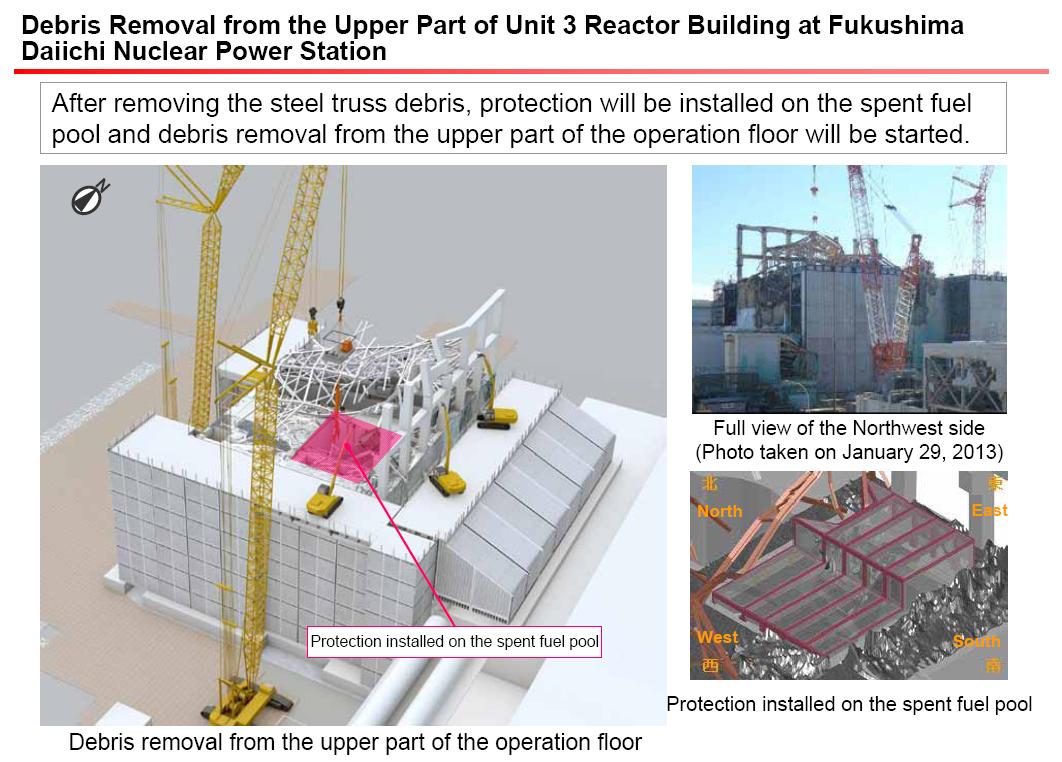
TEPCO (or rather, workers at 2nd-tier subcontractors just below the primary subcontractors such as Hitachi and Kajima) has been carefully removing the debris on what was used to be the operating floor of the Reactor 3 building. It says it is ready to remove one of the big trusses sometime in early February, and has released the photographs and diagrams.

From TEPCO's handout for the press, 2/4/2013:


Platforms have been built surrounding the reactor building so that the remote-controlled heavy equipment can operate from the platforms:


In the meantime, according to Mainichi Shinbun, the Japanese prosecutors have seized the testimony that the former Fuku-I plant manager Masao Yoshida gave in closed-door sessions by the Fukushima nuclear accident independent investigation commission set up by the Cabinet Office under the DPJ administration, for the purpose of potentially using the testimony to indict Yoshida and TEPCO. The testimony in the closed sessions was freely given, under the government guarantee that the information obtained would not be used against the person giving the testimony.

Now that it is no longer DPJ government but a new and improved LDP government, that guarantee means squat, and the court that routinely sides with the prosecutors readily grants a warrant of seizure.

Mr. Yoshida, stricken with esophagus cancer and after suffering a stroke last year, hasn't been seen or heard. TEPCO hasn't shared any information about his condition. The Mainichi article says he is in no condition to speak to the prosecutors.

Thursday, August 16, 2012

(Part 2 of 2) Video Interview Transcript of Former Plant Manager of #Fukushima I Nuke Plant Masao Yoshida: "We Put the Names of Workers on the Whiteboard, As a Grave Marker"


Following the part 1 , here's the part 2 of the video transcript of Mr. Masao Yoshida, former plant manager of Fukushima I Nuclear Power Plant.

Again, the occasion was a small symposium in Fukushima on August 11, 2012, and Mr. Yoshida's video interview was done in July, before he had cerebral hemorrhage.

The transcript is from Mainichi Shinbun article (8/11/2012), not from the video which only 140 or so people who attended the seminar got to watch.

−−吉田さんは所員の精神の支柱だった。
Workers relied on you as their mental [emotional] support.

◆私は何もしていない。私のとりえは福島第1原発に4回、赴任したことだ。第1原発のメンバーの名前もほとんどわかっているし、協力企業さんも結構つきあいがあり、名前で呼べるんですね。「○○さん、○○くん、大丈夫か」とか。それだけだ。それで声をかけただけだ。私は。何もできていない。みんなやってくれたということだ。いまだにそう思っている。

I didn't do anything. All I can say is that I have worked at Fukushima I Nuclear Power Plant on 4 different appointments. I know almost all [TEPCO] workers at the plant, and I know many in the affiliate companies. I know their names. "Mr. so-and-so, are you alright?" That was it. I asked them. That's all I did. I couldn't do anything. Everyone else did it. That's how I still feel.

−−事細かなコミュニケーションをとったということか?
You mean you took time to communicate with them?

◆そうだ。やはり知らない間じゃないということだ。昔から一緒に仕事をした仲間だ。そういう仲間が大変な現場に行って帰ってき、出て行くというのを見ているので、頭を下げるしかない。

Yes. We know each other. We've been working together for a long time, we're colleagues [we've been in this together]. I watched these colleagues of mine go to the horrendous scene of the accident at the plant, come back, and go back out again. All I could do was to bow my head [and thank them].

−−3号機が爆発した段階では死ぬかと思ったか?
Did you think you would die when Reactor 3 blew up?

◆今回一番インパクトがあったのは1号機もそうだが、3号機の爆発というのがあった。これは今まで経験した中で非常に、あとから考えれば水素爆発だったが、その時点では何が起こったかわからないという状態なので、これから、もう破滅的に何か起こってるんじゃないかと思った。爆発について。一つは自分が死ぬということ、メンバーも含めて、免震重要棟の人間は死んでたっておかしくない状態だった。3号機なんかは特にそうだった。あれだけのがれきが飛んできて。私は、最初は行方不明者が何人ということを聞いた時に、確か数十人レベルでまだ安否が確認できていないというのが最初の状況だった。ああこれは10人ぐらい死んだかもしれないというふうに思った。そこから時々刻々、だれだれがという話が入ってきて、軽傷の人間は何人かいたが。それから自衛隊の方には本当に申し訳なかった。水を補給しにきてくれた自衛隊の部隊がけがをされて、本当に申し訳ないと思っている。不幸中の幸いで人命にかかわるものではなく、これはある意味、仏様のあれかなという感じが私はしている。

In addition to Reactor 1 ['s explosion], Reactor 3's explosion made the strongest impact [on me]. In retrospect it was a hydrogen explosion, but at that time we didn't know what was happening. I thought something catastrophic had happened. About the explosions. I could die, and all people in the Anti-Seismic Building could die, at any moment. It was particularly so after the explosion at Reactor 3. That much debris flying all over. When I first heard that several people were missing, safety of tens of people was not confirmed yet. I thought, maybe more than 10 people just died. Then, more information started to come in, confirming the safety of people, though there were some with minor injuries. And I feel very sorry for the Self Defense Force. The SDF troop came to supply water and they were caught in the explosion and were injured. I am very sorry. One consolation is that injuries were not life-threatening, and I feel as if it was some kind of divine providence.

−−原発に残ったメンバーの名前をホワイトボードに書くように指示したとのことだが、どのような思いだったか?
You instructed your people to write down the names of the members who remained in the plant on the whiteboard. What were you thinking?

◆ほとんどその時のことを思い出せないが、たぶん、要するに最後まで残って戦ったのはこんな人間だぞということを残しておこうということだ。今から思えば。わかんないですよ。私自身。本当に。

I hardly remember how it was, but probably I just wanted to show what kind of people remained and fought till the bitter end. In retrospect. I don't know myself, really.

−−墓標になると思って書いたということか。

You thought it would serve as a grave marker.

◆はい。そうだ。

Yes.

−−最後に何かお話はあるか?

Any last thoughts, comments?

◆いずれにしても今回の事象は、いろいろ国会とか政府事故調、民間事故調などで書かれているが、我々は特に政府事故調にはすべてを話をさせていただいた。マスコミの方からいろいろ問い合わせがあるが、お話は全部すべてそちらでさせていただいているので、そこをベースに考えていただければいいと思っている。ただやっぱりなかなか我々の肉声というのは通じない。調査委員会を通すと肉声がなかなか届かない。その部分はいろいろな形でちゃんとメッセージを発信していかないといけないと思っている。私一人ではなくてあそこで一緒にやったいろいろな仲間の経験をちゃんと伝えたい。

This event [Mr. Yoshida uses an industry term for this accident] has been discussed and written up by the investigation commissions by the Diet, Cabinet Office, and the private foundation. We [at TEPCO] have thoroughly discussed with the Cabinet Office investigation commission in particular. There are many inquiries from the mass media, but we have said all to these commissions [TEPCO wasn't interviewed by the private commission] so I think it is enough for the media to go from there. But it is hard to have our true voice heard. Our true voice does not come across through the [reports of the] investigation commissions. For that part, I think we should spread the message in various ways. Not just my experience, but the experience of my colleagues who worked at the plant together, I would like to tell properly.

−−これから第1原発や福島県はどうあるべきか?

How should Fukushima I Nuke Plant and Fukushima Prefecture be, from now on?

◆そういう次元の高い話になると今すぐに答えがないが、やっぱり発電所をどうきちっと安定化させるかがベースだ。そこができていない中で、地元にお帰りいただくわけにはいかないので、そこが最大の(課題だ)。これは事故当時も言っていたが、日本国中だけでなく世界の知恵を集めて、より発電所、第1原発をより安定化させることが一番求められている。いろいろなだれの責任うんぬんということもきちっとやるべきだが、やはり発電所を少しでも安定させる。それには人も必要だし、技術もいろいろな知恵が必要だ。そこに傾注するということが重要なことだと思う。そのうえで、地元の方々に(通常の)生活に戻っていただけるか考えることができる。いずれにしても現場を落ち着かせる、安定化させることが一番重要な責務だ。私はちょっとまだ十分な体力がないが、戻ったらそういう形で現場のために力を届けたい。

That's a high-level question, and I don't have a ready answer for that. But it comes down to how to make the plant stabilized in a proper way. We cannot have the residents [in the surrounding areas] come back home while this is not accomplished, so it is the largest (task). What's needed most, as I was also saying during the accident, is to make Fukushima I Nuke Plant more stabilized, using the knowledge and expertise not just in Japan but in the world. We should properly assign responsibility [for the accident] on people, but what's most important is to make the plant as stable as possible. We need people for that, we need technologies and new ideas. I think it is important to focus [on the stabilization of the plant]. Only then we can decide whether the local residents can return to their normal lives. In any way, the most important task is to calm down, stabilize the situation at the plant. I still don't have enough strength, but when I come back [from illness] I want to do all I can for the plant that way [i.e. making the plant more stable].


It seems it was this last paragraph that went on a "telephone game" in some foreign media:

  1. Yoshida says they need to stabilize the plant.

  2. That means the plant is not stable, as of now.

  3. Therefore, the plant is unstable, in danger.

  4. Run! It's dangerous.


All Mr. Yoshida said was the plant needs to be made more stable, in a proper way - replacing Kanaflex hoses would be one, removing the debris and clutter would be another - so that the plant's various operations can run in a smooth, predictable manner, with no accidents like small fires and water leaks, not to mention major accidents.

By the way, this "Yoshida said the plant is not stable" duly came back to Japan as a credible piece of news in English, but it quickly disappeared among more sensational headlines (like butterfly mutation due to Fukushima radiation, for one).

Sunday, August 12, 2012

Video Interview of Former Plant Manager of #Fukushima I Nuke Plant Masao Yoshida: "I Saw Divine Beings in Workers in Hellish Situation" (Part 1 of 2)


(UPDATE: Part 2 of the video interview transcript is here.)

Mainichi Shinbun has the slightly-paraphrased but full transcript of the video interview with Masao Yoshida, former Plant Manager of Fukushima I Nuclear Power Plant. Since late July he has been hospitalized for cerebral hemorrhage, but the video interview, which was conducted on July 10, was shown at a small symposium in Fukushima on August 11, 2012.

I hope for the full recovery for Mr. Yoshida, so that he can continue to speak for the workers who have worked and who still work at the plant, trying to make the plant as stable as possible.

Mainichi's article reporting on the symposium has a screen capture of the video, which seems to be subtitled in English by the symposium organizer (a bookstore). But I don't have access to the video, so the following is my translation from the Mainichi transcript. It is most likely different from the official translation by the symposium organizer, and the mistakes contained in the translation below would be my mistakes, not the organizer's.

Here's Part 1 of the translation. The sentences are broken into paragraphs for easier reading. There are no paragraphs in the original Japanese text.

From Mainichi Shinbun (8/11/2012):

−−第1原発の現場の声を伝えてほしい。
Tell us about what it was like at Fukushima I Nuclear Power Plant.

◆昨年の大震災、それから私たちの発電所の事故で福島県の地元の方々に本当にご迷惑をおかけしている。この場で深くおわび申し上げる。まだしばらくこういう状況が続くが、我々も全力を挙げて復旧しており、ご理解をお願いする。

本来ならこの講演会に自分で出てきたいと思っていたが、昨年末から病気でずっと入院していてまだ体力が回復していない。そういう中でこういうビデオレターということで失礼する。政府などの事故調査委員会が開催されている中で、なかなか一般のマスコミの方に我々の生の声を届けるわけにはいかないと思っていた。事故調査委員会が一段落するまでは変な形でお話しをすることはルール違反になると私は思っていた。そういう中で(今回)話を聞いていただけるということは大変ありがたいと思っている。

The last year's earthquake and tsunami, and the accident of our nuclear power plant, have caused a great deal of hardship to the local residents in Fukushima Prefecture. I would like to take this opportunity to apologize deeply. The situation is likely to continue for a while, but we are doing our best to restore the plant. Please understand.

I wanted to come to this symposium in person, but I've been hospitalized since the end of last year and my strength hasn't been restored. So please excuse me for talking to you through video like this. As long as the accident investigation commissions were conducting their investigations, I didn't think I should speak to the mass media about the real situation at the plant. I thought it would be a violation of the rules to speak out, until the accident investigation commissions concluded their investigation. So, I welcome (this opportunity) in which you kindly allow me to speak.

−−発電所からの全面撤退がささやかれている。事実は?
Some say you [or TEPCO] contemplated full withdrawal from the plant. Is that true?

◆しゃべりだすととまらないが、基本的に私が考えていたのは第1原発をどうやって安定化させるかということに尽きる。そういう時に我々が現場を離れるということは絶対にあってはならない。かといって人命は非常に尊いので、関係のない人といったらおかしいが、事故の収拾に直接関与していない人には避難していただく。ただやはり現場で原子炉を冷やしたり、そういう作業をしている人間は撤退できないと思っていたし、本店にも撤退ということは一言も言っていないし、私は思ってもいなかった。本店には一言も撤退と言っていないということは間違いない。事故調にもそう話をしている。あとでいぶかしく思ったが結局、本店と官邸の間でそういう撤退騒ぎが起こっているが現場では一言も絶対そういうことは言っていない。これは間違っていない。

I could go on forever on the topic, but basically all I was thinking at that time was how to stabilize the plant. In such a situation, leaving the scene of the accident should never happen. However, the life is extremely precious, and people who were not involved, people who were not directly involved in the accident needed to be evacuated. Those people who were engaged in cooling the reactors, I didn't think they could evacuate. I have never said a word about withdrawal to the TEPCO headquarters, and it didn't enter my mind at all. I am 100 percent sure that I never said a word about withdrawal, and that's what I told the accident investigation commission [of the Cabinet Office] so. I was puzzled later [about the issue], but the fuss over "withdrawal" happened between the TEPCO Headquarters and the Prime Minister's Office, but we at the plant never said a word about that [withdrawal]. I'm quite positive on that.

−−自らの命を亡くす覚悟はあったか?
Were you prepared to die?

◆覚悟というほどの覚悟があったかはよくわからないが、結局、我々が離れてしまって注水ができなくなってしまうということは、もっとひどく放射能漏れになる。そうすると5、6号機はプラントはなんとか安定しているが、人もいなくなると結局あそこもメルト(ダウン)するというか、燃料が溶けることになる。そのまま放っておくと、もっと放射能も出る。福島第2原発も一生懸命、プラントを安定化させたが、あそこにも人が近づけなくなるかもしれない。そうなると非常に大惨事になる。そこまで考えれば、当然のことながら逃げられない。

そんな中で大変な放射能、放射線がある中で、現場に何回も行ってくれた同僚たちがいるが、私が何をしたというよりも彼らが一生懸命やってくれて、私はただ見てただけの話だ。私は何もしていない。実際ああやって現場に行ってくれた同僚一人一人は、本当にありがたい。私自身が免震重要棟にずっと座っているのが仕事で、現場に行けていない。いろいろな指示の中で本当にあとから現場に話を聞くと大変だったなと思うが、(部下は)そこに飛び込んでいってくれた。本当に飛び込んでいってくれた連中がたくさんいる。

私が昔から読んでいる法華経の中に地面から菩薩(ぼさつ)がわいてくるというところがあるが、そんなイメージがすさまじい地獄のような状態で感じた。現場に行って、(免震重要棟に)上がってきてヘロヘロになって寝ていない、食事も十分ではない、体力的に限界という中で、現場に行って上がってまた現場に行こうとしている連中がたくさんいた。それを見た時にこの人たちのために何かできることを私はしなければならないと思った。そういう人たちがいたから、(第1原発の収束について)このレベルまでもっていけたと私は思っている。

I don't know if I was prepared, but in the end, if we were to leave and water injection stopped, more radiation would leak. Then, Reactors 5 and 6, which were somehow stable, would melt, I mean the fuel would melt, once there was no one at the plant. If the plant was left all by itself, more radiation would leak. We managed to stabilize Fukushima II (Daini) Power plant, but we might not be able to be there [if Fukushima I was abandoned and more radiation leaked]. That would be a catastrophe. If you think that way, there is no way we could just run away.

In that situation, in the tremendous amount of radioactivity, my colleagues went to the scenes of the accident a number of times. It was them who did all they could, and all I did was to watch them do it. I didn't do anything. I really appreciate and thank every single one of my colleagues who went to the scenes of the accident. My job was to stay put in the Anti-Seismic Building, and I couldn't go to the accident scenes. I gave orders, and when I heard from the workers later, I knew it was a serious [terrible] situation. But [people who worked under me] went there without hesitation. There were many of them, who literally jumped into the scenes of the accident, trying to contain it.

In a Buddhism text that I've been reading for a long time, there is a mention of divine figures issuing from the ground. That was what I felt was happening in the hellish situation at the plant. Workers would go to the scenes of the accident, then come back upstairs (at the Anti-Seismic Building), they were dead tired, without sleep, with not enough food, reaching the limit of their physical strength. Then they would go out again, and come back, and go out again. There were many workers like them. When I saw these workers, I knew I had to do whatever I could for them. It's my belief that we have been able to restore the plant to the current level [of relative stability], because of these workers.


The precise word Mr. Yoshida uses for "divine figure" is "Bodhisattva" - one who vows to save all beings before becoming a buddha.

It was probably the first time that anyone from TEPCO spoke words of praise and appreciation for the workers at the plant in a personal way like Mr. Yoshida did. According to the local Fukushima newspapers, Yoshida's words were much appreciated by the families whose members worked or still works at the plant.

Sunday, August 5, 2012

TEPCO About to Release Video Footage of Teleconference in the Early Days of #Fukushima I Nuke Plant Accident


Plant Manager Masao Yoshida, who is now hospitalized for cerebral hemorrhage, is seen screaming to the TEPCO headquarter people "It's bad, it'd bad" when the Reactor 3 building exploded.

TEPCO will let the media view the video, but will not allow any recording (picture, voice). Images of some of the people in the video will be blurred to protect privacy if their names and faces have not already been in the news, and some sounds will be muted also to protect privacy. Even the organization made up of mainstream media is protesting, saying everything should be fully disclosed, now that TEPCO is a government ward.

For now, the only way for the ordinary people to get a glimpse will be through the reporting by the media.

Kyodo News has a few glimpses, in their article (8/4/2012):

原発所長「本店、大変、大変」 東電のテレビ会議映像

Fukushima Plant Manager "Honten, Taihen, Taihen" [HQ, its' bad, it's bad], in TEPCO's teleconferencing video

原子炉建屋の爆発に動揺する原発所長や作業員、首相官邸との連絡調整にうんざりした様子の幹部―。東京電力が6日から公開する福島第1原発事故直後の社内テレビ会議映像の一部内容が4日、関係者の証言から判明した。3号機建屋が爆発した際には吉田昌郎所長(当時)が血相を変えて「本店、大変、大変」と叫ぶ場面が記録されている。

Plant manager and workers shaken by the explosions of reactor buildings, senior managers tired of trying to communicate and coordinate with the Prime Minister's Office. Part of the content of the internal teleconferencing video right after the start of the Fukushima I Nuclear Power Plant accident was revealed by anonymous sources on August 4. TEPCO plans to disclose the video [to the media] starting August 6. The video captured Plant Manager Masao Yoshida as the Reactor 3 building exploded; he was screaming in great alarm, "Headquarters, it's bad, it's bad"

 第1原発事故では昨年3月12日、まず1号機の原子炉建屋が水素爆発した。テレビ会議の映像には、免震重要棟2階にある緊急時対策本部が激しく揺れ、余震と思ったのか天井を見上げる社員や、慌ただしく情報収集する技術系幹部らが写っている。

On March 12, 2011, the Reactor 1 building had a hydrogen explosion. The teleconferencing video shows the violent shaking in the Emergency Response Headquarters on the 2nd floor of the Anti-Seismic Building, with workers thinking it was an aftershock and looking up at the ceiling, and technical managers hurrying to collect information on what was going on.


Kyodo doesn't say what color Mr. Yoshida's face had turned when he was screaming. My first guess is that the blood had drained from his face, making it extreme pale. But since he had no choice but take action, any action, maybe his face was turning red.

Monday, July 30, 2012

Masao Yoshida, Former Plant Manager of #Fukushima I Nuke Plant, Is Hospitalized for Cerebral Hemorrhage


TEPCO says "His life is not in danger."

Judging from the past 16 months of communication by TEPCO and the Japanese government (who are one and the same at this point, after the effective takeover of TEPCO by the government), it may simply mean "not in immediate danger", and by "immediate" it means "instantaneously".

TEPCO announced the news 4 days after it happened.

From Jiji Tsushin (7/30/2012):

吉田前所長が緊急手術=脳出血、命に別条なし-東電

Former Fukushima I Nuke Plant Manager Yoshida underwent emergency operation for cerebral hemorrhage, his life is not in danger, says TEPCO

東京電力は30日、福島第1原発の吉田昌郎前所長(57)が26日夕方に外出先で不調を訴え、脳出血のため搬送先の病院で緊急手術を受けたと発表した。手術は成功し、病状は重いが意識はあり、命に別条はないという。

TEPCO announced on July 30 that Masao Yoshida (age 57), former plant manager of Fukushima I Nuclear Power plant, complained of feeling ill on the evening of July 26 when he was away from home, and that he underwent an emergency operation for cerebral hemorrhage at the hospital he was brought to. The operation was successful, and he is conscious even though he is still in grave condition. TEPCO says his life is not in danger.

 吉田氏は昨年3月11日の事故発生から、所長として現場で陣頭指揮を執った。食道がんと診断され昨年11月に入院し、同月末で所長を退任。その後、自宅で療養を続けていた。

Since the start of the nuclear accident on March 11 last year, Mr. Yoshida led his team of workers to deal with the accident as the plant manager. He was diagnosed with esophagus cancer and hospitalized in November last year. He resigned as the plant manager at the end of November and has been receiving medical treatment at home.

 東電の松本純一原子力・立地本部長代理は記者会見で、家族の意向として脳出血時の詳しい状況を説明しなかった。医師の所見では、脳出血は食道がんと直接の関係はないという。

TEPCO's Junichi Matsumoto didn't explain the details of when Yoshida suffered cerebral hemorrhage, saying it was his family's wish. According to the doctor [at the hospital?] there is no direct relationship between the cerebral hemorrhage and the esophagus cancer.

 東電は昨年12月、吉田氏の原発事故後の被ばく量は約70ミリシーベルトと発表。食道がんの潜伏期間は5~10年で、放射線医学総合研究所の明石真言理事の見解として、被ばくが原因の可能性は極めて低いと説明した。

TEPCO announced in December last year that Mr. Yoshida's radiation exposure level after the start of the nuclear accident was about 70 millisieverts. The latent period for esophagus cancer is between 5 to 10 years. At the time of the announcement, TEPCO quoted Dr. Makoto Akashi, Executive Director at National Institute of Radiological Sciences, who said the possibility was extremely low that [Yoshida's esophagus cancer] was caused by radiation exposure.

Friday, December 9, 2011

"Baseless Rumors": Japanese Twitterers Do Not Believe Yoshida's Cancer is in the Esophagus

Partly because of distrust of anything that comes out of the mouth of any TEPCO/government person, but also because of a TEPCO video in which Yoshida appeared to explain to the viewers the then-current situation at Fukushima I Nuclear Power Plant.

They think they see a bulge on the left side of his neck, and they think it is either thyroid or lymph node. Here's one of the threads captured at "Hanayu" blog.

Here's the screen capture of the video:

About the 70 millisievert radiation exposure that Yoshida allegedly had: It was April 30 that TEPCO finally announced the result of the internal radiation measurement of the plant workers using the whole body counter at J-Village, because the WBCs at Fuku-I coudn't be used because the background radiation was too high. Besides, the whole body counter cannot measure alpha and beta rays. (It only measures gamma rays.)

Also, he slept at the plant in the early days of the accident, and the radiation inside the building was particularly high back then, with radioactive materials thick in the air from the hydrogen explosions because the doors and windows didn't close well.

This tweet has a photograph of a thyroid cancer patient at the Organization of National Hospitals.

Thursday, December 8, 2011

TEPCO's Press Conference: Yoshida Has Esophagus Cancer

TEPCO is disclosing the condition of Masao Yoshida, ex-plant manager of Fukushima I Nuclear Power Plant, at the request of Yoshida.

Illness: Esophagus cancer
Cumulative radiation exposure (internal and external) since March 11: 70 millisieverts

The live feed was cut off at Yasumi Iwakami's channel. Will try TEPCO's live feed if it's there..

TEPCO's press room is near-empty. And the short presser is over now.

Monday, November 28, 2011

#Fukushima I Nuke Plant: Yoshida's Last Day on the Plant Was November 14

And TEPCO/Government kept silent for 2 full weeks until November 28.

Tweet from Ryuichi Kino:

統合会見。毎日、政府と東電、保安院はテレビ会議やってるのに、2週間も現場指揮官が理由不明で不在にしているにもかかわらず、保安院は気にせず。園田さんも気にせず。東電は説明せず。どういう統合会議だろう?

Consolidated press conference. The national government, TEPCO and NISA hold teleconference everyday. For two weeks the commander [Yoshida] at the plant was absent, no reason given. NISA didn't care, Sonoda [cabinet office spokesman, who drank the treated water] didn't care, TEPCO didn't bother to explain [for 2 weeks]. What kind of press conference is this?

Asahi Shinbun (11/28/2011) mentions only in passing, dutifully:

吉田氏は今月14日まで発電所に出勤。

Mr. Yoshida worked at the plant until November 14.

That was 2 days after Goshi "Everyone should share the pain of Fukushima" Hosono visited the plant with his side kick "I will drink Fuku-I treated water because it is safe" Sonoda.

Here's from the photo of that November 12 occasion (from cryptome). From left, Yoshida, Hosono, Sonoda.

Sunday, November 27, 2011

#Fukushima I Nuke Plant: Yoshida's Message to Plant Workers

From the tweet of NHK's Jun Hori:

吉田所長は原発で作業にあたる人たちに対し「検診で病気が見つかり残念ながら重要な事故に免振棟を去らざるを得ません。皆さんとこのような形で別れることは断腸の思いで、迷惑をかけることになり心よりお詫びします」というメッセージを出した。

Yoshida, head of Fukushima I Nuke Plant, issued a message to the plant workers as follows: "An illness was found during the medical exam, and I have no choice but to leave the plant, despite the on-going plant accident. To have to part with you like this is gut-wrenching, and I apologize from the bottom of my heart for any inconvenience that my leaving the post may cause."

As usual, TEPCO says it won't disclose what kind of illness that Yoshida suffers, or the cumulative radiation exposure he has received ever since March 11, as such information is "private".

#Fukushima I Nuke Plant: Head of the Plant Yoshida Is Hospitalized, Will Resign as of December 1st

Jiji Tsushin reports (3:18PM JST 11/28/2011):

東京電力は28日、福島第1原発の吉田昌郎所長が体調を崩して入院し、12月1日付で所長職を退任すると発表した。

TEPCO announced on November 28 that Masao Yoshida, head of Fukushima I Nuclear Power Plant, has fallen ill and been hospitalized; he will resign as the head of the plant as of December 1st.

(Oh no...)