Showing posts with label beyond nuclear. Show all posts

Sunday, February 9, 2014

(OT) Yoichi Masuzoe Is the New Governor of Tokyo, Thanks to Organized Votes from LDP and Komei/Soka Gakkai; Turnout 3rd Lowest in History


He should also be grateful for the Japan's mainstream media, from increasingly government-PR organ NHK to left-leaning Asahi Shinbun, for not reporting the various scandals that everyone in the media and the political class knew about during the election campaign and for their genuine, heart-felt effort to de-emphasize any nuclear issue to the point of not even showing the faces of the two former prime ministers as they campaigned on the anti-nuclear platform.

Looking at Asahi's site, it doesn't look like the paper will ever report Masuzoe's scandal, although suddenly the anti-nuclear movement is prominently mentioned.

From Asahi's Tokyo Gubernatorial Election page "Who is Mr. Masuzoe?", Masuzoe's prominent remarks as Asahi sees:

"LDP's draft constitution is too right-wing to receive broad support"

"Without redistribution, the gap [between the rich and the poor] will widen"

"What was Koizumi's postal reform?"

"Atomic Energy Agreement [to export nuclear power plant technologies] is OK"

"How does one spend first six years after retirement"


etc., etc., as if Masuzoe is a reasonable statesman.

Asahi, or for that matter, any Japanese mainstream media news outlet, never reported what the foreign press reported, and will never report, now that Masuzoe is installed as the governor, doing the Abe administration's bidding.

One of the most prominent remarks by Masuzoe appeared in UK's The Guardian and other foreign news outlets quoting AFP (2/7/2014):

In 1989, he told a men's magazine that it would not be proper to have women at the highest level of government because their menstrual cycle makes them irrational.

"Women are not normal when they are having a period … You can't possibly let them make critical decisions about the country [during their period] such as whether or not to go to war," he said.


For him to say so must be extremely distressful for one of his ex-wives, Ms. Satsuki Katayama, an LDP politician whose own party supported her ex-husband's candidacy. She reportedly suffered domestic violence during their short marriage, which she once described to a Japanese magazine as "simply terrifying".

Too much testosterone, or too many girlfriends, we don't know.

With the low turnout (46.14% including absentee ballots), there was not much at all that other candidates could do to counter the LDP/Komei/labor union votes, particularly those of Komei/Soka Gakkai (religious organization that founded Komei Party).

The most realistic anti-nuclear candidate was former Prime Minister Morihiro Hosokawa, but he and his supporters were bombarded with "negative" campaigns on the net (particularly social media) by the supporters of another supposedly anti-nuclear candidate, Kenji Utsunomiya, attorney who was backed by Social Democratic Party and Communist Party.

I put "negative" in quotation marks, as tweets I have seen almost always started with "positive" remarks about Hosokawa's candidacy: "It's great that he is running on the "beyond nuclear" platform, blah blah blah, BUT..."

Curiously, the words and sentences after this "BUT" were almost identical to what the Abe administration officials, right-wing think tanks supporting the administration, and mainstream media kept saying throughout the election campaign:

"BUT the governorship of Tokyo is so much more than just a "single issue" of beyond nuclear. There's public welfare, there's unemployment, there's support for working mothers and young people, there's TPP, there's Tokyo Olympic..."


The supporters of Mr. Utsunomiya say they will continue their long struggle toward a nuclear-free society, with the emphasis on "long".

What Hosokawa and Koizumi preached - immediate decision not to use nuclear energy any more - was too "soon", apparently.

As to whether Mr. Masuzoe can keep his governorship, probably. LDP holds 59 seats and Komei 23 in the Tokyo Metropolitan Assembly. Together, they control 82 seats, or 65% of the total 127 seats in the Assembly. LDP and Komei will make sure Masuzoe's scandals remain non-issues, as long as Masuzoe does not deviate from their agendas.

Monday, February 3, 2014

Tokyo Gubernatorial Candidate and Former Prime Minister Morihiro Hosokawa: "Polar Bears, Seals Dying Because of #Fukushima..."


He also says there was an explosion at the end of December in Fukushima I Nuclear Power Plant that proves there was a meltdown, citing Russian news.

I wonder whether anyone is advising Mr. Hosokawa on the Fukushima I NPP nuclear accident at all (or Mr. Hosokawa's news source is just 2ch when it comes to the nuclear accident).

Mr. Hosokawa on a net-based TV on January 22, 2014 (about 18 minutes into the video):

「数日前に私は見たんですけども、ロシアの国防軍が出した極秘資料というものが出てきてね。 それを見たんですが、福島でこないだ暮れに、12月31日だったかな、爆発があったという小さな記事が出ましたね。 その数日前から実は水蒸気が上がっていて『何かおかしい』という話があったのを私も確かに覚えているんですけども。 あれは完全にメルトダウンを起こしているということを、いろいろ分析をしていて。 (ロシアが。)それでアメリカはヨウ素を15000袋だっかな、既に2月の始めに配るという手筈を始めたということとかですね、それから、いま北極海とかいろんなところでシロクマ、アザラシ、その他の生物の大量死が続出していると、これはまさにその福島の影響であるということとか。いろんなものが出てきているわけです。これはまあ凄い話だと思いましたね。」

"I saw it a couple of days ago, but there was this confidential document issued by Russian National Defense Force. I saw it in there that in Fukushima [I NPP], on December 31 I believe, there was an explosion. I certainly remember, too, that "something was wrong" as the steam had been rising for several days prior. So the (Russian) analysis was that it suffered a complete meltdown. And so the United States arranged for 15,000 bags of potassium iodide to be distributed in early February. Also, polar bears, seals and other animals are dying in large numbers in the Arctic Ocean and other places and it is precisely due to the Fukushima accident. Many pieces of information like these. I thought they were terrible stories.


"Terrible stories" (凄い話) could also be translated as "terrific/fantastic stories". It was fantastic to watch the interviewers simply take what Hosokawa said as if they were incontrovertible "facts".

But in the reality-based world, steam has been seen rising on and off from Reactor 3 at least since July last year; it had probably been there ever since the March 14, 2011 hydrogen explosion that destroyed the operating floor and severely damaged the floors below but became visible only after enough debris had been removed. (See my post on 12/29/2013.)

As to the "explosion" on December 31, 2013, even the ex-ambassador to Switzerland who has been raising numerous alarms about the Fukushima accident, real or imagined, confirms it was just an earthquake (actually two earthquakes, he says) in Ibaraki Prefecture that day.

The "confidential Russian document" that the Ambassador links also has a mention of "radioactive snow" in several states in the US. That is so 2011/2012 winter in Japan, when people freaked out measuring naturally occurring short-life radionuclides in the snow (and rain, for that matter) - bithmus-214 and lead-214 - by using personal survey meters to get only the radiation levels or misreading the peaks of bithmus-214 for cesium-134/137 and lead-214 for iodine-131.

And "meltdown"? Mr. Hosokawa must know that meltdown (core melt) already happened in March 2011 in Reactor 1, Reactor 2 and Reactor 3.

I have no idea where Mr. Hosokawa came up with "15,000 bags" of potassium iodide pills, but it must be the "news" that the US Department of Health and Human Services solicited a bid for 1.4 million potassium iodide pills in December 2013. But the order is most likely part of the on-going program of stocking potassium iodide in preparation for nuclear emergencies. (This is an archive page of HSS announcing 1.7 million doses of liquid potassium iodide in 2005.)

As to the polar bears and seals and a host of other living things (including fish, starfish, etc.), they had been dying of mysterious diseases way before the Fukushima I NPP accident. In 2012, CNN reported that the cause of death of seal pups on the east coast of the US was "a new strain of avian flu" that jumped species. The most recent "scare" story was this one quoting the abstract of a paper presented by University of Alaska researchers, in which the researchers say they tested to see if cesium-134 and cesium-137 were present in the tissue samples. For some unknown reason, in Japan this morphed into "cesium-134 was detected, and therefore the seals were dying of Fukushima radiation!"

If Mr. Hosokawa's anti-nuclear stance is based on the fantastic stories (凄い話) like these, no wonder LDP and the Abe administration are comfortable letting the anti-nuclear ("beyond nuclear") issue be emphasized by the Hosokawa camp in the Tokyo gubernatorial race.

Quote a contrast to Mr. Junichiro Koizumi, who talks numbers and detailed facts about nuclear power and why he is against it now. Alas, he's not running for the governorship.

No matter. The Japanese media, from the NHK (increasingly government mouthpiece) on down, completely ignores the Hosokawa-Koizumi team anyway. The election is on Sunday, February 9, 2014.

Saturday, January 11, 2014

Update on Anti-Nuclear Former PM Tag Team for Tokyo Governorship: Anti-Nuclear, Pro-Casino?


(UPDATE) To the dismay of many, yet another former prime minister has declared his support for Hosokawa. Mr. Naoto Kan, who was the prime minister presiding over the unfolding nuclear disaster in March 2011, is urging Tokyo residents who are anti-nuclear to vote for Mr. Hosokawa.

=====================

Anti-nuclear former Prime Minister Morihiro Hosokawa is about to officially declare his candidacy in the gubernatorial race in Tokyo, with the support from another anti-nuclear former Prime Minister Junichiro Koizumi (see my previous post from 1/8/2014). But what little has been leaked about his policies as the governor of the most populous prefecture in Japan is not so simplistic.

While I could find nothing concrete about his energy policy beyond the "beyond nuclear" slogan, I found a few hints that may indicate Hosokawa's thinking.

Hosokawa's words, as reported by his close associates, according to Tokyo Shinbun (1/12/2014):

「カジノを容認したら女性の支持は離れるだろうか」
"If I allowed casinos, would women stop supporting me?"

「五輪は東京だけが独り占めしていいのか。被災地が置き去りにならないか」
"Should Tokyo monopolize the Olympics? Should the disaster-affected areas be left behind?"

「都知事選には日本の命運がかかっている。勝ち負けは関係ない。世論を喚起できればそれでいいんだ」
"The Tokyo gubernatorial race will determine Japan's destiny. It doesn't matter if I win or lose. All I want to do is to galvanize the public opinion."

I believe Hosokawa means "the public opinion toward 'beyond nuclear'," whatever the phrase means.

I have a feeling that LDP and the Abe administration, supporting the candidacy of Yoichi Masuzoe, won't be very disappointed even if their candidate loses to Hosokawa in the election, if Hosokawa is for bringing the casino (Las Vegas Sand and MGM are eagerly waiting, saying Macao wouldn't even come close to Tokyo in potential) to Tokyo Bay. If Hosokawa is hinting at moving some Olympics venues to the disaster-affected Fukushima to help spread the economic benefit of having the Olympics in Tokyo in 2020, great for LDP.

"Beyond nuclear"? As long as it remains a slogan, without any actionable steps toward it, LDP will tolerate.

Wednesday, January 8, 2014

Anti-Nuclear Former Prime Ministers of Japan May Join Forces, with One Running for the Governor of Tokyo, Says Asahi


(UPDATE) It looks almost official. TV Tokyo reports (1/9/2014) that Hosokawa has decided to run, and Koizumi has already pledged support. TV Tokyo says "Hosokawa and Koizumi are both popular with voters", which is probably true.

=========================

Now it gets somewhat interesting, with two weeks left till the official announcement of candidacy.

Former prime ministers - Morihiro Hosokawa (Japan New Party, 1995-1996) and Junichiro Koizumi (LDP, 2001-2006) may join forces, with Mr. Hosokawa running in the gubernatorial election for Tokyo set to be held on February 9, according to the latest Asahi Shinbun article.

Mr. Hosokawa was the first prime minister since 1955 who was not from Liberal Democratic Party. His coalition later evolved into Democratic Party of Japan. He has taken to pottery after he retired from politics.

Mr. Koizumi retains substantial influence within/out LDP even after he retired from politics, and he has caused a stir among anti-nuclear citizens who look at Koizumi's anti-nuclear stance with great suspicion. Koizumi doesn't seem to care about his critics, though, and continues to openly speak up against nuclear energy.

Hosokawa's potential entry into the gubernatorial race, from Asahi Shinbun (1/9/2014; part):

23日告示の東京都知事選まで2週間。細川護熙(もりひろ)元首相の名前が急浮上した。舛添要一・元厚生労働相が立候補の意向を示し、自民は支援する方向で調整に入ったが、構図が大きく変わる可能性が出てきた。

Two weeks till the official announcement on January 23 of the Tokyo gubernatorial election, the name of the former prime minister Morihiro Hosokawa has suddenly surfaced as a candidate. As Yoichi Masuzoe, former Minister of Health and Labor, has announced his intention to run with the LDP support, Hosokawa's entry into the race could vastly change the election landscape.

本命の1人となる舛添氏が立候補表明するなかで、「脱原発」を旗印に、細川氏と小泉純一郎元首相の連携が実現すれば、都知事選の台風の目になる。

Mr. Masuzoe is considered to be one of the favorite to win the race. But if the alliance of Mr. Hosokawa and the former prime minister Junichiro Koizumi materializes under the "anti [beyond] - nuclear" slogan, it could become the eye of a storm.

細川氏は政治の世界から引退して約15年。再び表舞台へ駆り立てている要因は、原発やエネルギー問題への危機感だ。

It's been 15 years since Mr. Hosokawa retired from politics. The main reason he is considering a comeback is his sense of crisis over nuclear power plants and energy issues.

細川氏が立ち上げた日本新党の関係者によると、細川氏は1月上旬、「安倍政権のエネルギー政策は国を過(あやま)つかもしれない。都知事選で有権者に脱原発を訴えることは重要だ。勝ち負けじゃない」と語ったという。

According to a person involved in Japan New Party, which Mr. Hosokawa started [it doesn't exist any more], Mr. Hosokawa told him in early January that "The energy policy of the Abe administration may harm the nation. It is important to appeal anti (beyond) - nuclear to the voters in the Tokyo gubernatorial election. It's not the matter of win or lose."

すでに立候補した場合の準備も進めており、この関係者は「本人の判断次第でいかようにも対応出来るよう、全部準備はしている」と話す。

This person says the preparation is already underway should Hosokawa decide to run. "Depending on his decision, anything is possible. It's been all prepared."

細川氏が立候補するかどうかの大きなカギを握るのが、小泉氏の動向だ。

The key to Hosokawa's candidacy is Mr. Koizumi's intention.

両氏は昨秋に会談し、脱原発で連携していくことを約束していた。関係者は「細川氏が立候補すれば、小泉氏は絶対についてくる。小泉氏と組めば都知事選の構図が一気に変わる」と期待を込める。細川氏も小泉氏の動向を注視しているという。

The two met and spoke last fall, and promised to join forces in anti-nuclear movement. The person involved [in Japan New Party] is hopeful, saying "If Mr. Hosokawa runs, Mr. Koizumi will definitely support him. If Mr. Hosokawa joins forces with Mr. Koizumi, the election landscape will suddenly changes." He says Mr. Hosokawa is watching Mr. Koizumi carefully.

...一方、舛添氏を支援する方向の自民党は警戒感を隠さない。すでに細川氏の動きについて情報収集を開始。党幹部の一人は「細川氏だけなら怖くない。しかし、小泉氏が付けば、核融合を起こしかねない」と漏らす。

... On the other hand, LDP, who will support Mr. Masuzoe, is openly wary. The party has already started gathering information on Mr. Hosokawa's moves. One of the senior party members says, "We're not afraid of Mr. Hosokawa, if he is alone. However, if Mr. Koizumi is behind him, it could lead to a nuclear fusion [meaning "very significant event that could jeopardize their soon-to-be-declared candidate Masuzoe"]."


If it is going to be a choice among Mr. Kenji Utsunomiya (attorney backed by Social Democrats and Communist Party), Mr. Yoichi Masuzoe (scholar-author-TV personality-politician backed by LDP and DPJ) and Mr. Hosokawa (with Mr. Koizumi's backing) and if I am forced to choose, I'll be totally at a loss for whom to vote. Mr. Utsunomiya and his message look too "1990s", Mr. Masuzoe is too slick and sleazy for my liking. Beyond the historical significance, Hosokawa was utterly ineffective as the prime minister who effectively threw out the job in only 9 months.

Hosokawa's ancestor was the lord that governed today's Kumamoto after Kiyomasa Kato, extremely popular lord who was displaced by the Tokugawa administration in the 17th century. Maybe Hosokawa is more fit for governing a prefecture, instead of the entire nation.

Asahi's hope that the anti-nuclear stance will get many votes seems little more than a hope, though. From all indications, the Fukushima nuclear accident is long over in the minds of most Japanese.

If Hosokawa runs in the race, it will be the very first time that a former prime minister of Japan runs for a prefectural office. At least I've never heard of it.

Saturday, March 9, 2013

#Radioactive Japan on 2nd Anniversary of #Fukushima Nuclear Accident: "Beyond-Nuclear" Demonstrations (Same Old, Same Old)


Nothing has really changed after the nuclear accident on March 11, 2011.

2 to 3 months after the March 11, 2011 disaster, just when the extent of radiation contamination became known - sewer sludge, ashes from garbage incineration exceeding 8,000 becquerels/kg - some people and organizations started the events of "beyond-nuclear" demonstrations, with celebrities and activists on stage telling the audience how they oppose nuclear energy.

It was not really about Fukushima or the residents of Fukushima, not really about radiation contamination and what to do with it; it was this beautiful concept of life without nuclear power. Then-LDP Secretary General and current Minister of the Environment and son of Shintaro Ishihara called "beyond-nuclear" movement a "mass hysteria" in June 2011.

I didn't think much of the moniker, "beyond-nuclear" or datsu genpatsu 脱原発, from the beginning.

About a year later, starting in March 2012, a group started the protest in front of the prime minister's office to oppose the restart of nuclear power plants. It's a "single issue" movement, the organizers said. The Friday protests were extensively covered by independent journalist Yasumi Iwakami. The movement fizzled after the organizers met with then-Prime Minister Yoshihiko Noda, and disdainful remarks from the organizers for the protest participants drew criticisms.

Meanwhile, food contaminated with radioactive cesium continued to be sold throughout Japan, so-called "hot spots" in Kanto and Tohoku regions remained mostly untouched, people continue to live in the contaminated middle-third of Fukushima Prefecture for one reason or another (job, children don't want to leave, etc.), and people are returning to the more contaminated ocean-third of Fukushima as the government promises them extra compensation money if they return. There has been a curious lack of coverage even by the independent journalists of contaminated food and wide-area disposal of disaster debris.

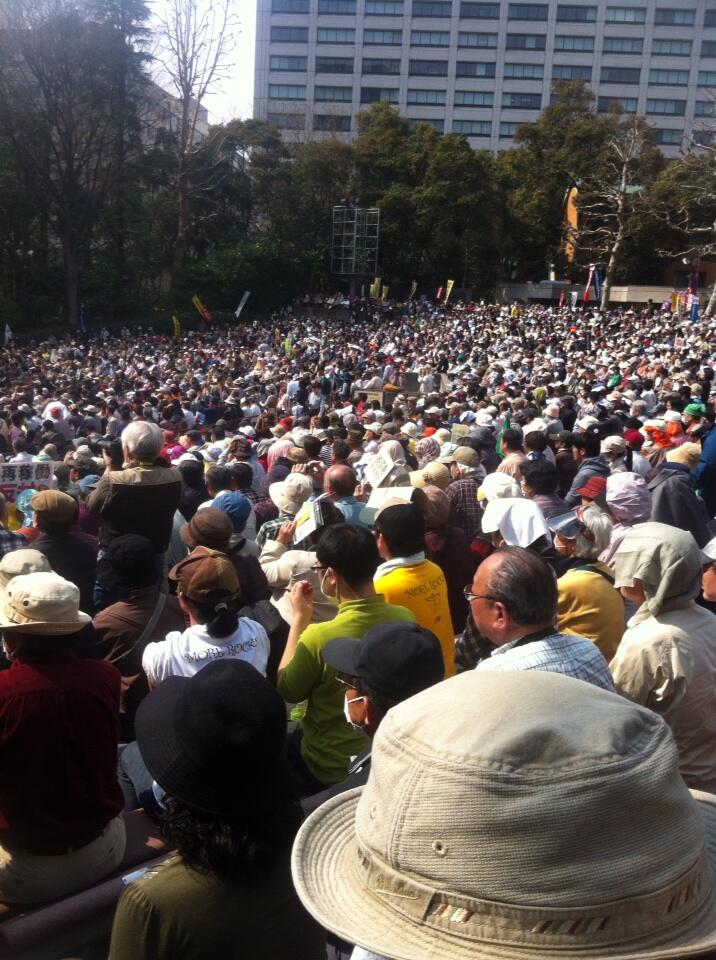
Two years later on March 10, 2013, people are still doing the same "beyond-nuclear" protest.

Here's from Hibiya Park in Tokyo, as tweeted by @noiehoie:


It's certainly a lot of people. It is as if I were back in September 2011.

I did like those local protests against particular politicians, though. The one against Yukio Edano in Saitama stood out.

========================

Today's Tokyo, Sky Tree, from this tweet. A windy, hazy day: