Details are to be announced By TEPCO's president Naomi Hirose at a press conference starting at 5PM, December 20, 2013, according to TEPCO's tweet.
"Decommission Company" is not going to be a separate company with separate capital but a company within TEPCO, more like a division. The idea was first floated in October this year at an LDP work group on recovery and reconstruction.
Now, why would they do that, instead of setting up a separate company? I have some ideas but they are not firm yet. I'll wait till I hear Mr. Hirose.
This "Decommission Company" will be in charge of decommissioning Fukushima I Nuclear Power Plant and dealing with contaminated water at the plant. Two disparate objectives it seems to me, but clearly not to LDP or TEPCO.
Reuters Japan reports (12/20/2013) that the national government will increase the amount of loan to TEPCO for decontamination and compensation from 5 trillion yen to 9 trillion yen. In addition, the government will pay 1.1 trillion yen to cover the cost to build the intermediate storage facilities for the contaminated soil removed as the result of decontamination. The cost of building the intermediate storage facilities was to be paid by TEPCO.
Total support of over 10 trillion yen, with the national government paying, not just TEPCO. Now it's getting halfway to the amount that some people say will cost to decommission and decontaminate.
If Japan had been to print money in great quantity and spend it, it would have been after March 2011. It didn't. The government of Democratic Party of Japan, whether under Naoto Kan or Yoshihiko Noda, was too busy putting the blame of the accident on TEPCO and looking for cheap solutions. They sure found the cheapest solution: talk.
Thursday, December 19, 2013
TEPCO to Set Up "Decommission Company" as a Separate Division Within TEPCO, National Government to Support TEPCO with 10 Trillion Yen
Sunday, September 22, 2013
Weekend Fun and Farce -2: Minister of Economy Says "More Space for Tanks if Reactors 5 and 6 Are Decommissioned" at #Fukushima I Nuke Plant
Minister Motegi, ex-McKinsey management consultant whose most recent utterance about Fukushima I Nuclear Plant was that the contaminated water problems are not because of lack of money or faulty engineering but because of TEPCO and the plant workers not working hard enough, seems to think decommissioning a nuclear reactor is just like dismantling a factory line.
According to the Yomiuri article below, Minister Toshimitsu Motegi seems very confident that decommissioning of Reactors 5 and 6 will be finished way before the end of fiscal 2014 (March 31, 2015) with reactors, equipments, and buildings all removed, and the space can be used to install more tanks to store contaminated water until that water is completely treated by the end of fiscal 2014.
This is the minister in charge of the national government being "at the forefront" of the Fukushima I Nuclear Power Plant accident.
And he screams, as always, "Accelerate! Ahead of schedule!"
From Yomiuri Shinbun (9/20/2013):
5・6号機廃炉ならタンク増設できる…経産相
If Reactors 5 and 6 are decommissioned, more tanks can be installed, says Minister of Economy
茂木経済産業相は20日の閣議後記者会見で、東京電力福島第一原子力発電所5、6号機の廃炉を安倍首相が要請したことについて「5、6号機は(廃炉が決まっている)1~4号機と極めて似た構造を持っている。5、6号機の実機を使えば訓練もできる」と述べ、1~4号機の廃炉などの事故処理を加速できるとの認識を示した。
During the press conference on September 20 after the cabinet meeting, Minister of Economy, Trade and Industry Motegi commented on Prime Minister Abe's request [to TEPCO] to decommission Reactors 5 and 6 at Fukushima I Nuclear Power Plant. He said, "Reactors 5 and 6 have very similar structures to Reactors 1-4 (which are being decommissioned). Training can be done on the actual reactors," thus accelerating the process of decommissioning Reactors 1-4.
汚染水処理については「5、6号機の廃炉で出来る空きスペースに、汚染水のタンク増設を行うことができる」と語った。2014年度内に貯蔵タンク内の汚染水を浄化することに改めて意欲を示し、「前倒しできることは、全て前倒しする」と強調した。
As to the contaminated water treatment, he said, "In the empty space created by decommissioning Reactors 5 and 6, we can build additional tanks to store contaminated water." He expressed his desire again to have all contaminated water stored in the tanks treated by the end of fiscal 2014, and emphasized he would "do anything ahead of schedule that can be done ahead of schedule".
"Happy", one of several workers who have been tweeting from the plant since the beginning of the accident, gently reminds his followers that:
Spent fuel assemblies in the Spent Fuel Pools of Reactors 5 and 6 should be removed first, and that won't happen until July 2014 at the earliest (tweet);
After spent fuel assemblies are removed, dismantling will start with equipments and pipes with low contamination. It will be at least 10 years before we start dismantling the reactors themselves. (tweet)
In dismantling a reactor, pipes and equipments in the primary line will be chemically cleaned and decontaminated, but dismantling doesn't happen at least until 5 years pass. (tweet)
It's because Cobalt-60, major source of radiation for pipes and equipment, has the half life of about 5 years. (tweet)
Even the decommissioning of small-scale or experimental reactors like the one in Tokai-mura is problematic, with unforeseen problems. (tweet)
I would suggest Mr. Motegi or his secretary follow these workers on Twitter.
I do feel sorry for TEPCO managers who have to kowtow to politicians like Motegi.
Thursday, September 19, 2013
Just as Expected, "National Government at the Forefront" of #Fukushima I Nuke Plant Problems Is All Talk, Little Money, Relies Entirely on TEPCO
To win 2020 Olympic for Tokyo, Japanese Prime Minister Shinzo Abe declared to the world that his government will be "at the forefront" to deal with problems at Fukushima I Nuclear Power Plant. Reading the article by Nikkei Shinbun about his most recent visit to the plant and comments from his ministers, it sure looks all talk, nothing but talk.
From Nikkei Shinbun (9/19/2013):
安倍晋三首相は19日、東京電力福島第1原子力発電所を視察し、広瀬直己東電社長に運転を停止している5、6号機の廃炉を決めるよう要請した。既に廃炉が決まっている1~4号機だけでなく福島第1原発全体を廃炉にすることで、汚染水問題など事故対策全体を加速させる。広瀬社長は年内に判断すると応じたが、受け入れる公算が大きい。
Prime Minister Shinzo Abe visited Fukushima I Nuclear Power Plant on September 19 and requested TEPCO's President Naomi Hirose to decommission Reactors 5 and 6. By decommissioning the entire plant, not just Reactors 1 through 4, Prime Minister Abe hopes to accelerate the whole response to the accident, including the problems of contaminated water. President Hirose said he would decide within this year, but it is likely that he will agree to the request.
首相は広瀬社長との会談で(1)5、6号機の廃炉決定(2)廃炉に向けた安全対策を機動的に取れるように、現場の裁量で使える予算枠を確保(3)福島第1原発の地上タンクから漏れる汚染水の浄化に期限を設ける――の3点を求めた。
During the meeting with President Hirose, Prime Minister Abe demanded 1) decommissioning of Reactors 5 and 6; 2) allocating enough budget that can be used at the discretion of the plant management; 3) time limit on decontamination of contaminated water.
予算枠の確保を巡っては、東電は汚染水や廃炉の費用として計9600億円を引き当て済みだが、広瀬社長は「プラスして1兆円を確保していく」と応じた。汚染水の浄化期限に関しては「2014年度中に完了していく」と確約した。政府は汚染水対策での470億円の財政出動のうち150億円を浄化装置の増設に充てた。
As to the budgeting, TEPCO has already secured 960 billion yen [967 million US dollars] for countermeasures for contaminated water and decommissioning. President Hirose said his company will secure additional 1 trillion yen [1 billion US dollars, over 10 years]. As to the deadline for the treatment of contaminated water, he promised it would be complete by the end of the fiscal 2014 [that ends in March 2015]. The national government has allocated 15 billion yen [15 million US dollars] out of 47 billion yen [47 million US dollars] that the government will pay for the contaminated water countermeasures to build additional water treatment facility.
菅義偉官房長官は19日の記者会見で、廃炉要請に伴う東電支援スキームの見直しは「現時点で考えていない。現在のスキームの中で最善を尽くす」と述べた。原子力損害賠償支援機構を通じた東電の支援体制など現行の枠組みに沿って支援を進める考えを示した。
Chief Cabinet Secretary Yoshihide Suga said during the press conference on September 19 that there was no plan to revise the support scheme for TEPCO due to the request for decommissioning [by the prime minister]. Suga said the government would do its best within the existing scheme, which includes Nuclear Damage Liability Facilitation Fund.
茂木敏充経済産業相は19日夜、都内で記者団に「まずは東電で資金を確保する努力をしていただきたい」と述べ、今回の件での追加支援は見送る考えを示した。
Minister of Economy, Trade and Industry Toshimitsu Motegi spoke to the press in Tokyo in the evening of September 19. He said, "We want TEPCO to make effort to secure the fund," indicating he is not going to allow additional monetary support this time.
The current support system via Nuclear Damage Liability Facilitation Fund is only for paying the victims of the nuclear accident, and no money goes from the fund to deal with the accident. All the cost of decommissioning Reactors 1, 2, 3, 4 is being borne by TEPCO alone.
By declaring the decommissioning of Reactors 5 and 6 at Fukushima I Nuke Plant, which are relatively new (operational since 1978 and 1979 respectively), TEPCO would have to immediately write them off on the asset side of the balance sheet, with the offsetting reduction in either the liabilities or shareholders' equity.
That would mean nothing to these politicians. While TEPCO somehow has to earn that money to deal with the accident and decommission, these politicians are fed by taxpayers' money. If Mr. Abe really thinks decommissioning the entire plant all at once will "accelerate the whole response to the accident", he's in a fantasy land.
An elite bureaucrat spokesman from now-abolished Nuclear and Industrial Safety Agency (NISA), which was under Ministry of Economy, Trade and Industry, said in a press conference in March 2011:
(About the workers at Fukushima I Nuclear Power Plant not having enough food to eat, no blanket, no spare underwear) we feel sorry for the workers. But this nuclear accident, it is basically TEPCO's problem, not ours. So, no, we are not going to do anything about it as the government, like delivering necessities to the workers.
I was watching the press conference live. My jaw dropped. But judging by the reaction at that time among the ordinary Japanese in Japan, I was clearly alone in thinking this would be one of the rare times where the government could actually be useful.
Well, they couldn't even deliver decent food to the workers in March 2011. It's impossible for me to imagine they are capable of doing anything beyond food delivery, but they sure can talk.
Sunday, August 25, 2013
Russia Offers Help to TEPCO to Clean Up #Fukushima I Nuke Plant
I remember Russia invited fishermen in Fukushima to relocate to Russian Siberia right after the start of the nuclear accident in March 2011 and to fish there, instead of trying (in vain) to make a living off the water being contaminated with radioactive materials from the plant. I don't think anyone took up the offer.
According to Bloomberg News article, Russia reiterated the offer to help, just as they had been ready in 2011 if asked by the Japanese government. The request for help never went to Russia under the DPJ administrations under Naoto Kan and Yoshihiko Noda.
For that matter, they never requested any help from any country, and they (practically) declined help when offered. TEPCO privately asked the US military for help in the first weeks of the accident, and was reportedly severely scolded by the Kan administration. The only incident I know of in which a foreign help (the US military) was accepted was to extinguish fire that broke out in Reactor 4 in March 2011.
(I said "practically" above, as what they did was to do the Sir Humphrey - "Thank you, we will be planning to form a committee to study whether it is feasible to consider accepting your offer, and we will get back to you as soon as reasonably possible, under the circumstance, if you know what we mean.".)
Russian officials say things have started to change under the new LDP administration.
From Bloomberg News (8/25/2013; emphasis is mine):
Russia Offers to Help Clean Up Fukushima as Tepco Calls for Help
By Yuriy Humber & Jacob Adelman - Aug 25, 2013 3:33 PM PT
Russia repeated an offer first made two years ago to help Japan clean-up its accident-ravaged Fukushima nuclear station, welcoming Tokyo Electric Power Co. (9501)’s decision to seek outside help.
As Tokyo Electric pumps thousands of metric tons of water through the wrecked Fukushima station to cool its melted cores, the tainted run-off was found to be leaking into groundwater and the ocean. The approach to cooling and decommissioning the station will need to change and include technologies developed outside of Japan if the clean-up is to succeed, said Vladimir Asmolov, first deputy director general of Rosenergoatom, the state-owned Russian nuclear utility.
“In our globalized nuclear industry we don’t have national accidents, they are all international,” Asmolov said. Since Japan’s new government took over in December, talks on cooperating between the two countries on the Fukushima clean-up have turned “positive” and Russia is ready to offer its assistance, he said by phone from Moscow last week.
After 29 months of trying to contain radiation from Fukushima’s molten atomic cores, Tokyo Electric said last week it will reach out for international expertise in handling the crisis. The water leaks alone have so far sent more than 100 times the annual norms of radioactive elements into the ocean, raising concern it will enter the food chain through fish.
‘Last to Realize’
The latest leak of 300 metric tons of irradiated water prompted Japan’s nuclear regulator to label the incident “serious” and question Tokyo Electric’s ability to deal with the crisis, echoing comments made by Prime Minister Shinzo Abe earlier this month. Zengo Aizawa, a vice president at Tepco, as the Tokyo-based utility is known, made the call for help at a press briefing in Japan’s capital on Aug. 21.
“It was clear for a long time that Tepco was not adequately coping with the situation,” Asmolov said. “It looks like Tepco management were the last to realize this,” he said. “Japan has the technologies to do this, but they lacked a system to deal with this kind of situation.”
The Fukushima accident of March 2011 is the world’s biggest nuclear disaster since the Soviet Union faced the explosion at Chernobyl in 1986.
So far, Tokyo’s solution to cooling melted nuclear rods at Fukushima that otherwise could overheat into criticality, or a self-sustained nuclear chain reaction, has been to pour water over them. That’s left more than 330,000 tons of irradiated water in storage tanks at the site so far. The water is treated to remove some of the cesium particles in it, which in turn leaves behind contaminated filters.
...The idea of pumping water for cooling was never going to be anything but a “machine for generating radioactive water,” Asmolov said. Other more complex methods such as the use of special absorbents like thermoxide to clean contaminated water and the introduction of air cooling should be used, he said.
Russia’s nuclear company, Rosatom, of which Rosenergoatom is a unit, sent Japan a 5 kilogram (11 pound) sample of an absorbent that could be used at Fukushima almost three years ago, Asmolov said. It also formed working groups ready to help Japan on health effect assessment, decontamination, and fuel management, among others, Asmolov said. The assistance was never used, he said.
“Since the arrival of the new Japanese government, the attitude’s changed,” he said. “So far the talks have been on a diplomatic level, but they are much more positive. And we remain open to working together on this issue. To follow developments I monitor Fukushima news every morning.”
Tap Experts
Japan can tap experts in France and the U.S. as well as Russia to help it tackle the situation at Fukushima, he said.
The U.S.’s long history with atomic research, including the nuclear weapons site at the Hanford Engineer Works in Washington state, has provided expertise in cleaning up contaminated sites, said Kathryn Higley, who heads the nuclear engineering and radiation health physics department at Oregon State University in Corvallis.
“We have individuals that are working on groundwater contamination and using technology and developing new technologies to clean up strontium in groundwater, for example, at the Hanford site,” she said. “So there are individuals around the world that have been doing this and certainly they would be more than willing to help in this process.”
France’s Areva SA (AREVA) had designed a radiation filtration system that was used for several months at the Fukushima site as temporary cover before Tepco installed its own facilities. Japanese delegations have also visited U.S. nuclear waste sites together with CH2M Hill Cos., an engineering company based in Englewood, Colorado.
This month a group of 17 Japanese companies including Toshiba Corp. (6502) and Mitsubishi Heavy Industries Ltd. (7011) formed an association, called International Research Institute for Nuclear Decommissioning, to support Tepco’s clean-up efforts.
(Full article at the link)
I don't think much at all about the industry association mentioned in the last paragraph above. It has been set up by the administrative guidance from Ministry of Economy, Trade and Industry and Agency of Natural Resources and Energy (the one who "assumed" 300-tonne groundwater "leak"), with nuclear and radiation scientists and experts on the panel, which includes scientists like Professor Sekimoto of Tokyo University.
I remember Professor Sekimoto very well, who appeared on NHK non-stop right after it was apparent that there was something wrong at Fukushima I Nuclear Power Plant after the earthquake and tsunami on March 11, 2011. To the jittery nation, he spoke calmly and nonchalantly that the whole thing was no big deal, even after the explosion that blew off the top floor of Reactor 1.
The METI consortium looks like an effort to defend the turf, so to speak, and probably to prevent, in an unofficial way, TEPCO from directly seeking help.
Big money at stake in decommissioning the plant, although I doubt that the motive is all about money. It may be a smart move for Prime Minister Abe if he accepts the offer.
Rosatom by the way is the one who's building a floating nuclear power plant.
Friday, June 28, 2013
Japan's Nuclear Regulatory Authority Blasts #Fukushima I Nuke Plant Revised Plan for Decommissioning As "Pie In The Sky"
The original Japanese is "drawing a picture of mochi (sticky rice cake)" - it may look nice but can't be eaten.
Sadly, their severe criticism won't make a bit of difference.
Japan's Nuclear Regulatory Authority had a meeting with TEPCO on June 28, 2013 to hear what TEPCO/government had to say about their new and improved decommissioning plan for Fukushima I Nuclear Power Plant, which proudly proclaims the corium (fuel debris) will be taken out of the reactors "ahead of schedule".
NRA's commissioners' response was: So what? What's the point of doing it "ahead of schedule" when you don't even know how to seal containment vessels that are leaking?
To that, TEPCO/government answer was: It is really very meaningful to do it "ahead of schedule".
In other words, they were from different planets.
Summary of the meeting from Jiji Tsushin (6/28/2013):
前倒し「絵に描いた餅」=規制委、工程表を批判-福島原発
NRA criticizes the Roadmap for decommissioning Fukushima I Nuke Plant as "pie in the sky"
東京電力福島第1原発事故の廃炉作業の安全性を監視する原子力規制委員会の検討会が28日、開かれた。政府と東電などの廃炉対策推進会議が核燃料の取り出し時期を前倒しする工程表をまとめたことに対し、専門家から「段取りが見えず、実感が持てない」「絵に描いた餅」など批判が相次いだ。
A meeting was held on June 28 at the Nuclear Regulatory Authority in charge of monitoring the decommissioning of Fukushima I Nuclear Power Plant and assuring the safety of decommissioning work. Experts at NRA criticized the revised roadmap from the government and TEPCO that would remove [melted] nuclear fuel [from the reactors] ahead of schedule, as "no concrete steps to do it ahead of schedule, unreal" and "pie in the sky".
新たな廃炉工程表は1、2号機の原子炉内で溶けた燃料の取り出し開始を、これまでより1年半早い2020年6月にするなど、計画の一部を前倒しした。
The revised schedule for decommissioning specifies the start of fuel debris removal from Reactors 1 and 2 as June 2020, one and a half year ahead of the original plan.
検討会で、メンバーの渡辺明福島大教授は「溶融燃料の取り出しが大きな意味を持つのは分かるが、現状では最終目標。1年半の前倒しに何の意味があるか分からない。着実な計画を見せてもらい、地元に説明するのが大事だ」と指摘。規制委の更田豊志委員も「絵に描いた餅に見える。いかなる根拠があって前倒しできるのか釈然としない」と批判し
た。
Professor Akira Watanabe of Fukushima University said in the meeting, "I understand the removal of fuel debris means a lot, but it is the ultimate goal at this point. What's the point of doing it one and a half year ahead of schedule? What's more important is to show a solid (credible) plan and explain it to the people in the affected areas." NRA's Commissioner Toyoshi Fuketa criticized by saying "It looks like pie in the sky. I don't see the basis on which [the removal of corium] can be done ahead of schedule."
更田委員は、第1原発の観測用井戸の検査結果などから、海に流出した疑いが強まっている汚染水への対応の記載が少ないことにも不満を見せ、「最終的な取り出しより、今あるリスクを下げることが目の前の目標だ。工程表が何を示そうとしているか、分からなくなってきた」と苦言を呈した。
Commissioner Fuketa was not happy either that the roadmap had only few mentions of countermeasures against contaminated water. Judging from the result of analysis of the water taken from the observation wells at Fukushima I Nuclear Power Plant, contaminated water may have leaked into the ocean. Commissioner Fuketa criticized [TEPCO/government], and said "The immediate goal should be to lower the current risks, not the ultimate removal [of fuel debris]. I don't understand anymore what this roadmap is trying to show."
IAEA really spoke the truth when it advised TEPCO/government to picture the end state - what is it that you want to achieve? How do you get there?
The government entity that was severely criticized by the NRA commissioners and experts is the Agency for Natural Resources and Energy within the Ministry of Economy, Trade and Industry. The Ministry is headed by Mr. Toshimitsu Motegi, the original "ahead of schedule because he says so" guy.
To the critical commissioners and experts at NRA, the Agency for Natural Resources and Energy, which oversees the nuclear industry, said during the 3-plus-hour meeting (from the tweet from someone who actually watched the entire meeting live):
The medium/long-term roadmap was already decided and confirmed yesterday, and it is hard to change anything right now.
There is a certain hazard to fuel and fuel debris. It means a great lot to remove them sooner.
We've written "safety first" in the roadmap.
That's comforting, isn't it? They wrote in "safety first".
By the way, there is apparently no "Plan B" if the fuel debris cannot be removed. The Agency for Natural Resources and Energy said in the meeting that the reason why the concrete steps toward removing the fuel debris ahead of schedule was not mentioned in the roadmap was because they couldn't figure out those steps yet.
Looking at TEPCO's plan for fuel debris removal, as posted at NRA's site, it is painfully clear that TEPCO was told by the Agency what to write (garbage).
So, this meeting between TEPCO/government and NRA, as with many (if not most) meetings in a "democratic" society, is just to keep up the appearance, so to speak. NRA has been consulted, never mind that the commissioners and experts blasted their plan. For TEPCO and the government, particularly the government, a mere gesture of consulting with NRA is more than enough for procedural purposes.
Now they can proudly announce "We have a great plan, and we have even spoken with NRA about it, and the fact that they met with us means the plan has been approved. It's ready to go."
They now get to squander more taxpayers' money for "pie in the sky".
Monday, June 10, 2013
Abe Administration's Plan to "Expedite" Corium Removal at #Fukushima I Nuke Plant As July Upper House Election Ploy?
The national government and TEPCO announced the revised "roadmap" (draft) for the decommissioning of Fukushima I Nuclear Power Plant on June 10, 2013, in which the removal of corium (fuel debris) is to be expedited by one and a half year ahead of the original schedule.
And no one says/asks/wonders (except for people like "Happy" and Ryuichi Kino),
WHY?
Mainichi doesn't ask that kind of fundamental question either. Instead, it sort of speculates, by quoting someone else and not as the paper's opinion or analysis. Sort of cross between the tabloid newspaper and the government PR department.
What are the speculations? That it is a ploy to secure the win for the LDP in the coming Upper House election in July, and that it is to prompt residents in the former evacuation zones around the plant to return sooner.
From Mainichi Shinbun (6/10/2013):
福島第1原発:燃料位置さえ不明 廃炉予定も変わらず
Fukushima I Nuke Plant: Locations of fuel debris unknown, decommissioning schedule unchanged
「絵に描いた餅」「参院選へのアピール」の見方も
"Pie in the sky", may be just the ploy for the Upper House election
東京電力福島第1原発事故で、原子炉に残った溶融燃料の取り出し開始を最大1年半、前倒しする改定案が10日公表された。しかし、廃炉予定時期は「30〜40年後」と当初計画のままだ。溶融燃料の場所なども把握できていないのが実態で、新たな技術開発が伴わなければ工程表は「絵に描いた餅」になる可能性もある。
The revised roadmap was announced on June, in which the removal of fuel debris inside the reactors at Fukushima I Nuclear Power Plant would be expedited by the maximum one and a half year. The decommissioning was still scheduled to end sometime "between 30 and 40 years" from now. The reality is that we don't even know where the fuel debris is. Unless there is a new technology development, the "roadmap" could be nothing but "pie in the sky".
福島原発では1〜3号機の原子炉に計1496体、1〜4号機の使用済み核燃料プール内に計3106体の核燃料がある。原子炉内の燃料は「デブリ」(塊の残骸)と言われ、金属などと混じり合って固まっているとみられる。燃料は1体約300キロ。散らばった放射性物質の塊約450トンを遠隔操作で切断し、回収するには高度な技術を要する。
There are [or rather, was] total 1496 fuel assemblies inside the reactors in Reactors 1 through 3, and total 3106 fuel assemblies in the Spent Fuel Pools in Reactors 1 through 4. The fuel inside the reactors is called "debris" (corium), which is considered to be a mass of fuel mixed with metals. A fuel assembly weighs about 300 kilograms. It would require sophisticated technology to cut and collect the [total] 450 tonnes of radioactive fuel debris by remote control.
前倒しには炉内を水で満たす「冠水」作業の成否も鍵になる。放射線を遮蔽(しゃへい)するための手法だが、福島原発では水をためる原子炉に穴が開いており、損傷場所の特定・修理作業が課題だ。
In order to expedite the removal, the key would be the success of "water entombment" of the reactors. It is a technique to shield radiation, but there are holes in the reactors at Fukushima I Nuke Plant which must be filled with water. Identifying and repairing the holes would be a problem.
政府と東電は来年度中に、廃炉技術を精査したうえで、前倒しが可能かどうかを最終判断する。
The national government and TEPCO will examine the decommissioning technology, and decide by the end of the next fiscal year whether it is possible to expedite the removal of fuel debris.
「前倒しは研究開発次第。場合によっては今より後ろにずれる」。経済産業省資源エネルギー庁の担当者も10日の記者会見で、計画が遅れる可能性を示唆した。改定は茂木敏充経産相主導だったこともあり、前倒しは「政権交代の成果を示すための参院選へのアピール」との見方もある。
The official in charge at the Agency of Natural Resources and Energy under the Ministry of Economy, Trade and Industry indicated the possibility that the plan may be delayed, during the press conference on June 10, saying "Expediting the debris removal depends on the R&D. It could be pushed further back." The revision of the roadmap has been spear-headed by Minister of Economy Toshimitsu Motegi, and some see this push for expediting the debris removal as "PR for the Upper House Election to show the positive result of the regime change".
廃炉に詳しい東京大の田中知(さとる)教授は「住民の早期帰還を促すために、計画を前倒ししたことを評価したい。だが、未知の技術が多く、政府は技術開発を今後も支援する必要がある」と話す。
Professor Satoru Tanaka of Tokyo University, who is knowledgeable about decommissioning, says, "I would like to commend the government for expediting the decommissioning schedule in order to encourage early return of the residents. However, there are many technologies to be developed, and the government need to continue the support for new technology development."
Dr. Satoru Tanaka was the 33rd chairman of the Atomic Energy Society of Japan (aka "nuclear village").
Wednesday, April 24, 2013
IAEA Team's Initial Review of Japan’s Plans to Decommission #Fukushima I Nuke Plant: "Define an end-state of the Fukushima Daiichi Nuclear Power Station site"
That was what struck me when I read the IAEA press release. The observations and other recommendations they made after visiting Fukushima I Nuclear Power Plant on April 17, 2013 and meeting with government and TEPCO officials are what you would expect - i.e. nothing new.
But this suggestion by the IAEA team led by Juan Carlos Lentijo, IAEA Director of Nuclear Fuel Cycle and Waste Technology, must have confounded the Japanese, who continue to operate on a crisis mode on a low budget after more than 2 years (TEPCO) and who somehow believe decommissioning will be done in less than 30 years (METI and the government):
"Launching efforts to define an end-state of the Fukushima Daiichi Nuclear Power Station site would help focus decommissioning efforts. This effort should be pursued with effective stakeholder involvement."
What end result do you want? What do you want to have happened to the plant and the site by the end of decommissioning? Then, can you figure out the steps to get there?
For those of you who think the so-called "roadmap" is what spells out such things, you're asking too much. There is no hard-thinking in the roadmap, and there is no end-game envisioned; it doesn't even include budgeting or solid human resource management for the project that will last for at least several decades. TEPCO and the government are probably hoping that by doing the work day after day transferring water and picking up rats diligently will somehow result in decommissioning in several decades from now. (You can review the roadmap yourself at TEPCO's sites, in Japanese here, only digest version in English here.)
Browsing the news in Japan on the IAEA visit and the initial review, I didn't even find a mention of this particular point. It probably totally lost on the reporters, too.
From IAEA press release (4/22/2013):
IAEA Team Completes Initial Review of Japan’s Plans to Decommission Fukushima Daiichi
22 April 2013 | Tokyo, Japan -- An IAEA expert team today completed an initial review of Japan's efforts to plan and implement the decommissioning of TEPCO's Fukushima Daiichi Nuclear Power Station. The International Peer Review of Japan's Mid-and-Long-Term Roadmap towards the Decommissioning of TEPCO's Fukushima Daiichi Nuclear Power Station Units 1-4 conducted its visit from 15 to 22 April 2013.
As requested by the Government of Japan, the IAEA team held extensive discussions with officials from the Ministry of Economy, Trade and Industry (METI) and Tokyo Electric Power Company (TEPCO). The team also met with officials of the Nuclear Regulation Authority. The team visited the nuclear accident site to gain first-hand information about conditions at the power plant and progress toward decommissioning the facility.
"Extraordinarily committed workers have made significant accomplishments at Fukushima Daiichi since the March 2011 accident, but Japan continues to face difficult challenges as it works to decommission the site," said team leader Juan Carlos Lentijo, IAEA Director of Nuclear Fuel Cycle and Waste Technology. "We saw that TEPCO has achieved the stable cooling of the reactors and spent fuel pools at the site."
The 13-member IAEA team examined a wide variety of issues related to decommissioning the Fukushima Daiichi Nuclear Power Station, such as the Roadmap's overall strategic approach, the current condition of the reactors and spent fuel pools, the management of the huge amount of accumulated water at the site, as well as the radioactive releases.
In a draft report delivered to Japanese authorities today, the team acknowledged a number of accomplishments that have been made to prepare Fukushima Daiichi Nuclear Power Station for decommissioning. For example:
In addition, the IAEA team provided advice in areas where current practices could be improved. For example:
Japan has addressed the plant's decommissioning in a timely manner, as demonstrated by its early preparation of the Roadmap and its acceleration of plans to remove fuel from the spent fuel pools at Units 1-4. In addition, Japan has logical and rational plans for the most complex task: removing damaged fuel from the reactors;
TEPCO has successfully deployed advanced and large-scale treatment technologies for decontaminating and desalinating highly radioactive water that has accumulated at the site; and
The Government of Japan and TEPCO have recognized the importance of effective stakeholder involvement and public communication in dealing with decommissioning programmes.
Launching efforts to define an end-state of the Fukushima Daiichi Nuclear Power Station site would help focus decommissioning efforts. This effort should be pursued with effective stakeholder involvement;
An assessment of TEPCO's incident reporting and communication practices - with the government, the regulator, and the public - could help to enhance stakeholder trust and respect;
TEPCO should continue its efforts to improve the reliability of essential systems, to assess the structural integrity of site facilities, and to enhance protection against external hazards; and
Measures should continue to improve management issues regarding radioactive releases and radiation exposures from the site, particularly issues created by the storage of accumulated water. The team encourages Japan to assess the overall benefit of the site-boundary dose limit, particularly in relation to the radiation levels at the site boundary due to solids and liquids stored at the site.
"Our team received good cooperation from all our Japanese counterparts, who are remarkably dedicated to moving forward quickly, yet safely," Lentijo said. "I hope our mission can help their progress, and I know the international community is learning many lessons from the Japanese experience."
The IAEA team's final report will be delivered to Japan within one month.
Japan's request for the mission came in the context of the IAEA Action Plan on Nuclear Safety, endorsed by all IAEA Member States in September 2011. The Action Plan defines a programme of work to strengthen the global nuclear safety framework, and it encourages the use of peer review missions to take full advantage of worldwide experience.
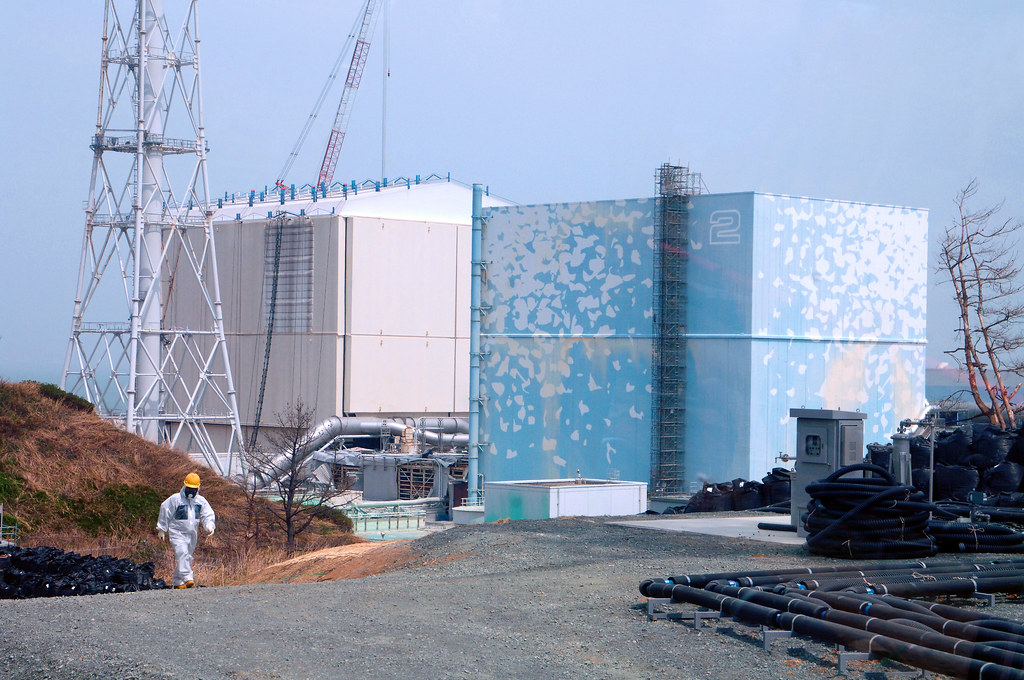
The IAEA team also took photos on their own and shared them on Flickr. In this photo, Reactor 2 almost looks pristine, as if nothing has happened in March 2011. (Click to enlarge.)
Sunday, April 14, 2013
IAEA Team in Japan to Discuss Progress on Decommissioning of #Fukushima I Nuke Plant
(Huh? That plant needs to stop leaking first.)
From Jiji Tsushin (4/15/2013):
IAEAが調査開始=福島第1原発の廃炉作業
IAEA has started examining the decommissioning work of Fukushima I Nuclear Power Plant
東京電力福島第1原発で停電による使用済み燃料プールの冷却停止や汚染水漏れなどのトラブルが相次ぐ中、廃炉に向けた取り組みを調べる国際原子力機関(IAEA)調査団が15日までに来日し、同日、調査を開始した。
Fukushima I Nuclear Power Plant has been having problems recently such as disruption in cooling Spent Fuel Pools due to power outage and leaks of contaminated water. International Atomic Energy Agency (IAEA) has arrived in Japan, and started the examination [of the plant] on April 15.
記者会見した調査団長のファン・カルロス・レンティッホIAEA核燃料サイクル・廃棄物技術部長は「今回は、廃炉に向けた総合的な戦略や計画について評価することが目的だが、汚染水漏れや停電などの問題も調査対象に入っている」と言及。現状認識については、「予備的な情報は把握しているが、この場で意見を申し上げるのは時期尚早だ」と述べるにとどめた。
Juan Carlos Lentijo, Director of Division of Nuclear Fuel Cycle and Waste Technology at IAEA and the head of the team visiting Japan, said in the press conference, "The purpose of the visit this time is to evaluate the overall strategy and plan for decommissioning, but we will also examine the problems of contaminated water leaks and power outages." As to their understanding of the current situation, he only said that they had preliminary information but it was too early to state their opinion.
Tuesday, June 12, 2012
Europe Has 150 Nuclear Reactors to Decommission in Two Decades
It may cost up to $1 billion to dismantle one reactor, so the potential total of $150 billion. Where does the money come from?
The US is kicking the can down the road by extending the license and doing nothing, for up to 60 years, even after the reactor is shut down. (See the New York Times article from March this year.)
(On the other hand, Spain just got $125 billion from EU to recap its banks...)
From The Washington Post WONKBLOG (6/9/2012):
How hard is it to dismantle 150 nuclear reactors? Europe’s about to find out.
Posted by Brad Plumer at 09:31 AM ET, 06/09/2012
Last year, after the tsunami and reactor meltdown in Fukushima, Japan, many European nations decided to phase out their existing fleets of nuclear power plants. Germany and Belgium are aiming to end all atomic generation by 2030. Switzerland is shooting for 2035.
Yet the mere act of shutting down those reactors is going to pose a huge challenge in the years ahead. According to a new report from GlobalData, Europe is on track to decommission nearly 150 nuclear power plants in the next two decades. Some, like those in Germany, are being mothballed for political reasons. Others, in France and Britain, are simply getting old. Yet dismantling a nuclear reactor is an arduous, time-consuming task — typically costing between $400 million and $1 billion per plant. And it’s not clear that Europe is fully prepared for the onslaught of retirements.
In a recent issue of New Scientist, Fred Pearce offered a handy step-by-step guide on how to take apart a nuclear reactor. There are thousands of tons of radioactive material to deal with — not just the spent fuel rods, but also various materials that have picked up lower levels of radioactivity. That includes, potentially, the reactor vessel, the fuel-rod casings, various bits of scrap metal and even old clothing. That waste can’t just be carted off to regular landfills; it needs to be disposed of properly. (Here’s a graphic breaking down the various types of waste.)
Very broadly speaking, there are three main ways (pdf) to decommission a nuclear reactor. The first option is to remove the fuel, disassemble the surrounding structure and find a safe place to store all the different radioactive bits. One problem with this option? Not every country in Europe currently has proper waste facilities set up, Pearce reports.
Alternatively, workers could simply take out the fuel, drain the plumbing and then lock up the reactor, letting the isotopes decay until the plant itself is less radioactive. After 10 to 80 years, the whole structure will be easier to dismantle. The third option, meanwhile, is to bury the reactor in a “tomb” of concrete and hope that no one cracks the structure open for the next 1,400 years. The U.S. Department of Energy took this approach for two old reactors at Savannah River in South Carolina.
All of these methods are time-intensive. As of 2012, some 138 nuclear reactors have been shut down (pdf) around the world, but only 17 have been fully decommissioned. It took England two full decades to finish its decommissioning of the Sellafield site after the nuclear reactor there was shut off in 1981.
What’s more, the process is costly: GlobalData estimates that it will cost at least $81 billion to decommission Europe’s reactors between now and 2030, with the biggest markets in France and Russia. Pearce suggests that some countries, such as Britain, may not currently have enough money budgeted for the task — in part because many of its reactors are custom-built and likely to cost more than expected to tear apart.
These sorts of headaches could be one reason why the United States is taking a different approach to its aging plants. The GlobalData report notes that U.S. utilities and regulators have announced plans to extend the lives of 71 nuclear reactors by another 20 years. Between now and 2030, only five U.S. commercial power reactors are expected to be decommissioned. (That’s in addition to the 28 commercial reactors that the United States has already shut down.)
Granted, the United States still has plenty of challenges — as Matthew Wald recently detailed for the New York Times, funds for decommissioning are lagging here, as well. But those problems are somewhat smaller than what Europe will be facing in the next two decades.
Friday, April 27, 2012
TEPCO to Raise Utility Charges for Households to Pay for Decommissioning #Fukushima Reactors
The company wants to raise the utility charges by 700 yen (US$8.70) per average household whose utility bill is 6,973 yen per month. If the national government approves, the rate hike will be effective in July.
From Yomiuri Shinbun (4/28/2012):
東電、廃炉費支援を要請…家庭700円値上げ
TEPCO requests support for decommissioning costs, raising the utility charges for households by 700 yen
東京電力は27日、政府による資金支援の前提となるコスト削減策を盛り込んだ総合特別事業計画を枝野経済産業相に提出した。
On April 27, TEPCO submitted the Special Business Plan to Minister of Economy, Trade and Industry Yukio Edano including cost-cutting measures, which are prerequisite for the financial support from the national government.
福島第一原子力発電所の廃炉と除染の費用について政府に資金支援を要請している。数兆円規模とみられる追加費用を東電単独で負担するのは困難と判断した。
TEPCO is requesting the government assistance for the decommissioning and decontamination of Fukushima I Nuclear Power Plant. The company has determined that it would be difficult to bear the additional cost of several trillion yen on its own.
計画には、7月から家庭向け電気料金で「10%の前半」の値上げ方針も盛り込まれた。政府が認可すれば、標準家庭の月額の電気料金(6月分、6973円)が700円程度上がる。7月の料金値上げ後に公的資金による増資が行われ、事実上国有化される。
The plan includes the rate hike for the utility charges for households starting July, by "slightly over 10%". If the government approves it, the monthly utility charges for the average household (6973 yen for the month of June) will rise by 700 yen. After the rate hike in July, the government will inject capital using public money, effectively nationalizing the company.
政府は賠償支払いについて現時点で累計2兆5462億円の資金支援を計画している。だが、廃炉費用は支援対象ではなく、東電負担が原則だ。除染費用も含め、東電が数兆円単位で追加負担することになれば債務超過に陥りかねない。
The government currently plans to support TEPCO on disaster compensation payments with 2.5462 trillion yen [US$31.6 billion], but the decommissioning of the reactors is not part of the support and has to be borne by TEPCO. The additional burden of several trillion yen [for decommissioning and decontamination] on TEPCO might render the company insolvent.
So the work that still continues at Fukushima I Nuclear Power Plant is not supported by the national government, and the TEPCO household customers in Kanto region will have to pick up the tab so that TEPCO can continue the work. Something's not right. But then, the national government is broke to the tune of the debt to GDP ratio of 240% (the US just passed 100% mark at the end of March by the way), and any money coming out of the government will be taken from the taxpayers anyway, whether it's for disaster compensation or decommissioning.
So much for clean and cheap energy that was nuclear.
And US$31.6 billion worth of money from the government for disaster compensation? Peanuts. The US Treasury Department raises that kind of amount in one single treasury auction.
Sunday, March 25, 2012
New York Times: As Reactors Age, the Money to Close Them Lags
US nuclear plant operators may not have enough money to decommission their aging reactors. If the reactors have to be shut down, it may be 20 to 60 years until they have enough money in the funds set up to pay for decommissioning.
The industry claims they are victims of the 2008 financial turmoil and market collapse.
From New York Times by Matthew L. Wald (3/20/2012; emphasis is mine):
WASHINGTON — The operators of 20 of the nation’s aging nuclear reactors, including some whose licenses expire soon, have not saved nearly enough money for prompt and proper dismantling. If it turns out that they must close, the owners intend to let them sit like industrial relics for 20 to 60 years or even longer while interest accrues in the reactors’ retirement accounts.
Decommissioning a reactor is a painstaking and expensive process that involves taking down huge structures and transporting the radioactive materials to the few sites around the country that can bury them. The cost is projected at $400 million to $1 billion per reactor, which in some cases is more than what it cost to build the plants in the 1960s and ’70s.
Mothballing the plants makes hundreds of acres of prime industrial land unavailable for decades and leaves open the possibility that radioactive contamination in the structures could spread. While the radioactivity levels decline over time, many communities worry about safe oversight.
Bills that once seemed far into the future may be coming due. The license for Vermont Yankee in Vernon, Vt., at 40 the nation’s oldest reactor, expires on Wednesday, for example. And while the Nuclear Regulatory Commission has granted its owner, Entergy, a new 20-year permit, the State of Vermont is trying to close the plant.
In New York, Gov. Andrew M. Cuomo has vowed to force the two operating reactors at another Entergy plant, Indian Point, 35 miles north of Midtown Manhattan, to shut down when their licenses expire in 2013 and 2015 by denying them state environmental permits.
Entergy is at least $90 million short of the projected $560 million cost of dismantling Vermont Yankee; the company is at least $500 million short of the $1.5 billion estimated cost of dismantling Indian Point 2 and 3.
The shortfall raises the possibility that Vermont could tend one sleeping reactor for decades while New York oversees three; Unit 1 , another reactor at Indian Point, shut down in 1974 and has yet to be dismantled.
Even the Nuclear Regulatory Commission’s chairman is uneasy about the prospect of a 60-year wait.
“These facilities should be cleaned up, and their footprints reduced as much as possible so that these areas can be returned to other productive uses within the community,” the chairman, Gregory B. Jaczko, said recently.
Gil C. Quiniones, the president and chief executive of the New York Power Authority, a state utility that sold Indian Point 3 to Entergy in 2000, called Entergy’s failure to plan for or finance the decommissioning of Indian Point in real time “stunningly irresponsible.”
“Delaying action for 60 years — when Entergy might no longer even exist — is offensive to the communities of Westchester County and the people of New York,” he said. James Steets, a spokesman for Entergy, said that financing would not be a problem because the company still expects to obtain new 20-year licenses for Units 2 and 3, which would allow time for savings to grow, and to prevail on the state permit issue.
Assuming that the plants remain open for two more decades, the company has promised Westchester County that it will decommission Indian Point in a “reasonable” period of time after the reactors close, probably in the 2030s.
Of the 20 reactors that lack the money for swift deconstruction, the owners hope that license renewals from the Nuclear Regulatory Commission will make the problem go away. For the plants that are fighting with their host states, Indian Point and Vermont Yankee, the federal courts may have the final say on whether and how long they keep operating. (A large demonstration in favor of closing the plant is planned for Wednesday at Vermont Yankee.)
The remaining 84 active reactors have enough savings on hand to satisfy the commission’s minimum financing requirements for eventual dismantling, some of them because they won license extensions.
The nuclear industry had been counting on steady returns on the funds and did not anticipate the 2008 market crash. Altogether the nation’s 104 power reactors have about $40 billion on hand. “A lot of decommissioning funds did take a hit at the nadir of the economic crisis,” said Scott Burnell, a spokesman for the regulatory commission.
One plant, Palisades in western Michigan, had $597.6 million saved up at the end of 2006, but the account was down to $218.8 million two years later and was only $279.2 million by the end of 2010, the most recent figures show.
Bruce Biewald, an economist who specializes in electricity economics at Synapse Energy, a Boston consulting firm, said the mothball strategy carries risks that could outweigh benefits. Proponents say “it’s like magic — compound interest on the one hand and radioactive decay on the other,” he said. (Because radioactivity levels decline over time, deconstruction workers would ultimately be exposed to less contamination.) But future investment returns could prove bleak, Mr. Biewald warns, and anticipated deconstruction costs could easily rise.
Responding to a petition from Sherwood Martinelli, an antinuclear activist who lives near Indian Point, Dr. Jaczko, the regulatory commission chairman, sought a shorter period between closing and dismantling.
But in October, Dr. Jaczko was outvoted 4 to 1 by his fellow commissioners. And the commission’s staff said that even 60 years was not a hard-and-fast outer time limit for suspending a reactor’s operations.
In the industry, this status is known as Safstor and it usually involves putting the spent nuclear fuel into storage casks on site, draining many of the plant’s fluids, making security arrangements and maintaining the reactor so it looks like a decent neighbor.
Environmental experts say the plants can be dangerous when they are not running. In a letter, the three members of Vermont’s Congressional delegation pointed out that 55,000 gallons of contaminated water spilled out of a mothballed plant in Illinois after a pipe froze. An attentive night watchman was credited with catching the spill in time to contain it.
Indian Point 1 has leaked a variety of radioactive materials into the soil on the banks of the Hudson in the 38 years since it closed, a point acknowledged by Entergy, which responded by emptying a spent fuel pool that was the source of the problem. The environmental group Riverkeeper argues that this is a harbinger of further trouble if Units 2 and 3 enter Safstor.
Compounding the worries about radioactive materials, the nation still lacks a permanent repository for spent nuclear fuel after decades of jockeying by politicians who sought to bar it from their backyards. So the fuel at the sleeping reactors will remain on site.
Twelve reactors across the country have been retired in the last three decades, all on short notice, because of a design or safety flaw that the economics did not justify fixing. The low price of natural gas, a competing fuel, makes the economic lifetime of existing reactors uncertain.
Some have been decommissioned in a few years, like Connecticut Yankee, whose owners, a group of New England utilities, footed the cost. Decommissioning started two years after its 1996 shutdown and was completed in 2005 at a cost of $871 million.
In Haddam, Conn., officials are still advertising for a new industrial tenant for its former site on the east bank of the Connecticut River.
Asked if tearing it down had been the right call, Paul J. DeStefano, the town’s first selectman and top official, said, “I’m a little hesitant, from a layman’s standpoint, of having something sitting around for 60 years. It just doesn’t sound right.”

Thursday, March 8, 2012
Photos of TMI Corium from Japan Atomic Energy Agency
JAEA published the photographs of the corium from the Reactor No.2 from the Three Mile Island nuclear accident in 1979.
Asahi Shinbun (3/7/2012) reports that the 60 samples of the TMI corium have been kept at JAEA since 1991. The samples, weighing 3 kilograms, were given to JAEA by Idaho National Laboratory as part of the international research collaboration.
According to Asahi, JAEA is planning to re-evaluate the samples as part of the basic research for decommissioning the reactors at Fukushima I Nuclear Power Plant.
Cross section of a corium sample, with the surface oxidized to show colors. Green is uranium dioxide. Brownish part is metals like zirconium, iron, nickel melted together (according to Asahi):
Cross section of a small 1-mm corium grain. Whitish color is where uranium and cladding melted and mixed (according to Asahi):
Wednesday, December 21, 2011
TEPCO/Japanese Government Released Mid to Long-Term "Roadmap" for Decommissioning Reactors 1 to 4 at Fukushima I Nuke Plant
where they hope they will have been long retired and gone before any of the serious stuff like removing the corium from somewhere deep in the reactor buildings (hopefully). Or taking out the spent fuel from Reactor 3 Spent Fuel Pool (if they can find any left).
The title of the Roadmap report does not say anything about Reactors 5 and 6. It says:
「東京電力(株)福島第一原子力発電所1~4号機の廃止措置等に向けた中長期ロードマップ」
"Mid- to long-term roadmap toward decommissioning of Reactors 1 through 4 and other works at TEPCO Fukushima I Nuclear Power Plant"
For now, it is only in Japanese, available at the Ministry of Economy, Trade and Industry (METI) press release section, here.
Let's take a look at the 5-page summary with pretty pictures that TEPCO drew. As you may have guessed, the whole thing is a joke, or based on hope and wishful thinking, because many of the technologies that will be needed to do any of the jobs that TEPCO lists as necessary for decommissioning the plant are not even developed.
That much is immediately obvious on Page 5, where TEPCO outlines necessary work on-site (in beige color arrows) and R&D necessary (in green arrows), and planning necessary (in pale yellow arrows) for removing the "fuel debris" (corium) from reactors, and decommissioning the reactors. "HP" in the map "means decision-making point" (handan point - handan means decision making in Japanese):
On the other hand, TEPCO seems to think removing the spent fuel from the Spent Fuel Pools will be an easy task - 2 to 3 years of planning, and removing the fuel sometime after 2016. How? Here's what TEPCO envisions (from Page 2; I added the English labels):
TEPCO thinks the easiest will be Reactor 4 Spent Fuel Pool, followed by (believe it or not) Reactor 3 Spent Fuel Pool. They hope to start removing the spent fuel from Reactor 4 SFP within 2 years from now, and from Reactor 3 SFP within 3 years.
How about removing the "fuel debris"? The process entirely depends on developing technologies - remote-control decontamination, remote-control repair of the Containment Vessels, remote-control surveying of the inside of the CVs, and finally removing the fuel debris. One funny thing about the pretty pictures that TEPCO drew for the presentation is that the company still depicts the "fuel debris" (corium) sitting pretty on the concrete floor of the Containment Vessel. TEPCO has admitted to the possibility that the corium is at least 65 centimeters into the concrete, and other researchers have said it may be as deep as 2 meters into the concrete.
In the first two pictures, I just noticed a stick figure inside the reactor building. So TEPCO is planning to send carbon-based workers to do the decontamination and repair of the Containment Vessel in extremely high radiation. Furthermore, the company seems to want to believe that whatever the damage to the Containment Vessel may be it is at the location that can be accessed, not in the basement. The only work in the basement in these pictures is stopping the water going from the reactor building basement to the turbine building basement.
The high-ranking US government officials were at hand for the declaration of the "cold shutdown state" and "end of the accident" by Prime Minister Noda. They were probably accompanied by the nuclear industry people and nuclear consultants wanting the piece of this decommission work that is guaranteed to last 30 years at least.
Not just nuclear industry consultants, but at least one alternative energy big shot was in Tokyo; Amory Lovins of Rocky Mountain Institute was urging the Japanese government and Japanese people to spend big money on alternative energy while telling the Japanese people they don't conserve energy enough. He may be eyeing for a government project on non-nuclear alternative energy. He said Japan should invest big money on alternative energy and energy conservation, and make a great contribution to the rest of the world by sharing the result.
I'm afraid the Japanese people may have had enough of being an exemplary global citizen, particularly when they have so many things to take care of within their own country.
Wednesday, August 31, 2011
#Fukushima I Nuke Plant: Water Entombment Is Back on the Table
Remember the time when the TEPCO/government complex pretended that it would fill the Containment Vessels of Reactors 1, 2 and 3 with water to cool the Reactor Pressure Vessels inside? It was late April, TEPCO started to pour an enormous amount of water in the RPV of Reactor 1 to fill the Vessel (as the water would leak into the CV). The operation was dubbed "water entombment".
We know how it quickly ended. TEPCO finally managed to actually measure the water level inside the CV and RPV of Reactor 1, and found that there was hardly any water in either of them - i.e. both the CV and the RPV of Reactor 1 were broken, kaput. Of 10,000 tonnes of water that TEPCO poured into the CV of Reactor 1, 3,000 tonnes were discovered in the basement.
But now, the water entombment is back in discussion in conjunction with decommissioning the reactors at Fukushima I Nuclear Power Plant, according to Mainichi Shinbun (8/31/2011).
According to Mainichi, the plan submitted by TEPCO to a special committee of the Nuclear Safety Commission calls for the following steps:
Clean up highly radioactive debris inside the reactor buildings;
Identify and repair the damage to the Containment Vessels and the reactor buildings;
Fill the Containment Vessels with water;
Open the top lid of the Reactor Pressure Vessels and remove the melted fuel.
The NSC committee will consider the plan, and the government will decide on the final plan by January 2012.
My questions:
Step No.1: How? By whom?
Step No.2: How? By whom?
Step No.3: What's the point again?
Step No.4: What melted fuel?
And no one knows, or rather, no one cares or wants to know, where exactly these melted blobs of fuel rods, control rods, instruments, metals, etc., are right now. TEPCO and the government will proceed as if they remain at the bottom of the Containment Vessel of each Reactor, if not still within the RPV.
Inside the reactor buildings there are at least several spots as identified by TEPCO where the radiation levels are measured in sieverts/hour. Who is going to do the cleanup work, not to mention repairing the CVs and the building (I suppose they are thinking about the concrete foundations)?


Tokyo Time
![[Most Recent Quotes from www.kitco.com]](http://www.kitconet.com/charts/metals/gold/t24_au_en_usoz_2.gif)