Showing posts with label radiation contamination. Show all posts

Monday, August 19, 2013

(UPDATED with Wind Direction/Speed Info) Mysterious Dust at #Fukushima I Nuke Plant Update: Where Did It Come From?


(UPDATE 8/20/2013) TEPCO keeps records of wind direction at the West Gate, which is close to Monitoring Post 5. For August 19, 2013, wind was from:


9:30AM: south-east, 2.2m/s
9:40AM: south-south-east, 2.2m/s
9:50AM: south-east, 2.3m/s
10:00AM: south-south-east, 2.9m/s
10:10AM: south-south-east, 3.5m/s

In other words, the Anti-Seismic Building was more or less directly down-wind from Reactors 1, 2 and 3.

=============================

This is an update of the previous post on mysterious dust that contaminated workers waiting for bus on August 19, 2013.

On the second incident of workers contaminated with radioactive materials while waiting for the bus to take them to the Entry/Exit Checkpoint at the gate, TEPCO seems to have gotten a little bit more curious than in the first incident, and actually did something that may (or may not) be worthwhile in figuring out where the radioactive materials may be coming from.

First, the timeline (from TEPCO's handout for the press in Japanese, 8/19/2013):

9:29AM: "high" alarm sounded from the continuous dust monitoring system (outside)

9:34AM: "high" alarm sounded from the continuous dust monitoring system (inside)

9:50-10:10AM: dust sampling

10:04AM: "high-high" alarm sounded from the continuous dust monitoring system (inside)

10:12AM: announced that workers should put on masks in the areas that are exempt from wearing masks

10:20AM: two workers out of three (affiliate company) who boarded the bus in front of the Anti-Seismic Building at 9:55AM were found with contamination (13 Bq/cm2, 7 Bq/cm2)

10:57AM: the workers were decontaminated

13:00AM: the workers took WBC, found with no internal radiation exposure


Result of dust sampling in front of the Anti-Seismic Building, from 9:50-10:10AM:

  • Cs-134: 2.6 x 10^-4 Bq/cm3 (2.6E-4, or 0.00026 Bq/cm3)

  • Cs-137: 5.8 x 10^-4 Bq/cm3 (5.8E-4, or 0.00058 Bq/cm3)


Dust sampling at the location up-wind, about 2 hours later (at the extra-high-voltage switching station for Reactors 1 and 2), from TEPCO's alert for the press, 8/19/2013:

From 12:48PM to 1:08PM:

  • Cs-134: 3.2 x 10^-5 Bq/cm3 (3.2E-5, or 0.000032 Bq/cm3)

  • Cs-137: 7.2 x 10^-5 Bq/cm3 (7.2E-5, or 0.000072 Bq/cm3)


From 1:50PM to 2:10PM:

  • Cs-134: 8.0 x 10^-6 Bq/cm3 (8.0E-6, or 0.000008 Bq/cm3)

  • Cs-137: 2.1 x 10^-5 Bq/cm3 (2.1E-5, or 0.000021 Bq/cm3)


And where is this switching station located? Right behind Reactors 1 and 2, on a terrace.

From TEPCO's handout for the press on 10/19/2012 when there was a brush fire in the area near the switching station:


The location of the Anti-Seismic Building, Entry/Exit Control, and Switching Station (English labels are by me):


How about down-wind location? TEPCO even checked the monitoring station No.2 located down-wind from the Anti-Seismic Building. From the alert to the press, 8/19/2013:

"Monitoring Post No.2, located down-wind from the Anti-Seismic Building, didn't show significant change. However in order to closely examine the incident, we expanded the monitoring range by 1,000, and found the following rise in radiation levels":

  • From 10AM to 10:20AM: rise of 42/1000 microsievert/hour

  • From 1:30PM to 1:50PM: rise of 31/1000 microsievert/hour

*Normal monitoring: significant digits of 2.

また、免震重要棟の風下に設置されているモニタリングポスト-2の値について、有意な変動は確認されませんでしたが、事案についてより詳細な確認を行うため、測定レンジを1000倍に拡大して確認したところ、以下の時間帯で通常の監視桁数を下回る範囲での指示上昇が確認されました。
・午前10時00分から午前10時20分 42/1000[μSv/h]の上昇
・午後1時30分から午後1時50分 31/1000[μSv/h]の上昇
※通常の監視桁数はμSv/hの有効数字2桁

Where is the monitoring station No.2 located? (English labels and red circles added by me)


"Happy", the worker who's been tweeting from Fukushima I Nuke Plant since March 2011, said this yesterday:

免震棟前の汚染は、2号機と3号機の窒素封入作業時間の先日(12日)と本日の時系列を洗い出し、因果関係を調べた方がいいかも…。あと詳細な核種分析も…。

About the contamination in front of the Anti-Seismic Building, it may be a good idea to examine the timelines for both August 12 and today [August 19] of the nitrogen injection work in Reactors 2 and 3, and see if there is any causality. And do detailed nuclide analysis.


Speaking of nitrogen injection, TEPCO released the alpha-nuclide monitoring results from the gas management systems in Reactors 1, 2 and 3 on August 12, 2013, and 0.19 Bq/cm3 of all-alpha was found in the condensed water from the Reactor 3 system.

TEPCO recently did the gas management system sampling test of gamma nuclides (cesium iodine) for Reactor 2 and Reactor 3, but the samples were taken on August 7 and August 3 respectively, and the result was ND.

Contamination still remains a mystery.

(UPDATED) Mysterious Radioactive Dust Again at #Fukushima I Nuke Plant, Cause Still Not Known


(UPDATE 2) New post with a bit more information.

(UPDATE) NHK News says the mist generator was not in use this time.

==================

It happened again. According to TEPCO's email alert for the press on August 19, 2013, an alarm sounded from the dust monitoring system in front of the Anti-Seismic Building at 10:04AM.

This time, two workers waiting for bus in front of the Anti-Seismic Building were later found with 13 Bq/cm2 contamination on their heads.

The dust monitoring result shows cesium-134 at 2.6×10^-4[Bq/cm3] (0.00026 Bq/cm3), and cesium-137 at 5.8×10^-4[Bq/cm3] (0.00058 Bq/cm3).

When it happened the first time on August 12, 2013, the water used in the mist generator was first suspected, but it turned out to be not the case.

There is no information whether the mist generator was in use this time or not.

The cause is still unknown.

Monday, August 12, 2013

(UPDATED) #Fukushima I Nuke Plant: Mist Was Not Radioactive, But TEPCO Doesn't Know What Was


(UPDATE 2) 10 workers were all TEPCO employees.

(UPDATE) Some researchers and independent journalists are speculating as to what could have contaminated the workers and how. Researchers Jun Makino and @study2007, and journalist Ryuichi Kino seem to have come to the same, albeit tentative, conclusion which can be summarized as:

A mass of air containing radioactive materials was passing the area, and caught by the mist and fell on the workers.


Another unconfirmed story is that the mist generator was contaminated. No information as to how it got contaminated.

=========================

This is a follow-up on the last post about workers who were waiting for the bus to take them from the Anti-Seismic Building to the checkpoint near the main gate at Fukushima I Nuclear Power Plant and somehow got their heads and faces contaminated with radioactive materials.

TEPCO at first suspected the water used in the mist generator, but it says the test confirmed the levels of radionuclides were below detection levels.

So what caused the sudden rise in radioactivity in that particular location? TEPCO says it doesn't know, but is certain that it was a one-off, localized event.

The workers had maximum 19 Bq/cm2 (square centimeter) of contamination, not 10 Bq/cm2. Test by WBC showed no internal radiation exposure.

TEPCO did disclose some information about the water source, in the handout for the press on August 12, 2013 (English labels added by me). As I added to my previous post, TEPCO has its own dedicated water source for the plant, which is a river water. As NHK reported, the water is dammed, and then transported, I assume via the duct or pipe, to the plant, just outside the plant perimeter. There is a water purification facility there. The purified water is then fed to the plant for daily use. How it is fed to the plant buildings is not explained:

Latest from #Fukushima I Nuke Plant: Workers Being Sprayed with Radioactive Mist


(UPDATE 3) TEPCO says it tested the water, and gamma nuclides, all-beta were NOT DETECTED. So how did 10 workers get contaminated? No one knows, but the contamination was not 10 Bq/cm2 but 19 Bq/cm2 on their heads and faces.

========================

(UPDATE 2) Before the accident, TEPCO had its own water source to supply to the plant. If TEPCO is still using the same water, it is a river water. (Information from Fukushima Prefecture, H/T Dr. Moriguchi)

(UPDATE) According to NHK, the water comes from a dam about 10 kilometers west of the plant. No details as to how the water gets to the plant.

========================

TEPCO's email alerts to the press today (August 12, 2013) are about a mysterious rise in radioactive levels in front of the Anti-Seismic Building and how it may have happened.

10 workers ended up with max 10 Bq/cm2 (square centimeter) of radioactive materials on their heads and faces, and will be checked by WBC.

How? They were doused with mist from water contaminated with radioactive materials. Why were they being doused with mist? To prevent heatstroke. How did the water get contaminated? That's what TEPCO is investigating right now.

The water used for the mist generator is also used in toilets in the Anti-Seismic Building, the headquarters for all the work being done at the plant.

First alert:

本日(8月12日)午後0時33分頃、福島第一原子力発電所免震重要棟前に設置してある連続ダストモニタで、放射能濃度が高いことを示す警報が発生しました。

At 12:33PM today (August 12), an alarm went off from the continuous dust monitoring system installed in front of the Anti-Seismic Building, indicating radioactive density was high.

そのため、同日午後0時48分に発電所内の全面(半面)マスク着用省略可能エリアでのマスク着用を指示しました。現在、現場において当該連続ダストモニタの状況確認、可搬型ダストサンプラによる測定等を行っており、状況等については、確認出来次第お知らせいたします。

At 12:48PM, we instructed workers to put in masks in the areas where workers are no longer required to put on full-face (and half-face) masks. We are currently observing the continuous dust monitoring system and carrying out measurement using portable dust sampler. We will let you know as soon as we know more.


Second alert:

免震重要棟前では熱中症対策のためのミストを噴霧しておりますが、免震重要棟前でバス乗車のため待機していた人(10人)について、入退域管理棟の退出モニタによる汚染測定で身体汚染が確認されました。

In order to prevent heatstroke, we've been spraying workers with water mist in front of the Anti-Seismic Building. Bodily contamination was found on 10 people who were waiting for the bus in front of the Anti-Seismic Building.

身体汚染の原因については、ミスト発生装置から出ているミストが汚染している可能性が考えられ、現在、詳細調査を行っており、分かり次第お知らせします。

The cause of contamination may be the mist from the mist generator. We are conducting detailed investigation.

同日午後1時25分、ミスト発生装置を停止しています。


As of 1:25pm, the mist generator is stopped.

Third (latest) alert:

免震重要棟内および5,6号機で使用している水(トイレ等)については、身体汚染原因と考えられる当該ミスト発生装置供給水と同じ水源であることから、同日午後1時16分に手洗い水等の使用を禁止し、一斉放送により周知しました。

The water used in the Anti-Seismic Building and Reactors 5 and 6 (in toilets, etc.) comes from the same source as the water used in the mist generator which is likely to be the cause of contamination on the body. So we stopped the use of water in the toilets at 1:16PM, and notified the workers by the simultaneous broadcasting system.

また、当該ミスト発生装置供給水、免震重要棟内および5,6号機で使用している水の元弁を同日午後1時40分に閉止しました。

At 1:40PM we closed off the master valve of the pipe that feeds water to the mist generator and to the Anti-Seismic Building and Reactors 5 and 6.

身体汚染が確認された10名は、頭部・顔面が最大10Bq/cm2で汚染していることから、ホールボディカウンターの受検を指示しました。

10 workers with bodily contamination have maximum 10 Bq/cm2 of contamination on their heads/faces. We have instructed them to undergo WBC.

現在、当該ミスト発生装置供給水の放射能分析を行っており、結果については分かり次第お知らせします。

We are conducting the nuclide analysis of the water in the mist generator, and will let you know the result as soon as possible.


No information as to WHERE the water source is located.

Friday, June 28, 2013

(Almost OT) Contamination of Freshwater Fish in #Fukushima and Eastern Japan, by Financial Analysts at Shiga University


Another gem from the open-access magazine Scientific Reports. If you think the blue butterfly mutation was flaky, this one takes the cake.

The paper is about freshwater fish contamination after the Fukushima I Nuclear Power Plant accident, published on Scientific Reports on April 29, 2013.

The first problem is right off the bat, the authors. They belong to Shiga University Economics Department, assessing risks of various financial instruments including insurance.

Here's Mr. Toshiaki Mizuno's bio, and here's Mr. Hideya Kubo's (in Japanese).

Uh.. Economics? Finance?

Here's their paper's abstract:

Overview of active cesium contamination of freshwater fish in Fukushima and Eastern Japan

Toshiaki Mizuno & Hideya Kubo (The Center for Risk Research, Shiga University)

This paper focuses on an overview of radioactive cesium 137 (quasi-Cs137 included Cs134) contamination of freshwater fish in Fukushima and eastern Japan based on the data published by the Fisheries Agency of the Japanese Government in 2011. In the area north and west of the Fukushima Nuclear plant, freshwater fish have been highly contaminated. For example, the mean of active cesium (quasi-Cs137) contamination of Ayu (Plecoglossus altivelis) is 2,657 Bq/kg at Mano River, 20–40 km north-west from the plant. Bioaccumulation is observed in the Agano river basin in Aizu sub-region, 70–150 km west from the plant. The active cesium (quasi-Cs137) contamination of carnivorous Salmondae is around 2 times higher than herbivorous Ayu. The extent of active cesium (quasi-Cs137) contamination of Ayu is observed in the entire eastern Japan. The some level of the contamination is recognized even in Shizuoka prefecture, 400 km south-west from the plant.


Scary, isn't it? Based on the quasi-Cs137 numbers (as the Fisheries Agency in their haste to measure anything radioactive right after the accident did not separate Cs-134 and Cs-137) the researcher drew up this contour map:

Figure 3: The isogram map shows average active cesium (quasi-Cs137) contamination level of the Ayu (Plecoglossus) captured in between May and September 2011 on each prefectures in eastern Japan.


Below the map, there is this remark:

Each isogram center points are each prefecture's capital city. We created the map using the GIS software which is 'MANDARA for windows 2000/XP/VISTA/7 Version 9.35' (the software copyright: 1992–2011 Tani Kenji).


I don't understand what they want to say in the first sentence.

This contour map, when it was first reported in Japan in April this year, spread fast, as the evidence of wide-area contamination of freshwater fish. "Look, even all of Shizuoka Prefecture is so contaminated!" It spread with comments like "The paper has been accepted by Nature Magazine! Peer-reviewed and authoritative!"

It turns out the economics researchers painted entire Shizuoka in green (0 to 10 Bq/kg of quasi-Cs137) from two samples that tested 5 Bq/kg and 2 Bq/kg.

As outsiders (not even a biologist or radiation expert) they were over-eager in drawing a radiation contamination contour map from a scant, incomplete data by the Fisheries Agency in the early days of the accident in 2011, while more detailed 2012 data was already available.

The original data points of the Fisheries Agency that these researchers used are plotted in this map (by @Kontan_Bigcat):


より大きな地図で アユのセシウムの放射能濃度(2011年) Radioactive cesium activity concentration in ayu after Fukushima nuclear disaster (2011) を表示

In the paper, part of which reads more like a tour guide, the two economists openly admits their data is not sufficient and over-estimating Cs-134 but at the same time declares the contamination has spread wide and all water systems are in danger:

The Japanese freshwater system is very high density as developed rice water paddy field, irrigation canal, urban water-system network. Therefore, we have to think that the contamination of freshwater fish is widespread not only in river basins but also all over the ground included all types of water-systems, for example, agricultural and urban water systems. The isogram map shows the contamination tendency quite well. The contamination levels of the freshwater fish provide insufficient data and the knowledge of the path about bioaccumulation. So, we will have to survey a more wide spread area and monitor bioaccumulation in each species level.

...Data 2011 of radioactive cesium of freshwater fish was analyzed by each local government according to the emergency food survey manual of radioactive substance14. The purpose of this manual is they avoid feeding high contaminated food it was defined by food security of emergency condition. Therefore, it is not aimed at collecting accurate data. As a result, this data did not distinguish between cesium137 and cesium134. Therefore, the analysis of this paper calculated by quasi-Cs137 included Cs134. They used germanium semiconductor machine when they measured the radioactive cesium contamination of freshwater fish. The measure time is from 10 minute to 1 hour. The calibration is only Cs137 in per week. The range of radioactive cesium applied only Cs137 regression equation. The result, when the case included Cs134 is relatively much, the numerical value become over estimation. The sample of freshwater fish was collected by each prefectural government by emergency policy of food security. In the survey, the fish sample collected 5–10 kg in one survey station. The measure is using wet condition fish. Ayu and small fish was measured hole body, while big fish measured the part of food portion.


"relatively much"??

I don't know who wrote English, but it is so bad that it makes my head spin. It could even be the Google translation. At least the blue butterfly paper was written in a decent enough English.

But no matter. Nature Japan decided to provide the very favorable Japanese translation of this hard-to-comprehend paper's abstract, and tweeted the page. So it is being tweeted again among people I follow.

I guess these two financial analysts just wanted to create a contour map like Professor Yukio Hayakawa, a volcanologist, did. If a volcanologist can, why not financial analysts?

At this point in time, after more than 2 years after the accident, people believe what they want to believe. Anything that shakes their belief system is either "pro-nuke" propaganda or "anti-radiation" over-reaction, depending on which "side" they are on. People in the "middle" who simply want to know what happened, what is happening, and what will happen are dwindling fast.

Saturday, May 25, 2013

#Radioactive Leak at J-PARC: Staff Let 100 Billion Becquerels Escape Through Ventilation Fans


(For all posts about J-PARC radiation leak, click here.)

To add further disgrace to what's already there aplenty, the researchers at J-PARC, Japan Proton Accelerator Research Complex, were fully aware that turning on the ventilation fans without any filter would release radioactive materials outside the facility, but did it anyway.

I wondered aloud in the previous post on this accident: Why didn't these particle physicists (supposedly some of the brightest people in Japan) connect the dots and figure out "Radiation level was high, turned on the fans, radiation level dropped, radioactive materials went from inside the facility to outside"?

Well now I know they did know.

From Chunichi Shiinbun Medical Site (5/26/2013; part, link won't last long):

職員たちは、放射線量が通常時の10倍の毎時4マイクロシーベルトまで上がっているのが分かると、施設内の線量を下げるために排気ファンを2度にわたって運転。KEKは「線量がそれほど高くなかった。大気に出ても迷惑はかからないだろうと思った」と説明した。

The staff, on learning the radiation level had risen to 4 microsievert/hour, 10 times the normal, operated the fans twice in order to lower the radiation level inside the facility. KEK [High Energy Accelerator Research Organization] explained, "The radiation level wasn't that high. We figured even if [radioactive materials] leaked into the atmosphere it wouldn't be of much inconvenience to anyone."

ファンは換気用で、放射性物質を吸着するフィルターは取り付けられていない。設備の誤作動も想定しておらず、事故時のマニュアルも用意していなかった。モニタリングポストで線量が上がっているのを確かめたのは、ファンを回して26時間もたった24日午後6時だった。

The fans are for ventilation, and there is no filter installed that would absorb radioactive materials. They didn't expect the malfunction of the equipment, and there was no accident manual. It was 26 hours after they operated the fans, at 6PM on May 24, that they finally confirmed the rise in radiation levels at the monitoring post.

KEKによると、現場では国などに速やかに報告すべきだという声も一部であったが、原子力機構出身の池田裕二郎J-PARCセンター長ら幹部が「通報に該当する事象ではない」と判断。報告遅れにつながった。

According to KEK, some people who were at the facility suggested the incident be reported to authorities including the national government, but the senior management including Yujiro Ikeda, J-PARC president who came from JAEA, decided it was not the event that requires reporting, leading to the delay in reporting.


But wait, there's always more in Japan when it comes to anything radioactive...

To ignore the warning buzzer and restart the experiment without confirming safety, and to expel radioactive materials from inside the facility using unfiltered ventilation fan is exactly what the operation manual at the facility calls for, according to KEK.

Again, from Chunichi Shinbun Medical Site (5/26/2013; part):

実験を実施していた高エネルギー加速器研究機構によると、23日午前11時55分、J-PARC内の原子核素粒子実験設備で金に陽子ビームを当てて素粒子を発生させる実験中、異常を検知して安全装置が作動、警報音が鳴ったため、いったん実験装置を停止した。

According to High Energy Accelerator Research Organization [KEK] who was conducting the experiment at the nuclear and particle physics experiment facility to hit gold with proton beams to generate elementary particles, the safety mechanism detected the abnormality and sounded an alarm at 11:55AM on May 23. The equipment was stopped.

担当者は安全装置作動の原因が分からないまま午後零時8分に警報をリセットし、実験を再開した。その後、施設内で放射線量が上昇し再び運転を停止。午後3時15分ごろ、排気ファンを作動させて施設内の線量が下がったため、また運転を再開していた。

The researcher in charge, without knowing why the safety mechanism tripped, reset the alarm at 12:08PM and resumed the experiment. Later, when the radiation level rose inside the facility, the experiment was stopped again. At about 3:15PM, the experiment resumed as the radiation level dropped after operating the ventilation fans.

高エネ研の担当者は「マニュアルに従った手順だった」と話している。

The person in charge at High Energy Accelerator Research Organization says, "It was the procedure following the manual."


This by-the-book release of radioactive material was 100 billion becquerels in the south-westerly direction, one-hundredths of the annual legal limit of radioactive material release, according to Mainichi Shinbun (5/26/2013) quoting JAEA.

Here's the image of the ventilation fans in question (from Chunichi Shinbun):


There are several Japanese nuclear and particle physicists that are widely followed on Twitter, and some of them were apparently scheduled to conduct their experiments using the facility at J-PARC. To a sheer puzzlement of people with some rational mind left, some of these researchers are being ridiculed and bad-mouthed by Twitter mob just because they are nuclear and particle physicists using J-PARC.

It Was #Radioactive Gold, Mercury, Potassium, and Sodium Leak at J-PARC


(For previous posts on the accident, go here and here.)

Particle physics scientists at J-PARC are trying to show they are not like nuclear scientists (or nuclear plant operators) and released the result of analysis for gamma nuclides using the germanium semiconductor detector on the night of May 23, 2013, the day of the accident.

No mention of tritium, which is beta nuclide.

From the scanned images of the report on paper, published on May 25, 2013:


Hg (mercury) 197: half life 2.706 days
K (potassium) 43: half life 0.9294 day
Au (gold) 198: half life 2.695174 days
Hg (mercury) 195: half life 10.5306 hours
Na (sodium) 24: half life 14.9589 hours

There are numerous spikes indicating other radionuclides. But since it is a scanned image, I can't read the tiny print clearly.

The report also says the external radiation exposure was 0.1 millisievert (max). Almost all radiation exposure for the researchers, therefore, was from internal exposure as they inhaled the air inside the facility without realizing the gold used as target had been partially vaporized and radioactive materials, instead of staying inside the metal, were released in the air.

(English labels are by me)


The accident timeline in the report shows they continued the experiment after the equipment malfunction at 11:55AM, until 4:15PM when they used the survey meter to measure the radiation levels inside the hall. It was between 4 and 6 microsievert/hour, 10 times the normal level.

The ostensible reason for the delay in reporting the accident to authorities was that on May 23 they thought the contamination was only inside the radiation control area. That doesn't quite fly, as they say (in the accident timeline) that the radiation level (gamma) inside the hall dropped when the ventilation fan was used, and rose when they stopped using the fan.

So these particle physics scientists claim they didn't connect the dots at that time, and that they finally decided there had been radioactive materials leak outside the facility when they checked the monitoring post placed outside the facility in the evening of May 24. Another facility inside the J-PARC compound notified the Hadron Facility that their monitoring post showed elevated radiation level on May 23, precisely when the ventilation fan was being used, according to the report.

It looks like a much larger leak than first reported.

J-PARC's Hadron Experimental Facility, from their homepage:

(Here We Go Again...) "Soh-Teh-Gai" (想定外, Beyond Expectation) Events at J-PARC That Possibly Leaked Tritium and Radioactive Gold


What are the "beyond expectation" events at J-PARC in which radioactive materials leaked after they managed to vaporize gold by hitting it with proton beam that was a bit too strong?

They say (according to Jiji Tsushin, 5/25/2013):

  • They didn't even imagine that the equipment could malfunction; and

  • They didn't even imagine that proton beam could be so strong that it vaporized the metal; and therefore,

  • They didn't even imagine that radioactive materials, which in normal situation remain inside the metal, would leak outside the equipment; therefore,

  • The ventilating fan did not have a filter to block the leak of radioactive materials.


NHK's latest news adds more "beyond expectation" events:

  • They did check the surface contamination on May 23, the day of the accident, and it showed the contamination 10 times the normal level. But they didn't even suspect internal radiation exposure, and let the researchers go home;

  • They didn't check the researchers for internal radiation exposure until 4 researchers asked to be tested;

  • They are yet to test 55 others who at the facility.


The highest radiation exposure, of both internal and external radiation, was 2 millisieverts, according to NHK.

NHK also says they noticed there was a leak of radioactive materials when the radiation level in the facility dropped after using the ventilation fan.

(Duh.)

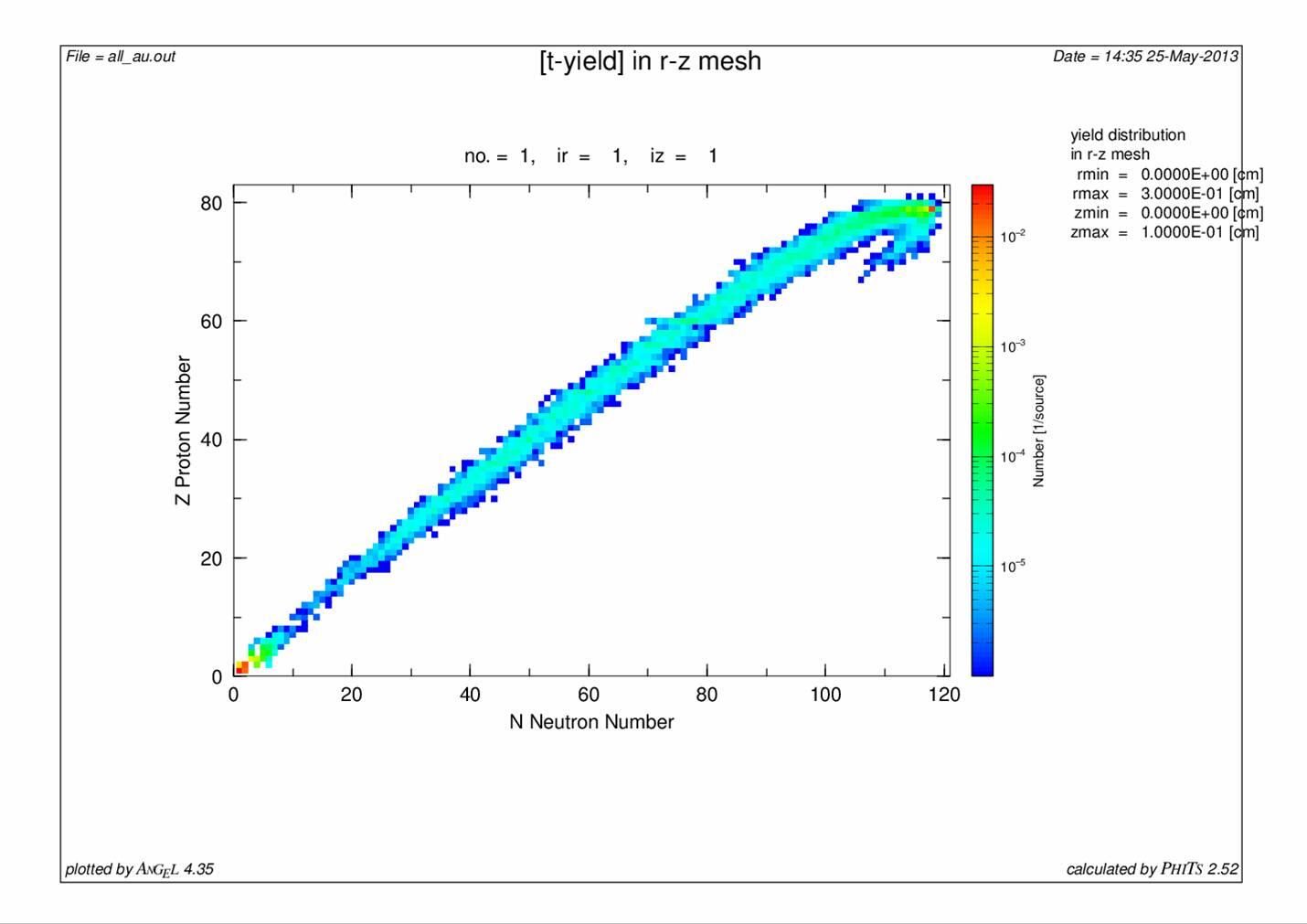
From the tweet of one of the nuclear researchers that I follow (Tomohiro Endo, of Nagoya University), "Calculation of distribution of all nuclides (including stable isotopes and radionuclides) created when 30GeV proton beams hit 1mm-thick gold (30GeVの陽子を1mm厚さの金に当てたときに生成される全核種の分布を計算)":

(Click to enlarge)


He says in another tweet that they are the sum of (1) nuclides created when protons hit gold, and (2) nuclides created when neutrons hit gold.

Most likely radionuclides from the accident are in red and yellow, which he thinks include tritium (proton number 1, neutron number 2) - the orange dot in the lower left corner, and radioactive gold (Au-196), on the left of the orange dot which is stable AU-187 in the upper right corner.

Au-196 has half life of about 6 days. Half life of tritium is about 12 years.

Friday, May 24, 2013

#Radioactive Materials Leak at Japan Proton Accelerator Research Complex (J-PARC) in Ibaraki, Researchers Accidentally Inhaled Radioactive Gold


(UPDATE 2) For the latest, see my posts here and here.

(UPDATE) From Jiji Tsushin (5/25/2013):

施設内の放射線量が上がった際に担当者が換気扇を回し、外部に放射性物質を放出していたことが25日、分かった。許可を出した三浦太一・高エネ研教授は会見で、「通常運転時も半減期の短い放射性物質で線量が上がることがあり、すぐ減衰するとの認識だった。結果として浅はかだった」と謝罪した。

When the radiation level inside the facility rose, the person in charge turned on the ventilating fan and released radioactive materials outside the facility. Professor Taichi Miura at High Energy Accelerator Research Organization, who authorized the ventilation, apologized in the press conference, saying "Radiation level rises even in the normal operation because of radioactive materials with short half life, so we thought they would decay quickly. But it turned out to be imprudent."


================================

Japan Atomic Energy Agency (JAEA), who operates J-PARC, didn't bother to notify the Nuclear Regulatory Agency (secretariat of the Nuclear Regulatory Authority, mostly made of people from NISA) for 2 days, because they did not think there was any leak of radioactive materials.

According to Asahi, the researchers suffer internal radiation of exposure of 1.7 millisievert, and the contamination of the facility is 40 becquerels per square centimeter.

Apparently, the Ibaraki prefectural government was not too happy about the incident and the fact that JAEA didn't bother to notify the authority and the prefectural government, and held an angry press conference at 2AM on May 25.

The official story of the accident, from Asahi Shinbun (5/25/2013, 1:37AM):

原子力機構で放射性物質漏れ 研究者ら4人が内部被曝

Radioactive materials leak at JAEA facility, 4 researchers suffer internal radiation exposure

日本原子力研究開発機構は25日、茨城県東海村のJ―PARCの原子核素粒子実験施設で、放射性物質が施設の外に漏れたと明らかにした。中にいた研究者ら少なくとも4人が内部被曝(ひばく)した。漏洩(ろうえい)は止まっており、拡大の恐れはないという。被曝した4人のうち、最大の被曝量は1・7ミリシーベルトという。原子力機構は外部に漏洩した放射性物質の量を調べている。

Japan Atomic Energy Agency disclosed on May 25 that there was a leak of radioactive materials outside the nuclear and particle research facility at J-PARC in Tokai-mura in Ibaraki Prefecture. At least 4 researchers inside the facility suffered internal radiation exposure. The leak has stopped, and there is no danger of the leak spreading further. The maximum radiation exposure was 1.7 millisievert, according to JAEA. JAEA is currently investigating how much radioactive materials have leaked outside the facility.

原子力機構や原子力規制委員会によると、放射能漏れがあったのは23日午前11時55分ごろ。陽子ビームを金にあて素粒子を発生させる実験をしていた。装置が誤作動を起こして陽子ビームは通常の400倍の出力になり、金が蒸発。放射性物質が漏れて研究者が吸い込んだ。現場には当時、研究者ら約30人がいたという。

According to JAEA and the Nuclear Regulatory Authority, the leak took place at 11:55AM on May 23. They were conducting an experiment of generating elementary particles by hitting gold with proton beam. The equipment malfunctioned, and the output of the proton beam increased to 400 times the normal strength, and gold was vaporized. Radioactive materials [radioactive gold vapor] leaked [from the equipment], and were inhaled by the researchers. There were about 30 researchers when the accident happened.

施設の汚染は最大で1平方センチあたり約40ベクレル。現在、施設内を立ち入り禁止にしている。原子力機構は発生当時、外部への放射能漏れはないと考え、国に報告しなかった。J―PARCは大型の加速器を備えた素粒子などを調べる実験施設。

Contamination of the facility is about 40 becquerels per square centimeter maximum. Currently the facility is off-limit. At the time of the accident, JAEA didn't think there was a leak of radioactive materials, and did not report to the government. J-PARC is a facility to study elementary particles with large accelerators.


Equipment malfunctioned. That's the official story.

Let us now turn to "baseless rumors" among knowledgeable researchers (like this one, from Professor Hayano of Tokyo University) for what may really have happened. According to the unverified rumors, it was not the equipment that malfunctioned. Researchers made a mistake, and instead of hitting the target (gold) with low, continuous proton beam over a long period of time they accidentally hit it with high-intensity proton pulses.

According to NHK quoting the Ibaraki prefectural government, the monitoring post outside the facility showed a slight increase in radiation level between 3PM and 6PM on May 23. The radiation level is normally between 70 to 130 nanogray/hour, but it rose by 10 nanogray/hour on May 23.

Never trust the Japanese with a gigantic facility like a proton accelerator. Or a nuclear reactor. They are not only incapable of operating them properly, but when an accident happens they don't tell you.

(How do you get rid of radioactive gold in the body? Does anyone know?)

Monday, May 20, 2013

Cherry Tomatoes and Asparagus, From #Fukushima to Thailand


I don't quite understand the psychology of some of the farmers in Fukushima in the past two years. From what's been reported and what I've known in blogs and tweets, they are angry that fickle consumers outside their prefecture are still fanning the "baseless rumors" that their produce is contaminated with radioactive materials from the biggest nuclear accident in Japan in history, and they are determined more than ever to keep producing anything they like and demand that consumers buy them, because they have to make living. I'm sure there are conscientious farmers who would rather not farm, but they are not vocal.

"Eat and support" is now clearly being expanded to foreign countries, with Thailand to start.

For some time, the Fukushima prefectural government and Fukushima JA seem to have been targeting Thailand, which receives 70% of foreign economic aids from Japan, according to Japanese Ministry of Economy, Trade and Industry. First, it was Fukushima peaches. Then apples, pears, then persimmons. Now, Fukushima will sell fresh cherry tomatoes and asparagus to wealthy Thais.

That, on top of the hot money escaping from Japan, thanks to PM Abe and BOJ's Kuroda, and pouring into developing nations including Thailand. Thais are traditionally very friendly to Japanese, but I wonder how long that will last.

From Fukushima Minyu (5/17/2013; part):

県産野菜をタイで販売へ ミニトマトとアスパラ初輸出

Vegetables grown in Fukushima to be sold in Thailand, first export of cherry tomatoes and asparagus

 県や市町村、県内企業でつくる県貿易促進協議会は16日、県産のミニトマトとアスパラガスをタイへ初輸出、24~26日にバンコク市の大手デパートで試験販売すると発表した。県産野菜のタイ輸出は初めて。23日は現地で商談会を開き、県内の酒造会社4社の銘酒も提供する。同協議会は県産モモとリンゴの売れ行きが好調だった実績を好感、タイへの輸出拡大に向け販売促進活動を本格化させる足掛かりにしたい考えだ。

Fukushima Trade Promotion Council made of the prefectural and municipal governments and corporations in Fukushima announced on May 16 that cherry tomatoes and asparagus grown in Fukushima will be exported to Thailand for the first time, and test sales will be on May 24 to 26 at large department stores in Bangkok. It will be the first export of Fukushima's vegetables to Thailand. On May 23, a business meeting with potential buyers will be set up in Bangkok, where 4 brands of well-renowned sake in Fukushima will be offered. The Council felt good that peaches and apples from Fukushima sold well [in Thailand last year], and wants to make this occasion a foothold to expand export to Thailand.

 輸出するのは、いわきトマトランド(いわき市)が生産するミニトマト40キロ、JA会津いいでが出荷する喜多方市産のアスパラガス30キロ。試験販売のため量を絞り、タイの大手デパート系列5店舗で店頭に並ぶ。輸出にはタイ政府指定の検査機関で安全性を確認する必要があるため、出荷時にアスパラガスとミニトマトの放射性物質検査を実施。それぞれ検査証明書を添え、羽田空港から空輸する。

Vegetables to be exported this time are 40 kilograms of cherry tomatoes produced by Tomatoland Iwaki (in Iwaki City), and 30 kilograms of asparagus produced in Kitakata City and shipped by JA Aizu Iide. Since it will be a test sales, the quantities will be small, and they will be sold at 5 stores of a large department store chain in Thailand. In order to export, it is necessary to confirm the safety of the produce at a testing laboratory designated by the Thai government. So, at the time of shipment, the vegetables will be tested for radioactive materials. The test results will be attached to the vegetables which will be transported by air from Haneda Airport.


Tomatoland Iwaki's homepage proudly says "Delicious and Safe Produce to Your Table".

The company says it tests its tomatoes for radioactive materials using the germanium semiconductor detector at an outside lab. Radioactive cesium not detected, says the latest result for cherry tomato on May 15, 2013. Looking closely, I notice that the detection limit is 10 Bq/kg. That's awfully high for the germanium semiconductor detector, meaning they don't test long. But in post-Fukushima Japan, if it is less than 10 Bq/kg, what are you complaining about? There's nothing to fear.

Iwaki City is located 30 kilometers south of Fukushima I Nuclear Power Plant.

While the Aizu region (mountain third of Fukushima) are relatively free of radioactive materials from the accident, areas around Kitakata City is unfortunately not so clean, as you can see in Professor Hayakawa's map.

Fukushima Prefecture's own testing of asparagus from Kitakata City has been N/D, with the detection limit of about 8 to 20 Bq/kg for radioactive cesium.

So, people in Bangkok will have an opportunity to taste pricey cherry tomatoes and asparagus from Fukushima which may or may not have radioactive cesium, in addition to peaches, apples and persimmons which were found with radioactive cesium, albeit below the government safety standard of 100 Bq/kg.

There are people who retweet this story in Japan with their comment like "Now the risk of having these vegetables and fruits processed in Thailand and shipped back to Japan as "Made-in-Thailand" food will be even greater!" It does not make any economical sense for Thais to do so, but for some Japanese, it has to be always the Japanese who are the victims of this nuclear accident.

Saturday, April 6, 2013

(Weekend Movie) The Area: A Journey through the Hanford Nuclear Reservation


From the official Youtube channel by Department of Energy Richland Operations Office, uploaded on October 17, 2011. (So don't expect details of the plutonium sludge, leaks, or tanks that may blow up...)

Monday, April 1, 2013

(Now They Tell Us) Only 10% of Water Was Reaching #Fukushima I Nuke Plant Reactor 1 Between March 20 and 22, 2011, As Newly Disclosed TEPCO's Teleconference Video Reveals


It took TEPCO and the national government who owns and regulates TEPCO more than 2 years to come clean.

It was just a few weeks ago that we finally learned that less than half the water being injected into Reactor 3 was reaching the reactor before the reactor building blew up on March 14, 2011, because the pump to the condenser was dead when the power went out. Water was filling up the condenser.


Huge spikes in radiation levels in wide areas in Tohoku and Kanto between March 20 and 23, 2011 (as seen in the chart from Asahi Shinbun, 8/8/2011) have been a mystery. TEPCO has so far said it doesn't know what was causing these spikes. Fumiya Tanabe, former researcher at the Japan Atomic Energy Agency (JAEA) and the current head of the Research Institute on Safety of Technology Systems, has proposed that Reactor 3 had a second meltdown, so to speak, when the water being injected into the Reactor Pressure Vessel dropped significantly starting March 20, 2011, and that the melted core dropped from the RPV to the Containment Vessel, releasing a large amount of radioactive materials from the Containment Vessel breach somewhere.

That may be, and now we are told that only 10% of the water being injected from the fire hydrant was reaching Reactor 1's Pressure Vessel, and the Pressure Vessel was near empty. Where did the remaining 90% of water go? No one knows.

This release of radioactive materials that happened between March 20 to 23, 2011 is what contaminated the wide areas in Tohoku and Kanto, because the release was met with the rain.

One of the local papers in Fukushima picked up the scene from the teleconference videos that TEPCO recently made available which covers the period from March 16 to April 11, 2011. I don't think anyone else did. Another set of videos covers the period from March 11 to 15, 2011.

From Kahoku Shinpo (3/31/2013; emphasis is mine):

福島第1原発 1号機注水9割漏出か 現場、水圧で認識

90% of water injected into Fukushima I Nuke Plant Reactor 1 may have leaked, the plant management knew by water pressure

東京電力福島第1原発事故で、電源喪失後に1号機原子炉へ注入した冷却水の約9割が途中で漏れていた疑いのあることが、東電の社内テレビ会議の録画映像で分かった。現場は消火栓の吐出圧で漏出を認識していたとみられる。原子炉へ水が十分入らなかったため2011年3月20日から22日にかけて炉心損傷が進み、放射性物質の拡散につながった可能性がある。

TEPCO's teleconference video during the Fukushima I Nuclear Power Plant accident has revealed that there is a possibility that after the power was lost, about 90% of the coolant (water) injected into Reactor 1's Pressure Vessel leaked before it reached the reactor. The plant personnel seem to have known about the leak from the discharge pressure of a fire hydrant. As not enough water was entering the reactor, the reactor core was further damaged during the period from March 20 to 22, 2011, resulting in the release of radioactive materials.

東電は11年3月12日から、建屋の消火設備ラインを通じて原子炉へ注水していた=図=。

Since March 12, 2011, TEPCO had been injecting water into the reactor via the line of the fire extinguishing system (see the diagram).

テレビ会議映像によると22日午後1時半ごろ、吉田昌郎所長(当時)が本店に「1号機の注水ラインをチェックしたら、途中にある消火栓で吐出圧が0.1メガパスカルしかない」と報告。「1メガパスカルで注入しているのに途中で0.1メガパスカルということは、流出しているとしか考えられない」と述べた。

According to the teleconference video, Masao Yoshida, then-plant manager, reported at about 1:30PM on March 22, 2011 to the TEPCO headquarters [in Tokyo], "We checked the water injection line to Reactor 1, and at a fire hydrant on the line, the discharge pressure is only 0.1 megapascal." He continued, "We are injecting the water at 1 megapascal, and it is 0.1 megapascal on the way to Reactor 1. The water must be leaking."

東電は消防車の送水圧力から原子炉への注水量を算出、公表しているが、吉田所長の発言は送水のほとんどが途中で漏れたことを意味する。

TEPCO published the amount of water injected into the reactors by calculating the amount based on the water supply pressure from the fire engine [in this case, 1 megapascal]. However, Yoshida's remark means almost all of water from the fire engine leaked before it reached the reactor.

東北大流体科学研究所の円山重直教授(熱工学)は、原子炉の温度や圧力のデータから「1号機は20日から22日、3号機は21日から23日ごろにかけて水がほとんど入らず、空だき状態だった。入った水もすぐに蒸発した」と分析。「格納容器の破損した部分から蒸気とともに放射性物質が大量に出ていた」と指摘する。

Based on the temperature and pressure data of the reactor, Professor Shigenao Maruyama of Tohoku University Institute of Fluid Science (his specialty in thermal engineering) says, "There was hardly any water entering Reactor 1 from March 20 to March 22, and Reactor 3 from March 21 to 23. The reactors were being heated without water in them. What water that went in evaporated right away." He points out that a large amount of radioactive materials and steam were leaking from the breach in the Containment Vessels.

国立環境研究所の計算では、3月20日に放出された放射性物質が風に乗って宮城県北から岩手県南に到達。雨と一緒に地上に降ったとされる。東電は20日以降の放射性物質の漏えい量と原因を「未解明」としている。

According to the calculation by the National Institute of Environmental Studies, radioactive materials released on March 20 were carried by the wind and reached northern Miyagi and southern Iwate, where they met the rain that fell on the ground. TEPCO describes the amount of radioactive materials released after March 20, 2011 and the cause of the release as "unexplained".

1号機は20日午後、原子炉圧力容器周辺の温度が400度近い高温と判明。原子炉へ注水できていないと考えた現場が注水ルートを調査していた。22日朝には原発内で「1号機の炉心損傷割合がここ数日増えている。水が入らずカラカラの状態の可能性が高い」との報告があった。

In the afternoon of March 20, 2011, the temperature around the Reactor 1 Pressure Vessel was found to be high near 400 degrees Celsius. The plant personnel determined that water was not reaching the reactor, and start examining the water injection line. In the morning of March 22, there was a report at the plant that "the core damage of Reactor 1 has been increasing in the past few days. It is highly possible that water is not reaching the reactor and the reactor is dry".

東電の姉川尚史原子力設備管理部長は「注水量に不確実性があることは認識している。今後、当時の炉の状態と放射性物質の拡散状況を明らかにしたい」と話している。

Takafumi Anegawa, TEPCO's manager in charge of nuclear facility management, says, "We are aware that there is an uncertainty in the amount of water injected. We would like to determine the condition of the reactor at that time and

◎全映像公開こそ責務/放射性物質拡散解明の鍵

It's TEPCO's responsibility to disclose all videos, keys to understanding how radioactive materials dispersed

東京電力福島第1原発事故で、1号機原子炉への注水が機能していなかった疑いが浮上した。放射性物質の広域拡散につながった可能性のある問題で、詳細な調査が必要だ。

A doubt has surfaced that water injection into Reactor 1's Pressure Vessel was not working. It may have been one of the causes for the wide-area dispersion of radioactive materials, and we need to examine very closely.

東電が事故直後に公表したデータでは2011年3月20日ごろから、1、3号機で注水量が激減していた。東電は11年9月、送水元だった消防ポンプの流量計の値を基に注水量を上方修正し、大量の水を入れたと発表した。

According to the data made public by TEPCO right after the accident, the amount of water injected dropped dramatically in Reactor 1 and Reactor 3, starting March 20, 2011. In September 2011, TEPCO recalculated the amount of water based on the data from the flowmeter of the fire engine that pumped the water, and announced a large amount of water had been injected.

テレビ会議映像に残る吉田昌郎所長(当時)の水圧に関する発言は、修正前の注水量が実態に近かったことを示す。ほかにも東電が格納容器の損傷を早い時期に認識していたことを示すやりとりがあり、テレビ会議の映像は事故の詳細分析に役立つ資料だ。

The remark in the teleconference video by Masao Yoshida, then-plant manager, regarding the water pressure indicates the original amount was closer to the reality. There are also dialogs that indicate TEPCO had known about the damage to the Containment Vessels from early on. The teleconference video is a useful data to analyze the accident in detail.

東電は、社員のプライバシー保護を理由に映像の一部しか公開していない。多くの人がチェックできるようにして、さまざまな視点から検証を求めることが、事故を起こした企業として当然の責任ではないか。

TEPCO have disclosed only part of the video, citing protection of privacy of its employees. However, isn't it the responsibility of a company who caused this accident to make it widely available so that many people can examine, and to ask for such examination from all angles?

自ら積極的に調べたり公開したりする姿勢に欠ける東電。「事故を反省し世界トップレベルの安全文化を有する組織に生まれ変わる」(広瀬直己社長)と強調しても、そうした体質を根本から変えない限り企業としての再生はあり得ない。

TEPCO lacks in taking initiative in researching and disclosing. "We reflect on the accident, and make a fresh start as an organization with the world-class safety culture", says President Naomi Hirose. I don't believe there will be a fresh start for the company unless it fundamentally changes its character.

(解説=報道部・末永智弘)

(Commentary: Tomohiko Suenaga, News Department)


Well, remember the "Water Entombment" idea that was tried in April 2011? The idea was to fill the Containment Vessel of Reactor 1 with water to cool the RPV inside the Containment Vessel. If they knew early on that the Containment Vessel was broken, what was this farce of "water entombment"?

TEPCO finally came clean on the breach of the Containment Vessels (Reactor 1 and Reactor 2) on May 24, 2011.

Tuesday, March 12, 2013

(UPDATED) Rasmussen Reports: "36% Think Radiation From Japanese Nuclear Disaster Hurt the U.S."


Jiji Tsushin (3/13/2013) headline reporting on the survey was even more dire: 36%が「米国に重大な被害」 - 36% think "grave damage in the US".

36%? Grave damage?

Here's Rasmussen page on the survey on the 2nd anniversary of the nuclear accident in Japan (3/11/2013):

36% Think Radiation From Japanese Nuclear Disaster Hurt the U.S.

Monday, March 11, 2013

It’s been two years since an earthquake and tsunami triggered an explosion at Japan’s Fukushima Dai-ichi nuclear power plant, and more than a third of Americans think radiation from that accident is likely to have done significant harm to the United States. Still, most Americans believe nuclear power plants at home are safe.

The latest Rasmussen Reports national telephone survey shows that 36% of American Adults believe it is at least somewhat likely that radiation from the Fukushima nuclear power plant did significant harm to the United States. However, that includes just nine percent (9%) who think that scenario is Very Likely. Fifty percent (50%) of adults say it’s not likely the radiation did any harm, including 17% who say it’s Not At All Likely. Sixteen percent (16%) are not sure. (To see survey question wording, click here.)

The survey of 1,000 Adults nationwide was conducted on March 9-10, 2013 by Rasmussen Reports. The margin of sampling error is +/- 3 percentage points with a 95% level of confidence. Field work for all Rasmussen Reports surveys is conducted by Pulse Opinion Research, LLC. See methodology.


The wording of the survey question:

1* It’s been two years since the disaster at the Fukushima nuclear plant in Japan. How likely is it that radiation from that plant did significant harm in the United States?

2* How safe are nuclear power plants in the United States – very safe, somewhat safe, not very safe, not at all safe?

3* Should more nuclear power plants be built in the United States?


Coverage of the Fukushima I Nuclear Power Plant accident by the major media outside Japan, including the US, pretty much ended by the end of March 2011. I was writing many posts each day starting March 11, 2011, and distinctly remember the foreign coverage dropped off significantly around March 23, 2011. There was nothing more to explode, nothing exciting to see or hear. By the time April rolled around, there was hardly any coverage. That was my unscientific impression, anyway.

If I were to answer the first question, I would answer "not sure". NOA did publish the data on contamination from the rain after the Fukushima I Nuke Plant accident, but the EPA in California didn't bother even measuring radioactive particles in the atmosphere. EPA in northern California relied on "volunteers" to collect air filters at the measuring stations, as it fit their "lifestyle", and the air filters were sent by mail to a laboratory in Alabama. I haven't seen any systematic, official measurement of agricultural produce except in the very early days (EPA stopped emergency monitoring on May 2011).

Friday, February 22, 2013

Six, Not One, Rad Waste Tanks Are Leaking at Hanford, Washington Governor Says


Governor Jay Inslee had said a week ago that one tank was found leaking (see my 2/16/2013 post).

Now it turns out there are six tanks leaking extremely toxic liquid, but they don't know which six, out of 177 tanks.

From Fox News quoting AP (2/22/2013; emphasis is mine):

6 underground Hanford nuclear tanks leaking, Washington governor says

Six underground tanks that hold a brew of radioactive and toxic waste at the nation's most contaminated nuclear site are leaking, Washington Gov. Jay Inslee announced Friday.

The leaking tanks strike another blow to federal efforts to clean up south-central Washington's Hanford nuclear reservation, where any successes often are overshadowed by delays, budget overruns and technological challenges.

State officials just last week announced that one of Hanford's 177 underground tanks was leaking in the range of 150 to 300 gallons a year, posing a risk to groundwater and rivers. So far, nearby wells haven't detected higher radioactivity levels.

Inslee traveled to Washington, D.C., this week to discuss the problem with federal officials. He said Friday he learned during meetings that six tanks are leaking waste.

"We received very disturbing news today," the governor said. "I think that we are going to have a course of new action and that will be vigorously pursued in the next several weeks."

Inslee noted there are legal and ethical considerations to cleaning up the Hanford site, both at the state and national level. He also stressed the state would impose a "zero-tolerance" policy on leaking radioactive waste into the soil and insisted that the Department of Energy fully clean up the site.

The tanks already are long past their intended 20-year life span. They hold millions of gallons of a highly radioactive stew left from decades of plutonium production for nuclear weapons.

The leaking tanks were missed because graphs that monitor the waste levels were evaluated only over a short period, rather than a longer period that might have shown the levels changing, Inslee said.

"It's like if you're trying to determine if climate change is happening, only looking at the data for today," he said. "Perhaps human error, the protocol did not call for it. But that's not the most important thing at the moment. The important thing now is to find and address the leakers."

The federal government created Hanford in the 1940s as part of the top-secret Manhattan Project to build the atomic bomb. The government spends $2 billion each year on Hanford cleanup -- one-third of its entire budget for nuclear cleanup nationally. The cleanup is expected to last decades.

Central to the effort is the construction of a plant to convert millions of gallons of waste into glasslike logs for safe, secure storage. The $12.3 billion plant is billions of dollars over budget and behind schedule.

Inslee and Oregon Gov. John Kitzhaber have championed building additional tanks to ensure safe storage of the waste until the plant is completed. Democratic Sen. Ron Wyden of Oregon said earlier this week that he shares their concerns about the integrity of the tanks, but that he wants more scientific information to determine it's the correct way to spend scarce money.

Wyden noted the nation's most contaminated nuclear site -- and the challenges associated with ridding it of its toxic legacy -- will be a subject of upcoming hearings and a higher priority in Washington, D.C.


Tanks as they were being installed, (from Wikipedia on Hanford):


These tanks were made of carbon steel, not stainless steel, and surrounded by reinforced concrete. According to a non-profit organization called Hanford Challenge (emphasis is original):

The tanks are leaking due to poor tank integrity – the waste is corroding the carbon steel lining. When the tanks were built during the World War II, a shortage of stainless steel necessitated the use of cheaper, less robust carbon steel – this practice continued long after stainless steel was again available.

Carbon steel corrodes in highly acidic environments like those in Hanford’s tanks, so large amounts of other chemicals were added to neutralize the pH in the tanks, minimizing the corrosion problem but making the waste very difficult to stabilize.

The tanks were built to last 20 years. They were never designed to permanently store high-level radioactive waste. Most of these tanks, 149 of them, are single-shelled and built between 1943 and 1964. These have far exceeded this 20-year projection. It is no surprise that they are failing. The double-shell tanks, 28 of them, are double-shelled, built between 1977 and 1986. The double shell tanks are more robust, but are also made of carbon steel. To date, none of the double-shell tanks have leaked, but a more secure solution is needed to contain this waste and prevent even more waste from leaking into the groundwater.


I'll go find out what kind of containers used in AREVA's decontamination system (which has been shut down for more than a year now), Kurion's cesium absorption system (also shut down), and Toshiba's SARRY (in operation) at Fukushima I Nuclear Power Plant.

Saturday, February 16, 2013

At Hanford, Rad Waste Tank Is Leaking Liquids as Bechtel's Waste Treatment Plant Lags


From Christian Science Monitor citing AP (2/16/2013; emphasis is mine):

Hanford nuclear tank in Washington State is leaking liquids

The long-delayed cleanup of the nation's most contaminated nuclear site became the subject of more bad news Friday, when it was announced that a radioactive waste tank is leaking.

The long-delayed cleanup of the nation's most contaminated nuclear site became the subject of more bad news Friday, when Washington Gov. Jay Inslee announced that a radioactive waste tank there is leaking.

The news raises concerns about the integrity of similar tanks at south-central Washington's Hanford nuclear reservation and puts added pressure on the federal government to resolve construction problems with the plant being built to alleviate environmental and safety risks from the waste.

The tanks, which are already long past their intended 20-year life span, hold millions of gallons of a highly radioactive stew left from decades of plutonium production for nuclear weapons.

On Friday, the U.S. Department of Energy said liquid levels are decreasing in one of 177 underground tanks at the site. Monitoring wells near the tank have not detected higher radiation levels, but Gov. Inslee said the leak could be in the range of 150 gallons to 300 gallons over the course of a year and poses a potential long-term threat to groundwater and rivers.

"I am alarmed about this on many levels," Inslee said at a news conference. "This raises concerns, not only about the existing leak ... but also concerning the integrity of the other single shell tanks of this age."

Inslee said the state was assured years ago that such problems had been dealt with and he warned that spending cuts — particularly due to a budget fight in Congress — would create further risks at Hanford. Inslee said the cleanup must be a priority for the federal government.

"We are willing to exercise our rights using the legal system at the appropriate time. That should be clear," Inslee said.

Inslee said the state has a good partner in Energy Secretary Steven Chu but that he's concerned about whether Congress is committed to clean up the highly contaminated site.

The tank in question contains about 447,000 gallons of sludge, a mixture of solids and liquids with a mud-like consistency. The tank, built in the 1940s, is known to have leaked in the past, but was stabilized in 1995 when all liquids that could be pumped out of it were removed.

Inslee said the tank is the first to have been documented to be losing liquids since all Hanford tanks were stabilized in 2005. His staff said the federal government is working to assess other tanks.

At the height of World War II, the federal government created Hanford in the remote sagebrush of eastern Washington as part of a hush-hush project to build the atomic bomb. The site ultimately produced plutonium for the world's first atomic blast and for one of two atomic bombs dropped on Japan, effectively ending the war.

Plutonium production continued there through the Cold War. Today, Hanford is the nation's most contaminated nuclear site. Cleanup will cost billions of dollars and last decades.

Central to that cleanup is the removal of millions of gallons of a highly toxic, radioactive stew — enough to fill dozens of Olympic-size swimming pools — from 177 aging, underground tanks. Many of those tanks have leaked over time — an estimated 1 million gallons of waste — threatening the groundwater and the neighboring Columbia River, the largest waterway in the Pacific Northwest.

Twenty- eight of those tanks have double walls, allowing the Energy Department to pump waste from leaking single-shell tanks into them. However, there is very little space left in those double-shell tanks today.

In addition, construction of a $12.3 billion plant to convert the waste to a safe, stable form is years behind schedule and billions of dollars over budget. Technical problems have slowed the project, and several workers have filed lawsuits in recent months, claiming they were retaliated against for raising concerns about the plant's design and safety.

"We're out of time, obviously. These tanks are starting to fail now," said Tom Carpenter of the Hanford watchdog group Hanford Challenge. "We've got a problem. This is big."

Inslee said he would be traveling to Washington D.C. next week to discuss the problem further.


Uh... billions of dollars? That's it?

The Hanford Tank Waste Treatment and Immobilization Plant (WTP) is being built by none other than Bechtel.

From the special site for WTP, recent press releases shows Bechtel's gift to the welfare of the local community:

Bechtel National gives $250,000 to build Delta High School
Wed, January 30, 2013

RICHLAND, Wash.–Bechtel National Inc. provided a $250,000 gift today to the Washington State STEM Education Foundation for the Delta High School capital campaign.

Vit Plant employees donate $20,000 to Toys for Tots
Thu, December 13, 2012

RICHLAND, Wash. — Employees at the Hanford Waste Treatment Plant, also known as the Vit Plant, donated toys, 1,000 bicycles and nearly $20,000 in cash to the U.S. Marine Corps Reserves' Toys for Tots campaign at the construction site this morning. Marines were present to accept the donation.

Bechtel donates $100,000 to build Columbia Basin College Planetarium Facility (
Fri, June 29, 2012

Richland, Wash. — The proposed planetarium at Columbia Basin College should be open for students in October thanks to a $100,000 donation by Bechtel National Inc.


And about the safety of the waste treatment plant:

Bechtel responds to DOE internal memo regarding safety of waste treatment plant design
Thu, August 30, 2012

RESTON, VA, August 29, 2012— Bechtel today responded to a memo that questions the company’s ability to safely design the Waste Treatment and Immobilization Plant (WTP), also known as the Vit Plant. The facility will treat 56 million gallons of radioactive waste currently stored in underground tanks in Washington state.

Bechtel’s Waste Treatment Plant Project receives VPP Superior Star Award
Wed, September 19, 2012

Hanford, Washington — Earlier this month, the Department of Energy awarded the Voluntary Protection Program's (VPP) "Superior" Star to Bechtel National, Inc.'s Waste Treatment Plant Project. This is the second year BNI has received this recognition.

Saturday, February 2, 2013

(Anything Goes Series 4) #Fukushima City's Tap Water "Safe and Delicious", To Be Served at Events in Fukushima to Eradicate Baseless Rumors


A 500-milliliter bottle sells for 100 yen.

This is the latest in the non-stop effort by people in Fukushima since March 11, 2011 to insist it's nothing but baseless rumors, not radioactive materials, and people in Fukushima are hurt by such rumors. To prove it is baseless rumors, they bottle the tap water in Fukushima City and sell it to you.

Nearly 2 years after the accident, that their land has been radioactively contaminated by the Fukushima I Nuclear Power Plant accident clearly hasn't sunk in to most of the residents who continue to live in the prefecture. And at this point, it doesn't look like it will ever sink in, even a millimeter.

From Fukushima Minyu, local Fukushima paper (2/1/2013):

「安全でおいしい」 福島市の水道水ペットボトルをPR

"Safe and delicious", bottled tap water in Fukushima City being promoted

福島市水道局は同市の水道水ペットボトル「ふくしまの水」を使い、安全性PRに乗り出している。市内で開く会議やイベントでの利用を各種団体などに呼び掛け、安全な福島の水を多くの人に飲んでもらい、東京電力福島第1原発事故の風評被害払拭(ふっしょく)につなげる。

The municipal water department of Fukushima City has embarked on a PR campaign to appeal safety using "Fukushima no Mizu [Fukushima water]", the city's tap water in plastic bottles. They are asking the organizers planning conferences and events in the city to use the bottled water so that many people can drink safe water in Fukushima. They hope to eradicate the baseless rumors from the Fukushima I Nuclear Power Plant accident.

「ふくしまの水」は同市の水道水を詰めたペットボトル。観光PRなどを目的に2008(平成20)年に販売を開始、市内の名所花見山をデザインしたラベルも昨年度リニューアルした。放射性物質の検査も行っており、ボトルには放射性物質が検出されていないことを示す「ND」と書かれたシールを貼り、安全性をアピールしている。

"Fukushima no Mizu" is bottled water filled with the city's tap water. It went on sale in 2008 for tourism promotion. The bottle label was updated last year with the design featuring Hanami-yama, city's popular tourist destination. Radioactive materials are tested, and the bottles have stickers that says "ND", indicating there was no radioactive material detected, to emphasize safety.

震災後、市内では県外からの人が多く集まる会議なども増えた。「多くの人に実際に水を飲んでもらえれば、風評被害が払拭できる」。市水道局はこうした会議やイベントを主催する企業、団体にペットボトル利用の呼び掛けを始めた。評判も上々という。

After the March 11, 2011 disaster, there have been conferences [held in Fukushima City] with many people from outside the prefecture. "If we could have these people drink our water, we would be able to eradicate baseless rumors." The city's water department started to ask corporations and groups that held these conferences and events if they wanted to use the bottles with the city's water. [The water department] says they are getting excellent reviews.


同水道局の阿部利秀技査と菅野孝文副主査は「福島市の水道水は摺上川を原水としたおいしい水。安全性も十分に確保しており、ぜひ利用してほしい」と話している。水道水ペットボトルは1本500ミリリットル入りを100円(税込み)で販売している。事前注文が必要。

Officials at the city's water department say, "Tap water in Fukushima City is from Surikamigawa River and it is delicious. Safety is amply secured, so please use it." A 500-milliliter bottle of Fukushima City tap water sells for 100 yen (including sales tax). Pre-order is required.


The detection limit is 1 becquerel/kg in Fukushima City's testing. Before the Fukushima nuclear accident, the Japanese government routinely monitored the radioactive materials in the environment. For tap water, the detection limit ranged from 0.074 to 0.185 millibecquerel/liter in case of Fukushima Prefecture (according to Japan Chemical Analysis Center's database). Note the unit: millibecquerel, one-thousands of a becquerel.

I fondly recall Goshi Hosono's sidekick who drank treated water at Fukushima I Nuclear Power Plant to demonstrate how safe the water is after the elaborate treatment. Iodine and cesium were ND, but the water was full of tritium.

Wednesday, January 30, 2013

(Anything Goes Series-2) Highly Contaminated Fukushima Hills to Be Fully Open for Cherry Blossom Viewers, Harbinger of Explosive Recovery in Fukushima


Or so it is hoped in Fukushima City.

The country was incomprehensible to the outside world for a long time. It has become incomprehensible even to some of its citizens after the Fukushima I Nuclear Power Plant accident.

The hills in question, Hanami-yama, are famous for cherry blossom trees, but they are also located in Watari District, the most contaminated district in Fukushima City. Professor Mori of Tokyo University picked up an earthworm in that district whose castings had 1.37 million becquerels/kg of radioactive cesium. That's also where the rice was harvested whose radioactive cesium exceeded 1,500 becquerels/kg.


According to Ministry of Education, as of now, the radiation level in the parking lot at the trail head is 0.528 microsievert/hour at 1 meter from the ground, a drop from about 0.7 microsievert/hour after decontamination done on what looks like January 13 and 14, 2013. However, the level has been creeping up again since.

Anyway, this is what the Fukushima local newspaper Fukushima Minpo (1/30/2013) reports:

花見山、全面開放再開へ 復興の起爆剤に

Hanami-yama to be fully open, hope is that it will trigger explosive recovery

「桃源郷」として名高い福島市の花見山は2月から、全面開放を再開する。29日、同市内で開いた花見山観光振興協議会総会で決定した。昨年は花木の養生のため「花見山公園」内の立ち入りを制限していたが、ファンの熱い要望に対し、園主の阿部一郎さん(93)はじめ、地元住民が応えた。東京電力福島第一原発事故の風評被害に苦しむ観光関係者は地域観光復興の起爆剤になると期待する。

Hanami-yama in Fukushima City is dubbed as "hidden paradise". Starting February, it will be fully open to visitors, as per the decision by the Hanami-yama tourism promotion association at its general meeting held in Fukushima City on January 29. The entry was restricted last year so that the trees could recuperate, but this year the local residents including the owner of the land Mr. Ichiro Abe (age 93) responded to a strong demand from the [cherry blossom tree viewing] enthusiasts. People in the tourism industry which has suffered from the baseless rumors after the Fukushima I Nuclear Power Plant accident hope that [opening the hills to the visitors] will trigger an explosive recovery of the local tourism.

花見山は、春の観光名所として人気で、入り込み数は平成22年に32万人を記録。しかし、東日本大震災、原発事故後の23年は9万4千人と減少した。24年は10万1千人。観光客数が増え、花木が弱ってきたため昨年は、立ち入りを制限し周囲のみの散策となった。

Hanami-yama is a popular destination in springtime. In 2010, there were 320,000 visitors. However, after the March 11, 2011 disaster and nuclear accident, only 94,000 visited. In 2012, 101,000 people came. As the number of visitors increased, the trees grew weakened. Last year, the entry was restricted, and walking only around the periphery was allowed.

本来であれば3年ほどの養生が必要だが、市などに再開放を望む声が多く寄せられたことや、震災と原発事故からの復興を成し遂げるため、阿部さんら地元農家が再開を決断したという。

The trees would need about three years to properly recuperate, but the local farmers including Mr. Abe decided to reopen as many people wrote to the city asking for the reopening, and to achieve recovery from the disaster and the nuclear accident.

2月1日から園内を開放。4月6日から29日(予定)までは周辺の道路で交通規制やシャトルバス運行を行う。また、同協議会のホームページで放射線量などの情報を提供する。4月のシーズン本格化までに駐車場の除染などを行い不安解消にもつなげる。

The park will be open on February 1. From April 5 to 29, the traffic control will be in place and shuttle buses will be operated. The tourism promotion association will provide radiation information on its homepage. The parking lot will be decontaminated by the busiest season in April to dispel fear.

同協議会の土田充会長(80)は「全国から励ましの声も受けた。より多くの人をお迎えしたい」と期待。瀬戸孝則市長は「にぎやかな春が戻り、市民の心に力を付けてくれる。地元の皆さんにも感謝したい」とコメントした。市観光コンベンション協会の渡辺和裕会長(62)は「震災後、観光のダメージも大きかった。三春の滝桜、八重の桜ブームの会津など各地と連携も見込める」と期待した。

Mr. Mitsuru [?] Tsuchida (age 80) is hopeful. He said, "We have received encouragement from people all over the country. We would like to welcome as many people as we can." Fukushima City Mayor Takanori Seto said, "Lively spring will be back, cheering the city residents. I would also like to thank the local residents [in Watari District]." Mr. Kazuhiro Watanabe (age 62), chairman of the city's tourism convention association, said expectantly, "Damage to tourism has been severe since the disaster. We are looking forward to collaborate with other areas [with famous cherry blossom trees] such as Minaru's cheery trees and Aizu, now popularized by [NHK's year-long drama titled] "Yae no Sakura (double cherry blossoms)."


So, according to the paper (I'm sure that's the popular and only acceptable meme in Fukushima) the reason why the hills were closed off to visitors last year was to give cherry trees a rest, as the trees suffered stress from too many visitors that went from 320,000 in 2010 to 94,000 in 2011. That makes sense, doesn't it?

I wonder if Mr. Abe, 93, and Mr. Tsuchida, 80 really know how contaminated their hills are.

Again, the meme of "visitors from afar will give cheers to the local residents" is there. Just like elementary school kids in Osaka Prefecture were to cheer the residents in another highly contaminated city in Fukushima (Date City), and just like the Tokyo Municipal government wanting to host the 2020 Olympics so that Tokyo residents and people in Japan can receive cheer and vigor from people around the world visiting Tokyo for the occasion.

Explode away, I say.

Hanami-yama before the nuclear accident (2010), from this blog:

Wednesday, January 23, 2013

#Radioactive Japan: Mayor Katsutaka Idogawa of Futaba-machi Resigns


After he decided to fight the resolution of no confidence against him and dissolved the Futaba-machi Assembly, he was holding meetings with his townfolks.

One such meeting was to be held in Koriyama City in Fukushima Prefecture where some of the Futaba residents have been living in the temporary housing. But Mayor Idogawa, 65, fell suddenly ill with dizziness and severe headache, and he was hospitalized on January 20 to have medical tests done.

On January 23, he asked to resign.

If you haven't read Mayor Idogawa's recounting of how he saw the white substance falling from sky like the snow after an explosion (that was Reactor 1 at Fukushima I Nuke Plant) as he tried to evacuate elderly citizens, go to my post from February 11, 2012.

From Jiji Tsushin (1/23/2013):

東京電力福島第1原発事故で役場機能を埼玉県加須市に移している福島県双葉町は23日、井戸川克隆町長が辞職を申し出たと発表した。辞職は2月12日付となり、同日から50日以内に町長選が行われる。町議会は昨年12月、井戸川町長の不信任決議を全会一致で可決。町長は同月26日に町議会を解散しており、町は首長と議会が同時に不在となる異例の事態に陥る。

Futaba-machi, whose official functions have been moved to Kazo City in Saitama Prefecture after the Fukushima I Nuclear Power Plant accident, announced on January 23 that Mayor Katsutaka Idogawa offered to resign. The mayor's resignation will be official as of February 12, and the mayoral election will be held within 50 days after that date. The town assembly unanimously passed the no-confidence resolution against Mayor Idogawa in December last year, and the mayor in turn dissolved the assembly on December 26. The town faces an extraordinary situation where there is no head of the town nor the town assembly.

町によると、井戸川町長は23日に町の幹部職員を集めた会議で辞職の意向を表明し、議会事務局長に辞職届を提出したという。新町長が就任するまでは井上一芳副町長が町長の職務代理者を務める。

According to Futaba-machi, Mayor Idogawa gathered senior officials of the town to a meeting on January 23 where he expressed his intention to resign, and submitted the notice to the secretariat of the town assembly. Until the new mayor is installed, Vice Mayor Kazuyoshi Inoue will assume the duties of the mayor.

福島第1原発のある双葉町は事故で全住民が町外に避難している。昨年3月には政府が除染で生じる汚染土を保管する中間貯蔵施設の建設受け入れを双葉、大熊、楢葉3町に要請。同施設の建設をめぐる井戸川町長の言動に不信感を持った町議会が不信任決議を出した。

All residents of Futaba-machi, where Fukushima I Nuclear Power Plant is located, have evacuated the town after the nuclear accident. In March last year, the national government requested that Futaba, Okuma, and Naraha to accept intermediate storage facilities to be built in their towns, which would be used to store contaminated soil removed in the process of decontamination. The town assembly became suspicious of the mayor's intentions over the construction of such facilities [two in Futaba-machi] and submitted the resolution of no confidence [against the mayor].


Town assemblymen/women wanted to go ahead with the government plan, which would mean more money for the town. Mayor Idogawa said no, as he wanted the town's people to fully understand the implication of such facilities and decide for themselves.

Jiji article doesn't say why Mayor Idogawa is resigning. Mayor Idogawa has penned his farewell letter which is posted on the Futaba-machi website, but he does not say why he is resigning.

Mayor Idogawa has had hardly any support from anyone in his quest to secure a safe, radiation-free permanent place for the town residents, official or private, except for a few volunteers who occasionally cooked meals for the evacuees who still live in an abandoned high school building in Kazo City, Saitama.

It's been nearly two years after the start of the nuclear accident.

Monday, January 21, 2013

Extremely High Levels of Radioactive Cesium in Fish Inside #Fukushima I Nuke Plant Harbor


The statement is not really true that the radiation level inside the harbor right at Fukushima I Nuclear Power Plant is no different than those outside, further away from the plant, say 10, 20 kilometer radius, as far as the contamination in fish goes.

The data that TEPCO released on January 18, 2013 shows the fish inside 20 kilometer radius to have radioactive cesium in one to three digits, and the fish inside the harbor in three to six digits.

It is not just the "murasoi" spotbelly rockfish with 254,000 Bq/kg of radioactive cesium but also jacopever with 110,000 Bq/kg, greenling with 40,000 Bq/kg of cesium. There was another spotbelly rockfish with 140,000 Bq/kg cesium.

The highest outside the harbor is 480 Bq/kg, and the lowest inside the harbor was 770 Bq/kg of radioactive cesium.

From TEPCO's Handout for the Press, January 18, 2013 (click to enlarge):

(Page 1, with highest number outside the harbor)


(Page 5)


(Inside the F-I harbor, pages 8, 9, 10)