Showing posts with label Tokyo. Show all posts

Tuesday, January 8, 2013

#Radioactive Japan's Olympic Gibberish (UPDATED with Japanese Message Translation)


Even the Japanese are dismayed at the Olympic message in Japanese by the Tokyo Metropolitan government, fully endorsed by the Abe pork-cutlet-curry government, which reads like fluffy TV commercial copy by the nation's top ad agency.

The Japanese message says, "Japan needs the power of Olympics! Olympics gives us dream, and the dream gives us power... Let's show to the world how strong we are!"

Uh... if Japan is so "strong", why do you need Olympics to give them "power"?

That aside, the English version exists, and though it is not the translation of the Japanese (which I may do later) it is equally bad if not worse.

It's an arrogant gibberish, and it's not even grammatically correct either.


Here's from Tokyo 2020 Candidate City website, which I had to transcribe because the message is in jpeg (how much more demented can it be? Oh I forgot about Goshi Hosono's message...). I couldn't help commenting, in square brackets in blue italic:

(The original text is centered; it has deliberate line breaks for whatever poetic effect that the ad agency intended, but I couldn't care less. So the line breaks are not original.)

Tokyo 2020

Japan has a long and distinguished history as part of the global sporting community.

[So what? Are you saying that the Japan's history is only about being part of the global sporting community?]

Our athletes first competed at the Olympic Games exactly 100 years ago, in 1912.

[So what? Besides, 1912 is not "exactly" 100 years ago either.]

We proudly hosted the Games in Tokyo in 1964, demonstrating the power of sport as a domestic catalyst for change and international agent for friendship and understanding.

[So you used the Olympic to build highways and other infra. So what?]

Now, we want to renew the success. We want to use the 2020 Games as a catalyst for development and progress at home, and an instrument for bringing the world closer together.

[I don't think you "renew" success. Besides, what success? Why should the rest of the world care?]

This bid has been given extra importance because of the tragic 2011 earthquake and tsunami. We have a responsibility to inspire and unite the entire population behind a common goal - and a vision for the future.

[The bid has been given extra importance? Who has given it extra importance? You have. Who has called it tragic? You have. Unite the entire population behind a common goal? You mean "the common goal", maybe? Like on the eve of the World War II, maybe?]

Tokyo 2020 will see new sporting and other development in the world's largest and most spectacular and urban areas. And global friendships renewed by Games of excellence and real excitement. Together, with new generations.
[WTF?]


The 1st round of Olympic soccer would be hosted by the disaster-affected areas in Tohoku (Miyagi, for one), and the torch relay would travel the length of Fukushima Prefecture, according to the Tokyo 2020 Bid Committee.

=================================

(UPDATE) Here's what the message (aka gibberish) in Japanese (a png file, for a change) says:

Right now, Nippon [Japan]
needs the power of this dream.

Olympics and Paralympics give us a dream.
A dream gives us power.
Power builds our future.
We need this power right now.
To be as one.
To be strong.
Let's tell the world how strong Japan is.
Because we're sure the world will be encouraged.

Now, let's [have] 2020 Olympics/Paralympics in Nippon!


Oh boy. This is beyond gibberish. It's sad.

Thursday, January 3, 2013

Tokyo Metropolitan Government to IOC: "There is Zero Risk" in Holding 2020 Olympic in Tokyo


As the national government plans to force retailers to sell Fukushima produce, the Tokyo Metropolitan government's Tokyo 2020 Bid Committee declares to the International Olympic Committee (IOC) that "there is zero risk" in holding the 2020 Olympic in Tokyo.

No risk from an earthquake, no risk from a tsunami, no risk from a nuclear accident. Not a problem.

Kyodo News reports (1/4/2013):

五輪、地震や原発「ノーリスク」 招致委、IOCに強調

"No risk" from earthquake or nuclear plant accident, Tokyo Olympic Bid Committee emphasizes to IOC

2020年東京五輪招致委員会の水野正人専務理事は4日、国際オリンピック委員会(IOC)に7日に提出する「立候補ファイル」では、大型地震による津波や原発問題への懸念を打ち消し、安全面について「ノーリスク」と記していることを明らかにした。

Masato Mizuno, Vice President of Tokyo 2020 Bid Committee disclosed on January 4 that the Committee has declared "No safety risk" from a large earthquake, tsunami, or nuclear problem in the "Candidature File" to be submitted to International Olympic Committee (IOC) on January 7.


 競技施設の耐震設計を紹介し、津波に対しては「東京湾の地図を示して水位が上がっても十分な防波堤がある」と説明しているという。

[The Candidature File] shows anti-seismic architecture of the Olympic venues; as to tsunami, the map of Tokyo Bay shows "there is sufficient breakwater even if the sea level rises", according to Mizuno.

 原発事故で放射線量が基準値を上回る地域があるとのIOCの指摘には「東北でも低い数値で安定し、食品などは市場に出る前に厳重なチェックをしている」と盛り込んだ。

IOC has pointed out that there are areas whose radiation levels are higher than the standard because of the nuclear accident. The Candidature File counters this by saying "[The radiation levels] are low and stable even in Tohoku. A vigorous test is performed on food items before they are sold in the market."


Oh really.

The Candidature File will be delivered to IOC in Lausanne, Switzerland on January 7 by the captain of Japan's medal-winning women's soccer team.

The choices will be either Tokyo, Japan, or Madrid, Spain, or Istanbul, Turkey.

My bet is on Turkey, but with enough creative marketing (wink wink) on IOC members, IOC may want to help Japan eradicate baseless rumors.

Monday, July 16, 2012

New York Times: "Thousands Gather in Tokyo to Protest Nuclear Restart" (Browser Headline)


Uh... thousands?

(Battle between the editors at New York Times?)

New York Times joined LA Times and others to report on the July 16 protest in Yoyogi Park in Tokyo against nuclear power generation. When I searched for the article, this title popped up as the NY Times article:

Thousands Gather in Tokyo to Protest Nuclear Restart - NYTimes.com


and that's what is displayed on the top bar of my internet browser.

The article itself is now titled:

Tokyo Rally Is Biggest Yet To Oppose Nuclear Plan


The caption of the photograph full of labor union flags says:
Tens of thousands of antinuclear protesters gathered on Monday in central Tokyo in the largest rally since last year's Fukushima disaster.

The article by Ms. Hiroko Tabuchi starts:

In Japan’s largest antinuclear rally since the disaster at Fukushima, tens of thousands of protesters gathered at a park in central Tokyo on Monday to urge the government to halt its restarting of the nation’s reactors.


and goes on to mention:

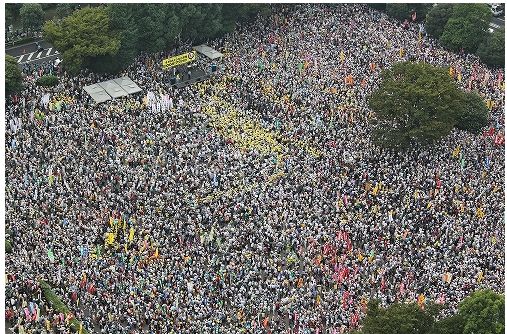
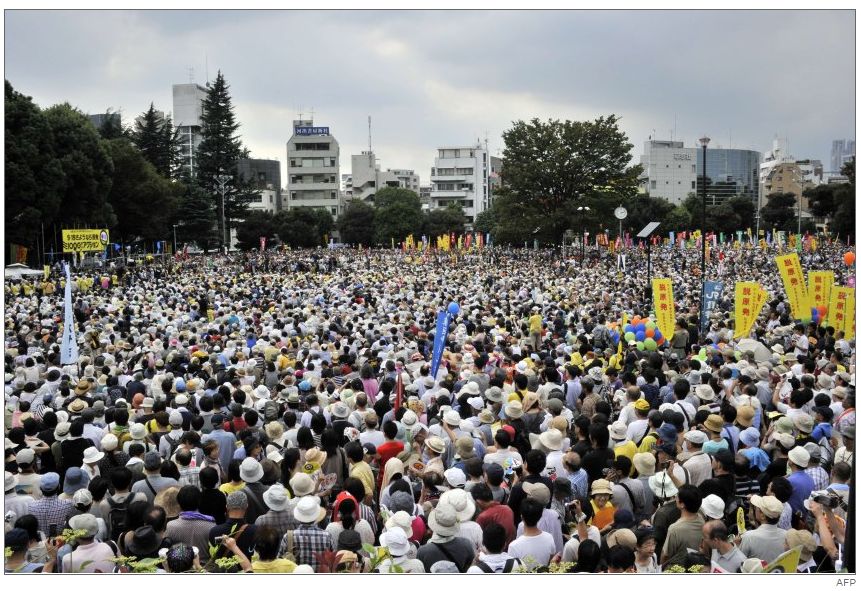
Organizers said 170,000 people filled a Tokyo square to sing songs, beat drums and cheer on a series of high-profile speakers who called for more Japanese to make their voices heard.


The entire article from New York Times (7/16/2012):

Tokyo Rally Is Biggest Yet To Oppose Nuclear Plan

By HIROKO TABUCHI
Published: July 16, 2012

TOKYO — In Japan’s largest antinuclear rally since the disaster at Fukushima, tens of thousands of protesters gathered at a park in central Tokyo on Monday to urge the government to halt its restarting of the nation’s reactors.

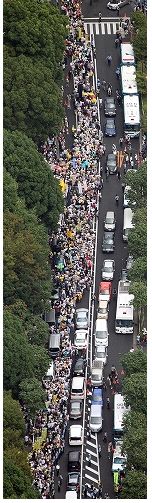
Organizers said 170,000 people filled a Tokyo square to sing songs, beat drums and cheer on a series of high-profile speakers who called for more Japanese to make their voices heard. The police put the number at 75,000, still making it the biggest gathering of antinuclear protesters since the Fukushima accident last year.

“To stay silent in the wake of Fukushima is inhuman,” the Oscar-winning musician Ryuichi Sakamoto told the crowd, which braved soaring temperatures to gather at Yoyogi Park.

Polls suggest that public opinion is still divided over the future of nuclear power in Japan. But a unilateral decision last month by Prime Minister Yoshihiko Noda to start putting the country’s reactors back into use has angered many Japanese and galvanized the antinuclear camp.

Antinuclear protests have gained momentum especially here in the capital, where tens of thousands of protesters now gather every week to shout slogans in front of Mr. Noda’s official residence.

After the rally, protesters marched through some of the city’s busiest shopping districts, prompting curious looks from passers-by but largely maintaining a strict discipline that has come to characterize the antinuclear rallies in recent weeks.

“It doesn’t matter, for now, if people hear us or not,” said Ayuko Higashi, an illustrator from Kamakura, southwest of Tokyo, who said this was her third antinuclear rally. “It’s just a big step forward to start raising our voices.”

Rally organizers have gone to great lengths to project a friendly image in a generally conformist country where protesters of any kind are seen by many as fringe agitators at best and terrorists at worst. This perception is left over from mass protests in the 1960s and ’70s against a security treaty with the United States, during which rioters armed with pipes and makeshift gasoline bombs clashed with the police.

At the weekly protests in front of the prime minister’s office, organizers cordon off family-only zones to urge parents with children to participate. They also ask protesters to cooperate with the local police and to go home at 8 p.m. on the dot.

Organizers have also started issuing pamphlets with advice on what to bring (drinks and hand wipes on sticky days), advice for shy or first-time participants (no need to say anything) and guidance on what to do if fellow demonstrators start getting out of hand (politely ask them to calm down).

An unlikely leader of the antinuclear movement is a fuzzy fictional character called Monju-kun, who has amassed a following on social networking sites like Twitter for his child-friendly jabs against the government’s energy policy.

Monju-kun made a brief appearance at the protest Monday with a colorful stuffed costume. “The government is restarting our nuclear reactors, and that makes me sad,” he said to squeals from fans — many of them families with small children — waving Monju-kun posters.

“If we’re not careful, we could have another nuclear accident, like a fire,” said Rion Nakajima, 5, who was clutching a balloon emblazoned with a smiling Monju-kun.

“We decided to participate because we want the Japanese government to realize that any mistake it makes now will have serious repercussions for future generations,” said Rion’s mother, Kazuki.

Nuclear power supplied nearly a third of Japan’s electricity before the Fukushima accident, but almost all reactors are now offline for checks or maintenance. Japanese leaders pledged last year not to restart any nuclear plant without local approval. But they apparently did not foresee the level of resistance that has since developed, and they have begun to push for plant reopenings, citing economic and security reasons. Last month, Mr. Noda approved the restarting of a reactor in western Japan. Others are expected to be put back into use in the coming months.

Recent polls have shown that public opinion remains divided between those who argue that Japan should abandon nuclear power and those who warn of a crippling energy shortage. A majority favor more stringent checks of reactors.

It is unclear whether the antinuclear protests can become a political force. There is still no significant Green Party in Japan, and the two largest parties say the country, for now, needs its reactors.

Mr. Noda, who initially raised the ire of protesters by calling their rallies “loud noise,” said last week that he was fully aware of public opinion both for and against nuclear power.

Sunday, July 15, 2012

"July 16 Goodbye Nuclear Protest" in Yoyogi Park, Tokyo


(UPDATE) The organizer says 170,000 people have gathered in the park.

This is Channel 2 Main Stage:


Streaming by Ustream


Anti- (or beyond-, if you like) nuclear celebrities are giving speeches with high-sounding words, how nuclear power has been pressed on the poor regions, talking about happiness of mankind without nuclear power, etc., etc. Now, some comedienne from Osaka with mohawk hair is shouting into the microphone.

And all I can think about while listening to these people is that old mother and her daughter in the no-entry zone in Fukushima, without water, without gas, whom (ex-journalist) Takashi Uesugi visited.

===========================================

The organizer, "Sayonara Nuke", hopes to attract 100,000 people.

If I remember right, it was somewhat like this last year - several months after the March 11 nuclear accident, several organizations started to stage anti-nuclear ("beyond nuclear" 脱原発, as they phrase it) gatherings and marches. I was rather disinterested in those events, with celebrities giving emotive speeches and ordinary citizens participate and chant "Beyond nuclear".

I couldn't care less last year as I was more interested in and worried about the radiation contamination of the environment and food. I remember often wondering why these people looked content "protesting" against nuclear power in the most generalized term after one of the worst nuclear accidents in history had happened in their own country with very tangible damage, particularly in Fukushima and southern Tohoku and northern Kanto.

Well the big gathering is back in Tokyo, in Yoyogi Park. It's just started, and you can view it on IWJ's 9 USTREAM channels:

Ch2,
Ch3,
Ch4,
Ch5,
Ch6,
Ch7,
Ch8,
Ch9,
Ch10

The channels I've checked says "Recorded Live". I don't know what's the deal is, but I hope it will start netcasting live soon.

This year, I am less disinterested because of totally citizen-based demonstrations that have been cropping up all over Japan.

Here's Channel 3, at the Second Stage. Some kind of funny act by a chubby man dressed as a devil, when I saw it:


Live stream by Ustream

Friday, July 13, 2012

Police "Divide and Conquer" on Friday July 13th Protest in Tokyo against Ooi Restart


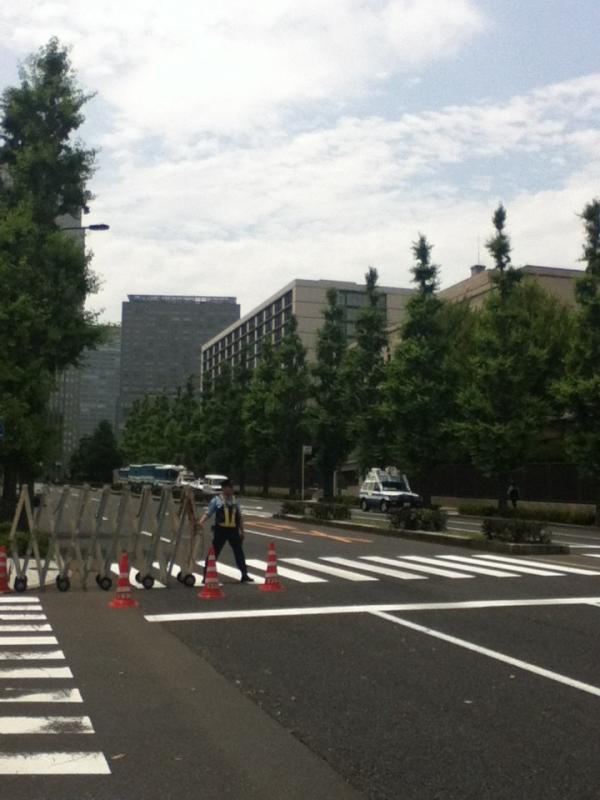
The Tokyo Metropolitan Police put up metal fences along the sidewalks, roadblocks, and restricted access to areas in the "protest zone" that they had set up, and effectively divided the protest into small pieces. No one seems to know how many people showed up.

The supposed "police" number quoted by the press is 10,000 people, though the PR department of the Tokyo Metropolitan Police has said they don't announce the numbers. What "police" the mainstream media outlets have been quoting, no one knows; supposedly some anonymous inside source that the press club reporters have access to all the time.

So, it was a success for the Noda administration and the pro-administration media, who didn't need to quote the number from the organizers this time.

This photo from the article by independent journalist Ryusaku Tanaka (7/13/2012) shows the police on one side of the metal fence and protesters on the other side. An older man on the left, looking at the camera looks puzzled and annoyed. (Click to enlarge.)


Tanaka calls it "Intifada". In Japan, it usually means the Palestinian ones. That's how he describes the protest that is herded in by the metal fences and the law enforcement.

In his article, Tanaka quotes two protest participants, both women in their 50s. The first one speaks like a man:

 「ふざけんじゃねえ。国民が自分の意志を表すために集まって来ているのにこんな鉄柵をつけるのはおかしい。これだけの人が来るのだから車道を開放すべきだ」(中野区・女性=50代)

"Stop bullshitting me. Citizens gather here to express their wills, and what's the point of this metal fence? With this many people coming, they should just open the road." (a woman in her 50s from Nakano-ku, Tokyo)

「初めて官邸前に来たら鉄柵があった。ものものしい雰囲気にびっくりしている。ノーと言える子供を育てたい。今日は子供たちに教室を休む理由を説明してきた」(名古屋・音楽教室を営む女性=50代)

"I'm here for the first time, and there are these metal fences. I'm surprised at this elaborate security. I want to raise children who can say "No". Before I came here today, I explained to my students why I was not giving lessons today." (a woman in her 50s from Nagoya, who runs a private music school)


There are tweets from younger people saying they didn't like the "obnoxious and impolite" baby-boomer generation at the protest, who apparently complained loudly to the police and to the pushy cameramen from the media, as they should. Well, young people, tough.

Friday July 13th Protest in Tokyo Live Netcast


(UPDATE: IWJ's channels don't seem to be working. Go to Nico Nico Video.

You can wait for IWJ's all 9 screens to go on air, here.

==============================================

IWJ's USTREAM channels on the protest at the Prime Minister's Official Residence in Tokyo for Friday July 13th, 2012:

Ch1—Yasumi Iwakami in front of the National Diet
Ch3—Aerial video or video from the car
Ch4—Bird's-eye view from a nearby building
Ch5—Front line at the PM Official Residence
Ch6—between the No.2 stage and the Ministry of Finance
Ch7—between the PM Official Residence and the Ministry of Finance
Ch8—Tents at the Ministry of Economy - Ministry of Education - Ministry of Economy
Ch9—In front of TEPCO, in front of KEPCO
Tokyo Ch1—Family area

Here's Channel 5. People holding white balloons must have gotten from Yasuo Tanaka, the head of New Party Nippon.


Live video from your iPhone using Ustream


You can also go to Nico Nico Video, netcasting the event for free for both members and non-members, here. You see the policemen on the other side (road-side) of the metal fences they installed.

Thursday, July 12, 2012

Tokyo Metropolitan Police Getting Ready for Another Big Protest at PM Official Residence in Tokyo on Friday July 13, 2012


Photos posted at Portirland (tamugon) blog:

This is new:


These were there before, too:


This is new:

This is new:

If you go, be safe.

If you want to watch USTREAM, Yasumi Iwakami's IWJ has 9 channels. See his page, here.

Sunday, May 13, 2012

Asahi's Asia Japan Watch: Japan Gymnastic Association Members Not Allowed on a Bus in Germany Last Year Because "People from Tokyo Are Contaminated"


No idea whether it is true or not, as it comes from Asahi Shinbun's "Asia and Japan Watch" (AJW) which has had very inaccurate headlines and articles regarding the nuclear accident.

From AJW, article by Kamome Fujimori (part; 5/12/2012):

Unease abroad over the post-3/11 situation in Tokyo is hardly new, however. Sports officials have had to deal with the reassignment of several events scheduled for Japan and some cancellations after the nuclear disaster.

One example was the 2011 World Figure Skating Championships, originally scheduled to be held in Tokyo in late March, but later reassigned to Moscow. The 2011 World Gymnastics Championships in Tokyo in October also appeared to be in danger at one point, but the Japan Gymnastic Association waged a successful campaign to reassure officials in other countries that Tokyo was safe enough to host the event as scheduled. It should be noted, however, that when some members visited Germany as part of that campaign, they were not allowed to get on a bus on the grounds that “people from Tokyo are contaminated.”


Ironic that Germany did that, if this Asahi's article is correct.

Friday, March 2, 2012

Tokyo Starts to Burn Onagawa Debris in Earnest at Incineration Plants for Regular Household Garbage in 23 Special Wards

Residents of those 23 Special Wards ("ku") had zero say in the decision. The decision was unanimously reached by the Assembly of Mayors of the 23 Special Wards, and the decision was quickly welcomed by the Tokyo Metropolitan government and the project of burning the disaster (radioactive) debris from Onagawa-machi in Miyagi Prefecture immediately started in December with the test incineration.

After the so-called "explanation" to the residents was done in the Special Wards, now the formality has been over. It's time to burn the debris no matter what. The first containers arrived at Chuo Waste Management Plant in Chuo-ku on March 2.

The governor of Tokyo and the mayors of the 23 Special Wards of Tokyo are so eager to "help out" people in the disaster-affected areas in Tohoku (where the radioactive fallout also landed) that they are willing to burn the disaster debris with radioactive materials, toxic chemicals, arsenic, asbestos, and no one knows what else, in the incineration plants with no special facilities to treat radioactive materials. These plants are often located in the middle of crowded residential/commercial areas with single-family homes, apartments, shops, schools, hospitals, small factories. When they are located on the landfills on Tokyo Bay, they are often close to public facilities like parks, schools, hotels.

These plants are not even for industrial waste; they burn regular garbage from households.

From Google Maps, some of the incineration plants in Tokyo's 23 Wards. The first two are the lucky two to receive the first batch of tsunami-soaked wood chips from Onagawa for the month of March:

Koto-ku:

Chuo-ku:

Katsushika-ku:


Edogawa-ku:

Adachi-ku:

Setagaya-ku:

Suginami-ku:

Wednesday, January 11, 2012

Disaster Debris from Onagawa, Miyagi: 133 Bq/Kg of Radioactive Cesium

which, if incinerated all by itself, would become ashes with maximum 4389 becquerels/kg of radioactive cesium, using the calculation by the Ministry of the (Destruction of) the Environment (multiply by 33).

The image below is from the information handed out to the residents who live near the incineration plants in Ota-ku and Shinagawa-ku in Tokyo, where the disaster debris from Onagawa-cho, Miyagi Prefecture was taken and burned in December. The entity in charge of burning the disaster radioactive debris from Miyagi in the 23 Special Wards ("ku") in Tokyo is the Clean Association Tokyo 23, who created the handout.

As you see, in the test conducted at Ishinomaki Clean Center, Onagawa-cho's regular waste is already radioactive, resulting in fly ashes with 2,200 becquerels/kg of radioactive cesium. Then, they measured the radioactivity by mixing the disaster debris to the regular waste, with 20% of the mix from the disaster debris, and burning. That resulted in fly ashes with 2,300 becquerels/kg of radioactive cesium.

This official information doesn't say whether the radioactivity of the disaster debris is the average or from one sample, or whether it was wood, plastic, or something else. It doesn't even say whether it was the debris with 133 becquerels/kg that was mixed and burned.

Now, many people who are all for bringing disaster debris from Miyagi and Iwate to Tokyo argue that since Tokyo is contaminated so much already, it doesn't make any difference, that Miyagi's disaster debris is less radioactive than Tokyo's regular garbage.

Is it?

Here's the latest test result (December 2011) of fly ashes at the municipal incinerators under the management of the Clean Association:


There are only three incineration plants whose radioactive cesium in fly ashes exceeds that of Onagawa-cho (circled in red), with two of them exceeding the level of Onagawa debris.

If we listen to those who believe it is logical to bring low-contamination debris/garbage to high-contamination areas and process, then most of the regular garbage should be shipped to Miyagi and be burned and buried there.

The mayor of Rikuzen Takata City in Iwate Prefecture thought it would be much better to process disaster debris in the city and wanted to build a new plant dedicated to disaster debris. He consulted the Prefectural government who turned down his request by saying the application procedure alone would take at least 2 years.

Disaster debris is as good as money. There are enough municipalities throughout Japan in a dire financial condition and willing to accept debris in exchange for subsidies. As Haruki Madarame of the Nuclear Safety Commission said 7 years ago, "It's all about money, isn't it?" He was talking about nuclear waste then.

Thursday, November 24, 2011

#Radiation in Japan: Tokyo Will Burn Miyagi's Disaster (and Radioactive) Debris in Incineration Plants in 23 Special Wards

The Tokyo Metropolitan government simply announced on November 24, 2011 that it will be accepting the disaster debris from Onagawa-machi in Miyagi Prefecture starting early December and lasting till March 2013, and the debris (which is radioactive, by the way) will be burned in the waste incineration plants operated by the 23 Special Wards and by municipalities in Tama District (western Tokyo). The agreement has already been signed.

In my November 15 post, I wrote about this deal. But I apparently forgot to write about my speculation at that time (I did in my Japanese blog) that the only reason I could think of as to why the Assembly of the Special Ward Mayors was being consulted in accepting the Miyagi debris was that the debris would be burned in the regular incineration plants in the 23 Wards. I was exactly right, and I don't enjoy having been right on this.

From NHK Kabun tweet:

宮城県女川町のがれきを東京23区と多摩地域の自治体が来月上旬から再来年3月にかけて都内に運び込んでおよそ10万トンを処理することになりました。各自治体が運営する清掃工場で焼却処理したあと、出た灰は東京港にある都の埋め立て処分場に埋め立てます(11/24)

Debris from Onagawa-machi, Miyagi Prefecture will be brought to Tokyo by the Tokyo 23 Special Wards and municipalities in Tama District of Tokyo starting early next month till March of 2013. 100,000 tonnes of debris will be processed. It will be burned in the waste incineration plants operated by the municipalities, and the ashes will be buried in the landfill on the Tokyo Bay. (November 24)

All over.

They are confident that bag filters will reduce or eliminate the radioactive materials on the debris, which will be flammable wood debris, according to the Tokyo Metropolitan Bureau of Environment.

How radioactive it can be? The Bureau of Environment's announcement has a link to the test result of burning the debris and measuring the radiation in Ishinomaki City in Miyagi Prefecture. The number is 2300 becquerels/kg of radioactive cesium in the ashes. Since it is so far below the 8000 becquerels/kg safety standard set by the Ministry of the Environment, there is no problem burning and burying, in the minds of the Tokyo Metropolitan governor and politicians and bureaucrats (and their celebrity supporters...).

By the way, the document from Onagawa-machi makes it clear that the debris may be burned in the private incineration plants in addition to the municipal incineration plants, and that the ashes may be used in "eco-cement".

Again, the only private incineration plant that would meet the spec (more than 100 tonnes per day capacity) is that TEPCO subsidiary, Tokyo Rinkai Recycle Power.

Friday, November 4, 2011

Tokyo Governor to Tokyo Residents Who Protest Against Disaster Debris from Iwate: "Shut Up"

Now that the radioactive disaster debris from Iwate Prefecture is a fait accompli and ready to be crushed and burned and buried, Shintaro Ishihara, irascible 79-year-old governor of Tokyo who almost single-handedly decided to do this mind-boggling project to "assist the recovery" of Iwate, mentioned the complaints that his government has received over the issue in the press conference on November 4 afternoon.

According to Fuji TV news clip on November 4, the governor said,

『黙れ』って言えばいいんですよ、そんなの。

"Shut up" is all we need to say to these complaints.

誰がそれでどうするの? 力のあるところが手伝わなくちゃ、しょうがないじゃないですか

What could one do? A powerful municipality [like Tokyo] must help [Iwate and other disaster-affected areas] because no one else can.

Fuji TV news also says that 3,000 complaints have been sent to the Tokyo Metropolitan government, over 90% of them protesting against the debris from disaster-affected areas to be transported, processed, crushed and burned and buried in Tokyo Bay.

Well, residents of Tokyo who voted for him in the spring election, isn't it time for his recall?

If the Fuji TV news link disappears (quite likely, since it is hosted at Yahoo Japan), there's a youtube clip, here. The comment section is filled with comments from Japanese people who praise the governor's decision and strong words. (Well they have their job to do, I guess.)

Tuesday, October 25, 2011

Elevated Radiation Level in the Center of Tokyo, in Ginza

An elementary school located in Ginza, Chuo-ku, Tokyo was found with a 0.80 microsievert/hour radiation spot, and a kindergarten, also in Chuo-ku, was found with 0.56 microsievert/hour spot. So-called "decontamination" effort using a power washer achieved only a modest success in lowering the radiation levels.

In both cases, the asphalt surface resisted decontamination effort, indicating radioactive materials are no longer on the surface after more than 7 months since the Fukushima I Nuclear Power Plant accident started.

From Tokyo Shinbun Tokyo local edition (10/25/2011):

中央区は二十四日、区立泰明小学校(銀座五)と中央幼稚園(湊二)の敷地内の排水溝などで放射線量を測ったところ、国が除染を行う基準としている毎時〇・二三マイクロシーベルト(一マイクロはミリの千分の一)を超える場所が見つかり、除染作業を実施したと発表した。

Chuo-ku announced on October 24 that Taimei Elementary School (located in 5 Ginza) and Chuo Kindergarten (2 Minato) had high radiation spots that exceeded the level that the national government uses as standard for doing decontamination (0.23 microsievert/hour). It also said the decontamination was carried out.

 区によると、二十一日に同小グラウンドの排水溝の一部で、毎時〇・三一マイクロシーベルトを測定。二十二日に高圧洗浄による除染をした結果、同〇・二二マイクロシーベルトに下がった。しかし、その脇のアスファルト部分で同〇・八〇マイクロシーベルトを検出。再度除染したが、同〇・五六マイクロシーベルトまでしか下がらなかった。

According to Chuo-ku, 0.31 microsievert/hour radiation was measured on October 21 in part of the drain on the school yard of Taimei Elementary. Decontamination was carried out on October 22 using a high pressure washer, and the radiation level dropped to 0.22 microsievert/hour. However, the asphalt surface next to the drain measured 0.80 microsievert/hour, and despite the decontamination it only dropped to 0.56 microsievert/hour.

 同幼稚園でも二十一日に雨どいの下二カ所で、同〇・五六マイクロシーベルトと同〇・四二マイクロシーベルトを検出。除染の結果、一カ所は同〇・二二マイクロシーベルトに下がったが、もう一カ所のアスファルト部分は同〇・四六マイクロシーベルトまでしか下がらなかった。

At Chuo Kindergarten, two locations under the rain gutter were found with 0.56 microsievert/hour and 0.42 microsievert/hour respectively on October 21. After decontamination, one location dropped to 0.22 microsievert/hour, but the other location, asphalt surface, remained high at 0.46 microsievert/hour.

 区は児童らが立ち入らないようにしたほか、今後アスファルトの入れ替えを予定している。

The city carried out measures to keep pupils out of the area, and is planning to replace the asphalt surface.

 区は各地で局所的に高い放射線量が検出されている問題を受け、二十一日から学校や公園で排水溝や植え込みなどの調査を始めたところだった。

In response to the reports of high radiation spots being discovered, the city started on October 21 to measure radiation levels in the drains and shrubs in schools and parks.

Tuesday, October 18, 2011

#Radioactive Tea from TOKYO: 3 Exceeding Provisional Safety Limit for Cesium

550 to 690 becquerels/kg of radioactive cesium detected in the commercial teas grown in 3 tea plantations in Tokyo. The Tokyo Metropolitan government tested 30 teas in early October, and radioactive cesium was detected from 29 of them.

Back in May, three elementary school in Itabashi-ku, Tokyo had the pupils pick radioactive tea leaves (2,700 becquerels/kg of radioactive cesium) as part of their social studies activities. But that wasn't, apparently, a big deal since it was not a commercial product.

Mainichi Shinbun (10/18/2011):

東京都は18日、都内の3茶園で栽培された東京狭山茶から、国の暫定規制値(1キロ当たり500ベクレル)を超える550~690ベクレルの放射性セシウムを検出したと発表した。都内で流通を目的にした製茶からの検出は初。

Tokyo Municipal government announced on October 18 that 550 to 690 becquerels/kg of radioactive cesium, exceeding the national provisional safety limit of 500 becquerels/kg, was detected from the "Tokyo Sayama-cha" tea from three tea plantations in Tokyo. It is the first time radioactive cesium was detected from commercial teas grown in Tokyo.

 都産業労働局によると、該当の茶葉は武蔵村山市、瑞穂町、あきる野市の3茶園で5月ごろに摘まれた。一部を生産農家が消費したが流通はしておらず、計500キロは茶園が保管しているという。都は各茶園に対し廃棄を要請した。

According to the Tokyo Metropolitan Bureau of Industry and Labor, the teas were picked in May at three tea plantations in Musashi Murayama City, Mizuho-machi, and Akiruno City. Part of the teas was consumed by the growers themselves but the rest haven't been sold yet. The tea plantations store 500 kg, which the Tokyo government has requested them to discard.

Discard how? Dump them in a garbage can as regular garbage, I suppose, since the radiation level is "low".

It was not until October 6 that the Tokyo Metropolitan government conducted a more extensive testing of the green teas grown, picked, and processed in Tokyo in May, after it learned of the teas grown in neighboring Saitama and Chiba Prefectures found with radioactive cesium exceeding the provisional safety limit.

If you look at the Tokyo government announcement, radioactive cesium was detected in significant amount in ALL but one teas tested. However, except for the three that exceeded the provisional safety limit, they can be sold without any restriction, and probably have been already sold. (The image of the announcement below is from savechild.net, with highlight on teas in which radioactive cesium was detected.)


Wednesday, October 12, 2011

#Radiation in Tokyo: Over 2.7 Microsievert/Hr in Setagaya-ku on a School Route

That is the air radiation. NHK News says the number happens to be much higher than the current air radiation in Iitate-mura (2.1 microsieverts/hour at the village office) in Fukushima Prefecture, where all the villagers have had to evacuate.

Just like in Yokohama City, a citizen measured the air radiation, and alerted the municipal government who then went and measured. At least the municipal governments have started to at least respond.

The result was 2.8 microsieverts/hour. The Setagaya-ku government power-washed the 10-meter stretch of the side walk, and the radiation came down to ... (hold your breath)... 2.71 microsieverts/hour.

Setagaya-ku is one of the special wards of Tokyo that located at the western end of the 23 special wards on the east Tokyo. It borders Kanagawa Prefecture to the south. (Setagaya-ku is marked in deep purple in the map, where the special wards are marked in light purple.)

From NHK News Japanese (10:58PM JST 10/12/2011):

今月初め、東京・世田谷区の区道で1時間当たり最大で2.7マイクロシーベルトという高い放射線量が検出され、世田谷区は、この場所に立ち入らないよう呼びかけるとともに今後の除染を検討しています。

2.7 microsieverts/hour radiation was detected on a municipal road in Setagaya-ku (special ward) in Tokyo earlier this month, and the Setagaya-ku government is asking people to avoid the location while it considers the decontamination plan.

高い放射線量が検出されたのは、世田谷区弦巻の区道の歩道の長さおよそ10メートル、幅およそ1メートルの部分です。世田谷区によりますと、今月3日、区民から「放射線量が高い場所がある」という情報が寄せられたため、区が測定したところ、1時間当たり最大でおよそ2.8マイクロシーベルトと周辺に比べて特に高い放射線が検出されたということです。

The high radiation was detected in the 10-meter long, 1-meter wide stretch of the side walk in Tsurumaki in Setagaya-ku. According to the Setagaya-ku government, a resident informed the government on October 3 that there was a location with high radiation. When the Setagaya-ku government measured, the radiation was 2.8 microsieverts/hour maximum, much higher than the surrounding area.

このため高圧の洗浄器を使って歩道部分の洗浄を行いましたが、放射線量はあまり下がらず、1時間当たり最大で2.707マイクロシーベルトが検出されたということです。原因について世田谷区が専門家に聞いたところ、問題の場所は雨水が集まって放射線量が高くなったことが考えられるということです。

The Setagaya-ku government used the pressure washer to wash the stretch of the side walk, but the radiation level only came down to 2.707 microsieverts/hour. The expert whom the government consulted with said the radiation level there may have become elevated because of the rainwater collecting there.

ただ、今回の測定では地表より高い場所でより高い数値が出るなど、通常あまり見られない結果が出ていることから、世田谷区では原因を詳しく調べることにしています。

However, the measurement revealed that the air radiation was higher off the ground than on the ground, and the Setagaya-ku government is planning to investigate further to identify the cause of this unusual result.

この区道は小学校の通学路にもなっていることから、区は、12日朝からこの場所をコーンで囲って立ち入らないよう呼びかけるとともに今後の除染を検討しています。世田谷区は、ことし7月から8月にかけて区内の小中学校や保育園、それに幼稚園で放射線量を測定しており、その際、高い放射線量は検出されていませんでした。世田谷区は、子どもへの影響を重視し、今月下旬から区内の砂場がある258か所の公園について調査することにしています。

This municipal road is a designated school route to an elementary school. Setagaya-ku has put up the road cones to alert people not to enter the area, and is considering decontamination. Setagaya-ku measured the radiation in elementary schools, middle schools, kindergartens and nursery schools in July and August, but there was no high radiation detected at that time. It plans to measure the radiation of 258 parks later this month to ensure safety for small children.

世田谷区環境総合対策室の斉藤洋子室長は「現場は小学校の通学路で、近くには幼稚園や保育園もある。心配する保護者の方がいると思うので、専門家とも相談してできるだけ速やかに除染などの対応をとりたい」と話していました。

Yoko Saito, head of the Setagaya-ku environmental office said, "This is a school route to an elementary school, and there are a kindergarten and a nursery school nearby. I think there are parents who may worry. We will respond as quickly as possible, such as decontamination, after we consult with experts."

Who wouldn't be worried? From what I have heard from an acquaintance, the majority of the parents. They are more worried if their toddlers can get into a prestigious kindergarten. (She is considering moving to Australia with her children.)

How is Setagaya-ku going to "decontaminate", anyway? Power-washing failed. They may have to remove the side walk altogether, and take down part of the yard that borders the sidewalk. I wonder if they are testing the soil or sediment on the side walk. There is no news or announcement at the Setagaya-ku government website.

Looking at the NHK video clip that accompanies the article, the particular stretch looks no different from any other stretch. It is bordering somebody's yard with plants. According to the Ministry of Education and Science aerial survey map of contamination for Tokyo, there should be hardly any contamination for Setagaya-ku.


Saturday, October 8, 2011

Tokyo Metropolitan Government Measures Soil Contamination in Shinjuku

And it is higher, much higher than the Ministry of Education's aerial survey indicates.

First, to recap, according to the just released Ministry of Education's aerial survey of radioactive cesium deposition in Tokyo, most of Tokyo has less than 10,000 becquerels/square meter of radioactive cesium, with the exception of the western-most Okutama and the eastern special wards ("ku") bordering Chiba Prefecture to the east.

Now, it turns out that the Tokyo Metropolitan government, who is not so eager to measure anything radioactive since March 11, was doing its annual survey of soil contamination in Shinjuku and quietly released the data on September 20.

The soil sample was taken at Tokyo Metropolitan Institute of Public Health in Hyakunin-cho, Shinjuku-ku, as it has always been done. (That's where the official air radiation level is monitored every day for Tokyo.)

For the last 5 years, radioactive iodine and cesium-134 were not detected, and cesium-137 was 2 to 3 becquerels per kilogram.

Now, this year, the numbers for the soil from the surface to 5 centimeters deep were:

  • Iodine-131: ND

  • Cesium-134: 360 becquerels/kg

  • Cesium-137: 430 becquerels/kg

  • Total cesium: 790 becquerels/kg

To convert from "per kilogram" to "per square meter", Japan's Nuclear Safety Commission uses the factor of 65. The total cesium per square meter in Shinjuku therefore is: 51,350 becquerels per square meter.

Even if you just take cesium-137 (for comparison purpose), 430 becquerels/kg translates to 27,950 becquerels/square meter.

The Tokyo Metropolitan government also found cesium-134 and cesium-137 in the soil between 5 and 15 centimeters deep. For the past 5 years, iodine-131 and cesium-134 were ND, and cesium-137 was 2 to 3 becquerels/kg.

But this year:

  • Cesium-134: 4.2 becquerels/kg

  • Cesium-137: 7.1 becquerels/kg

  • Total cesium: 11.3 becquerels/kg

However, true to form, the Tokyo Metropolitan government says it is in agreement with the Ministry of Education's survey of air radiation level. The government says the air radiation at the sample location is not that high (0.07 microgray/hr) therefore no decontamination of a wide area will be necessary. (Mr. Governor, we are talking about soil deposition here, not the air radiation level.)

The air radiation the Institute measures at 18 meters off the ground was 0.0563 microgray/hr that day, according to the announcement. The Tokyo Metropolitan government uses microgray as equivalent to microsievert.

It goes to show that the aerial survey with 300 to 600 meter radius and averaging out the numbers doesn't locate high radiation hot spots in the cities like Tokyo or Yokohama. Or anywhere else for that matter. And this Shinjuku location is not considered to be particularly hot.

Here's the screen capture of the Tokyo Metropolitan government announcement, with highlight:


(H/T savechild.net for the info and the screen capture)

Thursday, October 6, 2011

Ministry of Education's Radiation Map for Tokyo and Kanagawa

"Radiation? What radiation?" must be the message from the Ministry which has been doing the aerial survey of radiation in Tohoku and Kanto.

They did Tokyo and Kanagawa from September 14 to 18, using one helicopter that flew 10 times over the area. The radiation detection device on board the helicopter measured gamma radiation from the radioactive materials deposited on the ground from 150 to 300 meters off the ground. The measurement of about 300 to 600 meters radius below the helicopter is then averaged out. Here's the report by the Ministry (PDF).

As far as I know, there is no plan for the national government to conduct the ground-level measurement outside Fukushima Prefecture.

First, let's take a look at Tokyo.

Air radiation level at 1 meter off the ground:

Many residents have been measuring the radiation on the ground level in Tokyo, so have many organizations. Their measurement suggests much lighter blue colors for the eastern most one-quarter of Tokyo.

Cesium-134 and-137 deposition:


And Kanagawa.

Air radiation level at 1 meter off the ground:


Cesium-134 and -137 deposition:

Yokohama residents must be laughing at the Ministry's map, after over 100,000 becquerels/kg of radioactive cesium was detected on top of an apartment building.

What matters more in places like Tokyo and Kanagawa is the identification of hot spots and ultra-hot spots, which can only be done on the ground level. Measuring from the air and averaging out doesn't make sense, but then, that's how the government wants it done. It is not interested in details. The Tokyo Metropolitan government isn't interested in knowing the details either. Residents there are on their own.

The areas that have been mapped by the Ministry of Education so far:

Air radiation level at 1 meter off the ground:


Cesium-134 and -137 deposition:


Again, here's Professor Hayakawa's map:

Wednesday, September 28, 2011

Tokyo Metropolitan Government Will Accept and Burn Disaster Debris from Tohoku, Renews Efforts to Invite Olympic Games to Tokyo

If I thought Yokohama City was so slow in responding to citizens' concern on radiation contamination, I certainly didn't know what the Tokyo Metropolitan government could do.

It doesn't even tell the citizens.

First, the Tokyo government didn't tell anyone that they started dumping the radioactive ashes in the landfill in the Tokyo Bay in May. And now, without bothering asking the citizens, again, it will start bringing the disaster debris from Tohoku that are likely to be radioactive and burn in Tokyo.

NHK News (9/29/2011):

東京都は、東日本大震災で出た岩手県内のがれきを都内に運び込んで焼却処理することを決め、30日、岩手県との間で協定を結ぶことになりました。

The Tokyo Metropolitan government has decided to bring in the disaster debris from Iwate prefecture to Tokyo and burn them, and will sign an agreement with the Iwate prefectural government on September 30.

東日本大震災の被災地では、建物などが津波によって壊されたり、流されたりして出た大量のがれきの処理が問題になっていて、被災地だけでは処理しきれない状況になっています。国が被災地以外の自治体にがれきの処理を求めた結果、東京都は、被災地のうち、岩手県で処理しきれずに残っているがれきを、平成26年3月までの2年半にわたって受け入れることを決め、30日、岩手県との間で協定を結ぶことになりました。

In the disaster-affected areas in Tohoku, the amount of debris from tsunami is simply too huge for the affected municipalities to process by themselves. The national government has requested the prefectures and municipalities not affected by the disaster to take the debris and process. Responding to the request, the Tokyo Metropolitan government has decided to accept the debris from Iwate Prefecture for 2 and a half years till March 2014, and will sign an agreement with the Iwate prefectural government on September 30.

都では、今後、がれきを焼却処理などする業者を公募で決めたうえで、来月から岩手県宮古市のがれきをコンテナに入れて鉄道で都内に運ぶことにしています。がれきを運び出したり、焼却したりする際には放射性物質の濃度が測定され、処理されたものは、最終的に江東区青海の先にある処分場に埋め立てられる計画です。

The Tokyo Metropolitan government will conduct public bidding to decide which contractors will get to process (incinerate) the disaster debris before starting to accept debris from Miyako City in Iwate Prefecture starting next month. The debris will arrive in Tokyo in containers by rail. Radioactive materials will be measured when the debris are shipped, and when they are burned. After incineration, the ashes will be buried in the landfill beyond Aomi in Koto-ku.

東京都によりますと、事前に宮古市にあるがれきや焼却したあとの灰について、放射性物質の濃度を測ったところ、埋め立てが可能となる国の目安をいずれも下回っていたということです。被災地のがれきを東北以外の地域が受け入れるのは東京都が初めてで、都は最終的に東北の被災地からおよそ50万トンのがれきを受け入れる予定だということです。東京都環境局は「被災地の復旧や復興の支援につなげていきたい」と話しています。

According to the government, the density of radioactive materials measured on the debris and in the ashes from burning the debris in Miyako City was lower than the national standard to allow burying. Outside Tohoku, Tokyo will be the first to accept the disaster debris from Tohoku. The Tokyo government plans to accept the total of about 500,000 tonnes of debris. The Metropolitan bureau of environment says "We want to contribute to the recovery and rebuilding of the disaster-affected areas".

The landfill beyond Aomi, Koto-ku is the same one in the Tokyo Bay that the Tokyo Metropolitan government has been dumping the radioactive ashes since May. (See my 9/13/2011 post.)

As to the "safe" level of burying the radioactive ashes and debris, that's totally meaningless now that the Ministry of Environment has allowed the burial of just about anything, even the ashes that measures over 100,000 becquerels/kg of cesium, as long as there are measures in place at the processing facilities that will prevent the leakage. Uh huh.

Apparently, when the Tokyo Metropolitan government answered questions from the Tokyo Metropolitan Assembly on September 28, it was already a done deal. Assemblyman Hirofumi Yanagase, who has been active in alerting the citizens about dangerous radiation levels at sludge plants and waste incinerators in his district in Tokyo, fumes (link is in Japanese):

"The government said during the question and answer session in the Assembly on September 28 that the details were still being worked out. But then less than half a day later they announced a concrete plan of accepting 1,000 tonnes of debris from Iwate Prefecture by the middle of November."

Yanagase also wonders if his colleagues in the Assembly are even aware of radiation and radiation contamination in Tokyo at all. Probably not, Mr. Yanagase, from what I read and hear.

NHK also reports that the Tokyo will launch the campaign to invite the 2020 Summer Olympics to Tokyo but with the reduced budget, after the lavish and unsuccessful campaign by Governor Ishihara the last time (for 2016) was heavily criticized. Now Isihara says he will only use 7 billion yen (US$91.5 million) of taxpayers' money instead of 14 billion yen he spent the last time.

Oh and the national government now wants Tokyo and 7 other Prefectures in Kanto and Tohoku (Fukushima, Miyagi, Iwate, Ibaraki, Tochigi, Gunma, Chiba) to build intermediate storage facilities of highly contaminated soil in their own prefectures, according to Yomiuri Shinbun (9/28/2011). Half of Tohoku and most of Kanto are to have a nuclear waste dump, and Tokyo wants to invite Olympics.

Tokyo looks set to become the most radioactive capital in the world. I bet the governor of Tokyo likes that: "Ichiban (Number One)!" I doubt that it will win the Olympics bid, ever again.

Tuesday, September 20, 2011

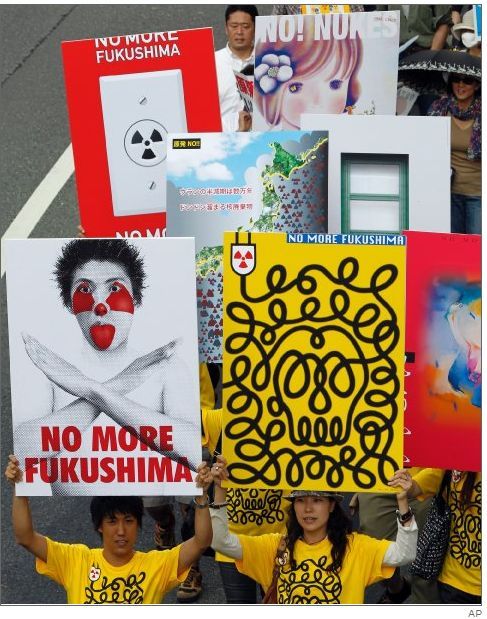
Photographs of 60,000-Strong Anti-Nuke Demonstration in Tokyo: Japanese MSMs Called It "A Parade"

Looking at this aerial photographs taken by Mainichi Shinbun (one of the better ones in terms of even coverage on nuke issues in Japan; another is Tokyo Shinbun), it sure looks more than 60,000 to me. People who actually participated in the event seemed to have the same impression as mine (on this blog comment sections, and on twitter), that it was far bigger than official number by the police (30,000).

Mainichi quotes the organizers' number of 60,000 people, and also quotes the number by the police (30,000):


Meanwhile, photos from Germany's Spiegel and France's Le Monde, who used the photos from AP and other agencies. Spiegel puts the number at 60,000:


and Yomiuri, who says "more than 30,000 people gathered" (exactly the police official estimate):


Asahi, slightly better perspective but not much, but the article does quite the organizers' number, 60,000 people:


and the US paper Forbes, without photo, says "tens of thousands of people marched", but the article title declares "Thousands march against nuclear power in Tokyo". Thousands??

Many participants in Japan are indignant that their demonstration was called a "parade", as if this was some festival attraction. Well, give the media time to learn. To me, it's amazing that the MSMs like Yomiuri and Asahi covered the event at all, and even had photographs. Asahi and Mainichi sent in their own photographers for the event. (Yomiuri's looks like Jiji Tsushin's photo.) I would take it as a sign that the anti-nuke movement may be crossing the threshold in Japan in terms of the number of people, and the MSMs cannot simply ignore anymore.

Calling it a "parade" and using the lowest official estimate by the police as the number of participants is a classic way to belittle a movement.

Sunday, September 18, 2011

60,000-Strong Anti Nuke Rallies in Meiji Park in Tokyo

or so the organizers say. But the number of participants are likely to have exceeded the target of 50,000, as many who are on the scene are tweeting.

Here's the link that you can watch: http://tanikichi.net/911/919-50000.html

Even the MSM (TV Asahi) is reporting that there are 30,000 people demonstrating against nuke.

Japanese people are slow to get started, but give them a bit more time. The number of protesters are getting bigger. (I mean, for Japan.)