

KEPCO seems to have much thicker skin than TEPCO, if that's even possible.
KEPCO says the alarm at one of the thermocouples inside the Reactor 4 Pressure Vessel has been triggered 137 times since the reactor started the full operation on July 25, but it's not a problem, things will sort themselves out soon.
From Mainichi Shinbun Fukui local version (8/3/2012):
関西電力は2日、大飯原発4号機(118万キロワット)の原子炉内の1次冷却水の温度が部分的に上昇したことを示す警報が同日午後3時現在で計137回作動したと発表した。警報は4号機がフル稼働に入った7月25日早朝に初めて作動。燃料集合体(193体)のうち1体について、周辺の冷却水の温度が警報基準に達した。
KEPCO announced on August 2 that an alarm was sounded 137 times as of 3PM that day which indicated the rise in local temperature of the primary coolant [water] inside the Reactor Pressure Vessel in Reactor 4 (1.18 million kilowatts) at Ooi Nuclear Power Plant. The alarm was first sounded in the early morning on July 25, when the reactor started the full operation. The temperature of the coolant around one of the nuclear fuel assemblies (193 assemblies total) rose to the level that would trigger an alarm.
関電によると、過去に1回使用した比較的燃焼度の高い燃料だったため、流量の変化で一時的に冷却水の温度が上がった。燃焼度に応じた燃料全体の配置に問題はなく、今月中旬ごろには安定した状態になるとみている。
According to KEPCO, the particular fuel assembly had been used once before and had relatively high fuel burnup. The company says that a change in the amount of flowing water temporarily raised the temperature of the coolant. KEPCO doesn't think there is any problem with the fuel assembly arrangement based on the fuel burnup, and says the temperature will stabilize by the middle of this month.
また、7月30日には取水口付近に漂着したクラゲの影響で3、4号機が共に取水量を抑えたため発電出力が最大約1・8%落ちた。
On July 30, the power output was decreased by 1.8% as both Reactors 3 and 4 reduced the amount of seawater intake because of jellyfish.
(So jellyfish are still protesting...)
KEPCO's press release on 8/2/2012 includes their explanation (in the attachment No.3) of why the alarm is being triggered and why it is no problem, in a very technical term (again, they outdo TEPCO).
From what I could figure, the thermocouple at this particular fuel assembly has been registering temperature higher than the standard (between 305 and 336 degrees Celsius), but it is because this assembly has high fuel burnup having been used once already, and as the time goes the relative output of the fuel assembly will drop, and the temperature will drop. The current cycle is the cycle No.15, and KEPCO uses more fuel assemblies that have been used once than in the previous two cycles, so the higher temperature is to be expected. As long as the temperature is below the saturation temperature (345.3 degrees Celsius), there is no problem with cooling.
(I put the English labels. KEPCO's press releases in English are almost all about financial results for the investors. They do have an English press release on the restart of Ooi Nuke Plant, dated June 16, 2012, if you're interested, here.)
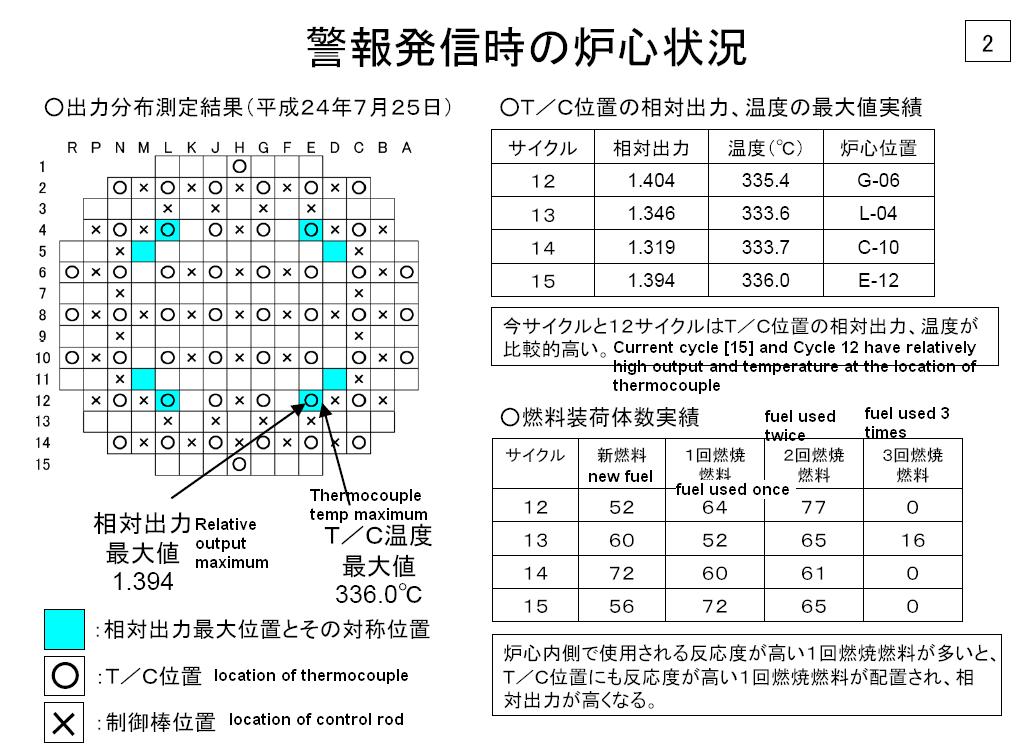

Ooi Nuclear Power Plant's two reactors are both pressurized-water reactors from Mitsubishi Heavy Industries.
The temperatures of the coolant inside the PWR, according to wiki, is 275 degrees Celsius as the water enters the RPV at the bottom, and 315 degrees Celsius as it flows upward to the reactor core.




 30-Day free trial by following the link.
 Tokyo Time
![[Most Recent Quotes from www.kitco.com]](http://www.kitconet.com/charts/metals/gold/t24_au_en_usoz_2.gif)


