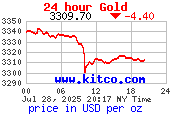
$1,321.80 was the high of the day for the spot price.
Here is an amusing chart for your weekend entertainment. It is a 3-year weekly chart of Dow Jones Industrial Average in candlesticks, with Dow divided by the gold price in solid black line. As expressed in gold, the index doesn't look that good, does it? In gold terms, the index is barely off the March 2009 bottom.
Friday, October 1, 2010
All That Glitters - Gold Going Higher
SEC Does Blame a Kansas Firm of Causing the Flash Crash
to the collective belly-laugh in the financial blogsphere and stock message boards.
Move on, nothing to see here, and those HTF algo bots are innocent.
(Who do they think they are kidding? Oh I see, themselves.)
Here's the SEC's report (the SEC staff managed to concoct a 100-page report in between porn viewing), and here's the initial take by Zero Hedge.
(The SEC would dare not point fingers at New York, Wall Street firms, would they?)
The stock of that Kansas firm in question, Waddell & Reed, is trading at $27.45 right now, up 9 cents for the day.
Thursday, September 30, 2010
Alex Jones Interviews Dr. Doug Rokke on Depleted Uranium
Another proof that when a state wages a war, it is more against its own than against another state.
Dr. Rokke "served as a member of the 3rd U.S. Army Medical Command's Nuclear, Biological, and Chemical response and special operations team and with the U.S. Army Depleted Uranium Assessment team during Gulf War 1. He was the U.S. Army's Depleted Uranium Project director from 1994 - 1995 and developed congressionally mandated education and training materials and wrote U.S. Army Regulation 700-48, the U.S. Army PAM 700-48, and the U.S. Army's common task for DU incidents." (from Alex Jones Show)
Here's the interview in three parts:
Part One
Part Two
Part Three
Stuxnet Has Moved On to China
After having wrecked havoc in Iran, Stuxnet the 'cyber weapon of mass destruction' apparently has moved on to China and is busy destroying computers there.
I'm very curious to know how it traveled from Iran to China... Hmmm. Maybe Chinese should have used legit copies of Windows from Microsoft...
So, who was it who created this malware? Maybe this one and this one?
Stuxnet 'cyber superweapon' moves to China (9/30/2010 AFP via Breitbart)
"A computer virus dubbed the world's "first cyber superweapon" by experts and which may have been designed to attack Iran's nuclear facilities has found a new target -- China.
"The Stuxnet computer worm has wreaked havoc in China, infecting millions of computers around the country, state media reported this week.
"Stuxnet is feared by experts around the globe as it can break into computers that control machinery at the heart of industry, allowing an attacker to assume control of critical systems like pumps, motors, alarms and valves.
"It could, technically, make factory boilers explode, destroy gas pipelines or even cause a nuclear plant to malfunction.
"The virus targets control systems made by German industrial giant Siemens commonly used to manage water supplies, oil rigs, power plants and other industrial facilities." [The article continues.]
SEC About to Blame a Small Trading Firm in Kansas for May 6 Flash Crash
Yeah right. No mention of High Frequency Trading, no mention of quote delay in NYSE.
I read the article on Bloomberg, and was about to write a post.
Zero Hedge beat me to it:
Bloomberg has just released something which if true, will wipe out every last ounce of credibility left in the market. As readers will recall, the initial scapegoat that CNBC and everyone else, who has no clue what really happens in the market decided to pin the flash crash on, was small Kansas-based trading firm Waddell & Reed, which traded a few extra contracts of E-Mini futures in the hours preceding the flash crash. Well, ladies and gentlemen, if this advance glance into what the SEC is about to disclose in its flash crash report is indeed valid, then the entire flash crash is about to be blamed on Waddell and Reed once again, with no mention of High Frequency Trading, or any of the other real culprits for the drop which wiped out $1 trillion in market cap, and the furthermore the report will have no policy recommendations. This is so insulting to the general intelligence of the average American investor who has by now seen the destructive influence of HFT in action so many times, that it will wipe out the last remaining shards of credibility left in US stocks. Will Mary Schapiro next blame every single mini flash crash which we have seen on almost daily basis over the past month on Waddell and Reed as well? Or is that reserved for E-Trade retail accounts? We will not pass judgment until we see the final report, but if true, this is immediate grounds for termination of the SEC head, and will require that everyone pull their money from the market asap, as it will definitely confirm that even our regulators have no clue just how broken the market truly is. It will also confirm that every single SEC staffer has been bribed, bought and corrupted beyond repair by the HFT lobby.
In case you haven't caught on yet to what really most likely caused the flash crash that clearly triggered the 21 consecutive weeks of outflow from equity funds, here it is.
Will HTF algo bots walk scot-free? Where will they go next? Someone at CNBC thinks it will go to CDS market, which is currently OTC but will be forced to move to exchange trading and clearing under the new financial regulation bill, and it may not be a pretty sight:
But what the heck, as long as the gullible taxpayers exist....Let's imagine, however, what a flash crash might look like in the CDS market.
Let's say high-frequency traders have become liquidity suppliers to the market, buying and selling bond protection. The broker-dealers have stopped providing this liquidity, in part because their profits have been squeezed out of the market by the new transparency. One day, an event somewhere in the world triggers the algorithms of a few highly correlated HFT shops to start buying more protection on a wide variety of stocks.
This triggers other HFT programs to stop selling, which triggers more buying. Prices on CDS soar across the board. The clearing houses start demanding more collateral from everyone to reflect the higher prices, triggering a rush for cash by everyone participating in the market.
Meanwhile, the risk management operations of institutional investors detect the soaring CDS prices, which are read to signal that the bonds are about to become distressed. The corporate bond market sells off and even more buyers for CDS enter the market. The short-term credit markets freeze up as money market funds stop providing credit to what look like increasingly risky corporate borrowers.
And then the clearing house notices that some market participants aren't making good on the collateral calls, so it starts closing out their positions. Outsiders get wind of this and begin to doubt the solvency of the clearing house, triggering a run on the clearing house itself. With no one able to process trades through the perhaps insolvent clearing house, and all other alternatives have been declared illegal by Dodd-Frank, the credit markets seize up completely.
The next thing we know, we're all hearing about emergency meetings down on Maiden Lane, where bankers and regulators are putting together a plan to fend off the next Great Depression. The plan is elegant and its proponents are articulate and highly adroit at defending it against critics. It involves the transfer of risk from the private market participants to the taxpayers. It is, in short, another bailout.
Can we handle a flash crash in the bond market? Are we prepared for a freeze in derivative clearing? Has anyone even asked these questions?
Wednesday, September 29, 2010
Amrose Evans-Prichard Apologizes for Having Defended the Fed
Apologies accepted. I'm glad he is finally discarding Keynesianism.
(He must have been reading Austrians at Lewrockwell.com, Ludwig von Mises Institute, Ron Paul, Peter Schiff...)
Shut Down the Fed (Part II) (Ambrose Evans-Prichard, 9/27/2010 Telegraph UK)
"I apologise to readers around the world for having defended the emergency stimulus policies of the US Federal Reserve, and for arguing like an imbecile naif that the Fed would not succumb to drug addiction, political abuse, and mad intoxicated debauchery, once it began taking its first shots of quantitative easing.
"My pathetic assumption was that Ben Bernanke would deploy further QE only to stave off DEFLATION, not to create INFLATION. If the Federal Open Market Committee cannot see the difference, God help America.
"We now learn from last week’s minutes that the Fed is willing “to provide additional accommodation if needed to … return inflation, over time, to levels consistent with its mandate.”
"NO, NO, NO, this cannot possibly be true.
"Ben Bernanke has not only refused to abandon his idee fixe of an “inflation target”, a key cause of the global central banking catastrophe of the last twenty years (because it can and did allow asset booms to run amok, and let credit levels reach dangerous extremes).
Worse still, he seems determined to print trillions of emergency stimulus without commensurate emergency justification to test his Princeton theories, which by the way are as old as the hills. Keynes ridiculed the “tyranny of the general price level” in the early 1930s, and quite rightly so. Bernanke is reviving a doctrine that was already shown to be bunk eighty years ago.
"So all those hillsmen in Idaho, with their Colt 45s and boxes of krugerrands, who sent furious emails to the Telegraph accusing me of defending a hyperinflating establishment cabal were right all along. The Fed is indeed out of control.
"The sophisticates at banking conferences in London, Frankfurt, and New York who aplogized for this primitive monetary creationsim – as I did – are the ones who lost the plot.
"My apologies. Mercy, for I have sinned against sound money, and therefore against sound politics."
[Emphasis is mine. The article continues.]
Obama Scolds Own Supporters for 'Apathy'
Blames anyone and everyone but himself.
Obama: Democratic voter apathy 'inexcusable' (9/28/2010 My Way News)
"WASHINGTON (AP) - Admonishing his own party, President Barack Obama says it would be "inexcusable" and "irresponsible" for unenthusiastic Democratic voters to sit out the midterm elections, warning that the consequences could be a squandered agenda for years.
""People need to shake off this lethargy. People need to buck up," Obama told Rolling Stone in an interview to be published Friday. The president told Democrats that making change happen is hard and "if people now want to take their ball and go home, that tells me folks weren't serious in the first place."" [Emphasis is mine. The article continues.]
Ding ding ding ding... What would you expect from college freshmen and sophomores (now juniors and seniors if they haven't dropped out)?
Oh I see, that's why Obama is speaking to a fresh batch of freshmen and sophomores in Wisconsin. (Sucker born every minute, as they say.)
(Are we paying for this partisan campaign event, by the way?)
Squandered agenda? Now, pray tell, what is it? Do you mean...
- Perpetuation of TBTF (too big to fail) banks via the Dodd-Frank financial "reform" bill while more Americans are facing foreclosures;
- Giving the Federal Reserve, a private entity, enormous power to create inflation (= loss of purchasing power of US dollar which hurts lower income people more than the "rich");
- Obama administration in the pocket of Wall Street, big pharma, big oil;
- Huge taxation for everyone (not just "rich") via the health care "reform" bill;
- Expanded war in Afghanistan, continuing "war" in Iraq, secret war against Pakistan, destroying lives there and ruining many US soldiers physically and psychologically;
- More jobs being shipped overseas, with active government help, depriving unskilled youth labor (predominantly blacks) opportunities to work.
So, true liberal and progressive voters who value human rights and justice, who support struggling working class families, who oppose wars, what are you going to do? Will you snap back into line and march with the establishment Democrats and vote for the "agenda" that seems, from what I understand, diametrically opposed to your core beliefs?
Tuesday, September 28, 2010
Zero Hedge: Gross, El-Erian Rumored Replacements For Larry Summers
Of all people....
Gross, El-Erian Rumored Replacements For Larry Summers
(Tyler Durden, 9/28/2010 Zero Hedge)
"Rumor making rounds now that either of Pimco's top two men could replace the man who destroyed Harvard's endowment. Should either of these two be forced to quit Pimco, it would mean that QE would have to be massive to make sure that the Fed is a backstop of last reserve in case the next head of Pimco is unable to replicate his predecessor's success."
I bet it would be El-Erian. He was the president of the Harvard Endowment and quit just in time before the investments blew up. I'm sure he can hop out right before the US finally collapse, on his way back to the IMF where he was a deputy director, so that he can blow up the entire world.
But in between, either Gross or El-Erian may be able to make a sh-tload of money for the government by trading the government money with high leverage. 33 Liberty had better watch out...
Gold Hit New High at $1,311.20
Gold spot (as reported by Kitco.com) hit $1,311.20.
As Ambrose Evans-Pritchard says, "Gold is the final refuge against universal currency debasement".
Hear that, Dr. Bernanke?
Monday, September 27, 2010
$100 Billion QE2 a Month, As Far As Eyes Can See
By now, many of you may have already read the Fed leak piece that appeared in Wall Street Journal this afternoon.
Benny and the Inkjets are planning QE2 alright, but with a twist. And that twist is given by none other than James Bullard, St. Louis Fed President who penned the light-weight paper back in July about inflation target and fed funds rate, comparing the US with Japan.
In that paper, Bullard came out in favor of the Quantitative Easing 2 as a way to nudge the inflation rate toward the Fed's unofficial but implicit target, which he calls "stable target state". (I've read the paper, and I still don't quite understand his logic of why that particular area is "stable".)
Now according to the WSJ article, he is in favor of QE2 in a sneaky way, by not announcing the total amount or duration. He wants to do QE2 at a measured rate, less than $100 billion a month, and keep doing it until the Fed decides to stop. Or Bullard decides to stop.
He says in the article that $1 trillion per year of QE2 would give him "pause", but he doesn't say whether that would deter him from printing further. He is worried, supposedly, that it would amount to outright monetization as $1 trillion would be close to the net debt issues by the Treasury Department.
Not that Turbo Timmy and Barry at the White House (who by the way is reduced to pitching a longer school days ) would mind issuing extra debt so that the Fed would appear not to be completely monetizing. And they would get more free money to squander on their grand plans for the rest of us while sending US dollar down the drain.
Bullard seems to have more clout than others within the Fed. It's just my sense, but the Fed's announcement after the September FOMC read like one particular section of Bullard's July paper; that was about how to craft the FOMC language on inflation expectation to guide the inflation expectation and hopefully actual inflation rate higher. In the paper, he praised highly the FOMC language on inflation after the dot-com bust, and he seemed to think that clever language did the trick and the stock market and the economy recovered.
So why do these people at the Fed need advanced degrees in economics? All they would need seems to be BA or MA in English Literature. If they call it economics, then economics is certainly not a science.
Anyway, here we have it. The Fed's plan, $100 billion a month, for as long as it takes. To achieve what? Don't ask. Don't even bother.
They will achieve inflation alright. Just don't expect it to be a gradual affair. We will never know (neither will they) which incremental $100 billion will break the camel's back.
If you want to read Bullard's paper, here's the link. I've read it, and I can assure you there's nothing to be intimidated if you don't have a PhD in economics. It's not really a research paper, but more like an essay, a stream of consciousness about zero interest rate and fear of being stuck forever.
Sunday, September 26, 2010
Czech President to UN: Stay out of Economics and Science
Czech President Vaclav Klaus, speaking like an Austrian (economist, that is). I would go one step further and not leave the solutions to the member governments either; the solutions are to be found in free market capitalism. But I'm sure Professor Klaus knows that, as he is after all a follower of Friedrich Hayek. "UNITED NATIONS, Sept 25 (Reuters) - Czech President Vaclav Klaus on Saturday criticized U.N. calls for increased "global governance" of the world's economy, saying the world body should leave that role to national governments. "The solution to dealing with the global economic crisis, Klaus told the U.N. General Assembly, did not lie in "creating new governmental and supranational agencies, or in aiming at global governance of the world economy." ""On the contrary, this is the time for international organizations, including the United Nations, to reduce their expenditures, make their administrations thinner, and leave the solutions to the governments of member states," he said. ""The anti-crisis measures that have been proposed and already partly implemented follow from the assumption that the crisis was a failure of markets and that the right way out is more regulation of markets," he said. "Klaus said that was a "mistaken assumption" and it was impossible to prevent future crises through regulatory interventions and similar actions by governments. "That will only "destroy the markets and together with them the chances for economic growth and prosperity in both developed and developing countries," he said.
From Reuters:
Zero Hedge: Implication of QELite and QE2 = Death of Fiat Monetary System
Excellent article from Zero Hedge on the implication of QE2 that is to come our way, courtesy of the uncontrollable, unaccountable Federal Reserve.
(If you prefer to print out the article and sit down to read it, here's the printer-friendly version.)
Oh BTW, got gold?
(Or for that matter, toilet paper, baby formula, bag of rice, packs of cigarettes ... and a whole lot other items?)
Why QE2 + QE Lite Mean The Fed Will Purchase Almost $3 Trillion In Treasurys And Set The Stage For The Monetary Endgame (Tyler Durden, 9/26/2010 Zero Hedge)
Recently the debate over when QE2 will occur has taken a back seat over the question of what the implications of the Fed's latest intervention in monetary policy will be, as it is now certain that Bernanke will attempt a fresh round of monetary stimulus to prevent the recent deceleration in the economy from transforming into outright deflation. Whether or not the Fed will decide to engage in QE2 on its November 3 meeting, or as others have suggested December 14, and maybe even as far out as January 25, the actual event is now a certainty. And while many have discussed this topic in big picture terms, most notably David Tepper, who on Friday stated that no matter what, stocks will benefit from QE2, few if any have actually considered what the impact of QE2 will be on the Fed's balance sheet, and how the change in composition in Fed assets will impact all marketable asset classes. We have conducted a rough analysis on how QE2 will reshape the Fed's balance sheet. We were stunned to realize that over the next 6 months the Fed may be the net buyer of nearly $3 trillion in Treasurys, an action which will likely set off a chain of events which could result in rates dropping all the way to zero, stocks surging, and gold (and other precious metals) going from current price levels to well in the 5 digit range.
A Question of Size
One of the main open questions on QE2, is how large the Fed's next monetization episode will be. This year's most prescient economist, Jan Hatzius, has predicted that the minimum floor of Bernanke's next intervention will be around $1 trillion, which of course means that he likely expects a materially greater final outcome from a Fed that is known for "forceful" action. Others, such as Bank of America's Priya Misra, have loftier expectations: "We expect the size of QE2 to be at least as much as QE1 in terms of duration demand." As a reminder, QE1, when completed, resulted in the repurchase of roughly $1.7 trillion in Treasury and MBS/Agency securities. It is thus safe to assume that the Fed's QE2 will likely amount to roughly $1.5 trillion in outright security purchases. However, as we will demonstrate, this is far from the whole story, and the actual marginal purchasing impact will be substantially greater.
A Question of Composition
Probably the most important fact that economists and investors are ignoring is that QE2 will be accompanied by the prerogatives of QE Lite, namely the constant rebalancing the Fed's balance sheet for ongoing and accelerating prepayments of the MBS/Agency portfolio. This is a critical fact, because once it becomes clear that the Fed is indeed commencing on another round of monetization, rates will collapse even more beyond recent all time records (and if we are correct, could plunge all the way to zero). What is very important to note, is that as Bank of America's Jeffrey Rosenberg highlights, a material drop in rates, which is now practically inevitable, is certain to cause a surge in mortgage prepayments of agency securities: "Our mortgage team highlights a 100 basis point decline in rates would raise the agency universe of mortgages refinanciability from currently about half to over 90%." (full report link)
The fact that declining rates creates a feedback loop on prepayments, which in turn results in more security purchases and even lower rates, is most certainly not lost on the Fed, and is the primary reason for the formulation of QE Lite as it currently exists. Indeed, those who follow the Fed's balance sheet, are aware that the MBS/Agency book has declined from a peak of $1.3 trillion on June 23, to $1.246 trillion most recently, a decline of $53 billion, which has been accompanied by $25 billion in Bond purchases, resulting in such direct FRBNY market involvements as $10 billion weekly POMOs. These, in turn, are nothing less than a daily pump of liquidity into the Primary Dealers (who exchange bonds boughts at auction for outright cash) by the Fed's Open Market Desk, which then liquidity is used to the PD community to bid up risk assets.
If we are correct in our assumption that on November 3, the Fed will announce a $1.5 trillion new asset purchase program, the implications of the previous observation will be dramatic. We additionally believe, that unlike QE1, the Fed will be far less specific as to the composition of purchases this time around, specifically for the aforementioned resion. As the Fed adds an additional $1.5 trillion in total assets, and as 10 Year rates, and thus 30 year cash mortgage rates, drop, the prepayment frequency of the Fed's existing MBS/agency book will surge, until it approaches and surpasses BofA's estimated 90% in a very short period of time. And courtesy of its QE Lite mandate, the Fed will purchase not only $1.5 trillion of US Treasurys as part of its new QE2 mandate, but will actively be rolling those MBS and Agencies put to it by the general public. As a result, it is our belief that over the six months beginning on November 3, the Fed will end up purchasing almost $3 trillion in US Treasurys in total. This can be summarized visually as follows:
As the chart shows, while the Fed's balance sheet grows from its current level of $2.3 trillion to $3.8 trillion, it is what happens to the Treasurys held outright by the Fed that is most disturbing: from $800 billion, we expect this number to surge to nearly $3.6 trillion in just over half a year, a massive increase of almost $3 trillion. The implications of this asset "transformation" on the Fed's balance sheet, not to mention those of US retail and foreign investors, and capital markets in general, will be dramatic.
Offerless Bonds?
One of the main problems facing the Fed in indirectly monetizing US Treasurys (keep in mind the proper definition of monetization is the Fed buying bonds directly from the Treasury, as opposed to using Primary Dealer middlemen, which is how it operates currently), is that there simply are not enough bonds in circulation to be bid, under its current regime of operation! Readers will recall that as part of existing SOMA guidelines, the Fed is limited to holding at most 35% of any specific marketable CUSIP. Furthermore, applying the SOMA limit to the $2 trillion in upcoming next twelve month issuance, means that in the interplay of the prepayment feedback loop coupled with collapsing rates, the Fed will need to either change the cap on the SOMA 35% limit, or the Treasury will need to issue far more debt to keep up with the sudden expansion in the Fed's outright, and not just marginal, capacity for incremental debt. Priya Misra summarizes this conundrum facing the Fed best:
We examine the Treasury market to analyze which part of the curve might benefit the most from Fed buying if it embarks on QE2. The constraints will come in term of the 35% SOMA limit as well as current outstandings and issuance profile. Table 5 provides the breakdown of average SOMA holdings and eligible dollar amount outstanding by sector. We estimate that in the nominal coupon universe, there is currently $1.3trillion in outstanding eligible issues for the Fed to buy. We compute eligible number of issues as the amount the Fed can buy without breaching its SOMA limit of owning 35% of the issue size. Considering that the Fed has not purchased 0-2 year securities in either QE1 or the reinvestment program so far, the eligible universe reduces to $935billion. Interestingly, $560bn of this is in the less than 7 year sector.
While the total eligible securities may seem like a low number in the context of QE2, we expect $2.1tn in gross issuance over the next year. Adding 35% of this gross issuance to the total, the Fed will have $1.67tn in eligible nominal outstanding to purchase without breaching the 35% limit. However, depending on the total size of QE2, much of the buying might have to be concentrated in the 2-7 year sector. To the extent that the Fed wants to keep long end rates low, it might have to increase the 35% SOMA limit, or the Treasury could change issuance.
We believe that the resolution to the limited supply question will be found promptly, as the last thing the US government and Treasury need is to be told that they need to issue more debt. We are confident they will obligly handily. From a purely structural perspective, suddenly the entire UST curve, and not just the "belly", will be offerless, as the Fed will now have a mandate of buying up virtually every single bond available in the open market, and then some! What this means is that rates will promptly plunge, and while many have noted the possibility that the 10 Year drops below 1% upon the formal announcement of QE2, we believe there is a very high probability that even the long-end can see rates drop substantially below 1%, while the 10 Year approaches 0%. Keep in mind that this move will not be predicated upon inflation expectations whatsoever (and in fact we believe this is merely the first step to an outright monetary collapse also known in some textbooks as hyperinflation), but merely as a means of frontrunning Ben Bernanke, as the entire bond market goes offerless, knowing full well that the Fed will buy any bond below its theoretical minimum price of 0% implied yield (we leave it to our readers to determine what this means price-wise on the curve). It also means that the Fed will finally cross the boundary into outright monetization, as Bernanke will be forced to directly bid for any new paper emitted by the US Treasury, to maintain the tempo of its purchases.
Asset Implications
As we have noted above, the immediate implication of the vicious (or virtuous if you are Ben Bernanke) feedback loop of collapsing rates, prepayments, and accelerating UST purchases, is that mid-and long-term rates will likely promptly approach zero, as every UST holder realizes they are now the marginal price setter in a market in which there is a bid for any price. The Fed will merely render the traditional supply/demand curve meaningless, and any bonds offered for sale at any price will be bid up by Brian Sack. The implication on stock prices is comparably obvious: to readers who have been confounded by the impact on stocks when there is $10 billion worth of POMOs in a week, we leave to their imagination what the impact on 4x beta stocks will be once the Fed floods the market with $90 billion worth of weekly liquidity, which is what we calculate to be the peak repurchase activity between the months of January and March, as QE2 ramps up to its full potential. In this vein, analysts such as Deutsche's Joe LaVorgna who this Friday came out with a note advising clients not to "Fight the Fed" (link) may take the message to heart. After all, if this last attempt by the Fed to spur asset price inflation, in which Bernanke is effectively telling the consumer that a house can be had for no money down, and for no interest ever, thereby eliminating the risk of price deprecitation, fails, it is game over.
And speaking of game over, we dread to look at a chart of the DXY in early 2011. The dollar will plunge, pure and simple, as the Fed makes it clear that it will not tolerate currency appreciation. Also, don't forget that as a side effect of QE2, another component that will surge in addition to Fed Treasury holdings, will be excess reserves held by the banks. If we are correct in estimating that the Fed's assets will explode to $3.8 trillion, then bank excess reserves will skyrocket by a factor of 150% from the current $1 trillion to well over $2.5 trillion. The immediate casualty of this will be the US Dollar: one needs to look no further than 2009 to see what happened to the DXY when excess reserves increased by $1 trillion, in order to extrapolate what happens when it becomes clear that Bernanke is prepared to put any amount of liabilities on the Fed's balance sheet in its latest reflation attempt. And if anyone had doubts about the Fed being able to successfully absorb $1 trillion in excess reserves accumulated through QE1, all those concerns will be put to rest once the number hits $2.5 trillion, or more.
Which brings us to gold. Needless to say, once the full "all in" realization of just what QE2 means for risk assets and capital markets sets in, gold (and other physical commodities) will promptly go from its current price of $1,300 to a number well in the five-digit range. We leave it up to our readers to provide the actual digits.
In summary, David Tepper may well be right that stocks will benefit from QE2, as will Bonds and as will commodities. In fact, every asset class will explode in a supernova of endless liquidity. To be sure, all of this will be very short lived. Very soon, all those assets denominated in fiat paper, will promptly collapse in the great black hole of reserve currency devaluation, as it becomes clear that the Fed will stop at nothing to win the race of global currency debasemenet. And of course, none of this is to be confused for an actual improvement in the economy, as QE2 will result in a dramatic and irreversible deterioration in the US, and thus global, economy, which, once the initial euphoria from QE2 recedes, will promptly progress to isolationism, protectionism, currency wars and exponentially accelerating monetization of each and every asset class, thereby rendering price discovery irrelevant, as central banks around the world stampede into irrelevant capital market, each buying up as much of everything as their printing presses will allow them, until the ink runs dry.
At this point we refuse to pass ethical judgment on the Fed's actions. The Fed will do this action regardless of what happens on that other fateful event scheduled to take place on November 3. If it does not, asset prices will collapse leading America into a deflationary vortex of deleveraging, and Bernanke is fully aware of this. The only reason the market has found some validation to the September risk asset surge, is the "certainty" of QE2. Were this to be taken away, stocks would plunge, as would all other assets. And since the Fed is uncontrollable, and unaccountable to anyone, it is now impossible to prevent this line of action, whose outcome is what some may be tempted to call, appropriately so, hyperinflation. The direct outcome will be an explosion in all asset prices, although we continue to believe that of all assets, gold will continue to outperform both stocks and bonds, as recently demonstrated. Those who are wishing to front-run the Fed in its latest and probably last action, may be wise to establish a portfolio which has a 2:1:1 (or 3:1:1) distribution between gold, stocks and bonds, as all are now very likely to surge. We would emphasize an overweight position in gold, because if hyperinflation does take hold, and the existing currency system is, to put it mildly, put into question, gold will promptly revert to currency status, and assets denominated in fiat, such as stocks and bonds, will become meaningless.
And while Zero Hedge refuses to condemn what is now openly an act of war against the US middle class and the country's holders of dollar-denominated assets, by Ben Bernanke, who is fully aware what the implications of QE2 will be, we were delighted to read a brief note by none other than Bank of America's Jeffrey Rosenberg, who analyzes the costs of QE2, and comes to a politically correct conclusion which recapitulates everything said previously.
The costs of QE 2 in our view however go beyond the cost benefit analysis Chairman Bernanke highlighted in his Jackson Hole speech. There, the Chairman highlighted two key risks to additional purchases of longer-term securities. First, that they do not know with precision the effect of changes in Fed holdings of securities on financial conditions. On this point we have emphasized on numerous occasions that the main consequences of QE1 to date have been financial asset inflation. Further purchases under QE2 hence in our view would likely be limited in impact to furthering this process of asset inflation. However, the costs of even further asset inflation would likely accelerate the risks associated with what we characterize as conditions conducive to the growth of a credit bubble: low global yield levels, tight credit spreads, and an excess of demand for credit relative to supply. While those characteristics create asset inflation and form the backdrop of our near term bullish outlook on risky asset class performance, the risks of sparking future credit bubbles with their attendant systemic risk consequences grows under a scenario of QE2, in our view.
It’s the (lack of) confidence, stupid
The second risk highlighted in Jackson Hole by the Chairman concerns the confidence effects of Fed’s ability to exit accommodative policy and shrink the size of its balance sheet. While we agree with the notion that the key risk is one of confidence, the confidence impact of greater near term importance may lie less with concern over the Fed’s eventual ability to exit and more with what expanding QE2 says about the Fed’s confidence in its ability to utilize monetary policy to address deflationary risks.Bernanke acknowledged that fiscal policy needs to be part of the policy response and that “Central bankers alone cannot solve the world’s economic problems.” In our assessment, further liquidity injection beyond some additional marginal transmission mechanism into mortgage refinancing or housing affordability would achieve little impact on the real economy. Much of the liquidity benefit of QE1 for the commercial side of the economy already remains on display in the form of very high rates of corporate refinancing activity. Additional rate declines from QE2 would add only marginally to those trends well underway. For smaller corporates or small business, QE1 did little to expand lending, though QE1 likely did prevent even further declines in lending. However, QE alone appears incapable of leading to expanding lending as the problems today shift from one of supply to one of demand. Chart 5 illustrates the stabilization of lending and how most of the Fed’s expanded balance sheet remains in the form of cash, not loans. Chart 6 shows that even as banks have eased underwriting standards, the demand for loans remains low.
Rather than liquidity – and its potential augmentation from expanding QE - the key issue behind the inability to see credit expansion and the weakness of monetary policy more broadly to affect a more positive economic outlook is confidence. And this leads to our final cost analysis on QE2. Where confidence stands as the key issue for the economy, expanding QE2 may end up doing more damage than good as the confidence loss from a Fed indicating its fears of deflation through expansion of QE2 as well as the follow on loss of confidence from the diminishing impact of further QE leads to a loss in confidence whose costs outweigh those of the benefits of further reductions in long term rates.
Perhaps at this point it is prudent to recall what the first definition of credit is:
1. Belief or confidence in the truth of something.
By that defintion, America's "credit" has ran out.

| Attachment | Size |
|---|
| Attachment | Size |
|---|---|
| BofA Securitization Weekly 9.17.pdf | 882.84 KB |
Unilever to Study Stone-Age Diet
Bloomberg News cites the Times of London that reports Unilever is studying Stone-Age diet to come up with new product.
Well, you don't need to wait around for a big multinational food and consumer goods conglomerate to come up with a Paleo diet for you. You can start right away by going to Mark's Daily Apple, and eat and exercise like a caveman!
Saturday, September 25, 2010
War and Deficit As Far As Eyes Can See
The first three links go to the articles by Jason Diz on September 24, 2010 at Antiwar.com website:
US Combat Continues in 'Post-Combat' Iraq
...US military spokesman Brig. Gen. Jeffrey Buchanan announced today that “our rules of engagement have no changed,” meaning the claims that only “non-combat” troops remains in the nation were even more transparently false than they appeared on the surface.Pants on fire!
Obama Vows US Troops to Stay in Afghanistan ‘Until the Job Is Done’
...In an interview today with the BBC’s Persian Television channel, President Barack Obama promised that the United States would not end the war in Afghanistan as a result of the July 2011 drawdown date.Pants on fire! I thought the reason of going there was to grab Osama Bin Laden. No?
Rather Obama insisted the war would continue “until the job is done”and went on to define the job as “to provide Afghans themselves the capacity to secure their own country.” He gave no indications of when he thought this might be.
FBI Launching Mass Raids of Antiwar Activists’ Homes
...The FBI is confirming that this morning they began a number of “raids” against the homes of antiwar activists, claiming that they are “seeking evidence relating to activities concerning the material support of terrorism.”
Now, how do they define "material support" and "terrorism"?
Here's Paul Craig Roberts' take:
...Now we know what Homeland Security (sic) secretary Janet Napolitano meant when she said on September 10: "The old view that 'if we fight the terrorists abroad, we won't have to fight them here' is just that--the old view." The new view, Napolitano said, is "to counter violent extremism right here at home."And the multibillionaire Warren Buffett excoriates us for being angry at the government.
"Violent extremism" is one of those undefined police state terms that will mean whatever the government wants it to mean. In this morning's FBI's foray into the homes of American citizens of conscience, it means antiwar activists, whose activities are equated with "the material support of terrorism," just as conservatives equated Vietnam era anti-war protesters with giving material support to communism.
"Material support" is another of those undefined police state terms. In this context the term means that Americans who fail to believe their government's lies and instead protest its policies, are supporting their government's declared enemies and, thus, are not exercising their civil liberties but committing treason.
As this initial FBI foray is a softening up move to get the public accustomed to the idea that the real terrorists are their fellow citizens here at home, Kelly will get off this time. But next time the FBI will find emails on his computer from a "terrorist group" set up by the CIA that will incriminate him. Under the practices put in place by the Bush and Obama regimes, and approved by corrupt federal judges, protesters who have been compromised by fake terrorist groups can be declared "enemy combatants" and sent off to Egypt, Poland, or some other corrupt American puppet state--Canada perhaps--to be tortured until confession is forthcoming that antiwar protesters and, indeed, every critic of the US government, are on Osama bin Laden's payroll.
Almost every Republican and conservative and, indeed, the majority of Americans will fall for this, only to find, later, that it is subversive to complain that their Social Security was cut in the interest of the war against Iran or some other demonized entity, or that they couldn't have a Medicare operation because the wars in Central Asia and South America required the money.
If you add up all the defense related expenditure, it adds up to slightly over $1 trillion. The federal deficit is $1.5 trillion. But "Suck it up" says Warren Buffet.
Will "gullible" Americans suck it up, for the sake of .....what?
Friday, September 24, 2010
Warren Buffet to Taxpayers: Get Over It!
Huh?
I sincerely, truly hope and pray that the rumor of Buffet becoming the chief of that consumer financial protection bureau within the Federal Reserve was, is, and remains utterly, totally false.
Buffett to taxpayers: Get over your anger (9/24/2010 Omaha.com)
"Taxpayer anger against President Barack Obama and Congress is counterproductive because policy makers took measures including deficit spending to stimulate the economy, billionaire investor Warren Buffett told CNBC.
"“Sentiment has turned very sour in the last three or four or five months,” the chairman and CEO of Omaha-based Berkshire Hathaway Inc. said in an interview broadcast Thursday.
"“I hope we get over it pretty soon, because it’s not productive,’’ Buffett said. “We will come back regardless of how people feel about Washington, but it is not helpful to have people as unhappy as they are about what’s going on in Washington.”
"...“The truth is we’re running a federal deficit that’s 9 percent of gross domestic product,” Buffett said. “That’s stimulative as all get out. It’s more stimulative than any policy we’ve followed since World War II.”
"...Buffett said he uses a common sense standard to evaluate the economy. Buffett gets insight into the health of the economy through the performance of Berkshire’s many subsidiaries." [The whole article at the link above.]
So the federal government running deficit of over 9% of GDP is a good thing, according to Buffett. Deficit spending on useless projects and government union workers is a good thing.
And if that's his common sense, then he really, truly has nothing in common with the rest of us. (His father would be very disappointed in him.)
Iranian President Got Applause for his UN Speech on 9/11
and the US delegation walked out.
As a financial blogger, I find it amusing that the US delegation walked out on his 9/11 theory but didn't, on his comment on capitalism being the cause of poverty.
Anyway, neoconservatives are fuming, alongside the US government whose delegation walked out. Here's one of them:
Applause for Ahmadinejad (9/23/2010 Fox News)
"He was greeted by applause when he walked into the United Nations General Assembly, and applauded again, even after questioning 9/11 and claiming that the American government may have been behind the attack.
"That’s right, applauded after questioning the motivation for the terrorist attacks, who was responsible for them, and essentially suggesting they were a U.S. plot.
"...On Tuesday, when Ahmadinejad spoke during the global summit on poverty, the American delegation remained even as he predicted the defeat of capitalism.
"But true to form, he quickly went over the line with his 9/11 remarks and that prompted the U.S. diplomats, and others, to get up and walk out.
"But as Ahmadinejad walked from the podium, he did so rewarded by applause in the august chamber of the world body." [The full article at the link above.]
So what exactly is Ahmadinejad's theories about 9/11? According to AP,
1. That a “powerful and complex terrorist group” penetrated U.S. intelligence and defenses.
2. That some segments within the U.S. government orchestrated the attack to reverse the declining American economy and its grips on the Middle East in order also to save the Zionist regime.
3. That the attack was the work of “a terrorist group but the American government supported and took advantage of the situation.
So, the Iranian president proposes that either the US intelligence was compromised, or the US government orchestrated the attack, or the US government was complicit and took advantage of the situation (and introduced the monstrosity like the Patriot Act).
Obama's former Green Czar had the same doubts... Oh wait, he had to resign. Over 80% of Americans thought (probably still think) that the government was hiding something. Oh wait, the non-ruling class is irrelevant. And so-called Tea Partiers of Sara Palin's and her cohort's variety are all for bombing Iran anyway.
I'm sure either the CIA or the State Department recorded which delegation applauded after the speech (all of them?) and will take appropriate retaliatory measures.
Wednesday, September 22, 2010
Terrorist Attacks May Be Imminent, Warn Officials
Just in time. October surprise, anyone?
Here's from Washington Post on September 22:
"Al-Qaeda and its allies are likely to attempt small-scale, less sophisticated terrorist attacks in the United States, senior Obama administration officials said Wednesday, noting that it's extremely difficult to detect such threats in advance.
""Unlike large-scale, coordinated, catastrophic attacks, executing smaller-scale attacks requires less planning and fewer pre-operational steps," said Homeland Security Secretary Janet Napolitano, testifying before the Senate Homeland Security and Governmental Affairs Committee. "Accordingly, there are fewer opportunities to detect such an attack before it occurs." [Emphasis is mine. The article continues.]
Ummm, excuse me Ms. Napolitano but the US government claimed it couldn't detect a large-scale, coordinated, catastrophic attack which was 9/11. "Who could have known?" said Condoleezza Rice.
But wait, it may not be Al-Qaeda but domestic terrorists!
ABC News scares us by saying terror threats highest since 9/11, and the terrorists will likely be Americans or Westerners:
"The nation's top counterterrorism officials were blunt. The threat from within---of Americans willing to commit terrorist acts--- is growing. FBI Director Robert S. Mueller III told a congressional hearing today that a spike in recent terrorism cases is direct evidence of the evolving threat.
""Groups affiliated with al Qaeda are now actively targeting the United States and looking to use Americans or Westerners who are able to remain undetected by heightened security measures," Mueller said. "It appears domestic extremism and radicalization appears to have become more pronounced based on the number of disruptions and incidents."" [Emphasis is mine. The article continues.]
Oh, you mean, like those guys that the FBI practically manufactured so that they could arrest them for doing what they coerced them to do? (The latest example: Wrigley Field "bomber")
Or do you mean those "racist" health care "reform" protesters of last summer, or crazy people demanding the audit of the Federal Reserve, or people who donated $2 million to the GOP candidate in Delaware in two days? Or anyone who oppose the president's policies?
(Oh wait, are these warnings being coordinated with the release of Bob Woodward's book?)
In Heaven, as on Earth, and the Financial Markets (UPDATED)
Today (September 22) is the autumn equinox. Early tomorrow morning, we will have the full moon, the Harvest Moon. We also have some unusual planets accompanying the full moon - Jupiter and Uranus.
These should be enough to cause some unusual events on earth, shouldn't they?
As if as a follow-up the Federal Reserve New York Bank will be conducting another POMO (permanent open market operation) on Friday, buying up Treasuries from the likes of PIMCO which clearly front-runs the Fed as a matter of course.
I will let you know if I figure out this astrological portent.
(UPDATE)
From Wikipedia:
Jupiter: Astrologically, Jupiter is associated with the principles of growth, expansion, prosperity, and good fortune.
Uranus: Astrologically modern interpretations associate Uranus with the principles of genius, individuality, new and unconventional ideas, discoveries, electricity, inventions, and the beginnings of the industrial revolution.
Some august planets to accompany Moon...
Even the NASA weighs in, calling this "Super Harvest Moon", a must-watch celestial event!!
Usually, the Harvest Moon arrives a few days to weeks before or after the beginning of fall. It's close, but not a perfect match. The Harvest Moon of 2010, however, reaches maximum illumination a mere six hours after the equinox. This has led some astronomers to call it the "Harvestest Moon" or a "Super Harvest Moon." There hasn't been a comparable coincidence since Sept 23, 1991, when the difference was about 10 hours, and it won't happen again until the year 2029.
Tuesday, September 21, 2010
Quick Read of FOMC Statement - August vs September
from Zero Hedge. I'm reading it right now myself. It looks like Benny and the Inkjets have done what James Bullard, St. Louis Fed President, was pushing: guide the inflation expectation ever so slightly upward with the sheer power of words. More later.
Aug Sept Comparison
84-Year-Old Suffers Broken Neck at the Hand of 26-Year-Old Police Officer
Such an incident arising from what I'd call "police bubble" has become so common but it never ceases to infuriate me.
A drunk and frail (he uses a walker) 84-year-old man was thrown on the asphalt pavement with such a force by a young police officer in Orlando, Florida that his neck broke. Eyewitnesses say the man didn't pose any threat at all. For what? For having parked his car in a wrong spot.
Will Grigg at Lewrockwell.com blog said it all for me. Thank you. Here's the entire blog post, and emphasis is mine.
Orlando Police Prepare to Charge Victim of Police Assault
(William Grigg, 9/20/2010 LRC Blog)
Travis Lamont, the costumed government enforcer who assaulted Daniel Daley outside an Orlando bar on the morning of September 18, is 26 years old. His victim is 84 years old and uses a walker. Lamont, as a member of the state’s enforcement caste, was armed. Daley was not.
Eyewitnesses to the assault insist that the elderly man never harmed or threatened Lamont in any way. His “offense” was to grab the younger male’s shoulders to balance himself when he stumbled. This “assault” supposedly justified a violent attack in which Lamont body-slammed the elderly man head-first into the pavement.
In his report, Lamont claims that Daley “cocked his right hand back as if to throw a punch”; the officer “feared a physical attack was imminent,” to he “directed him [Daley] to the ground with an arm bar technique…. In the process of directing the subject to the ground, the right side/top forehead [of the victim] struck the pavement.” Apparently, Lamont “directed” the old man so forcefully that witnesses on the scene feared that they had just witnessed an act of homicide.
Eyewitness Sean Hill recalls the sickening noise made when Daley’s head collided with the asphalt: “Like a watermelon — pop!”
Daley remains in intensive care following emergency surgery to repair his broken neck. Assuming that he recovers from his ordeal, the police intend to prosecute him for assaulting the tax-devouring goon who attacked him.
“He grabbed the officer, pulled back his arm and said, `I’m not going anywhere until I knock out this cop,’” insists Orlando Police spokeswoman Sgt. Barbara Jones, who wasn’t there. Those who were there insist that Daley never uttered anything that could be construed as a threat — assuming, of course, that a decrepit octogenarian could possibly pose a threat to a valiant representative of the Regime’s domestic army.
Sgt. Jones, who like her professional peers has been taught to regard “officer safety” as the highest priority, asserts that Daley was a threat to the two-year veteran of the Orlando P.D.
“Everybody is focusing on the age,” she told local television station WFTV. “I am focusing on the action of this person. People, 84, can kill officers, too, can cold-cock my officer in the face, knock him out and now you’ve got an officer laying [sic] down on the ground with a gun, and everything is completely out of control.”
According to eyewitness Tim Scott, Lamont was all but palsied with terror over the “threat” posed by an 84-year-old man who could barely stand upright.
“I told him [Lamont] `Dude, you’re tougher than that,’” after the officer had assaulted Daley. “He said, `I didn’t know what he was going to do.’”
Any officer who can be laid out by a hobbled 84-year-old man deserves to get his tax-fattened ass handed to him. Any nominal male who can list himself as a “victim” after beating up a crippled 84-year-old — as Lamont did in his official report charging Daley with “battery on a law enforcement officer” — doesn’t deserve to be called a man.


Tokyo Time
![[Most Recent Quotes from www.kitco.com]](http://www.kitconet.com/charts/metals/gold/t24_au_en_usoz_2.gif)