Wednesday, September 21, 2011

(Dark Humor) Sing-Along "Hotel Fuku-Ichi"

Someone used "Hotel California" (by the Eagles) and turned into a satirical song about "Hotel Fuku-Ichi", aka Fukushima I Nuclear Power Plant.

It's an accompaniment with beautiful shots of the "Fuku-Ichi" hotel, and the words come up like a karaoke screen for you to sing.

On a dark coastal highway, dirty wind in my hair
White steam from the plant rising up through the air
Up ahead in the distance I saw a shimmering smoke
My head grew heavy and my sight grew dim, I had to stop for the night

There he stood in the doorway
I heard the explosion sound
I was thinking to myself this could be heaven or this could be hell
Then he took dosimeter and he showed me the number
There were voices down the corridor, I thought I heard them say

Welcome to the Hotel Fuku-Ichi
Such a lovely place (such a lovely plant)
Such a lovely lie
Plenty of reactors at the Hotel Fuku-Ichi
Any time of year (any time of year)
You can find death here...


The author of the video also has "Smoke on the Water" parody on Fuku-Ichi.

"Smoke on the water, and fire in the sky..." That part he didn't even need to change the words.

Tuesday, September 20, 2011

TEPCO Admits to 200 to 500 Tonnes of Groundwater Flooding into Bldg Basements Every Day at #Fukushima I Nuke Plant

Here are some numbers from Yomiuri Shinbun article (9/20/2011):

200 to 500 tonnes of groundwater per day to the basements of reactor buildings and turbine buildings of Reactors 1, 2, 3 and 4.

105,000 tonnes of highly contaminated water in the basements at the end of May

90,000 tonnes of this water have been processed by TEPCO up to September 13

102,000 tonnes of highly contaminated water in the basements as of September 13

87,000 tonnes of water added

Of that 87,000 tonnes, estimated 47,000 tonnes were recirculated back into the reactors, leaving 40,000 tonnes of water to have been coming from somewhere.

TEPCO now admits that the rainwater contribution to this amount is only a small portion, and most is from groundwater.

40,000 tonnes divided by 180 days equals is 222 tonnes. Hmmm. Where did that 500 tonnes per day number come from?

Extremely Powerful Typhoon No. 15 On Course to Fukushima I Nuke Plant

Or so it looks like, though no MSMs in Japan dare mention that.

Here's the map from Yahoo Japan typhoon information, and the location of Fukushima I Nuke Plant is marked with an arrow (courtesy of Savechild.net). The expected path of the typhoon looks almost directly over the plant.

According to NHK Kabun tweet, rainfall in 24-hour period in Shikoku, Kinki and Tokai region is between 300 to 400 millimeters (11.8 to 15.7 inches). Rainfall in Tohoku is exceeding 150 millimeters (5.9 inches).

NHK Kabun is also warning about storm surge in the coastal areas.

There are other nuke plants to worry about along the way, most notably Hamaoka Nuke Plant in Shizuoka Prefecture whose reactors somehow managed the "cold shutdown". From Fukushima I, we know that all it takes for a serious accident to happen at a nuke plant is for the cooling of the reactors to stop. If the power supply somehow get disrupted along with disruption in transport long enough (landslide anyone?), and the backup generators run out of diesel and backup batteries to simply die and they are not resupplied, well it doesn't need a Great Tokai Earthquake to wreck the plant, does it?

Arnie Gundersen's Latest Video Link

For those of you in Japan and don't read the language and wondering how to get to Fairewinds Associates' English site at all, you can follow this link and see their latest video on Youtube.

http://youtu.be/M-gFV_K-Qtk

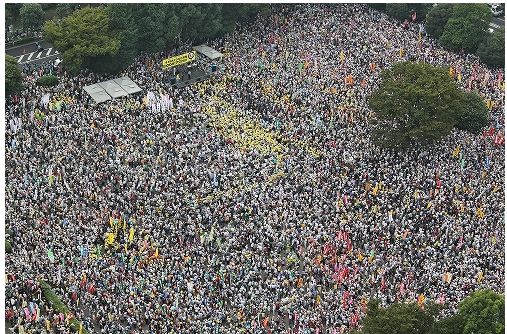
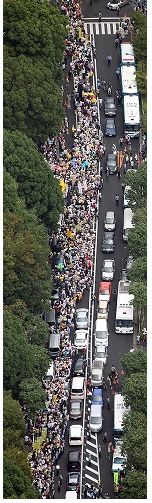
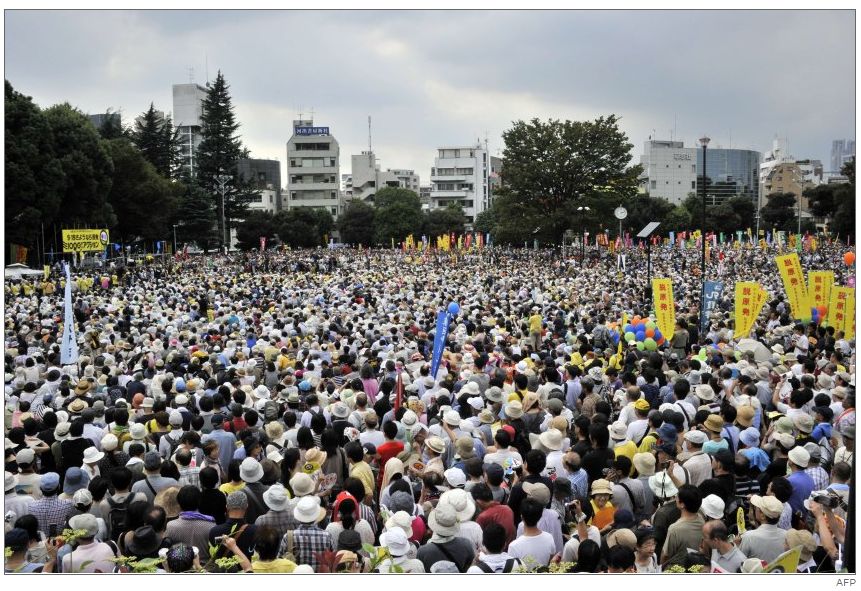
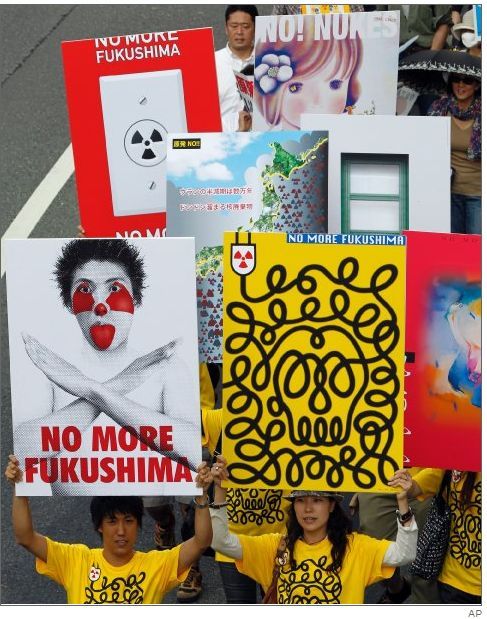
Photographs of 60,000-Strong Anti-Nuke Demonstration in Tokyo: Japanese MSMs Called It "A Parade"

Looking at this aerial photographs taken by Mainichi Shinbun (one of the better ones in terms of even coverage on nuke issues in Japan; another is Tokyo Shinbun), it sure looks more than 60,000 to me. People who actually participated in the event seemed to have the same impression as mine (on this blog comment sections, and on twitter), that it was far bigger than official number by the police (30,000).

Mainichi quotes the organizers' number of 60,000 people, and also quotes the number by the police (30,000):


Meanwhile, photos from Germany's Spiegel and France's Le Monde, who used the photos from AP and other agencies. Spiegel puts the number at 60,000:


and Yomiuri, who says "more than 30,000 people gathered" (exactly the police official estimate):


Asahi, slightly better perspective but not much, but the article does quite the organizers' number, 60,000 people:


and the US paper Forbes, without photo, says "tens of thousands of people marched", but the article title declares "Thousands march against nuclear power in Tokyo". Thousands??

Many participants in Japan are indignant that their demonstration was called a "parade", as if this was some festival attraction. Well, give the media time to learn. To me, it's amazing that the MSMs like Yomiuri and Asahi covered the event at all, and even had photographs. Asahi and Mainichi sent in their own photographers for the event. (Yomiuri's looks like Jiji Tsushin's photo.) I would take it as a sign that the anti-nuke movement may be crossing the threshold in Japan in terms of the number of people, and the MSMs cannot simply ignore anymore.

Calling it a "parade" and using the lowest official estimate by the police as the number of participants is a classic way to belittle a movement.

60,000-Strong Anti-Nuke Rally in Tokyo: How High Was the Radiation Level?

One demonstrator got curious and turned his personal survey meters on from his home in the high radiation Kashiwa City in Chiba Prefecture to the rally in central Tokyo.

He found that right by the sidewalk where smartly dressed young people were walking by, the radiation level near the ground under a tree was 0.31 microsievert/hour. It was about 30 meters from the Jingu-mae Intersection near Omote Sando, he said.

The Tokyo Municipal government's official measurement is 0.06 microsievert/hour.

On his blog, he called the experience "surreal", seeing the cheerful demonstrators and seeing the high number on his survey meter.

Much as I admire people finally standing up, I wish there were more people like him, armed with personal survey meter and measuring everywhere. Personally, radiation contamination is a more pressing, immediate problem that people can still do something about it, while stopping the nuke plants is a longer-term project.

Hosono at IAEA: Cold Shutdown by the Year-End, Invite IAEA Experts on Decontamination

Whatever you say, Mr. Hosono. (Do you know where the corium is, by the way?)

Yomiuri Shinbun (9/20/2011) reports:

細野原発相は19日、ウィーンで開幕した国際原子力機関(IAEA)の年次総会で演説し、東京電力福島第一原子力発電所の事故収束に向けた工程表について、原子炉を冷温停止状態とする「ステップ2」の達成期限をこれまでの「来年1月中旬」から「年内」に前倒しする考えを表明した。

Goshi Hosono, Minister in charge of nuclear accident, gave a speech at the annual meeting of IAEA in Vienna, Austria on September 19, and said his government was planning to achieve the "step 2" of the Fukushima I Nuclear Power Plant "Roadmap" - cold shutdown of the reactors - by the end of this year instead of by the middle of January next year.

 また、放射性物質の除染に関する国際的知見を得るため、10月にIAEA除染調査団を受け入れる方針を明らかにした。

He also announced the plan to receive the decontamination survey team from IAEA in October, in order to get their international expertise and knowledge about decontamination.

 細野氏は演説で「事故の状況は着実に収束に向かっている。『ステップ2』の予定を早めて年内をめどに達成すべく、全力を挙げて取り組む」と語った。

Mr. Hosono said in the address, "The accident is steadily winding down. We will be doing our best to achieve the "step 2" by the end of this year, ahead of schedule".

 工程表では、原子炉が安定的に停止する冷温停止状態の実現を「ステップ2」の条件として位置づけ、10月中旬から来年1月中旬までに達成するとしてきた。

According to the "roadmap", the achievement of cold shutdown is set as the condition for the completion of the "step 2", where the reactors are stopped in a stable manner. It is to be achieved sometime between mid October and mid January next year.

Does IAEA have decontamination experts?

So the Japanese government is slowly changing the definition of "cold shutdown". The indicator of "cold shutdown" used to be the temperature of the RPV below 100 degrees Celsius, but now it seems they have added "in a stable manner". The temperatures of the RPVs of Reactor 1 and 3 measure less than 100 degrees these days, but "cold shutdown" is not declared.

So the charade goes on, trying to achieve "cold shutdown" of what remains of a Reactor Pressure Vessel, probably long devoid of the molten jumble of fuel rods, control rods and everything else inside (corium). Even TEPCO admitted they are not 100% sure what they are measuring as temperature, pressure, and water level is accurate.

Since he's in Vienna, Hosono may not know that TEPCO has admitted to several hundred tonnes of groundwater leaking into the basements of the reactor buildings and turbine buildings every day. I guess he can take the line from ex-chief Cabinet Secretary Edano (and current head of the Ministry of Economy and Trade) and say "Not an immediate problem". It worked for Edano.

Monday, September 19, 2011

(Now They Tell Us Series) Groundwater Coming into Reactor Bldg and Turbine Bldg Basements at #Fukushima I Nuke Plant

TEPCO finally admits, after confronted with the calculation by Tokyo Shinbun. To no surprise to anyone but TEPCO, the Japanese government, and probably the majority of the Japanese people, the basement walls and floors are likely to have cracked and been damaged during the earthquake.

If this is true, it's good in one sense. Instead of the highly contaminated water in the basements leaking into the groundwater, the groundwater is coming into the basements...

From Tokyo Shinbun (7:06 AM JST 9/20/2011):

福島第一 建屋に地下水大量流入か 収束作業に難題

Large amount of groundwater flowing into the basements at Fukushima I? Obstacle to the work to wind down the accident

東京電力福島第一原発1~4号機の原子炉建屋やタービン建屋地下に、一日数百トンの地下水が流入している可能性のあることが分かった。汚染水処理の 実績などから計算すると、五万トン強まで減っているはずだが、実際には八万トン強も残る。東電も地下水流入の可能性を認めており、地震で建屋地下の壁が損 傷し、流入していることが考えられる。今後の収束作業に影響が出そうだ。

It's been revealed that there is a possibility that several hundred tonnes of groundwater may be flowing into the basements of reactor buildings and turbine buildings in Reactors 1 through 4 at Fukushima I Nuclear Power Plant. The amount of contaminated water should have decreased by now to slightly over 50,000 tonnes, based on the amount of water processed. However, there are still over 80,000 tonnes of highly contaminated water remaining in the basements. TEPCO has admitted to the possibility of groundwater flowing into the basements, whose walls may have been damaged in the earthquake and are letting in the water. This may affect the future work to wind down the accident.

 建屋からくみ出した汚染水の移送量や原子炉への注入量など東電が公表したデータを本紙が集計したところ、約十万トンあった汚染水は、十三日時点で約五万千六百トンにまで減っているはずだった。

Tokyo Shinbun calculated the hypothetical amount of the remaining contaminated water, based on the data published by TEPCO on the amount of contaminated water transfer and the amount of water injection into the reactors. According to our calculation, about 100,000 tonnes of contaminated water should have been reduced to about 51,600 tonnes by September 13.

 しかし、実測の地下水位から東電が推計した汚染水残量の最新値は約八万千三百トン。移送量などから逆算した値とはほぼ三万トンの開きがある。

However, the latest estimate by TEPCO from the actual water levels in the basements is 81,300 tonnes, leaving 30,000 tonnes or so gap from the calculated amount.

  東電はこれまで、汚染水がなかなか減らない理由を、雨水の影響と説明してきた。福島第一周辺では、七月以降の三カ月間に三回まとまった雨が降っており、一 部は屋根の損傷部などから建屋に流れ込んだとみられるが、水位の変動は小さく、三万トンの差を説明できるほどではない。

So far, TEPCO has explained that the contaminated water is not decreasing as fast because of the rainwater. Around Fukushima I Nuclear Power Plant, there have been 3 heavy rainfalls since July. Part of the rain may have entered the buildings through the damaged rooftops. However, the contribution of rainwater to the water in the basements is not big enough to explain the 30,000 tonnes difference.

 建屋のひび割れなどから地下水が流入している可能性は、以前から指摘されていたが、あらためてその可能性が高まった。東電に本紙の計算結果を示すと、「日量百トン単位でわき出ていると思う」との回答があった。

It has been pointed out before that the groundwater may be flowing into the basements through cracks in the basement walls, and now that possibility is even more heightened. We showed the result of our calculation to TEPCO, and they answered "The water may be flowing in in the order of 100 tonnes per day".

地下水流入が事実なら、汚染水処理はさらに膨大な量になるばかりか、原子炉への注水量を絞る必要があるなど、事故収束に向けてさまざまな影響が出ると予想される。

If the groundwater is indeed flowing into the basements, the amount of contaminated water to be treated will be further increased, necessitating the decrease of water being injected into the reactors. The work to wind down the accident may be affected in many ways.

I don't know whether TEPCO means "100 tonnes per day per unit" or "100 tonnes per day per each building" or "100 tonnes per day at the plant".

In the latest announcement on the contaminated water processing on September 14, TEPCO is processing about 1,500 tonnes per day.

Germany's Siemens Pulled 500 Million Euro from a French Bank

One day after the announcement that the company will pull out of nuclear power business, it has been revealed today that Siemens, headquartered in Munich, Germany, had pulled 500 million euros (US$684 million, 52 billion Japanese yen) 2 weeks ago from an unnamed French bank which is not BNP. (So it's either Societe Generale or Credit Agricole...)

And what did the company do with the money? It deposited the money to the European Central Bank for safety and higher interest. How could an engineering company make a diposit at a central bank? Because Siemens does have a bank, for about a year.

From Financial Times (9/19/2011):

Siemens withdrew more than half-a-billion euros in cash deposits from a large French bank two weeks ago and transferred it to the European Central Bank, in a sign of how companies are seeking havens amid Europe’s sovereign debt crisis.

The German industrial group withdrew the money partly because of concerns about the future financial health of the bank and partly to benefit from higher interest rates paid by the ECB, a person with direct knowledge of the matter told the Financial Times.

In total, Siemens has parked between €4bn ($5.4bn) and €6bn at the ECB’s facilities, mostly through one-week deposits, this person said. Only a handful of large companies have the banking licences that allow them to deposit cash directly with the ECB.

...High quality global journalism requires investment. Please share this article with others using the link below, do not cut & paste the article. See our Ts&Cs and Copyright Policy for more detail. Email ftsales.support@ft.com to buy additional rights. http://www.ft.com/cms/s/0/dca4cc08-e096-11e0-bd01-00144feabdc0.html#ixzz1YRNtx7sY

The company’s move came almost a year after Europe’s largest engineering conglomerate prepared itself for a future financial crisis by launching its own bank, an unusual move for an industrial group outside the car sector, where companies run big car financing and leasing businesses.

In an interview last December, Roland Châlons-Browne, chief executive of Siemens’ financial services unit, said its banking business would enable the group to tap the central bank for liquidity and deposit cash at the ECB.

“In the case of another financial crisis, we will be able to broaden our flexibility and take out risk with our own bank,” Mr Châlons-Browne said at the time.

Siemens does not only use the ECB as a haven; it also gets paid a slightly higher interest rate than it would get from a commercial bank.

The ECB paid an average interest rate last week of 1.01 per cent for its regular offers of one-week deposits, under which it withdraws from the financial system an amount of liquidity equivalent to the amount it has spent on eurozone government bonds.

That compares with an average overnight interest rate paid by eurozone banks of 0.95 per cent.

63,000 Bq/Kg of Radioactive Cesium from Rooftop of Apartment Bldg in Yokohama City

It made the national news ONE MONTH AFTER a private citizen measured the air radiation level on his own and had the dirt tested with his own money.

According to TV Asahi's "Morning Bird" news variety show on September 19, 63,000 becquerels/kg of radioactive cesium was detected from the dirt sediment on the rooftop of a 5-story apartment building in Kohoku-ku in Yokohama City. It is the same Kohoku-ku where 42,000 becquerels/kg of radioactive cesium was found near the side drain on the road.

The person who measured the radiation tweeted the result as early as August 15.

The air radiation at the spot was 1.8 microsievert/hour. The result of the soil analysis:

Cesium-134: 29,775 becquerels/kg
Cesiu-137: 33.659 becquerels/kg
Total cesium: 63,434 becquerels/kg

æ��ã��å®¶ã�®ã��ã�³ã�·ã�§ã�³å±�ä¸�ã�®å �ç©�ç�©ã�®æ ¸ç¨®å��æ��ã�®çµ�æ��ã��å�ºã�¾ã��ã��ã�»ã�»ã�» Cs137ã��33659<span class=

The show's commentators are saying "Oh... what about Tokyo? I thought we're safe."

Duh.

(H/T shusse)

Sunday, September 18, 2011

60,000-Strong Anti Nuke Rallies in Meiji Park in Tokyo

or so the organizers say. But the number of participants are likely to have exceeded the target of 50,000, as many who are on the scene are tweeting.

Here's the link that you can watch: http://tanikichi.net/911/919-50000.html

Even the MSM (TV Asahi) is reporting that there are 30,000 people demonstrating against nuke.

Japanese people are slow to get started, but give them a bit more time. The number of protesters are getting bigger. (I mean, for Japan.)

Japanese Government to Invite Foreigners Who Have Large Facebook and Twitter Followers to Tohoku So That They Can Tell Their Followers "Japan Is Safe"

It's buried in my previous post about radioactive canned fish and wheelchair out of Tohoku as ODA, but this merits its own post because of its sheer absurdity.

(Who do you call someone who tweets, anyway?)

From Mainichi Shinbun (9/19/2011):

東日本大震災:「日本安全」つぶやいて 風評対策、海外からツイッター発信者ら招待

Tweet "Japan is safe" to dispel "baseless rumor": Japan to invite Twitterers from overseas

 外務省は、東京電力福島第1原発事故による日本の農 産物や観光などへの風評被害対策として、フェイスブックやツイッターなどソーシャルメディアの発信者を海外から招く準備に入った。世界で5億人以上が利用 するとされるソーシャルメディアが、中東政変などで大きな影響力を見せていることに着目した試験事業。被災地を回った発信者に、安全性や感動を伝えてもら うことで、風評被害の緩和を狙う。

Japan's Ministry of Foreign Affairs have started to make preparations for inviting people from overseas who disseminate information via the social media such as Facebook and Twitter, as part of the countermeasures against "baseless rumors" that have damaged sales of Japanese agricultural products and tourism industry. More than 500 million people in the world are said to use the social media. The ministry has seen the great impact of the social media in the revolutions in the Middle East, and decided to use the social media to counter the "baseless rumor" by having people disseminate the messages of safety and favorable impressions.

 東日本大震災からの復旧に向けた11年度第2次補正予算で、外務省は風評対策のため、15億円を計上した。外務省として初めての発信者招待は、この対策の一環。

In the second supplementary budget for the fiscal year 2011, the ministry obtained 1.5 billion yen for the countermeasures against "baseless rumors". This plan to invite Facebook and Twitter users with large followers is part of the countermeasures.

 11月ごろから、欧米や中国、中東などから、読者の多い発信者約15人を数回に分けて、福島、宮城、岩手県などに招く方向で、在外公館を通じて参加者を選ぶ。

Starting November, the ministry will invite the total of about 15 people over time from Europe, the United States, China and the Middle East who have large Facebook or Twitter followers. They will be selected by the Japanese embassies and consulates overseas, and they will be invited to Fukushima, Miyagi and Iwate Prefectures.

 ソーシャルメディア関係者が、日本に好意的な書き込みをする保証はないが、外務省の担当課は「現地に足を運び、特産物を食べてもらった上での発信だけに、風評ではない信頼性の高い内容になる可能性が高い。迅速、大量、広範囲に情報を届けることもできるはず」と期待。さらに、海外の新聞やテレビ関係者を数十人ずつ被災地に招き、より広範囲に日本の農産物、観光情報を発信したい考えだ。

There is no guarantee that these social media users will disseminate messages that are favorable to Japan. But the section in charge of the project at the Ministry of Foreign Affairs is hopeful that "They will send out messages after they actually visit the places and eat the local specialty food. We believe that the messages will be more credible, not the baseless rumor. The messages will be sent out fast, in great numbers, and widely". In addition, the Ministry will invite foreign media - newspapers and TV stations - to the disaster affected areas, so that they can send out information on Japanese agricultural products and tourism to a wider audience.

 風評対策事業ではこのほか、日本産品の安全性を伝える著名人のテレビコマーシャルを海外で流し、各国の在外公館で被災地産品の物産展や試食会の開催も計画している。

Other countermeasures against "baseless rumors" include airing TV commercials outside Japan using celebrities telling the foreign viewers how safe the Japanese goods are, and fairs and food tasting events at the Japanese embassies and consulates overseas that feature the goods and produce from the disaster-affected areas.

So the Ministry correctly identified the social media like Facebook and Twitter that played a significant role in the Middle East uprisings. What they have chosen to ignore was that the social media was used by the protesters as a countermeasure to the government propaganda, not the other way around.

Using the same budget, the Ministry is hiring two people with collage or graduate degrees to tweet in English on behalf of the Ministry, and take care of these social media foreign visitors when they come. The message that they should tweet is about how charming Japan is and how well it has recovered from the earthquake/tsunami disaster. The position is temporary, lasting 6 months starting October 3, and you are to work 5 days a week excluding weekends and holidays for up to 29 hours per week. One hour lunch break. English proficiency is a must.

If you think you've got what it takes to do the government propaganda, contact:

外務省外務省大臣官房広報文化交流部総合計画課 経理庶務班
電話番号:03-5501-8127
ファックス:03-5501-8126

I wonder who will appear in the commercials? Which celebrity will be purchased? Anyone that you would recommend?

Japanese Government to Use Seafood, Goods Made in Fukushima, Miyagi, Iwate as Aid to Developing Nations as Part of ODA

I reported this already in late June, but now it's a formal request from Japan's Ministry of Foreign Affairs for the appropriation for the 3rd supplementary budget for the fiscal 2011.

Back in June, the talk was only for processed seafood like canned fish. Now, as part of the ODA (Official Development Assistance) the Ministry of Foreign Affairs wants to use 5 billion yen (US$65 million) to buy up canned fish, wheelchairs and other industrial products from the disaster-affected areas and offered them to developing nations, says NHK News Japanese (9/19/2011).

By "disaster-affected" areas, read Fukushima, Miyagi, and Iwate Prefectures.

The purposes for this plan is two-fold, according to NHK. First, to aid the developing nations of course. Second and more importantly, to erase for once and for all the "baseless rumors" about radiation contamination of the Japanese produce and products in the minds of people in the developing nations.

The Ministry of Foreign Affairs is asking for 17 billion yen (US$221 million) total in the 3rd supplementary budget. If you look at the planned projects at the ministry, they read like a sublime lesson in irony and cynicism:

  • 5 billion yen for this ODA fish and wheelchair for development countries scheme

  • 4 billion yen for giving the earthquake and tsunami analysis and early warning systems to nations in Southeast Asia and in the Pacific Rim

  • 1 billion yen for inviting IAEA experts for their advice on how to wind down the Fukushima I Nuclear Plant accident

  • (from the 2nd supplementary budget) 1.5 billion yen for inviting people with big Facebook and Twitter followers in the US, Europe, and Middle East to Fukushima, Miyagi, and Iwate and wine and dine them with local produce, with the hope that they will spread the word to their followers "Japan is safe"; launching a media blitz overseas using celebrities to appeal safety of Japanese products (Mainichi Shinbun, 9/19/2011)

For the last one, the ministry is hiring 2 people with college or graduate degrees with English proficiency to tweet for the ministry, and take care of the Facebook/Twitter writers when they come to Tohoku. The ministry's elite bureaucrats seem to think the revolutions in the Middle East happened because of Facebook and Twitter. What they've decided to ignore is that they were used by the anti-regime protesters, not by the regimes.

Despairing of their own government, some Japanese are hoping that the US will occupy Japan again. But then, under the current US president, all they would get would be killer drones.

#Radiation in Japan: Another Reason Not to Trust Your Goverment - Inferior Survey Meter

Change the survey machine, then the radiation levels may double, as they did in Misato City in Saitama.

A sort of "Shadenfreude" for citizens and particularly parents whose own radiation measurements were ridiculed and discredited by the authorities as "amateurish", "prone to mistakes", "using cheap and inaccurate Chinese-made survey meters", etc., etc..

Misato City in Saitama Prefecture is in the "corridor" of the radioactive plume that reached from the north and continued on to eastern part of Tokyo and western part of Chiba.

(From the radiation contour map (ver.4) by Professor Yukio Hayakawa of Gunma University; I marked the location of Misato City.)

After concerned parents finally persuaded them to measure the radiation levels in schools within the city, the city government started to measure, using Hitachi Aloka TCS-161 which wasn't working too well. Then the city government upgraded the survey machine to Hitachi Aloka TCS-172B on September 6.

Lo and behold! The radiation levels in school yards jumped; at several schools they more than doubled.

According to Misato City website, here's the survey on August 29 on the left, measuring radiation in the middle of the school yards using the old machine. At these schools, school yards are dirt. The survey on September 12, using the new machine is on the right. The numbers are in microsievert/hour:

The explanation by the city is simply "there is a change in numbers because we upgraded the survey machine."

One interesting thing about the new survey is that the radiation at 50 centimeters off the ground is the same as or higher than 5 centimeters off the ground, across the board, and there is not much drop-off at 1 meter off the ground.

At 0.31 microsievert/hour, if you stand in the middle of the school yard for 24 hours a day for one year, you would get 2.7 millisieverts of external radiation exposure. Of course you don't stand in the middle of the school yard 24/7, but if anything, the middle of a school yard may have lower radiation level than bushes, side drains, roads, and homes.

Saturday, September 17, 2011

#Radiation in Japan: 42,000 Bq/kg of Radioactive Cesium in Dirt Around a Drain in Yokohama City

It's not that the city that clearly does not care much about radiation safety (cesium beef for kids, dumping radioactive ashes in the ocean) did the measurement on its own. A citizen measured the radiation in the area, got the sample and had it tested using his own money, and alerted the city when the result came in.

Then, the city finally went and took the sample to be tested. The result was 42,000 becquerels/kg of radioactive cesium from the dirt that accumulated around the drain grid on the side of the road in Kohoku-ku (Okurayama) in Yokohama City, just inside the 250-kilometer radius from Fukushima I Nuclear Power Plant.

The city also found 35,000 becquerels/kg of cesium in the sediment at a fountain nearby, 27,600 becquerels/kg from the dirt overflow from the plant box on the road, and 11,320 becquerels/kg from the dirt overflow from the plant box on the side walk.

Here's Yokohama City's press release, taken from the message board of Yokohama Assemblyman Ota:

By the way, Assemblyman Ota suggests that Mayor Hayashi is known within the city administration as someone who doesn't think on her own (i.e. she relies on others in any decision making). That makes sense. That's been the ideal for the head of any organization in peace time in Japan, to be the figurehead. Literally deadly in the time of crisis like this.

#Radiation in Japan: Tonga Man Starts Teaching English in Fukushima

to show the world that "Fukushima is OK".

Some people have ridiculed the Bayerische Staatsoper members who refuse to come to Japan for a few weeks for the radiation contamination fear. They should be all praise for this man from Tonga, who persuaded friends and family members and came to Japan to teach English in Iwaki City in Fukushima.

Personally, I cannot join in the praise but feel free.

From Jiji Tsushin (9/17/2011):

福島第1原発事故で世界的に有名になった「フクシマ」の学校で、10カ国から来た52人の新米外国語指導助手(ALT)が新学期から教壇に立っている。母国では家族や友人が心配するが、「ここで働くことで、福島は大丈夫ということを世界に示したい」と意気込んでいる。

"Fukushima" has become world-famous thanks to the Fukushima I Nuclear Plant Accident. In schools in Fukushima, 52 new teachers from 10 different countries have started teaching English as ALT (assistant language teacher). Their families and friends back in their home countries are worried, but the teachers are determined "to show to the world that Fukushima is alright, by working in Fukushima".

 「私の国では、刺し身をココナツミルクにつけて食べます」。原発30キロ圏内に一部が含まれ、津波で300人以上が犠牲になったいわき市の市立平第一中学校。5日午前、南太平洋のトンガ王国出身、ペセティ・ベアさん(35)が英語で紹介すると、静かだった教室が沸き返った。初授業で緊張感が漂っていたが、遠い国の話を聞くうちに生徒の表情は和らぎ、最後は「伝言ゲーム」で笑いに包まれた。女子生徒(13)は「英語は嫌いだけど、ペセティ先生となら楽しくやれそう」。

"In my country, we dip sashimi in coconut milk", said a 35-year-old teacher ペセティ・ベア [I haven't a slightest idea how this name is spelled] from Tonga in the south Pacific, as a way to introduce himself to the class on the morning of September 5 at Iwaki City Taira Daiichi Junior High School. Part of Iwaki City is within the 30-kilometer radius from the power plant, and more than 300 people perished in the March 11 tsunami. The students laughed. It was the first class, and at first the students were nervous. But as they listened to the stories from a distant country they relaxed, and enjoyed a "telephone game". A 13-year-old girl said, "I don't like English but it looks like fun with this teacher".

 地元高校の英語教師をしていたベアさんがALTに応募したのは、日本の「相手を敬う」文化を身に付けたかったから。赴任先が福島県と分かり、周囲は放射線被ばくを懸念したが、「福島には人が住んでいて、過度に恐れる必要はない」と粘り強く説得した。

Mr. ペセティ・ベア was teaching English at a local high school in Tonga before he applied for the ALT. He says he wanted to learn the Japanese culture of "respecting others". Once his teaching assignment turned out to be in Fukushima, his friends and family worried about radiation exposure, but he steadfastly persuaded them by saying "People live in Fukushima. There is no need to fear excessively."

That's akin to saying "If the food is sold in the market, it is safe", a la the mayor of Yokohama City who fed kindergarteners with radioactive beef. And for Fukushima, it seems impossible to fear excessively when the radiation level is already excessive.

As to the Japanese culture of "respecting others", I have my doubts that "others" only refers to people with money or power or both.

But it's just me.

In the above Jiji's article, I put Fukushima in parenthesis, as the original Japanese. The original Japanese for Fukushima is written in Katakana, instead of Kanji, indicating "Fukushima" as understood outside Japan.

TEPCO's #Fuku I Sub-Drain Density Measurement Shows Increase in Late July and Mid August

According to TEPCO's press release on September 17, there were increases in radioactive cesium in the sub-drain of Reactor 1 in late July, then mid August, and in early September. From mid August to early September, iodine-131 was also detected.

This happened most noticeably in Reactor1's sub-drain, but small increases are discernible in Reactor 2's sub-drain, too. (For the sub-drains for other Reactors, see TEPCO's PDF.)

By the way, in a separate presentation, TEPCO says it doesn't quite know exactly what the pressure or the water level is inside the Containment Vessel or the Reactor Pressure Vessel. In the press conference, they didn't quite seem to know what temperature they were measuring. The presentation is in Japanese only. I'll link if they post the English version.

TEPCO and the government are talking about what to do when the "cold shutdown" is finally achieved. How they determine the "cold shutdown" without knowing the pressure or the temperature remains mystery. They are in no hurry to find out where the corium may be, either.

(H/T viola)

Japanese Researcher: Recriticality in July and August? (UPDATED)

Yoyo Hinuma, currently at University of California San Diego, says recriticality may have happened in one of the three reactors at Fukushima I Nuclear Power Plant in late July and again in mid August, releasing the largest amount of radioactive materials since April.

I cannot find much about the researcher, other than he was at MIT before, and that he has published papers in peer-reviewed magazines.

The article below says there was a criticality in March, but I don't know if the reporter is referring to the explosion events in March or the recriticality in one of the broken reactors as some researchers have alleged and hypothesized.

(UPDATE: I totally forgot about the report by the UC San Diego researchers that radioactive sulphur of Fukushima origin was detected in California in late March, indicating on-going chain reaction. So the Playboy magazine reporter may be right. To recap, chlorine in the seawater being injected back then captured neutron, turning to radioactive sulphur.)

(Of all magazines) the article appeared in the Weekly Playboy magazine in Japan.

Part from Shukan Playboy Japan (9/12/2011):

...実は公的機関が発表している放射線量の数値で、不可解な動きが計測されているのだ。それは、7月末から8月にかけて発生した放射線量の大幅な上昇。3月の事故直後から、事態の深刻さをネット上での論文発表などで訴え続けてきた日沼洋陽工学博士はこう解説する。

... Indeed, there are some inexplicable numbers reported on the air radiation levels by the government agencies. That is, a big rise in the radiation levels from late July to mid August. Dr. Yoyo Hinuma, who has published papers on the net about the seriousness of the situation since the beginning of the accident in March, explains.

「私は福島第一原発1~3号機のいずれかで、メルトダウンした核燃料が連鎖的に核分裂する『再臨界』が発生し、4月以降では最大量の放射性物質が施設外へ漏れ出したと考えています。時期は7月28日から31日頃と、8月19日から21日頃の2回。放射物質の大量流出は、発表数値が実際よりも低めではないかと疑われている東京都や横浜市の線量測定データからもはっきりと読み取れる科学的事実です」

"I think there was a recriticality in which the melted fuel started a chain reaction again in one of the reactors at Fukushima I Nuclear Power Plant, and that the largest amount of radioactive materials since April was released from the plant. It may have happened twice. The first was between July 28 and 31. The second was between August 19 and 21. That the large amount of radioactive materials were released can be clearly seen in the radiation survey data in Tokyo and Yokohama City, where it is suspected that the announced radiation levels are lower than the actual levels. So it's a scientific fact."

例えば、東京都発表のデータでは、8月19日の最大線量が前日の約1.4倍となる0.0865マイクロシーベルトを記録。この日には横浜市でも0.051マイクロシーベルトと、こちらは3月末並みの線量が観測されている。

For example, according to the data released by the Tokyo Metropolitan government, the air radiation level on August 19 was 0.0865 microsievert/hour (maximum), 1.4 times as high as the previous day. On the same day, Yokohama City measured 0.051 microsievert/hour, the level last recorded in late March.

「さらに詳しくデータを分析してみると、7月よりもよりはっきりと数値が上昇している8月のほうでは、規模が大きく継続時間が長い『即発臨界』という分裂反応が起きたと推定されます。これによって大量発生した放射性のセシウムやヨウ素などが首都圏にも達し、線量を増大させたと考えていいでしょう」(日沼氏)

"Further analyzing the data, we find that August saw a more definite rise than July. It may have been caused by the so-called "prompt criticality" which is bigger and lasts longer. The large amount of radioactive cesium and radioactive iodine released as the result may have reached the Tokyo Metropolitan area, raising the air radiation level", says Dr. Hinuma.

振り返ってみれば、東京都と神奈川県の「下水脱水汚泥」から高い数値の放射性ヨウ素131が検出され始めたのも7月後半から。ヨウ素131の半減期は8日間なので、3月の臨界で発生したものが7月以降になってから検出されることはありえない。また8月には、都内各区の数十ヶ所の砂場で安全基準値を大幅に上回る放射線量が測定され、砂を全交換するまで使用禁止の措置がとられた。だが、その砂場のほとんどが7月以前の計測では基準値以下だったのだ。

Looking back, it is since the end of July that the high level of iodine-131 have started to show up in the "dehydrated sewer sludge" in Tokyo and Kanagawa Prefecture. Half life of iodine-131 is 8 days, so it couldn't have come from the criticality happened in March. Also in August, radiation that exceeded the safety standard was detected in tens of sandboxes in the parks where children play, and the use of the sandboxes was prohibited until the sand was replaced. But before July, air radiation at most of these sandboxes measured lower than the safety standard.

この夏、福島第一原発で再臨界が少なくとも二度発生、新たに放射性物質が降り注いでいる可能性が高いと言わざるを得ない。

We'd have to admit that there is a high possibility that the recriticality happened this summer at Fukushima I Nuclear Power Plant, at least twice, and fresh radioactive materials are being released.

I checked the Tokyo Metropolitan government's official measurement of air radiation in Shinjuku. The maximum levels recorded on July 30 and August 19 are indeed elevated:

July 29: 0.0697 microsievert/hour
July 30: 0.0735 microsievert/hour
July 31: 0.0610 microsievert/hour

August 18: 0.0621 microsievert/hour
August 19: 0.0865 microsievert/hour
August 20: 0.0605 microsievert/hour

For July and August, the maximum air radiation level recorded in Tokyo is in 0.06 microsievert/hour range, and does not exceed 0.07 microsievert/hour, except for these two days.

Iodine-131 detected in sewer sludge in mid August in Tokyo and in Oshu City in Iwate Prefecture (among others) is attributed to the medical use, because there was no corresponding increase in radioactive cesium. Also in the case of Tokyo, radioactive iodine has been continuously detected in sewer sludge since they started to take measurements in May.

However, iodine-131 detection in sewer sludge is NOT the reason why Dr. Hinuma thinks there were two recriticality events at Fukushima I; it is what the Playboy reporter lists as a supporting evidence.

I do want to point out though that when Fukushima Prefecture detected tellurium-132 in the early morning of March 12 - that is, before the explosion of Reactor 1 building - in Namie-machi and other locations outside the plant including Minami Soma City, 25 kilometers from the plant (and they didn't bother to tell anyone for nearly 3 months), there was no concurrent, significant detection of iodine-131 and radioactive cesium even though this was clearly a precursor to the explosive event that took place that afternoon

Friday, September 16, 2011

Potentially Radioactive Lumber to Be Promoted with "Eco-Point" Incentive?

Seiji Maehara, who lost his bid to become the party leader and the prime minister of Japan, has nonetheless landed on a very powerful party position as the chairman of the DPJ's policy bureau.

He went to Fukushima, and after visiting with the evacuees from Iitate-mura, he disclosed his party's plan to use the "eco-point" system for residential housing to promote timber from the disaster-affected area.

Aggghhhhh.

What is the "eco-point" for houses? Well, if you build or renovate your house with energy saving features and alternative energy features (eg. solar panels) the government will give you "eco-points". Then you can use the points at participating stores and buy whatever you want to buy with the points.

Maehara is saying the government may entice builders to use the lumber from the disaster-affected area with "eco-points", even if the potentially radioactive lumber has nothing to do with energy saving.

Iitate-mura's major industry is forestry. Iitate-mura's mountains and forests have been contaminated with whatever fell on them - radioactive cesium, plutonium, strontium. No one has tested them (if someone did, he's not saying anything), but the contamination should be an order of magnitude bigger than the radioactive firewood from Rikuzen Takata City in Iwate Prefecture.

If Mr. Maehara has his way, the contaminated trees are to be cut from the contaminated mountains and hauled out of the mountains, disturbing the contaminated soil and dead leaves, and made into lumber in a village with high air radiation level and sold all over Japan with "eco-points", in order for the rest of the Japanese to help the villagers.

This is "socializing the cost" to the extreme.

From Sankei Shinbun (9/17/2011):

民主党の前原誠司政調会長は17日午前、福島市を訪れ、東京電力福島第1原発事故で避難した福島県飯舘村の住民が暮らす仮設住宅を視察した。住民との対話で前原氏は、原発事故に絡む不適切な発言で辞任した鉢呂吉雄前経済産業相について「皆さんの気持ちを踏みにじった。与党の一員として心からおわび申し上げたい」と謝罪した。

Seiji Maehara, chairman of the policy bureau of the Democratic Party of Japan, visited Fukushima City in the morning of September 17, and visited with the residents of Iitate-mura in their temporary houses. They evacuated to Fukushima City after the Fukushima I Nuclear Plant accident. In the dialog with the residents, Maehara apologized to them about Yoshio Hachiro, who resigned the post of Minister of Economy, Trade and Industry after his inappropriate remarks concerning the nuclear accident. Maehara said, "His words trampled down your feelings. As a member of the ruling party I would like to apologize from the bottom of my heart".

 視察は、東日本大震災の本格的な復興予算となる平成23年度第3次補正予算案に被災地の要望を盛り込むのが目的で、前原氏は住民から要望が相次いだ放射性物質の除染作業の迅速化に関して「3次補正で思い切った予算を計上したい」と応じた。

The purpose of his visit was to incorporate the demands from the disaster-affected area into the 3rd supplementary budget plan for the fiscal 2011, which will be the budget for the recovery in earnest from the March 11 earthquake/tsunami disaster. Maehara responded to the decontamination request from the residents, by saying "We want to appropriate a large sum for the effort".

 また、被災地の木材などを使って住宅を建設した場合、「住宅エコポイント制度」を活用できるよう検討していることも明らかにした。前原氏は対話後、県庁で佐藤雄平知事と会談。佐藤氏は「政府の復興基本方針がまだ形になっていない」と国の対応の遅れを指摘し、復興基金の創設を求めた。

He also disclosed that he [or his party] is discussing the possibility of utilizing "residential eco-point system" if residential houses are built with lumber from the disaster-affected area. After the dialog with the Iitate-mura residents, he met with Governor Yuhei Sato. Governor Sato pointed out the slow response by the national government, and urged the creation of the recovery fund.

 前原氏は午後、宮城県へ移動し、村井嘉浩知事らと会談。がれき処理状況も視察する。

Mr. Maehara will go to Miyagi Prefecture in the afternoon to have a talk with Governor Yoshihiro Murai. He is also scheduled to survey the debris clearing operation.

To the right-leaning and the US-favoring (and nuke-favoring) Sankei, Maehara is a darling, WikiLeaks or not.

"Oh it's just outside of the trees that is radioactive. In lumber, there will be no radiation, it's safe" will be the mantra. "Don't you want to help the victims of the accident?" will be another.

My answer: so what? and no. Not through buying their radioactive goods.

Iitate-mura's so-called "decontamination" of farmland and houses is expected to cost 200 billion yen, or US$2.6 billion. Part of the "decon" bubble, as Iitate-mura's "decontamination" is to be done by the national government and its researchers (as if they know anything about radiation decontamination on a massive scale), with the help of large general contractors.

Contaminated Water Treatment at #Fukushima I: What Kurion Took Away, AREVA Put It Back

Radioactive cesium, that is.

TEPCO announced the numbers for the density of radioactive materials after the decontamination using Kurion and then AREVA.

Cesium-134:
940,000 Bq/cm3 --> Kurion, ND --> AREVA, 450,000 Bq/cm3, and 66,000 Bq/cm3 (2 tests)

Cesium-137:
1,100,000 Bq/cm3 -->Kurion, ND --> AREVA, 520,000 Bq/cm3, and 77,000 Bq/cm3

So what is TEPCO's solution to the conundrum?

Stop using AREVA.

Does the company know why this happened?

No.

Is the company interested in knowing?

No.

To see the data for yourself, go here (PDF).