Friday, December 16, 2011

Cold Shutdown State at #Fukushima: IAEA's Amano Congratulates

If the rulers decide it's a cold shutdown, it is a cold shutdown. If enough august entities say it enough times, it must be true.

IAEA's Director General is a former Japanese bureaucrat (Ministry of Foreign Affairs) Yukiya Amano, who duly congratulates the Japanese administration for the exemplary job it has done and "significant progress" it has made, as follows:

16 December 2011 | IAEA Director General Yukiya Amano issued the following statement today:

The IAEA welcomes the announcement by the Government of Japan that the reactors at Fukushima Daiichi Nuclear Power Station have achieved a "cold shutdown condition" and are in a stable state, and that the release of radioactive materials is under control.

Overall TEPCO and the Japanese government have made significant progress and have completed the second step of the TEPCO's roadmap by the end of the year as they had planned.

The IAEA is continuing to monitor the status of the Fukushima Daiichi Nuclear Power Station and the radiological situation in Japan following the earthquake and tsunami of March 11. The IAEA receives information updates from a variety of official Japanese sources, through the national competent authorities. The Agency continues to stand ready to provide necessary assistance to Japan as requested.

".. national competent authorities", that's too rich.

Just In: 348 Bq/Kg of Strontium Discovery in Tokorozawa City in Saitama?

For now, the information is via the tweets of people who watched the press conference online.

It was during the question by Yasumi Iwakami, independent journalist, during the press conference at the Nuclear and Industrial Safety Agency, who has declared there was/is/will be no water leak from Fukushima I Nuke Plant.

348 becquerels/kg of radioactive strontium was discovered in Tokorozawa City in Saitama Prefecture, according to Iwakami.

State of Cold Shutdown in #Fukushima: US Deputy Secretary of Energy Was Also At Hand

As I posted yesterday, NHK quoted the US Deputy Secretary of State expressing a strong interest from the US companies to participate in Japan's decontamination (bubble), after he congratulated the administration on this important milestone.

Well, he was not alone. It looks like a whole delegation of the US government has been quietly in Japan, negotiating with the extremely pro-US Noda administration for a big piece of "post"-accident bubble in decommission and decontamination, to be paid for by the hapless Japanese taxpayers.

Businessweek/Bloomberg news on the "state" of cold shutdown at Fukushima (12/16/2011) quotes the US Deputy Secretary of Energy Daniel Poneman:

Cold War weapons production in the U.S. left the country with “a significant nuclear cleanup legacy, including high- level waste, contaminated soil and groundwater,” Daniel Poneman, the U.S. Deputy Secretary at the Department of Energy, said in Tokyo yesterday.

The Hanford Site in Washington State and the Savannah River Site in South Carolina have more than 90 million gallons of liquid waste in tanks the government is working to convert into more stable forms that do not threaten the environment, he said.

Japan's government has requested support from the U.S. to decommission the Fukushima Dai-Ichi plant as well as managing the site from an environmental perspective, he said.

Sovereign capture is so complete. Or it always has been.

State of Cold Shutdown: Hosono Says "No One Knows Where the Fuel Is, But I'm Confident It is Cooled"

In a typical display of utter disregard for the general public, the Noda administration announced last night that there would be no more joint press conference where reporters could meet with TEPCO people and the government officials from the Cabinet Office and other relevant ministries and agencies, receive updates and ask questions.

The last night's joint press conference is to be the last one, now that Fukushima I Nuclear Power Plant is officially in a "state of a cold shutdown" and the accident has been decreed by the government to be "over".

Here's what Minister in charge of the accident and Minister of the Environment Goshi Hosono had to say last night in the last joint press conference, as reported by Nifty News (12/16/2011):

...細野環境相は「どこに燃料があるのか、原子炉をあけてみなければ誰もわからない」と不安な部分ものぞかせたものの 野田首相に続いて、冷温停止という認識を再確認。「燃料の場所がどこにあるにしても、冷却されているという状態」と述べた。

Minister of the Environment Hosono expressed some concern that "No one knows where the fuel is until we open the reactors", but he reaffirmed the cold shutdown, following the lead of his prime minister. He said, "No matter where the fuel is, it is being cooled".

Trust us, take our word for it, he says.

As Noda Declares Fukushima Accident Over, US Deputy Secretary of State Congratulates, Offers Support in Decontamination

Thomas Nides, who happens to be in Japan, congratulates the Noda administration on the end of the nuclear accident marked by a cold shut down "state".

He said in the press conference that he had heard it one day in advance from Japan's Foreign Minister that the Fukushima plant had achieved the state of cold shutdown. Hahahahaha.

Is NRC Chairman Greg Jaczko still coming to Japan to join the farce?

From NHK News (12/16/2011):

来日しているアメリカのナイズ国務副長官は、16日、都内で記者団に対し、15日に玄葉外務大臣から福島第一原発が冷温停止の状態に達したことを聞いたと明らかにしたうえで、「アメリカ政府としては、大変喜ばしく思っている。復旧に向けて日本政府は正しい選択を行っていると感じている」と述べて、歓迎しました。一方、今後必要となる大がかりな放射性物質の除染作業について、「多くのアメリカの企業が関心を示しており、アメリカ政府も支援を申し出ている」と述べて、引き続き原発事故からの復旧を支援する考えを示しました。

US Deputy Secretary of State Thomas Nides, who is in Japan, held a press conference on December 16 and disclosed that he had been informed by Foreign Minister Genba on December 15 that Fukushima I Nuclear Power Plant had achieved a cold shutdown state. "We at the US government are very happy to hear the news. We believe the Japanese government has made the right choice toward recovery." Regarding the massive decontamination work that will be needed, he said "Many US companies are interested in taking part, and our government has offered assistance", indicating the continued support for the recovery from the nuclear accident.

Recovery from the nuclear accident, NHK? The accident is ongoing and you know it.

So here you go. Nothing the US companies like better than a bubble, and they are eager to join in Japan's decon bubble, at the Japan's taxpayers' expense.

Japan's PM Noda Declares a Cold Shutdown "State" and the End of Nuke Accident

Declaring a cold shutdown, even with "state", is a joke, but Noda went further and declared the Fukushima I Nuclear Power Plant accident to be over.

Why did he do that? Asahi Shinbun (12/16/2011) reports that:

「事故の収束」という、より強い表現に置き換えることで、風評被害など国内外に根強い原発事故への不安を払拭(ふっしょく)したいという狙いがある。政権は今後、放射性物質の除染を進めていく方針。避難区域の縮小も行い、住民の帰還へとつなげたい考えだ。

By using the word "the accident is over", the government wants to dispel fears of the nuclear plant accident that are still strong both inside and outside Japan, resulting in baseless rumors. The administration will proceed with decontamination and shrinking the evacuation zone to have the residents return.

Why does the Japanese government want the residents to return? Why, to save on compensation money of course. Or so the Wall Street Journal's Japanese reporters say, as they can say what Japanese reporters for the Japanese MSMs cannot say:

As many as 140,000 people were asked to either evacuate or remain indoors for an extended period of time during the peak period of the crisis. By cleaning up the contaminated areas, the government hopes to rebuild the local economy and rein in compensation payments.

And remember, the Nuclear and Industrial Safety Agency has declared there has been no leak of contaminated water from Fukushima I Nuke Plant, and will never be.

Thursday, December 15, 2011

A Man Committed Suicide in His Home in Namie-Machi, Fukushima

His home was in Tsushima District of Namie-machi, northwest of Fukushima I Nuclear Power Plant.

If you haven't read it, Asahi Shinbun's "Trap of Prometheus" Series 1 was about Tsushima District. That's where people from other parts of Namie-machi that are closer to the plant as well as from other towns and cities escaped to, not knowing the radiation was extremely high in Tsushima, exceeding 100 microsieverts/hour. The government knew, because it had SPEEDI simulation results and it actually sent an official there to measure the radiation levels. But it decided to keep quiet. (You can read the whole series here, as per my translation.)

Fukushima Minyu (12/16/2011) reports:

東京電力福島第1原発事故により計画的避難区域に指定される、浪江町津島地区の自宅で今月上旬、福島市の避難先から帰宅していた50代男性が遺体で見つかったことが15日、分かった。双葉署によると、現場の状況から自殺とみられる。

It has been disclosed that a man in his fifties were found dead earlier this month in his home in Tsushima District in Namie-machi, which is designated as "planned evacuation zone" after the Fukushima I Nuclear Power Plant accident. The man had come back from his temporary stay in Fukushima City where he had evacuated. According to the Futaba Police Department, the death is considered suicide.

同署によると、自宅にあった包丁を使い、腹を刺して自殺を図ったとみられる。遺書などはなかったという。男性は、福島市の親類宅に避難していたが、「自 宅に行ってくる」と言って出掛けた。帰りが遅いため不審に思った親類が自宅を訪ねると、男性が倒れていたという。

According to the Police, he must have used a kitchen knife at home and stabbed himself in the stomach. There was no suicide note left. The man was staying at his relative's house in Fukushima City, but he left, saying he was going to take a look at his home. When he didn't come back, the relative visited his home in Tsushima, and found him dead.

Japan Gone Nuts: NISA Declares No Contaminated Water Leak From Fuku-I, in the Past, Now, and the Future


At this point, I can only laugh. Totally predictable.

As the national government under Prime Minister Noda (who looks like a popular manga character Patalliro, except Pata is extremely smart) prepares to declare a cold shutdown "state" and is about to become the laughing stock of the world, the Nuclear and Industrial Safety Agency is busy rewriting the definition of "leak".

Tokyo Shinbun reports that NISA has decided to basically "nullify" the leaks of contaminated water from Fukushima I Nuclear Power Plant in the past, and declare that there will be no leak in the future either, even if there is actually a leak or deliberate discharge. Why? Because NISA says so.

From Tokyo Shinbun (via Asyura, so that the link doesn't disappear; 12/16/2011):

保安院 海への汚染水 ゼロ扱い

NISA considers the amount of contaminated water into the ocean to be zero

福島第一原発事故で、何度も放射性物質を含む汚染水が海に漏出したが、経済産業省原子力安全・保安院は「緊急事態」を理由に、法的には流出量は「ゼロ」と扱ってきたことが本紙の取材で分かった。今後、漏出や意図的な放出があってもゼロ扱いするという。政府は十六日に「冷温停止状態」を宣言する予定だが、重要な条件である放射性物質の放出抑制をないがしろにするような姿勢は疑念を持たれる。

There have been several leaks of water contaminated with radioactive materials from Fukushima I Nuclear Power Plant. Tokyo Shinbun has found out through own investigation that the Nuclear and Industrial Safety Agency under the Ministry of Economy, Trade and Industry has treated the amount of the leaks as "zero" from a legal [or regulatory] point of view, because it was a "state of emergency". The Agency has said it will treat the future leaks and deliberate discharges into the ocean the same way. The national government is scheduled to declare a "cold shutdown state" on December 16, but we are suspicious of the government's position that seems to ignore the suppression of the radioactive materials released from the plant, which is one of the important conditions [of the cold shutdown "state"].

 原子炉等規制法により、電力事業者は、原発ごとに海に出る放射性物質の上限量を定めるよう決められている(総量規制)。福島第一の場合、セシウムなどは年間二二〇〇億ベクレルで、年度が変わるとゼロから計算される。

The Nuclear Reactor Regulation Law specifies that the operator needs to set the maximum amount of radioactive materials released into the ocean for each nuclear power plant (total emission control). In the case of Fukushima I Nuke Plant, the maximum amount allowed is 220 billion becquerels per year for radioactive cesium. The amount is set to zero again at the beginning of a new fiscal year.

 しかし、四月二日に2号機取水口近くで高濃度汚染水が漏出しているのが見つかり、同四日には汚染水の保管場所を確保するため、東京電力は建屋内のタンクに入っていた低濃度汚染水を意図的に海洋に放出した。

However, a leak of highly contaminated water was found on April 2 near the Reactor 2 water intake, and TEPCO conducted a discharge of low contamination water that was stored in a tank inside the plant buildings to make space to store the highly contaminated water.

 これら二件の漏出と放出だけで、原発外に出た放射性物質の総量は四七〇〇兆ベクレル(東電の試算)に達し、既に上限値の二万倍を超える。

This leak and the discharge alone released radioactive materials outside the plant to the tune of 4,700 terabecquerels (according to TEPCO's estimate), already more than 20,000 times as much as the maximum amount allowed.

 試算に対しては、国内外の研究機関から「過小評価」との異論も出ている。

Both domestic and foreign research institutions have disputed TEPCO's estimate as "too low".

 今月四日には、処理済みの汚染水を蒸発濃縮させる装置から、二六〇億ベクレルの放射性ストロンチウムを含む水が海に漏れ出した。

On December 4, the water that contained 26 billion becquerels of radioactive strontium was found leaking into the ocean from the apparatus that evaporates and condenses the treated water.

 さらには、敷地内に設置した処理水タンクが来年前半にも満杯になる見込み。この水にもストロンチウムが含まれている。東電はできるだけ浄化して海洋放出することを検討している。漁業団体の抗議を受け、当面は放出を見送る方針だ。

Furthermore, the storage tanks that are set up inside the compound are expected to become full in the first half of the next year. The water in these storage tanks also contains radioactive strontium. TEPCO is contemplating the discharge of the water into the ocean after further decontaminating it, but facing the protest from the fisheries associations the company has said it will postpone the discharge for now.

 保安院は本紙の取材に対し、事故への対応が最優先で、福島第一は損傷で漏出を止められる状態にない「緊急事態」だった点を強調し、総量規制を適用せず、四七〇〇兆ベクレルの漏出をゼロ扱いする理由を説明した。

Responding to the questions from Tokyo Shinbun, NISA emphasized that responding to the accident came first, and Fukushima I Nuke Plant was in a "state of emergency" where it was not possible to stop the leak, due to the damage the plant had sustained, and that was the reason for not applying the rule of "total emission control" and treating the 4,700-terabequerel leak as zero leak.

 「緊急事態」に伴う特例扱いは「事故収束まで」続くとも説明したが、具体的な期間は「これからの議論」とあいまい。

The special treatment under the "state of emergency" will last until the accident winds down, according to the Agency; but it was vague as to how long the special treatment will last, saying "it will be decided in the future discussions".

 今後、仮に放射性物質を含んだ処理水を放出したとしても、ゼロ扱いを続けるという。

The Agency said even if the treated water that contains radioactive materials is released into the ocean, the Agency will continue to treat it as zero release.

Well, why should NISA stop at the water leak? They should simply declare that there was no emission of radioactive materials in the air, because the plant was in a state of emergency and in no shape to prevent the emission.

The national government declaring a cold shutdown "state" on broken reactors without even knowing where the corium has gone; government experts declaring 20 millisievert radiation is totally OK after one-month deliberation; the government agency declaring there was, is, will be no contaminated water leak or discharge from Fuku-I even if there was, is, will be a leak or discharge.

Gone nuts.

Japanese Government Decides 20 Millisieverts Annual Radiation Exposure Poses Little Cancer Threat to General Public

While the entire nation and the entire world wait with bated breath for the declaration by the Japanese national government of a cold shutdown of Fukushima I Nuclear Power Plant (to be exact, as NY Times correctly reported on December 14, "state of a cold shutdown") later in the evening of December 16 Japan Standard Time, the working group of government radiation experts has declared that:

  • Annual radiation exposure of more than 100 millisieverts is known to raise risks for developing cancers, but nothing is known about annual radiation exposure of less than 100 millisieverts;

  • Annual cumulative radiation exposure (external only, it seems) of 20 millisieverts for the general public poses hardly any danger of developing cancer;

  • There is no difference between internal and external radiation exposure;

  • Low-dose radiation exposure over a long period of time is less risky than one-time episodic exposure to large-dose radiation;

  • The relationship between low-dose internal radiation exposure and bladder cancer cannot be proven.

Above points are from the article in Mainichi Shinbun 12/15/2011, the only paper that had any critical thinking on this issue. All the other large-circulation newspapers and NHK simply parroted what was said by the experts and the government officials.

Speaking of government officials, Asahi Shinbun reports (12/15/2011) that Minister in charge of the nuclear accident and Minister of the Environment Goshi Hosono explained the government's thinking in the press conference after the group meeting, saying:

「20ミリシーベルトで人が住めるようになるということだ」

"So, 20 millisieverts per year radiation means people can live there."

This working group of so-called experts met for about a month to discuss the risk of "low-level" radiation exposure (meaning less than 20 millisieverts per year) and make a decision. Now they have made the decision and submitted the report to the government, the government duly accepts the independent experts' opinion, declares 20 millisieverts radiation to be an acceptable guideline, and plan accordingly.

What's the plan, you ask?

The government is set to convene a cabinet meeting in the evening and declare a "cold shutdown state" and will soon declare certain municipalities within the 20-kilometer radius "no entry" zone to be now "safe" to return (see my previous post).

In that country, if the government declares "one plus one equals four", or "tomorrow the sun rises from the west", people are expected to say "of course", and the calculators would start showing one plus one equals 4 and the sun would rise from the west. Or at least they would try. The land of miracles.

20 millisieverts per year of radiation exposure for the general public. There is no mention of different standard for children, except for the "effort" that the government is supposed to exert to lower the radiation for children.

Radiation control zone is 1.3 millisieverts per 3 months (5.2 millisieverts per year).

Japanese Government to Abolish Evacuation Zone for Fukushima II (not I) by Year-End

The area within the 8-kilometer radius from Fukushima II (Daini) Nuclear Power Plant has been designated as "evacuation" zone following March 11 earthquake/tsunami and the residents have been evacuated. The Japanese government has decided to abolish that zone by the year-end, paving the way for the residents of Okuma-machi, Naraha-machi, Tomioka-machi, and Hirono-machi to return.

Never mind that Okuma, Naraha, Tomioka also happen to fall within the 20 kilometer-radius "no entry" zone for Fukushima I (Daiichi) Nuclear Power Plant.

From Fukushima Minyu, a local newspaper in Fukushima (12/14/2011):

経済産業省原子力安全・保安院は13日、東京電力福島第2原発から8キロ圏内の広野、楢葉、富岡、大熊4町に措置している避難指示を解除する方針を関係市町村に伝えた。

The Nuclear and Industrial Safety Agency under the Ministry of Economy, Trade and Industry told the municipalities within the 8-kilometer radius "evacuation" zone around Fukushima II (Daini) Nuclear Power Plant on December 13 that the evacuation order would be lifted shortly.

 関係者によると、政府は年内に福島第1原発から20キロ圏内の警戒区域と計画的避難区域見直しの考え方を示すとみられる。ただ、警戒区域は、福島第2原発の避難指示区域と重なっていることから、警戒区域の見直しに先行して第2原発の避難指示を解除することで、見直しに向けた環境を整える考えとみられる。

According to the people involved, the national government is to indicate its thinking about how to redesign the "no-entry" zone within the 20-kilometer radius from Fukushima I Nuke Plant and the "planned evacuation" zone [between 20 and 30-kilometer radius] before the year-end. The "no-entry" zone for Fukushima I includes the evacuation zone for Fukushima II. By lifting the evacuation order for Fukushima II first, the government may be trying to create a favorable environment in which to revise the "no entry" zone for Fukushima I.

 警戒区域などの見直しについて政府は、福島第1原発事故収束の工程表ステップ2の完了を受けて実施する方針。年間の積算放射線量に応じて50ミリシーベルト以上を「長期帰還困難」、20~50ミリシーベルト未満を「居住制限」、20ミリシーベルト未満を「解除準備」の3区域に再編する方向で関係自治体と調整しているもようで、見直しの考え方について年内に明らかにする見通し。

Revision of the evacuation zones is to be carried out by the national government on the completion of the "step 2" of the roadmap to recovery of the Fukushima I Nuclear Power Plant. The plan seems to be that the no-entry zone will be reorganized into three different zones depending on the cumulative [external] radiation exposure levels per year. If the annual cumulative radiation exposure is to be 50 millisieverts and above, the areas will be designated as "difficult to return for a long time"; the areas between 20 and 50 millisieverts as "restricted residence", and the areas below 20 millisieverts as "preparing for return". The national government is said to have been discussing with the municipalities affected, and to disclose its thinking before the year-end.

To be more precise, in practical terms, on the "declaration" of the completion of the step 2, whether the so-called "step 2" has been achieved or not. As long as you declare.

According to Yomiuri Shinbun (12/15/2011) on the subject, a NISA official told the mayor of Tomioka-machi the reason for lifting the evacuation order as Fukushima II fully prepared for disaster with "external power source secured and emergency generators equipped".

The mayor of Naraha-machi has been itching to restart Fukushima II Nuclear Power Plant and get "genpatsu (nuke plant)" money flowing again. He may get his wish soon.

When the national government talks about "radiation" in these areas, it is talking about external radiation only, and at 1 meter off the ground. The latest survey result (12/13/2011) by the Ministry of Education and Science is here.

France's ACRO Finds Radioactive Cesium in Vacuum Cleaner Filters in Fukushima, Iwate

The highest is Watari District in Fukushima City, close to 20,000 becquerels/kg of radioactive cesium. Kashiwa City in Chiba and Ichinoseki City in Iwate, about 200 kilometers south and north of Fukushima I Nuclear Power Plant respectively, also tested rather high, with close to 6,000 becquerels/kg of radioactive cesium.

ACRO used Osaka as control.

No mention of whether other nuclides were tested or found.

From ACRO press release on December 15, 2011:

House dust

ACRO has analysed dust of vacuum cleaners from 13 dwellings. Excepted Osaka, chosen as a reference because it is located 600 km from the plant, all dust samples are contaminated with cesium 137 and 134 following the catastrophe of Fukushima.

It is in the district of Watari of Fukushima-city that the contamination is highest with almost 20,000 becquerels per kilogram for both cesium. This district, located about fifty kilometres from the plant, is known to be particularly contaminated and the sale of rice is prohibited.

Homes are also significantly contaminated in Ichinoseki in Iwate province to the north and in Kashiwa in Chiba to the south, situated in the northern suburbs of Tokyo. In both cities, located about 200 km of the plant, contaminated dust is nearly 6,000 becquerels per kilogram.

We don’t know from when the dust was collected by the vacuum cleaners. In Japan, one removes shoes before entering home.

(H/T anon reader)

Wednesday, December 14, 2011

#Radiation in Japan: Osaka Decided on the Standard to Accept Disaster (Radioactive) Debris (Goodbye Kansai)

I have written about the dynamic duo of Osaka who are very eager to help those poor people in Tohoku buried under the mountains of disaster debris which happens to be radioactive.

Now, apparently without further interference from pesky citizens who try to stop them from bring the debris all the way to Osaka to be burned and buried, the committee of select experts have agreed on the safety standard to be used in accepting and processing the debris throughout Osaka, and the governor is to come up with the detailed guidelines by the year-end.

From Yomiuri Shinbun Kansai Version (12/15/2011):

震災がれき受け入れ安全基準まとめる…大阪府専門家会議

Osaka Prefecture Expert Committee decided on the safety standard to accept disaster debris

東日本大震災で発生したがれきや廃棄物について、大阪府の専門家会議は14日、受け入れを前提とした安全基準をまとめた。松井一郎知事は「安全性が確保されれば、被災地復興に国を挙げて協力するべきだ」と前向きで、年内にも基準を踏まえ府の処理指針を定める考え。今後、府内市町村に理解を求めていくとみられる。

The expert committee of Osaka Prefecture decided on the safety standard to accept the disaster debris and waste from the March 11 earthquake/tsunami. Governor Ichiro Matsui is positive about accepting the debris, saying "As long as it is safe, the entire nation should cooperate so that the disaster-affected area will recover." The governor plans to establish the prefectural guidelines for processing the debris based on the safety standard [decided upon on December 14]. It is expected that the municipalities in Osaka will be asked to cooperate.

 放射線の専門家らによるこの日の会議では、受け入れ安全基準について、1キロあたりの放射性セシウムの測定値は100ベクレル以下、埋め立て可能な焼却灰は国基準(同8000ベクレル以下)より厳しい同2000ベクレル以下が妥当とした。

The expert committee made up of radiation expert agreed as appropriate on the level of radioactive cesium in the debris at 100 becquerels/kg and less to accept the debris, and the level of radioactive cesium in the ashes after the debris is burned at 2000 becquerels/kg and less, stricter than the national standard of 8000 becquerels/kg and less.

 ただ、府が受け入れを決めても、焼却施設などを所有する市町村側が応じるかどうかは不透明。府には、受け入れに反対する府民らから約1万2000件の意見が寄せられており、実現には曲折も予想される。

However, even if Osaka Prefecture decides to accept the debris, it is not clear whether the municipalities with incineration facilities will cooperate. The Osaka prefectural government has so far received about 12,000 messages from Osaka residents who are against accepting the debris, and it is possible that the debris acceptance may encounter complications.

Complications? I don't think so. There's nothing that these politicians cannot overcome with patience, when they see either fame or money. Just listen to the mayor of Daisen City in Akita Prefecture, who has decided to accept disaster radioactive debris. He said,

(住民が)『仕方がない』と言うところまで話し合う。

I will persuade the residents until they give up and say "OK, no other choice".

There you have it. They will keep at it until the residents become so weary that they simply give up. Worked every time in the past.

And never mind that their math is wrong; debris with 100 becquerels/kg of radioactive cesium in the debris will become ashes with 3300 becquerels/kg of radioactive cesium, exceeding the just-established Osaka limit of 2000 becquerels/kg. I guess they are not too worried about details.

Latest Decon Technology from Japan: Coffee Filter

This one may actually work, if they can do it on a large scale. But I just can't visualize how.

A university researcher and his friend have come up with a cesium removal system from fallen leaves using a coffee filter.

From Mainichi Shinbun (12/15/2011):

落ち葉のセシウム 完全除去法を開発

A system to completely remove radioactive cesium from fallen leaves developed

 落ち葉や雑草などから放射性セシウムを完全に除去する方法を、千葉大工学部の片山栄作特別研究員(62)=元東大医科学研究所教授=と群馬県渋川市の阿藤工務店専務、川上勇さん(63)が開発した。セシウムが葉や茎に含まれる「プラントオパール」(植物石)と呼ばれる粒子に結合していることを突き止め、プラントオパールを分離することでセシウム除去に成功。片山さんは「さまざまな除染に応用できる」と期待している。

Eisaku Katayama, 62-year-old researcher at the Engineering Department of Chiba University and former Professor of Tokyo University Medical Research Institute, and Isamu Kawakami, 63-year-old executive at a building firm in Shibukawa City in Gunma Prefecture have come up with a system to completely remove radioactive cesium from fallen leaves and weeds. They discovered that cesium binds to "plant opals" in leaves and stems of plants, and succeeded in removing cesium by removing the plant opals. Katayama is hopeful that their system "can be used in a variety of decontamination work".

 2人は放射性セシウムに、雲母などケイ酸化合物を主成分とする鉱物と強く結合する性質があることに着目。同じ主成分のプラントオパールにも同様の現象が起きるとの仮説を立てて実験した。

The two focused on the characteristics of radioactive cesium which strongly binds with minerals whose main ingredient is silicon compound such as mica. Since plant opals contain the silicon compound, they hypothesized that the similar phenomenon may happen with the plant opals and conducted the experiment.

 福島県南相馬市で11月中旬、刈り取られた雑草570グラムを水分が蒸発しないよう密封。どろどろの液状に腐らせた後の12月10日に測定すると、1キロあたり2万8924ベクレルの放射性セシウムが計測された。これに水を加えてコーヒーフィルターでろ過すると、ろ過後の液体からは検出されなかった。フィルターに残ったかすを顕微鏡で観察すると、多数のプラントオパールを確認。セシウムがプラントオパールと化学的に結合し、フィルターに引っかかったとみられる。

First, they put 570 grams of weeds from Minami Soma City, Fukushima Prefecture in a sealed container in mid November. After letting it rot until liquefied, they measured the density of radioactive cesium on December 10. The result was 28,924 becquerels/kg. They added water to this weed sludge, and filtered it using a coffee filter. They found that radioactive cesium was not detected from the filtered water. Upon close inspection of what remained on the coffee filter using a microscope, they identified numerous plant opals. They concluded that radioactive cesium had chemically bound with plant opals, and didn't go through the filter.

 かすの容積は元の雑草の約10分の1になった。かすにはセシウムが濃縮されるが、置き場探しが課題の落ち葉や雑草の容積を減らせるとみて、2人は大量に処理できる装置を開発したい考えだ。

The dreg left on the filter was about one-tenths of the weeds. It contains concentrated level of radioactive cesium, but they want to develop a system to process a large amount of fallen leaves and weeds, as the system may be able to reduce the bulk of the leaves and weeds that takes up storage space.

 プラントオパールは数マイクロメートル~100マイクロメートルほどの粒子。枯れた葉からはがれて飛散することから、片山さんらは▽落ち葉や雑草は野積みせず閉鎖された所に保管する▽植物の多い汚染地域ではマスクをする--などの対策が必要と指摘している。

A plant opal is a particle between several and 100 micrometer in diameter. It gets detached from fallen leaves and scatter. Katayama points out that it is necessary to store fallen leaves and weeds in an enclosed area and not in the open, and to wear masks in the contaminated areas with many plants.

 片山さんと川上さんは趣味の天文観測仲間。福島県の友人から除染の相談を受けた川上さんが研究を進め、片山さんが協力した。片山さんは「本来なら論文にして発表するところですが、被災地のために実用化を優先します」と話している。

Katayama and Kawakami became friends through their common hobby, astronomical observation. After being consulted by his friend in Fukushima Prefecture on decontamination, Kawakami did the research, with the help of Katayama. Katayama says, "It should have been written up and published as a research paper, but for the sake of the disaster-affected areas we'll put developing the practical application first."

If only radioactive cesium were the only nuclide that fell.

Bloomberg News: Iran to Hold Military Drill for Closing Hormuz Strait, Fars Says

From Bloomberg via The San Francisco Chronicle (12/13/2011):

Dec. 13 (Bloomberg) -- Iran's military is set to conduct drills for closing the Strait of Hormuz, a bottleneck for oil exports from the Persian Gulf, the state-run Fars news agency reported, citing parliamentarian member Parviz Sorouri.

"Soon we will hold a military maneuver on how to close the Strait of Hormuz," said Sorouri, a member of the national security and foreign policy committee, according to Fars. "If the world wants to make the region insecure, we will make the world insecure." His comments first appeared yesterday on the website of the state-run Iranian Students News Agency before the report was withdrawn without an explanation.

About 15.5 million barrels of oil a day, about a sixth of global consumption, flows through the Strait of Hormuz between Iran and Oman, according to the U.S. Department of Energy.

Still, crude oil went from $100 pre-US market to $95, as the global de-risking continued today, hitting commodities extra-hard.

I hope whatever drill that they plans to do will start and end without incident.

"Now They Tell Us" Series: Radioactive Cesium Fallout in Fukushima from March to June Was 6.83 Million Becquerels

(UPDATE) The Ministry's other release says the measurement in Fukushima was done in July, therefore no detection of iodine-131 or any other short-lived nuclides. The Ministry sat on the data for only 5 months then.

===========================================


or 47 times as much as all the 45 prefectures (excluding Fukushima and Miyagi) combined.

Or 145 million times as much as the pre-accident annual number for Fukushima, in half a month.

It took only 9 months for the Ministry of Education and Science to finally disclose the number for Fukushima Prefecture. The Ministry is yet to say anything about Miyagi Prefecture.

The ostensible reason for not disclosing the numbers for Fukushima and Miyagi has been that the measuring stations got damaged by the earthquake. Well, by releasing the data, albeit very late, the Ministry makes it rather clear that the measuring station in Fukushima was just fine, and it had the data.

Still, the number is only for radioactive cesium (134 and 137). No word about radioactive iodine, or about any other nuclide.

From Asahi Shinbun (12/14/2011):

東京電力福島第一原発の事故で大気中に放出された放射性セシウムについて、文部科学省は14日、事故後4カ月間で福島県に降った積算値は1平方メートルあたり683万ベクレルだったと発表した。文科省は先月、宮城、福島を除く45都道府県の積算値を発表したが、最も多かった茨城県(4万801ベクレル)の168倍で、45都道府県の合計値(14万4446ベクレル)の47倍に相当する。

Regarding the radioactive cesium that has been released into the atmosphere as the result of the Fukushima I Nuclear Power Plant accident, the Ministry of Education and Science announced on December 14 that the cumulative amount of radioactive cesium fallout in 4 months after the accident in Fukushima Prefecture was 6.83 million becquerels/square meter. The Ministry announced the cumulative amounts of radioactive cesium fallout for the 45 prefectures last month, excluding Fukushima and Miyagi. The amount in Fukushima is 168 times as much as that in Ibaraki Prefecture (40,801 becquerels) which had the highest amount among the 45 prefectures, and 47 times as much as the amount for the 45 prefectures combined (144,446 becquerels).

 各地の衛生研究所などで容器にたまったちりからセシウム134と137を測定した3~6月の積算値。福島県は震災の影響で分析が遅れていた。測定地は第一原発のある大熊町。683万6050ベクレルのうち94%が3月に集中しており事故直後の深刻さがうかがえる。事故前にも大気圏内核実験による降下物などがあるが、福島県の09年度の積算値は0.044ベクレル。

The numbers are the cumulative numbers, measuring cesium-134 and cesium-137 from the dusts collected in containers at institutes of public health throughout Japan from March to June. The analysis for Fukushima Prefecture was delayed because of the March 11 earthquake/tsunami. The measuring location was in Okuma-machi where Fukushima I Nuclear Power Plant is located. Of the 6,836,050 becquerels that fell [between March and June], 94% fell during March, attesting to the severity of the situation right after the accident. There was nuclear fallout from the past atmospheric nuclear testing before the Fukushima accident, but the cumulative fallout for Fukushima for the year 2009 was 0.044 becquerel.

For the entire year of 2009, Fukushima had 0.044 becquerel of radioactive cesium fallout.

In March of 2011, it had over 6.4 million becquerels. That's 145 million times more than the pre-accident level for a year, in half a month.

The Ministry of Education and Science's press release on December 14 (Japanese only) simply states the reason for the disclosure now as "The results just came in", on top of page 2.

Aside from cesium-134 and cesium-137, the press release also states the numbers for tellurium-129, tellurium-129m, and cesium-136. For the 4 months period in Fukushima, they are:

  • tellurium-129: 528,936 becquerels/square meter

  • tellurium-129m: 2,042,500 becquerels/square meter

  • cesium-136: 247,000 becquerels/square meter (March only)

(The Ministry uses Mbecquerels/square kilometer.)

A smart move by the Ministry, I suppose, to disclose the worst number (in Fukushima) first before disclosing the number for Miyagi, which I suspect to be much higher than that of Ibaraki.

Tuesday, December 13, 2011

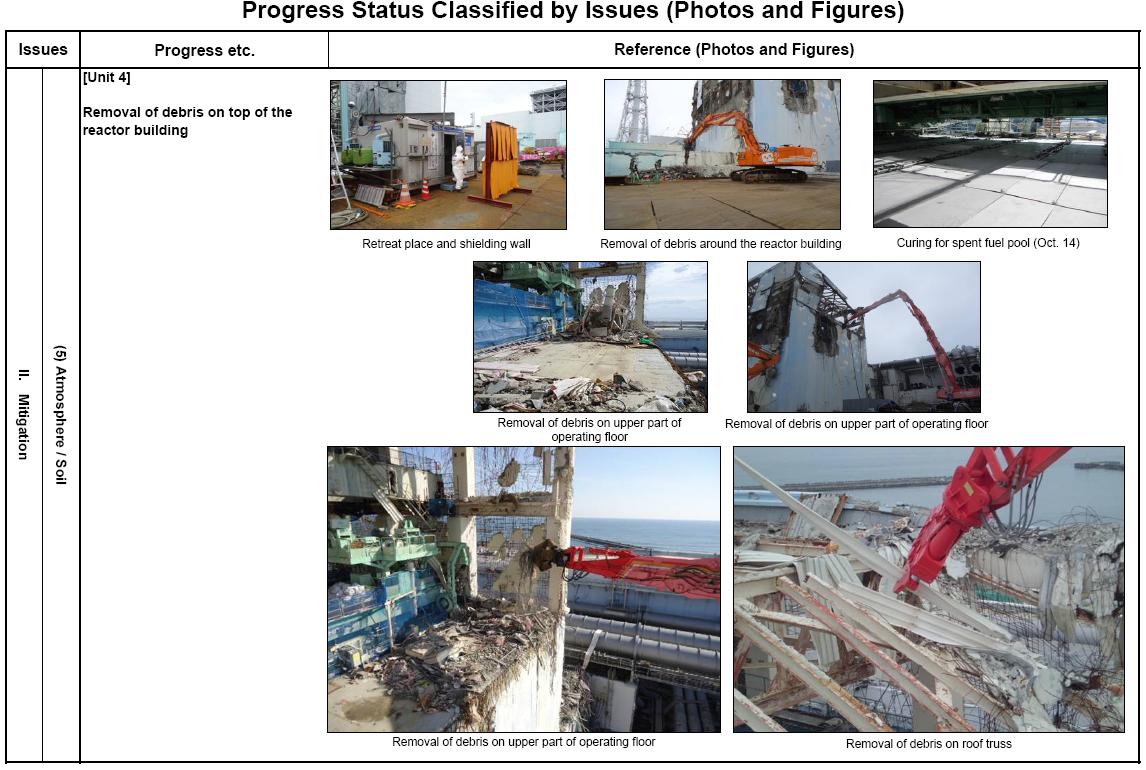
#Fukushima I Nuke Plant: Reactor 4 Is NOT Falling Apart (Yet); It Was Cleanup/Demolition Work by TEPCO

Contrary to what you may have heard, the rumor of the collapse of Reactor 4 is, for now, just a rumor. What you have instead is the result of a planned cleanup/demolition by TEPCO.

Several readers of my blog sent me the link that shows photographs of Reactor 4 at different times in December and links to a post that claims Reactor 4 is falling apart.

Alarmed, I started looking for information. There was absolutely no news or rumor of that in Japan, not even in the Internet message boards on the Fuku-I disaster. I looked at the photos again. I noticed that part of the ceiling trusses were gone, and it looked they were removed systematically.

Then I remembered the tweets a few months ago by the worker who tweets from Fuku-I, saying the debris clearing in Reactor 3 and Reactor 4 upper floors were ongoing. On checking his recent tweets, sure enough, it was a planned take-down of part of walls and ceiling in Reactor 4:

From December 13 tweet:

3号機はオペフロの瓦礫をクレーンを使って撤去してるよ。まだまだ先は長いでし。4号機はオペフロ南側の落ちそうな梁と柱と天井トラスを撤去してスッ キリしたよ。オペフロ南側の東西の壁もはなくなったから東側最上階の壁にあった4号機の「4」と書いてあった壁もなくなっちゃった。

In Reactor 3, they are removing the debris on the operation floor using a crane. It will take a long time still. In Reactor 4, they removed the failing beams, columns and ceiling trusses from the south side of the operation floor. It looks cleaner now. They also removed the wall panels on the east and west side of the southern end of the operation floor, so there is no more wall panel that had the letter "4" for Reactor 4 on the top floor on the east side.

Then one of my readers just posted TEPCO's Progress Status report on November 17, 2011 in the comment section. On pages 26 and 27, TEPCO shows the cleanup/demolition work in Reactor 4 in details:


So the long story short, no it is not falling apart.

(H/T anon reader)

#Radiation in Japan: Toshiba to Sell Camera That Visualizes Hot Spot

Now that France's AREVA is in dire financial trouble, Toshiba may have one less competition in selling nuke plants all over the world. And when a nuke plant goes bust, like Fukushima I Nuclear Power Plant did in a spectacular fashion, why it makes more money by first selling cesium towers (SARRY) which have so far delivered OK performance but not that great, then selling a desalination system (evaporative condensation apparatus) that keeps leaking water.

Now, Toshiba is set to make money in the "decon bubble" in wider communities outside the nuke plant by introducing a camera that can visualize radiation levels in different colors. According to the Asahi article below, it has been tested in the harshest environment - Fuku-I compound.

From Asahi Shinbun (12/14/2011):

東芝は13日、放射線量を色の違いで映し出すカメラを開発したと発表した。局地的に放射線量が高い「ホットスポット」を見つけるのに役立ち、除染作業の効率がよくなるという。このカメラを使った計測サービスを来年から環境省や自治体などに売り込む予定だ。

Toshiba announced on December 13 that it has developed a camera that can show different radiation levels in different colors. The company says the camera will help identify so-called "hot spots" with localized high radiation and improve the effectiveness of decontamination work. The company plans to market the survey service using the camera to the Ministry of the Environment and local municipalities, starting next year.

 カメラ内部に放射線を測定するセンサーと、映像を取り込むセンサーを取りつけた。センサーからの2種類の信号をあわせ、パソコンなどの画面に映し出すことで放射線が見えるようにした。放射線量が高い場所は赤く表示されるので、従来の放射線量を数値で示す測定器よりもホットスポットが発見しやすいという。

The camera contains a sensor that measures radiation and a sensor that captures graphic images. By combining two signals from the two sensors and sending the signals to the computer screen, the system allows users to visualize radiation. The locations with high radiation levels will be displayed in red, making it easier to identify "hot spots" than the traditional display of radiation in digits.

 東京電力福島第一原発の建屋内でも、ほぼ同じ機能を持つ東芝製のカメラが使われた。感度を高めたうえで、大きさと重さをほぼ半分にして自治体などでも使いやすくした。年内に福島市と共同で実証実験をして実用化する。自治体などから希望があれば、カメラそのものの販売も検討する。

The Toshiba-made camera with almost identical capabilities has been used inside the buildings at Fukushima I Nuclear Power Plant. The company has improved that camera by raising the sensitivity and reducing the size and weight by half, making it easier for local municipalities to use. Toshiba will conduct a joint experiment with Fukushima City before the year end, and commercialize the camera. If there's a demand from municipalities, the company will consider the sales of the camera itself.

Shizuoka Prefecture Goes to New York with Green Tea, Again, to Educate US Consumers about Safety

This time, Heita Kawakatsu, the Oxford-grad governor of Shizuoka Prefecture, is using young Shizuoka people to push his radioactive tea to New Yorkers instead of going there himself.

From Yomiuri Shinbun (12/13/2011):

福島原発事故の風評被害を吹き飛ばそうと、日本一の荒茶生産量を誇る静岡県は12日、米ニューヨーク中心部の和菓子店で深蒸し茶を振る舞い安全性をPRした。

Wanting to completely dispel the baseless rumors after the Fukushima I Nuke Plant accident, representatives from Shizuoka Prefecture, the largest producer of "ara-cha" (bulk tea) in Japan, served "fukamushi-cha" [tea made by steaming the leaves longer) at a Japanese confectionery store in the center of New York City on December 12 as part of the PR event to appeal safety.

 原発事故後、同県産の茶の一部から国の暫定規制値を超える放射性セシウムが検出された。しかし流通している茶は、飲んでも健康に影響がないことを消費者に理解してもらうのが狙い。

After the nuclear accident, some of the teas produced in Shizuoka were found with radioactive cesium exceeding the provisional safety limit set by the national government. However, the event was to educate [the US] consumers that there would be no effect on health if they drank teas that were being sold in the marketplace.

 高校生アリアナ・ソロモンさん(17)は「日本のお茶は祖母が毎日飲むので私も大好き」と話し、静岡茶を味わっていた。

Arianna Solomon, 17-year-old high school student, enjoyed the Shizuoka tea. "My grandmother drinks Japanese tea every day. I like it too."

"Some" Shizuoka teas were indeed found with radioactive materials exceeding the Japanese provisional safety limit (500 becquerels/kg). What the newspaper fails to mention is that radioactive cesium was found in almost all the Shizuoka teas tested.

The US peacetime limit for radioactive cesium in water and drinks is 3.0 picocuries, or 0.1 becquerel/liter. The same for food is 170 becquerels/kg.

The US FDA has the Derived Intervension Level (DIL) which is 1200 becquerels/kg, and the level of concern at 370 becquerels/kg to govern the domestic food in interstate commerce and the imported food as a non-enforceable "recommendation". But this is NOT a nuclear emergency for the United States, in which the citizens would suffer without food and drinks if the government did not raise the limits for radioactive materials in food and drinks in interstate commerce or from import.

Scanning the official webpage of Shizuoka Prefecture where the results of tea testing are published, you'll notice that testing seems to have been one bag at one tea plantation in one city. We know how well the similar testing of rice in Fukushima Prefecture has turned out to be.

  • Number of teas that tested with radioactive cesium: all of 102 samples tested

  • Number of teas that tested between 100 and 370 becquerels/kg): 46

  • Number of teas that tested above the "level of concern"(370 becquerels/kg) in the US: 21

  • Number of teas that tested above the provisional safety limit of Japan: 7

  • Number of teas that tested above the DIL in the US: 0

Shizuoka's webpage has a limited number of tests on brewed tea, using 10 grams of dried tea leaves and brewing for 60 seconds with 430 milliliters of water at 90 degrees Celsius. The results are between 1.6 and 14 becquerels/kg of radioactive cesium in brewed tea.

I drink 3, 4 cups of green tea every day. That's about 500 milliliters per day. If I were drinking the Shizuoka tea that had 14 becquerels/kg of cesium after it was brewed, I would ingest 14 becquerels of radioactive cesium every two days. In one year, I would have 2555 becquerels of radioactive cesium total, more than half of which would be retained in the body, looking at the ICRP chart below (from ICRP Publication 111).

I think I'll stay away from teas grown in Shizuoka, or anywhere in Kanto region, but it's my personal decision based on the information that I have digested since March 11.

Monday, December 12, 2011

Japanese Engineer: "There Was a Nuclear Explosion in Reactor 3 in Addition to a Hydrogen Explosion"

There are foreign nuclear experts who have said the explosion in Reactor 3 on March 14 at Fukushima I Nuclear Power Plant was a nuclear explosion. But this Japanese engineer and whistleblower at JNES (Japan Nuclear Energy Safety Organization) Setsuo Fujiwara says there were two explosions at Reactor 3: a hydrogen explosion, and a nuclear explosion at the Spent Fuel Pool.

The following is my best-effort translation of the interview Fujiwara did with the SPA magazine, without detailed technical knowledge of nuclear physics, subject to revision.

From Zakzak (12/13/2011):

「福島第一原発3号機で3月14日に起きた爆発はピカドン(核爆発)だ!!」

"The explosion in Reactor 3 at Fukushima I Nuke Plant on March 14 was nuclear!"

 そう語るのは、’10年の春まで日本原子力安全基盤機構(JNES)で原発検査員を務めていた藤原節男氏。原発の施設と運用について隅々まで知る専門家の一人だ。

So says Mr. Setsuo Fujiwara, who worked at Japan Nuclear Energy Safety Organization (JNES) until the spring of 2010 as nuclear plant inspector. He is one of those experts who know the nuclear power plant facilities and operations in great details.

 「3号機の爆発では、一度ピカっと炎が出た後、ドーンと黒煙がまっすぐ建屋上方へと立ち上っています。水素爆発であんな黒い煙は出ません。キノコ雲の形状といい、核爆発の現象に酷似している」

"In the Reactor 3 explosion, there was a flicker of fire, then a vertical, black smoke up the reactor building. A hydrogen explosion does not produce such a black smoke. And the mushroom cloud. It resembles a nuclear explosion."

 しかし、政府、東電の発表では、原子炉内部は安定を取り戻してきているはずだが?

But according to the government and TEPCO, the nuclear reactors are getting more stable, aren't they?

 「重要な放射能飛散原因は、使用済み燃料プールです」

"A more important source of radioactive materials dispersed is the Spent Fuel Pools."

 彼は一原発を陸側から写した航空写真を取り出した。

Fujiwara takes out an aerial photograph of the plant shot from the land side.

 「建屋上部フレームは、使用済み燃料プールの場所が吹っ飛んでいます。プール内で爆発が起こり、そこにあった燃料棒は飛び散ってしまったと思われます」

"The upper frames of the reactor building are blown off at the location of the Spent Fuel Pool. I believe there was an explosion inside the SFP, and the fuel rods inside were blown out."

 だが、たとえ使用済み燃料が溶融して下に溜まっても、果たしてそれで核爆発は起きるのだろうか。

If the spent fuel had melted and sank to the bottom of the pool, would that cause a nuclear explosion?

 「3号機の燃料プール内では、爆発が生じるまでに冷却水が少なくなり、ジルカロイ・水反応で水素が発生。上方の燃料被覆管が溶けて、中のペレットはブロック崩し状態。プール内が原子炉さながら、小出力で臨界状態となって水が沸騰したと思われます。そして、プール水面上方で水素爆発。その圧力で沸騰水中のボイド(水蒸気)が圧縮。ボイド反応度係数はマイナスなので、一気に核分裂の反応度が高まり、即発臨界の核爆発が起きた。3号機爆発のスローモーションビデオを観ると、爆発音が3回聞こえる。これが、水素爆発の後に核爆発が生じた証拠です」

"The amount of cooling water decreased in the Reactor 3 SFP prior to the explosion, and hydrogen was generated from the zircaloy-water reaction. The upper part of the cladding melted, and the pellets fell out and piled [at the bottom of the pool?]. Inside the SFP, it was like a nuclear reactor becoming critical, and the water boiled. Then there was a hydrogen explosion above the surface of the water in the SFP, and due to the pressure from the explosion, voids (steam bubbles) in the boiling water were compressed. The void coefficient was negative, so the reactivity of nuclear fission was suddenly heightened, resulting in a nuclear explosion from the prompt criticality. When you see the slow-motion video of Reactor 3's explosion, you hear three explosive sounds. It is the evidence that the nuclear explosion occurred after the hydrogen explosion."

 続いて彼が指差したのは、排気筒と3号機を結ぶ配管部分だ。太いパイプはそこで断裂し、短い管が口を空けて転がっている。

Next, he points to the pipe that connected the exhaust stack and Reactor 3. The big pipe is broken, and the short segment of the pipe is lying on the ground.

 「東電は、定期点検中の4号機で水素爆発が起きたのは、3号機で発生した水素がこの配管を通って、4号機建屋に入ったためだと説明しました。しかし写真を見ると、このとおり配管は繋がっていない。4号機でも使用済み燃料プール内で水素が発生して、爆発したと言える。3、4号機爆発とも、使用済み燃料プールの水素なら、1号機も使用済み燃料プールの水素による爆発ではないか。これら重要な事故シナリオについて、誰もダメ出しをしていない」

"TEPCO explained that the hydrogen gas generated in Reactor 3 passed through this pipe and entered the reactor building of Reactor 4, causing the hydrogen explosion in Reactor 4 which was in regular maintenance at that time. However, if you look at the photo, the pipe is broken. I think it was a hydrogen explosion in Reactor 4 also, caused by hydrogen generated inside the Spent Fuel Pool. If Reactors 3 and 4's hydrogen came from the Spent Fuel Pools, is it possible that the explosion of Reactor 1 was also caused by hydrogen from the Spent Fuel Pool? But no one is questioning [TEPCO] hard on these important points in reconstructing the accident."

 彼は、脱原発の技術者たちにもこれら事故シナリオ内容を投げかけたが、コメントを控えたという。「日本の技術者は、自分の専門領域以外のことにはなかなか発言しようとしない」と藤原氏は苛立つ。

Fujiwara says he tried to run his scenario of the accident with the engineers who are anti-nuclear, but that they withheld comments. "Japanese engineers are too reluctant to comment on things outside their specialties", says Fujiwara, irritated.

More on "void coefficient" here (wiki).

People like Arnie Gundersen talked about prompt criticality as a shockwave from a hydrogen explosion "moved and distorted" the fuel rods. I didn't quite understand the mechanism of distorted fuel rods resulting in prompt criticality. Fujiwara's explanation makes the mechanism much clearer for me, but it is also possible that I (non-expert) am imagining that I understand.

Canada Formally Withdrew from the Kyoto Protocol: "Kyoto Is an Impediment"

From AFP (12/12/2011):

OTTAWA — Canada became the first country to formally withdraw from the Kyoto Protocol, saying the pact on cutting carbon emissions was preventing the world from effectively tackling climate change.

"We are invoking Canada's legal right to formally withdraw from Kyoto," Environment Minister Peter Kent said following a marathon UN climate conference in South Africa, at which nations agreed to a new roadmap for worldwide action.

The landmark pact reached in 1997 is the only global treaty that sets down targeted curbs in global emissions.

But those curbs apply only to rich countries, excluding the United States, which has refused to ratify the accord.

"Kyoto is not the path forward for a global solution to climate change," Kent said. "If anything, it's an impediment.

"We believe that a new agreement with legally binding commitments for all major emitters that allows us as a country to continue to generate jobs and economic growth represents the path forward."

Canada agreed under the Kyoto Protocol to reduce CO2 emissions to 6.0 percent below 1990 levels by 2012, but its emissions of the gases blamed for damaging Earth's fragile climate system have instead increased sharply.

Saying the targets agreed to by a previous Liberal administration were unattainable, Conservative Prime Minister Stephen Harper's government last year unveiled its own measures aimed at curbing emissions, in line with US efforts.

Pulling out of Kyoto now allows Canada to avoid paying penalties of up to CAN$14 billion (US$13.6 billion) for missing its targets.

Kent also cited major impacts on Canada's economy that will be avoided by withdrawing from the treaty.

"Under Kyoto, Canada is facing radical and irresponsible choices if we're to avoid punishing multi-billion-dollar payments," Kent said, noting that Canada produces barely two percent of global emissions.

"To meet the targets under Kyoto for 2012 would be the equivalent of either removing every car, truck, ATV, tractor, ambulance, police car, and vehicle of every kind from Canadian roads or closing down the entire farming and agricultural sector and cutting heat to every home, office, hospital, factory, and building in Canada."

For Kyoto supporters, the anticipated Canadian pullout was expected to be a symbolic blow and badly damage a UN climate process already weakened by divisions.

Last week at the UN climate conference in Durban, South Africa, Kent had already said that Kyoto was "in the past" for Canada.

"It is an agreement that covers fewer than 30 percent of global emissions, by some estimates 15 percent or less," the Canadian minister said.

The conference on Sunday approved a roadmap towards an accord that for the first time will bring all major greenhouse-gas emitters under a single legal roof.

If approved as scheduled in 2015, the pact will be operational from 2020 and become the prime weapon in the fight against climate change.

But environmentalists have called it porous.

Kent said that in the meantime, Canada would continue to try to reduce its emissions under a domestic plan that calls for a 20 percent cut from 2006 levels by 2020, or as critics point out, a mere three percent from 1990 levels.

The latest data last year showed that Canadian carbon emissions were currently up more than 35 percent from 1990.