(Shame on the Japan Football Association for flying her and her team mates in the economy class...)
From @Kontan_Bigcat on Twitter:



(Shame on the Japan Football Association for flying her and her team mates in the economy class...)
From @Kontan_Bigcat on Twitter:
Researchers from Stony Brook University and New York State Stem Cell Science found the compact fluorescent light (CFL) bulbs emitting harmful UV lights that can cause skin damages.
The research was funded by the National Science Foundation, and the result is similar to the 2008 European study.
These CFL bulbs, said to be energy-efficient and environmentally friendly according to the proponents, have been federally mandated in the US to completely replace incandescent light bulbs.
From Daily Caller (7/23/2012; emphasis is mine):
Energy-efficient CFL bulbs cause skin damage, say researchers
New research funded by the National Science Foundation has scientists warning consumers about the potentially harmful effects energy-saving CFL light bulbs can have on skin.
The warning comes based on a study conducted by Stony Brook University and New York State Stem Cell Science — published in the June issue of Photochemistry and Photobiology — which looked at whether and how the invisible UV rays CFL bulbs emit affect the skin.
Based on the research, scientists concluded that CFL light bulbs can be harmful to healthy skin cells.
“Our study revealed that the response of healthy skin cells to UV emitted from CFL bulbs is consistent with damage from ultraviolet radiation,” said lead researcher Miriam Rafailovich, Professor of Materials Science and Engineering at Stony Brook University, in New York, in a statement. “Skin cell damage was further enhanced when low dosages of TiO2 nanoparticles were introduced to the skin cells prior to exposure.”
According to Rafailovich, with or without TiO2 (a chemical found in sunblock), incandescent bulbs of the same light intensity had zero effects on healthy skin.
The scientists found that cracks in the CFL bulbs phosphor coatings yielded significant levels of UVC and UVA in all of the bulbs — purchased in different locations across two counties — they examined.
With high levels of ultraviolet radiation present, the researchers delved into how the exposure affected the skin. According to the findings, skin damage from exposure to CFLs was consistent with harm caused by ultraviolet radiation.
“Despite their large energy savings, consumers should be careful when using compact fluorescent light bulbs,” said Rafailovich. “Our research shows that it is best to avoid using them at close distances and that they are safest when placed behind an additional glass cover.”
The research was inspired by a similar 2008 European study conducted by the Scientific Committee on Emerging and Newly Identified Health Risks which found a potential for skin damage and suggested the use of double-enveloped bulbs as a mitigation tool.
CFLs have been the source of political rumblings since 2007 when Congress approved new energy standards that would have started to phase out the traditional incandescent light bulb in favor of the energy-efficient CFL bulb this year. In December, Congress offered a provision to prevent the Department of Energy from enforcing the standards for nine months. The regulation is still on the books.
The restriction on consumer choice has represented a political battle cry for Tea Partiers and conservatives alike who view the regulation as an infringement on individual liberty. Environmentalists and CFL proponents argue the bulbs are environmentally friendly and economically efficient.
How a mercury-filled bulb could be environmentally friendly remains a mystery to me. As to energy efficiency, as far as my personal experience goes, they keep dying on me prematurely so I wouldn't know how efficient it could be.
The investigation commission on the Fukushima accident set up by the Cabinet Office of the government has just issued its final report.
You can download your own copy from this page, but the main report in English has to wait.
This commission conducted the investigation and carried out interviews with people involved since the start of the nuclear accident in March last year in private, unlike the National Diet commission who also released its final report recently.
Some have criticized the government commission for not making its sessions open to public. I don't think it is necessarily a bad thing. The National Diet commission should be applauded for its openness and its highly critical final report (anyone reading?), but in some of the public testimonies of the commission that I watched it was rather a place for the expert commissioners to display (or show off) their expertise and knowledge of the nuclear issues in general.
So, will there be information only obtainable in the closed sessions? We'll find out, but someone at Jiji Tsushin has clearly been assigned to read the voluminous report, and he/she has been putting up short articles. Judging from these articles, the government investigation commission is just as critical, if not way more, as the Diet investigation commission. Some of the points from Jiji articles (7/23/2012, here, here and here, in Japanese):
Detailed analysis and timeline from the time the water injection into RPVs failed till the damages to RPVs and Containment Vessels occurred;
Conclusion on how and when the core melt happened and progressed cannot be made because the actual survey at the plant is highly difficult [to say the least...];
Experts from TEPCO, NISA, and Nuclear Safety Commission at the PM's Official Residence failed to provide expert opinion and advice, adding to the distrust by PM Kan of these "in-house" experts;
Head of NISA couldn't answer Kan's question about the precise locations of emergency diesel generators [... should he be asking such details?];
PM Kan decided to go to Fukushima I Nuke Plant on March 12 morning because he (said he) had "the food feel for the place" when it came to technical aspects of nuclear energy;
Communication process was haphazard, direct communication between TEPCO and PM's Official Residence, without NISA's intermediation, had never been assumed or planned;
TEPCO, even though they were well trained and knowledgeable, they critically lacked the ability to think in a flexible and proactive manner;
TEPCO's organization was too vertically segmented to deal with the accident;
TEPCO didn't seem eager to find out what was happening at the plant in the early hours and days of the accident.
If you can think flexibly and proactively and you are curious, you wouldn't be working at TEPCO or NISA (or any ministry or government agency), I'm afraid.
The last Jiji Tsushin article linked above has examples of TEPCO's "inattention" to details and its vertically segmented organization:
From March 12 to 21, nearly 1,000 personal dosimeters were sent to Fukushima I Nuke Plant from Kashiwazaki-Kariwa Nuke Plant in Niigata (operated by TEPCO) and from Shikoku Electric Power Company. However, TEPCO employees didn't ask for [?] the equipment needed [to use those dosimeters], they were never used. Until the end of March, only one dosimeter was available per work group of several workers.
On the first day of the accident on March 11, Masao Yoshida, general manager of the plant, instructed [his managers] to plan for water injection using fire engines. However, because of TEPCO's vertically segmented organization, no one thought it was his job to do so.
Following the last week's success, they are at it again, protesting in Omiya City against the restart of Ooi Nuke Plant and against Mr. Edano himself, calling out loud, "EdaNO, YameRO! (Edano, resign!)" with accent on "NO" and "RO".
The crowd looks less than last week, but just as noisy and vigorous.
Come to think about it, Japan has come a long way. Now ordinary citizens are calling the sitting minister of one of the most powerful ministries in the Japanese government without "Mr.".
I like these local events. There are no fences, there are no orange cones. People are shouting about all kinds of issues.
"No No EdaNO!"
"Genpatsu Iranai, Edano mo Iranai!" (We don't need nuke plants, we don't need Edano)
"Zo-zei Iranai!" (We don't need tax increase!)
and "Let's vote them out in election. Let's vote out Edano!"
I wonder if people in Goshi Hosono's constituency are doing any protest...
I haven't written about the disaster debris disposal for a long time, as it has dwindled into a non-issue in most part of Japan now that the amount of the debris in Miyagi and Iwate Prefectures has turned out to be much, much less than what was predicted. EXCEPT in the cities whose mayors are more than ever determined to bring and burn the debris NO MATTER WHAT.
One such city is Tokyo under the 79-year-old governor Shintaro Ishihara. Another is Osaka City under the boy-wonder mayor Toru Hashimoto who would say and do anything to stay in the news.
Then there is Kitakyushu City, whose mayor Kenji Kitahashi has been on a relentless campaign to shove the debris on the residents. His latest antics: Educate elementary school children and junior high school pupils so that they will tell their parents how safe and wonderful it is to bring the disaster debris all the way to their city in Kyushu Island and burn it.
Some Kitakyushu City's parents were outraged when they found out about this education pamphlets. Here's a copy of the pamphlet for 4th to 6th graders in elementary schools, tweeted here:

What is "disaster debris disposal"?
More than one year has passed since the March 11, 2011 disaster but there are still large piles of debris in the disaster affected areas. [The picture shown is probably more than one year old.] People in the disaster-affected areas want the debris to be removed as soon as possible. [Not true. Iwate Prefecture officials are on record saying they are considering shipping the debris to Kitakyushu City because the city has asked for it; otherwise, they say, there is no problem disposing it in Iwate.] It is necessary for everyone to help in disposing the debris. Kitakyushu City has decided to help by accepting the flammable debris for the sake of people who are suffering in the disaster-affected areas.
In the middle segment titled "2. There is no effect on health or the environment even if the debris is burned" ("No immediate effect" perhaps? a la Mr. Yukio EdaNO):
We have been receiving the radiation, even if it is invisible, from the universe, soil, air, and food. This time, the city consulted with the experts and decided to accept the debris. The amount of radiation from the debris does not affect your health or environment.
And in fine print, as if to further impress the youngsters on the cleansing effect of burning the debris, it mentions numbers:
Air radiation levels before the debris test burning: Kokura Kita-ku 0.08 microsievert, Moji-ku 0.10 microsievert.
Air radiation levels after the debris test burning: 0.06 to 0.07 microsievert
Wow, burning the debris lowered the radiation levels! (Professor Hayakawa would be pleased.)
In the last segment titled "3. Let's prevent baseless rumors", it says:
What's worrisome in accepting the disaster debris is the baseless rumor against produce in Kitakyushu City, residents of Kitakyushu City, and against Kitakyushu City in general. In order to prevent the baseless rumor, Kitakyushu City is providing the correct facts. The safety of the debris and of the disposal process will be announced on the city's homepage and pamphlets. It is important to make a correct judgment, without distracted by the wrong information about the debris.
As residents of Kitakyushu City, let's learn more about the debris disposal, and let's pray that the towns and schools affected by the disaster will be back to normal as soon as possible.
And look at the cute little three boys. I could almost tell what they are saying. The middle boy is saying:
"But my parents say burning the debris is dangerous, because it's not just radioactive materials but also toxic industrial materials on the debris..."
The other two boys are telling the middle boy,
"Don't be absurd, that's called "baseless rumor"! We have to help those poor children up in Iwate who are suffering. We must tell our parents to shut up and do what the teachers and the mayor of the city say!"
Or it could be the other way around: The middle boy is telling the other two to calm down, and telling them there is no danger.
According to the togetter about Kitakyushu City's pamphlets, school principals were instructed by the mayor and the city's Board of Education to speak positively about accepting and burning the disaster debris in Kitakyushu City at the end-of-semester ceremony before the summer break (most likely it was on July 20). Here's one of the tweets in the togetter:
昨日、学校長に終業式で小4以上に「がれきの受け入れは良いことをしたのだと生徒に話すように」と繰り返し話すことと、北橋市長が伝達したと聞いた。我が家は中学生なので、どうかな?と思っていたが、やはり今日の終業式で、その話が出たそうだ。
The other day, I heard that school principals were instructed by Mayor Kitahashi to repeatedly tell pupils from 4th graders on at the end-of-semester ceremony that "to accept the disaster debris is to do a good thing". Our child is in junior high school, so I wondered if they do that in junior high school also. Sure enough, [my daughter] said the principal talked about that in the ceremony today [July 20].
Mayor Kitahashi has his own website where he posts his reasoning for accepting the debris in English. If you care to read it, it is here.
Why doesn't the mayor come outright and say "I want the disaster debris for the money it brings to the city, and the business concessions it will bring to the city"?
By the way, asbestos and mercury have been detected in municipal incineration plants in Setagaya-ku, Tokyo that have been mixing the disaster debris from Onagawa City, Miyagi with the household garbage and burning the mixture. Hexavalent chromium and arsenic have also been detected in the disaster debris in the amount that exceeds the limit set by the regulations.
No matter. All is safe, and all to help "recovery" that is non-existent.
The mayor of the city believes the tree is the symbol of hope for the residents for the future, and it has to be standing, dead or alive. 150 million yen or not.
Some residents wholeheartedly agree with the mayor, while others have doubts, particularly about the money supposedly needed to preserve the tree in the standing position. I am rather surprised that the tree gets "embalmed", instead of burned in a religious ceremony and sent to the "heaven" (wherever the pine tree heaven may be) - a traditional Japanese way.
NHK Morioka (Iwate) had the article for about several hours yesterday, now gone. This is part of the article that I copied while it was still at the local NHK website (7/21/2012):
津波に耐えて残った陸前高田市の「奇跡の一本松」の保存方法が決まりました。
The method of preservation has been decided for the "Miracle Lone Pine" in Rikuzen Takata City that survived the tsunami of March 11, 2011.
根元から切り倒して幹を5つに分割し、防腐処理をした上で中に金属の棒を通してもとの場所に立てて保存するというものです。
これは20日、陸前高田市の戸羽太市長が記者会見して明らかにしました。
The tree will be cut down at the base, and the trunk will be cut into 5 parts. After they are treated with preservatives they will be pierced through with a metal rod. The tree thus preserved will stand in the original location. Rikuzen Takata Mayor Futoshi Toba disclosed the plan in the press conference on July 20.
それによりますと、一本松はまず根元から切り倒して幹を5つに分割し、芯をくりぬいて防腐処理を施します。そして、金属製の棒を幹の中に通し、根元をボルトで固定することで生えていたときと同じように立てて保存するということです。
According to the plan, the tree will be cut down at the base, and the trunk will be cut into 5 parts. After they are treated with preservatives they will be pierced through with a metal rod, and the base will be secured with bolts so that the tree can stand just like when the tree was alive.
切り倒す時期は8月下旬を予定していて、加工する施設のある名古屋市や京都市にいったん運び、芯のくり抜きや防腐処理をした上で、来年2月末までにもとあった場所に立てたいとしています。
The tree is scheduled to be cut down in the second half of August. [After being cut] the tree will be brought to Nagoya City and Kyoto City where the facilities to treat the wood are located. The core will be removed and the tree will be treated with preservatives. It is hoped that the tree will be standing by the end of February next year.
また、陸前高田市は、保存にかかる1億5000万円程度をまかなうための募金を呼びかけていますが、おとといまでに集まったのは350万円にとどまっているということで引き続き、協力を呼びかけていくことにしています。
Rikuzen Takata City is asking for donations to cover the cost of preservation, about 150 million yen [US$1.9 million], but as of two days ago the amount collected was 3.5 million yen. The city will keep calling for support.
戸羽市長は、「津波に耐えて立っている姿が市民に希望を与えているので立ったまま姿で保存したいと考えこの方法を選んだ。一本松は我々にとっても心の支えでありこれからのまちづくりの希望なので、全国の皆様にご協力を頂きたい」と話しています。
Mayor Toba says, "Because the tree, having survived the tsunami and standing, is giving hope to the residents, we have chosen this preservation method. The Lone Pine is our emotional support and our hope for future rebuilding of the city. We would like people all over the country to help us preserve the tree."
Mayor Toba, I was told by one of my twitter followers, lost his wife to the tsunami.
I would still say "Let it go, let the tree die a peaceful death" and find hope elsewhere.
On the other hand, it may be a clear sign that the "recovery", much publicized by the national government, doesn't exist, if the residents of one of the areas hardest-hit by the March 11 tsunami have to rely on a dead tree for hope and support.
So Japan is not so singular in the world. That's good to know. But Australia is about to change that long-time custom without any condition attached like the Japanese Soccer Federation whose head insisted that the team win the gold medal in order to fly home in the business class.
From The Sydney Morning Herald (7/21/2012):
Backflip on Opals travel
BASKETBALL Australia is set to rewrite an inequitable travel policy that saw the male members of the Olympic team fly to London in business class while the female team travelled in premium economy.
Under mounting pressure after the Herald revealed the Opals were given economy tickets to London while the Boomers flew business class, the national sports federation, which has a new chairwoman in the former premier Kristina Keneally, admitted its poor policy. Ms Keneally, who will begin in her new role on August 4, gave a scathing assessment of the travel policy.
''In this day and age, there's just no excuse for men's and women's sporting teams to be treated differently when they both compete at the same world-class level,'' she said.
Mr. Tomohiko Suzuki, journalist who went to work at Fukushima I Nuclear Power Plant last year to report how it really was in the plant, said the workers use a variety of ways to lower (i.e. fake) the radiation exposure as measured by their dosimeters. One of the ways is to simply hand the dosimeter to a person who is not entering the high-radiation areas; another way is to flip the dosimeter in the pocket so that it won't measure radiation as much.
Here's a new one, decidedly more effective. A subcontractor in Namie-machi, Fukushima who contracts work from one of the 1st-tier TEPCO subcontractors supposedly told its workers to cover their dosimeters with lead plates when working at the plant last year.
Asahi Shinbun reveals in the article below (7/21/2012) that the paper obtained the recording of the company's executive telling workers to do so:
線量計に鉛板、東電下請けが指示 原発作業で被曝偽装
Lead plate on dosimeter, a TEPCO subcontractor instructed the workers to fake radiation exposure at the plant
東京電力が発注した福島第一原発の復旧工事で、下請け会社の役員が昨年12月、厚さ数ミリの鉛のカバーで放射線の線量計を覆うよう作業員に指示していたことがわかった。法令で上限が決まっている作業員の被曝(ひばく)線量を少なく見せかける偽装工作とみられる。朝日新聞の取材に、複数の作業員が鉛カバーを装着して作業したことを認めた。役員は指示したことも装着したことも否定している。厚生労働省は、労働安全衛生法に違反する疑いがあるとして調査を始めた。
It has been revealed that a senior executive of a subcontractor instructed its workers to cover their dosimeters with lead plates several millimeters thick for the work ordered by TEPCO for the restoration of Fukushima I Nuclear Power Plant last December. It was done to disguise the radiation exposure levels of the workers, whose upper limit is set by the regulations. More than one worker has admitted to Asahi Shinbun that they worked with the lead cover over their dosimeters. The senior executive denies that he ever instructed the workers and that the lead cover was used.
朝日新聞は、福島県の中堅建設会社である下請け会社「ビルドアップ」の役員(54)が偽装工作したことを示す録音記録を入手した。昨年12月2日夜、作業員の宿舎だった福島県いわき市の旅館で、役員とのやりとりを作業員が携帯電話で録音していた。
Asahi Shinbun has obtained the recording that shows a senior executive (age 54) of the subcontractor "Build Up", which is a medium-sized construction company in Fukushima Prefecture. The exchange between the executive and the workers took place at night on December 2 last year, at a ryokan [Japanese-style hotel, inn] in Iwaki City in Fukushima where the workers were staying. One of the workers recorded the exchange with his cellphone.
役員はその前日、作業チーム約10人に対し、胸ポケットに入るほどの大きさの線量計「APD」を鉛カバーで覆うよう指示した。だが3人が拒んだため、2日夜に会社側3人と話し合いがもたれた。役員は録音内容を否定するが、この場にいた複数の作業員が事実関係を認めている。
On the previous day, the executive had told the team of 10 workers to cover their pocket-sized dosimeter "APD" with lead cover. 3 workers had refused. So on the night of December 2 a talk was held between the company [the executive] and the 3 workers. The executive denies what's in the recording, but more than one worker who were at the scene confirms the facts.
Asahi's subscriber-only section has the actual transcript of the conversation that took place between the executive and the workers. Two additional articles (also subscriber-only) give the detailed background that led to this request. Reading them, I just feel sorry for the executive and the workers.
The company was contracted to put insulation around the pipes near Reactors 1, 2, 3 and 4 that carry contaminated water from the turbine buildings, so that the pipes wouldn't rupture or leak from the freeze.
From the transcript of the recording (Asahi articles here and here, subscription-only; you can subscribe for free and read up to three articles per day):
わかりやすいように説明すると、年間50ミリシーベルトまでいいですよっていうのは、原発やってる人はみんな知ってるんだわな。で、これは、50ミリシーベルトっていうのは各個人の線量。で、俺らみたいな年間通して原発で働く人は、50ミリっていうのは50ミリだから。いっぱい線量浴びちゃうと、年間なんてもたないわけよ、はっきり言って。3カ月、4カ月でなくなっちゃうのよ、50ミリなんて。 だから、自分で自分の線量を守んないと、1年間原発で生活していけないのよ。原発の仕事でぎねがったら、もうその場でどっかで働くかっていうわけにはいかねえんだから。俺ら何十年もやってっから、原発ばっかり。だから、自分の線量を守るためにどうするっていうごどでやってるわけ
To explain it to you simply, everyone working for a nuke plant knows it is OK to be exposed up to 50 millisieverts per year. This 50 millisieverts limit is for each person. Then, for people like us, who work at the nuke plant all year round, 50 millisieverts is 50 millisieverts, and if we're exposed to too much radiation it won't last a year, frankly. [50 millisieverts] is up in 3, 4 months. So, unless we protect our own radiation exposure limit we cannot work at the plant and earn our living for one year. If we can't work at the plant, we don't have any other work. We've been working at the nuke plant for decades. Only at the nuke plant. So the thing is how we protect our radiation exposure [allowance].
線量がなくなったら生活していけねえんだ。わかる? 50ミリがどんどん目減りしていくわけだから
If this radiation [allowance] is depleted, we can't earn our living. Do you understand? 50 millisieverts will just decrease.
やってはいけないってのは百も承知。やりたくない人は無理にやらなくたっていいんだよ
I'm fully aware that we shouldn't be doing this. I'm not forcing anyone who doesn't want to do it.
別の作業員が「これって犯罪に近いと思う」と言うと、役員はこう反論した。
When one of the workers said "I think it is almost a crime", the senior executive countered:
「私、無理押しした? 自分のために納得してやってもらえるんだったらやってください、ということなの。俺は自分の線量を守りたいからやるよ」
Have I forced you to do it? All I'm saying is if you understand the situation and willingly do it for yourself, then please do it. I will do it because I want to protect my radiation [allowance].
「鉛で隠さないと、線量なくなったら仕事にならないんだ
If we don't shield [the radiation] with lead, we will lose our radiation [allowance] and there will be no more work.
It looks these three workers had never worked at any nuclear power plant until they started working for this contractor. The senior executive at one point told them:
だから、よそでやれる人はいいよ。別にそんなことしなくったって。でしょ? ちょこっと来てやって。あと原発の仕事なんかする必要ねえと思ってる人、ね? だけど、俺らは年間通してずっとやってる。1年、2年、3年と継続してやってるわけだから、ドンドン累積されっちゃうと、原発の仕事できなくなっちゃうよ。
As I said, people who can work outside nuclear plants are OK. Don't need to do it, right? Those people who come to work for a short time and no need to work at a nuke plant afterwards. But we've been working all year round. One year, two years, three years, we work continuously [at the nuke plant]. If radiation exposure accumulates we cannot work at the nuke plant.
Some Japanese bloggers are accusing the subcontractor and this executive for forcing the workers to fake the radiation exposure (even if it was technically a non-enforceable "request").
According to NHK News who reported on the same topic, specifically naming the company (which is highly unusual for NHK):
役員は社長に対して「工事の始まる前に現場に下見に行った際、放射線量が急速に上がっていることを示す線量計のアラーム音に驚き、被ばく線量を少なく見せかけようとした。9人の作業員が一度鉛のカバーを使った」と説明したということです。
The executive allegedly explained to the president of the company that when he went to survey the location before the work, he was surprised at the alarm of his survey meter sounding off, indicating the rapidly rising radiation levels, that he wanted to make the radiation exposure levels look lower, and that 9 workers used lead covers once.
NHK also says the Ministry of Health, Welfare and Labor is investigating the company.
Two levels removed, TEPCO sits pretty with plausible deniability. TEPCO doesn't force any subcontractors to fake the radiation levels. The subcontractors themselves do, each deciding what is best for the company in order to secure the work for the workers and to get the job done.
No one investigates TEPCO. No one will, as it is now practically owned by the national government.
The nuclear power plants in Japan have been supported by the companies like this Namie-machi subcontractor. Without them, there would have been no nuclear power plant, anywhere in Japan. And now, without them, there will soon be no skilled workers at Fukushima I Nuclear Power Plant. And who is going to decommission all the other nuclear power plants in Japan? Decommissioning the plants cannot happen all at the same time.
PM NOda declared the Fukushima I Nuclear Power Plant accident "over" in December last year, soon after these workers insulated the pipes around Reactors 1 through 4, wearing dosimeters covered with lead plates. And his government goes after this subcontractor. What a joke.
also known as "space alien" among his critics for his off-the-wall remarks in the past. True to this moniker, Mr. Hatoyama said he would go inside the PM's Official Residence and tell the prime minister to listen to the protesters, and he actually did (PM NOda was not there). Good for him on that.
According to the Jiji article below, Prime Minister NOda was as far away possible from Tokyo on Friday. He was in Fukuoka Prefecture in Kyushu. Noda has apparently been complaining to his guards that he cannot freely go out for a drink on Friday evening because of the protest.
From Jiji Tsushin (7/20/2012):
民主党の鳩山由紀夫元首相は20日夕、首相官邸前で行われた原発再稼働の抗議デモに参加した。マイクを握った鳩山氏は「皆さんの新しい民主主義の流れを大事にしなければならない。再稼働を止めるべきだ」と訴えた。
Former Prime Minister Yukio Hatoyama of Democratic Party of Japan participated in the protest against the restart of nuclear power plants in front of the Prime Minister's Official Residence in the evening of July 20. Holding the microphone, Mr. Hatoyama said, "We have to respect a new trend in democracy that you are creating. We should stop the restart."
鳩山氏は「これから官邸に乗り込んで皆さんの思いを伝える」と宣言。そのまま歩いて官邸に入り、藤村修官房長官に、野田佳彦首相がデモ参加者の声を聞く場を設けるよう求めた。藤村長官は「首相に伝える」と語った。首相は、鳩山氏の要請について、視察先の福岡県柳川市で記者団に「さまざまな声を聞いていきたい」と述べた。
Mr. Hatoyama then declared, "I will go inside the Official Residence right now and tell them how you feel." He then walked inside the Official Residence, and asked Chief Cabinet Secretary Shu Fujimura that Prime Minister Yoshihiko Noda set up an occasion to hear what the protesters have to say. Mr. Fujimura answered "I will tell the prime minister." Of Mr. Hatoyama's request, PM Noda said to the press in Yanagawa City in Fukuoka Prefecture where he was visiting, "I want to listen to various opinions."
デモに参加した理由について、鳩山氏は記者団に「政治家として民主主義の新しいうねりを肌で感じる必要がある」と説明。しかし、党内からは「党の元代表、元首相の参加はいかがなものか」(城島光力国対委員長)と冷めた声が聞かれた。
Asked why he participated in the protest, Mr. Hatohama explained to the press, "It is necessary to feel the new wave of democracy first hand." However, his party was not enthusiastic about his participation. "Should he be participating in the protest as the former head of the party and former prime minister?" (Koriki Jojima, chairman of DPJ diet policy committee).
By the way, Hatoyama, who voted against the sales tax hike and got his DPJ membership suspended for a few months, is a member of the group of politicians who wants to build nuclear power plants deep underground so that the plants could be easily buried should serious accidents happen.
Yasumi Iwakami did the interview with Mr. Hatoyama on July 18 and it was netcasted on IWJ's USTREAM. People have been tweeting "Oh he sounded so reasonable! Totally different from how the media has been portraying him!"
I didn't think much of him when he was the prime minister, and don't think much of him after he resigned. But I haven't seen the video yet. If you understand Japanese, you can still view it for free at IWJ, here
Whether it is Hatoyama, or Kamei, or other politicians at the protest (including Yasuo Tanaka giving out white balloons), the need to hold up the "higher authority" must be in the national genes.
I came across this tweet by one of the organizers while browsing tweets to find information on Hatoyama's appearance on the Friday protest:
首都圏反原発連合のやり方を批判する人たちは、まさにそのやり方を取ることによって首都圏反原発連合がこれだけの参加者を集めるようになったという単純な事実を無視する根本的な矛盾に気づかない。それが事実でないと言うのであれば、金曜日に自分たちの主催でそれ以上の参加者を集めてみれば良い。
Those people who criticize the way we do things at Metropolitan Coalition Against Nukes simply ignore the fact that by doing it our way we've been able to gather so many people to participate. If they want to deny that fact, why don't they organize something on their own on Friday and gather more people?
"Success" seems to have gotten better (or worse) of him.
I suppose the phase "tens of thousands" must be the global standard that the media has to follow whenever they have to report a very large demonstration. (If it is just a large demonstration, the phrase is "thousands".)
What good does the government's austerity programs do? Well it will squeeze out enough money to pay to the bankers outside Spain.
From AFP (7/20/2012):
Police fire rubber bullets after huge Madrid protest
Spanish police fired rubber bullets and charged protestors in central Madrid early Friday at the end of a huge demonstration against economic crisis measures.
The protest was one of over 80 demonstrations called by unions across the county against civil servant pay cuts and tax hikes which drew tens of thousands of people, including police and firefighters wearing their helmets.
"Hands up, this is a robbery!" protesters bellowed as they marched through the streets of the Spanish capital.
At the end of the peaceful protest dozens of protestors lingered at the Puerta del Sol, a large square in the heart of Madrid where the demonstration wound up late on Thursday.
Some threw bottles at police and set up barriers made up of plastic bins and cardboard boxes in the middle of side streets leading to the square and set them on fire, sending plumes of thick smoke into the air.
Riot police then charged some of the protestors, striking them with batons when they tried to reach the heavily-guarded parliament building.
The approach of the riot police sent protestors running through the streets of the Spanish capital as tourists sitting on outdoor patios looked on.
A police official told AFP that officers arrested seven people while six people were injured.
The protests held Thursday were the latest and biggest in an almost daily series of demonstrations that erupted last week when Prime Minister Mariano Rajoy announced measures to save 65 billion euros ($80 billion) and slash the public deficit.
Among the steps is a cut to the Christmas bonus paid to civil servants, equivalent to a seven-percent reduction in annual pay. This came on top of a pay cut in 2010, which was followed by a salary freeze.
"There's nothing we can do but take to the street. We have lost between 10 and 15 percent of our pay in the past four years," said Sara Alvera, 51, a worker in the justice sector, demonstrating in Madrid.
"These measures won't help end the crisis."
(Full article at the link).
At least these people still have jobs. Spain's unemployment rate is over 24%, hitting young people disproportionately. The unemployment rate for people aged 16 to 24 in Spain is 51.5%, about twice as much as the overall average (which has always been the case in Europe, except Germany).
Also at a host of other locations, I'm sure. Tokyo is raining.
Same place, same time:
Yasumi Iwakami's IWJ USTREAM channels:
Ch1—Yasumi Iwakami, in front of the National Diet Building
Ch3—21:30- Aerial video (if it's raining, from the car)
Ch4—at the Diet Press Club building
Ch5—at PM Official Residence, front line
Ch6—at "Family Area"
Ch7—around Ministry of Finance
Ch8—at Ministry of Economy, Annex [That's where NISA is.]
From the organizer (Metropolitan Coalition Against Nukes)'s website,
Attention:
- Please kindly refrain from carrying banners, flags, placards of particular political organizations or political themes that have nothing to do with anti nuclear or beyond nuclear theme.
- As it is crowded in the areas, if you are going to distribute flyers or collect signatures please do so after 8PM, after the protest is over.
- This protest in front of Prime Minister's Official Residence is a non-violent, direct action. Please understand that spirit, and participate accordingly.
- We ask you to please follow the instructions from the organizers.
- About speeches, please cooperate in the following manner:
1. Please limit your speech to 1 minute.
2. Please refrain from making a speech on a theme that has nothing to do with anti nuclear/beyond nuclear.
3. Please refrain from making a speech that will advertise a particular organization. Please make a speech as an individual.
4. Please note that if we, as organizers, think the speech doesn't fit in with our intention, we may ask you to stop.
注意事項:
※反原発・脱原発というテーマと関係のない特定の政治団体や政治的テーマに関する旗やのぼり、プラカード等はなるべくご遠慮ください。
※現場が混雑しているため、ビラ配布や署名集め等は抗議終了後の20:00以降にお願いします。
※この首相官邸前抗議は、あくまで非暴力直接行動として呼びかけられたものです。その趣旨を十分にご理解頂きご参加いただきますよう、宜しくお願い致します。
※その他、基本的に主催者の指示に従っていただきますようあらかじめご了承お願いたします。
※スピーチに関しましては以下のご協力をお願いいたします。
1.一人あたり 「1分以内」 でお願いします。
2.反原発・脱原発テーマに関係のないテーマでのスピーチはご遠慮ください。
3.特定の団体のアピールにつながるスピーチはご遠慮ください。個人としてアピールをお願いします。
4.主催者側の意向に沿わない内容であると判断した場合、中断をお願いすることもあります。あらかじめご了承ください。
As I posted before, one such speech that didn't fit in with the organizers' intention was a speech about radiation exposure for the young policemen who were sent to high radiation areas in Fukushima Prefecture with little protection.
I'm aghast. Japan's women's team won the World Cup Soccer in 2011, and all they got for that was a bump up from the economy class to the economy "premium" class, while the men's team was in the business class, on the same plane.
How that for the insult?
And the reason? The Japan Football Association says "Well, it's been always like this..." The country of Japan is a place for routines, no matter what. All through last year, people went through annual routines - children digging up bamboo shoots in the dirt, planted rice seedlings in the mud with bare feet, people having outdoor parties under the cherry blossoms, having school children clean out the swimming pools before the swimming season, on and on. So what the women's soccer team won the World Cup? They've always flown economy, why change now?
From Wall Street Journal (7/19/2012; emphasis is mine):
Sexist Soccer? Japan’s World Cup Women Fly Economy; Men Relax in Business
A whole nation celebrated when the Japanese women’s soccer squad won the World Cup last year. But hopes that the surprise victory would change attitudes toward women playing the beautiful game in Japan appear to have been premature.
World champions they may be, but when it comes to the pecking order against their male counterparts, Japan’s female football players are relegated to backseat status — literally.
The Japanese women, considered strong contenders for Olympic gold in London, had to squeeze into economy seats on a 12-hour flight to Europe this week, while members of the less successful men’s soccer team, enjoyed the plush amenities of business class further up the cabin.
“It should have been the other way around,” team captain Homare Sawa, the belle of Japanese soccer, told reporters after arriving in Paris. “Even just in terms of age, we are senior,” joked FIFA’s women’s soccer player of the year.
The Japan Football Association lies behind the class separation. While the Japan Olympic Committee gives all Olympic-bound athletes economy class tickets, it is up to the respective associations of each sport to upgrade athletes’ seats as necessary, a JOC spokesman said.
Economy seats to Europe cost as much as ¥160,000 a pop, or about $2,000, but that is considerably less than the ¥400,000 or so a business class seat on a Japan Airlines flight from Tokyo to Paris cost as of Thursday.
To be fair, the Japanese women did get a bump of sorts. They were upgraded to economy premium, which offers 20% extra leg room.
The JFA was not immediately available for comment. But the association has previously said the ticket class distinction has been this way for a long time. The men have been flying business since the 1996 Summer Games in Atlanta, a couple of years after the men’s league went professional, while the women have remained in coach.
...
The president of the JFA said on Wednesday that for him to consider upgrading the women to business class on the return flight, the women would have to win gold. The men, who are not tipped for a medal, will be there regardless.
(Full article at the link)
I wonder how the men's team felt. I hope they were uncomfortable, but "hope" is a dirty word these days.
TEPCO released still photographs of the July 18 and 19 operations to remove two new (unused) fuel assemblies from the Reactor 4 Spent Fuel Pool.
The company also released 4 short videos of the July 19 operation. They look like videos taken from someone's mobile phone (i.e. bad). TEPCO had to blur the names on the backs of the workers to hide their identities, making poor-quality videos even worse. From the still photographs, the operations on July 18 and 19 were identical.
In the photographs, you can see that the workers on the platform were from Hitachi. They are seen hosing down and wiping off a tall, black fuel assembly as the assembly is being pulled out by the crane. The assembly looks clean and intact.
From TEPCO's Photos and Videos Library, 7/19/2012, photographs from the 7/19/2012 operation (click to enlarge; there are more photos at the link):
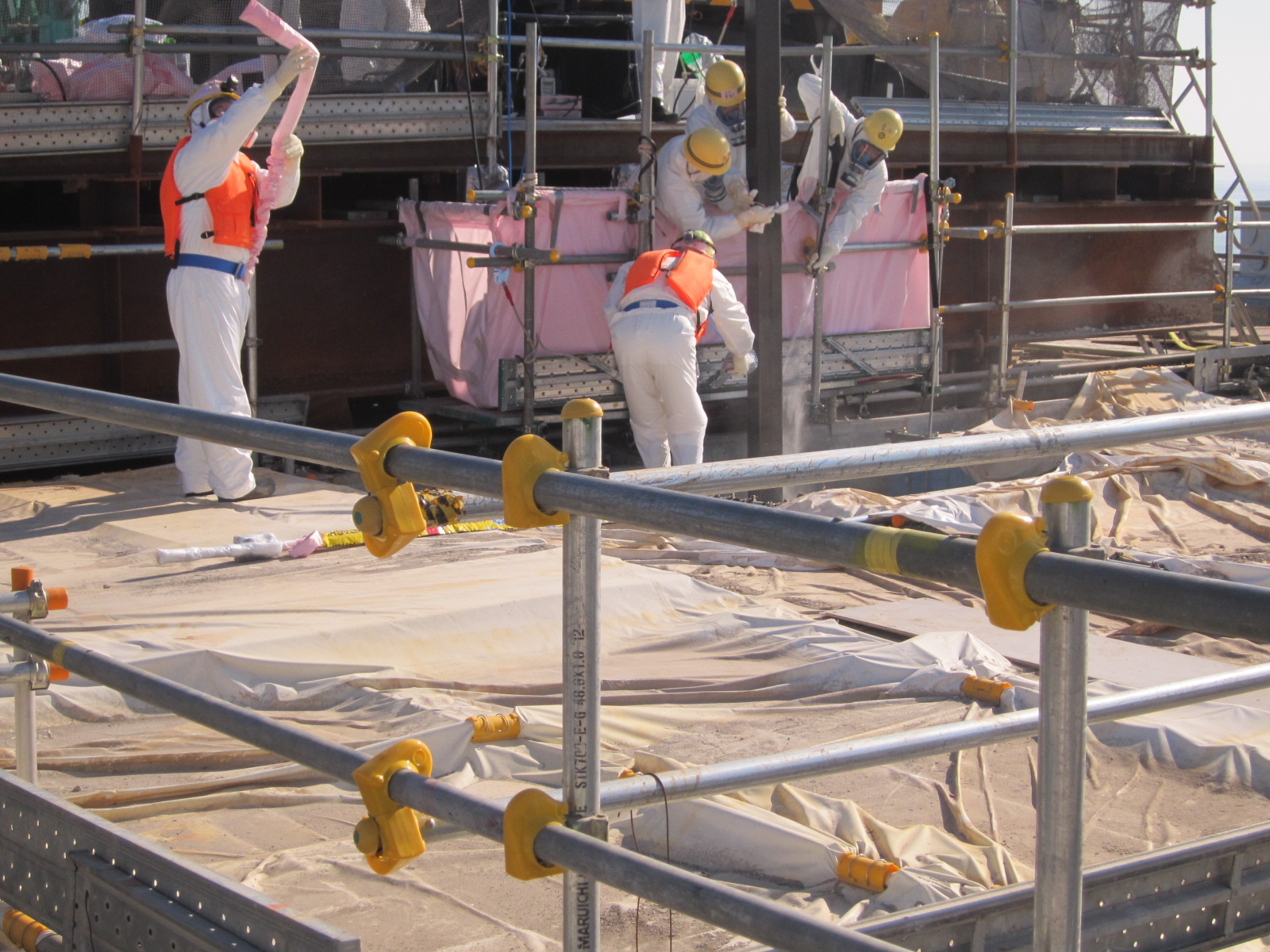


I'll upload the videos later.
From Reuters (7/19/2012):
Sweden's Ringhals-2 nuclear reactor fails after restart
OSLO, July 19 | Thu Jul 19, 2012 2:45am EDT
(Reuters) - Sweden's Ringhals-2 nuclear reactor was shut down on Thursday morning, less than nine hours after being restarted, due to a technical glitch, the Nordic power exchange said in a market message.
The 865-megawatt (MW) pressurized water reactor's trip was caused by an elevated high-steam generator level after it was restarted at 1930 GMT on Wednesday, it added.
The reactor was previously shut a month ago due to oil leakage from a transformer, and was expected to be back in full operation after maintenance by Thursday evening.
Ringhals-2 is one of the four reactors at the plant south of Gothenburg, 70 percent owned by Swedish state energy group Vattenfall and 30 percent held by German E.ON .
Nuclear generators supply 40 percent of Sweden's power needs.
(Reporting by Nerijus Adomaitis; editing by Keiron Henderson)
I wonder whose steam generator is used.
From UBAlert (7/19/2012):
Sizewell B nuclear power station on the Suffolk coast has had its second automatic shutdown in four months. Owner EDF Energy said electricity production had ceased at 17:11 BST on Wednesday and it was investigating the cause of the stoppage. A spokesman said: "The reactor was safely shut down, with the plant responding as expected and at no time was anyone's safety at risk." The plant had an 11-day automatic stoppage in March. EDF said it was not predicting when the plant would begin generating again. The company said the March shutdown had been the first automatic one in three years and was for an electrical fault in the non-nuclear side of the plant. There was a controlled stoppage in May to fix a lubrication problem. EDF Energy said Sizewell B produced enough electricity for two million homes, or about 3% the UK's electricity needs.
Is this kind of "automatic shutdown" with cause unknown a common event occurring at nuclear power plants all over the world, but people and the media (like Reuters) have started to pay more attention because of the Fukushima I Nuclear Power Plant accident?
(H/T anon reader)
The Limerick Generating Station is operated by Exelon.
From Excelon's press release on 7/18/2012, announcing that the Unit 1 has been taken offline:
Limerick Operators Take Unit 1 Offline
Operators at Limerick Generating Station took Unit 1 offline this morning following an electrical disturbance on the non-nuclear side of the plant.
POTTSTOWN – Operators at Limerick Generating Station took Unit 1 offline this morning following an electrical disturbance on the non-nuclear side of the plant.
Unit 1 will remain offline until repairs, inspections and testing can be completed. Limerick Unit 2 continues to operate at full power.
As a result of the electrical disturbance, an Unusual Event was declared at 8:39 a.m. and terminated at 9:46 a.m. in keeping with NRC procedures. An Unusual Event is the lowest of four Nuclear Regulatory Commission emergency classifications.
Exelon Generation notified all appropriate federal, state and local government officials of the event. There is no threat to the health and safety of the public associated with this event.
Limerick Generating Station is located approximately 21 miles northwest of Philadelphia. With both units at full power, the site can produce enough carbon-free electricity for 2 million homes
An excellent example of not saying anything like "where exactly" and "what exactly".
According to reports, a transformer blew up in the turbine building. Here's from The Times Herald (7/18/2012):
‘Unusual event’ reported at Limerick power plant
(Updated at 10:55 a.m.) LIMERICK — The Nuclear Regulating Commission said it is closely monitoring events at the Limerick Generating Station after a manual scram around 8:15 a.m. shut down the reactor at the nuclear power plant.
According to NRC spokesman Neil Sheehan, an electrical fault was reported in a transformer in a turbine building that spurred the scram and that the transformer is not a main transformer.
The event was listed as an “unusual event” around 8:39 a.m., the lowest of the event ratings, Sheehan said. No one was injured in the incident and no outside help was requested, Sheehan said.
Sheehan said the transformers have been known to fail from time to time and that the reactor was safely shut down.
Sheehan said there are no complications at the power plant at this time and there is no danger to the public from the incident.
EARLIER VERSION OF THIS STORY
LIMERICK — An “unusual event” was reported Wednesday morning in Unit 1 of the Limerick Nuclear Generating Station.
According to Frank Custer, communications director with Montgomery County, the county received an email from Exelon, parent company of the nuclear power plant, stating that an explosion had occurred causing the “unusual event,” in Unit 1 but the event did not pose any threat to the public.
Custer said the notice reported the “unusual event” had been terminated.
A call placed to the Limerick Generating Station’s media relations spokesperson was not picked up or returned as of 11 a.m. Wednesday.
Tokyo Shinbun has an article (7/18/2012) about a 36-year-old man from Futaba-machi, Fukushima who evacuated the town after the nuclear accident and now lives in Aichi Prefecture with his wife and a small son. Fukushima I Nuclear Power Plant is located in Futaba-machi and neighboring Okuma-machi.
When Yuji Onuma was a 6th grader in Futaba-machi in 1987, he came up with the winning slogan selected and proudly displayed at the town's entrance across the road:
"Nuclear - Energy for Bright Future"
原子力 明るい未来の エネルギー

Onuma and his wife returned home temporarily on July 15. The reporter from Tokyo Shinbun accompanied them. At the sign, Onuma made a correction to the slogan that he created 25 years ago by holding up his handmade sign that says "Destruction" (破滅), hiding the word "Bright" (明るい) and turning the sign into:
"Nuclear - Energy for Destroyed Future"
原子力 破滅未来の エネルギー
From Tokyo Shinbun (7/18/2012):
「原子力明るい未来のエネルギー」。福島県双葉町の中心街の入り口に掲げられた看板の標語だ。二十五年前、当時小学六年の大沼勇治さん(36)が町のコンクールに応募し、選ばれた。大沼さんは、一年四カ月の避難生活で「脱原発」を確信した思いを伝えたいと、今月十五日、一時帰宅した際、自ら標語を「訂正」した。
"Nuclear, Energy for Bright Future". It is a slogan displayed on the entrance to the main street in Futaba-machi, Fukushima Prefecture. 25 years ago, Yuji Onuma (age 36) came up with the slogan when he was a 6th grader. It was selected in the town-wide contest. After spending a year and 4 months as an evacuee and having convinced that "going beyond nuclear" is the way to go, he "corrected" his slogan on July 15 when he returned home temporarily.
大沼さんは東京電力福島第一原発の事故後、身重の妻せりなさん(37)と地元を離れ、現在は愛知県安城市で避難生活を送る。町が原子力標語を公募したのは一九八七年。原発が町の未来をつくると信じた言葉が入選。第一原発から約四キロの自宅近くに鉄製の看板が電源立地交付金で建てられ、誇らしかった。
After the Fukushima I Nuclear Power Plant accident, he left town with his pregnant wife Serina (age 37). They now live in Anjo City in Aichi Prefecture. Futaba-machi called for a nuclear slogan in a public contest in 1987. Onuma's slogan expressing belief in the nuclear power plant building the future for the town, won. A sign made of steel was built with the grant money for municipalities with power generation facilities near Onuma's home, which was about 4 kilometers from Fukushima I Nuke Plant. He was proud.
大学を出て就職などし、二十九歳で帰郷。不動産会社に勤める傍ら、看板の横にある土地にオール電化のアパートを建てて、東電社員にも貸していた。ずっと町の発展が原発とともにある「安全神話」を疑わなかった。
After graduating from college and worked elsewhere, he returned home at the age of 29. While working for a real estate company he built an all-electric apartment near the sign, and rented to TEPCO employees. He never doubted the "safety myth" that the town would prosper with the nuclear power plant.
しかし事故後、町は警戒区域となり、全町民が避難。「平穏な暮らしが町ごと奪われた現実」にさいなまれ、テレビで標語が紹介されるたびに胸を痛めた。自らを責め悔いる日々から「原発の現実を話す権利はある」と考えた。脱原発を行動で示し、その姿を長男勇誠ちゃん(1つ)に将来伝えたいと思った。
After the accident, the town was designated as no-entry zone, and all residents evacuated. Onuma was tormented by the fact that a normal life was taken away from the town, and was distressed every time the slogan was shown on TV. He blamed himself and regretted. But he thought he had the right to speak about the reality of [having] the nuclear power plant. He wanted to show to his one-year-old son that he was now anti-[or "beyond-"] nuclear.
夫婦が一時帰宅した今月十五日、記者も同行した。防護服姿の大沼さんはまず、標語にレッドカードを突き付け「退場」と叫んだ。その後、看板の手前で持参した画用紙を高く掲げた。すると、そこに書かれた「破滅」の二文字が「明るい」に重なり新しい標語が読み取れた。「原子力破滅未来のエネルギー」。二十六年目の訂正の瞬間だった。
When he and his wife temporarily returned home on July 15, I accompanied them. Onuma, in the protective clothes, first waved a red card at the slogan, and shouted "Out!". Then, he held aloft a piece of drawing paper that he had brought in front of the sign. On the paper were two characters "破滅" (Destruction), which covered "明るい" (Bright) [on the sign], creating a new slogan: "Nuclear - Energy for Destroyed Future". Correction on the 26th year.
大沼さんは「原発事故で故郷を奪われることが二度とあってはならない。日本に原発はいらない」と話した。 (野呂法夫、写真も)
Onuma said, "A nuclear plant accident forcing people to leave their hometown, that should never happen again. There is no need for nuclear power plants in Japan." (Report and photograph by Norio Noro)
"The best estimates of cancer cases resulting from the Fukushima disaster is 180, and range from 24 to 2,500", according to the Bloomberg News article below.
(180 cases?)
Further, the article says:
The most likely number of cancer deaths is 130 and estimated to range from 15 to 1,300, the authors said, adding that the ranges reflect uncertainties about emissions and the methods the researchers used to calculate their impact.
(130 deaths?? Worldwide?)
The paper by the Stanford researchers further says 2 to 12 cases of cancer may happen among the plant workers.
From Bloomberg News (7/17/2012; part, emphasis is mine):
Fukushima Radiation May Cause 1,300 Cancer Deaths, Study Finds
By Jason Gale - Jul 17, 2012 3:15 PM PT
Radiation from the Fukushima nuclear plant may cause as many as 1,300 cancer deaths globally, according to a study that showed fallout from Tokyo Electric Power Co.’s (9501) crippled reactors may be deadlier than predicted.
The March 2011 nuclear disaster may cause as many as 2,500 cases of cancer, mostly in Japan, Stanford University scientists said. They incorporated emission estimates into 3-D global atmospheric modeling to predict the effects of radiation exposure, which was detected as far away as the U.S. and Europe.
Cancer cases may have been at least 10 times greater if the radiation hadn’t mostly fallen in the sea, said Mark Z. Jacobson, co-author of the first detailed analysis of the event’s global health effects. Identical emissions from a hypothetical accident at California’s Diablo Canyon Power Plant would be 25 percent deadlier because of differing weather patterns, according to the study published yesterday in the journal Energy & Environmental Science.
“There was a lot of luck involved,” said Jacobson, a professor of civil and environmental engineering at Stanford, in a telephone interview. “The effects vary significantly with the meteorological conditions and the only reason this wasn’t a lot worse was because 81 percent of all the emissions were deposited over the ocean.”
The failure of backup power at the Fukushima Dai-Ichi plant, located 135 miles (220 kilometers) north of Tokyo, caused the worst atomic accident since Chernobyl in 1986.
Radiation fallout forced the evacuation of about 160,000 people surrounding the plant. It also left about 132 square kilometers as a no-go zone, some of it uninhabitable for decades. Prolonged exposure to radiation in the air, ground and food can damage DNA, causing leukemia and other cancers.
The best estimates of cancer cases resulting from the Fukushima disaster is 180, and range from 24 to 2,500, yesterday’s study said.
The most likely number of cancer deaths is 130 and estimated to range from 15 to 1,300, the authors said, adding that the ranges reflect uncertainties about emissions and the methods the researchers used to calculate their impact.
“They have demonstrated there are no significant public health effects” from radiation exposure, said Evan Douple, associate chief of research at the Hiroshima Radiation Effects Research Foundation. “Their best estimate of 130 cancer deaths in Japan would be lost in the background wash of the hundreds of thousands of cancer deaths that would be occurring in the million or so people in the population exposed.”
The biggest health effects were psychological, said Douple, whose team is studying the impact from Fukushima. Stress from the earthquake, tsunami and meltdown may cause a range of health effects, including cancer, he said.
(Full article at the link.)
Excellent. Bloomberg even quotes in the last two paragraphs above the researcher at the institution whose antecedent is the infamous Atomic Bomb Casualty Commission.
Only 130 deaths worldwide (though mostly from Japan) from 3 core melts and 900,000 terabecquerels of radioactive materials (iodine equivalent).
The abstract from Energy & Environmental Science also says that radiation exposure to workers at the plant may result in 2 to 12 cases of cancer:
This study quantifies worldwide health effects of the Fukushima Daiichi nuclear accident on 11 March 2011. Effects are quantified with a 3-D global atmospheric model driven by emission estimates and evaluated against daily worldwide Comprehensive Nuclear-Test-Ban Treaty Organization (CTBTO) measurements and observed deposition rates. Inhalation exposure, ground-level external exposure, and atmospheric external exposure pathways of radioactive iodine-131, cesium-137, and cesium-134 released from Fukushima are accounted for using a linear no-threshold (LNT) model of human exposure. Exposure due to ingestion of contaminated food and water is estimated by extrapolation. We estimate an additional 130 (15–1100) cancer-related mortalities and 180 (24–1800) cancer-related morbidities incorporating uncertainties associated with the exposure–dose and dose–response models used in the study. We also discuss the LNT model's uncertainty at low doses. Sensitivities to emission rates, gas to particulate I-131 partitioning, and the mandatory evacuation radius around the plant are also explored, and may increase upper bound mortalities and morbidities in the ranges above to 1300 and 2500, respectively. Radiation exposure to workers at the plant is projected to result in 2 to 12 morbidities. An additional [similar]600 mortalities have been reported due to non-radiological causes such as mandatory evacuations. Lastly, a hypothetical accident at the Diablo Canyon Power Plant in California, USA with identical emissions to Fukushima was studied to analyze the influence of location and seasonality on the impact of a nuclear accident. This hypothetical accident may cause [similar]25% more mortalities than Fukushima despite California having one fourth the local population density due to differing meteorological conditions.
*Definition of "morbidity": The rate of incidence of a disease.
One of the researchers, Dr. Mark Z. Jacobson, is a Professor of Civil and Environmental Engineering at Stanford University, California. I can see that he may be good at radioactive materials dispersion modeling. But at putting the numbers on cancer cases and deaths?
Headline only at Kyodo News (2012/07/18 12:13):
速報:東京電力は、福島第1原発4号機の燃料プールから未使用の燃料集合体1体を試験的に取り出した。
TEPCO removed one unused fuel assembly from the Spent Fuel Pool at Reactor 4 at Fukushima I Nuclear Power Plant, as a test.
Aerial photo at NHK, with workers in white suits. It almost looks like a religious ceremony of some sort.


I hope there will be a foreign reporter who is also a reader of this blog, and he/she will ask TEPCO's new president why TEPCO is still banning independent journalist Ryuichi Kino from the regular press conferences because he transmitted TEPCO's shareholders meeting via audio using his smartphone on June 27, 2012.
Independent journalists attending TEPCO's regular press conferences have started asking why TEPCO has singled out Kino and banned him from the press conference, while ignoring (or pretending it doesn't know about) major TV stations broadcasting the video taken at the same shareholders' meeting. I have even seen a reporter from a major newspaper asking the question. According to TEPCO, both video and audio recording of their shareholders' meeting is prohibited (by them, not by any law or regulation).
For more about Kino's plight, see my post from July 6, 2012.
From the Foreign Correspondents' Club of Japan's Event Calendar, a rather dramatic announcement of the event:
P/C Naomi Hirose, President of TEPCO
Event Type :
PAC
Summary :
PRESS CONFERENCE Naomi Hirose, President, Tokyo Electric Power Co., Inc.(TEPCO) Junichi Matsumoto, General Manager, Nuclear Power and Plant Siting Division (Corporate Communications)
Language :
The speech and Q & A will be in English and Japanese with English interpretation
Description :PRESS CONFERENCENaomi Hirose,President, Tokyo Electric Power Co., Inc.(TEPCO)Juichi Matsumoto, General Manager,Nuclear Power and Plant Siting Devision (Corporate Communications)
13:30-14:45 Thursday, July 19, 2012(The speech and Q & A will be in English and Japanese with English interpretation)
Who would want Naomi Hirose’s job? The newly elected president of battered utility Tokyo Electric Power Co. takes over a company that is technically bankrupt, disgraced and despised by many people around the world. Recovering from the Fukushima nuclear disaster will consume the company for years to come as it struggles with the enormously complicated task of decommissioning the stricken Daiichi plant, pay out billions in compensation and somehow rehabilitate its tattered reputation.
True to form for a company that has often seemed Teflon-coated with its own brand of confidence, Tepco has come out fighting. Hirose has announced that his top mission is restarting the Kashiwazaki Kariwa, the world's largest nuclear power complex. The Niigata plant has already been rocked by a serious accident. Five years ago an earthquake struck almost underneath the seven-reactor, 8200-megawatt behemoth. Many would like it to stay permanently offline along with Japan's other mothballed reactors. However Hirose believes the restart is vital to the revival of his company, and Japan.
That only scratches the surface of Tepco's battles. The company has received a reported 1 trillion yen in bailout money from the state, effectively nationalizing it. Will that money ever be paid back, and can Tepco decouple itself from state control? Can it deal with the bitter criticism of its compensation process and end the suffering of the estimated 200,000+ people forced to evacuate from Fukushima? And amidst all that, how will it sell a 10-percent rate hike to the Japanese public?
The man with this giant burden on his shoulders is a former managing director of the firm. He spent years in sales before working his way to the top. His loyalty to the utility is not in doubt. "I personally like Tepco," he said after his appointment in May. "It is unbearable for me to abandon the company as it is." But many observers believe he is already living on borrowed time – one called him a "sacrificial lamb." Come along and hear him discuss the future of the utility.
Please reserve in advance, 3211-3161 or on the website (still & TV cameras inclusive). Reservations and cancellations are not complete without confirmation.
Who will want Hirose's job? Probably many people. I don't think the president that Hirose replaced wanted to go; he had just been installed at the top after Shimizu departed at the last year's shareholders' meeting. The company is effectively backstopped by the national government. Why worry? Living on borrowed time? So? A cushy amakudari job will wait for him.

Join Amazon Prime 
Shop Amazon Warehouse Deals - Deep Discounts on Open-box and Used Electronics
![[Most Recent Quotes from www.kitco.com]](http://www.kitconet.com/charts/metals/gold/t24_au_en_usoz_2.gif)


 Tokyo Time


