I was watching the main floor discussion of the State Secrecy Protection Law in Japan's Upper House (House of Councilors) in the Japanese National Diet via the live feed by the Upper House. All of a sudden there was a motion from an LDP member for a break, and the motion was granted by the chairman. The chairman then interrupted the Special Committee chairman who was reporting the discussion in the Committee.
The Upper House livecast screen says "House of Councilors main session is in a break".
The reason is apparently to allow a so-called public hearing in Saitama City in Saitama Prefecture to proceed as scheduled at 3:20PM. The public hearing was hastily scheduled yesterday by the ruling coalition.
You know how one of these public hearings go. It's nothing but formality, one item on the check-off list.
Since the bill passed the Lower House on November 26, more celebrities, scholars, citizens, foreign journalists (here's one from the New York Times Tokyo Bureau chief, in Japanese) and ex-government officials (like Morton Halperin, here) and heads of international institutions have joined the chorus of opposition to the Japanese domestic law.
...leaving Japan's Prime Minister Shinzo Abe hung to dry. Nice job, Mr. Obama.
After kindly informing China the other day that its two B52 bombers that flew inside the Air Defense Identification Zone over Senkaku Islands were unarmed, the United States government now says it is requesting the US commercial airlines to adhere to China's new rules and submit flight plans to China, to be safe.
China's Declared ADIZ - Guidance for U.S. Air Carriers
Question: Is there any specific guidance or information we are giving to U.S. carriers operating in China's recently declared Air Defense Identification Zone (ADIZ)?
Answer: Freedom of overflight and other internationally lawful uses of sea and airspace are essential to prosperity, stability, and security in the Pacific. We remain deeply concerned by China's November 23 declaration of an "East China Sea Air Identification Zone."
The U.S. government generally expects that U.S. carriers operating internationally will operate consistent with NOTAMs (Notices to Airmen) issued by foreign countries. Our expectation of operations by U.S. carriers consistent with NOTAMs does not indicate U.S. government acceptance of China's requirements for operating in the newly declared ADIZ.
Well, even NHK News is taking this as "acceptance".
[NHK quoting the State Department answer (second paragraph of the answer above), then says that] the US State Department has made it clear that it is the intention of the US government to effectively request the US airlines to file flight plans with the Chinese authority.
NHK also quotes part of the New York Times article on the matter, with the officials in the Obama administration putting safety first.
While the United States continued to defy China by sending military planes into the zone unannounced, administration officials said they had made the decision to urge civilian planes to adhere to Beijing’s new rules in part because they worried about an unintended confrontation.
... It was not immediately clear if the Obama administration had notified Japan, a close ally, of its decision.
Well they hadn't. At all.
The clearly irate Ministry of Foreign Affairs official says they haven't heard anything like that from the US counterpart, as reported by Mainichi Shinbun (11/30/2013):
防空識別圏:米国の新方針に外務省「聞いていない」
ADIZ: Ministry of Foreign Affairs on the new US policy "We haven't been informed"
A top official at the Ministry of Foreign Affairs spoke with Mainichi Shinbun in the morning of November 30 on the US government policy, and said "We haven't been informed at all. It is a completely different response from what the US has been doing."
The Japanese government's stance on the Chinese ADIZ is that it does not have any enforceability, the Japanese government will continue to follow the existing rules and that there is no need to submit flight plans to China. The Japanese airlines have been informed of the government stance by the Ministry of Land, Infrastructure, Transport and Tourism. The Japanese government will ask the US for the details of the new policy.
It was only several days ago the Secretary of State John Kerry and the Secretary of Defense Chuck Hagel issued a strong statement condemning China.
But it was also only several days ago that National Security Advisor Susan Rise made a strange speech at Georgetown University which was interpreted in Japan as a sign that the US will form a partnership with China as the two biggest powers in the world, leaving Japan hanging in the air.
Ms. Rice, of lying-through-her-teeth-on-Benghazi fame, indeed said, "When it comes to China, we seek to operationalize a new model of major power relations."
She mentioned China 20 times, Korea 11 times, Japan 7 times. No mention of Senkaku Islands.
(Operationalize? What kind of ugly verb is that? DCSpeak?)
The US (who declared to the world that its B52 bombers were unarmed), Australia, South Korea do not matter, according to the editorial in the English language paper Global Times by China's People's Daily.
Japan has been giving fierce reaction to China's demarcation of the East China Sea Air Defense Identification Zone (ADIZ).
Japanese Minister of Defense Itsunori Onodera has made malicious remarks almost daily since last Saturday when the zone was set up. Perhaps that just proves a folk saying: The more guilty one feels, the more unscrupulous he will be.
Apart from Japan, the US and Australia have also rebuked Beijing for its new air defense rules with provocative remarks or actions, and even South Korea's foreign ministry expressed formal regrets over the ADIZ.
Nonetheless, all the criticism and provocation will not pose a real challenge for the newly created ADIZ. It is a fact that China has already established its ADIZ over the East China Sea.
Maybe an imminent conflict will be waged between China and Japan. As a staunch supporter of Tokyo, Washington is expected to refrain from confronting Beijing directly in the East China Sea, at least for now. Canberra and Seoul just chimed in.
The Chinese government is supposed to remain resolute in its strategies while taking flexible and resilient measures to cope with unexpected accidents.
If the US does not go too far, we will not target it in safeguarding our air defense zone. What we should do at present is to firmly counter provocative actions from Japan. Australia, having no real conflict with China now, can be ignored at the moment.
Seoul understands it is not the target of China's ADIZ, plus it has tensions with Japan right now, therefore, China has no need to change its actions toward South Korea.
We should carry out timely countermeasures without hesitation against Japan when it challenges China's newly-declared ADIZ. If Tokyo flies its aircraft over the zone, we will be bound to send our plane to its ADIZ.
If the trend continues, there will likely be frictions and confrontations and even tension in the air like in the Cold War era between the US and the Soviet Union. It is therefore an urgent task for China to further train its air force to make full preparation for potential conflicts.
We are willing to engage in a protracted confrontation with Japan. Our ultimate goal is to beat its willpower and ambition to instigate strategic confrontation against China.
Though Beijing has encountered difficulties in the nascent stage of the ADIZ, Chinese authorities appear calm in the wake of all the provocations.
The Chinese nation is heading towards peace and prosperity with peace-loving people.
Turbulence over the Diaoyu Islands and the East China Sea Air Defense Identification Zone will in no way alter China's overall architecture.
Fierce reaction? The US, staunch supporter of Tokyo, is to refrain from confronting Beijing?
What they are saying doesn't make much sense, but I suppose it is a good match for the equally incomprehensible Abe administration.
BBC reports (11/29/2013) that China scrambled fighter jets to monitor Japanese fighter jets and the US surveillance planes entering, as far as Japan and the US know, their ADIZ over Senkaku Islands.
TEPCO announced on November 28 that a monitoring camera was dropped into the Spent Fuel Pool of Reactor 3 at Fukushima I Nuclear Power Plant by mistake, during the preparation work for the removal of debris inside the pool. The camera weighs about 5.5 kilograms, and the company says there is no danger of fuel damage from the drop.
According to TEPCO, when the workers pulled the monitoring camera out of the water via the remote control, the cable snapped, and the camera dropped from the height of several meters. The cable snapped when it was wound up too tight, and the safety mechanism to prevent the tight winding failed to work.
Unlike Reactor 4's operating floor, Reactor 3's operating floor is too radioactive for humans (and for robots, probably) with one location above the shield plug exceeding 2 Sievert/hour air dose rate.
Refusing the Fukushima produce because of radiation fear is tantamount to racial discrimination, according to the student and the Ministry of Justice who selected his essay as the best of the best this year. (The essay in PDF here, for those of you who read Japanese.) Not buying Fukushima produce, as the government tells you to? You're racist (or, transliterated into Japanese as "reishisuto" with "r" pronounced like "l")!
3. Perishable food price in Japan shot up 16.6% compared to a year ago, with overall consumer price (including food and energy) up 1.1%, according to Reuters Japan. BOJ's Kuroda seems happy that his "QE from another dimension" (or I'd call it Twilight Zone QE) is working, the media paints it as evidence that "Abenomics" (or "Avenomics" ) is working. Good luck, working class citizens of Japan.
4. A citizen was forcibly removed from the balcony in the Diet where he was observing the debate of the State Secrecy Protection Law in the Lower House on November 26, 2013, as he shouted his opposition to the passage of the law. His mouth was stuffed with cloth so that he couldn't shout any more while being removed by several guards against his will.
What's even scarier to me than the man being forcibly removed by the guards is people sitting near him. They just sit there as if nothing is happening. They are not even looking; the one in the same row even looks away.
5. While the above citizen was being hauled away by security guards, the Representatives in the Lower House in the supposedly tense and heated debate over the State Secrecy Protection Law were anything but tense and heated, according to Nikkan Gendai (11/27/2013).
Nikkan Gendai claims a Representative from Democratic Party of Japan, a hawk who has more in common with LDP and Prime Minister Abe, gave a speech voicing his "opposition", sat down, and started checking emails on his cellphone. The photo shows some "Mama" praising him for the wonderful speech:
on November 27, 2013, the day after the Lower House had passed the equally controversial (or should be) but more hyped State Secrecy Protection Law.
The legislation to create the NSC for Japan has already passed the Lower House, so now it becomes the law of the land.
The voting count in the Upper House? According to NHK (11/27/2013),
Yes vote: 213
No vote: 18
There is no opposition to speak of. Nearly everybody in the legislative branch (National Diet) is on board, in both Houses, to give a huge power over foreign affairs and defense to the executive branch (the LDP/Abe administration).
Again, the ostensible reason is that the US wanted Japan to have the NSC like the one that exists in the US, so that confidential information can freely be shared between the US and Japan.
The Japanese government has already passed the national ID law, again with near unanimous vote.
The reason why I am rather cynical about the current hype and hyperventilation over the State Secrecy Protection Law is these two laws - one to create the NSC and the other to assign a unique number to each and every citizen in Japan (with the cute moniker "My Number"). They have passed these two laws already, with hardly a squeak from the media and the citizens.
The words uttered by a Councilor (Upper House member) from the Communist Party on the State Secrecy Protection Law sound great but vain, when the laws that will empower the executive branch out of proportion have been already passed:
"This legislation even targets the members of the National Diet. Aren't we, as members of the Diet, supposed to fight against the huge power of the executive branch and the bureaucrats?"
Mainichi reports there was a huge applause after he finished speaking.
Let's see. Was there an outrage over the "My Number" legislation and the NSC legislation? Nope. Power grab by the executive branch in these two laws has gone unnoticed, or I should say unrecognized as such, either out of ignorance or out of self-censorship, by the legislators, media, and citizens.
(Is there anyone who retweets my Japanese tweet about the NSC and national ID laws as integral of the State Secrecy Protection Law as power grab by the executive branch? Yes, seven people.)
AP has a nice summary of the situation surrounding Japan's state secrecy protection law which easily passed the Lower House (House of Representatives) yesterday (11/26/2013) with votes from Liberal Democratic Party, Komei Party, and Your Party. There are 294 Representatives from LDP alone in the Lower House with total 480 Representatives.
One of the ostensible reasons for the ruling coalition (LDP, Komei)'s push for the passage of the law has been that, without such a law, no foreign country will share sensitive information with Japan.
New Japanese secrecy law welcomed by US but stirs fears at home
TOKYO – A proposed state secrecy law in Japan that imposes stiffer penalties on bureaucrats who leak information — and journalists who seek it — is spurring a public outcry, with opponents blasting it as a heavy-handed effort to hide what the government is doing and restrict press freedom.
The public's top concern is that the government won't say exactly what it wants to make secret. Critics say the law could allow the government to withhold information about whatever it wants and ultimately undermine Japan's democracy.
The ruling party says the "secrecy protection" law, which the lower house of parliament could vote on as soon as Tuesday, is needed to allow the United States and other allies to share national security information with Japan. Along with the creation of a U.S.-style National Security Council in his office, it's part of an effort by Prime Minister Shinzo Abe to beef up Japan's role in global security, and make a more authoritarian government at home.
The moves are welcomed by the United States, which wants a stronger Japan to counter China's military rise, but they raise fears in Japan that the country could be edging back toward its militaristic past, when authorities severely restrained free speech.
"My biggest concern is that it would be more difficult for the people to see the government's decision-making process," said Kyouji Yanagisawa, a former top defense official who was in charge of national security at the Prime Minister's Office from 2004-2009. "That means we can't check how or where the government made mistakes, or help the government make a wise decision."
The bill allows heads of government ministries and agencies to classify information related to defense, diplomacy, counterintelligence and counterterrorism, almost indefinitely.
Critics say that it might sway authorities to withhold more information about nuclear power plants, arguing they could become terrorist targets. Or they warn that officials may refuse to disclose key elements of free trade talks to protect concessions that would make Tokyo or a partner look bad.
At a public hearing in Fukushima on Monday, the only one held by the government just before the planned vote, lawyer Hiroyasu Maki said the bill's definition of secrets is so vague and broad that it could easily be expanded to include radiation data crucial to the evacuation and health of the residents in the case of another nuclear crisis.
Ruling Liberal Democratic Party lawmakers say Washington has repeatedly said that they feel insecure about sharing top security information with Japan due to its lack of legal protection for secrets. The U.S. is worried about leaks to China, they say.
"(The bill) is by all means necessary to step up Japan's intelligence levels. Many other countries already have legal framework like this but Japan does not," said Nobutaka Machimura, a senior ruling lawmaker and head of the party's secrecy bill team.
Under the bill, leakers in the government face a prison term of up to 10 years, up from one year now, if convicted. Journalists who get information "inappropriately" or "wrongfully" can get up to five years in prison, prompting criticism that it would only make officials to be more secretive and intimidate the Japanese media.
"This is a severe threat on freedom to report in Japan," said Lawrence Repeta, a law professor at Meiji University in Tokyo. "It appears the Abe administration has decided that they can get a lot of what they want, which is to escape oversight, to decrease transparency in the government by passing a law that grants the government and officials broad authority to designate information as secret."
Experts including Repeta say the new law paves the way for Abe's drive to revise Japan's U.S.-drafted pacifist constitution to give more power to the government and stress civil duties over basic human rights.
Currently, Japan lacks a comprehensive legal framework to protect state secrets except for "defense secrets" that the Defense Ministry is allowed to decide. The proposed bill would complement a separate law, also due to be passed this week, to establish a National Security Council that would centralize the chain of command in the office of the prime minister and give him more power.
Washington sees the proposal as a positive step that would make Japan "more effective alliance partner," U.S. Charge d'Affairs Kurt Tong said in his recent speech in Tokyo. He urged Japan, however, to make the process transparent and to explain the policies to its Asian neighbors.
The former bureaucrat, Yanagisawa says he does not recall any instance Japan failed to obtain necessary information from Washington or other countries due to lack of secrets law. When the U.S. or other countries decide not to share information with Japan, it was because of their own national interest not because of Japan secrecy protection, he added.
Even without the new secrecy law, journalist Takichi Nishiyama, 82, was convicted for exposing confidential cables related to Tokyo's secret deal with Washington over the reversion of U.S.-administered Okinawa to Japanese control in 1972.
He said what he revealed was only a tiny part of the mountain of secrets that never surface. He said that most classified Japanese military or diplomatic documents often come out of U.S. archives, not Japanese.
"In this country, it's already difficult enough to get information to verify our own history," Nishiyama said. "The new law would only make it worse."
Japanese and foreign journalists, writers, academics and activists have opposed the bill. On Thursday, about 10,000 people gathered at a Tokyo park to protest the bill.
According to the result of government-sponsored "public comment" process in September, a policymaking procedure similar to public hearing, 77 percent of about 90,000 comments opposed the bill, most of them expressing concerns about a possibility of their civil activities being curtailed.
Some people worry that the law might point Japan back toward severe restrictions on freedom of speech and press imposed before and during World War II. Under the Maintenance of the Public Order Act in 1925, some 100,000 people were arrested.
Activist Kazuyuki Tokune says his attempts to access information about nuclear power plants may be considered illegal under a broad interpretation of the law.
"I may be arrested some day for my anti-nuclear activity," Tokune said during a recent protest against the secrecy bill outside the prime minister's office. "But that doesn't stop me."
The battle cry from the Japanese media - mainstream and alternative - over this law is that it will restrict press freedom. That is a bit preposterous, particularly coming from the mainstream media. Most have been little more than the government PR division, reporting what they are told to report without raising many questions or objections. What freedom will they lose? Freedom to report what they are told to report?
What's more preposterous is the comment by the US Charge d'Affairs Kurt Tong. For the current US administration to lecture Japan on transparency is a joke.
Now, more importantly, why is the Abe administration in such a great hurry to please the US by passing the law, particularly when not having such a law in place hasn't prevented Japan from obtaining information from the US or other countries? What would be the benefit that the administration would get in return, particularly from the US?
Many in Japan do not even think about the problem from that angle, and their answer to the passage of the law in the Lower House is to express fear that Japan is heading back to pre-World War II era of secret police and to vent frustration that Japan is nothing but a territory of the US with no sovereignty.
Quid pro quo for Japan, in my humble opinion, is the secret information collected by the US National Security Agency (NSA) on Chinese political and military intelligence. The article above hints as much, with "The moves are welcomed by the United States, which wants a stronger Japan to counter China's military rise".
And that for the US? Another information laundering hub for the NSA, I presume, where the NSA ships information it is not supposed to be collecting, and re-import as "foreign intelligence" back into the US.
Japan could do the similar thing: Have the NSA collect information on Japanese citizens, and receive that information from the NSA as "foreign intelligence". There is no penalty in the law for foreign entities to collect sensitive information in Japan.
Transparency indeed.
As to the Japanese citizens who are worried about freedom of speech suppressed, well they have let pass so many pieces of information of the government's misdeeds, willful neglect, suppression of critical information, even without the secrecy law. One of the most glaring examples in recent years is, in my mind, the very unusual NHK's documentary in the summer of 2011 that the Japanese government had known about the details of Hiroshima/Nagasaki atomic bombing and done nothing. (See my special posts for August 15, here and here.) Was there an outcry from citizens? Hardly. Were other news outlets covering the story? None.
It's better late than never, but it is rather late.
(UPDATE-2) The second day of fuel assembly removal (11/27/2013). The work started at 9:30AM JST, according to TEPCO. On November 26, 2013, the workers removed six spent fuel assemblies into the cask in the cask pit inside the Reactor 4 Spent Fuel Pool. The work took about three hours - 30 minutes per one fuel assembly.
===========================
(UPDATE) From TEPCO, the first spent fuel assembly from the pool was placed in the cask, at 3:21PM.
===========================
Hardly anyone on the net in Japan is paying attention, as the bigger and more distressing (unless you are a staunch supporter of Liberal Democratic Party) news of the day is the passage of Secrecy Act in the special committee in the Lower House with overwhelming majority votes by LDP, Komei (the ruling coalition), and Your Party. Passage in the Lower House (where LDP alone holds majority) is expected in the afternoon.
Six groups of workers (6 workers each in a group) in two-hour rotations will remove 22 irradiated SPENT FUEL assemblies, according to Mainichi, unlike the first time when unused, new fuel assemblies were removed.
Just like the first time, the entire operation will be done under water. So far, no news of a sizeable earthquake, and hardly any news coverage of the event.
The second removal of fuel assemblies from the Reactor 4 Spent Fuel Pool at Fukushima I Nuclear Power Plant is scheduled today.
Preparation started at 9AM.
At 10:56AM, the work started to move the container for the transfer of the fuel assemblies from the temporary storage location on the operating floor of Reactor 4 to the Spent Fuel Pool.
At 11:29AM, the container was placed at the bottom of the Spent Fuel Pool.
(UPDATE-2) Two B52 bombers out of the base in Guam flew over the airspace over Senkaku Island as part of regular training, without informing the Chinese. (from Wall Street Journal, 11/26/2013)
(UPDATE) According to Yomiuri (11/26/2013), China's newly declared ADIZ includes the airspace used by the US military stationed in Japan. The US Department of Defense spokesman said that the US military has been conducting the training in the area, and the US will not submit flight plans to China as demanded by China.
============================
China seems to think they have Japan (and the US behind it) all figured out, and is confident that it can get away with it.
The Air Defense Identification Zone, or ADIZ is already in place by the Japanese government over Senkaku Islands. Japan's ADIZ is almost identical to the airspace set by the US military, according to the Japanese wiki on ADIZ.
From The Guardian (11/23/2013; part, emphasis is mine):
China imposes airspace restrictions over Japan-controlled Senkaku islands: China says it is exercising self-defence right but experts say move will exacerbate tension between the two nations
China has tried to establish its authority over Japanese-controlled islands in the East China sea by demanding that all aircraft flying in the region obey its rules or face "emergency defensive measures".
The East China sea air defense identification zone came into effect from 10am local time on Saturday when the Chinese defence ministry issued a map of the area, which includes the uninhabited East China sea islands.
The ministry said all aircraft entering the zone must notify Chinese authorities and warned they would be subject to emergency military measures if they did not identify themselves or obey orders.
It said it would "identify, monitor, control and react to" any air threats or unidentified flying objects coming from the sea.
"China's armed forces will adopt defensive emergency measures to respond to aircraft that do not cooperate in the identification or refuse to follow the instructions," it added.
...But Narushige Michishita, director of the security and international studies programme at the National Graduate Institute for Policy Studies in Tokyo, said: "China is playing a dangerous game here. It is certainly an escalatory action and might prolong and exacerbate the ongoing tension."
(Full article at the link)
Japan's Asahi (11/24/2013) has actual quotes from both Japanese and Chinese officials:
...“Japan’s ADIZ [Air Defense Identification Zone] is a ‘trench in the air’ that is illegally occupying our country’s territory. To break the ADIZ is the first step to protect the sovereignty of the Diaoyu Islands (Chinese name of Senkaku Islands),” Liang Fang, a professor of strategy at PLA (People’s Liberation Army) National Defense University, told the Global Times this month. The newspaper is published under the auspices of the People’s Daily, mouthpiece of the Chinese Communist Party.
...China is also bolstering its military capabilities, especially by building aircraft carriers and developing new ballistic missiles, partly to deter U.S. forces from approaching areas around Senkaku Islands.
“China’s establishment of the ADIZ seems to be a way of discouraging U.S. military aircraft from approaching Chinese territorial airspace,” a Japanese government official said.
On the day that China announced its ADIZ, Japanese Defense Minister Itsunori Onodera held an executives’ meeting in the Defense Ministry.
Those who attended the Nov. 23 meeting confirmed that the ASDF will continue to patrol the skies around Senkaku Islands in the same way as before. Those activities include scrambles if Chinese aircraft enter Japan’s ADIZ.
After the meeting, Onodera voiced extreme concern about China’s latest move.
“The unilateral declaration of the ADIZ without having any consultation with neighboring countries is an issue that we have to protest against. If an incident takes place in the ADIZ, it could trigger a dangerous situation,” Onodera told reporters.
“I wonder whether Chinese aircraft will scramble when a (Japanese) SDF plane enters airspace claimed by China as its ADIZ. We need to see how China will operate its ADIZ,” a Japanese Defense Ministry official said.
(Full article at the link)
After the last-minute deal on Syria where the US president was outsmarted by the Russian president, and the latest nuclear deal with Iran despite the protest from the US's allies in the Middle East, China may be thinking the US is such a pushover and a wimp, and now's the time.
South Korea is not too happy with China's newly expanded ADIZ either, which now covers the territory claimed by both South Korea and China, according to Asahi (Japanese).
NHK, who apparently had a live footage of the scene at Fukushima I Nuclear Power Plant according to people who were watching TV, says it took the truck carrying the cask 10 minutes to go from the Reactor 4 building to the Common Pool which is 100 meters away.
At 1PM on November 21, 2013, the first container to transport 22 nuclear fuels taken from the Spent Fuel Pool of Reactor 4 at Fukushima I Nuclear Power Plant was removed from the reactor building, and transported to the storage facility 100 meters away inside the plant compound.
On November 21, the container, called "cask", that has 22 unused, new fuel assemblies was taken out of the Reactor 4 building on a trailer [trailer truck, or rig], and transferred to the facility called the Common Pool in 10 minutes.
This was the first time the container with fuel assemblies was transported out of the Reactor 4 building since the start of the fuel removal work on November 18. According to TEPCO, the Common Pool was evaluated to be able to withstand the earthquake of the same level as the March 11, 2011 earthquake, and fuel assemblies would be more securely stored there than in the Spent Fuel Pool located in the building damaged by the accident.
In this, I don't blame TEPCO for not having posted a video of the entire work (9 to 10 hours) on November 18, 2013.
The preparation for submerging the cask started in the morning, with the cask submerged completely at 12:30PM. The removal of unused (new) fuel assemblies into the cask started at 3:18PM, and by 6:45PM 4 unused fuel assemblies were transferred into the cask.
The names of the companies and the names of the workers are blurred in the video. They could be TEPCO workers, but most likely from one of the primary contractors.
Compared to the still photos (see below), the water in the pool looks slightly murky. After the day's work ended at 7PM on November 18, another set of workers were scheduled to be there all night, clearing small debris and particles using a vacuum cleaner in the water.
(From TEPCO, 11/18/2013; click to enlarge. For higher resolution photos, go to the link.)
Today (November 19, 2013), the workers have removed 8 unused fuel assemblies into the cask as of 1:30PM, according to Nuclear Regulation Agency (secretariat of Nuclear Regulation Authority). The Agency thinks the workers will be able to remove additional 10 fuel assemblies to fill the cask.
There are six group of workers who take turns in removing the fuel assemblies so that each group of workers spends less than 2 hours on the operating floor.
(UPDATE-2) Jiji reports (11/19/2013) that the workers successfully removed 4 unused new fuel assemblies into the cask by 6:45PM. The air dose level near the pool was 0.04 millisievert/hour (or 40 microsieverts/hour).
=================
(UPDATE) TEPCO says the workers started lifting the very first fuel assembly at 3:25PM JST.
(UPDATE) According to TEPCO, it took 30 minutes from the moment the bottom of the cask touched the water in the cask pit till the cask bottom is securely at the bottom of the cask pit in the SFP.
===========================
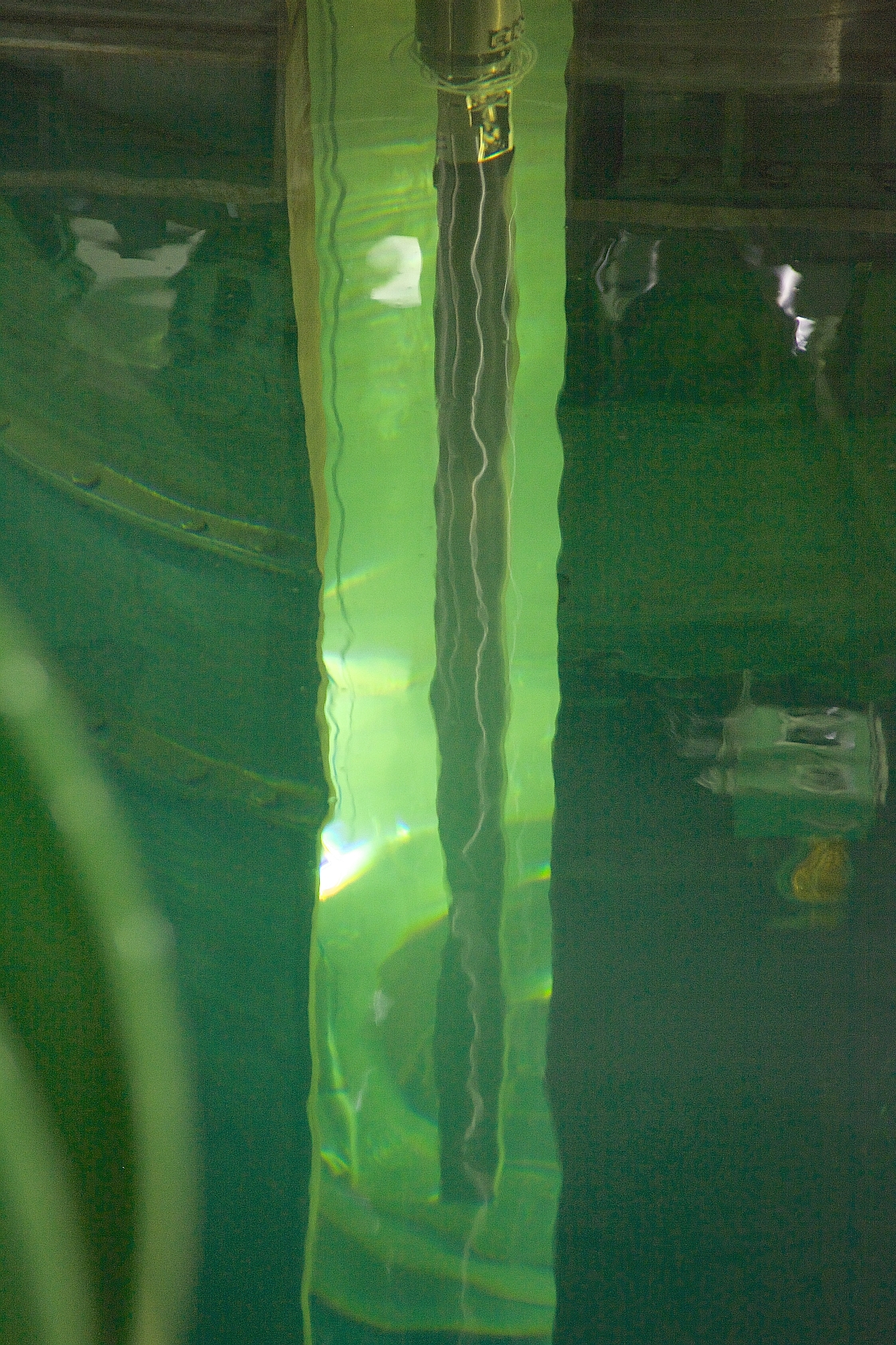
TEPCO released the high-resolution (for TEPCO, at least) photographs of the cask being submerged in the cask pit of the Spent Fuel Pool in Reactor 4 at Fukushima I Nuclear Power Plant.
According to the schedule, they should soon start removing the first fuel assembly from the pool into the cask.
Removal of the fuel assemblies will continue tomorrow (November 19), the cask will be lowered to the ground on November 19. It will take about a week for the first cask to be transported to the Common Pool 100 meters away.
A week?
(UPDATE) Wrong schedule. From NHK News at 12:05PM:
AM: The cask is being submerged into the cask pit.
At 3PM: Start removing the 22 fuel assemblies (unused, new assemblies) using the fuel handling machine into the cask
======================
According to NHK News (11/18/2013 at 6:07AM), the schedule is:
AM: Using the fuel handling machine, put fuel assemblies (unused, new, 22 of them) into the cask submerged in the cask pit
At 3PM: Lower the cask using the gantry crane
It must be proceeding well so far, as the bright pink headline banner on NHK's homepage (circled in blue below) only says "We will let you know as soon as there is further news."
The fuel handling machine is operated by the workers with long experience of handling the nuclear fuel, according to the workers who regularly tweet from Fukushima I NPP.
Here's the link to the 7-page summary of the fuel removal operation, from TEPCO (11/13/2013).
Just as the independent journalist Ryuichi Kino said previously, "Fuel removal conducted in the daytime, and debris removal at night".
Perhaps as a small pushback against the LDP politicians who demand "acceleration" and "ahead of schedule" work, TEPCO says on the 2nd page in red letters:
After conducting the above actions, we will proceed with fuel removal with “first priority given to safety”, not to achievement of the schedule.
Mainichi Shinbun (11/13/2013) says the reactor building cover over the Reactor 4 operating floor was built with 4,200 tons of steel beams, the same amount of steel beams that were used to build Tokyo Tower. If I remember right, the design and construction was by Kajima. It was designed and built so that the weight of the heavy cover would not be borne by the original reactor building.
Move over, three fuel assemblies with damaged/deformed fuel rods inside in the Reactor 4 Spent Fuel Pool! You're nothing.
According to Kahoku Shinpo, a Fukushima local paper, TEPCO admitted on November 15, 2013 that there are 70 fuel assemblies with damaged fuel rods in the Reactor 1 Spent Fuel Pool, located on the operating floor (top floor) of the reactor building whose air radiation levels are measured in millisievert/hour and sievert/hour (first floor).
There are also three such fuel assemblies in the Reactor 2 SFP, and four of them in the Reactor 3 SFP.
Total 80 spent fuel assemblies in the SFPs in Reactors 1 - 4 are damaged.
The damages had been there long before the March 11, 2011 accident, and TEPCO claims it properly notified the national government as they discovered the damages. But the company has come clean in public only now.
Kahoku Shinpo article below suggests that the oldest of such damaged fuels may have been there for 40 years in the Reactor 1 Spent Fuel Pool. (Reactor 1 started generating electricity in 1971.)
Reactor 1 at Fukushima I Nuke Plant is TEPCO's oldest nuclear reactor; it was entirely the project by General Electric of the US, a turnkey.
Fukushima I Nuke Plant Reactor 1 has 70 fuel assemblies damaged before the March 11, 2011 disaster, a quarter of the total spent fuel assemblies [in the Spent Fuel Pool of Reactor 1]
It was revealed on November 15 that 70 fuel assemblies in the Reactor 1 Spent Fuel Pool at Fukushima I Nuclear Power Plant had had damages before the March 11, 2011 earthquake/tsunami.
The damaged assemblies are about one-quarter of the 292 spent fuel assemblies stored in the pool. Technologies to remove damaged fuel haven't been established, and there are worries that [the revelation] may negatively affect the plan to remove the fuels from Reactor 1 [SFP] starting 2017 and the decommissioning work in general.
According to TEPCO, these 70 fuel assemblies had series of problems including leakage of radioactive materials from small [pinhole-size] holes [on fuel rods]. So the company removed them from the reactor and stored in a separate location inside the Spent Fuel Pool.
There are three damaged fuel assemblies inside the Reactor 4 Spent Fuel Pool, where the removal of the fuel assemblies will start on November 18. TEPCO has postponed the removal of the damaged assemblies as it is difficult to remove them in a normal manner.
Other than in the Spent Fuel Pools of Reactor 1 and Reactor 4, the Reactor 2 Spent Fuel Pool has three damaged fuel assemblies, and the Reactor 3 Spent Fuel Pool has four, making the total of damaged fuel assemblies 80. TEPCO will consider the measures such as building a dedicated container for transfer for these damaged fuels.
As to the reason why Reactor 1 has the largest number of damaged fuels, TEPCO says, "Reactor 1 [at Fukushima I Nuke Plant] is the oldest nuclear reactor of our company, and we hear that there were quality control issues when the fuel rods were manufactured and that there were many fuel rods with inferior quality. From Reactor 2 onward, much improvement was done on the fuel rods, and quality improved."
1号機は東電初の原発で、1971年3月に商業運転を開始した。
Reactor 1 at Fukushima I Nuke Plant is the first nuclear reactor for TEPCO, and it started the commercial operation in March 1971.
No major national newspaper has covered this story so far.
The small boat that can, fitted with video camera and dosimeter, boldly going where no humans can ever go (ambient air dose of 1.8 SIEVERT/hour max).
The boat was lowered from a hole (510mm in diameter) drilled on the floor of the 1st floor of Reactor 1 into the torus room which is flooded with highly contaminated water leaking from the dry well.
The route of the surface boat (red for November 13 expedition, blue for November 14):
Leak 1: the upper part of the S/C facing side of the vent pipe at the location [4] (S/C = Suppression Chamber):
Leak 2: The sand cushion drain pipe at the location [1]:
The video taken by the boat:
(Oh my goodness, what are they capturing in the lower left screen? It looks like some organic materials growing on the metal surface...)
The boat looks to be tethered, meaning human workers from Hitachi Nuclear Energy were operating it from the 1st floor of the Reactor 1 building which has rather high air dose levels (unlike Reactor 4, the levels in Reactor 1 is in millisievert/hour, with several locations in sievert/hour). There is no information as to the radiation exposure for the workers who operated the boat.
Now, we need a little submarine that could to dive under the water in the torus room and check the damage on the Suppression Chamber and the surrounding walls.
And a swarm of self-organizing, self-propelled small flying robots for the upper floor surveys, and an army of soldier ant robots to eat away the irradiated concrete debris on the operating floors and inside the Spent Fuel Pools of Reactor 3 and Reactor 4.
According to NHK (11/15/2013), TEPCO will start removing the fuel assemblies from the Spent Fuel Pool of Reactor 4 at Fukushima I Nuclear Power Plant on Monday, November 18.
TEPCO will start with unused (therefore not irradiated) new fuel assemblies (there are 202 of them in the pool). 22 new fuel assemblies will be the first to be moved UNDER WATER into the container (called "cask") in the cask pit, using the fuel handling machine. Then the sealed cask will be lifted out of the pool by the gantry crane onto the truck waiting on the ground, which will transport the cask to the Common Pool about 100 meters away. TEPCO has two casks to be used for transport.
After removing 22 new fuel assemblies, then TEPCO will start removing the spent fuel assemblies. The removal is scheduled to continue until the end of next year, "ahead of schedule" as has been loudly demanded by the LDP politicians.
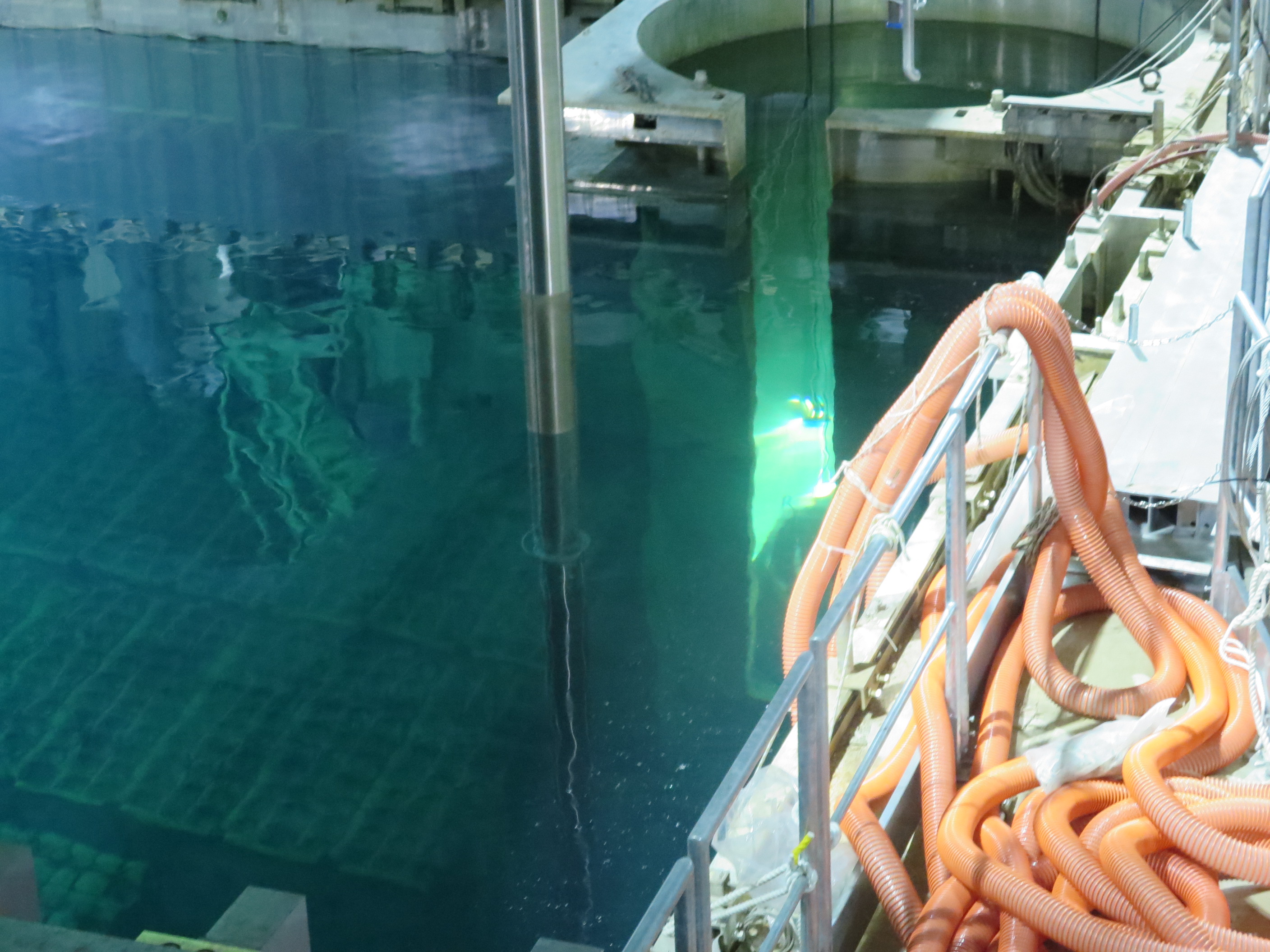
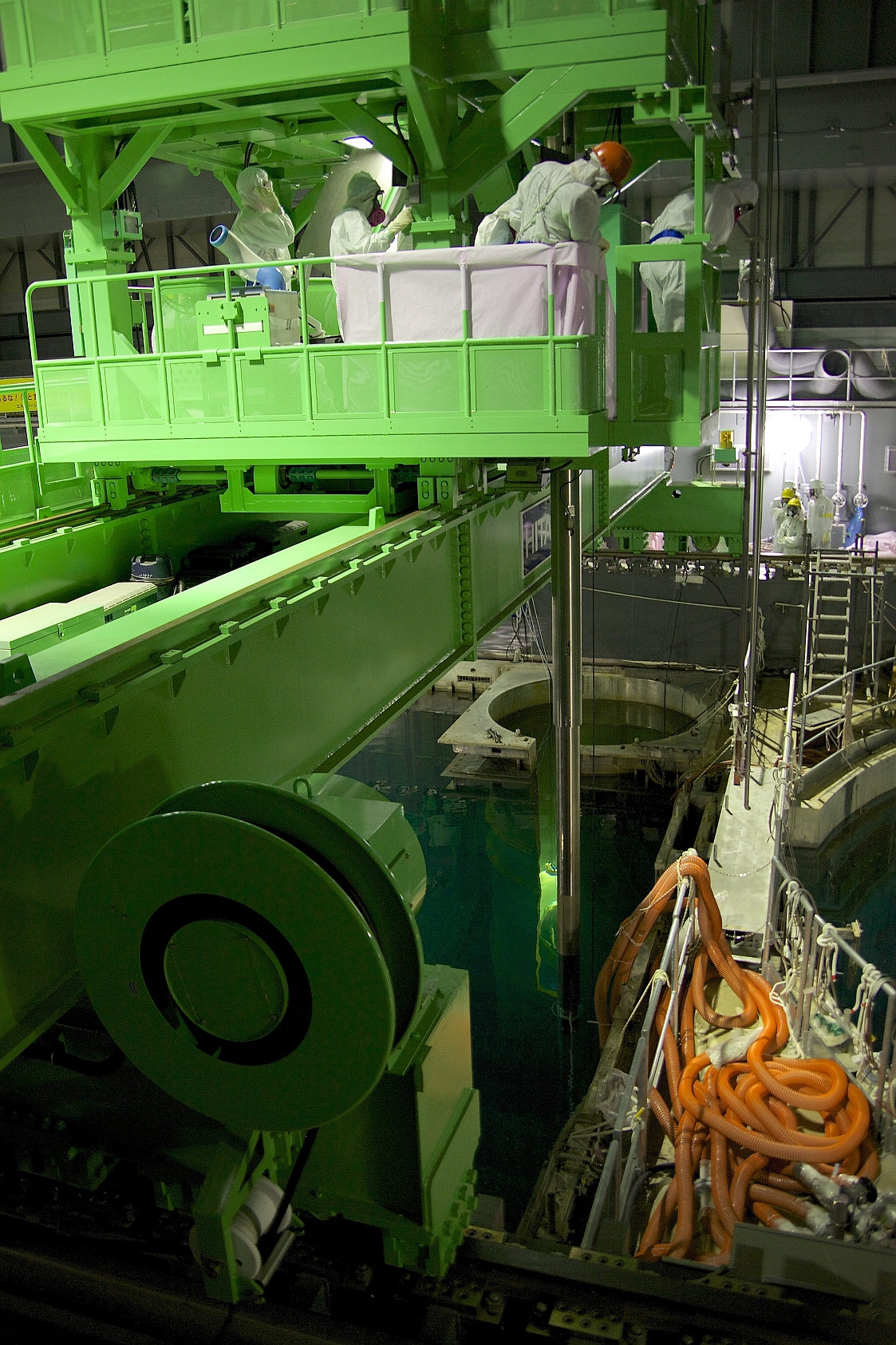
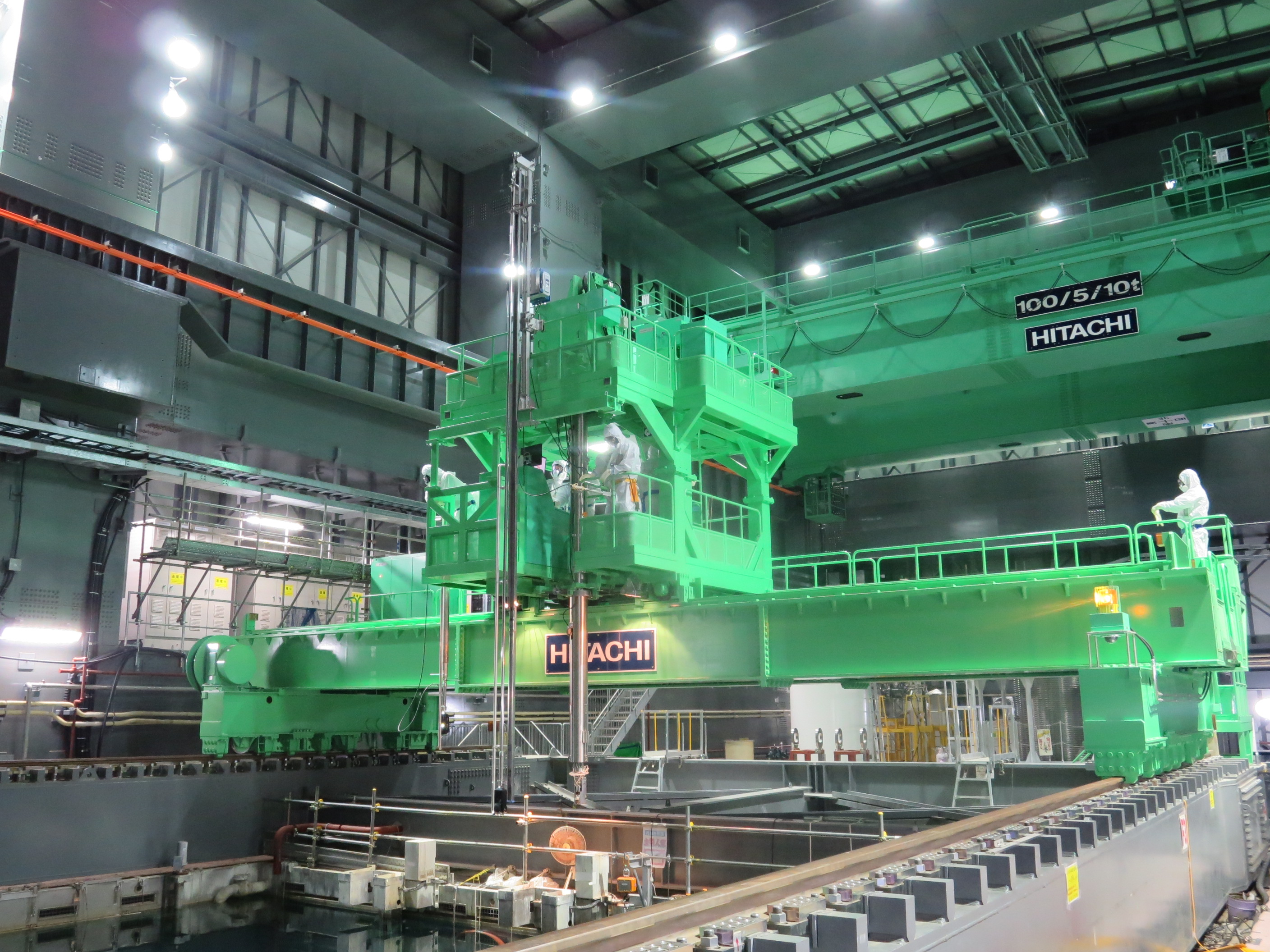
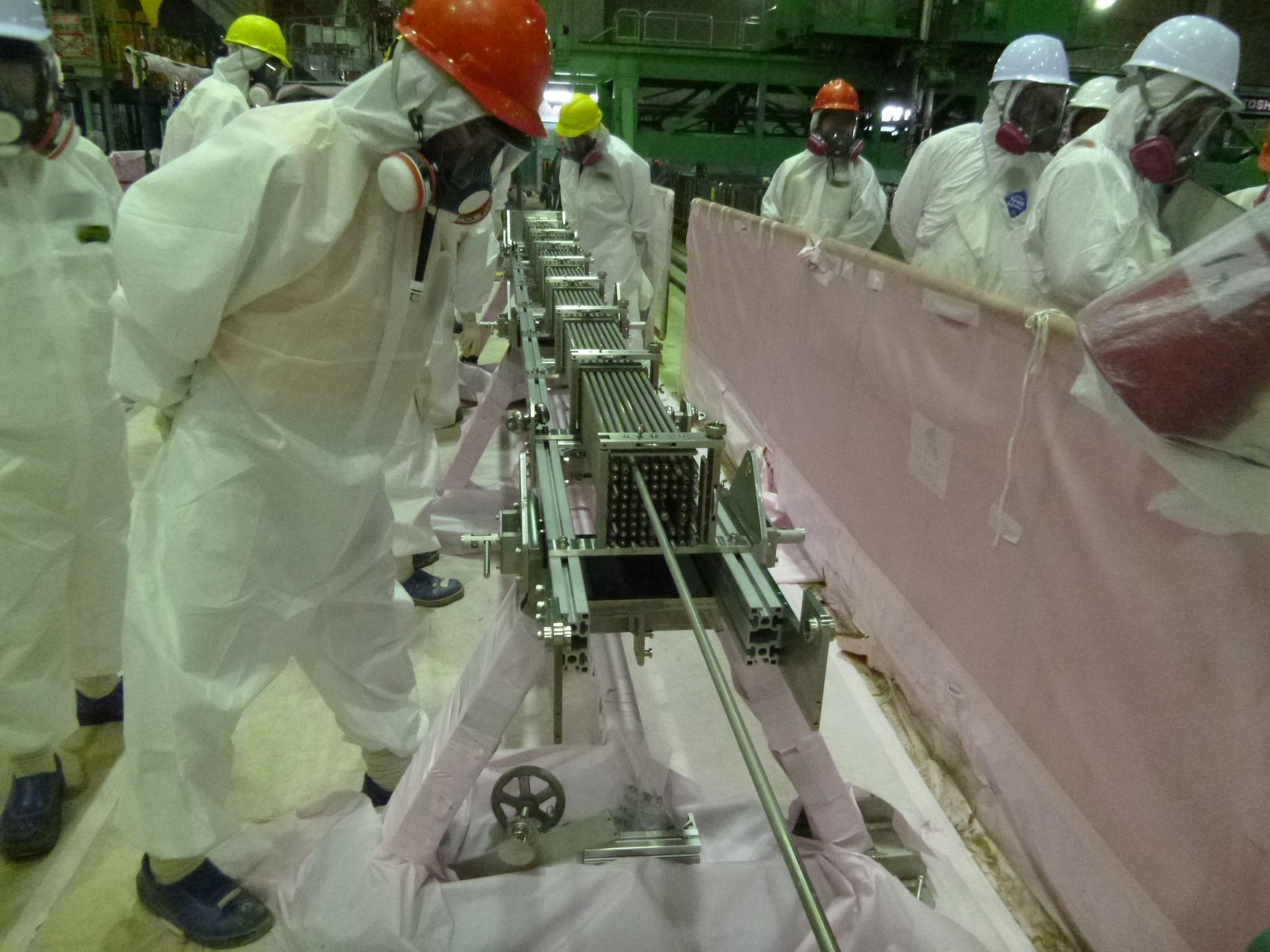
The fuel handling machine in the foreground, over the Spent Fuel Pool, and the gantry crane in the back, as workers conduct a dry-run on November 14 using mock fuel assemblies on the Reactor 4 operation floor (from TEPCO, 11/15/2013; click to enlarge; follow the link for more photos):
Workers who tweet from Fukushima I Nuke Plant say the people who will be operating the fuel handling machine and the gantry crane are the workers with long experience and expertise in fuel handling, from TEPCO's primary contractors. Not "yakuza and rank amateurs".
==========================
To disabuse some people, including scholars and experts (albeit in different fields, not related to nuclear energy or nuclear power plant technologies, or who simply have not followed the Fukushima nuclear accident much other than catching some soundbites), the following is NOT, I mean NOT, how the fuel assemblies will be removed. (I couldn't believe it at first, but there were many in Japan for example who thought the removal would be done exactly like this. Maybe they still do...)
First, we use a crane like this one (whose jib mast collapses after 1:35 into the video)...
And we will take out individual fuel "rods" (and not fuel assemblies) one by one, like this one being taken out of the fuel assembly (casing has been already removed)(from TEPCO, 8/28/2012):
And using the crane in the first photo, and pull the fuel "rods" out of the pool into open air, irradiating the workers regardless of whether the "rods" are new or used, like this (except in this case it was an unused new fuel ASSEMBLY with the casing, not an individual rod)...
Then the "rods" will then be placed in a container, and the container will be lowered to the ground...
In the process, a mishap may occur, and the fuel rods may be scattered on the ground, then they go critical.
And on and on till the end of either the northern hemisphere or the entire planet.
This dire scenario is best summarized by a Yale University sociology professor (emeritus), who says the Reactor 4 SFP is in danger of collapsing (from Huffington Post 9/20/2013; emphasis is mine):
Much more serious is the danger that the spent fuel rod pool at the top of the nuclear plant number four will collapse in a storm or an earthquake, or in a failed attempt to carefully remove each of the 1,535 rods and safely transport them to the common storage pool 50 meters away. Conditions in the unit 4 pool, 100 feet from the ground, are perilous, and if any two of the rods touch it could cause a nuclear reaction that would be uncontrollable. The radiation emitted from all these rods, if they are not continually cool and kept separate, would require the evacuation of surrounding areas including Tokyo. Because of the radiation at the site the 6,375 rods in the common storage pool could not be continuously cooled; they would fission and all of humanity will be threatened, for thousands of years.
Just like many North American experts, the professor simply declares conditions in the Reactor 4 SFP are "perilous". The common Pool is 100 meters away, not 50 meters. It's not "rods" but "assemblies". No idea what he's talking about when he says "two of the rods touch", but I have seen this phrase in other places from other experts. It must be part of the standard things to say if you are to comment on the fuel "rods" from the SFP at Fukushima I Nuke Plant. That Tokyo is part of "surrounding areas" of the plant would be news to most Japanese.
Compared to other reactors that suffered the core melt, the air radiation levels in Reactor 4 have been low enough (measured in microsievert/hour instead of millisievert/hour in other reactors) to allow human workers to work inside the reactor building and on the top floor for the past two and a half years.
For a fond memory, this was the operating floor of Reactor 4:
On November 12, TEPCO disclosed that there were three fuel assemblies out of 1533 fuel assemblies in the Spent Fuel Pool of Reactor 4 at Fukushima I Nuclear Power Plant that were deformed and would be difficult to remove. The removal of fuel assemblies from the Reactor 4 SFP will start this month.
The three fuel assemblies has slight deformation or damage caused by the past work [in the SFP]. No leak of radioactive materials has been observed. TEPCO will transport other fuel assemblies first, while they figure out how to remove and transport these three fuel assemblies. Nuclear Regulation Authority has already approved the fuel removal, and the work will start within this month as scheduled.
So, are these fuel assemblies new? used? How long ago was the "past work"?
I found the answer in Fukushima Minyu, one of the local newspapers in Fukushima Prefecture. It was long before the start of the March 11, 2011 nuclear accident, with the oldest "past work" 25 years ago...
According to TEPCO, one of the damaged fuel assemblies is bent at a 90-degree angle [literal meaning: bent in the shape of a Japanese character "く"; actual angle could be less]. It was bent 25 years ago when a mistake occurred in handling the fuel. The other two were found to be damaged 10 years ago; there are small holes on the outside from foreign objects.
燃料損傷について当時公表したかどうかは東電が調査中。
TEPCO is investigating whether the damages to the fuel assemblies were made public when they were discovered.
According to Fukushima Minyu, the occasion was a visit by the delegation of the Fukushima Prefectural Council for Decommission Safety Monitoring. The council members include officials from the Fukushima prefectural government, municipalities around Fukushima I Nuclear Power Plant, and experts.
How do you bend a fuel assembly at a 90-degree angle, handling it in the spent fuel pool?
And how could Yomiuri call a fuel assembly bent at a 90-degree angle "slight deformation"? Slight?
--------------
For your information, there are 1533 fuel assemblies (each of which contains 50 to 60 fuel rods in channels inside the casing) in the Spent Fuel Pool of Reactor 4 at Fukushima I Nuclear Power Plant.
There used to be 1535 fuel assemblies there, but two new fuel assemblies were taken out from the Reactor 4 SFP last year for examination.
Of 1533 fuel assemblies currently in the Reactor 4 SFP, 202 of them are never-used, brand-new fuel assemblies. The rest, 1331 are used fuel assemblies. Of 1331, 783 are spent fuel assemblies that have been stored in the SFP at least for several years; 548 are the fuel assemblies that had been used in the Reactor Pressure Vessel until Reactor 4 went into extended maintenance to replace the core shroud. These 548 "hot" fuel assemblies were taken out of the Reactor Pressure Vessel and placed temporarily in the Spent Fuel Pool.
A prospective buyer at a dealership in Saitama Prefecture sustained slight neck injuries, while the dealership employee on the passenger's seat broke his arm.
A Mazda Motor Corp. (7261) sport-utility vehicle equipped with an automatic-braking system crashed in Japan on Nov. 10 during a dealership test drive, injuring the driver and front-seat passenger, according to the police.
The Mazda CX-5 was being driven by a prospective buyer on the dealership’s parking lot when it crashed through a urethane barrier set up to demonstrate the SUV’s automatic braking feature, according to the Saitama Prefectural Police, which is investigating the accident. The customer suffered a neck injury while the dealership employee sitting in the front passenger seat fractured his arm, the police said.
A Mazda Motor Corp. (7261) sport-utility vehicle equipped with an automatic-braking system crashed in Japan on Nov. 10 during a dealership test drive, injuring the driver and front-seat passenger, according to the police.
The Mazda CX-5 was being driven by a prospective buyer on the dealership’s parking lot when it crashed through a urethane barrier set up to demonstrate the SUV’s automatic braking feature, according to the Saitama Prefectural Police, which is investigating the accident. The customer suffered a neck injury while the dealership employee sitting in the front passenger seat fractured his arm, the police said.
The car started from about 7 meters away [from the urethane mat]. After hitting the urethane mat, the car collided with the fence about 6.6 meters away.
Needless to say, the car was supposed to detect the mat and stop.
Automatic braking and automatic (self) driving are touted as the next huge things for the auto industry.
(I'd rather drive a stick-shift pickup truck from 1980s and will make sure I don't go anywhere near the newer-looking Japanese automobiles...)
But when more than half of the proceeds of QE to date... have ended up at foreign banks, perhaps at least a theatrical congressional hearing is in order?
That has brought to mind an article that I read yesterday in Japan's Nikkei Shinbun, which said part of the quantitative easing by the US Federal Reserve after the so-called "Lehman Shock" in September 2008 was not so much about helping the US domestic banks or the US housing market but about responding to the demand for the US action from foreign governments for their financial institutions, particularly from China and Japan, two largest foreign holders of the US treasuries AND mortgage-backed securities issued by Fannie Mae and Freddie Mac.
In the US, the purchase of mortgage-backed securities (MBS) issued by Fannie and Freddie by Federal Reserve has been explained as measures to support the housing market. It's that way even today.
Two months after the "Lehman Shock", the US Federal Reserve decided to purchase long-term bonds issued and guaranteed by the US government corporations [Fannie Mae adn Freddie Mac], as emergency response measures. It was the beginning of the extraordinary monetary easing that still continues today. What forced Chairman Ben Bernanke's hand was the cry for help and the pressure from foreign governments, including Japan and China.
November 24, 2008 at night, Federal Reserve Board in Washington DC. "I will announce it tomorrow. Prepare the package for additional measures as soon as possible. One-page summary, and quick." Bernanke instructed the staff with a slight quiver in his voice.
Early next morning on November 25, Federal Reserve Board called an emergency meeting and decided on the emergency response measures that centered on the purchase of long-term bonds issued and guaranteed by Fannie Mae [and Freddie Mac].
8:15AM US Eastern time. The announcement by FRB was typed on one page, in 13 lines. The total amount of purchase by Federal Reserve would, however, be 600 billion dollars. It was the beginning of an extraordinary measures whereby Federal Reserve, central bank of the US, would buy bonds directly from the market.
「とにかく市場の安心感を最優先に考えた。金額の根拠は乏しかった」。当時の議長側近は振り返る。
"Our first priority was to assure the market. There was little basis for the amount," says an aide to the chairman at that time.
Why did Federal Reserve choose to buy the long-term bonds issued by Fannie and Freddie? The official (ostensible) reason was "to support the housing market which was the cause of the financial crisis". However, there was an "international pledge" [as the real reason] that the US government had made right before the "Lehman Shock".
On the night of September 7, 2008. Treasury Secretary Henry Paulson had just announced the effective takeover of Fannie and Freddie, and he was now on the phone. "The US government will now fully back these companies." The Treasury Secretary was talking to the Chinese counterpart. Paulson also conducted a teleconference of G7 finance ministers, and made a pledge that the US government, for the first time, would guarantee the bonds issued by Fannie and Freddie.
It was clear that the collapse of the housing bubble left Fannie and Freddie deeply insolvent. In the meantime, the long-term bonds issued by them were estimated at that time to be about 1.5 trillion dollars. These bonds were considered high grade with implicit guarantee of the US government, and held by more than 130 entities such as governments, central banks, and institutional investors in Europe and Asia.
The two most worried countries were China and Japan, whose holdings were No.1 and No.2. President Hu Jintao of China pressured the US by threatening to sell its large holding of the bonds even at a loss.
At one time, a plan was being discussed whereby the Japanese government would take over (buy) part of the Chinese holding. If China dumped the bonds from Fannie and Freddie the damage to the international financial markets would be immeasurable. It didn't come to pass, but "Japan and the US were seriously considering the plan" (according to the source in international finance). The situation was very tense.
(Full article in Japanese at the link)
Slight quiver in his voice. That's poetic of Nikkei, but I think Mr. Bernanke's speaking voice always sounds like that.
By the way, how much Fannie and Freddie papers did China and Japan have at that time?
China had over 500 billion dollar worth of mortgage-backed securities from Fannie and Freddie, and Japan had over 250 billion dollars worth. The third largest holder was Russia, at slightly over 50 billion dollars.
From Nikkei (English labels are by me):
China and Japan were worried, Nikkei says. China threatened to dump, Japan was willing to buy what China would dump. In 20-20 hindsight, if China had dumped and Japan had picked up those MBS at a significant discount, maybe Japan would have no problem paying for the nuclear accident cleanup. Oh well.
Nikkei doesn't say why Federal Reserve was worried enough to start purchasing the MBS from Fannie and Freddie at that time. I don't remember the reason myself. All I remember was that the stocks of investment banks like Goldman Sachs, Citi, JP Morgan Chase were on a free fall in November, and a extra large downward pressure was on the stocks on November 21, 2008 which was Friday. After the announcement by Federal Reserve on November 25 next Tuesday, the stock markets were lifted somewhat, but all it did was to not fall for the duration of the year.
Making your Amazon purchases through this Search Box helps support exskf.com at no cost to you. (If you don't see the box, please disable ad-block software first.)
I am Japanese, and I not only read Japanese news sources for information on earthquake and the Fukushima Nuke Plant but also watch press conferences via the Internet when I can and summarize my findings, adding my observations.
"Magno Arms" What Does It Indicate? Nothing Good
-
*UPDATE *
As an affiliate of Elliott Wave International I'll be promoting the
following all week:
EWI has given me the OK to share Bob Prechter's April ...
SO WHAT'S NEXT
-
Just a list. Not too complicated, but time to think about the next few
months. We're in the "Quickening"......"the Fourth Turning"..... basically
we'r...
DOWN we go.......
-
corona virus could be a black swan Hehehe
Information here is not meant as trading advice. Please do your own DD
before any decisions.
Well, this was, until March 11, 2011. Now it is taken over by the events in Japan, first earthquake and tsunami but quickly by the nuke reactor accident. It continues to be a one-person (me) blog, and I haven't even managed to update the sidebars after 5 months... Thanks for coming, spread the word. ------------------ This is an aggregator site of blogs coming out of SKF (double-short financials ETF) message board at Yahoo.
Along with commentary on day's financial news, it also provides links to the sites with financial and economic news, market data, stock technical analysis, and other relevant information that could potentially affect the financial markets and beyond.
Disclaimer: None of the posts or links is meant to be a recommendation, advice or endorsement of any kind. The site is for information and entertainment purposes only.







 30-Day free trial by following the link.
 Tokyo Time
![[Most Recent Quotes from www.kitco.com]](http://www.kitconet.com/charts/metals/gold/t24_au_en_usoz_2.gif)


