Tuesday, May 31, 2011

#Radioactive Strontium from Soil Within 10 Kilometers of #Fukushima I Nuke Plant

A slow dribbling of information on the extent of radiation contamination, so that people in Japan don't connect the dots and figure out that their soil, water, ocean have probably been contaminated beyond repair.

It took the Ministry of Education and Science one month to announce the test result, just like when it announced the result for the locations 30 kilometers away from the plant back in mid April.

Asahi Shinbun (6/1/2011):

文部科学省は31日、福島第一原発から10キロ圏内の大熊町、双葉町の4カ所の土壌から、半減期が約29年と長い放射性物質ストロンチウム90が検出されたと発表した。

The Ministry of Education and Science announced on May 31 that the radioactive strontium-90 was detected from the soil samples at 4 locations in Okuma-machi and Futaba-machi, the towns located inside the 10-kilometer radius from Fukushima I Nuke Plant.

 土壌は4月29日~5月1日に採取した。原発から西南西約2キロの大熊町夫沢では、1キロあたり最大で68ベクレルが検出された。他の3カ所では 2.5~12ベクレルだった。半減期が約50日と短いストロンチウム89も4カ所で出ており、過去の核実験によるものではなく、第一原発から放出されたも のとみられる。ストロンチウムの土壌での基準はないが、体内に入ると骨にたまる傾向がある。

The samples were taken from April 29 to May 1. At Ottozawa district of Okuma-machi, located 2 kilometers west by southwest of the plant, 68 becquerels/kilogram strontium-90 was detected. At the other 3 locations, it was 2.5 to 12 becquerels/kilogram. Strontium-89, whose half life is 50 days, was also detected at all 4 locations. They are thought to have come from Fukushima I Nuke Plant, not from the past nuclear tests. There is no standard on the amount of strontium in the soil. Strontium tends to accumulate in the bones once ingested.

 文科省が3月中旬に浪江町と飯舘村の土壌を採取したときは、最大で1キロあたり32ベクレルが出た。東京電力が4月中旬に第一原発の敷地内で採取した土からは約570ベクレルが検出されている。

When the Ministry tested the samples taken at Namie-machi and Iitate-mura in mid March, the maximum amount of strontium detected was 32 becquerels/kilogram. From the sample that TEPCO took in mid April at Fukushima I Nuke Plant, 570 becquerels/kilogram strontium was detected.

The result of this particular test has been uploaded at the Ministry's site (image is below), but it is not just strontium that they found. They also found:

  • Cesium-136 (half-life 13 days);
  • Tellurium-129m (half-life 33.6 days)
  • Uranium-234, -235, -238;
  • Plutonium-239 and 240 (at three locations)

The Ministry believes uranium there is naturally occurring, and plutonium is from the past nuclear tests.

IAEA Experts Investigated #Fukushima I Accident for 10 Days, Ready to Report and Praise the Japanese Government

So the IAEA's team of nuclear experts arrived on May 23 on a 10-day mission to figure out what happened at Fukushima I Nuke Plant, and they're now done and ready to report.

As reported in Mainichi Shinbun Japanese, the IAEA report will state the obvious, nothing new, nothing to contradict what TEPCO and the Japanese government have been insisting. And a generous praise for the Japanese government.

The IAEA findings to be included in their report, from Mainishi Shinbun Japanese (2:50AM JST 6/1/2011):

  • Danger of tsunami was underestimated. People who build nuclear power plants and people who operate the plants should factor in the impact of "natural disasters" more;

  • Nuclear and Industrial Safety Agency (regulatory agency for the nuclear industry) should be more independent;

  • Initial response should be better thought out;

  • Hydrogen is dangerous;

  • Dedicated and determined skilled workers at the plant;

  • TEPCO's "roadmap" needs to be revised as the situation develops, and some form of international cooperation may be possible;

  • The international community should learn from the Fukushima I accident as a lesson on nuclear safety.

And

  • The Japanese government's response to the accident has been "wonderful and well-organized".

No kidding. The IAEA had better inform the residents of Japan about that very quickly; they may already have gotten some funny ideas about the effectiveness of their government in dealing with the on-going nuclear crisis.

The IAEA team is scheduled to visit the Prime Minister's Residence on June 1, and hand the report to the Prime Minister.

TEPCO Now Has #Fukushima I Live Camera

It's "live" with 30 seconds delay.

The "live" camera replaced the good old "Fukuichi" camera that was a still shot every hour.

The camera is set at about 250 meters northwest of the Reactor 1. The image is black and white, and you see mostly the Reactors 1 and 2. You do see what's left of the Reactor 3 and the Reactor 4, but for those reactors TBS/JNN's live camera is much better.

Here's the link to TEPCO's live camera (or click on the image):

http://www.tepco.co.jp/nu/f1-np/camera/

Here's the link to TBS/JNN live camera, again (I have a tiny embed of the video on this blog, to the right): http://youtu.be/FptmoVcgpqg

Ambrose Evans-Pritchard: "Chinese Are Going for the Safe, Thorium Reactors, and They Are Doing Mankind a Favour"

The Telegraph's commentator also thinks, along with many nuke proponents that inhabit the world, that "there has never been a verifiable death" in the West from the nuclear power. (I suppose he doesn't include Russia as part of the West.)

Right.

In his own words, from The Telegraph 3/20/2011 right before he headed off to the Mayan Highlands:

Safe nuclear does exist, and China is leading the way with thorium

A few weeks before the tsunami struck Fukushima’s uranium reactors and shattered public faith in nuclear power, China revealed that it was launching a rival technology to build a safer, cleaner, and ultimately cheaper network of reactors based on thorium.

This passed unnoticed –except by a small of band of thorium enthusiasts – but it may mark the passage of strategic leadership in energy policy from an inert and status-quo West to a rising technological power willing to break the mould.

If China’s dash for thorium power succeeds, it will vastly alter the global energy landscape and may avert a calamitous conflict over resources as Asia’s industrial revolutions clash head-on with the West’s entrenched consumption.

China’s Academy of Sciences said it had chosen a “thorium-based molten salt reactor system”. The liquid fuel idea was pioneered by US physicists at Oak Ridge National Lab in the 1960s, but the US has long since dropped the ball. Further evidence of Barack `Obama’s “Sputnik moment”, you could say.

Chinese scientists claim that hazardous waste will be a thousand times less than with uranium. The system is inherently less prone to disaster.

Ah. China is known for its safety records for sure.

“The reactor has an amazing safety feature,” said Kirk Sorensen, a former NASA engineer at Teledyne Brown and a thorium expert.

“If it begins to overheat, a little plug melts and the salts drain into a pan. There is no need for computers, or the sort of electrical pumps that were crippled by the tsunami. The reactor saves itself,” he said.

“They operate at atmospheric pressure so you don’t have the sort of hydrogen explosions we’ve seen in Japan. One of these reactors would have come through the tsunami just fine. There would have been no radiation release.”

Then why aren't the nuke reactors in the world thorium-based, by now? Evans-Pritchard says it's because thorium cannot be made into weapons:

US physicists in the late 1940s explored thorium fuel for power. It has a higher neutron yield than uranium, a better fission rating, longer fuel cycles, and does not require the extra cost of isotope separation.

The plans were shelved because thorium does not produce plutonium for bombs.

Evans-Pritchard further says western-lifestyle needs nuclear power, and no one has died from nuclear power:

I write before knowing the outcome of the Fukushima drama, but as yet none of 15,000 deaths are linked to nuclear failure. Indeed, there has never been a verified death from nuclear power in the West in half a century. Perspective is in order.

We cannot avoid the fact that two to three billion extra people now expect – and will obtain – a western lifestyle. China alone plans to produce 100m cars and buses every year by 2020.

The International Atomic Energy Agency said the world currently has 442 nuclear reactors. They generate 372 gigawatts of power, providing 14pc of global electricity. Nuclear output must double over twenty years just to keep pace with the rise of the China and India.

And his parting shot:

So the Chinese will soon lead on this thorium technology as well as molten-salts. Good luck to them. They are doing Mankind a favour. We may get through the century without tearing each other apart over scarce energy and wrecking the planet.

This is my last column for a while. I am withdrawing to the Mayan uplands.

As the Fukushima I Nuke Plant accident has made abundantly clear to many people (clearly Evans-Pritchard is not one of them), it is the human errors that make up the accident - from the design of the reactor and the plant, fitting the pipes that don't fit, hiding the condition of the degrading parts and equipments and structures and the regulatory agency who helps the operator to hide them, to name only a few.

It doesn't quite matter how safe thorium is, when the most dangerous and unpredictable component of all is the humans.

Monday, May 30, 2011

#Fukushima I Nuke Plant: 2 TEPCO Workers Exceeded 250 Millisieverts Radiation Limit Mostly from INTERNAL Radiation Exposure

From Mainichi Shinbun English (5/30/2011; emphasis added):

TOKYO (Kyodo) -- Two Tokyo Electric Power Co. employees working at the crisis-hit Fukushima Daiichi nuclear power plant may have been exposed to radiation exceeding the ultimate limit of 250 millisieverts, but no health problems have so far been reported, the company and the government said Monday.

The two men, who are in their 30s and 40s and have been at the plant from the time the March 11 quake and tsunami triggered the crisis, may have been cumulatively exposed to several hundred millisieverts, a company official said, while adding that they are "not at a stage that would require emergency medical treatment."

The two workers have been involved in dealing with the plant's Nos. 3 and 4 reactors. At a measurement on May 23, their thyroid glands were found to have absorbed 7,690 and 9,760 becquerels of radioactive iodine-131, respectively, 10 times higher than data on other workers.

The external exposure levels of the two workers were between 74 and 89 millisieverts, the plant operator known as TEPCO said.

The two have worked at the plant's reactor control room, a building where the headquarters to deal with the crisis is located, and outside on the premises. They ingested stable iodine on March 13 to prevent radioactive iodine from accumulating in the thyroid and increasing the risk of thyroid cancer.

TEPCO said it plans to check some 150 other workers who have engaged in similar work.

(The article continues.)

Well, what the article doesn't say (but it is mentioned in the Mainichi's Japanese articles) is that the two workers stopped taking potassium iodide pills after March 13. No reason is given. The Japanese articles also say that the high level of iodine-131 was detected from the urine of the workers.

These workers were not even working among highly radioactive debris outside or inside the turbine buildings or reactor buildings with high air radiation. They were working in the central control rooms for the Reactors 3 and 4, although the English article above makes it sound as if they were also working outside.

Did TEPCO have enough potassium iodide pills for the workers to begin with? Or the Japanese government?

The CBS News article back in March 16 alleges that the Japanese government had only 230,000 doses of potassium iodide when the Fukushima crisis started, and as of March 16 it hadn't yet asked other countries who had abundant supplies "at least not publicly". (h/t anon reader of my Japanese blog)

As far as the Japanese government went, it chose to hide the simulation data from the public that predicted the very high organ dose of iodine-131 over a surprisingly wide area rather than admitting the radiation problem and the lack of potassium iodide.

Sunday, May 29, 2011

Kyodo News: "TEPCO believes stabilizing Fukushima reactors by year-end impossible"

Oh what a surprise.

From Kyodo News English (full article by subscription only; 5/30/2011):

Tokyo Electric Power Co. is coming to the view that it will be impossible to stabilize the crisis at the Fukushima Daiichi nuclear power plant by the end of this year, senior company officials said Sunday, possibly affecting the timing for the government to consider the return of evacuees to their homes near the plant.

The revelation that meltdowns had occurred at the Nos. 1 to 3 reactors at the plant, most likely with breaches to pressure vessels encasing nuclear fuel, has led the officials to believe that ''there will be a major delay to work'' to contain the situation, one of them said.

The plant operator, known as TEPCO, announced on April 17 its road map for bringing the troubled reactors at the plant into a stably cooled condition called ''cold shutdown'' in six to nine months.

Well, as late as May 17 when the revised "roadmap" was disclosed, TEPCO said there would be no change in the target time-frame for the "cold shutdown".

The Kyodo Japanese article has a bit more information "leaked" by the TEPCO execs:

  • One executive said "6-9 month time-frame is only a target to strive for, and not a binding one." [So the "roadmap" is a wish-list.]

  • About the Reactor 1 whose Containment Vessel is now found to be leaking water, "We have to find the leak and stop it. If we don't know the extend of the damage to the Containment Vessel, we don't know how long it takes to stop the leak."

  • Another exec says "it will take 1 or 2 additional months" to bring the reactors in "cold shutdown" because of the bigger cooling system now envisioned.

  • Yet another one says "the works at three reactors [1, 2, 3] are not progressing simultaneously, as planned. We'll have to ask workers to work during the New Year holidays."

These executives are no doubt from the TEPCO's Tokyo headquarters and probably the same ones who ordered a fancy "roadmap" at the government's request, not people at Fukushima I Nuke Plant trying to contain the on-going crisis for the past 2 and a half months.

"Cold shutdown", as Kyoto University's Koide has repeatedly said, assumes the Reactor Pressure Vessel intact, and the fuel rods intact. There is no word for bringing the broken reactor with totally melted fuel into a stable condition so that it won't emit any more radiation. There is no established process to do that, particularly when the melted jumble, corium, is possibly eating away the concrete beneath the Containment Vessels.

As long as TEPCO (headquarters) and the Japanese government are fooling around with the impossible idea of "cold shutdown" of the reactors that are broken, with the corium already outside the Reactor Pressure Vessels, or Containment Vessels, there will be no end in sight, I'm afraid.

High Level of Radioactive Cesium from Snow in #Fukushima

Radioactive pollution is now detected in snow and freshwater fish.

And Japan's Kan administration still pushes for nuclear power, not just for the Japanese but for the up-and-coming countries in Asia and the rest of the world.

From Mainichi Shinbun Japanese (5/30/2011; link, emphasis added):

山岳愛好家らで作る「高山(たかやま)の原生林を守る会」は29日、福島市周辺の山岳地帯から採取した雪の放射線量分析結果を公表した。標高1500メー トル以下を中心に高濃度の放射性セシウムが検出され、最高は箕輪山東斜面の1338メートル地点で1キロ当たり2968ベクレルだった。市内の阿武隈川の ヤマメなど川魚からは国の暫定規制値(1キロ当たり500ベクレル)を上回るセシウムが検出され、雪解け水の流入が原因とみられるという。

On May 29, a private association of mountain lovers [in Fukushima], "Association for preserving the primal forests in Takayama Mountain", announced the result of radiation analysis of snow samples taken from the mountains around Fukushima City in Fukushima Prefecture. High concentration of radioactive cesium was detected from snow samples taken below the altitude of 1,500 meters (4,921 feet), with the highest being 2,968 becquerels per kilogram from the sample taken on the east slope of Mount Minowa at 1,338 meters high. Radioactive cesium that exceeds the provisional national limit (500 becquerels per kilogram) has been detected from freshwater fish in the Abukuma river that runs through Fukushima City, and it is considered that radioactive cesium in fish comes from the water from melted snow.

US, Japan Jointly Push for Spent Fuel Storage Facility in Mongolia To Sell Their Nuke Plants

It's an old piece of news (May 9, 2011) which I think should have received a wider coverage in light of the on-going crisis at Fukushima I Nuke Plant (which receives little coverage on its own these days).

Japan and the US want to build a spent nuclear fuel storage facility in Mongolia, and Mongolia is very eager to join the nuclear power generation club by building the first nuke plant in the country, undeterred by the Fukushima accident.

The reason for the push for the spent fuel storage facility in Mongolia? So that the US-Japan joint ventures that sell nuclear power plants can sell the plants as a package deal that comes with the spent fuel storage, competing with Russians who already offer such a package deal.

Mongolia has faults capable of producing earthquakes of Magnitude 8.

From Reuters (5/9/2011):

TOKYO, May 9 (Reuters) - Japan and the United States plan to jointly build a spent nuclear fuel storage facility in Mongolia to serve customers of their nuclear plant exporters, pushing ahead despite Japan's prolonged nuclear crisis, the Mainichi daily said on Monday.

A Trade Ministry official said Japan, U.S. and Mongolia officials, at a meeting shortly before Japan's March 11 earthquake, informally discussed possible construction of a nuclear waste storage facility for countries with nuclear power plants but no spent fuel storage capability of their own.

He said there were no concrete plans at this time but the ministry would consider such a project if Mongolia were interested.

The Mainichi said the facility would allow Japanese and U.S. nuclear plant exporters, which include joint ventures and units of General Electric , Hitachi and Toshiba , to better compete with Russian rivals that offer potential nuclear plant customers spent fuel disposal in a package.

Mongolia plans to have its first nuclear power plant by 2020 and to build nuclear fuel production capacity to tap its rich uranium resources, undeterred by the crisis at Japan's Fukushima nuclear power complex, a senior official at the state-owned MonAtom LLC said in April.

MonAtom represents the Mongolian government in mining and developing the country's uranium resources.

The trade ministry official denied the Mainichi's report that the three countries had originally planned to sign a deal on the spent fuel disposal project in February but it was postponed as Japan's Foreign Ministry opposed the schedule, citing a lack of consensus among Japanese ministries.

The Mainichi said a new date had not been set in the wake of the March 11 earthquake and tsunami in northeast Japan, which triggered cooling system malfunctions at Tokyo Electric Power Co's Fukushima Daiichi nuclear plant and led to radiation leaks into the atmosphere and the sea.

Engineers are still struggling to bring the plant under control. (Reporting by Kiyoshi Takenaka; Editing by Edmund Klamann)

#Fukushima I Nuke Plant: Radioactive Materials at Reactor 2 Silt Fence Rising, Again

Radioactive iodine-131 shot up inside the silt fence in front of the water intake for the Reactor 2. Radioactive cesium (134 and 137) continues to rise OUTSIDE the silt fence for the Reactor 4, and the water levels at the trenches from the Reactors 2 and 3 continue to rise.

All is not well at Fukushima I Nuke Plant; it never has been since the earthquake.

From TEPCO's press release (English) on May 29:

Unit 2 inside the silt fence, for the sample taken on May 28:

Iodine-131: 24,000 becquerels/liter
Cesium-134: 4,100 becquerels/liter
Cesium-137: 4,300 becquerels/liter

The same nuclides from the sample taken on May 27 (and announced on May 28):

Iodine-131: 5,200 becquerels/liter
Cesium-134: 1,600 becquerels/liter
Cesium-137: 1,700 becquerels/liter

Saturday, May 28, 2011

#Fukushima I Nuke Plant: Higher Radioactive Materials Outside the Silt Fence of Reactor 4 Than Inside?

Some funny numbers for the Reactor 4's nuclide analysis at the silt fence at the water intake.

TEPCO's press release on May 28 on the samples taken on May 27 shows the water OUTSIDE the silt fence for the Reactor 4 water intake had a much higher radioactive material concentration than the water inside the silt fence.

This wasn't the case at all on May 25 samples whose level of radioactive materials was higher INSIDE the silt fence, as you would expect. Hmmm. The silt fence for the Reactor 4 water intake is not working? But why would the outside be more radioactive than the inside?

Top, May 25 sample data; bottom, May 27 sample data, from TEPCO press releases; iodine-131, cesium 134, cesium-137:

#Fukushima I Nuke Plant: Water Levels Rising in Trenches from Reactors 2, 3

If the typhoon No.2 dumps a whole lot of rain, they will overflow. Even if it doesn't, it looks just the matter of time.

From the Ministry of Economy, Trade and Industries (METI)'s press release (in Japanese) on May 28 on the Fukushima I plant conditions, "Water levels at trenches":

Reactor 2 trench water level:

5/7: 880 millimeters (34.65 inches) from the top of grating of the trench
5/14: 760 millimeters (29.92 inches)
5/21: 760 millimeters (29.92 inches)
5/28: 576 millimeters (22.68 inches)

Reactor 3 trench water level:

5/7: 820 millimeters (32.28 inches) from the top of grating of the trench
5/14: 720 millimeters (28.35 inches)
5/21: 640 millimeters (25.20 inches)
5/28: 431 millimeters (16.97 inches)


The top edge of the trenches is at the Onahama Peil (O.P., average sea level used for the plant) plus 4,000 millimeters. In other words, 4 meters (13.12 feet) above sea level.


Typhoon No.2 Coming, Heavy Rain Expected Over #Fukushima

Uh oh.

Japan Meteorological Agency forecasts heavy rain in Kanto and Tohoku areas on May 29 and 30 from a strong typhoon (Typhoon No.2; central pressure 960 hectopascal or millibar) coming up north from Amami Oshima (where the red circle is on the map above).

According to Mainichi Shinbun Japanese (5/28/2011), TEPCO admits that Fukushima I Nuke Plant is not ready for the typhoon, and apologizes for the lack of preparation for the wind and rain. The company has been spraying the special resin on the radioactive debris and dust at Fukushima I Nuke Plant for a month to prevent the spread of radioactive materials by wind and rain, but the spraying is only half-way done.

The Central Waste Processing Facility that has been storing the contaminated water from the Reactors 2 and 3 is near full, and the water levels in the trenches remain high. The Containment Vessels are leaking.

#Fukushima #Radioactive Debris to Be Disposed of As Regular Debris

Radioactive sewage sludge sold as cement, radioactive teas sold unchecked. Now radioactive debris in the middle section of Fukushima Prefecture to be burned and buried like normal debris, because the radiation level is "low", according to the Ministry of Environment.

The Ministry of Environment has just given an OK sign to 10 towns and villages in the middle section of Fukushima Prefecture called "Naka-dori" region to burn, bury, or recycle the debris from the disaster (earthquake/tsunami) contaminated with radioactive materials, because the air radiation levels in these cities and villages were less than that of the city in the "Aizu" region (western third of Fukushima) with the highest level of air radiation.

Does that make sense? I don't know any more, but that's what the Ministry is saying in its press release (original in Japanese). To roughly summarize:

1. Debris from the earthquake/tsunami in Fukushima's "Hama-dori" (ocean 1/3) and "Naka-dori" (middle 1/3) have been stored in temporary storage depots, but now in ten towns and villages [they are all in the south-eastern corner of "Naka-dori", the middle 1/3 of Fukushima, adjacent to "Hama-dori", the ocean 1/3] they can be processed as regular debris.

However, just in case, they are to be processed within Fukushima Prefecture for the time being. As for shipping them and processing outside Fukushima, it is to be decided after the experts discuss in the meeting.

2. The reasons for resuming the processing in these 10 towns and villages:

1) These towns and villages have their air radiation levels less than that of "Aizu" region [western 1/3 of Fukushima Prefecture], considered least affected by the Fukushima I Nuke Plant accident in terms of radiation contamination. Specifically, their air radiation levels are the same as or less than that of Sakashita-machi in the Aizu region that has the highest air radiation level in Aizu and also has a large amount of the disaster debris.

2) Air radiation levels at the debris depots were not much different from the background air radiation. In some cases, the air radiation level at the depot was lower than the level in the town.

These 10 towns and villages have total of 6,155 tons of debris, which they can now burn, bury, or recycle.

The page 5 of the Ministry of Environment release shows the air radiation levels in those cities (I added the labels in English):

At the highest depot, the air radiation level at a distance of 1 meter from the debris was 0.31 microsievert/hour. That would be 2.7 millisieverts per year.

In a post-nuke disaster Japan, that is totally OK and acceptable.

The Ministry's release does mention the "clearance level" in passing (in page 2), which is one-hundredth of the annual allowable radiation dosage of 1 millisievert. The clearance level therefore is 10 microsieverts per year, or 0.001 microsievert/hour. Debris at the depots in these towns and villages, needless to say, exceeds this clearance level by a big fat margin.

My questions:

1. Why does the Ministry ignore the clearance level, which is specified by law? The debris exceed the clearance level.

I guess I know the answer to my own question. The Ministry of Education did it, and upped the radiation for kids to 20 millisieverts per year because "this is an emergency", with a promise to keep the actual exposure as low as possible without saying how. If the Ministry of Education can do it, so can the Ministry of Environment! Everybody's doing it!

(Hey that's like the "foreclosuregate" in the US! All the banks do it - robo-signing, foreclosing without the clear title, issuing mortgage-backed securities without any mortgage in the pool - so what's the big deal?)

2. How is it possible that the depots that have piles of debris with radioactive materials test lower in air radiation than background radiation? It just defies the common sense. You put the radioactive debris in one place, and the radiation measures lower?

3. Why is a town in Aizu region with the HIGHEST air radiation level chosen as a reference, instead of picking a town with the LOWEST radiation level, if the Ministry wants to ensure safety?

I think I know the answer to my own question No.3. If the Ministry had picked the town with the lowest radiation level in Aizu, none of the debris in the "Naka-dori" region could be burned, buried, or recycled.

4. What is the point of deciding by the air radiation level at the debris depot, to begin with?

These are some numbers from TEPCO's latest contamination map of Fukushima I Nuke Plant. Notice that the air radiation level is much lower than the radiation on the debris themselves:

  • Water transfer pipe: surface 130 millisieverts/hr, airborne 25 millisieverts/h

  • Dropped rubble: surface 160 millisieverts/hr, airborne 40 millisieverts/hr

So these debris in these towns and villages could have much higher radiation if the radiation were measured on the surface.

But now the Ministry of Environment has given the permission for the debris to be burned without special filters or system to capture the radioactive materials, buried without consideration for groundwater or soil contamination, or recycled. Soon, the Ministry will allow the debris to be shipped outside Fukushima to be burned, buried, and recycled.

Share the pain. Share the radioactivity. Let everyone suffer the consequence of TEPCO's and the government's mismanagement and pollute the entire country. That seems to be the Japanese way.

Friday, May 27, 2011

#Fukushima I Nuke Plant: High Concentration of Radioactive Cesium in the Ocean Soil in 300-Kilometer Strip Along the Coast

Radioactive materials in concentration that was up to several hundreds of times the normal level were detected from the soil on the ocean floor in the 300-kilometer strip along the coast from Kesennuma City in Miyagi Prefecture to Choshi City in Chiba Prefecture.

Oh what a surprise. Who could have known?

The Ministry of Education and Science, who did the survey, even goes to contradict the oft-repeated statement by the chief cabinet secretary and says "the marine products may be affected."

Chief Cabinet Secretary Edano's favorite refrain whenever a new leak was found at Fukushima I Nuke Plant was: "It will have no immediate effect" on health, on environment, on anything. (These days, he is busy trying to "qualify" his use of "immediate". Quite funny if the situation is not this dire.)

No word on other nuclides like plutonium, uranium, and strontium.

I'm trying to locate the original survey data at the Ministry's site.

From Mainichi Shinbun Japanese (1:15AM JST 5/27/2011):

 文部科学省は27日、宮城県気仙沼市沖から千葉県銚子市沖まで南北約300キロにわたる海底の土から、最高で通常の数百倍に当たる濃度の放射性物 質を検出したと発表した。文科省は「海産物に影響が及ぶ恐れがある」としている。東京電力福島第1原発から海に流出した汚染水に含まれた放射性物質が、広 範囲に拡散していることが裏付けられた。

The Ministry of Education and Science disclosed on May 27 that radioactive materials in concentration that was up to several hundreds of times the normal level were detected from the soil on the ocean floor in the 300-kilometer strip along the coast from Kesennuma City in Miyagi Prefecture to Choshi City in Chiba Prefecture. The Ministry says "the marine products may be affected". It is now confirmed that the radioactive materials in the contaminated water released [both intentionally and unintentionally] from TEPCO's Fukushima I Nuclear Power Plant into the ocean have spread far and wide.

 9日から14日にかけ、沖合約15~50キロの12カ所で海底の土を採取。すべてから放射性物質が検出された。濃度が最も高かったのは、福島第1 原発の沖合約30キロの水深126メートルの海底で、土1キロ当たりセシウム134は260ベクレル、セシウム137は320ベクレルだった。

The soil samples were taken from May 9 to May 14 at 12 locations about 15 to 50 kilometers off the coast. Radioactive materials were detected in all samples. The highest concentration of radioactive materials was detected from the sample taken from the ocean floor, 126 meters deep, 30 kilometers off the coast of Fukushima I Nuke Plant. Cesium-134 was 260 becquerels/kilogram, and cesium-137 was 320 becquerels/kilogram.

 ほぼ同じ海域で09年に行った調査では、セシウム134は検出されず、セシウム137は1ベクレル前後だった。

In comparison, in the survey done in 2009 in the approximately the same location, cesium-134 was not detected, and cesium-137 was 1 becquerel/kilogram.

 半減期が短く09年の調査で検出されなかったヨウ素131も、土1キロ当たり1・6~6・1ベクレル検出された。

Iodine-131, whose half life is short and was not detected at all in the 2009 survey, was found at 1.6 to 6.1 becquerels/kilogram.

 セシウムなどの分布は福島第1原発から北で比較的高く、約70キロ離れた宮城県岩沼市沖のセシウム137は110ベクレル。一方、南にほぼ同距離の北茨城市沖では12ベクレルだった。

The spread of cesium was more concentrated north of Fukushima I Nuke Plant. Cesium-137 at a location off the coast of Kesennuma City in Miyagi Prefecture, 70 kilometers north of the plant, was 110 becquerels/kilogram, whereas at a location off Kita-Ibaraki City in Ibaraki Prefecture, 70 kilometers south of the plant, it was 12 becquerels/kilogram.

 文科省は「海底の地形や海流の影響で、放射性物質の量にばらつきがある」と説明した。

According to the Ministry, "There's a variation in the amount of radioactive materials due to the variation in ocean floor topography and the effect of the ocean current."

Rabbit Without Ears, Allegedly Born After #Fukushima Accident

It is actually a very cute animal, trying to eat as much as it can among much bigger "normal" rabbits.

The video was uploaded on Youtube on May 21 by someone who says he/she lives in the area in Fukushima Prefecture close to Fukushima I Nuclear Power Plant.

In one of the replies to the comments, he/she says the location is "500 meters from No.34 in the Ministry of Education's radiation map." No.34 in the radiation map is "Ookawara, Ookuma-machi, Futaba-gun, 7 kilometers from Fukushima I Nuke Plant, south by southwest."

The youtube video has received a ton of negative comments from the Japanese viewers calling it fake and fear-mongering. Reading the comment by the person who uploaded it, I don't get that feeling and the video doesn't look like a fake, but it's just me.

The person who uploaded the video says it is one of their rabbit, and it was born after they fed their rabbits with their favorite fresh green grass after the Reactor 3 blew up. He/she says "We were working in our backyard when the Reactor 3 blew up, which we didn't know at that time. Our faces and throats felt burned, and we thought we're going to die. So we fed the rabbits with their favorite grass." And "It's just too late, telling us after 2 months how contaminated the soil is around here. We've drunk from the well water, have eaten the wild mountain vegetables."

Some samples of viewers' comments (original in Japanese); many of them attacking the messenger (the person who uploaded it):

What a cute little rabbit. Breed as a new breed.

There's no proof that this video was shot in Japan!

That cannot be in Fukushima. Dubious video.

Yeah just blame everything on radiation, idiot.

It's gotta be China.

I've seen the rabbits with no ears or stunted ears. Nothing to do with radiation.

You [the person who uploaded it]'re spreading the malicious rumor.

You [the person who uploaded it] are crazy. You should go see the psychiatrist quick.

Interestingly, many comments from people who take the video seriously and discuss the implications of radiation exposure (both internal and external) are flagged as "spam".

AREVA's Water Treatment System for #Fukushima I: TEPCO Denies "Rumor", Says It Only Costs US$2585 Per Tonne

TEPCO released the cost calculation for the AREVA's contaminated water treatment system on May 27, and denied the "rumor" (originated in the sources inside the Ministry of Economy, Trade and Industry) that it would cost 200 million yen per tonne of water.

Instead, TEPCO said it would be "210,000 yen [US$2,585]" per tonne, and the total would be 53.1 billion yen [US$656 million] to process about 250,000 tonnes of water in the end.

It was 200,000 tonnes of water only a few days ago, I think. And what "end"?

Still no information on exactly what nuclides are to be removed and how much. Corporate secret.

From Mainichi Shinbun Japanese (10:45PM JST 5/27/2011):

 東京電力は27日、福島第1原発のタービン建屋地下などにたまった高濃度の放射性物質を含んだ汚染水の処理費が総額531億円に上るとの試算結果 を公表した。1立方メートル当たり21万円となり、東電が全額を負担する。処理費用を巡っては、総額数十兆円に上るとの臆測も流れていたが、東電側が否定 した。

On May 27, TEPCO released the result of the cost calculation for the treatment system for the highly contaminated water in the turbine buildings and other locations at Fukushima I Nuke Plant, and it was 53.1 billion yen. It would be 210,000 yen [US$2,585] per tonne, and the cost would be borne by TEPCO. There was a "rumor" that the treatment cost would be several tens of trillion yen, but it was denied by TEPCO.

 高濃度汚染水は、仏アレバ社が建設する水処理施設で浄化し、一部を原子炉へ再び冷却水として戻す予定で、6月中旬の稼働を目指す。東電によると、 約8万4700立方メートル(5月16日現在)の高濃度汚染水があるが、最終的には約25万立方メートルを処理する必要があると見込み、施設や仮設タンク の建設費、汚染水の処理費などを積算した。高濃度汚染水は現在、タービン建屋地下から集中廃棄物処理施設に移送しているが、移送費や低濃度汚染水の処理費 は含まれていない。

The highly contaminated water is to be treated at the water processing facility that AREVA of France is building, and part of the water is to be returned to the reactors as coolant. The system is expected to be operational in mid June. According to TEPCO, there are 84,700 cubic meters (as of May 16) of the highly contaminated water. In the calculation, TEPCO estimated the total of 250,000 cubic meters of water to be treated, and added the construction costs for the facility and the temporary storage tanks, and the cost of water processing. The highly contaminated water is being transported from the turbine building basements to the Central Waste Processing Facility, but the cost calculation does not include the cost of this transport nor the cost to treat the less contaminated water.

"Shizuoka Shincha (New Tea) Has Arrived!"

(UPDATE) A customer representative at the tea merchant answered my email and said "It was picked and processed mid April to early May." So that was before they tested for radioactive iodine and cesium.

-----------------------------

That was a cheerful e-mail message this morning from a Japanese tea merchant that I had bought from in the past.

In light of what has transpired in Shizuoka - radioactive cesium detected in raw tea leaves and the finished, blended tea, governor refuses to test the bulk tea (aracha), and promise by the prefecture's tea merchants to aggressively market Shizuoka tea in cooperation with the prefectural government - I'll pass.

For those interested in tasting the fresh brew of Shizuoka tea, 3-oz loose leaf tea in a canister can be had for $40. Here's the link:

http://www.itoen.com/loose-leaf-tea/shizuoka-superior-shincha-tin.html

Thursday, May 26, 2011

TEPCO-AREVA Contract to Treat Contaminated Water at #Fukushima I Nuke Plant Is Shrouded in Secrecy

With TEPCO again running out of space to hide (aka move) the highly contaminated water from the Reactors 2 and 3 at Fukushima I Nuke Plant, the hope is that the water treatment facility being built by AREVA will be in operation in June.

I mentioned the "rumor" in my post yesterday that the cost to treat 1 tonne of contaminated water will cost TEPCO/Japanese taxpayers 200 million yen (US$2.44 million). In addition to the exorbitant cost, some people are asking, "What exactly will the facility do? What types of radioactive materials is it capable of removing from the water?"

After all, it will be the first even for AREVA to treat radioactive water of this level of contamination.

To my (feigned) surprise, no one in the Japanese government seems to know exactly what the facility is designed to do, and TEPCO is not saying anything, because it is under the "confidentiality [non-disclosure] clause" of the agreement with the French company.

Why any work related to Fukushima I Nuke Plant is still considered "private" is a mystery to me, when the entire world is being affected and the Japanese taxpayers will likely be required to pick up the tab.

A Japanese writer Ryuichi Kino wrote about the TEPCO-AREVA agreement on his blog, and the following is my quick translation of his post in Japanese (emphasis is mine):

Doubt on the TEPCO's plan to remove the contaminated water based on the AREVA's water processing system, whose system details are not publicly disclosed

There's one thing that I have been wondering about for a while. I have asked about it several times during the press conferences and for which I have always gotten incomplete answers, and that is the AREVA's water processing system. The AREVA's system is basically for the removal of radioactive cesium, and it is not known if it removes any other radionuclides.

I forgot when was the first time I asked about the processing system for the contaminated water, but I do recall that I asked the question in the May 1 press conference. I had heard somewhere that the noble gas like iodine would be released untreated, so I asked whether it was true. The answer was that it was true [that iodine would be released untreated]. TEPCO seemed to think it wouldn't make much difference now that the roof of the reactor building had been blown off anyway in the Reactors 1 and 3.

It does make a difference in terms of reducing the release of radioactive materials into the environment, but what became clear in the press conference [of the government/TEPCO consolidated headquarters for dealing with the Fukushima I Nuke accident] yesterday (May 19) was an even bigger problem. To my surprise, TEPCO said the details of the AREVA's water processing system were "not to be disclosed, due to the contractual obligation." What is going on with the effort to wind down the Fukushima I accident, when the critical information is withheld due to "contractual obligation"?

What's even more surprising was that Prime Minister's Assistant Goshi Hosono, who acts as the secretary of this joint headquarters for the accident, didn't know the details of the water processing system either. Nuclear and Industrial Safety Agency didn't know either. I was appalled.

The following is the summary of the answers given by TEPCO and government officials [regarding the AREVA's system] during May 19 press conference:

TEPCO's Matsumoto:
"The main purpose of the AREVA's water treatment system is to remove cesium. I hear that it could also remove other gamma [ray-emitting nuclides?] and metal (such as strontium). However, due to the contractual obligation with AREVA, it is not to be disclosed what other nuclides can be removed and how much. I'm told that is the agreement between TEPCO and AREVA."

NISA's Nishiyama:
"In building the water processing system, the details of the system needs to be reported [to NISA] in order to ascertain the safety. The details would include the types of nuclides to be treated. We would have to further consider how to deal with the non-disclosure issue in the agreement."

PM Assistant Hosono:
"I didn't know that [the details were not disclosed]. All I paid attention to was radioactive iodine and cesium, but there are other radionuclides. Is AREVA saying there is no data on other radionuclides? Or is is saying there is such data but not willing to disclose? I'll confirm [with AREVA?]. The data should be made public. If AREVA doesn't have information on other radionuclides [other than iodine and cesium], I would like to request the company to run the system, obtain the data, and then disclose the data."

TEPCO admitted that strontium was one of the nuclides to be processed, but didn't have information on plutonium and uranium. I simply don't understand why Hosono, representing the consolidated headquarters, and NISA were not aware of the situation [surrounding the AREVA's water treatment system].

Both the consolidated headquarters and NISA must have had a major role in crafting the [revised] "roadmap" announced on May 17. But they didn't know the details. What was the "roadmap" based on? Is it just a wish list [as many critics alleged], after all?

Without the detailed information on the types of nuclides to be processed, we wouldn't know how to treat and dispose the filters after the contaminated water is processed, and how to treat and dispose the still contaminated water after it is processed.

As to the contaminated water after being processed, it may be OK, as Hosono said in the press conference, "to analyze after the treatment", even though it gives the impression that the government is "behind the curve". Who is going to treat the filters that catch radioactive materials and where? What are the radioactive materials that need to be treated and disposed and how much, by the time the accident is wound down? Without the details of the water processing system, the "roadmap" doesn't even address such things.

I have another doubt. [TEPCO] seems to have abandoned the idea of "water entombment" for the Reactor 1, and instead try to process the contaminated water in the basement using the AREVA's system and put it back into the reactor core. However, without knowing what nuclides are still in the water after the treatment, is it safe to circulate this water? The more this water circulates, the radioactive materials not treated by the AREVA's system will increase in the water.

Neither NISA nor Hosono seems to think the current situation is acceptable. But will the detailed information be disclosed? It is rumored that the final cost of processing the contaminated water will run up to over 10 trillion yen (US$123 billion). The system that costly, and the details are not disclosed. Not only am I not satisfied with this non-disclosure, but I am also doubtful whether the accident is really being wound down.

I believe there should be a 3rd-party organization, other than TEPCO, to check the progress of the "roadmap" as soon as possible. A nuclear power plants is an ultra-complex system, and it is easy to fool a layman. It may be necessary to have people with the experience in working in the nuclear power plants in such an organization.

The IAEA Team To Figure Out #Fukushima Disaster

A good doctor in Kumamoto, Japan who writes a blog in Japanese on Fukushima I Nuke Plant accident and the ensuing nuclear and radiation disaster that's slowly unfolding telephoned the Nuclear and Industrial Safety Agency of METI and asked for the names of the IAEA team that has been sent to investigate the Fukushima I Nuke Plant accident.

(He wrote about how much the ground upon which Fukushima I Nuke Plant sits may have shifted by the quake, which I posted here.)

NISA told Dr. Ono the list was released to the press, but not to the general public, but they sent him a fax anyway.

Here's the fax, with his permission:


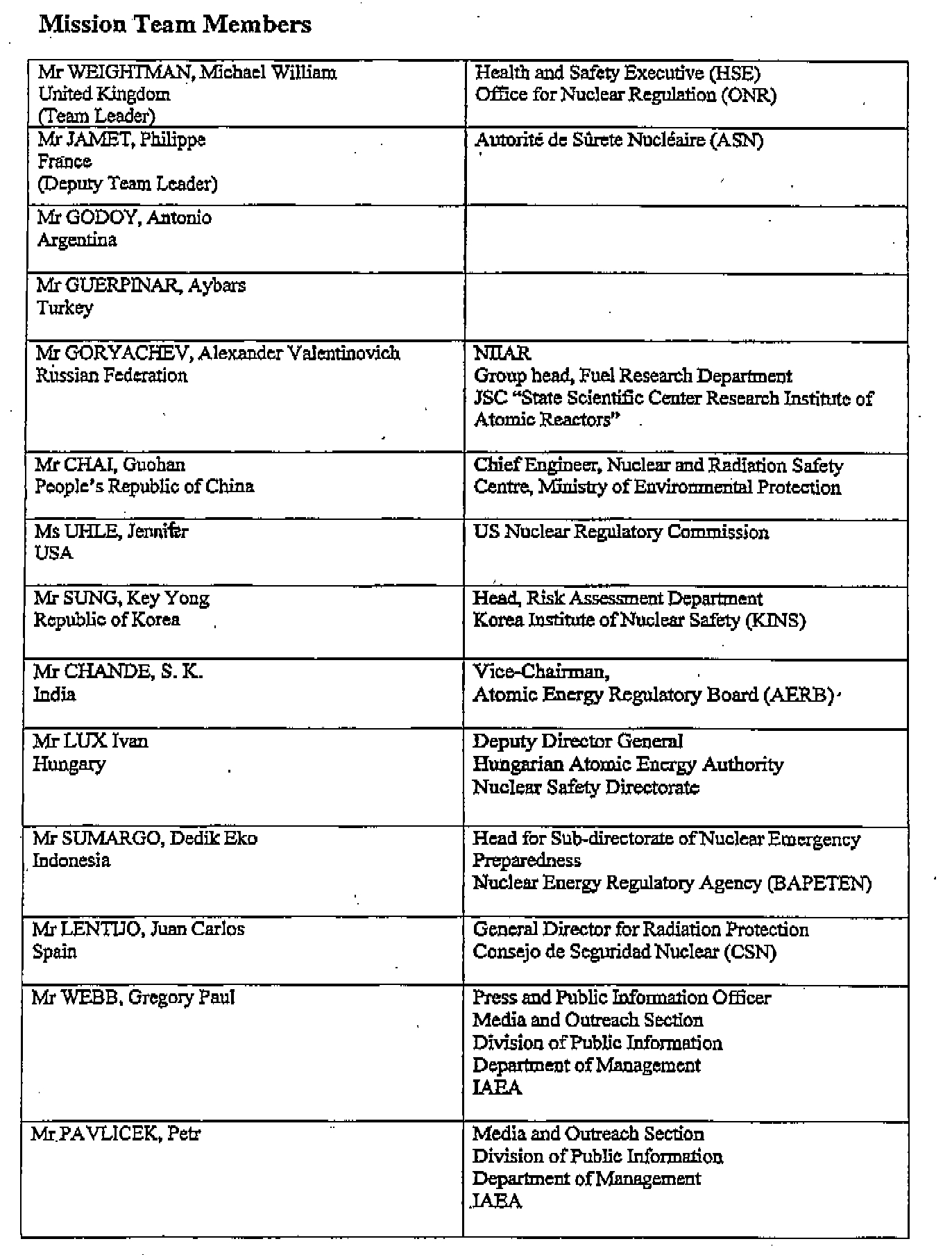
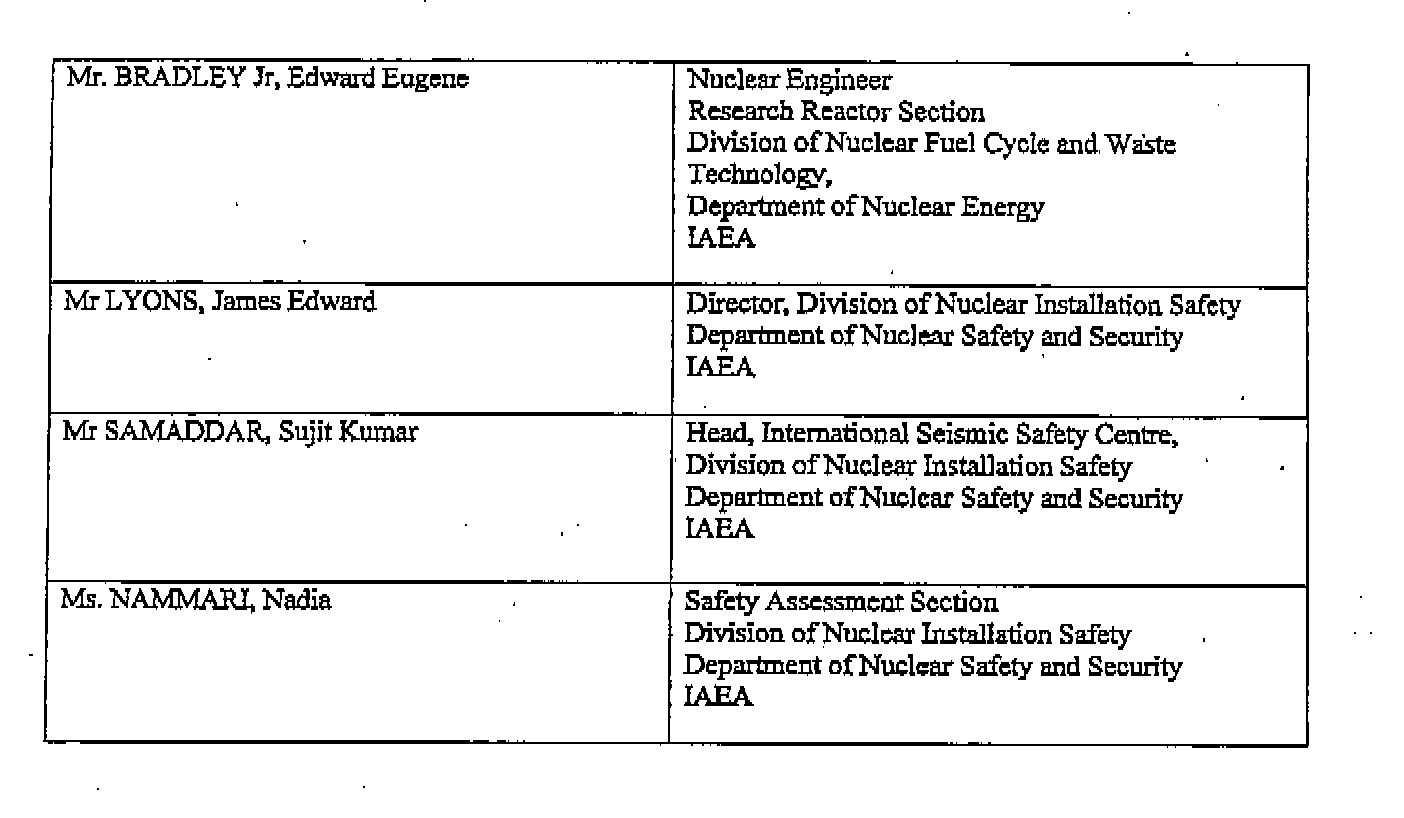
18 people total:

6 people from IAEA, 2 of them from PR department;
1 from UK (leader)
1 from France (deputy leader)
1 from Argentina
1 from Turkey
1 from Russia
1 from China
1 from USA
1 from South Korea
1 from India
1 from Hungary
1 from Indonesia
1 from Spain

The list reads like the attendance list of G20. More power to emerging economies!

Does anyone know anything about these people, whether they are actually capable of assessing anything? Or is this just an international political theater?

Many Japanese, including the doctor, are really counting on the IAEA investigation to reveal what's been hidden by the Japanese government and TEPCO. But I have a sinking feeling that won't happen, looking at the list.

On May 26, the IAEA team went to a nuclear power plant to learn about what happened on the day of the earthquake. No, not Fukushima I. They went to Tokai II Nuclear Power Plant in Ibaraki Prefecture, where 1 of the 3 emergency power generators stopped temporarily and the seawater intake pump broke after the tsunami.

That should help them assess the Fukushima I's situation. No doubt.

Wednesday, May 25, 2011

Highly Contaminated Water Probably Leaking from the Central Waste Processing Facility at #Fukushima I Nuke Plant

Remember TEPCO has been transporting the highly radioactive water from the turbine buildings to the basement of one of the buildings of the Central Waste Processing Facility after they said they had leak-proofed the Facility?

Leak-proof? Not so. The water level at the building dropped 5 centimeters, TEPCO announced on May 26, and that's equivalent of 50 tonnes of water. But TEPCO also assures us that it is not leaking outside the building.

As the article below says, the Reactor 3's turbine building alone has 22,000 tonnes of highly contaminated water. The transfer to this particular building of the Central Waste Processing Facility only reduced that amount by 3,660 tonnes.

TEPCO claims AREVA's water processing facility will be ready in June and that will solve all kinds of problems. The cost of processing the contaminated water allegedly demanded by AREVA is 200 million yen (US$2.44 million) per tonne. (More about the shady AREVA contract later.)

All kinds of other solutions like "water entombment" were going to solve all kinds of problems, until TEPCO had to reveal that both the RPV and the Containment Vessel had holes.

From Mainichi Shinbun Japanese (11:25AM JST 5/26/2011):

 東京電力は26日、福島第1原発3号機のタービン建屋から移送した汚染水の受け入れ施設で、1日で約5センチの水位の低下が見つかったと発表した。周辺地下水の分析結果に変動がないことから、東電は「施設から外に漏れだしている可能性は低い」と説明している。

TEPCO announced on May 26 that the facility that received the contaminated water from the Reactor 3 turbine building at Fukushima I Nuke Plant saw the water level at the facility dropped by 5 centimeters in one day. The analysis of the ground water around the facility didn't show a marked increase in radioactive materials, which led TEPCO to conclude that it was unlikely that the contaminated water had leaked from the facility.

 3号機の汚染水は17日から集中廃棄物処理施設の一つの建屋地下に移送していたが、満杯に近づいたとして25日午前9時過ぎに移送を中断した。そ の後に水位を確認したところ、同日午前11時から26日午前7時までの間に48ミリ低下していた。水量は約50立方メートルに相当するとみられる。

TEPCO started to transfer the contaminated water from the Reactor 3 to the basement of one of the buildings that makes up the Central Waste Processing Facility on May 17, and stopped the transfer at 9AM on May 25 as the basement almost became full. But when the water level was measured at 7AM on May 26, it had decreased by 48 millimeters (4.8 centimeters) since 11AM on May 25. The decrease is equivalent of about 50 cubic meters [or 50 tonnes].

 東電は「処理施設建屋の地下2階で止水工事が不十分な場所から、(同施設の)別の建物との連絡通路に漏れている可能性がある」と原因を推測。外部 への漏えいが見つかれば汚染水を別の場所に再び移送する必要が出てくる。しかし、現在2号機の汚染水を移送している同施設の別の建屋もほぼ満杯になってお り、移送先の確保は難航が予想される。

TEPCO thinks "there is a possibility that the 2nd floor of the basement in the building may have places that are not totally leak-proof, and the water is leaking from there into the corridor that connects to the other building of the [Central Waste Processing] Facility." If the leaks are found, the contaminated water there needs to be transported to somewhere else. However, the building that's been receiving the contaminated water from the Reactor 2 is almost full, and it will be hard to secure the space for the transfer.

 3号機タービン建屋では、高濃度の放射性物質を含む約2万2000立方メートルの汚染水が見つかっている。移送先の施設は約4000立方メートルの受け入れが可能だが、計3660立方メートルを移送した時点で中断した。

There are 22,000 cubic meters [22,000 tonnes] of highly contaminated water in the Reactor 3 turbine building. The building that this water was being transferred to has the capacity of 4,000 cubic meters [4,000 tonnes], but the transfer was halted after 3,660 cubic meters [3,660 tonnes] of the water had been transferred.

#Fukushima I Nuke Plant: Reactor 1 RPV, Reactor 3 Cooling Pipe Broke In the Earthquake, TEPCO Now Says

After two months TEPCO is dribbling the information out which only proves the critics and fringe scholars and the "sensational" media abroad were right from the beginning. First was the news of core meltdowns in all three reactors, and after two months no one cared. Next, the news yesterday that the Containment Vessels, not just the RPV, have holes, and no one cared.

Today, TEPCO admits the Reactor 1's Reactor Pressure Vessel (RPV) may have broken right after the earthquake and the pipe connected to the High Pressure Coolant Injection system (HPCI) for the Reactor 3 probably also broke during the earthquake. (The article linked below doesn't say the piping is for the HPCI, but the earlier Mainichi Japanese article on May 25 says so.)

So much for the "tsunami did it" narrative that's been adopted by the government, TEPCO, and the nuke industry.

And so much for the "reactor will not break" myth cultivated by the nuke industry worldwide.

Still no one cares.

From Mainichi Shinbun English, quoting Kyodo News (5/26/2011):

TOKYO (Kyodo) --The pressure vessel housing nuclear fuel at the No. 1 reactor of the Fukushima No. 1 power plant or its accessory piping is likely to have been partially damaged immediately after the March 11 earthquake, possibly allowing steam to leak out to the containment vessel encasing it, according to data made public by its operator.

At the reactor, the magnitude 9.0 quake registered an intensity smaller than envisaged under its quake-resistance design. But if the temblor actually caused damage to the critical reactor component, power suppliers across the country might be forced to reconsider the quake resistance designs for their reactors.

A diagram showing temperature changes at the reactor's containment vessel indicates that temperatures and pressure momentarily shot up immediately after the quake.

Mitsuhiko Tanaka, a former nuclear reactor design engineer, says high-temperature steam apparently leaked out to the containment vessel after either the reactor's pressure vessel or its accessory piping was partially damaged.

The operator, Tokyo Electric Power Co., admitted Wednesday that critical cooling piping at the same plant's No. 3 reactor may also have been damaged in the quake.

The utility, known as TEPCO, had earlier suggested that no major damage was done to the reactor, such as ruptures in the facility's main steam piping, until the arrival of massive tsunami after the quake.

"If we do our analysis on the premise that there was a leak in the piping, it matches (data) in reality," a TEPCO official said at a news conference, referring to possible damage at the No. 3 reactor. "We can't deny the possibility."

According to TEPCO, as soon as the reactor's emergency core cooling system was activated shortly after noon on March 12, pressure inside both the reactor's pressure vessel and containment vessel, which encases the pressure vessel, dropped, suggesting that steam was leaking from the cooling pipe.

While measuring devices may have malfunctioned, pressure readings corresponded to an analysis based on the hypothesis that steam did indeed leak from the piping, TEPCO said.

At the No. 3 reactor, the earthquake had an intensity greater than envisioned under resistance guidelines. The cooling piping is housed in a building designed to resist direct damage from tsunami.

"We must fully accept the fact that (the earthquake) has been cited as a possible" cause for the damage to piping, said Goshi Hosono, a special adviser to Prime Minister Naoto Kan, at a news conference.

"A thorough investigation should be carried out on the cause of the incident" after the government's Nuclear and Industrial Safety Agency analyzes related data, he added.

Agency spokesman Hidehiko Nishiyama stressed at the same news conference that steam leaks from the piping have not actually been confirmed.

Another analysis by TEPCO has shown that breaches may have occurred to containment vessels encasing the Nos. 1 and 2 reactors at the power plant in Fukushima Prefecture, possibly causing leaks of highly radioactive water.

The possible ruptures to the containment vessels at the Nos. 1 and 2 reactors are certain to complicate efforts to deal with accumulating contaminated water there, raising questions about the soundness of a TEPCO plan to rebuild a stable cooling system by around mid-July.

In a report submitted to the agency, TEPCO said that if a breach around 3 centimeters in diameter occurred at the No. 1 reactor's containment vessel 18 hours after the quake and it widened to about 7 cm 50 hours after the quake, it would account for changes in pressure readings inside the containment vessel.

TEPCO said it believes that parts used to ensure air tightness in the containment vessel may have broken from overheating, judging from temperatures measured when the leaking possibly occurred.

The company also hypothesized that a rupture roughly 10 cm in diameter occurred to the No. 2 reactor's containment vessel 21 hours after the quake due to elevated temperatures, among other factors, finding that it also corresponds with data obtained.

The same TEPCO report has also shown that massive amounts of hydrogen likely formed at the Nos. 1 to 3 reactors shortly after water levels dropped in their reactor cores and exposed nuclear fuel inside, possibly causing explosions at the buildings housing the reactors.

According to TEPCO's analysis, about 750 kilograms of hydrogen gas was produced at the No. 1 reactor, between 350 and 800 kg at the No. 2 reactor and between 600 and 700 kg at the No. 3 reactor.

Hydrogen is formed when zirconium cladding on fuel rods gets heated and reacts chemically with water.

Between 300 and 400 kg of the gas quickly formed within an hour of exposure at each reactor, the analysis shows, though No. 2 was spared the kind of explosion that blew off the roofs of the buildings for the other two reactors in the days following the massive quake and tsunami.

There is a possibility that the No. 2 reactor escaped an explosion because a ventilating hatch on the upper part of its building was opened in time, unlike at the Nos. 1 and 3 reactors.

TEPCO is struggling to bring the three reactors and a spent fuel storage pool at the No. 4 reactor under control, with the plant's two other reactors having already been brought into a stable condition called "cold shutdown."


(PS: Struggling almost all day with the ISP tech support for internet connection at our new place. Still only manage to get onto the net one computer at a time, and this ISP claims they don't know anything about networks with a third-party router (a major one like Linksys). Aghhh.)

Tuesday, May 24, 2011

Haruki "the Detarame (Falsehood)" Madarame's Furious Backtracking on His Remark about Recriticality in Reactor 1 at #Fukushima I Nuke Plant

He senses a danger that his cushy and prestigious position as the head of the Nuclear Safety Commission is in jeopardy over his alleged remark which may have caused the delay in cooling the Reactor 1 RPV.

It is hard to believe he is a scientist and not a lawyer or politician. With that fine parsing ability of the words, he could make a wonderful assistant to a certain President of the United States (there are many candidates).

First, it was reported (see my post) that when Japan's Prime Minister Kan sought the advice from Madarame regarding the seawater injection to the Reactor 1 Reactor Pressure Vessel (RPV) on the evening of March 12 (by which time, now we all know, the entire core melted down) Madarame said:

"There is a possibility of recriticality if seawater is injected."

After that remark was publicly announced at the government-TEPCO joint press conference, Madarame was furious, and took it as a personal insult (see my post). His rebuttal?

"I couldn't have said such a thing."

But then, a talk ensued among the concerned parties including Madarame, and a "compromise" remark emerged. Now, Madarame's remark is modified thus:

"The possibility of recriticality if seawater is injected is not zero."

To an uncritical, non-scientific mind, that still means "there is a possibility".

Not so. The latest narrative coming from this ex-Tokyo University professor and current chief of the Nuclear Safety Commission who assured PM Kan that "the nuclear reactors at Fukushima are OK, they will never explode" on their trip to the plant on March 12 morning is this (from Yomiuri Shinbun article in Japanese):

"When I say 'the possibility is not zero', it means 'it is practically zero'."


Let me know when you figure that out.

Multiple 10-Centimeter Holes in Reactor 2 Containment Vessel at #Fukushima I Nuke Plant

So says the Mainichi Shinbun reporters who must be reading the report submitted by TEPCO on May 23 and released on May 24.

Multiple 10-centimeter holes in the Reactor 2 Containment Vessel, and one 7-centimeter hole in the Reactor 1 Containment Vessel.

Hiroaki Koide of Kyoto University was so right. The Containment Vessels' integrity has been long gone. TEPCO should have known all along, and all the experts, including Koide, must have known.

From Mainichi Shinbun Japanese (2:30AM JST 5/25/2011):

 東京電力が24日公表した福島第1原発2、3号機で炉心溶融があったとする報告書の中で、1号機は原子炉圧力容器の外側にある格納容器に直径7センチ相当の穴、2号機では格納容器に直径10センチ相当の複数の穴が開いている可能性が初めて示された。

In the report that TEPCO disclosed on May 24 regarding the core meltdown in the Reactors 2 and 3, the possibility of holes in the Containment Vessels of the Reactors 1 and 2 is mentioned for the first time. The Reactor 1 Containment Vessel may have a hole 7-centimeter in diameter, and the Reactor 2 Containment vessel may have multiple holes 10-centimeter in diameter.

According to the Mainichi article, TEPCO came to the conclusion of multiple 10-centimeter holes in the Reactor 2 Containment Vessel and one 7-centimeter hole in the Reactor 1 Containment Vessel from the analysis of the pressure data.

Containment Vessels of Reactors 1, 2, 3 Were Possibly Damaged Within 24 Hours of March 11 Earthquake

Someone at Yomiuri Shinbun who was made to read the TEPCO's report to the Nuclear and Industrial Safety Agency (NISA), the government overseer, found this bit of information in the main report (225 pages, in Japanese; English translation is on-going at TEPCO): Containment Vessels were damaged within 24 hours of the quake.

It is not in the summary slides (10 slides, in Japanese), which I did read. In the TEPCO's press conferences since May 15, Matsumoto never admitted to the Containment Vessel damage but he didn't deny it either. He specifically said in a press conference I watched that he "cannot deny the possibility of the Containment Vessel having been damaged." (I will link my post reporting that if I ever retrieve it; Google deleted it in their "maintenance".)

Looks like a fun reading. I will report back when I see the exact words from TEPCO on the subject.

It's also amusing to see the Japan's MSMs now use the word "core meltdown (炉心溶融) quite often, which was a taboo word for 2 months until TEPCO officially admitted it on May 15.

Yomiuri Shinbun (9:53PM JST 5/24/2011):

 東京電力が福島第一原子力発電所の炉心溶融(メルトダウン)について詳しいデータ解析を行った結果、1~3号機では、圧力容器だけではなく、その外側を覆う鋼鉄製の格納容器も、地震後24時間以内に損傷していた可能性があることが分かった。

It's been revealed that the steel Containment Vessels of the Reactors 1, 2 and 3 that house the Reactor Pressure Vessels (RPV) may have been damaged within 24 hours after the earthquake on March 11, according to the detailed analysis of the core meltdown at Fukushima I Nuclear Power Plant by TEPCO.

 解析結果の報告書は23日に経済産業省原子力安全・保安院に提出された。

The result of the analysis was compiled into a report and submitted to the Ministry of Economy and Industry's Nuclear and Industrial Safety Agency on May 23.

 原子炉の運転データなどに基づいて地震後の状況を詳しく計算したところ、1号機は緊急冷却装置の「非常用復水器」が十分に働かず、炉心溶融の進行によって、地震後15時間で圧力容器の底部が破損したことがわかった。底部には制御棒や中性子計測装置の貫通部が多数あり、強度の弱い溶接部分などが壊れて、溶けた燃料を含む高濃度汚染水が漏れ出したとみられる。

The detailed calculation of the reactors' operation data after the earthquake revealed that the bottom of the Reactor 1 RPV was broken after 15 hours after the earthquake because the emergency core cooling system didn't function well and the fuel started to melt down. There are many openings through which the control rods and the neutron measurement device goes through. The welded parts at the bottom, which do not have the same strength as the other part of the RPV, broke, and highly contaminated water that included the melted fuel may have leaked from there, according to the report.

I've been thinking about the "Level 7" designation of the Fukushima I Nuke Plant accident. When the NISA announced "Level 7", they were still publicly (at least) assuming that the majority of the fuel rods were more or less intact and inside the RPVs; that the RPVs were intact, and the Containment Vessels were intact, except for the Reactor 2 (the Suppression Chamber was damaged).

So, is it more likely now, that far more radioactive materials have escaped the reactors than the NISA or the Nuclear Safety Commission calculated? "Don't worry it's only 1/10 of Chernobyl" was another lie?

Or, were their calculations based on the secret knowledge that the RPVs and Containment Vessels were broken in the very early stage of the accident?

Mainichi English: "Agency gears up to retrieve device fallen inside Monju reactor"

Ah, the horror, the horror....

Monju is a fast breeder reactor that uses sodium as coolant, which catches on fire on contact with air. It uses MOX-fuel.

3.3-tonne, 12-meter "In‐Vessel Transfer Machine" fell into the reactor vessel on August 26, 2010. The manager at the plant in charge of fuel exchange committed suicide in February this year.

From Mainichi Shinbun English (5/24/2011):

TSURUGA (Kyodo) -- The Japan Atomic Energy Agency began preparatory engineering work Tuesday to set up equipment it will use to retrieve a device that fell inside the vessel of its prototype fast-breeder reactor Monju in Fukui Prefecture last August, agency officials said.

The agency aims to collect the cylindrical 3.3-ton device together with part of the vessel's upper lid by mid-June to get the reactor back to normal by autumn, allowing the resumption of a test run of the 280,000-kilowatt prototype, the officials said.

But it is unknown when the test run will begin at the unit on the Sea of Japan coast as Prime Minister Naoto Kan has declared a review of Japan's basic energy plan following the nuclear accident at the Fukushima Daiichi power plant caused by the March 11 earthquake and tsunami.

After the Aug. 26 accident, the agency tried in October to recover the device used in fuel exchange but failed as it had become misshapen, preventing its retrieval through the upper lid.

Bando City in Ibaraki Prefecture Made 3rd-Graders Pick Tea Leaves in the Rain, Have Them Eat Tempura Made from Raw Tea Leaves

It's hard to believe that it actually happened in the post-Fukushima Japan, but it most certainly did. For the city's commercial tea growers, the Board of Education and teachers, it was more important to proceed with the pre-scheduled annual event and to promote the local industry (tea growing) than to ever so slightly think about the health and safety of the 10-year-olds.

The event took place on May 11, and one week later, a high level of radioactive cesium (830 becquerels per kilogram) was detected in the tea grown and harvested in Bando City.

From the now-withdrawn (but cached) web page of Iwai Sakura Shopping District (original in Japanese; not the literal or complete translation but you get the idea...):

Wednesday May 11, 2011: "Sashima Tea Field Study" - 3rd-grade pupils of elementary schools in Bando City picked tea leaves in the rain, enjoyed tempura made of raw leaves

Sponsor: The Board of Education of Bando City, Ibaraki Prefecture,
tel: 0297-35-2121

On Wednesday May 11, the annual "Sashima Tea Field Study" was held in Ibaraki Prefectural University of Agriculture in Bando City. It was raining, but 3rd-graders from 13 schools in Bando participated in the study.

13 schools were divided into 6 groups, and took turns in learning about the tea. The field study was first started in Sashima district, which is famous for its Sashima tea, but when Bando City was created by merging Iwai City and Sashima-machi, the field study got bigger in scale.

This photograph [photos were not cached] shows the pupils from the First Elementary School in Group 3. When a Bando City worker greets them, they greet back vigorously.

The head of the Board of Education of Bando City greets the participants.

The head of the Bando Branch of the Ibaraki Prefecture Tea Growers Cooperative explains tea growing, and the pupils listen attentively.

Now it's time to go to the tea plantation and pick the tea leaves.

Bright green, new tea leaves. It almost smells like brewed tea.

Pupils holding up the tea leaves they just picked to the camera.

They pick tea leaves in two rows. For some, it may be their first time to touch tea leaves.

Teachers are having a good time with their pupils.

Members of a Bando city citizens' group make tempura using the tea leaves that have been just picked by the pupils.

Eating delicious tea-leaf tempura. For some, it may be their first time ever.

Organizer: Tea Growers Cooperative of Ibaraki Prefecture, Bando Branch
Sponsor: Bando City, Bando City Board of Education

Monday, May 23, 2011

Ministry of Economy, Trade and Industry Will Hold "Let's Help Fukushima" Food Market

Mark your calendar.

Not surprising at all from the Ministry in charge of promoting producers at the expense of consumers. (Remember they were busy promoting nuclear power plants all over the world, made by Hitachi and Toshiba and run by TEPCO.)

From METI's press release (in Japanese, exclamation marks are theirs, not mine) on 5/23/2011:

METI will set up a market for the goods from the earthquake-hit areas to support the recovery!

The first will be held on Wednesday May 25 to sell vegetables!!

At the Ministry of Economy and Trade, we will display and sell traditional crafts, daily goods, and farm produce from the areas affected by the March 11 earthquake in order to promote the recovery in those areas.

On Wednesday May 25, we will hold "'Ganbare' Fukushima! Produce Market" on the ground floor of the METI building, where the vegetables grown in Fukushima will be sold. The market is open to the general public, so please stop by.

Date and time: Wednesday May 25, 11:30AM to 1:30PM
Place: at the main entrance of the METI main building
What is sold: vegetables and other food items made in Fukushima
Open to public
Details (vegetables subject to change, depending on the availability): asparagus, tomato, cucumber, blueberry jam, curry sauce with chickens grown in Aizu [western 1/3 of Fukushima Prefecture], ramen noodles, seasoned soy sauce.

TEPCO Stating the Obvious After 2 Months: Reactors 2, 3 Total Meltdown More Likely

Here we go. It's official now. All three reactors at Fukushima I Nuke Plant had a total meltdown. What a surprise. We're so shocked, aren't we?

Yomiuri Shinbun (3:03AM JST 5/24/2011):

 東京電力は23日、福島第一原子力発電所2、3号機について、地震発生直後の原子炉の各種データをもとに解析を進めた結果、1号機と同様に核燃料がメルトダウン(炉心溶融)していたとする報告書をまとめた。

TEPCO reported on May 23 that the Reactors 2 and 3 at Fukushima I Nuclear Power Plant had a core meltdown just like the Reactor 1, based on their analysis on the reactor parameters right after the earthquake on March 11.

 経済産業省原子力安全・保安院に提出する。

The company will submit the report to METI's Nuclear and Industrial Safety Agency.

 報告書では、2、3号機について〈1〉炉内の水位が水位計の表示通りだった〈2〉水位計のデータは信頼できず、1号機と同じ様に核燃料が全露出し ている――の二つのケースに分けて、模擬計算を行い、結果を示した。それによると、いずれの場合にも核燃料が溶融して、原子炉圧力容器底部に崩落した状態 になっていると評価。特に、水位計が故障しているケースでは、核燃料全体が溶融して、崩壊しているとした。

In the report, TEPCO did two simulations regarding the Reactors 2 and 3: 1st, based on the assumption that the water level was what the water gauge had been showing all along; 2nd, based on the assumption that the data from the water gauge were not to be trusted, and the fuel rods were completely exposed, as in the Reactor 1. In both cases, the result showed that the nuclear fuel had melted and dropped to the bottom of the Reactor Pressure Vessel. In the 2nd case where they assumed the faulty water gauge, the result showed the entire fuel rods had melted, according to the report.


Mainichi English: US Researcher Says Fukushima Reactor Had Meltdown 3.5 Hours after Cooling System Collapsed

A US researcher Chris Allison did the simulation of one of the Fukushima reactors (Reactor 1) and concluded that the meltdown occurred 3.5 hours after the cooling system stopped. It was reported to the IAEA in late March.

So they all knew, except for the hapless citizens of Japan and the rest of the world.

Or they say "Oh we didn't know for sure until May 15 when TEPCO finally announced it," like Japan's PM Kan has said.

We do not know for sure, because no one has looked inside the RPV and reported back to us. All we can do is to collect the evidence and hypothesize, and that has been pointing to a meltdown. Even the PM Assistant has admitted that they knew it was a meltdown early on.

Here's the summary of the simulation by Allison, as described in the Mainichi English article (linked below):

  1. The emergency core cooling system (ECCS) fails;

  2. 50 minutes later: reactor core starts to melt;

  3. 1 hour 20 minutes later: control rods and other pipes inside the RPV start to melt;

  4. 3 hours 20 minutes later: most of the melted jumble ("corium") drops to the bottom of RPV;

  5. 4 hours 20 minutes later: temperature at the bottom of the RPV reaches 1,642 degrees Celsius, damaging the RPV stainless steel lining [melting point of stainless steel is 1,510 degrees Celsius].

It is not clear from the TEPCO's log on the day exactly when the emergency core cooling system failed. After the earthquake on March 11 at 2:46PM JST, the ECCS for the Reactor 1 started to operate at 2:52PM JST, but failed only after 10 minutes. And that was before the tsunami arrived at about 3:30PM JST. Attempts were made to restart the ECCS until 1:48AM JST on March 12, when the pump that feeds water to the ECCS broke. (From the summary at Yomiuri Shinbun, 5/16/2011.)

If you can read English, you can read Wikipedia's various entries on nuclear reactor and reactor accidents, and would have figured out that there was no way that the Reactor 1's reactor core had not melted once the cooling system failed. I read several wiki entries ("corium", "meltdown", "Three Mile Island accident", "Chernobyl accident" and others), and that was my conclusion as a layman. I kept scratching my head right after the accident, watching the Japanese government vigorously attack anyone who hinted at a core meltdown and hearing TEPCO insist that the fuel rods were only partially "damaged".

And why has this scientist kept quiet? A confidentiality obligation with a threat of jail time like Professor Kosako?

From Mainichi Shinbun English (5/23/2011):

A meltdown occurred at one of the reactors at the Fukushima No. 1 Nuclear Power Plant three and a half hours after its cooling system started malfunctioning, according to the result of a simulation using "severe accident" analyzing software developed by the Idaho National Laboratory.

Chris Allison, who had actually developed the analysis and simulation software, reported the result to the International Atomic Energy Agency (IAEA) in late March. It was only May 15 when Tokyo Electric Power Co. (TEPCO) admitted for the first time that a meltdown had occurred at the No. 1 reactor at the Fukushima nuclear plant.

According to Allison's report obtained by the Mainichi, the simulation was based on basic data on light-water nuclear reactors at the Laguna Verde Nuclear Power Plant in Mexico that are about the same size as that of the No. 1, 2, and 3 reactors in Fukushima.

According to the simulation, the reactor core started melting about 50 minutes after the emergency core cooling system of the No. 1 reactor stopped functioning and the injection of water into the reactor pressure vessel came to a halt. About an hour and 20 minutes later, the control rod and pipes used to gauge neutrons started melting and falling onto the bottom of the pressure vessel. After about three hours and 20 minutes, most of the melted fuel had piled up on the bottom of the pressure vessel. At the four hour and 20 minute mark, the temperature of the bottom of the pressure vessel had risen to 1,642 degrees Celsius, close to the melting point for the stainless steel lining, probably damaging the pressure vessel.

TEPCO, the operator of the crippled Fukushima nuclear plant, had tried to fill the containment vessel of the No. 1 reactor with water, but it decided to abandon the plan after it discovered that a meltdown had occurred at the reactor.

Masanori Naito, director in charge of safety analysis at the Institute of Applied Energy, said, "TEPCO could have conducted similar analysis at an early stage and assumed the meltdown had occurred. TEPCO should have prepared other cooling methods besides the method of filling the reactor with water."

Sunday, May 22, 2011

Hiroaki Koide: "Pressure Not To Release Radiation Data"

In the testimony in the Japan's Upper House Government Oversight Committee, Hiroaki Koide of Kyoto University said there was an outside pressure on him and his colleagues not to release the survey data including the radiation data on March 15.

He talks straight.

The committee hearing is still on-going. Access is still spotty.

Things Are Slowly Changing in Japan Over the Fukushima Crisis

Hiroaki Koide of Kyoto University is testifying in the Upper House government oversight committee. The session is broadcast over the Internet, but the Upper House site is being overwhelmed with access requests.

Alongside Koide, Masashi Goto, whistleblower ex-Toshiba engineer who designed the containment vessel at Fukushima I Nuke Plant, Masayoshi Son of Softbank, geologist Katsuhiko Ishibashi are also there.

(Ishibashi insists on doing it (dealing with Fukushima I Nuke Plant) by the Japanese experts only.)

In the meantime, angry and concerned parents and citizens are swarming the Ministry of Education and demand that the government withdraw the 20 millisievert/year radiation (external only) limit for children. The Minister is hiding.

They are holding a meeting outside the Ministry. Each time some punk of a bureaucrat utters something, he is being shouted down by angry protesters, demanding the Ministry retract 20 millisievert/year.

"Why can't you understand? What can't you understand?" they are shouting at the bureaucrat.

I'm watching live on USTREAM.

caption

(Photo by Yusuke Hara)

Ministry of Education Quietly Released WSPEEDI Simulation, It Shows Very High Organ Dose of Iodine-131 for Infants in Wide Area

I mentioned the system called the WSPEEDI simulation system in passing when I wrote about SPEEDI data for the early period of the Fukushima I Nuke Plant accident (March 11 onward).

When Professor Kosako resigned from his post as PM special advisor in protest of the 20 millisievert/year radiation limit for school children, he called for the release of WSPEEDI, which can cover much wider area ("several thousand kilometers", according to Professor Kosako).

Well well. The Ministry of Education very quietly put the WSPEEDI simulation data on their webpage for SPEEDI data list on May 10, without any fanfare, without any media (I mean MSM) coverage.

The Ministry released 2 simulation maps, one for March 24 and another for March 25. They are only about iodine-131.

One of the maps, "Organ dose of I-131 for infant [less than a year old]", shows that the extremely high dose along the coast of Fukushima, with the dose in the area around Fukushima I Nuke Plant over 500 millisieverts (deep pink color). I added the prefecture names:


Another map, "Surface deposition of I-131", shows a very wide area in Kanto and Tohoku in green, which indicates iodine-131 deposition of between 100,000 to 1,000,000 becquerels per square meter. In Tokyo, one green band goes over the densely populated eastern Tokyo (23 "ku" or districts) and another one goes over the middle. That pretty much corresponds with the higher air radiation level that continues in the 23 districts, particularly the eastern most districts, and the elevated level in cities like Fuchu, which sits in the middle. Again, I added the prefecture names:


So this is what TPTB wanted to hide at all cost, and released in a sneaky fashion after 2 months, and it's only about iodine-131 whose half life is 8 days. Where there's iodine-131, there's got to be cesium, but they are still mum on cesium or any other radionuclides. No WSPEEDI data from the earlier days, nor after March 25.

Iceland Volcano Erupts, "No Immediate Effect"

These days, whenever I hear that phrase - "no immediate effect" - I tend to assume there is longer-term effect...

Here's a screen capture from Reuter's video footage:


The Reuters' article is here.

TEPCO Releases Gamma Camera Photos of Reactor 1

They were taken on May 20.

From TEPCO's "Photos for Press" page:

"From the large equipment service entrance to the south side airlock", regular photo top, gamma camera photo bottom:


"Around the large equipment service entrance", normal photo top, gamma camera photo bottom: