Tuesday, July 17, 2012

#Radioactive Japan: 16-Year-Old Boy Was Working at #Fukushima I Nuke Plant in May Last Year


TEPCO says the company found out about it only this month, this year.

But what's more disturbing is what Jiji Tsushin reports in the article below: that the job application was submitted by the boy's relative. The article doesn't say what relationship this relative has to the boy.

From Jiji Tsushin (7/17/2012):

16歳少年が作業=福島第1原発、労基法違反-東電

16-year-old boy worked at Fukushima I Nuke Plant, against Labor Standards Law, says TEPCO

東京電力は17日、昨年5月から6月にかけ、東京電力福島第1原発で当時16歳の少年が作業していたと明らかにした。同原発の事故後、労働基準法違反に当たる18歳未満の就労が判明したのは2人目。

TEPCO disclosed on July 17 that a 16-year-old boy had worked from the end of May to early July last year at Fukushima I Nuclear Power Plant. It is against the Labor Standards Law to employ people under the age of 18 to work [this is not exactly correct; more later in the post], and it is the second such case at Fukushima I Nuclear Power Plant since the accident.

東電によると、鹿島建設の下請け企業に少年の親族が雇用を申し入れた際、18歳と年齢を偽っていたという。

According to TEPCO, when the boy's relative applied for the boy to work for a subcontractor of Kajima, the relative falsified the age as 18.

少年は津波で破損した車両の解体作業に従事。6日間働き、被ばく線量は内部と外部合わせて0.45ミリシーベルトだった。今月になって、作業員の登録解除手続きのため、親族から取り寄せた少年の健康保険証で詐称が判明した。

At the plant, the boy was engaged in dismantling the vehicles damaged by the tsunami. He worked for 6 days, and the radiation exposure was 0.45 millisievert, including both internal and external exposures. The falsification was discovered this month when TEPCO [or Kajima?] asked for the [copy of the] boy's health insurance card from the relative in order to cancel worker registration [at the plant].


In Japan, health insurance is mandatory, and the health insurance card is often used as a form of ID.

Under Japan's Labor Standards Law, companies can employ people under the age of 18, provided that:

  1. The company have the applicant submit his/her census-register certificate to verify the age;

  2. The applicant himself/herself enter into labor contract, not the relative(s) on behalf of the applicant;

  3. The applicant's relative(s) cannot receive wages on behalf of the applicant;

  4. The applicant won't be made to work overtime.


The mandatory school education in Japan ends at junior high school. Upon graduation, most students are 16 years of age, and eligible to work. So, the violation in this case may be that:

  1. The relative falsified the age of the applicant so that no age verification would be required (the hiring subcontractor may have colluded in this);

  2. The relative may have entered into the labor contract on behalf of the applicant, which is against the law;

  3. The relative may have received the wages, which is against the law;

  4. The applicant may have worked overtime at the plant, which is against the law.


There is no information about the boy's family's situation, but it must have been dire if the family had to rely on the boy working at Fukushima I Nuke Plant under false papers.

Monday, July 16, 2012

(Humor) PM Noda as "I'm a Real Wild One..."


Someone's masterpiece in one of the July 16 demonstrations in Tokyo after the 170,000-strong gathering in Yoyogi Park in Tokyo that even NHK reported (from @RinkoWaters):


I'm a real wild one...
See how I restarted Ooi without surveying the faults...
There is no vent...
Don't tell anyone that thermal power was shut down, worth 3 nuclear reactors...

TEPCO's Space-Age Decon Tool Can Visualize Nuclide, Direction and Intensity of Radiation


Finally there's something sort of "high-tech" about the whole "decontamination" business which has boasted screw drivers, brooms and blue tarp as effective decon tools outside Fukushima I Nuke Plant, and vacuuming and strip-painting inside the plant compound. One of the "high-tech" items is GPS used to map the contaminated areas (see my previous post), and the other is a Compton camera developed by Japan's space agency.

TEPCO has been doing the GPS survey assisting the government research institutions OUTSIDE the plant to identify the radiation contamination. Examples of the survey were announced at the press conference on June 15, 2012.

Browsing through the press handout on June 15 titled "Developing Technology on Monitoring Radioactive Materials and Decontamination", I found a very interesting picture taken by a "super-wide angle Compton Camera" developed by JAXA (Japan Aerospace Exploration Agency).

According to TEPCO's explanation (page 5 of the handout),

The utilization of the Compton camera experimentally produced by JAXA for decontamination is currently under consideration (JAEA and TEPCO). A “super-wide angle Compton camera” allows to visualize radioactive materials such as cesium-134 and cesium-137 by identifying the nuclide, direction and intensity of radioactive materials excluding the air dose rate of the environment (See below).


It is a bit unnerving to "see" the radiation.

From JAXA's English website, the press release on March 29, 2012:

Visualization of Radioactive Substances
with JAXA's 'Ultra-wide-angle Compton Camera'

The Japan Aerospace Exploration Agency (JAXA) has constructed a prototype of a new device called the "Ultra-wide-angle Compton Camera," which can visualize radioactive substances that emit gamma rays. The camera was developed by applying technology for a gamma-ray observation sensor that will be installed in the next generation X-ray astronomy satellite "ASTRO-H."

This device combines the power of a wide-angle vision covering almost 180 degrees, and a nuclide whose unique feature is identification of gamma-rays, in order to visualize the distribution of Cesium 137 (Cs-137) and 134 (Cs-134) in any plot of ground or a house lot. Hence it can be utilized to obtain images of radioactive substances accumulated on rooftops and other raised locations that are difficult to survey using conventional investigation methods by human beings with a survey meter.

On February 11, JAXA, the Japan Atomic Energy Agency (JAEA) and Tokyo Electric Power Company (TEPCO) conducted a demonstration of dosimetry and imaging using the Ultra-wide-angle Compton Camera in Kusano district, Iidate Village, Fukushima Prefecture, an area which is designated as a planned evacuation zone. We were able to successfully capture high precision images of radioactive Cesium distribution with a much wider view as compared to that of a conventional gamma-ray camera.

JAXA and JAEA, in cooperation with TEPCO, will carry out further studies of possible practical uses of the Ultra-wide-angle Compton Camera for decontamination of radioactive substances and other related operations. 


Attachment-1
Attachment-2

Reference link: http://www.astro.isas.jaxa.jp/~takahasi/index-e.html

New York Times: "Thousands Gather in Tokyo to Protest Nuclear Restart" (Browser Headline)


Uh... thousands?

(Battle between the editors at New York Times?)

New York Times joined LA Times and others to report on the July 16 protest in Yoyogi Park in Tokyo against nuclear power generation. When I searched for the article, this title popped up as the NY Times article:

Thousands Gather in Tokyo to Protest Nuclear Restart - NYTimes.com


and that's what is displayed on the top bar of my internet browser.

The article itself is now titled:

Tokyo Rally Is Biggest Yet To Oppose Nuclear Plan


The caption of the photograph full of labor union flags says:
Tens of thousands of antinuclear protesters gathered on Monday in central Tokyo in the largest rally since last year's Fukushima disaster.

The article by Ms. Hiroko Tabuchi starts:

In Japan’s largest antinuclear rally since the disaster at Fukushima, tens of thousands of protesters gathered at a park in central Tokyo on Monday to urge the government to halt its restarting of the nation’s reactors.


and goes on to mention:

Organizers said 170,000 people filled a Tokyo square to sing songs, beat drums and cheer on a series of high-profile speakers who called for more Japanese to make their voices heard.


The entire article from New York Times (7/16/2012):

Tokyo Rally Is Biggest Yet To Oppose Nuclear Plan

By HIROKO TABUCHI
Published: July 16, 2012

TOKYO — In Japan’s largest antinuclear rally since the disaster at Fukushima, tens of thousands of protesters gathered at a park in central Tokyo on Monday to urge the government to halt its restarting of the nation’s reactors.

Organizers said 170,000 people filled a Tokyo square to sing songs, beat drums and cheer on a series of high-profile speakers who called for more Japanese to make their voices heard. The police put the number at 75,000, still making it the biggest gathering of antinuclear protesters since the Fukushima accident last year.

“To stay silent in the wake of Fukushima is inhuman,” the Oscar-winning musician Ryuichi Sakamoto told the crowd, which braved soaring temperatures to gather at Yoyogi Park.

Polls suggest that public opinion is still divided over the future of nuclear power in Japan. But a unilateral decision last month by Prime Minister Yoshihiko Noda to start putting the country’s reactors back into use has angered many Japanese and galvanized the antinuclear camp.

Antinuclear protests have gained momentum especially here in the capital, where tens of thousands of protesters now gather every week to shout slogans in front of Mr. Noda’s official residence.

After the rally, protesters marched through some of the city’s busiest shopping districts, prompting curious looks from passers-by but largely maintaining a strict discipline that has come to characterize the antinuclear rallies in recent weeks.

“It doesn’t matter, for now, if people hear us or not,” said Ayuko Higashi, an illustrator from Kamakura, southwest of Tokyo, who said this was her third antinuclear rally. “It’s just a big step forward to start raising our voices.”

Rally organizers have gone to great lengths to project a friendly image in a generally conformist country where protesters of any kind are seen by many as fringe agitators at best and terrorists at worst. This perception is left over from mass protests in the 1960s and ’70s against a security treaty with the United States, during which rioters armed with pipes and makeshift gasoline bombs clashed with the police.

At the weekly protests in front of the prime minister’s office, organizers cordon off family-only zones to urge parents with children to participate. They also ask protesters to cooperate with the local police and to go home at 8 p.m. on the dot.

Organizers have also started issuing pamphlets with advice on what to bring (drinks and hand wipes on sticky days), advice for shy or first-time participants (no need to say anything) and guidance on what to do if fellow demonstrators start getting out of hand (politely ask them to calm down).

An unlikely leader of the antinuclear movement is a fuzzy fictional character called Monju-kun, who has amassed a following on social networking sites like Twitter for his child-friendly jabs against the government’s energy policy.

Monju-kun made a brief appearance at the protest Monday with a colorful stuffed costume. “The government is restarting our nuclear reactors, and that makes me sad,” he said to squeals from fans — many of them families with small children — waving Monju-kun posters.

“If we’re not careful, we could have another nuclear accident, like a fire,” said Rion Nakajima, 5, who was clutching a balloon emblazoned with a smiling Monju-kun.

“We decided to participate because we want the Japanese government to realize that any mistake it makes now will have serious repercussions for future generations,” said Rion’s mother, Kazuki.

Nuclear power supplied nearly a third of Japan’s electricity before the Fukushima accident, but almost all reactors are now offline for checks or maintenance. Japanese leaders pledged last year not to restart any nuclear plant without local approval. But they apparently did not foresee the level of resistance that has since developed, and they have begun to push for plant reopenings, citing economic and security reasons. Last month, Mr. Noda approved the restarting of a reactor in western Japan. Others are expected to be put back into use in the coming months.

Recent polls have shown that public opinion remains divided between those who argue that Japan should abandon nuclear power and those who warn of a crippling energy shortage. A majority favor more stringent checks of reactors.

It is unclear whether the antinuclear protests can become a political force. There is still no significant Green Party in Japan, and the two largest parties say the country, for now, needs its reactors.

Mr. Noda, who initially raised the ire of protesters by calling their rallies “loud noise,” said last week that he was fully aware of public opinion both for and against nuclear power.

Lithuania to Hold a Referendum on Nuclear Power Plant to Be Build by Hitachi-GE


From Reuters (7/16/2012; emphasis added):

Lithuania to hold a consultative vote on nuclear plant

(Reuters) - Lithuania will hold a non-binding referendum on the centre-right government's planned new nuclear power plant on the same day as a parliamentary election, in a move that could boost support for the opposition and derail the project with a big vote against.

Parliament's decision on Monday to hold the vote puts energy issues at the centre of the election, with the opposition and government split on how to reduce country's energy dependence on its former Soviet master, Russia.

Polls have showed public support for nuclear energy in Lithuania wane following the Fukushima disaster in 2011 in Japan, with opinion now roughly divided.

The government has proposed building the Visaginas plant on the site of the Ignalina plant in eastern Lithuania that was shut in 2009.

But the main opposition party in the current parliament, the Social Democrat Party, said the government should focus on renewable resources and renovating houses to save energy and rather than on a costly nuclear power plant project.

"We should stop dreaming about nuclear power, benefits of which we might see or might not see in only 30 years," Birute Vesaite, deputy chair of the party, told parliament.

Centre-left parties such as the Social Democrats lead the opinion polls before the parliamentary election.

Prime Minister Andrius Kubilius, who opposed the referendum, said it was causing doubts about commitments made by his coalition government.

Parliament last month voted, with a narrrow margin, in favor of giving the government a go-ahead to work towards a final construction deal with U.S.-Japanese alliance Hitachi-GE Nuclear Energy for the 1,350 MW ABWR reactor.

In 2011, Lithuania imported 65 percent of its electricity, mostly from Russia, making it the European Union member most dependent on power imports.

Lawmakers voted 62-39 to hold the referendum on Oct. 14, the parliament press office said. Eighteen abstained.

(Reporting via Oslo Newsroom; Editing by Alison Williams)

July 16 Protest in Yoyogi Park "Largest Anti Nuclear Protest Ever in Tokyo", Reports NHK


What a surprise. I'm just shocked, SHOCKED! that NHK reported!

(Sarcasm off)

NHK reported on the July 16 protest in Yoyogi Park in Tokyo, for a change. It must be near impossible to ignore, because NHK is located right around the corner from the park.

The Tokyo Metropolitan Police apparently told NHK that 75,000 people participated.

From NHK (7/16/2012; part):

東京で過去最大の反原発集会

Largest-Ever Anti-Nuclear Event in Tokyo

関西電力大飯原子力発電所3号機がフル稼働に達するなど、国内で原発の運転再開に向けた動きが進むなか、東京で、過去最大規模の原発に反対する集会が開かれ、参加者が運転再開の撤回や原発の廃炉を訴えました。

As Reactor 3 at KEPCO's Ooi Nuclear Power Plant is in full operation and other nuclear plants in the country may be getting ready to resume operation, an anti-nuclear event was held in Tokyo which attracted the largest crowd ever. The participants demanded the reactor at Ooi Nuclear Power Plant be stopped and that nuclear reactors be decommissioned.

16日の集会は、ノーベル賞作家の大江健三郎さんやルポライターの鎌田慧さんなどが呼びかけ人となって、政府に抗議の声を届けようと開きました。

The July 16 gathering was organized by people including Nobel Prize winning author Kenzaburo Ooe and Satoshi Kamata, journalist and author, to let the government hear their voice of protest.

会場となった東京の代々木公園には、市民団体や労働組合のほか、ツイッターなどで呼びかけられた人たちが集まりました。
参加したのは、主催者側の発表でおよそ17万人、警視庁によりますとおよそ7万5000人で、東京で行われた反原発の集会やデモとしては、過去最大の規模になったということです。

Citizens' groups, labor unions, and people who had learned of the event via Twitter [and other net media] gathered in Yoyogi Park in Tokyo. The number of participants was 170,000 according to the organizers, and 75,000 according to the Police. It was the largest crowd ever gathered in Tokyo for anti nuclear protest.

French Nuclear Waste Management Agency Invents "Hard Disk" That Will Last 1 Million Years


The disk is made of sapphire, with information engraved in platinum. Materials more appropriate for Tiffany's than nuclear waste management.

The first thing I thought about when I read the headline of the Science article was, "In what language?" That's what the inventor is thinking about, according to the article.

After all, archeologists still can't read "Linear A" or letters on tablets found in Mohenjo-daro, and they are only several thousand years old...

From Science (7/12/2012; emphasis added):

A Million-Year Hard Disk
by Daniel Clery on 12 July 2012, 12:15 PM

DUBLIN—It seems these days that no data storage medium lasts long before becoming obsolete—does anyone remember Sony's Memory Stick? So have pity for the builders of nuclear waste repositories, who are trying to preserve records of what they've buried and where, not for a few years but for tens of thousands of years.

Today, Patrick Charton of the French nuclear waste management agency ANDRA presented one possible solution to the problem: a sapphire disk inside which information is engraved using platinum. The prototype shown costs €25,000 to make, but Charton says it will survive for a million years. The aim, Charton told the Euroscience Open Forum here, is to provide "information for future archaeologists." But, he concedes: "We have no idea what language to write it in."

Most countries with nuclear power stations agree that the solution for dealing with long-lived nuclear waste is to store it deep inside the earth, about 500 meters below the surface. Finland, France, and Sweden are the furthest advanced in the complicated process of finding a geologically suitable site, persuading local communities to accept it, and getting regulatory approval. Sweden's waste management company, SKB, for example, spent 30 years finding the right site and is now waiting for the government's green light to begin excavation. It plans to start loading in waste a decade from now, and will be filling its underground pits for up to 50 years.

While the designers of such repositories say they are confident that the waste will be safely incarcerated, the most uncontrollable factor is future archaeologists or others with a penchant for digging. Archaeologist Cornelius Holtorf of Linnaeus University in Sweden showed meeting participants an early attempt at warning future generations: a roughly 1-meter-wide stone block with the words "Caution - Do Not Dig" written in English with some smaller text explaining that there is nuclear waste below. But who knows what language its discoverers will understand in thousands or hundreds of thousands of years—or even if they will be human beings? Holtorf points out that a much earlier attempt to warn off future excavations, the Egyptian pyramids, were looted within a generation. "The future will be radically different from today," says archaeologist Anders Högberg, who is also from Linnaeus University. "We have no idea how humans will think."

In 2010, ANDRA began a project to address these issues, says Charton. It brings together specialists from as wide a selection of fields as possible, including materials scientists, archivists, archaeologists, anthropologists, linguists, and even artists—"to see if they have some answers to our questions." The initial goal is to identify all the approaches possible; in 2014 or 2015, the group hopes to narrow down the possibilities.

The sapphire disk is one product of that effort. It's made from two thin disks, about 20 centimeters across, of industrial sapphire. On one side, text or images are etched in platinum—Charton says a single disk can store 40,000 miniaturized pages—and then the two disks are molecularly fused together. All a future archaeologist would need to read them is a microscope. The disks have been immersed in acid to test their durability and to simulate ageing. Charton says they hope to demonstrate a lifetime of 10 million years.

Researchers have some time to work on the problem because the repositories will probably not be filled and sealed up until the end of this century. "Each country has its own ideas, but we need to get a common approach," says SKB's Erik Setzman. "We technical people can't solve this problem ourselves. We need help from other parts of society."

Sunday, July 15, 2012

Some Citizens Got Wiser on July 13 Protest at PM Official Residence in Tokyo, on Bikes and Cars to Take Advantage of Roads Cleared by the Police


From OurPlanetTV (7/14/2012):


I tweeted some of the suggestions from the readers of this blog about the protest, including using cars going round the Prime Minister's Official Residence. From the reaction from my Japanese followers, it simply didn't occurred to them. But it did occur to some people who took part on their bikes and cars, as you see in the video above.

"July 16 Goodbye Nuclear Protest" in Yoyogi Park, Tokyo


(UPDATE) The organizer says 170,000 people have gathered in the park.

This is Channel 2 Main Stage:


Streaming by Ustream


Anti- (or beyond-, if you like) nuclear celebrities are giving speeches with high-sounding words, how nuclear power has been pressed on the poor regions, talking about happiness of mankind without nuclear power, etc., etc. Now, some comedienne from Osaka with mohawk hair is shouting into the microphone.

And all I can think about while listening to these people is that old mother and her daughter in the no-entry zone in Fukushima, without water, without gas, whom (ex-journalist) Takashi Uesugi visited.

===========================================

The organizer, "Sayonara Nuke", hopes to attract 100,000 people.

If I remember right, it was somewhat like this last year - several months after the March 11 nuclear accident, several organizations started to stage anti-nuclear ("beyond nuclear" 脱原発, as they phrase it) gatherings and marches. I was rather disinterested in those events, with celebrities giving emotive speeches and ordinary citizens participate and chant "Beyond nuclear".

I couldn't care less last year as I was more interested in and worried about the radiation contamination of the environment and food. I remember often wondering why these people looked content "protesting" against nuclear power in the most generalized term after one of the worst nuclear accidents in history had happened in their own country with very tangible damage, particularly in Fukushima and southern Tohoku and northern Kanto.

Well the big gathering is back in Tokyo, in Yoyogi Park. It's just started, and you can view it on IWJ's 9 USTREAM channels:

Ch2,
Ch3,
Ch4,
Ch5,
Ch6,
Ch7,
Ch8,
Ch9,
Ch10

The channels I've checked says "Recorded Live". I don't know what's the deal is, but I hope it will start netcasting live soon.

This year, I am less disinterested because of totally citizen-based demonstrations that have been cropping up all over Japan.

Here's Channel 3, at the Second Stage. Some kind of funny act by a chubby man dressed as a devil, when I saw it:


Live stream by Ustream

Radiation Levels Inside #Fukushima I Nuke Plant Compound Exceed 300 Microsieverts/Hr in Some Locations


TEPCO did the survey of the air radiation levels within the plant compound on May 9, 2012, using the GPS system for the first time. Unbelievable as it is, that's what the company says in the June 2012 report for the Working Group for the Decommissioning of Reactors 1 through 4 at Fukushima I Nuke Plant. The report is only available in Japanese, and it sometimes contains information that is not reported to the media in the regular press conferences.

The following map is on the page 66 of the report, in a section that discusses the various methods of decontamination of the plant compound.

(Ex-Journalist) Takashi Uesugi Goes Inside #Fukushima No-Entry Zone, Measures 106.87 Microsieverts/Hr Near Fukushima I Nuke Plant


Takashi Uesugi, who says he is an ex-journalist and now a "hyper golf creator" (whatever that means), went inside the no-entry zone in Fukushima (I believe it was in May or June) with his dosimeters to ostensibly visit his favorite golf course in Fukushima.

Mr. Uesugi, former New York Times reporter, created the bilingual (Japanese/English) video below, which is on his website, as a teaser for the longer, full version to be released later.

In the early days of the Fukushima nuclear accident, he was more active, accusing the government and TEPCO for withholding the information about the accident, particularly about the "meltdown" of the reactors.

On his visit to his favorite golf course, Uesugi also dropped by near Fukushima I Nuclear Power Plant. His dosimeter showed 106.87 microsieverts/hour.

What's astonishing to me about the video than the radiation level (yes it is high) is that Uesugi visited a family who continues to live inside the no-entry zone because of the very old mother who is bed-ridden. The daughter, herself in her 60s or 70s, says even the doctors tell them it was a good choice to remain there, because her mother wouldn't have made it in the temporary shelter. But there is no water, no gas, no propane delivery, nothing. How do these people survive? Why should they suffer like this? Because of the arbitrary circle that the inept government marked on the map in March last year. But the daughter is reassuring the mother, "This is your house, you don't need to go anywhere."


Many who saw this video are crying "TEPCO lies!" on Twitter because one of the monitoring posts at the plant on July 12 was only 9.3 microsieverts/hour, nowhere near 106 microsieverts/hour that Uesugi measured.

That is an unjust accusation, though. TEPCO says on its webpage that summarizes the monitoring post data that the company did the thorough decontamination from February to April this year around the the monitoring posts MP2 through 8 in order to reduce the background radiation levels to better monitor the radiation fluctuations. The radiation level near the Main Building has been extremely stable around 220 microsieverts/hour.

(H/T Helios)

Saturday, July 14, 2012

Anti-Nuke, Anti-Noda Protest in Funabashi, Chiba Started


"7.15 What a big demonstration! We need anti-nuke demos to protect the citizens' living! Slaying Noda [as in slaying a fictional monster] Demonstration Part 2 - Drus of Fury" just started.

It looks like a nice, hot sunny day in Funabashi, Prime Minister Noda's constituency. People are of good cheer.

Live netcast by IWJ's Chiba Channel 1.


Live streaming by Ustream


Unlike the protest at the Prime Minister's Official Residence in Tokyo, people here seem free to say anything. The head of the Japan Communist Party just spoke in front of a cheering crowd of ordinary citizens.

One of the organizers is saying "Let's make the protest into 30,000-strong..." I think 300 hundred people or so all over Chiba, or Japan for that matter, is just fine.

IMF, World Bank to Help Japan's "Recovery" by Holding Annual Meeting in Tokyo in October


How nice of them.


Japan is probably a great choice, because the country is about the only place in the world where both IMF and World Bank can hold their meetings in peace, without loud protests going on against them and their officials and the police battling the protesters.

In fact, very idealistic (read "naive") people, both young and not so young, on Twitter are saying "Oh, maybe we can appeal to these world leaders about our bad government starting nuclear power plants against our wish!"

Sorry boys and girls. IMF, or World Bank, is probably the last place you want to appeal for the nuclear-free world.

As the Secretary General of the Japan Secretariat for the 2012 Annual Meetings of the International Monetary Fund and the World Bank Group, Ministry of Finance proudly recollects in the statement below, the last time Tokyo was selected to host the IMF/World Bank annual meeting was in 1964, the year Tokyo Olympics was held. A proud moment for the nation (at least the Olympics was). Secretary General Naka says Japan wants the repeat.

His words eerily echo those bizarre, off-the-mark PR commercials made by the Ministry of Finance to appeal to the world how Japan has recovered from the earthquake of March 11, 2011 (no mention of tsunami or nuke accident).

From the website set up by Japan's Ministry of Finance, "2012 Tokyo Annual Meetings - International Monetary Fund World Bank Group", Introduction:

With growing uncertainty facing the global economy, cooperation and partnership among the countries has never been more important. The Annual Meetings of the International Monetary Fund and the World Bank Group, to be held in Tokyo in October 2012, will aim to promote global economic stability and to deliver a promising new start.

Following the first Tokyo Annual Meetings in 1964, this will mark the second time that these meeting are held in Tokyo.
Together with the Tokyo Olympics that were held in the same year, the 1964 Annual Meetings were an opportunity to promote Japan to the world and one of the driving forces behind Japan’s post-war new start.

A half century has passed since.
Japan presented itself as a candidate nation to host the 2012 Annual Meetings in hopes of once again achieving a new start.
We want the people of the world to see a nation that is in the process of a strong recovery following the devastating earthquake.


We want to demonstrate the underlying power of the Japanese economy through our unique advanced technologies and services, and by conducting a global event with perfect efficiency.

At the Annual Meetings here in Japan, where the importance of partnership and solidarity is well understood and appreciated, we want to strengthen the bonds between the countries and forge the global resolve to sweep away the uncertainty surrounding the global economy.

October 2012: From Tokyo, a promising new start for Japan and the global economy

Hiroshi Naka

Secretary General
The Japan Secretariat for the 2012 Annual Meetings of the International
Monetary Fund and the World Bank Group,
Ministry of Finance, Japan

(I'm embarrassed reading this blurp... The original Japanese is just as embarrassing. It reads like it was written by a copy writer at Dentsu or Hakuhodo. Maybe it was...)

July 15: "Take the Yellow Train (Sobu Line) to Funabashi (Noda's Constituency), Make the Sound of Drums Heard!" Demo from 1PM in Funabashi, Chiba


I think I like these organizers.


Clearly including the ones who organized the very fun protest on June 24 in Funabashi City, Chiba (Prime Minister Noda's constituency), the group of people calling themselves "Drums of Fury" is doing another protest in Funabashi. Participants are encouraged to take the "Yellow Train" - JR Sobu Line that goes from the western Tokyo into Chiba.

This protest looks to be fun again, if I judge by their blog page.


There are many who legitimately ask "How effective are these protests? They haven't achieved anything." I do share that sentiment, particularly when I see people falling for made-up symbols and slogans that have little to do with what's been happening in Japan since March 11, 2011. But on the other hand, it is still amazing to me, as a Japanese, to see Japanese people having been able to focus their attention to anything nuclear for the past 16 months. I've always thought (still think) the Japanese collectively have "attention deficit disorder". So, keeping doing something like protest marches all over Japan, no matter how small or large, may itself be worthwhile.

After all, to express discontent to the authorities using drums, music, dance, ridicule, and marching on the streets and roads is a wonderful Japanese tradition for centuries.

Anyway, if you live along the JR Sobu Line (yellow train) and want to participate, here's the tongue-in-cheek details, making fun of what PM Noda has said in the past. (Oh and there are several Funabashi merchants offering discounts for the protest participants, just like on June 24. Check out the maps at the organizer's site.)

“7.15大きなデモだね!国民の生活を守るために脱原発デモが必要だ!”野田退治デモ第2弾
"7.15 What a big demonstration! We need anti-nuke demos to protect the citizens' living!" Slaying Noda [as in slaying a fictional monster] Demonstration Part 2

["What a big demonstration" is a pun on Noda's comment that the protest outside the PM Official Residence was "a big sound". "We need anti-nuke demos ..." is a pun on Noda's reason for starting Ooi Nuclear Power Plant.]

集合西船近隣公園(前回と同じ)
集会13:30
出発14:00
解散は天沼弁天池公園です!(これも前回と同じ)

Starting place: Nishifuna Kinrin Park (same as before)
Meeting will start at 1:30PM
March will depart at 2PM
Ending place: Amanuma Bentenike Park (same as before)

【呼びかけ】
首相官邸前抗議など、日本各地で「原発をなくそう!」「再稼働反対!」と声が高まる中、
野田首相は事もあろうに抗議の声を「大きな音」だねと警備に当たる警官に漏らしたそうです。
一方で「国民の声を受け止めたい」と言いながら、抗議の声は「音」でしかないならば、
怒りの「声」をもっと「大きな音」で叩き付けて、無視出来ないデモにしようと企画されました。
野田首相の選挙区内で、彼を支持し期待した方もきっと多く居たはずの船橋で、
MC 悪霊のコールと言葉と共に、怒りを叩き付けに行きます。
何卒よろしくお願いします。

Our call
As the voices rise in various parts of Japan against nuclear power plants and against the restart of these plants including the protest at the PM Official Residence, Prime Minister Noda has reportedly commented on the protest voice to the police guarding the Residence, "It is a big sound." If the voice of protest is nothing but a "sound" to him, let's make our "voice" of anger into a really big sound and hit him so hard that he cannot ignore. That's the purpose of this demonstration. We are going to hit hard with our anger and our MC "Akuryo (Evil Spirit)" the constituency of Prime Minister Noda, Funabashi City, where there must have been many people who supported him and expected great things out of him.
We look forward to having you there.

主催:脱原発船橋(仮) + 怒りのドラムデモ実行委員会
後押し:黄色い電車連合
協力:ロフトプロジェクト
賛同:原発さよなら千葉

Sponsors: Beyond Nuke Funabashi + Drums of Fury Executive Committee
Support: Yellow Train Alliance
Help: Loft Project
Approval: Genpatsu [nuke plant] Sayonara Chiba

[LOL...]

「黄色い電車連合」時刻表 JR総武線1105C
JR Sobu Line Time Table (train 1105C) from Yellow Train Alliance
三鷹 Mitaka 11:43発
西荻窪 Nishiogikubo 11:48
阿佐ヶ谷 Asagaya 11:53
中野 Nakano 11:57
新宿 Shinjuku 12:04
飯田橋 Iidabashi 12:15
秋葉原 Akihabara 12:22
西船橋 Nishibunabashi 12:48着
※先頭車両
Take the first car.

【出演】
MC悪霊(illeastrecords )&DJ M28

Appearance:
MC Akiryo, DJ M28

Latest Videos of Reactor 3 Upper Floors at #Fukushima I Nuke Plant, Taken on July 5, 2012


The videos (four of them) were taken by the camera attached to the boom of the Putzmeister crane on July 5, 2012, during the air sampling operation.

Very desolate feel to it. Supposedly, Kajima, one of the large general contractors working at the plant on construction and civil engineering, has been removing the debris using the remote-controlled heavy equipment. But it looks just the same as last year.

From TEPCO's Photos and Videos Library (7/13/2012):


For each of the 4 directions indicated in the handout above, TEPCO released 4 short videos.

1. Northwest part of the Operating Floor


2. East part of the Operating Floor


3. Fourth floor


4. Third floor


Friday, July 13, 2012

San Onofre Nuke Plant: Tube Wear Caused by Vibration and Settling of Support Equipment, Says SCE


In mid June, NRC said the cause of the excessive wear of the tubes in the steam generators at San Onofre Nuclear Power Plant could be a faulty computer modeling by the manufacturer, Mitsubishi Heavy Industries, which underpredicted the velocity of the steam and water.

Mitsubishi Heavy Industries sold 4 replacement steam generators to Southern California Edison. Each has over 10,000 tubes, instead of 4,000 or so for a standard steam generator that the company manufactures. Mitsubishi Heavy Industries is one of the top manufacturers of steam generators in the world.

From 10News.com (7/13/2012):

Tube Wear At San Onofre Blamed On Settling, Vibration
SoCal Edison Says Wear On Steam Generator Tubes Did Not Reach Federal Limits

SAN ONOFRE, Calif. -- The wear in the walls of steam generator tubes that forced the shutdown of the San Onofre Nuclear Generating Station earlier this year was caused by a settling of support equipment and vibrations, Southern California Edison announced Friday.

A leak from a tube forced the utility to take Unit 3 off-line in January, and thinning was found in a large number of them, which are less than two years old.

The plant's other unit had already been closed for routine maintenance. Neither has been returned to service.

SCE reported to the Nuclear Regulatory Commission last week that most of the wear in the tube wall was less than 20 percent, below the federal safety threshold of 35 percent. A tube over the limit must be plugged.

The cause of the wear on the tubes was vibration, which is unusual, and settling of the support structures, which sometimes occurs, SCE spokeswoman Jennifer Manfre said. She said the number of tubes affected by the settling was higher than normal.

"We're using this information and additional detailed data collected through testing to develop our repair plans according to best practices and industry standards, particularly the data on the unexpected tube-to-tube wear," said Pete Dietrich, senior vice president and chief nuclear officer.

SCE reported that in Unit 3 -- where the leak occurred -- 1,806 tubes showed wear of some type and 807 tubes were ultimately plugged. Of those, 381 tubes were plugged for wear of more than 35 percent and the rest as a precaution.

In Unit 2, 1,595 tubes showed wear of some type and 510 tubes were ultimately plugged. Six were for showing wear of more than 35 percent and the rest for preventative measures.

The units each have thousands of steam generator tubes.

An anti-nuclear group called Friends of the Earth released a statement Thursday, claiming that the utility and the NRC were down-playing the extent of damage. The FOE statement calls the steam generator problems at San Onofre the "most severe" of any nuclear plant in the United States.

San Onofre has more than three and a half times the number of steam tubes plugged as a safety measure than at 31 other similar U.S. reactors combined, according to the group. They contend that the number of tubes plugged in Unit 2 -- which did not have a leak -- is nearly five times that of any other reactor.

The San Onofre plant generates about 20 percent of the power for San Diego Gas and Electric. The utility is importing power to cover for the San Onofre shutdown, much of it coming over a transmission line from Imperial County that recently began operating.


Well, if each unit has two steam generators which have 10,000 tubes each, there are 20,000 tubes. If the number of tubes plugged in Unit 2, 510, was five times that of any other reactor in the US, what I'd like to know is the total number of tubes in the steam generator(s) in a typical PWR in the US. (Does anyone know? I'm being lazy on weekend...)

And yes, the tubes got worn out in 2 years instead of 20...

Police "Divide and Conquer" on Friday July 13th Protest in Tokyo against Ooi Restart


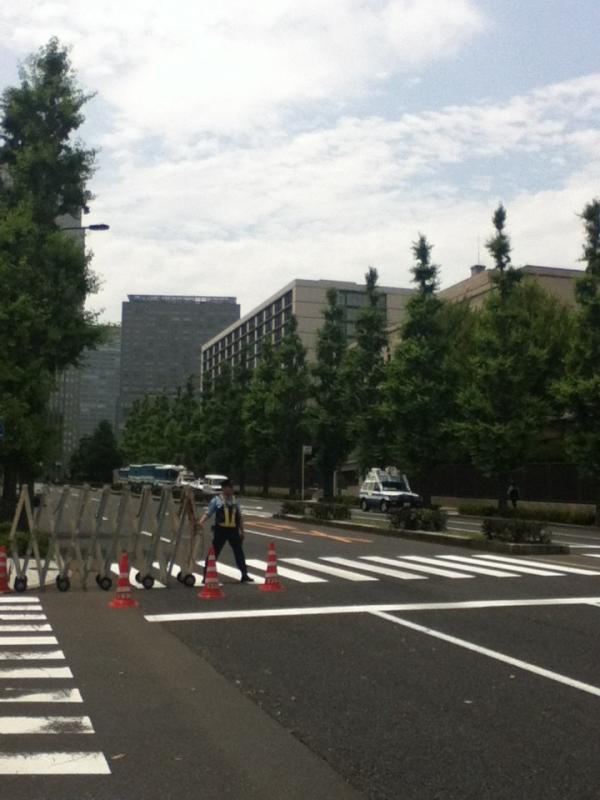
The Tokyo Metropolitan Police put up metal fences along the sidewalks, roadblocks, and restricted access to areas in the "protest zone" that they had set up, and effectively divided the protest into small pieces. No one seems to know how many people showed up.

The supposed "police" number quoted by the press is 10,000 people, though the PR department of the Tokyo Metropolitan Police has said they don't announce the numbers. What "police" the mainstream media outlets have been quoting, no one knows; supposedly some anonymous inside source that the press club reporters have access to all the time.

So, it was a success for the Noda administration and the pro-administration media, who didn't need to quote the number from the organizers this time.

This photo from the article by independent journalist Ryusaku Tanaka (7/13/2012) shows the police on one side of the metal fence and protesters on the other side. An older man on the left, looking at the camera looks puzzled and annoyed. (Click to enlarge.)


Tanaka calls it "Intifada". In Japan, it usually means the Palestinian ones. That's how he describes the protest that is herded in by the metal fences and the law enforcement.

In his article, Tanaka quotes two protest participants, both women in their 50s. The first one speaks like a man:

 「ふざけんじゃねえ。国民が自分の意志を表すために集まって来ているのにこんな鉄柵をつけるのはおかしい。これだけの人が来るのだから車道を開放すべきだ」(中野区・女性=50代)

"Stop bullshitting me. Citizens gather here to express their wills, and what's the point of this metal fence? With this many people coming, they should just open the road." (a woman in her 50s from Nakano-ku, Tokyo)

「初めて官邸前に来たら鉄柵があった。ものものしい雰囲気にびっくりしている。ノーと言える子供を育てたい。今日は子供たちに教室を休む理由を説明してきた」(名古屋・音楽教室を営む女性=50代)

"I'm here for the first time, and there are these metal fences. I'm surprised at this elaborate security. I want to raise children who can say "No". Before I came here today, I explained to my students why I was not giving lessons today." (a woman in her 50s from Nagoya, who runs a private music school)


There are tweets from younger people saying they didn't like the "obnoxious and impolite" baby-boomer generation at the protest, who apparently complained loudly to the police and to the pushy cameramen from the media, as they should. Well, young people, tough.

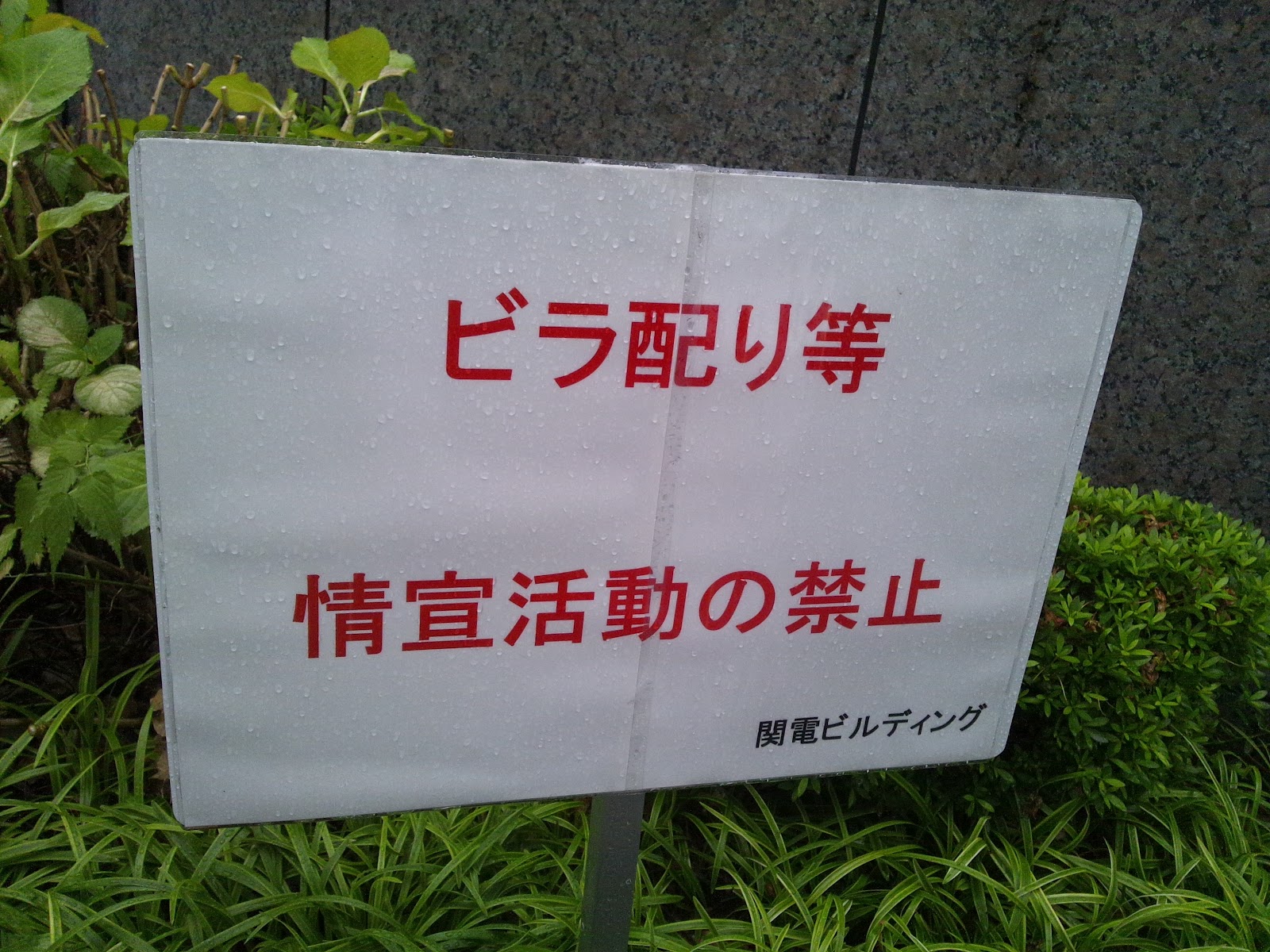
Osaka Protest at KEPCO HQ: Station Exit Blocked, KEPCO Sign "Loitering Prohibited" (7/13/2012)


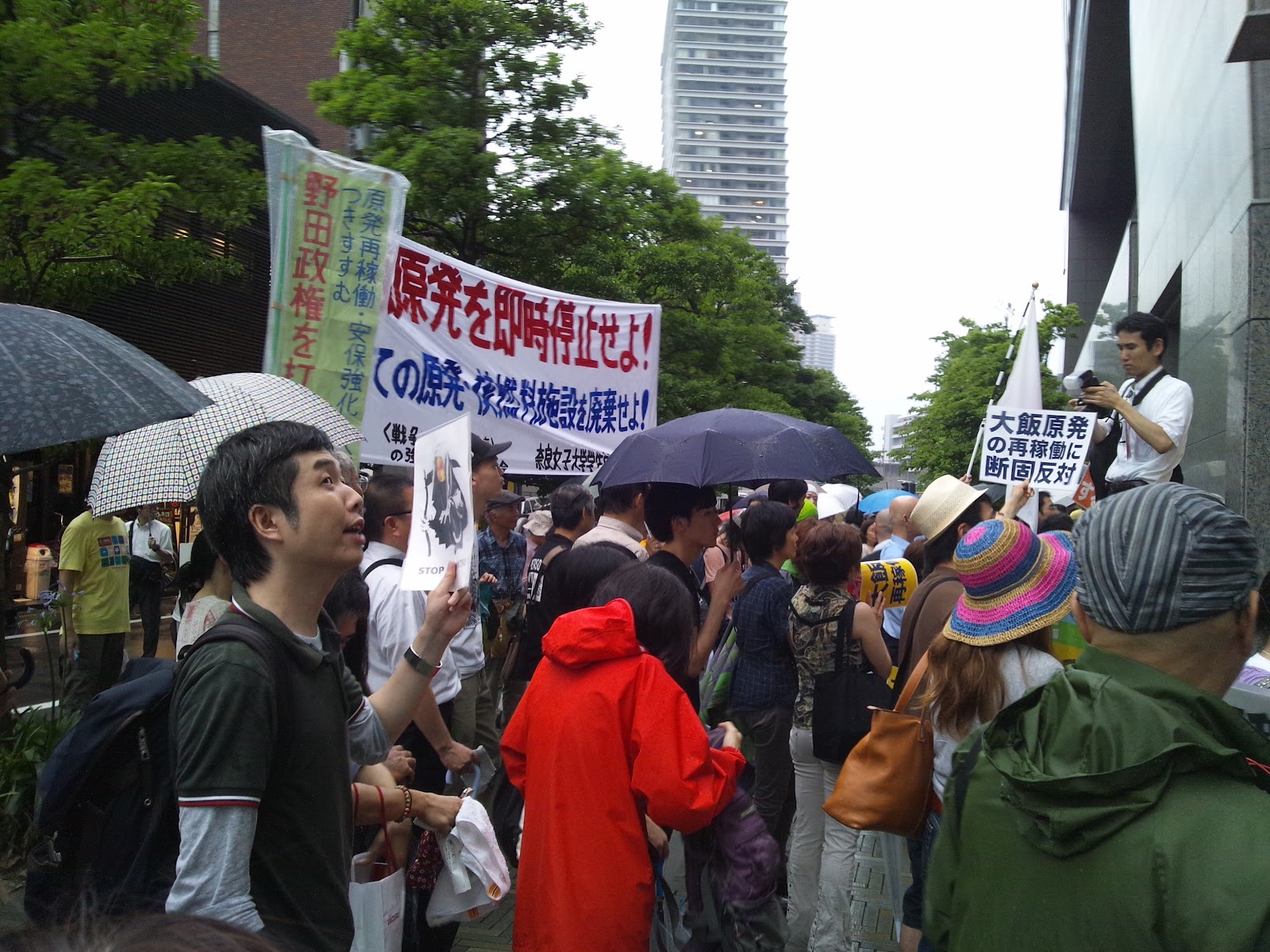
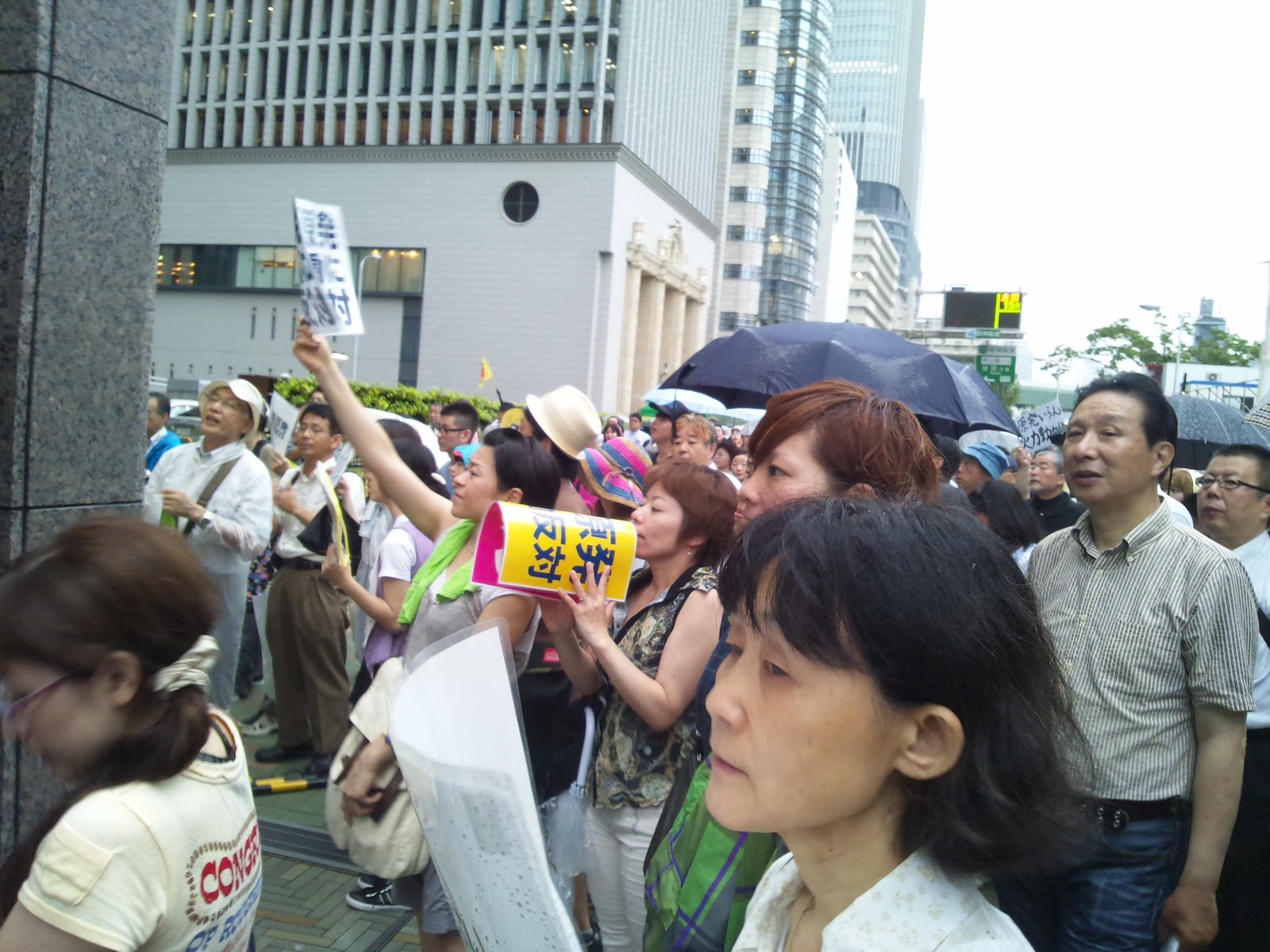
Reader Rick Streeby joined the protest in front of KEPCO's headquarters in Osaka City for the second time on Friday July 13, and posted the photographs he took of the protest on his blog.

Though much smaller in scale and in publicity, people have been protesting there against the restart of Ooi Nuclear Power Plant operated by KEPCO and the number is increasing.

Here are some of the photographs from Rick's blog post (7/13/2012) (Click to enlarge):

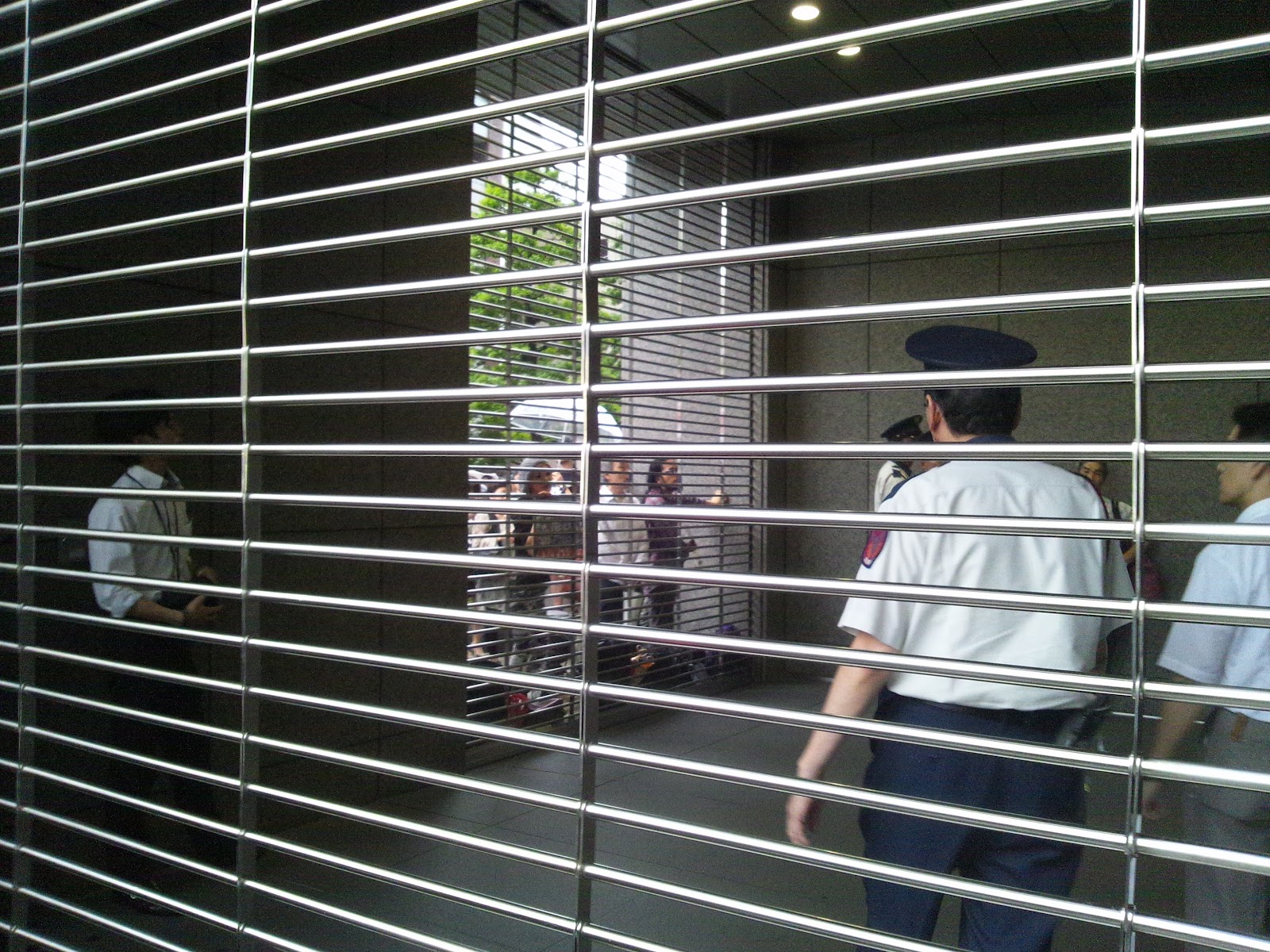
I am surprised that the Osaka police, or the train operator under the advice from the police, mimicked the Tokyo Metropolitan police in closing the exit at the closest station. Rick reports, "They closed the station exit this time, so we couldn't get our message out to commuters, at least for a while."


Ordinary citizens, in front of KEPCO Headquarter:


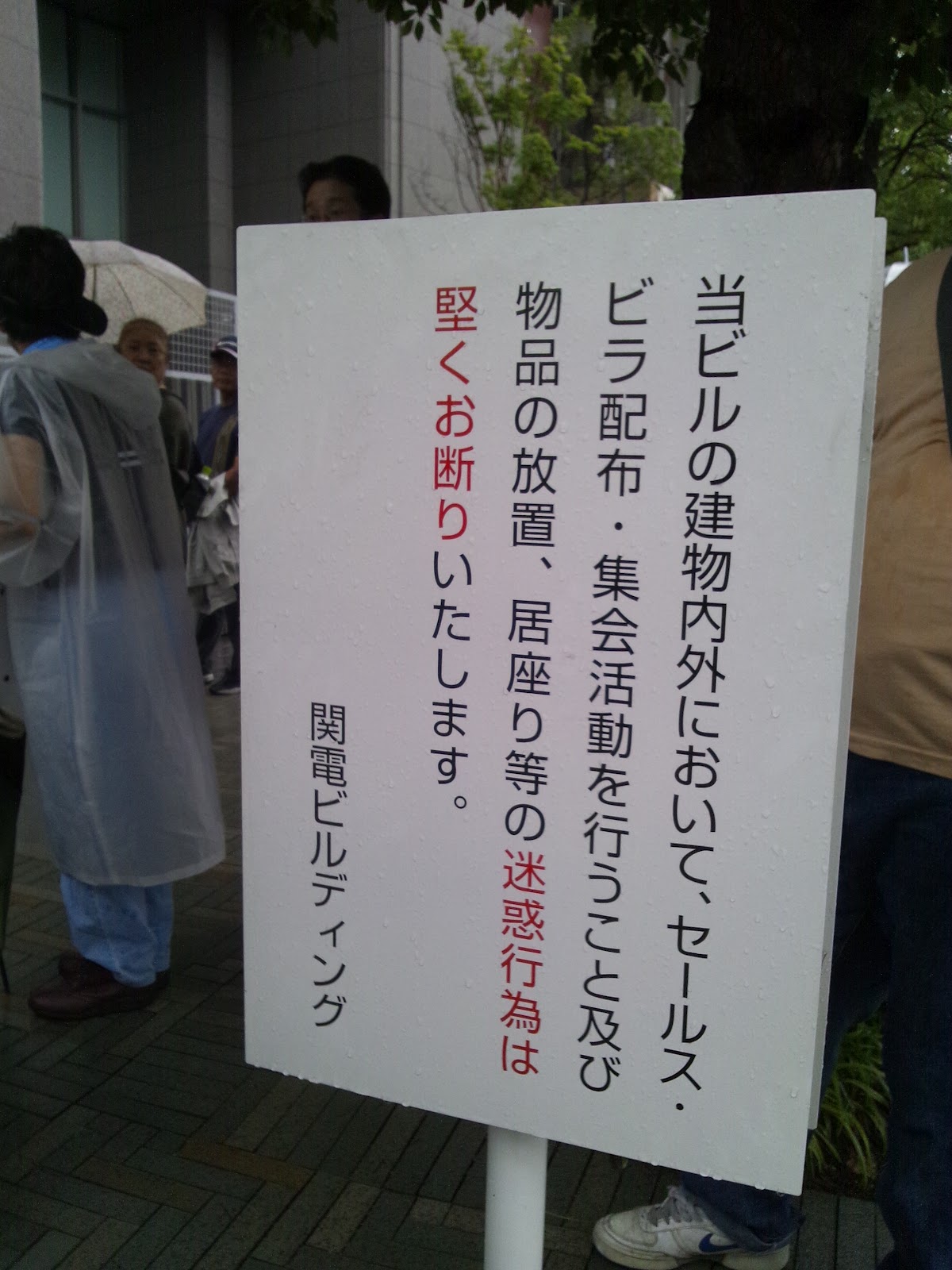
KEPCO's temporary signs. The first one says "Loitering prohibited", the second one "Agitation like handing out leaflets prohibited" (that's so 1960s):


and this, as Rick says, ""No sales, leafleting, gatherings, placing of objects, loitering or other nuisance behavior --Kansai Electric Power." Yeah. "Nuisance behavior." Unlike the creation of nuclear waste without a plan for safely disposing of it."


More photos at his blog, here.

Friday July 13th Protest in Tokyo Live Netcast


(UPDATE: IWJ's channels don't seem to be working. Go to Nico Nico Video.

You can wait for IWJ's all 9 screens to go on air, here.

==============================================

IWJ's USTREAM channels on the protest at the Prime Minister's Official Residence in Tokyo for Friday July 13th, 2012:

Ch1—Yasumi Iwakami in front of the National Diet
Ch3—Aerial video or video from the car
Ch4—Bird's-eye view from a nearby building
Ch5—Front line at the PM Official Residence
Ch6—between the No.2 stage and the Ministry of Finance
Ch7—between the PM Official Residence and the Ministry of Finance
Ch8—Tents at the Ministry of Economy - Ministry of Education - Ministry of Economy
Ch9—In front of TEPCO, in front of KEPCO
Tokyo Ch1—Family area

Here's Channel 5. People holding white balloons must have gotten from Yasuo Tanaka, the head of New Party Nippon.


Live video from your iPhone using Ustream


You can also go to Nico Nico Video, netcasting the event for free for both members and non-members, here. You see the policemen on the other side (road-side) of the metal fences they installed.

Thursday, July 12, 2012

Tokyo Metropolitan Police Getting Ready for Another Big Protest at PM Official Residence in Tokyo on Friday July 13, 2012


Photos posted at Portirland (tamugon) blog:

This is new:


These were there before, too:


This is new:

This is new:

If you go, be safe.

If you want to watch USTREAM, Yasumi Iwakami's IWJ has 9 channels. See his page, here.