Monday, September 23, 2013

Evacuees from Futaba-machi, #Fukushima Still Living in Abandoned High School Building After Two and a Half Years


As Japan celebrates "recovery" (at least in the stock market), 2020 Tokyo Olympic, maglev bullet train that will run under Japan Alps, there are still 100 people from Futaba-machi, Fukushima still living in the abandoned high school building in Saitama Prefecture, more than two and a half years after the earthquake and tsunami and the nuclear accident struck Tohoku and Kanto.

Time has frozen for them, too.

In my August 16, 2012 post, I wrote there were more than 200 Futaba-machi residents living in shelter in the Kisai High School building in Kazo City in Saitama Prefecture, in partitioned classrooms and gyms, getting boxed meals.

Since September 1, 2012, the residents who live in the high school building have had to pay for the boxed meals, 30,000 to 40,000 yen (US$300 to 400) per month, out of their own pockets.

According to a volunteer group who's been providing the residents, mostly elderly, with hot meals every one to two months since September 2012,

それから約1年、徐々に避難所生活の方々は減って来ていますが、現在もまだ約100名の方がこちらの避難所で3食お弁当の生活を続けられております。

One year since [we started serving hot meals], the number of people living in the shelter have been gradually decreasing. However, there are still about 100 people living here [at the high school], eating three boxed (bento) meals every day.

そして避難所は急ピッチで閉鎖の方向に向けての動きがあるようですが、現在残っていられる約100名の方々の行く先、賠償問題など、残された課題はまだまだたくさんあります。

The plan to close this shelter is rapidly gaining momentum, but there are still many issues to be resolved. Where will the current 100 residents at the shelter go? What about compensations?

避難所自体がいつまでも存属していると言うことは、決してよいことではありません。ただ、納得のゆくかたちで閉鎖に結びつくわけでないのでは、決して良いわけでもないと思います。

It is not a good thing that a shelter continues to exist. But we don't think it is a good thing if this shelter is closed without consensus from the residents.

避難所の方達は、生活環境はよくないものの同じ町の知り合いやお友達と、寄り添い合って共に生活しているという、人と人とのつながりだけが心の支えである、ともおっしゃっています。避難所から出ることになると、みなさんがバラバラになってしまいます。ただでさえ多くの物を理不尽に失って辛い生活を強いられている中、そのような状況はお年寄りの孤独感を倍増させ、日々の楽しみもなくなると思います。

The residents at the shelter also tell us that despite bad living conditions they find emotional support through human relationship - that they live together with their friends and acquaintances from the same town [Futaba-machi]. If the shelter is closed, they will have to live apart. They have already lost so much and are forced to live in a harsh condition. It would increase the sense of loneliness in the elderly residents and deprive them of their daily joy and happiness.


Katsutaka Idogawa is no longer the mayor of Futaba-machi; he decided not to fight the recall motion by the town assembly. He was a candidate of the Green Party for the Upper Election in July this year, but his campaign didn't get any attention and he lost.

There is no incentive for politicians to do anything about the evacuees in an abandoned high school building in Saitama. The evacuees don't complain, and no one complains for them.

They are going to squander a ton of money (maybe literally) on maglev trains and 2020 Olympic, but they can't even convert this high school building into a more comfortable, habitable living space.

Photo Essay by Ryuichi Kino: Time Frozen in Ex-Evacuation Zone in #Fukushima


Independent journalist Ryuichi Kino went to Fukushima I Nuclear Power Plant in June 2013, his fourth. Along the way, he went inside the ex-evacuation zone (no-entry zone within 20-kilometer radius from the plant) and took these photos, and posted on his Flickr site. (Copyright: Ryuichi Kino, all rights reserved.)

Kino wonders aloud in his tweet, "How do they expect the residents to live here? Will the tanks full of contaminated water and the reactor buildings that blew up disappear in five years?"


The following photos are only part of 54 photos of the set.

=================

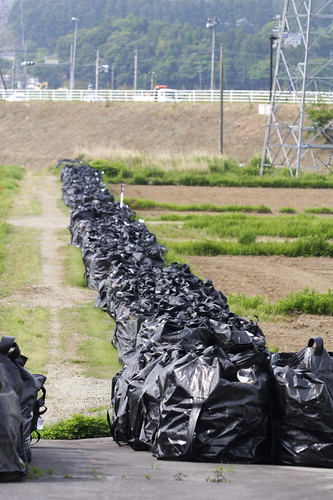
Naraha-machi, where Fukushima II (Daini) Nuke Plant is located. Farm road lined with plastic bags containing contaminated soil removed from farmland.

ex evacuation zone, Fukushima

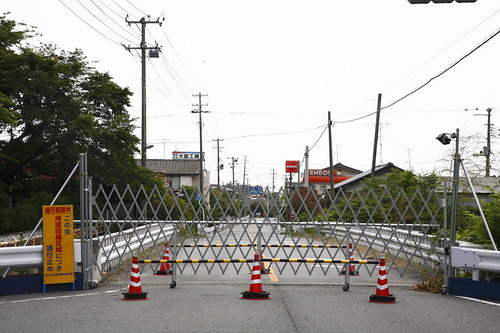
Tomioka-machi, where Fukushima II Nuke Plant is located. The fence bars entry to the "zone where the residents won't be able to return for 5 years". As if the radiation is suddenly higher beyond the fence.

ex evacuation zone, Fukushima

JR Joban Line Yonomori Station in Tomioka-machi. Nature is taking over.

ex evacuation zone, Fukushima

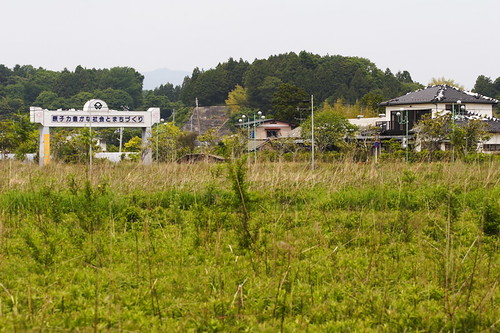
Futaba-machi, from the distance. Half of Fukushima I Nuke Plant is located in Futaba-machi. The arch in the left of the picture says "Nuclear Power to Build Affluent Society and Town".)

ex evacuation zone, Fukushima

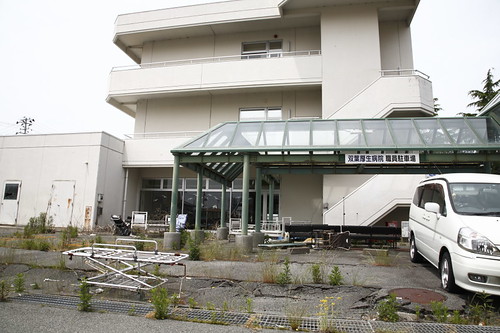
Futaba Kosei Hospital. Doctors, nurses, and patients were still trying to evacuate when Reactor 1 building exploded in hydrogen explosion on March 12, 2011. Beds and stretchers abandoned in haste.

ex evacuation zone, Fukushima

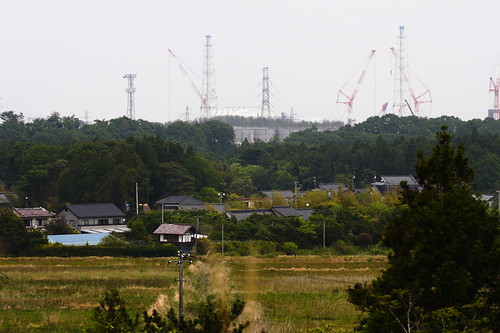
Okuma-machi, with Reverse Osmosis waste storage tanks, exhaust stacks, and tall cranes working on the broken reactors in the backdrop. Would you feel safe, returning to the area?

ex evacuation zone, Fukushima

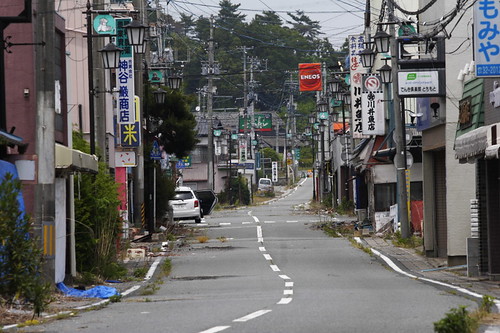
Okuma-machi. It looks almost normal.

ex evacuation zone, Fukushima

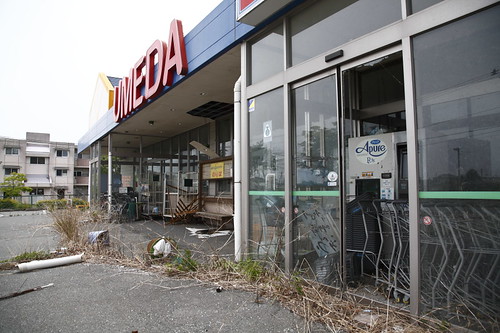
Until you look up close.

ex evacuation zone, Fukushima

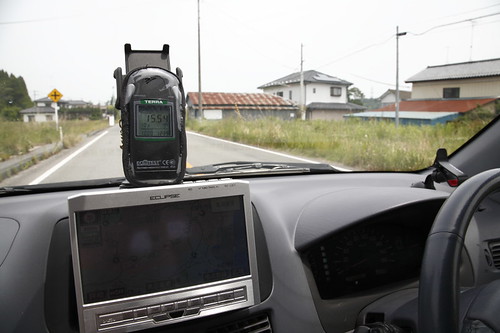
Somewhere within the ex-evacuation zone. The survey meter shows 15.54 microsieverts/hour radiation (gamma).

ex evacuation zone, Fukushima

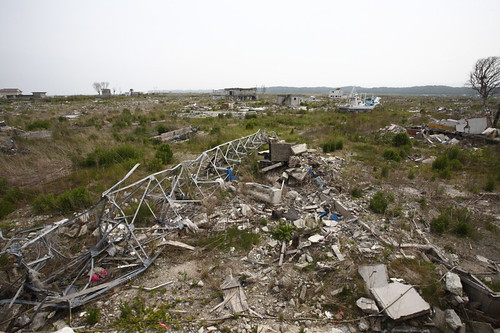
Ukedo District in Namie-machi, along the Pacific Ocean. Total wipe-out.

ex evacuation zone, Fukushima

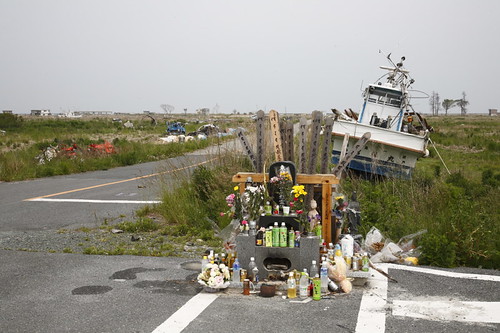
Memorial for the dead, in Ukedo District in Namie-machi. Someone does come here (probably more than one) to offer flowers and drinks.

ex evacuation zone, Fukushima

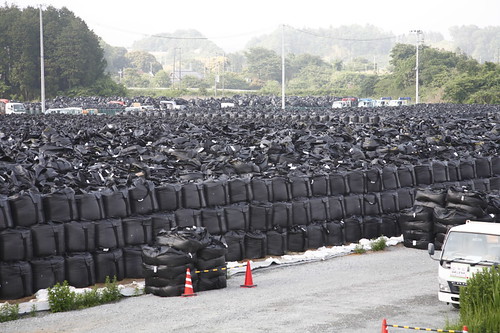
As far as eyes can see, plastic bags with radioactive waste from decontamination along Route 6 in Naraha-machi. As talks of building intermediate storage facilities for contaminated waste have stalled in the ex-evacuation zone, these bags are left like this in many locations.

ex evacuation zone, Fukushima

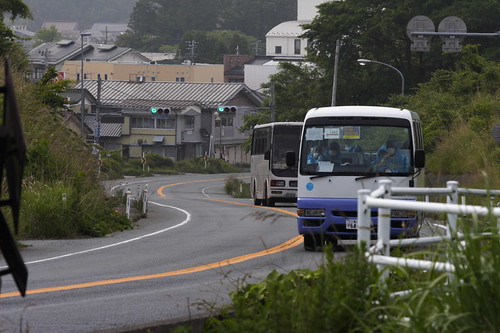
Route 6 in Tomioka-machi. Buses carry workers to Fukushima I Nuclear Power Plant.

ex evacuation zone, Fukushima

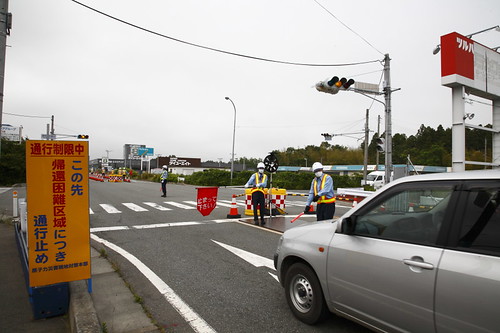
Guards manning the checkpoint to the "difficult for the residents to return" zone. Kino writes that they are from private security company, and that:

以前の警戒区域は法的根拠があ ったので警察権を行使することができたけど、今の帰還困難区域は強制力がないので、法的には立ち入りを止めることはできない。中に入らないという制限 は、ある意味で市民の協力により成り立っているということになる。

The evacuation zone had a legal basis, and the police authority was used to enforce it. But the current "difficult for the residents to return" zone does not have legal force behind it, and there is no way to legally stop one from entering the zone. Restriction of entry is, in a way, made possible by the cooperation of the residents.


ex evacuation zone, Fukushima

The national government is essentially telling the the residents, "At your own risk."

For more photos of the ex-evacuation zone by Kino, go to his Flickr page, here.

Sunday, September 22, 2013

Weekend Fun and Farce -2: Minister of Economy Says "More Space for Tanks if Reactors 5 and 6 Are Decommissioned" at #Fukushima I Nuke Plant


Minister Motegi, ex-McKinsey management consultant whose most recent utterance about Fukushima I Nuclear Plant was that the contaminated water problems are not because of lack of money or faulty engineering but because of TEPCO and the plant workers not working hard enough, seems to think decommissioning a nuclear reactor is just like dismantling a factory line.

According to the Yomiuri article below, Minister Toshimitsu Motegi seems very confident that decommissioning of Reactors 5 and 6 will be finished way before the end of fiscal 2014 (March 31, 2015) with reactors, equipments, and buildings all removed, and the space can be used to install more tanks to store contaminated water until that water is completely treated by the end of fiscal 2014.

This is the minister in charge of the national government being "at the forefront" of the Fukushima I Nuclear Power Plant accident.

And he screams, as always, "Accelerate! Ahead of schedule!"

From Yomiuri Shinbun (9/20/2013):

5・6号機廃炉ならタンク増設できる…経産相

If Reactors 5 and 6 are decommissioned, more tanks can be installed, says Minister of Economy

茂木経済産業相は20日の閣議後記者会見で、東京電力福島第一原子力発電所5、6号機の廃炉を安倍首相が要請したことについて「5、6号機は(廃炉が決まっている)1~4号機と極めて似た構造を持っている。5、6号機の実機を使えば訓練もできる」と述べ、1~4号機の廃炉などの事故処理を加速できるとの認識を示した。

During the press conference on September 20 after the cabinet meeting, Minister of Economy, Trade and Industry Motegi commented on Prime Minister Abe's request [to TEPCO] to decommission Reactors 5 and 6 at Fukushima I Nuclear Power Plant. He said, "Reactors 5 and 6 have very similar structures to Reactors 1-4 (which are being decommissioned). Training can be done on the actual reactors," thus accelerating the process of decommissioning Reactors 1-4.

汚染水処理については「5、6号機の廃炉で出来る空きスペースに、汚染水のタンク増設を行うことができる」と語った。2014年度内に貯蔵タンク内の汚染水を浄化することに改めて意欲を示し、「前倒しできることは、全て前倒しする」と強調した。

As to the contaminated water treatment, he said, "In the empty space created by decommissioning Reactors 5 and 6, we can build additional tanks to store contaminated water." He expressed his desire again to have all contaminated water stored in the tanks treated by the end of fiscal 2014, and emphasized he would "do anything ahead of schedule that can be done ahead of schedule".


"Happy", one of several workers who have been tweeting from the plant since the beginning of the accident, gently reminds his followers that:

  • Spent fuel assemblies in the Spent Fuel Pools of Reactors 5 and 6 should be removed first, and that won't happen until July 2014 at the earliest (tweet);

  • After spent fuel assemblies are removed, dismantling will start with equipments and pipes with low contamination. It will be at least 10 years before we start dismantling the reactors themselves. (tweet)

  • In dismantling a reactor, pipes and equipments in the primary line will be chemically cleaned and decontaminated, but dismantling doesn't happen at least until 5 years pass. (tweet)

  • It's because Cobalt-60, major source of radiation for pipes and equipment, has the half life of about 5 years. (tweet)

  • Even the decommissioning of small-scale or experimental reactors like the one in Tokai-mura is problematic, with unforeseen problems. (tweet)


I would suggest Mr. Motegi or his secretary follow these workers on Twitter.

I do feel sorry for TEPCO managers who have to kowtow to politicians like Motegi.

Saturday, September 21, 2013

Weekend Fun and Farce: Telephone Game (or Flight of Imagination) Over #Fukushima I Nuke Plant Exhaust Stack


(UPDATE 9/22/2013) The person at least admits both exhaust stacks are still standing despite her belief, but still insists the situation is "equivalent to having been collapsed". It's beyond comprehension at this point.

========================

From:

"Part of the support structure of the exhaust stack for Reactors 1 and 2 was found to have been damaged" (TEPCO's announcement (in Japanese only) on September 18, 2013).

The radiation measurement near the bottom of the stack was over 10 Sieverts/hour when it was measured in August 2011 (here and here, for more info).

Japanese media quoted TEPCO as saying "There is no danger of the exhaust stack collapsing."


(From TEPCO's photos and videos library, 9/18/2013)


to:

"Exhaust stack for Reactor 3 at Fukushima I Nuke Plant broke off and collapsed this morning, killing workers. Extremely high radiation of 10 Sieverts/hour is spreading rapidly, and no one can go near it. TEPCO has abandoned the plant. Radiation is spreading from the plant."


and:

"The Ministry of Foreign Affairs has issued a secret order only to Tokyo University graduates to evacuate Kanto and escape to Kyushu and Okinawa"


and:

"Aside from Tokyo University grads, only foreigners were told about it. Foreign embassies are in panic."


Ah the world is ending.

These all issued from someone who continues to insist the message she received from a Japanese living outside Japan and disseminated widely on Twitter is genuine and accurate (despite latching onto the wrong exhaust stack). After probably realizing (I hope) the exhaust stacks are still standing, she deleted her tweets, but she continues to claim it's only a matter of time before the world knows this dire truth.

She doesn't seem to know that 10 Sieverts/hour radiation was detected in 2011.

What was funny was her going back and forth with one of the workers who regularly tweet from Fukushima I Nuke Plant. She apparently did not know whom she was talking to. It went something like:

Worker ("Sunny"): That's demagogy.

Woman: No it is not, it is from reliable source!

"Sunny": If that (collapse of exhaust stack) actually happened, there would be a press conference immediately from TEPCO. The stacks are standing.

Woman: How do you know? Have you seen them in person?


Well, "Sunny" works there.

According to some who have been retweeting the "news" from this person, all major foreign media outlets are reporting it. Firm believers of this "news" say "Japanese media will never report the truth like this."

I think I can guess what will come next from the believers: "An exaggerated lie is totally acceptable to alert people on the danger of the plant."

If this kind of "news" had been released on Twitter in 2011, it might have caused a real panic.

Here's the latest screen shot from TEPCO's Fuku-I live cam:


Here's the screen shot from JNN live cam:


They are both still standing, even if "it's just a matter of time".

Idio(syncra)tic Japan: Maglev Linear Bullet Train to the Rescue of Nuclear Power Plants?


Abe's Liberal Democratic Party, which was the ruling party for most of the post-World War II period in Japan and promoted nuclear power plants as "national policy" and thus responsible for 54 nuclear reactors dotting the coasts of earthquake-prone Japan, is quite nonchalant about its culpability.

Au contraire, a gigantic, 9-trillion-yen (US$90 billion) project that will necessitate the operation of several nuclear power plants (or so the politicians claim) is getting a heavy, front-page coverage all of a sudden: Linear Shinkansen (Bullet Train) by JR Tokai that will operate on Maglev - super-conductive magnetic levitation.


Why would the Maglev bullet train help nuclear power plants? Because maglev Linear Shinkansen will require three to four times the electricity the current Shinkansen uses. There are already LDP politicians and local politicians along the proposed line (initial segment from Shinagawa to Nagoya, over 86% of it will be deep underground - 40 meters, or 130 feet) demanding the restart of nuclear power plants to secure the supply for the Linear Shinkansen which was originally scheduled to be operational in 2027.

Which nuclear plants? Hamaoka NPP (Chubu Electric) and Kashiwazaki-Kariwa NPP (TEPCO) are geographically close.

Unlike JR East which has its own power stations, JR Tokai doesn't have any, and will have to buy extra electricity needed for Linear Shinkansen from power companies.

The hope now is that the first segment of the Linear Sinkansen line will be built "ahead of schedule" - a recurring theme under the Abe administration - to be in time for 2020 Olympic.

Just like the original Shinkansen was built and became operational on October 1, 1964 to be just in time for 1964 Olympic that started on October 10.

Linear Shinkansen has been in the planning for over 30 years, but Ministry of Land, Infrastructure, Transport and Tourism (MLIT) under the Kan administration ordered JR Tokai to go ahead and build the line in late May 2011, two months after the start of the Fukushima I Nuclear Power Plant accident.

From my post on June 2, 2011:

Japan's addiction to a huge, infrastructure business continues, despite the disaster at Fukushima I Nuke Plant. Now, the Ministry of Land, Infrastructure, Transport and Tourism has given the approval to start building the line for the "Linear Shinkansen (bullet train)" in the middle of Japan, through the pristine mountainous region dubbed in Japan as "Japan Alps", so that people in a nation with dwindling population can go from Tokyo to Osaka in 1 hour, instead of 2.5 hours.

The project has been on the table for more than 30 years, but it was the Kan administration who has finally given a go-sign on May 27, formally "instructing" JR Tokai (the railroad operator in charge of the area that the Linear Shinkansen will run) to build the rail line.

...The line will go through the Japan Alps by building the longest underground tunnel that Japan will have ever built. Not only it will be so counter to environmental protection, but the tunnel will have to go through one of the major tectonic lines in Japan, "Itoigawa-Shizuoka Tectonic Line".


Compared to the amount of groundwater that they will have to deal with in building this tunnel under Japan Alps, the current groundwater situation in Fukushima I Nuke Plant (1,000 tonnes per day) is a child's play.

You can rest assured that the environmental impact study will be done and rubber-stamped quickly. And effect of electromagnetic fields on humans and animals? What effect? It's all for economic growth, you know, in a country with declining population that is aging fast (32% of population over 60, expected to be 41% in 2050).

UK Guardian: US nearly detonated atomic bomb over North Carolina in 1961


It happened on January 23, 1961, three days after the inaugural address by President John F. Kennedy. Three out of four safety controls were off.

From The Guardian (9/20/2013; emphasis is mine):

US nearly detonated atomic bomb over North Carolina – secret document

Exclusive: Journalist uses Freedom of Information Act to disclose 1961 accident in which one switch averted catastrophe

Ed Pilkington in New York

A secret document, published in declassified form for the first time by the Guardian today, reveals that the US Air Force came dramatically close to detonating an atom bomb over North Carolina that would have been 260 times more powerful than the device that devastated Hiroshima.

The document, obtained by the investigative journalist Eric Schlosser under the Freedom of Information Act, gives the first conclusive evidence that the US was narrowly spared a disaster of monumental proportions when two Mark 39 hydrogen bombs were accidentally dropped over Goldsboro, North Carolina on 23 January 1961. The bombs fell to earth after a B-52 bomber broke up in mid-air, and one of the devices behaved precisely as a nuclear weapon was designed to behave in warfare: its parachute opened, its trigger mechanisms engaged, and only one low-voltage switch prevented untold carnage.

Each bomb carried a payload of 4 megatons – the equivalent of 4 million tons of TNT explosive. Had the device detonated, lethal fallout could have been deposited over Washington, Baltimore, Philadelphia and as far north as New York city – putting millions of lives at risk.

Though there has been persistent speculation about how narrow the Goldsboro escape was, the US government has repeatedly publicly denied that its nuclear arsenal has ever put Americans' lives in jeopardy through safety flaws. But in the newly-published document, a senior engineer in the Sandia national laboratories responsible for the mechanical safety of nuclear weapons concludes that "one simple, dynamo-technology, low voltage switch stood between the United States and a major catastrophe".

Writing eight years after the accident, Parker F Jones found that the bombs that dropped over North Carolina, just three days after John F Kennedy made his inaugural address as president, were inadequate in their safety controls and that the final switch that prevented disaster could easily have been shorted by an electrical jolt, leading to a nuclear burst. "It would have been bad news – in spades," he wrote.

Jones dryly entitled his secret report "Goldsboro Revisited or: How I learned to Mistrust the H-Bomb" – a quip on Stanley Kubrick's 1964 satirical film about nuclear holocaust, Dr Strangelove or: How I Learned to Stop Worrying and Love the Bomb.

The accident happened when a B-52 bomber got into trouble, having embarked from Seymour Johnson Air Force base in Goldsboro for a routine flight along the East Coast. As it went into a tailspin, the hydrogen bombs it was carrying became separated. One fell into a field near Faro, North Carolina, its parachute draped in the branches of a tree; the other plummeted into a meadow off Big Daddy's Road.

Jones found that of the four safety mechanisms in the Faro bomb, designed to prevent unintended detonation, three failed to operate properly. When the bomb hit the ground, a firing signal was sent to the nuclear core of the device, and it was only that final, highly vulnerable switch that averted calamity. "The MK 39 Mod 2 bomb did not possess adequate safety for the airborne alert role in the B-52," Jones concludes.

The document was uncovered by Schlosser as part of his research into his new book on the nuclear arms race, Command and Control. Using freedom of information, he discovered that at least 700 "significant" accidents and incidents involving 1,250 nuclear weapons were recorded between 1950 and 1968 alone.

"The US government has consistently tried to withhold information from the American people in order to prevent questions being asked about our nuclear weapons policy," he said. "We were told there was no possibility of these weapons accidentally detonating, yet here's one that very nearly did."

Friday, September 20, 2013

Friday Humor: "So Where Is This 0.3 Square Kilometer?" PM Abe Asks TEPCO on #Fukushima I Nuke Plant Visit


Prime Minister of Japan was talking about his own "0.3 square kilometer" of the harbor where the "effect" of contaminated water is supposedly completely contained, according to none other than himself. (Even TEPCO was baffled at his comment.)

That's what the national government "at the forefront" is, in reality.

From Kyodo News (9/20/2013):

汚染水の影響範囲知らず発言か 首相「0・3平方キロはどこ?」

So he didn't know the extent of the effect of contaminated water? "Where is the 0.3 square meter?" asks PM

東京電力福島第1原発の汚染水問題をめぐり、安倍晋三首相が19日に現地を視察した際、放射性物質による海洋への影響が抑えられていると説明する東電幹部に、「0・3(平方キロ)は(どこか)」と尋ねていたことが20日、分かった。

It was revealed on September 20 that Prime Minister Shinzo Abe had asked "(Where) is the 0.3 (square kilometer)?" to the TEPCO management at Fukushima I Nuclear Power Plant on September 19, as they explained to the prime minister how the effect of radioactive materials on the marine environment is contained.

首相は東京五輪招致を決めた国際オリンピック委員会(IOC)総会で「汚染水の影響は港湾内0・3平方キロの範囲内で完全にブロックされている」と説明していたが、実際の範囲がどの程度か理解しないまま発言していた可能性がある。

At the General Meeting of the International Olympic Committee (IOC) which voted for Tokyo, Prime Minister Abe explained "The effect of contaminated water is completely blocked within the 0.3 square meters of the plant harbor." He may have been saying it without knowing the actual extent [of the effect of contaminated water].

安倍首相は東電の小野明所長から放射性物質の海への流出や海中での拡散を防ぐ対策の説明を受けた際に「0・3は?」と質問した。

Prime Minister Abe was briefed by TEPCO's Plant Manager Akira Ono on the countermeasures to prevent radioactive materials from leaking into the ocean and spreading in the ocean, when he asked "Where is 0.3?"


Speaking of a farce, PM Abe wore a protective suit with his name printed wrong ("安部" instead of "安倍", both of which reads "Abe"), and Abe's supporters are indignant (like the political commentator quoted in ultra pro-LDP Sankei Shinbun's magazine), accusing TEPCO of this egregious, disrespectful mistake.

According to the Sankei's magazine that carries the photo below, it was not just disrespectful but "it cast doubts over TEPCO's crisis management skills".


Big deal. Clearly Mr. Abe didn't make a fuss over the wrong character and wore the suit.

What's funnier to me is that Abe wore the name tag that declares he's the Prime Minister. As if that matters in dealing with the problems that have been constantly cropping up at Fukushima I Nuclear Power Plant since the day 1 of the accident.

At least, the name tag on the back of Abe's protective suit had the character correct (photo is from TEPCO):

Thursday, September 19, 2013

Just as Expected, "National Government at the Forefront" of #Fukushima I Nuke Plant Problems Is All Talk, Little Money, Relies Entirely on TEPCO


To win 2020 Olympic for Tokyo, Japanese Prime Minister Shinzo Abe declared to the world that his government will be "at the forefront" to deal with problems at Fukushima I Nuclear Power Plant. Reading the article by Nikkei Shinbun about his most recent visit to the plant and comments from his ministers, it sure looks all talk, nothing but talk.

From Nikkei Shinbun (9/19/2013):

安倍晋三首相は19日、東京電力福島第1原子力発電所を視察し、広瀬直己東電社長に運転を停止している5、6号機の廃炉を決めるよう要請した。既に廃炉が決まっている1~4号機だけでなく福島第1原発全体を廃炉にすることで、汚染水問題など事故対策全体を加速させる。広瀬社長は年内に判断すると応じたが、受け入れる公算が大きい。

Prime Minister Shinzo Abe visited Fukushima I Nuclear Power Plant on September 19 and requested TEPCO's President Naomi Hirose to decommission Reactors 5 and 6. By decommissioning the entire plant, not just Reactors 1 through 4, Prime Minister Abe hopes to accelerate the whole response to the accident, including the problems of contaminated water. President Hirose said he would decide within this year, but it is likely that he will agree to the request.

首相は広瀬社長との会談で(1)5、6号機の廃炉決定(2)廃炉に向けた安全対策を機動的に取れるように、現場の裁量で使える予算枠を確保(3)福島第1原発の地上タンクから漏れる汚染水の浄化に期限を設ける――の3点を求めた。

During the meeting with President Hirose, Prime Minister Abe demanded 1) decommissioning of Reactors 5 and 6; 2) allocating enough budget that can be used at the discretion of the plant management; 3) time limit on decontamination of contaminated water.

予算枠の確保を巡っては、東電は汚染水や廃炉の費用として計9600億円を引き当て済みだが、広瀬社長は「プラスして1兆円を確保していく」と応じた。汚染水の浄化期限に関しては「2014年度中に完了していく」と確約した。政府は汚染水対策での470億円の財政出動のうち150億円を浄化装置の増設に充てた。

As to the budgeting, TEPCO has already secured 960 billion yen [967 million US dollars] for countermeasures for contaminated water and decommissioning. President Hirose said his company will secure additional 1 trillion yen [1 billion US dollars, over 10 years]. As to the deadline for the treatment of contaminated water, he promised it would be complete by the end of the fiscal 2014 [that ends in March 2015]. The national government has allocated 15 billion yen [15 million US dollars] out of 47 billion yen [47 million US dollars] that the government will pay for the contaminated water countermeasures to build additional water treatment facility.

菅義偉官房長官は19日の記者会見で、廃炉要請に伴う東電支援スキームの見直しは「現時点で考えていない。現在のスキームの中で最善を尽くす」と述べた。原子力損害賠償支援機構を通じた東電の支援体制など現行の枠組みに沿って支援を進める考えを示した。

Chief Cabinet Secretary Yoshihide Suga said during the press conference on September 19 that there was no plan to revise the support scheme for TEPCO due to the request for decommissioning [by the prime minister]. Suga said the government would do its best within the existing scheme, which includes Nuclear Damage Liability Facilitation Fund.

茂木敏充経済産業相は19日夜、都内で記者団に「まずは東電で資金を確保する努力をしていただきたい」と述べ、今回の件での追加支援は見送る考えを示した。

Minister of Economy, Trade and Industry Toshimitsu Motegi spoke to the press in Tokyo in the evening of September 19. He said, "We want TEPCO to make effort to secure the fund," indicating he is not going to allow additional monetary support this time.


The current support system via Nuclear Damage Liability Facilitation Fund is only for paying the victims of the nuclear accident, and no money goes from the fund to deal with the accident. All the cost of decommissioning Reactors 1, 2, 3, 4 is being borne by TEPCO alone.

By declaring the decommissioning of Reactors 5 and 6 at Fukushima I Nuke Plant, which are relatively new (operational since 1978 and 1979 respectively), TEPCO would have to immediately write them off on the asset side of the balance sheet, with the offsetting reduction in either the liabilities or shareholders' equity.

That would mean nothing to these politicians. While TEPCO somehow has to earn that money to deal with the accident and decommission, these politicians are fed by taxpayers' money. If Mr. Abe really thinks decommissioning the entire plant all at once will "accelerate the whole response to the accident", he's in a fantasy land.

An elite bureaucrat spokesman from now-abolished Nuclear and Industrial Safety Agency (NISA), which was under Ministry of Economy, Trade and Industry, said in a press conference in March 2011:

(About the workers at Fukushima I Nuclear Power Plant not having enough food to eat, no blanket, no spare underwear) we feel sorry for the workers. But this nuclear accident, it is basically TEPCO's problem, not ours. So, no, we are not going to do anything about it as the government, like delivering necessities to the workers.


I was watching the press conference live. My jaw dropped. But judging by the reaction at that time among the ordinary Japanese in Japan, I was clearly alone in thinking this would be one of the rare times where the government could actually be useful.

Well, they couldn't even deliver decent food to the workers in March 2011. It's impossible for me to imagine they are capable of doing anything beyond food delivery, but they sure can talk.

Monday, September 16, 2013

Monju Fast Breeder Reactor's Emergency Response Support System Was Down for One Hour, Cause Unknown, Plant Site Not Accessible Due to Landslides


According to an emergency email from Nuclear Regulatory Authority that independent journalist Ryuichi Kino shares, the cause of the system stoppage is not likely to be known anytime soon as the maintenance staff cannot reach Monju because of landslides caused by Typhoon 18's heavy rain.

From Kino's tweets:

本日(16日)、原子力規制庁は、独立行政法人原子力安全基盤機構(JNES)より、日本原子力研究開発機構もんじゅの緊急時対策支援システム(ERSS)のプラント情報表示システムからのデータ伝送が停止している旨の連絡を受けました。

Today (September 16), we at Nuclear Regulatory Authority received correspondence from Japan Nuclear Energy Safety Organization (JNES) that data transfer from the plant parameter display system of the Emergency Response Support System (ERSS) for Japan Atomic Energy Agency (JAEA)'s Monju Fast-Breeder stopped.

(16日2時56分から伝送停止。同日3時46分から順次受信)。JNES及び日本原子力研究開発機構においてデータ伝送停止の原因を調査中ですが、台風18号の大雨による土砂崩れのため、保修担当者がもんじゅ構内に通行不能であり、伝送停止の原因判明には時間を要する模様です。

(The data transfer stopped at 2:56AM on September 16, and partially resumed after 3:46AM.) JNES and JAEA are currently investigating the cause of the data transfer stoppage. However, because of landslides from heavy rain from Typhoon No.18, maintenance and repair staff cannot get to the Monju Plant compound. Therefore, it may take a while to determine the cause of the stoppage.

なお、ERSS伝送装置復旧までの間に原子力施設でトラブルが発生した場合には、電話、FAX、電子メール等の代替手段によりデータを入手でき、データ提供を確実なものとするよう、日本原子力研究開発機構に指示済みです。

We have already instructed JAEA to secure the collection and transfer of data via alternative means such as telephone, FAX, email if a problem arises at the nuclear facility before the ERSS data transfer system is fully restored.


According to Asahi Shinbun (9/16/2013), there were two landslides near Monju, with one of them at the entrance of a tunnel 1 kilometer from the plant.

There are several nuclear power plants in Japan which are only accessible by one road and/or a tunnel - Monju, Tsuruga Nuclear Power Plant, and Ooi Nuclear Power Plant.

Here's how Monju is situated: accessible via a tunnel, or a narrow road hugging the coastline:


Accessibility to the site in case of a problem is not included in the conditions for restarting the nuclear power plants in Japan.

By the way, in terms of accessibility, TEPCO's nuclear plants including Fukushima I Nuclear Power Plants are one of the best nuclear plants in Japan, and still the earthquake and tsunami led to the disaster we continue to face at Fukushima I Nuclear Power Plant.

Sunday, September 15, 2013

(OT, UPDATED) Typhoon No.18 with Strong Wind and Rain Wrecking Havoc in Japan, Set for Direct Hit on Kanto Region


(UPDATE-3) It looks like Typhoon No.18 will miss Fukushima I Nuke Plant. It is expected to pass south of Koriyama City and continue its north-eastern path.

(UPDATE-2) 100 millimeters/hour rain in Shizuoka and Aichi Prefectures. Tornado warning in Kanagawa Prefecture. Heavy rain and wind to intensify in Kanto and Tohoku in the afternoon of 9/16/2013.

(UPDATE) According to NHK, Kyoto City issued an order to evacuate to 146,000 residents in the four Special Wards (Minami, Ukyo, Nishikyo, Fushimi) at 8AM, September 16, 2013.

==========================

Fukushima on course afterwards, it looks.

From Japan Meteorological Agency, as of 6AM, September 16, 2013:

(Click to enlarge)


NHK reports that Kyoto City government has issued "recommendation to evacuate" to more than 40,000 people in one Ward alone (Fushimi Ward) in Kyoto City.

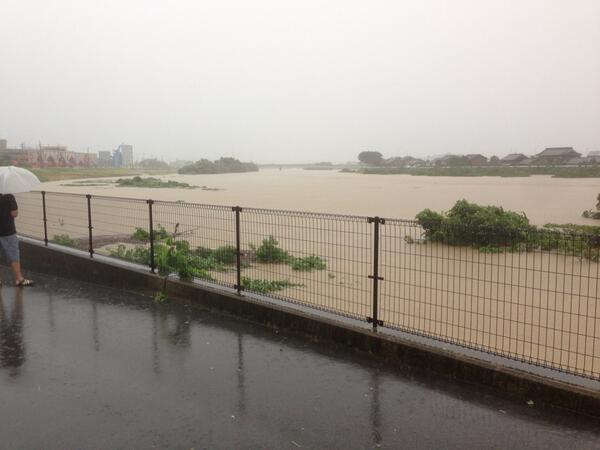
This is Uji River in Kyoto, from a tweet about 45 minutes ago:


Even before the typhoon lands, Kanto Region and southern Tohoku have been experiencing heavy wind and rain since September 15.

At Fukushima I Nuclear Power Plant, the rainwater that had rapidly accumulated inside the 30-centimeter-high barrier around the RO waste water tanks went over the barrier in the afternoon of September 15. TEPCO is examining the water to see if it contains radioactive materials, according to Jiji Tsushin (9/15/2013).

#Radioactive Olympic in 2020? Try 1964


Cesium-137 in monthly fallout in Tokyo, from 1964 (the year of the first Tokyo Olympic) to 2013, using the data and graph function from Japan Chemical Analysis Center database:


The fallout levels in 1964 look slightly higher than in 2011-2013, except for the initial huge spike in March 2011 due to the Fukushima I Nuclear Power Plant accident. With luck, in 7 years, the fallout levels may come down to 1970s' levels. Even if Cs-134 is included, the order of magnitude doesn't look to increase. (The Y-axis is log.)

As of July 2013, Cs-137 in monthly fallout in Tokyo is 4.4MBq/km2, and Cs-134 is 2.2MBq/km2.

What about strontium, you ask? The maximum amount of strontium-90 in the monthly fallout after the Fukushima I Nuclear Power Plant accident was about half of the fallout after the Chernobyl accident, and close to 1/100 of the maximum 1964 level:


Atmospheric nuclear testing by the United States, the Soviet Union stopped after 1963 Limited Test Ban Treaty, but France, not being a signatory, continued until 1974, and China until 1980.

Some images from 1964 Tokyo Olympic:

Billy Mills (USA), winner of 10,000 long distance run, who overcame prejudice and discrimination (he was a Native American) to win a surprise win in the Olympic (according to Japanese wiki; no such information in English wiki).


Czech gymnast Věra Čáslavská, who enthralled the Japanese and the world viewers.


Ethiopian marathon runner Abebe Bikila, who had run bare-foot in 1960 Rome Olympic; in 1964 Tokyo Olympic, he wore Puma shoes. After the marathon, he said he could easily run another 10 kilometers.


1964 Olympic poster:

Friday, September 13, 2013

Contaminated Water Problems at #Fukushima I Nuke Plant "A Matter of How to Communicate"


Oh. Here I thought they were about:

  • figuring out where the groundwater and contaminated water are coming from, and how much;

  • diverting the groundwater from the contaminated areas;

  • decreasing the amount of water injected into the reactors to reduce the amount of contaminated water to treat;

  • possibly diluting and dissipating if only tritium is the issue;

  • building welded tanks to replace the assembled tanks;

  • coming up with different ways to cool the reactors that do not rely on continuous injection of water; and

  • creating a human resource management system so that the workers at the plant (other than TEPCO employees) can work with decent training, pay and benefits.


According to TEPCO and Mr. Lake Barrett, a former US NRC official advising TEPCO, it seems it is more about how the problems are explained to the rest of the world, since the contaminated water is well contained.

From NHK News (9/13/2013; part):

汚染水「世界にどう伝えるか取り組みを」

Contaminated water "more effort to communicate with the world"

東京電力の本店で開かれた対策会議にはスリーマイル島原発の事故の後、およそ4年間にわたって現場で廃炉作業を指揮したアメリカ原子力規制委員会の元職員、レイク・バレット氏が社外の専門家として参加しました。

Mr. Lake Barrett, former US NRC official who directed the decommissioning work for 4 years after the Three Mile Island Nuclear Power Plant accident, attended the meeting at TEPCO headquarters as an outside expert.

会議の冒頭でバレット氏は「大量の汚染水があるにも関わらず最大限の努力によってきちんと封じ込められていると考えている。非常に複雑な地下水の流れがあるなか、困難な問題ではあるが技術的な対策とともに世界全体にどう伝えていくのかということにぜひ取り組んで頂きたい」と述べました。

At the start of the meeting, Mr. Barrett said, "Despite the large amount of contaminated water at the site, I think it is properly contained by the maximum effort [by TEPCO]. It is a difficult problem with the very complex groundwater flow, but I would recommend that the efforts not only be for technical control of the water but also to improve your methods of communicating to the world the situation that's actually there at the site." [From "I would recommend..." onward, it is Mr. Barrett's actual remark as heard on the NHK video.]

またバレット氏は▽何かが起きてからではなく、事前に手当てを打っていくべきだということや▽一般の人たちにも分かりやすく情報を発信し、コミュニケーションの改善を図るべきだなどと提言したということです。

Mr. Barrett also suggested that problems should be dealt with before they become problems, and communication be improved by disseminating information in a way that is easy for the general public to understand.

これに対し、東京電力の廣瀬社長は「専門家から意見を頂きながら漁業関係者の方々を含めて一般の人たちに分かりやすく情報を発信し、対策の強化にしっかりと取り組んでいきたい」と話していました。

TEPCO's President Hirose said, "With the advice from experts, we will do our best to communicate better with the general public including the fishermen, and to reinforce measures [for contaminated water].


Mr. Barrett, according to NHK World news from 9/12/2013, visited Fukushima I Nuclear Power Plant on the day before (9/12/2013) and inspected the tanks himself.

Thursday, September 12, 2013

#Radioactive Japan: Fukushima Prefecture Wants to Sell Wild Mushrooms and Wild Edible Plants


While fishermen in Fukushima Prefecture have, for the most part, restrained themselves from pushing hard on resuming the commercial fishing after the Fukushima I Nuclear Power Plant accident, farmers are a totally different story.

They have never stopped growing vegetables, rice, fruits, mushrooms, cattle for meat, etc., and have insisted that they sell to the rest of Japan as long as the national government says they are under the safety limit (100 Bq/kg radioactive cesium). Right after the start of the nuclear accident and as radioactive fallout was descending on their land, farmers in Fukushima started tilling the land to plant.

"They have to make a living", supporters say. (Don't fishermen, too?)

But this news goes too far as far as I am concerned. Fukushima Prefecture wants to allow farmers to sell wild mushrooms and wild edible plants, which have been known to concentrate radioactive cesium. There is no specific reason given in the article why they are considering lifting the shipment restriction now, and there is no mention of the fact that these food items tend to contain high levels of radioactive cesium.

From Fukushima Minpo via Yahoo Japan (9/12/2013):

キノコ・山菜類の出荷制限解除に向けて説明会 郡山

Briefing on lifting the shipment restriction

福島県は11日、東京電力福島第一原発事故によるキノコ・山菜類の出荷制限の解除に向けた説明会を郡山市の県林業研究センターで開いた。市町村に対し、個人から持ち寄られた食品の放射性物質検査のデータ提供を求めた。

Fukushima prefectural government held a briefing at the Prefectural Forestry Research Center in Koriyama City toward lifting the shipment restriction on mushrooms and edible wild plants that was put in place because of the Fukushima I Nuclear Power Plant accident. The prefectural government asked the municipalities to submit data of nuclide analysis of food items submitted by citizens.

 出荷制限の解除には、市町村の単位で、3カ所以上の検査結果が基準値を下回ることが条件。制限する政府は、露地栽培や野生のキノコ・山菜類については管理の難しさなどから、さらに検体数を増やすよう県に求めている。このため、県は検体数を増やし、モニタリングの検査精度を高めたい考えだ。

To lift the shipment restriction in a municipality, samples from three or more locations within a municipality must test below the safety standard. The national government who sets the standard is requesting Fukushima Prefecture to increase the number of samples as it is difficult to manage mushrooms cultivated outdoors, wild mushrooms and wild edible plants. The prefectural government plans to increase the number of samples and enhance the accuracy of monitoring.

 説明会には市町村の担当者ら約百人が出席した。

The briefing was attended by about 100 managers from the municipalities in Fukushima Prefecture.


The reason why the prefectural government is asking for data on a municipal level is that there is hardly any official monitoring data of wild mushrooms and wild edible plants done by the prefecture.

Come to think about it, a "shipping restriction" has not been a "shipping ban" anyway, as the prefectural government lacks will and personnel to enforce the "restriction". All the government (prefectural and municipal) officials do is to tell farmers not to sell them. Besides, the shipment restriction only means farmers are not supposed to sell either outside the municipalities they live in or outside Fukushima Prefecture.

Full of loopholes big enough to drive a farm truck through.

And the farmers cry "baseless rumors" because they cannot get the price they used to get before the accident.

Tuesday, September 10, 2013

(OT) Today's John Kerry on Syria: "It Was Me Who Suggested Syria's Chemical Weapon Control Last Week"


After the scramble to spin Secretary Kerry's blunder during a press briefing in London on Monday which gave an opening to Vladimir Putin was unsuccessful, the Obama administration's Tuesday's spin is that it is not Russia but the US who suggested it, and it was last week.

From Buzz Feed (9/10/2013):

Administration Changes Russian Proposal’s Origin Story

WASHINGTON — The Obama Administration’s explanation of how a Russian proposal to get rid of Syrian chemical weapons came to be has morphed rapidly in the past 24 hours from being portrayed as an unexpected slip-up to — in its new incarnation — a plan that U.S. officials were involved in as early as last week.

“I had some conversations about this with my counterpart from Russia last week,” Secretary of State John Kerry said during a House Armed Services Committee hearing on Tuesday, referring to Russian Foreign Minister Sergei Lavrov. “President Putin raised the issue with President Obama at St. Petersburg. President Obama directed us to try to continue to talk and see if it is possible. So it is not something that — you know, suddenly emerged, though it did publicly. But it cannot be allowed to be a delay.”

Later, under questioning by Rep. Hank Johnson, Kerry said he had not made a mistake when he suggested the proposal in a press conference in London on Monday.

I didn’t misspeak,” Kerry said. “I was asked about it. I responded because I was asked.”

(Full article at the link)


How he takes us for fools who cannot (do not, would not) remember what his own department put out yesterday that his remark was nothing but "hypothetical and rhetorical".

But now the Obama administration's "strategy" today is to make it near-impossible for the UN Security Council to come to any agreement on Russia's proposal for an international supervision of Syria's chemical weapons. Russia has just withdrawn the request for the emergency session of the Council.

Meanwhile "Syrian rebels" that the US supports are dead set against political solutions, as they have been planning their offensive around the coming US military attack on Syria.

Mccain-Graham duo now says the Assad administration's willingness to submit its chemical weapons under international supervision is an excellent reason for the US Congress to vote "yes" on launching a military attack on Syria.

President Assad, during his interview with Charlie Rose that was aired on Monday, said:

"... for us in Syria, we have principles. We'll do anything to prevent another crazy war in the region. ... It's not about me, it's about the region."

Monday, September 9, 2013

"National Government at the Forefront" on Contaminated Water Problems at #Fukushima I Nuke Plant Means Committees, Teams, Groups


that would make Sir Humphrey Appleby proud.

Now that Prime Minister Shinzo Abe declared to IOC Commissioners who gave him the 2020 Summer Olympic in Tokyo that his government would be at the forefront in dealing with contaminated water problems, and that "the effect of contamination" (carefully note the word "effect") was confined within the plant harbor (to the great puzzlement of TEPCO who said they hadn't advised Mr. Abe on anything), the government is in full gear - creating committees.

Let's see. How many committees, teams, working groups are there on the Fukushima I Nuclear Power Plant accident?

On contaminated water problems:

  • Working Group set up by Nuclear Regulatory Authority, headed by Commissioner Fuketa

  • Team set up by Ministry of Economy, Trade and Industry, headed by Minister Motegi himself

  • Group set up by the national government that include Fukushima Prefecture officials, headed by Vice Minister of Economy, Trade and Industry

  • Committee of 10 government ministers to discuss the problems (useless of them all...)


TEPCO has to send people to each group meeting, and it has set up its own group on contaminated water as demanded by the national government.

On decommissioning:

  • Government committee to promote decommissioning based on the "roadmap"

  • Government committee on R&D for decommissioning technologies

  • Private industry association set up at the prompting by Ministry of Economy, Trade and Industry to develop decommissioning technologies


Other than the working group set up by NRA which actually is very useful in analyzing the situation and suggesting courses of action, the rest look like good venues for government officials, bureaucrats and university professors to earn extra per diem, and waste of resource for TEPCO who will have to send mid to high-ranking managers and prepare presentations to placate the officials and bureaucrats.

(OT) US Secretary of State John Kerry's Own Goal on Syria, and Obama Takes Credit for Possible "Political Solution"


Now the Obama administration is busy taking credit for possible political solutions on Syria, after Russia made good use of Secretary Kerry's blunder, aka "hypothetical" remark, during a press briefing in London on Monday, and Syria, the UN, and a host of political leaders around the world (including UK's Cameron) warm up to the Russian proposal of putting Syria's chemical weapons under international supervision.

Even the GOP duo McCain and Graham, who have been staunch supporters of President Obama's policies and initiatives, say "the proposal should be given a chance".

Harry Reid has delayed the procedural vote in the US Senate due to this new development (aka he doesn't have enough vote to pass the resolution).

From Washington Post (9/9/2013; emphasis is mine):

(Original title of the article as seen on the browser bar: Syria says it 'welcomes' Russia proposal on chemical weapons)

(Current article title is all about Obama) Obama sees potential ‘breakthrough’ in Russia’s Syria proposal

Russia and Syria embraced Secretary of State John F. Kerry’s suggestion Monday that the Syrian government could avert a U.S. attack by placing its chemical weapons under international control, upending the Obama administration’s efforts to sharpen its case for military action.

...

The timing of the new proposal was awkward and its apparent genesis perhaps more so.

It began when Kerry was asked early Monday whether Assad could avoid a U.S. attack.

“Sure. He could turn over every bit of his weapons to the international community within the next week, without delay,” Kerry responded with a shrug. “But he isn’t about to.”

As Kerry flew back to Washington to help lobby lawmakers, he received a midair call from Russian Foreign Minister Sergei Lavrov, who said he had heard the secretary’s remarks and was about to make a public announcement.

The statement in Moscow came before Kerry landed.

“We are calling on the Syrian authorities [to] not only agree on putting chemical weapons storages under international control but also for its further destruction and then joining the Organization for the Prohibition of Chemical Weapons,” Lavrov said, adding, “We have passed our offer to [Syrian Foreign Minister] Walid al-Moualem and hope to receive a fast and positive answer.”

Moualem, who was in Moscow meeting with Lavrov, followed with a statement that his government “welcomes Russia’s initiative, based on the Syrian government’s care about the lives of our people and security of our country.”

Although Syrian President Bashar al-Assad denies having a stockpile of the widely banned weapons, the idea of international control also quickly gained traction among diplomats and at least some senior Democrats whose support Obama seeks for a show of force.

Sen. Dianne Feinstein (D-Calif.) was the first senior lawmaker to voice support for the Russian proposal.

“I think if the U.N. would accept the responsibility of maintaining these facilities, seeing that they’re secure, and that Syria would announce that it is giving up any chemical weapons programs or delivery system vehicles that may have been armed, then I think we’ve got something,” Feinstein said.

The Russian announcement was met with approval by international backers and critics of a U.S. strike. U.N. Secretary General Ban Ki-moon, who has said a U.S. attack on Syria would be illegal without U.N. approval, signaled support, as did British Prime Minister David Cameron.

French Foreign Minister Laurant Fabius, whose government had said it would join an American attack and who two days ago stood at Kerry’s side in Paris to pledge an all-out effort to build public support, said it was worth testing. German Chancellor Angela Merkel, who has been wary of a strike, welcomed the idea.

Republican Sens. John McCain (Ariz.) and Lindsey O. Graham (S.C.) said the proposal came only because Assad feels the threat of military force and that Congress should continue considering Obama’s request for legislative backing. But the two said the proposal should be given a chance — and a test of its sincerity — by being committed to writing in a U.N. Security Council resolution.

“We should not trust, and we must verify,” the pair said in a joint statement.

A senior State Department official said Kerry warned Lavrov that the United States was “not going to play games.”

Current and former Obama administration officials scrambled Monday to say the proposal should not derail plans for a punitive strike. They suggested it was a delaying tactic after more than two years of diplomatic efforts with Syria and its ally Russia, albeit one spurred by the prospect that a U.S. military attack is imminent.

“It’s very important to note that it’s clear that this proposal comes in the context of the threat of U.S. action and the pressure that the president is exerting,” deputy national security adviser Tony Blinken said at the White House. “So it’s even more important that we don’t take the pressure off and that Congress give the president the authority he’s requested.”

(Full article at the link)


Senator John McCain's initial reaction to Secretary Kerry's own goal was, "unbelievably unhelpful".

(OT) "Coalition of the Willing" to Attack Syria for Whatever Reason that Obama Administration Comes Up With Has Expanded to 25


(UPDATE) The latest and hilarious development over Syria in the new post.

===================

Nations who signed the joint agreement with the US at G20:

Australia
Canada
France
the U.K. (even though the Parliament voted No)
Italy
Japan
Saudi Arabia
South Korea
Spain
Turkey

As of 9/9/2013, according to Washington Times):

Albania
Croatia
Denmark
Estonia
Germany
Honduras
Hungary
Kosovo
Latvia
Lithuania
Morocco
Qatar
Romania
United Arab Emirates

Total 25 mighty nations of the world.

As the Obama administration sends out top officials (including this one of Benghazi fame) to TV networks to prep the general public for the big speech by Mr. Obama himself on Tuesday, Russia has proposed the initiative for chemical weapon disarmament for Syria, and Syria has welcomed the proposal. The UN Secretary General Ban Ki-moon is now calling for the destruction of Syria's chemical weapons in internationally supervised safe zones.

Sunday, September 8, 2013

RO Waste Water Leak at #Fukushima: TEPCO's Video of Tank Patrol by Workers (UPDATED)


Three workers are doing the patrol of the tank area to spot the leaks. These are the assembled tanks as opposed to welded, held together by rivets and packing (whose effective life is about 5 hours, and that doesn't assume radiation).

The tanks contain highly contaminated waste water after cesium absorption treatment and desalination treatment (currently Reverse Osmosis only), high in beta nuclides including strontium. The beta radiation levels are about 2,000 mSv/hr, give or take 200, at 70 micrometer dose equivalent measured at 5-centimeter distance. (For more, read my posts on the topic, here.)

Workers are to examine the tanks and any water puddles closely, and measure the radiation. The area looks huge, and there is no way to distinguish the actual leak from the rainwater puddle until and unless they actually measure the radiation.

TEPCO released the video on September 4, 2013, which was taken on September 3.


By the way, there is a job listing posted on September 3, 2013 at the government job agency "Hellowork" in Fukushima Prefecture to recruit workers to do the tank patrol at Fukushima I Nuclear Power Plant. The listing was posted by one of the subcontractors (of the subcontractors, most likely).

According to the job listing, the tank patrol has three 8-hour shifts, and the workers will be paid between 10,000 yen to 14,000 yen per day with no benefit. There is no risk benefit either, even though they will be in very close proximity of the high beta source.

From Hellowork (9/3/2013):

  • Type of job: Full-time, contract

  • Job description: Monitoring tanks that store contaminated water at Fukushima I Nuclear Power Plant

  • Shifts: three (08:00~17:00, 16:00~01:00, 00:00~09:00)

  • Break: 60 minutes

  • Overtime: 10 hours per month average

  • Wages: 10,000 to 14,000 yen [100 to 140 dollars] per day

  • Benefits: none

  • Details of work: to monitor tanks that store contaminated water at Fukushima I Nuclear Power Plant. You will patrol the compound with survey meter with another worker, and visually inspect the tanks and write reports. One round takes about 30 to 40 minutes, and you are expected to do 4 to 6 rounds of patrol per one shift. The work will be intermittent, and the effective hours of work per day will be about three hours. When you are not doing the patrol, you will wait in the room that is shielded from radiation inside the plant. Trial workers are also wanted.

  • Required education: none

  • Required work experience, license, certificate: none


If the national government is serious about tackling the problems at Fukushima I Nuke Plant, the very first thing they should do is to change this employment scheme of subcontracting pyramid which gives each layer profit by skimming off workers' wages and gives the top contractor(s) plausible deniability that they do not know about work conditions of the workers in the lower layers of the pyramid and therefore they are not responsible for the workers.

But I fear the government is not serious, and only interested in evading their responsibility and finding others to blame for any failure, past, present, and future.

For Japanese Politicians, Contaminated Water Leak at #Fukushima Is All About "Who to Blame" (Other Than Themselves, Of Course)


Now that the 2020 Summer Olympic is in the bag, Japanese politicians have resumed the blame game instead of actually trying to solve the problems of contaminated water storage and leaks at Fukushima I Nuclear Power Plant.

DPJ politicians are afraid of being criticized for their (lack of) response to the nuclear accident when they were in power. LDP politicians are afraid of being criticized for their (lack of) response to the nuclear accident now. But they can both criticize Ministry of Economy and Trade and Industry. So let's do that...

From Yomiuri Shinbun (9/8/2013; part):

東京電力福島第一原子力発電所の汚染水問題を巡る国会審議の日程が、与野党の駆け引きに翻弄されている。

Scheduling of the debate in the National Diet over the contaminated water problems at Fukushima I Nuclear Power Plant is going nowhere because of political bargaining.

民主党は政府の対応を追及しようと閉会中審査の開催を求めるが、政権担当時の汚染水対応への負い目からか、腰が定まらない。一方の自民党にも政府への不満がくすぶっており、審査日程が決まる見通しは立っていない。

Democratic Party of Japan demands an "inspection while the Diet is not in session" [a special Diet procedure] in order to press on the government's response, but the party's effort lacks determination perhaps due to its own response to contaminated water while it was in charge of the government. On the other hand, there is a smouldering discontent inside Liberal Democratic Party over the government response, and there is no prospect that the date is set any time soon.

閉会中審査は、民主党の海江田代表が8月26日の記者会見で求めた。これを受け、同30日の衆院経済産業委員会理事懇談会で、民主党側が9月中旬までの開催を要求。だが、自民党が「政府の対応を見たうえで検討したい」と回答すると、民主党もこれをすんなりと受け入れた。

Head of DPJ Kaieda requested an "inspection while the Diet is not in cession" during his August 26 press conference. On August 30 during the informal gathering of the Lower House Economy and Industry Committee members, DPJ members requested that the "inspection" be started by the middle of September. However, they readily accepted the response from LDP that they would consider it after how the government responds.

... 民主党のちぐはぐな対応の背景には、自らの政権時代の対応を逆に批判されかねないとの懸念がある。海江田氏は6日、「民主党もただ単にケチをつけるのではなく、政権与党にあった時代の事故に対して大きな責任がある」と述べており、政府を攻めあぐねる展開も予想される。

Behind DPJ's inconsistent attitude is the fear that their own handling of the problems when they were in charge of the government may be criticized. Mr. Kaieda said on September 6 that "DPJ cannot just criticize LDP, as it shares a large responsibility for the accident that happened when the party was the ruling party". They may not be able to effectively attack the government on the issue.

一方の自民党も一枚岩ではない。政府の汚染水対策を議論した4日の経済産業部会などの合同会議では、出席議員から「今回の問題は経産省にある。今度(汚染水問題が)起こったら経産相が責任を取るということでいいのか」と批判の声が上がった。

On the other hand, LDP does not have monolithic solidarity either. In the meeting on September 4 to discuss the government response to the contaminated water problems, there were members of the Diet who criticized METI (Ministry of Economy, Trade and Industry) saying "METI is the cause of the current problems. If it (contaminated water problem) happens again, are we correct in assuming Minister of Economy, Trade and Industry will take responsibility [and resign]?"


Where have I heard something similar just recently? Oh yes, about Tokay Reprocessing Plant and its highly radioactive liquid waste and plutonium. NRA Commissioner Oshima, who is from Ministry of Foreign Affairs, just wanted to know if Ministry of Education would be held responsible, instead of being interested in understanding the situation and coming up with the solution.

While I wholeheartedly agree that METI is the cause of the current and past problems regarding the nuclear plant (most recently a METI career bureaucrat with his "assumption" about 300 tonnes of "contaminated water" into the ocean every day), it is just tired old déjà vu of politicians whose only interest is to cover their behind, whether they are DPJ politicians or LDP ones.

What's amazing to me personally is that after nearly two and a half years of abysmal track record of the national government when it comes to dealing with the nuclear accident and its aftermath (contamination, decontamination, compensating the victims, monitoring, etc.), many Japanese are still looking longingly to the national government for magical solutions.

"TEPCO cannot be trusted!" they say. But somehow they can still trust their government.

Soaring Nikkei index does wonders. It is up more than 300 points today, as investors celebrate 2020 Tokyo Olympic by buying up the stocks of construction companies and real estate companies.

(OT) Obama's Chief of Staff Says Military Attack on Syria Is to Teach Iran a Lesson (UPDATED)


(UPDATE 9/9/2013) "Coalition of the willing" has added new members. See the list at the bottom.

============================

Rumor has it (other than the amount of money each candidate cities spent on winning the hearts and minds of IOC members) that Istanbul lost because of its proximity to Syria and Middle East. (See Xinhua news, for one.)

True that this Olympic is for 2020 not this year or the next, but it seems the recency bias worked on the IOC members.

The reason for the Obama administration to attack Syria continues to shift, and the latest reason was offered by Obama's Chief of Staff Denis McDonough on NBC "Meet the Press" by David Gregory on Sunday, September 8, 2013.

It's about teaching IRAN, not Syria, a lesson.

But instead of attacking Iran to teach the lesson, the Obama administration wants to attack Syria.

Now that's clear, I wonder how many Senators and Congressmen/women will rush to the support of the President.

From NBC News (9/8/2013):

McDonough says attack on Assad regime would send message to Iran

By Tom Curry, National Affairs Writer, NBC News

White House Chief of Staff Denis McDonough said Sunday that an impending U.S. attack on Syria would send a message to Iranian leaders that they should not feel free to develop nuclear weapons.

“This is an opportunity to be bold with the Iranians,” McDonough said on NBC’s Meet the Press.

He said, “nobody is rebutting the intelligence; nobody doubts the intelligence” that is the basis for President Barack Obama pinning the blame for an August 21 chemical weapons attack in Syria on President Bashar Assad's regime which is fighting to suppress a rebellion that began in 2011.

McDonough noted that “our troops have not been subject to chemical weapons attacks since World War I” and argued that “we have to make sure that for the sake of our guys – our men and women on the front lines – that we reinforce this prohibition against using chemical weapons.”

If Assad is not deterred, he will put chemical weapons on the front lines in his battle against the Syrian rebels and that would mean “a greater risk of them being proliferated” and perhaps falling into terrorists’ hands, McDonough argued.

He added that “the momentum on the battle field will be changed by a targeted, limited effort” but he said ultimately “there’s not a military resolution” to the civil war in Syria, only a “political, diplomatic resolution.”

(Full article at the link)


In the video segment at the link, Mr. Gregory shows the Youtube video (he doesn't say it's from Youtube) which was then edited by the State Department for public consumption and breathlessly explains that was the work of the Assad regime.

"Nobody is rebutting the intelligence, nobody doubts the intelligence"? I've seen several already, including the one from Russians on March 2013 attack, and the one from the retired US military and intelligence officers. I suppose Mr. McDonough's "nobody" means "nobody" in the administration and in the US Congress who are in support of attacking Syria.

So far, the "coalition of the willing" for Obama on attacking Syria includes:

10 countries at G20 who signed the joint statement with the US):
Australia
Canada
France
the U.K. (even though the Parliament voted No)
Italy
Japan
Saudi Arabia
South Korea
Spain
Turkey

(and)
few unnamed Arab countries, as per Secretary Kerry

(as of 9/9/2013, according to Washington Times)
Albania
Croatia
Denmark
Estonia
Germany
Honduras
Hungary
Kosovo
Latvia
Lithuania
Morocco
Qatar
Romania
United Arab Emirates


The Japanese government pretends as if the statement they signed at G20 was not about military intervention.