Saturday, March 30, 2013

(OT) Effect of Radiation on Living Organisms from Nuclear Accidents in Fukushima and Chernobyl


Birds, butterflies, King Kong, Godzilla...

I happened to pick up a tweet that had a link to the presentation Professor Timothy Mousseau of University of South Carolina, discussing the effect of radiation on living organisms in the contaminated areas in Fukushima and in Chernobyl.

In February last year, Professor Mousseau announced the result of his initial research on birds in Fukushima Prefecture, and it was "an immediate negative consequence of radiation for birds".

From Professor Timothy Mousseau's presentation on March 11, 2013 the 1st day of the Fukushima Symposium by Helen Caldicott Foundation (where former PM Naoto Kan made a video appearance):

A humorous page with our favorite radiation mutant monsters:


"Note lack of decomposition" - Are we supposed to infer that irradiated trees don't decompose? Or is it just a matter of no water or moisture to expedite decomposition?


Number of birds plotted against the air dose rates, for both Fukushima and Chernobyl.


So, do birds avoid high radiation areas? Were there birds in those high radiation areas before the nuclear accident?

Or are we supposed to conclude that birds died off or failed to reproduce in the high radiation areas?

(Oh wait, is King Kong big because of irradiation?)

#Fukushima I Nuke Plant: TEPCO Has Started "Hot" Test on ALPS (Multinuclide Removal Equipment)


A short announcement on March 30, 2013 from TEPCO:

本日(平成25年3月30日)午前9時56分、多核種除去設備(ALPS)において、水処理設備で処理した廃液を用いたホット試験を開始いたしました。

At 9:56AM today (March 30, 2013), we started the hot test of the multinuclide removal equipment (ALPS) using the water treated by the contaminated water treatment system.

多核種除去設備(ALPS)は3系統(A~C)ありますが、まずは1系統(A)でホット試験を行い、処理状況を確認してまいります。

The multinuclide removal equipment (ALPS) has three lines (A through C), but we are starting the hot test using the line A to observe the effectiveness of the treatment.


The vessels ("high-integrity containers") for the system managed to pass the test of being dropped onto concrete surface.

TEPCO's information on ALPS, released on March 29, 2013, "Overview of the Multi-nuclide Removal Equipment (ALPS) at Fukushima Daiichi Nuclear Power Station":

On hot testing:

- At hot testing, the capabilities of the multi-nuclide removal equipment to “remove radioactive materials” and to “maintain its capability to remove radioactive materials while in operation” are evaluated.
- In accordance with a direction given by NISA (at the time) “perform testing in a minimum amount of time/scope to evaluate the specified capabilities”, the hot testing will be performed on system A first.

[Evaluation of capability to remove radioactive materials]
- Confirm that the radioactivity densities of target 62 nuclides are below the density limit specified by the Reactor Regulation.
- Perform evaluation during the period in which approx. 1000-2000m3 of water is treated per system.

[Evaluation of capability to maintain its capability to remove radioactive materials while in operation]
- Confirm that the capability to remove radioactive materials is maintained until the timing of adsorbent replacement.
- Considering that the longest adsorbent replacement cycle (adsorbent 7) is 121 days (Flow rate of treated water: approx. 30,000m3), perform evaluation during the period in which approx. 30,000m3 of water is treated per system.


In the big scheme of things, ALPS is at the end of the treatment cycle:


Detailed schematics of ALPS:


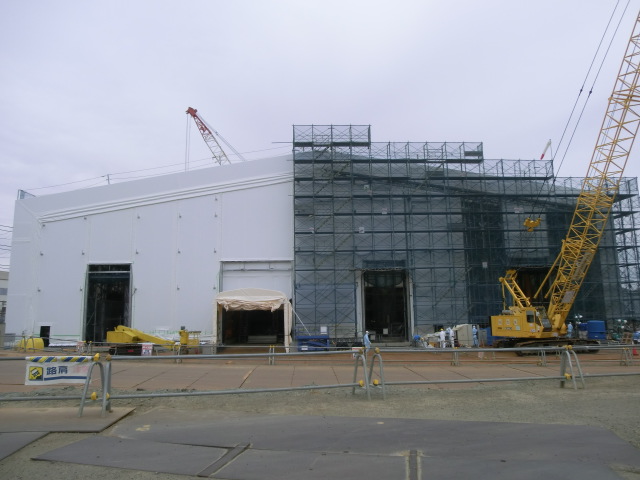
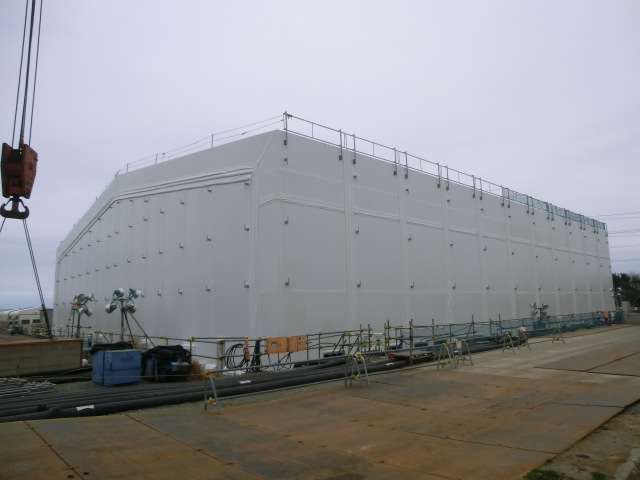
This structure...


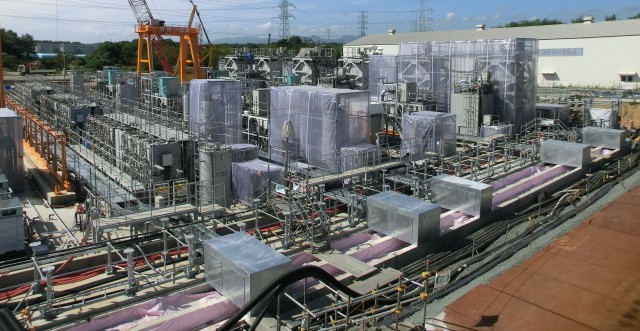
Is housing this (photo taken on September 16, 2012):


The hot testing of the line A is to continue till the end of July. The first analysis of treated water is scheduled in mid April, according to TEPCO's timeline (on page 8 of the handout above).

ALPS can remove 62 different nuclides, including strontium and americium. Pages 13 to 17 shows the nuclides and removal performance of ALPS (on a small-scale test, I suppose).

What's missing is tritium, which cannot be removed.

As space to build more temporary storage tanks becomes scarcer at Fukushima I Nuclear Power Plant, and some materials used to build these tanks (which are bolted together not welded) reach the end of useful life in 3 years, the company (and its effective owner, the national government) will try harder to win consensus on releasing the water treated by ALPS into the ocean.

Not before another politician, this time from LDP, does another performance of drinking the treated water to prove safety, I'm hoping.

Friday, March 29, 2013

"Soh-Teh-Gai" (想定外; Beyond Expectation) in Cyprus: Bank of Cyprus Depositors to Get 37.5% of Deposits in Bank Shares and Some Interest on the Remaining Deposts Which Will Not Be Returned


It looks like Russians have cleaned their accounts.

According to Reuters, Bank of Cyprus's depositors will get, for deposits over 100,000 euros:

37.5% bank equity (priced at ....?)
22.5% of deposit will earn no interest
40% of deposit will earn interest but won't be repaid sans some miracle that the bank does well.

Latest from Reuters (3/29/2013):

Big depositors in Cyprus to lose far more than feared

Big depositors in Cyprus's largest bank stand to lose far more than initially feared under a European Union rescue package to save the island from bankruptcy, a source with direct knowledge of the terms said on Friday.

Under conditions expected to be announced on Saturday, depositors in Bank of Cyprus will get shares in the bank worth 37.5 percent of their deposits over 100,000 euros, the source told Reuters, while the rest of their deposits may never be paid back.

The toughening of the terms will send a clear signal that the bailout means the end of Cyprus as a hub for offshore finance and could accelerate economic decline on the island and bring steeper job losses.

Officials had previously spoken of a loss to big depositors of 30 to 40 percent.

Cypriot President Nicos Anastasiades on Friday defended the 10-billion euro ($13 billion) bailout deal agreed with the EU five days ago, saying it had contained the risk of national bankruptcy.

"We have no intention of leaving the euro," the conservative leader told a conference of civil servants in the capital, Nicosia.

"In no way will we experiment with the future of our country," he said.


(Well Mr. Anastasiades, you just did.)

...At Bank of Cyprus, about 22.5 percent of deposits over 100,000 euros will attract no interest, the source said. The remaining 40 percent will continue to attract interest, but will not be repaid unless the bank does well.

Those with deposits under 100,000 euros will continue to be protected under the state's deposit guarantee.


(For now, you mean.)

...But policymakers are divided, and the waters were muddied a day after the deal was inked when the Dutch chair of the euro zone's finance ministers, Jeroen Dijsselbloem, said it could serve as a model for future crises.

Faced with a market backlash, Dijsselbloem rowed back. But on Friday, European Central Bank Governing Council member Klaas Knot, a fellow Dutchman, said there was "little wrong" with his assessment.

"The content of his remarks comes down to an approach which has been on the table for a longer time in Europe," Knot was quoted as saying by Dutch daily Het Financieele Dagblad. "This approach will be part of the European liquidation policy."

(Full article at the link)


So he did say that and now it's confirmed as experiment and template. I have a feeling that more people are now hoping for liquidation of EU.

So it probably isn't "soh-teh-gai" after all. It was, and has been, well within the expectation that Russians would clean their accounts in time, and that "haircuts" (or decapitation) will be administered to the rest of them small people so that they can serve as a model of European liquidation.

CBS News: Obama Signs "Monsanto Protection Act" into Law, GMO Opponents Furious


The "Act" is actually the Section 735 of H.R. 933 "Consolidated and Further Continuing Appropriations Act, 2013" which enables the US government to fund itself without passing any budget until the end of the fiscal year (September 30, 2013):

Sec. 735. In the event that a determination of non-regulated status made pursuant to section 411 of the Plant Protection Act is or has been invalidated or vacated, the Secretary of Agriculture shall, notwithstanding any other provision of law, upon request by a farmer, grower, farm operator, or producer, immediately grant temporary permit(s) or temporary deregulation in part, subject to necessary and appropriate conditions consistent with section 411(a) or 412(c) of the Plant Protection Act, which interim conditions shall authorize the movement, introduction, continued cultivation, commercialization and other specifically enumerated activities and requirements, including measures designed to mitigate or minimize potential adverse environmental effects, if any, relevant to the Secretary’s evaluation of the petition for non-regulated status, while ensuring that growers or other users are able to move, plant, cultivate, introduce into commerce and carry out other authorized activities in a timely manner: Provided, That all such conditions shall be applicable only for the interim period necessary for the Secretary to complete any required analyses or consultations related to the petition for non-regulated status: Provided further, That nothing in this section shall be construed as limiting the Secretary’s authority under section 411, 412 and 414 of the Plant Protection Act.


As CBS News (3/28/2013) puts it:

Critics slam Obama for "protecting" Monsanto

There's no love lost between Washington and the American public, it seems, five days after Congress for the first time in years managed to handle a budget-related issue without reaching the brink of crisis.

Protesters have descended on Pennsylvania Avenue outside the White House this week, enraged at a potentially health-hazardous provision they allege lawmakers inserted surreptitiously into a continuing resolution (CR) that will fund the government through the remainder of the fiscal year. The bill sailed through the Capitol on Friday; President Obama signed it into law on Tuesday.

Opponents have termed the language in question the "Monsanto Protection Act," a nod to the major agricultural biotech corporation and other like firms geared at producing genetically modified organisms (GMO) and genetically engineered (GE) seeds and crops. The provision protects genetically modified seeds from litigation suits over health risks posed by the crops' consumption.

Food safety advocacy groups like Food Democracy Now, which collected more than 250,000 signatures on a petition calling for the president to veto the CR, argue not enough studies have been conducted into the possible health risks of GMO and GE seeds. Eliminating judicial power to halt the selling or planting of them essentially cuts off their course to ensuring consumer safety should health risks emerge.

Seeking a "balance" to the newly minted law, Food Democracy Now has shifted its tactics to encouraging supporters to sign and send letters to Mr. Obama, chiding him for signing the legislation despite that refusal to do so would have expired the federal budget and triggered a government-wide shutdown this week.

Part of the template for the letter reads: "In an effort to balance this violation of our basic rights, I am urging you as President to issue an Executive Order to require the mandatory labeling of genetically engineered foods, something that you promised farmers while on the campaign trail in 2007. It is urgent that the U.S. government rectify the 20 year old politically engineered loophole and allow for open and transparent labeling of genetically engineered foods," the letter continues, "a basic right that citizens in 62 others countries already enjoy."

Other groups have aimed their ire toward the more worthy target, criticizing Congress for slipping the language into a must-pass bill without review by the Agricultural or Judiciary Committees. The International Business Times reports that the Center for Food Safety is putting in the hot seat Sen. Barbara Mikulski, D-Md., chairwoman for the Senate Appropriations Committee, for not giving the amendment a proper hearing. According to Salon, many members of Congress who voted to approve the bill were unaware the language existed.

(Full article at the link)


Seeking a "balance"? It's amusing that Food Democracy Now is urging the president to use an Executive Order to mandate GMO labeling. As if campaign promise is something that any candidate should fulfill once in office. As if the president cares, when his food safety czar is a former vice president of Monsanto. And an Executive Order?

I'd love to know who put this section into the bill, though.

CBS says "refusal to do so [sign the bill] would have expired the federal budget and triggered a government-wide shutdown this week", as if it is a really bad thing. Very funny.

The proposition that would have required GMO labeling in California was soundly defeated in the November 2012 election by an extremely well-funded, out-of-state industrial lobby headed by Monsanto.

Thursday, March 28, 2013

US Sends Nuclear-Capable B-2 Stealth Bombers to South Korea


To further feed paranoia in the already paranoid North Korean regime? To achieve what?

From Washington Post quoting AP (3/28/2013):

US sends nuclear-capable B-2 bombers to South Korea in show of force

SEOUL, South Korea — The U.S military says two nuclear-capable B-2 bombers have completed a training mission in South Korea amid threats from North Korea that include nuclear strikes on Washington and Seoul.

The statement Thursday by U.S. Forces Korea is an unusual confirmation. It follows an earlier U.S. announcement that nuclear-capable B-52 bombers participated in ongoing U.S.-South Korean military drills.

The U.S. says the B-2 stealth bombers flew from a U.S. air base and dropped munitions on a South Korean island range before returning home.

The announcement will likely draw a strong response from Pyongyang. North Korea sees the military drills as part of a U.S. plot to invade and becomes particularly upset about U.S. nuclear activities in the region.

Washington and Seoul say they the annual drills are routine and defensive.


"Defense Secretary Chuck Hagel said the addition of nuclear-capable B-2 stealth bombers to military drills with South Korea was part of normal exercises and not intended to provoke a reaction from the north." (CBS News, 3/28/2013)

To fly two B-2 stealth bombers to and from South Korea, it costs $5.5 million, according to Antiwar.com.

(Sequester? What sequester?)

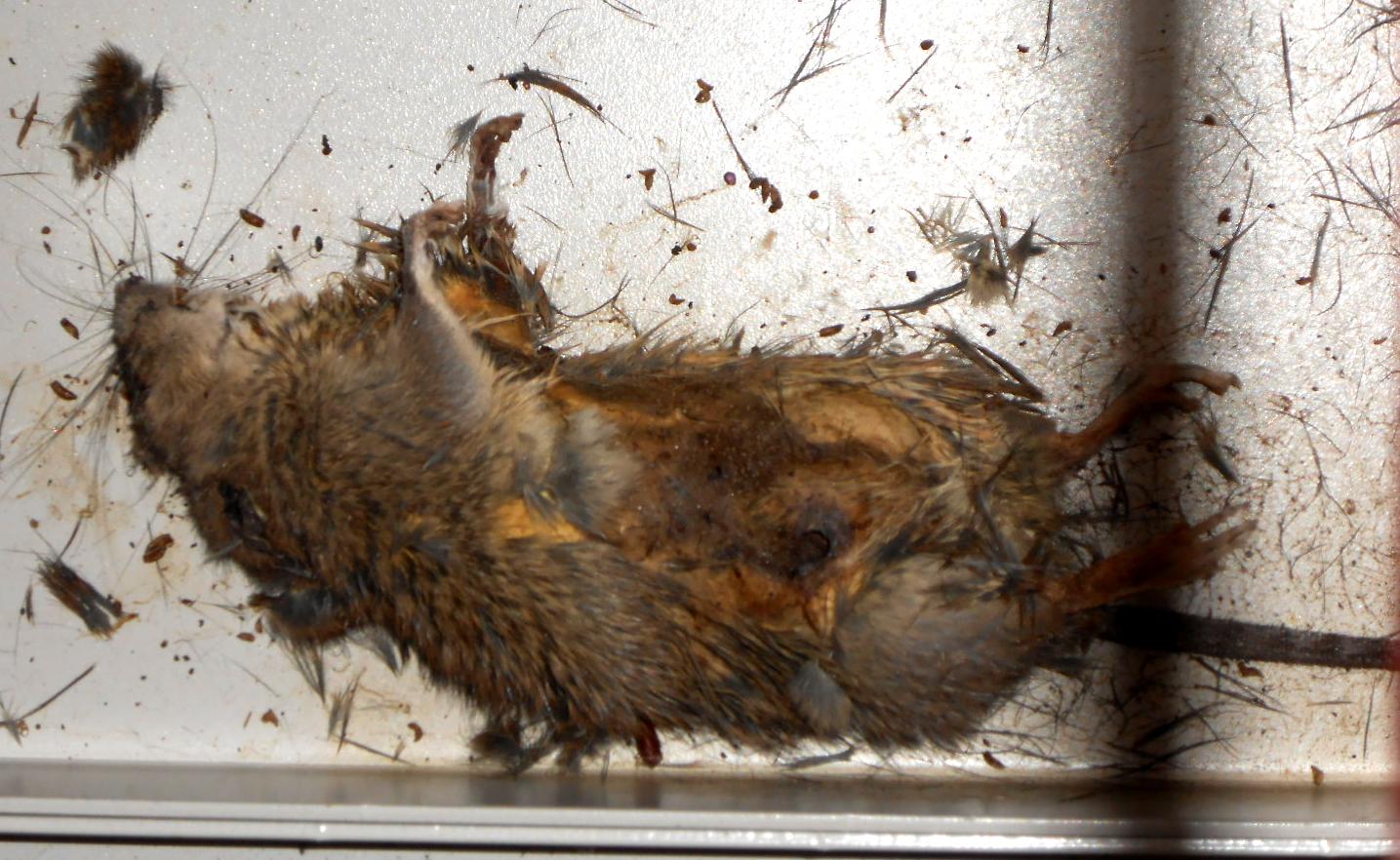
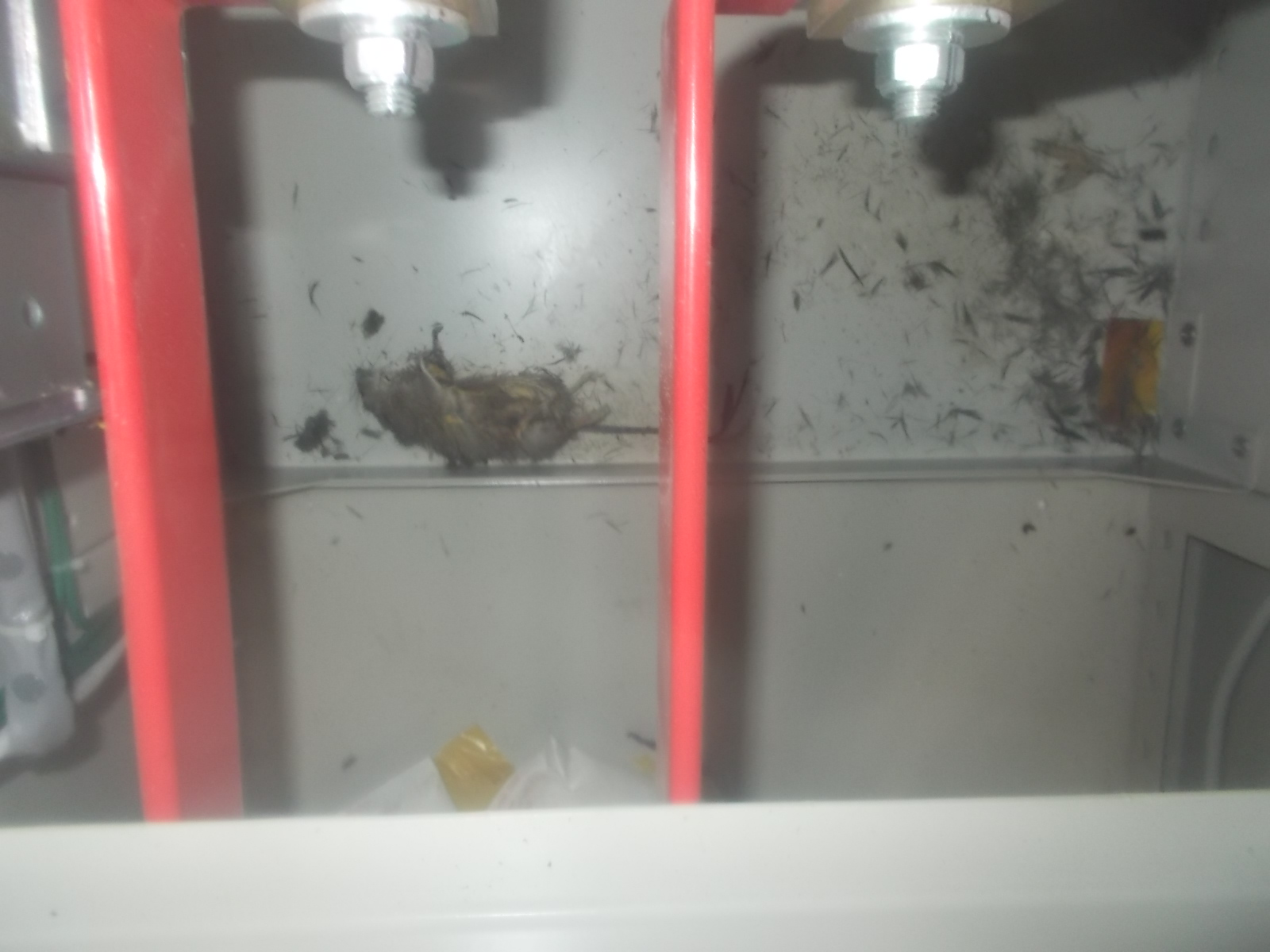
#Fukushima I Nuke Plant: Photo of an Electrocuted and Very Dead Mouse


Remember that power outage? TEPCO released the result of their investigation on March 25, 2013.

The mouse has a mark in the stomach from an electric shock.


From TEPCO's Photos and Videos Library, 3/25/2013, "Progress of Investigation of Power Supply Facilities Failure at Fukushima Daiichi Nuclear Power Station":

The regular M/C was receiving power from the temporary M/C because of the ongoing renovation work:


(Text part)

[Power supply system structure]
Since power receiving cable renovation for the regular M/C in the Process Building (as part of Tsunami countermeasures) was ongoing at the time of the incident, the regular M/C was temporarily receiving power from the
backup M/C in the Process Building.
[Analysis]
1. The ground relay in B system operated: The failure is assumed to have occurred in B system and high voltage power supply system.
2. The circuit breakers of the regular M/C (3A) and (4A) in the Process Building and the backup M/C in the Process
Building (3A) tripped due to overcurrent. : The failure is assumed to have occurred in the downstream of the regular M/C in the Process Building (4A).
3. The ground directional relays and the circuit breakers of Units 3-4 temporary M/C (4A), (5A) and (10A) did not
operate. : The failure is assumed to hav
e occurred in the upstreamof the load systems of Units 3-4 temporary M/C.
4. Fault current was found in Units 3-4 temporary M/C (A)(5B). : The failure is assumed to have occurred in the
downstream of Units 3-4 temporary M/C (A) (5B).

Conclusion page:


TEPCO will install mouse traps as countermeasure.

Wednesday, March 27, 2013

#Fukushima Namie-Machi on Google Street View


Google announced on March 4 this year that it was sending the crew to capture "Street View" of Namie-machi, Fukushima Prefecture, at the request of Mayor Baba.

Not all of Namie-machi is captured yet, but here it is. There is no one there, and houses and stores are broken, deserted; there is nothing left in the farmland along the coast. In the center of the town, there are stores side by side, one utterly collapsed, the other seemingly intact.


View Larger Map

I don't know if Google Japan plans to send people to the high radiation spots within Namie-machi, such as Akougi and Tsushima.

There are many in Japan who seems to think anything done by a company based in the US has something to do with "conspiracy" to defraud Japan. According to such people, the reason why Google Japan has already started showing the Street View (they said it would take a few months) is because the mayor of Namie-machi has sided with the national government, so all the goodies like Google Street View will be quickly done, as some kind of perks.

Sided with the national government? It seems that for such people, having to agree to the reorganization of the no-entry zone into three new zones in preparation for future return (as if these mayors have any choice), as pushed by the national government, is the same as colluding with the national government.

I thought of responding to someone who clearly seems to think that way, but then I looked at the desolation captured by the Street View. I'd rather thank Google instead. Thank you.

Tuesday, March 26, 2013

JNES Calculation of the Amount of Radioactive Materials Released from #Fukushima I Nuke Plant


Japan Nuclear Energy Safety Organization (JNES), an independent administrative corporation under the Ministry of Economy, Trade and Industry, issued the result of its calculation of radioactive amounts released from Fukushima I Nuclear Power Plant in the first week of the nuclear accident.

From JNES presentation (3/27/2013), unit is petabecquerel (1x10^15) and 1 petabecquerel is 1,000 terabecquerels:

From March 11 to March 17, 2011,

I-131: 250 to 340 petabecquerels (or 250,000 to 340,000 terabecquerels)
Cs-134: 8.3 to 15 petabecquerels (or 8,300 to 15,000 terabecquerels)
Cs-137: 7.3 to 13 petabecquerels (or 7,300 to 13,000 terabecquerels)

For I-131, JNES's calculation, which is based on the accident progress analysis, is closest to TEPCO's number which is the highest (500 petabecquerels, or 500,000 terabecquerels).

In the image below (English labels added by me), from the top row, the entities that did the analysis are:

  • Japan Nuclear Energy Safety Organization (JNES)

  • TEPCO

  • Japan Atomic Energy Agency (JAEA)

  • Japan Agency for Marine-Earth Science and Technology (JAMSTEC)

  • Central Research Institute of Electric Power Industry (CRIEPI)


All except JNES based their calculation on the actual measurement of radioactive materials.


I find it interesting that JNES's calculation shows potentially more Cs-134 than Cs-137. From the actual measurements on the ground, I believe the ratio has been 1:1 to 1:1.2.

On the night of March 11, 2011, the now-defunct Nuclear and Industrial Safety Agency (NISA) had JNES do the simulation using the Emergency Response Support System (ERSS) to predict the progression of the accident. JNES faxed the result of the simulation for Reactor 2 to NISA as early as 9PM on March 11, the simulation for Reactor 1 by noon on March 12 (more than three hours before the explosion), and the simulation for Reactor 3 at 6:30AM on March 13. The faxed results for Reactor 2 was delivered to the Prime Minister's Official Residence just past midnight on March 11 (early hours of March 12). (Jiji Tsushin, 9/3/2011)

No one acted on them.

NISA was trying to figure out the areas to have people evacuate. In addition to ERSS, the agency also ordered SPEEDI simulations done, using the information that the agency collected on its own. The agency dropped that effort when Prime Minister Kan and his ministers thought they knew best and drew concentric circles around the plant and decided the evacuation zones, ignoring the emergency protocol that specifically said they should use SPEEDI simulations for that purpose. (Asahi Shinbun's "Trap of Prometeus" Part 2)

Cyprus Latest: 80 Percent "Haircut" for Uninsured Depositors at 2nd Largest Bank


And "informality" of all of this.

First, from UK's Telegraph Live Blog on Cyprus Bailout (3/26/2013):

21.19 Cyprus Finance Minister Michael Sarris has said uninsured Laika depositors could face an 80pc haircut, and might have to wait up to seven years for a payout.

He adds: "If Parliament had voted on March 17 [instead of March 19], maybe we could have saved Laiki Bank... It's obvious that Germany wants to impose its will on the people of the South. They didn't want to show to German taxpayers that they would pay to save Russian depositors' money.


Sure, Minister Sarris.

That's the meme by the way in the US in the public radio programs - taking the money from those bad, rich Russians is only fair. (Fair to whom? German taxpayers who fork out money as their government instructs them to do?)

What's so really funny and sad about all this is: Why does anyone have to listen to this "informal" group of Eurozone finance ministers which doesn't even keep the records of their "informal" meetings, not to mention follow what these ministers informally decide?

From Gary North (3/19/2013; emphasis is mine):

The No-Name European Committee That Made the $13 Billion Guarantee to Cypriot Banks

The Eurogroup held a teleconference this evening to take stock of the situation in Cyprus.

The eurozone's decision-making institution on the euro is an informal committee of finance ministers. The committee has no official name. It has no official power. It is not voted into office.

In the Lisbon Treaty, which went into effect on January 1, 2009, this no-name informal committee at last got its legal status.

Article 1: The Ministers of the Member States whose currency is the euro shall meet informally. Such meetings shall take place, when necessary, to discuss questions related to the specific responsibilities they share with regard to the single currency. The Commission shall take part in the meetings. The European Central Bank shall be invited to take part in such meetings, which shall be prepared by the representatives of the Ministers with responsibility for finance of the Member States whose currency is the euro and of the Commission.

Article 2: The Ministers of the Member States whose currency is the euro shall elect a president for two and a half years, by a majority of those Member States.

http://en.wikipedia.org/wiki/Euro_Group

So, it meets informally. It discusses questions. The Commission takes part. (How? With what authority? With how many votes?) The ECB is invited. It does not have a vote.

The president of the no-name committee has a name no one can pronounce unless he is Dutch, Jeroen Dijsselbloem. (http://en.wikipedia.org/wiki/Jeroen_Dijsselbloem)

Yet this no-name Committee promised Cyprus banks $13 billion worth of euros over the weekend, on its own authority, and answerable to no one in any European parliament, including the European Union.

This is called democracy in Europe. In Europe, democracy means: "You dumb clucks."

The bailout required the government of Cyprus to impose a capital tax on all bank accounts.

This was announced on Monday by the newly elected President of Cyprus. The voters of Cyprus went ballistic. The President of Cyprus had sworn to the people in his inauguration address on February 28 that he would never, ever do this.

Translation: "You dumb clucks."

The Parliament of Cyprus has thrown a spammer into the works. It has refused to impose the tax. What's this? It's democracy. The real kind.

The president of the no-name informal committee, which is informally called the "Euro Group," has issued a statement. It is unsigned. (No one can pronounce it, so who cares?) He is appalled at this betrayal by the parliament of Cyprus. This was a secret deal, and secret deals are supposed to be agreed to by Parliaments. Parliaments are supposed to be rubber stamps. Who does the bunch of stooges think they are, anyway?

I reproduce this announcement verbatim from the website of the so-called Euro Group. I also provide a translation.

I recall that the political agreement reached on 16 March on the cornerstones of the adjustment programme and the financing envelope for Cyprus reflects the consensus reached by the Cypriot government with the Eurogroup.

Because the meeting was held in secret, there were no official notes. You will have to trust my memory. The group met with the someone or other -- I cannot recall who -- who said he represented the government of Cyprus.

The implementation of the reform measures included in the draft programme is the best guarantee for a more prosperous future for Cyprus and its citizens, through a viable financial sector, sound public finances and sustainable economic growth.

The parliament of Cyprus should rubber stamp this deal. It is best for Cyprus citizens. Pay no attention to those crowds in front of the Parliament shouting "no!"

I reiterate that the stability levy on deposits is a one-off measure.

No body in the Eurozone outside of the no-name group with no official power has approved any of this. It has never happened before. It will never happen again. Trust me.

This measure will - together with the international financial support - be used to restore the viability of the Cypriot banking system and hence, safeguard financial stability in Cyprus. In the absence of this measure, Cyprus would have faced scenarios that would have left deposit holders significantly worse off.

No one in power told the voters of Cyprus that its banking system was close to collapse. But I am, now that someone or other representing the government of Cyprus agreed to it.

The Eurogroup continues to be of the view that small depositors should be treated differently from large depositors and reaffirms the importance of fully guaranteeing deposits below EUR 100.000. The Cypriot authorities will introduce more progressivity in the one-off levy compared to what was agreed on 16 March, provided that it continues yielding the targeted reduction of the financing envelope and, hence, not impact the overall amount of financial assistance up to EUR 10bn.

The Cypriot authorities will do this because we say so. They have cooperated so far by stealing the people's money over the weekend, in preparation for the heist on Monday.

The Eurogroup takes note of the authorities' decision to declare a temporary bank holiday in Cyprus on 19-20 March 2013 to safeguard the stability of the financial sector, and urges a swift decision by the Cypriot authorities and parliament to rapidly implement the agreed measures.

Our no-name committee speaks for all of the member nations of the eurozone.

The euro area Member States stand ready to assist Cyprus in its reform efforts on the basis of the agreed adjustment programme.

The voters who will fork over the money to bail out the banks of Cyprus are 100% behind this. Trust me.

That ended the press release:

http://eurozone.europa.eu/newsroom/news/2013/03/peg-statement-cyprus-18-03-13

This is the foundation for a never-ending crisis in the eurozone. This is business as usual.

Here is the no-name president of the no-name committee which pledged the money to bail out the banks of Cyprus. Let me translate. "There is no problem here. There is nothing to see here. Move along."

Obama's Carbon Tax Plan with IMF, G-20, World Bank with Iran as Model


Speaking of anthropogenic global warming caused by CO2 (reference to the previous post), the Team Obama has a great plan for you, which probably will be forced on to you via the presidential executive order.

It'll be for the interest of people in the United States, they will say, just like the deposit theft in Cyprus will be in the interest of people in Cyprus. (By the way, Russians may have already transferred their money out of Cyprus, leaving Cypriot citizens and businesses to pay for their own bail-out, I mean bail-in. 100% haircut? More like a decapitation.)

If you look at the players - US Treasury, IMF, G-20, World Bank (who cites Iran as success), you know they are up to no good.

Just like so-called housewives (employees of TEPCO PR subcontractor) shaping the "more electricity and more nuclear power are good for you" message for naive fellow housewives and their kids, they suggest a clever way to make people feel good about being taxed and having the standard of living lower while their money goes to bureaucrats in foreign countries:

call the carbon tax an “offset” instead of a “tax,” and downplay economic costs to “focus on framing green policies as a way to reach an ambitious and positive social goal

How they take us for fools.

From Fox News opinion page, by Phil Kerpen (3/21/2013; emphasis is mine):

Here comes Team Obama's carbon tax

The Treasury Department’s Office of Environment and Energy has finally begun to turn over documents about its preparations for a carbon tax in response to transparency warrior Chris Horner’s Freedom of Information Act request. The documents provide solid evidence that the Obama administration and its allies in Congress have every intention of implementing a carbon tax if we fail to stop them.

The Office of Environment and Energy, if you’ve never heard of it, is housed in Treasury’s Office of International Affairs and exists principally to wait for authority to administer the revenue from a cap-and-trade scheme or carbon tax. And, apparently, to trick Americans into supporting the tax to provide it the money. So the documents they’ve reluctantly released are worth a careful look.

There’s the G-20 report titled “Mobilizing Climate Finance,” which pegs the price tag at $2.1 trillion “of investment requirement” in a “global carbon market.”

There’s the helpful IMF report from Ian Parry of the Fiscal Affairs Department on “Public Sources of Climate Finance.” Parry’s stated goal for the United States is “raising revenue and putting it to good use.”

He suggests a $25 per metric ton carbon tax – right in the middle of the range suggested by the discussion draft legislation recently released by U.S. Rep. Henry Waxman, the top Democrat on the House Energy and Commerce Committee – and noted that $25 billion a year could be sent abroad “for climate finance.”

He singles out aviation and maritime fuels as “under-taxed” and suggests new taxes on fuels or directly on aircraft and ship operators. Parry notes that this “will harm developing countries” – for the simple reason that it’s economically harmful -- and concludes “compensation needed for fairness.” (Obama recently asked Congress to OK another $65 billion in increased IMF dues, no doubt so we can receive more of this kind of advice.)

By far the biggest document is from the World Bank. It’s titled “Inclusive Green Growth: The Pathway to Sustainable Development.” The document itself is posted on the World Bank website, but that doesn’t mean its use at the U.S. Treasury Department doesn’t require scrutiny. The report notes that “some observers, mostly in high-income countries, have argued against the need for more growth, suggesting that what is needed instead is a redistribution of wealth.” It seems this “remains more relevant for high-income countries” like the United States.

The report goes on to outline how a carbon tax could be used to drive a massive redistributive scheme based on – believe it or not – Iran as a model of success: “The political economy of reform will likely require compensatory transfers to the middle class. In the Islamic Republic of Iran… 80 percent of households received significant transfers—no doubt contributing to the success of the reform.” It continues: “In the end, the redistributive impacts of a carbon price scheme depend on how revenues from the scheme are used.”

Such a redistributive scheme is a key element of carbon tax proposals from Waxman and from Barbara Boxer, the chair of the Senate Environment and Public Works Committee.

It’s easy to foresee a “gas stamps” program much like food stamps that would provide a taxpayer-funded gas purchasing card to people up to some multiple of the federal poverty level. Much like ObamaCare, a policy driving up costs would be paired with a huge new welfare program that would foster government dependency and political loyalty.

The World Bank paper also advises Treasury on how to convince the public. It says to call the carbon tax an “offset” instead of a “tax,” and downplay economic costs to “focus on framing green policies as a way to reach an ambitious and positive social goal (such as becoming carbon neutral by 2050 or becoming a leader in solar technologies).”

This advice helps explain why an administration so heavily invested in implementing a carbon tax attempts to deny any such thing is going on.

What else are they hiding? At least 10,000 emails from 2012 alone. Horner has filed suit, and Treasury can only stonewall for so long.

One thing that’s already clear is that the preparations to pursue a carbon tax are very much proceeding in earnest.

We need to be ready to fight back.


Monday, March 25, 2013

#Radioactive Japan: Once TEPCO, Always TEPCO, Even for Female Employees


Japan is the number one country in the world where nearly 90% of the citizens believe in anthropogenic global warming. 54 nuclear reactors in Japan have been justified as carbon-free "clean" energy to help fight the global warming.

The truth is that nuclear energy has been pushed by the electric power companies because it fattens their bottom lines thanks to the accounting allowed by the national government. No matter how much the nuclear power generation costs, the power companies are allowed to fully transfer that cost to the consumers (mostly retail, household customers) and add a fixed percentage of that cost as their profit. In other words, bigger the cost, bigger the profit.

But nuclear energy was actually not needed to meet the demand in the beginning of this century, as the economy was still in doldrums after the massive real estate bubble burst and people had other sources for heating and cooking (natural gas, heating oil). So what did the power companies and the national government come up with?

A coordinated push to increase electricity consumption by launching a campaign of "all-electric lifestyle". It suddenly became "cool and sophisticated" to heat the house using electricity, cook with electricity. Electricity consumption skyrocketed in large cities like Tokyo, justifying more nuclear reactors to meet the newly created "demand" in a country with declining population and the economy that was going nowhere.

At the same time, TEPCO, for one, was busy educating the impressionable mothers, selling them the story of global warming and how they could help save the planet by going clean electric.

The company didn't do it themselves, of course. It used a subcontractor.

Mainichi English (3/25/2013):

'Housewives' educating children on energy linked to TEPCO PR firm

A puppet theater troupe advertising itself on its website as "started by a group of housewives concerned about energy" was in fact founded by staff from Tokyo Electric Power Co. (TEPCO)'s PR firm, the Mainichi has learned.

According to the website of the puppet theater troupe in question -- Kappa no Kawataro Ichiza -- in 2000 a group of housewives set up an online "energy club" to exchange their views on energy after taking their "children to visit a nuclear power plant and discovering the great efforts being taken to supply energy to private households."

The puppet troupe was launched after club members decided they "wanted to pass on the importance of energy to (their) children," the website continues. In 2002, the troupe was certified as the Japan Industrial Location Center (JILC)'s "energy theater caravan nonprofit organization project."

According to a leading member of the group, however, all five members of the troupe belong to a research firm doing publicity work for TEPCO. Their PR work involves holding parties at their homes for fellow housewives and informing participants of the necessity of nuclear power. One troupe member threw approximately 300 such parties at her home.

Upon hearing from participants at the parties that they wanted their children to learn the same information, the group responded to a JILC call for theater troupes to educate young children about energy. Group members said they made a presentation at the Agency for Natural Resources and Energy -- which commissioned the JILC competition -- before the public competition, and were promised assistance on the spot. The members did not explain, however, whether they went to the agency on their own initiative or were encouraged by another party to do so.

One puppet show plot entails "kappa," a creature from Japanese folklore, receiving a letter from a polar bear asking for help. The kappa set out to find that melting ice has separated a baby polar bear from its mother. While the mother and cub are reunited, the kappa are dumbfounded to hear about global warming. Another of the group's shows features a trip to the Edo period (1603-1868) in a time machine to get a glimpse of life without electricity and an understanding of how convenient life has become because of it.

Through 2005, the troupe received up to 2.5 million yen a year in assistance as part of the agency and JILC program, performing at schools in areas hosting nuclear power stations, and at events in the Tokyo metropolitan area. Each member received 7,000 yen per performance. After financial assistance subsequently plummeted to 600,000 yen per year, however, the group chose to cut off its affiliation with the project. Since the March 2011 Great East Japan Earthquake, the troupe has performed for children at the request of the Atomuseum in Niigata Prefecture.

The members admit to some feelings of discomfort with their dealings with TEPCO PR officials.

"TEPCO employees sometimes come to our parties for training, but they say they want us to keep their presence a secret form the people we've invited," one member said. "There are things (TEPCO) won't tell even us."


Now they say they are uncomfortable, after being busted by Mainichi. They also quickly took down their website (here's a cache). They took down the youtube videos on their channel, but here's one copied by a user - "Kappa meets dinosaur":

#Radioactive Japan: 50 Millisieverts Radiation Exposure Per Year Is "Low" Enough to Bring Residents and Businesses Back to Tomioka-Machi in Fukushima


That's where Fukushima II (Daini) Nuclear Power Plant is located, but the town was heavily contaminated when the radioactive plume released from Fukushima I (Daiichi) Nuclear Power Plant (mostly from vent, from explosions to a lesser degree) hit south. The entire town has been designated as "no-entry (exclusion) zone".

But now, one year after similar measures were taken in other outlying cities and towns like Minami Soma City, Tomioka-machi and Namie-machi, another very contaminated town north of Fukushima I Nuke Plant, are being reorganized into new zones that signifies "hope" (at least for the government if not for the residents). No more forbidding "no-entry zone".

The areas which are expected to have cumulative radiation exposure of 20 millisieverts or less per year will be called the "zone in preparation for having the evacuation order lifted" (避難指示解除準備区域) where people are free to go back and live (or I should say strongly encouraged to go back and live) after the national government thoroughly decontaminate the areas.

The areas with the expected cumulative radiation exposure of 20 to 50 millisieverts per year will be called the "zone with restricted entry" (居住制限区域) which only means cannot cannot stay there overnight but no problem if they want to commute to work there.

Only if the cumulative radiation exposure per year in the areas exceed 50 millisieverts, the areas are designated as "zone where it is difficult for people to return" (帰還困難区域), and people cannot go back at all until 5 years after the accident, meaning only three more years. After three more years, the cumulative radiation levels per year are magically expected to drop below 50 millisieverts. (Good luck with that, with cesium-137 whose half-life is 30 years.)

Who measures the radiation levels? The national government under the pork-cutlet-over-rice prime minister (baseless rumors say he won't last long, as his stomach ailment has returned) of course. They will continue token "decontamination" - practically smearing the area with water and bagging the top soil (if that, these days), cutting branches of trees (and dumping in the rivers nearby) - mostly to profit general contractors, greatly save on compensation money, and claim "See, we're not Chernobyl! We're returning people in two years!".

Here's from Mainichi English, talking hopefully about cherry blossom viewing event in the most contaminated area inside Tomioka-machi (3/25/2013; emphasis is mine):

Nuke disaster exclusion zone change has Fukushima town ready for cherry blossom season

TOMIOKA, Fukushima -- The cherry blossoms in this town are on the edge of blooming, and as of March 25 local residents can see the buds in person for the first time since the Fukushima nuclear disaster began more than two years ago.

Tomioka had been locked inside the nuclear disaster exclusion zone since the town was evacuated in March 2011. However, the national government has determined that radiation doses in about 70 percent of the town have fallen to 50 millisieverts per year or less -- still high, but low enough to re-designate these areas as open to temporary visits.

The rezoning happens to cover a good portion of Yonomori Park, known for its some 1,500 cherry trees lining an L-shaped road and forming a pink tunnel when in full bloom.

"The buds look ready to pop open," said Kiyoshi Horikawa, the 72-year-old chairman of a local cherry blossom viewing group as he looked on the trees on March 25.

The day also marked the beginning of decontamination work on the trees. Unfortunately, the east-west part of the route generally remains in the exclusion zone and generally out-of-bounds even for quick visits. Many of the trees in that section are more than a century old.

Nevertheless, the town government is planning a cherry blossom-viewing bus trip for residents in late April, and includes the section still inside the exclusion zone.


So the national government has simply decided the radiation levels have dropped below 50 millisieverts per year in 70% of the town. Why didn't Russians think of this wonderful gimmick?

Sunday, March 24, 2013

Cyprus President Justifies 40 to 100% "Haircut" as "Best Interest of the Cyprus People and EU"


Rejoyce! Cyprus is saved!

From what, you may ask?

Who cares? They will take 40% of uninsured (over 100,000 euros) deposits at one bank, and take 100% of such deposits at another bank so that they can pay international creditors, and say "it's for the people of Cyprus".

It's for the people of Cyprus but the Cypriot Parliament doesn't need to vote, says Germany's fin min Wolfgang Schaeuble.

Stock market futures jump on this merry news of yet another save for the large financial institutions in Europe and the US.

(Photo is Cyprus President Nicos Anastasiades emerging from the meeting, from Nikkei.)

From Bloomberg News (3/24/2013):

Cyprus Said to Reach Tentative Deal to Avert Default

Cyprus agreed to the outlines of an international bailout, paving the way for 10 billion euros ($13 billion) of emergency loans and eliminating the threat of default.

The accord between Cyprus and the “troika” representing international lenders was reached in overnight talks in Brussels and ratified by finance ministers from the 17-nation euro area.

“It’s in best interest of the Cyprus people and the European Union,” Cyprus President Nicos Anastasiades told reporters.

...The agreement calls for Cyprus Popular Bank Pcl (CPB) to be shut down and split. The Bank of Cyprus Plc would take over the viable assets of the failed bank along with 9 billion euros in central bank-provided emergency liquidity aid, according to three EU officials who asked not to be named because talks are ongoing.

Deposits below the EU deposit-guarantee ceiling of 100,000 euros will be protected, and a loss of no more than 40 percent will be imposed on uninsured depositors at the Bank of Cyprus, two EU officials said. Uninsured depositors at Cyprus Popular would largely be wiped out, two other officials said.

(Full article at the link)


Much more and with appropriate sarcasm at Zero Hedge (who still shows me ANA's horrendous "maid" with contact-lens-augmented blank eyes).

I wonder how Cyprus residents react to this wonderful news. Since most of their savings are guaranteed (under 100,000 euro) and it will be mostly Russians who will get wiped out, will they breathe a sigh of relief?

Or will some of them recall what one Nazi camp survivor said long time ago?

Saturday, March 23, 2013

#Fukushima I Nuke Plant Reactor 3: Those Blank 6 Hours of No Water Injection on March 13, 2011 May Have Been 12 Hours Instead, TEPCO's New Analysis Shows


So instead of just past midnight on March 13, 2011, the water may have stopped 6 hours earlier, on the night of March 12, 2011, a few hours after the Reactor 1 building blew up in an hydrogen explosion (which may have happened on the 4th floor instead of the 5th, top floor).

From Yomiuri Shinbun (3/24/2013):

3号機注水、12時間途絶か…解析やり直しへ

Water injection into Reactor 3 may have stopped for 12 hours, analysis to be redone

2011年3月の東京電力福島第一原子力発電所事故の際、3号機の原子炉への冷却水注入が途絶えた「注水の空白」は約12時間に及んでいた可能性が、東電などの調査で明らかになった。

It has been revealed by analysis by TEPCO and others that the blank in water injection into the Reactor 3 RPV may have been 12 hours in March 2011 in the Fukushima I Nuclear Power Plant accident.

 3号機の「注水の空白」は従来、3月13日未明から6時間半とされていたが、当時の運転員が記録した水位データが昨秋、新たに判明し、最大で約6時間早い12日夜には注水が止まっていた恐れが出てきた。

The blank in water injection into Reactor 3 is said to have been for 6.5 hours starting in the early hours of March 13, 2011. However, the data on water levels recorded by the operator at that time surfaced in fall last year, which shows the water injection may have stopped max 6 hours earlier, on the night on March 12, 2011.

 東電はこれまでの解析で、3号機の炉心溶融は13日朝に始まったとしてきたが、注水が早く停止したという新しい条件に基づき、解析をやり直す方針。その結果次第では、放射性物質の拡散状況を推定する前提条件が変わる可能性もある。東電の調査に関して、政府の事故調査・検証委員会は昨年7月の最終報告書で「事故の解明は不十分で、検証すべき論点やデータが残っている」と指摘していた。

TEPCO's current analysis shows the core melt of Reactor 3 started in the morning of March 13, 2011. The company plans to redo the analysis based on the new condition that the water injection may have stopped earlier. Depending on the result of the new analysis, it is possible that the conditions to estimate the dispersion of radioactive materials will change. Regarding TEPCO's investigation [of the accident], the independent accident investigation commission set up by the Cabinet Office pointed out in the final report issued in July last year that "the investigation of the accident is not enough, and there are issues and data still to be studied".


All I can say is that the investigation commission is correct.

Even though there was no MOX fuel in the Reactor 3 Spent Fuel Pool at the time of the accident, it was in the Reactor Pressure Vessel, being used in generating power.

Back in May 26, 2011, Mainichi English reported that TEPCO admitted the pipe connected to the High Pressure Coolant Injection system (HPCI) for the Reactor 3 probably broke during the earthquake (see my post on that day).

On March 13, 2011 at 12:55PM, TEPCO discovered that 1.9 meter of the fuel rods in Reactor 3 were exposed, and at 1:12PM they started to pour seawater into the RPV (see my post that day). Well, that 1.9 meter exposure was false, in retrospect.

Earlier that day, the emergency battery power ran out for the High Pressure Coolant Injection System, and the system shut itself down at 2:44AM. At 4:15AM, the fuel rods started to get exposed as the water in the container started to boil and water level started to go down. Nuclear emergency was issued on 6AM. (See my post from that day.)

Now, TEPCO is saying the water may have stopped much earlier than 2:44AM on March 13, 2011 when the HPCI stopped. Or are they saying the HPCI itself stopped much earlier? Or are they saying water ran out (as the pipe to the HPCI had been broken in the earthquake) before the HPCI stopped?

I'm looking forward to TEPCO's new and improved analysis. I want to know the true timeline of events, which is clear as mud after more than two years since the start of the nuclear accident.

Whether you like it or not, TEPCO remains unfortunately the only source of information when it comes to Fukushima I Nuke Plant.

Friday Humor from Idiosyncratic Japan: Government May Make English Proficiency Test (TOEFL) Mandatory for Career Bureaucrat Exam, to Prepare for TPP Negotiations


For those of you inside and outside Japan who don't know, TOEFL is an English language proficiency test for non-English speakers who want to study at colleges and universities in English-speaking countries.

It's basically a test to see if the prospective students can make conversations with classmates and teachers, read not-so-difficult textbooks and newspaper articles and write more or less grammatically correct sentences - English ability enough to get accepted at a college and enjoy a college life in English-speaking countries.

But as Tokyo Shinbun reports, the Japanese government under the Abe administration thinks it may be THE tool to select career bureaucrats who can battle it out with foreign counterparts in difficult and complicated international treaty negotiations, like the one for TPP.

I can't figure out whether Tokyo Shinbun is making fun, or they seriously believe what they've written.

(God save Japan. Or God demolish Japan ASAP...)

From Tokyo Shinbun (3/23/2013):

官僚は英語交渉力を 国家公務員試験にTOEFL 政府が義務付けを検討

Bureaucrats must have negotiation skills in English - government may make TOEFL test mandatory as part of Civil Service Examination

外国と渡り合える人材を求む-。政府は二〇一五年度の国家公務員採用試験から、英語運用能力テスト「TOEFL」の受験を義務付けることの検討を始めた。環太平洋連携協定(TPP)の交渉参加表明などを受け、将来的に対外交渉能力の強い官僚の育成が急務となっていることも背景にあるようだ。 (大杉はるか)

Wanted: People who can cross swords with foreigners. The national government is considering making TOEFL mandatory as part of the Civil Service Examination for the fiscal 2015. The government has formally expressed intention to participate in the negotiation of Trans Pacific Partnership (TPP), and may be feeling an urgent need to promote bureaucrats with strong ability to negotiate with foreign countries.

 TOEFLは、英語を母国語としない人を対象とした英語試験で、主に英語圏に留学する際に活用される。政府の産業競争力会議で委員から義務化の提言があり、人事院の原恒雄総裁が理解を示した。義務付けるテストをTOEFLに限定するか、点数を採用の判定基準にするかなどの具体案は今後検討する。人事院によると、一二年度の国家公務員(総合職)合格者のうち、TOEFLの受験者は16%にすぎない。

TOEFL is an English proficiency test targeted at people whose mother tongue is not English, and it is used primarily when one applies to study in English-speaking countries. The idea of mandatory TOEFL [for Civil Service Examination] came from commissioners in the Industrial Competitiveness Committee set up by the government, and Tsuneo Hara, president of the National Personnel Authority, has agreed to consider. Details will be discussed later, including whether they use TOEFL only, or whether the TOEFL score become one of the criteria for hiring. According to the National Personnel Authority, only 16% of people who passed the Civil Service Examination (career) in the fiscal 2012 had TOEFL test.

 ただ、現状でも官僚に求められる能力として「企画立案では諸外国の状況を参考にする場面が増えている」という。日本はTPP以外でも国際的な経済連携を拡大していく方針で、各国との交渉を担当する機会が増える官僚にとって、英語などの語学力は不可欠な素養となっている。

However, as of now, there are already an increasing number of occasions where the bureaucrats [must] study the situations in foreign countries when planning [government policies]. The Japanese government intends to expand international economic alliance in addition to TPP, and the language capabilities, particularly that of English, are indispensable for the bureaucrats in charge of negotiating with other countries.

 TOEFL義務付けだけでは交渉力までは身に付きそうにないが「内向き」「縦割り」の傾向が目立つ霞が関官僚の意識改革につながる可能性もある。

It is not likely that ability to negotiate can be acquired by making TOEFL mandatory, but there's a possibility that it will lead to the change in the way Kasumigaseki (career) bureaucrats think, who tend to be "inward-looking" and "hierarchical".


So they think TOEFL will prepare bureaucrats for the treaty text like this (US-Korea Free Trade Agreement, Article 11.2):

2. A requirement by a Party that a service supplier of the other Party post a bond or other form of financial security as a condition of the cross-border supply of a service does not of itself make this Chapter applicable to measures adopted or maintained by the Party relating to such cross-border supply of the service. This Chapter applies to measures adopted or maintained by the Party relating to the posted bond or financial security, to the extent that such bond or financial security is a covered investment.


I don't think so.

Besides, English language skills and negotiation skills are two totally separate things, but that apparently does not occur to most in Japan.

Japan has its own, strange English proficiency test called "Eiken". Native English speakers have told me they had a hard time understanding the questions.

They all say "communication", or "komyunikehshon" in Japanese in Japan. And that remains the most elusive thing in Japan, to communicate with others beyond their border. It will remain elusive as long as they think it is a matter of speaking English.

Thursday, March 21, 2013

#Radioactive Japan: Number of Food Items to Be Tested for Radiation Will Be Reduced by 25%, First Major Revision Since the Start of Nuclear Accident


It looks like the nuclear accident is so behind them in Japan, rat or no rat. Ministry of Health and Labor announced that the radioactivity testing for food items will be scaled down significantly, by exempting 34 items from testing.

That's 25% of food items that have been regularly tested since the start of the Fukushima I Nuclear Power Plant accident.

They have been testing only 132 food items to begin with.

What's puzzling is that certain fruits that have consistently been found with elevated amounts (if not exceeding the safety standard of 100 Bq/kg) of radioactive cesium are going to be exempted - peaches, apples, and pears.

From Kyodo News (3/19/2013):

食品のセシウム検査縮小へ 厚労省

Testing for radioactive cesium in food to be scaled down, Ministry of Health and Labor says

 政府は19日、自治体が実施している食品の放射性セシウム検査で、葉もの野菜や、果実の一部とイワシなど魚類の一部などを4月以降、原則として重点検査対象から除外すると発表した。厚生労働省によると、対象食品数(品目・類)は132から98に減る。重点検査の大幅見直しは初めて。

On March 19, the national government announced that certain leafy vegetables, fruits, and certain kinds of fish will be exempt from the tests conducted by the municipalities for radioactive cesium, starting April. The number of food items to be tested will be reduced from the current 132 to 98. It is the first time that the radiation test for food has been significantly revised.

 同省は「検査で放射性セシウムが検出されない食品が多くなっているため」としている。

The reason given by the ministry is that radioactive cesium is not detected any more in increasing number of food items.

 具体的には、野菜類ではホウレンソウやレタス、キャベツ、ダイコン、ジャガイモなど、果実ではモモ、リンゴ、ナシなど、魚類ではコウナゴ(イカナゴの稚魚)、イワシ、サバ、ブリなどが除外される。

For example, the items to be excluded from the testing are spinach, lettuce, cabbage, daikon, potatoes and others for the vegetables, peach, apple, pear and others for the fruits, young lancefish, sardine, mackerel, yellowtail and others for the fish.


Well, as you know, peaches, apples, pears and persimmons from Fukushima will be sold to Thailand as "gourmet fruits" for the rich. JETRO just announced that Malaysia will no longer require the radiation test certificates for the food items from Japan. Rich Malaysians will get to eat those "gourmet fruits", too.

Information at the website of Ministry of Health and Labor is as clear as mud. You can't readily tell which vegetables, fruits and fish have been exempted by the Nuclear Disaster Response Headquarters. You have to know exactly what they have been testing (132 items) to know what will be exempt, as the ministry's press release only confirms what are still to be tested.

Idiosyncratic Japan: ANA Ad (Horror) Continues...


And today, Zero Hedge has another version of ANA ad for me - "Find Your Angle".

In addition to the top banner, there is also a square banner on the right side, with a young girl with a blank face with color-contact-lense-augmented blank eyes in a maid costume.


For those who don't know about "maid cafes" in Japan that have cropped up in the past 10 years or so, they are outfits where customers can engage in a conversation, play games with young girls (as young as high school students) and women dressed as maids who work at these outfits. Some cafes offer alcohol beverages. There are "maid cafes" specialized in giving hand and foot massages. Some apparently give more than hand and foot massages.

Maid cafes like this one in Akihabara say "We're waiting for the return of our masters".

I personally find it very insulting and demeaning for girls in particular, but if you read Japanese commentaries on the subject, you'll find these cafes are lauded as empowering for young girls and women.

(And they wonder why women don't marry and the birth rate is low in Japan?)

These "maid cafes" have totally ruined my favorite town Akihabara, as far as I'm concerned, which used to be just the place for tech geeks of all ages.

Wednesday, March 20, 2013

Idiosyncratic Japan: "Let's Do Japan - Manganizer" Ad by ANA


Speaking of clicking ads...

Zero Hedge is one of the sites I regularly go for financial news. The site uses Google AdSense. Today, the top banner is this creepy ad from All Nippon Airways (ANA) displayed especially for me:


WTF? I clicked it, costing ANA a few cents and benefiting Zero Hedge and Google. This is where I landed:


Then I remember the pledge by the Japanese national government to promote "Cool Japan" (a fine example of Japlish, the meaning of which is only known - no, actually guessed at - by the Japanese). ANA, I believe, is doing the bidding of the government by launching this ad campaign which is possibly being paid for by the government.

Come to Japan, the land of manga, on ANA's Boeing 787 Dreamliner which may or may not catch fire...

And Akiba Cafe....


Ughhh.....

(OT) "Hacked PCs falsify billions of ad clicks", according to Financial Times


Financial Times article (3/19/2013) says the so-called "botnet scheme" highjacked 120,000 residential computers in the US, simulated the mouse cursor movements as if there were viewers who actually visited the sites, and generated 9 billion impressions every month across over 200 sites, costing the advertisers about $6 million a month.

Built on a tower of sand...

#Fukushima I Nuke Plant Power Failure Aftermath: A Small Animal (Rat?) Found in the Temporary Switchboard


No further information such as:

  • What the animal was;

  • Whether the animal was singed or burned;

  • How the animal died; or

  • Whether the wiring had been damaged (by the animal).


What we do know is the animal is about 15 centimeters long, or 25 centimeters including the tail.

Asahi's "Hodo Station" news apparently made a decision on its own that the animal was burned to death, and reported as such. But from the TEPCO's afternoon press conference on March 20, 2013, there was no reference to how the animal, which does look like a rat, died.

From TEPCO's Photos and Videos on March 20, 2013:

3/4 M/C (A) Switchboard box on what looks like a trailer bed:


Workers inspecting 3/4 M/C (A):


The bottom compartment looks fine:


But above, the terminals look burned:


And the compartment wall is sooty:


And here's the animal, at the bottom of the compartment (photo taken from above):


From my personal experience, there is no way to prevent rodents from entering any enclosure and build nests. You have to be very vigilant and monitor regularly, and remove the first bits of nesting materials or shit as soon as you see them. If this switchboard enclosure has been there on the the trailer since March 18, 2011 without regular inspection, I would be surprised if there were no rat's nest.

"TEPCO" stands for Tokyo Electric Power Company. It should know very well how these critters behave.

On second thoughts, such knowledge was probably held by TEPCO's subcontractors, not by TEPCO.