Saturday, May 11, 2013

Atomic Energy Society of Japan Survey: 70% of Nuclear Experts Say They Are Comfortable with Nuclear Power, 92% Say We Should Continue to Use Nuclear Power


Just as the stock market performance has increasingly little or nothing to do with the real economy, the nuclear experts who are the members of Atomic Energy Society of Japan feel more confident about nuclear power while ordinary people continue to feel uneasy and threatened, 2 years after the worst nuclear accident in Japan which is still on-going.

The Mainichi article below speculates that the experts may have regained confidence after the LDP win in the Lower House election in December last year. If that's the case, well they are not scientists, but politicians.

As far as I am aware, there has been very little soul-searching, so to speak, after the Fukushima I Nuke Plant accident by the members of Atomic Energy Society of Japan (and who make up the so-called "nuclear village"), nor active participation by the members in solving the many problems that TEPCO has been dealing with (albeit ineffectively) since the day 1 of the accident.

They have been lying low, but now that LDP has put the restart of nuclear power plants in the election promise for the Upper House election in July, they should be more confident.

Mainichi English (5/8/2013):

70% of nuclear experts still 'comfortable' with atomic power: survey

Some 70 percent of nuclear energy experts with the Atomic Energy Society of Japan (AESJ) remain "comfortable" with atomic power, while at the same time public confidence in the technology remains low, a society survey has revealed.

The AESJ began the annual survey of its members in fiscal 2006, and of the general public in fiscal 2007. The fiscal 2012 survey, conducted in January and February this year, queried 500 randomly selected residents of the Tokyo region and 559 AESJ members at universities and in the private sector.

In the fiscal 2010 survey, 86.5 percent of AESJ members queried said they were either "comfortable" or "somewhat comfortable" with atomic power generation. In the fiscal 2011 survey -- conducted after the March 2011 Fukushima No. 1 nuclear plant meltdowns -- that figure dropped to 62 percent, but bounced back to 69.2 percent for fiscal 2012.

Meanwhile, only about 25 percent of the 500 members of the public agreed or somewhat agreed that Japan should keep using atomic power -- around the same rate as in the 2011 survey and half that of before the Fukushima nuclear disaster. Asked if Japan should keep using atomic power, some 92 percent of AESJ members said yes -- 6.6 points higher than in the fiscal 2011 survey and close to the pre-disaster level of around 95 percent.

"The Liberal Democratic Party (LDP) included continuing atomic power in their election promises last year and won a huge victory, so I think nuclear experts might have regained some of their confidence in the technology," Kansai University professor of social psychology Shoji Tsuchida said of the survey results. "But it would be a mistake for them to think that the election results mean the public has signed off on nuclear energy."


For some unknown reason, Mainichi English drops the reference to the percentage of ordinary citizens who are comfortable with nuclear power. According to Mainichi Shinbun's Japanese article,

一方、市民は10年度の18・6%が5・2%(11年度)に下がり、12年度も6%と低下したままだ。

On the other hand, 18.6% of citizens answered they were comfortable with nuclear power generation in the fiscal 2010. The number dropped to 5.2% in the fiscal 2011, and it remains low at 6% in the fiscal 2012.

Even before the Fukushima accident, most citizens were not comfortable with nuclear power. But they were told it was good for them and good for the planet Earth, and were told it was unscientific and unreasonable to fear the nuclear power.

About the experts confidence, Mainichi English says it is the "confidence in the technology". But that cannot be inferred from the original Japanese, which simply says:

原発利用継続を公約した自民党が圧勝したことで、専門家は自信を回復したのかもしれない。

Because of the huge victory by LDP who promised continued use of nuclear power plants, the experts may have regained their confidence.


I think it is the confidence in themselves.

OT: Obama's Press Secretary's Fine Performance of Non-Answer on Benghazi


Obama White House spokesman Jay Carney answers questions from reporters with facts and details totally unrelated to the questions, and the reporters are left wondering what in the world they just heard and why, forgetting to press for real answers. Classic.

"Terms of reference". Sir Humphrey Appleby would be proud.

From White House Dossier by Keith Koffler (5/9/2013):

Internal Benghazi Review Ignored Clinton, Obama

The internal State Department Accountability Review Board report being touted by the White House as an “unsparing” investigation into the Benghazi response actually completely spared the two individuals whose actions Republicans want to know about most: President Obama and former Secretary of State Hillary Clinton.

There is no mention in the report of the what Clinton or Obama did related to Benghazi. In fact, Obama isn’t mentioned at all in the document, and Clinton only once – in the context of her appointing the Review Board. There is no suggestion that Clinton or Obama were interviewed or even examined by the investigation.

What’s more, Accountability Review Boards are part of statutory State Department process that is not legally permitted to investigate the president.

It’s not even clear that an Accountability Review Board is permitted to probe the Secretary of State. The purview of a Review Board covers “employees” of the State Department who could be subject to discipline by the Secretary of State, who presumably would not be tasked to discipline herself.

Despite all this, White House Press Secretary Jay Carney Wednesday suggested the Review Board report exculpates Clinton.

From the briefing:

Q    So the White House is confident that Hillary Clinton acted appropriately throughout this process?
MR. CARNEY:  We are.  And I think I would point you to the Accountability Review Board and what –
Q    Which didn’t –
MR. CARNEY:  I think I would point you to the report the put out.  I would point you to what the two heads of that board, Ambassador Pickering and Admiral Mullen — each highly praised by both sides of the aisle for their long, distinguished careers — put out in a statement this week:  “From the beginning of the ARB process, we had unfettered access to everyone and everything, including all of the documentation we needed.  Our marching orders were to get to the bottom of what happened, and that is what we did.”
Again, this is an unsparing report done by two career professionals, nonpartisan career professionals, that contain within it very serious recommendations, found shortcomings that needed to be corrected, and the State Department acted immediately on that.

But there is no evidence Pickering and Mullin ever talked to Clinton, or that they even sought to.

Carney dodged a question about whether Obama was interviewed by the Review Board.

Q    On the question of the Accountability Review Board, you keep saying it was unsparing and you said they had unfettered access.  Did Admiral Mullen and Mr. Pickering interview the President about what he did on the night of September 11th?
MR. CARNEY:  Again, I will point you to what Admiral Mullen and Ambassador Pickering said and what the report said, beginning with the fact that — this is useful here.  The Accountability Review Board investigation, headed by, as I said, two of the most respected, non-partisan leaders in Washington, found that the interagency response was timely and appropriate and “helped save the lives of two severely wounded Americans.”

Here’s a video of the exchange, in which Carney appears a little flustered. [video at the link]

Note that this is a classic case of press secretary spin, in which the answer contains a litany of facts wholly unrelated to the question and designed to draw attention away from the fact that the press secretary is not addressing the issue that was raised.

In this case, Carney was successful. There was no follow up.


"Terms of reference" dialog between Minister Hacker and Sir Humphrey Appleby, from "Yes, Minister: Doing the Honours" (1981), from IMDb:

Sir Humphrey Appleby: Minister, if you block honours pending economies, you might create a dangerous precedent.

James Hacker: You mean that if we do the right thing this time, we might have to do the right thing again next time. It seems on that philosophy, nothing would ever get done at all.

Sir Humphrey Appleby: On the contrary, many, many things must be done...

Sir Humphrey Appleby, James Hacker: [together] but nothing must be done for the first time.

Sir Humphrey Appleby: No, no, Minister. What I mean is that I am fully seized of your aims and of course I will do my utmost to see that they are put into practice.

James Hacker: If you would.

Sir Humphrey Appleby: And to that end, I recommend that we set up an interdepartmental committee with fairly broad terms of reference so that at the end of the day we'll be in the position to think through the various implications and arrive at a decision based on long-term considerations rather than rush prematurely into precipitate and possibly ill-conceived action which might well have unforeseen repercussions.

James Hacker: You mean no.


Well, fictional Minister Hacker saw it through.

Friday, May 10, 2013

WSJ's Hilsenrath: Federal Reserve Maps Exit from Stimulus


This is really funny. What started as a joke on Twitter yesterday became real, sort of, today, as Jon Hilsenrath channels Federal Reserve (Dallas Fed Richard Fisher, in particular) and says the Fed has mapped out an exit strategy from its unprecedented easing of the past 4 years.

Mr. Kuroda of Bank of Japan, uh oh. My condolences, and best of luck holding the bag.

The news, for what it is worth still from the once-omniscient Hilsenrath, of course broke after the financial market is solidly closed for the weekend.

From Wall Street Journal (5/10/2013):

Fed Maps Exit From Stimulus
Timing of Wind-Down Is Uncertain, but Focus Is on Managing Unpredictable Market Expectations

Federal Reserve officials have mapped out a strategy for winding down an unprecedented $85 billion-a-month bond-buying program meant to spur the economy—an effort to preserve flexibility and manage highly unpredictable market expectations.

Officials say they plan to reduce the amount of bonds they buy in careful and potentially halting steps, varying their purchases as their confidence about the job market and inflation evolves. The timing on when to start is still being debated.

The Fed's strategy for how and when to wind down the program is of intense interest in financial markets. While the strategy being debated leaves the Fed plenty of flexibility, it might not be the clear and steady path markets expect based on past experience.

Officials are focusing on clarifying the strategy so markets don't overreact about their next moves. For example, officials want to avoid creating expectations that their retreat will be a steady, uniform process like their approach from 2003 to 2006, when they raised short-term interest rates in a series of quarter-percentage-point increments over 17 straight policy meetings.

"I don't want to go from wild turkey to cold turkey," Richard Fisher, president of the Federal Reserve Bank of Dallas, said in an interview Friday. "I think we ought to dial it back." Mr. Fisher is part of a contingent of Fed hawks who are wary of the central bank's easy-money policies.

...

Mr. Fisher said he advocated starting right away at the last Fed meeting. Some officials can envision taking a first step this summer, if strong data show the economy is weathering the tax increases and federal spending cuts that appear to be weighing on growth. But they might wait longer, especially if the economy disappoints, as it has for several years during the spring and summer months.

A Wall Street Journal survey of private economists this week showed that 55% expect the Fed to start shrinking its bond purchases in the third or fourth quarter this year, while 45% expect the Fed to wait until next year or later. None expected the Fed to increase its purchases as its next step.

(Full article at the link)


Dial it back. Just like that. The rich got way richer, the not-so-rich got poorer, says Pew Research; many lost all their assets in the form of home equities and even went into negative assets because of the foreclosure fraud by the major Wall Street banks. But what's that to the Fed? Nothing, as it is not their so-called mandate. Now these banks and hedge funds are landlords, having bought those houses on the cheap.

Dial it back. Really, Mr. Fisher.


Thursday, May 9, 2013

#Fukushima I Nuke Plant: TEPCO to Release 'Uncontaminated' Groundwater to Pacific Ocean, Starting Later This Month


Here we go. TEPCO plans to discharge water from the wells that they have dug to intercept part of the groundwater before it leaks into the reactor buildings, into the Pacific Ocean.

400 tonnes of groundwater go into the basements of the reactor buildings every day. The 14 wells to intercept that water can only divert about one-quarter of it. It is better than no diversion, but not by much.

TEPCO has been laying the pipes to transport the water from the wells to the ocean.

As a measure to decrease the amount of groundwater going into the reactor building, this is not much of a help, but it is precedent-making. Discharge of groundwater into the Pacific Ocean, albeit supposedly uncontaminated water for now, may start as soon as this month, with the local fishing industry set to approve the plan.

The TEPCO's true desire is no secret: to discharge water treated by ALPS (multi-nuclide removal system), clean of almost all radionuclides except for tritium, which there is no effective way to remove.

From Kahoku Shinpo (5/8/2013):

福島原発地下水、月内にも海へ 東電「安全性問題ない」

Groundwater at Fukushima I Nuke Plant to be discharged to the ocean this month, TEPCO says "No safety problem"

東京電力は福島第1原発の放射能汚染水対策として、敷地内でくみ上げた地下水を海に放出する方針を固めた。「汚染前の水で安全性に問題はない」とし、地元市町村や漁業関係者の了承を得て5月中にも踏み切る。

TEPCO plans to release the groundwater drawn from the wells inside the plant compound into the ocean, as part of the measures to deal with water contaminated with radioactive materials at Fukushima I Nuclear Power Plant. According to TEPCO, the groundwater is not contaminated as the water is drawn before it gets contaminated, and there is no problem of safety. After obtaining the approval from the local municipalities and fishing industry, the company will start [releasing the water] before May is over.

構内では大量の地下水が1~4号機の原子炉建屋に流れ込み、原子炉冷却水と混ざって1日約400トンの放射能汚染水がたまり続けている。放水対象は建屋に流入する前にポンプでくみ上げた地下水で、「放射性セシウム137の濃度は1リットル当たり1ベクレル以下で通常の地下水と変わらない」(東電)としている。

A large amount of groundwater leaks into the reactor buildings of Reactors 1-4, which then mixes with the reactor cooling water to generate about 400 tonnes of contaminated water per day. The water to be released into the ocean is the groundwater that is drawn by pumps [into the wells] before it reaches the reactor buildings, and according to TEPCO, "Density of cesium-137 is less than 1 Bq/liter, and it is no different from normal groundwater."

東電は13日の福島県漁連の組合長会議で方針を伝え、理解を求める。県漁連は「注意深く水質検査しながら行ってほしい」(野崎哲会長)と承認する考えだ。

TEPCO will announce the plan on May 13 at a meeting of the heads of the Federations of Fishery Cooperatives in Fukushima Prefecture, and try to win their understanding. The Federations' president (Tetsu Nozaki) is set to approve the plan, as he says "We would like [TEPCO] to proceed by carefully testing the water [for radioactive materials]."

渡辺敬夫いわき市長は「東電が『汚染されていない』と言っても消費者は理解してくれるのか。現時点では承知できない」と話した。

Takao Watanabe, Mayor of Iwaki City, says "Will consumers accept TEPCO's word that "it is not contaminated"? I cannot approve [the plan] at this point."


"At this point" is the key for Mayor Watanabe. He is free to change his opinion on May 13, or any other day. He can also join other mayors and farmers and fishermen in Fukushima Prefecture in crying "baseless rumors" by ignorant consumers.

Triump Japan Introduces "Branomics" Bra, Guaranteed to Increase the Seeming Volume by 2%


No, April Fool's Day was on April 1.

I thought it was a joke or fake news until I saw the bra maker's spokeswoman who looks bored to death explaining how wonderful the new bra is, how it matches the new era of (seeming) prosperity under Prime Minister Abe.

At the height of the real estate bubble in Japan in the 1980s, I don't think I saw anything like this.

News clip from NTD TV:


I thought ANA's maid cafe video was bad enough.

Three miniature arrows under the girls' golden bras have tiny tags that say "intelligence", "prosperity", and the third one which is covered by "triump" tag and I can't read; they are to signify the three core policies of so-called "Abenomics".

"2%" of course refers to the avowed target of inflation that Abe and Kuroda want to unleash on the Japanese public and which is sold as "price stabilization". Just as these girls look to be in need of more than 2% boost, Japanese consumers have already been hit with price increases far greater than 2% on certain items (McDonald hamburger, for one, toilet paper for another).

But as Tyler at Zero Hedge (who has this video) says,

The analogy of an exogenous force maintaining a natural force at an unsustainable size is just too easy - as, just as in the real-life, at some point that 'supportive bra' of monetary policy has be removed.


So what's next? Is there any plan for men's underwear?

Wednesday, May 8, 2013

Bloomberg News: Kuroda's Antics Backfire, as Mortgage Rates and Corporate Lending Rates Go Up in Japan


You will never see an article like that in today's Japan on any paper. How dare you call Governor Haruhiko Kuroda's action a failure? It's all for us, our well-being, our future!

Volatility in Japanese Government Bonds (JGB) that Kuroda has unwittingly introduced in April is causing the investors to demand premium to compensate for the volatility, thus the rates rise. That's not what Kuroda or his boss Prime Minister Abe intended.

Federal Reserve's Ben must be chuckling, and saying under his breath, "Amateurs..."

Bloomberg News (5/7/2013; emphasis is mine):

Kuroda Stimulus Backfires as Mortgage Costs Rise: Japan Credit

By Masaki Kondo, Mariko Ishikawa & Yumi Ikeda

Bank of Japan Governor Haruhiko Kuroda’s stimulus policies are backfiring in the housing market, where mortgage rates are rising even as the central bank floods the financial system with cash.

While 35-year home-loan costs rose one basis point to 1.81 percent this month from an all-time low of 1.8 percent in April, any increase will be undesirable for the BOJ, according to Mizuho Securities Co. Federal Reserve Chairman Ben S. Bernanke’s monetary easing almost halved 30-year U.S. mortgage rates since 2008 to 3.35 percent on May 2.

The BOJ’s April 4 announcement that it would double bond buying to generate 2 percent inflation unleashed the highest government-debt volatility in a decade and pushed 10-year yields up by 4 1/2 basis points. The benchmark lending rate for large corporations, known as the prime rate, increased five basis points from its record low to 1.2 percent on April 10, despite the BOJ’s aim of stoking the economy through cheaper funding.

“It makes little economic sense for rates to decline when the BOJ says it will raise consumer prices,” said Toru Suehiro, a market economist in Tokyo at Mizuho, one of the 24 primary dealers obliged to bid at government debt auctions. “Yields are higher than before the monetary easing to reflect the volatility risk, and lending rates have risen because they are set based on bond yields.”

Volatility, as measured by the gap between the 10-year yield’s daily high and low, jumped to 30 1/2 basis points on April 5, the most since July 2003, after Kuroda unveiled a plan to buy more than 7 trillion yen ($70.7 billion) of Japanese government bonds a month, accounting for more than half of the total amount that the government plans to sell in the market this fiscal year.

“The BOJ’s buying is reducing the liquidity of government bonds, preventing market participants from finding appropriate yield levels,” said Satoshi Okagawa, a senior global-markets analyst in Singapore at Sumitomo Mitsui Banking Corp., a unit of Japan’s second-largest financial group by market value. “That situation will make the market dependent on the BOJ’s purchases just like a morphine addict.”

(Full article at the link)


The US primary dealers wouldn't be able to do without that morphine from the Fed.

4 and a half basis points is 0.045%. What's the big deal, you may ask? Well, if Japan's 10-year bond yield was 0.5% before Kuroda's intervention, it was 9% jump in the yield. That's huge for bonds.

By the way, after breaking just about every financial market with his enormous liquidity, Federal Reserve Chairman Bernanke won't be attending the annual Jackson Hole confab of world's central bankers this year. Rumors is that he won't be seeking the next term.

(If and when SHTF, Kuroda will get the blame, I suppose.)

Tuesday, May 7, 2013

"Depleted Uranium Used by Israel" in Bombing Outside Damascus, Syrian Military Official Alleges


From Jerusalem Post quoting Russia Today (5/6/2013):

'Israel used depleted uranium shells in Syria'

Israel used depleted uranium shells in the alleged strike in Syria on Sunday, a senior Syrian military source told Russia Today on Monday.

"When the explosion happened it felt like an earthquake, then a giant golden mushroom of fire appeared. This tells us that Israel used depleted uranium shells," the source said.

Depleted uranium is a byproduct of the production of enriched uranium for use in nuclear reactors. It is 2.5 times as dense as steel, which allows it to penetrate heavy protection. The material is known to be toxic, but not dangerously radioactive.

Syrian state television claimed the bombing occurred around a military research facility at Jamraya. The New York Times reported that the strike also targeted the bases of the elite Republican Guard and storehouses of long-range missiles.
The senior official speaking to RT downplayed the strategic importance of the weapons targeted in the attack, saying the military losses were "negligible" and that valuable equipment was removed from the site of attack after a previous strike.

"The target was just an ordinary weapons warehouse. The bombing is an ultimatum to us – it had no strategic motivation," he was quoted by RT as saying.

A Western intelligence source told Reuters the attack targeted "stores of Fateh-110 missiles that were in transit from Iran to Hezbollah," while a senior Hezbollah source denied to Kuwaiti daily Alrai on Monday that the weapons targeted belonged to his organization.

(Full article at the link)


It is interesting, almost amusing, that the Israeli newspaper quotes all these news sources in describing the attacks allegedly by Israel. The Israeli government remains silent on the attacks.

Meanwhile, contradicting what the US administration has been saying (and still saying, as of Monday), the UN investigators say it may have been the rebel forces in Syria that used sarin gas, not the Assad regime.

Monday, May 6, 2013

Long Shadow of Chernobyl (3): Dried Mushrooms from Italy Still Found With 170 Bq/kg of Cesium-137


One of the scientific researchers that I follow who goes by the name of "Tomynyo" on Twitter has been measuring all sorts of things after the Fukushima nuclear accident - soil accumulated on top of his apartment complex in Yokohama City with high levels of radioactive cesium to bamboo shoots and mushrooms served in the kindergarten lunch.

His latest tweets is not about the domestic mushrooms but about mushrooms from Italy:

イタリア製のボルチーニ茸6検体を測定したところ全ての検体からセシウム137が検出されました。 最大は170.3±18.0Bq/kg、最低は31.6±6.2Bq/kgでした。スーパーの乾椎茸はほとんど九州産ですから、普通に買える乾椎茸より汚染されていると思います (link)

We measured 6 samples of [dried] Italian porcini mushrooms, and all samples were found with cesium-137. Maximum was 170.3±18.0Bq/kg, and minimum was 31.6±6.2Bq/kg. Dried mushroom you buy at a supermarket are almost all grown in Kyushu, so we think these Italian mushrooms are more contaminated than the dried Japanese mushrooms you can buy at a supermarket.

ボルチーニは水戻しした場合セシウム濃度は1/4になるそうです。... 3.11以前からそれなりの汚染された食品食べていた可能性があることは認識すべきです。(link)

If porcini mushrooms get rehydrated, the density of radioactive cesium would be one-fourths, we are told. We should recognize that we may have been eating food with certain levels of contamination even before March 11, 2011.


Just like the wood pellets from trees in Shikoku, Japan tested by one of my Twitter followers, cesium-137 is most likely from the atmospheric testing and the Chernobyl accident.

I happened on this video, supposed to be the raw footage of Chernobyl soon after the accident. I got scared watching workers with scant protection dumping loads of what looks like concrete debris:


Other "Long Shadow of Chernobyl" posts:

Long Shadow of Chernobyl: 224 Bq/kg of Cesium-137 in the Ashes from Burning Wood Pellets Made from Trees in Shikoku

Long Shadow of Chernobyl (2): German and Belarusian Researchers Say 64% of 229 Belarusian Children with High-Risk Thyroid Cancer in Complete Remission, 30% in Near-Complete Remission

#Fukushima I Nuke Plant Reactor 3's Latest Parameters (5/7/2013) and More "Loose Ends" on Reactor 3


When it comes to the plant data, TEPCO remains to be the only game in town, whether you like it or not.

For those of you who are interested in the most recent plant parameters on Reactor 3, the latest data continues to show Reactor 3's Primary Containment Vessel's pressure is more than atmospheric pressure, that they are measuring temperature of the Reactor Pressure Vessel and there is temperature (about 34 degrees Celsius), about 10 degrees Celsius higher than the Reactor 1 RPV. They are spraying water using core spray system, indicating the RPV is there.

From TEPCO's Plant Parameters page (English), latest plant parameters as of May 7, 2013 (click to enlarge):


Reactor 3's Spent Fuel Pool, now covered with steel sheets, does have spent fuel assemblies in it, as evidenced by the temperature rise of the pool water when the cooling stops (like the recent stoppage because of a dead rat) as well as visual.

Plant status from May 2, 2012 shows Reactor 3's RPV temperature was much higher (nearly 60 degrees Celsius). The CV pressure is about the same, so is the hydrogen concentration inside the CV:


I've been waiting for a very long time (almost two years) for TEPCO to publish the result of measurement of radioactive materials (density and type) from the swipes that the workers took from the floor of the reactor building. From my post on June 10, 2011, the first floor of Reactor 3 had a spot with 100 millisieverts/hour radiation at one meter off the floor, and the area looked blackened with soot:

Blowup of the photo at the location (3), where 100 millisieverts/hour radiation was measured:


I've been also waiting for the test result from the cleanup job by Packbot in November 2011 along the very wet equipment hatch rail, where the robot encountered 1.6 Sievert/hour radiation about 30 centimeters off the rail. It took TEPCO another five months to admit that the equipment hatch had been open all along, leaking radioactive steams and water.

I don't think workers, carbon-based or non-carbon-based, have entered the Reactor 3 building since April 2012.

#Fukushima I Nuke Plant: Just How High Is the Radiation Level of Reactor 3 Operating Floor?


Just how high is the radiation level on the (what used to be) operating floor of Reactor 3? TEPCO has released only one measurement of the Reactor 3 operating floor, and it was on one location only (above the reactor well). While I am still looking for that TEPCO's PDF document, there is an indirect indication of how high it could be.

Kyodo News reporters visited Fukushima I Nuclear Power Plant on April 4, and wrote up a detailed article for the 2nd anniversary of the nuclear accident. The article, judging by the number of retweets, doesn't seem like it's been read widely. But in it, there is a reference to radiation levels of Reactor 4 and Reactor 3, located 100 meters apart.

From Kyodo News "Current situation at Fukushima I Nuke Plant: 2 years after the accident, uncertainty still reigns, guarding against trouble 24/7" (4/8/2013; part):

(On the operating floor of Reactor 4)

「長くとどまることはできません。もうここを離れましょう」。同行の東電社員から声をかけられた。オペフロの放射線量は毎時262マイクロシーベルト。北側で無残な姿をさらす3号機建屋の線量が極めて高く、約100メートル離れているのに影響を受ける。オペフロでは、作業員数人が全面マスクに防護服姿で黙々と働いていた。

"We can't stay here long. Let's go back down." The TEPCO employee who accompanied us called to us. The air dose level on the [Reactor 4] operating floor is 262 microsieverts/hour. The wrecked Reactor 3 building, located north of the Reactor 4 building, has extremely high radiation, and the Reactor 4 building [operating floor] is affected even though it is 100 meters away. On the Reactor 4 operating floor, several workers with full-face masks and protection gear were working quietly.


The article is accompanied by a picture indicating the locations of their reporting and radiation levels in microsievert/hour.


From the top left of the picture, clockwise:

  • ALPS: 4.5 microsieverts/hour

  • Dry cask temporary storage area: 5

  • Outside the Anti-Seismic Building: 20

  • Ocean-side of Reactor 3 (beyond the Reactor 3 turbine building): 1300

  • Plugged hole where the highly contaminated water leaked into the ocean: 250

  • At the wall to shield ground water: 130

  • Reactor 4 Operating Floor: 262

  • Control room for Reactor Cooling System (indoors): 7.4

Kyodo News also has the video news, showing the locations that they visited:


0:20 Anti-Seismic Building, the plant's headquarter for day-to-day operation of the plant "restoration" work

0:55 Construction of walls to block the flow of groundwater, at the water intake for Reactors 1-4, due for completion in April next year

1:10 ALPS (Multi-nuclide removal system) building

1:34 Control room for the reactor cooling system

2:20 Reactor 4 building

2:40 Reactor 4 Operating floor (they went up in an elevator)

3:09 Reactor 4 narrow stairway to descend from the operating floor

Sunday, May 5, 2013

#Fukushima I Nuke Plant Accident Reactor 3 Explosion: Where Did the Black Smoke Come From? And White Smoke?


I know it's an old story at this point, but the comment section of my post on highly radioactive debris from the Reactor 3 operating floor piqued my interest again.

The worker who tweeted from Fukushima I Nuke Plant, "Happy", said in his interview with Tokyo Shinbun that right after the explosion of Reactor 3 building on March 14, 2011, there were people who were coated with black soot that came from the explosion. Unlike the explosion of the Reactor 1 building, the Reactor 3 explosion emitted a decidedly dark, black smoke skyward, with what looks like several huge chunks of structure (concrete?) blown up and then falling down.

Video of Reactor 3 explosion; after more than 2 years since it took place, there are still many Japanese who have never seen the footage:


The camera is looking at the Reactor 3 building from west. The flicker does seem like it's from the Spent Fuel Pool or close to it. Here's Reactor 3's SFP (covered, as of 4/22/2013) and the operating floor plan (from Ian Goddard's article that appeared on Lewrockwell.com on 9/3/2011; H/T reader Atomfritz) oriented the same way as the explosion video:


Was the explosion ex-vessel? In one of the very early meetings after the explosion, one of the US NRC people casually mentioned that it was ex-vessel. Others, in an unofficial capacity, have insisted that the explosion was nuclear, from the Spent Fuel Pool that they say went critical.

I'm personally more inclined to Mr. Goddard's theory that it was an ex-vessel steam explosion when the molten fuel escaped the Reactor Pressure Vessel and dropped in the water that had accumulated in the Containment Vessel, and the pressure from explosion lifted the reactor cap flange, gas escaped through the gap and ignited the hydrogen gas generated and accumulated in the Spent Fuel Pool.

If those black smokes were black because they were from the Containment Vessel after the molten fuel dropped, the smokes and the soot from the smoke must have been very radioactive. I wonder if any measurement of radioactivity exists of the smokes or the soot.

(I do believe more contaminated debris will be found when TEPCO attempts to remove them from the area above the reactor well cap. I'm trying to locate the document again, but TEPCO released a while ago the measurement of radiation in all the reactor buildings and turbine buildings at Fukushima I Nuke Plant. In that, at 2 to 3 meters above the area where the reactor well is located, the radiation was over 500 millisieverts/hour. The measurement must have been taken using the crane boom during the air sample collection.)

-----------------

New York Times reported on April 5, 2011 that "fragments or particles of nuclear fuel from spent fuel pools above the reactors were blown "up to one mile from the units"", quoting the then-confidential NRC report that the paper obtained.

However, the NRC report dated March 26, 2011, later released, says on page 10:

Fuel pool is heating up but is adequately cooled, and fuel may have been ejected from the pool (based on information from TEPCO of neutron sources found up to 1 mile from the units, and very high dose rate material that had to be bulldozed over between Units 3 and 4. It is also possible the material could have come from Unit 4).


Comparing the New York Times description and the NRC report, it looks the New York Times writers took the "neutron sources found up to 1 mile" from the reactor buildings to be fuel fragments.

The way TEPCO reported at that time was that neutron beam was detected at the main entrance of the plant on March 14, 2011, which is located at about 1.5 kilometer, or about 1 mile, west of the Reactors 3 and 4.

Checking TEPCO's revised data from that day (from TEPCO's 2011 data archive), neutron beam was not detected at the main gate on March 14 until 9PM (0.01 microsievert/hr). The explosion was at 11AM. Neutron beam was detected again later that night, at 11:20PM, 11:50PM, 11:55PM, then intermittently during the early hours of March 15, 2011. It seems to me that they coincide more with the dry vent of Reactor 2 that the plant was attempting.

(I have seen this "up to 1 mile" of neutron beam detection morphing into "fuel fragments scattered several miles outside the plant".)

-------------------

In the Reactor 3 explosion, there were also streaks of white smoke (or steam?) from the lower part of the building, much like the explosion in Reactor 1.

Professor Takashi Tsuruda of Akita Prefectural University thinks that's the steam from the Suppression Chamber, and the Suppression Chamber of Reactor 3 (and 1) is broken. Personally, people like Professor Tsuruda, expert in explosive reactions, should be sitting in a committee at the Nuclear Regulatory Authority trying to figure out what exactly happened at the plant on March 11, 2011 and after.

There are so many loose ends, after more than two years.

Tokyo Shinbun: Worker Who Tweeted from #Fukushima I Nuke Plant, and His Two Years of Being Jerked Around by TEPCO and Government


The worker who tweeted for two years from Fukushima I Nuclear Power Plant is no longer there, but he was recently interviewed by Tokyo Shinbun. He shared his first-hand knowledge of how it was like to work at a nuclear plant that went spectacularly bust, under the conflicting and useless direction from both TEPCO Headquarters in Tokyo and the national government under then-Prime Minister Naoto Kan.

People on Japanese Twitter, blogs, and message boards have been accusing the worker whose Twitter name is "Happy" as TEPCO agent of disinformation. I've been following him and reading his tweets, but I don't get that feeling. As far as I know, he is a worker at either one of the first-tier subcontractors or one of the major local subcontractors of a first-tier subcontractor.

In the interview with Tokyo Shinbun, "Happy" describes what was effectively "TEPCO that couldn't say no".

"Prime Minister says 'Work 24 hours a day', so do something!"


Instead of shielding the workers at the plant from the ignorant politicians and bureaucrats so that they could do the job, TEPCO headquarters was nothing more than a messenger boy.

Then the national government under the Democratic Party of Japan interfered with the work for their convenience, and it was not just Naoto Kan. "Happy" says the probe of Reactor 2's Containment Vessel was originally scheduled in December 2011, but since then-Prime Minister Noda needed to declare "cold shutdown state" (to the snicker and ridicule around the world except at IAEA and NRC) and he didn't want to have a potentially dangerous work during that month, the DPJ government told TEPCO to delay the work until after the New Year.

From Tokyo Shinbun, as archived at Asyura (5/5/2013; as article links don't last long at Tokyo Shinbun):

つぶやく福島作業員 政府・東電に振り回された2年間 (東京新聞)

Worker Who Tweeted from Fukushima I Nuke Plant, and His Two Years of Being Jerked Around by TEPCO and Government

東京電力福島第一原発事故の発生当初から収束作業に従事し、現場の様子をツイッターでつぶやき続け、その内容を七万超の人が注目している「ハッピー」さん。福島第一の近くに家があり、作業員としてここで長年働いてきた。このほど本紙の取材に応じ、二年間を超える収束作業で感じた疑問などを語った。 (片山夏子)

He worked at Fukushima I Nuclear Power Plant since the beginning of the nuclear accident and tweeted the situation. His tweets as "Happy" are followed by more than 70,000 people. His home is near the plant, and has worked at the plant for many years. We interviewed him recently, and he told us what he thought during the past two years of his effort to control the situation.

◆まるで戦場

It's like a war zone.

 二〇一一年三月十四日昼、3号機原子炉建屋で水素爆発が起きた時、ハッピーさんは近くで作業をしていた。突き上げる衝撃、すさまじい爆音に襲われ、がれきがバラバラ降ってきた。

When the hydrogen explosion happened in the Reactor 3 building on March 14, 2011, "Happy" was working nearby. The ground shook with deafening explosion, and debris rained on him.

 「ここで死ぬかもしれない」

"I may die here."

 まるで戦場だった。建屋から煙が上がり、すすで全身が真っ黒になった人、防護服が血に染まった人もいた。怒号が飛び交う様子はとても現実とは思えなかった。

It was like a war zone. Smoke rose from the reactor building, and there were people who were coated with black soot, and whose protection gear was bloody. People were shouting. It didn't seem real.

 ハッピーさんがツイッターを始めたのは水素爆発から六日後の二十日のこと。

"Happy" started to tweet on March 20, six days after that hydrogen explosion.

 理由は二つあった。一つは情報が錯綜(さくそう)し、不安をあおる報道もあったこと。もう一つは、福島県南相馬市に小さな子どもと住む知人に、現場で起きていることを冷静に伝え「必要以上に心配することはないよ」と伝えるためだったという。

There were two reasons. First, communication was garbled and confused [in the early days of the accident] and there were media reports that fanned fear. Second, he wanted to tell his acquaintance who lived in Minamisoma City in Fukushima with small child[ren] that "there is no need to worry too much", by calmly describing what was happening at the plant.

 つぶやきの中で自分のことを「オイラ」と書き、「です」ではなく「でし」で結ぶことが多い独特のメッセージ。初めのころ、読み手は子どもがいるお母さんが多かった。「助けられました」「救われました」というお礼や温かい言葉が寄せられた。

His tweets are unique. He calls himself "oira", writes "deshi" instead of "desu" [in closing a sentence]. In the beginning, many of his readers were mothers with children, who replied to him saying "You helped me", "You saved me".

◆命は二の次

Life is on the back burner

 ハッピーさんのつぶやきには現場で感じる政府や東電への率直な疑問が多い。

Many of "Happy"'s tweets include frank doubts he felt as he worked at the plant, toward the government and TEPCO.

 政府や東電が、根拠のない楽観的な見通しを示したり、きちんと説明しない発表をするたびにいらついた。事実をありのまま伝えないことで、かえって不安をあおっていると感じたという。

He was irritated each time the national government and TEPCO showed optimistic prospect without basis, or made presentations without full explanation. He says he felt not telling the facts was fanning the fear.

 事故発生当初、作業工程の調整がなされないまま、現場に指示が飛んだことにも閉口させられた。電気系と配管系の作業が同じ場所で同じ時間にぶつかり、片方の作業ができなくなるなどの混乱が起きた。

He was also annoyed at the instructions without coordinating the work processes, which caused confusion in the early days of the accident. [At one time] electrical work and pipe work were scheduled on the same location at the same time, and one of the work couldn't be done.

 混乱の跡は、二年たった今も福島第一の各所に残る。ほぼ同じ場所に汚染水の移送ホース、電源ケーブルや機器を制御するケーブルが乱雑に設置されている点などがそうだ。緊急作業だったとはいえ、誤作動や漏電の恐れがあり、今後の不安要因になっている。

The result of the confusion is still visible in many places at Fukushima I Nuclear Power Plant even after two years. Hoses to transfer contaminated water, power cable and control cables for equipments are installed in a messy way in the same location, for example. Even if it was an emergency, there is a possibility of malfunctioning and short circuit.

 「総理が二十四時間作業しろと言っているから何とかしろ」。こんな指示が現場に飛んだこともあった。無理やり二十四時間体制のシフトを組んだが、作業効率が落ちた。

"Prime Minister says 'Work 24 hours a day', so do something!" was one of the instructions to the plant. So they set up 24-hour shifts, but work efficiency suffered.

 現場の状況も考えず毎月発表された工程表にも悩まされた。「政府がやるって発表しちゃったから作業を急いでくれ」と言われ、準備もできていないのに夜中に駆り出されたこともあったという。

He was bothered by the time schedule of work published every month without considering the situation at the plant. At one time, he was told to hurry up the work because the national government had already publicly announced it, and he was called to the site in the middle of the night even though no preparation had been made.

 特に、防護服を着ての夏の作業では何度も倒れそうになった。「休め」とは言われるが、工程表はそのまま。作業員の命や安全は、二の次になっていると感じた。

He almost fainted a number of times during the summer with full protective gear. He was told to "rest", but the time schedule for work remained the same. He felt that life and safety of the workers were put on the back burner.

◆コスト優先

Cost comes first

 一一年九月、ハッピーさんの耳に、政府と東電が「冷温停止」に「状態」をくっつけて新語をつくり、年内にも福島第一が「冷温停止状態」になったと宣言する、との情報が入ってきた。

In September 2011, a piece of information reached "Happy" that the national government and TEPCO [HQ] were going to create a new word by combining "cold shutdown" and "state" and declare within the year that Fukushima I Nuke Plant achieved "cold shutdown state".

 だが、溶け落ちた核燃料の状態もわからない。原子炉の冷却にしても、ポンプ故障だけでなく、配管の詰まりや破損などで止まる可能性がある。原子炉の温度計が不安定な動きをし始める中で、炉内が一〇〇度以下と言えるのかどうか…。「冷温停止なんてあり得ない」と思った。

But they didn't know the condition of the melted fuel. Reactor cooling could stop, not just because of the pump failures but also because of clogged or broken pipes. Thermometers attached to the reactors had started to behave erratically. How could anyone say the temperature inside the reactors is below 100 degrees Celsius? "Happy" thought, "Cold shutdown cannot be happening."

 さらに十一月ごろには、「事故収束」まで宣言するらしい、との情報が入ってきた。

Then in November, he heard that they were going to declare, in addition, "end of the accident" [restoration of the plant to the normal state].

 「まさか」と思ったが、十二月に実施する予定だった2号機の格納容器の穴開け作業が年明けに延びるなど、宣言の妨げになるかもしれない危険な作業は延期され始めた。

"That cannot be", he thought, but the work to drill a hole in the Reactor 2 Containment Vessel, which had been scheduled in December, was delayed until after the New Year. Other dangerous works that could mar the declaration started to get postponed.

 これまでも「選挙があるから、それまで危険な作業はするな」「担当大臣が明後日、海外に行くから今日中にやれ」と現場で指示されるなど、政治の動きに振り回されてきたが、まただった。

The work at the plant had been at the mercy of the politicians before. "There is an election coming, so don't do dangerous work until after the election." "Minister in charge will go on an overseas trip the day after tomorrow, so finish the work within today."

 収束宣言後、事故現場では、コスト優先の契約が目立つようになり、危険手当や給与の削減など作業員の雇用条件が悪化した。事故後に福島第一に導入された設備類は、保守管理のことを十分考慮していない仮設のものが多い。耐久性のあるものに交換すべきだと東電に提案しても、「予算がない」と却下されることも増えた。

After the declaration of end of the accident, there were more work contracts whose priority was to cut costs, and employment condition for the workers deteriorated with the cut in hazard bonus and pay. Many of the pieces of equipment that were installed at Fukushima I Nuke Plant after the accident were temporary, without ample consideration for maintenance. When he [his company] suggested to TEPCO that they should be replaced with durable [permanent] ones, the suggestion was often turned down by TEPCO, who said "There is no budget".

 ハッピーさんは、東電が会社再建を急ぎながら、事故収束も進めることに大きな疑問を感じている。コスト優先では、経験豊かな作業員も雇用が安定しないため集まらず、廃炉作業も進まない、と危機感を抱いている。

"Happy" doubts if TEPCO could rebuild itself and end the accident at the same time. With cost cutting as a priority, experienced workers won't come to work at the plant because their employment is not stable, and the decommissioning work won't make progress, he fears.

 「国がいくら税金を投入しても、東電の借金になるだけ。東電が民間企業である以上、コストを優先するのは当然。これでは廃炉は遅々として進まない。世界を揺るがした原発事故なのだから、国と東電は収束作業を専門に担う組織をつくって強力に進めるべきだ」

"No matter how much taxpayers' money the national government pours in, it simply becomes TEPCO's debt. Since TEPCO remains as a private company, it naturally puts cost-cutting as priority. As such, decommissioning won't make much progress. It is the nuclear accident that has shaken the entire world, and the government and TEPCO should create a new organization that focus only on ending the accident and move aggressively."


(First-pass quick translation, subject to change later.)

The nuclear accident that has shaken the world seems to have been forgotten by most people in the world, particularly those in emerging nations like Vietnam and Turkey, who want Japanese-made nuclear reactors and plants in their respective country, probably because of Fukushima. They think Japan has learned a lot from the accident (which in their mind is probably long over) and the knowledge and the expertise from the accident will be highly beneficial for their countries' push for nuclear energy.

And so it goes, until next time.

Saturday, May 4, 2013

#Fukushima I Nuke Plant: Reactor 3 Operating Floor Debris with 540 Millisieverts/Hr Radiation


I followed the link in the TEPCO (Nuclear) tweet from about an hour ago, and the landing page was the email notice to the media on May 4, 2013.

The notice says TEPCO happened on a piece of debris cleared from the Reactor 3 operating floor as it was being loaded on the special remote-controlled truck that carries highly radioactive debris. The piece was emitting 540 millisieverts/hour radiation.

Also in the notice (my translation),

At 1:45PM today [May 4], access was restricted around the truck that was carrying the debris.
There is no effect on the workers or the debris removal work.
There is no significant change in the monitoring post measurements.


In the most recent notice on the debris, about 30 minutes ago,

高線量ガレキ運搬用トラック(無線式)に積載していた高線量率ガレキは、3号機原子炉建屋南側にある高線量ガレキ仮置場へ移動しました。

The high radiation debris that was in the remote-controlled truck has been moved to the temporary storage areas for highly radioactive debris, which is located on the south side of the Reactor 3 building.

 今後、5日程度の間に、従来から行っている高線量率ガレキ運搬作業と同様に、高線量ガレキコンテナ運搬用トラック(無線式)にて、発電所免震重要棟北側にある固体廃棄物貯蔵庫に運搬する予定です。運搬作業の際は、放射線被ばくに注意して実施いたします。

Within 5 days or so, using the remote-controlled truck for the high radiation debris, we will move it to the Solid Waste Storage on the north side of the Anti-Seismic Building. We will pay attention to radiation exposure when we move the debris.


Moving the highly radioactive debris from one temporary storage to another. Then what? No end-state envisioned.

Has TEPCO been mapping the debris as they remove from the Reactor 3 operating floor, and recording the radioactivity of each pieces? Probably not. I wish they did. It might have given some clues on the explosion - how it happened, or what kind of explosion it was.

Thursday, May 2, 2013

Bloomberg News: "Japan’s Abenomics Haunted by Ghost of General MacArthur"


The prime minister of Japan who likes to play tank commander wants to change the Article 96 of the Japanese Constitution as the first step to rewrite the entire Constitution which he and his cohort firmly believe was pressed on to unwilling Japan by the US occupation army (known as GHQ in Japan) under General Douglas MacArthur (whose nicknames included "Gaijin Shogun").

What's the Article 96? It's about Constitutional amendment requiring two-thirds of each House of the National Diet. Abe's LDP and two other so-called opposition parties including the boy-wonder's Japan Restoration Party want to make it a simple majority.

From the English version of the Japanese Constitution, from Prime Minister's Office website:

Article 96. Amendments to this Constitution shall be initiated by the Diet, through a concurring vote of two-thirds or more of all the members of each House and shall thereupon be submitted to the people for ratification, which shall require the affirmative vote of a majority of all votes cast thereon, at a special referendum or at such election as the Diet shall specify.

Amendments when so ratified shall immediately be promulgated by the Emperor in the name of the people, as an integral part of this Constitution.


Of course, in order to amend the Article 96, Abe needs two-thirds of both Houses, which he think is totally feasible. There is even a talk of simultaneous elections of the Upper and Lower Houses in July.

Abe's first target after they successfully ditch the two-third requirement in the Article 96 will be the complete rewrite of the Article 9 "Renunciation of War".

As it exists:

RENUNCIATION OF WAR

Article 9. Aspiring sincerely to an international peace based on justice and order, the Japanese people forever renounce war as a sovereign right of the nation and the threat or use of force as means of settling international disputes.

In order to accomplish the aim of the preceding paragraph, land, sea, and air forces, as well as other war potential, will never be maintained. The right of belligerency of the state will not be recognized.


According to the LDP's draft, Abe wants to change this into (my translation from the LDP draft and existing Article 9):

Aspiring sincerely to an international peace based on justice and order, the Japanese people forever renounce war as a sovereign right of the nation, and the threat or use of force won't be used as means of settling international disputes.


and ditch the second half entirely, insert "the right of collective self-defense" instead so that Abe can send Japanese soldiers to fight alongside the "allies" even if Japan is not being attacked, and create a new clause that defines "National Defense Forces"

The bellicose noise, with the photo of Abe saluting (sort of) from the tank, is getting loud enough that even the foreign media has started to write about the worries over Abe's push for changing the Constitution.

From Bloomberg News (5/1/2013; emphasis is mine):

Japan’s Abenomics Haunted by Ghost of General MacArthur

By Isabel Reynolds & Takashi Hirokawa

Prime Minister Shinzo Abe’s drive to revise Japan’s pacifist constitution for the first time risks alienating voters who support his economic agenda and dividing his coalition government before July elections.

Abe aims to make it easier to amend the constitution, a first step in plans to beef up the military at a time when Japan is mired in territorial disputes with China and South Korea. His Liberal Democratic Party is forecast to win the upper house race, potentially giving him the two-thirds majority in both chambers needed to alter the charter.

Overhauling a document imposed by U.S. General Douglas MacArthur’s occupation force after World War II has been a goal of LDP politicians, including Abe’s grandfather, since the party was founded in 1955. While polls show the public backs Abenomics, his strategy to resuscitate the world’s third-largest economy after more than a decade of deflation, a majority of voters don’t rate constitutional revision as a priority.

“The growth strategy can only be accomplished with sustained attention,” said Koichi Nakano, a political science professor at Sophia University in Tokyo. “It’s a monumental task in its own right. If he takes up more nationalistic causes and Abenomics is not looking good, this could lead to a loss of authority after the election.”

...

Abe backs an LDP proposal to alter the constitution so it asserts the right to possess armed forces for self-defense. To implement that, he is first seeking to change Article 96 of the charter to allow amendments to be made with a simple majority in each house, rather than the current two-thirds. Any revision must also face a public referendum.

“Constitutional change is coming closer to reality,” Abe told reporters on April 19. “I want to change Article 96 to put the constitution back in the hands of the people.”

While 50 percent of the public approves of Abe’s policies to boost growth, only 6 percent favor his bid to change the constitution, according to an April 16 Asahi newspaper poll. A survey in the Mainichi newspaper six days later found 7 percent of respondents picked the constitution as the most important issue in the upper house election, compared with 35 percent for the economy. None of the newspaper surveys provided a margin of error.

“The constitution is different from any other law,” said Setsu Kobayashi, a law professor at Keio University in Tokyo who favors constitutional change while opposing Abe’s plan. “Every country makes it hard to amend, because a nation’s foundations should not flip over with every passing hysteria.”

...

The LDP draft would also make it a “duty” not to damage the “public interest” or interfere with “public order.” The clause has sparked concern with junior coalition partner New Komeito, which is backed by a pacifist Buddhist sect. While a Yomiuri survey published today shows almost all LDP lawmakers favor changing Article 96, Komeito wants to keep the existing constitution and add new rights for citizens, according to the party’s policy chief Keiichi Ishii.

Our understanding is that a constitution is intended to allow citizens to limit the powers of the state,” Ishii said. “It seems odd to include duties.”

Komeito has a loyal vote-gathering system that has benefited the LDP, said Steven Reed, a professor of political science at Chuo University in Tokyo. The party, which has supported the LDP for more than a decade, has 31 members in the 480-seat lower house and 19 in the 242-seat upper chamber.

“If Komeito left the coalition, the LDP would be in deep trouble,” Reed said. “That takes a lot of votes away from their pockets.”

(Full article at the link)


I think Abe knows his so-called three-prong economic strategy will end in disaster. What better backup plan than war to deflect the public anger over the economic failure?

If Abe and LDP get their way, there will be no "eternal and inviolable" fundamental human rights in Japan (Article 11). You will have to behave, in order to be allowed such rights by the government.

Wednesday, May 1, 2013

#Fukushima I Nuke Plant: Was TEPCO Using Used Bottle to Collect Water Samples from the Pond Leak?


As I posted on Monday, TEPCO announced a 10-fold spike in radioactive materials (all-beta) in the water sample collected from soil just outside the thin (6.4 millimeter-thick) bentonite layer of the in-the-ground water storage pond No.1.

In the successive email alert for the press (which they know post on their homepage press release section), TEPCO sort of tell us what they think was the cause for the spike:

A used bottle that previously collected samples.


TEPCO doesn't say it outright, but instead, from their email alert for the press regarding the pond leak (No. 110) on April 28, 2013:

本日午前および午後に地下貯水槽No.1ドレン孔(南西側)の水を採取する際、採取した水が汚染しないように新品のサンプリングボトルを使用して採取したところ、一昨日(4月26日)と同レベルの低い値が得られました。そのため、昨日(4月27日)、地下貯水槽No.1ドレン孔(南西側)の水を採取した際、採取した水が何らか汚染した可能性があるものと推定しております。

When we collected the water samples from the drain hole (southwest) of the in-the-ground water storage pond No.1 in the morning and in the afternoon today [April 28, 2013], we used brand-new sampling bottles to avoid contamination of the water collected. Then the amount of [radioactive materials in the water] dropped to the same low level as the one on April 26. Therefore, we now assume the possibility that the water collected on April 27 from the southwest drain hole of the pond No.1 got somehow contaminated.


which I take it to mean they were using used bottles to collect highly radioactive water samples until April 28.

It is little wonder why there is no "end-state" vision for the plant.

US Stock Market: "Sell in May and Go Away" Again, Despite the Accommodative Fed?


Dow drops 138 points after Ben and his gangs (aka Federal Reserve) say they could increase or decrease stimulus as they see fit.

From Reuters UK (5/1/2013); the best part of the article is the title:

US STOCKS-Wall St drops as steady Fed can't offset data, earnings

* Fed maintains stimulus measures despite job market improvements

* Merck, MasterCard shares slide after earnings

* U.S. companies hire less, factory growth slows in April

* Dow off 0.7 pct, S&P 500 off 0.6 pct, Nasdaq off 0.7 pct

By Ryan Vlastelica

NEW YORK, May 1 (Reuters) - U.S. stocks fell on Wednesday as the Federal Reserve's decision to stand pat on its current monetary stimulus was not able to offset weak economic figures and several lackluster earnings reports.

The U.S. Federal Reserve stood by its plan to stimulate the economy through bond purchases, and while the central bank noted some improvements in the labor market, it said recent budget tightening in Washington could be a risk to growth.

The statement came in largely as expected. While equities have performed well of late, with the S&P 500 hitting both intraday and closing highs on Tuesday, a trend of discouraging data indicated that the Fed wouldn't ease up on its accommodative monetary policy of quantitative easing.

"That the Fed won't end QE any time soon is positive for stocks in the near term, but the data we've seen is creating a lot of angst for investors," said Mike Gibbs, co-head of the equity advisory group at Raymond James in Memphis, Tennessee.

U.S. private employers added 119,000 jobs in April, well below economists' expectations. A separate report showed the U.S. manufacturing sector expanded only modestly in April.

...

"We're a bit overextended, which is leading to some profit taking," said Gibbs, who helps oversee about $400 billion. "But relative to historical measure, we're not in an expensive market, and we would view declines as buying opportunities."

(Full article at the link)


A "bit overextended"? The two of the major stock indices (Dow, S&P500) are at all-time high, and as far as the "93%" of the US household are concerned who have seen their net worth decrease since 2009 March market bottom, it's been overextended for over 4 years.

And what "data" is creating a "lot of angst" for the investor class? Just about everything on the real economy which is no longer reflected in the stock market thanks largely to the Fed's large-scale money printing for the past four years.

Much more interesting is the talk given by Kevin Warsh, former Fed Governor who resigned the position in March 2011, at Milken Institute on April 29, 2013. He says "There is no plan B", and that the Fed has enabled the federal government to do nothing (other than spending money on companies like Solyndra and Fisker, I may add, among many others). The US growth has been mediocre and will remain so because of the Fed policy, he says.

From Zero Hedge (5/1/2013):

...The entire discussion is worthy of attention but Warsh's comments begin around 18:00:


...but "the ability of a central bank, exclusively, without the rest of Washington doing any bit of the task, to turn an economy from a modest recovery to a robust one is an experiment that is untested - and will not prove to be successful."

...The Fed is taking on the problem of the shortfall in aggregate demand alone. Warsh does not believe that the Fed means to do this alone but their "good intentions" are simply not enough to get the economy to a 3-4% growth rate needed to create sustainable improvements in the labor markets.

... Warsh adds, "over the last several years, [the Fed] has over-promised and under-delivered," and the bank's most important asset - credibility - is under attack.

...The Fed has "enabled" Washington to do nothing, since the politicians expect the same "rabbit out of the hat" rescue that occurred in the darkest days of the financial crisis. This means no growth strategies ("the mix of policies has to be right") will occur - until the Fed draws the line.

...Since the financial crisis, Washington has done its level best to focus on GDP in the next quarter, or perhaps the election, and precious little beyond that short-term horizon. Warsh concludes, "There Is No Plan B." The Fed has fewer degrees of freedom and the rest of Washington is not coming to the rescue.

...In light of our status as reserve currency, the rest of the world's central banks feel empowered to match the Fed's efforts since "we do not act in a vaccuum" which due to economic and competive reasons, means "the US economy will not break out to the upside."

...It is not bad luck that is creating this medicrity, it is bad policy


Zero Hedge seems to leave out the best part of the speech, which you can view in their post.

(From what I watched, first pass)

  • The Fed's monetary policy is nothing but buying time.

  • The Fed shouldn't care about the stock market, instead of continuing to manipulate the financial market to stoke risk appetites of people.

  • Real effect is not trickling down.


I wonder if Mr. Kuroda, governor of Bank of Japan, knows about this video. Probably not. Japanese financial media? Probably not.

Economist and former NHK director Nobuo Ikeda dubbed Kuroda BOJ as "a whale in a small pond", whose slight move will splash all water in the pond. It's the same Mr. Ikeda who said radioactive cesium would disappear once you burned the contaminated wood, but on Bank of Japan, I share his assessment.

Monday, April 29, 2013

April 28 Is Restoration of Sovereignty Day in Japan, and PM Abe Has a Special Message to Okinawans


During the ceremony in Tokyo with the Emperor and Empress on April 28, 2013, Prime Minister Abe said, according to TBS News,

「沖縄が経てきた辛苦にただ深く思いを寄せる努力をなすべきだと訴えようと思う」

沖縄が経てきた辛苦 Hardships endured by Okinawa

ただ深く思いを寄せる simply deeply sympathize

努力をなすべき should try to, make effort to

訴えようと思う I think I will appeal

I think I will appeal to people that an effort should be made to simply and deeply sympathize with hardships endured by Okinawa.


Got that?

TBS News also captured the awkward moment when "three banzai" for the Emperor occurred, supposedly spontaneously, as the Emperor and Empress were leaving the stage. Totally out of proper protocol, to say the least. The Emperor and Empress look very awkward and almost embarrassed. (At about 1 minute into the news):


Emperor did not utter a word during the ceremony.

Under the current draft constitution by Liberal Democratic Party, the Emperor would be expected to attend events at municipalities, not just on the national level.

#Fukushima I Nuke Plant: Amount of Radioactive Materials in Water Sample from Outside the In-The-Ground Water Storage Pond No.1 Rose by 10


Cause unknown, according to TEPCO.

No surprise there.

From Jiji Tsushin (4/28/2013):

土壌の放射能濃度10倍に=1号貯水槽、2日前と比べ-福島第1

Fukushima I Nuke Plant: amount of radioactive materials in the soil [outside] the in-the-ground water storage pond No.1 10 times larger, compared to two days ago

東京電力福島第1原発の地下貯水槽から放射能汚染水が漏えいした問題で、東電は28日、1号貯水槽の外側土壌で27日に採取した水の放射能濃度が、2日前と比べ10倍超に上昇したと発表した。貯水槽外側土壌での水採取場所は2カ所あり、今回上昇が判明した場所はこれまで濃度が低い状態が続いていた。東電は「原因は分かっていない。監視を続ける」としている。

Regarding the leak of radioactive waste water from the in-the-ground water storage ponds at Fukushima I Nuclear Power Plant, TEPCO announced on April 28 that the amount of radioactive materials in the water sample taken from the soil outside the Pond No.1 on April 27 was more than 10 times the amount from two days prior. There are two sampling locations outside the pond, and the location that saw the increase this time had had low amount of radioactive materials. TEPCO says "We don't know the cause. We will continue to watch carefully."

東電によると、放射能濃度が上昇したのは1号貯水槽の南西側土壌。27日に採取した水でストロンチウムなどベータ線を出す放射性物質が1ミリリットル当たり1.1ベクレル検出された。26日は検出限界値未満で、25日は同0.099ベクレルだった。

According to TEPCO, it was [the water from] the soil on the southwest side of the Pond No.1 that saw the increase in radioactive materials. 1.1 Bq/milliliter (cubic centimeter) of beta nuclides including radioactive strontium was detected from the water taken from there on April 27. From the same location, it was below detection level on April 26, and 0.099 Bq/milliliter on April 25.


TEPCO's handout for the press on 4/27/2013, showing 1.1 Bq/cm3 of beta nuclides (red rectangle):


Measurement on 4/28/2013 of the same location shows the amount dropped down to 0.074 Bq/cm3 and 0.048 Bq/cm3 (they measured twice, the second time only beta nuclides):


In the meantime, Fukushima Prefecture sent in a group of officials and experts to the plant on April 24 to observe the in-the-ground storage ponds firsthand. They said they were appalled at what they saw. One of the experts, Professor Susumu Nakamura of Nippon University (seismic engineering) said, according to Mainichi Shinbun, "Amateurs. If it were at least 50 to 100 centimeter-thick, the leak of highly radioactive waste water may have been prevented."

Oh but that would cost too much, in a nation whose central bank prints 7 trillion yen (about US$70 billion, at least the conversion calculation is getting easier by the day) each month out of thin air to buy up JGBs from financial institutions to create inflation.

And this thin blue hose is what is transporting extremely contaminated waste water from the Pond No.1 to the metal storage tank(s) (TEPCO will use two, one tank meant for filtered water, and another in the H2 area):

(Photo from Mainichi)


Farcical Japan: More LDP Cosplay, and Governor of Tokyo Says "That's Not What I Meant" to NY Times Article


(UPDATE 4/30/2013) Now the governor wants to correct his remarks, according to Nikkei Shinbun. Nikkei quotes him saying "不適切な発言があり、おわびしないといけない。訂正したい Some of my remarks were inappropriate, and I need to apologize. I want to correct my remarks." Governor Inose his supporters spent all day yesterday criticizing New York Times.

===========================

It was not just Prime Minister Abe. Shigeru Ishiba, Secretary-General of Liberal Democratic Party, and Junko Mihara, LDP Upper House Councilor and former singer/actress, at "NicoNico Chokaigi 2" (photo uploaded by yunomi at Photozou):


Meanwhile, as the news of what he said in New York on his recent trip, Tokyo Governor Inose defends himself saying New York Times didn't report his true intention.

What was his true intention? According to Sankei Shinbun (4/29/2013),

「イスタンブールは個人的にも好きな都市。候補都市を批判する意図はなく、インタビューの文脈と異なる記事が出たことは残念。私の招致にかける熱い思いは変わらない」

"Istanbul is one of my favorite cities. I had no intention of criticizing other candidate cities, and it is regrettable that [my intention in] the interview was taken out of context. I remain enthusiastic about inviting [2020 Summer Olympics to Tokyo]."


Right. As if what he says he thinks matters. The New York Times article is totally in line with what I have read of Inose's past remarks about 2020 Olympics.

Hiroko Tabuchi, New York Times reporter who contributed to the article by (she attended the interview) by Ken Belson, tweets additional information in response to readers:

  • She joined the interview at the last moment, and the official interpreter was already there.

  • In order to avoid potential reporters' bias [they were both fully capable of translating Japanese into English] on very controversial remarks by Inose, they decided to use the official interpreter's words.

  • At no point during the interview, Governor Inose requested any part of the interview to be off-record.

  • They both heard what Governor Inose said in Japanese, and they don't think the interpreter said anything different from what Inose said.


Asahi Shinbun reports that the interview was recorded, and the interpreter was hired by Mr. Inose himself.

Sunday, April 28, 2013

40 Chinese Fighter Jets Buzzed Senkaku Islands


And the prime minister of Japan is doing cosplay on a tank.

Sankei Shinbun who reported the news doesn't say whether the Japanese airspace was breached.

From Sankei Shinbun (4/27/2013):

尖閣諸島(沖縄県石垣市)周辺の日本領海に中国の海洋監視船「海監」8隻が侵入した23日、中国軍の戦闘機など軍用機が40機以上、尖閣周辺に飛来していたことが分かった。複数の政府高官が26日、明らかにした。軍用機は戦闘機が大半で、新型のSu27とSu30を投入。航空自衛隊の戦闘機パイロットの疲弊を狙って絶え間なく押し寄せた。政府高官は「前代未聞の威嚇だ」と指摘している。

On April 23 when eight Chinese patrol ships entered the Japan's territorial water around Senkaku Islands (Ishigaki City, Okinawa Prefecture), there were more than 40 Chinese military planes including fighter jets flying near Senkaku, it has been revealed. Multiple government officials told [Sankei Shinbun] on April 26. The planes were mostly fighter jets including the latest Su27 and Su30. They came in incessant waves to wear out the Air Self Defense Force pilots. The government officials say "It was an unprecedented intimidation."

政府は、中国軍機の威嚇飛行について、海監の領海侵入と連動していたと分析している。海上保安庁の警備態勢や海上自衛隊の護衛艦、P3C哨戒機の配置を軍用機が上空から情報収集し、海監に伝える狙いもあったとみられる。

The national government thinks the Chinese military planes were in coordination with the patrol ships that violated the territorial water. The military planes may have been collecting information on the security measures by the Maritime Safety Agency and arrangement of the Maritime Self Defense Force's escort vessels and P3C patrol planes, and passing that information to the patrol ship, according to the government sources.

海監8隻は23日午前7時23分ごろから8時25分ごろにかけ、尖閣周辺の海域で相次ぎ領海に入った。うち1隻は尖閣諸島の魚釣島の北西約1キロまで近づいた。8隻は同日午後7時半ごろまでに領海を出た。

Eight patrol ships entered the territorial water near Senkaku Island from 7:23AM to 8:25AM on April 23. One of the ships came as close as 1 kilometer northwest off the Uotsuri Island. The eight ships departed from the territorial water by 7:30PM.

領海侵入を始めた頃、戦闘機など軍用機も尖閣周辺に飛来し始めた。入れ代わり立ち代わり尖閣周辺上空に接近し、その都度、航空自衛隊那覇基地のF15戦闘機などが緊急発進(スクランブル)で対処。飛来してきた中国軍機は延べ40機以上に上った。

As the ships started to enter the territorial water, military planes including fighter jets started to arrive in the area near Senkaku. The planes approached the area around Senkaku one after another, and F15 fighter jets from the Air Self Defense Force at Naha Base (in Okinawa) responded each time with scramble. The total number of the Chinese military planes was more than 40.


Sukhoi-30, from Wikipedia:


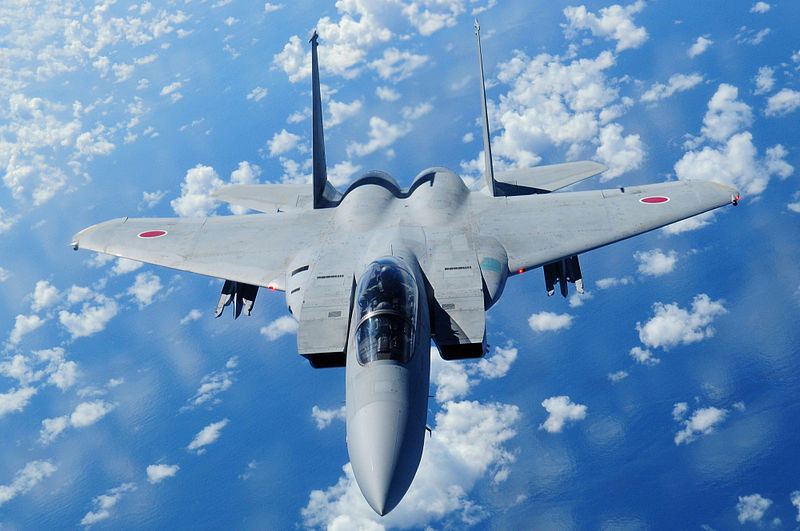
F-15J Eagle (by Mitsubishi):


Well, what are you going to do now, Mr. Abe? Anything? There is absolutely no point in ramping up the rhetoric when there's no action.

(Oh I forgot. He's not reality-based. He just loves to play a tank commander in Makuhari Messe.)