Wednesday, May 18, 2011

TEPCO's New Roadmap to .... Anywhere?

TEPCO announced the new and revised "roadmap" on May 17. Come what may (total core meltdown in 3 reactors? no problem), TEPCO still plans to wind down the accident in 6 to 9 months. They look pretty with color-coded progress indicators, graphics and photos. Prime Minister Kan must be pleased.

"Progress Status":
http://www.tepco.co.jp/en/press/corp-com/release/betu11_e/images/110517e2.pdf

"Current Status of Roadmap":
http://www.tepco.co.jp/en/press/corp-com/release/betu11_e/images/110517e3.pdf

"Progress Status of Countermeasures":
http://www.tepco.co.jp/en/press/corp-com/release/betu11_e/images/110517e4.pdf

"Progress Status of Roadmap":
http://www.tepco.co.jp/en/press/corp-com/release/betu11_e/images/110517e5.pdf

#Fukushima I Nuke Plant Reactor 2 Reactor Bldg Photos

TEPCO released the photos of the inside of the Reactor 2 reactor building. The photos were taken on May 18, when 4 TEPCO employees entered the building with tungsten vests on.

The photos are taken on the 1st floor of the reactor building.


OT: Going Offline Again....and Hamaoka Plant Layout

Still moving. It's a protracted process... (Sigh). Have to test the DSL modem at the new place, but I'm sure Murphy will be there waiting.

For your entertainment while I'm gone, here's the plant layout and geological map for Hamaoka Nuclear Power Plant. Anything wrong with it? Green boxes are reactor buildings, blue boxes are turbine buildings. Both images are from http://onodekita.sblo.jp/article/45215822.html (in Japanese):


For comparison, here's Fukushima I's layout:

Schools in #Fukushima Don't Know What to Do with the School Swimming Pools

Public schools in Fukushima Prefecture say they are frustrated that there is no direction from the national government as to what to do with the school swimming pools. "Can we have swimming classes? Is it safe to drain water? Just tell us what to do!"

What is surprising to me is that they were even thinking about using the swimming pool.

From Asahi Shinbun (5/18/2011):

 福島県内全13市の教育長でつくる「福島県都市教育長協議会」は18日、同県郡山市で定期総会を開き、13市の公立小中学校約500校で今夏、プールを使った授業を実施しない方針を示した。

The Council of School Administrators in Cities in Fukushima Prefecture, made up of school superintendents in all 13 cities in Fukushima Prefecture indicated in its May 18 regular general general that classes using the swimming pools at the cities' 500 elementary schools and middle schools won't be held this summer.

 協議会では、いわき市が「たまっているプールの水を排水すると放射性物質を含んだ水が農業用水に流れてしまう」と報告。水の処理方法が国から示されないという不満が相次いだ。

During the general meeting, Iwaki City reported, "If the pool water is drained, the radioactive water will flow into the water for agriculture." Many cities were frustrated that there is no national guidelines for disposing the [radioactive] water in the pools.

 また、プールを使用できる放射線量についても、国から基準値の提示がないといい、伊達市は「国の基準が分からず、判断できない。保護者の理解が得られない」とプール使用に消極的な意見を述べた。

They were also frustrated that there is no radiation level set by the national government to allow the use of the pool. Date City said "Since we don't know the national standard, we can't judge. We can't persuade the parents without such standard," indicating it is not too eager to allow the use of the swimming pools.

In other words, if there's a word from the national government that it is safe to use the swimming pool if the radiation level is, say 3.8 microsieverts/hour (just like the use of the school yards), these school administrators may be just as happy to let the children swim in the pools, and have them clean the pools like they do every year.

As Professor Takeda said so eloquently the other day, these school administrators should resign immediately. They are not fit for being involved in any way in educating children.

Arsenic-76 Radioisotope from #Hamaoka Nuke Plant Reactor 5 Exhaust Duct

Hamaoka Nuclear Power Plant in Shizuoka Prefecture, where the sea water got mixed up in the Reactor 5's RPV (reactor pressure vessel) as the reactor was being shut down, had radioactive arsenic (As-76) released from the exhaust duct of the Reactor 5 ancillary building.

Checking wiki on arsenic isotopes:

Although arsenic (As) has multiple isotopes, only one of these isotopes, 75As, is stable; as such, it is considered a monoisotopic element. Arsenic has been proposed as a "salting" material for nuclear weapons (cobalt is another, better-known salting material). A jacket of 75As, irradiated by the intense high-energy neutron flux from an exploding thermonuclear weapon, would transmute into the radioactive isotope 76As with a half-life of 1.0778 days and produce approximately 1.13 MeV of gamma radiation, significantly increasing the radioactivity of the weapon's fallout for several hours.[citation needed] Such a weapon is not known to have ever been built, tested, or used. Standard atomic mass: 74.92160(2) u.


That's cheerful...

There are so much information of the "incidents" that have occurred at this particular plant I don't know where to start. For now, suffice to say that this was the plant that Godzilla attacked in the 1984 movie ("Godzilla", series No.16); Godzilla must have had a very good reason.

From Yomiuri Shinbun (9:14PM JST 5/18/2011):

中部電力は18日、運転停止作業中に冷却水に海水が混入するトラブルが起きた浜岡原子力発電所(静岡県御前崎市)5号機に隣接した補助建屋の排気ダクトの出口で、ごく微量の放射性核種「ヒ素76」を検出したことを明らかにした。

Chubu Electric announced on May 18 that a minute amount of arsenic-76, radionuclide, was detected at the exhaust duct of the ancillary building to the Reactor 5 reactor building at Hamaoka Nuclear Power Plant, where the sea water got mixed up in the reactor coolant while the reactor was being shut down.

 周辺環境への影響はないという。

The company says there is no ill effect on the environment.

 同社は、トラブルの影響で、海水中に存在する「ヒ素75」が原子炉内で放射化したものとみている。

The company thinks arsenic-75 present in the seawater turned radioactive inside the reactor.

 また、同社は同日、トラブルの原因調査に向けた点検作業に着手した。混入が確認された「主復水器」内部の水抜きを行った後、混入経路や原因を調べるという。

The company started the investigation as to why the sea water entered the reactor. They will drain the water from the main condenser to find out where the sea water came from and why.

 同社によると、14日午後、原子炉を冷やす「冷温停止」状態への移行作業中に海水約400トンが混入するトラブルが発生。放射性物質の外部への漏えいはなかった。

On the afternoon of May 14, as the Reactor 5 was being shut down, about 400 tons of sea water entered the reactor [other news says it was 500 tons]. There was no release of radioactive materials in the environment from the incident.

Tuesday, May 17, 2011

#Fukushima I Nuke Plant: Workers Enter Reactor 2 Bldg in Tungsten Vest

It is the first time the workers enter the reactor building since March 15 when there was an explosion in the Suppression Chamber.

According to Mainichi Shinbun (11:13AM JST 5/18/2011), 4 workers entered the reactor building of the Reactor 2 at 9:30AM to survey the interior of the building to prepare for the equipment calibration and installation of the cooling system. The workers will also go to the 2nd floor of the reactor building. The workers wear a "tungsten vest" to prevent external radiation exposure. They also carry oxygen tanks on them.

Never heard of a tungsten vest...

#Radioactive Dandelion and Horsetail

From the blog of Professor Bin Mori of Tokyo University Graduate School of Agricultural and Life Sciences:

Autoradiograph of Equisetum arvense (Horsetail; young shoots are edible), picked on May 3, left; autoradiograph of dandelion leaves, right:


Professor Mori says the pictures show that radioactive materials have been absorbed from the roots and distributed throughout the plants. He thinks the dark dots on the dandelion leaves are the radioactive materials landed on the leaves.

Professor doesn't recommend tempura made out of these spring delicacies.

Geiger Counters, Dosimeters from US, France, Canada Still Sit in Narita Warehouse

40,000 units of Geiger counters and dosimeters donated by the United States, France, and Canada after the Fukushima I Nuke Plant accident still sit in a warehouse at Narita International Airport, according to a Japanese blogger (yougen).

The blogger says in his/her post (in Japanese) these Geiger counters and dosimeters are under the jurisdiction of the Nuclear and Industrial Safety Agency. Donations from foreign countries are handled by the Ministry of Foreign Affairs.

Distributing the Geiger counters and dosimeters to the plant workers is done by the Ministry of Health and Welfare.

Distributing the Geiger counters and dosimeters to civilians is done by the Nuclear and Industrial Safety Agency under the Ministry of Economy, Trade and Industry.

This blogger attacks a Representative from Japan Communist Party because the Representative asked the Ministry of Health and Welfare why the Ministry hadn't distributed the donated Geiger counters and dosimeters to the residents in Fukushima. According to the blogger, this Representative is totally out of the line for asking the "wrong" ministry - it is METI's NISA in charge of civilians! How dare she asks such a stupid question!

I thought that was very strange, but the main point of his/her post is that the donated radiation measurement devices still sit in a warehouse.

Beside the Geiger counters and dosimeters, mountains of ramen noodles, water bottles, sneakers, blankets, underwear, socks, canned food, rice, mattresses, soap may be sitting at official distribution centers. Never mind that there are still many, many people living in shelters with scant food and water. Bureaucrats do what they gotta do, and that is to do what they are told to do by the book and nothing else.

Hiroaki Koide of Kyoto University: "Melted Core Outside the Containment Vessel"

Hiroaki Koide of Kyoto University Research Reactor Institute is quoted by Mainichi Shinbun as saying that the melted core of the Reactor 1 is not just out of the Reactor Pressure Vessel but out of the Containment Vessel.

From Mainichi Shinbun, Koide's comments only (5/16/2011):

小出裕章・京都大原子炉実験所助教は「電源喪失で原子炉が冷やせなくなれば、早い時期に炉心溶融に至ることは想定できていたはずだ。燃料の損傷が限定的だとしてきた東電の説明は完全に誤っていたことになる。データの公表も遅すぎる」と指摘する。

Hiroaki Koide of Kyoto University Research Reactor Institute points out that "[TEPCO] could have foreseen the core melt at an early stage when the cooling of the reactor stopped due to the power failure. TEPCO's assessment that the damage to the fuel was limited has turned out to be completely wrong. The disclosure of the data came too late."

 東電は今回の解析で「圧力容器の損傷は大規模ではない」と説明するが、小出助教は「圧力容器は完全に破損し、溶けた燃料が格納容器の底に穴を開け、原子炉建屋の地下に大量の汚染水が漏れ出す原因になっている」と推定する。

According to TEPCO, the data analysis shows that damage to the RPV is not extensive. However, Koide thinks "The RPV has been completely damaged, the melted core bore a hole at the bottom of the Containment Vessel, causing the large amount of contaminated water to leak into the ground beneath the reactor building."

Monday, May 16, 2011

#Fukushima I Nuke Plant: Ground May Have Shifted So Much That It May Have Caused Damage to Foundation (Guest Post)

Arnie Gundersen of Fairewinds Associates mentioned in the latest video, in passing, toward the end, that Fukushima I Nuke Plant has sunk about a foot (about 30 centimeters) and that the foundation of the buildings must have been damaged.

One of the readers of my Japanese blog that has the Japanese translation of the video got curious and did some research using the data from the government agency (the Geospatial Information Authority of Japan), and came to a conclusion that the area where the plant sits may indeed have moved quite a bit, not just vertically but also horizontally.

His conclusion:

Vertical: - 50 centimeters (it sank 50 centimeters)
Horizontal: 220 to 250 centimeters to the east.

The following is the findings of Dr. Shunichi Ono, a medical doctor in Kumamoto Prefecture in Kyushu, from his blog (original in Japanese; my translation). [My notes in square brackets]

(Dr. Ono's post begins)------------------------------------

[After mentioning Arnie Gundersen's comment about Fukushima I having sunk a foot]

If it is true, it's a big story. Large-scale land subsidence have already been reported in Iwate and Miyagi.

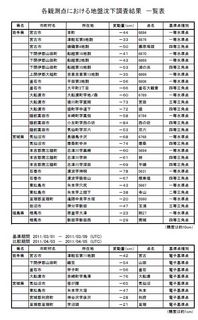
So I searched the Geospatial Information Authority of Japan (GSI) site, and found the following information (in Japanese). [It is a list of cities and towns in Iwate, Miyagi, and Fukushima and the size of the land subsidence in each.]

http://www.gsi.go.jp/common/000060316.pdf
2011051601.jpg

Overall, the land subsidence is between 20 to 80 centimeters.

The southern-most city on this list is Minami-Soma City in Fukushima Prefecture, located 20 kilometers north of the Fukushima I Plant. The land subsidence is 30 centimeters.

What about further south?

So I contacted the GSI and asked. Their answer was:

  • The results of measurement south of Minami-Soma City will be compiled by the end of this year;

  • There are electronic points of reference, and these results have already been made public.

http://www.gsi.go.jp/chibankansi/chikakukansi40005.html

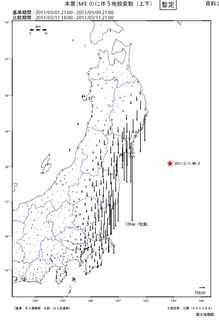
Horizontal movement:
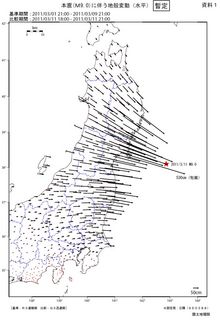
2011051603.jpg

Vertical movement:

2011051602.jpg

Map that plots the levels of movement [当変動量線図I do not know the official terminology], horizontal, Fukushima Prefecture
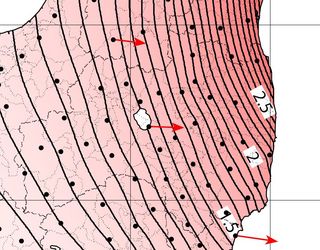
2011051604.jpg

Map that plots the levels of movement, vertical, Fukushima Prefecture
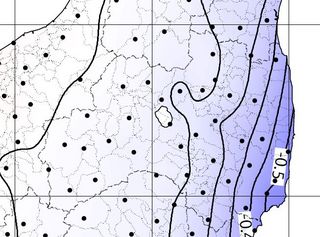
2011051605.jpg


Fukushima I Nuclear Power plant is located about halfway along the Fukushima coastline. Checking the maps above, the ground underneath the plant may have moved:

Horizontal: 2 meters and 20 centimeters to the east;
Vertical: -40 centimeters (it sank)

(Update) Here's the map of Fukushima Prefecture.


Fukushima I Nuclear Power Plant is Located in Futaba-machi and Okuma-machi [red circle].

Fukushima II Nuclear Power Plant is located in Tomioka-machi and Naraha-machi [blue circle].

Again, looking at the maps above that shows the levels of movement,

Land subsidence at both plants: more than 50 centimeters;
Horizontal movement: between 220 to 250 centimeters (possibly distorting the ground).

These maps were created by the GSI; they are accurate, with the measurement error of 10 centimeters [for non-electronic points of reference].
 
If the ground shifted this much, I wonder if the foundation of the Fukushima Nuclear Power Plant has indeed sustained some grave damage.

The current seismic safety evaluation only uses ground motion acceleration (Gal, in cm/s^2):

mass * acceleration = force

and the evaluation is whether the structure can withstand this force.

This earthquake clearly brought about the distortion of the ground. Seismic safety evaluation should include the effect of land subsidence and horizontal movement. Needless to say, land subsidence and horizontal movement don't occur uniformly within the same plant compound.

Is it even possible to build a structure that wouldn't be affected by an earthquake that distorts the ground?

I suspect it is a given that the ground would not shift.

I think this is a serious problem.

(end of the post)----------------------------

Dr. Ono's bio says he once worked for TEPCO, before he quit and enrolled in a medical school. In his latest post (in Japanese), he diagnoses Japan's PM Kan and Nuclear Safety Commission chief Madarame as suffering dementia, based on their remarks about the state of the Fukushima I reactors.

The Geospatial Information Authority of Japan has an interactive map that shows the ground movements (vertical and horizontal). It's in Japanese only. Click on a red dot (point of reference), and you can see how much movement that point has experienced.

US NRC to Stop 24-Hour Fukushima Watch, "Situation Stable and Improving"

Just when TEPCO and the Japanese government are coming clean of what they knew all along - that it was a core meltdown in all three reactors at Fukushima, the US Nuclear Regulatory Commission announced that it will stop monitoring Fukushima on the 24-hour/day basis because the situation is now "stable" and continues to "improve".

Uh huh.

The NRC must have known all along about the core meltdown, if what they claimed was true, that they had access to all the information that TEPCO had.

From NY Times (5/16/2011):

The United States Nuclear Regulatory Commission said on Monday that its 24-hour operations center had stopped monitoring the nuclear reactors at the Fukushima Daiichi plant because the situation there had improved. “The conditions at the Japanese reactors are slowly stabilizing,” said William Borchardt, the agency’s chief staff official. “As conditions have continued to improve and the Japanese continue to implement their recovery plan, the N.R.C. has determined that it is time to adjust our response,” he said. The agency still has a team of engineers in Tokyo, he said. Mr. Borchardt said last week that the condition of the reactors was “static but not stable.”

Air Radiation Level In Tokyo, Unofficial Version

As this blog has reported both in English and Japanese, the official number for the air radiation level in Tokyo is measured at only one location in Shinjuku, on top of the building about 18 meters from the ground.

However, there are many unofficial numbers, i.e. measured by concerned citizens and residents at the level where most people live and work - 1 meter above the ground.

Here is a Japanese site, "Environmental radiation monitoring by volunteers who are engaged in radiation and nuclear science". The site name says it all.

Looking at the numbers in different locations in Tokyo (PDF file for download), the radiation level varies significantly. To measure only at the Shinjuku location and tell the residents in Tokyo that the radiation level in Tokyo is back to normal range is highly misleading.

Here's some numbers from the "Environmental radiation monitoring" latest PDF file that exceed the "official" number (0.0629 microgray/hour, or microsievert/hour, 5/17/11)

Nishi-Shinjuku, Shinjuku-ku: 0.124 microsievert/hour, 100 cm above the side walk, 5/10/11

Kyobashi, Chuo-ku: 0.071 microsievert/hour, 100 cm above concrete, 5/10/11

Hongo, Bunkyo-ku: 0.14 microsievert/hour, 100 cm above asphalt, 5/10/11

Kanamachi, Katsushika-ku: 0.359 microsievert/hour, 100 cm above sand, 5/10/11

Shimo-Shakujii, Nerima-ku: 0.074 microsievert/hour, 100 cm above dirt, 5/6/11

Yoyogi, Shibuya-ku: 0.114 microsievert/hour, 100 cm above asphalt, 5/10/11

Nihonbashi Nakasu, Chuo-ku: 0.111 microsievert/hour, 100 cm above asphalt, 5/10/11

Kitano-maru Park, Chiyoda-ku: 0.085 microsievert/hour, 100 cm above dirt, 5/10/11

Fuchu City: 0.091 microsievert/hour, 100 cm above asphalt, 5/10/11


The number in Kanamachi, 0.359 microsievert/hour, would translate to more than 3 millisieverts per year. (8.61 microsieverts per day x 365 = 3.142 millisieverts per year)

Asahi Shinbun: Core Meltdown in Reactors 2 and 3 at #Fukushima

Fun to see the spin by one of the MSM in Japan. Now they are all saying core meltdown, complete core meltdown, we knew from the beginning, we knew in March. It's hysterically comical.

Particularly hilarious is Haruki Madarame, who now basically says "we knew that", while he was the one who told the PM on March 12, "Don't worry, the nuclear reactor doesn't break."

Yes, there were nuclear experts and independent journalists in Japan and around the world who said it was a meltdown, and they were attacked by the government and the MSM like Asahi as "fear-mongering". I thought so too, after reading the entries on wiki on Three Mile Island, Chernobyl, and corium, among others.

But it isn't true until the official, government-approved sources say so, and it is now, after more than 2 months: complete core meltdown in all three operating Reactors at Fukushima I.

What's next? Recriticality, maybe, announced in two months or so?

Quick and dirty translation, subject to later revision.

Asahi Shinbun (3:01AM JST 5/17/2011):

東京電力福島第一原子力発電所の2、3号機でも炉心溶融が起こり、原子炉圧力容器の底に燃料が崩れ落ちるメルトダウンが起きていたとみられること が、16日に東電が公表したデータで裏付けられた。3号機では溶けた核燃料がさらに下の格納容器内に落ちた恐れもある。専門家は事故直後から指摘してお り、細野豪志首相補佐官も16日の会見で2、3号機でのメルトダウンの可能性を示唆した。

The data disclosed by TEPCO on May 16 shows that core meltdown may have occurred in the Reactors 2 and 3 at Fukushima I Nuclear Power Plant. In the Reactor 3, the melted fuel may have dropped to the Containment Vessel. Nuclear experts have pointed to the possibility [of meltdown in the Reactors 2 and 3] and Prime Minister's Assistant Goshi Hosono hinted at the possibility in the May 16 press conference.

 東電が4月17日に示した工程表は、6~9カ月で原子炉を安定した状態で停止させるとした。1号機に続き2、3号機でもメルトダウンの可能性が出てきた ことにより、工程表の大幅な見直しは必至だ。炉心を冷やすシステムづくりに時間がかかり、高濃度の放射能汚染水の処理も膨大になるからだ。

According to TEPCO's "roadmap" on April 17, it was going to take between 6 to 9 months to shut down the reactors. The revision of the "roadmap" will be inevitable now that both Reactor 2 and Reactor 3 may have had a meltdown, as it will take more time to build a cooling system for the reactor core, and the massive amount of highly contaminated water will need to be processed.

 今回公表された地震直後のデータは原発内の中央制御室にあり、電源復旧に時間がかかったことや、記録紙に放射性物質が付着しているため整理に時間がか かっていた。公表されたのは、記録紙に打ち出されたグラフや当直長がつける運転日誌などで、大型ファイル4冊分にあたる。

The data disclosed on May 16 was the data right after the earthquake on March 11. It took TEPCO some time to retrieve the data from the central control room of the plant because of the long period of power outage and the radioactive materials on the recorded printout. The data in 4 large binders includes graphs on the printout and operation diaries kept for each shift.

 データによると、圧力容器内の圧力が、2号機は3月15日午後6時43分に、3号機は3月16日午後11時50分に、それぞれ下がった。圧力容器の密閉性が損なわれ、圧力が抜けたとみられている。

According to the data, the pressure inside the Reactor 2 RPV (Reactor Pressure Vessel) dropped at 6:43PM on March 15 (JST), and the pressure inside Reactor 3 RPV dropped at 11:50PM on March 16. The integrity of the RPVs were compromised, it is thought, and the pressure went down.

 圧力容器の底には制御棒や計測機器を外から通すための数多くの貫通部がある。メルトダウンした核燃料が圧力容器の底にたまり、その熱の影響で機器が溶け るなどした結果とみられる。3号機内の汚染水からは、原子炉内の核燃料が損傷して出るテクネチウムなどの放射性物質も確認されていることから、溶けた燃料 がさらに圧力容器から格納容器内に落ちた可能性もある。

There are many channels that go through the bottom of the RPV [16 centimeters thick] to insert control rods and measurement devices. The melted fuel went down to the bottom of the RPV, and may have melted the devices at the bottom. The contaminated water from the Reactor 3 has been found to contain the radioactive materials like technetium that are produced when the nuclear fuel gets damaged, indicating that the melted fuel may have dropped from the RPV into the Containment Vessel.

 東電は会見で「プラント全体の事象を追いかけられておらず、評価できていない」と明確な判断を示さなかった。

In the press conference, TEPCO refrained from saying anything definite. "We haven't fully grasped the situation at the plant, and we haven't been able to evaluate it."

 一方、細野氏は会見で炉心に水が入らなかった時間について「1号機は14時間9分、2号機は6時間29分、3号機は6時間43分と短くない」とし「炉心の完全な溶融(メルトダウン)の可能性をみておかないといけない」と話した。

PM Assistant Hosono said that there was no water being poured into the Reactor 1 for 14 hours and 9 minutes, Reactor 2 for 6 hours and 29 minutes, and Reactor 3 for 6 hours and 43 minutes. He said "We should be prepared for the possibility of the complete meltdown of the reactor core."

 また原子力安全委員会の班目(まだらめ)春樹委員長は16日の定例会後の会見で「3月下旬に2号機で高濃度汚染水が発見された時点で、メルトダウンして いたという認識があり、助言した。1号機と3号機も、事故の経緯を考えると同じことが起こっているとの認識を持っていた」と語った。

Haruki Madarame, chief commissioner of the Nuclear Safety Agency spoke after the regular meeting of NSA on May 16. "When the highly contaminated water was found coming from the Reactor 2 in late March, we recognized that the reactor had had a meltdown, and advised [the government]. We also knew that the Reactor 1 and 3 had the same situation, looking at how the accident unfolded."

 東電によると、機器の記録から、運転中だった1~3号機は地震によっていずれも自動停止。配管の破断などの兆候はみられないとしている。非常用ディーゼ ル発電機も正常に起動していたという。東電はこれらの記録や地震計のデータをもとに、地震直後は機器が正常に作動し、津波到達までは大きな損傷はなかった とみている。(中村浩彦、佐々木英輔)

According to TEPCO, based on the records, the Reactors 1, 2 and 3 stopped automatically after the quake, and there was no sign of any physical damage to the reactor. Emergency diesel power generators were working. TEPCO concluded that all the equipments were working normally after the quake and there was no major damage to the plant until the tsunami hit.

Well, this last bit is highly questionable. Other reports say that the emergency core cooling system stopped working even before the tsunami hit, and that a very high level of radiation was detected at the reactor building of Reactor 1 on the night of March 11, too high unless the RPV and the Containment Vessel were breached by the earthquake, not by tsunami. (On these, later.)

Asahi Shinbun: #Fukushima Reactors 2, 3 Also Had Core Meltdown

Oh what a surprise.

Asahi Shinbun, one of the MSM in Japan, says in the article published at 3:01AM JST 5/17/2011 that core meltdown may have occurred in the Reactors 2 and 3 at Fukushima I Nuclear Power Plant, according to the data that TEPCO disclosed on May 16.

That data is here, as I posted in my previous post.

Translating Asahi's article right now, and will post ASAP.

Posted.

#Fukushima I Nuke Plant: TEPCO Just Dumped the Plant Data on the Day of the Earthquake

Very smart of TEPCO and its overseer (NISA) to do it now, after so much radioactive materials have been released and spread in the air, the soil, the ground water, and the ocean. (Remember that it was a Level 7, and that's just by counting the airborne radioactive materials.)

It is like TEPCO and the Japanese government saying "Well it happened, and nothing we can do about it now. So here's the data, if you want."

Let's see if any nuclear researchers in Japan, whether they are paid by the government or not, steps up and explain the data for the rest of us. They've been awfully quiet, except for a few vocal critics like Chubu University's Takeda and Kyoto University's Koide, and even they don't share their analysis of TEPCO's data very much with the lay people.

In Japanese only for now (English link goes to this Japanese page):

Sunday, May 15, 2011

(UPDATED) TEPCO's Analysis of Reactor 1 Core Meltdown

From their press release, their English.

It's in "secure" mode, and I can't even do the screen capture. Take a look at page 3 and page 4.

The temperature reached the core melting temperature in about 4 hours, when the water level dropped to the bottom of the fuel. From there, nothing could stop the melt, all of it.

OK, here we go. (h/t Hope, culture of insanity)

Page 3:


Page 4:

OT: I have to go offline for a while

We're in the middle of moving, and we're doing the moving by ourselves. The Internet connection has to be tested at the new place, and I'll have to go offline.

Watch out the news for me for a few hours (I hope).

I'm removing the comment moderation in the meantime, so you can post anything you want in the comment section.

#Fukushima I Reactor 3: TEPCO Pouring Boric Acid to Prevent Recriticality

Yomiuri Shinbun (10:02PM JST 5/15/2011):

 東京電力は15日、福島第一原子力発電所3号機の原子炉で再臨界が起きないよう、原子炉の冷却水に、中性子線を吸収するホウ酸を溶かした上で、同日から原子炉への注水を始めたと発表した。

TEPCO announced on May 15 that it started to use boric acid in the reactor cooling water for the Reactor 3 at Fukushima I Nuclear Power Plant to prevent recriticality from happening. Boric acid absorbs neutrons.

 1、2号機も今後、同じ措置を取る。

TEPCO plans to do the same for the Reactors 1 and 2.

 再臨界は連続的な核分裂が再び起こる現象。1~3号機の原子炉圧力容器には当初、冷却のために海水を注入した経緯があり、東電はその塩分が中性子 線を吸収すると見ていた。ホウ酸を冷却水に溶かすのは、冷却水を海水から淡水に替えて以降、塩分濃度が下がっていると見られるためだ。

Recriticality is when the nuclear chain reaction is restarted. There is salt in the Reactor Pressure Vessels of the Reactors 1, 2 and 3, as TEPCO initially poured seawater to cool the RPVs. TEPCO thought the salt would absorb neutrons. TEPCO has decided to use boric acid in the cooling water because the level of salt in the cooling water may have decreased since TEPCO switched the cooling water from seawater to regular water.

 一方、3号機の圧力容器は、上端部の温度が急上昇している。東電は「注水用配管から水が漏れている可能性がある」として、12日からは別の配管を 追加し、二つの配管で毎時計12トンを注水した。14日からは注水量を毎時計15トンに増やしたが、上端部の温度は15日午前5時までの24時間で46・ 5度上昇し、297度になった。東電は、「注水がまだうまくいっていない」と見ている。

In the meantime, the temperature at the top of the Reactor 3 RPV has risen rapidly. TEPCO increased the amount of cooling water to 12 tons per hour on May 12 using two water feeding systems, then to 15 tons per hour on May 14. However, the temperature at the top of the RPV increased by 46.5 degrees Celsius in 24 hours to 297 degrees Celsius as of 5:00AM on May 15. TEPCO thinks there's a problem with the pipes that feed water into the RPV.

In the latest measurement data (11:00AM 5/15) released by the Ministry of Economy, Trade and Industry (METI) , that temperature (the 4th column) appears to have dropped slightly to 291.7 degrees Celsius, although the data table is put up sideways and it is a bad scan and hard to see. The second digit could be 9, 8, or 3. An age-old trick by bureaucrats to discourage people from seeing the data... (My neck is hurting from trying to read the number.)

TEPCO Stating the Obvious After 2 Month: Reactor 1 Meltdown Occurred Within 16 Hours of March 11 Earthquake

"Almost of all the fuel rods melted and dropped to the bottom of the pressure vessel by 6:50 am on March 12th." (NHK WORLD news)

NHK WORLD, whose outlandish report that there was a 300 millisievert/hr debris on a nearby mountainside is still uncorrected, says that TEPCO has disclosed the Reactor 1 meltdown occurred within 16 hours of the March 11 earthquake:

Tokyo Electric Power Company, the operator of the Fukushima Daiichi nuclear power plant, says most of the fuel rods in the No.1 reactor had dropped to the bottom of the pressure vessel within 16 hours of the earthquake on March 11th.

The utility revealed its study on the subject on Sunday.

TEPCO said it analyzed the data and calculated a timeline for the developments in the No. 1 reactor on the assumption that the reactor lost its cooling system as soon as it was hit by the tsunami.

The firm said that within about 3 hours after the reactor automatically shut down, the cooling water had evaporated to a level at the top of the rods.

In the next hour and a half, parts of the fuel rods are believed to have begun melting.

The temperature of the fuel rods is believed to have reached 2,800 degrees Celsius at this stage, and the meltdown advanced rapidly.

Almost of all the fuel rods melted and dropped to the bottom of the pressure vessel by 6:50 am on March 12th.

TEPCO said the temperature dropped after water was poured into the reactor starting at 5:50 am on the same day.

The firm says the melted rods created small holes on the bottom of the vessel, but that no major problems are developing there. It believes that the amount of radioactive substances that could spread from the reactor will be limited.

Sunday, May 15, 2011 23:29 +0900 (JST)

For people who can read the Wikipedia entry on "Corium", it's abundantly clear what happens once the water is no longer cooling the fuel rods:

During the Three Mile Island accident, slow partial meltdown of the reactor core occurred. About 19,000 kg of material melted and relocated during about 2 minutes, about 224 minutes after the reactor scram.

In the case of Chernobyl:

The first phase lasted only several seconds, with temperatures locally exceeding 2600 °C, when a zirconium-uranium-oxide melt formed from no more than 30% of the core.

Arnie Gundersen: 1 Step Forward, 4 Steps Backward at #Fukushima

Arnie Gundersen of Fairewinds Associates says:

  • Reactor 1's fuel melted and probably dropped to the Containment Vessel;

  • Reactor 2 is leaking like a sieve;

  • Reactor 3 may have another hydrogen explosion;

  • The plant has sunk about a foot, and the concrete foundation may have cracked.

So what was the "step forward"? That TEPCO was able to enter the Reactor 1 reactor building to install equipments to measure the true water levels.

He also refers to the ramification on the US nuclear regulations now that it has been proven possible for a Containment Vessel to get damaged. The Containment Vessels for the Reactors 1, 2 and 3 at Fukushima are all officially acknowledged to have been damaged.

Toward the end, he mentions a high school in the contaminated area 50-60 kilometers from the plant. He says it is unconscionable to keep the school open.

Fukushima - One Step Forward and Four Steps Back as Each Unit Challenged by New Problems from Fairewinds Associates on Vimeo